







Abstract
This article describes the use of energy dialogue technique (EDT), a healing intervention that provides awareness of imbalances in the energetic field that affect patients’ health and guide the practitioner to sense and direct the frequency, vibration, intention, awareness, or consciousness to correct these imbalances. The authors document the effectiveness of this technique as it was used to treat side effects of the medical intervention for hepatitis C in a male with hemophilia. Following EDT, the client’s symptoms of fatigue and pain improved by 30% to 40%; moreover, thyroid function returned to normal. The authors suggest that EDT be studied and explored for inclusion as a treatment modality.
Hepatitis C virus (HCV) is the most prevalent blood-borne infection in the United States, commonly leading to liver disease. Fatigue, pain, and thyroid dysfunction are some of the common side effects that present in patients taking Pegylated interferon and Ribavirin (PI&R) treatment for HCV. Stress from infection, inflammation, and disease, as well as psychological distress, can result in symptoms similar to those generated by these treatments (Tsatsoulis, 2006).
Some 60% of the population with HCV respond to PI&R, which eliminates the presence of HCV (Shindo, Arai, & Okuno, 1997, 1999). However 20% of those infected develop thyroid dysfunction and require thyroid medication to stabilize. It may take up to 6 months after completion of the medical treatment to normalize the side effects of PI&R. The case presented in this report represents a typical hemophilia patient with hepatitis C infection undergoing medical treatment. However, when energy dialogue technique (EDT) was used in conjunction with the medical treatment, the patient’s pain and fatigue were reduced, thyroid dysfunction was normalized, psychological distress appeared lower, and recovery period was shortened.
The EDT described in this case study is a product of the efforts of five health professionals who have been students of various holistic, mind–body, and energetic therapies for over 25 years. Our group comprises a nurse practitioner, physical therapist, speech therapist, and two occupational therapists. Our collective studies beyond our profession include Craniosacral Therapy (Zhang, 1995), Integrative Manual Therapy (Giammatteo & Wieselfish-Giammatteo, 1997), Applied Kinesiology (Savva, 1997; Tsatsoulis, 2006), Mindfulness Meditation (Davidson et al., 2003; Kabat-Zinn & Burney, 1981), and Osteopathic Manipulation, as well as multiple manual and energetic diagnostic and therapeutic interventions. The EDT is an intervention that can be used in any healing setting by diverse practitioners.
The EDT intervention that we developed, which is described in Appendix A, is based on several key ideas: that disturbances in the biofield or energetic environment affect wellness, that it is possible to alter those disturbances energetically, and that the practitioner interfaces with the patient’s energetic field. (Please see Appendix A for details.)
EDT begins with internal stillness in which one’s mind is quiet. The effectiveness of a quiet mind, as achieved through many meditation techniques, has been well documented in reversing the metabolic effects of stress (Grossman, Niemann, Schmidt, & Walach, 2004), reducing pain (Astin, 2004), improving cognitive ability (Benson et al., 2000), reducing depression (Kabat-Zinn et al., 1992), and facilitating neuroplasticity (Davidson et al., 2003).
A quiet mind provides a state of heightened awareness and the ability to sense and experience subtle energies (Dale, 2009) that pulse and permeate throughout a person’s energetic field. The subtle energy fields are part of the energetic makeup of the biofield.
Laboratory studies have shown the ability of thought and intention to effect physical change. These studies have documented the ability of meditative thought to effect change on the pH of water (Tiller, Dibble, Shealy, & Nunley 2004), propagation of fruit flies (Tiller, 1993), permeability of red blood cells (Tiller, Kohane, & Dibble, 2000), and crystal formation of water (Radin, Hayssen, Emoto, & Kizu, 2006). Clinical studies demonstrate that positive thought increases the level of immune antibody S-IgA (secretory immunoglobulin A) and the production of the hormone DHEA (dehydoepiandosterone), found to be a factor in medical problems such as sleep disorder, diabetes, chronic fatigue, high cholesterol, and depression (McCraty, Atkinson, & Tomasino, 2001).
EDT utilizes communication between a person and his or her inner self that gives access to the wisdom of the biofield. Based on many years of clinical experience, the practitioners/authors view the biofield as a huge field transmitting information between all life forces. To best navigate the ocean of information, the practitioner dialogues with the inner self to serve as a guide to access information from the biofield.
Energy Dialogue Technique as a Healing Intervention
The National Institute of Health in 1994 recognized this energy field as the biofield and defined it as the “endogenous, complex dynamic electromagnetic field . . . proposed to be involved in self-organization and bio-regulation of the organism” (Rubik, 2002, p. 709). Eastern philosophies theorize that the subtle bodies of the human being beyond the physical body involve realms of mind, soul, and spirit. They posit that a full scientific model of the human being may require elements that go beyond space–time and matter–energy and require multidimensional geometry (Rubik, 2002). Biofield theory (Jonas, 2004) expands this model of healing to include the flow of energy among quantum, potential, and electromagnetic layers. Disease is manifested with impeded flow; intention can focus biophysical energy and create healing conditions (Sicher & Targ, 1998; Harris et al, 1999). In contrast to conventional biology, which offers a reductionist analytic perspective based on molecules and structure, the biofield model posits a broader concept with its field interactions and flow of information in relation to the environment. The biofield is the mechanism through which Energy Medicine operates. Energy Medicine includes biofield therapies such as Reiki, Therapeutic Touch, external qi healing, and other subtle energy interactions, as well as homeopathy, acupuncture, magnet therapy, and bio-electromagnetic therapy (Rubik, 2002)
Dr. Valerie Hunt, working with NASA to measure the energetic fields radiating off of the body, found that imbalances in these fields predict dysfunction in the body (Hunt, 1989). Kirlian photography documents the presence of the energetic field through visual demonstration of an electrical corona. The coronal discharge patterns provide diagnostic information pertaining to the presence of cancer, cystic fibrosis, and other diseases (Gerber, 2001). Dr. Harold Burr, in the 1930s, identified and measured energy fields surrounding organisms from mold to plants to frogs and humans. He was able to distinguish electrical patterns that corresponded with health and illness (Gerber, 2001).
A variety of energy healing therapies are based on the awareness that questions thought by a practitioner elicit a perceptible response. This response reflects information accessed from the wisdom of the body, soul, or unconscious, all of which are part of a complex multilevel of information transmission that takes place in the biofield (Rosch, 2009; Rubik, 2002). Dr. John Upledger, the founder of Craniosacral Therapy, describes dialogue with “the inner physician,” or inner knowing of an individual. He found that tissue rhythm or motility responds to questions or communications offered by the practitioner (Upledger, 2003). Applied Kinesiology utilizes a unique feedback system of muscle testing to interpret the body’s special “body language.” The body can “talk” simply by changing the response of the muscle test when asked specific questions. Ask the body specific questions and you can get answers to growing health concerns and gain valuable information that cannot be attained through traditional types of laboratory testing or symptom analysis (Barral, 1996; Benor, 2004; Levy & Lehr, 1996).
The Anecdotal Case Study
The client, a 26-year-old male who has hemophilia, was followed by a traditional hematology practice located in a large urban metropolitan area in New York. In 1989, at the age of 8, he contracted HCV from a blood transfusion. His liver function was monitored closely through blood tests and computerized tomography (CT) scans. His liver showed progressive deterioration with progressive scarring evident on CT scans. By July 2007, his physicians recommended treatment with PI&R, shown to be effective in treating HCV. At the time of initiation of treatment, the client was a newlywed employed in a community-based nonprofit organization that required a high level of activity and long hours. Despite the immediate development of achiness (pain scale 3-4/10) and flu-like symptoms, the patient was able to sustain a full workload and personal responsibilities. The patient reported that symptoms of fatigue and achiness progressed in a slow but consistent level until March 2008, when pain values reached 8-9/10. His blood values of thyroid-stimulating hormone (TSH) increased on March 6, 2008, secondary to interferon treatment. In March 2008, he was referred for treatment for relief of pain and fatigue. The practitioner first gathered all medical information, diagnostic tests, and objective values relevant to the presenting symptoms. The client’s kyphotic posture, soft atrophied extremities, overall weakness of ≥3/5, and fatigue placed him in the category for the preferred practice patterns for endocrine and metabolic disease based on pattern 4B impaired posture guidelines for metabolic-based fatigue (American Physical Therapy Association, 2012).
Energy Dialogue Technique: “What Is It?”
EDT is the dialogue between an individual’s inner self and the biofield. EDT is based on the understanding that the energetic field or biofield is the blueprint of our physical self and contains wisdom, experience, and knowledge about the body beyond our conscious awareness. Through the EDT, the energetic disturbance, imbalance, or blocks in the biofield, also known as energetic lesions, can be identified. More in-depth dialogue can specify understanding and awareness of the energetic imbalances or lesions on or off the body. Imbalances that are felt or perceived are balanced through awareness and consciousness that can facilitate the healing process.
Energy Dialogue Technique: “How Does It Work?”
The process of awareness or consciousness of these energetic levels facilitates change in the physical dimension (Tiller, 1993). Quantum theory proposes that awareness generates changes of vibrations of the energetic wave pattern. These energetic wave patterns transform into particles of matter, allowing change on the physical level (Tiller, 1993).
Energy Dialogue Technique: “How to”
Dialogue is the means of sharing or transmitting information through verbal or nonverbal exchange. (Verbal exchange requires the use of language common to the parties involved, whereas nonverbal expression can be through facial motion, movement, or some other means of indicating thoughts, needs, or other expression.) The EDT also requires the establishment of some form of agreed-on communication. The yes/no (y/n) communication used in various therapies is a means of communicating with a person’s inner self. The energetic breath scan (EBS) is another method of communication used in EDT, in which the practitioner observes the flow of energy through his or her own energetic field as described in Appendix A.
The EDT takes place between the person and his or her inner self, otherwise referred to as the inner wisdom, inner physician, soul, or All. The information accessed through EDT can be transmitted through various tools. One is through the EBS, where imbalances in the energetic field are sensed through bodily sensation and intuition. The other is the y/n communication, which can confirm findings of the EBS and also provide alternative avenues of exploration.
The y/n in EDT is established through sensory training of the hands. Sensation of directional change in the hand indicating yes and no is perceived in response to questions posed by the practitioner. The y/n dialogue allows for exploration into the many aspects of causes and solutions for presenting problems. The choice of different healing vibrations such as color, music, words, and prayer can be explored and offered through the y/n dialogue. On completion of the energetic intervention, the practitioner returns to the physical professional guidelines to determine change or improvement.
Table 1 documents the thyroid function and perception of pain for the patient from October 30, 2007, at the beginning of interferon treatment through May 19, 2008. His perception of pain stayed at the 3-4/10 range until January 2008 where he began to become more symptomatic of achiness, soreness, and pain in the range of 6-7/10. In March, his pain increased, along with elevated TSH, which is indicative of decreased thyroid function, a documented side effect of interferon treatment. EDT offered on March 7 provided immediate relief of pain in the range of 4/10. A follow-up blood test in April 2008 indicated improved TSH values and continued lower levels of pain.
Thyroid Function and Perception of Pain Scale for Patient Receiving Interferon Treatment Before and After Energy Dialogue Technique
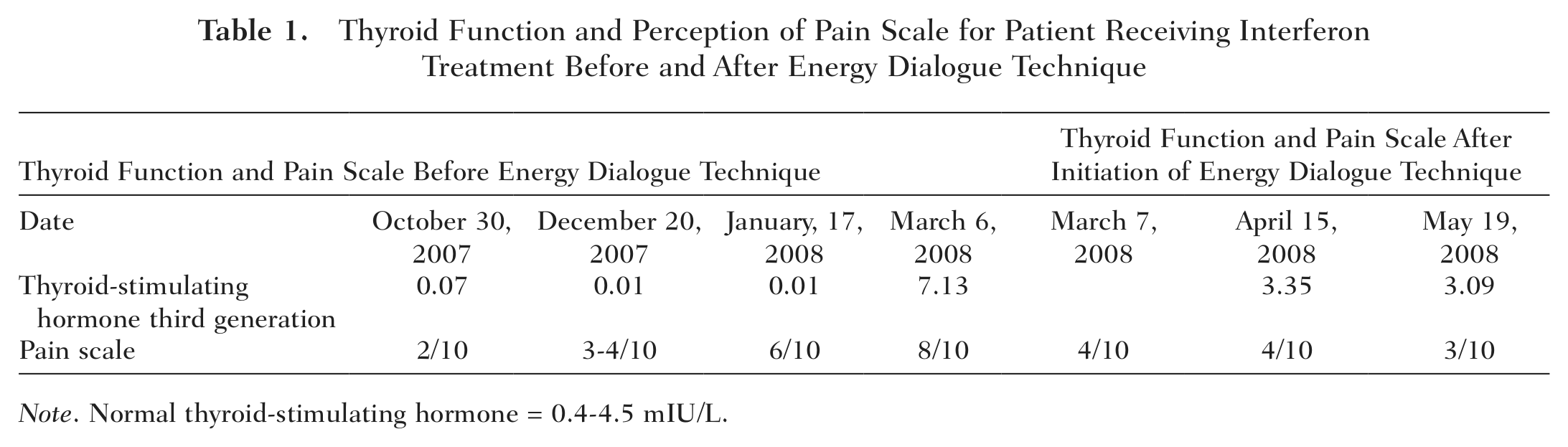
Note. Normal thyroid-stimulating hormone = 0.4-4.5 mIU/L.
Case Discussion and Conclusions
The client experienced the expected achiness of interferon from the beginning of treatment in July 2007. He developed thyroditis in October 2007 and subsequently became hypothyroid in March 2008. Energy dialogue sessions were initiated in March 2008. In this case study, subsequent to the EDT there was a 40% relief of pain, which improved progressively over the month. There was also an improvement in TSH values, moving toward normal thyroid function.
Systemic effects of PI&R therapy include fatigue, nausea, muscle achiness, and thyroid dysfunction. The literature does not cite any cases of thyroid function normalizing during the year’s duration of PI&R therapy. Also, the literature does not describe the use of nonpharmaceutical intervention to relieve symptoms of treatment. In this case study, using EDT, there was a 30% to 40% relief of symptoms of fatigue and achiness and the thyroid function was moving toward normalization.
The cornerstone of EDT requires quieting of the mind and sensing and balancing of energetic restriction in the client’s field. Quieting of the mind has been shown to be effective in reducing anxiety (Kabat-Zinn et al., 1992), depression (Teasdale et al., 2000), and chronic pain (Bonadonna, 2003). It has also shown clinically significant changes in bacterial growth (Nash, 1982), hemolysis of red blood cells (Braud, 1992), and increasing cellular messengers of healing (Kiang, Ives, & Jonas, 2005). The uniqueness of EDT is that it expands the quieting of the mind to actual dialogue and sensing of imbalances in the field that allows the patient to nonverbally guide the practitioner.
Based on this research and the preliminary findings, EDT should be explored for inclusion as part of the physical therapy for those suffering with systemic effects of PI&R and other stress-related diseases. EDT demonstrates the influence a practitioner can have in choosing the healing possibilities of clients. As there is currently limited documentation of the EDT and only anecdotal and case study evidence to assess its practical and effective application, the authors encourage a structured study of its use in multiple sites.
Footnotes
Appendix A
Appendix B
Acknowledgements
The authors would like to thank Carole Oshinsky, former Publication’s Manager at the National Center for Children in Poverty, and the reviewers for this journal for their expertise and clear guidance in preparing this article for publication.