







Abstract
It is well understood that Hispanics often do not seek or use Western medicine due to cost factors (Nahin, Dahlhamer, & Stussman, 2010). They seek and use other sources of medical care, such as traditional medicine or skills and practices, to maintain health that reflects their culture. Many Hispanics use both Western medicine and traditional medicine (Chao, Wade, Kronenberg, Kalmuss, & Cushman, 2006). Sometimes, Hispanic Americans seek the services of a curandero (a traditional healer), but it is not fully understood why they seek these services (Luna, 2003; Padilla, Gomez, Biggerstaff, & Mehler, 2001; Reyes-Ortiz, Rodriguez, & Markides, 2009). This article provides a systematic review designed to answer two research questions: Why Hispanics seek a curandero and how they use a curandero.
Nurses who care for Hispanic patients provide more holistic and comprehensive care when they are knowledgeable about Hispanic folk illnesses, treatments, and the practices of curanderos. Also essential for the nurse is patient disclosure about the use of curanderos and folk remedies and how the curandero meets the patient’s needs. The curandero brings a complementary aspect of holistic care to patients that is not commonly found in Western medicine (Ransford, Carrillo, & Rivera, 2010).
According to the U.S. Census Bureau, Hispanics are the fastest growing minority group with more than 50 million in the United States (U.S. Department of Commerce, Census Bureau [USDC], 2011). By 2050, more than 100 million Hispanics will live in the United States (USDC, 2011). The National Poverty Center purports that the Hispanic poverty rate (25.3%) “greatly exceeds the national average” compared to non-Hispanic Whites (9.4%; National Poverty Center, n.d.). Furthermore, the Bureau of Labor Statistics states that Hispanics hold the second highest unemployment rates in the United States (U.S. Department of Labor, Bureau of Labor Statistics, 2013). They also consistently experience poorer health and greater health disparities than nonminority Americans (Lurie & Dubowitz, 2007). These factors have contributed to health disparities among Hispanics and may encourage them to seek and utilize a curandero.
Broadly speaking, curanderismo is a melded holistic practice of traditional medicine associated with spiritual, psychic, and physical healing (Amerson, 2008; DeBellonia et al., 2008). The Spanish verb curar means to heal. Hispanics immigrating to the United States have a deep history of utilizing curanderismo, with historical roots dating back to the Middle Ages (Amerson, 2008; Luna, 2003). Hispanic tradition holds that there are many gods who punish sins with illness (Padilla et al., 2001). Other Hispanic beliefs include illness as stirred by an imbalance of “hot” and “cold” properties within the body (Lopez, 2005; Ortiz, Shields, Clauson, & Clay, 2007). Curanderismo healing practices cure these kinds of traditional illnesses using medicinal plants, magic, prayer, and other indigenous methods (Amerson, 2008; DeBellonia et al., 2008). The curanderismo healer/practitioner is called the curandero.
Curanderos practicing in the United States are commonly of Spanish ancestry, in their mid-50s, married, and with no formal medical training. They have obtained special skills that have either been passed down by ancestral curanderos or through apprenticeships (Clark, Bunik, & Johnson, 2010; Padilla et al., 2001; Tafur, Crowe, & Torres, 2009). Their skills include healing, herbalism, massage, prayer, card reading, midwifery, and spiritual cures (Clark et al., 2010). Some curanderos practice only one skill, such as an herbalist. Others practice a combination of skills. The term curandero (male) or curandera (female) refers to the use of any of these forms of healers, even though there may be significant differences between their practices. Many curanderos practice out of their home and receive donations for their practice fees (Amerson, 2008; Padilla et al., 2001; Tafur et al., 2009). Hispanics often pay for curandero services by traditional bartering (Luna, 2003).
Method
This systematic literature review was conducted using two databases (PubMed and CINAHL). The search was limited to articles published in English language in journals from January 2000 through September 2012 that included the following primary keywords: (a) Hispanics/Latinos and curandera/curandero, or (b) Complementary Alternative Medicine (CAM) use, or (c) traditional healers/traditional medicine. The search produced 281 articles (a, b, and c) of which 228 were indexed in PubMed and 53 in CINHAL. Excluded were 225 articles that did not reflect the two key questions, yielding 56 articles (42 PubMed, 14 CINHAL) that met the inclusion based on the keywords, title, or abstract. Evaluation of the 56 articles revealed 25 that answered the two research questions. Of these, 19 were found in keywords a, b, or c (5, a; 4, b; 10, c), and an additional 6 articles were found in a combination of a, b, or c, yielding 25 articles. A reference list search was also conducted to identify articles that were not indexed in the target databases. Five additional articles were obtained, totaling 30 articles for the review. Each article was entered into a matrix and divided into two categories to facilitate data sorting: (a) seeking a curandero and (b) utilizing a curandero. Studies were reviewed using a narrative approach. The strategy used for choosing articles for review is shown in Figure 1. A summary of the articles, with purpose, sample, and relevant findings is presented in Table 1.
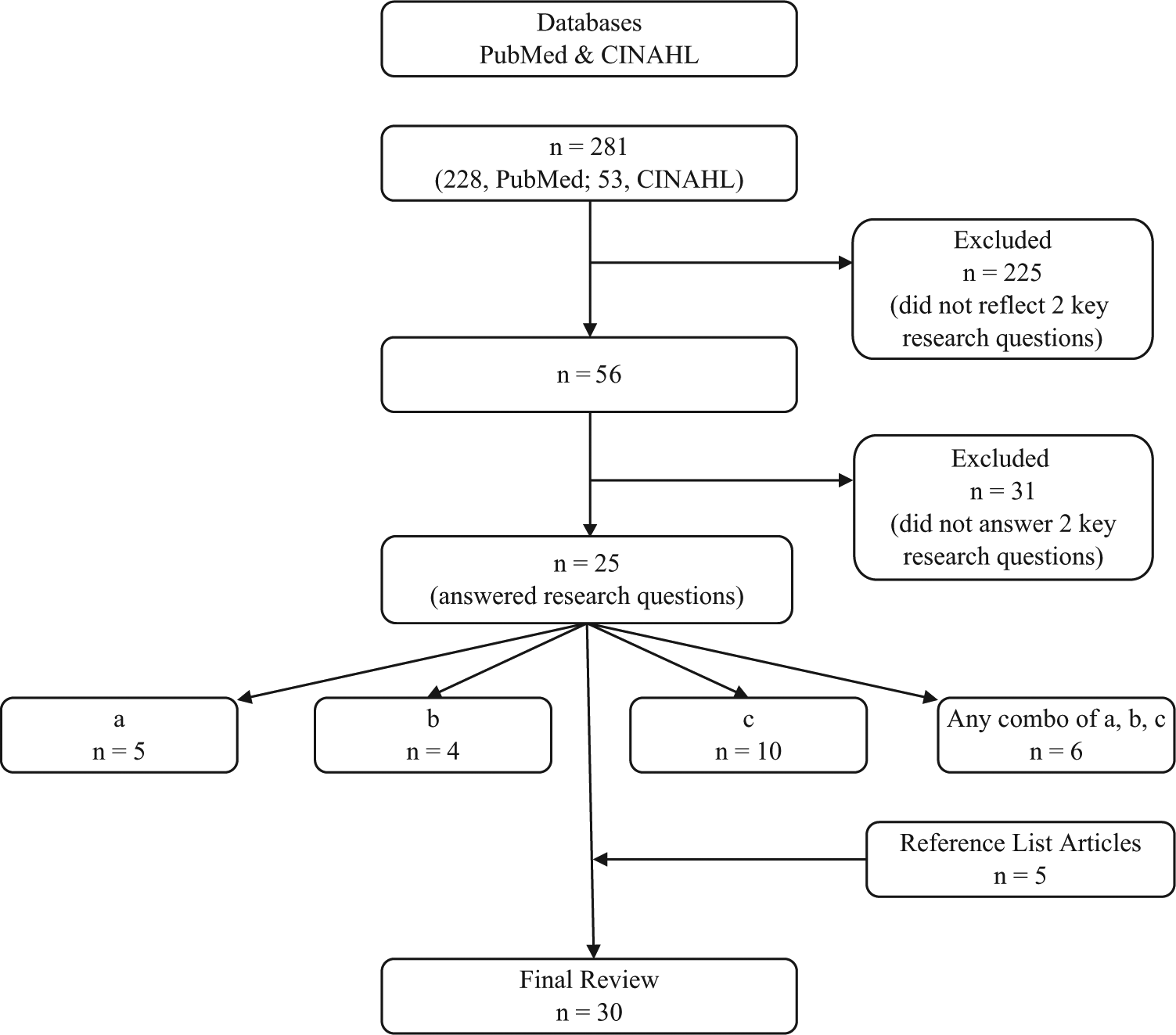
Literature Search Method
Seeking and Utilizing a Curandero: Studies Reviewed (N = 30)
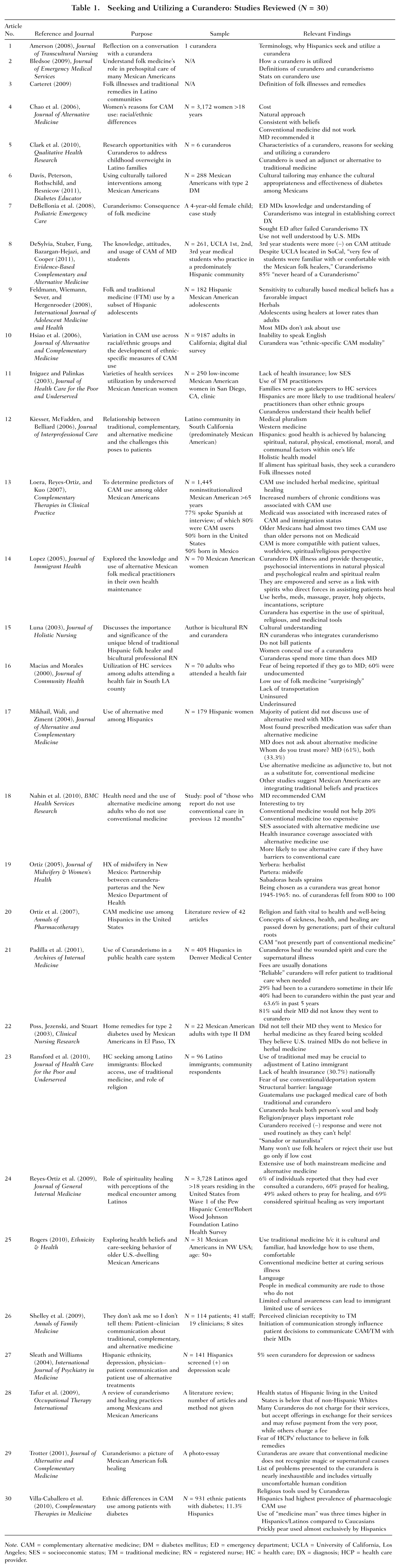
Note. CAM = complementary alternative medicine; DM = diabetes mellitus; ED = emergency department; UCLA = University of California, Los Angeles; SES = socioeconomic status; TM = traditional medicine; RN = registered nurse; HC = health care; DX = diagnosis; HCP = health care provider.
In a recent survey by the Pew Hispanic Research Center about which ethnicity label is preferred, 51% (1,220 adults from 50 states) stated they had no preference regarding either term (Hispanic or Latino); those who indicated a choice preferred Hispanic; thus, it is used in this article (Taylor, Lopez, Martinez, & Velasco, 2012).
Results
Curandero use is imbedded in the literature but difficult to find. Of the 30 studies meeting the inclusion criteria, only 9 were found using the search terms of Hispanic/Latino and curandero. Among these nine articles, four spoke directly of the curandero. One was a brief reflection of a conversation with a curandera (Amerson, 2008), a second identified the “nurse curandera” (Luna, 2003), a third explored the relationship between the curandera and a local Department of Health (Ortiz, 2005), and the last noted the curandero’s role within Mexican-Americans’ curanderismo practices (Tafur et al., 2009). Of the other five articles, three focused on Hispanic use of traditional medicine, briefly noting the role of a curandero (DeBellonia et al., 2008; Feldmann et al., 2008; Lopez, 2005); one evaluated the rate of use of curanderismo with data collected outside the search limits for this article (Padilla et al., 2001); and the last was a brief photo essay of curanderismo, which noted the role of the curandero (Trotter, 2001). This article differs from the four articles using the term “curanderos” in two primary ways: (a) it offers insights into why Hispanics seek a curandero and (b) it expresses how Hispanics utilize a curandero to treat their health care needs.
Hispanics Seeking a Curandero
Affordability
It was not surprising to find that Hispanics seek a curandero because they cannot afford Western medicine (Iniguez & Palinkas, 2003; Nahin et al., 2010). Some curanderos do not charge for their services but accept offerings in exchange (Padilla et al., 2001). Some do not accept payment from the very poor, whereas other curanderos charge a minimal fee (Tafur et al., 2009). Curanderos typically set up their clinic within Hispanic neighborhoods offering affordability due to ease of accessibility (Kiesser et al., 2006).
Language
Hispanics seek curanderos due to language use as their practice is typically found in Spanish-speaking communities (Amerson, 2008; Hsiao et al., 2006). Unlike curanderos, many health care providers cannot communicate in Spanish. Hispanics can be “confused” when difficult medical terminology is not spoken in their native language (Reyes-Ortiz et al., 2009). Indeed, proper medical care requires all patients and practitioners to communicate effectively; this is particularly important for those who do not speak English as their native language.
Immigration Status
Hispanic immigration status may also be related to why they seek a curandero. Macias and Morales (2000) explored reasons Latinos utilized a community health fair in southern California. They found that many were not eligible for government-supported health care due to their undocumented status. These Latinos came to the community fair wanting to pay cash for their health care needs. Macias and Morales (2000) noted that undocumented Hispanics commonly pay cash for medical services, as they fear that their immigration status would be reported to authorities. Other undocumented immigrants try and meet their health care needs with home remedies; however, when these fail they, too, turn to community clinics to pay for services with cash (Menjivar, 2002).
Culturally Appropriate
Consistent evidence shows Hispanics seek a curandero because their traditional practice is culturally appropriate (Debellonia et al., 2008; Lopez, 2005; Tafur et al., 2009). Hispanics often view alternative medicine as more “compatible” with Hispanic cultural values and beliefs, in particular the way alternative providers view health and illness (Loera et al., 2007). Curanderos offer a holistic approach that provides effective treatment for folk illnesses. An example of culturally holistic care found was a curandera who used mint teas and a warm massage to relax the expectant mother and reposition the fetus before birth (Amerson, 2008). Furthermore, Hispanics commonly use alternative medicine and curandero practitioners “growing up” in their home country (Chao et al., 2006; Ortiz et al., 2007). Mexican American adults were more likely to seek a curandero to manage their diabetes as they “preserve” Mexican culture (Davis et al., 2011).
Spiritual Healing
Hispanics also seek curanderos for spiritual healing. They believe traditional health care providers do not understand Hispanic health beliefs, in particular the need for spiritual healing (Kiesser et al., 2006). DeSylvia et al. (2011) found that medical students purport spiritual beliefs and practices do not play an “important role” in healing (p. 3). Moreover, while some Hispanics seek a priest or other “spiritual healer” for healing, other Hispanics seek a curandero as they believe this cultural practitioner often possesses spiritual powers that can cure certain illnesses that a priest may not hold (Clark et al., 2010; Lopez, 2005; Tafur et al., 2009). Many believe only a curandero can treat both a “person’s soul and body” (Ransford et al., 2010, p. 871). For example, it is believed that curanderos can drive out evil spirits found within the body by bathing the Hispanic child in isopropyl alcohol (DeBellonia et al., 2008). Other curanderos use tools such as crucifixes, holy water, religious pictures, and candles to spiritually cleanse Hispanic patients of illnesses and hexes (Lopez, 2005; Trotter, 2001).
Acculturation
Similarly, curanderos help Hispanics acculturate to the United States by assisting them maintain their cultural and ethnic identity (Rogers, 2010). Specifically, Rogers (2010) noted that older U.S. Mexicans sought curanderos as they “evoked a sense of familiarity” giving them “comfort” in maintaining traditional methods of health care (p. 589). Ransford et al. (2010) add that curanderos are an important “coping mechanism” due to the separation from family who remain in their home country (p. 864). Ransford et al. (2010) suggest that continued use of traditional medicine may be “crucial to [their] adjustment” into America (p. 864). Loera et al. (2007) found that overall, immigrant Mexicans who are “less acculturated” have a higher use of “alternative medicine” than those who were “more acculturated” (p. 230). Furthermore, Mexicans born in their home country were more likely to consult a curandero than Hispanics born in the United States (Reyes-Ortiz et al., 2009). Immigrants believe that traditional providers help them maintain their identity as they become acculturated to their new land (Davis et al., 2011). On the contrary, Padilla et al. (2001) found that “assimilation,” or the time spent living in the United States, was not a significant indicator of Hispanic use of a curandero.
Dissatisfaction
Finally, dissatisfaction with Western medicine was cited as a reason to seek a curandero. Dissatisfaction was noted as the inability to communicate effectively due to language, feeling confused after a medical encounter, receiving unsatisfactory Western medicine, feelings of reproach by their provider, perception that their provider does not believe in folk illnesses or know how to treat them, and maintaining medical resources in Mexico (Feldmann et al., 2008; Lopez, 2005; Ransford et al., 2010; Reyes-Ortiz et al., 2009; Shelley et al., 2009).
In summary, Hispanics most often seek a curandero due to affordability and language issues. Less familiar reasons include immigration status, culturally appropriate care, spiritual healing, acculturation, and dissatisfaction with Western medical care. Yet, when Hispanics seek Western medicine, the question of “how a curandero is utilized” is “often overlooked” (DeBellonia et al., 2008, p. 228).
Hispanics Utilizing a Curandero
Diabetes
Diabetes is a common chronic illness among Hispanics with its prevalence higher than in Caucasians (Poss et al., 2003). Villa-Caballero et al. (2010) found that Hispanics were three times more likely to use a “medicine man” to treat diabetes when compared with Caucasians (p. 246). Davis et al. (2011) note that 11% of Mexican Americans consult curanderos to manage their diabetes. Interestingly, Hispanics residing in the United States, on the border of Mexico, frequently cross over to seek a curandero for prescription treatments for diabetes (Poss et al., 2003; Trotter, 2001).
Pain
Pain was also frequently cited as a reason for utilizing a curandero. Mikhail et al. (2004) noted pain to be the “main reason” for using alternative medicine, which included seeking a curandero (p. 854). Similar studies focused on the use of CAM specifically for back pain, abdominal pain, menstrual pain, sore throat, and earaches (Nahin et al., 2010; Trotter, 2001). Padilla et al. (2001) explored the use of a curandero at a public medical center and found headaches to be the most common problem treated. Feldmann et al. (2008) noted that adolescents who reported the use of a traditional healer did so only for pregnancy and back pain.
Prayer
Prayer was expected as a way Hispanics utilize a curandero as religion and faith are vital to their culture. Mikhail et al. (2004) reported that 43% of Hispanic patients use prayer as the second most common alternative medicine, whereas 22.8% reported prayer as their only alternative medicine practice. Curanderos commonly use prayer for spiritual interventions, something Western providers typically do not offer (Ransford et al., 2010). Reyes-Ortiz (2009) explored the relationship between spiritual healing/curandero and information provided during a medical encounter. They found that when Hispanics are “confused” after a Western medical encounter, they seek a curandero for prayer in healing.
Folk Illnesses
Hispanic communities in the United States often seek a curandero to treat common folk illnesses reflective of their cultural roots. Folk illnesses tend to carry both religious and symbolic meanings. Some folk illnesses occur “naturally” whereas others occur “supernaturally” (Ortiz, 2005; Padilla et al., 2001). Hispanics believe that healing of folk illnesses requires treating physical, spiritual, and psychological needs and is most effectively done through a curandero (Lopez, 2005; Trotter, 2001). Common folk illnesses include caida de mollera (sunken fontanel) in infants, susto (fright sickness), empacho (upset stomach), mal ojo (evil eye), and envidia (envy; Amerson, 2008; Tafur et al., 2009; Trotter, 2001).
Caida de mollera, or sunken fontanel, occurs as a result of inefficient sucking, quickly removing the baby from the nipple, the baby falling to the ground, or dislocation of real or imaginary body parts (Bledsoe, 2009; Carteret, 2009; Tafur et al., 2009). Symptoms of caida de mollera include vomiting, diarrhea, failure to suck, and/or sunken eyes. Treatment varies, but the goal is to restore the fontanel. Western practitioners commonly treat the condition with rehydration methods, whereas a curandero applies warm, soapy water over the fontanel and then presses on the baby’s palate with a finger. Carteret (2009) adds “holding the baby upside down over a pan of water and slapping the bottoms of the feet” works as well.
Susto, or “fright sickness,” is caused by severe fright or shock, likely a traumatic experience. It typically presents during childhood (Lopez, 2005). The fear is considered so great that the soul is believed to actually leave the physical body for safety reasons (Trotter, 2001). Carteret (2009) suggests that “knowledge of its existence” is a strong influence in becoming well. Treatment for both the body and soul includes herbal teas, sprinkling of holy water, isopropyl alcohol baths, and cleansing ceremonies conducted by a curandero (Amerson, 2008; DeBellonia et al., 2008; Tafur et al., 2009). If susto is left untreated, death can result (Lopez, 2005).
Empacho, or stomachaches, is a third common folk illness. Empacho causes include overeating, consuming spoiled foods, or simply eating at the wrong time of the day that lead to digestive disorders (Lopez, 2005). Feldmann et al. (2008) noted that Hispanic teens commonly use herbal teas and healers to treat cramps, gas, and other stomach problems. Curanderos treat “digestive blockages” supernaturally (Trotter, 2001).
Of the many common folk illnesses, Mal ojo, or evil eye, is perhaps the most peculiar to Western practitioners. Evil eye is believed to occur when a “stronger eye” stares at a child without touching him. Carteret (2009) posits it can occur “intentionally or unintentionally.” It can also be caused by “paying too much attention” to babies (Tafur et al., 2009, p. 86). As a result, the extended stare may cause the baby’s blood to “heat up” resulting in fever, irritability, colic, and extended crying. Mal ojo is most commonly treated by a curandero who lays the child down and sweeps the body with an egg. Other treatment includes placing an amulet on the infant’s clothing (Carteret, 2009).
Other Uses
Other folk illnesses in the literature search included bilis (anger/rage) that can lead to hypertension (Ortiz et al., 2007), envidia (envy) caused by intense jealously (Tafur et al., 2009), matris caida (fallen womb; Iniguez & Palinkas, 2003), and aire del oido (air in the ear) as a result of strong wind that results in an earache (Bledsoe, 2009). Finally, pregnant teenagers (Feldmann et al., 2008) and those suffering with depression (Sleath & Williams, 2004) report utilizing a curandero. Rarely was a curandero consulted for weight issues (Clark et al., 2010).
In summary, curanderos are utilized to treat a wide range of needs including physical, emotional, and spiritual, as well as treatment of common folk illnesses that may be unfamiliar to health care practitioners. Trotter (2001) suggests the range of needs is “nearly inexhaustible and includes virtually every uncomfortable human condition” (p. 130). As such, Bledsoe (2009), an emergency room physician, stresses that when health care providers assess a Hispanic patient, they should, “always consider [their] possible belief in folk medicine.” Understanding their Hispanic health care needs and potential treatment for folk illnesses will help Western practitioners provide culturally competent care, increase trust with their Hispanic patience, and encourage utilization of Western medicine.
Discussion
This literature search found evidence that Hispanic Americans continue to seek a curandero for their health care needs (Amerson, 2008; Davis et al., 2011; DeBellonia et al., 2008; Lopez, 2005; Luna, 2003; Tafur et al., 2009). The Pew Hispanic Center (n.d.) reports that about 6% of Hispanics obtain care from a curandero, whereas Feldmann et al. (2008) found that “many” used a curandero in the past year. Lopez (2005) noted that 70% of Mexican American women (n = 63) knew someone who had used a curandero, with 25.7% reporting they personally utilized curandero services. Luna (2003), a bilingual nurse and curandera, found that Hispanic women seek curanderos but tend to “conceal” their use to both their family and physicians (p. 332). When Western providers were perceived to not accept or discuss traditional medical practices, Hispanics chose not to disclose its use (Shelley et al., 2009).
Affordability was consistently seen in the literature as to why Hispanics use alternative medicine (Chao et al., 2006; Loera et al., 2007; Macias & Morales, 2000). Only three articles, however, directly noted seeking a curandero due to cost factors (Lopez, 2005; Nahin et al., 2010; Ortiz, 2005). Hispanics have the highest poverty rate (28.2%) among U.S. minority groups with more than one fourth of adults having no insurance or underinsured (USDC, 2011). The U.S. Census Bureau adds that 60% of Hispanics who are not citizens/permanent residents do not have insurance (USDC, 2011). Finally, the cost of Western medical care continues to soar adding to reasons why Hispanic seek other sources of care that are less than costly than Western care.
Spanish is the native tongue for most Hispanics. Limited English language was found as a reason why Hispanics seek a curandero (Luna, 2003; Rogers, 2009; Tafur et al., 2009). DeBellonia et al. (2008) suggests that this is a common problem when assessing patients. They recommend translation services from staff who share a “similar cultural background” to the patient for accurate health assessments (p. 229). Language barriers are a common reason for lack of communication among Western providers, thus encouraging Hispanics with limited English language skills to seek Spanish-speaking practitioners (Rogers, 2010; Tafur et al., 2009).
Cultural appropriateness, acculturation, and immigration status often overlapped in the literature search as to why Hispanics seek a curandero. Amerson (2008) suggests that Hispanics with Spanish language preference tend to seek a curandero because of the cultural values these traditional practitioners hold. Clark et al. (2010) noted that newer immigrants or those less acculturated to America are more likely to seek the curandero, who is perceived as an expert in Hispanic cultural health practices. They interviewed a curandera who suggested that Hispanics seek curanderos because they offer health care “expectations, experiences, and preferences” similar to Hispanic culture (Clark et al., 2010, p. 9). Luna (2003) echoes that curanderas are sought because of their familiarity to Hispanic culture and language abilities, making them uniquely qualified to offer medical care, especially to the newer immigrant. These findings are consistent with previous research by Dowling (1984) who found that Hispanics seek a curandero because they offer an “instant cultural infusion” by making them culturally comfortable (p. 457). Moreover, Palchikoff (2011) noted that some Hispanics seek a curandero even at the risk of receiving “illicit care” as the curandero spends time with them by providing holistic care.
Dissatisfaction with Western care was consistently given as a reason to seek a curandero. Dissatisfaction was found as an inability to communicate effectively due to language issues, feeling confused after a medical encounter, feelings of reproach by their provider, and a perception that their provider does not believe in folk illnesses/medicine or know how to use traditional treatments. These finding have several implications. First, when Hispanics do not understand medical language or fear that their health care provider will not understand their English language skills, they become dissatisfied with Western care (Padilla et al., 2001). Indeed, proper translation services are critical in creating an environment that decreases confusion and encourages the limited English speaker to seek Western care. Second, Hispanics are dissatisfied with Western care when they “fear” being reproached or “scolded” (Poss et al., 2003, p. 316) for using traditional medicine and providers. Maduro (1983) noted that with regard to the Hispanic use of curanderismo, the health care relationship between the patient and the Western provider is dependent on respect of Hispanic culture and beliefs. Third, perceiving health care providers did not believe in folk medicine, or the use of a curandero, was consistently seen in this systematic search (DeSylvia et al., 2011; Luna, 2003; Tafur et al., 2009). DeSylvia et al. (2011) explored attitudes of medical students and the use of CAM to find third-year medical students who practiced in communities that hold a large Hispanic population, were less likely to suggest “curanderismo” to a patient compared to first- or second-year medical students. Luna (2003) noted that curanderos commonly refer Hispanic patients to Western medical providers but “rarely” did Western providers do the opposite. To improve culturally appropriate care by Western providers, Kiesser et al. (2006) outlined four cultural values that Hispanics hold high: (a) the need for Hispanics to respect and even agree with advice from their health care provider, (b) involvement of family in all care and decision-making, (c) respect of Hispanic values and opinions, and (d) desire to be treated as unique and valuable. On the contrary, Mikhail et al. (2004) found that most (61.3%) Hispanics had more “confidence” in their Western medical provider than in their “alternative provider” (p. 858).
The findings on how Hispanics utilize curanderos were consistent with prior studies. This literature search consistently showed that Hispanics utilize alternative medicine for treatment of chronic illnesses (Mikhail et al., 2004; Nahin et al., 2010; Sleath & Williams, 2004). Other Hispanics extend their use of alternative medicine as their chronic illness increased (Rogers, 2010). On the contrary, some managed their chronic illness with Western medicine or in combination with traditional medicine (Ortiz et al., 2007). Few articles specifically noted the use of a “curandero” for treatment of chronic illnesses.
Within the review of nine articles, which used the search terms of Hispanic/Latino and curandero, all noted ways Hispanics utilize curanderos. Some included common Hispanic folk illnesses, others included traditional treatments, whereas several included both folk illnesses and traditional treatments. Two articles gave a table of some folk illnesses and their definitions (Luna, 2003; Tafur et al., 2009). Similarly, Feldmann et al. (2008) presented a table of folk treatment and their indications. DeBellonia et al. (2008) presented a pediatric case on the consequences of using one form of folk medicine to treat a child ill with “fright.” This article adds to these articles by outlining folk illnesses and treatments utilized by a curandero. Clearly, further studies are needed that explore how diverse Hispanic groups utilize curanderos for particular folk illnesses that are commonly found in U.S. communities. In particular, specific studies that explore the utilization of a curandero by immigrants from first-, second-, and third-generation status would offer nurses’ insight on how to provide effective care to these diverse Hispanics. Since only one article addressed the potential adverse consequences of folk medicine, it is also important to further study folk treatments, especially those that may have fatal consequences.
Limitations
The literature search was limited to 12 years (2000 to 2012), and only four articles were found reflecting utilization of curanderos. Thus, the results cannot be used to generalize the use of seeking and utilizing curanderos in the United States. However, the results may have implications for understanding how nurses and other health care professionals assess Hispanics during a clinical encounter.
An additional limitation was the restrictive inclusion of the term curandero. For example, when queried about its use, Hispanic immigrants perceived the term to hold a negative meaning, whereas other Hispanics were reluctant to disclose the use of a curandero (Davis et al., 2011; Ransford et al., 2010). Davis et al. (2011) cited one immigrant as describing curanderos as “charlatans . . . [who] play on the ignorance of many people” (Davis et al., 2011, p. 871). This finding reflects the importance of using other terms in future studies such a sanador, naturalista, or simply healer (Villa-Caballero et al., 2010). Indeed, Hispanics “more readily express use” of a folk healer when using terms other than a curandero (Ransford, 2010, p. 871). There is great diversity among Hispanic groups and, the reasons they seek health care providers may not be the same among their various cultures. Studies are needed to explore which Hispanic groups reject or accept the term curandero and why. These findings could potentially contribute to an understanding of why Hispanic Americans continue to seek traditional health care providers and whether the rate of seeking a curandero is shifting.
Nursing Implications
As utilization of curanderos among Hispanics in the United States was the focus of only four articles (Amerson, 2008; Luna, 2003; Ortiz, 2005; Tafur, 2009), nursing research on curanderos is sorely lacking. Three of the four articles were interviews of curanderos and did not directly address the implications for holistic nursing care. Nurses typically provide direct patient care to Hispanics. Knowledge of Hispanic folk illnesses and treatments is important in providing culturally appropriate holistic care. One article in the full review of literature explored knowledge, attitudes, and use of CAM of medical students (DeSylvia et al., 2011). The results of this study found “less than favorable attitudes” toward CAM use among their patients, who were predominately Hispanic. A similar study that explored nursing students’ knowledge and attitudes of curanderismo and the curandero is merited as none are currently known. Furthermore, patient disclosure about the use of curanderos and folk remedies given may be critical to nurses and the care they provide. It is recommended that nurses collaborate with community curanderos since the curandero holds an etic view of Hispanic health care needs (Luna, 2003). It is noteworthy, however, that when partnering with curanderos to conduct research, Clark et al. (2010) found working with them to be “problematic” and cited a difference in personal characteristics between the health researchers (p. 4). Finally, it is recommended that nurses include into their practice intentional inquiry of why and how Hispanics utilize curanderos. Failure to do so may result in potential treatment interactions as a result of traditional remedies.
Footnotes
Author’s Note:
The author was a participant in the 2013 NLN Scholarly Writing Retreat sponsored by Pocket Nurse and the NLN Foundation for Nursing Education. She is grateful to Leslie Nicoll, PhD, RN, and Leslie Block for their mentoring in preparation of this article.