






Abstract
Introduction
Transgender individuals have been a part of world culture throughout history, yet healthcare support for this population has only recently received attention. The World Professional Association for Transgender Health (WPATH) has developed and disemminated standards of care focused on medical and psychological approaches that foster the highest quality of care for this vulnerable population (Coleman et al., 2012). While these standards support an understanding of surgical, hormonal, cosmetic and psychologic care, they do not address nursing care or nursing care outcomes for transgender individuals. Given the systemic bias and discrimination experienced by transgender individuals within the healthcare system, the proposed theory supports the development of gender affirming knowledge and care practices within the domain of nursing to improve healthcare outcomes.
Background and Context
To address marginalization and overt discrimination of transgender persons in healthcare, the concept of holism was selected as the foundation for cultural humility within the caring process of therapeutic relationship building. Holism, as defined within this project, refers to the recognition of a person as a being greater than the sum of their parts and recognizes this unitary being as having a connection with their environment (Dossey et al., 2000). This holistic view of healthcare is central to the delivery of patient centered nursing care (Frisch, 2001). As such, the concept of holism serves as the foundation of cultural humility as nursing care of the whole person must include health plans focused upon the interrelationships between the “bio-psycho-social-spiritual dimensions of the person” (Mariano, 2007) influenced by ever-evolving cultural influences.
Cultural humility has been defined as the process of inquisitiveness, self-reflection, critiquing and life-long learning; as such, it is never mastered, ever changing with every encounter while maintaining an open mind and heart (Fahlberg et al., 2016). This holistic view is supportive of the development, application and understanding of a culturally humble nursing practice becoming the instrument and facilitator of healing (Mariano, 2007). Holistic nursing practice requires self-reflection to increases personal awareness of the integration of interconnectedness between self, and others to foster healing processes. Through this dynamic process, opportunities for relational learning and humility emerge. Joint leaning requires openness, recognition and subsequent rejection of power differentials and respect in collaborative healing partnerships between the patient and the nurse. This dynamic process cannot be collapsed into a single interaction, lesson or educational course as cultural influences change over time and location necessitating the need for ongoing engagement across the lifespan (Yeager & Bauer-Wu, 2013).
Recently, the concept of cultural humility has been imbedded into healthcare policy and accreditation standards as an approach to ensure quality of care for all individuals (Agency for Healthcare Research & Quality, 2020; The Joint Commission, 2011; U.S. Department of Health & Human Services, n.d.). Recent research has attempted to clarify the meaning of the term “cultural humility” and to investigate applicability to practice and challenges to implementation (Frisch, 2001; Foronda et al., 2016). While evidence suggests that inclusion of culturally humble approaches has a positive effect upon patient outcomes, there is little empirical evidence describing the relationships between gender affirming nursing care behaviors, cultural humility, and outcomes. The suggested relationship between gender affirming behaviors and cultural humility requires further exploration to better understand the complex interaction between variables.
Prior Research
Existing research consistently reveals cultural humility is dependent upon the development of therapeutic relationships characterized by mutual respect, trust, effective communication, understanding, and shared knowledge (Fahlberg et al., 2016; Foronda et al., 2016; Masters et al., 2019; Zuzelo, 2016). This evidence is consistent with previous theory literature on relationship building and caring such as Theory of Nursing as Caring (Boykin & Schoenhofer, 1993), Theory of Cultural Care (Leininger, 1988), and Theory of Human Caring (Watson, 2012). While many researchers have explored the impact of the nurse-patient relationship on patient and nurses’ outcomes (Davison & Cooke, 2015; Fahlberg et al., 2016; Molina-Mula et al., 2019) none have attempted to evaluate the impact of holistic gender affirming nursing care.
Conceptual and Theoretical Underpinnings
Critical (Weaver & Olson, 2006) and Interaction (Scheel et al., 2008) theories were utilized to inform a holistic nursing approach characterized by gender affirming care practices. Critical Theory (Weaver & Olson, 2006) was selected for its inclusive constructs aligning with goals for theory development. Critical Theory posits nurse-patient interactions are cooperative manifestation of shared understanding of meaning with the potential to impede equality and equity. Theory constructs expose oppression (Ludz et al., 1997), represent diverse groups (Wuest, 2000), and employ actions to address inequities. As the research process is iterative with cooperative interactions, tact and knowledge is generated from criticism formulated during self-reflection (Fawcett et al., 2001). Given the vital role of self-reflection in the Gender Affirming Nursing Care (GANC) model, the theory offers a sound foundation upon which to build gender affirming therapeutic relationships between nurses and patients. Though beyond the scope of this manuscript, the process utilized to create the GANC Theory is presented elsewhere (Rivera, In progress).
Theoretic underpinnings necessary to support, understand, and explore the holistic relationship building within the caring process were explored. Consistent with Interactional Theory (Scheel et al., 2008), nursing relationships within the proposed middle-range theory are reciprocal in nature and comprehension oriented in dialogue and action. Further, this reciprocal interaction between nurse and patient is present across all caring processes. Tenants of the Interactional theory include Internal Good, External Good, Goals, Ethic Action, Speech Action, and Avoidance of Instrumental Strategic Action.
The two theories were selected for the following synergistic properties:
Derived from a view of caring in the humanistic paradigm High degree of consistency and alignment supporting face validity Derived from a collaborative inductive research process Informed through a synthesis of the available literature on cultural humility, caring, and the everyday social construct of holistic nursing practice.
Based on these two theories, a middle-range theory for gender affirming nursing care was developed using Fawcett’s (2013) criteria for a middle-range nursing theory. The meaning given to the term model here is representative of a diagram of a middle-range theory and not a philosophical model. Thus, this middle-range theory provides a unique approach to nursing care linking caring and culturally sensitive relationship development for transgender and cisgender individuals alike.
Assumptions
Theoretical assumptions are accepted as truths and reflect the theorist’s personal and professional values and beliefs. Within the GANC theory, assumptions function to explain the nature of concepts, relationship propositions, and nursing characteristics, and the overall structure of the theory. Grounded in the key assumption that gender affirming nursing care transcends gender, the GANC theory is all-inclusive. Gender affirming holistic nursing care:
Requires a paradigm shift from a gender-binary to a gender-affirming world view; Moves care towards elimination of social struggle and oppression; Posits that the phenomenon of gender inequality must be examined through the lens of the oppressed; Requires initial and ongoing self-assmessment for bias; Requires a therapeutic relationship with the person engaging care; Requires aquisition of knowledge about gender transition and gender affirming care; and Recognizes that the “person” belongs to themselves and is the “owner” of their decisions.
The potential of the model to advance nursing science is in its capacity to generate and test hypotheses through relational propsitions (Table 1). These function to link the concepts of gender affirming nursing care to essential outcomes and serve as a guide for continued practice and reasearch. Validation of the GANC model through scholarly exploration to provide empiric evidence illuminating the impact of the gender affirming nursing care model on holistic health outcomes is needed. Anticipated outcomes of theory testing include validation of the models use in promoting caring relationships, demonstrating improved patient outcomes, reduction in healthcare inequity, and enhanced wisdom of both patient and nurse.
Theory Concepts and Relational Propositions
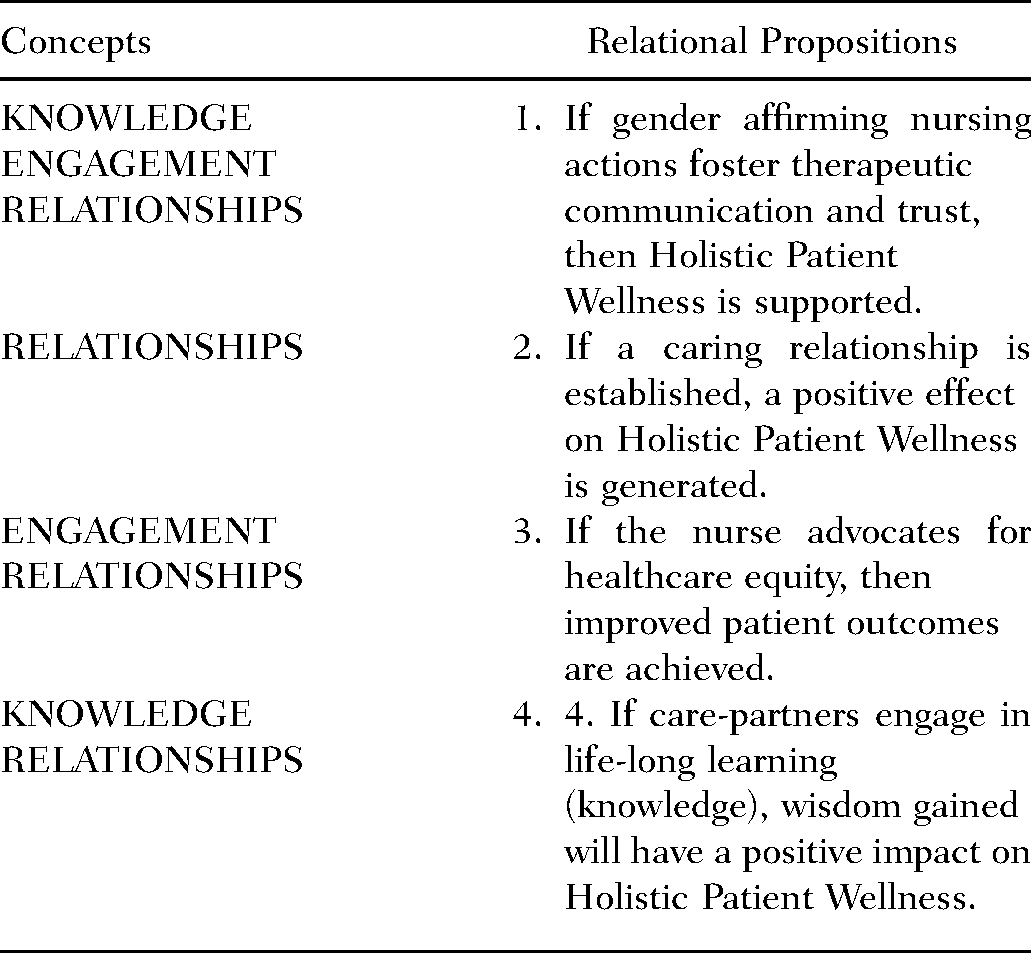
Creation of the Graphic Model
Nursing ontology is innately caring, therefore, to be a nurse, one is called to develop the full potential of caring, expressed ethically, and without bias (Goldberg et al., 2018; Watson et al., 1979). The model posits that holistic nursing practice must move toward the elimination of social struggle and oppression experienced by transgender patients. The intent of a graphic model is to provide a representation of the probabilistic relationship among a set of components. The graphic model created to represent GANC includes the following components: concepts, domains, drivers and nurse characteristics. The pictoral graphic depicts the central role of the nurse-patient relatioship as foundational for holistic patient wellness. The wheel-shaped graphic (Figure 1) represents ongoing internal development, propelled by the nurse’s intentional actions and unique nurse-patient interpersonal interactions. The theory goal, holistic patient wellness, is a result of dynamic and collaborative nurse-patient interactions as depicted in the Venn diagram at the center of the graphic.

Rivera’s Gender Affirming Nursing Care Model (GANC). Source: D. Rivera & P. Starke (2018) copyright TX 8-608-659 Used with permission.
Gender Affirming Nursing Care Model Components
The model concepts of relationships (“join with”), engagement (“partner with”) and knowledge (“learn with”) were derived from theoretical underpinnings and scaffold the caring process. The intent of the model is to shift the paradigm of nursing from a gender binary world to one of gender transcendence and affirmation leading to the theory goal of holistic patient wellness fostered by gender affirming nurse-patient interactions.
Concepts
The Rivera’s GANC model is comprised of three concepts within the Caring Process:
Relationships – Interconnection between nurse and patient. Knowledge – Nurses’ understanding and clarification of current and emerging transgender care. Engagement – Nurses’ informed and caring actions in the context of the care delivery system and society.
Relationships
Numerous studies have identified the positive impact of the nurse-patient relationship on patient outcomes (Davison & Cooke, 2015; Fahlberg et al., 2016) and the ability to enhance patient autonomy and meaningful engagement (Molina-Mula et al., 2019). Nursing attitudes, cultural humility and resulting patient interactions greatly influence patient engagement in shared healthcare decision making (Fahlberg et al., 2016; Foronda et al., 2016; Masters et al., 2019). The term “Knowing Self”, coined by Weaver and Olson (2006), is closely linked to the assumption of “before helping others, we must first have insight into our own function as a person within human interactions”. Engagement in clarification of personal beliefs and values supports the development of a gender affirming nursing practice platform. Rivera’s GANC concept of “Relationships” (Join With), represents interactions of gender affirming nursing care comprised of nursing characteristics fostering the development of trusting therapeutic interactions.
Knowledge
Within the GANC concept “Knowledge” (Learn With), specific nursing characteristics have been identified, such as wisdom, acceptance, and compassion. Specific to knowledge, evidence-informed practice is the foundation for effective nursing care, grounded in knowledge acquisition and application (Boothe & Macias, 2020; Cullen et al., 2020; Melnyk, 2019). In the nascent transgender nursing field, the critical need to use evidence to develop, test and modify standards to inform the pragmatic adequacy of the theory.
Engagement
The concept of “Engagement” (Partner With) within the GANC model is defined as a formal agreement to interact with and advocate for the patient. Therapeutic nursing relationships require action; within the GANC model, the nurse interacts with the patient and environment within the practice setting. The theoretical underpinnings of the GANC model describe the centrality of nurse-patient engagement as necessary and foundational to effective care. The role of the nurse in ameliorating inequities within healthcare is central to the concept of caring (Scott et al., 2021; Watson et al., 1979; Watson, 2012; Wilson et al., 2018); further, patient advocation across societal boundaries is an ethical expectation of the profession (American Nurses Association, 2015).
Domains
The perspective of a profession is referred to as the “domain” (Fawcett, 2013); the domain of the nursing paradigm includes person, environment, health, and nursing. Rivera’s theory presents the concept of person as an individual or group (irrespective of gender) who is the recipient of care. Person is a unique individual or group who is in a continuous process of evolving and becoming with a distinct sense of identity and self-worth. Health is the optimum level of function possible as defined by the nurses and the person receiving care. Health is not static but is dynamic ranging on an illness-wellness continuum. All external and internal influences and forces surrounding and affecting the nurse-patient (group) interaction is the environment. The goal of gender affirming nursing care is to attain Holistic Patient Wellness.
Rivera’s GANC acknowledges the nurses affect upon the domains of person, health, environment, and nursing with recognition of the interaction between GANC concepts within each of domain.
Drivers
Within Rivera’s GANC model, driver is defined as an encounter(s) catalyzing a response within or across domains. The model is comprised of five drivers: Ongoing Learning, Ongoing Research, Ongoing Assessment, Leadership and Patient Variables. Nursing is more expansive than knowledge; it is the intentional and skillful application of nursing knowledge (i.e. the art of nursing practice) to meet the patient’s needs. Positive nurse-patient relationships are a foundational component of therapeutic care serving to support informed decision making and subsequent high-quality health outcomes (Molina-Mula et al., 2019).
Through nurse-patient interactions, knowledge (i.e., Ongoing Learning) needed to improve nursing care for the vulnerable is informed. These interations, when characterized by cultural humility, are supported by the nurses intentional action to conduct a self-assessment of implicit and explicit biases to inform direct care practices, institutional policies, and societal prejudice (Briscoe, 2013; Panadero et al., 2017). Through this process, the nurse expands self-awareness (i.e. Ongoing Self-Assessment) to expose personal biases or “blind spots” (Ehrlinger et al., 2005) potentially impeding or preventing gender affirming nursing care. As such, “knowing self” (Panadero et al., 2017) is a critical component of gender affirming nursing care.
A characteristic of professional disciplines is the ongoing incorporation of evoling knowledge (Cullen et al., 2020). Nursing’s culture of ongoing knowledge development (i.e., Ongoing Research) through research supports evidence-informed practice and positive patient and healthcare system outcomes (Berthelsen & Holge-Hazelton, 2016; Gullatte & Corwin, 2018). Further, sustaining a culture on continuing inquiry, motivates and influences the acquisition of skills that support creativity and process improvement.
The involvement of nurses in process management (i.e., Leadership) has long revealed positive results and is in essence the hallmark of nursing leadership (Cummings et al., 2021; Hopper & Zborowski, 2018). Process management reveals gaps in care delivery, allowing nurse leaders to advocate effectively to improve quality and safety through actions directed toward nursing sensitive indicators.
Within the GANC theory, patient variables relate to facets of the individual that influences their interactions within the healthcare system. Personal health beliefs, preferences and personal values (i.e., “Patient Variables”) all directly influence healthcare actions, choices and resulting outcomes (Krumholz, 2013). Recognition and inclusion of the impact of “Patient Variables” into the caring process will help to further support gender affirming nursing care practices.
Nursing Characteristics
Rivera’s GANC drivers support the development of nursing characteristics consisitent with gender affirming care; the relationship between the nursing characteristics and drivers is presented in Figure 1. Nursing characteristics refer to learned beliefs and behaviors developed as a result of exposure to expansive education on gender affirming content and/or meaningful clinical opportunities for experiential learning. Through subsequent self-reflection of personal implicit and explicit biases, the nurse can develop a gender affirming practice. Essential GANC Theory nursing characteristics (presented in Table 2) include trust, wisdom, education, humility, openness, delivery of gender affirming care, advocacy, ethical behaviors, compassion, competence, acceptance, dispelling myths; these characteristics form the foundation for gender affirming nursing practice.
Gender Affirming Nursing Theory Concepts and Related Nursing Characteristics
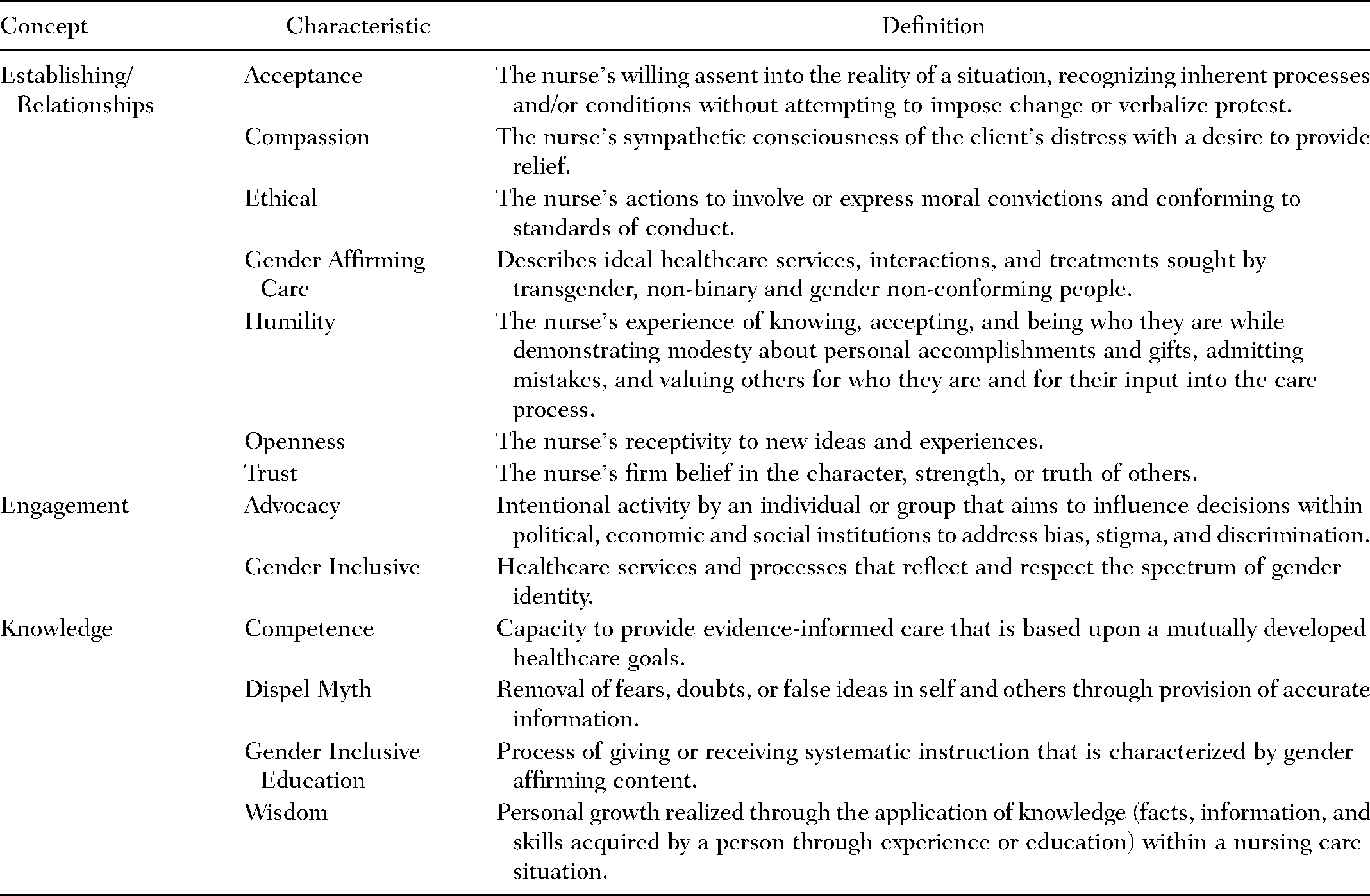
Though nurse characteristics are often developed simultaneously across concepts, for clarity, they have been categorized and defined (Table 2). The concept “Relationships” is characterized by acceptance, compassion, ethical interaction, gender affirming care, humility, openness, and trust. “Engagement” in healthcare includes the interpersonal interaction between patient and nurse in addition to the actions of advocacy and gender inclusive care within the healthcare system. The concept of “Knowledge” is characterized by competence, dispel myth, gender inclusive education, and wisdom.
Gender Affirming Nursing Care
Gender affirming nursing care is defined as the practice of nursing care without the impact of uninformed bias, especially in regard to gender. In essence, the nurse embodies acceptance and affirmation of the patients chosen gender, which may include the transformative process of negating prior societal or personal beliefs about gender. Through this paradigm shift, the nurse engages in interactions with patients without bias thereby establishing mutually respectful nurse-patient relationships. Affirming personal identity of the patient in a gender affirming manner is an essential goal of holistic patient wellness and thus serves as the foundation for the model.
Holistic Patient Wellness
The impetus for development of the model came from the need to address societal barriers and stigma toward transgender individuals frequently encountered within the healthcare system and the lack of nursing standards to inform gender affirming practice. In this context, holistic patient wellness would be defined as wellness of the whole person, regarding mind, body, and spirit.
Implications for Education, Practice, Research and Policy
Developing a gender affirming nursing practice is challenged by the lack of transgender nursing standards and gender-neutral educational preparation (Baldwin et al., 2018; Guerin, 2020; Korpaisarn & Safer, 2018). As such, nursing practice and education leaders (Klotzbaugh & Spencer, 2015) and the individual nurse are compelled to acquire knowledge to fill this practice and education gap. Rivera’s GANC model serves as a guide for the creation and inclusion of gender affirming nursing content into curricula and subsequently into practice. The complex and rapidly changing healthcare system can make even meaningful practice shifts difficult for nurse leaders; further, biased organizational and individual provider attitudes may create substantial barriers to the provision of gender affirming care. These factors may combine and interact to create unique challenges to theory testing.
Within the practice setting, the model could serve as a benchmark to assess quality, inform nursing care delivery models, assess nursing care outcomes, inform institutional policies guiding direct patient care, and inform healthcare system culture. The model makes explicit the need for nurses to move beyond the technical, insensitive, binary culture of the current healthcare system. Using the model as a framework for change could foster system level organizational characteristics, such as culture, safety, and patient satisfaction, supporting gender affirming care across the organization. It is important to note model implementation is likely beyond locus of control of any individual nurse and without needed organizational change, Rivera’s GANC may fail to realize its full potential.
Rivera’s GANC also serves to inform and guide legislative and healthcare policy development to improve the societal health. Policies and legislation serve to guide the process of decision making focused upon desired outcomes (Burgess & Purkis, 2010). Current policies related to gender affirming care are limited; this reality is experienced through the pervasive systemic barriers creating stigma across healthcare services. While the goal of patient centered care has long been a priority within healthcare, the development of gender affirming policies and procedures may create tension within an organization due to individual healthcare professional beliefs (Kreindler, 2015) further marginalizing transgender individuals. Rivera’s GANC serves as a platform for the necessary paradigm shift to achieve systematic holistic patient wellness and avoid marginalization.
The purpose of a theoretic model is twofold: to guide care delivery and support research. Despite the abundant research on nursing and cultural humility, there is little if any empiric evidence exploring the relationship between cultural humility, gender affirming nursing care and health outcomes. Currently, the model is being used in an educational research project by the authors to inform curricular development and support model testing specific to the delivery of gender affirming nursing care for transgender persons. The GANC Nursing Characteristics Evaluation Tool, created by the authors for model testing, outline the empirical indicators to measure gender affirming nursing practice behaviors (Appendix A).
Conclusion
This article presents the community informed, iterative process used to develop Rivera’s GANC Middle Range Theory. Included is a rich description of theory components and recommendations for education, practice, and research. Rivera’s GANC begins the important work of guiding nurses and nurse leaders to explore the impact of gender affirming care, particularly within at-risk populations such as the transgender and gender diverse population. Grounded in cultural humility and holism, the theory proposes concrete nursing actions and characteristics to inform holistic gender affirming nursing care. Gender affirming nursing care in combination with evidence-informed practice is synergistic and supports improved health outcomes across all populations.
Footnotes
Acknowledgements
The authors would like to thank Willa Starke, Trystan Reese, and Hannah Simpson for their contributions to the development and evaluation of this project from the lens of the transgender patient. In addition, we would like to thank Dr. Lisa Goldberg, Dr. Susan Luparell and Dr. Jean Watson for their theoretical expertise and mentorship in the refinement of this manuscript.
Author Note
Denise Rivera, College of Nursing Montana State University Missoula Campus
Angela Jukkala, College of Nursing Montana State University Great Falls Campus
T. Rohini, Samaritan College of Nursing, Kerala, India
This research was not supported by any grants.
The Authors declare that there is no conflict of interest.
Declaration of Conflicting Interests
The author(s) declared no potential conflicts of interest with respect to the research, authorship, and/or publication of this article.
Funding
The author(s) received no financial support for the research, authorship and/or publication of this article.
