







Abstract
Keywords
Introduction
Alzheimer’s disease (AD) is one of the leading causes of death in the United States. In 2013, it is estimated that 5.2 million Americans are currently living with AD, including 5 million Americans aged 65 and older (Alzheimer’s Association, 2013). While most individuals diagnosed with AD are non-Latino Whites, older Latino adults are disproportionately affected by this disease (Alzheimer’s Association, 2013; Dilworth-Anderson, Hendrie, Manly, Khachaturian, & Fazio, 2008). Indeed, Latinos of Caribbean descent have twice the incidence of AD compared to non-Latino Whites (Tang et al., 2001). Some Latinos are also at risk for AD because of factors that are more prevalent among this population, including chronic diseases such as high blood pressure and diabetes, lower levels of education, and other differences in socioeconomic characteristics (Alzheimer’s Association, 2013). By 2030, the Latino population aged 65 years and older will increase by 224% compared to a 65% increase for the White population, creating a situation where thousands of Latinos may be at risk for developing AD (Greenberg, 2009).
Despite the known benefits of regular physical activity (PA), older adults are the least active age group (Centers for Disease Control and Prevention (CDC), 2011). Previous research has reported a positive correlation between engagement in PA and better brain health (Rolland, Abbelan van Kan, & Vellas, 2008), this is especially true among older adults (Colcombe et al., 2006; Colcombe & Kramer, 2003; Kramer et al., 2003). Research has found that older adults’ engagement in leisure-time PA can protect against cognitive impairment and decline by reducing one’s risk for cardiovascular diseases such as hypertension, obesity, and diabetes (Rolland et al., 2008; Rovio et al., 2005). Unfortunately, Latinos, aged 55 to 64 years, are 50% less likely to engage in leisure-time PA than older non-Latino Whites, thus increasing their risk for poorer health outcomes (Marquez, Neighbors, & Bustamante, 2010). It is possible that older Latinos have not received proper information regarding the health benefits associated with PA, as many older Latinos have limited to no history of engaging in traditional exercise (Cromwell & Berg, 2006). Despite findings from the State-of-the Science Conference on Preventing Alzheimer’s Disease and Cognitive Decline indicating inconsistent association between lifestyle behaviors or risk factors and cognitive decline (Daviglus et al., 2010), research has shown that PA plays an important role in the prevention of chronic disease and accompanying disability and cognitive dysfunction (Chodzko-Zajko et al., 2009). A review by the American College of Sports Medicine (2009) concluded that PA can reduce risks of cognitive decline and dementia, and that PA in previously sedentary older adults may improve cognition (Chodzko-Zajko et al., 2009).
Older adults rely heavily on mass media to access health information. According to the Pew Internet and American Life Project (2009), 54% of older adults use print media sources to access health information. Another study found that 56% of Americans over the age of 50 received a substantial amount of health information from magazines (Duerksen et al., 2005). In addition, a report by the Pew Hispanic Center (2008) found that while 71% of Latinos still received health information from a medical professional, 83% received health information from media sources. Among Latinos, Spanish-speaking Latinos are significantly more likely than non-Latino Whites to pay attention to health messages on television, on the radio, and in magazines (Viswanath & Ackerson, 2011). Thus, among older adults, specifically older Latinos, magazines appear to be a popular source of health information. Furthermore, while many populations access health information on the Internet, many older Latinos do not have access to the Internet, and likely rely on more traditional sources of health information such as magazines (Livingston, Minushkin, & Cohn, 2008).
Accessing information about cognitive health is gaining importance, given the rising rates of dementia and AD. Among individuals of different ethnicities, print materials including newspapers and magazines have been considered valuable for cognitive health education because these information sources allow individuals to review these materials in the privacy of their own home (Friedman et al., 2009). One of the most commonly cited media sources of health information among older adults is the American Association of Retired Persons (AARP) magazine (CDC, n.d.; Matthews, Laditka, Laditka, & Friedman, 2009). AARP The Magazine is the top-circulating magazine in the United States. More than 34 million consumers read AARP annually (AARP, 2010). AARP released AARP Segunda Juventud in 2002 given the growing Latino demographic in the United States. AARP Segunda Juventud, now referred to as AARP Viva, was the first national publication aimed at delivering information to older Latinos (AARP, 2004). AARP Segunda Juventud reaches more than 1.6 million Latinos aged 50 years and older (AARP, 2004). Recent studies examined the cognitive health content of AARP The Magazine (Friedman, Laditka, Laditka, & Matthews, 2010; Friedman, Laditka, Laditka, & Price, 2011; Matthews et al., 2009), however, little is known about the current English or Spanish media coverage focused specifically on PA. In addition, to our knowledge, no studies have examined if AARP media content has discussed the relationship between PA and cognition in-depth.
This study was designed as a content analysis to examine and compare the content and scope of English and Spanish PA articles in the top-circulating U.S. magazine, AARP. The objectives of this study were twofold: (a) To compare the content and scope of English and Spanish PA-focused articles in AARP magazines; and (b) to determine whether these articles discussed PA as a potential correlate of cognitive health.
Method
Article Selection Criteria
The 2009 and 2010 issues of AARP The Magazine (English) and AARP Segunda Juventud (Spanish) were used to access articles focused specifically on PA among older adults. In October 2008, the United States Department of Health and Human Services (2008) developed and issued the first PA Guidelines for Americans. Thus, the years 2009 to 2010 provide a practical baseline for examining PA among older adults. Moreover, the PA guidelines issued in 2008 were translated into Spanish thus illustrating the need to include AARP Segunda Juventud. AARP The Magazine has the highest circulation of all general audience magazines (Friedman et al., 2011). AARP The Magazine releases six issues per year (January/February, March/April, May/June, July/August, September/October, and November/December). AARP Segunda Juventud has a readership of more than 800,000 Latinos, aged 50 and older. This magazine was the first national publication for older Latino adults. AARP Segunda Juventud is released four times a year on a seasonal basis (Spring, Summer, Fall, Winter). Table 1 presents demographics about the magazines including circulation, number of pages searched, and annual issues.
Physical Activity in Popular Print Media, 2009 and 2010: Magazine Characteristics.
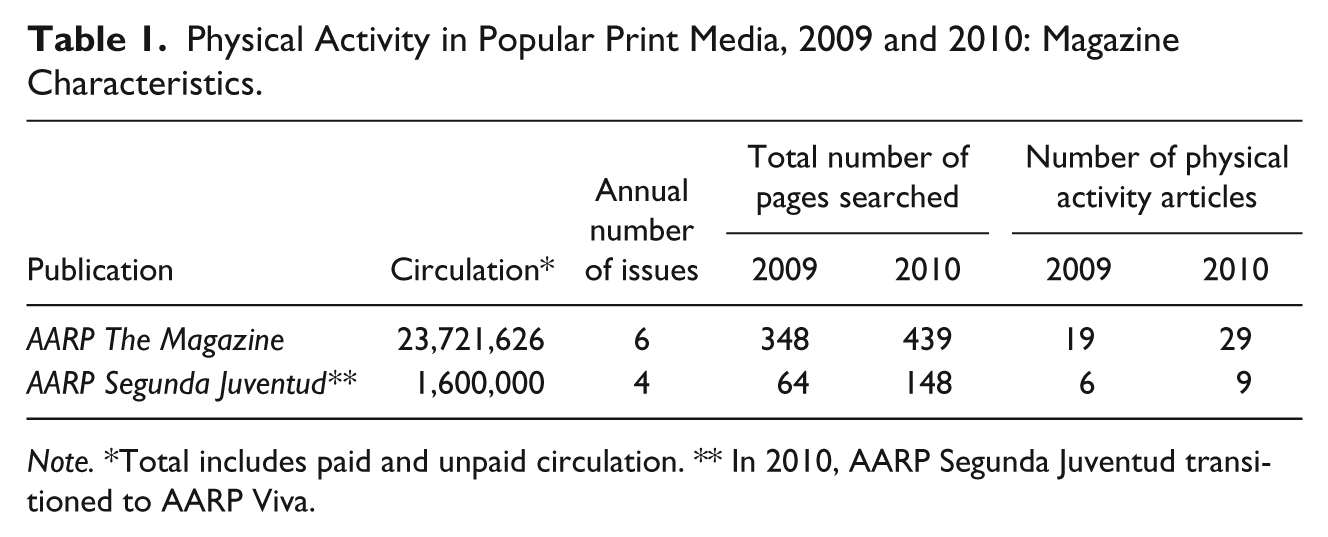
Note. *Total includes paid and unpaid circulation. ** In 2010, AARP Segunda Juventud transitioned to AARP Viva.
Authors collectively developed search criteria to identify relevant articles. The inclusion criteria for the AARP The Magazine article selection were: published in 2009 to 2010; available through the library system, and included reference to formal exercise or leisure-time PA in the title or body of the article. The inclusion criteria for AARP Segunda Juventud articles were: published in 2009 to 2010, available through the library system or AARP website, and included reference to formal exercise or leisure-time PA in the title or body of the article. Once these articles were accessed, an identifier code was assigned to each article. Two authors manually searched for articles using photocopied AARP issues and microfiche archives. Each page of 12 English AARP issues (N = 799 pages) and 6 AARP Segunda Juventud issues (N = 212 pages) were carefully examined to identify all articles about PA. AARP Segunda Juventud was not released during Fall and Winter 2009 because AARP transitioned this magazine to AARP Viva.
In the current content analysis, authors searched for articles that discussed both leisure-time PA and more specific formal exercise. Leisure-time PA is an activity undertaken in one’s discretionary time that leads to any substantial increase in the total daily energy expenditure (Bouchard & Shephard, 1994). Exercise refers to the primary form of leisure-time PA, and is structured, planned, and repetitive, and is performed with the purpose of increasing physical fitness or other health-related parameter (Bouchard & Shephard, 1994). Articles that mentioned either leisure-time PA (e.g., gardening) or more formal exercise (e.g., walking, group exercise, cycling,) were included. This study included only two types of PA because of the direct correlation between leisure-time and formal PA and cognitive health (Rolland et al., 2008).
Article Coding
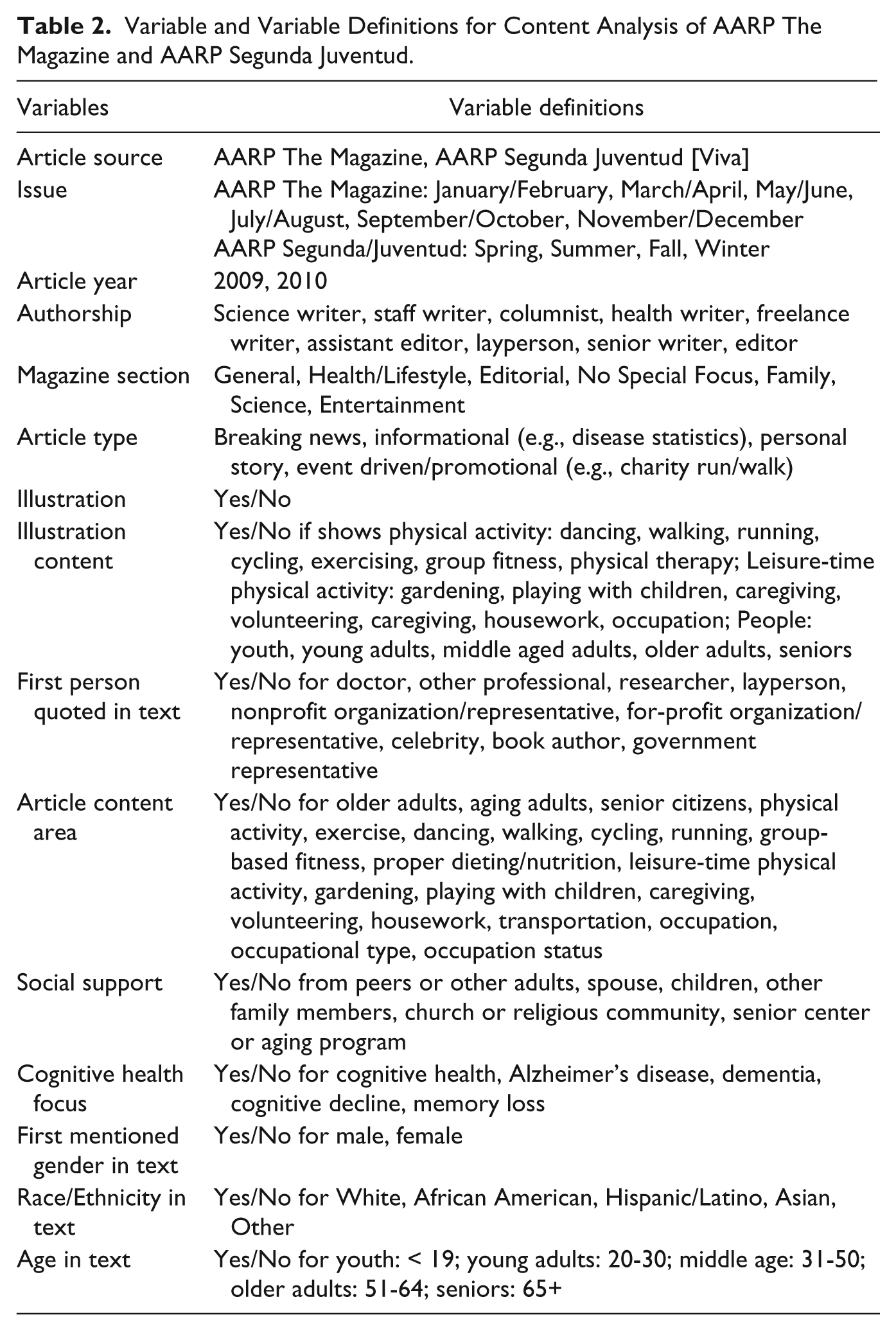
A coding schema was developed based upon previous cognition-focused content analysis research of our group (Friedman et al., 2010; Friedman et al., 2011; Vandenberg, Price, Friedman, Marchman, & Anderson, 2012). The schema for this analysis covered 15 content domains. The coding schema was pilot tested with a sample (n = 12) of magazine articles. Revisions were made based upon the results of the pilot test and the finalized schema was reviewed by all authors. Table 2 provides a listing of all variables coded and their corresponding definitions. All articles were coded by one of the primary raters (IR), using the detailed coding schema. Another coder (KF), who is bilingual, coded all Spanish language articles found in the AARP Segunda Juventud magazine. These two authors performed an interrater reliability check with 20% of the AARP articles using the detailed codebook. Since articles in AARP Segunda Juventud are translated to English, both coders were able to independently code this sample of articles and then in consultation make any necessary revisions and adjustments to the codebook. In an effort to reach agreement in the Spanish articles, both coders used the English-translated articles of AARP Segunda Juventud. To ensure coding agreement, Cohen’s Kappa statistic for each variable was calculated, and scores ranging from .764 ±.215 to 1.000 were considered good to perfect (Szklo & Nieto, 2004). Coders had contrasting coding responses for only three variables. They quickly reached 100% coding agreement after discussing these codes.
Variable and Variable Definitions for Content Analysis of AARP The Magazine and AARP Segunda Juventud.
Analytic Approach
The number of PA articles is reported. A standardized frequency, number of articles per 50 pages, was calculated for each magazine to provide an appropriate measure of the prevalence of PA articles. For example, 787 pages of AARP The Magazine (6 issues per year) were searched, whereas only 212 page of AARP Segunda Juventud (4 issues per year) were searched. Using the standardized frequency of number of articles per 50 pages provides a more meaningful comparison of English versus Spanish articles. Articles were coded using SPSS version 19.0. Descriptive statistics and nonparametric frequencies were used to assess the frequency and proportion of articles that associated PA with cognitive health. While coding, we also reviewed article content to select representative quotes. This type of mixed methods content analysis approach has been used elsewhere (Friedman et al., 2011; Hoffman-Goetz, Friedman, & Clarke, 2005).
Results
Article Demographics
A total of 63 articles discussed PA (48 in AARP English; 15 in AARP Spanish) and were included in the analysis. Most English articles (77.1%) were located in the general section of AARP The Magazine, followed by health/lifestyle (18.8%). Seventy-three percent of the articles did not specify authorship. Most articles were informational (64.6%), followed by promotional (18.8%), and personal stories (16.7%). More than one third of the articles (37.5%) mentioned laypersons as the first person quoted. Within informational articles, laypersons (41.9%) were more likely to be quoted first compared with doctors and other individuals (χ2(df=10) = 20.122, p < .036). In addition, within anecdotal articles, laypersons (50.0%) were more likely to be quoted first compared to doctors and other individuals such as other professionals, researchers, and celebrities (χ2(df=10) = 20.122, p < .036). More than 95% of the articles included a graphic, the most common being walking (27.1%), followed by dancing (8.3%). Most articles did not mention gender (87.5%) or race (95.8%). When included, the most commonly listed races were Caucasian (2.1%) or Asian American (2.1%). One third of the articles mentioned older adults (51-64) or seniors (65+), and some articles (60.4%) that mentioned age also included actual numerical values.
In the Spanish sample of AARP articles, 53% of articles were located in the health/lifestyle section of the magazine, followed by the general section (33.3%), entertainment section (6.7%), and special section (6.7%). Authorship was not specified in the entire sample of articles. As for article type, 53% were informational in nature, followed by personal stories (33.3%), and promotional/event-driven articles (13.4%). One third (33.3%) of the articles quoted laypersons upfront, followed by doctors (20.0%), nonprofit organizations (13.3%), celebrities (13.3%), for-profit organizations (6.7%), and book authors (6.7%). Most articles did not mention gender (86.7%) and approximately 80% of the sample mentioned Hispanic or Latino ethnicity. Table 3 presents additional details about the sample of AARP articles.
Characteristics of Article Sample by Magazine.
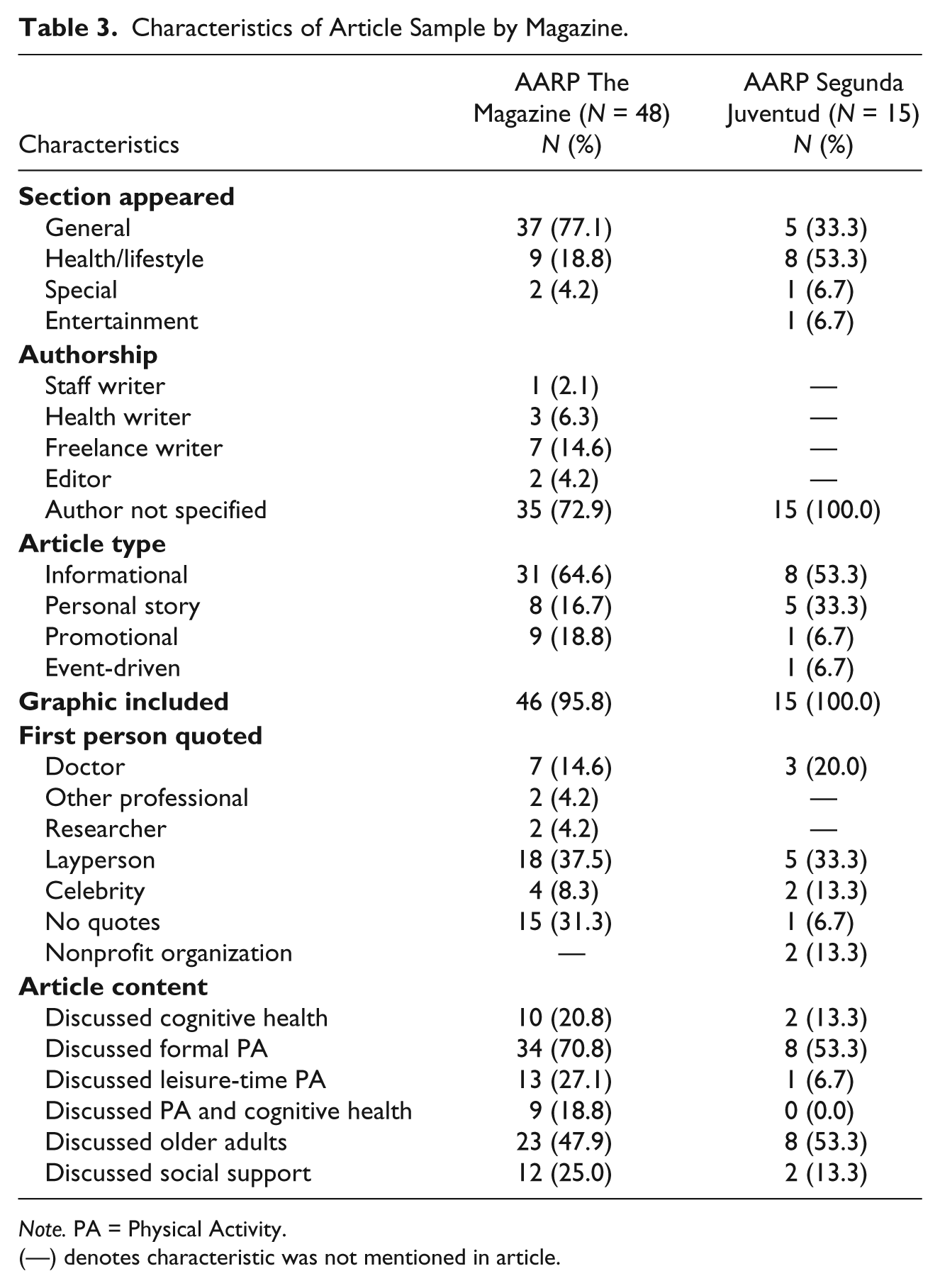
Note. PA = Physical Activity.
(—) denotes characteristic was not mentioned in article.
Article Content
In the AARP English sample, 70.8% of articles mentioned formal PA (e.g., running, walking) and 27.1% mentioned leisure-time PA (e.g., volunteering, gardening, caregiving). Also, 41.7% of the PA articles mentioned proper dieting or nutrition. In contrast, in the AARP Spanish sample, 53% of the articles discussed exercise, 33.3% discussed proper dieting or nutrition, and 26.7% discussed aging adults. Using the standardized frequency, AARP Spanish had more articles discuss PA per 50 pages (3.54) than AARP English (3.05).
Ten English articles and two Spanish articles mentioned cognition. These articles mentioned the importance of cognitive health among older adults, however, only three articles (6.3%) illustrated how PA may contribute to improved cognitive health. The sample included one article in particular that illustrated to consumers the relationship between PA and cognitive health. This article stated that “everyone can maximize his or her brain health. Living an active life is your best bet for staying sharp” (Doraiswamy, 2010, p. 39). Another quote illustrating PA as a benefit to cognitive health was “[find] a walking partner, study a topic, and discuss it on your walks. You’ll get mental stimulation, physical exercise, and social connection- they key brain strengtheners” (Doraiswamy, 2010, p. 40). This article also summarized the importance of PA on cognition by stating “exercising your body and brain can keep it working at its best” (Doraiswamy, 2010, p. 42).
Some articles (20.8%) mentioned activities that could boost one’s cognitive health. These activities included: science-backed puzzles, exercising once a week, not engaging in smoking, volunteering or working, and living with a spouse or caregiver. The articles focusing on cognition discussed mental stimulation activities such as puzzles and memory games. These articles also mentioned the importance of monitoring other health conditions such as blood pressure, weight, blood sugar, and cholesterol. In addition, these articles focused on relaxation techniques such as meditation and yoga. One article stated that “meditation, yoga, a walk in the woods: focus your mind and relax. This may build clearer memories” (Doraiswamy, 2010, p. 39).
In addition to mental stimulation, these articles mentioned the importance of a healthy diet to improve cognitive health. One English article mentioned that “a diet rich in fruits and vegetables, whole grains, and fish will help keep oxygen flowing to your brain.” (Doraiswamy, 2010, p. 40).
Only two Spanish articles focused specifically on cognitive health. The Spanish articles were not as informative as the English articles that were focused on cognitive health. The two Spanish articles in our sample did not mention PA as a potential correlate of cognitive health. Instead, these articles made reference to AD and dementia when discussing aging and other health or medical issues. One Spanish article stated, “many other Latinos are modifying their diets later in life. While some make changes to feel better, others do so under doctor’s orders to manage everything from lactose intolerance, diabetes, heart disease, and high blood pressure to arthritis, osteoporosis, and Alzheimer’s disease- conditions that hit the 50-plus crowd the hardest” (Palma, 2009, p. 26).
Discussion
This study examined and compared the coverage of PA and cognition media content in English and Spanish versions of a top-circulating magazine for adults 50 and older. The content analysis included 48 English articles and 15 Spanish articles from AARP The Magazine and AARP Segunda Juventud, respectively. Of these 63 articles, 12 articles focused specifically on cognitive health. Of these 12 articles, only three (English) explicitly mentioned PA as a benefit to cognition. In addition, this study found that the first person quoted was often a layperson which has implications for whether the article content will be perceived as applicable, credible, and trustworthy to the consumer (Kreuter & Strecher, 1996; Kreuter, Strecher, & Glassman, 1999). Oftentimes, older adults prefer receiving health information from traditional sources such as doctors and health care professionals because they consider them to be trustworthy and credible sources of health and medical information (Zulman, Kirch, Zheng, & An, 2011). In the context of health content in the mass media, older adult consumers may prefer to see doctors and health care professionals quoted instead of laypeople.
The results of this content analysis clearly indicate that print media is missing the opportunity to educate and inform older adults about AD, dementia, and other cognitive health issues. While previous research has examined cognition content published in print media (Friedman et al., 2010; Friedman et al., 2011; Matthews et al., 2009), this study illustrates that not many articles mentioned PA as a potential correlate of cognitive health. Research suggests that PA has the potential to reduce one’s risk of developing cognitive health problems, illustrating the need to have more content focused in this area (Colcombe & Kramer, 2003; Cotman & Berchtold, 2002; Cotman, Berchtold, & Christie, 2007; Nichol, Deeny, Seif, Camaclang, & Cotman, 2009; Parachikova, Nichol, & Cotman, 2008). AARP The top-circulating magazine in the United States and is exclusively focused on adults aged 50 years and older. AARP The Magazine has a readership of more than 34 million people. Given the large readership, this publication has the potential to serve as an important source of cognitive health information. Communication that is targeted specifically to an audience has the potential to influence health behaviors, attitudes, and beliefs (Noar, 2006). Research shows that older adults are concerned about maintaining their cognitive health as they get older (Connell, Scott, & McLaughlin, 2007), however, this study found that the top-circulating U.S. magazine only published 12 cognitive health articles over a 2-year time period (2009-2010).
Given the growing U.S. Latino demographic, it was of equal importance to examine cognitive health content in Spanish publications. Surprisingly, our study found that only two Spanish articles discussed cognitive health. These articles referenced AD and dementia, but did not inform Latino and Spanish-speaking consumers that they are considered high risk for developing AD in the future. In addition, authorship was not presented in any of the AARP Segunda Juventud articles. Providing authorship details can often lend credibility to the article and it is suggested that these types of health articles include information about the authors (Tanner & Friedman, 2011). These findings illustrate the need to develop culturally targeted cognitive health information specifically for to Latino and Spanish-speaking consumers. It is essential to develop health information with one’s targeted population in mind. Without regard to the targeted population, consumers may not know that health content is applicable to them (Kreuter et al., 1999). Future research should be conducted with a larger sample of Spanish publications to examine the coverage of PA and cognitive health content. In addition, future studies should examine Latino and Spanish-speaking consumers’ perception of cognitive health print media coverage.
Major Implications
This study has several implications for practice. First, AARP The Magazine ranges in page length from 68 to 84 pages while AARP Segunda Juventud is only 32 to 40 pages long. In addition, each article in AARP Segunda Juventud is translated into English which decreases the amount of space used for article content. AARP English is a larger magazine than AARP Spanish (i.e., more issues and more pages per issue) and has a greater opportunity to publish stories on PA and cognitive health, however, using a standardized approach to examine article volume, there were more PA articles published in AARP Spanish per 50 pages (3.54) than in AARP English (3.05). Of the AARP Spanish sample of articles, however, only 15 articles mentioned PA over a 2-year time period. Furthermore, only two Spanish articles discussed cognitive health and these articles did not provide consumers with information about lifestyle factors that may be associated with delaying the onset of AD and cognitive decline. These findings highlight the need to disseminate more content focused on the relationship between PA and cognitive health in both AARP The Magazine and AARP Segunda Juventud. These publications, which are targeted at older adults, are missing the opportunity to educate older consumers about cognitive health and AD.
Study Limitations
This study is not without limitations. First, this content analysis included a small sample of 63 articles. Nonetheless, albeit small, this sample included all PA articles published in AARP The Magazine and AARP Segunda Juventud between 2009 and 2010. Second, only two mainstream magazines were included in this review. However, these magazines were selected because of their large readership of adults aged 50 years and older. Future research should be conducted with a broader range of mainstream and ethnic magazines and newspapers.
Conclusion
Print media has an opportunity to disseminate PA and cognitive health information to consumers. This study found that some articles provided information that is consistent with scientific evidence, linking the adaption of healthy behaviors, such as PA, dieting, and mental stimulation, to cognitive health (Luchsinger, Noble, & Scarmeas, 2007). The findings of this content analysis revealed that print media is missing an opportunity to educate consumers, especially older Latinos, about cognitive health. Despite searching through over 1,000 pages of articles, only 63 PA-focused articles were located in AARP English and Spanish magazines. Furthermore, the current cognitive health content is not adequately illustrating the connection between PA and cognition. By disseminating accurate, targeted, and culturally appropriate cognitive health information, print media has the potential to contribute to the health of both English- and Spanish-speaking consumers.
Footnotes
Acknowledgements
We thank Dr. Teresa A. Keenan, PhD for reviewing this paper prior to submission.
Declaration of Conflicting Interests
The authors declared no potential conflicts of interest with respect to the research, authorship, and/or publication of this article.
Funding
The authors disclosed receipt of the following financial support for the research, authorship, and/or publication of this article: DB Friedman was partially supported by 1U48/DP001936 - the Healthy Aging Research Network from the Centers for Disease Control and Prevention.