






Abstract
Introduction
Good hearing is a prerequisite for verbal communication and thus essential for social interaction with other people (Brink & Stones, 2007). However, hearing problems are extremely common in older adults. Prevalence of hearing loss ranging from 27% to 63% has been reported for audiometrically measured hearing detection thresholds (Chia et al., 2007; Kiely, Gopinath, Mitchell, Browning, & Anstey, 2012; Lin, Thorpe, Gordon-Salant, & Ferrucci, 2011; Viljanen et al., 2009) and 37% to 56% for self-reported hearing impairment (Chia et al., 2007; Hannula, Mäki-Torkko, Majamaa, & Sorri, 2010; Kiely et al., 2012) in older adults. Hearing loss increases dramatically as a function of age (Chia et al., 2007; Kiely et al., 2012). Excluding the ototoxic effects of some medications, hearing problems in older adults are most often related to progressive degeneration of cochlear structures and the auditory nervous system (Schuknecht, 1964; Schuknecht et al., 1974). Impaired hearing may cause frustration and embarrassment in social interaction (Gopinath, Hickson, et al., 2012) and older adults may avoid situations in which good hearing abilities are needed (Gopinath, Hickson, et al., 2012; Stephens, Jaworski, Lewis, & Aslan, 1999).
The World Health Organization (WHO) recognizes participation relative to one’s needs, including optimization of participation in social and cultural affairs, as a vital element of active aging (WHO, 2002). The consequences of social withdrawal may be considerable: It has been shown to be associated with poorer life satisfaction (Huxhold, Fiori, & Windsor, 2013; Sampaio & Ito, 2013) as well as increased risk for institutionalization (Pynnönen, Törmäkangas, Heikkinen, Rantanen, & Lyyra, 2012), and death (Holt-Lunstad, Smith, & Layton, 2010; Pynnönen et al., 2012). Previous studies investigating the relationship between hearing and social activity have used “objective” measures of social participation, where respondents are asked to rate the frequency or extent of their participation in various activities. However, it is also possible to measure “perceived” participation also referred to as autonomy (Cardol, de Haan, de Jong, van den Bos, & de Groot, 2001; Seekins et al., 2012). Perceived participation describes a person’s experience relative to the person’s needs to be involved in various life situations (in and outside the home, self-care, social relations, work; Cardol et al., 2001; Wilkie et al., 2011). In other words, perceived participation scales measure the opportunity that a person has to live life in the way that she or he would like to (Cardol et al., 2001). Thus, perceived participation may be more relevant for the well-being of an individual than objective participation. Perceived participation has been found to be associated with number of health conditions, activity limitations, mental problems, and income (Wilkie, Peat, Thomas, & Croft, 2007). However, knowledge on perceived participation among persons with hearing difficulty appears to be very limited. One study found that deaf persons had a 1.4 times higher odds ratio (OR) for perceived participation restriction measured using the Keele Assessment of Participation questionnaire in a large sample of adults aged 50 years and above (Wilkie et al., 2007). However, to our knowledge, no studies have thus far explored the relationship of hearing to perceived participation in persons with milder hearing impairment.
Some investigators (Crews & Campbell, 2004; Simonsick, Kasper, & Phillips, 1998), but not all (Yamada, Nishiwaki, Michikawa, & Takebayashi, 2012), have reported an association between self-reported hearing difficulty and a lower level of social participation. Crews and Campbell found that persons with any hearing problem in a sample of nearly 10,000 older adults aged 70 or above were less likely (OR 0.8-0.9) to visit friends, attend church, and go to movies (Crews & Campbell, 2004). Simonsick and colleagues found that hearing difficulties in a crowded room were associated with infrequent in-person contact (OR 1.6) in a sample of 1,000 community-dwelling disabled women aged 65 and above. In another study, self-reported hearing difficulties were associated with social loneliness but not with emotional loneliness in a sample of over 800 adults aged 55 to 85 (Pronk et al., 2011). However, in a longitudinal study conducted among more than 1,000 adults aged 65 to 98, hearing another person in a quiet room did not have any significant influence on decline in social participation over a 3-year follow-up period. The social participation subscale was measured according to reported engagement in visiting friends, giving advice to family or friends, visiting friends or family in the hospital, and initiating conversations with young people (Yamada et al., 2012).
The differences between these investigations may be due to the particular different variables chosen to measure social and leisure participation. Previous studies have either investigated rather specific types of leisure activity separately or combined them as a scale. These approaches do not take into account whether the activities require social contact with others or are carried out in a non-group context, both of which might be relevant factors in terms of hearing. This issue clearly warrants further investigation. Furthermore, it has been suggested that cognitive abilities may be related to both hearing and social participation (James, Wilson, Barnes, & Bennett, 2011; Pronk et al., 2011; Rahman, Mohamed, Albanouby, & Bekhet, 2011; Wang, Karp, Winblad, & Fratiglioni, 2002), although the relationships posited between these three phenomena have not been confirmed when included in the same study (Pronk et al., 2011; Simonsick et al., 1998). However, the possible associations necessitate the inclusion of cognition when investigating the relationships between hearing and social participation.
The purpose of this study was to investigate whether self-reported hearing difficulty among older community-dwelling men and women is associated with (a) less frequent participation in social activities and group or non-group leisure activities and (b) more restricted perceived participation outside the home. Furthermore, these relationships were investigated taking into account the cognitive status of the participants.
Method
Design and Sample
The analyses made use of cross-sectional data gathered for the LISPE (Life-Space Mobility in Old Age) project, which is a study of community-dwelling older adults. The project has been described in detail elsewhere (Rantanen et al., 2012). Briefly, a sample of 2,550 older persons between 75 and 90 years of age and living in the municipalities of Muurame and Jyväskylä, both located in Central Finland, was drawn from the population register. A telephone interview was used to screen eligible participants. Of this sample, 268 persons were not reached. In total, 1,070 persons declined to participate. Most of the persons declined were either not interested in participating in the project or perceived their health as too poor to participate. The inclusion criteria included living independently, residing in the recruitment area, being able to communicate, and willingness to participate in the study. Based on these criteria, 321 persons, of whom 47 persons were excluded since they were unable to communicate, were excluded during the project recruitment phase. Furthermore, the data of two participants were lost due to technical problems. The final data set comprised 848 individuals who participated in structured computer-assisted interviews in their homes. The LISPE project was approved by the ethical committee of the University of Jyväskylä. The subjects signed an informed consent at the start of the home interview.
Hearing
Hearing was assessed by the following question: “Do you have difficulty hearing when conversing with another person in a noisy environment?” The response categories were (1) No difficulty, (2) Sometimes, some difficulty, and (3) Yes, major difficulty. The participants were asked to estimate their level of difficulty when using a hearing aid if they had one.
Participation in Social and Leisure Activities
Objective participation was measured by asking the participants how often they (a) attend group activities outside the home, such as a choir, physical activity class or church activities; (b) engage in non-group cultural or other activities outside the home, such as going to a concert, the theater, or a coffee house; (c) meet their children or grandchildren; (d) meet close friends; and (e) meet acquaintances. The response set included seven categories, from daily to never.
Perceived participation was measured using the Impact on Participation and Autonomy (IPA) questionnaire (Cardol et al., 2001; Kanelisto & Salminen, 2011). In the LISPE study, only the domain of autonomy outdoors was used. This domain contains five questions regarding perceived opportunity to (a) visit relatives and friends, (b) take trips and travel, (c) use leisure time, (d) meet other people, and (e) live life the way one wants to. The response categories ranged from 0 (very good) to 4 (very poor). The scores of all the questions are then summed to yield an aggregate score, with a higher score indicating poorer perceived participation. Total score was also calculated for participants with one missing item (n = 2).
Potential Confounders
Cognitive function was assessed using the Mini-Mental State Examination (MMSE; Folstein, Folstein, & McHugh, 1975). The test contains 30 items, and the score ranges from 0 to 30, with higher scores indicating better cognitive functioning. For the present study, the MMSE scores were dichotomized into MMSE > 24 and MMSE ≤ 24. MMSE score ≤24 is considered to be indicative of at least mild cognitive impairment in the Finnish evidence-based guidelines for clinical practice (Working Group Appointed by the Finnish Medical Society Duodecim, Societas Gerontologica Fennica, the Finnish Neurological Society, Finnish Psychogeriatric Association and the Finnish Association for General Practice, 2010).
The number of chronic diseases was determined with a question that required the participant to have been diagnosed with the disease in question by a physician. The question was followed by a list of 22 chronic diseases and an open question. The relevance of diseases reported in the open question was checked by a physician. Auditory diseases and traumas were omitted from the total number of diseases.
Those who reported being unable to walk 2 km without difficulty were defined as having mobility limitation. A participant was considered to have impaired vision if she or he reported that vision problems restricted their mobility. The participants were also asked whether they lived alone, whether they were a caregiver to a close relative (daily), whether they had sufficient financial resources relative to their needs, and how many years of education they had completed (Rantanen et al., 2012). These potential confounders were chosen, as poor mobility has previously been found to be associated with lower social participation (Nilsson, Avlund, & Lund, 2011). We also hypothesized that persons who live alone, care for a close relative, have inadequate financial resources and less education are less likely to participate in social and leisure activities than others.
Statistics
The statistical analyses were performed using IBM SPSS Statistics for Windows software version 20.0 (IBM Corp., Armonk, NY, USA). There were missing values: Information on hearing, group activities, non-group activities, and meeting friends were missing for only one participant in each case. The pairwise analysis option was used where possible, that is, subjects with some missing values were not excluded from the analysis. First, the distributions of categorical variables across the hearing groups were analyzed using cross-tabulations and chi-square tests. Due to the non-normal distributions, median and interquartile range (IQR) were calculated for the continuous variables. The Kruskal–Wallis H-test was used to compare the distributions of the continuous variables between the hearing groups.
To investigate the relationship between self-reported hearing categories and participation, ordered logistic regression analyses with proportional odds were used. The regression coefficient describes the odds of a group (in the present study some difficulty or major difficulty in hearing), compared with the reference group (no hearing difficulty), having a certain value of the ordinal outcome variable (participation restriction) versus all the higher values. The proportional odds model assumes constant distances between the outcome variable levels and thus the model produces only one OR for each group of the independent variable (hearing) except for the reference group. In other words, OR that describes the odds of the lowest versus all the higher categories of the outcome variable is the same as the OR that describes the relationship between the next lowest category and all the higher categories. For the ordered logistic regression analysis, the number of categories of the objective participation variables was reduced. This was achieved by merging categories with a small number of observations with adjacent categories to better meet the parallel line assumption of the analysis. Owing to the different distributions of observations in the objective participation variables, the final number of categories varied from three to five depending on the variable. Although the IPA scale was continuous, its distribution was non-normal in the hearing groups. Hence, IPA was divided into quartiles, and ordered logistic regression analysis was also used for this variable. The higher values of the outcome variables correspond to less frequent or poorer perceived participation. Thus, the results show the odds for less frequent objective participation or poorer perceived participation. Statistical significance was set at p < .05.
First, a crude model including all participants was constructed. Using the crude model, it was tested whether hearing and age, gender, hearing aid ownership, or MMSE had significant (p < .05) interaction effects on participation. Only MMSE score was found to have systematically significant interaction effects with hearing on participation. Consequently, crude models were built separately for participants with MMSE > 24 and MMSE ≤ 24 to determine whether the association between self-reported hearing difficulty and participation was significant in these two groups. The crude analyses in these subgroups revealed that hearing difficulty was not associated with objective participation in the group of participants with MMSE ≤ 24. Adjusting the models for age, gender, number of diseases, mobility, vision, living alone, financial situation, caregiving for a close relative, and years of education did not markedly change this result. Hence, the adjusted models of objective participation are reported only for the participants with normal cognitive function. The first criteria for a covariate were its associations (p < .2) with both hearing (independent variable) and participation (dependent). This was done using analysis of variance (ANOVA) for continuous, and crosstabs with chi-square test for categorical variables. The potential covariates meeting these criteria were added separately to the ordered logistic regression models with hearing as the independent and participation as the dependent variable. Next, the potential covariates were added to the ordered logistic regression model one by one in the order of change induced in the regression coefficient of hearing (the variable that induced the biggest change was added first). The criterion for keeping the covariate in the model was that adding the covariate changed the OR of hearing by 10% or more.
Results
Of the participants, 43% reported no difficulty, 46% some difficulty, and 10% major difficulty in hearing when conversing with another person in the presence of noise (Table 1). The group with major difficulty in hearing had the largest and the group with no hearing difficulty the smallest proportion of participants who reported hearing aid ownership and mobility limitation. Also, median age was highest in the group with major difficulty in hearing and lowest in the group with no difficulty in hearing. With respect to the distribution of number of diseases reported and MMSE scores, significant differences were observed across the three categories of hearing status: The group with major difficulty in hearing had greater median number of diseases and lower median MMSE score than the other groups.
Characteristics of the Participants Reporting No Difficulty, Some Difficulty, and Major Difficulty in Hearing When Conversing in Noisy Environment (N = 847).
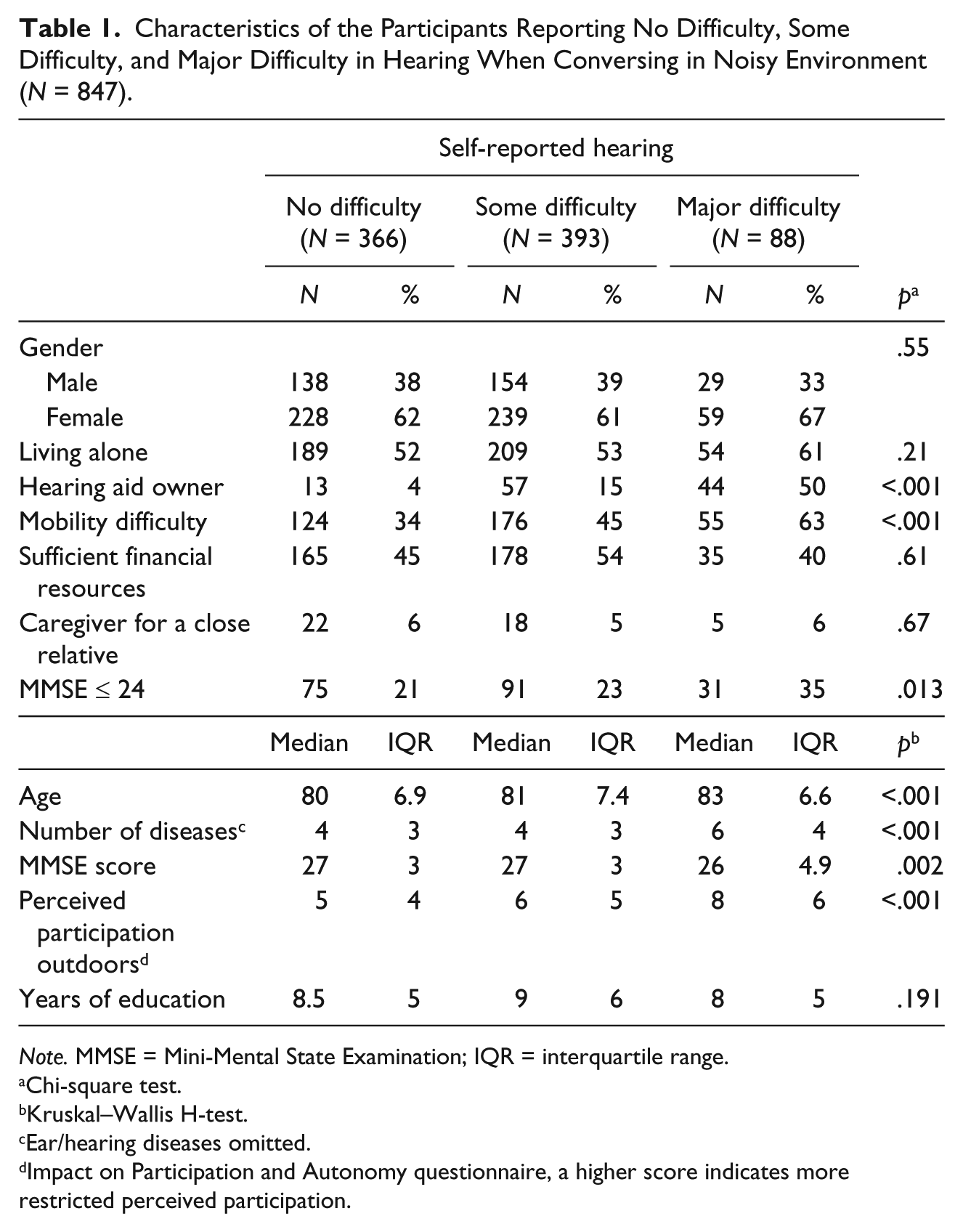
Note. MMSE = Mini-Mental State Examination; IQR = interquartile range.
Chi-square test.
Kruskal–Wallis H-test.
Ear/hearing diseases omitted.
Impact on Participation and Autonomy questionnaire, a higher score indicates more restricted perceived participation.
The participants with major hearing difficulty met close friends less frequently than those with no or some hearing difficulty (χ2 test p = .019; Table 2). The data also showed a trend indicating that hearing difficulty is associated with less frequent participation in group activities (p = .082). The majority of the participants with major hearing difficulty were in the quartile of the poorest perceived participation (i.e., high IPA score), whereas the majority of participants in the no hearing difficulty group were in the quartile of the greatest perceived participation (low IPA score; p < .001). The hearing groups did not differ significantly in the frequency of attending non-group activities outside the home, meeting children and grandchildren, or meeting acquaintances.
Frequency of Social Activity in Participants Reporting No Difficulty, Some Difficulty, and Major Difficulty in Hearing When Conversing in Noisy Environment (N = 847).
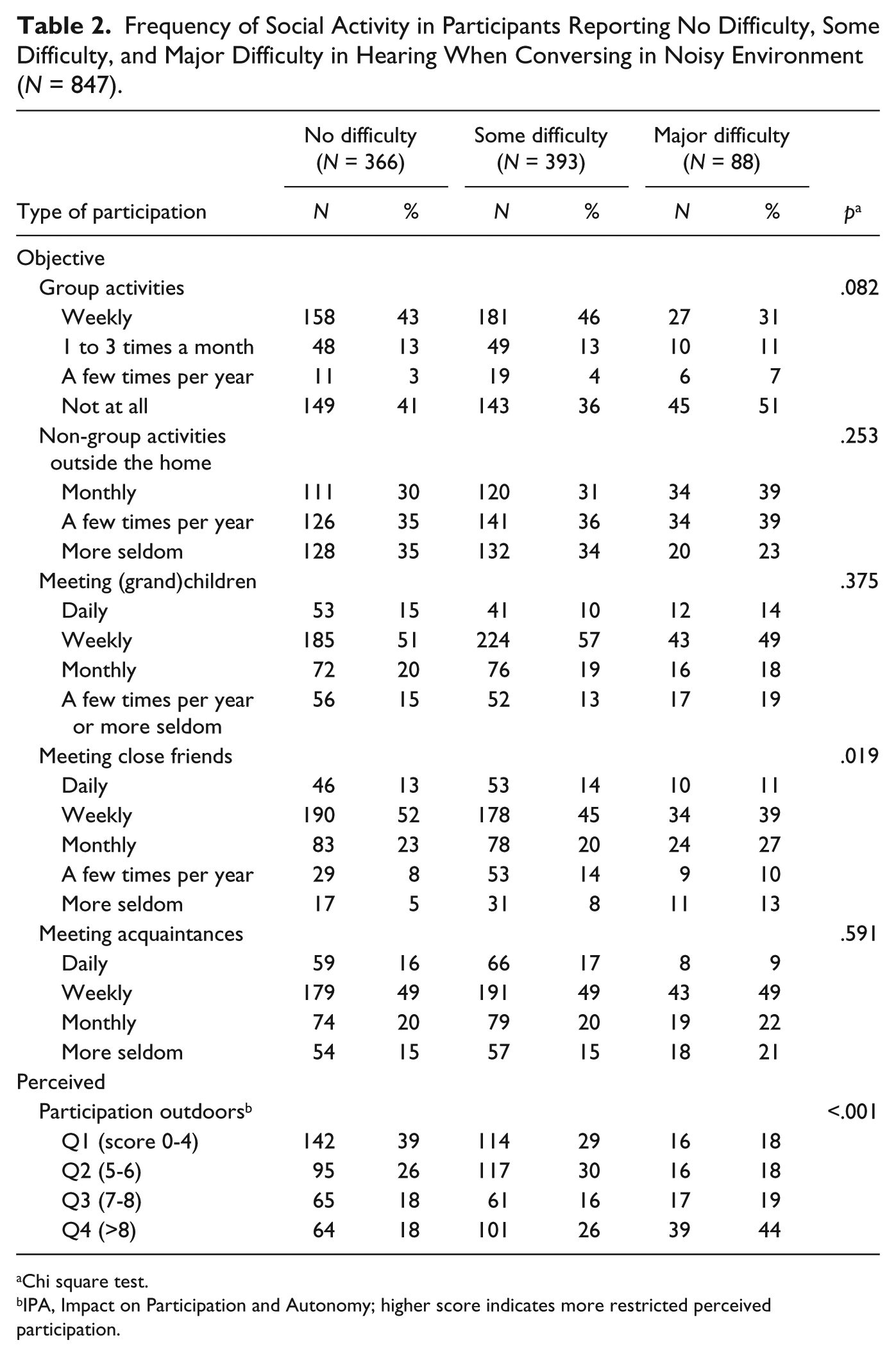
Chi square test.
IPA, Impact on Participation and Autonomy; higher score indicates more restricted perceived participation.
Objective Participation
The results of the ordered logistic regression analyses used to investigate the relationship between hearing difficulty and participation are shown in Table 3. The crude models revealed that, relative to the participants who reported no difficulty in hearing, those who reported major difficulty in hearing had 1.6 (95% CI [1.1, 2.5]) times higher odds of infrequent participation in group activities, 1.6 (95% CI [1.0, 2.5]) times higher odds of infrequent participation in non-group activities outside the home, and 1.7 (95% CI [1.1, 2.6]) times higher odds of meeting close friends infrequently. In the crude models containing all the participants, hearing was not significantly associated with meeting children and grandchildren or acquaintances.
The Odds for More Restricted Participation by Categories of Self-Reported Difficulty in Hearing.
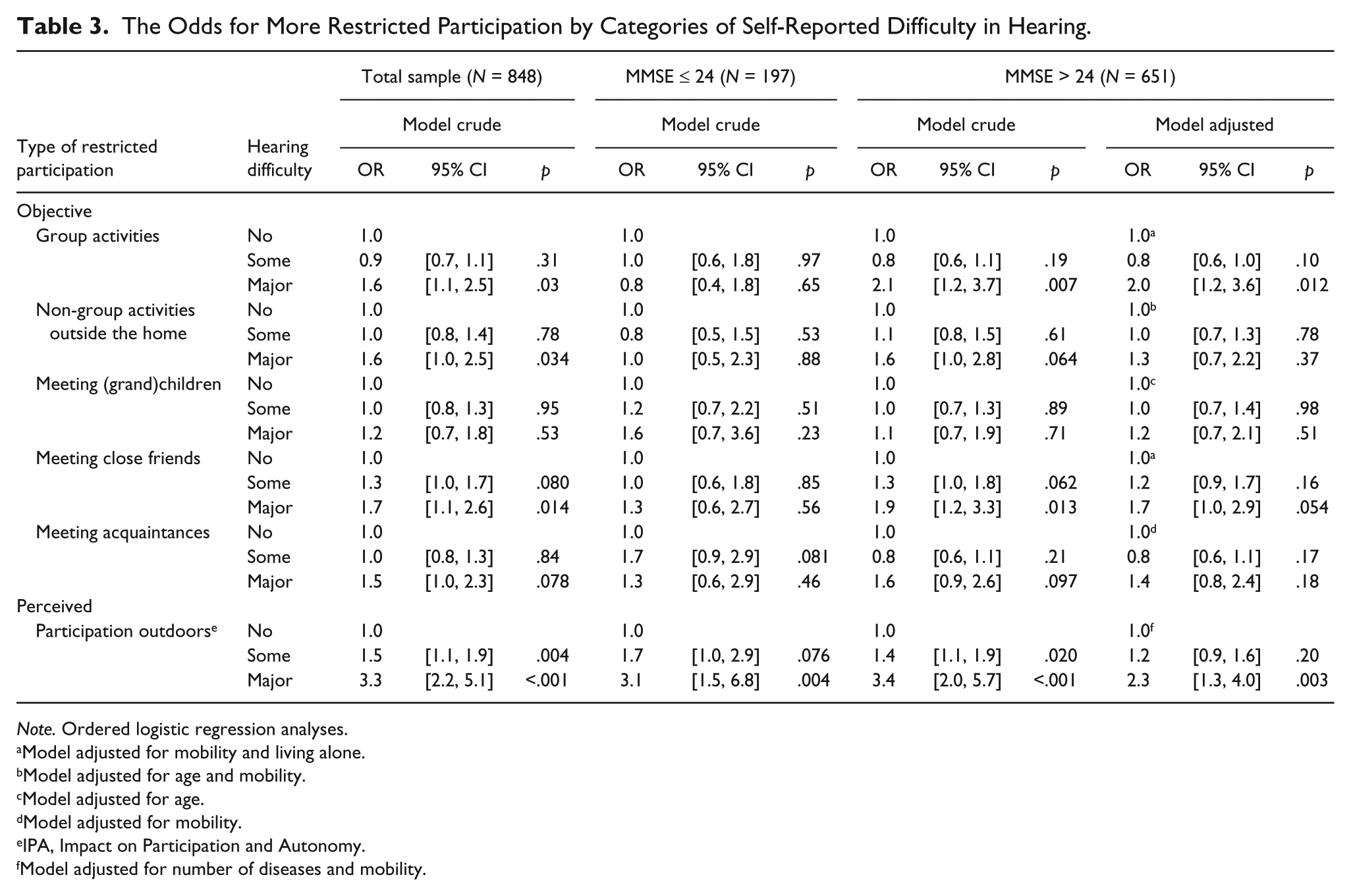
Note. Ordered logistic regression analyses.
Model adjusted for mobility and living alone.
Model adjusted for age and mobility.
Model adjusted for age.
Model adjusted for mobility.
IPA, Impact on Participation and Autonomy.
Model adjusted for number of diseases and mobility.
When the participants were divided into groups based on their cognitive status, the crude models showed that none of the types of objective participation was associated with hearing in persons with MMSE ≤ 24 (Table 3). Adjusting the models did not change the result. However, among persons with MMSE > 24, hearing was found to be associated with meeting friends and attending to group activities: Those with major hearing difficulty had 2.1 (95% CI [1.2, 3.7]) times higher odds of infrequent attendance at group activities and 1.9 (95% CI [1.2, 3.3]) times higher odds of meeting friends infrequently. Adjusting the models did not markedly change the odds (2.0, 95% CI [1.2, 3.6] and 1.7, 95% CI [1.0, 2.9], respectively), although the p-value of the odds of meeting friends increased (p = .054). In persons with MMSE > 24, hearing was not significantly associated with frequency of engagement in non-group activities, meeting children/grandchildren or meeting acquaintances. Also, participants who reported only some difficulty in hearing did not significantly differ from the participants who reported no difficulty in any of the measures of objective participation.
Perceived Participation
In the crude models, participants who reported some or major difficulty hearing had 1.5 (95% CI [1.1, 1.9]) and 3.3 (95% CI [2.2, 5.1]) times higher odds of perceived participation restriction, respectively, than those who reported no hearing difficulty (Table 3). The odds were of the same order of magnitude among participants with MMSE ≤ 24 and those with MMSE > 24. After introducing the covariates into the model, among participants with MMSE > 24, the odds of more restricted perceived participation were reduced to 2.3 (95% CI [1.3, 4.0]) in those with major difficulty in hearing. After adjustment, the older adults with some difficulty in hearing no longer differed significantly from those who reported no difficulty in hearing. After adjustment, among participants with MMSE ≤ 24, the odds of more restricted perceived participation was not significant for those who reported some or major hearing difficulty. Specifically, the ORs of participants with some and those with major hearing difficulty were 1.5 (95% CI [0.8, 2.6]) and 1.5 (95% CI [0.6, 3.5]), respectively.
Discussion
The results of the present study suggest that, among older adults with normal cognition, there is an association between self-reported hearing difficulty and social and leisure activity. Moreover, the association appears to be activity-specific. Older adults with normal cognition and who report major hearing difficulty participate less frequently in group activities and tend to meet less frequently with their close friends than older adults who do not report any difficulty in hearing. However, older adults who report hearing difficulty do not differ in their frequency of participation in non-group activities and meeting relatives or acquaintances from those who report no difficulty in hearing. Also, among older adults with normal cognition, those who report a major hearing difficulty perceive their participation to be more restricted relative to their needs outside the home than the others.
Participation in social and leisure activities seems to be vital for older adults. In this population, social activity has been shown to be associated with functional ability (Avlund, Lund, Holstein, & Due, 2004; James, Boyle, Buchman, & Bennett, 2011), cognitive functioning (James, Wilson, Barnes, & Bennett, 2011; Wang et al., 2002), and mortality (Holt-Lunstad et al., 2010; Pynnönen et al., 2012). In addition, older adults who are socially active are more satisfied with their life than those who are less active (Huxhold et al., 2013; Sampaio & Ito, 2013). Our results suggest that self-reported major hearing difficulty may compromise active aging through a reduced level of social participation. Previous studies investigating the relationship between hearing and social activity have reported conflicting results. Recently, Yamada et al. found no associations between self-reported hearing and decline in social participation (Yamada et al., 2012). In a study involving adults aged 70 years and above, Marsiske et al. observed that good hearing acuity, assessed using pure-tone audiometry, was associated with more time spent in leisure activities (Marsiske, Klumb, & Baltes, 1997). Hearing loss has also been found to be related to feeling lonely or left out in group situations (Pronk et al., 2011; Strawbridge, Wallhagen, Shema, & Kaplan, 2000). Our results suggest that also severity of hearing problems counts. Those who reported major hearing difficulty participated less often in some social activities while those who reported only some hearing problems were equally socially active than persons who reported good hearing.
The finding that reported major hearing difficulty was associated with less participation in some activities, but not all, suggests that hearing ability may have an activity-specific effect on participation. In relation to the activity of meeting relatives and friends, the trend seen in the present results is consistent with those reported by Crews et al. who found that, compared with older adults with no hearing or vision impairment, individuals with self-reported hearing loss were less likely to have visited friends within the past 2 weeks (Crews & Campbell, 2004). However, self-reported hearing difficulty did not have an effect on meeting relatives. In the present investigation, reported major difficulty in hearing was negatively associated with participation in group activities but not with non-group activities outside the home. These findings are intuitively plausible. Group activities may be more challenging for people with hearing loss, as they typically involve communicating with one or more persons in a noisy environment. However, our results partly contradict the results of Crews and Campbell, who reported that, compared with older adults with no hearing difficulty, persons with reported hearing loss less often go to church and the movies, both non-group activities (Crews & Campbell, 2004). However, it could be argued that these activities may be challenging for people with hearing loss. Furthermore, the authors did not observe an effect of reported hearing difficulty for two activities that, depending on the situation, may or may not have group-like features, namely, eating out and exercising. Nevertheless, and notwithstanding the differences between the present results and those reported by Crews and Campbell, it appears as though at least some of the inconsistencies that have been observed across the studies that have investigated the relationship between hearing difficulty and participation may be resolved by taking into account the specific type of social and leisure activities in question.
Cognitive function seems to be related to both hearing abilities and social participation. Hearing impairment and a low level of social activity level have been shown to predict a steeper decline in cognitive functions with aging (James, Wilson, Barnes, & Bennett, 2011; Lin et al., 2013; Wang et al., 2002). In the present study, social and leisure activities were associated with hearing but only among persons with normal cognitive function. Several factors could explain the influence of cognitive function on the association observed between hearing difficulty and social participation. It is possible that poor hearing makes it more difficult to understand the instructions when cognitive tests are administered. This may result in poorer performance on cognitive tests (Räihä et al., 2001) as well as strengthen the relationship observed between hearing difficulty and cognition. It has also been shown that even mild cognitive impairment has a deleterious effect on auditory processing (Rahman et al., 2011), which in turn may hamper verbal communication. According to Brink et al., impaired verbal communication is a factor that mediates the influence of hearing loss on social engagement (Brink & Stones, 2007). Furthermore, cognitive problems may disturb verbal communication due to the misinterpretations of non-literal meanings used in spoken language (Maki, Yamaguchi, Koeda, & Yamaguchi, 2013).
Novel components of the present study included the use of various indicators of social activity and investigation of perceived participation. To our knowledge, the association between hearing and perceived participation has been addressed in only one other study. Wilkie et al. used the Keele Assessment of Participation questionnaire to explore the association between hearing loss, among other health conditions, and participation in various aspects of life in older adults (Wilkie et al., 2007). The authors reported that persons with hearing loss had 1.4 times higher odds than persons without hearing loss for participation restrictions, that is, not participating when and in the way they wanted to all or most of the time. The present results show that older adults with self-reported major hearing difficulty perceived more restrictions on their participation in life situations outside the home than those who reported no hearing difficulties. The questionnaire included the IPA domain of autonomy outdoors, which includes items related to perceived opportunities for social activity, life in general, trips, and leisure (Cardol et al., 2001; Kanelisto & Salminen, 2011). Participation outside the home may be an especially sensitive indicator of autonomy restriction among community-dwelling older adults, as found in the present sample, as it is the most likely area of participation restriction in older individuals (Wilkie, Peat, Thomas, & Croft, 2006). In the present study, participants with major hearing difficulty met relatives and acquaintances and engaged in non-group activities as often as persons with no hearing difficulty. However, it is noteworthy that this type of social participation was not sufficient for the participants with hearing difficulty to experience a sense of autonomy comparable with that of non-hearing impaired.
It should be noted that we studied self-rated hearing irrespective of hearing aid use. Participants were asked to rate their hearing while wearing a hearing aid, if they had one. We assessed hearing irrespective of hearing aid use, as we consider that perceived hearing ability in everyday life is a more important determinant of participation than use of a hearing aid as such. However, we used just one question to determine level of hearing in the analyses. Therefore, we do not know whether some of those using a hearing aid and hence reporting good hearing have difficulties in other situations that might limit their participation. If so, our results underestimate the strength of the association between hearing and participation. It is challenging to study the influences of hearing aid use in an observational study, as hearing aid use is statistically confounded by hearing difficulty. Owing to the design, we were unable to determine the influence of hearing aid use on participation, which could have yielded valuable information on the importance of audiologic rehabilitation for participation in older people.
The results should be interpreted with caution. First, a cross-sectional design was used. This limits any causal relationship that may be drawn among the variables investigated. However, it seems intuitively more plausible that hearing loss leads to reduced participation than vice versa. A strength of this study was having a population-based sample of community-dwelling older adults. Although a marked number of those invited to participate declined to do so, this is not exceptional in studies of older people (Mody et al., 2008). For one thing, poor health status is likely to decrease the willingness to participate in research (Mody et al., 2008). In fact, the non-participants significantly more often perceived their health as poor or very poor and moved outdoors less often than those who participated in the present study (Rantanen et al., 2012). Moreover, some persons were excluded because they were not able to communicate during the telephone screening or home interview. This exclusion criterion is likely to have diminished the number of persons with severe hearing impairment in this study. If these persons had participated, the associations observed between hearing and participation might have been stronger. Unfortunately, the data on hearing status were based on responses to a self-report question rather than on audiometric measurements. However, self-reports of hearing are widely used in epidemiological research (Chia et al., 2007; Crews & Campbell, 2004; Pronk et al., 2011; Strawbridge et al., 2000; Yamada et al., 2012) and have been shown to have sufficient sensitivity and specificity in comparison with pure-tone audiometry (Salonen, Johansson, Karjalainen, Vahlberg, & Isoaho, 2011; Sindhusake et al., 2001). Furthermore, it could be argued that in some respects, relative to indices of hearing detection thresholds, self-report estimates of hearing difficulty are a more appropriate variable for investigating issues related to well-being (Gopinath, Schneider, et al., 2012). Given the range of adaptive strategies that can be used to optimize communication as well as the complex constellation of physical and social environments in which individuals maneuver (Garstecki & Erler, 1996; Gomez & Madey, 2001; Hallberg, Hallberg, & Kramer, 2008), it is possible that the effects of hearing status on social participation are better accounted for by responses to a self-reported questionnaire than hearing detection thresholds obtained in a sound-treated test suite. Furthermore, our question on hearing when conversing in the presence of noise may be especially suitable for assessing hearing in older adults since understanding speech in noise is one of the most frequent hearing disabilities perceived by older people (Kramer, Kapteyn, & Festen, 1998; Plomp & Mimpen, 1979).
In conclusion, major hearing difficulty among older community-dwelling adults with normal cognition increases the risk for less frequent participation in group activities, fewer meetings with friends, and poorer perceived participation outside the home. Audiologic rehabilitation services should be available for older adults with hearing difficulties to optimize their participation in social and leisure activities. Pertinent rehabilitation intervention strategies may include the use of technological equipment, learning strategies to appropriately manage the social and physical environment, and the use of effective communication strategies.
Footnotes
Authors’ Note
Gerontology Research Center is a joint effort between the University of Jyväskylä and the University of Tampere.
Declaration of Conflicting Interests
The authors declared no potential conflicts of interest with respect to the research, authorship, and/or publication of this article.
Funding
The authors disclosed receipt of the following financial support for the research, authorship, and/or publication of this article: This work is funded by the Academy of Finland (Grant 263729). The LISPE project is funded by the Academy of Finland, the Future of living and housing (ASU-LIVE; Grant 255403) program and Finnish Ministry of Education and Culture. Anne Viljanen is financially supported by a personal grant from the Academy of Finland (Grant 251723).