







Abstract
This study explores the role that place of birth and place of residence have in variation in cognition in adulthood in the UK. We take advantage of both the large sample size and number of cognitive domains in the UK Biobank to estimate the effect of place of birth and place of residence on adulthood cognition using multilevel modeling. We find, consistent with studies in the US, that place effects at both time points contribute modest variation (<3% of the variation) across all measured cognitive domains, suggesting a relative lack of contribution of shared environments in explaining future Alzheimer’s Disease and Related Dementias. Moreover, the geographical contribution to cognitive function in adulthood was slightly larger for females than for males. This study is among the first to explore the impact of both the independent and joint associations of place of birth and place of residence with different cognitive domains.
Introduction
Cognitive outcomes, representing the multifaceted aspects of human cognitive abilities, are integral to understanding human potential, adaptive capabilities, and overall well-being (Laland & Seed, 2021). Specific dimensions like fluid intelligence, numeric memory, reaction time, visual memory, and prospective memory are more than just abstract constructs; they play pivotal roles in daily decision-making, problem-solving, and adaptability (Fawns-Ritchie & Deary, 2020). In real-life scenarios, these cognitive dimensions influence educational attainment, job performance, and even socioeconomic mobility (Hauser, 2010). Moreover, as the U.K. society witnesses a demographic shift with an increasing proportion of its population aging, these cognitive dimensions gain heightened significance. An older population presents increased risks for disorders like Alzheimer’s and other age-related cognitive impairments (Richardson et al., 2019). Understanding cognitive outcomes becomes crucial, not just for enhancing the quality of life for older adults but also for formulating preventive measures and interventions (Kim & Kwon, 2023; Park & Kim, 2022). This becomes especially pertinent when we consider the strain these disorders can place on healthcare systems, caregivers, and the broader community (Lindeza et al., 2020; Reynolds et al., 2022). Therefore, there is a growing need to understand the various determinants of these outcomes and their broader implications for societal well-being, whether in the realm of education, the workforce, community engagement, or geriatric care (Kim & Hwang, 2024).
The environment has long been recognized as a pivotal force in shaping individual development (Shankar et al., 2018). Among the myriad environmental factors, geographical location, both in terms of place of birth and residence, emerges as a salient determinant in influencing cognitive development (Topping et al., 2021a, 2021). Regional variations in cognitive outcomes can be attributed to several mechanisms. Access to resources, ranging from educational amenities, health facilities, to recreational spaces, can have a direct impact on cognitive nurturing. A child born in an area with well-furnished schools and strong early learning programs is likely to experience a cognitive advantage (Allen & Kelly, 2015). Cultural nuances specific to regions can also shape cognitive styles and preferences. For instance, certain cultures might emphasize rote learning, while others might promote critical thinking (Varnum et al., 2010). Moreover, opportunities for cognitive enrichment, such as exposure to diverse experiences, languages, and challenges, can vary significantly between regions, further driving disparities (Tooley et al., 2021). The dynamism of cognitive growth influenced by one’s birthplace or current residence underscores the complex interplay of environmental determinants (Xu et al., 2021).
While both the place of birth and current residence play crucial roles in determining cognitive outcomes, their impacts might manifest through different pathways. Early childhood development theories underscore the formative nature of the environment during the initial years of life (Campbell et al., 2016). For instance, being born in an area with a higher socioeconomic status might grant a child access to better nutrition, more stimulating environments, and early educational interventions, all of which are crucial for optimal neural development (Hackman et al., 2010; Prado & Dewey, 2014). Such foundational experiences can leave lasting imprints, potentially influencing cognitive capacities and predispositions throughout life. Conversely, the current place of residence encapsulates the ongoing environmental interactions of an individual, often during their adult years. This includes continuous exposures to new learning experiences, both formal and informal, which can further enhance or diminish cognitive abilities (Besser et al., 2017). For instance, living in a culturally rich environment might provide exposure to diverse arts, languages, and problem-solving situations, fostering cognitive flexibility (Finlay et al., 2021). Moreover, the dynamics of one’s current community, such as social support networks, local policies on health and education, and even exposure to environmental pollutants, play a role. Such factors, in combination, determine the trajectory of cognitive maintenance or decline (Costa-Cordella et al., 2021; Zhang et al., 2018). In this regard, the place of birth sets the stage, building the foundational cognitive structure, while the place of residence continually remodels this structure based on new experiences and exposures.
The U.K. offers a unique and rich context for examining the geographical determinants of cognitive outcomes. As the U.K. grapples with an aging population, the study of cognitive outcomes becomes even more pressing (Super, 2020). An aging society brings with it a surge in age-related cognitive challenges, such as Alzheimer’s and other neurodegenerative conditions (Cornelis et al., 2019). Thus, understanding regional cognitive strengths and challenges is not just an academic pursuit but becomes essential for comprehensive policy-making. Highlighting regional disparities in cognitive outcomes is crucial in formulating targeted interventions to reduce inequalities. This emphasis on disparities can lead to more effective educational policies, community programs tailored for older populations, and labor market strategies that accommodate the varying cognitive strengths across regions. In addition, each region within the U.K., with its distinct culture, educational opportunities, healthcare systems, and economic structures, can offer varying cognitive stimuli and challenges (Patias et al., 2022). As individuals migrate between regions, they not only transition between physical locations but also between these socio-political and economic setups, each with potential implications for cognitive trajectories (Xu et al., 2017). These regional differences suggest the need to understand how these specific state policies and opportunities over the life course impact cognitive outcomes.
The significance of geographical determinants in shaping cognitive outcomes is undeniable, yet a clear gap exists in research that distinctly quantifies and contrasts the roles of birthplace and current residence. The vast majority of previous studies have chosen to focus on either of these factors, rarely placing them in a direct comparative framework. There are only a few exceptions that examined place of birth and residence simultaneously (Topping et al., 2021b; Zacher et al., 2023). However, these studies have focused exclusively on older populations in the U.S. This is perplexing, given that in the UK, it has been found that at the district level in England that there is strong spatial patterning along the lines of income, employment, education, crime, environment, and housing (Abellan et al., 2007). The place in which an individual is born in the UK has been linked with low birth weight (Dibben et al., 2006), preterm birth (Gray et al., 2008), and infant health more broadly (Oakley et al., 2009), primarily through a place-based area deprivation index. With the most disadvantaged areas having poor outcomes near the beginning of the life course, one could theorize that later life outcomes, too, would be impacted by those exposed early in life (Topping et al., 2023). Indeed, place often is a reflection of the socioeconomic environment, which in turn can influence the trajectory of those born in them.
Additionally, the multifaceted nature of cognitive functions remains underexplored, with many studies narrowing in on specific terminal cognitive outcomes, such as the risk of dementia or mortality from Alzheimer’s disease, overlooking diverse cognitive dimensions (Harvey, 2019). Furthermore, there is an evident lack of studies addressing gender differences in relation to these geographical determinants. As gender roles and experiences often intersect with geographical factors (Weber et al., 2014), overlooking such differences may yield incomplete findings. This, combined with the fact that while similar, gender roles in the UK have been both slower to change relative to countries such as the US (Scott et al., 1996), means that less is known about gender disparities in cognitive outcomes. Some prior work that has looked at two cohorts in the UK finds that women in the earlier cohort had lower cognitive scores than males, which could be a function of differences in access to educational opportunities at the time (Bloomberg et al., 2021). Indeed, the specific lack of access to educational opportunities in the UK to women could impact their ability to access specific occupations, which may have direct and indirect benefits to cognitive health across the life course. Another limitation is the scarcity of research using population-based large-scale data sets, which are essential for yielding more robust and generalizable findings.
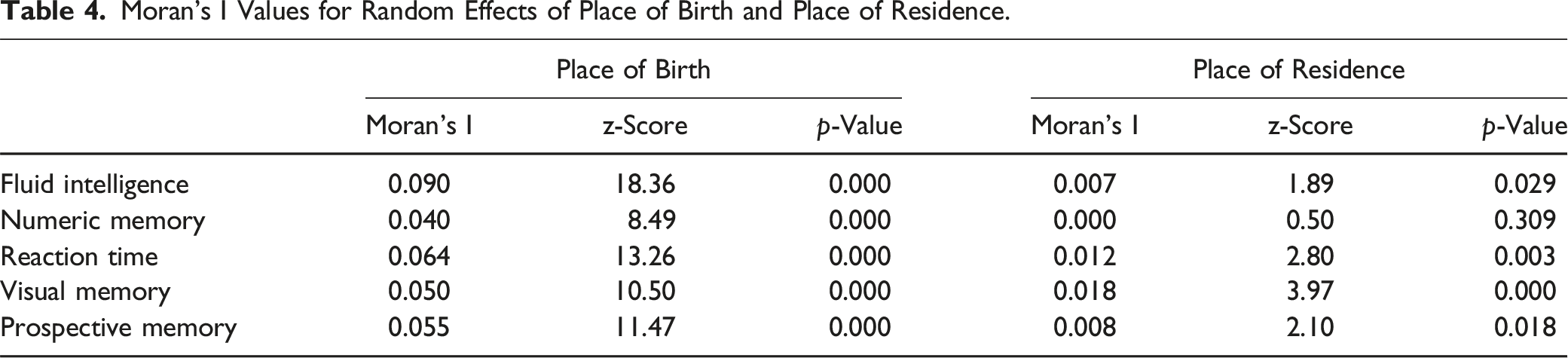
This study aims to examine the geographical determinants of cognitive outcomes, specifically focusing on the U.K. Using the UK Biobank data and multilevel regression modeling, we seek to examine whether one’s place of birth and current residence contribute to their cognitive outcomes in adulthood. Notably, this study considers various dimensions of cognitive function, including fluid intelligence, numeric memory, reaction time, visual memory, and prospective memory. By comparing the amount of variation in cognitive outcomes explained by these two geographical factors, this study aspires to determine the relative importance of birthplace and current residence in terms of cognitive function. This study also investigates whether there are gender differences in the relationship between place of birth, place of residence, and cognitive function. In addition, to understand spatial clustering patterns in place effects on cognitive outcome, this study calculates Moran’s I, a spatial autocorrelation coefficient.
Data and Methods
Data
This research utilized data from the UK Biobank (UKB). The UKB is a large prospective study conducted in the United Kingdom. UKB collected epidemiological, biological, and socioeconomic information from around 500,000 individuals between the ages of 37 and 74, registered with the National Health Service and who lived within 25 miles of one of the 22 assessment centers. Participation involved completion of questionnaires completed via touchscreen and nurse-led interviews, and information was collected between 2006 and 2010. For our sample selection in this study, we excluded participations who were without cognition information, along with place-based information and other covariates. However, because certain cognitive tests were implemented at different stages of the baseline assessment, the number of participants across cognitive domains varies, which impacts our overall sample sizes depending on domain. The UKB data is publicly available, and the participants in the UKB provided informed consent prior to participating in the study. This study was exempted from full review from the institutional review board because it relies on secondary analysis of publicly available data.
Measures
Cognitive Measures
We use five different measures of cognition in this research: (1) fluid intelligence, which indicates verbal and numerical reasoning and was ascertained by summing the number of 13 logic puzzles that participants could answer correctly in two minutes; (2) numeric memory, which represents working memory, was ascertained by individuals being shown a two-digit number which they were asked to recall after a brief pause. If recalled correctly, they were asked to recall an additional number, up to a maximum of 12 digits or until they made an error; (3) reaction time is related to the domain of processing speed, and was ascertained by participants playing a common card game, from which the score on the task was the mean response time in milliseconds; (4) visual memory represents declarative memory, which was constructed from participants being required to memorize the position of card pairs and then match them from memory; (5) prospective memory was ascertained by a test that tasked participants with engaging in a specific behavior later in the assessment, such as touching an orange circle rather than a blue square.
The reliability and validity of the various cognitive tests that exist in the UKB have been well documented (Fawns-Ritchie & Deary, 2020). At the baseline survey, nearly all respondents were administered the reaction time and visual memory tests. Subsamples of the UKB completed the tests relating to numeric memory, fluid intelligence, and prospective memory. Moreover, these latter three measures were introduced later into the field period than the other metrics, which resulted in some cognitive outcomes having substantially fewer individuals partake in them. All of the cognitive measures are measured on a continuous scale, with higher values indicating higher performance on the examination, with the exception of prospective memory, in which 1 indicates that they recalled the correct shape in their test and 0 indicates they did not. Moreover, due to the skewed distributions of both reaction time and visual memory, these values were log transformed to account for this uneven distribution. Yet, to allow for easier interpretation of findings, the four continuous measures of cognition are standardized and normalized, as has been done in prior research (Zhang et al., 2023). We opted to use these five measures because they were all conducted in the baseline UKB study and also provide a robust examination of different domains of cognition to see if the effects of place manifest differentially depending on the outcome.
Place Measures
Place of birth of the individuals in the UKB is provided at the county/district-level via A Vision of Britain through Time (https://www.visionofbritian.org.uk/). A Vision of Britain through Time provides the geographical boundary data for administrative districts/counties in select years (i.e., 1931, 1941, and 1951); thus, we classified respondents into districts/counties by using boundary data nearest to the birth year. Districts/counties are a level of geography in the United Kingdom that are sub-national and primarily used for the purposes of local government. As such, they are a unique level of geography that helps us capture potential contextual effects at a smaller level than is available elsewhere. Place of residence was determined in the baseline questionnaire that the participants filled out at the assessment centers. However, we should note that while we have information on each place of birth in the UK, we do not have full geographic coverage of all districts of residence in the UK, which does have some implications for our findings, which we elaborate on in the limitations section.
Covariates
Sex and European ancestry were used as covariates in order to account for differences in cognitive functioning that exist among males and females and among Europeans and non-Europeans, respectively. Similarly, age was also included as a covariate to account for the differences in cognition across the life course. Educational attainment was measured by mapping each educational qualification from the UKB to an International Standard Classification of Education (ISCED) category. From this, the number of years educational equivalent is produced for each ISCED category, which has been also used in prior studies (Fletcher et al., 2021; Lee et al., 2018). We also use in supplementary analyses another measure of socioeconomic status that reflects the average total pre-tax household income in a year.
Analytical Strategy
In this paper, we run a series of multilevel linear regression models for the continuous measures (fluid intelligence, numeric memory, reaction time, and visual memory) and multilevel logistic regression models for the prospective memory measure. The first model included place of birth random effects and the second model added in the fixed effects of sex, age, and European ancestry. The third and fourth models followed a similar approach, but with place of residence random effects. The fifth model then included both place of birth and place of residence random effects, along with fixed effects. We present results from model 5 for each of the outcomes, given that regression diagnostics revealed that they had the best model fit. To quantify the proportion of the total variation in cognitive outcomes that is attributable to place effects, the intraclass correlation coefficients (ICCs) were computed.
We also opted to look into separate models by gender, given that many mechanisms that stem from early life influences can operate differently for men and women. Furthermore, we calculated the global Moran’s I for place of birth intercepts from the fully adjusted model in order to see whether place of birth effects across the different cognitive domains were spatially clustered throughout the districts. Global Moran’s I is a measure of spatial autocorrelation and is used to evaluate whether or not a specific attribute is clustered or dispersed and to what degree, with higher values indicating greater correlation and lower values indicating less (LeSage & Pace, 2009). Finally, given that socioeconomic outcomes such as education and income are often too shaped by place of birth and place of residence, we opted to look the impact of place of birth and place of residence, to see if the strength of the effect was similar or not to that of the cognitive outcomes we explore.
Results
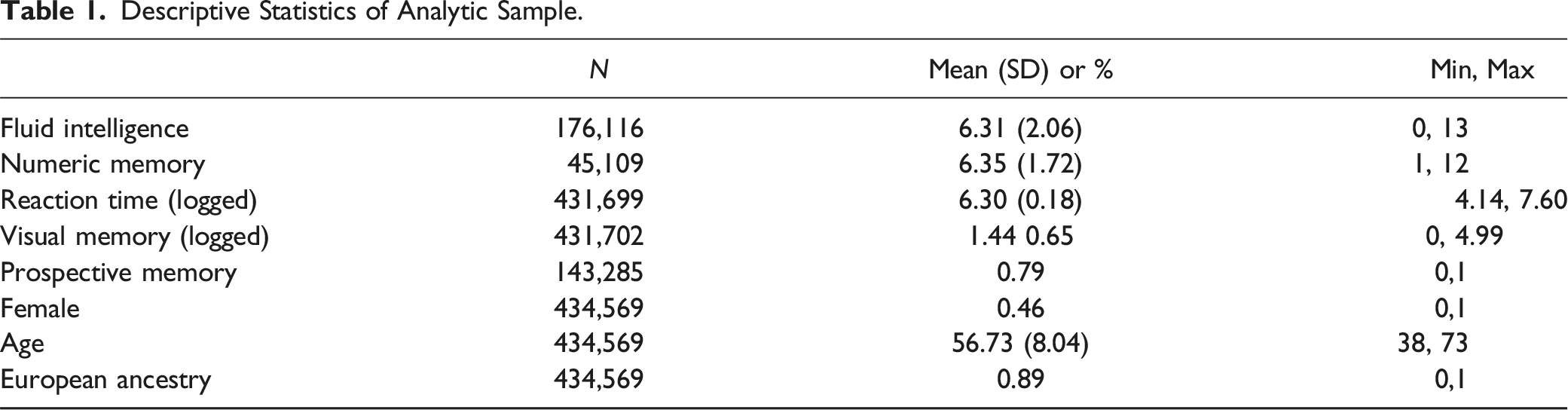
Descriptive Statistics of Analytic Sample.
Results of Multilevel Regression Models of Cognitive Outcomes.
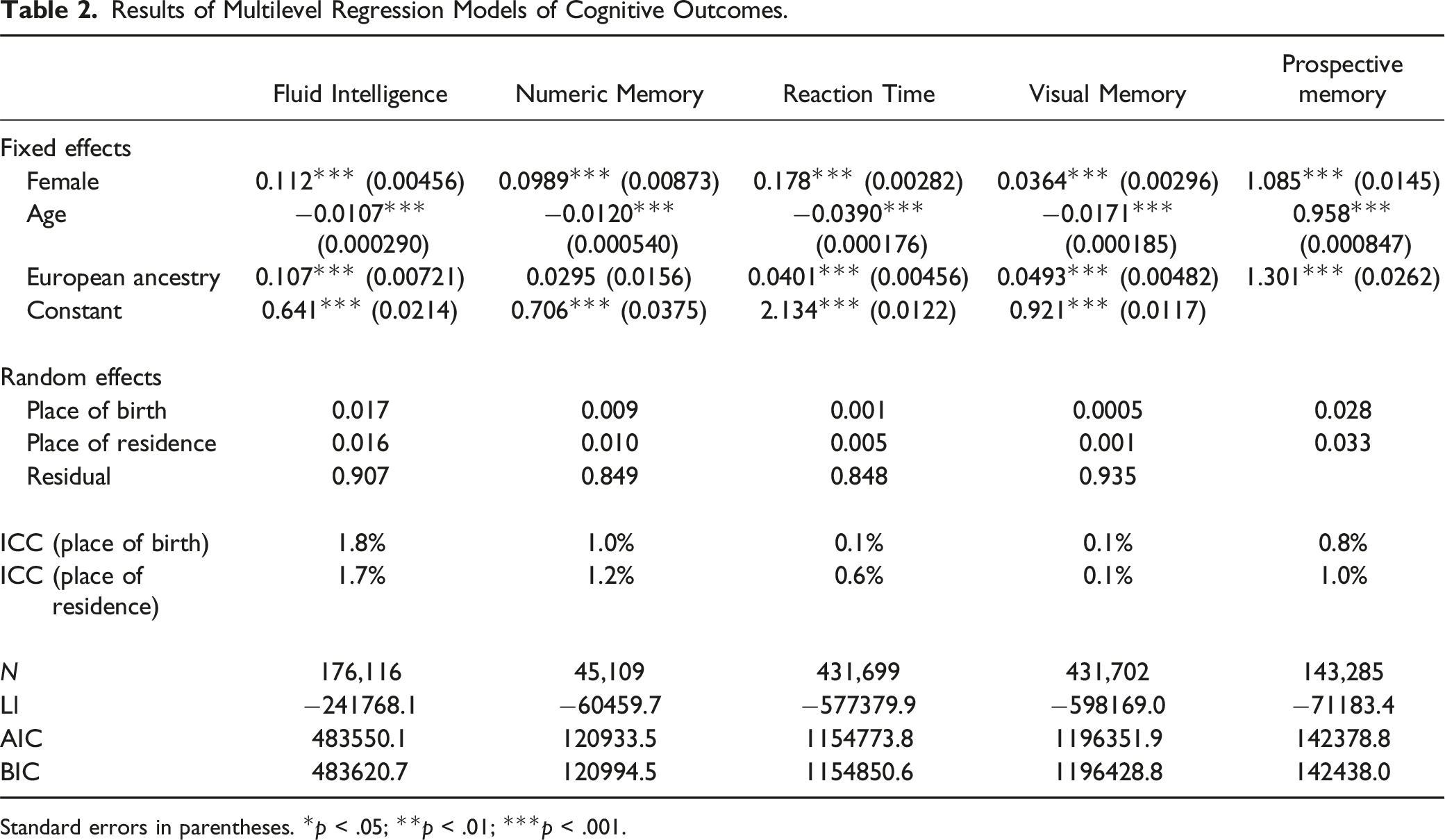
Standard errors in parentheses. *p < .05; **p < .01; ***p < .001.
We also opted to compare the magnitude of our place effects on cognition using socioeconomic status as a benchmark. We used a common sample with each cognitive domain and education and income to see how our findings would match up. For both education and income, it showed that place effects for socioeconomic outcomes were far greater than they were for cognition outcomes (Table S3 in the Online Supplementary Files). For place of birth effects, they ranged from 3.8% to 4.8% and 1.4% to 2.4% for education and income, respectively. Place of residence showed a stronger effect, ranging from 5.1% to 5.7% for education and 5.2% to 8.4% for income.
Results of Multilevel Regression Models of Cognitive Outcomes, by Gender.
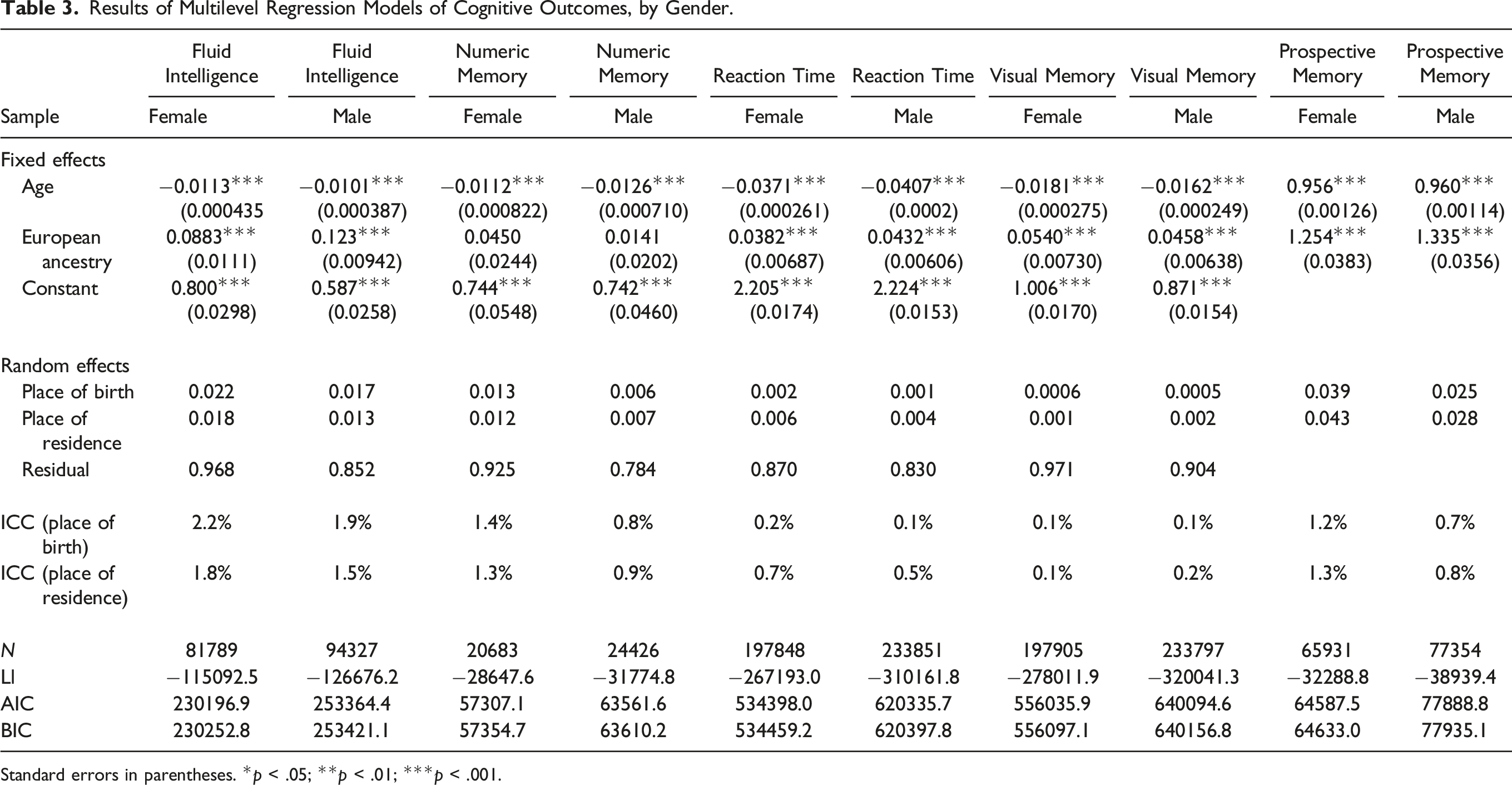
Standard errors in parentheses. *p < .05; **p < .01; ***p < .001.
To explore further the potential geographic patterning of place of birth effects on the different cognitive outcomes, we mapped place of birth intercepts from our final regression models as shown in Figure 1. The results suggested largely a metropolitan/non-metropolitan divide, where the large urban centers of the United Kingdom, such as London, generally had higher levels of cognition on average, whereas more sparsely populated districts/areas have lower levels. Spatial variation in fluid intelligence by place of birth.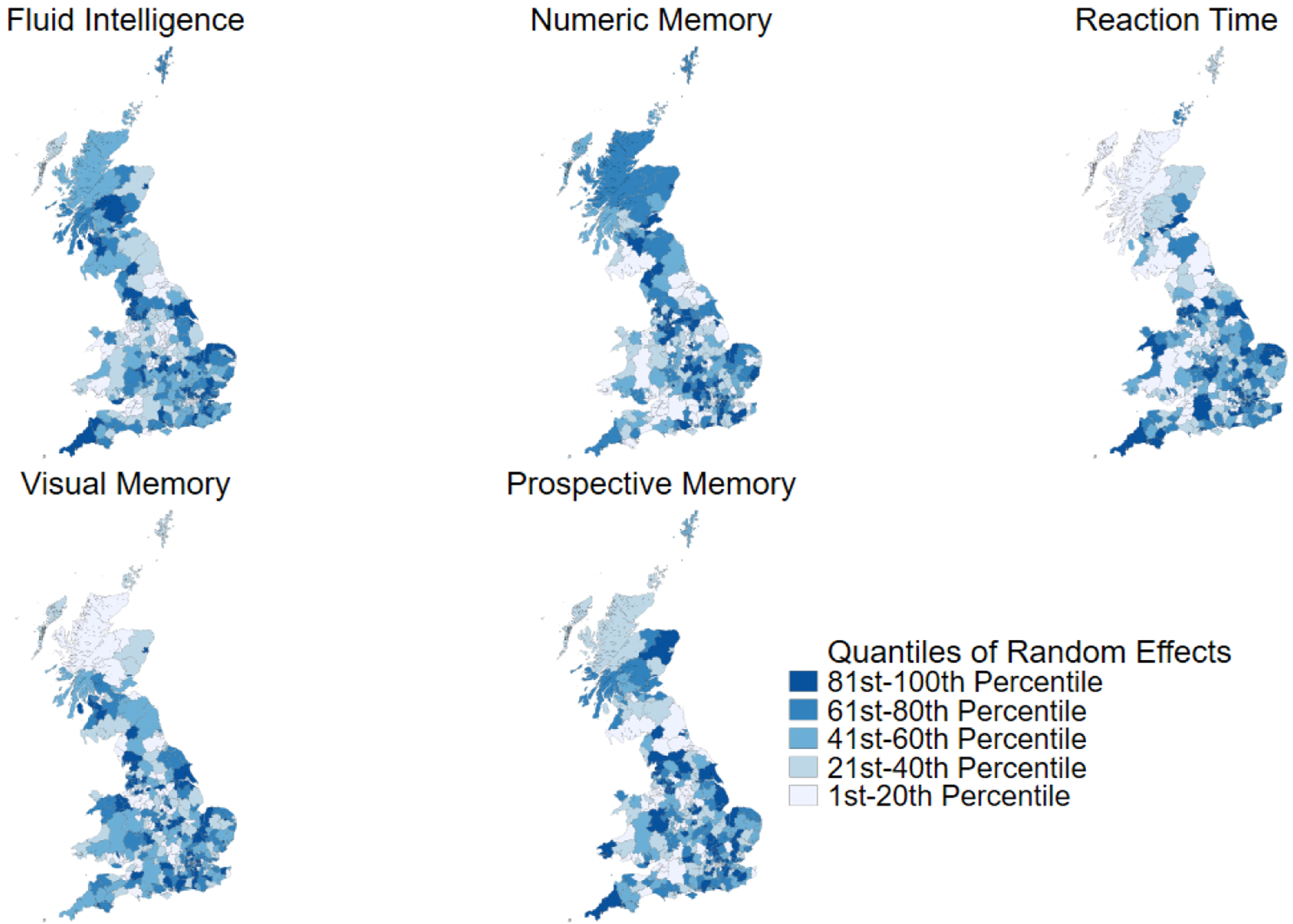
Moran’s I Values for Random Effects of Place of Birth and Place of Residence.
Discussion
The geographical determinants of cognitive outcomes have long been recognized as one of the key driving forces within the broader context of cognitive development (Kramer et al., 2004; Shankar et al., 2018). The current study, leveraging the rich UK Biobank dataset, sought to investigate geographical determinants of cognitive outcomes by focusing on the influence of two key geographical factors: place of birth and current residence. In particular, this study aimed to disentangle the respective contributions of place of birth and current residence to diverse cognitive dimensions. Our findings provide several key insights, adding nuance to the understanding of how geographical factors are related to cognition.
Our results elucidate the relationship between place of birth and cognitive outcomes. Consistent with developmental theories highlighting the critical influence of early childhood experiences on lifelong cognitive capacities (Campbell et al., 2016), place of birth was found to account for a modest amount of variation in cognitive dimensions, particularly fluid intelligence (1.8%), and to a lesser extent, numeric memory (1.0%) and prospective memory (0.8%). This underscores the lasting impact of foundational experiences, suggesting that the early environment, including access to quality nutrition, stimulating environments, and early educational interventions, sets a trajectory that has enduring implications for cognitive function in adulthood (Hackman et al., 2010; Prado & Dewey, 2014).
Similarly, place of residence accounted for a modest amount of variation in cognitive function in adulthood. Fluid intelligence, numeric memory, prospective memory, and reaction time were explained by 1.7%, 1.2%, 1.0%, and 0.6%, respectively. The influence of current residence echoes the dynamic and continual nature of cognitive development. Continuous exposure to new experiences, cultural stimuli, educational opportunities, and even social networks in adulthood can either augment or dampen cognitive abilities (Ailshire et al., 2017; Chen et al., 2017). This is in line with previous findings emphasizing the role of ongoing environmental interactions in shaping cognitive flexibility and maintenance (Besser et al., 2017; Finlay et al., 2021).
Interestingly, our findings also allude to the nuanced relationship between these two geographical factors and cognitive function. The contribution of geography to cognitive function differs across various dimensions. While fluid intelligence is most influenced by geographical factors, other dimensions are less affected. Notably, visual memory was unaffected by either place of birth or current residence. Moreover, while certain cognitive dimensions, such as fluid intelligence, numeric memory, and prospective memory, showed roughly equal contributions from both birthplace and current residence, reaction time exhibited a dominance of current residence over birthplace. Such disparities may reflect the varying nature of cognitive domains, with some being more susceptible to early environmental influences and others being more malleable and responsive to current environmental stimuli (Kim & Park, 2023). This has been found in prior research, with factors earlier in the life course such as education being linked with differences in episodic memory and visuospatial ability, whereas later-life cognitive activities could be indicative of greater perceptual speed (Jefferson et al., 2011). However, this has not been documented as much in the context of the United Kingdom. As such, future research should explore additional cognitive domains and a multitude of exposures across different points of the life course to better understand how they impact cognition. If there are similar impacts to those found in prior studies, it could be indicative a potential physiological response to environmental stimuli.
In addition, the results of this study shed light on gender differences in the relationship between geographical determinants and cognitive outcomes. Overall, the geographical contribution to cognitive function in adulthood was about 1.2–2.0 times greater for females than for males, with the exception of visual memory. Several theoretical frameworks can be posited to elucidate the observed gender differences in how geographical determinants influence cognitive outcomes (VP et al., 1998). One perspective centers on the differential hormonal responses to environmental stressors between genders (Verma et al., 2011). For instance, females, influenced by fluctuating levels of estrogen and progesterone, might have unique neuroendocrine responses to environmental challenges compared to males, who are primarily influenced by testosterone. Such hormonal interactions with the environment might amplify the cognitive effects of geographical determinants in females (ter Horst et al., 2012). Additionally, in many societies, females may have more pronounced interactions with their immediate environment, given their traditional roles in child-rearing and household management (Baum & Grunberg, 1991; Oksuzyan et al., 2018). This intimate interaction with their surroundings could render them more susceptible to the cognitive influences of their geographical context. For example, females tend to have a higher mental load (via cognitive and emotional labor) as a function of not participating as greatly in the labor market or traditional gender roles (Dean et al., 2022). This may in turn compound over time and work to shape the cognitive trajectories as a function of their environment.
Our results on the spatial concentration of our place effects also revealed an urban–rural divide. Overall, urban environments tend to have greater socioeconomic resources and healthcare infrastructure, both of which have been proven to have an effect on childhood nutrition, health, and socioeconomic status, which are all factors that have been found to have lasting impacts on cognitive health across the life course and into old age (Scazufca et al., 2008; Zhang et al., 2010, 2020). Additionally, many of these factors that specifically influence cognition across the life course disproportionately tend to be spatially patterned. Indeed, factors such as area-level socioeconomic deprivation have been found to be associated with lower cognitive scores, along with fewer years of formal schooling, greater mental health issues, and more vascular risk factors, all of which have the potential to amplify or dampen risk for poorer cognition in later life (McCann et al., 2018). This clustering of disadvantages has the potential to accumulate from birth and across the life course, manifesting in later life cognitive inequality (Lyu & Burr, 2016).
This study is not without limitations. First, in using the UK Biobank data, our outcome measures are not all one uniform size, due to the fact that three of the measures (fluid intelligence, numeric memory, and prospective memory) are subsamples. When initially conducting analyses, we first conducted the above analyses, and then one with a common sample for those that had information on all five measures (not shown), and found that it did not alter our findings drastically. We also opted to see if the differing sample sizes due to the differential sample sizes of the UKB for their cognition measures differed substantially based on the covariates we used in the study and found no significant differences in any of the subsample characteristics (Table S5 in the Online Supplementary Files). Moreover, the data from the UK Biobank is not fully representative of the UK population, given its sampling strategy and cross-sectional design. That being said, it would be useful for future research to employ more diverse or representative data to capture more of the mechanisms that impact health in the U.K. Also, while we have delved into the roles of birthplace and current residence, other geographical determinants such as migration patterns, urban versus rural residence, temporal residence changes, and length of time spent in current residence could offer additional layers of understanding (Weden et al., 2018). People move for a variety of reasons—economic opportunities, conflicts, educational pursuits, or personal relationships. By broadening our perspective to include migration patterns, the urban–rural divide, and the dynamics of residence changes, we can achieve a more nuanced and comprehensive understanding of the myriad ways geography influences cognitive development. In addition, our study could not pinpoint the specific geographical factors that might have contributed to regional variations in cognitive function.
In conclusion, the geographical landscape that underpins our cognitive development is both expansive and multifaceted (Topping et al., 2021b). Our birthplace lays down the initial foundation, imbuing us with cultural, linguistic, and social imprints that form the cornerstone of our early cognitive development. Conversely, our current residence, reflecting our choices and circumstances in adulthood, layers our cognitive framework with fresh experiences and challenges. In an aging society, these geographical effects on cognitive function take on heightened importance (Clarke et al., 2012; Zacher et al., 2023). As individuals age, their cognitive resilience and adaptability can be influenced by the richness of their geographical experiences, from exposure to diverse environments to interactions with varied cultures (Gilsanz et al., 2017). Additionally, regions with better healthcare, social support, and opportunities for mental stimulation can offer protective factors against cognitive decline (Lindeza et al., 2020). This dynamic interplay gains prominence in our increasingly mobile world, characterized by migration, economic pursuits, and personal endeavorsco. It is thus essential to understand how these geographical influences are not just static factors but continuously evolving elements shaping our cognitive well-being.
Supplemental Material
Supplemental Material - Variation in Adult Cognition Across Domains and Life Course Place Effects in the UK
Supplemental Material for Variation in Adult Cognition Across Domains and Life Course Place Effects in the UK by Michael Topping, Jason Fletcher, and Jinho Kim in Journal of Aging and Health.
Footnotes
Author Contributions
All authors contributed equally to this research. This research has been conducted using the UK Biobank Resource under Application 57284.
Declaration of Conflicting Interests
The authors declared no potential conflicts of interest with respect to the research, authorship, and/or publication of this article.
Funding
The authors disclosed receipt of the following financial support for the research, authorship, and/or publication of this article: This research was supported by the NIA (RF1AG062765 and R01AG060109) and the National Research Foundation of Korea (NRF) grant funded by the Korea government (MSIT) (RS-2023–00219289).

Supplemental Material
Supplemental material for this article is available online.
References
Supplementary Material
Please find the following supplemental material available below.
For Open Access articles published under a Creative Commons License, all supplemental material carries the same license as the article it is associated with.
For non-Open Access articles published, all supplemental material carries a non-exclusive license, and permission requests for re-use of supplemental material or any part of supplemental material shall be sent directly to the copyright owner as specified in the copyright notice associated with the article.
