







Abstract
Objectives
Indigenous populations in Mexico, comprising roughly one-fifth of the population, face significant unique cognitive health challenges in older adulthood. This study examines cognitive performance differences between Indigenous and non-Indigenous language speakers and evaluates whether the cognitive benefits of educational attainment differs between these populations.
Methods
We analyzed the 2018 Mexican Health and Aging Study (MHAS, n = 16,199), a nationally representative study of Mexicans 50+. We assessed the association between educational attainment and cognitive performance, both general and domain-specific, for Indigenous and non-Indigenous language speakers.
Findings
While Indigenous language speakers scored lower overall, they experienced significantly greater improvement with more years of education in Verbal Learning, Visual Scanning, and Visuospatial Ability.
Conclusions
Increasing educational attainment may improve cognitive functioning in Mexico, but especially for Indigenous populations. Further research is needed to explore mechanisms driving these stronger returns for Indigenous populations and to inform culturally responsive interventions and policies.
Keywords
Introduction
The rapid growth of the older adult population in Mexico stresses the need to evaluate older adult health and aging processes, with cognitive functioning being a key component of older adult health and livelihood (Gutiérrez-Robledo & Arrieta-Cruz, 2015). In general, cognitive functioning can determine an older adult’s ability to remain independent, with severe impairment requiring significant assistance from families, communities, and health workers (Mejia-Arango & Gutierrez, 2011). While cognitive impairment risk increases with age (Murman, 2015), the timing and duration of cognitive impairment are highly modifiable with educational attainment being one of the strongest modifiable risk factors (Lövdén et al., 2020; Zhang et al., 2024). Higher levels of education are associated with greater cognitive functioning and lower risk of dementia risk in later life (Lövdén et al., 2020); an association that has been found in countries across around the world, including Mexico (Díaz-Venegas et al., 2019; Zhang et al., 2024). Thus, education presents an important determinant of cognitive health in older adulthood that can be highly modifiable to improve population-level health in Mexico.
There is mounting evidence of subpopulation differences in health returns to educational attainment in high-income countries (Farina et al., 2020; Rahmani et al., 2024; Sheehan et al., 2020). Research has indicated “diminished returns” of education for health outcomes among American Indian and Alaskan Native adults compared to non-Hispanic White adults (Assari & Bazargan, 2019; Assari & Zare, 2025a, 2025b). However, less attention has been given to potential variation in the cognitive returns to education across demographic subgroups in low- and middle-income countries, which are dramatically different contexts. These differences include unique educational systems that vary in quality and access, bilingualism, and differences in the predominant language of each country, as well as disparate socioeconomic structures that may fundamentally alter how education relates to cognitive outcomes across population subgroups (Díaz-Venegas et al., 2019; León-Pérez & Bakhtiari, 2024).
Indeed, understanding whether educational returns differ across subpopulations is especially urgent for Mexico’s large Indigenous populations, who make up roughly one-fifth of Mexico’s population (INEGI, 2022). Indigenous populations in Mexico have also experienced a disproportionate demographic shift toward an older population structure, endure heightened life course inequality, and face systemic barriers to quality education, all of which may uniquely influence cognition throughout the life course and the educational returns for cognition (Hernandez-Zavala et al., 2006; Pelcastre-Villafuerte et al., 2017, 2020). Further, there is relatively little research regarding the unique potential educational returns of cognition among Indigenous populations outside of the U.S., even as there is recent research that has documented distinctive Indigenous cognitive patterns and determinants in Mexico (Renteria et al., 2023) and Ecuador (Amano et al., 2024). To address these gaps, we analyze if the benefits of educational attainment differ between Indigenous and non-Indigenous language speakers in older adults in Mexico. Moreover, we examine whether these differences vary by gender and age and whether they are tied to adverse socioeconomic status in early life and health behaviors in adulthood.
Literature Review
Indigenous Populations in Mexico
Mexico has one of the largest Indigenous populations in the Americas comprising roughly 20% of the Mexican population in 2020 (INEGI, 2022). Recent estimates further suggest that as of 2020 more than seven million Mexicans speak an Indigenous language and there are dozens of Indigenous languages spoken throughout Mexico (INEGI, 2020, 2022). The profound social inequalities and hierarchies that characterize Mexican society disproportionately impact Indigenous populations, especially those who speak Indigenous languages and face compounded forms of social, economic, and educational disadvantage (Villarreal, 2014). While there is considerable diversity among Indigenous peoples in Mexico, Indigenous peoples in Mexico overwhelmingly experience structural discrimination that limits their access to socioeconomic resources and exposes them to negative social interactions. These challenges significantly undermine their well-being across the life course, with childhood being a particularly critical period for cohorts now in older adulthood (León-Pérez & Bakhtiari, 2024; Pelcastre-Villafuerte et al., 2020; Renteria et al., 2023; Stoddard et al., 2011).
Importance of Educational Attainment for Cognition
Higher levels of education are associated with greater levels of cognitive functioning in older adulthood across the globe (Lövdén et al., 2020; Zhang et al., 2024). The association between education and cognitive functioning is thought to occur along two pathways. First, education directly improves the structure and function of the brain (Lövdén et al., 2020), increasing cognitive development and building cognitive reserve, which leads to higher levels of cognitive functioning and cognitive reserve in older adulthood. Cognitive reserve refers to the brain’s ability to compensate for brain pathology that typically leads to cognitive dysfunction from age-related diseases (Tucker & Stern, 2011). Cognitive reserve is a malleable mechanism that individuals can improve throughout their life course by engaging in cognitively stimulating activities, such as education. In fact, much research provides evidence of this association with greater baseline cognitive functioning in older adulthood for those with higher levels of educational attainment (Díaz-Venegas et al., 2019; Lövdén et al., 2020). Moreover, in a meta-analysis of 92 longitudinal studies on the effects of education and cognitive decline, Seblova and colleagues (2020) found that educational attainment delays age-related cognitive decline rather than slowing the rate of cognitive decline. This study further highlights the importance of education in preserving cognitive performance.
Second, education may also provide more indirect “flexible resources” such as opportunities, health behaviors, and social networks that are positively associated with cognitive functioning (Link & Phelan, 1995). These indirect associations are dynamic and shaped by larger context (Hayward et al., 2015). Accordingly, these indirect processes likely do not unfold in the same ways across subpopulations, presumably among Indigenous populations who endure greater structural marginalization (Farina et al., 2020; Pelcastre-Villafuerte et al., 2020).
Education and Mexico’s Indigenous Population
While there are notable reasons to anticipate muted or smaller benefits of education for Indigenous language speakers in Mexico, we anticipate a greater benefit from educational attainment for cognition among Indigenous Mexicans than non-Indigenous Mexicans due to a larger relative benefit and importance of education as a form of socioeconomic status, the resilience that accompanies overcoming systemic barriers of attaining education, and the benefits of bilingualism (Renteria et al., 2023). Indeed, while research examining differential returns to education across ethnic groups has primarily focused within the U.S. context, where minoritized groups often benefit less from education, emerging evidence from Mexico shows that educational attainment explains most of the disparity in self-rated health between Indigenous and non-Indigenous people (León-Pérez & Bakhtiari, 2024). The researchers suggest that differences in each country’s racialized, health, and economic structures are responsible for differential returns to education (León-Pérez & Bakhtiari, 2024). We build on this research by examining cognitive health rather than general health among older adults, which may be more responsive to educational attainment due to its direct imprinting on the brain (Lövdén et al., 2020), and specifically examine older adults, rather than all adults (León-Pérez & Bakhtiari, 2024), where cognitive differences are particularly pronounced (Murman, 2015).
Importantly, the association between education and cognitive functioning in Mexico may differ between Indigenous and non-Indigenous populations for important reasons. While access to education in Mexico expanded dramatically throughout the 20th century (Díaz-Venegas et al., 2019), Indigenous Mexicans experienced substantial challenges in attending schools, and even for those who attended, quality was generally considered poor (Hernandez-Zavala et al., 2006). These structural challenges may have impeded the educational achievement of Indigenous populations, resulting in lower educational attainment, which itself likely contributes to cognitive health inequalities (Hernandez-Zavala et al., 2006; Pelcastre-Villafuerte et al., 2017, 2020; Sanchez, 2024). The lack of access to quality educational attainment reflects broader inequities to resources and greater stressors in early life for the Indigenous in Mexico, factors which are important for cognition throughout the life course (Ben-Shlomo & Kuh, 2002; Saenz et al., 2018). Still, as Indigenous Mexican older adults may have reduced educational access to each additional level of educational attainment, schooling could contribute to cognitive and psychological resilience in later life (Lövdén et al., 2020). Education could also foster healthier more educated social networks, provide richer and more complex quotidian interactions, and offer one of the primary forms of socioeconomic opportunities and mobility among the Indigenous population (Link & Phelan, 1995).
Alternatively, the benefits of educational attainment for cognition may be lower for Indigenous than non-Indigenous language speakers. As a heterogeneous minoritized subpopulation, Indigenous language speakers in Mexico are potentially more exposed to lower-quality schooling (Hernandez-Zavala et al., 2006), which prior research suggests is associated with lower cognition in later life (Mantri et al., 2019). Indigenous Mexicans who attain high levels of educational attainment may also develop greater awareness of discrimination and systemic barriers, thereby increasing stress, which could undercut any health/cognitive benefit as has been shown among U.S. among minoritized populations including American Indians and Alaska Natives, known as diminishing returns (Assari, 2018; Assari & Bazargan, 2019; Assari & Zare, 2025a, 2025b; Pearson, 2008) and may face more barriers and discrimination in translating education into economic opportunity throughout life (Canedo, 2019).
Early Life Experiences
Accounting for early life experiences and exposures is crucial when comparing the influence of education on cognition between Indigenous and non-Indigenous language speakers in Mexico. Research increasingly indicates that childhood conditions have a lasting impact on health and cognitive abilities throughout the life course (Farina et al., 2024; Greenfield & Moor; Hayward & Sheehan, 2016; Seixas & Macinko, 2023). For example, in a cohort study of 20,244 European individuals, Cermakova and colleagues (2018) found that individuals who reported being in an adverse socioeconomic position as children also reported a lower cognitive performance than their counterparts. Notably, the researchers measured childhood socioeconomic status by including three measures relating to respondent’s housing conditions when they were 10 years old. This study further highlights the possible impact of early life characteristics on later life cognition.
Indigenous populations in Mexico have historically faced significant challenges, often growing up with limited access to basic resources such as clean water and electricity and experiencing high rates of childhood poverty (Canedo, 2018). The specific elevated deleterious childhood exposures that the Indigenous in Mexico endure have been found to be associated with worse health and worse patterns of cognition among older adults in Mexico (Gonçalves et al., 2023; Saenz et al., 2018, 2020) and other countries (Chen & Cao, 2020; Greenfield & Moorman, 2019). Childhood health conditions similarly shape health and cognitive trajectories into later life (Farina et al., 2024; Sheehan et al., 2023).
Accordingly, controlling for these early life circumstances is critical for us to be able to determine whether the hypothesized stronger returns to education among Indigenous Mexicans persist even after accounting for early life conditions, which are important selection factors as people with worse childhood socioeconomic conditions may be less likely to attain higher levels of education. Overall, in this context of pervasive and systematic disadvantage that emerges in childhood, educational attainment emerges as a crucial—and often sole—pathway for Indigenous Mexicans to build socioeconomic resources, develop cognitive reserve, and potentially mitigate the cumulative impacts of systemic inequalities in childhood and across the life course.
Gender and Age Differences
Historical changes in educational access in Mexico—shaped by both gender norms and changing institutional barriers over time—have led to different educational benefits for cognition for men and women and across birth cohorts (Díaz-Venegas et al., 2019). Mexico has experienced a dramatic increase in the access of education throughout the 20th century, when older adults in Mexico were in schooling ages. The dramatic expansion of education in Mexico is evident in the sharp decline of those with no formal schooling, falling from nearly one-third of all Mexicans (32%) to less than a 10th (7%) of the population between 1970 and 2010, with women experiencing particularly pronounced gains in educational access (Díaz-Venegas et al., 2019). Although educational attainment has been increasing in recent decades in Mexico at a national level, the expansion in education has been most rapid for women, and particularly women in rural areas where the average years of education for women increased 260% for women aged 26–30 from 1970 to 2000 (Wong & Palloni, 2009). The expansion of education had pronounced implications for cohort and gender patterns of cognition in older adulthood, with past research finding an increased benefit from education for cognition among women compared to men in more recently born cohorts (Díaz-Venegas et al., 2019). Given these patterns, we also investigate if the differential benefits of educational attainment among Indigenous versus non-Indigenous language speakers also vary by gender and birth cohort.
In this study, we systematically evaluate cognitive functioning differences between Indigenous and non-Indigenous language speakers in Mexico. We further examine whether there are differential returns of educational attainment across multiple domains of cognitive functioning among both groups. That is, cognitive functioning was evaluated using domain-specific measures for memory, executive functioning, and orientation. Examining different cognitive batteries allows us to explore potential domains where educational returns vary significantly for Indigenous language speakers versus non-Indigenous language speakers, potentially elucidating mechanisms (Anstey & Christensen, 2000; Mejía-Arango & Gutierrez, 2011). Given the cross-sectional data, we also examined the importance of early life health and socioeconomic conditions in attenuating the association between educational attainment and cognitive functioning—adjusting for potential selection factors. We also briefly evaluated the importance of adult circumstances in explaining any potential differences in educational returns, pointing toward downstream mechanisms. Overall, this investigation advances the understanding of the dynamic association between educational attainment and cognition across the life course in global contexts, with implications for both educational and aging policy in societies marked by ethnic, educational, and socioeconomic stratification.
Data and Methods
Data
We analyze the 2018 wave of the Mexican Health and Aging Study (MHAS), a nationally representative, longitudinal study of adults 50+ in Mexico that collects extensive socioeconomic and health information. The study began in 2001 with a sample of individuals ages 50+ and their partners, regardless of age. Follow-up interviews have been conducted in 2003, 2012, 2015, 2018, and 2021. To maintain representation of the Mexican population age 50+, the MHAS has added “refresher” cohorts born 1952–1962 in the 2012 wave and born 1963–1968 in the 2018 wave. For this reason, we focus our analyses on the 2018 wave as the most recent MHAS wave in which the sample was nationally representative of the Mexican population aged 50 and over. The MHAS is a sister study of the United States Health and Retirement Study and has been described in greater detail elsewhere (Wong et al., 2017). Given that we used Full Information Maximum Likelihood (discussed further below), the sample consists of those aged 50+ with valid measures of cognition (n = 16,199), and we present information regarding the missing data in Supplemental Table 1. Writing was improved with Claude 3.5.
Measures
Cognitive Functioning
Cognitive functioning was measured using the scores from seven cognitive functioning tasks. For Verbal Learning, respondents recalled a list of eight words for three trials, and we calculated the average number of words recalled across the trials (range: 0 to 8). To measure Verbal Recall, interviewers asked respondents to recall the list of words after a delay (range: 0 to 8). Visual Scanning consisted of a 60-second task where respondents identified a specific stimulus within an arrangement of stimuli (range: 0 to 60). Verbal Fluency required individuals to recall as many animals as possible within 60 seconds (range: 0 to 60). Respondents identified the day, month, and year for Orientation to Time (range: 0 to 3). MHAS measured Visuospatial Ability by asking respondents to copy figures (range: 0 to 6). Lastly, for Visuospatial Memory, respondents had to recall and redraw the figures they copied earlier. Most of the cognitive tasks originate from the Cross-Cultural Cognitive Examination (CCCE). Previous research has operationalized cognitive functioning using the seven cognitive tasks (Saenz et al., 2018).
Indigeneity and Demographics
To measure Indigeneity, we included a measure asking respondents whether they speak an Indigenous language. The measure reads, “Do you speak any Indigenous language?” While this is consistent with previous research (Renteria et al., 2023) and the only currently available measure in MHAS, we further discuss this decision in the limitations section. For educational attainment, we examine the highest year of education completed. We also accounted for gender, which we coded dichotomously, and age in years.
Early Life Covariates
Existing literature on cognitive functioning indicates that early life circumstances can affect cognitive functioning later in life (Farina et al., 2024; Greenfield & Moorman, 2019; Hayward & Sheehan, 2016; Seixas & Macinko, 2023). As such, we include measures that inquire about respondent’s socioeconomic status and health before the age of 10. We included six binary measures relating to respondents’ home infrastructure and access to resources. More specifically, the measures ask respondents if, before the age of 10, their home had a toilet, if they went to bed hungry, wore shoes regularly, had siblings drop out of school, if their family received economic help, they or a family member slept in the kitchen, and if they had electricity in their home. We also included two measures asking respondents about their mother’s and father’s educational attainment. The measures read, “What was the final level of school your mother [or father] completed?” The response categories were: no education (i.e., no formal schooling; reference), incomplete elementary, elementary, and beyond elementary. Researchers have previously identified parents’ educational attainment and childhood housing conditions as indicators of childhood socioeconomic status (Galobardes et al., 2006). Lastly, to measure childhood health, we included as series of six dichotomous measures asking respondents if before the age of 10, they experienced any of the following illnesses or health problems: typhoid fever, tuberculosis, rheumatic fever, polio, a serious blow to the head, and a serious health problem lasting longer than a month.
Methods
We first calculated weighted descriptive statistics and compared the distribution of educational attainment for Indigenous and non-Indigenous language speakers using T-tests. Next, we fit five linear regression models for each of the seven cognitive functioning tasks. In Model 1, we provide only Indigenous language, educational attainment, age, and gender. Model 2 included an interaction between Indigenous language and educational attainment. Models 3 and 4 are the same as Model 2 but each includes early life socioeconomic status and early life health measures, respectively. Lastly, Model 5 was the same as Model 2 but included both sets of measures on early life socioeconomic status and early life health. In supplemental analyses, we also fit models stratified by age and gender, and adjusted for adult characteristics. We used the SEM command on STATA 18.0 to regress the models using Maximum Likelihood with Missing Values (mlmv) to contend with missing data. This approach allows cases to be included in regression models even if their data is incomplete. Supplemental Table 1 summarizes the number of cases with present versus missing data for each of our study variables. Regression models were fitted unweighted due to our focus on individual-level associations, though sensitivity analyses with weights yielded similar directional findings with inflated significance levels.
Results
Descriptive Statistics
Weighted Descriptive Statistics, Adults aged 50+ in Mexico. Mexican Health and Aging Study 2018
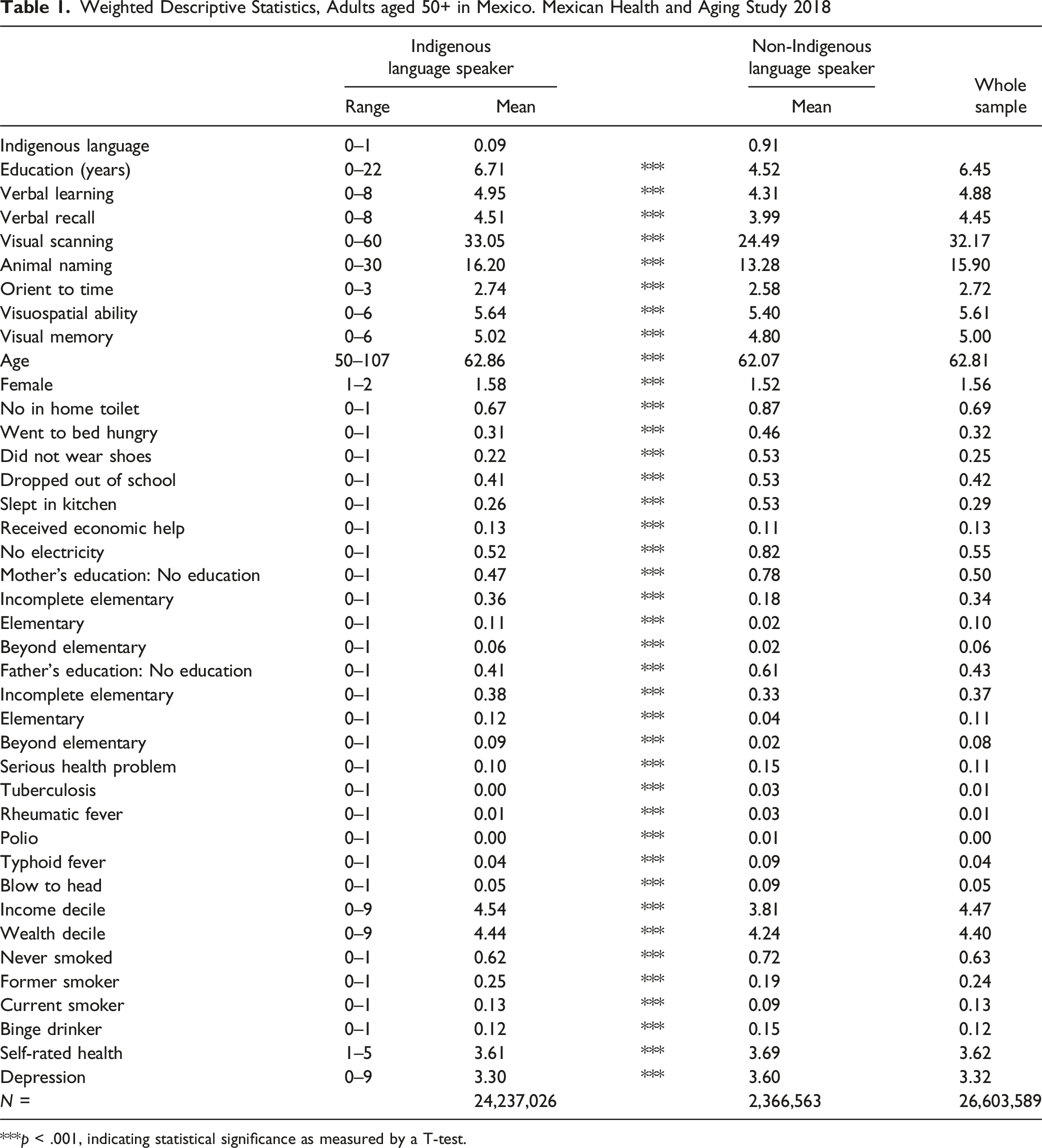
***p < .001, indicating statistical significance as measured by a T-test.
Supplemental Figures 1 and 2 document the weighted distribution for years of educational attainment for Indigenous speakers and non-speakers, respectively. On average, Indigenous speakers reported 4.52 years (SD: 4.31) of educational attainment compared to 6.71 years (SD: 4.72) reported by non-Indigenous language speakers. Among Indigenous speakers, most respondents (78.82%) reported between zero and six years of educational attainment. Conversely, Supplemental Figure 2 demonstrates a higher distribution of educational attainment for non-Indigenous language speakers. Among non-speakers, 12.32% reported 0 years of education compared to 24.35% for Indigenous language speakers. The remaining non-Indigenous-speaking respondents varied widely in terms of years of educational attainment.
Differential Cognitive Benefits of Education by Indigenous Status
Coefficients From Regression Models Predicting Cognitive Batteries. Adults aged 50+ in Mexico. Mexican Health and Aging Study 2018. N = 16,199
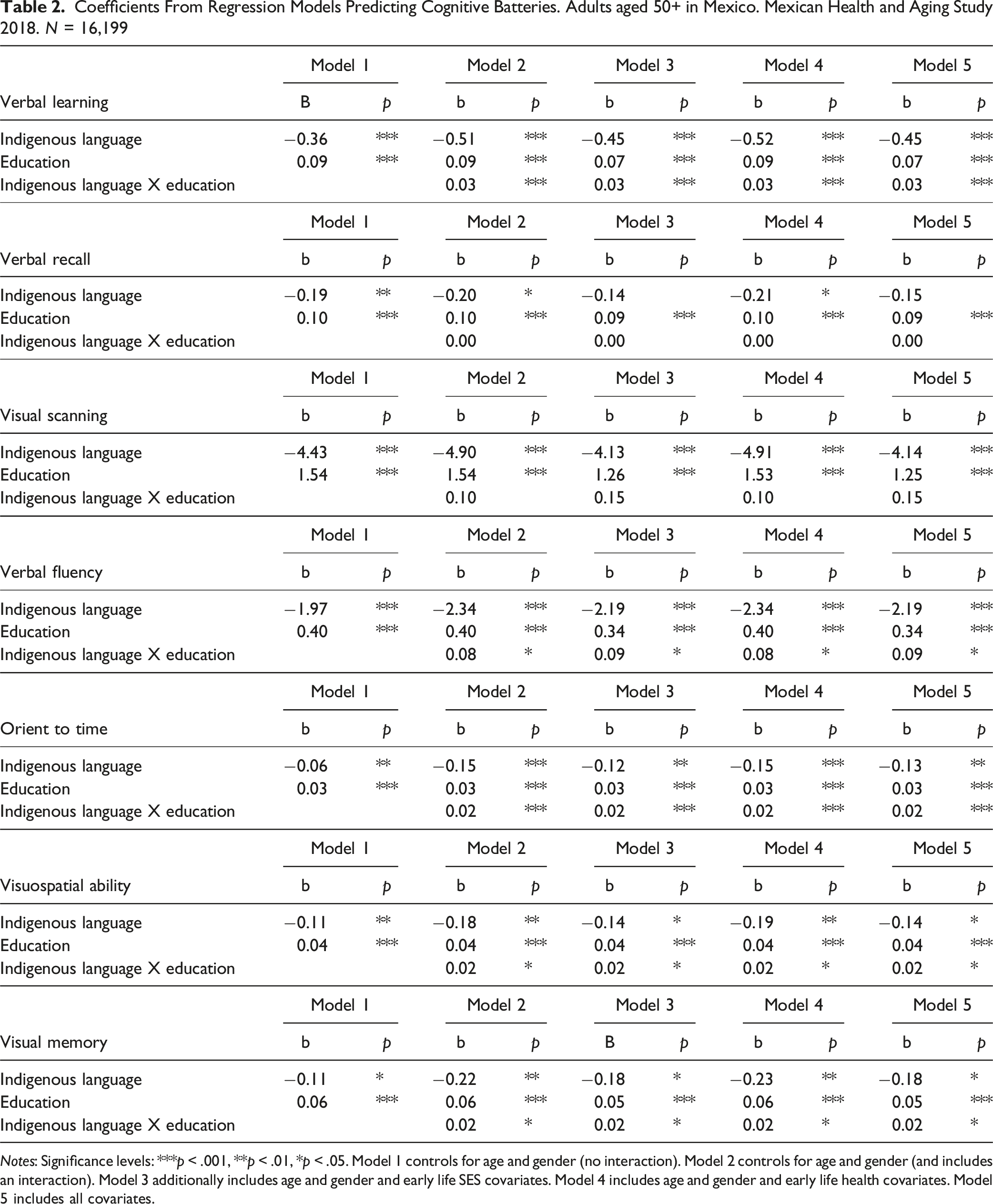
Notes: Significance levels: ***p < .001, **p < .01, *p < .05. Model 1 controls for age and gender (no interaction). Model 2 controls for age and gender (and includes an interaction). Model 3 additionally includes age and gender and early life SES covariates. Model 4 includes age and gender and early life health covariates. Model 5 includes all covariates.
Supplemental Materials
In supplemental analyses, we also evaluated the importance of adult circumstances. Specifically, we included covariates reflecting adult socioeconomic status, health behaviors, and health. We discuss the coding of the variables and present these results in Supplemental Table 2. We found that adult circumstances did little to influence our findings regarding education, Indigenous language speaking, and their interaction. Indeed, their inclusion did not alter the results across all batteries except Visual Memory which changed the interaction to be no longer significant in the final model when all the adult covariates were included.
We also investigated gender (Supplemental Table 3) and age-stratified models (Supplemental Table 4). In the gender-stratified models, we found similar overall results for males and females. However, in the age-stratified models, we found that the interaction terms were generally stronger in the younger age group (50–74) compared to the older one (75+). That is, among respondents 50 to 74 years old, the benefit of educational attainment was greater for Indigenous language speakers among all cognitive batteries except Verbal Recall. However, among respondents 75 years and older, the benefit of educational attainment was greater for Indigenous language speakers only for Verbal Learning, stressing that Indigenous language speakers in the younger age group benefited significantly more from educational attainment.
Discussion
As the Mexican population rapidly ages, understanding the determinants of cognition is imperative to developing and implementing targeted interventions and policies. Education is considered to be one of the most important modifiable risk factors for cognition with strong associations with cognition found in Mexico (Díaz-Venegas et al., 2019; Saenz et al., 2020) and across the globe (Lövdén et al., 2020; Zhang et al., 2024). However, past research may have implicitly assumed uniform benefits from educational attainment for cognition across subpopulations in low- and middle-income countries. Yet, the benefits of educational attainment may vary considerably within the Mexican population as they do in the United States (Assari & Zare, 2025b, 2025a), and we are unaware of any research that has analyzed if there are different associations between educational attainment and cognition among the Indigenous in Mexico or in other low- or medium-income countries. This lack of research is particularly concerning given the unique historical, social, and structural barriers faced by Indigenous populations in Mexico (Pelcastre-Villafuerte et al., 2017, 2020), which may shape both their access to education and the ways in which educational attainment translates into cognitive resilience throughout the life course (Ben-Shlomo & Kuh, 2002). Our findings replicated past research, which indicated that Indigenous language speakers had lower levels of cognition compared to non-Indigenous (Renteria et al., 2023). We built on this work by testing if the benefits of education varied between Indigenous and non-Indigenous language speakers, examining the influence of childhood conditions as well as adult conditions, and testing for gender and cohort differences.
Our results indicated that the benefits of educational attainment were significantly stronger for Indigenous language–speaking older adults than non-Indigenous language–speaking older adults. While the associations were not uniform, Indigenous language speakers’ cognition did benefit significantly more from each additional year of educational attainment than non-Indigenous language speakers. This general finding corresponds to previous research focused on physical health in Mexico among all adults (León-Pérez & Bakhtiari, 2024). The results are also similar to one U.S. study that found greater educational returns on cognitive health among Black older adults compared to White older adults (Farina et al., 2020), but inconsistent with several studies in the U.S. that indicate muted or reversed health benefits (i.e., diminished returns) from education for minoritized populations including American Indian and Alaska Native adults (Assari, 2018; Assari & Bazargan, 2019; Assari & Zare, 2025a, 2025b). The reasons for the reversed educational gradient for certain health outcomes for minoritized populations but not others in the U.S. (i.e., diminished returns) and the enhanced gradient in Mexico for cognition stresses the importance of national contexts and warrant further cross-national research, including research on bilingualism (discussed below).
Additionally, we found that the benefits of educational attainment were significantly stronger for certain, but not all, cognitive batteries for Indigenous language speakers. In more detail, we found that the educational association was stronger for the Verbal Learning, Visual Scanning, Verbal Fluency, Orient to Time, Visuospatial Ability, and Visual Memory. However, there were not significant differences for Verbal Recall, indicating that the different associations are domain-specific. These differences may reflect differences in the returns of education across different cognitive domains and tasks. Educational benefits may be weaker in tasks requiring fluid intelligence (such as Verbal Recall memory tasks) and weaker benefits of education have been noted for memory, an essential skill in Verbal Recall performance (Anstey & Christensen, 2000; Lövdén et al., 2020; Rehnberg et al., 2024).
Given the well-established importance of childhood conditions for later life cognition and health (Ben-Shlomo & Kuh, 2002; Greenfield & Moorman, 2019; Hayward & Sheehan, 2016; Saenz et al., 2018) and the disadvantaged childhoods endured by Indigenous language speakers (Canedo, 2018), we accounted for childhood socioeconomic and childhood health conditions. For Indigenous language speakers, systemic barriers such as limited access to quality education, poor infrastructure, and socioeconomic disparities during childhood likely co-occurred with educational attainment (Hernandez-Zavala et al., 2006). Despite the possibility of overcontrolling the model, we chose to include early life covariates in a supplementary analysis to explore additional mechanisms that may explain differences in educational returns and acknowledge previous research on childhood conditions and cognitive health. However, even after adjusting for early life health and socioeconomic status the results remained substantively similar. The consistency of the results after adjusting for early life health and socioeconomic status suggests that the stronger cognitive benefits of education for Indigenous language speakers are not simply a reflection of disadvantageous childhood exposures. This stresses the possibility of other mechanisms, such as cultural or community-level factors, the linguistic benefits that accompany educational attainment, or increased psychological resilience, that may uniquely amplify the educational benefits for cognition among Indigenous older adults in Mexico. Examining other potential mechanisms remains unexplored for subsequent research.
Bilingualism may be particularly important in explaining our findings. Specific linguistic benefits from languages taught in school and potential direct community integration knowledge gained from educational attainment may help throughout the life course and when navigating the health care systems in later life (Renteria et al., 2023). Indeed, concomitant with education, researchers have theorized that the high cognitive demands accompanying speaking more than one language aid in developing cognitive reserve. Speaking more than one language is a cognitively intensive experience involving actively monitoring all languages known while simultaneously suppressing the non-target language/s. Over time, these cognitive demands improve executive control and result in higher cognitive reserve (Cao et al., 2025). Despite ample evidence of a relationship between education and cognitive reserve and multilingualism and cognitive reserve, few studies, if any, examine the interplay between both factors, Guzmán-Vélez and Tranel (2015), making our findings an important contribution. Further, it is possible that by having access to an environment that demands speaking Spanish, specifically in formal educational settings, Mexican Indigenous–speaking individuals build up their cognitive reserve. Another explanation relating to bilingualism could be the added benefit of enhanced bilingualism as the tests are conducted in Spanish. In this sense, Indigenous language speakers would benefit more from educational attainment in their ability to understand and engage with the cognitive items. Clearly, future research should investigate the factors, including bilingualism and testing, that are driving the enhanced benefits of education for health and cognition among the Indigenous populations in Mexico (León-Pérez & Bakhtiari, 2024) and leading to different results from the diminished returns observed in the U.S. (Assari & Zare, 2024; 2025a; 2025b).
In supplemental analyses we adjusted for adult characteristics including adult socioeconomic status, behavioral health, and health we found similar patterns, suggesting that the enhanced benefits of educational attainment do not necessarily operate through the adult measures that we were able to control for. Thus, there are other explanations that could be driving the association such as unobserved selection, or the idea that Indigenous language speakers who attained education are more select than those who did not. However, these selection processes would potentially translate to income attainment but we found similar results when income was accounted for.
Given past research that has emphasized gender differences and cohort patterning of educational attainment for cognition (Díaz-Venegas et al., 2019), we also tested for gender and potential age/cohort differences with stratified models. We found no significant gender differences, indicating that the enhanced benefits of educational attainment were consistent for men and women Indigenous language speakers. However, when we fit age/cohort stratified models, we found stronger results among the younger cohort analyzed (aged 50–64). Younger Indigenous language speakers may have benefited from broader educational reforms and expanded education in Mexico during the latter half of the 20th century (Díaz-Venegas et al., 2019). These education and policy reforms could have improved the quality and reach of education available to Indigenous communities, resulting in greater cognitive returns compared to older cohorts who had comparably more limited access. In addition, the more muted influence among the older group may also be due to educational attainment’s relevance being diminished at the older ages, leading to convergence in cognition across the population despite the level of education. In other words, the protective factors of educational attainment may have produced a less varied and more educated sample of living older adults. That is, these results could also be due to selective mortality or missing data patterns. Future research should further investigate this finding, analyzing if it replicates in other global contexts, and disentangling the age and/or cohort effects.
There are important limitations that must be considered. This study used a measure asking respondents whether they speak an Indigenous language to measure Indigeneity rather than a self-identifying measure. However, historically, Latin American countries have used fluency in an Indigenous language as an indicator of Indigenous identity (Loveman, 2014). Moreover, research indicates that the Indigenous-speaking population is, on average, “more traditional, and typically more disadvantaged than the self-identified Indigenous population” (Flores et al., 2023, p.134; Villarreal, 2014); presumably, this makes our measure of Indigeneity more reflective of Indigenous groups that are likely to be more marginalized. At the same time, we are unable to account for effect differences by type of Indigenous language spoken, nation, or location, which is an important avenue for subsequent research. Given our focus on older adults, age and mortality selection may limit the number of older adults in the study, possibly explaining the stronger effect of education on cognition among respondents ages 50 to 64. We also lacked important measures regarding the characteristics and the quality of education. For instance, we lack information regarding the schooling infrastructure, type of schooling attended (e.g., public and private), and the proportion of proportion of Indigenous versus non-Indigenous speakers in school to understand the role of homogeneity/heterogeneity in exposure to education. Future research with more information on educational quality could help to better contextualize our findings. Lastly, this study was not able to account for the effect of occupational exposures on cognitive performance; however, Cao and colleagues (2025) found educational attainment to still be a strong predictor of cognition despite accounting for occupational exposures (Cao et al., 2025).
While there is extensive evidence stressing the importance of educational attainment for cognition and health (Zhang et al., 2024), considerably less research has investigated nuance in this relationship, especially in low- middle-income contexts. However, better understanding this nuance and heterogeneity in educational attainment can help to better understand how education may influence health and cognition more broadly. Indeed, here, we illustrated that better understanding of the benefits of educational attainment for diverse and minoritized populations is critical for targeted interventions in Mexico, and accordingly, we urge future researchers to conduct such analyses.
Supplemental Material
Supplemental Material - Does the Association Between Educational Attainment and Cognition Differ Between Indigenous Language Speakers and Non-Indigenous Language Speakers in Mexico?
Supplemental Material for Does the Association Between Educational Attainment and Cognition Differ Between Indigenous Language Speakers and Non-Indigenous Language Speakers in Mexico? by Angelica Lopez, Connor M. Sheehan, Joseph Saenz, Nekehia T. Quashie, and Mateo P. Farina in Journal of Aging and Health
Footnotes
Acknowledgements
We thank Margarita Osuna and the audience at the 8th Annual Meeting of ENASEM for helpful comments. We also thank the Mexican Health and Aging Study (MHAS) for making the data available to the public.

Ethical Considerations
This research was conducted on publicly available secondary data and thus was exempt from IRB review.
Consent to Participate
All participants provided informed consent.
Funding
The MHAS (Mexican Health and Aging Study) is partly sponsored by the National Institutes of Health/National Institute on Aging (grant number NIH R01AG018016) in the United States and the Instituto Nacional de Estadística y Geografía (INEGI) in Mexico. Data files and documentation are public use and available at www.MHASweb.org.
Declaration of Conflicting Interest
The authors declared no potential conflicts of interest with respect to the research, authorship, and/or publication of this article.
Supplemental Material
Supplemental material for this article is available online.
References
Supplementary Material
Please find the following supplemental material available below.
For Open Access articles published under a Creative Commons License, all supplemental material carries the same license as the article it is associated with.
For non-Open Access articles published, all supplemental material carries a non-exclusive license, and permission requests for re-use of supplemental material or any part of supplemental material shall be sent directly to the copyright owner as specified in the copyright notice associated with the article.
