







Abstract
The impact of the global recession has served to increase resource pressures on voluntary organizations in many social service sectors, serving to constrain the choices that organizational leaders can make in the face of changing resource niches. Not all organizational leaders face the same set of viable choices in the face of both changing demands from funding bodies and highly dynamic resource niches. Drawing on theories of organizational change, it is possible to identify three key factors that will serve to limit the tactics that voluntary organizations can employ: niche-level dynamics, niche density, and the presence of organizational champions. These three factors are illustrated through an analysis of the effects of the economic recession in Northern Ireland on two subsectors: community development and youth-serving organizations. We conclude with a call for greater theoretical and empirical development of the resource niche as the appropriate unit of analysis.
Rethinking the Range of Management Tactics in the Face of Recession
Discussions of global recession have created a sense of unease, if not outright panic, in the minds of citizens throughout the world. The rapid nature of the economic decline and a sense of having no control over one’s own destiny has created a unique situation that many have not seen for generations. Voluntary and community sectors also face a level of uncertainty in how organizations will continue to deliver social services in times of greater need and potentially fewer resources. There are few systematic studies on what voluntary and community organizations should do when it comes to severe recession. Here, we turn to theories of organizational selection (Hannan & Freeman, 1977, 1984; Hawley, 1968) and adaptation (Alexander, 2000; Thompson, 1967) to discern what types of organizations may survive exceptionally tough times. We examine the tactics that voluntary and community organization leaders may attempt to use to steer their organizations through rapid changes in resource environments.
The Northern Irish voluntary and community sector provides an illustrative example of the dynamics of severe recession on entire voluntary sectors. Northern Ireland faces not only recession but also a voluntary sector that is being forced to adapt to a new resource environment that has developed 10 years after the Troubles, a 30-year conflict, has ended. For 15 years the European Union, United Kingdom, and Northern Ireland governments have considered the sector as an essential mechanism for delivering necessary social services to communities that have traditionally felt uncomfortable, if not antagonistic, toward the state (Birrell & Williamson, 2001; McVeigh, 2002). Organizations in the sector rapidly formalized their structures and programs to access financial resources that had never been available previously; over the last 15 years, these organizations became a crucial service delivery mechanism to communities of intense need.
Today, 15 years after a ceasefire in the conflict and over a decade following the Belfast Agreement officially setting up new postconflict state institutions, key parts of the sector now face a rapid divestment of the resources that were so important to the sector’s growth. What types of organizations are going to be able to successfully adapt to a rapid decline in the health of the economy on top of a different funding environment? This question is not particular to Belfast or Northern Ireland: throughout the United States and the United Kingdom, where the voluntary and community sectors have been tightly woven into the fabric of social service delivery (Milward, 1994; Milward & Provan, 2000; Salamon, 2002; Smith & Lipsky, 1993), executive directors of agencies face a seemingly impossible situation: how to continue providing services in the face of potential increased demand while facing a difficult resource environment.
Here, I examine the limitations that voluntary and community organization (VCO) leaders face when it comes to adjusting their organizations to rapid change in resources. The article begins by considering the full range of tactical options posited by literatures that expound near-complete adaption through reasoned foresight, such as strategic management, to theories of organizational selection, such as population ecology, where leaders can only hope to find themselves in fertile resource environments. Whereas theory can point to a continuum of tactics that range from the most steadfast to the most conciliatory, the article then moves on to explore how particular resource niche dynamics serve to limit leaders’ choices. Using recent data provided by the Northern Ireland Council for Voluntary Action (NICVA), I apply this logic to the particular case of Northern Ireland, where VCOs face not only the economic recession but also the exit of European Union supports for the sector. In particular, the article explores the choices of leaders in two very different subsectors: community development and youth-service organizations. I conclude by discussing the profound implications that theory can have for education and training of leaders who face one of the most challenging environments in the past century.
Organizational Change for the Voluntary Sector
While it may be hard to find commonalities between organizations as diverse as a neighborhood food pantry in a church basement and the International Red Cross, voluntary and community organizations exist to provide goods or services to members (member-serving organizations) or clients (public-benefit organizations). However, there are core dynamics that one can glean from the organizational change literature that are essential for all organizations, no matter the nature of profit motives.
One could argue that the organizational change literature is overapplied and underexplained (Barnett & Carroll, 1995). After all, the fact that organizations do change is universal; understanding the process for how they change, the direction of that change and its success continue to be difficult to understand (Barnett & Carroll, 1995; Scott, 1994; Tucker & Zolbert, 1999). Theories of change have been placed into two separate conceptual categories based on the mechanism for change at a population or resource-niche level: theories based on selection and theories based on adaptation (Oliver, 1991). Here, we develop a deeper understanding of how these two broad categories of theory can be applied by leaders facing challenging resource environments.
Selection theories focus on the ability of the resource environment to determine organizational success or failure: a Darwinian organizational struggle of the fittest where access to a pool of resources, what is termed a resource niche, determines whether a population of organizations will survive. Resources are finite and dynamic. Similar to biotic ecology, organizations can be grouped together based on where they find their resources (Hawley, 1968). So, as animals in the Serengeti are drawn to a common water source, different types of organizations may all be drawing from the same resource niche. For voluntary and community organizations, this niche may include a particular grant program from a foundation or a certain type of contract from a Department of Human Services. As funders change their priorities or the amount of resources available, meaning that the niche has changed in size or location, organizations dependent on that funding will cease to exist (a selection dynamic) or will have to alter their strategy (an adaptation dynamic) to survive.
In contrast to selection theories such as population ecology and institutional theory, theories of adaptation find that organizational decision makers can have a variable amount of latitude in deciding whether their organizations adapt to the environment. Examples of adaptation theories are resource dependency as well as strategic management, although because the latter uses the individual manager as the unit of analysis, it may not be considered a part of organization theory. Proponents of strategic management assert that rational, diligent leaders can thrive even given changes in organizational resources. Core to many theories of public, private, and voluntary sector management is the concept that organizational leaders are able to foresee changes in a resource environment to place their organization in a better position in the future. Organizations are not at the mercy of dynamic resource niches. As resources shift, organizations can make a calculation as to whether it is in their best interest to shift, also, or to find a new set of resources (Pfeffer & Salancik, 1978; Roller, 1996). Not all organizations are equally successful in this process: many will incorrectly adapt. There is the possibility of success if leaders are diligent in investigating the needs of clients and funders (Alexander, 2000).
The Range of Organizational Tactics
A synthesis between the two dominant research traditions would be that organizations could have a range of tactics that they could pursue to contend with potential changes in the resource niches (Alexander, 2000; Grønbjerg, 1993; Oliver, 1991; Perlmutter & Gummer, 1994; Roller, 1996). The success or failure of such tactics would largely depend on the three factors.
First is the position of the organization in a particular niche (Oliver, 1991) or the density of organizations in the niche. An organization that plays the role of the only service provider in a particular community may have greater latitude in how it interacts with the institutional environment; that very same organization would have considerably less latitude if it delivered services in a community with many different service deliverers.
Second, the success of tactics depends on an understanding of the fundamental nature of the resource niche. A resource niche depends on other organizations (states, funding bodies, corporations, etc.). The existence of resources for organizations is not solely dependent on how well organizations do in providing goods or services; it is also dependent on larger resource allocation decisions for the niche providers (Grønbjerg, 1993). States may shift funding priorities, foundations develop new strategic initiatives, and preferences for individual donors can change given shifts in major media stories.
Third, the relationship between organizations and key institutional champions, or sometimes called policy entrepreneurs, can facilitate resource transfer (Kingdon, 1984; Roberts & King, 1991). Champions have privileged access to resource allocation decisions at the niche level. Key political figures or foundation board members can champion resources for an organization that may not be the best provider of goods and services to a community (e.g., Scott, Deshenes, Hopkins, Newman, & McLaughlin, 2006, p. 706). Cultivating connections to organizational champions can result in greater stability in the resource horizon.
Given a niche’s density, a leader’s understanding of the niche, and the presence of champions, organizations face a choice in potential tactics to employ when faced with potential changes in the niche. Oliver (1991) lays out five separate organizational responses laid out on a continuum from most passive to most aggressive: acquiescence, compromise, avoidance, defiance, and manipulation. Within the category of acquiescence, organizations may simply mimic institutions out of habit all the way through active compliance with institutional demands (Oliver, 1991, p. 152). Compromise involves the need to weigh different or conflicting institutional demands in the interest of achieving the best possible outcome for the organization. Avoidance is an attempt to avoid institutional pressures. Defiance is actual resistance of those pressures, and manipulation is an outright attempt to alter the pressures (Oliver, 1991, pp. 151-157). Given information about the resource niche and the place of an organization within that niche, it is possible to then categorize potential tactics that organizations may use in reaction to changes in the resource environment. Northern Ireland presents an important case of the impacts of economic recession coupled with rapid divestment of a major source of revenue.
The Context of Northern Ireland
Northern Ireland has emerged from 30 years of overt sectarian conflict (1968-1998). Although it is unclear whether the institutional settlement to the conflict will result in long-term stability, this settlement has fundamentally reordered how the state delivers social services to its citizens. One could argue, in a limited sense, that at the origin of the Northern Irish conflict was a state dominated by unionist/Protestant leaders, at the detriment of nationalist/Catholic communities. Before the Troubles, the Northern Irish civil service was dominated by Protestants at all managerial levels; city council districts in Londonderry were sufficiently gerrymandered to have the council dominated by unionists in a city that was two-thirds nationalist (Coogan, 2002, pp. 37-38). For decades, if not centuries, the Catholic community of Northern Ireland felt slighted by a state that did not represent its own interests (Elliott, 2001).
The creation of a robust voluntary and community sector is due in many ways to this perceived injustice. The Catholic Church through the late 19th and early 20th centuries was essential to setting up a parallel extrastate system of schools and health care (Acheson, Harvey, Kearney, & Williamson, 2004; Birrell & Murie, 1980). This process accelerated through the Troubles as accessing state services could be construed as a political statement; nationalists developed their own systems of transportation (ubiquitous black taxis), crèche, youth development, and counseling. Local VCOs were the answer for a number of public problems. Positively, they were crucibles of managerial learning for people in the poorest communities. On-the-job training led to flexible responses to particular local needs. Of course, this came to the detriment of formalization and extension of services beyond particular local areas.
Although it can be said that the nationalist VCO sector grew organically through the 20th century in reaction to a stateless void, unionists in communities of intense need largely did not create a voluntary sector, as the state was the preferred outlet for social services (Birrell & Williamson, 2001). Nic Craith (2003, p. 118) argues that in addition to unionists having access to state services, there was also a long-standing myth of the Protestant work ethic. The myth went that while Catholics were quite fine with a communitarian ethic, which in its most pernicious form meant accepting the dole while denigrating the state, Protestants would simply work harder instead of resorting to accessing social services. Whereas myths are not statements of empirical truth, one can view the slow development of a unionist VCO sector, especially in the communities of most intense need, as partially tied to this myth. As Meyer and Rowan (1977) find, myths can be used to justify action or inaction over time.
One of the first major shifts in the formalization of the sector occurred in 1994 with the first comprehensive ceasefire between the Irish Republican Army and Loyalist paramilitaries. The European Union, drawn in by nationalist political leaders, saw an opportunity not only to engage in the conflict but also to test models of conflict resolution that could possibly be used in other theaters of conflict such as the Balkans and the Spanish Basque country (Acheson & Milofsky, 2008). It was no small feat for the U.K. government, and the Northern Ireland Office within that structure, to agree that VCOs could be a preferred service delivery mechanism. Previous wisdom was that VCOs were associated with paramilitary organizations (Birrell & Williamson, 2001, p. 207), but after a quarter of a century of conflict, they remained one of the most palatable options for engaging communities “on the other side” of the conflict (Acheson & Milofsky, 2008). With the agreement of the U.K. government and the Northern Ireland Office, the European Union opened the first Programme for Peace and Reconciliation (PEACE I) with the intention of creating political stability through creating social stability in communities particularly affected by the Troubles. PEACE II (1997-2006) was concerned with creating a sustained peace through creating economic opportunities. PEACE III (2006-Present) is more narrowly focused on the process of conflict resolution.
One core aspect of the PEACE program, operationalizing the concept of social inclusion, has been that of parity or equality between the unionist and nationalist communities in the receipt of grants (Osborne, 2003). Parity has presented a distinct challenge due to the divided nature of the voluntary and community sector. Given the extensive development of nationalist organizations over the course of the 20th century, many unionists felt that they would not have a fair opportunity at receiving grant monies. The converse of this argument was articulated by nationalists who felt that they had the capacity and know-how to create viable projects and should be able to naturally out-compete unionist organizations for the funding. Organizations that intended to deliver services in underserved Protestant communities rapidly developed as PEACE funding became available. The process of building capacity not only to deliver services but also to compete for grants has been difficult for these organizations (Osborne, 2003). Today, urban Protestant neighborhoods tend to have the least access to VCO services even given the injection of PEACE money.
While the PEACE programs have resulted in the receipt of €2 billion over the course of 15 years, the election of New Labour in 1997 marked a fundamental shift in how the U.K. government engaged with the entire U.K. voluntary and community sector. The Thatcher Revolution has been seen as devolving public functions to the private sector, but it is the Blair Revolution that created a system of compacts between the public and voluntary sectors (Plowden, 2003). No longer were charities officially viewed as quaint ways for citizens to advocate for very particular causes; rather, they would be a core method of delivering social services to underserved communities. A series of compacts were agreed to between the Blair Government and the constituent voluntary sectors of the United Kingdom. The consequences for Northern Ireland were promises of longer-term engagement with the sector through service contracts and grants (Birrell & Williamson, 2001). As it became clear that philanthropic interest in Northern Ireland waned (whether from the European Union, the U.K. central state, or various external funding bodies), organizations faced a choice: Should they diversify their funding sources or rely on the existing flow of resources?
The current difficulties for the voluntary sector are juxtaposed against fantastic growth in the past 25 years. Since 1986, it has more than doubled (Acheson et al., 2004) and now totals 4,700 organizations for a Northern Irish population of 1.75 million (NICVA, 2009). Currently 26,737 individuals are employed in the sector, making it 3.7% of the total workforce (NICVA, 2009). The entire sector in 2006/07 had a total income of £570.1 million, as compared to £614.5 million in 2003/04, a contraction of 7.2%. The trend is particularly troubling for organizations with income below £1 million (about 96% of the sector), as they averaged a 25% decrease in funding during this same time period. This is countered by a 27.8% increase for organizations with an income of more than £1 million (NICVA, 2009). A further worrying trend is a 7.5% decrease in cash available to the sector, in addition to a 2.4% decrease in investments (NICVA, 2009, p. 55).
One of the most important trends over time for the sector as a whole has been a substantial shift from grant-based income to fee-for-service and contract income. Today, two thirds of government funding is in the form of contracts for services. Funding from government sources has generally remained level over the past decade—£242 million in 1996/97 to £259 million in 2006/07.
Table 1 considers the funding streams for the two largest subsectors. Income has been divided into government funds (grants and contracts), donated funds from the general public, grants from the European Union, U.K. lottery funds, and monies from private foundations. What is apparent is that each subsector has distinct funding streams.
Revenue Streams (Millions of £) for Entire Voluntary Sector (1996-2007)
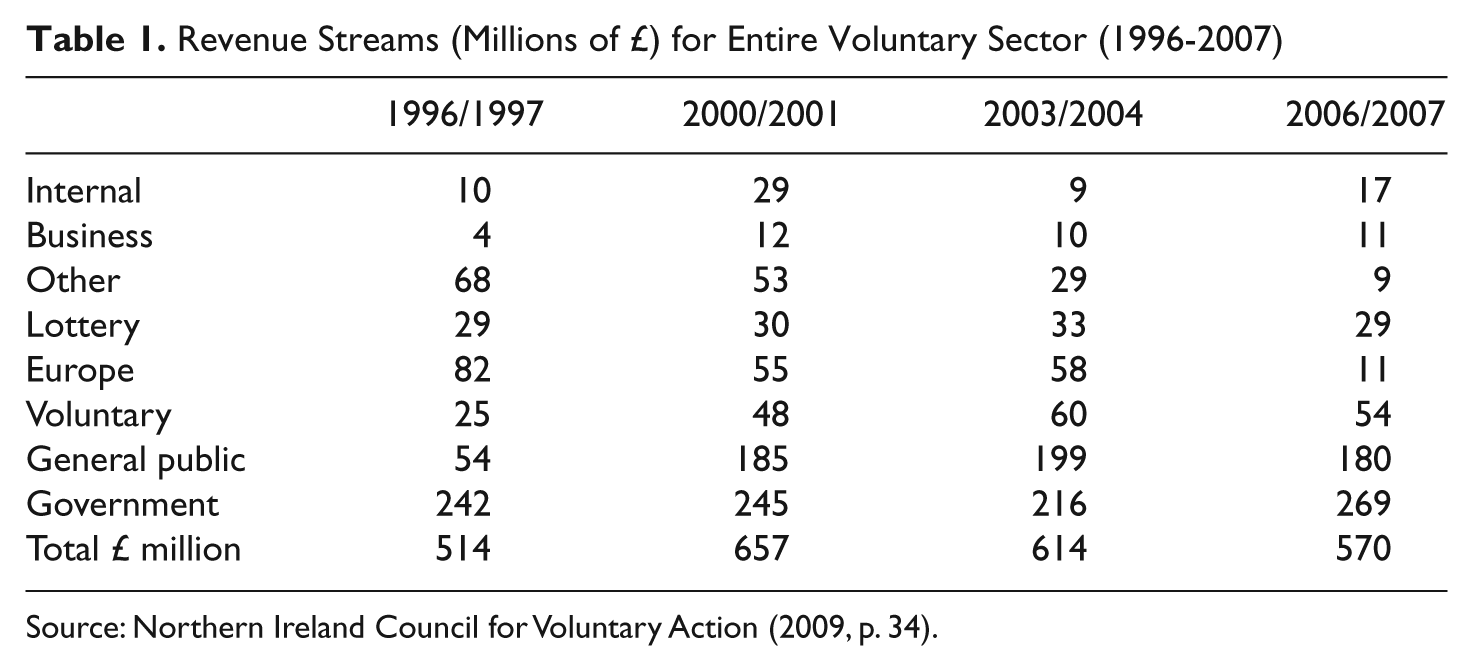
Both selection and adaptation theories would lead one to believe that the marked differences in funding streams for each subsector would lead to different managerial tactics in the face of resource constraint. The question becomes, at the level of a niche, what can one expect in these recessionary times? What tactics can organizational leaders pursue given a rapid shift in the types of income available as well as the types of services demanded? To illustrate the potential effect of the recession on managerial tactics, I draw from the NICVA’s recently conducted State of the Sector research report (NICVA, 2009). NICVA has been able to conduct a series of five sectorwide surveys, roughly every 2 years, to gauge the strength of a sector so important to the lives of community members. The information drawn from the surveys of voluntary organizations helps to draw into relief the divergent choices that different leaders must face when resources rapidly constrict.
Recession and the Choices for Northern Irish Voluntary Organizations
The main question of concern is whether the recession in the U.K. economy, and more specifically the Northern Irish economy, will lead to a drastically different future for different types of organizations. Organizational leaders potentially face a range of tactical choices, but niche-level dynamics can serve to limit those choices (Oliver, 1991). To create a sufficiently narrow scope of analysis for this study, only the two largest organizational fields (DiMaggio & Powell, 1983) in Northern Ireland are considered: community development (27% of the VCO sector) and young people organizations (19.4% of the VCO sector; NICVA, 2009). Although there is no comprehensive information as to the number of organizations that could be considered nationalist/Catholic versus unionist/Protestant, there is the common understanding that the entire sector, particularly in deprived urban and border areas is divided along sectarian lines.
The community development subsector has been the most intimately involved in providing services in the most destitute urban communities across Northern Ireland; it so happens that the effects of sectarianism, along with economic despair, are most prevalent in these areas. It also is intuitive that this sector may be the most directly affected in the near future as recession begins to generate a greater demand for community development services. Fully one fifth of VCOs operate in the top 10% of the most deprived wards in Northern Ireland (NICVA, 2009, p. 18). Young people organizations serve vital and diverse functions from sports and recreation to counseling and advocacy. One might conjecture that organizations dealing with youth may be more resistant to recessionary cutbacks in funding given that donors often define children as high priority for giving.
The community development subsector has been tied closely to European Union PEACE funding programs over the past 15 years; particularly, organizations with a desire to focus on social inclusion have been very successful finding grant monies. Over the past 3 years, there has been an 82% drop in EU PEACE funding from 21.2% of total funding for the subsector to 3.1% (NICVA, 2009, p. 33). The result has been a rapid contraction of those community development organizations most dependent on EU funding. Even given this fact, close to 20% of these organizations continue to depend on EU grants for 75% to 100% of income, which is the highest of any subsector (NICVA, 2009, p. 36). Given the long-term trend in European funding, with a drastically reduced scope and funding level for the PEACE III program, the organizations that are solely dependent on EU grants will need to drastically alter their funding structures or face little hope for continued viability (Figure 1).
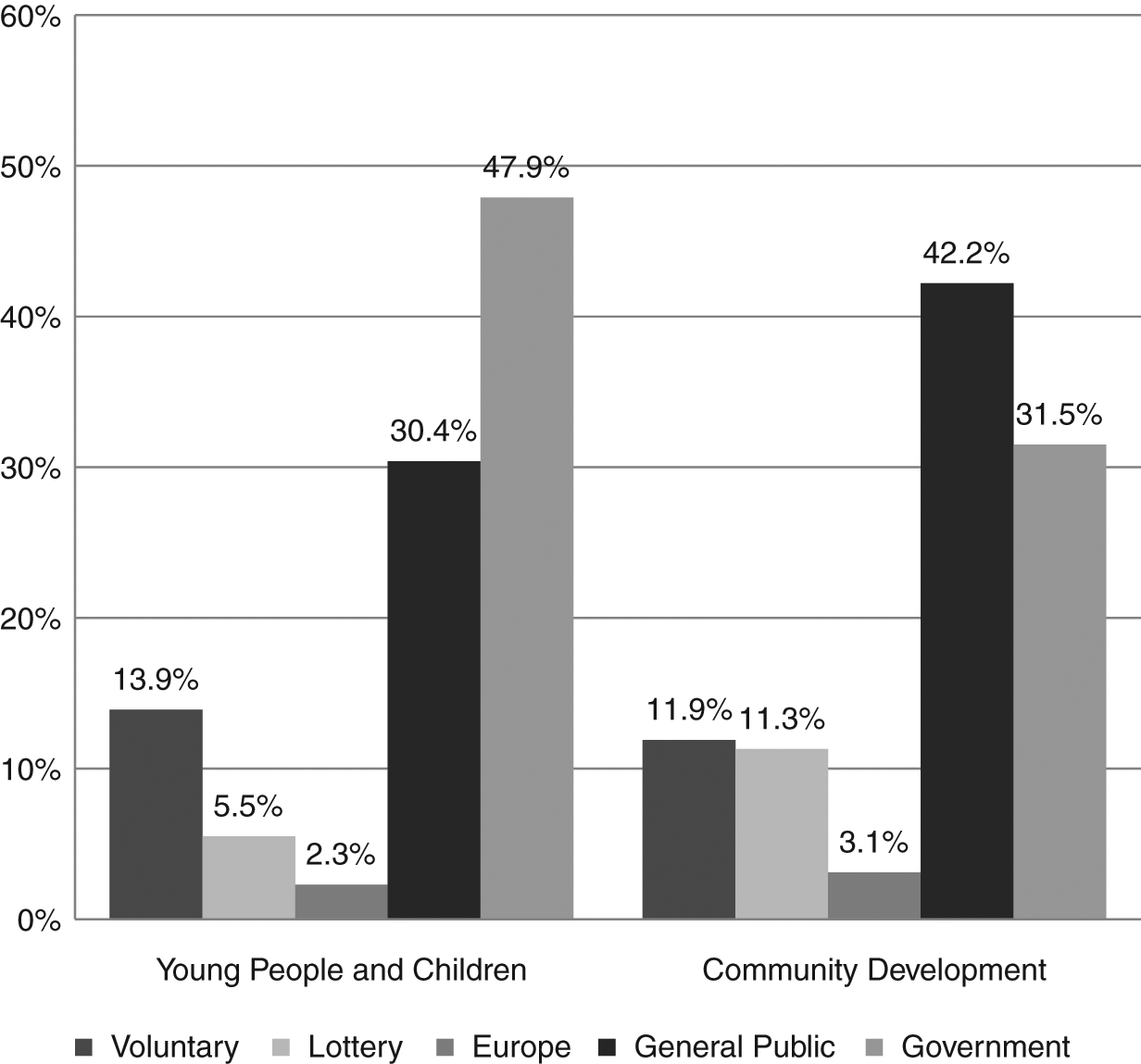
Funding streams for top two VCO subsectors
Community development organizations are dependent on voluntary income, which typically comes in the forms of grants and individual giving, for a full 80% of total income. Only 20% is the result of earned-income activities through fees for services or government contracts for services. By contrast, young people organizations have a much more diversified stream of income with 56% of revenue coming from earned income and 44% from voluntary income (NICVA, 2009, p. 34). The subsector is much more dependent on the Northern Ireland government for its income, as compared with community development: 47.9% for youth versus 31.5% for community development (NICVA, 2009, p. 33).
Organizational Tactics for Community Development Organizations in the Face of Recession
VCO leaders face a range of potential choices in the face of dynamic resource environments. Not all choices are equally viable, depending on the nature of the resource niche, the density of the niche, and the presence of organizational champions. Northern Irish community development organization leaders face difficult choices in the face of declining European Union funding and a heavy reliance on grants to cover expenses.
Community development organizations have become omnipresent over the past decade, largely due to funding provided through the European Union PEACE I, II, and III Programmes (Birrell & Williamson, 2001). As the funding for each EU program has been progressively narrowed in scope, from general community capacity building to currently only focused on conflict resolution projects, and in overall funding, the niche density has changed. Many organizations have been forced from the resource niche because of the rapid shrinking of the pool (NICVA, 2009). Given that the drastic cutbacks have happened between the end of the PEACE II program in 2006 and the stopgap extension of the program through the creation of PEACE III in 2007, the population entirely dependent on EU funding has been culled mainly to organizations that provide conflict resolution services in the most deprived urban and border wards in Northern Ireland. PEACE III funding has been extended until 2013, after which time there is very little hope for continued support. The organizational density looks to be stable for the next several years.
Champions abound in the community development arena. With the Belfast Agreement of 1998 came a devolved local assembly at Stormont, the people of Northern Ireland after a quarter of a century had access to local representation. Still, during the darkest years of the Troubles, a coterie of local community leaders became the essential connection between a community, oftentimes the most deprived, and influential leaders around the world, from the civil servants of the Northern Ireland Office, the MPs in Westminster, to American senators and presidents. In fact, a small industry of local champions today continues to thrive. Champions may be local clergy members, particularly prevalent in Protestant communities, members of the Stormont assembly, leaders of political parties, paramilitary leaders, and ex-prisoners. There is a great diversity in how champions achieved a level of institutional legitimacy, yet their continued existence depends on their ability to deliver resources back to their local area. Champions are important elements in buffering core processes from invasive demands from funders (Thompson, 1967). Because of a champion’s institutional legitimacy, it is possible to push funders off of intrusive demands by inferring legitimacy to the organization itself.
Community development organizations in the most deprived wards tend to have strong connections to institutional champions. Organizations in nationalist communities that were developed during the Troubles have developed strong legitimacy in their particular areas as they “stuck by us” during the worst of times. Some of the most vocal champions are politicians who have at one time been affiliated with a paramilitary organization or at the very least depend on (ex-) paramilitaries for their own positions. Organizations in deprived unionist wards have faced a different trajectory. Given the concept of parity enshrined in the EU PEACE programs, which has continued into broad principles behind government grants and contracts, unionist community development organizations have been fairly recent creations. One could argue that parity has even created two separate resource niches. Unionist champions, much like nationalists, have been very effective in steering government grants and contracts to preferred organizations; the one difference between deprived urban nationalist and unionist wards is the comparative lack of unionist organizations with the capacity to deliver needed social services.
Currently community development organizations have a greater range of tactics available vis-à-vis institutions, even given the economic recession for four main reasons: (a) The timeline for grants can range between one and several years. The cut in EU funds has served to cull the organizations with the least amount of administrative capacity leading to a stronger subsector. Organizations that have received grants in the past are much more likely to use the institutional capital in the future to keep receiving grants. (b) Organizations that work in the most deprived wards, and especially urban Protestant wards, are typically the only providers of essential services for that immediate region. The lack of competition means that they hold a monopoly position in many instances. (c) The concept of parity protects many organizations from competition across sectarian lines. While there are very competent community organizations that strive to remain nonsectarian—and those tend to be UK-wide or are among the top income producers across the subsector—it can be very difficult to deliver services across the walls (some quite literal) that separate deprived urban wards. (d) The presence of very strong institutional champions such as local political leaders allows organizations greater latitude in pushing back on institutional demands, especially when it comes to government-funded grants and contracts.
Community development organizations that operate in deprived wards can be effectively divided based on which side of the sectarian divide they reside. Unionist organizations potentially can have greater latitude in actively resisting institutional pressures such as increased program evaluation and reporting standards, particularly when it comes to government funding, due to their underrepresented status in applications for EU and government funding. Nationalist organizations also have the ability to be active in their resistance due to the presence of local champions, yet the concept of parity and the history of a robust subsector can work against them leaving a more dense resource niche. In many wards, there are other delivery options, although funders must invest in investigating the new providers’ abilities to provide services. For this reason, one can project the idea that nationalist organizations may attempt passive resistance tactics such as obfuscation, but will have to be more guarded in active resistance.
Organizational Tactics for Young People Organizations in the Face of Recession
Young people organizations are not as reliant on EU funds and have been much more accepting of fees for services as well as contracts with government entities. This has resulted in a different structure to the resource niche (like the community development subsector, the niche could be divided along sectarian lines when it comes to organizations operating in the most deprived wards). Because as a whole there has been less dependence on EU grants, the sector has not been dramatically culled in the past several years. A counteracting force has been a general trend toward government contracts. Presumably those organizations with the least administrative capacity to develop and submit strong contract proposals to the government have been forced from the niche and either died or been transformed.
Institutional pressures can be high when receiving government contracts, especially when they are contracts for at-risk populations such as children. For organizations providing counseling and educational services, there are also strong professional norms in the field about how to conduct services (Milward & Provan, 1991; Provan & Milward, 1995). For organizations that are involved in recreation and sports, there are less normative and formal institutional pressures. This distinction is most important in determining the ability of organizations to actively resist institutional pressures. The presence of local champions can be important in securing initial funding, in certain cases, but this will not mitigate professional norms of conduct when it comes to children. Any violation of these norms can cause immediate sanctions from both the public at large and government regulators.
The result is to limit the range of tactics available to young children organizations, especially those involved in providing services governed by strong professional norms of conduct. Even though an organization may be the only one to provide services in a particular ward, potentially abrogating professional norms may lead to a harsh reaction from the government or other contracting entity. It will also have an effect on individual giving to that particular organization. Organizations must accept all institutionally legitimated demands in this case but may be able to push back when the organizational field collectively finds the demands to be detrimental to their operations. This determination would seem to be rare, meaning that young people organizations oftentimes will be more likely to passively accept any additional requirements from the resource environment.
Conclusion
The recession of 2008-09 has brought into relief the fact that different organizations are better able to weather financial crisis than others, which does not defy common sense. The important empirical question is how we differentiate between those organizations that are likely to survive without much difficulty from those organizations that face tremendous challenges in the future. Voluntary sector organizational leaders face significant resource constraints, which then color how they can react to their resource environments. This article draws on the cases of two subsectors to highlight how theories of organizational change do not have universal application to all organizations. Rather, it depends on the density of the resource niche, the fundamental understanding of niche-level dynamics, and the presence of organizational champions.
Although we seek to categorize the potential organizational responses that leaders could feasibly make, the argument that we make is not completely deterministic. Equally important, effective leadership does matter. Even in the worst of economic times, the success or failure of organizations is not a random occurrence devoid of agency. Efforts to map different subsectors can provide the necessary empirical basis for testing over time how changes in the dimensions of a resource niche can alter the choices that leaders face. The limit to the research rests in how one is to categorize organizations or a basic unit-of-analysis problem. Given the recent economic recession, a focus on resource niches seems to be particularly important.
This article does not intend to be deterministic; realistically, organizational leaders have agency even in situations where they are completely dependent on a single funder. Even population ecology models highlight the fact that particular organizations may be able to escape larger funding trends through diligent planning and communication, instead focusing on how populations in general succeed or fail. In turn, one should use the analysis here to indicate how organizations in different subsectors have divergent choices as far as what they can do vis-à-vis the funding environment. Just as Grønbjerg (1993) articulated using the example of Chicago-based organizations, the value in this analysis lies in highlighting the inherent blinders in any model of organizational change. From the standpoint of model development as well as application to the voluntary sector, one should be cognizant of the intense funding pressures that organizational leaders face during the current economic recession.
The applied impact of empirical research on organizational tactics is potentially great. Leadership education and training for the voluntary sector should not be one-size-fits-all; at the same time, it is not possible to have education tailored to every situation for every person. The categorization presented in this article attempts to make the argument that somewhat abstract organization theories have great utility for leaders on the ground. While helping organizations to better understand their positions vis-à-vis their funders, the theory presented here can also aid foundations and governments in better comprehending the difficult choices that their service providers face during a recession. This knowledge can aid funders in helping those organizations that may be selected against through the contraction of a resource niche to diversify funding streams or create longer-term agreements with funders to allow adaptation dynamics to prevail.
Footnotes
The author wishes to thank the Northern Ireland Council for Voluntary Action and Nicholas Acheson for their wonderful support as well as the thoughtful comments of the anonymous reviewers.
The author declared no potential conflicts of interest with respect to the authorship and/or publication of this article.
The author received no financial support for the research and/or authorship of this article.