







Abstract
Traditional sociological insights assume that cities are characterized by lower levels of voluntary engagement as it is expected that community size and population density are negatively associated with network and mobilization opportunities. Others, however, argue that cities allow for the formation of different networks that are no longer based on ascribed personal characteristics. The authors analyze voluntary association membership in Belgium, based on the “Social Cohesion Indicators in Flanders” dataset (n = 2,080 respondents, sampled in 40 communities). The analysis shows that neither population density nor community size have an effect on scope or intensity of participation in voluntary associations. Only two forms of associations are negatively related to population density. Their results therefore do not support the hypothesis of a rural-urban divide in participation in voluntary associations. They speculate how future research could take into account different sorts of voluntary associations when investigating the rural-urban divide and include other measurements of participation.
Introduction
Within traditional sociology, it was often assumed that living in an urban environment is not conducive for community engagement and social integration. Following the lead of 19th-century authors like Tönnies (1898/1979) and Durkheim (1897/1993), urbanization was often equated with a disruption of social ties, anonymity, and a breakdown of social order, because of a lack of voluntary associations, religious institutions, family ties, neighbor and other personal networks and, as a consequence, low levels of social control (White & White, 1962). In the contemporary literature, however, the effect of urbanization on voluntary participation is a hotly debated topic. In his seminal work To Dwell Among Friends, Fischer (1982) argued that city dwellers do not necessarily have fewer ties, but that their networks are structurally different, as city size creates the opportunity to develop ties with distant but like-minded others. While rural ties often call for geographic closeness and resemblance, networks in an urban context allow for the development of specific subcultures (Fischer, 1975b, 1995; Gans, 1962). This line of reasoning suggests that urban centers will be characterized by a lower concentration of traditional voluntary associations. Membership in these associations is usually based on one background characteristic (e.g., gender, age, or religion) and hence these associations are assumed to appeal less to city dwellers who have the opportunity to engage in various other manifestations of civic life. Several scholars have made the claim that patterns of voluntary engagement are changing rapidly in Western societies, as younger age cohorts prefer different, more loosely structured forms of associations (Dalton, 2008). They argue that the relation between individuals and associations is becoming more fluid and is less based on ascribed identities (Taniguchi, 2008; Torpe, 2003). If this assumption is correct, we can assume that these new forms of civic engagement will be present most strongly in an urban context, while traditional forms of voluntary associations will be found predominantly in a rural environment.
While these authors assume that urban centers can be an important hotbed for innovating forms of civic participation, empirical evidence about the relation between urbanization and participation is, at best, rather mixed (Latane & Darley, 1970; Levine, Martinez, Brase, & Sorenson, 1994; Oliver, 2001; Olson, 1965). Verba, Schlozman, and Brady (1995) document a negative relation between urbanization and levels of engagement. In an urban context, looser ties with other citizens will decrease the odds that one will become mobilized to participate in voluntary associations (Stadelmann-Steffen & Freitag, 2011). In this geographical setting, participation becomes much more an individual decision, that is less strongly embedded in social networks than is the case in more close-knit communities. Given the importance of these networks for mobilization, it can therefore be assumed that participation will occur less frequently in large urban contexts (Bell & Force, 1956a, 1956b). Community size, furthermore, may have a negative effect on the sense of community and the level of cohesiveness within a community, thus decreasing motivation for community integration via membership of voluntary associations (Graddy & Wang, 2008).
In other studies too, a negative association between urbanization and participation has been documented (Curtis, Grabb, & Baer, 1992; Sundeen, 1992; Wallace & Pichler, 2009). Smith (1994) summarizes the literature by concluding that large urban centers inhibit the formation of strong civic communities.
In this article, our goal is to assess the impact of urbanization on participation in voluntary associations. Looking at the contextual determinants of civic engagement from the community-level perspective, we investigate how citizens participate in voluntary associations in increasingly complex and heterogeneous communities. Do we still encounter the rural-urban divide, as in traditional sociological studies? Or is there a need to qualify the general statement by introducing distinctions based on the intensity (active or passive) of the involvement, or the number of associations?
In the next section, we start with a literature review on the relation between participation and urbanization and we develop our hypotheses. Subsequently, we describe the research design, data and methods. In the discussion, we return to the question whether the urban-rural divide is still relevant for the contemporary study of participation patterns and we point out where future research is needed.
Participation and Urbanization
Traditionally, it was assumed that urbanization would have a negative impact on most forms of social participation. Urban life was equated with anonymity, a lack of strong social ties and a reduced possibility for the individual to exert any influence in social life (Fischer, 1975a). The fact that the geographical mobility of urban populations tends to be higher than that of rural populations even further increases the psychological distance with neighbors and other members of the community (Wirth, 1938). The lack of social integration and the weakness of social ties in general also would make it more difficult to mobilize city dwellers for various forms of engagement (Huckfeldt & Sprague, 1995).
Empirical research tends to confirm these negative views regarding the effect of urbanization on community engagement. Oliver (2000), for example, investigates four participation measures with a local and political focus like attending meetings of voluntary associations or contacting local politicians. He concludes,
Residents of larger places are much less likely to participate in a variety of social civic activities than are people in small communities. (. . .) People in larger communities are less likely to be mobilized for political activity, particularly by neighbors or acquaintances. (Oliver, 2000, p. 370)
Recently, Remmer (2010) has confirmed these findings in a comparative research project, arguing that residents of large scale communities have less reason to assume that their individual contribution could make a difference in the way their society is being run.
Not all authors, however, share this same negative assessment of the impact of city life. Sampson (1988) has found that city size does not have an effect on the scope or the extensiveness of friendship networks, while Steblay (1987) too did not find the rural-urban division to have any effect on helping behavior. According to these studies, some traditional forms of social networks might be less frequent in urban settings, but this is compensated for by the occurrence of different and more modern kinds of voluntary networks in the city. Kelleher and Lowery (2009) are equally skeptical about the findings of the Oliver study. They argue that if one focuses on participation in civic associations as a dependent variable, city size even has a positive impact on participation figures. For political participation, it indeed makes sense that the level of political involvement is inversely related to city size, as the number of available political positions usually does not rise in the same proportions as the inhabitants of a city. Inhabitants of small communities have more opportunities for political engagement than city-dwellers, but the same cannot be said for nonpolitical forms of engagement. The effect of city size, therefore, seems to be strongly dependent on the specific acts of participation that are being investigated (Rose, 2002).
Haddad (2004) has argued forcefully that city size as such should not be considered as a determinant of helping behavior. Much more important is the way communities embed volunteering, by offering a context that includes abundant opportunities for recruitment and mobilization and also offers social support and appreciation for volunteers. This kind of supporting environment, according to Haddad, might as well be realized in a small community setting as in a large urban environment. Sense of community has been proven to be an important determinant of willingness to engage in community life, and this sense of community does not seem to be dependent on city size (Anderson, 2009).
The debate about the impact of community size and density on engagement levels becomes all the more salient, given the fact that the characteristics of voluntary engagement themselves are rapidly changing. Traditional mass membership–based organizations that were constructed on the dispersion of local chapters gradually lose ground (Skocpol, 2003). Although these traditional forms of associations might prosper more abundantly in rural settings, new forms of engagement are typically to be found among young, highly educated citizens residing in the large urban centers. If one wants to determine the impact of city size on engagement levels, it is therefore extremely important to make a distinction between specific forms of participation and engagement.
Building on a recent participation study in Belgium, our aim in the current analysis is to determine the impact of community-level indicators on civic participation levels by highlighting the role played by a number of specific voluntary associations. We hypothesize that urbanization has a negative effect on participation in traditional voluntary associations, but we do not assume that urbanization has an effect on the intensity or scope of participation in voluntary associations in general. Since the objective is to include both community- and individual-level independent variables, we will use multilevel analysis to distinguish both levels.
Data and Method
In this article, we investigate the impact of community-level characteristics on membership in voluntary associations. The analysis is based on the results of a new population survey in Belgium that allows us to connect individuals to statistical information about the communities they reside in. The “Social Cohesion Indicators Flanders” (SCIF) survey was designed specifically to analyze the impact of community-level characteristics on individual social capital outcomes. A total of 2,080 respondents from 40 different communities were interviewed in 2009. The analysis confirmed that the communities were representative for all communities within the Flemish region and that the sample of respondents too is representative for the population of that region (see Appendix A for the full documentation of the survey). Flanders is the Northern, autonomous regions of Belgium, with 6 million inhabitants, or almost 60% of all inhabitants of Belgium (Deschouwer, 2009). Belgium is on an average European level with regard to participation in voluntary associations, with both a strong presence of traditional associations and various new associations like new social movements that are active on human rights or the environment, or sports clubs that tend to attract a young membership base (Hooghe, 2003b).
Individual-Level Variables
To measure membership in voluntary associations, respondents in the survey were presented with a list of 18 different associations and for every association they could indicate whether they were an active or a passive member of that association, or not a member at all (for the full wording, see Appendix B). This wording allows us to investigate both active and passive membership in these associations. During the interview, it was explained that passive membership amounted to paying membership dues and reading the publications of the association. This extended battery of associational questions allows us to investigate the intensity of membership, the membership in specific associations, and the specific character of membership (active or passive).
On the individual level, we included various control variables, as they have been developed in the “dominant status model” (Lemon, Palisi, & Jacobson, 1972). This model emphasizes that individuals who are characterized by a more dominant set of social positions and roles are also more likely to participate in voluntary associations (Smith, 1994). For this reason, control variables that are included are age, education level, income, and gender. Furthermore, given the importance of informal networks, it can also be expected that those having a partner and/or children, will be more easily recruited into voluntary associations (Hooghe, 2003a; Hooghe & Stolle, 2003; Rotolo, 1999; Smith, 1994).
Since we assume the effect of age to be curvilinear, with the highest participation level to be found among the middle-aged group, we include both age and age squared. Socioeconomic status is measured with three variables: education level, family income, and unemployment. We expect that highly educated and affluent respondents will be more likely to participate in voluntary associations, while we expect a negative impact of unemployment.
Education level is coded into seven categories, ranging from no formal qualifications to having attained a university degree. For family income, we used the OECD equivalence scale, controlling for the number of household members (Van Doorslaer & Masseria, 2004). 1 Next, religion as well has been shown to be an important determinant of membership in voluntary associations (Bekkers, 2005; Van Ingen & Dekker, 2011). Two dimensions have to be distinguished in dealing with religion. First, denomination is taken into account: As 75% of all respondents belong to the Catholic Church, we assume that Catholic respondents will have more structural opportunities to engage in voluntary associations than respondents having no or a different denomination. Second, we include church practice, with 7 categories ranging from never attending church to weekly attending church, as previous research has shown that this form of religious behavior is strongly connected to membership in voluntary associations (Putnam, 2000).
In the first part of Table 1, descriptive statistics for the dependent variable and all individual-level independent variables included in the analysis are provided. In our sample, more than 58% reported to be an active member of at least one voluntary association with a mean of 1.1 memberships per respondent.
Descriptive Statistics for Individual- and Community-Level Variables
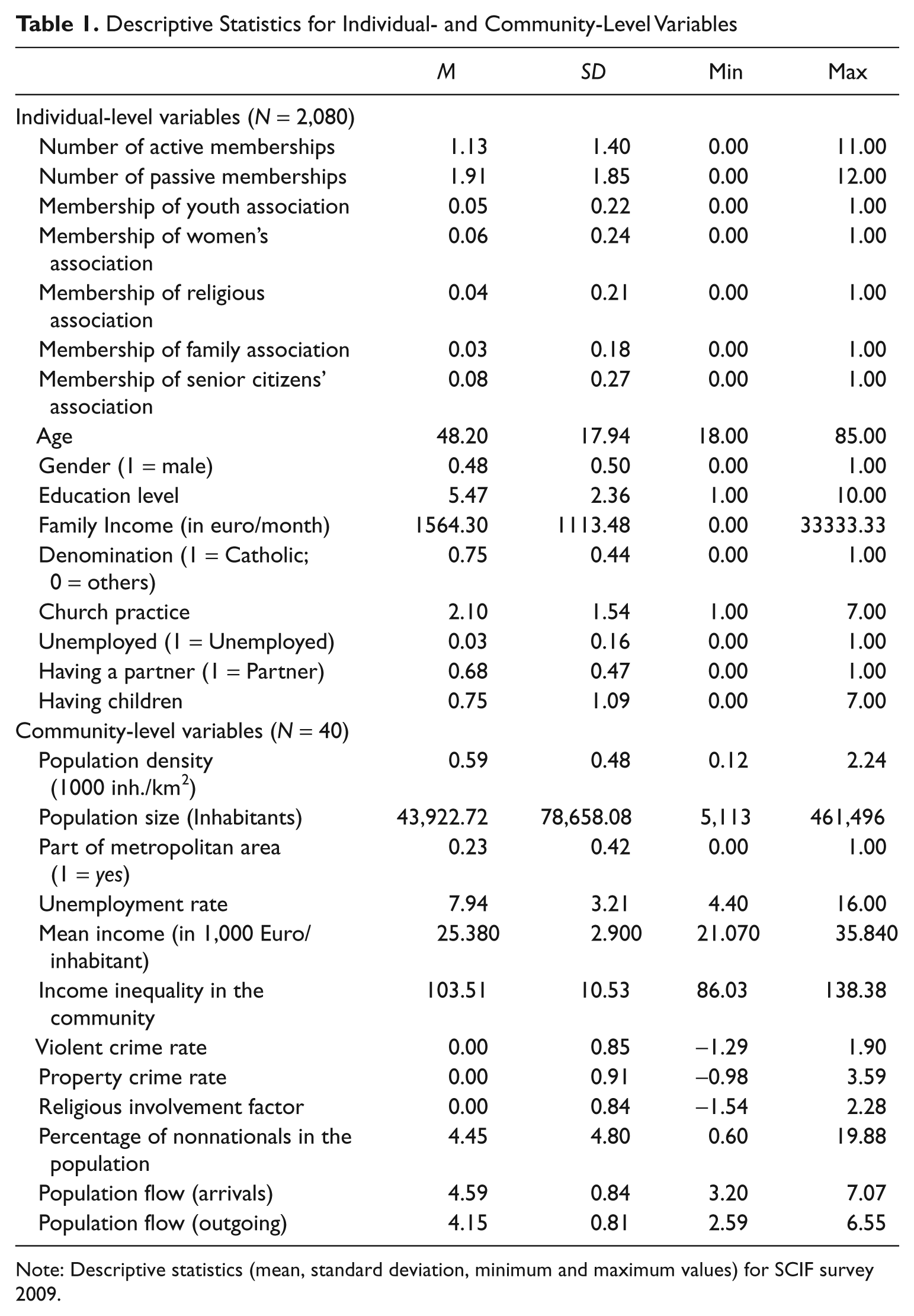
Note: Descriptive statistics (mean, standard deviation, minimum and maximum values) for SCIF survey 2009.
Community-Level Variables
For the community level too, it is important to include sufficient control variables in the analysis. City size is the first, obvious community-level variable. We include both population density as the number of inhabitants of the community as indicators for the urban character of the place of residence as larger metropolitan areas can be divided in distinct communities, so that in these cases, population density should function as a more straightforward indicator. Oliver (2001) further has made the point that local communities should not be studied in isolation, but that we should also pay attention to the process of suburbanization. Whether or not a community belongs to a larger metropolitan area therefore was also included in the analysis. Building on an existing typology of communities in Belgium, local communities that could be considered an integral part of a larger metropolitan area in the country received a value of “1” in this dummy variable (Van der Haegen, Van Hecke, & Juchtmans, 1996).
Various community-level variables have also been shown to have an effect on participation. As urbanization is also related to other social and economical processes, we further include variables that indicate ethnic and cultural diversity, social and economic heterogeneity, social disorder, religious behavior, and residential instability.
First of all, we look at mean income per inhabitant. It can be assumed that income has a positive effect on participation, as residents of more affluent communities will enjoy more opportunities to participate in associational life (Ahlbrandt, 1984; Dahl, Flotten, & Lorentzen, 2008; Chaskin, 1994; Oliver, 2001; Stoll, 2001). As it can be expected that inequality reduces engagement levels (Kennedy, Kawachi, Prothrow-Stith, Lochner, & Gupta, 1998; Wilkinson and Pickett, 2009), we also include income inequality. This is expressed by the interquartile coefficient, summarizing the relation between the income of the lowest and the highest quartile of the population of that community, thus expressing in a concise manner the level of income inequality. 2
The unemployment rate in a community is further taken as a control variable, based on the assumption that unemployment levels have a negative effect on voluntary engagement (Lindström, 2005; Lindström et al., 2002). The unemployment rate is the ratio between the number of nonworking job-seekers and the total labor force. It has to be noted that in this manner we can combine information on individual unemployment experience (measured at the individual level) with aggregate level measurements of unemployment levels in the community.
Furthermore, religious involvement is included on the community level too. Here we summarized the information into one factor, formed by four forms of religious participation. The four items were the percentage of baptisms (ratio of newborns being baptized to all newborns), the percentage of religious marriages (ratio of marriages conducted in church to all civil marriages), the percentage of religious funerals (ratio of religious funerals to all deceased), and the percentage of church attendance during Christmas (ratio of church attendance to the population). These four items formed one religious factor with a Cronbach’s alpha of .78 (see Appendix C).
Next, we included indicators of social disorder, being property and violent crime rate, that are hypothesized to have a negative impact on participation in voluntary associations (Bursik, 1998; Paxton, 2007). Here, we could rely on official police statistics on reported crimes in the community. A factor analysis showed that property crime (three items) should be distinguished from violent crime (four items) and, consequently, both forms of crimes were introduced independently from one another (see Appendix C). We included the percentage of non-Belgian foreigners in a community as a control variable, as some of the previous research suggests that ethnic diversity in a community could inhibit voluntary engagement although it has to be noted that evidence on this relation certainly is not conclusive (Greif, 2009). We furthermore have access to information about residential stability, as it can be assumed that rapid population mobility poses a burden for the development of voluntary associations (Ahlbrandt, 1984; Kang & Kwak, 2003; Taylor, 1996). We include both information about the percentage of the population leaving the community and the percentage of the population entering the community on an annual basis.
Hierarchical Nonlinear Models
Individuals living in the same community cannot be considered as independent observations because they are grouped into these communities. This second or community level has specific characteristics that we include in the analysis, using multilevel analysis. This way we can take into account this hierarchical two-level structure, namely, individuals (Level 1) who are nested in communities (Level 2). Data are analyzed using HLM6.0 software (Raudenbush, Bryk, & Congdon, 2004).
As the outcome variable, we are interested in the number of memberships in voluntary associations and the question whether these membership were active or passive. Since these variables are not normally distributed, we will rely on Poisson regression analysis (Agresti, 1996; King, 1989; Land et al., 1996). Second, we look at the membership of distinct associations, and here the dependent variable is a dummy variable (active member of that specific association or not). Consequently, we will rely on logistic regression techniques for this analysis.
A major problem for this kind of analysis is that community characteristics tend to be closely related, leading to a danger of multicollinearity. Unemployment rate, for example, is too closely related to violent crime rates, leading to unacceptable variance inflation factors. Therefore, we have to rely on a specific technique: every time we include a full individual model, supplemented by only one community level variable. Basically, this means that every new community level variable leads to a completely new model, and comparing all these models allows us to determine the strength of the various community level variables. Because of a lack of space, we will only report the effects of the additional variables for every model (full tables available from the authors).
Results
Our main independent variable of interest is population density as preliminary analysis has shown that this offers the strongest proxy measurement for urbanization of the community. Therefore, we will first conduct an analysis with only this variable included to assess the uncontrolled relation between urbanization and participation levels. Subsequently, individual-level variables will be added to the model, to control for compositional effects. If the inclusion of individual-level variables would render the population density effect nonsignificant, we can conclude that this latter effect is caused by the composition of the community and does not indicate a direct relationship between population density and participation.
Memberships in Voluntary Associations
The results of the survey show that participation in voluntary associations is quite widely spread across the population: 58% of all respondents reported at least one form of active membership. On average, respondents reported 1.3 active and 1.9 passive memberships. Given the skewed distribution of the variable, we opted for a Poisson regression, resulting in event-rate ratios. A ratio higher than “1” indicates a positive relation between the independent and the dependent variable.
First, we look at population density as the only independent variable in Table 2. As can be observed, even this uncontrolled univariate relation is not significant, neither for active nor for passive memberships. This already hints at the fact that in the Belgian context, urbanization is not related to overall engagement levels in voluntary associations.
Uncontrolled Effect of Population Density on Membership in Voluntary Associations
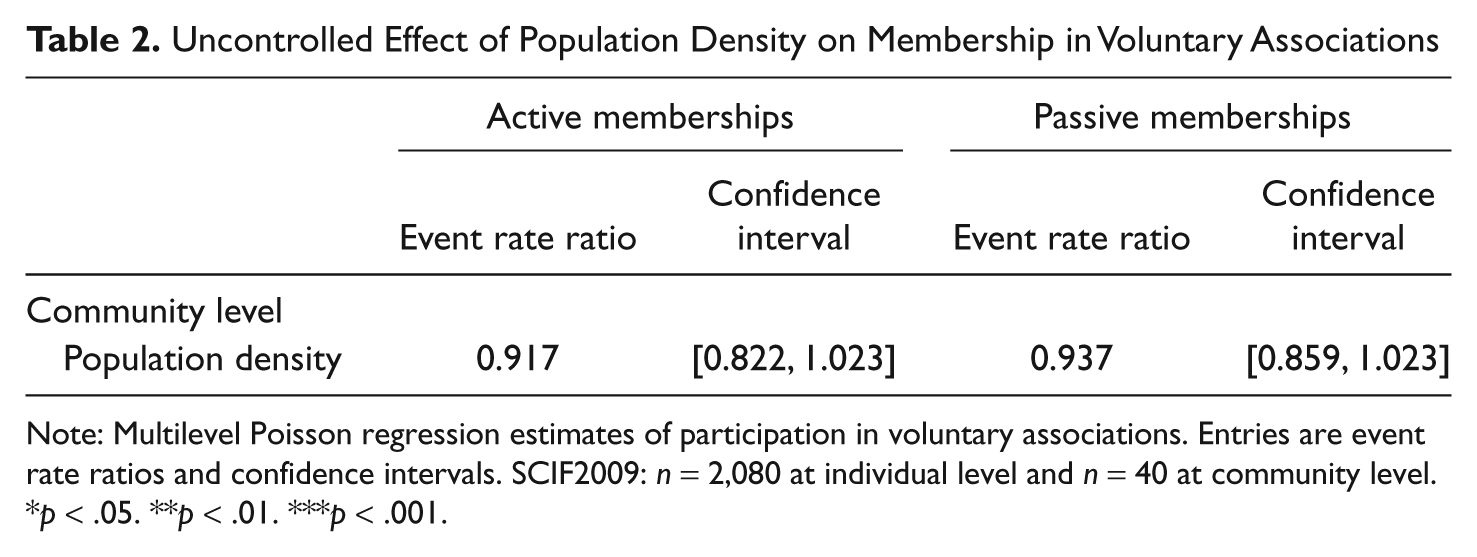
Note: Multilevel Poisson regression estimates of participation in voluntary associations. Entries are event rate ratios and confidence intervals. SCIF2009: n = 2,080 at individual level and n = 40 at community level.
p < .05. **p < .01. ***p < .001.
Looking at the individual determinants of diversity of memberships in Table 3, education level and church practice seem to have the strongest positive effects on the number of memberships in voluntary associations, both for active and passive memberships. The effect of age is significant for passive participation, but the coefficient is very small. While there is no gender difference for active memberships, men on average report more passive memberships in voluntary associations. Whereas in the past, women on average were less active than men, in the more recent literature, most of this classical gender difference seems to have disappeared (Themudo, 2009). The individual determinants for participating in voluntary associations do not differ strongly regarding the scope of involvement.
Membership in Voluntary Associations: Full Model
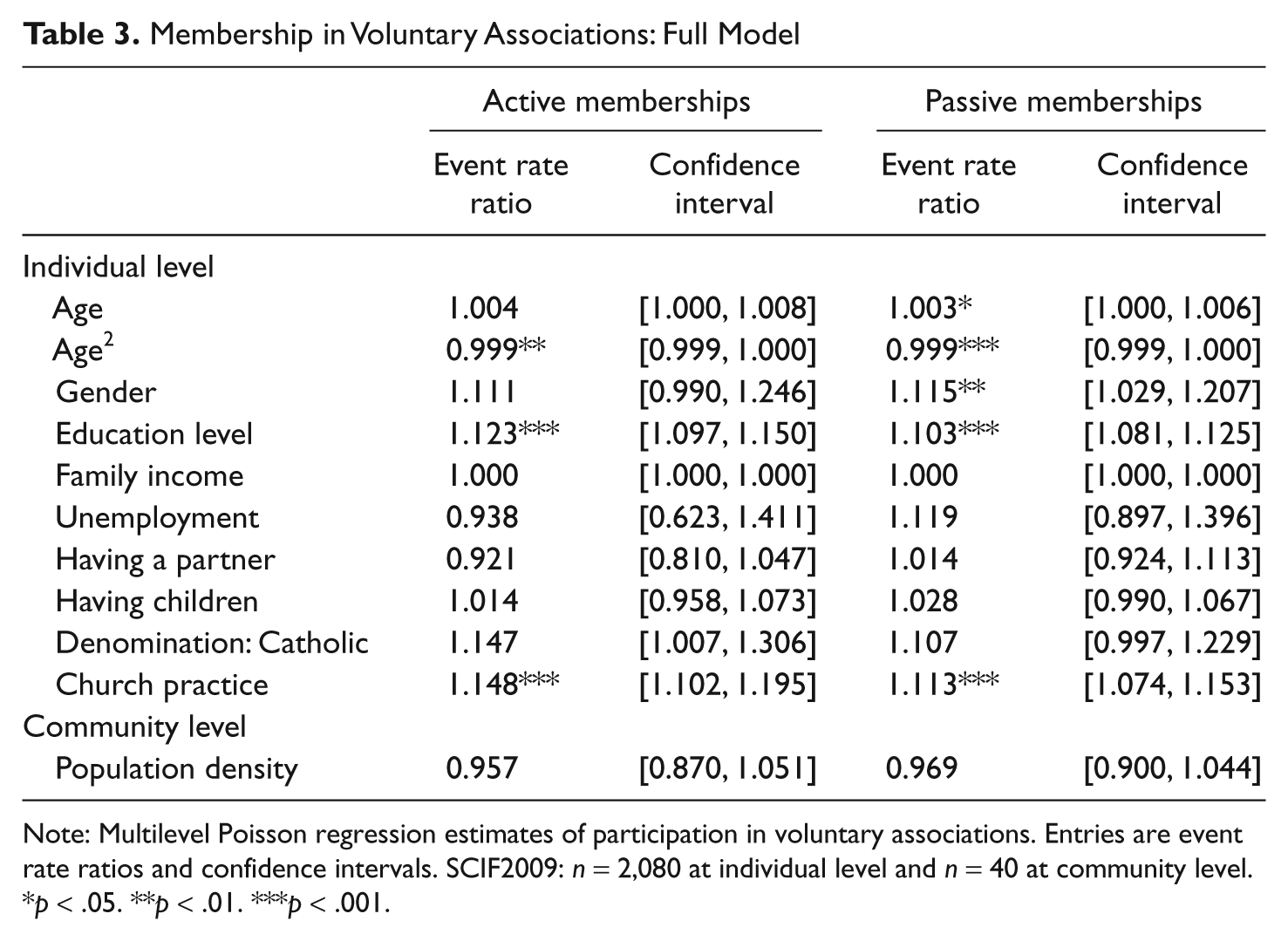
Note: Multilevel Poisson regression estimates of participation in voluntary associations. Entries are event rate ratios and confidence intervals. SCIF2009: n = 2,080 at individual level and n = 40 at community level.
p < .05. **p < .01. ***p < .001.
Adding other community-level variables to the models in Table 4 provides us with more information. The arrival of new inhabitants and the presence of nonnationals both seem to reduce the number of active memberships. Passive membership is positively related to the level of religious participation in the community (controlling for the religious behavior of the respondent). Next to population density, neither city size, nor belonging to a metropolitan area seem to yield a significant result looking at the number of active or passive memberships in voluntary associations.
Membership in Voluntary Associations: Community-Level Effects
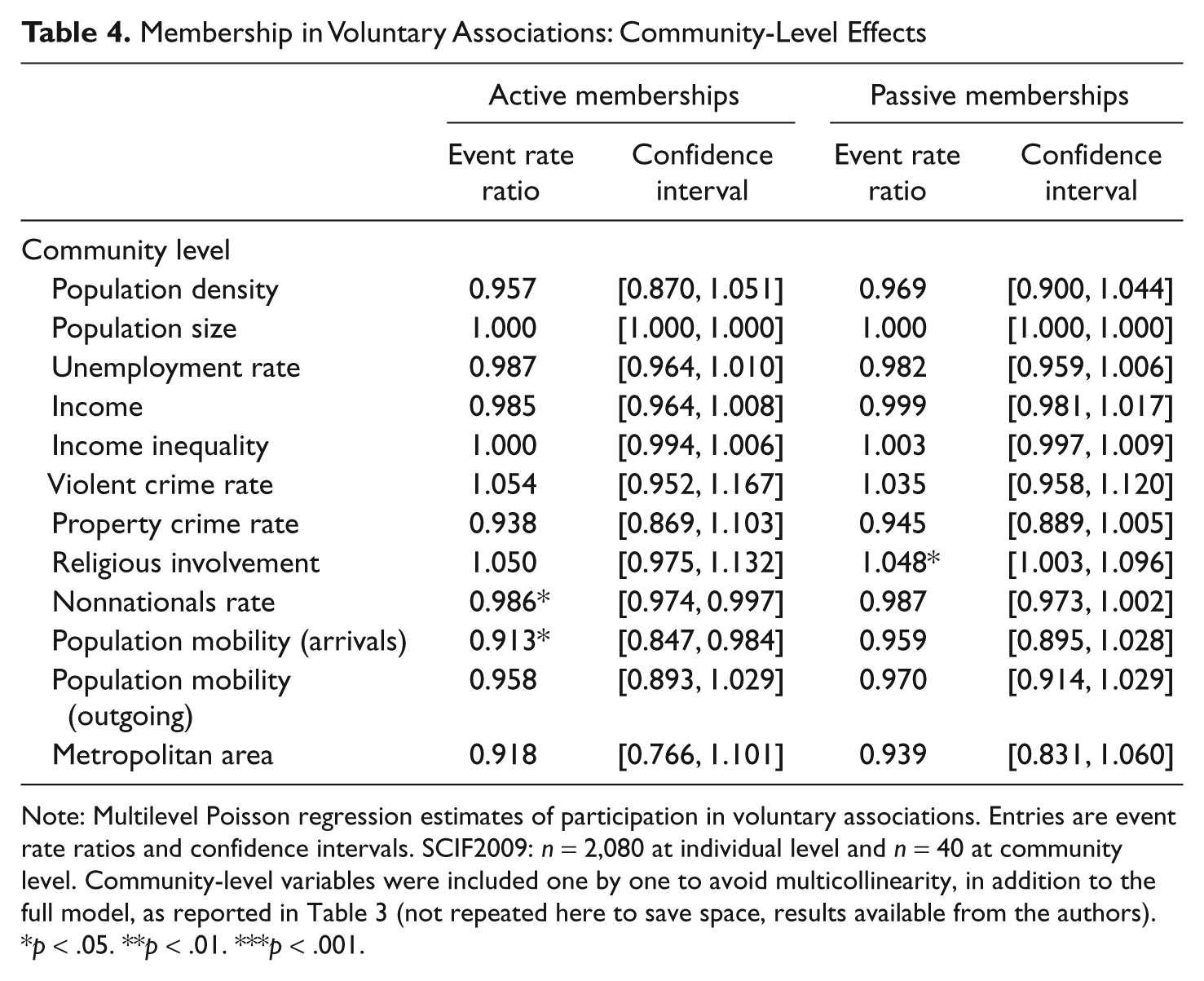
Note: Multilevel Poisson regression estimates of participation in voluntary associations. Entries are event rate ratios and confidence intervals. SCIF2009: n = 2,080 at individual level and n = 40 at community level. Community-level variables were included one by one to avoid multicollinearity, in addition to the full model, as reported in Table 3 (not repeated here to save space, results available from the authors).
p < .05. **p < .01. ***p < .001.
In general, it can be learned from Tables 2 to 4 that urbanization does not have a significant impact on either the scope or the intensity of participation in voluntary associations, as population density, city size, or belonging to a metropolitan area are not significant. It can be observed, however, that there is a negative impact of the level of newcomers and nonnationals in the community and a positive effect of the level of religious involvement. This would suggest that urbanization by itself does not effect participation, but some social developments that are associated with the process of urbanization do, though the effects remain very weak.
Membership in Distinct Voluntary Associations
Investigating the general membership figures did not reveal any significant effects of population density or city size. In the literature, however, it has been suggested that while some modern forms of associations will be more successful in an urban context, traditional forms of voluntary associations can be found predominantly in a rural context (Skocpol, 2003). The nonfindings from the previous analysis might thus be explained by the fact that while urbanization may have a positive impact on some forms of associations, it may have a negative impact on others. Therefore, we subsequently look at some specific kinds of associations. It has to be remembered that 18 different forms of associations were included in the questionnaire. However, most smaller associational types were only weakly represented in the survey sample and the number of respondents reporting an active or passive membership in them was too low for a valid multilevel analysis. If less than 3% of respondents reported an active membership, we were confronted with too many empty cells to conduct a reliable analysis, and therefore these small associations were excluded from the analysis. Furthermore, since we are mainly interested in community-level determinants, it makes sense to study only those associations individually, with sufficient intraclass correlation at the level of the community. 3 If there is no, or a very limited, intraclass correlation, this automatically rules out the possibility that community-level variables could have any meaningful effect. In line with standard practice in this kind of research, we therefore excluded also the associations with less than 3% intraclass correlation. Applying these two criteria, we are left with five large associations for which a meaningful analysis can be conducted. We find an intraclass correlation of 8.8% for family associations, 6.5% for youth associations, 6.8% for senior citizens’ associations, 11.0% for religious associations, and 5.6% for women’s associations. For all other forms of associations, the intraclass correlation is well below 3%, and this already makes clear that community-level variables cannot have an effect on membership in these associations. 4 For these latter associations, the individual level matters for explaining membership, but apparently not the community level.
For the analysis of specific associations, we will proceed in the same manner, by first analyzing the uncontrolled effect of population density (Table 5), before subsequently adding individual-level determinants in Table 6 and furthermore adding one by one other community-level determinants in Table 7.
Uncontrolled Effect of Population Density on Active Membership in Specific Associations
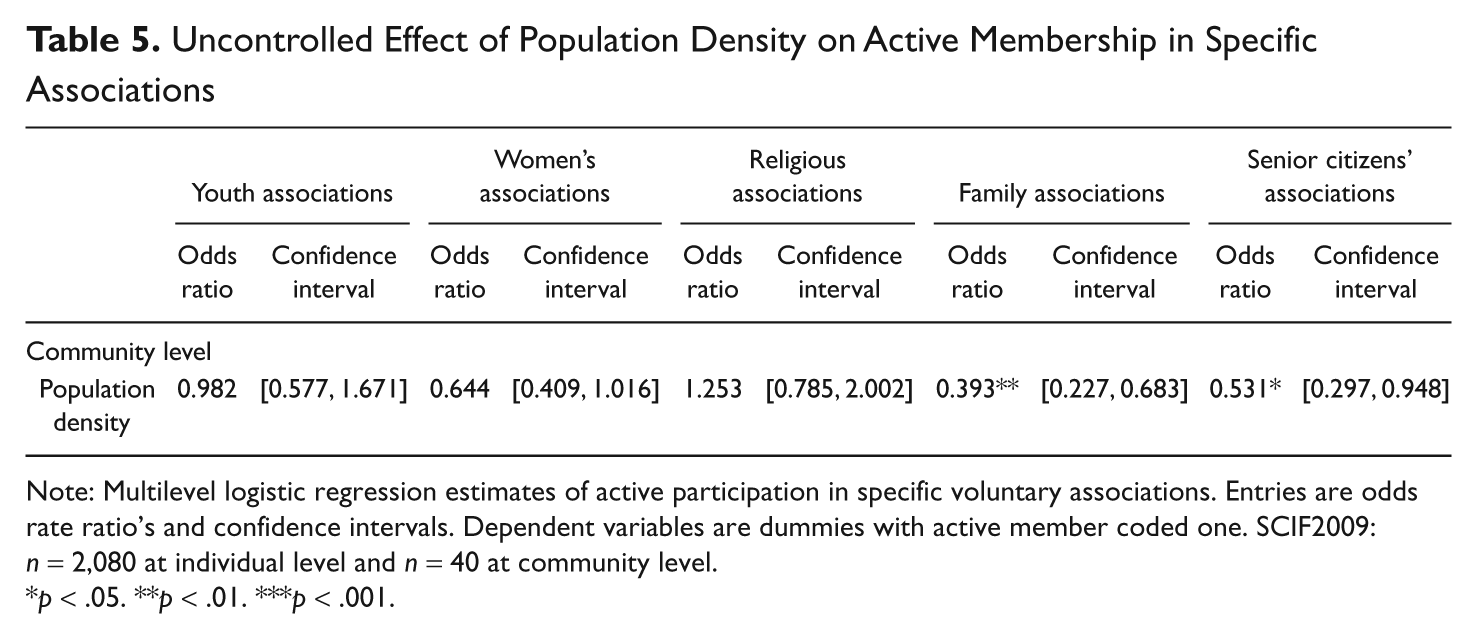
Note: Multilevel logistic regression estimates of active participation in specific voluntary associations. Entries are odds rate ratio’s and confidence intervals. Dependent variables are dummies with active member coded one. SCIF2009: n = 2,080 at individual level and n = 40 at community level.
p < .05. **p < .01. ***p < .001.
Active Membership in Specific Associations: Full Models
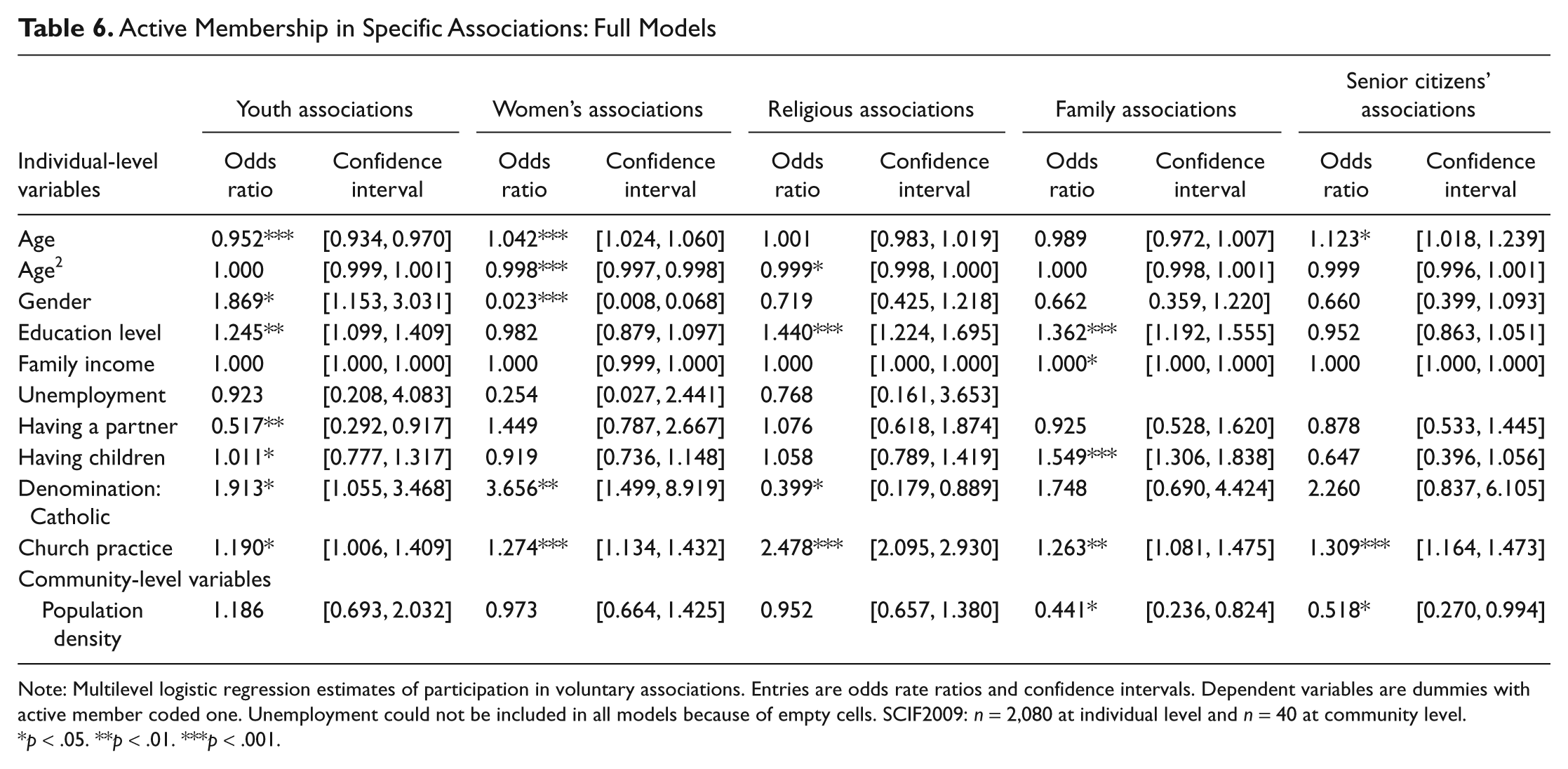
Note: Multilevel logistic regression estimates of participation in voluntary associations. Entries are odds rate ratios and confidence intervals. Dependent variables are dummies with active member coded one. Unemployment could not be included in all models because of empty cells. SCIF2009: n = 2,080 at individual level and n = 40 at community level.
p < .05. **p < .01. ***p < .001.
Community-Level Determinants of Specific Associations
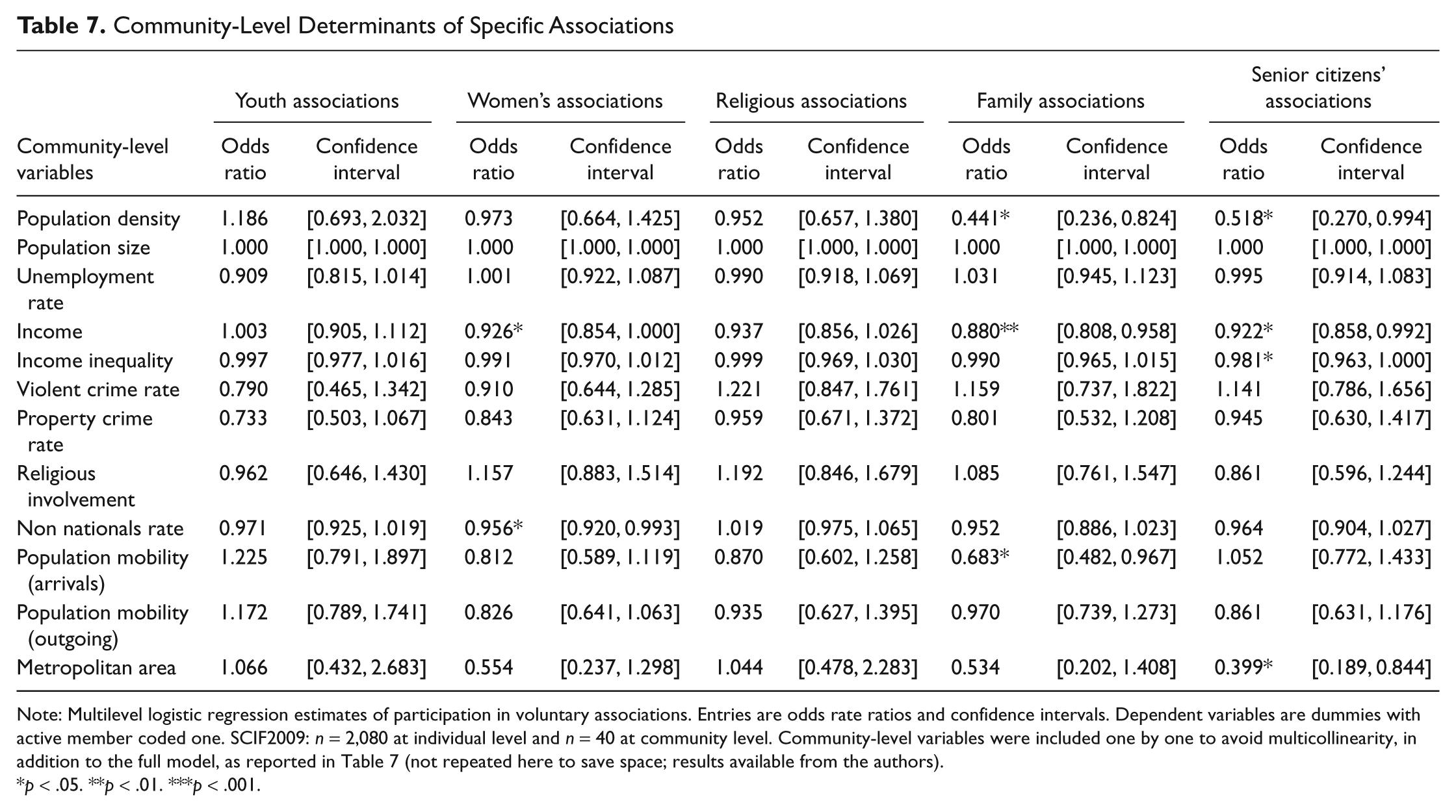
Note: Multilevel logistic regression estimates of participation in voluntary associations. Entries are odds rate ratios and confidence intervals. Dependent variables are dummies with active member coded one. SCIF2009: n = 2,080 at individual level and n = 40 at community level. Community-level variables were included one by one to avoid multicollinearity, in addition to the full model, as reported in Table 7 (not repeated here to save space; results available from the authors).
p < .05. **p < .01. ***p < .001.
First, we investigate whether population density has an effect on participation in voluntary associations. We can observe in Table 5 that only for family associations and organizations for senior citizens, population density at first sight is negatively related to participation levels. There is no significant relation for the other forms of associations. Since both family and senior citizens’ associations belong to the more traditional organizations in Belgium, this first explorative analysis already confirms our expectations.
In the next step (Table 6), we include individual-level variables to ascertain whether the effects of population density on the likelihood to participate are explained by the composition of a community. This proves not to be the case: The effect of population density on being an active member in family and senior citizens’ associations remains significant. The individual-level variables differ according to the type of association, as expected. Almost self-evidently, youth associations tend to attract young and highly educated members without a partner, while womens’ associations attract female and religious members.
We now turn to the results of the additional variables at the community level (Table 7). We do see a negative impact of average income on the likelihood to join a women’s, family or senior citizens’ association. It has to be remembered, however, that average incomes tend to be lower in the rural countryside than in the urban center of Belgium. Communities with a strong influx of new arrivals tend to have lower participation rates in family associations. These associations typically cater to families with children, and apparently these families opt for residential stability. In communities belonging to a metropolitan area, membership rates in senior citizens’ associations clearly are lower.
To summarize, mainly senior citizens’ and family associations tend to be weakly represented in an urban setting, and this is indicated by the negative relation with various indicators that are closely related to urban settings. Although traditionally these associations were very large and well-structured in Belgium, during the past decades they have systematically lost members. The current analysis suggests that these traditional associations are less strongly present in an urban setting, but it still has to be remembered that for general participation levels, we did not observe a significant impact of the rural-urban divide.
Discussion
In this article, our aim was to investigate whether community size and other indicators of urbanization really have a negative impact on voluntary participation, as is assumed in various sociological theories stressing the merits of small scale community life. Our analyses, however, did not support these alleged negative effects of urban life. Population density, city size, or belonging to a metropolitan area did not have a significant impact on the intensity or the scope of participation in voluntary associations. While there are strong individual-level differences, the impact of community-level variables on the number of memberships, or the distribution between active and passive memberships, remains very limited or is nonsignificant. The only community effects we could find were rather small: religious involvement and residential stability have a small, positive effect on participation in voluntary associations. We could not observe a meaningful difference between determinants of active and passive memberships, which is in line with the results of Wollebaek and Selle (2002) and Wollebaek and Strømsnes (2007): “the difference between active and passive members is absent or negligible” (Wollebaek & Selle, 2002, p. 32).
We also have to acknowledge that our findings might be related to the specific case of Belgium that we investigated. Belgium is a small and densely populated country, and this means that even those who live on the countryside still have access to sufficient collective resources. Maybe this is not the case in larger or more sparsely populated countries. Furthermore, it has to be noted that in the past, civil society organizations have made a very strong and deliberate effort to build an extensive organizational infrastructure to reach out to as many members as possible (Billiet, 1988). The legacy of this infrastructure is still present in contemporary society, and this might explain why we find little evidence for strong geographical differences in the access to social movement organizations. Whether or not these two features are typical for Belgian society has to be investigated in future comparative research.
The assumption that population density will erode social networks, social contact, and connectedness between citizens was not supported. Still, however, it can be expected that urbanization has an effect on specific forms of participation, and therefore it is important not just to investigate overall levels of participation but also to look more closely at specific kinds of associations. The current analysis suggests that some, more traditional forms of associations do not thrive all that well in urban settings. For Belgium, this is the case for senior citizens’ associations and family associations. These two types of associations have some things in common. First, traditionally they were very important in the Belgian context and they used to be strong, local chapter-based mass membership organizations. Most of these organizations were also affiliated in some way or another with the Catholic Church or the Christian Democratic party in the country. Apparently these associations are less successful in an urban setting. Furthermore, these associations are structured on one ascribed personality characteristic: having children or being old aged. In rural settings, apparently this is still sufficient to function as a base for voluntary engagement. In most small villages, the critical mass will be rather limited so that only a limited number of associations for, for example, senior citizens can actually function. In urban centers, on the other hand, much more opportunities for leisure behavior are available, and therefore there is less of a need for these large umbrella associations.
The analysis suggests that in cities too, senior citizens are just as active as in rural communities. The difference, however, is that in an urban setting they can spread out to all kinds of associations, and therefore the membership base for these traditional associations is further reduced. Traditional associations like senior citizens’ associations are less clearly represented in the cities but on an aggregate level we do not find any differences based on population size or density. The demise of traditional associations sometimes will receive more attention, but in general there is no reason to assume that urban environments should be less conducive for forms of civic engagement and participation.
With the only exception of these two traditional associations, the findings from the current study do not support any pessimistic assumption about the demobilizing effect of urbanization. Despite anecdotal evidence, it seems clear that there is not less voluntary engagement even in larger cities. Since our findings contradict some of the earlier research, it also needs to be spelled out that we limited ourselves to membership of voluntary associations, and we did not include other measurements, like voting in local elections or contacting local politicians, which have also been used in some of the previous studies. It has to be acknowledged in this respect that some form of bias might be present in analyses of participation, including this one. Formal membership in formally organized associations is most easy to measure and is effectively taken up in survey research, like the one that underlies this article. More fluid forms of participation, however, that are less formal and sometimes do not even use the category “membership” are more difficult to measure, and therefore they might be underestimated in this kind of quantitative research. We have shown that with regard to formal membership in Belgium, there is no evidence for any rural-urban divide. Whether this conclusion would hold if we would expand our measurement and include more diverse forms of engagement remains to be investigated.
Footnotes
Appendix A
Appendix B
Appendix C
Both authors have contributed equally to this article.
The authors declared no potential conflicts of interests with respect to the authorship and/or publication of this article.
The authors disclosed receipt of the following financial support for the research and/or authorship of this article: This research project was funded by the Institute for Science and Technology (IWT) as part of the Program on Social Cohesion Indicators in Flanders.