







Abstract
The NGO–donor relationship is especially volatile. NGOs in developing countries heavily rely on foreign donor funding and donor dominance is evident. This article explores the relationship at times when donors revise funding priorities and partner NGOs try to adapt. The article draws on qualitative research of multiple observations to study the decisions of four NGOs in response to several shifts in donor funding. The analysis reveals variation in NGO responses to such shifts: suspend the relationship, reach common ground, automatically execute the donor’s interests, and voluntarily and deliberately adapt to the situation. Building on Hirschman’s typology, four modes of NGOs’ response are identified: exit, voice, loyalty, and, a newly proposed mode, adjustment. Additional interpretation of NGOs’ responses and possible implications for NGO management are discussed.
Introduction
Since the early 1980s, donors have preferred local nongovernmental organizations (NGOs) to governments as the recipients of development funding. This continuing trend reflects a political statement of distrust in the capabilities and integrity of the official apparatus (Mitlin, Hickey, & Bebbington, 2007). “The government is seen by many as a source of problems rather than as a solution [. . .] favoring political ends rather than development concerns” (Kharas, 2007, p. 4). NGOs are favored for many reasons. NGOs are able to efficiently deliver results, can do the same job at a cheaper cost than the private sector, and use fewer coordination expenses than the government. NGOs’ values make them suitable agents of inspired change. These organizations are perceived to be the “good guys,” with whom donors can partner to reinstate the legitimacy of assistance in developing countries. Finally, should a donor decide to alter its obligations, it is easier to dissolve funding agreements with NGOs than with governments where donors have complicated and binding bilateral agreements (Edwards & Hulme, 1996; Kharas, 2007; Smith & Lipsky, 1993; Van Rooy, 1998).
As this trend continues, the aid channeled through NGOs rapidly increases (Kakarala, 2001). One critical result is the growing dependence of NGOs on financial resources from donors. Donors continuously revise their strategic objectives for a certain country, but NGOs lag behind in their plans, trying to figure out how to adapt to these developments (Doornbos, 2003). However, the resulting adaptations of NGOs are not necessarily the same.
Cases from around the world indicate the transformational impact of donor funding on local NGOs. Brouwer (2000) and Hanafi and Tabar (2003) report on cases of Palestinian NGOs abandoning their social service missions when their funders decided to reallocate the money to democracy, participation, and advocacy in preparation for the 2006 elections. Rahman (2006) addresses an opposite cycle in Bangladesh where the NGO sector reallocated its focus from promoting political mobilization to the delivery of basic services.
This observation raises a research question: How do NGOs in developing countries react to shifts in donor funding? An instantaneous answer to the question comes in the form of a traditional African proverb that says, “If you have your hands in another man’s pocket, you must move when he moves” (Edwards & Hulme, 1996, p. 961). This reflection on human relationships can be also applied to the relationship between donors and NGOs in developing countries.
To answer the question, I explore the reactions of NGOs to donor funding shifts and capture the variation in these reactions in a conceptual framework that builds on Hirschman’s (1970) individual self-interest theory. I examine cases from Lebanon, a developing country in the Middle East that receives fairly large amounts of NGO funding from donors. The insights may be generalizable to NGO–donor relations in other developing countries, as the dynamic in Lebanon is not very different—NGOs find themselves in a dependency trap that results from the need for financial resources to survive as well as from other forms of donor intervention (Bieber, 2002).
The Nature of NGO–Donor Relationships
It is hard to make any generalization on the nature of the relationship between donors and local partner organizations. However, NGOs’ dependence on foreign aid is evident. The literature discusses two approaches: the demand-led and the supply-led.
In the much hoped for demand-led model, NGOs would assume responsibility and take the initiative in designing and presenting priorities and preferences. Donors would then place “consolidated resources at the disposal of local institutions who decide on and own the uses to which they are put” (Edwards, Hulme, & Wallace, 1999, p. 123). Such a model is preferred by NGOs as it allows participation in decision making and a relatively equal partnership with the donor. It further ensures ownership and sustainability of results (Doornbos, 2003; Sanyal, 2006).
Conversely, the supply-led approach is the most dominant in the donor–NGO relationship (Edwards et al., 1999). Bebbington (2004) refers to “intentional” development, which describes international aid channeled into programs that have specific goals set by donors. Some of these programs take what the local people are familiar with and formulate it into program ideas that appeal to funding strategies. The relationship here is principally one-way, where donors set program objectives and NGOs implement programs and are expected to send back information in the form of reports and evaluations (Ebrahim, 2005).
Stiles (2002) has argued that NGOs are part of “intermestic development circles,” formed by religious missionaries, political tendencies and ideologies, personal relations, and social networks. The circles have gradually emerged into social structures separate from the rest of the society, imposing certain changes and conditions on their members. As key players, donors reposition themselves to accommodate demands from other members. However, the change donors undergo is subtle compared to that NGOs undertake. As implementing partners and receivers of funding, NGOs have to dramatically transform their organizational interests and cultures to align with those of other members in the circle. In doing so, they lose much of their identity and interaction with constituents.
This top-down or supply-led approach is especially worrisome. Frequent fluctuation in funding priorities deepens the uncertainty in NGOs’ surrounding environments and leads to additional pressures on and confusion among these organizations (Brouwer, 2000; Degnbol-Martinussen & Engberg-Pedersen, 2003). Succinctly stated, “donors develop their programs, preferences and priorities and revise them at an ever-increasing pace, while at best NGOs try to figure out how they might fit in or if they meet the criteria underlying the latest preoccupation of donors” (Doornbos, 2003, p. 15).
Both approaches expose a struggle between development imperatives and institutional imperatives (Edwards, 2008), with direct implications for NGO accountability. Development imperatives represent the normative themes of humanitarian assistance and cooperation (Edwards, 1996). These imperatives align with the demand-led approach to empower marginalized groups, encourage voice, focus on stakeholders, highlight flexibility and risk taking, and invest in impact-oriented programs toward long-term goals and sustainable results. Here, accountability is either downward toward constituents or internal toward organizational mission and values (Ebrahim, 2003, 2005; Edwards & Hulme, 1996).
Institutional imperatives are concerned with the operation and growth of organizations (Edwards, 1996). These imperatives characterize the supply-led approach and lead to bureaucratization, lack of cooperation, duplication of initiatives, falloff in flexibility and innovation, and conflicting accountability mechanisms (Carothers & Ottaway, 2000; Edwards & Hulme, 1996; Martens, 2008; Sanyal, 1997; Wallace, Bornstein, & Chapman, 2006). The resulting problem is that NGOs capture the voice of the people and decide on their behalf instead of channeling their voice into decisions (Edwards, 2008). The concern is that NGOs become predominately accountable upwards to donors who control funding and determine priorities, not to their missions and values that should guide activities or to constituents they should serve (Ebrahim, 2003; Edwards & Hulme, 1996).
In this article, I explore how NGOs respond to shifts in donor funding. I acknowledge a variation in NGOs’ responses and undertake an exploratory research approach, without preconceived ideas. The findings should lead the way to capture that variation in a conceptual framework.
Research Design and Method
This research is designed around multiple case studies to examine the responses of Lebanese NGO to shifts in the funding priorities of donors. Lebanon is a developing country with an economy weakened by civil strife and regional wars. The country heavily relies on foreign assistance and investment rather than on nationally generated tax revenues. Most developmental programs in the country are funded through bilateral or multilateral assistance. A significant proportion of this foreign assistance is channeled through Lebanese NGOs, who manage a financial portfolio of US$1 billion (AbouAssi, 2006). Lebanon has the highest citizen–NGO ratio in the Middle East with an estimated number of 15,000 organizations (AbouAssi, 2006). The NGO sector is dynamic and covers many areas, such as education, corruption, women’s rights, and gay rights. NGOs are easily established. They function without any governmental restrictions or scrutiny of their funding sources.
To control variables such as sector, size, and location, four NGOs working in the environment sector and in the same region in Lebanon were selected. Selection criteria included being a medium-size organization with an average annual budget of US$100,000 and at least a 12-year relationship with multiple donors. Data collection consisted of document analysis and semistructured interviews with experts and representatives of the NGOs and donors. Data from different sources were compared to ensure consistency and reliability of information.
The unit of analysis in this research is NGO decision to respond to shifts in donor funding. The four NGOs interact with multiple donors. Each case provides an opportunity to record multiple observations over the covered period, which saw at least four shifts in funding objectives. Findings discussed below focus on two donors. The total number of observations is 32 (Blee & Traylor, 2002; Yin, 2003). Process tracing and discourse analysis are used to analyze processes, understand variations in interpretations, and assess causality (Capoccia & Kelemen, 2007; Checkel, 2008; Johnston, 2002; Neumann, 2008).
Findings and Patterns
The donor base of the four studied organizations is small; however, two of these organizations have more diversified sources of funding than the others. For the purpose of comparability, I focus on two donors who are common to all four NGOs. I present the changes in funding objectives and then report on each NGO’s reaction to these changes. The two donors are governmental foreign aid agencies in developed countries that provide bilateral development assistance to Lebanon.
Two caveats are in order. First, common themes dominate different donors’ agendas in Lebanon. These themes have become very similar although they might lag or have different labels. Second, donors revise their strategic objectives periodically. In principle, the revision process involves consultation with local partners and the recipient government. However, few NGO representatives confirm participating in these processes, rather describing them as a procedural requirement. “Sometimes we spend more time meeting with delegations assessing needs and discussing future priorities than doing our work; at the end, we find out that what we ask for is less important than what they ask us about” (Interview No. 10, 2010).
Donors’ Objectives
Numerous shifts in the objectives of donor funding to Lebanon can be seen since 1990. In the early 1990s, the two bilateral donors (Donor A and Donor B) focused their efforts on livelihood support in Lebanon. The themes of rural development and development in general were dominant. As the Lebanese government started regaining power and providing services to its people after the end of the civil war, the focus of most funding shifted in the mid 1990s to provision of welfare or social services, in parallel to government efforts. By the late 1990s, Lebanon witnessed parliamentary and local elections. Good governance and institutional development then became the prevailing theme, a theme that was championed by donors and appealed to the interests of local politicians and organizations.
Since 2000, Lebanon has been captured by insecurity, instability, and political turmoil. The Israeli army pullout from Southern Lebanon in 2000 was followed by political divisions. Following the assassination of a national leader, the rise of the 2005 “cedar revolution” brought civic participation and engagement to its highest levels until the 2006 war between Israel and Hezbollah. All donors were then compelled to respond to the Lebanese government’s call for emergency and relief assistance. Nevertheless, the two donors included in this research started preparing Lebanon for the future. As soon as the war settled down, democracy and human rights found their way to the top of the funding agenda.
NGOs’ Activities
Before proceeding to discuss the activities of the four NGOs and whether they were affected by changes in donors’ funding objectives, it is important to stress that the four organizations studied in this research are environmental NGOs. Their mission statements are primarily focused on the overarching themes of protecting the environment, conserving natural resources, combating environmental threats and abuses, raising environmental awareness, and building capacities for better environmental management and engagement.
This section describes the general purpose of the activities carried out by the four NGOs, as stated in project documents, annual reports, and web sites. These activities are wholly funded by the two bilateral donors (Donor A and Donor B). For confidentiality purposes, the four NGOs are labeled as NGO1, NGO2, NGO3, and NGO4. Figure 1 captures changes in NGOs’ activities in response to shifts in the two donors’ objectives over four funding cycles.
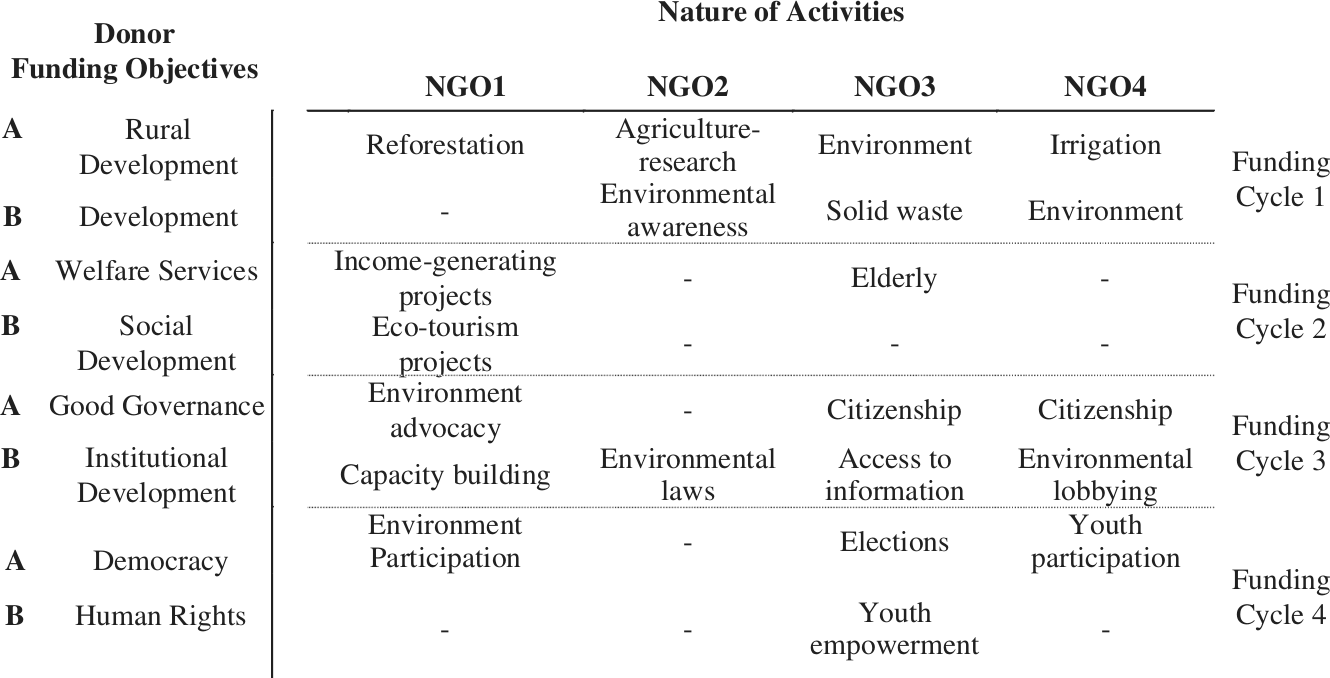
Diagrammatic representations of changes in NGOs activities.
NGO1 worked on reforestation with funding from Donor A under its rural development objective. When the donor shifted to welfare services, NGO1 devised an income-generating program; all activities were both environmentally friendly and oriented, such as production of goods from recycled materials. With the introduction of good governance as the donor’s main focus, NGO1 launched an environmental advocacy campaign to raise awareness and motivate the public to lobby elected representatives to take necessary actions to protect the environment. Finally, an activity focusing on public participation in public affairs related to environment received funding from the donor as part of its democracy program.
NGO1’s relationship with Donor B started when the latter introduced social development as its main in-country objective. In parallel with its income-generating program funded by Donor A, NGO1 also launched eco-tourism ecotourism activities in cooperation with local communities in certain areas of the country, with funding from Donor B. The relationship continued as the donor shifted its funding into institutional development. NGO1 crafted an activity to build the capacity of small clubs and groups to ensure better environmental monitoring and management. With the shift of the donor’s funding into human rights, NGO1 decided not to apply for any funding. “We found it impossible to convince ourselves to do a project on human rights that does not transform our whole identity; many organizations working on human rights can do a better job”(Interview No. 8, 2010).
NGO2 was conducting research on the agriculture sector in Lebanon, specifically on the environmental impact of introducing certain modes of production into the sector. The research was funded by Donor A as part of its rural development program in the early 1990s. Subsequent changes in the donor funding objectives compelled NGO2 to decide to suspend its relationship with this particular donor.
We are an environmental group and cannot just hop around from one place to another according to the wish of the donor. Every time they put a call for proposal they contact and encourage us to apply; we study their criteria and we say no thank you. (Interview No. 5, 2010)
The relationship with Donor B is similar. As part of its development program, the donor was funding NGO2’s activities to promote and raise environmental awareness in schools. The shift of funding into social development did not appeal to NGO2. Funding from this donor was resumed when NGO2 started working with local government officials on environmental standards, policies, and rules. A representative of NGO2 explained,
both of our interests [NGO2’s and the donor’s] were aligned under environmental institutional development; that was not the case before or after as you can see with donor’s interest in human rights which is not something we want to get involved in. (Interview No. 11, 2010)
NGOs 3 and 4 took a completely different route. Funded by Donor A under the rural development program, NGO3 conducted environmental activities such as planting trees and cleaning public areas. NGO4 executed a small irrigation project. The donor’s shift of funding into welfare services was met by NGO3’s decision to launch a project that provides services for older persons. A representative from NGO3 clarified, “We thought that the people we have been serving are in need of such services and there was the money; after all, development takes different forms and they complement one another” (Interview No. 14, 2010). NGO4 did not seek any funding from Donor A at that stage.
However, both organizations approached the donor with different projects on citizenship when the funding objective changed to good governance. Another shift in the types of activities took place when the donor moved to funding projects focused on democracy. NGO3 secured a grant for a project on voting choices during elections, and NGO4 received a grant to promote youth participation in elections. The representative of NGO4 justified these shifts by saying, “we saw other organizations taking money from the donor so we decided to do the same to sustain our programs; however, we are committed to perform an excellent job in any kind of project we are working on” (Interview No. 15, 2010).
Reactions to the changes in Donor B’s funding pertaining are not very different. Donor B funded NGO3’s solid waste management project and NGO4’s environmental awareness campaigns at the community level. Both organizations chose not to apply for any funding from this donor when it shifted its focus to social development. Interestingly, NGO3 was conducting a welfare service project with funding from Donor A at that time. Nevertheless, the organization “did not have the capacity to simultaneously carry out two projects that are new to us; we decided to do one project only and try it out” (Interview No. 18, 2010). When the focus of funding shifted to institutional development, NGO3 secured funding for an access to information project, which disseminated information on government transactions to the public via printed materials. NGO4 argued it was able to meet the donor’s new requirements while serving its own mission by conducting an environmental lobbying project. The next funding cycle focused on human rights. NGO4 did not attempt to secure funding, but NGO3 developed a proposal for a project to empower youth and to ensure and protect their rights.
Application: A Conceptual Framework
NGOs enjoy agency and are driven by a certain degree of self-interest that determines their behaviors (Barman, 2002; Gronbjerg, 1993; Tschirhart, 1996). Thus Hirschman’s (1970) individual self-interest theory is relevant for making sense about findings discussed above.
Hirschman’s (1970) individual self-interest theory introduces the individual as a consumer shopping for products or services that best meet his or her interests. Hirschman (1970) explains consumer behaviors using a typology of exit, voice, and loyalty. When there is decrease in quality or the associated benefits of a certain product or service, a consumer can choose to exit and seek better service, product, or conditions elsewhere, using the market to defend her or his welfare. It is a neat and impersonal decision to exit. The consumer can also attempt to repair or improve the relationship, rather than escape from it, by exercising voice and communicating a complaint or proposal for change to the organization. “Voice is far messy; it can be graduated and elevated; it is the articulation of one’s critical options rather than a private secret vote” (Hirschman, 1970, p. 16).
Exit is favored by economists because it is a predictable, individual, self-interested choice, while voice is more of a political action. Although exit is practiced more often, both reaction modes should be considered of strictly equal rank and importance (Hirschman, 1970). In some cases, Hirschman argues, voice is a complement of exit; in other cases, it substitutes for exit. The choice of mode depends to a large extent on the elasticity of demand for a particular product or service, the stage and form of deterioration in the quality of the product, or in the relationship between the consumer and the organization, the readiness to trade certainties of exit with uncertainties of voice, the price of entry and reentry, and the penalty for a certain reaction response or behavior. Moreover, despite potential positive outcomes, voice is costly and requires bargaining power and mechanisms that are not always particularly available (Gehlbach, 2006; Hirschman, 1970).
Nonetheless, some consumers are attached to a product or its provider that they decide to continue pursuing the service despite any dissatisfaction. This behavior is called loyalty which “means strong attachment to an organization that does not seem to warrant such attachment because it is so much like another one that is also available” (Hirschman, 1970, p. 81). Loyalty can be an attitude that deters exit and promotes voice; loyalty can also be seen as a distinct behavior, like exit and voice resulting from dissatisfaction (Leck & Saunders, 1992). As a compromise between these interpretations, loyalty could help to redress the balance between voice and exit as much as it characterizes a distinctive reaction. This compromise becomes clearer in the concept of unconscious loyalist behavior, which is “free from felt discontent [and] will not lead to voice” (Hirschman, 1970, p. 91). However, in general, loyalty remains poorly developed as a category (Withey & Cooper, 1989).
The exit-voice-loyalty typology has been frequently used and broadly adopted by scholars not only with respect to the economic market but also with regard to sociopolitical values. One significant modification to the typology is in human resources management. While studying employee dissatisfaction, Farrell and Rusbult (1981) and Farrell (1983) expanded Hirschman’s typology by adding a fourth element, neglect, defined as “passively allowing conditions to deteriorate through reduced interest or effort, chronic lateness or absences, using company time for personal business, or increased error rate” (Rusbult, Farrell, Rogers, & Mainous, 1988, p. 601).
The exit-voice-loyalty typology has also been applied to nonprofits. For example, Hirschman (1970) considers nonprofits as good example of organizations where both exit and voice are common, strongly practiced, and particularly evident for examining the turnover of volunteers and members (Hirschman, 1970). Ebrahim (2003) and Benjamin (2008) use Hirschman’s (1970) typology, in part, to understand NGOs’ relationship with donors. To make sense of NGO accountability, Ebrahim (2003) suggests that NGOs used the mechanisms of exit and voice with donors. Voice is expressed through exchange of information and exit is practiced through suspension of funding. Benjamin (2008) considers exit to be the consequence of a funder’s rejection of a nonprofit accounting and financial reports. Here, voice is neither an option nor a consequence.
Proposed Exit-Voice-Loyalty-Adjustment (E-V-L-A)
Based on the findings from field research—presented in the multiple observations—and in an attempt to classify the variation in NGOs’ reaction to shifts in donors’ funding objectives, I propose applying Hirschman’s (1970) typology of exit, voice, and loyalty. I use this typology, as opposed to other typologies classifying behavior (e.g., see Dunn, 2010, and Oliver, 1991), for two main reasons.
First, fluctuation and alteration in donor funding is often met with great dissatisfaction among NGOs. Kharas (2007) describes the aid industry as a market of supply and demand, which brings out the “market similarity” and situates NGOs as consumers seeking a certain product from a service provider; in this case, the product is a financial resource and the service provider is a donor. Second, there is a need to restore the balance in NGOs’ relations with their stakeholders, including donors. Hirschman (1970) emphasizes that organizations decline as a result of random causes. The behaviors or responses of stakeholders (members or customers) are “repairable lapses” that should guide the organization to rise and alter its decisions and performance (or those of the stakeholders) to avoid further decline. This is particularly crucial in the unstable NGO–donor relationship, as explained earlier.
Despite the strengths of using Hirschman’s (1970) typology in this analysis, it was developed for application to individuals. Applying it to organizations requires introducing a fourth category, adjustment. Thus the modified typology used in this study consists of exit, voice, loyalty, and adjustment.
One reaction to shifts in donor funding is exit. When an NGO decides to no longer seek funding from a particular donor, the relationship between the two is suspended during that funding cycle. As indicated before, donors tend to revise their funding objectives without necessarily consulting their local partners. Some NGOs become dissatisfied with or do not find a match with the new funding objectives and lose the interest in complying with the associated modified criteria. In such a case, the NGO may exit the particular funding relationship and pursue other funding sources to sustain its programs. For example, one NGO representative said,
as soon as our project funded by that particular donor comes to an end, we submitted the final reports and did not respond to the donor’s call for grant proposals. We did not see ourselves anywhere in the new scheme of funding. (Interview No. 15, 2010)
A second reaction to shifts in donor funding is voice. Hirschman (1970) talks about consumers who become dissatisfied with a certain product and complain to the producer, hoping to be heard. To a great extent, the same applies to NGOs vis-à-vis their donors. Voice can be used as a mechanism by an NGO interested in pursuing its relationship with an existing donor despite changes in funding objectives, but without sacrificing its own goals and interests. Such an NGO can approach the donor to relay its concerns and give feedback, with the intention of influencing the donor’s agenda and aligning the donor’s priorities as closely as possible with its own interests. This was the case for one of the Lebanese NGOs. A representative stated,
We have been working with this particular donor for more than 10 years now. We have established trust along with systems of accounting and reporting. We want to think we are on the same wavelength and understand each other. However, we cannot do whatever their headquarters decides. We have our own credibility at stake. In several cases, we have tried to work with the donor’s local office to find ways to continue our relationship. In some cases, we were able to agree on project ideas that do not divert far from our objectives stated in our mission statement; we applied and got the money. In other cases, we tried and it did not work, so we waited. (Interview No. 20, 2010)
Similarly, an expert on the NGO sector commented,
some NGOs are favored by certain donors. You can notice they waive certain criteria which allow these organizations to continue doing whatever they have been doing with a sustained source of funding; others have to design completely new project ideas that suit donor’s new objectives. (Interview No. 22, 2010)
A third mode of reaction is loyalty. The exercise of loyalty is likely to be particularly prevalent among so-called “donor-organized NGOs,” that is NGOs that are directly set up by donors to carry out their agendas in developing countries (Loung & Weinthal, 1999; Vakil, 1997). Although limited in number, these Donor–NGOs are established as “local” NGOs and become part of the NGO sector. These organizations receive a substantial amount of aid funds channeled to a certain country. As such, loyalty to their creator, the donor, is the salient characteristic of these NGOs. Because of the lack of autonomy and ability to decide on what to do and how to react, loyalty classifies the automatic and positive reaction to the will of the donor, reflected in the swing with shifts in donor funding regardless of whether the new funding is channeled to areas close or alien to the original field of work. The loyalty category in the proposed conceptual framework is exclusively limited to these organizations. I recognize the limitations of indentifying and researching these types of organizations as well as the consequent implications for providing further clarification and support for the “loyalty” category of the conceptual framework.
Finally, a fourth mode of reaction, and a new category for the typology, is adjustment, which occurs when NGOs voluntarily decide to reshuffle their priorities to account for changes in the donor’s funding preferences. Adjustment reactions can (and should) be clearly distinguished from loyalty reaction by examining and verifying the nuance in the NGO response. Loyalty refers to unconscious decisions to abide by donor funding objectives. In contrast, adjustment applies to conscious or discretionary decisions made only after an internal deliberative process about how to react to a donor’s change in funding objectives. In this case, the NGO’s response is neither imposed nor required but rather made at the full discretion of the organization. As rationalized by a representative of one NGO undergoing such adjustment,
we thought it is better for our organization and the people we are serving to have our feet in several playgrounds at the same time. We deliberately decided to broaden the scope of our work and we know we will meet the expectations. Now we need to broaden the focus of our mission statement. (Interview No. 15, 2010)
Many NGOs “ride the fashion waves” set into motion by donors (Challand, 2005). They change hats according to the shift in the “fashion.” Adjustment, then, occurs when NGOs willingly and voluntarily decide to adjust their activities in an attempt to meet the changes in donor funding priorities. Adjustment could be minor, and considered to be a transparent compromise. Adjustment could also be a substantial risk, resulting in a blind co-optation of the organization (Eade, 1993). In such situations, these NGOs lose touch with their own missions as their “roles are determined as much by donor fashion” (Edwards et al., 1999, p. 130).
Interpretative Analysis and Implications
The proposed exit-voice-loyalty-adjustment (E-V-L-A) framework for understanding NGO reactions to shifts in donor funding is an improvement over previous typologies. For example, none of the reported observations from interviews and fieldwork with Lebanese NGOs satisfy the application of Farrell and Rusbult’s (1981) modified typology that includes neglect. Neglect, which “aptly describes lax and disregardful behavior” (Farrell, 1983, p. 598), is hard to apply to NGOs whose activities are under scrutiny, not the least of which comes from donors who closely examine how taxpayers’ money is spent. Elaborate systems and mechanisms are in place to track funds, monitor programs, and evaluate success with quantifiable criteria such as the number of beneficiaries and program cost-effectiveness. In short, it is hard to identify the practice of neglect among NGOs and confirm such practice by both NGOs and donors.
Despite its improvements, the typology proposed in this study requires further analysis. First, the proposed framework is case-specific. By and large, this framework seeks to explain an NGO’s relationship with a specific donor at a specific point in time, that is, when the donor decides to alter the nature of funding. This means the NGO’s reaction is subject to change in the next funding cycle, as the findings illustrate. It also means there may be a variation in the way an NGO reacts to multiple donors. For example, while an organization might exit its relationship with one donor, it could practice voice or adjustment with another. More research is needed to examine NGO reactions over time.
Second, variation in NGO response to shifts in funding might have direct implications on its accountability mechanisms and role in shaping public policy. An NGO that practices voice has strong connections with the donor and understands the donor “language” (Stiles, 2002). For example, NGO1 leveraged its organizational capacity and relations with local beneficiaries and communities as a differentiation strategy (Barman, 2002) to pursue a favorable relationship with the donor. The downward accountability to constituency empowers the organization and is further reinforced by the voice it practices. The strong voice acquired by such an NGO also extended to its relationship with government. The organization uses its relations, especially with donors, to engage in continuous dialogue with government. The NGO relies on sustained donor funding to partner with public agencies in formulating public policies (Brinkerhoff, 1999).
An NGO that tends to exit is resistant to changing the nature of its activities. For example, NGO2 wanted to stay true to its organizational identity and therefore did not want to undertake any project too far outside its stated mission. This well reflects an inward accountability to organizational mission and values (Ebrahim, 2003; Edwards & Hulme, 1996). To compensate for the drop in funding, NGO1 had to mobilize its grassroots and rely more on volunteers. The organization started to do more advocacy work (Brinkerhoff, 1999). Advocacy does not necessarily require external funding; it also keeps the NGO constituents involved and mobilized.
An NGO that practices adjustment is tightly captured inside the development circle. For example, an NGO that favorably responds to shifts in donor funding, whether consciously or unconsciously, is more likely to witness substantial transformation in its organizational identity. In such a case, the organization subjects itself primarily to upward accountability toward the source of funding, not toward its values or beneficiaries (Ebrahim, 2003, 2005; Edwards & Hulme, 1996). The ability to affect public policies is trivial since the credibility of the organizational comes under scrutiny. The NGO’s role in public policy is somehow limited to awareness and information dissemination (Brinkerhoff, 1999).
In brief, the stronger the downward or internal accountability, the more likely an NGO is to exit or exercise voice. Conversely, upward accountability is associated more with reactions of adjustment. Further in-depth research is necessary to examine the interplay of various forms of accountability and their association with NGO responses to shifts in donor funding.
Third, some organizations might use exit as a strategy toward adjustment. While this strategy was not found in the cases studied, the experts in the Lebanese NGO field cited a few examples. As one said, “there are organizations claiming they no longer receive funds from a donor but surprisingly you see many of their members in another newly registered NGO applying for a grant from the same donor” (Interview No. 3, 2010). Such organizations might be interested in keeping a good public image, buffering demands, or reducing pressure on their legitimacy. These organizations may prefer to end an existing relationship with a donor and form a new entity, such as a sister or branch organization that appeals to the donor’s interests without having to worry about the public image. One expert commented, “the law allows the formation of NGOs without much restriction. NGOs exit from one door and use the law to access the same donor from another door in no time” (Interview No. 20, 2010). These cases require further scrutiny in future research.
Fourth, NGOs’ interorganizational arrangements, such as partnerships, reflect simultaneous responses of exit, voice, and adjustment. An interviewed NGO expert referred to cases of NGOs forging partnerships as an indirect way to get donor funding.
NGOs claim they are no longer getting the donor funding because they do not want to serve the donor’s new objectives, but you find them cooperating with other organizations on projects that actually serve these same objectives, [doing] the job they are good at. We cannot deny that this whole arrangement is a “concealer” of a bitter reality which defies positive arguments for collaboration and partnerships. (Interview No. 19, 2010)
In other words, an NGO here exits the relationship with the donor, but chooses to join a consortium of NGOs on a project funded by the same donor. Arguably, this reflects a certain degree of willingness to adjust to meet donor’s objectives. Nevertheless, the NGO negotiates the terms of its involvement in the partnership to align with its mission, resembling a voice mechanism. Needless to say, some partnerships are forged not as a response to fluctuations in funding but rather as a tool to practice voice by differentiating the NGO from peers and rivals and empowering its position vis-à-vis the donor (Barman, 2002).
Fifth, there may be reason to question a clear-cut distinction between reactions in the typology. For example, reactions to donor funding may be sequenced, as illustrated in the decision tree analysis in Figure 2. As a matter of fact, Dowding, John, Mergoupis, and Van Vugt (2000) and Light, Castellblanch, Arredondo, and Socolar (2003) suggest using the decision tree analysis to understand internal deliberative processes and analyze end results as reflected in modes of reactions and their associated repercussions.
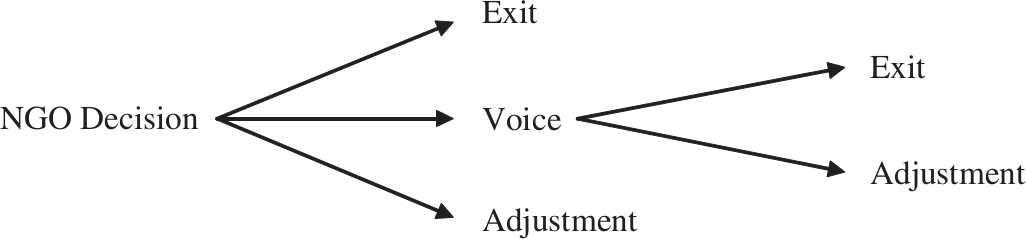
NGO’s decision analysis tree.
Faced with a situation where a specific donor is changing its funding focus, an NGO has three basic options: (a) to exit, that is, to reconsider its existing relationship with the donor and stop requesting and receiving funds; (b) to adjust, that is to change its activities to accommodate the donor’s emerging interests; or (c) to exercise voice, that is to address its concerns with the donor. If voice is selected, the NGO might be successful in convincing the donor to work out a more balanced arrangement that account for the NGO’s interests. In such a case, the exercise of voice is successful and the NGO has no further decisions to make. However, the exercise of voice might not convince the donor. In this case, the NGO must then decide whether to exit the relationship or, alternatively, to adjust to the new situation and pursue donor’s funding. Therefore, in reality, the final mode of action is a result of a process initiated by the organization but requires a donor response. This decision tree analysis should be further researched.
Finally, it is useful to note that one NGO expert argued that all NGOs adjust according to donors’ wishes.
What we are talking about here is not whether NGOs adjust or not but rather the degree of adjustment. Some NGOs modify 10% of their activities to get the new funding and preserve their core functions, others make a 50% change, and you can find NGOs completely transforming themselves and working in new areas that have nothing to do with their mission. (Interview No. 6, 2010)
Consequently, except in cases of complete abandonment of donor’s funding (exit), all responses by NGOs to shifts in funding might fall on an adjustment spectrum. At one end is voice, which reflects some degree of resistance but with mild modification of activities. At the other end is loyalty, which indicates a situation of total compliance with robust changes in organizational mission and activities according to emerging preferences of donors rather than the pressing needs of consistencies or strategic organizational objectives.
More research is necessary to examine implications on NGO management, specifically accountability, interorganizational relations, and decision-making processes. Future research should also address the applicability of the proposed framework on other aspects of NGO–donor relationship.
Conclusion
The NGO–donor relationship is complicated. To decipher the variation in NGO reactions to shifts in donor funding, I added the category of adjustment to Hirschman’s (1970) typology of exit, voice, and loyalty. Observations from the fieldwork and interviews used in this study fit well with this new conceptual framework, suggesting that the exit, voice, loyalty, and adjustment typology has merit and promises to be productive for future research.
One area that seems particularly relevant for exploration concerns the determinants of NGO reactions. The degree of NGO dependency on external resources is the most obvious determinant of a particular reaction. For example, the two NGOs with more diverse portfolios of donors (NGO1 and NGO2) exercised adjustment less than the other two NGOs. However, NGO1 practiced more exit than NGO2, although both organizations have low level of resource dependence. Therefore, even NGOs with comparable resource dependence still vary in their responses to changes in their external resource environment.
The examples of NGO1 and NGO2 indicate that donor diversity, and consequently resource dependence, do not fully prompt the variation in responses among the NGOs studied here. It is possible, however, to apply institutional theory and/or agency theory in explaining the variation. The weakness or strength of existing ties the organization has in a network of actors or, in other words, the proximity to or in the intermestic development circle (Stiles, 2002) could also provide a persuasive justification. However, the convergence of multiple perspectives might better predict responses to a changing external resource environment. This is what future research should reveal.
To conclude, the fact that NGOs react differently to shifts in funding across time and donors is interesting, though perhaps not surprising. This variation demonstrates that the process of transformation is neither universal nor inevitable and irreversible, promising to be repaired. Responses to a changing or deteriorating relationship should serve as a guide for the organization to rise and alter its decisions and performance to avoid further decline. This is particularly crucial in the unbalanced and unstable NGO–donor relationship. Shifts in donor funding affect the relationship directly, and NGO autonomy and performance indirectly. Both sides should learn from the variation of responses captured in the typology of exit, voice, loyalty, and adjustment. An NGO reaction is an indicator of a change in an existing relationship. Accordingly, the NGO may wish to signal, not only to the immediate donor but also to other donors and peer organizations, that necessary actions should be considered to avoid further deterioration of the relationship and to possibly remedy a situation. In this case, the practice of exit may have more favorable results. Such signals, over time, may lead to longer term improvements in NGO–donor interactions and mitigate the perceived necessity, of either party, to completely dissolve what had previously been a strong and useful relationship.
Footnotes
Acknowledgements
I want to thank the peer reviewers for the constructive feedback. I also gratefully acknowledge helpful comments from Tina Nabatchi, David Murray and Slyvia Trent.
Declaration of Conflicting Interests
The author(s) declared no potential conflicts of interest with respect to the research, authorship, and/or publication of this article.
Funding
The author(s) received no financial support for the research, authorship, and/or publication of this article.