







Abstract
The aim of this article is to explore how charitable giving is structured in a universal welfare state. The article presents new data based on more than 200 national fundraising campaigns in Sweden during the past 60 years. The varying success of these campaigns for different causes creates a historical pattern of charitable giving under a social democratic welfare regime. Which causes are still considered urgent and appropriate for donations in a country where welfare is considered to be a social right, and how have these attitudes developed over time? More specifically, the article analyses differences in the success of campaigns for domestic and for international causes, including several subcategories of campaigns. The results not only show that Swedes give considerably more money to causes not addressed by the state but also that charitable giving in Sweden is increasing for all types of causes.
Introduction
It is hard to imagine a country more closely associated with or more clearly influenced by the social democratic welfare regime than Sweden. This Scandinavian country has been a symbol of universal welfare services, redistribution of wealth, and egalitarian social policies for the greater part of the past century. The effects on voluntary action by such a state-centered model, with its large public sector and its focus on collective political reforms, is sometimes believed to be distinctly negative. Many of the arguments asserting that the vast public sector in Sweden is crowding out the voluntary sector have, however, come under question in recent decades. A vibrant civil society clearly exists in Sweden, as in the quite similar neighboring Nordic countries, but it is in many ways different from its Anglo-American and continental European counterparts (Lundström & Wijkström, 1997; O’Connell, 1999). A perhaps more fitting description, therefore, is to say that the Swedish welfare regime is not so much crowding out as structuring civil society, leading it to be less developed in the core areas of the welfare state and more developed in areas such as leisure interests, sports, culture, and labor relations. The aim of this article, hence, is to study how charitable giving is structured—an aspect of Swedish civil society that is relatively unexplored.
The reason for studying charitable giving is that it is arguably a type of voluntary action that stands out as being especially foreign in the Scandinavian welfare context. Charitable giving not only is a civil society phenomenon that could be expected to compete unfavorably with the vast public spending on social issues in Sweden. It is also in itself, unlike other aspects of civil society, a phenomenon that the state actively and intentionally tried to make redundant in the early years of modern welfare, since charity implies an unequal balance of power between giver and receiver, which is at odds with the Swedish perception of welfare as a social right. There are no formal hindrances, but from a moral perspective charitable giving has an ambivalent and contested status in Sweden. To share of one’s wealth with the less fortunate is, of course, considered admirable in Sweden, as elsewhere. However, many causes are also considered to be entitlements that should be funded through taxation. Private giving, in other words, comes in certain cases into conflict with the onus of collective giving through taxation. Hence for some—but not all—causes, charity giving has been perceived as irrational and even objectionable. At the same time, a renewed tradition of charitable giving has emerged in Sweden since World War II. So which charities are acceptable in a society like Sweden, where the very principle of charity can be seen as morally at error? How has the giving developed over time? Are we seeing any changes in what is considered acceptable giving and what is not?
Somewhat simplified, this article will explore which causes, given these circumstances, are perceived as acceptable, or even admirable, to donate money to as an individual giver. To be able to do this, charity giving at the aggregated level will be described using a historical data set stretching 60 years back in time. Our overarching question is, to what types of charities have Swedes been willing or less willing to give money during this time? The answer to this question will help us to map how Swedish civil society is structured from a charity perspective.
The Case of Radiohjälpen
In order to decide how the welfare state structures charitable giving in Sweden, this article will take a closer look at the varying levels of support gained by different charitable causes. The data used for this analysis come from the archives of the Swedish fundraiser Radiohjälpen (The Swedish Fundraising Council, n.d.).
Radiohjälpen is an official arm of the Swedish public service broadcasting system that has been raising money for charitable causes from Swedish radio listeners, and later TV audiences, since the Second World War. The earliest Swedish Radio fundraising efforts were exclusively aimed at channeling donations for the reconstruction of war-torn Europe from the Swedish public, which had been largely spared the devastation of the war. The popularity of the radio programs that collected donations while playing the listeners’ music requests proved to be more lasting than the needs of the postwar reconstruction efforts, and in 1950 Radiohjälpen gained permanent status as a charity division of the public broadcasting services with a mission to conduct campaigns for a wide range of other causes. These campaigns have varied in length from 1 day up to almost 2 years, but the typical Radiohjälpen campaign lasts only for about 2 or 3 months. The campaigns are in most cases carried out in close cooperation with one or several charitable organizations, usually large organizations like the Red Cross, Save the Children, and Doctors without Borders. The broadcasted campaign efforts are therefore often combined with traditional grassroots work by organizations such as these. In other cases, Radiohjälpen might set up a campaign for a particular cause and then decide which organization(s) should receive the money, based on an application process. Radiohjälpen also manages resources collected in a general fund to which charitable organizations may apply for support for their various causes. Radiohjälpen is, in other words, a state-owned fundraiser for charitable organizations and not a charitable organization in itself. The fact that Radiohjälpen is ultimately a part of public service broadcasting, however independent, of course also raises questions about which causes are given campaign coverage. Most campaigns are either initiated due to an immediate concern among the general public, such as a natural disaster, or at the request of a charitable organization. Organizations can also present proposals to the Radiohjälpen board, which then decides which campaigns to lend itself to.
The Swedish public service broadcasting archives contain a vast amount of documentation on Radiohjälpen, stretching over more than 60 years and covering 224 national fundraising campaigns. One of many fascinating findings made during the research for this article is a short note from a former head of Radiohjälpen, Mr. Bo Willners. The note is a comment on a set of charts that displayed the radio listeners’ donations in the first couple of years. In this note, which was addressed to the board of the organization, Willners claimed that
People are not inclined to give contributions when they think that [the cause] concerns conditions that should be helped by what they already pay in hefty taxes. (Willners, 1950; author’s translation.)
It is clear from the document that Willners is expressing some disappointment over the campaign figures for domestic causes. His hypothesis is that the poor results are caused by the widely held public opinion that the state is expected to handle certain causes with what has already been collected in taxes. This is an early example of the opinion, or rather the assumption, that the universal welfare state preempts willingness to donate to charity, even when that need may not in fact have been met by the state. Willners moves on to point out donation needs for several domestic causes, but concludes somewhat pessimistically that
As soon as the public sector, that is the state and the municipalities, is perceived as being the ones that actually are economically responsible, then a considerably weaker result [for the campaign] is to be expected. (Willners, 1950; author’s translation)
What is clearly expressed in this unassuming note from a 1950s civil servant is that willingness to give money to charities in general and domestic charities in particular is negatively influenced by the widely held view that a large public sector should eliminate the need for such individual efforts.
It is apparent, however, from simple, descriptive statistics that people in Sweden donate as much or more to charities as people in other comparable countries. The 15 largest charitable organizations alone collected about 360 million Euros in 2011 in Sweden, a country with just less than nine-and-a-half million inhabitants (FRII, 2010). The proportion of Swedes donating money is, according to the Charities Aid Foundation’s “World Giving Index,” 52%, which places Sweden just above the middle on the top 20 list of generous nationalities in Europe, at place number 9 (World Giving Index, 2011).
Considering the Swedish welfare state, these facts suggest, then, that Swedes predominantly give their money to international relief campaigns and to other causes abroad that are not covered by Swedish taxes. However, up to now it has been hard to decide whether this is really the case, since philanthropy is an underresearched area in Sweden, perhaps because it is considered both less relevant and even less desirable in a welfare state that prides itself on universal access to state-provided social services. The data from the public broadcasting archives offer an entirely new opportunity to test whether the Swedish public has been and still is more inclined to give money to international rather than to domestic charities. If the analysis can show such an inclination among the Swedish givers, then this would support the assumption that charitable giving takes a different form here compared with more liberally inclined welfare states. If the analysis shows, however, that Swedish givers donate in equal proportion to domestic causes, then we would have to reconsider the alleged pacifying effect of a large public sector. We will therefore study the proportions of charity giving between different international and domestic causes.
Social Rights and Social Citizenship
The Swedish take on charitable giving can be understood through consideration of theories on social citizenship. T. H. Marshall (1950) famously differentiated between three different types of citizenship, based on three different types of rights: civil, political, and social. Social rights are the domain of the modern welfare state, to be addressed in the social policies that ensure a certain standard of living and provide a common bond between everyone covered by these policies. Sweden is of course not the only country dealing in social rights—Marshall himself wrote almost exclusively about England—but it is fair to say that Sweden and the other Nordic states stress social rights more strongly than many other countries. It has been argued that in Sweden this is done at the expense of civil rights, whereas in a country like the United States, civil rights rather than social rights—or entitlements—have a greater influence on policy making (Trägårdh & Svedberg, 2011).
Social citizenship with its social rights has in Sweden established a norm for public sector responsibility that is stronger and present in a wider range of areas than in almost any other country. According to this theory, charitable giving can be expected to be reserved for areas not covered by this norm. Marshall was not preoccupied with the issue of charitable giving in itself, but his theory of social citizenship based on social rights explains the high expectations on the public sector and indirectly the low expectations for private giving.
T. H. Marshall saw social rights as a necessary part of a modern industrial state in that they tied its citizens together through social policies and social benefits, creating a social citizenship. Not all theories on how a universal welfare state influences the behavior of the individual citizen or groups of citizens are as positive. The typical example of a more critical viewpoint is the neoliberal assumption that the social democratic type of welfare state tends to pacify its citizens. The argument goes that the intrusive “nanny state” of the Nordic countries both limits freedoms and removes responsibility from its increasingly conformed citizens. The empirical evidence for such a development is not conclusive, but theorists such as Friedrich von Hayek (1948, 2007) and Friedman and Rose (1980) have raised warning fingers and found their own understanding of the “free society” represented by the pacifying and ultimately nonfree welfare states of the Nordic region. Both Marshall and neoliberal theorists like von Hayek and Friedman suggest implications for charitable giving, and both camps would probably agree that a welfare state with extensive social rights, such as the Swedish one, replaces some of the need and preempts much private initiative for charitable giving. The main difference between them is an ideological understanding of whether or not this is desirable.
Leaving the ideological debate aside, however, and following the theories on social citizenship and social rights, we reason that charity is given in Sweden to causes outside the scope of the welfare state, preferably to international causes and to non–welfare-core domestic causes.
Previous Research
Much of previous research on the welfare states’ structuring of charitable giving has been performed at the micro level, typically in experimental studies of the effect of public funding on individuals’ incentive to give, which results should not be transferred to the macro, societal level, but there are, of course, some overlapping conclusions to be drawn. Individual incentives for giving money are clearly related to the societal context. Whether or not the individual citizen decides to give money is dependent on whether or not this is considered to be something one ought to do in the specific cultural context. In the American context, giving money to charities has by some, like Vogel (2006), been considered an expression of active citizenship and by some, like Corneo (2007), even an institutionalized part of American society. The same is not necessarily true for individuals in a social democratic welfare state like Sweden, where citizenship is social and charities are associated with social inequality and the perpetuation of these inequalities. Hernegger (2006) devotes special attention to these contextual factors, pointing out that the division between private and public spheres of responsibility differs between political systems and that just like structural conditions—economy, the legal system, and the taxation system—cultural understanding also shapes giving.
Theories at the micro level sometimes disregard this complexity of individual incentives in favor of the simplified assumption that individuals give money to charities simply for altruistic reasons based on rational grounds. Bekkers and Wiepking performed a meta-analysis of almost 500 publications on the motives for private donations to charities in order to find a richer explanation of the determinants of giving. They concluded that the following variables had an effect: awareness of need, fundraising efforts, the cost and benefit of giving, altruism, social standing, psychological reward (“warm glow”), private values, and the efficiency of the charity (Bekkers & Wiepking, 2011). These results show that there are many different reasons for giving money, several of which are not dependent on whether or not the state is addressing or is expected by the public to address the specific issues. There are, in other words, still individual incentives for giving even in a universal welfare state.
Some of the previous research on charitable giving focuses on public funding of charitable organizations and the extent to which this crowds out private donations. This focus places the perspective on a meso level. In a rare study of philanthropy in Sweden, Breman (2006) shows small or statistically insignificant crowding-out effects of public funding in social services, health, and international aid organizations, but a relatively substantial “crowding-in effect” in environmental, cultural, and interest organizations. The latter categories, in other words, gained in private donations as a result of public funding, for the most likely reason that the public funding acts to legitimize the organizations and their causes. In Sweden it is considered safe to give money to an organization trusted by the state.
Much of macro-level research concerns tax effects on charitable giving. The question of whether high taxes reduce willingness to give is at least twofold, as high taxes both increase expectations on the state to act to alleviate problems and reduce the individual disposable income that could be spent on charities. Clotfelter’s classic study shows that an increase in income did not lead to an equivalent increase in charitable giving, whereas other empirical studies show how tax reductions even can lead to a decline in giving in absolute figures, through the lessening of the tax planning incentive (Clotfelter, 1985; Okten & Weisbrod, 2000; Rushton, 2008; Weisbrod, 1997). One study performed by Roodman and Standley (2006) shows that a strong adverse effect of taxation on giving at an aggregated level but that comparison of 23 countries is based on some very unlikely assumptions, such as a very strong, positive income effect on giving that to a large extent has been proven wrong by other research. Other macro-level studies have shown that people do not give less during economic downturns, which is further evidence that having less money to spend does not make the public less willing to give per se (Arulampalam et al., 2009). The direct effects of tax reforms on disposable income therefore seem to have little consequence for charitable giving. The other aspect of taxation, the raised expectations on the public sector to address needs, is more difficult to dismiss. There seems to be at least some support for the reversed relationship—that lowered expectations on the state increases incentives for private giving, as suggested by Brooks (2007).1
Most of the international publications on the crowding-out effect at the macro level address crowding out as an adverse side-effect of public sector social reforms. It should therefore be noted that certain charities were early on directly and intentionally replaced by the public sector. The emerging welfare state actively sought to do away with some charities in social service areas such as eldercare, childcare, disability care, and treatment of drug addiction because these and other services were considered to be social rights to be maintained by the state and that should not dependent on charity (Lundberg & Åmark, 2001; Rothstein, 1994, 2001; Siisiainen, 1999; Vamstad, 2007; van Oorschot & Arts, 2004). The domestic charities described in the following analysis therefore consist primarily of support for indirect social causes, such as cancer research, and less of direct social causes, such as the actual treatments of illnesses.
Our overarching question is how charity giving is structured in Swedish civil society. Considering the character of the Swedish society and its emphasis on social rights we assume that charities are preferably given to international causes and to domestic causes outside the responsibility of the welfare state. We test our assumption by first posing the following operative question when analyzing our empirical data:
1. Is charitable giving in Sweden structured toward causes not covered by social rights?
Yet since the structure of Swedish civil society has changed in recent decades (Wijkström & Einarsson, 2006; Wijkström & Lundström, 2002) there is reason to believe that the structure of charitable giving has also undergone changes during the 60 years studied. This leads us to our second operative question:
2. How has the pattern of charitable giving changed over this period?
Data and Methods
The main data set used for this article is compiled from a series of archive studies performed at the joint archives for Swedish Radio and Swedish Television. This archive contains all official documentation on the fundraising branch, Radiohjälpen, from 1950 to date, with information about well above 200 broadcasted fundraising campaigns from this period. Some of these had to be left out due to incomplete documentation or due to special circumstances surrounding the campaigns that would lower precision in the comparisons between campaigns. The three main criteria for inclusion were (a) size of the campaign effort, (b) duration of the campaign, and (c) universality (whether the campaign was directed to the general public or to some specific group). To be included, in other words, the campaign must have had a certain minimum amount of airing time and general effort, contain radio and TV announcements on repeated occasions, and be directed to the general public. A total of 224 campaigns met these criteria. The collected data were coded using four main variables: time of the campaign, duration, type of cause, and amount of money collected. These are the four variables included in the following analysis, where the amount of money collected for the campaign is the dependent variable. The time and duration of the campaign are simple numeric data, but the “type of cause” is variable, based on constructed categories. The recorded campaigns were qualitatively assessed and distributed across a wide range of suggested categories. There were no campaigns for nature or environmental causes, so these categories were removed, leaving the following: international relief (general), famine, war, natural disasters, disease, and disabilities. The campaigns for diseases were for medical research and all categorized as domestic, as were the campaigns for people with different kinds of disabilities. A total of only six campaigns belonged to other domestic categories than research or disabilities. The remaining categories were entirely made up of international campaigns, mainly for famines, wars, and natural disasters. Three cases could be interpreted as belonging both to the “international relief” category and the “disease” category. These campaigns for the treatment of diseases not found in Sweden, like leprosy, were finally placed in the general “international relief” category, leaving four wholly international categories and two entirely domestic ones. The main categories are therefore “international” and “domestic,” with four and two subcategories respectively.
Findings
First, we posed the question of whether charitable giving in Sweden is structured toward causes not covered by social rights. To answer this question we will begin with study of the proportions between domestic and international causes. Of the total of 224 national campaigns, 94 were labeled as domestic and 130 as directed to an international cause. The first result of the analysis, therefore, is that international relief campaigns have proven to be more common. The second result is that the average campaign for an international cause collected a considerably larger sum than the average campaign for a domestic cause. The mean for the international campaigns was 2,189,164 Euros at their 2010 value whereas the domestic campaigns collected on average 926,137 Euros at their 2010 value. The Radiohjälpen tsunami campaign of 2005 collected about 42.5 million Euros and is therefore an outlier. The mean for the internationals is reduced to 1,876,811 Euros without the tsunami campaign, but a stem-and-leaf plot shows that there is a clear outlier among the 96 domestic cases as well. The 1969 cancer research campaign collected 30.8 million Euros at their 2010 value and without it the mean is reduced to 612,217 Euros at their 2010 value. A simple comparison of the two means is summarized in Table 1.
Mean Comparison for Campaigns, in 2010 Euros.
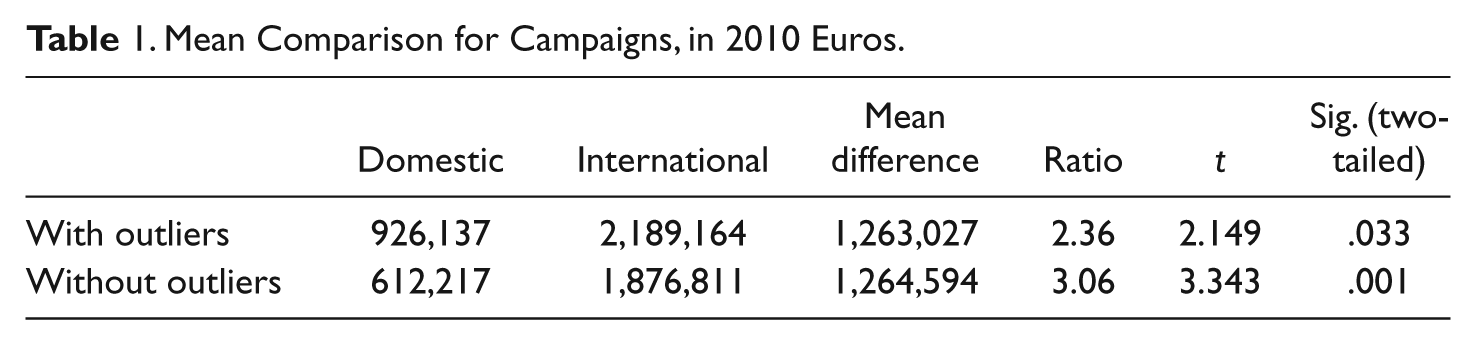
The mean difference between domestic and international campaigns is significantly different and even more clearly so when removing the outliers of the two groups. Are there any possible intermediate variables that could be expected to influence this mean difference? One such variable is clearly the duration of the campaigns, which is positively correlated to the success of the campaign, as might be expected (see also Table 2, for correlations).
Correlation Between Duration and Results in 2010 Euros.
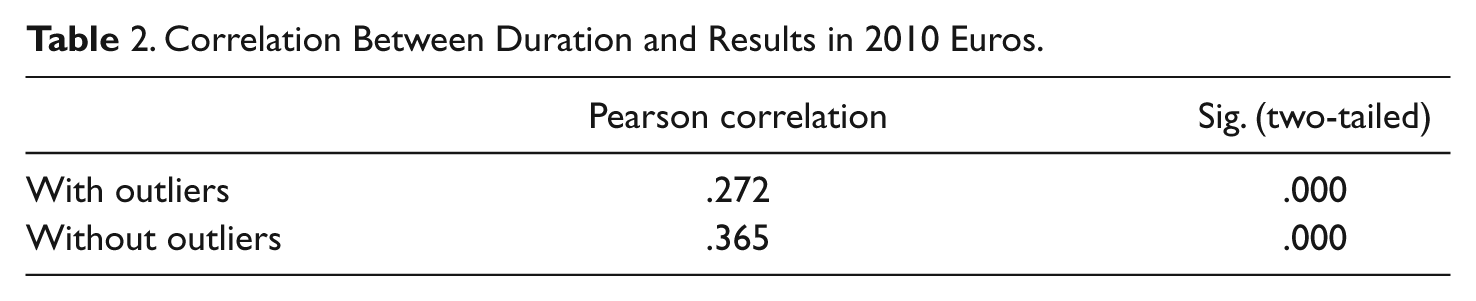
The national campaigns for international causes are on average just about half a month longer than the domestic campaigns, but this difference is far from statistically significant at a significance level of .403 (two-tailed). In other words, the difference in results between the domestic and international campaigns cannot be explained by the latter being longer. So far, the Swedish data indicate that there is a stronger inclination to give to international causes for which the Swedish welfare state is not expected to take responsibility. But does this interpretation hold if we study the data from another perspective?
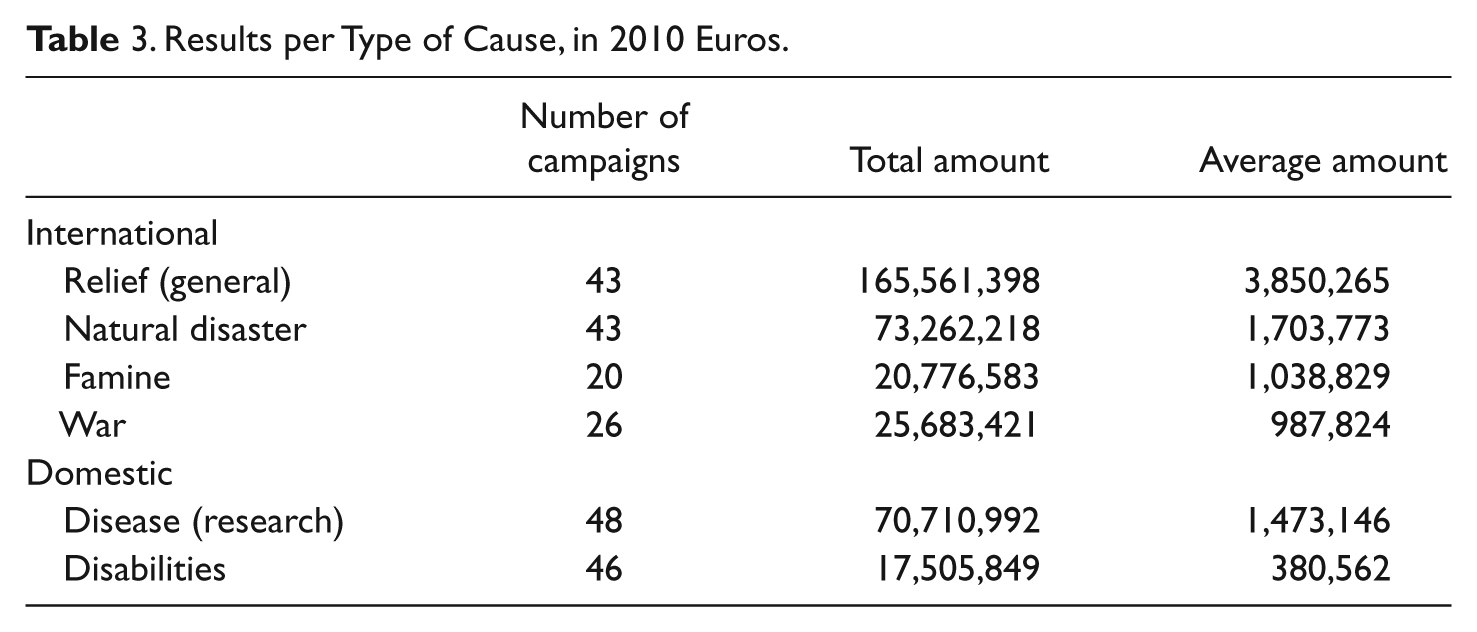
What kinds of campaigns can be found behind the general labels “domestic” and “international”? Can a more specific classification of the 224 campaigns shed light on which causes givers in a universal welfare state like Sweden are most willing to donate to? The subcategories on the variable “type of cause” give us the opportunity to test this possibility. Table 3 summarizes the success of campaigns for different causes:
Among international campaigns, by far the most successful is the broad category “international relief,” which consists of campaigns that in themselves are quite broad and includes, for instance, the very successful Världens barn [“Children of the world”] and Musikhjälpen [“Music aid”]—both campaigns that collect money for several different causes. The second most successful category is natural disasters, which is in line with results from existing research showing that natural disasters collect more money than man-made disasters. (Zagefka, Noor, Moura, & Hopthrow, 2011)
Results per Type of Cause, in 2010 Euros.
Another interesting finding, not shown in the table, is that only four campaigns were for causes in non-communist Europe, all of them for natural disasters that took place before 1976.
Among domestic causes, the campaigns for different diseases are considerably more successful than those for disabilities. Swedish givers seem to be more willing to give money to medical research than to aid people in Sweden who are paraplegic, blind, deaf, or in other ways in need of special assistance. This finding supports the hypothesis that people in a universal welfare state are reluctant to give donations to causes that could be interpreted as social rights to be upheld by the state. The fight against diseases like cancer, heart, and lung disease, and AIDS are causes that the state might have an interest in and even a responsibility for, but where public spending cannot be expected to fully solve the problem. A possible conclusion is that from a Swedish popular movement perspective, charity giving to needs abroad, especially in underdeveloped countries, is normatively acceptable, but that charity giving to domestic causes is perceived as paternalistic and offensive, although less so if directed to causes beyond the scope of the welfare state.
Now, let us turn our attention to our second question: Are there any changes over time in how charitable giving is structured? The data material covers campaigns from 1950 to the year 2010, a time frame long enough to show possible variations in giving. Table 4 presents the results from the campaigns per decade.
Campaigns per Decade.
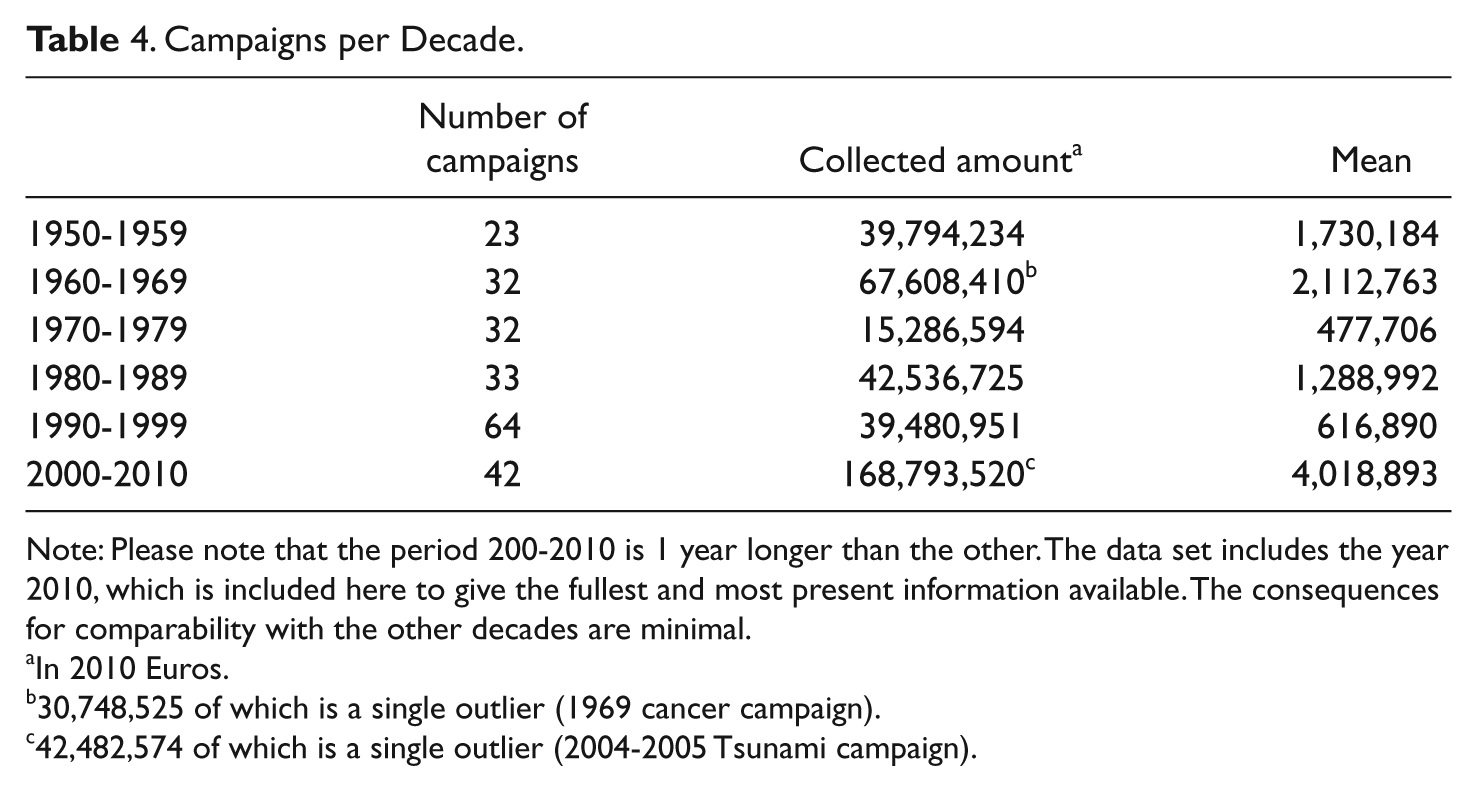
Note: Please note that the period 200-2010 is 1 year longer than the other. The data set includes the year 2010, which is included here to give the fullest and most present information available. The consequences for comparability with the other decades are minimal.
In 2010 Euros.
30,748,525 of which is a single outlier (1969 cancer campaign).
42,482,574 of which is a single outlier (2004-2005 Tsunami campaign).
The table shows a relatively stable level of giving in the first two decades, if one subtracts the 30.7 million from the figures for the 1960s that are made up of a single outlier. The 1970s marks a steep decline in donations, but the giving was back to its initial level by the 1980s and continuing into the 1990s. The massive increase in giving in the most recent 10 years cannot alone, however, be explained by the 42.5 million collected by Radiohjälpen for the 2004 tsunami disaster. The mean without this outlier is still 3,007,403 Euros, almost 5 times as much as for the previous decade. The total amount for the 2000s is 3 times as high as for the 1990s. Table 5 shows how the domestic (dom.) and the international (int.) campaigns have developed.
Domestic and International Campaigns, per Decade.
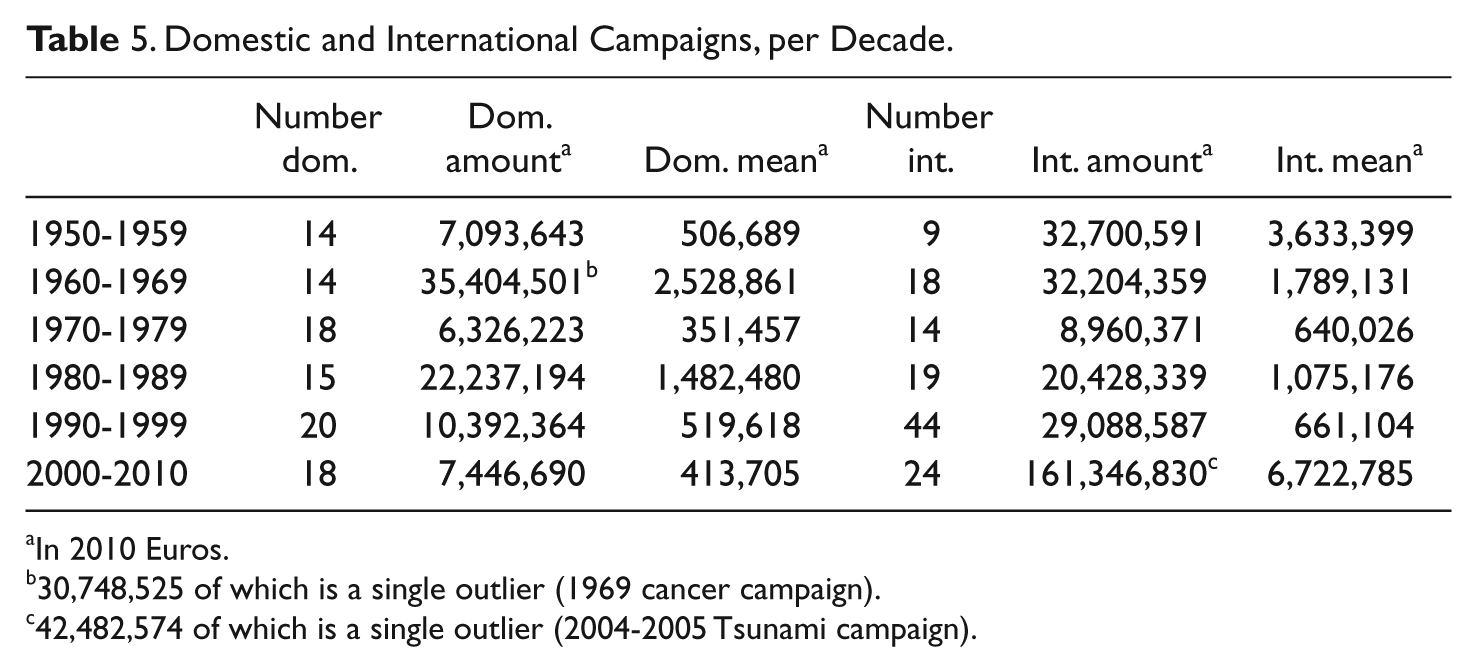
In 2010 Euros.
30,748,525 of which is a single outlier (1969 cancer campaign).
42,482,574 of which is a single outlier (2004-2005 Tsunami campaign).
The figures show that the campaigns for domestic causes have had a relatively stable development but that the difference between domestic and international causes has grown in recent decades, from a relatively even level to international campaigns in the 1980s becoming 3 times larger in the 1990s, to the domestic campaigns being just a fraction of the international in the 2000s. A dominant giving to international causes is, as mentioned above, only one of two ways to indicate a structuring of giving according to social rights. The difference between domestic giving to medical research and giving for aid to the disabled is a second test of this question. How has the giving to these two types of domestic causes developed over time? This is shown in Table 6, where six domestic campaigns from Table 5 that were neither for research nor for disabilities are excluded; two in the 1960s, 1990s, and 2900s, respectively.
Campaigns for Domestic Research and Disability, per Decade.
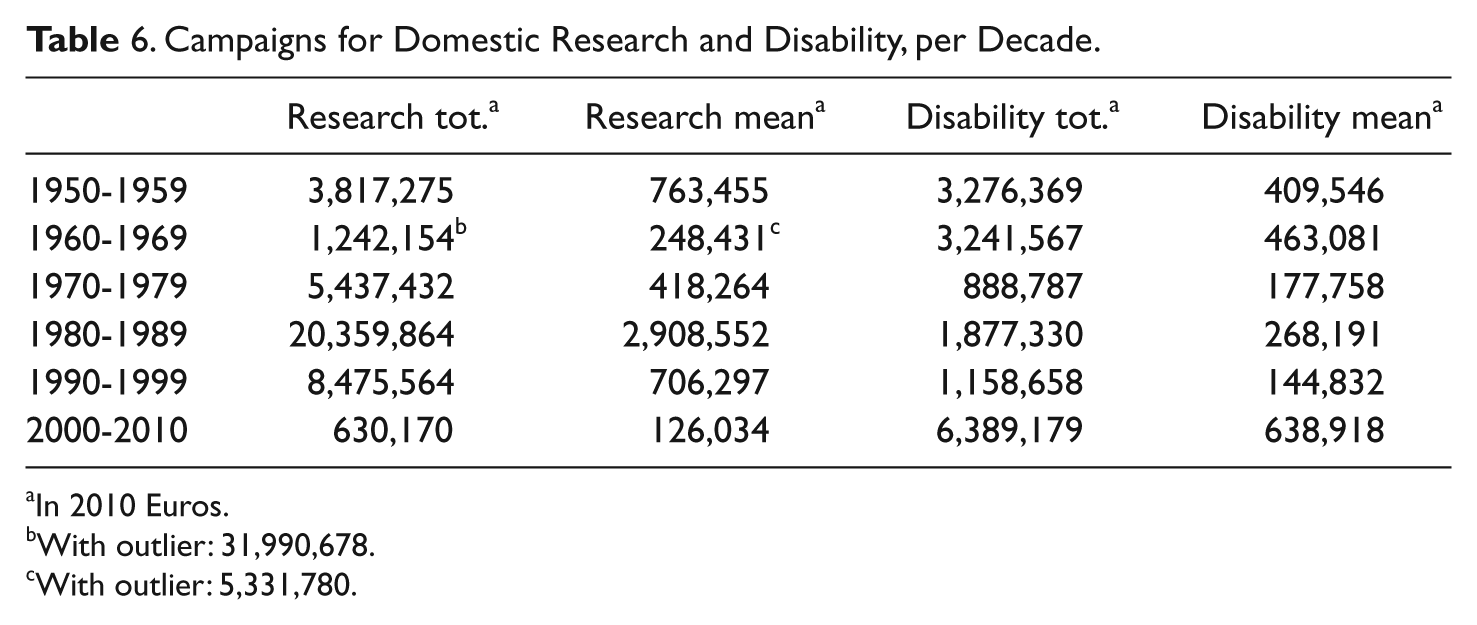
In 2010 Euros.
With outlier: 31,990,678.
With outlier: 5,331,780.
The table shows that the two types of causes received a comparable amount of donations in the 1950s but that the research donations dropped in the 1960s. Donations to the causes of the disabled remained on the same level as in the 1950s through the 1960s, but dropped dramatically in the 1970s. A reasonable assumption here would be that this reflects the zeitgeist. The tradition of giving to the less fortunate, here the disabled, lived on in the early periods, but had been replaced by social rights in the 1970s. In the 1980s we see a drastic increase in giving to medical research, mainly cancer research, and also research for illnesses like rheumatism, asthma, and AIDS, whereas the giving to disabilities remains fairly stable at almost the 1970s level all through the 1990s. What happens in the 2000s is that giving to causes for the disabled starts to increase, which is almost entirely due to the annual campaigns of the Crown Princess Victoria Fund for the disabled, a campaign, incidentally, that has been criticized by the Disability Rights Movement for being paternalistic in pointing out the needs of the disabled as a charity rather than a social right. Does this development in the first decade of the new millennium indicate a shift toward a pattern where charity is coming to be given as well to domestic causes within the scope of the welfare state? In that case it would mean that the Swedish welfare tradition with its social rights is being challenged by a new attitude toward charities.
Analysis
How can the mean difference between domestic and international campaigns be understood? Radiohjälpen initiated 94 campaigns for domestic causes in a 60-year period that collected on average more than 600,000 Euros at the currency value of 2010. The international campaigns are more numerous, 132 in 60 years, and more successful, with an average of close to 2 million Euros. A closer look at the domestic campaigns reveals a clear tendency among them; they are predominantly concerned with medical research. Clearly, severe illnesses like cancer, AIDS, and rheumatism are, like the international causes, problems that are clearly beyond the Swedish welfare state’s sole responsibility and capacity to solve and are therefore considered to be more proper causes. The campaign results for causes more closely associated with public sector services, on the other hand, are significantly less successful. The data cannot measure causality between social rights and patterns of giving, but the success for foreign causes and domestic causes not fully covered by the state supports our assumption that the Swedish welfare state and its emphasis on social rights structure charitable giving.
There are also patterns to the campaigns for international causes. The general relief campaigns and the campaigns for natural disasters are more successful than campaigns for man-made disasters like war. Another clear tendency is that there are almost no campaigns for causes in Europe after the 1950s, with the exception of relief actions for causes in Eastern Europe after 1989. This suggests that the expectations on the welfare states are projected onto other Western countries. Not only do Swedish givers expect the Swedish state to deal with domestic welfare issues, they also expect neighboring states with comparable conditions to do the same. These results show how Swedish civil society is structured from the charity perspective. It also indicates a moral order for charity giving where people in general are more willing to donate money for causes outside the reach or responsibility of the state, be it international or domestic causes. To sum up we will discuss how we can understand these structuring processes and the changes that charity giving has undergone in recent decades.
Civil society action is not simply reaction to state failure. As we can show, people give money for domestic causes in Sweden even though the extensive welfare programs of the state can be expected to meet these needs. The welfare regime is consequently not wholly removing responsibility from its increasingly conformed citizens. However, charity giving is structured by the Swedish welfare regime and we will theoretically understand this structuring by taking the importance of the cultural context as our point of departure. In doing so, we are supported by some of the findings discussed above in the literature review.
The size and composition of civil society is influenced by the society as a whole, and hence, by the reach of the public sector. The question is then not whether civil society activities are crowded out, but what types of organizations, ideologies, or actions have been crowded out and when and by whom (Wijkström, 2011). Obviously Swedish civil society as a whole is structured by the welfare regime. Civil society organizations were more or less forced to abandon their former engagement in the core domains of the welfare state during the mid-20th century as the public sphere expanded. The dominant popular movements at that time were not sympathetic to the former paternalistic civil society solutions for the poor and the disabled, instead perceiving the new institutions of the welfare state as modern and promising. Today, a similar “crowding-out,” or rather “restructuring,” seems to be taking place. The former popular movement tradition is being replaced by a mixture of business and charity (Wijkström, 2011). In several domains of Swedish civil society, organizations are becoming shaped by business principles, so as to make them more competitive in different markets (Boli, 1991; Hvenmark, 2008; von Essen, 2012). The explanation of how civil society is structured rests on the premise that it is generally shaped by those institutions that are perceived as successful at any one time. In the mid-20th century the institutions of the welfare state were perceived as modern and promising. Today, although Swedish civil society is increasingly being shaped by business sector principles, inclination to charity and philanthropy is nevertheless growing. A good example of this development is that Sweden, after decades of ideologically charged debate, became the last country in Europe to introduce tax deductions for charitable giving in 2012 (Trägårdh & Vamstad, 2009). One could say that civil society phenomena—whether in terms of actions or organizations—tend to reflect the age in which they exist.
We argue that this theoretical perspective, focusing on time and cultural influences, is consistent with our empirical data. The massive increase in charity giving for international causes during the 2000s is consistent with the thesis of the return of charity as a morally accepted civil activity. However, for domestic causes the normative order of social rights still remains stable. Our data confirm that charity giving, at least for causes outside the Swedish welfare state, nowadays is perceived as a morally proper and effective way for individuals to contribute to alleviating urgent human needs. If so, we are seeing today the return of philanthropy and a new hybridization of Swedish civil society, where the close relations with the Swedish state is being supplanted by an older pattern with the borders between civil society and the business sphere more blurred.
How can we explain the steep decline in donations during the 1970s? It is of course tempting to point to the general left-oriented “air de temps” in Sweden during this period. This might possibly explain why the rate increased in the more liberal oriented 1980s, but not the high rate during the 1960s. Perhaps the decline during the 1970s is best explained by contingent factors, such as less well conducted Radiohjälpen campaigns.
Conclusions
This article has shown that charitable giving in Sweden has historically been structured toward causes not considered to be the responsibility of the public sector and away from causes that are tied to social rights, even when those needs have not actually been met by the state. This supports the theoretical assumption that social rights affect private incentives for giving to different types of causes even though there is no proof of causality. However, the fact that both the distribution between domestic and foreign causes and the distribution within the domestic category support the theory makes it more than plausible that the Swedish “social contract” with its emphasis on social rights is what has determined the structure of charitable giving. The findings also show that this understanding has changed over time. The main change is a substantial increase in the total amount of money donated to international causes, whereas the donations for domestic causes have been relatively stable. We can, in other words, observe a new willingness to give money, possibly due to a new acceptance of and reliance on charities as an immediate means of meeting urgent needs. However, almost all of the increase in giving is directed toward the types of causes that have been the most successful historically. It seems, therefore, that charitable giving has become a proper activity in the Swedish, universal welfare state, but that the structuring effect of its social citizenship, at least for now, remains stable.
Footnotes
Declaration of Conflicting Interests
The authors declared no potential conflicts of interest with respect to the research, authorship, and/or publication of this article.
Funding
The authors received no financial support for the research, authorship, and/or publication of this article.