







Abstract
In the United States, a small proportion of private donors gives to international charity. We explore the profile of these donors with a view to understanding who supports international causes relative to domestic causes only and, more generally, what shapes public concern for those in need in other countries. Using data from the 2001 survey on “Giving and Volunteering in the United States,” we employ a series of probit regressions to compare the sociodemographic correlates of giving to international causes with 11 other domestic causes such as health, education, and the arts. We find that while income is not associated with the likelihood of international giving, postgraduate education, being foreign-born, and religiosity are large and significant predictors. We also explore the impact of various measures of social capital and civic engagement, and find that institutional trust and youth volunteering are strongly associated with international giving relative to the other causes.
Introduction
In 2008, charitable donors in the United States gave US$307 billion to a variety of causes, of which 75% were donations made by private individuals (Giving USA Foundation, 2009). Private giving is therefore a potentially powerful force for global redistribution and for promoting human development in poor countries. However, the overwhelming majority of private charity in the United States is channeled toward local causes. In 2008, for example, only 4% of total private donations accrued to international causes, defined to include “relief, direct aid, exchange, and other programs focused on international issues”. Along with the environment, international causes received the smallest share of the total funds.
Although donations to international causes make up a small fraction of total private giving, this share has grown, from only 1% in 2000 to 4% in 2008 (Giving USA Foundation, 2001, 2009). According to Giving USA Foundation (2010), of the few subsectors that saw an increase in donations in 2009 in the wake of the financial crisis (human services, health, the environment, and international aid), donations to international causes grew the most. This suggests that factors other than economic circumstance influence giving to particular charitable causes.
A large body of empirical research has investigated the determinants of giving generally, but less is known about the determinants of giving to specific causes. We found very few published empirical studies that examine the characteristics of international donors in particular (Micklewright & Schnepf, 2009, on the United Kingdom; Rajan, Pink, & Dow, 2009, on Canada; and Wiepking, 2010, on the Netherlands). We add to this literature by exploring the factors that shape an individual’s preference for international giving in the United States, and we compare these with the factors that influence giving to a variety of other domestic causes, such as education, religion, the arts, and politics. 1
Identifying which kind of donor gives to international causes is important for at least two reasons. On a practical level, charities in the international sector need to know who their most likely target group is to devise effective fund-raising strategies. More broadly, though, exploring what influences international giving might help us to better understand how some individuals come to conceptually and behaviorally support global aid and redistribution. As A. B. Atkinson (2007) notes, giving to international charity “is one of the few direct ways in which individuals reveal information relevant to the properties of the social welfare function to be applied to global redistribution” (p. 1).
For this study, we draw on data from the 2001 survey on “Giving and Volunteering in the United States,” which collected information on formal donations to 12 different causes. Because the survey was conducted with a specific view to understanding the determinants of philanthropy, the data set contains a wide range of relevant sociodemographic variables that have been used in empirical research on giving. This enables us to specify a fuller equation than many of the studies in this area were previously able to; in addition to the standard set of demographic variables used to predict giving, we also include indicators of social capital and civic engagement and control for individual values and solicitation.
Literature Review and Hypotheses
The act of giving is likely to be motivated by a complex mix of self- and other-regarding motivations and much has been written on this subject. But what leads individuals to give to specific charitable causes? While some studies have investigated giving to one particular cause (most commonly religion), few have explored the individual determinants of giving across a range of causes with a view to establishing patterns in individuals’ choice of charity (Bennett, 2003; Micklewright & Schnepf, 2009; Srnka, Grohs, & Eckler, 2003; Wiepking, 2010).
Bennett (2003) asks a sample of randomly selected individuals in central London to choose which of three charities (cancer relief, cruelty to animals, and human rights) they would give to if they had a £100 to donate. His results suggest that the alignment of personal and organizational values are important in determining the choice of charity; for example, the more empathetic gave to cancer care and animal welfare, and those who valued achievement and hedonism and were more individualistic gave to human rights.
In her study of giving across a range of causes in the Netherlands (including charities with an international focus), Wiepking (2010) suggests three important mechanisms in identifying the choice of charity: people need to encounter the opportunity to give through various means of solicitation; they must have confidence in the charitable organization; and they need an incentive to give—for example, improved social status through giving to cultural institutions, or support of one’s beliefs/values as with religious people donating to religious organizations.
In the marketing literature, Srnka et al. (2003) explore the impact of age, education, income, and gender on giving to various causes among a sample of 300 people in one district in Austria. They posit that the purpose of the charity must be relevant to “the sphere of the individual” or to the image of themselves they would like to portray. Along these lines, they suggest that women, for instance, give to environmental and animal protection causes because of their “caring” nature, and the educated give to more abstract or “mentally remote” causes such as human rights. In addition, they argue that the likelihood of giving increases with the opportunity to benefit from the organization; consistent with this, they find that older individuals are more likely to give to health and men are more likely to donate to local friendly societies (Srnka et al., 2003).
International charity offers fewer such opportunities for benefit than domestic charity. The number of recipients is also large and they are generally far removed from the donor, so the public good and insurance benefits of giving are less obvious. 2 While it is possible that international donors experience the “warm glow” effect described by Andreoni (1990), they would also benefit in this way from giving to a number of other causes. This implies that donating to international causes must in some way also connect to the “sphere of the individual” or support their beliefs or value system in some specific way.
Although they only distinguish between giving to religious versus secular causes in their study, the conceptual model of identification that Schervish and Havens (1997) propose is useful here. They suggest a model in which “the type and degree of empathetic identification with the needs of others” or a “sense of we-ness” generates philanthropic behavior (Schervish & Havens, 1997, pp. 238-239). So while all givers may be motivated by “impure altruism,” they give to specific causes because they identify with them in distinct ways. Schervish and Havens (1997, pp. 240-242) refer to four interrelated mobilizing factors that foster identification: “communities of participation” where “being connected to an array of such life-settings is the basis for people becoming aware of needs and choosing to respond”; “frameworks of consciousness” such as religious beliefs, political ideology, and social concerns; “direct requests” and “positive models and experiences in one’s youth.”
In the subsections that follow, we draw on these ideas as well as on insights from the broader empirical literature on giving to build hypotheses with respect to international giving for each of the sociodemographic variables that are commonly included in these studies. Given the size of this vast literature, we try to summarize the main findings only, and draw particularly from recent comprehensive reviews of more than 500 articles by Bekkers and Wiepking (2007, 2011). We also pay special attention to the two empirical papers that studied international giving specifically in the United Kingdom and Canada (Micklewright & Schnepf, 2009; Rajan et al., 2009). While neither propose specific theoretical models of international giving, the empirical insights gained from this work are useful in building our own hypotheses.
Income
In multivariate analyses, income is consistently identified as one of the most important predictors of the amount donated; however, the results on the probability of making a donation are mixed (Bekkers & Wiepking, 2007). We might predict a positive relationship between income and international giving, because people with higher incomes are more able to afford giving at home and abroad. As Micklewright and Schnepf (2009) point out, The notion that “charity begins at home” suggests that overseas giving is a luxury and hence progressive in incidence: people give mainly to domestic causes at lower levels of income but add-on giving to overseas causes as their income rises. (p. 328)
However, given reports that international philanthropy in the United States increased relatively more than donations to most local charitable subsectors despite the economic recession (Giving USA Foundation, 2009), there may be other more important predictors of giving to international causes than income.
The findings in the empirical literature on international charity do not suggest a large role for income. Micklewright and Schnepf (2009) find no significant impact of income on overseas giving controlling for various sociodemographic variables including education, although income did affect the likelihood of giving to other domestic causes in the United Kingdom. Similarly, Wiepking (2010) and Rajan et al. (2009) do not find a positive and significant effect of income on the probability of giving to international causes relative to domestic causes in the Netherlands and Canada, respectively.
Education
Most philanthropic research has found that the propensity to give increases with the respondent’s level of education, even after controlling for income (Bekkers & Wiepking, 2007). Education may increase giving because the more educated have greater knowledge and possibly cognitive ability (Wiepking & Maas, 2009), which helps them to better comprehend the needs of distant others. This mechanism is likely to be particularly important for international causes, which in some cases might be considered more “mentally remote” than many domestic causes. For example, as Srnka et al. (2003, p. 82) and Wiepking and Maas (2009, p. 1978) suggest, a degree of abstract thinking may be necessary to support causes such as human rights or the “empowerment of women in Africa,” which do not involve easily quantifiable goals.
In addition, education, and more so higher education, will expand the realm of identifications people can make through fostering greater awareness of and empathy for the plight of others. Wiepking and Maas (2009) write, “The longer they stay in school, the more they learn about society and about people who are different from themselves, the more they will care for the wellbeing of other people, the environment and society as a whole” (p. 1978). The existing empirical evidence on international charity supports this hypothesis; education, and particularly higher education, has been found to be one of the largest predictors of giving to international causes (Micklewright & Schnepf, 2009; Rajan et al., 2009).
Religion
Religious involvement is one of the most widely discussed determinants of prosocial behavior, and has been found to be positively related to giving in general and religious giving in particular (Bekkers, 2003; Bekkers & Schuyt, 2008; Brooks, 2005; Brown & Ferris, 2007; Wang & Graddy, 2008; Wiepking, 2010). Bekkers and Schuyt (2008) differentiate two mechanisms through which religion affects prosocial behavior—“conviction” and “community.” The former refers to the values that religion instills in individuals, such as concern for and responsibility toward the well-being of others. The latter captures how participation in religious institutions is likely to result in individuals being made more aware of opportunities to give and of being solicited. In addition, there may be social pressure or reputation effects of giving associated with group membership in religious organizations (Bekkers & Wiepking, 2007), especially if donors have some notion of what their peers donate (Croson, Handy, & Shang, 2009).
We hypothesize that religious involvement will be positively associated with international giving in particular, and here the role that religious organizations play in shaping people’s value systems is likely to be of importance. Religious teachings encourage people to empathize with and help those who are worse off than themselves without regard to reciprocity or to the “distance” between them, values that may be particularly important to international giving where there are few “tangible” benefits of giving. To illustrate the emphasis placed on showing kindness to complete strangers, Bekkers and Schuyt (2008) refer to the parable of the Good Samaritan and suggest that religion “expands the identification with distant others as ‘neighbors’ who deserve help” (p. 92). Furthermore, in line with the religious tradition of uplifting the poor, the last two decades have seen a growing concern and solidarity among religious bodies to address global poverty and inequality, 3 which is likely to be internalized by members and reflected in their prosocial behavior.
Social Capital
Although fewer studies have explored the relationship between social capital and giving (probably due to a lack of data; Brown & Ferris, 2007), those that do find large and significant effects (Brooks, 2005; Brown & Ferris, 2007; Wang & Graddy, 2008; Wiepking & Maas, 2009). Social capital refers to the “networks, norms, and social trust that facilitate coordination and cooperation for mutual benefit” (Putnam, 1995, p. 67). While these concepts have been operationalized in various ways, most studies tend to distinguish between two types of social capital: “embeddedness in one’s community” reflected in various associational measures of group membership or engagement, and “trust”—generalized social trust (or trust in one’s fellow human beings) and trust in civic institutions.
Associational ties or networks increase one’s knowledge of different causes as well as the chances of being asked to give. In addition, by actively participating in the lives of others, people are more likely to perceive their welfare as being connected or interdependent, promoting charitable behavior (Putnam, 2000; Schervish & Havens, 1997; Wang & Graddy, 2008). This type of social capital is also likely to influence which charitable causes an individual supports if membership or participation in a voluntary association signals a particular concern for the purpose or work of that organization (as with religious people giving more to religious causes). However, it is not clear that international charity will necessarily benefit. If associational ties embed individuals particularly in their local community, charitable funds may be diverted to domestic causes. Instead, a positive effect of social networks on international giving may be indicative of what Bekkers and Wiepking (2007, 2011) refer to as a more profound “moral principle of care.” In other words, individuals who are embedded in their communities are the type who would also donate to a number of different causes.
A number of studies have found trust to be positively associated with charitable giving (Bekkers, 2003; Brown & Ferris, 2007; Wang & Graddy, 2008; Wiepking & Maas, 2009). Given uncertainty that donations will be (efficiently) used for their specified purpose, trust will be especially important for those types of charities with goals that are harder to achieve. Wiepking (2010) hypothesizes that trust in institutions in particular (measured by confidence in charitable organizations) is likely to be a significant predictor of international charity, and her empirical analysis supports this. She attributes this to the risk attached to a large physical distance between the donor and intended recipient, and the difficulty of achieving objectives such as reducing poverty and providing aid in poor countries. In addition, trust in charitable organizations might be particularly important for international giving because the output is much harder to observe compared with domestic charity. 4
Volunteering
There is evidence of a complementarity between giving and volunteering in the empirical literature (Bekkers & Schuyt, 2008; Rooney, Steinberg, & Schervish, 2004; Schervish & Havens, 1997; Wang & Graddy, 2008). As volunteering is a more “intensive form” of civic participation, the same mechanisms as those described above would operate—volunteers are more likely to be aware of charitable causes, to identify with others’ needs, and to be solicited. Furthermore, the relationship between donating money and volunteering may be indicative of a common value system (Bekkers & Wiepking, 2007; Wang & Graddy, 2008).
However, a problem with using current volunteer activity to estimate the relationship with charitable giving over the previous year is that the reverse relationship is just as plausible. This form of endogeneity can result in a bias in the estimated effect, making causal interpretation difficult. In our empirical work, we therefore include a measure of whether the individual volunteered in their youth. In addition to the mechanisms described above, volunteering in one’s youth may capture the influence of parental background on prosocial behavior. Experiences in one’s youth are among the mobilizing factors that Schervish and Havens (1997) include in their identification model, as they “are part of a moral education that molds our lives at a period when we are less guarded about our priorities and more apt to accrue at least a feel for the charitable impulse” (p. 242). Although few studies have explored the impact of youth participation on giving, the association has been found to be positive (Bekkers & Wiepking, 2007).
As with group memberships, the type of organization one has volunteered for is likely to affect the charitable causes one identifies with and donates money to, and if these are locally oriented, we might not expect to find an association with international giving. However, given the popularity of youth mission trips to developing countries (Salmon, 2008), there may well be a positive relationship between youth volunteering and international giving, assuming youth volunteering exposes people at a young age to the plight of the poor in other countries.
Immigrant Status
Although there is not much empirical evidence of a difference between general giving to formal causes by immigrants and native citizens in the United States once other factors such as income, education, and religion have been accounted for (Osili & Du, 2005), immigrant status has been found to be an important factor in giving to international causes (Okten & Osili, 2009; Osili & Du, 20055). Here, the mechanisms are more obvious; through both emotional and relational ties, foreign-born individuals are more likely to be able to identify and empathize with those in other countries and be aware of their needs. To use an extreme example, the support of human rights in a developing country will certainly be less “mentally remote” for someone who has sought asylum from political persecution, for instance. Indeed, Rajan et al. (2009) find that other than education and religiosity, being foreign-born was a particularly important predictor of international giving in Canada.
Other Demographic Characteristics
Other demographic factors that are commonly included in empirical work on giving are age, gender, marital status, race, and whether there are children in the household. We refer to these briefly here as none of the studies on international philanthropy report significant effects of these variables, and we can find no clear conceptual justification for a particular direction of effect. For example, people of different ages or marital status may support different causes due to changing resources, experiences, and values. However, we can think of no obvious reason for why giving to international programs would increase (or decrease) with these factors, or at least any more so than they would for the other causes, particularly when controlling for income and social capital. It is also not clear that race would have a specific impact on international giving in a multivariate analysis, especially once immigrant status and income are accounted for.
Households with children may be more likely to give to international causes if parents in the United States are better able to empathize with parents in developing countries, and are more aware of their needs (Bekkers & Wiepking, 2007). But domestic educational and youth development programs, which benefit local children, possibly the donor’s own, and with whom donors can more readily identify, might receive these households’ donations instead. In a similar vein, women might be more empathetic toward the struggles of the poor to support their families in developing countries, given their traditional role in the home, but their inclination to give to local family causes might cancel this effect.
Data and Method
Data
We use data from the Independent Sector’s (IS) 2001 survey on “Giving and Volunteering in the United States.” The 2001 survey was unfortunately the last in the series, which means that our data source is somewhat outdated. Nonetheless, we use these data for a number of reasons. First, the IS survey distinguishes between formal donations to 12 different causes, allowing us to explore patterns in respondents’ choice of charity across a wide range of causes. Second, as the survey was conducted with the specific purpose of exploring philanthropy among Americans, it collected information on a variety of demographic, socioeconomic, and behavioral variables relevant to predicting charitable giving that are not simultaneously available in other surveys, such as the Panel Study of Income Dynamics (PSID). 6 Third, the IS survey collects information on all private donations regardless of the amount, whereas the PSID only collects information on donations of greater than US$25. Fourth, the IS survey includes a question on who in the household decides what cause to donate to (discussed further below), which is particularly useful for our purposes (whereas in the PSID, respondents are asked who in the household decides how much to give).
The IS 2001 data were collected between May and June by random digit dial telephone interviews, resulting in a national sample of 4,178 adults aged 21 years and older. To increase the sample sizes of certain groups for statistical purposes, an oversampling of Hispanics, Blacks, and affluent Americans with household incomes of US$100,000 or higher was included in the survey design. A subsampling of males was also implemented to increase their probability of selection in the final sample. To ensure national representativity, we make use of the relevant weights provided with the data set that account for sampling design and survey nonresponse (IS, 2002).
Individuals were asked whether they or members of their household had contributed either money or property in 2000 to any of the following formal causes: religious organizations; youth development; education; health; human services; the environment, including animal welfare; adult recreation; arts, culture, and humanities; public/societal benefit; political organizations; private and community foundations; and international/foreign programs. Roughly 87.1% of respondents reported contributing to at least one cause, with the mean number of causes supported among givers 3.1 (SD = 2.01). 7 Only 7.2% of giving households reported donating to international charity, 8 the lowest percentage across the causes (along with adult recreation at 7.3). This is in contrast to the 70.9% and 41.7% that supported religious- and health-related causes, respectively, the two most popular causes.
Table 1 reproduces the survey questions, including the short list of examples for each cause that was read out to respondents. The question on international giving was phrased as follows: “In 2000, did you and members of your household contribute money or property to or for international or foreign programs, either in the US or abroad? Examples include relief abroad and student or cultural exchange programs.” While this wording might suggest a rather broad range of potential programs, it is likely that most of the donations are intended to benefit developing countries and their citizens. Kerlin and Thanasombat (2006, p. 2) find that 74.0% of the 5,598 international organizations they study and 89.0% of total international donations are designated for aid to or programs in the developing world (with the remainder shared between “international understanding”—which includes exchange programs—and “international affairs”). 9
Survey Questions in Giving and Volunteering in the United States, 2001.
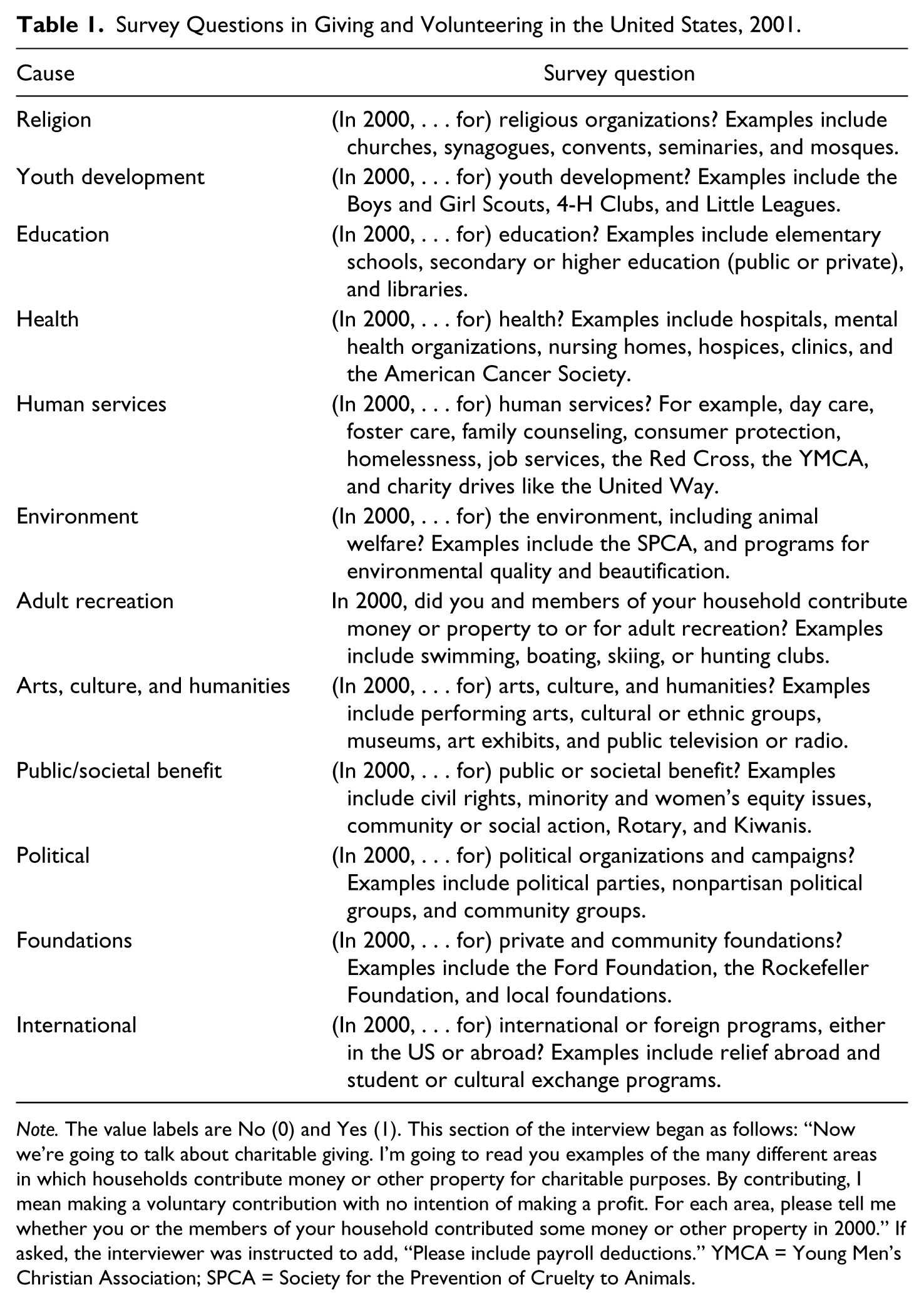
Note. The value labels are No (0) and Yes (1). This section of the interview began as follows: “Now we’re going to talk about charitable giving. I’m going to read you examples of the many different areas in which households contribute money or other property for charitable purposes. By contributing, I mean making a voluntary contribution with no intention of making a profit. For each area, please tell me whether you or the members of your household contributed some money or other property in 2000.” If asked, the interviewer was instructed to add, “Please include payroll deductions.” YMCA = Young Men’s Christian Association; SPCA = Society for the Prevention of Cruelty to Animals.
One potential concern with the category delineations in the questionnaire is that donations to other causes like “health” and “education” may actually be intended for international programs. Health and education precede international causes in the sequence of survey questions, but the specific examples of health and education given—such as hospitals, clinics, the American Cancer Society, libraries, and primary schools—conceivably primed respondents to think locally rather than globally. Therefore, it is likely that respondents attributed donations to international health and educational programs to the international category. In addition, although the questionnaire asked whether respondents gave to “religious organizations” (specified to include churches, synagogues, convents, seminaries, and mosques), it is possible that people may have given to their church with the understanding that the donation would be used to help the poor in developing countries. 10
Sample
Most surveys that collect information on giving, including the IS survey, capture this information at the household level by asking respondents whether they or another member of their household had made a charitable donation (Rooney et al., 2004). This recognizes the public good nature of donations in multiperson households (Andreoni, Brown, & Rischall, 2003). However, it creates difficulties when trying to identify the determinants of giving. Most papers that we reviewed predict household giving using the respondent’s individual-level characteristics (such as age, education, religion, gender, race) alongside a few household variables such as household income and size (some examples are Bekkers, 2003; Bekkers & Schuyt, 2008; Bekkers & Wiepking, 2006; Okten & Osili, 2009; Osili & Du, 2005; Rooney et al., 2004; Wiepking, 2010; Wiepking & Maas, 2009). Bekkers and Wiepking (2007) make a similar observation in their extensive literature review.
A concern with this practice is that in multiperson households, the individual responding to the survey, and for whom individual-level information is available, may not have been responsible for decisions around giving, and in this case, the choice of charity to support. We therefore follow Schervish and Havens (1997) and Rajan et al. (2009) and restrict our sample to those respondents who reported being involved in the decision of which charity to support. The questionnaire asks as follows: Even though members of a household give as a unit, individual members may select certain charities or nonprofit organizations to support. Who in your household is considered most involved in deciding which organizations you give to? Would you say . . . 1. Yourself 2. Your spouse or partner 3. Both yourself and your spouse or partner 4. Another household member?
Our sample consists of those who chose either Option 1 (49.15%) or 3 (36.26%)—so, of those who reported that they or a household member had made a formal donation in 2000 to at least one cause, just over 85% also reported being involved in the decision about the choice of charity.
While this approach has its limitations, among them that we are not able to predict the choice of charity for the remaining 15% of households, nor are we able to ascertain the influence of spouse characteristics on the choice of charity in couple households, it is arguably an improvement over the more common method of using individual characteristics to predict household giving regardless of decision-making involvement. In restricting the analysis in this manner, our sample size fell from 3,597 to 3,198 individuals, and the sample of donors who gave to international causes dropped from 261 to 231 individuals.
Regression Model
We estimate a series of probit regressions in which the dependent variable in each regression is a binary variable representing whether or not the respondent chose to give to a particular cause, conditional on giving to at least 1 of the 12 causes. In the “Regression Results” section, we comment on the implications of using this selected sample.
The choice of explanatory variables was driven largely by our review of the literature described earlier. We include the standard set of individual demographic characteristics: gender, race, a quadratic in age, whether the individual was married or cohabiting, and education (captured in a set of dummy variables ranging from less than high school to postgraduate). Whether the individual was born outside of the United States is also added, given the relevance of this variable to international giving. The household-level variables we include are logged per capita household income 11 and whether there are children younger than 18 years living in the household. Religiosity is measured by the frequency of attendance at religious services, captured in a dummy variable equal to one if the individual had attended “nearly every week or every week.” Our measures of social capital try to reflect both associational and trust aspects. The former is measured by membership in a nonreligious group (examples provided to respondents included service clubs like Kiwanis and Rotary, an alumni or neighborhood organization, professional societies, labor unions, and sports or hobby groups). The latter is captured by whether individuals responded that “generally speaking . . . , most people can be trusted” (generalized social trust), and whether they reported having a lot of confidence in charitable organizations as opposed to some or none (institutional trust). We also include whether the individual had done any volunteer work in his or her youth (18 years or younger).
Table 2 compares the mean characteristics of the samples of international and domestic donors. It shows that international donors are significantly more likely to have given to every other cause except adult recreation, and that the mean number of causes supported was 5.6 for this group compared with 3.0 for domestic-only donors. In terms of sociodemographic characteristics, international donors are likely to be older, more educated, religious, married/cohabiting, foreign-born, and to have greater income. There are also significant differences across all the social capital and civic engagement variables, with international donors displaying higher group membership, youth volunteering, and levels of trust than domestic donors.
Mean Characteristics of International and Domestic Donors.
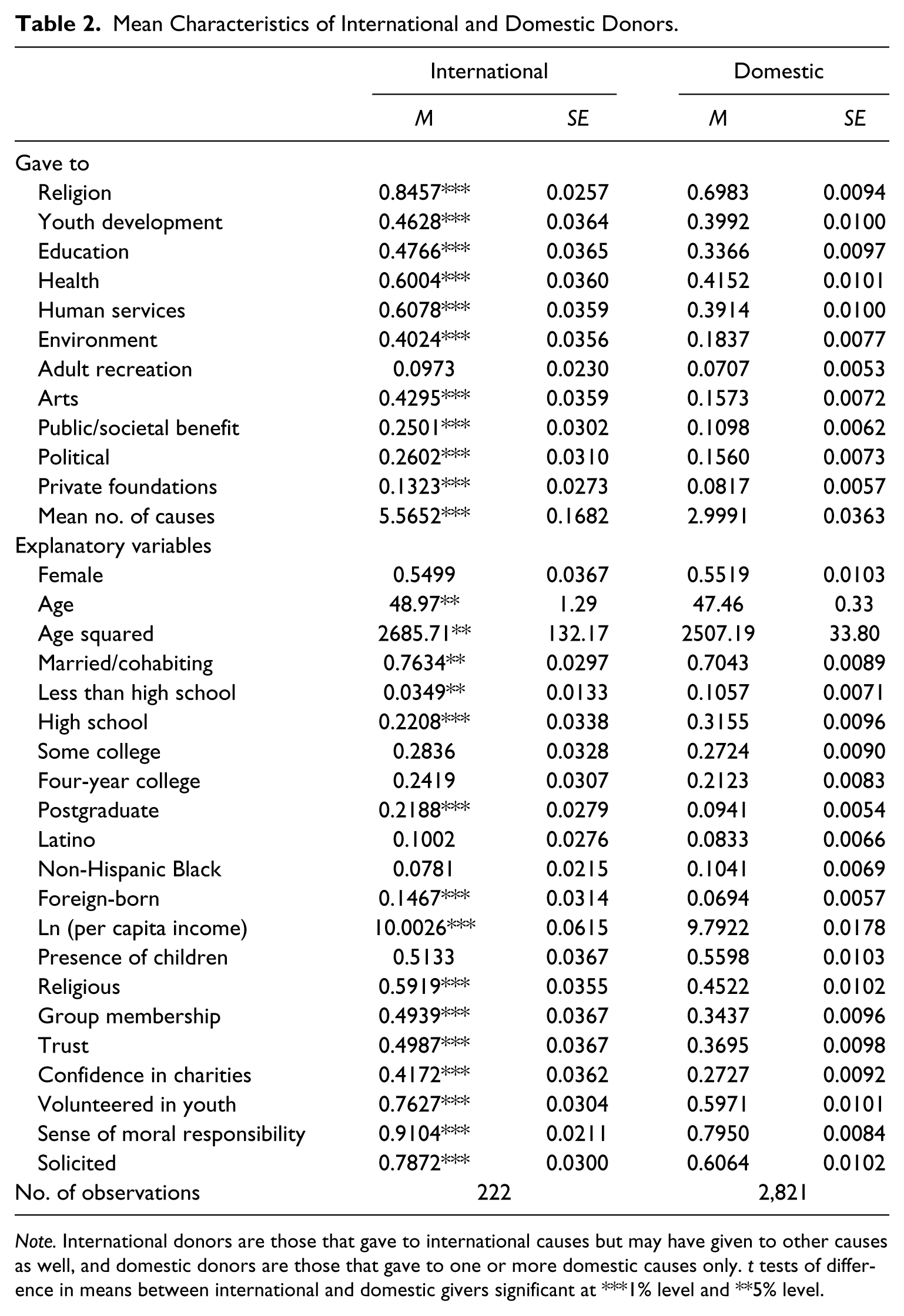
Note. International donors are those that gave to international causes but may have given to other causes as well, and domestic donors are those that gave to one or more domestic causes only. t tests of difference in means between international and domestic givers significant at ***1% level and **5% level.
Regression Results
Table 3 presents four specifications for the international giving regressions, while Table 4 shows the comparative results across the 12 causes using the fullest specification only. Marginal effects, expressed as elasticities (i.e., the proportional change to the probability of giving), are displayed in the tables.
Probit Regressions on Giving to International Causes, Conditional on Giving to at Least One Cause (Marginal Effects With Standard Errors in Parentheses).
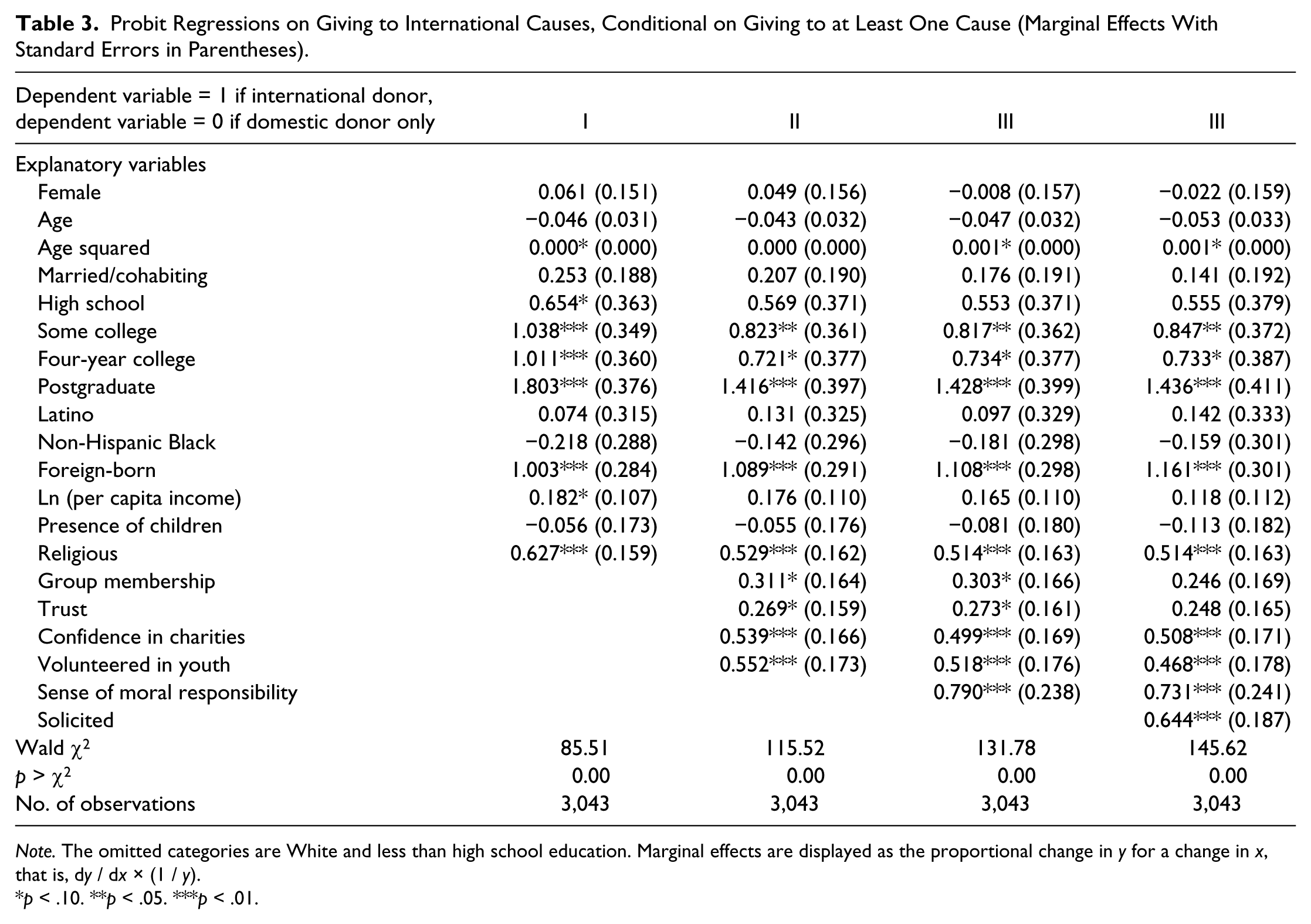
Note. The omitted categories are White and less than high school education. Marginal effects are displayed as the proportional change in y for a change in x, that is, dy / dx × (1 / y).
p < .10. **p < .05. ***p < .01.
Probit Regression Results for Giving by Cause (Marginal Effects With Standard Errors in Parentheses).

Note. The omitted categories are White and less than high school education. Marginal effects from the probit estimations are displayed as the proportional change in y for a change in x, that is, dy / dx × (1 / y).
p < .10. **p < .05. ***p < .01.
International Giving
Regression I in Table 3 contains the standard set of sociodemographic variables commonly included in giving equations. We estimate this simpler equation for comparability with other studies, and because often charitable organizations only have access to basic demographic information on which to base fund-raising strategies (Srnka et al., 2003). The variables that have the greatest impact on the likelihood of having chosen to donate to an international charity are education, religiosity, and being foreign-born. The age effect is U-shaped, while income has a positive influence on international giving, but these effects are only marginally significant at the 10% level and when we include the social capital and volunteering variables in Regression II, they lose significance. Of the social capital variables we include, only our measure of institutional trust is strongly significant. In addition, volunteering in one’s youth had a positive and highly significant effect on international giving.
Brown and Ferris (2007) argue that it is important to examine social capital variables not just because of their value in understanding the mechanisms behind giving but also to better understand the mechanisms through which other key indicators of giving, such as education and religiosity operate, as these are closely related to the accumulation of social capital. They suggest that excluding social capital controls results in an omitted variable bias as their inclusion has been found to greatly reduce the impact of religion and education (Bekker & Wiepking, 2010; Brown & Ferris, 2007). We find a similar impact here; in Regression II, the marginal effects of the religiosity and particularly the education variables fall.
A concern with the inclusion of social capital and youth volunteering in the estimation is the problem of endogeneity—that individuals who are deeply embedded in their communities or who are trusting in nature, for example, are also more generous or have a greater sense of social responsibility. None of the studies we reviewed on social capital and giving dealt with this issue explicitly, and in fact Bekkers and Wiepking (2007, 2011) note this as one of the limitations of the giving literature more generally that relies mostly on cross-sectional data. We are also unable to fully control for these individual fixed effects. However, following Bekkers and Schuyt (2008) and Wiepking and Maas (2009), who included measures of prosocial value orientation and empathetic concern in their regressions, we include a measure of moral responsibility or concern for the well-being of others. Although our data are not nearly as extensive as theirs in capturing individual values, respondents were asked whether they felt that “those who have more should give to those who have less.” When we include this measure in Regression III, we find a large and significant effect and, while the effects of the religiosity, social capital, and youth volunteering variables tend to fall, the impact is not substantial. However, to the extent that we are unable to control for unobserved heterogeneity, there is still likely to be an upward bias on these variables.
Finally, in Regression IV, we take on board another key criticism made in Bekkers and Wiepking (2007)—that most studies do not control for “the ask” (exceptions are Bekkers & Schuyt, 2008; Wiepking & Maas, 2009). For instance, the finding that religious people are more likely to give may not be indicative of greater prosocial tendencies, but simply that those attending religious services are more frequently asked. Although we do not know how often respondents were asked to give, we at least know whether they had been “personally asked to give money or property to charitable organizations, including religious organizations, in 2000.” The effect of this variable is positive and highly significant as expected, but the effect of religiosity is virtually unchanged. The group membership and generalized social trust variables are now no longer even marginally significant and the impact of the volunteering variable decreases somewhat, suggesting that these activities/attributes expose one to greater solicitation.
To summarize, regardless of the specification, the variables that are consistently the strongest predictors of international giving are postgraduate education and being foreign-born (with marginal effects of 1.436 and 1.161, respectively, based on Regression IV). Religiosity, youth volunteering, and confidence in charities are also highly significant predictors, with marginal effects in the region of 0.5.12,13
A potential concern with our analysis is that, because we estimate the probability of giving to international causes conditional on giving to at least one cause, we introduce a sample selection bias. Ideally a two-stage selection model should be estimated. However in this case, such an estimation is complicated by the nature of our sample (i.e., those involved in the decision making on charity choice), as we do not have information on decision making in households that did not give to any cause in the previous year. As a test of the sensitivity of our results to this selection of the sample (and for comparability with research that does not have decision-making information), we also estimate the final regression in Table 3 using the full sample of giving households, that is, including non-decision-making respondents. We find little difference in our results. The age squared variable loses significance and the income variable becomes marginally significant again at the 10% level. Also, the magnitude of the education effects drops somewhat, but the impact of postgraduate education remains strongly significant and along with being foreign-born, these two variables continue to have the largest impact on giving to international causes.
Using this full sample of giving respondents, we then estimate a two-stage Heckman selection model to test whether bias has been introduced by estimating the international regressions conditional on giving. The first step predicts the probability of giving (i.e., to any cause) relative to not giving among all respondents, and the second step predicts giving to international causes specifically. In none of the specifications 14 we tried did we find strong evidence of selection (i.e., the Wald tests of independent equations were not significant at the 10% level at least).
Comparative Analysis
Examining the results across the full range of charitable causes provides further insights (Table 4). While a college education increases giving to a number of causes, postgraduate education specifically has a very strong effect on giving to international causes and the arts. It would seem that higher education in particular provides individuals with the level of abstract thinking that promotes giving to more “mentally remote” causes. Furthermore, the longer one stays in education, the more one is likely to identify with distant others, as greater knowledge of other countries is acquired. Also in line with the idea that choice of charity reflects the individual’s ability to identify with that cause, we find that being born outside the United States has a very large impact on international giving compared with the other causes. In fact, the only other cause for which this variable is significant is giving to private/community foundations (the specific examples of which, such as the Rockefeller and Ford Foundations, have a strong global outreach focus).
A particularly interesting finding from the comparative results is that, apart from giving to religious organizations, religiosity has a positive effect only on giving to international causes. This unique association may in part be due to religious institutions taking up special collections for international programs. As we try to control for solicitation, it is also likely that this effect is capturing that religious institutions, through their teachings and values, promote empathy with the less fortunate, without concern for reward or the “distance” between donor and recipient.
Although none of the other variables in our standard set of sociodemographic characteristics has a significant effect on international giving, the findings for the other causes are generally consistent with the notion that choice of charity reflects the “sphere of the individual.” Those with children are more likely to give to education and youth development; women are more likely to give to the environment, education, health, and the arts and less likely to give to adult recreation and politics (traditionally male-dominated spheres); and Black Americans are more likely to give to public/societal benefit (examples of which included civil rights and minority issues).
We turn now to a discussion of the social capital and youth volunteering variables. While nonreligious group membership is not a significant correlate of international giving, it is positively associated with every other domestic cause (except religion, which is driven by religious membership). This supports the assertion in the literature that being connected to others promotes prosocial behavior. However, it also implies that this measure is capturing embeddedness in one’s local community in particular.
Although there is no obvious pattern in the influence of general social trust on giving to particular charities, institutional trust has a positive effect on donating to many of the causes, with a particularly large impact recorded for international giving. This supports Wiepking’s (2010) hypothesis that confidence in charities will be especially important for those charities with harder goals to achieve, such as providing aid in faraway countries often under challenging conditions. It is also interesting that a similarly large effect is obtained for political organizations/campaigns, possibly reflecting concerns that political donations are not used appropriately.
Youth volunteering is positively associated with almost every cause. Those who have volunteered will be more aware of various charitable causes, but they will probably also have developed greater empathy through their active participation in helping others. Even though we do try to control for an individual’s sense of moral responsibility toward others in the regressions, it is also possible that this variable reflects a certain “altruistic” personality type—those willing to give up their time for no monetary reward in their youth might be the kind of person who will exhibit other prosocial tendencies. That the effect of this variable is relatively strong in the international regression could mean that an altruistic personality type is particularly important for giving to international causes, where, unlike for many of the other domestic causes, the opportunity for returns is not as obvious. However, it is also possible that the volunteer work that people did in their youth exposed them to the plight of those beyond their borders (especially if it involved traveling abroad).
A final interesting finding from the comparative analysis is the result on the variable that attempts to capture a sense of moral responsibility toward those in need. Individuals who felt those with more should give to those with less were significantly more likely to give to international causes, religion, youth development, education, health, and human services—causes oriented toward improving human well-being—while there were no significant effects on giving to adult recreation, the environment, the arts, politics, or private foundations for instance. Again, that this variable has such a strong effect in the international equation is consistent with the suggestion made above that “values” will play a particularly important role in international giving.
Concluding Comments
In this article, we asked the question: What type of private donor in the United States chose to give to international charity compared with various domestic causes? We find few of the standard sociodemographic variables, such as gender, race, marital status, children, and income, had a significant effect on international giving (whereas they did influence giving to a number of domestic causes). The characteristics most strongly related to international giving were postgraduate education, being foreign-born, and religiosity. We suggest that these factors are likely to represent channels through which people are able to learn about and empathize with distant others, promoting identification with those in need in other parts of the world.
We also explored the impact of various measures of social capital and civic engagement. We find that institutional trust, measured by confidence in charities, and having volunteered in one’s youth had very strong effects on giving to international causes relative to the domestic causes. The result on youth volunteering may be capturing that this form of intensive civic engagement exposes individuals to the plight of others, fostering greater empathy toward them. However, this variable might also be reflective of a certain “altruistic” personality type and, if this is the case, it suggests that these preexisting prosocial tendencies are particularly important in giving to international causes. That our measure of moral responsibility toward others also had a very large relative impact on international giving is consistent with the notion that individuals with a stronger “moral principle of care” are more likely to be concerned also with the well-being of those in other countries.
Our findings may have some useful policy implications for fund-raisers trying to identify their appropriate target group. At a more general level, they suggest that empirical studies on giving should consider disaggregating by charitable cause, as our comparative results show that the determinants of giving vary quite markedly. For charitable organizations in the international sector specifically, our robust findings on education, religiosity, and citizenship suggest that fund-raising activities that target religious organizations, international clubs, and alumni associations, for example, may be fruitful. In addition, greater success might be achieved if potential donors were supplied with information on the organization’s cost-income ratios, for instance, or evidence of some kind of institutional accreditation (as has been done in the Netherlands; see Bekkers, 2003). Finally, campaign strategies that appeal to an individual’s sense of moral responsibility toward others may foster more generous responses.
While we believe that this study provides some useful insights into who gives to different causes, and particularly what drives them to support citizens of other countries rather than (or in addition to) their own, there is still much space for further inquiry. New and better data for studies on philanthropy and its determinants would be welcome, especially in light of the difficulty in reconciling household and individual-level information. One obvious gap for studies on international charity is information on travel abroad. Qualitative research in the United Kingdom (R. Atkinson & Eastwood, 2007) finds that international travel influences attitudes toward development aid, further substantiating the idea that mechanisms for identification have an important impact on what causes people choose to support. Furthermore, a study that makes use of the panel data available in the PSID, while unable to examine the impact of many of the variables we explore in our study, would provide insights into the causal mechanisms behind giving for the more standard set of variables.
Finally, a study of the determinants of international giving using more recent data would add substantially to the discussions here, as one of the major limitations of this work is that we draw on a much earlier data set from 2001. Not only is it possible that specific events like the 9/11 terrorist attacks changed the way Americans think about international relations and how they designate their charitable donations, but globalization more generally (and the related increase in information gathering through the Internet) may have altered the way people identify their interests in relation to those in other countries. Even if Americans have not become more inward-focused in their donations in recent years (despite the global financial crisis), the type of person who gives to international charity may have changed.
Footnotes
Declaration of Conflicting Interests
The author(s) declared no potential conflicts of interest with respect to the research, authorship, and/or publication of this article.
Funding
The author(s) received no financial support for the research, authorship, and/or publication of this article.