







Abstract
This study reflects upon differences in generalized trust levels among active participants of voluntary organizations with varying levels of ethnic diversity. Based on the Family Survey of the Dutch Population 2009, we find that (a) average trust levels are highest among participants of ethnically diverse organizations; (b) On average, length of participation is unrelated to trust, and (c) ethnic diversity does not positively moderate this relationship; (d) Level of trust is considerably higher among recent joiners (0-2 years) of highly-diverse organizations (26%+ minority membership), than among recent joiners of (more) homogeneous organizations, strongly implying that those with higher trust select into diverse organizations. However, (e) we see a substantially lower level of trust among members of highly-diverse organizations (26%+ minority) when comparing mid-term duration of participation (3-10 years) with short-term duration of participation (0-2 years) and again a higher level of trust when participation duration is 11 years or more. Trust scores, thus, converge across different diversity levels at longer duration of participation.
Keywords
Introduction
In 2007, Robert Putnam published an article arguing that in the short term, ethnic diversity will adversely change civic participation, which, in turn, might affect the generation of trust and solidarity. Not only out-group trust is allegedly disturbed by ethnic diversity; according to Putnam, people in diverse neighborhoods even distrust their in-group. People in diverse areas, thus, “hunker down” like turtles (Putnam, 2007, p. 149). A recent meta-analysis disputes this general claim and it could not establish a global negative relationship between diversity and different social cohesion indicators (Van der Meer & Tolsma, 2014). It also arges how anomie and threat perceptions may lead people to hunker down in the first place. Once intergroup contact arises, which was not empirically assessed by Putnam, due to the proximity of different ethnic groups, it may translate into trust (see also Hewstone, 2015; Savelkoul, Gesthuizen, & Scheepers, 2015). In a similar vein, Harell and Stolle (2010) argue that “being involved in an association or other interaction contexts with a relatively high proportion of immigrants would foster more socially and politically tolerant attitudes” (p. 239).
To be sure, the bulk of the evidence about the detrimental effects of ethnic diversity on generalized trust comes from analyses examining the proximity of ethnic groups in neighborhoods and countries (see Van der Meer & Tolsma, 2014). There is little empirical work investigating a potentially positive socialization effect arising from proximity of multiple ethnic groups in bridging—as opposed to bonding—voluntary organizations (for example see, Achbari, 2015, 2016; Rapp & Freitag, 2015; Stolle, 1998). Because voluntary organizations often consist of smaller units than society-at-large, the proximity of out-groups in those settings may more readily translate into intergroup contact. Moreover, in a meta-analysis of intergroup contact, Pettigrew and Tropp (2006) find that “the largest mean effects emerge from contact that occurs in recreational” contexts (p. 765). There are, however, several necessary conditions for positive effects of intergroup contact to arise. Pettigrew (1998) identifies four: (a) equal status within the contact situation; (b) an active, goal-oriented effort among participants; (c) cooperation within the group; and (d) support of authorities, law, or custom. Small-scale voluntary organizations are settings in which the participants may enjoy equal status and collaborate regularly toward a specific goal and, hence, are ideal sites for investigating intergroup contact.
This article addresses a major gap in the literature by analyzing the effect of ethnic diversity levels in voluntary non-profit organizations on the generalized trust of their active members with a majority background. 1 That is to say, both these active participants and their parents were born in the Netherlands or in another Western country. We draw on data from the Family Survey of the Dutch Population 2009 (Kraaykamp, Ruiter, & Wolbers, 2009).
The central research question of this article is as follows: Are differences in generalized trust levels conditional on the degree of ethnic diversity and the duration of majority members’ participation in voluntary organizations? By examining conditional effects, we regard the “contact hypothesis” as a potential socialization mechanism through which generalized trust might be positively affected, and we also consider self-selection and familiarization effects. Our main findings suggest that across all participation durations, active participants in ethnically diverse organizations tend to have higher trust levels on average, whereas duration of participation in general is not related to generalized trust. Nevertheless, and crucially, both these unconditional results hide important conditional effects. Specifically, the effect of ethnic diversity is not positively moderated by length of participation: Active participants in high-diversity organizations have higher trust levels than participants in less-diverse organizations during the first 2 years, but they have lower generalized trust levels after 3 to 10 years in such high-diversity organizations (compared with participants of a similar duration in moderately diverse and homogeneous organizations). Furthermore, they show a relatively higher level of trust again when looking at membership durations of 11+ years. These high-trust levels for participants with participation durations of 2 years or less may reflect their selection into active membership of diverse organizations, while with larger values of length of participation, convergence in trust levels appears between active participants of organizations with varying levels of ethnic diversity. Throughout the regression analyses, we control for the most salient socioeconomic and demographic characteristics of the participants to at least partly account for prior levels of trust and participation in a (diverse) association.
Theory: The Civic Engagement and Generalized Trust Nexus
Generalized trust constitutes the bedrock of cooperation as it is a vital attitude in large-N collective action dilemmas in which the other is unknown (Sønderskov, 2009). It is a norm reflecting expectations about the trustworthiness of strangers or others unknown to the person (Uslaner, 2002). The civic engagement literature initially saw voluntary organizations as creating norms of reciprocity and attitudes of generalized trust (Nannestad, 2008)—they were “schools of democracy” where people learn to view others as trustworthy by collaborating toward collective goals (De Tocqueville, 1840/1990; Warren, 2001). This idea has been popularized by Putnam (1993, 2000), but he offered only macro-level evidence from Italy and the United States that related organizational density to aggregate levels of generalized trust. Obviously, these macro-level studies may be subject to causality issues and ecological fallacies. In addition, not all organizations may have universally benign effects on the development of generalized trust (Levi, 1996).
Bridging and Bonding
For Putnam, bridging organizations could have different degrees of ethnic diversity, while bonding organizations would not have ethnic diversity; bonding organizations are “inward looking and tend to reinforce exclusive identities and homogenous groups” (Putnam, 2000, p. 22). On the other hand, bridging organizations are “outward looking and encompass people across diverse social cleavages” (Putnam, 2000, p. 22). Consequently, many researchers have elaborated upon Putnam’s own typology of ‘bonding’ and ‘bridging’ associations by focusing on more micro analyses. For instance, Stolle and Rochon (1998) found that organizations with more socioeconomically and ethnically diverse memberships have higher percentages of trusting members. Different types of associations were also investigated in Paxton’s (2007) study on the effects of cross-cutting memberships, referring to people who are active in two or more associations. Due to these memberships, two associations could be linked to each other, or when three associations share one member or more, all three are connected to varying degrees. The results suggest that connected associations have a higher proportion of trusting members. Coffé and Geys (2007a) found that members of bridging associations (defined as socioeconomic diversity) adhered less strongly to attitudes of authoritarianism, individualism, and ethnocentrism and felt more politically efficacious compared to members of bonding organizations. While these studies are informative, the literature to date lacks a systematic comparison of levels of generalized trust among members of organizations with different degrees of ethnic diversity because past bridging and bonding typologies often conflate ethnic diversity with the socioeconomic composition of the organization (see, for example, Coffé & Geys, 2007b). That is to say, an organization diverse in terms of age, gender, religion, and political divides, or an organization with cross-cutting membership, are labeled as bridging. As many datasets specify organization type (e.g., sports, political, a church), the mission of those organizations sometimes stands for (or against) diversity, which obviously obfuscates more than it reveals. Although Stolle (1998), Stolle and Rochon (1998), and Rapp and Freitag (2015) have specific measures of ethnic diversity in their data, they blend their measure of bridging with socioeconomic diversity and ethnic diversity. In contrast, in this article, we focus solely on percentages of ethnic diversity in voluntary associations to isolate its implications for levels of generalized trust.
From a theoretical perspective, ethnic diversity in organizational contexts may lead participants to learn to cooperate with people who are ethnically different from themselves, thus instilling generalized trust. A less-optimistic corollary to this literature predicts that being involved in less-diverse organizations has a negative effect on generalized trust as homogeneity inhibits the learning of cooperation beyond the in-group (cf. Achbari, 2015; Marschall & Stolle, 2004; Newton, 1999; Paxton, 2007; Putnam, 2000; Stolle & Rochon, 1998; Theiss-Morse & Hibbing, 2005; Uslaner, 2002; Uslaner & Conley, 2003). The theoretical underpinning of these expectations is that interaction among people of a similar ethnic background creates an in-group bias, where trust is developed only toward an in-group and hostility is developed toward out-groups (for discussion, see Stolle, Soroka, & Johnston, 2008). The mirror image is a diverse setting where interaction among dissimilar people creates an overarching identity, which, in turn, weakens intergroup bias and helps foster generalized trust. Bridging organizations that include many people from different ethnic backgrounds, expand the category of “we” and, therefore, increase trust. In addition, interactions including people from different ethnic backgrounds require reconciliation, compromise, and an ability to take account of others’ perspectives, which will again increase generalized trust (Paxton, 2007). In contrast, bonding associations are inherently bounded, and the category “we” refers to a group of limited heterogeneity, thus inhibiting the development of generalized trust. Finally, the literature suggests a focus on active participants who take part in activities, as we are otherwise unsure of face-to-face contact with fellow participants. Therefore, we hypothesize first that:
General Selection or Socialization?
Skeptics of the “schools-of-democracy” model of voluntary organizations assert that participation does not instill attitudes of trust. Rather, people join associations due to prior positive evaluations of others (see Nannestad, 2008). Differences in generalized trust between members and non-members may suggest both selection and socialization. By examining whether long-term members have higher generalized trust levels than more recent joiners, Stolle (1998) put forward precisely this question: Do voluntary associations socialize their members, or do more trusting individuals become members? Contrary to expectations, she found that membership length did not linearly and incrementally affect members’ levels of generalized trust. She concluded that highly trusting people self-select into membership (of diverse associations). In line with this conclusion, Wollebaek and Selle (2002) investigated the extent to which passive membership inhibits the development of generalized trust. They also find no evidence for socialization in the form of a relationship between intensity of engagement and level of trust.
The best evidence on selection and socialization clearly derives from panel studies, which can examine prior trust levels. Such studies are rare, however, and their findings are mixed. Claibourn and Martin (2000) found a weak path from joining to developing trust, while the reverse cannot be confirmed. Jennings and Stoker (2004) found the opposite. By focusing on cohort effects, they reported a stronger relationship between trust and joining among older people. Van Ingen and Bekkers (2013), compared people who enter into organizational membership with those who remain uninvolved; they showed that trusting individuals select into membership and their membership also enhances their trust over time, but these effects are rather small. Second, examining the length of participation, they also establish that a positive entry effect, which occurred within 6 months to 1.5 years, disappears over a period of 2 years (cf. Hooghe, 2003; Hooghe & Quintelier, 2013). These conclusions hold when comparing results from Switzerland, the United Kingdom, the Netherlands, and Australia. It is noteworthy that Stolle’s (1998) study also finds the strongest effect on generalized trust within a year after joining an association. The mixed results reported from panel studies may be due to different intervals between their waves (6 months, 1-2 years, 8, 9, 15, and 17 years), making it necessary to examine the duration of participation (initially without considering ethnic diversity levels). In line with Van Ingen and Bekkers (2013), we expect no increase in trust after prolonged participation; general socialization effects will be short-lived. We thus next hypothesize:
Intergroup Contact, Selection Into Diversity, and Familiarization
As discussed earlier, previous diversity measures capturing bridging and bonding are based on age, gender, religion, education, and political divides, or simply organizational mission (advocacy, leisure, etc.). Our study, in contrast, aims to extend the current literature by examining ethnic diversity levels in voluntary organizations. Social psychologists have extensively demonstrated that repeated intergroup contact between different ethnic groups reduces prejudiced attitudes (Allport, 1979; Pettigrew & Tropp, 2006). While reduced prejudice involves decreasing negative emotions toward a specific out-group, generalized trust requires extending positive emotions about specific groups to other, unknown people. “Secondary transfer effects” occur when attitudes toward encountered individuals are generalized to many out-groups, which are not part of the contact (Hewstone, 2015; Pettigrew, 2009). This process is further strengthened by changed perspective-taking, increased empathy, and “saliency of group membership,” meaning that when an out-group member is seen as a typical member of that group, contact is more successful in reducing prejudice toward the whole group. What seems crucial in this process is friendship or a close, long-term relationship between ethnically-diverse participants (Brown & Hewstone, 2005; Pettigrew & Tropp, 2006); so it is important that voluntary organization members are often recruited through friendship ties (Arends & Flöthe, 2015). We, thus, investigate conditional effects of levels of diversity and duration of participation on generalized trust, and we expect members of more diverse organizations to have higher trust levels. These differences are larger with lengthier participation times, as suggested in our next hypothesis:
Our fourth hypothesis is based on the homophyly principle (McPherson, Smith-Lovin, & Cook, 2001)—the tendency of individuals to associate and bond with similar others. We, therefore, expect that people generally prefer involvement in homogeneous settings with people like themselves. “Individuals with low trust will avoid voluntary associations with a large diversity because they fear interactions with dissimilar others” (Bekkers, 2012, p. 230). High trusters, in contrast, may tend less toward selecting into homogeneous organizations and are more likely to participate in more diverse organizations. These expectations are in line with extant literature, which concludes that lack of intergroup friendships is a predictor of anxiety and threat perceptions (Brown & Hewstone, 2005). Segregation may, thus, feed perceptions of threat and feelings of anxiety, which may spill over to general distrust (Allport, 1979; Van der Meer & Tolsma, 2014). Based on selection mechanisms, we, therefore, expect the following:
One further observation is in place before formulating our final hypothesis: Rapp and Freitag (2015,) discuss—and find evidence for—the role of familiarization due to interethnic contact in developing tolerance. Familiarization refers to growing accustomed to diversity, implying that initial ethnic differences become less pertinent. Contact within diverse organizations is expected to generate tolerance particularly upon joining, after which its effect fades. We expect a similar familiarization process to take place for the development of trust: Trust first a rises as a result of contact, but then declines again toward its original level. It might even be the case that, within diverse organizations, active participants’ trust drops below its initial level, as intra-organizational processes involving ethnic groups—competition over scarce resources, voice and power struggles, for instance—become visible. Negative contact, indeed, reduces tolerance, which might also be the case for trust, though less strongly in situations where contact is voluntary (Pettigrew, Tropp, Wagner, & Chist, 2011). The findings imply that people may modify their trust levels over time, possibly to such an extent that high trusters who self-selected into diverse organizations lose some level of trust. As discussed earlier, the literature suggests we study duration of participation using different lengths because trust attitudes are not changed incrementally. We have, therefore, focused on three groups: 0 to 2 years to capture short-term effects, 3 to 10 years to take account of midterm effects, and 11 or more years to encapsulate prolonged participation. As we have cross-sectional data, we are unable to fully disentangle causal processes. However, given that among less-diverse and homogeneous organizations, both potential positive selection effect and a familiarization effect are less pronounced than in highly-diverse organizations, we expect a decline in trust to be less steep in the former organizations. Conversely, selection effects, familiarization effects, and negative contact may all play a greater role in highly-diverse organizations. Therefore, for our final hypothesis we expect the following:
Data and Method
Sample
Our results are derived from further analysis of survey data from the Family Survey of the Dutch Population, conducted by the Radboud University Nijmegen in 2009-2010 (Kraaykamp et al., 2009). This survey was administered to a random sample of Dutch households, and 3,269 individuals from 1,841 households were interviewed. Half (51%) of the contacted households participated in the survey, which is fairly normal for a lengthy interview. The researchers oversampled married or cohabiting people. As some of the partners did not participate, the individual response rate is slightly lower at 49%. The sample also under-represents singles and people aged 18 to 24 due to the same oversampling procedure. To compensate for this under-coverage, and to better represent the Dutch population, responses from young persons received more weight in the analysis (i.e., a weight factor is applied). The weighting factor makes our results more representative and increases our external validity. Primary respondents’ ages are between 18 and 70. Respondents reported their activities in 11 possible types of voluntary organizations, including unions, political organizations or parties, religious congregations, leisure groups, and Parent-Teacher Associations. Separate questions were asked about the respondent’s membership in an organization and his/her participation in the organization’s activities to exclude passive members from this study and to ensure that the contact condition is met. As the literature review suggested, the analysis below includes only active participants, resulting in 842 cases.
Dependent and Independent Variables
Our dependent variable is generalized trust (a variable used previously in the World Values Survey). Using a 5-point Likert-type scale, respondents (dis)agree with the question, “Generally speaking would you say that most people can be trusted?” Although the validity of this item has been debated, recent analysis of the World Values Survey demonstrates that in most Western countries, the radius of “most people” includes people met for the first time and people of different religions and nationalities (Delhey, Newton, & Welzel, 2011).
Respondents were also asked about what percentage of their co-members in the organization had a non-Western ethnic background. More specifically, they reported percentages of co-members from Turkish, Moroccan, Surinamese, Antillean, and other non-Western backgrounds. Ethnic diversity, our first main independent variable, refers to this percentage. 2 Survey percentage bands (and weighted proportions of the sample) are 0% diverse (30.6%), 1% to 25% (60.4%), 26% to 49% (6.4%), 50% (2.2%), 51% to 75% (0.1%), 76% to 99% (0.1%), and 100% (0.3%). We consolidated the sparse upper bands into a single category: 26% and above (9.0%).
Duration of participation, our second main independent variable, is regrouped into three categories: up to 2 years, 3 to 10 years, and 11 years or more. These measures are based on (integer) years originally specified by respondents. The first interval follows the literature, as general socialization is expected only within the first 2 years (Stolle, 1998; Van Ingen & Bekkers, 2013). To capture subsequent convergence effects, 3 to 10 years seemed a reasonable interval. Because we cannot assume diversity levels have been stable over time, estimates become increasingly unreliable for longer participations. We, therefore, consolidated participation durations of 11 years or more into a single category. Similar shifts in diversity level in the 3- to 10-year interval are possible, but unlikely as strong. Structural market impediments hinder changes in ethnic shares in Dutch neighborhoods (Van Ham & Clark, 2009; Zorlu & Latten, 2009), likely slowing changes to associations’ minority percentages.
All participation questions were repeated for each of the 11 organization types. We emphasized the longest participation within a respondent’s highest organizational diversity band. For example, for a participant active in one 0% diverse organization, one up to 25%, and two above 26% diverse, we take the longer of the two durations in the most diverse organizations. Furthermore, as intergroup contact effects are expected mainly for the Dutch-European majority respondents, we excluded respondents if either they or their parent(s) were born in Suriname, Antilles, Morocco, Indonesia, or Turkey.
Control Variables
We further controlled for sociodemographics, education, socioeconomic well-being, and religiosity (e.g., Alesina & La Ferrara, 2002; Borgonovi, 2012). These characteristics were operationalized as follows. First, the gender of the participant was a dichotomous variable. Age was a (standardized) continuous variable. Marital status was single, widowed, divorced, or our reference category of married or cohabiting. Labor market position included unemployed, sick, in education, taking care of the home, retired, and other. The reference category was being in paid labor. To control for intergroup contact opportunities outside associations, we used the indicator urbanization, capturing residence in one of the four largest and most diverse Dutch cities. For attendance of religious services, categories included yearly, monthly, and weekly, whereas the reference category is those who never attend services. Household monthly net income was grouped as follows: 1,000 Euros (or lower); 1,001 to 1,750 Euros; 1,751 to 3,000 Euros; and above 3,000 Euros (reference category). Respondents’ educational attainment is our final control variable: primary school or lower secondary school (reference category), higher secondary school or vocational training, and higher vocational training or a university degree.
To readily interpret regression effects below, we standardized the dependent variable, generalized trust. In other words, responses have been transformed to have a mean of zero and a standard deviation of one. Thus, the estimates below can be interpreted as standard deviations along the trust scale. Distributions of all variables are summarized in Table 1.
Descriptive Details of the Variables.
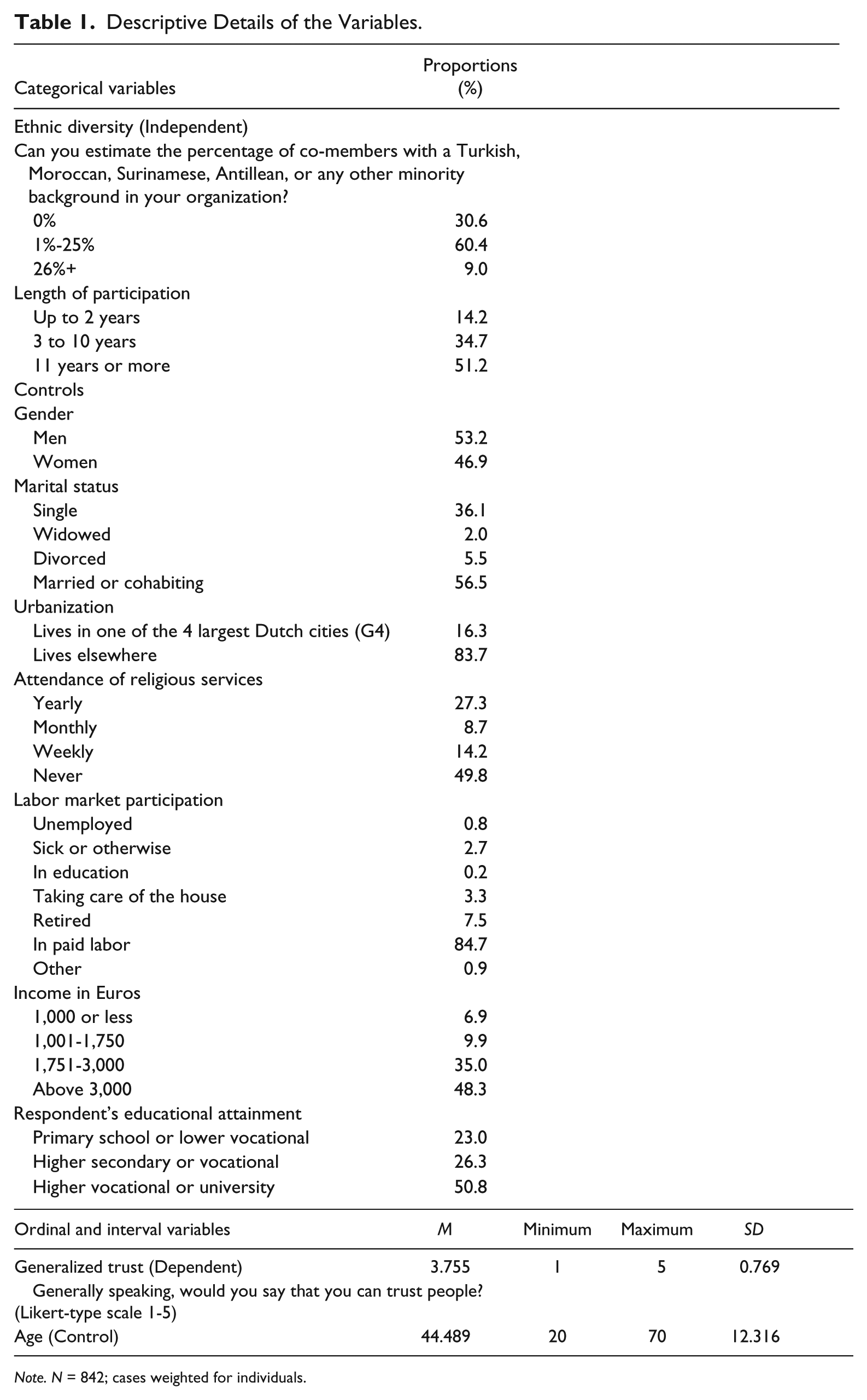
Note. N = 842; cases weighted for individuals.
Results
Regression Results
Our hypotheses were tested in three linear regression models, reported in Table 2. Model 1 includes our measure of voluntary organizations’ ethnic diversity, and all background control variables. Model 2 includes length of participation, and Model 3, in addition, estimates interactions between participants’ duration of participation and their voluntary organization’s corresponding ethnic diversity level.
Generalized Trust and Ethnic Diversity in Voluntary Organizations, 2009 (Family Survey Dutch Population).

Note. Cases weighted for individuals; dependent variable is z standardized. Reference categories control variables: gender: men; marital status: married or cohabiting; urbanization: lives outside 4 largest Dutch cities; church attendance: never or non-member; labor market participation: in paid labor; income in Euros: above 3,001; respondent’s educational attainment: primary school or lower vocational.
p ≤ .10. *p ≤ .05. **p ≤ .01.
Five main findings result. First, we found a significant and relatively substantial correlation between a voluntary organization’s ethnic diversity and participants’ generalized trust, corroborating H1. However, this relationship is not strictly linear. Active participants of organizations whose diversity reaches 25% have higher mean levels of trust than active participants of zero-diversity organizations (Model 1: B = 0.161, p < .01). Although active members of organizations with higher levels of diversity (26%+) have higher levels of trust than participants of homogeneous organizations (p < .10), they do not differ significantly from active participants in moderately diverse organizations.
Second, H2 is also supported by our results; we found no significant effects for duration of participation on generalized trust in Model 2 (B = 0.084 for 3-10 years of participation and B = 0.010 for 11 years or more), suggesting no real differences from recent joiners. In general, then, we found no support for the idea that longer active participation in voluntary organizations breeds trust, irrespective of their diversity levels.
Next, by interacting different levels of organizational ethnic diversity with length of participation, we tested the final set of hypotheses (H3, H4, and H5). 3 These conditional effects of diversity and length of participation on trust are estimated in Model 3 in Table 2, and—for easier interpretation—are also presented in a predicted value plot in Figure 1.
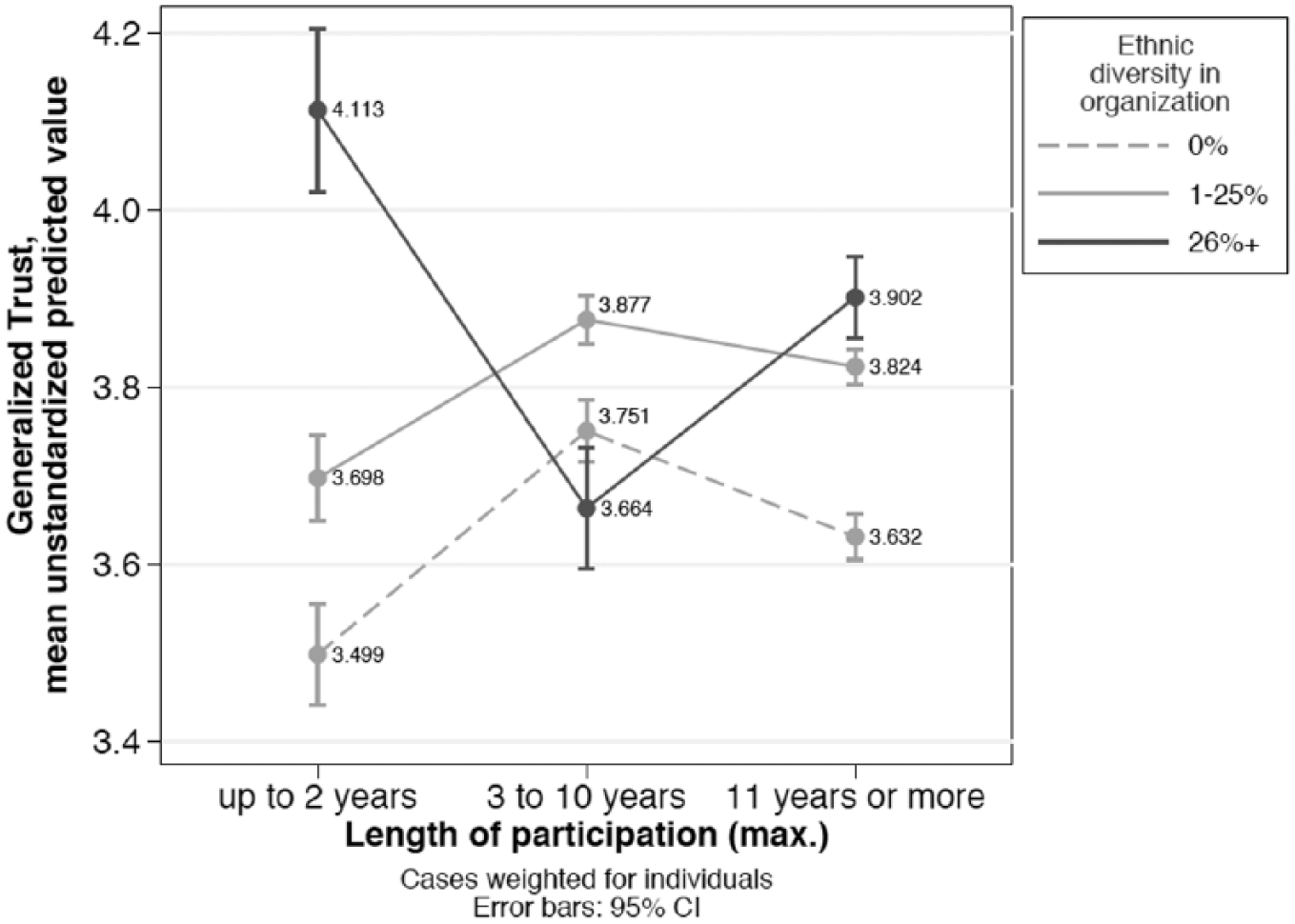
Interaction effect of ethnic diversity for different lengths of participation.
Our third main finding is that, contrary to expectations, the effect of ethnic diversity levels on trust is not positively moderated by participation duration; rather it appears to be negative in the medium term. This is particularly pronounced—as shown by the statistically significant effect—in comparing predicted trust levels between short-term (up to 2 years) and midterm (3-10 years) participation intervals across the highly diverse (26%+) and homogeneous (0%) groups in Figure 1. This observation reflects the negative sign and statistically significant coefficient (B = −0.757, p < .01) in Model 3. Figure 1 also demonstrates, however, that longer (as opposed to midterm) involvement in highly diverse organizations is again associated with higher trust levels, whereas the shifts among participants of moderately and non-diverse organizations are negative and less pronounced. Overall, therefore, we find some qualified support for H3, but only beginning with the 3- to 10-year interval. Between joining and 3 to 10 years, the opposite effect seems to be evident among participants of highly diverse organizations.
Fourth, Figure 1 illustrates that participants of highly diverse organizations (26%+) who have been active for less than 2 years have considerably higher average trust levels than those active in moderately-diverse or homogeneous organizations. Given that Model 3 interacts binary indicator measures of diversity and participation duration, this difference reflects the positive and significant uninteracted effect on trust of 26%+ memberships from the regression (Brambor, Clark, & Golder, 2006; Braumoeller, 2004). Among these recent joiners, high-diversity members’ predicted trust is 0.614 units greater than that of homogeneous members, and 0.415 greater than members of moderately-diverse organizations, on the 5-point survey scale. Both these differences and the 0.199-point difference between moderately diverse and homogeneous members are highly significant. We, therefore, found strong support for H4. Because the entry effect of joining shown in Van Ingen and Bekkers’s (2013) panel is rather small (standardized dummy effect = .08), the differences between the highly diverse group and the homogeneous groups are larger than what might reasonably be expected to arise from socialization effects in a period of 2 years. As such, even though we cannot exclude the possibility that some entry effect also exists in our data, the size of our effects suggests that highly-trusting individuals select into highly-diverse organizations.
Fifth and finally, Figure 1 shows that the differences in predicted trust values across organizational diversity levels are markedly greater in the first duration band (0-2 years) than in either subsequent band. In other words, the series demonstrates some convergence. This is consistent with the notion that the longer one is active in a diverse organization, the more one becomes familiarized with diversity. The rather sizable difference in level of trust among the participants in highly-diverse organizations between 0 and 2, and 3 and 10 membership years might even suggest that negative contact plays a role in voluntary organizations where the size of the minority group approaches or exceeds the size of the majority participants. Interestingly, participants of homogeneous organizations may also have become accustomed to their environment, with further participation associated with lower trust levels. The same holds for those in moderately-diverse organizations, while the pattern is reversed for participants in high-diversity organizations. We, therefore, find not only support for H5 but also clear evidence that diversity’s role in moderating the effect of participation duration on generalized trust is nuanced.
Robustness Analyses
To further verify the results, we repeated the analyses including only passive members. 4 Neither ethnic diversity, length of participation, nor the interaction effects are significant, confirming that active membership drives the results above. Moreover, because participants have self-selected into our participant sample, endogeneity may obscure the true effects. For example, higher educational attainment may affect both participation and trust. To evaluate the stability of control variables, ethnic diversity, length of participation, and the interactions, we also ran a Heckman selection model (results are presented in Table A1 in the appendix). Findings regarding ethnic diversity, length of participation, and their interactions are essentially unchanged, substantiating the claim that our main models above are unbiased.
Because multiple memberships may expose individuals to more diversity than single memberships, Figure 2 illustrates differences in trust between participants of one versus more than one moderately diverse organization (up to 25%), as well as those who are in homogeneous organizations only. Within the middle-diversity band, multiple memberships are associated with significantly higher trust levels (p = .039) relative to only one membership, consistent with the selection effect commonly evidenced in the literature (Van Ingen & Bekkers, 2013). Consequently, we repeated all our analyses incorporating separate dummies for single and multiple memberships in moderately diverse organizations (and the associated interactions) in place of the single dummy for membership in any number of moderately diverse organizations. The results (available upon request)—and particularly tests of our hypotheses—are nearly identical to those with a single dummy for all moderately diverse memberships. 5 Similar analysis of highly diverse memberships (26%+) is limited by sample sizes in this category.
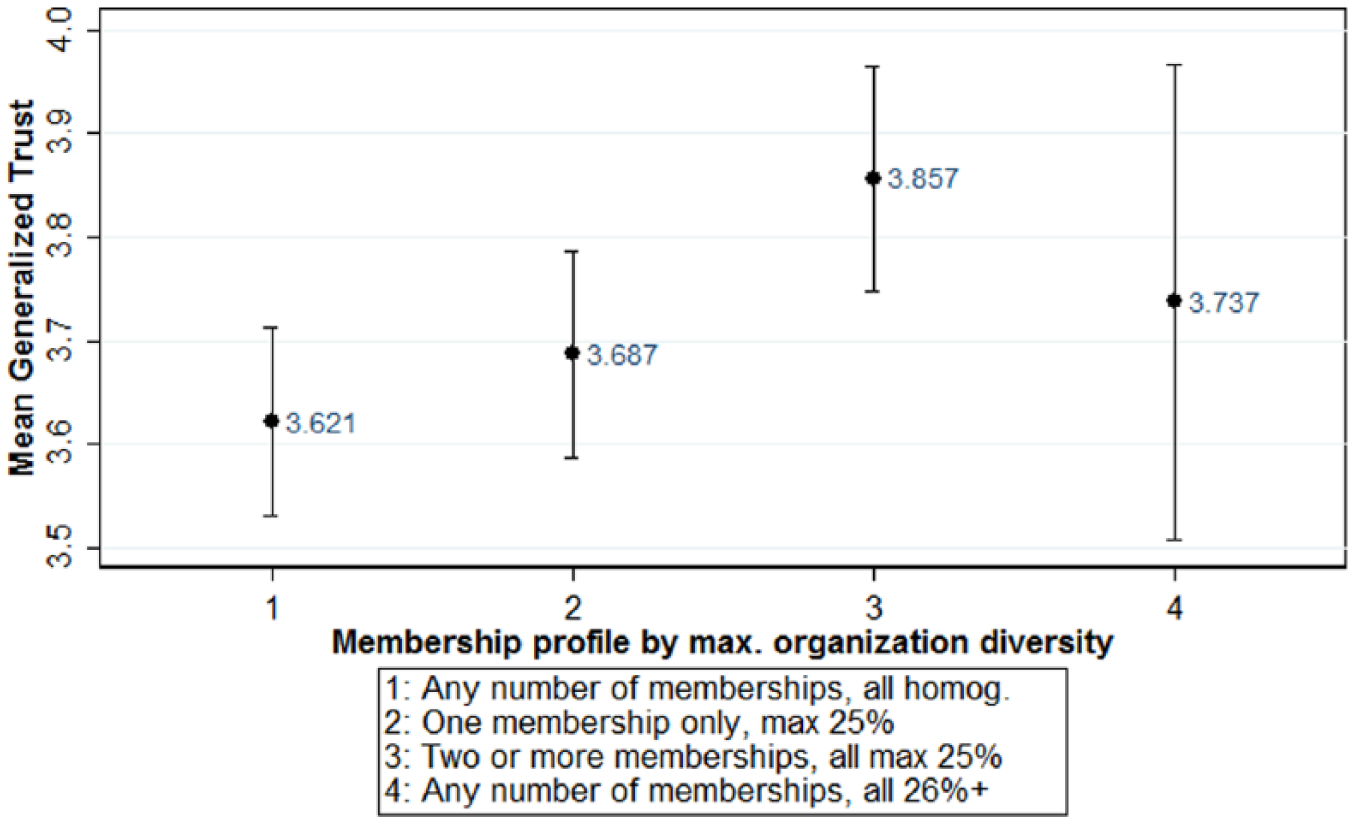
Mean level of generalized trust for participants of multiple organizations.
Next, Figure 3 shows individuals’ average lengths of participation in their most diverse organization. Average participation for 26%+ organizations is around 8 years shorter (highly statistically significant) than for either homogeneous organizations or moderately diverse organizations. It is possible that members of diverse organizations report shorter tenures because these organizations themselves are younger, as opposed to alternate explanations such as member attrition, which is more likely to happen earlier on. However, given that duration of participation on its own does not affect generalized trust, it is unlikely that our results are driven by the shorter tenure in high-diversity organizations. This finding validates our forgoing analyses of the effect of members’ duration of participation on generalized trust conditional upon the voluntary organization’s level of ethnic diversity.
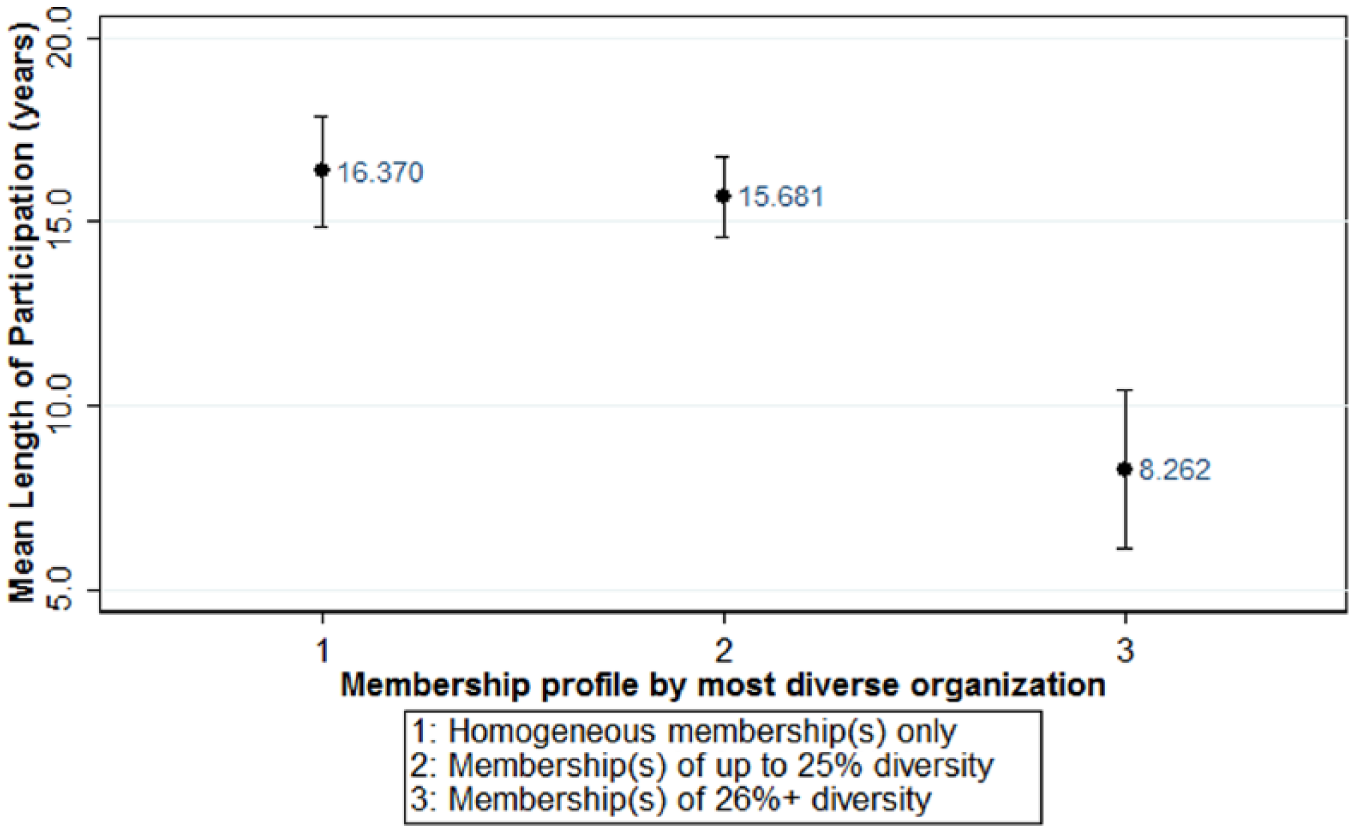
Mean length of participation by most diverse organization.
Discussion and Conclusions
This article contributes directly to the literature on civic engagement. By comparing organizational ethnic diversity levels with participation lengths, we have investigated intergroup contact effects due to the proximity of ethnic groups in organizations. Such analysis has been absent in the literature as previous operationalizations conflate socioeconomic diversity with the share of minorities in an organization.
Our main conclusions are as follows. First, there are strong positive differences in generalized trust for participants of ethnically diverse (bridging) voluntary organizations as compared with participants of ethnically homogeneous (bonding) organizations. Second, as no significant differences between recent joiners and longer-term members is evident, we find no support that longer active participation in voluntary organizations breeds trust regardless of the proximity of ethnically diverse participants. Although work by Stolle (1998) and Van Ingen and Bekkers (2013) uncovered such a general socialization effect in the first 2 years, according to our models, that effect subsequently flattens or disappears. Third, trust levels are highest for participants who have been active for less than 2 years in highly-diverse organizations. We cannot definitively exclude the possibility of some positive socialization effect early within the initial 2-year interval, but because such socializing effects have generally been found to be small (Stolle, 1998; Van Ingen and Bekkers, 2013), the size of our effects suggests that highly-trusting individuals select into highly-diverse organizations. Fourth, we find some support that lengthy participation in either ethnically diverse or homogeneous associations shows the level of trust converging toward the same level. This finding is in line with Rapp and Freitag’s (2015) analysis of tolerant views and (ethnic, ideological, and educational) diversity in voluntary organizations. They also found that as years of engagement increase, positive diversity effects weaken. Conversely, we find that diversity effects appear negative when comparing members of several years with recent joiners, but that this implied trend weakens or reverses for longer memberships. Interestingly, lengthy participation in less-diverse organizations and homogeneous organizations is also associated with lower trust levels. Finally, contrary to our expectation that with longer participation durations, trust levels should be higher (particularly for active participants in highly diverse organizations), active participants in highly diverse organizations actually have lower average trust when comparing 0 to 2 years of participation with 3 to 10 years. When length of participation is 11 years or more, trust is higher again, but it does not reach the level of recent joiners.
The finding of lower levels of trust among the high-diversity group in the 3- to 10-year period suggests that, besides familiarization playing a role, proximity of ethnic groups in a social setting may also engender negative contact and feelings of threat (Barlow et al., 2012; Pettigrew et al., 2011; Stephan et al., 2002), particularly in settings where the out-group reaches prominence. More diverse organizations might encourage a general tendency of groups to compete for scarce (symbolic) resources, which according to the intergroup threat or conflict theory (for review, see Riek, Mania, & Gaertner, 2006) could result in negative attitudes. Biases or threat might occur due to conflicting cultural values or arise from power struggles. Greater diversity might, thus, lead to reduced positive attitudes among the majority population if diversity challenges their position or long-held beliefs, even if members of the majority population were highly trusting to begin with (as shown). As the minority group participants grow in size, their power in decision-making processes within the organization becomes more substantal, and the input of the majority group might be more easily challenged or disregarded (cf. Wagner, Christ, Pettigrew, Stellmacher, & Wolf, 2006). This situation may lead to out-group distrust, impeding the development of generalized trust.
Our finding that highly trusting majority group members likely self-select into highly diverse voluntary organizations—yet, subsequently, experience lower trust—has implications for theory, research, and practice. The literature mainly argues for positive socialization effects increasing trust, due to active participation in diverse voluntary organizations. No study has yet hypothesized that diversity in voluntary organizations might have negative consequences for generalized trust due to conflict experiences and feelings of threat. Both theoretically and empirically, more light must be shed on processes within voluntary organizations of varying levels of ethnic diversity. Future research should employ panel data, by dynamically measuring negative and positive contact, and their effects on changes in experienced conflicts, threat, (in)tolerance, and generalized trust. Also, qualitative, in-depth research is needed to uncover what role ethnicity plays in decision-making processes within voluntary organizations. What conflicts, threats, and power struggles do highly trusting participants in highly diverse organizations experience? How and why does this affect their trust negatively? Furthermore, research should not be limited to voluntary organizations, but extended to other contexts where in- and out-groups interact, have a voice in decision-making, and where group size influences (experienced) power relations.
The practical implication of our findings is that high trust may not be fostered—or, indeed, endure—when ethnic groups intermingle. Society profits in many ways from a highly trusting population. As such, our findings take on increasing relevance in light of the heated ongoing debates regarding migration and ethnic diversity in Europe and elsewhere. Organizational managers—and others wishing to navigate ethnically diverse contexts effectively—should bear in mind the processes in play when minority groups reach sufficient prominence. Although our research does not offer more concrete suggestions immediately—for that, the future research suggested above is needed—in the long run, more institutional support from organizational leaders could channel conflict among groups. Yet, we also found that among participants of highly-diverse organizations, longer participation is associated with higher trust levels after an initial reversal. This could suggest positive effects of longer participation or familiarization with diversity. In line with this, longer participation may forge stronger friendship ties among majority and minority-background participants in the organization, resulting in changed perspective-taking and empathy across ethnic groups, perhaps eventually translating into positive attitudes (Pettigrew & Tropp, 2006). In addition, especially in organizations whose goal or culture is to promote tolerance and diversity, the process of value congruence within the group implies that trust increases with lengthier participation (Hooghe, 2003). In our view, the main scientific challenge is to unravel the processes behind a negative short-term effect of participation in highly diverse voluntary organizations on trust, while also gaining understanding why lengthier participation in those same organizations may forge trust in the long run. The practical challenge is to tackle the organizational processes that impact trust negatively.
Footnotes
Appendix
Heckman Selection Model of Generalized Trust, Ethnic Diversity, and Active Membership of Voluntary Organizations, 2009 (Family Survey Dutch Population).
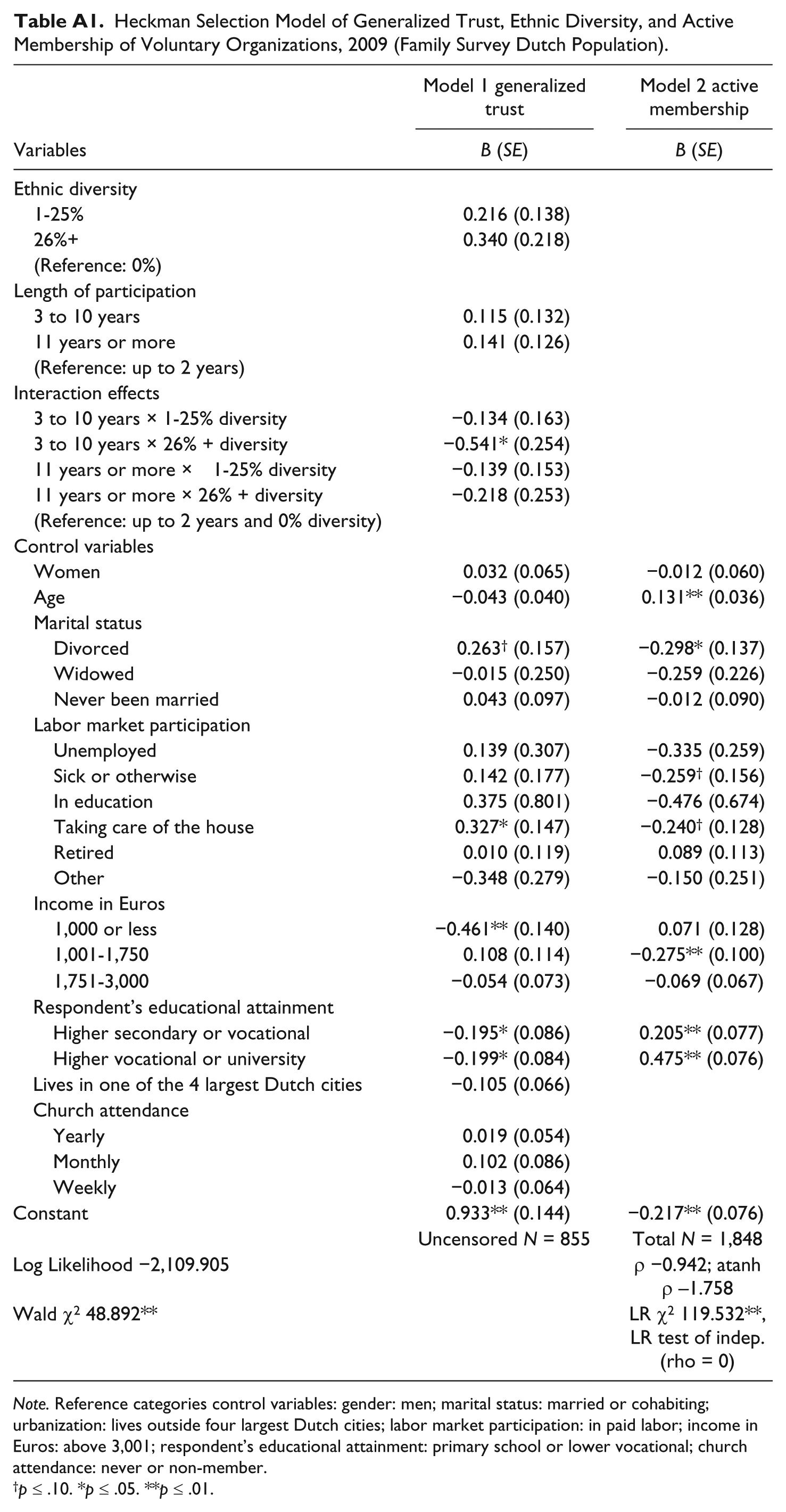
| Variables | Model 1 generalized trust |
Model 2 active membership |
|---|---|---|
| B (SE) | B (SE) | |
| Ethnic diversity | ||
| 1-25% | 0.216 (0.138) | |
| 26%+ | 0.340 (0.218) | |
| (Reference: 0%) | ||
| Length of participation | ||
| 3 to 10 years | 0.115 (0.132) | |
| 11 years or more | 0.141 (0.126) | |
| (Reference: up to 2 years) | ||
| Interaction effects | ||
| 3 to 10 years × 1-25% diversity | −0.134 (0.163) | |
| 3 to 10 years × 26% + diversity | −0.541* (0.254) | |
| 11 years or more × 1-25% diversity | −0.139 (0.153) | |
| 11 years or more × 26% + diversity | −0.218 (0.253) | |
| (Reference: up to 2 years and 0% diversity) | ||
| Control variables | ||
| Women | 0.032 (0.065) | −0.012 (0.060) |
| Age | −0.043 (0.040) | 0.131** (0.036) |
| Marital status | ||
| Divorced | 0.263 † (0.157) | −0.298* (0.137) |
| Widowed | −0.015 (0.250) | −0.259 (0.226) |
| Never been married | 0.043 (0.097) | −0.012 (0.090) |
| Labor market participation | ||
| Unemployed | 0.139 (0.307) | −0.335 (0.259) |
| Sick or otherwise | 0.142 (0.177) | −0.259 † (0.156) |
| In education | 0.375 (0.801) | −0.476 (0.674) |
| Taking care of the house | 0.327* (0.147) | −0.240 † (0.128) |
| Retired | 0.010 (0.119) | 0.089 (0.113) |
| Other | −0.348 (0.279) | −0.150 (0.251) |
| Income in Euros | ||
| 1,000 or less | −0.461** (0.140) | 0.071 (0.128) |
| 1,001-1,750 | 0.108 (0.114) | −0.275** (0.100) |
| 1,751-3,000 | −0.054 (0.073) | −0.069 (0.067) |
| Respondent’s educational attainment | ||
| Higher secondary or vocational | −0.195* (0.086) | 0.205** (0.077) |
| Higher vocational or university | −0.199* (0.084) | 0.475** (0.076) |
| Lives in one of the 4 largest Dutch cities | −0.105 (0.066) | |
| Church attendance | ||
| Yearly | 0.019 (0.054) | |
| Monthly | 0.102 (0.086) | |
| Weekly | −0.013 (0.064) | |
| Constant | 0.933** (0.144) | −0.217** (0.076) |
| Uncensored N = 855 | Total N = 1,848 | |
| Log Likelihood −2,109.905 | ρ −0.942; atanh ρ –1.758 | |
| Wald χ2 48.892** | LR χ2 119.532**, LR test of indep. (rho = 0) | |
Note. Reference categories control variables: gender: men; marital status: married or cohabiting; urbanization: lives outside four largest Dutch cities; labor market participation: in paid labor; income in Euros: above 3,001; respondent’s educational attainment: primary school or lower vocational; church attendance: never or non-member.
p ≤ .10. *p ≤ .05. **p ≤ .01.
Acknowledgements
The authors thank Benny Geys (Norwegian Business School and Free University Brussels), Jona Linde (Maastricht University), and the three anonymous reviewers of this journal for their helpful comments on earlier drafts.
Declaration of Conflicting Interests
The author(s) declared no potential conflicts of interest with respect to the research, authorship, and/or publication of this article.
Funding
The author(s) disclosed receipt of the following financial support for the research, authorship, and/or publication of this article: The research for this paper was financially supported by Research Foundation Flanders (FWO grant number G.0022.12).