







Abstract
Recent literature on commercialization in the American nonprofit sector attributes increased reliance on fee income to neoliberal policies. This trend is often depicted as an invasion of market forces that debase civil society by reducing social values and interpersonal relations to commodities and transactions. My article challenges these beliefs by presenting historical data that have been largely ignored in recent writing. Examining a series of multicity financial reports, I demonstrate that the U.S. nonprofit human services sector increased its fee-reliance significantly before neoliberal policy changes. Drawing on social work literature, I show that the practice of fee-charging reflected an ethos of communal inclusiveness rather than mere profit-seeking. In light of this evidence, I argue that fee-charging should be understood as a long-standing and multivalent feature of the nonprofit human services sector rather than as a recent incursion of profit-driven rationalities.
Introduction
Charities have long been viewed as symbols of fellowship and generosity distinct from the self-interested business firms of the private sector. Accordingly, the rise of for-profit strategies among nonprofit organizations (NPOs) has caused alarm over a utilitarian transformation of civil society, leading scholars to study the extent and nature of business-oriented change in the nonprofit sector. A number of methods have been used to examine how NPOs are emulating their private sector counterparts, but an especially popular approach has been to gauge the proportion of commercial income—particularly fees from service and sales—in nonprofit revenues (Guo, 2006; Kerlin & Pollak, 2011; Moulton & Eckerd, 2012).
There are intuitive reasons for identifying fee-charging with pecuniary rather than charitable goals. Fees seem to entail bilateral transactions between NPOs and clients, an arrangement that deviates from the traditional donative model, in which individuals receive services underwritten by third parties. While the donative model involves a redistributionist function, fee-charging evokes the insular priorities of for-profit businesses (Fitzgerald & Shepherd, 2018). As a result, fee income as a proportion of total revenue is often treated as an indication of the extent of market rationalities in the nonprofit sector. Again, market-oriented change can be studied in a variety of ways, but the focus of this article is commercialization, which is generally understood as “increasing reliance on revenue from sales of goods and services” (Maier, Meyer, & Steinbereithner, 2016, p. 71).
The question of whether the nonprofit sector has increased its reliance on fees invites a variety of policy considerations, ranging from whether fee-reliant NPOs should lose their tax-exemption (Bennett & DiLorenzo, 1989) to whether the nonprofit sector is fulfilling its mandate to improve the wellbeing of poor and vulnerable populations, who are often unable to pay for services (Backman & Smith, 2000). As indicated above, increased fee-reliance in the sector also suggests a commodification or “marketization” of benevolence (Eikenberry & Kluver, 2004). Given these implications, the topic of commercialization has generated much debate.
This article moves the debate forward by looking backward. I contend that much of the symbolic importance of fee-charging in the United States hinges on beliefs about the dispositions of American NPOs in the past. In particular, the notion that increased rates of fee-charging have changed the character of the nonprofit sector implies novelty in significant fee-reliance. Until now, this assumption has been passable because of a supposed lack of records on nonprofit finances prior to the late 1970s. This article fills that gap with data on the revenues of voluntary human service agencies from the 1930s to the 1960s. In addition, I examine social work literature relating to fee-charging during this period. Taken together, these quantitative and qualitative data pose a challenge to the historical narrative of commercialization in the nonprofit sector and to the reductionist conception of earned income as a sign of profit-seeking. Rather than treat fees as a proxy for business-minded action, this article makes a case for economic sociology’s constructivist theorization of markets.
The remainder of the article proceeds as follows. I begin by demonstrating that the subject of commercialization is most directly relevant to changes in the human services subsector beginning in the 1980s. I then highlight historical and sociological assumptions inherent in the prevailing commercialization narrative. Specifically, authors have assumed that the increase in fee-reliance in the 1980s was an unprecedented effect of neoliberal policy changes. Current literature also suggests a fundamental conflict between commercialism and the civic values that NPOs are supposed to encapsulate. Citing historical financial data, I show that human service NPOs actually boosted their fee-reliance substantially beginning in the 1940s. Moreover, professional literature suggests that fee-charging was framed by a sense of universalism in community welfare provision contrasted with a class-bound imagery of charity. This progressive portrayal of fee-charging waned in the 1960s with the growing emphasis on selective services targeted to the poor, but I assert that the egalitarian rendering of fee-charging still offers important lessons for the study of NPOs and of the organization of human services.
Current Views on Commercialization
Child (2010) finds that the best support for commercialization comes from the 2002 Nonprofit Almanac, which shows that NPOs classified as providing “social and legal services” grew their reliance on commercial income between 1977 and 1997, with most of the increase occurring before 1982 (see Table 1). Although the numbers in the Nonprofit Almanac suggest a straightforward operationalization of commercialism, they belie a complex set of theoretical and empirical considerations resulting in significant variation among estimates. These complications notwithstanding, retrospective analyses of fee-charging in the nonprofit sector converge on two findings evident in the 2002 Almanac: (1) increased reliance on fees (regardless of how this income stream is measured) is largely a feature of the human services subsector; (2) much of this increase occurred during the 1980s (Grønbjerg & Salamon, 2012).
Revenue From Private Sector Payments in the Nonprofit Sector.
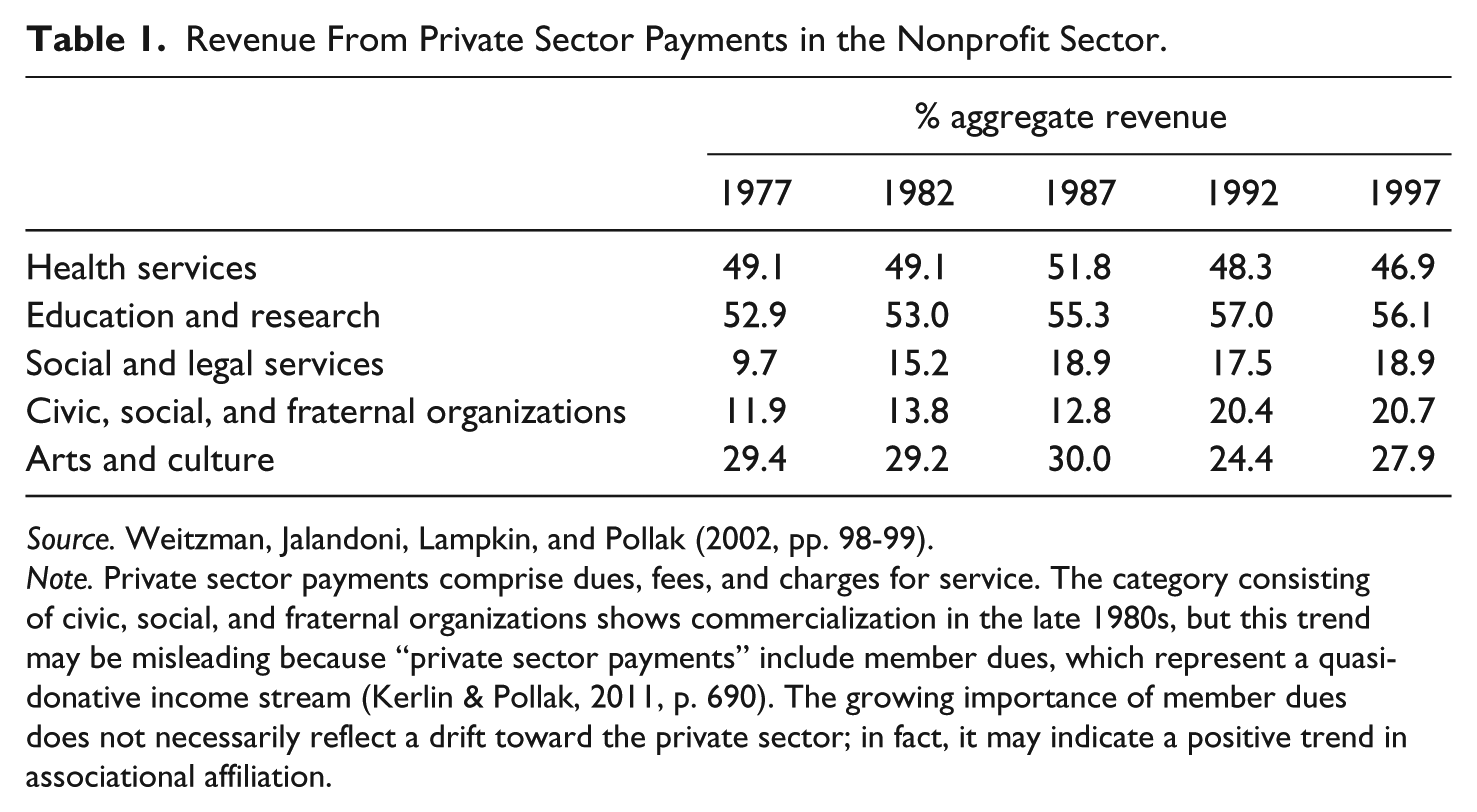
Source. Weitzman, Jalandoni, Lampkin, and Pollak (2002, pp. 98-99).
Note. Private sector payments comprise dues, fees, and charges for service. The category consisting of civic, social, and fraternal organizations shows commercialization in the late 1980s, but this trend may be misleading because “private sector payments” include member dues, which represent a quasi-donative income stream (Kerlin & Pollak, 2011, p. 690). The growing importance of member dues does not necessarily reflect a drift toward the private sector; in fact, it may indicate a positive trend in associational affiliation.
Clarifying Commercialization
Although narrowing commercialization to a time and subsector would seem to diminish the issue’s importance, this circumscription actually draws attention to the heart of the matter. There are two reasons. First, the human services field comprises institutions that have traditionally financed their operations largely with contributions. Areas of activity commonly characterized as human services include individual and family counseling, job training, child care, and residential care. Broader definitions include recreation, youth development, emergency and legal services, and certain civic organizations. Although definitions vary (for an overview see Grønbjerg, 2001), the human services sector is known for encompassing organizations that are “almost synonymous with charities” (p. 287). Although this area of activity is small compared with other tax-exempt fields, the human services carry considerable symbolic weight as classically charitable organizations and, as such, are recognized as “the mainstay of the nonprofit sector” (Hwang & Powell, 2009, p. 281). 1 NPOs such as universities and hospitals make up a larger portion of the nonprofit sector and also show signs of market-oriented change, but these institutions have long depended on commercial transactions for most of their income. Therefore, to the extent that commercialization is conceptualized as a drift from donative to commercial revenue with consequences for civic culture and community welfare, human service agencies are particularly relevant.
Second, the fact that much of the proportional increase in commercial income occurred in the 1980s underscores the importance of neoliberalism as an overarching theme in discussions of businesslike behavior in the nonprofit sector, especially with respect to the human services domain (Eikenberry, 2009; Gray, Dean, Agllias, Howard, & Schubert, 2015; Hasenfeld & Garrow, 2012). These discussions center on the following policy changes in the 1980s, which are widely associated with the neoliberal sacralization of competition and government austerity: (1) the transition from cost-reimbursement grants to performance-based contracts; (2) the welfare budget cuts stemming from the 1981 Omnibus Budget Reconciliation Act; and (3) the use of consumer-side financing of human services. Numerous authors have argued that, among the many consequences of these policy shocks, the resulting resource scarcity and uncertainty forced NPOs to seek earned income to replace lost government grants, establish a buffer against future shortfalls, compete with for-profits, and meet expectations of revenue diversification (Galaskiewicz, Bielefeld, & Dowell, 2006; Robichau & Wang, 2018; Salamon, 1995; Smith, 2012).
To summarize, identifying the rise of fee-charging with the human services sector and with the 1980s clarifies the issue’s moral and political dimensions. Commercialization is not merely a fiscal trend; it is described as a historical encounter between traditional notions of charity and recent market-centered philosophies of social welfare. As such, the issue of commercialization is especially relevant to changes in the human services field in the 1980s.
Historical and Sociological Aspects of Nonprofit Commercialization
The narrative of growing fee-reliance implies novelty in commercial income at current levels. To be sure, authors have acknowledged that fee-charging has a long history in American charity, but this history has been invoked with vague claims and selective illustrations. For instance, Young, Salamon, and Grinsfelder (2012) point out that “religious orders . . . have long marketed wine, and orphanages have taken in laundry to help cover their costs” (p. 522). Kerlin and Pollak (2011) note that early American charities “held bazaars and sold homemade goods to supplement voluntary donations” (p. 686). Although these quaint examples show that earned income is not new to charity, they also highlight the lack of data on the historical extent of fee-charging. This lack of data enables the assumption that the scale of commercialization in the 1980s represents a marked departure from the past—a “commercial transformation of the sector” raising a “host of new issues concerning the fundamental character of nonprofit charitable service provision” (Frumkin, 2002, p. 152; Lynn, 2002, p. 69, emphasis added).
The idea that commercialization is relatively new in the sector finds expression in a prevalent language of market encroachment, with businesslike behavior described as a “penetration,” “colonization,” “infiltration,” or “invasion” of the market into the nonprofit sector (Eikenberry, 2009, p. 583; Salamon, 1995, p. 220; Scott, 2014, p. 252; Young et al., 2012, p. 538). As this language suggests, the commercialization narrative is not simply a claim about budget statements over time; it also offers a stark view on the interplay of monetary transactions, organizational behavior, and social relations. According to this view, there is an inherent tension between altruistic values and “the economic and competition-centered values” of commercialism (Sanders & McClellan, 2014, p. 70). As Froelich (1999) summarizes, “the fear is that nonprofits will become so like business firms that the social missions will take a backseat to revenue and profitability goals . . .” (p. 258). The most iconic example of this reductionist framing is Weisbrod’s “collectiveness index,” which operationalizes the public orientation of NPOs as a function of reliance on grants and contributions as opposed to sales (Weisbrod, 1988, p. 75). Of course, authors have recognized that NPOs may engage in commercial activities that generate surplus revenue while also advancing social mission (e.g., Young, 1998), but this nuance has not carried over to discussions of sector-wide commercial trends.
The portrayal of commercial activity as an invasive and corrupting force accords with a critique of market society with a long history in the social sciences. According to Zelizer (1988), this pessimistic depiction speaks to the idea of a “boundless market” undercutting “traditional forms of social responsibility and cooperation . . .” (p. 621). Likewise, Fourcade and Healy (2007) describe a “commodified nightmare” in which a dominant market ethos “reduces our justifications for action to the narrowest kind of self-interest” (p. 291). An alternative conception of market activity—one that informs the analytical approach in this article—interprets economic action as a social process shaped and colored by a variety of factors, ranging from interpersonal networks to national cultures. Especially since the rise of the “new economic sociology,” a growing and influential contingent of sociologists has adopted this perspective on the market, arguing that economic activity is embedded in social relations and institutions (Smelser & Swedberg, 2005).
A more recent manifestation of economic sociology shows not only how culture constrains neoclassical models of economic behavior but also how economic activity is always an inherently cultural project (Krippner & Alvarez, 2007). A leading example is the “moralized markets” school, which argues that “the notion of an all-powerful market impinging on our lives is a fiction, a fallacious dichotomy between a market out there and the social values we cherish” (Reich, 2014, p. 1577). This paradigm challenges us to move beyond the idea of the market as an imperialist entity and to seek an understanding of how economic valuation and exchange may channel morals rather than debase them. Drawing from the moralized markets school, this article scrutinizes both the assumption that commercialization is a novel phenomenon among human service NPOs and the belief that commercialization necessarily conflicts with pro-social values.
Data and Research
The primary data source for quantitative trends in fee-reliance is a series of surveys that grew out of the Registration of Social Statistics, a groundbreaking national initiative started in the 1920s to collect service and financial information from community welfare planning bodies across the United States (Zimbalist, 1977). Launched jointly by the University of Chicago and the Association of Community Chests and Councils (forerunner of the United Way), the project was transferred in 1930 to the Children’s Bureau, which continued to cooperate with the national Community Chest headquarters until transferring the project back in 1946. The Community Chest umbrella organization continued publishing survey results until 1965. Although all of these reports furnish valuable data on community health and human service finances, the ones for the years 1938, 1940, 1948, 1955, 1960, and 1965 are particularly useful for the purposes of this article, as they distinguish between private and public agencies. These surveys include organizations not affiliated with local Community Chest branches and generally cover a substantial geographic range, though the 1965 report is based on only 13 urban areas and should, therefore, be interpreted with extra caution (the five other reports average nearly 28 urban areas).
It is impossible to know exactly how accurate these documents are, but some insight on their reliability can be gained by comparing the estimate for fee-reliance among nonprofit, short-term, general and specialist hospitals to the same estimate from the American Hospital Association (AHA), which undertook annual surveys of hospitals starting in 1946. The AHA estimated that these hospitals earned 87.5% of their income from patients in 1948 (AHA, 1956), while the corresponding estimate from the 1948 Community Chest report is a close 90.3%. 2 This comparison supports Ormsby’s (1965) conclusion that the Community Chest estimates “may be accepted as showing overall trends” (p. 332). Indeed, the data from these reports were reviewed in academic journals (e.g., Reed, 1940) and cited in government agency bulletins (e.g., Karter, 1958). It is therefore surprising that these documents have not been used in more recent studies of historical nonprofit financial trends. 3
The reports vary slightly in their service categorization, but each of them classifies healthcare organizations and central planning/financing organizations separately from other subgroups (Table 2 presents the taxonomy from the 1960 report). To maintain comparability with later data, I excluded these two categories from my calculations, leaving organizations that conform to current understandings of non-healthcare direct human service providers. I recorded revenue figures from the appendix of each report, measuring fee-reliance as aggregate fee income divided by aggregate total income. This is the same method used to generate the numbers shown in Table 1.
Service Taxonomy From 1960 Report.
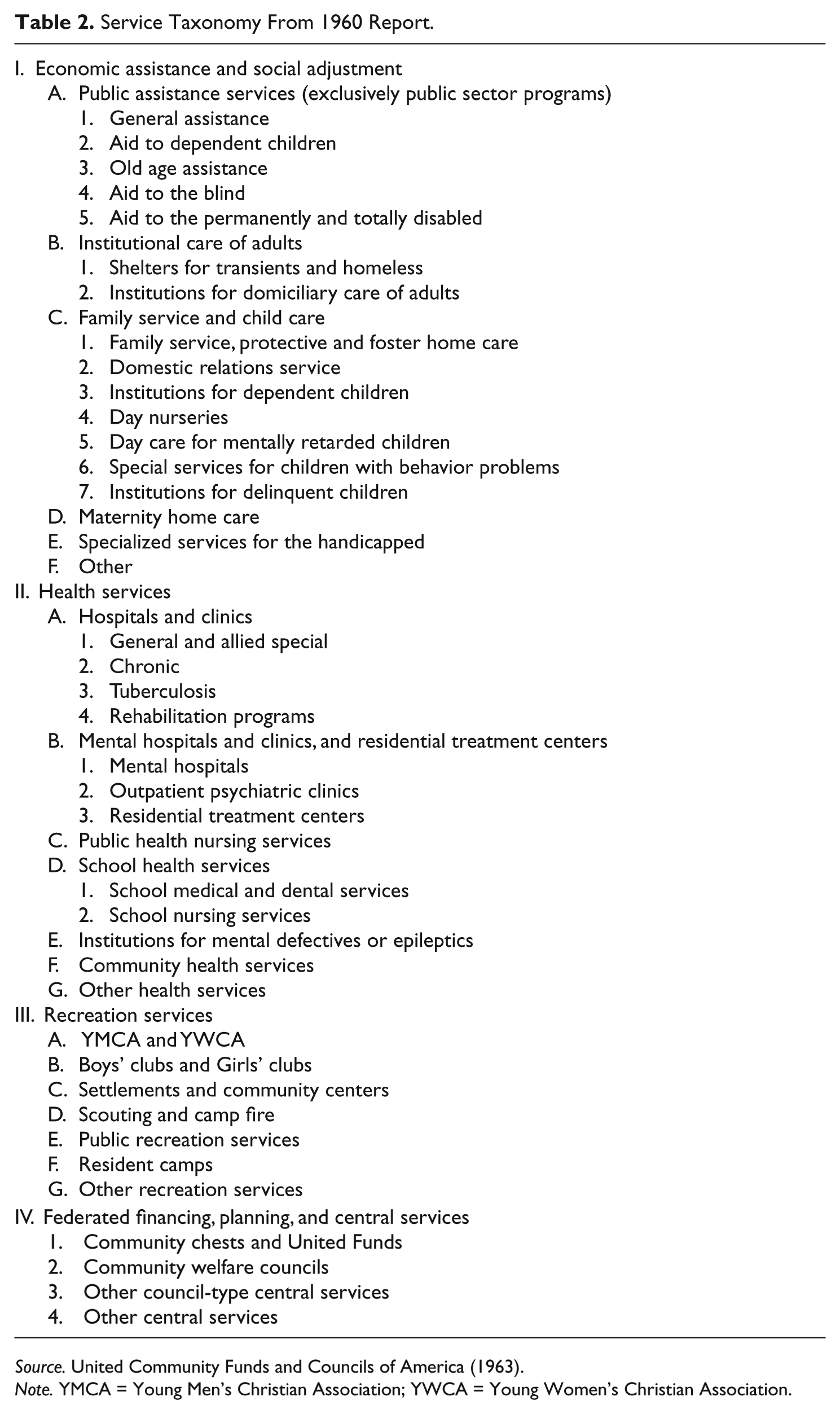
Note. YMCA = Young Men’s Christian Association; YWCA = Young Women’s Christian Association.
In addition to determining quantitative trends in fee-reliance, I aimed to understand how human service professionals conceptualized and implemented fee-charging as a component of organizational finance and of client interaction. Historical data exhibiting professional sentiment and practice are embedded in the vast body of academic papers, conference presentations, trade journal articles, and administrative reports comprising the literature of the time. I began my qualitative research by triangulating among authoritative sources that integrate various viewpoints rather than convey the position of a single author or agency. Three sources were treated as both authoritative and summative.
The first source is the periodical Social Work Year Book. Published every 2 to 4 years between 1929 and 1960, these volumes were comprehensive reviews of social work practice issues. Although the focus on social work may appear arbitrary, the term “social work” had broader institutional connotations in the first half of the 20th century, often signifying a general focus on health and welfare services (examples of this use of “social work” include the National Conference of Social Work and the Social Work Publicity Council). Later editions of the Year Book are titled the Encyclopedia of Social Work and were released less frequently. Published initially by the Russell Sage Foundation and later by the National Association of Social Workers, these volumes were regarded as reflective of mainstream practice and philosophy. As such, they have been used as historical data for assessments of various trends in the human services (e.g., Cnaan, Wineburg, & Boddie, 1999). I reviewed all entries on the financing of private human services from 1929 to 1977, each of which includes commentary on developments in fee-charging. In addition, it is noteworthy that the 1965 and 1971 editions feature separate entries on fee-charging, indicating that the subject had become meaningful enough to be treated as a discrete concern.
The second source is a study titled Fees for Health and Welfare Services. Published in 1949 by the national Community Chest headquarters, this report was intended “to provide overall perspective on the function of fee payments in the financing of health and welfare services” (Community Chests and Councils of America [CCC], 1949, p. 1). In addition to documenting variation in pricing and other aspects of fee-charging policy, the study aimed to answer “questions of general thinking and philosophy about fee payments” (p. 1). The report was organized jointly with the Child Welfare League of America, the Family Service Association of America, and the Council of Jewish Federations and Welfare Funds. The data are based on questionnaire responses received from “several hundred local health and welfare agencies” (p. 1).
The third source is the final report of a 1957 workshop organized by the National Social Welfare Assembly (NSWA) on fee-charging. The event drew 100 participants from the human services who, according to the report, “represented a cross-section, geographically and in fields of interest” (NSWA, 1957). Participants represented both agencies that had implemented fee policies and agencies that were only considering doing so. Attendees were divided into discussion groups organized around particular questions concerning the basic philosophy and practice of fee-charging. The report presents a final composite summary of the discussions along with a “Resume of Published Data” providing a summary of the state of knowledge about fee-charging based on an extensive literature review.
After identifying consistent themes in these sources, I reviewed the standalone sources listed in the 43-item bibliography in the report of the NSWA workshop. In addition, the journal Social Casework includes an index of articles published between 1920 and 1979, which cites numerous articles on attitudes and policies related to fee-charging. I also carried out online searches on JSTOR and HathiTrust for articles published in academic journals such as Social Service Review and trade publications such as The Survey. Citations in the Social Work Year Book also offered a useful guide to relevant literature.
Quantitative Trends
The U.S. nonprofit human services sector was at a low point of fee-reliance in the late 1930s (see Table 3), with payments from clients making up about 16% of total revenue. It is worth mentioning that fee-reliance was probably higher in the 1920s and likely dropped with diminished purchasing power during the Great Depression (Todd, 1937, p. 159). Financial reports on non-healthcare private agencies in Boston in 1922 (Boston Chamber of Commerce [BCC], 1924), New York City in 1929 (Huntley, 1935), and Chicago in 1922 (Chicago Council of Social Agencies [CCSA], 1924) show fee-reliance levels of 38%, 34%, and 32%, respectively. However, there are insufficient data on private agency finances from before the Depression to make a reliable estimate.
Composition of Nonprofit Human Services Revenue.
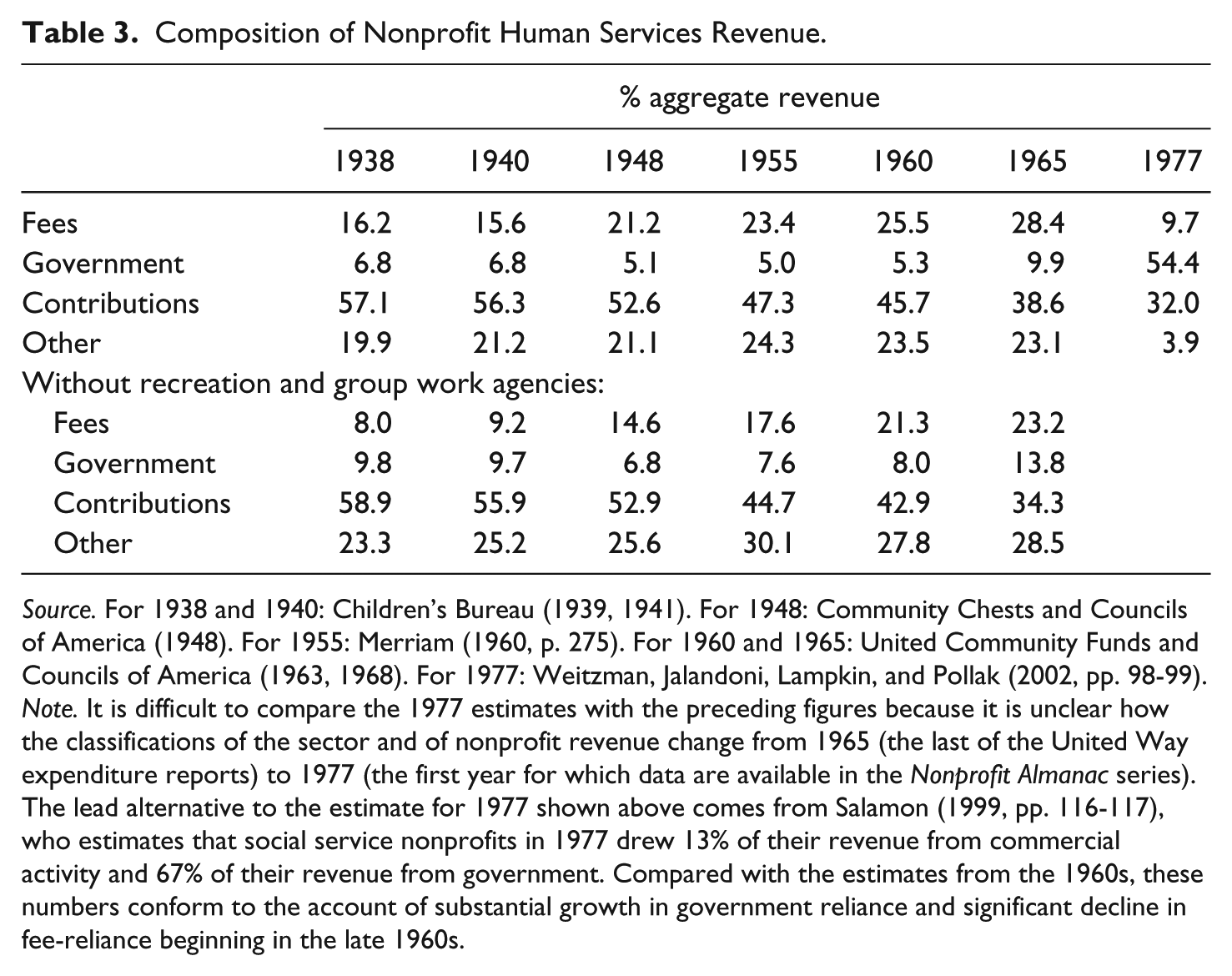
Source. For 1938 and 1940: Children’s Bureau (1939, 1941). For 1948: Community Chests and Councils of America (1948). For 1955: Merriam (1960, p. 275). For 1960 and 1965: United Community Funds and Councils of America (1963, 1968). For 1977: Weitzman, Jalandoni, Lampkin, and Pollak (2002, pp. 98-99).
Note. It is difficult to compare the 1977 estimates with the preceding figures because it is unclear how the classifications of the sector and of nonprofit revenue change from 1965 (the last of the United Way expenditure reports) to 1977 (the first year for which data are available in the Nonprofit Almanac series). The lead alternative to the estimate for 1977 shown above comes from Salamon (1999, pp. 116-117), who estimates that social service nonprofits in 1977 drew 13% of their revenue from commercial activity and 67% of their revenue from government. Compared with the estimates from the 1960s, these numbers conform to the account of substantial growth in government reliance and significant decline in fee-reliance beginning in the late 1960s.
The data presented in Table 3 also show that human service NPOs increased their fee-reliance throughout the 1940s and 1950s. This increase is more pronounced if we remove recreation and group work agencies (e.g., Girl Scouts and YMCAs), which maintained a relatively consistent aggregate fee-reliance of approximately 35% throughout the period studied. Without these agencies, the proportion of income from fees nearly triples from 8% in 1938 to 23.2% in 1965. Although some of this growth undoubtedly stemmed from compositional changes in the sector (i.e., expansion of subsectors more disposed to implementing fee policies), studies from the period show that much of the trend derived from organizations adopting new financing strategies. For example, a study by the Child Welfare League of America in 1947 found that only a quarter of affiliated adoption agencies charged fees (Schapiro, 1956). In 1960, over two thirds of surveyed member agencies reported fee-charging (Fradkin, 1961). Similarly, fee-charging for casework services was practically nonexistent among member agencies of the Family Service Association of America in 1941 (FSAA, 1951: 139). By 1965, 98% of surveyed agencies reported fee-charging (FSAA, 1967).
Table 3 also reveals the dramatic influx of government funding into the nonprofit human services sector after 1965. A concomitant trend is the proportional decline of nongovernment sources of revenue, including commercial income. In addition to simply changing the denominator in the proportional calculation of commercial income, the influx of government funding in the mid-1960s brought down the relative share of fee income by incentivizing human service agencies to target services to the poor. Among other initiatives in President Lyndon Johnson’s War on Poverty, the Community Action Program (CAP) directed grant funding to local human service agencies with the explicit intent of increasing service utilization among low-income clientele. Government-commissioned program evaluations confirm that CAP funding exerted “a moderate influence on change in the proportion of social services delivered to the poor and a strong influence on change in the levels of interaction between social service agencies and the poor” (Orden, 1973, pp. 364-365). Thus, the proportional decline of commercial revenue resulted not only from growth in government funding but also from the conditions and goals attached to this funding (this development is discussed at greater length later in this article). 4
Authors recognize that government grants played an increasingly important role in nonprofit human service financing beginning in the mid-1960s, but a lack of data has prevented an understanding of the extent to which government funding changed fee-reliance. The quantitative data discussed in this section show that the revenue profile of human service NPOs in the late 1970s does not reflect the degree of fee-reliance among these organizations in prior decades. It appears that the relatively low reliance on fee income before neoliberal restructuring is the result of state intervention beginning in the 1960s. In other words, rather than describe the proportional growth in fee income during the neoliberal period as a “transformation” of the nonprofit human services sector, we should view this increase as the resumption of a trend going back decades and interrupted only briefly by the War on Poverty.
The Moral Dimensions of Fee-Charging
As explained previously, fee-charging in the nonprofit sector is often interpreted as a sign of concern with financial gain rather than public welfare. From this perspective, the increase in fee-charging discussed above may suggest that human service NPOs began succumbing to market forces well before the advent of neoliberal policies. However, a more nuanced analytical approach is to explore how social values “can be realized in and through economic activity” (Barman, 2016, p. 16). Adopting this sociological frame, it is important to consider how human service professionals conceptualized changes in organizational financing.
Ormsby’s (1965) entry on fee-charging in the 1965 edition of the Encyclopedia of Social Work identifies four main reasons for the practice: 1) Many potential clients can afford to pay and would use services more readily if a fee plan were in effect. 2) The charging of fees has therapeutic value for clients. This reason is advanced primarily by casework agencies. 3) When fees are charged, agency services will become better known and will be extended to a wider cross section of the population of the community. . . . 4) Fee income is essential to finance agency programs. (p. 333)
The same four reasons are listed in the final report of the NSWA workshop on fees, confirming that motives for fee-charging revolved around attracting a broader clientele and generating extra revenue (the claim of therapeutic value is addressed later).
Here it is helpful to note that numerous historians of the American social welfare system have shown that courting middle class clientele was central to social work’s evolution following the Great Depression (Morris, 2009; Stuart, 1999; Walkowitz, 1999). With the expansion of the American welfare state in the 1930s, public agencies solidified their role as primary dispensers of relief aid, leading voluntary agencies to shift to issues beyond material needs. Recognizing that problems such as depression, domestic conflict, and disability cross class lines, human service professionals sought out higher income clientele by presenting family guidance, child care, vocational counseling, mental health treatment, and other agency services as commodities fit for purchase by middle class consumers. This professional rebranding required downplaying the association between social work and charity, which carried the stigma of poverty and deviance. Fees facilitated this rebranding by marking social work as a service “worthy of its hire” (Goodman, 1960, p. 46). For this and other reasons, the social work establishment was generally in favor of fee-charging. Although professionals disagreed on the appropriate extent and particular criteria for selling services, data from the period suggest widespread support for the general principle of charging clients capable of paying. For example, a survey of 190 members of the Philadelphia chapter of the American Association of Social Workers found that 73% were strongly in favor of “charging for private social services whenever the person served had the ability to pay,” with an additional 20% somewhat in favor (Jacobs, 1952, p. 200). 5
To be sure, plenty of social workers believed that their profession should concentrate on the poor rather than serve a broad cross-section of the community, and even those who supported extending services to the middle class worried about alienating the poor. For example, the report of the NSWA workshop on fee-charging notes that, despite agreement that fee-charging is acceptable, participants shared concerns about “the possibility that there may be discrimination against those who desire and need service but cannot pay for it . . .” (NSWA, 1957, p. 13). Overall, however, the various historical sources reviewed clearly indicate an evolutionary process toward a general acceptance of fee-charging, a trend borne out by the financial data presented in the previous section. As the final report of the NSWA workshop summarizes, “the propriety of fee-charging is demonstrated by the continuous growth in the number of agencies establishing a fee for service and an attending increase in the number of persons paying fees” (NSWA, 1957, p. 10).
Fee-Charging and Disengagement
Those who have written about social work’s growing interest in middle class clientele have taken a mostly critical stance (e.g., Ehrenreich, 1985; Reisch & Andrews, 2001). Authors have attributed this episode of social work history to, at best, a regrettable aloofness to lower class problems and, at worst, a dereliction of professional responsibility to the poor. The text cited most frequently (and often exclusively) as evidence for social work’s lack of concern for the poor during the middle of the 20th century is a well-known essay by Richard Cloward and Irwin Epstein (1965) titled “Private Social Welfare’s Disengagement from the Poor: The Case of Family Adjustment Agencies.” Cloward and Epstein famously argued that social workers’ concern with professional status and preoccupation with talk-based therapeutic services led them to seek out more educated and affluent clientele, abandoning the poor to overburdened public agencies charged with basic material relief. This narrative of disengagement has proven highly influential in historical scholarship on the U.S. human services sector (Stuart, 1999), and it is also consistent with present-day concerns that growing fee-reliance means a departure from social welfare priorities. From this perspective, increases in fee-reliance beginning in the 1940s may be viewed as a sign of sector-wide mission drift. However, the evidence for disengagement in the middle of the 20th century is not nearly as persuasive as typically suggested.
The literature on disengagement (including Cloward and Epstein’s critique) has focused on family service agencies, largely because this prominent subsection of the American human services sector published highly detailed service reports. These reports confirm that family service agencies drew in a clientele roughly representative of the national income distribution (Beck, 1962); however, family service agencies were not representative of the human services sector as a whole and do not serve as a reliable sample for determining how voluntary agencies related to the poor (Kahn, 1976). Illustrating this point, a 1964 government-commissioned survey of private human service organizations (including but not limited to family service agencies) in high-poverty areas found that at least half of clients came from families with annual income of less than $3,000, the definition of poverty used at the time by the Council of Economic Advisors. Furthermore, at least 90% of clients came from families with annual income of less than $5,000, the lower end of what might be considered the “working poor” designation (Orden, 1973, pp. 368-369).
It is undoubtedly true that human service professionals increasingly worked above the poverty line during the middle of the 20th century, but the extent of this transition has been overstated. 6 Although social workers forthrightly acknowledged the financial advantages of fee-charging and their desire for a broader clientele, human service NPOs did not abandon the poor in pursuit of a more lucrative caseload. In addition, the financial federations overseeing many of the most professionalized agencies at the time regularly redistributed earned surpluses, thus making self-enrichment from fees unlikely because increased revenue would need to correspond to increased expenses. 7 In short, the popular disengagement narrative does not provide an adequate framework for interpreting mid-20th-century developments in fee-charging. I argue that we can better understand the rise of fee-charging by examining how human service professionals “articulat[ed] and institutionaliz[ed] a vision of the market as moral . . .” (Reich, 2014, p. 1578).
Fee-Charging and Egalitarianism
Scholars have thoroughly documented how social workers strove to distinguish themselves from traditional charity by building a modern identity based on professional credentials and scientific expertise (Lubove, 1965). This account stresses that the social work establishment sought to differentiate itself from the amateurism and sentimentalism caricatured in the popular image of “Lady Bountiful,” the privileged woman of status who spent her leisure time imparting moral instruction and gift baskets to poor urban families (Walkowitz, 1999, p. 50). Yet historical literature shows that the social work establishment disdained Lady Bountiful not only because she was perceived as frivolous and inept but also because she was “superior and patronizing, the object of envy, and the cause of class antagonism” (Robbins, 1914, p. 452). Thus, the “charity connotation” was not simply amateurism and sentimentalism; it was an archaic notion of “the rich serving the poor” (Jacobs, 1952, p. 198). Lady Bountiful epitomized a time “in which status was fixed and the upper classes were not self-conscious about their superiority and their obligation to help the less fortunate” (Becker, 1964, p. 71).
This blatantly paternalistic vision of class-based dependency relations was anathema to an emerging profession whose idea of community was based on inclusiveness and solidarity. The most pronounced and progressive example of this ethos was the settlement movement, but the social work mainstream advanced a cooperative and neighborly vision of community organization until well into the 1960s: “Community organization practice attempts to modify situations characterized by conflict, social lag, social stratification, concentration, and segregation. It seeks to bring about cooperation and assimilation” (Murphy, 1954, p. 201). 8
Consistent with the popular ideal of communal fellowship, the introduction of broad-based fundraising methods such as payroll deduction for Community Chest contributions enabled a folk image of extensive community participation, as exemplified by a popular Community Chest campaign slogan designed specifically to evoke an egalitarian sense of philanthropy: “Everybody Gives, Everybody Benefits.” 9 Fee-charging was very much a part of this new financial circuitry, as it helped to frame human services as community amenities for all in need rather than as handouts for a bottom segment of society. Accordingly, social work leaders often presented fee-charging as a feature of modern service provision “long since graduated from the primitive charitable field” (Nelson, 1954, p. 88). For example, in her foreword to a Child Welfare League pamphlet on fee-charging in adoption services, Gordon (1956) writes that the “growth of social work as a professional service needed by people in every walk of life [has] hastened the departure of the ‘charity’ concept” and that “the charging of fees for all services is aiding this departure” (p. 3). Similarly, at the 1955 Southwest Regional Conference of Community Chests and Councils, Chest executive Rudolph Evjen criticized his colleagues for “still waving around the ‘old charity concept,’” arguing that “once we sell agency programs . . . as services salable to all walks of life, we need not worry about charging services rendered to those who have ability to pay” (Evjen, 1955). Policy manuals (United Community Funds and Councils of America [UCFCA], 1965, p. 7), journal articles (Berkowitz, 1947), and conference presentations (Foster, 1947) all expressed the ideal that services should be advertised as purchasable commodities accessible and beneficial to all. In this way, clients would approach agencies not as recipients of handouts financed by the upper class but rather as active consumers of professional services. Thus, to many social workers, fee-charging embodied a sense of empowerment and equity rather than passivity and noblesse oblige, as Robert Morris (1957) expressed in his opening talk to the NSWA workshop on fee-charging: “the concept that ‘we serve each other’ replaces the claim ‘we help them’” (p. 4).
The theme of client agency also appeared in claims that fee payment holds therapeutic value. Jacobs’s (1952) survey of social workers found that many professionals believed that a fee-paying client “has more of a feeling of self-esteem, more self-respect, is more comfortable, and has more freedom to express his true feelings” (p. 200). Although more ambitious claims of improved service outcomes were not formally tested, the sentiment that fee-charging promotes self-image aligns with the general theme of fee-charging as a mechanism for granting a sense of active participation to beneficiaries.
One cannot properly interpret the increase in fee-reliance prior to the 1970s without understanding the moralization of commercial transactions as a means to distinguish modern services from a conception of charity based on flagrant class distinctions and a patronizing elite. Although it is true that fee-charging entailed market rather than eleemosynary activity, historical evidence shows that fee-charging was infused with the service ethic of social work and with the aspiration to universalism in service provision. This notion differs markedly from more recent concerns that earned income signifies a “focus on client demands rather than community needs” (Eikenberry & Kluver, 2004, p. 135). Past scholars conceptualized the interdependence between client and community interests quite differently, arguing that when “health and welfare agencies become increasingly fee-charging and fee-supported, the slogan of ‘charity’ must be replaced by the slogan of ‘community service’” (Lurie, 1955, p. 71).
A Premature Universalism
I have argued thus far that fee-reliance in the human services sector began growing substantially in the 1940s and that social workers viewed fee-charging as part of a broader effort to modernize and democratize service financing and provision. Thus, mid-20th-century commercialization was not merely an incursion of market-oriented rationalities; it was embedded in a professional service ethic emphasizing community belonging. In practice, however, the moral significance of fee-charging was influenced not only by professional ideology but also by the material conditions of American life. Accordingly, it is worth considering the practical application and limitations of social work’s egalitarian rendering of commercialism in light of the political and economic environment.
Despite the ideal of inclusiveness in an “affluent society,” mid-20th-century American communities were shot through with economic inequality (Harrington, 1962), undermining the universalist ethos behind support for fee-charging. A common practical response to this economic reality was to charge fees “in relation to ability to pay” (Goodman, 1971, p. 413). However, this “sliding fee” policy did not sit well with much of the social work profession. Some decried the attention to differential spending capacity as comparable to the means test, a public policy held in poor repute among social workers at the time because of its violation of privacy and emphasis on class distinctions. The controversy over the sliding fee policy highlights a fundamental contradiction in the universalist portrayal of fee-charging. On one hand, social work professionals correctly identified the stigmatizing potential of the traditional charitable model and the progressive promise of market transactions. On the other hand, fee-charging could not truly facilitate egalitarianism as long as a sizable segment of American society lacked the spending power to purchase services comfortably. The sliding fee was an administrative manifestation of this tension; it was neither a donation nor a standard market exchange.
To its credit, the social work establishment demonstrated awareness of the need to eliminate cash poverty. Despite complaints that “the social work profession has been slow to recognize income as a basic human right . . .” (Dorfman & Sherrard, 1967, p. 204), the National Association of Social Workers was the first professional organization to call for a guaranteed minimum income, supporting the principle of “income as a matter of right, in amounts sufficient to maintain all persons throughout the nation at a uniformly adequate level of living” (quoted in Wade, 1967, p. 95). 10 This advocacy evidences an awareness that the universalism espoused by fee-charging advocates would remain an inchoate universalism in the face of persistent poverty.
Although the annual guaranteed income ultimately did not come to pass, the 1960s witnessed a massive influx of government grants aimed at combatting entrenched poverty. With the growing focus on the particular needs of the poor, social work’s celebration of inclusiveness and fellowship gave way to a more conflict-oriented paradigm of community organization, which was more sensitive to the specific demands of the economically disadvantaged and of disenfranchised racial minorities (Barman, 2006). The romantic view of a common public interest was seen increasingly as a conservative strategy of social control (Brilliant, 1986). With this change in professional focus and philosophy, fee-charging faded from the human service agenda, declining as a proportion of total revenues and dropping off from the professional literature of the period. As Goodman (1971) observed at the time, “this lack of concern with fees relates to the increased preoccupation with services for the poor more closely and actively related to their needs” (p. 415).
Great Society legislation brought much-needed attention to poor communities throughout the United States. However, retrospective analyses of the War on Poverty demonstrate that its emphasis on targeted services rather than universalist welfare provision perpetuated the exclusion of the poor from mainstream society (Lawson & Wilson, 1995). Richard Titmuss, perhaps the foremost advocate of universalist welfare policy, commented at the time that the “‘War on Poverty,’ despite its radicalism . . ., has not found the answers to the challenge of how to provide benefits in favour of the poor without stigma” (Titmuss, 1968, pp. 113-114). The War on Poverty provided a valuable correction to naïve ideals of communal equality under material conditions of inequality; however, it was unable to construct the environment under which such universalist ideals could be realized. The revenue composition of the nonprofit human services sector in 1977 (the first year cited in previous studies of financial trends) symbolizes this mixed record. The dominance of government-funded subsidies for human service NPOs reflects the emergence of public initiatives to provide much-needed services to those living in poverty, and the decline in fee-reliance illustrates the failure to bundle these targeted services in a broader universalist welfare regime that would shore up the purchasing power of the poor (Skocpol, 1995).
In light of this historical review, it is instructive to revisit the standard narrative of marketization in the nonprofit human services sector. According to that account, the shift from donative toward commercial revenue accompanying neoliberal policy changes in the 1980s reflects a concomitant shift from social purpose objectives toward profit-oriented priorities. Furthermore, scholars have suggested that this tension between “mission and margin” is inherent in nonprofit income streams, which are thought to “derive from the nature of the services offered by nonprofit organizations” (Wilsker & Young, 2010, p. 197). Yet a farther reaching historical perspective indicates that the moral valence of nonprofit revenue depends very much on social context. To review, professional ideologies of the past have presented fee-charging not merely as a revenue-maximization strategy but also as a potential vehicle for communal inclusiveness, while economic conditions and political systems have determined the extent to which commercial transactions can realize egalitarian principles.
Discussion
The study of the nonprofit sector has benefited immensely from the work of historians such as Peter Hall and David Hammack, but historical inquiry constitutes a small and often overlooked segment of nonprofit scholarship (Friedman, 2002). As a result, one of the most striking features of research on the blurring of organizational boundaries in the nonprofit sector is its lack of historical context (Morris, 2004). Without the benefit of a rich historical perspective, our field has been prone to exaggerated claims of organizational and sectoral transformation. The narrative of commercialization is a case in point. Although scholars have associated commercialization with neoliberalism in the 1980s, I have shown that fee-charging has a longer and more complex history.
Uncovering the history of fee-charging in the nonprofit human services sector will hopefully help to add nuance and qualification to the “unchallenged, hegemonic view of neoliberalism [that] pervades the human services literature” (Gray et al., 2015, p. 370). To be clear, the objective of adding more nuance and qualification to views of neoliberalism is not to downplay the consequences of neoliberal policies in recent decades; rather, the evidence in this article invites us to analyze the interaction between sociopolitical developments and organizational change more precisely.
This article also demonstrates the utility of economic sociology’s frame of reference by challenging the representation of commercialization as a colonizing force that transforms civil society into a marketplace, thereby supposedly corroding altruism and civic values. Departing from this portrayal, I have argued that fee-charging expressed social work’s flawed but underappreciated communitarian ethos during the middle of the 20th century. Given this finding, it is critical to recognize that the complexity of commercial transactions has not disappeared since the 1980s. Sliding scale fees remain a fixture in the human services sector (Frumkin, 2002), and the rise of consumer-side subsidies means that commercial trends increasingly reflect (often embattled) public initiatives to grant lower income populations access to human services (Grønbjerg & Salamon, 2012). Although there is methodological convenience in treating the ratio of fee income to total income as a proxy for commercialization, earned income is too multifaceted to reduce to a consistent and ahistorical narrative of market intrusion. Disregarding the social packaging and political context of commercial transactions leads us to neglect how market processes may complement rather than crowd out civic values (Child, 2016; Daniel & Kim, 2016; Dimitriadis, Lee, Ramarajan, & Battilana, 2017; Vaceková, Valentinov, & Nemec, 2017).
Likewise, the designation of donated income as a “sacred source of nonprofit support” may encourage a lack of critical reflection on the social implications of reliance on contributions (Froelich, 1999, p. 258). As with commercial transactions, donations entail a variety of sources, conditions, expectations, and agendas, including some that may undermine communal values (e.g., Arena, 2012). Moreover, research has shown that charitable aid remains a source of stigma for recipients (Fothergill, 2003; Kissane, 2012). Especially in a time of runaway economic inequality, it is worthwhile reflecting on the distinction that social workers came to establish between charitable services and community services.
Footnotes
Declaration of Conflicting Interests
The author(s) declared no potential conflicts of interest with respect to the research, authorship, and/or publication of this article.
Funding
The author(s) received no financial support for the research, authorship, and/or publication of this article.