






Abstract
The impact of social capital on philanthropy has been studied extensively, but existing research fails to measure social capital consistently and completely. Using a representative data set from the 2013 Survey on Philanthropic Behaviors of Urban Citizens in China, this study first expanded existing social capital measurements to be more comprehensive, consisting of civic networks, norms of reciprocity, institutional trust, acquaintance trust, and stranger trust. Tobit regression and Heckman selection model were then used to explore the impact of social capital on philanthropy in China. Regression analyses indicate that civic network, norms of reciprocity, institutional trust, and stranger trust are positively associated with both volunteering and giving in the Chinese context. In addition, acquaintance trust is negatively correlated with giving, but has no significant association with volunteering. These findings provide insights to better understanding the complex relationship between social capital and philanthropy, especially in non-Western contexts.
Introduction
Volunteering and giving have become two major forms of civic participation in China, especially since the Wenchuan earthquake and the 2008 Beijing Olympic Games. According to Giving China, annual individual giving has grown dramatically, increasing from 3.2 billion in 2007 to 26.3 billion RMB (Chinese Yuan) in 2012. Meanwhile, since 2007, increasingly more people have started to volunteer (China Charity Information Center, 2007, 2012). The Chinese government realized the importance of civil society in meeting social needs and encouraged the development of philanthropy and nonprofit organizations to reform the social service delivery system (Zhao, Wu, & Tao, 2016). The growing importance of volunteering and giving in China is getting attention from both social media and academics. However, in contrast to the extensive body of literature on volunteering and giving in the West, very little research has empirically explored them in China, partially due to lack of representative survey data.
Because volunteering and giving are two of the major indicators of the strength of a civil society, it is important to understand the factors that might affect them. Existing research reveals that social capital is one of the major factors that influence voluntary actions. Although there is a consensus in the literature that social capital has a positive impact on volunteering and giving behaviors in general (e.g., Brown & Ferris, 2007; Forbes & Zampelli, 2014; Wang & Graddy, 2008), existing studies do not provide a comprehensive understanding of its impact on philanthropy, especially in the Chinese context due to following two limitations.
First, measurements of social capital used in previous research were inconsistent, which makes it challenging to compare results across different studies and generalize the findings. For example, using data generated from surveys with the same research design, three studies selected different indices to measure social capital (Brown & Ferris, 2007; Forbes & Zampelli, 2014; Wang & Graddy, 2008). Although most scholars agree that social capital consists of three dimensions (i.e., networks, norms, and trust) as proposed by Putnam (1995), they chose inconsistent indicators to measure them. This inconsistency reveals the constraints of data availability and different preferences in selecting indices and makes the comparison of results across studies problematic.
Second, previous studies excluded several important components of social capital. These components not only are essential in the case of China but also are valuable to better understand social capital’s impact on philanthropy in other contexts. For instance, for the trust dimension, most previous research only included generalized trust even though social trust also includes institutional trust (i.e., trust in institutions) and particularistic trust (i.e., trust in acquaintances), both of which might influence individuals’ philanthropic behaviors (Luhmann, 1979; Luo, 2005; Uslaner, 2002). These two components of social trust are especially important in understanding individuals’ philanthropic behaviors in China. This is because the Chinese government has a strong influence over the third sector and individuals’ charitable behaviors (Howell, 2007; Yu, 2006). Moreover, norms on interpersonal relationships still influence people’s social behaviors (Hwang, 1987; Ma, 2007). In addition, little existing research measured the norm dimension of social capital, despite the fact that norms of generalized reciprocity can be critical for production of the common good (Putnam, 1995). The incompleteness of previous social capital measures stops us from having a more comprehensive understanding on the relationship between social capital and philanthropy.
To address these limitations, this study aims to extend the existing measurements of social capital and explore its impact on individuals’ philanthropic behaviors in China. The remainder of this article is organized as follows. The “Literature Review” section summarizes existing research, examines its measurement limitations, and provides a revised measurement of social capital. The “Data and Method” section describes the data set, measurement, and analytical models. The “Results” section presents factor analysis results on the construct validity of our social capital measurement and regression findings of social capital’s impact on volunteering and giving. The last section summarizes the conclusions, contributions, and limitations of this study and discusses directions for further research.
Literature Review
Previous studies have shown that individuals’ volunteering and giving behaviors are influenced by their demographic characteristics and the stock of human, financial, cultural, and social capital that they possess (e.g., Bekkers, 2003, 2004; Jackson, Bachmeier, Wood, & Craft, 1995; Schervish & Havens, 1997; Smith, Kehoe, & Cremer, 1995; Taniguchi, 2012, 2013; Wilson & Musick, 1997). In these studies, human capital was consistently measured by education and health, and financial capital was measured by level of income. Cultural capital was usually measured by religiosity (e.g., Forbes & Zampelli, 2014; Hill & Hood, 1999; Wilson & Janoski, 1995), even though conceptually, cultural capital encompasses more than religious observance. Researchers seem to gradually share a common understanding of the broad concept of social capital and agree that it consists of three dimensions: networks, norms, and social trust. Putnam (1995) posits that these three dimensions can facilitate coordination and cooperation for mutual benefits and, thus, promote collective actions. This is because networks, norms, and social trust can transform contingent relations into relationships with durable obligations (Bourdieu, 1986). Specifically, several recent representative studies regarding social capital’s impact on philanthropic behaviors included civic network and generalized trust in their measurements and revealed positive impact of these two indicators (e.g., Brown & Ferris, 2007; Forbes & Zampelli, 2014; Wang & Graddy, 2008). Therefore, we follow them to hypothesize the following, all else being equal:
These hypotheses are to test the impact of civic network and generalized trust on philanthropic behaviors in the Chinese context. However, existing social capital measurements have two limitations—inconsistency and incompleteness—that need to be addressed when exploring the impact of social capital on philanthropy.
The Inconsistency of Existing Social Capital Measurements
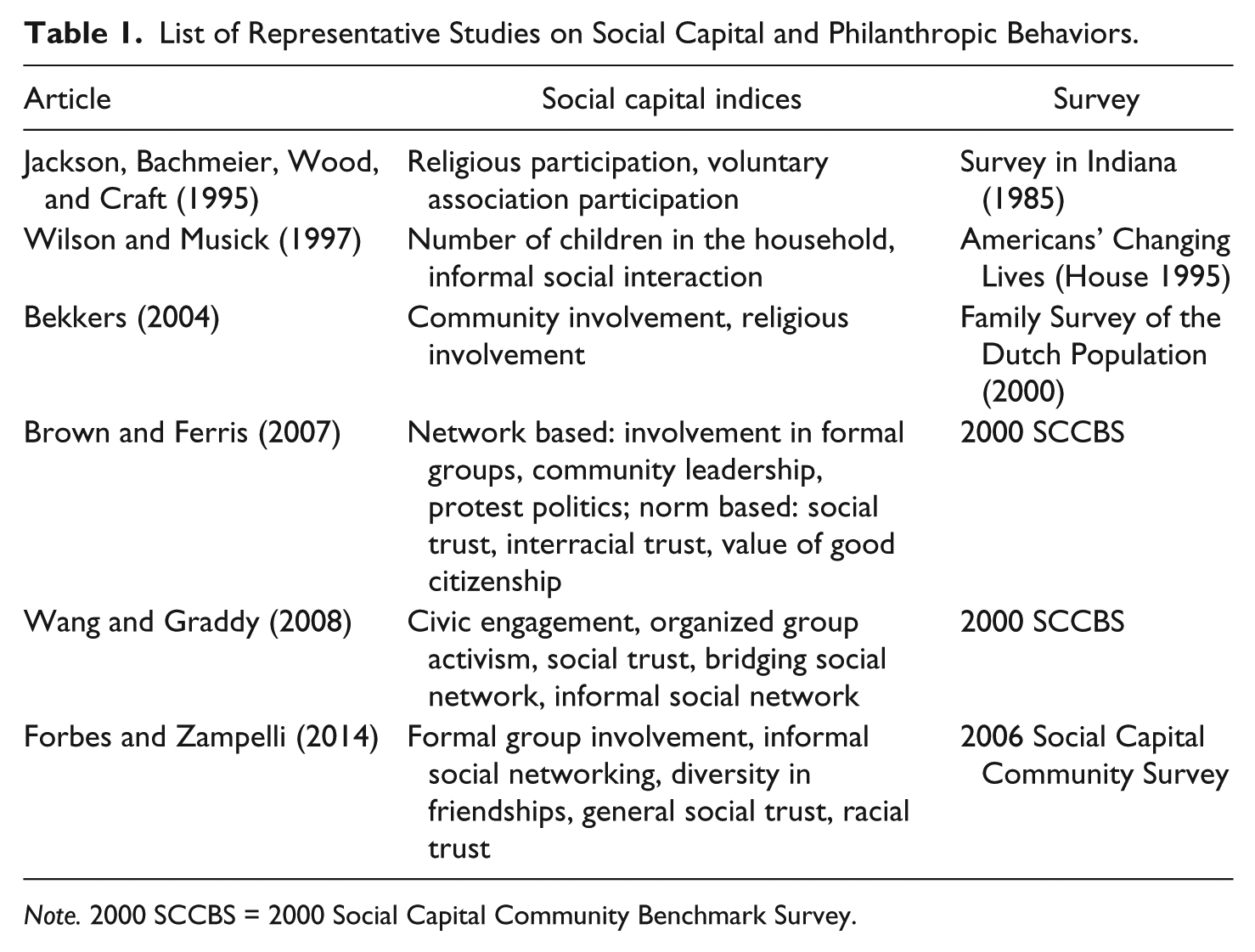
The social capital measurements used by studies examining social capital’s impact on philanthropic behaviors are generally inconsistent except that the two abovementioned indicators were used by most recent studies. For example, Smith (1994) defined social capital as social connections, which provide resources (e.g., information, labor, and trust) that facilitate volunteering, whereas Jackson et al. (1995) defined social capital as religious and associational ties. Wilson and Musick (1997) developed an integrated theory, covering human, social, and cultural capital, of volunteerism, but they only included two indicators—the number of children in the household and informal social interactions—to measure social capital. In exploring factors influencing giving and volunteering in the Netherlands, Bekkers (2004) used community and religious involvement as indicators of social capital (see Table 1).
List of Representative Studies on Social Capital and Philanthropic Behaviors.
Note. 2000 SCCBS = 2000 Social Capital Community Benchmark Survey.
Even using the same data set generated from the 2000 Social Capital Community Benchmark Survey (2000 SCCBS), Brown and Ferris (2007) and Wang and Graddy (2008) selected different indices to measure social capital. As shown in Table 1, these two articles only have three indices in common. Furthermore, Forbes and Zampelli (2014) used the data set from the 2006 Social Capital Community Survey, which adopted the same indices of social capital as the 2000 survey. However, the indices that they chose to measure social capital are quite different from both the Brown and Ferris (2007) article and the Wang and Graddy (2008) study. These studies reached similar conclusions regarding the impact of social capital on volunteering and giving, despite the variation of the indices that they used to measure social capital.
There are several reasons for the inconsistency in social capital measurement. First, the inconsistency reflects different preferences of survey institutions and scholars in specific contexts. For instance, the indicators of social capital chosen by the Current Population Survey, the General Social Survey, and the Panel Study of Income Dynamics are different from one another. This is because the institutions that sponsor these surveys have specific preferences for social capital indices (Hudson & Chapman, 2002). Earlier studies in the United States chose social connections (Smith, 1994), religious and associational ties (Jackson et al., 1995), and number of children in the household and informal social interaction (Wilson & Musick, 1997) to measure social capital, whereas later studies are mostly based on the three dimensions of social capital (Brown & Ferris, 2007; Forbes & Zampelli, 2014; Wang & Graddy, 2008). Moreover, individual scholars (e.g., Brown & Ferris, 2007; Forbes & Zampelli, 2014) using the same survey data might have specific preferences and, thus, select different indices.
Second, the inconsistency represents constraints of data availability and inadequate efforts to evaluate the construct validity of measurements. Because most researchers relied on secondary data generated from large social surveys, they had limited influence on what kind of social capital indicators to include in those surveys. In addition, given that most of these social surveys lacked rigorous evaluation of the validity of their instruments on social capital, scholars are likely to neglect the construct validity, and only include the indices that generate statistically significant results.
The Incompleteness of Existing Social Capital Measurements
The existing social capital measurements did not fully capture the concept of social capital. First, according to Putnam (1995), norms of generalized reciprocity are a key dimension of social capital that facilitate collective actions. However, few studies included this dimension in their measurements. Brown and Ferris (2007) explored the norm dimension, integrating trust indices into the norm dimension and renaming it norm-based social capital. It was an innovative idea to divide social capital into norm based and network based. However, their norm-based social capital measure does not contain any indicators for norms of generalized reciprocity because no such indicators were included in the 2000 SCCBS, on which the study was based. In this study, we develop a measure of norms of generalized reciprocity and hypothesize the following, all else being equal:
Second, previous social capital measurements only included generalized trust (usually measured by “trust in most people or others”) as the indicator for the trust dimension of social capital. However, Luhmann (1979) indicated that social trust consists of interpersonal trust, which characterizes small and relatively undifferentiated societies, and institutional trust, which characterizes modern and complex societies. None of the measurements in existing Western research regarding the impact of social trust on philanthropic behaviors included institutional trust, which may affect individuals’ philanthropic behaviors. Institutional trust is found to play a critical role in affecting charitable giving in collectivist societies such as Japan, though it has little impact on formal volunteering (Taniguchi & Marshall, 2014). This is especially true in countries such as China, where there is a long collectivist tradition and the government has been strongly influencing the third sector and individuals’ charitable behaviors (Howell, 2007; Yu, 2006; Zhao et al., 2016). For example, the Chinese government has been a primary mobilizer of citizens’ volunteer participation (Hustinx, Handy, & Cnaan, 2012). Therefore, we hypothesize the following, all else being equal:
Furthermore, previous studies excluded particularistic trust from their interpersonal trust measurements. According to Uslaner (2002) and Luo (2005), interpersonal trust is composed of generalized trust and particularistic trust. The term “generalized trust” is synonymous with “stranger trust.” Stranger trust is defined as the level to which a person trusts strangers, or most people in society. Particularistic trust means “acquaintance trust,” namely, the level to which one trusts his or her acquaintances. Given that interpersonal relationships of Chinese citizens are still significantly influenced by particularistic moral principles (Ma, 2007), particularistic trust could be an important factor to include in studying the impact of social capital on philanthropic behaviors in China.
As illustrated by Fei, Hamilton, and Wang (1992), Chinese citizens tend to follow the principle of “Differential Mode of Association,” in which one holds different principles when interacting with others depending on each individual’s closeness to him or her. Specifically, following norms of particularistic reciprocity, Chinese people have a strong obligation to help acquaintances and they anticipate the latter helping them in return when needed (Hwang, 1987). For example, declining a request for help from an acquaintance is considered inappropriate even if the request itself is deemed inappropriate, such as borrowing a large amount of money from a neighbor. Although they are expected to help people in the inner circle of their social networks, helping people outside of their personal networks (i.e., strangers) is not a norm in Chinese society (Hwang, 1987). Uslaner (2002) argues that particularized trusters tend to think as follows: “people unlike themselves are not part of their moral community, and thus may have values that are hostile to their own” (p. 27). They divide people into an in-group (acquaintances) and an out-group (strangers). These individuals are often bound to their in-group network and, thus, have relatively narrower social networks compared with generalized trusters. Their limited resources (such as time and money) are more focused on their narrow in-group networks, and, thus, are less likely to be allocated to help out-group strangers. Therefore, we hypothesize the following, all else being equal:
Toward a More Comprehensive and Valid Social Capital Measurement
Considering the limitations of the existing social capital measurements, we argue that a more comprehensive measure is needed. First, a good measure should be based on a broadly accepted conceptual framework. Therefore, we follow Putnam’s three-dimensional social capital theory. Second, a good measure should capture a concept completely. Thus, we construct indicators for each dimension of social capital. Finally, a good measure should have solid construct validity. Therefore, we create a new measurement and employ factor analysis to examine its construct validity. We then use representative survey data from China to explore social capital’s impact on individuals’ volunteering and giving.
Data and Method
Data
The study uses a data set from the 2013 Survey on Philanthropic Behaviors of Urban Citizens in China (SPBUCC) conducted in 27 cities. The survey was conducted by Beijing Normal University and is the first systematic investigation of individuals’ social capital and civic engagement in urban China. SPBUCC adopted a multistage, stratified sampling method to ensure a representative sample. First, 27 cities were randomly selected based on geographic location, population size, and level of economic development. Next, four residential communities were randomly selected in each city based on community type: old housing, commercial housing, Danwei 1 housing, and public housing communities. Finally, 50 individuals were randomly selected in each community based on addresses of respondents. From October to December 2013, 5,400 individuals were interviewed door to door.
Dependent Variables: Volunteering and Giving
Dependent variables are time spent volunteering and donation amount. Respondents were asked about the total amount of time they spent on volunteering initiated by charitable organizations, corporations, government agencies, religious groups, communities, and other organizations in the past 12 months. They were also asked about the total amount of money they donated to the society in the past 12 months. On average, the respondents contributed about 8 hr and 137 RMB per person in the past 12 months (see Table 2).
Descriptive Statistics (N = 5200).

Note. RMB = Chinese Yuan; CPC = Communist Party of China.
Independent Variable: Social Capital
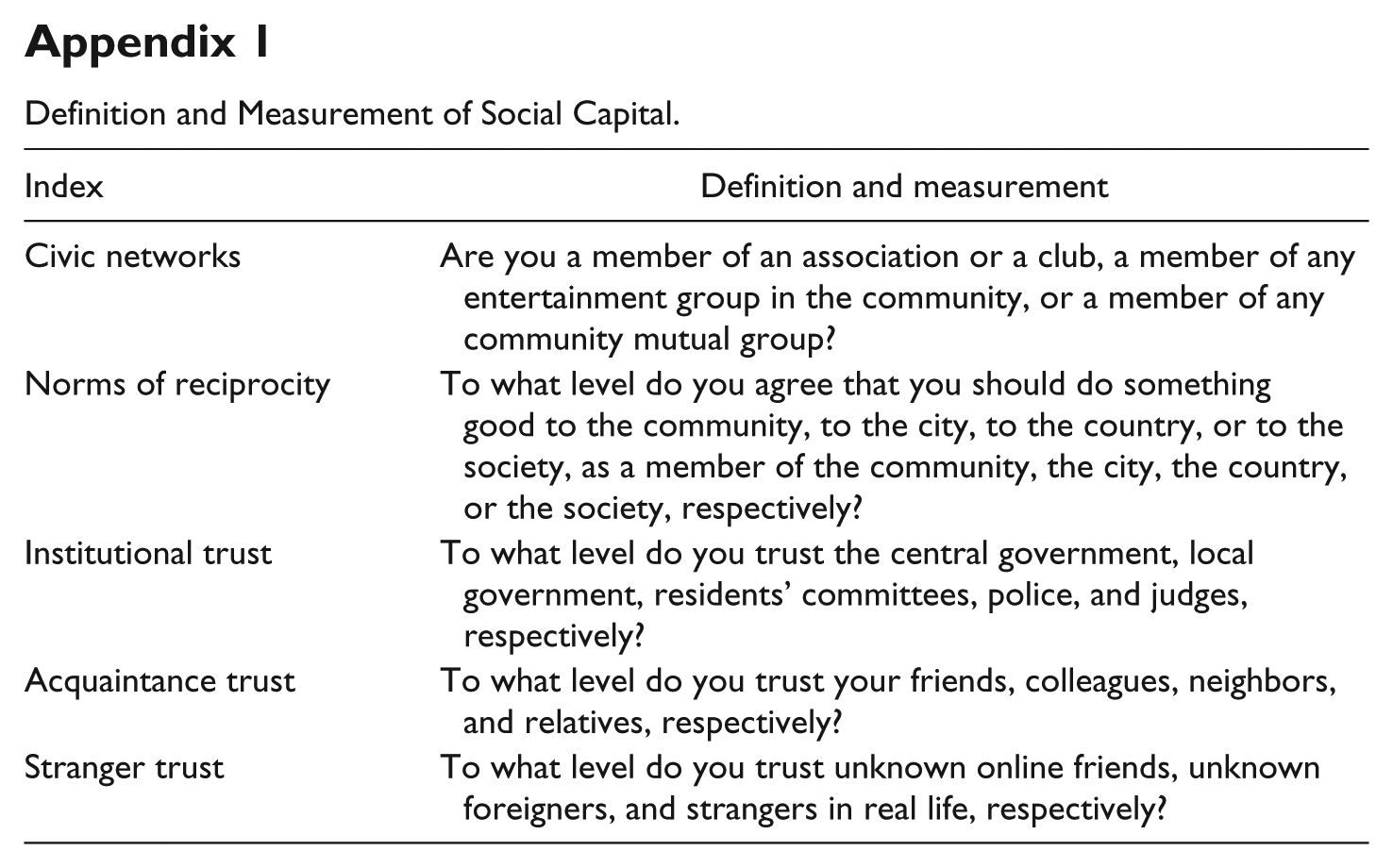
The independent variable is social capital, consisting of five indices as illustrated below (see Appendix 1 for details). Civic network index is measured by membership in associations, recreational groups, and mutual support groups. Respondents were asked whether they were members of an association or a club, any recreational groups in the community, or any community mutual support groups. Norms of reciprocity index is defined as the degree to which the respondent thinks he or she should do good in the residential community, city, country, and society in which he or she lives. The answers range from strongly disagree to strongly agree on a 5-point scale. Institutional trust index is based on five questions: The respondent was asked the level to which he or she trusted the central government, local government, residents’ committees, 2 the police, and judges. Acquaintance trust index is defined by four questions: The respondent was asked the level to which he or she trusted his or her friends, colleagues, neighbors, and relatives. Finally, stranger trust index is based on three questions: The respondent was asked the level to which he or she trusted unknown online friends, unknown foreigners, and strangers in real life. The answers to questions of the last three indices range from completely distrust to completely trust on a 5-point scale.
Control Variables 3
Control variables include human capital (education level, employment status, health status), financial capital (household income level), cultural capital (religiosity), happiness, membership in the Communist Party of China, and demographic characteristics (gender, age, age squared, marital status, citizenship status, and residential community type).
Analytical Method
We first conducted exploratory factor analyses to verify the validity of our social capital measure. We then used Tobit regression to examine the relationship between social capital and philanthropy. Because time spent volunteering and donation amount are left censored around zero, ordinary least squares (OLS) regression is inappropriate as it assumes a symmetrical distribution of the dependent variable. Tobit regression is used to correct biases caused by censored dependent variables (Tobin, 1958). In addition, as suggested by Forbes and Zampelli (2011), the Heckman selection model (i.e., “Heckit” model) could outperform the Tobit model; thus, we used the “Heckit” model to check the robustness of the Tobit estimates.
Results
Validity of the Social Capital Measurement 4
Factor analysis of the proposed social capital measurement (see Table 3) indicates that this measure is valid. The accumulated variance contribution rate is 71.2%; the value of the Kaiser–Meyer–Olkin (KMO) test is 0.832; the chi-square is equal to 54,000; and the p value is 0.00. These test statistics prove that our social capital measure has a good construct validity. We saved the factor scores of the factor analysis and created five new variables to represent the five components of social capital. Because the scores are standardized, their mean values are all approximately equal to zero and the standard deviations are all equal to one.
Results of Factor Analysis (N = 4,881).

Note. Method: principal component factors. Retained factors = 5.
Tobit Regression Results 5
Tobit regression results are reported in Table 4. We summarize the results based on the significance level and effect size of a factor that influences volunteering and giving. In general, the results show that social capital is a significant predictor of both volunteering and giving, which is consistent with most previous studies (e.g., Brown & Ferris, 2007; Forbes & Zampelli, 2014; Hossain & Lamb, 2017; Wang & Graddy, 2008). Specifically, four social capital indices (i.e., civic network, norms of reciprocity, institutional trust, and stranger trust) are positively associated with both volunteering and giving. All four regression coefficients are statistically significant at 0.01 confidence level. On average, if an individual’s scores on the network index, norm index, institutional trust index, and stranger trust index increase by one standard deviation, he or she is predicted to volunteer about 11.8, 14.4, 19.1, and 4.5 more hours, respectively (see Table 4). In addition, on average, as an individual’s involvement in civic networks, level of agreement with norms of reciprocity, level of trust in institutions, and level of trust in strangers increase by one standard deviation, respectively, he or she is predicted to donate 37.1, 91.9, 132.5, and 38.3 more RMB to society. These results are all significant at 0.01 confidence level.
Results of Standard Tobit Models for Volunteering and Giving.

Note. Volunteering: 2,884 left censored, 1,784 uncensored, 0 right censored; giving: 2,458 left censored, 2,207 uncensored, 0 right censored. CPC = Communist Party of China.
The positive impact of civic networks and generalized trust on volunteering and giving have been well examined by previous studies, whereas the positive effect of norms of generalized reciprocity and institutional trust is a new finding by this study. How norms of generalized reciprocity influence philanthropic behaviors is similar to that of generalized trust (Putnam, 1993). People adhering to norms of generalized reciprocity tend to follow the universalistic moral principles and have higher generalized trust toward—and, thus, are more likely to help—others. In addition, institutional trust is shown to be a strong positive predictor of both volunteering and giving even after controlling for the membership of Chinese Communist Party. It matters in China’s context because people’s philanthropic behaviors are embedded in the institutional system (Howell, 2007; Yu, 2006). The Communist Party and the Chinese government have a strong influence over people’s willingness and pathways to volunteer and donate (Hustinx et al., 2012). One example is that hundreds of thousands of people were mobilized by the state to volunteer for the Wenchuan earthquake disaster relief efforts and the Beijing Olympic Games in 2008.
As hypothesized, level of acquaintance trust is negatively correlated with giving. People with higher levels of trust in acquaintances tend to donate less money to society. Specifically, as an individual’s factor score of acquaintance trust increases by one standard deviation, he or she is predicted to donate about 22 RMB less to society, holding everything else constant.
China’s distinct historical and cultural backgrounds provide some explanation for these results. Unlike many Western societies, in which prosocial and altruistic values originating from Christian traditions are influential (Bekkers & Schuyt, 2008; Bekkers & Wiepking, 2011), Chinese history does not have a tradition of universal altruism (Dubs, 1951). Instead, Chinese people follow the principle of “Differential Mode of Association” (Fei et al., 1992), a particularistic moral principle that encourages, even compels, them to help acquaintances, but discourages them from helping strangers (Chen, 2006). Due to the limited social welfare assistance available to Chinese citizens, people rely on acquaintances for financial help. Therefore, when they are more bound to their in-group network (acquaintances), and their total resources (i.e., time and money) are fixed, those resources available to contribute or donate to help strangers are inevitably reduced.
However, level of acquaintance trust has no statistically significant effect on time spent volunteering. The hypothesis that higher level of trust in acquaintances is negatively associated with an individual’s volunteering time is not supported. In other words, these results indicate that people with higher levels of trust in acquaintances would donate less money, but not necessarily devote less time to volunteer activities. One possible explanation is that an individual’s participation in volunteering is primarily determined by other factors, such as civic networks, norms of generalized reciprocity, institutional trust, and stranger trust. Another possibility is that, for Chinese people, donating money to strangers might be different from contributing time to volunteer to help others because money seems to be a more important and limited resource than time for most Chinese people, who are still not affluent. This is supported by the finding that more affluent people tend to donate more money but less time than those who are not affluent (see Table 4).
Robustness Check
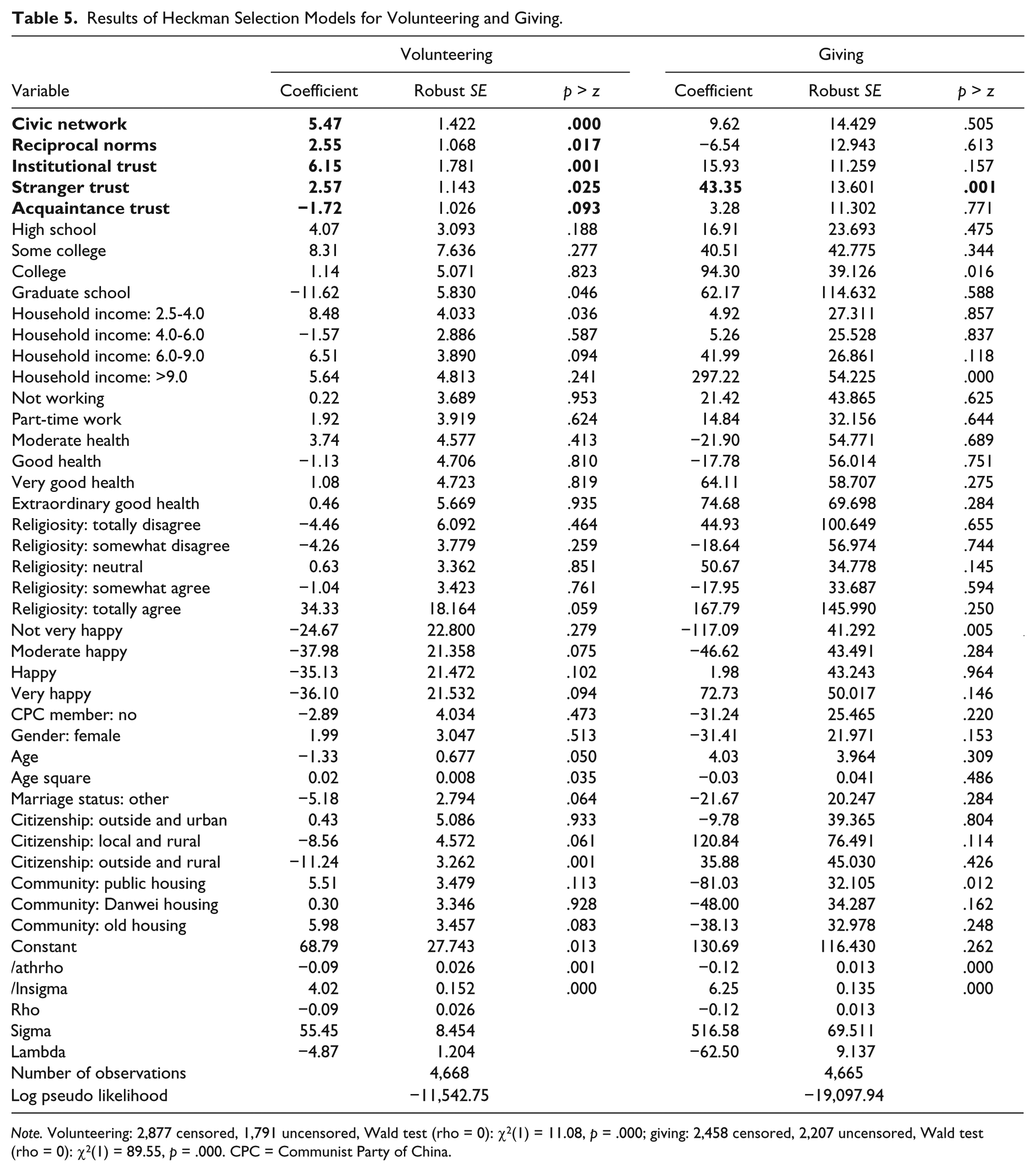
According to Forbes and Zampelli (2011), some alternative generalized two-stage structural models, such as the “Heckit” model, seem to be superior to the standard Tobit model for both volunteering time and monetary donations. Therefore, we used the “Heckit” model to check the robustness of our Tobit estimates of volunteering time and monetary donations. As shown in Table 5, the “Heckit” model produced different results from the standard Tobit estimations, but it is not necessarily superior to the standard Tobit model. In contrast to Forbes and Zampelli’s finding, the log-likelihood values of standard Tobit models are larger than those of the “Heckit” models for both volunteering and giving. This means that the standard Tobit models did not cause upward biases in the estimates.
Results of Heckman Selection Models for Volunteering and Giving.
Note. Volunteering: 2,877 censored, 1,791 uncensored, Wald test (rho = 0): χ2(1) = 11.08, p = .000; giving: 2,458 censored, 2,207 uncensored, Wald test (rho = 0): χ2(1) = 89.55, p = .000. CPC = Communist Party of China.
Discussions
Conclusion, Implications, and Contributions
The results of this study support most of the hypotheses regarding the impact of social capital on individuals’ philanthropic behaviors as suggested by the literature. Consistent with previous research (e.g., Alhidari, Veludo-de-Oliveira, Yousafzai, & Yani-de-Soriano, 2018; Brown & Ferris, 2007; Forbes & Zampelli, 2014), this study confirms the positive effect of civic networks and generalized trust on charitable behaviors. Moreover, the study adds to the literature with several new findings. First, norms of generalized reciprocity are also found to be a significantly positive predictor of volunteering and giving. In fact, standardized effect size (14.37) of norms of generalized reciprocity is greater than that of civic network (11.78) and stranger trust (4.50). Therefore, future research should study it as a predictor of philanthropic behaviors.
Second, institutional trust has a positive effect on both volunteering and giving, and its influence is the strongest among the five social capital indices. This finding is expected, given the strong influence that the Chinese government and the Communist Party have over Chinese society (Howell, 2007; Yu, 2006), including individuals’ civic participation (e.g., volunteering and giving). This finding is a notable contribution to the literature as previous research neglected the impact of institutional trust on philanthropic behaviors (e.g., Forbes & Zampelli, 2014; Taniguchi, 2012; Wang & Graddy, 2008). This finding runs counter to Bekkers’ (2016) conclusion that regional differences in philanthropy are primarily due to individual-level donor characteristics, rather than region-level context characteristics. It suggests that China might be a different case in cross-national comparison of philanthropy.
Finally, the study finds that higher levels of acquaintance trust are negatively associated with giving but have no significant impact on volunteering. Previous research (e.g., Forbes & Zampelli, 2014; Taniguchi, 2012) usually focuses on generalized trust and ignores other types of social trust. This finding indicates that social trust needs to be further explicated and acquaintance trust should not be excluded.
Acquaintance trust might negatively affect charitable behavior especially in the Chinese context. If individuals trust their acquaintances more, they might still adhere to the particularistic moral principle to deal with interpersonal relationships; they, thus, would be less likely to pay attention or contribute time or money to others (such as strangers) in society (Chen, 2006; Hwang, 1987). This novel finding not only is applicable to the specific context of China but also has implications for other contexts. This conclusion might hold for any society in which the social distance between in-group members and out-group members is distinct. This finding is consistent with what Uslaner and Conley (2003) revealed in the context of ethnic Chinese in Southern California: People with higher levels of particularized trust have stronger ties to their in-group, and, thus, are less likely to actively engage in the larger society, because particularized trusters tend to have a narrower social network and weaker ties to the larger society, and do not assume that others in the larger society share their values (Fukuyama, 1995). Thus, acquaintance trust both in China and other countries deserves further research.
This study has three major contributions to the literature. First, it reveals the complex impact of social capital on individuals’ philanthropic behaviors in the context of China. It adds empirical evidence to research on the relationship between social capital and philanthropic behaviors. Second, it is the first study that reveals the negative correlation between acquaintance trust and charitable giving, as well as the positive association between institutional trust and volunteering. It is also among the very first few studies that find the positive impact of institutional trust on charitable giving (Taniguchi & Marshall, 2014). Finally, it forms a more comprehensive social capital measure and verifies it in the context of China. This new measurement will inform future research on the same topic, especially studies in countries where there is a collectivist tradition, where the state has a strong influence over individuals’ civic participation, and where interpersonal relationships are dominated by particularistic trust and norms of particularistic reciprocity.
Limitations and Directions for Future Research
This study has several limitations. First, as it is based on cross-sectional data, we are unable to achieve causality between social capital and philanthropic actions. Future research should examine the causal relationship between the two. Second, the data were collected exclusively in the urban areas of China; therefore, the study does not speak to the volunteering and giving behaviors of the rural population of China. Given that about half of the Chinese population lives in rural areas and that the social life of urban and rural residents differs significantly, specific research on social capital and philanthropic behaviors of rural citizens is needed, both in China and other nations. Third, we only tested the validity of our new social capital measurement with data on the Chinese urban population. The validity and applicability of this new measurement in other contexts are unknown. Future research could examine its applicability in different contexts and advance the collective understanding of social capital’s impact on individuals’ philanthropic behaviors.
In addition, as Glanville, Paxton, and Wang (2016) have suggested, more attention should be given to the effects of context-level social capital. Another possible research direction is to explore the potential influences of philanthropic actions on individuals’ well-being and political participation. These were the outcomes of philanthropic behaviors suggested by Snyder and Omoto (2008), as well as Wilson (2012). Finally, future research could explore the relationship among the three dimensions of social capital. Putnam (1995, 2000) stated that social networks not only promote the formation of social trust but also foster norms of generalized reciprocity. To date, this statement has not been tested empirically. Researchers should explore whether the three dimensions of social capital affect one another, especially how acquaintance trust and stranger trust interactively influence individuals’ philanthropic behaviors.
Footnotes
Appendix
Definition and Measurement of Social Capital.
| Index | Definition and measurement |
|---|---|
| Civic networks | Are you a member of an association or a club, a member of any entertainment group in the community, or a member of any community mutual group? |
| Norms of reciprocity | To what level do you agree that you should do something good to the community, to the city, to the country, or to the society, as a member of the community, the city, the country, or the society, respectively? |
| Institutional trust | To what level do you trust the central government, local government, residents’ committees, police, and judges, respectively? |
| Acquaintance trust | To what level do you trust your friends, colleagues, neighbors, and relatives, respectively? |
| Stranger trust | To what level do you trust unknown online friends, unknown foreigners, and strangers in real life, respectively? |
Acknowledgements
We would like to thank the three anonymous peer reviewers, as well as editors-in-chief Dr. Jeffrey Brudney, Dr. Susan Phillips, and Dr. Chao Guo for their helpful comments and suggestions on earlier drafts of this article. We also thank John Kuntz, Vanessa D. Guida, and Thomas McCloskey for their assistance in revising the language.
Declaration of Conflicting Interests
The author(s) declared no potential conflicts of interest with respect to the research, authorship, and/or publication of this article.
Funding
The author(s) disclosed receipt of the following financial support for the research, authorship, and/or publication of this article: The study was part of a 985-project grant (Grant No. 11SSCH042) at Beijing Normal University, funded by the Ministry of Education of the People’s Republic of China.