






Abstract
The study of philanthropy has largely been the purview of the wealthy and privileged in Western societies. However, the act of giving transcends race, religion, nationality, ethnicity, and socioeconomic conditions. This article adds to the philanthropic literature by providing empirical evidence of the prosocial behaviors of rural villagers throughout India. Using responses from a large-scale, door-to-door survey (n=3,159), we found that high percentages of rural Indians regularly engage in both formal and informal giving and volunteering. Even among generally poor, rural Indian villagers, socioeconomic indicators still matter (with the exception of education), and minority religions and lower social groups tend to exhibit higher levels of prosocial behavior than dominant religious and social groups.
Introduction
A fuller understanding of philanthropy requires more research devoted to the prosocial behavior of the poor and other understudied populations. Rural villagers in India is a population that has received little attention in philanthropic literature. The extant literature on Indian philanthropy depicts a rich history and culture of charity, yet the few surveys conducted report contradictory levels of charitable giving and volunteering (Cantegreil et al., 2013; Charities Aid Foundation, 2021; Sen et al., 2020; Sheth et al., 2015). The present study finds empirical support for relatively high levels of giving and volunteering among rural Indians, and provides a more nuanced understanding of their various forms of giving. This is critical, as our work broadens understanding of philanthropic behavior, which has historically focused on wealthier, Western populations.
Many studies in the philanthropic literature find that donating and volunteering are positively correlated with indicators of high socioeconomic status (SES) (Bekkers, 2010; Bekkers & Wiepking, 2011; Gesthuizen & Scheepers, 2012; Hackl et al., 2007; Musick & Wilson, 2008; Putnam, 2015; Wiepking & Bekkers, 2012; Wilson, 2012). David Horton Smith (1994) proposed the “Dominant Status Approach,” suggesting that volunteering is the purview of the well-to-do (D. H. Smith & Wang, 2016). The perspective that philanthropic behavior is the purview of the privileged can preclude us from examining giving activities among the poor. However, exploring prosocial behavior among less privileged populations is important for developing theory on this aspect of human behavior. Bekkers et al. (2020) expanded the scope of philanthropy research and have broadly defined giving as
all formal and informal philanthropy and other types of prosocial behavior, including volunteering, helping others . . .and many other formal and informal prosocial behaviors, to come to a complete, inclusive understanding of all forms of giving practiced across the world. (Para. 1)
We employ this broad definition of giving in this study, including both formal and informal activities, and use the terms philanthropy, giving, and prosocial behavior interchangeably.
From a global perspective, most of the work on philanthropy focuses on the global North. M. B. Smith et al. (2017) noted that “research to date on volunteering and development has largely focused attention on the global South as a place that ‘hosts’ volunteers and the global North as a place that ‘sends’” them (p. 158). The few studies that focus on the giving among the poor in the South sampled urban populations (Kassam et al., 2016; Lewis, 2015; Wilkinson-Maposa et al., 2005), whereas much of the global South live in rural areas. Therefore, in addition to broadening the literature on philanthropy among the poor, we focus on a country in the global South with vast populations living in rural areas: India. The 2011 Census of India (n.d.) recorded 833,463,448 people—68.8% of India’s total population—living in rural 1 areas. Given the lack of research centered on the prosocial behavior of the poor in the global South 2 and the lack of focus on rural populations, this article addresses the gap in the literature with a large-scale survey among rural villagers in India. We are not suggesting that all rural villagers in India are poor (as we will report), nor that all the poor in India live in rural areas (which is also not the case); rather, we suggest that studying rural populations in India provide insight into two overlapping and understudied demographics in the philanthropic literature.
We focus on the following questions: (a) To what extent do rural villagers in India participate in various forms of formal and informal prosocial behavior? and (b) What social variables help to explain the various forms of prosocial behavior? We begin by reviewing the literature on philanthropy among the poor, including various forms of giving and volunteering that inform our outcome measures. We explain the context of philanthropy in rural India and derive informed hypotheses on the social variables associated with prosocial behavior. We describe the methods of our large-scale field survey and our analytical strategy. We then present our findings and discuss their implications for the literature.
Literature Review
Studying prosocial behavior among the rural and poor in India is not easy. In their book on Indian philanthropy, Kassam et al. (2016) concluded, “due to the challenge of capturing numbers on individual giving, it is widely debated how generous Indians are” (p. 96). The World Giving Index (WGI) ranked India 14th out of 114 surveyed countries, based on a nationally representative survey of 1,000 participants, reporting that 36% of Indians gave money to charity and 34% donated their time (Charities Aid Foundation, 2021). Similarly, Sheth et al. (2015) found that in 2013, only 28% of Indians donated money to charity and 21% formally volunteer. However, Sen et al. (2020) used survey data from 1,925 income earners in urban areas to report that 76% of respondents donated in some form, and the most common type of donation (61% of respondents) was cash. Sen et al. (2020) focused primarily on the recollection of “major donations,” excluding smaller “daily” acts of giving like gifting small amounts to someone in need. Unfortunately, the authors did not specify whether the giving was to a charitable organization or not, nor do they report the timeframe. By contrast, the WGI specifically asked about giving “money to a charity” within the last month. Such discrepancies make the contradictory survey results difficult to interpret. The WGI survey is more specific and reports lower levels of giving, whereas Sen et al. (2020) report higher levels of giving but with a seemingly broader definition. The United Nations Volunteers (UNV, 2018) reported that India provided the second-highest amount (374 million) of full-time equivalent volunteers, indicating that they have a relatively high level of volunteerism, but they do not compare per capita statistics. Given the disparity and lack of accurate data on giving and volunteering in India, the findings from the current article provide new insights into prosocial behavior, which help explain discrepancies in these various findings. Specifically, we will see the importance of bifurcating religious giving and volunteering from other forms of volunteering. Furthermore, we provide data from rural communities that are often understudied.
The forms of giving in India do not always compare directly to forms of giving in Western cultures (Cantegreil et al., 2013; Sen et al., 2020). Moreover, research on philanthropy often neglects various types of prosocial behavior, such as informal giving and volunteering, that may be more common among the poor (Allen, 2018; Cnaan & Park, 2015; Einolf et al., 2016; Penner et al., 2005). Studying philanthropy among populations traditionally underrepresented in this field requires a broadened comprehension of the subject. Fowler and Mati’s (2019) conceptualization of African “gifting” indicated how prosocial behaviors embedded in uniquely African historical contexts are often obscure by Western interpretations. To broaden our conception of philanthropy for this study, we review the literature on various types of prosocial behaviors among the poor—the context of the global South and rural India specifically—as well as social variables associated with giving among this population.
Forms of Philanthropy Among the Poor
Charitable giving
The research on charitable giving (to formal organizations) among lower income individuals and households has mixed conclusions. Walker and Pharoah (2002) reported that in the United Kingdom, the poor give between 3.5% and 4% of their incomes, whereas the wealthy give between 1% and 2%. R. Bennett (2011) documented the giving activity of 771 poor people residing in London, finding that 51% reported donating money, and “the median monthly amount given by individuals in the lowest quartile of the income distribution in 2008 (i.e., £8) was not drastically lower than the national median of £10” (R. Bennett, 2011, p. 872). Several studies find a nonlinear, u-shaped, relationship between income and the percentage of income given to charity: Lower income households give more as a percentage of income when compared with their middle-income counterparts who give more in dollar amounts (Andreoni, 2006; Auten et al., 2000; Brooks, 2006; Clotfelter & Steuerle, 1981; James & Sharpe, 2007; Piff et al., 2010). Schervish and Havens (1995) explained that this pattern arises when only considering those households that give to charity. They found “an increasing level of participation as income rises” (p. 87). Similarly, Pharoah and Tanner (1997) found that increases in income increased the probability of giving to charity. Thus, the poor are less likely to give, but those who do are more generous than those with higher income.
Informal gifts of money
Informal modes of giving are associated with poor people, ethnic minorities, and women (Hacker et al., 2017; Hustinx et al., 2010; Jacobs & Xaba, 2011; Perold & Graham, 2014; Warburton & McLaughlin, 2007). In his comparative study of Western and non-Western forms of charitable giving, Einolf (2017) remarked, “It would be instructive to test whether informal giving to people one knows personally varies as much from country to country as charitable giving.” Several country-specific studies on charitable giving have included informal donations. Butcher and Sordo (2016) found that 51.2% of Mexicans gave money to people they knew personally. In South Africa, 45% of respondents of a national survey reported giving money to beggars and others asking for help (Everatt et al., 2005). Such informal donations are common in other countries, including Pakistan (Arnjad & Ali, 2018), Turkey (Campbell & Çarkoğlu, 2019), and Sri Lanka (Osella et al., 2015). Einolf (2017) found that much informal giving happens in the form of internal remittances from family members who leave rural areas and go to cities to find work. Note, however, that many of the families we surveyed were recipients of remittances, rather than providers.
In-kind donations
In-kind donations, defined as “any donation of goods and services for a charitable purpose,” represent another form of giving that those with less disposable income may be more inclined to give (Barth, 2016, p. 49). Like volunteering, in-kind donations can be geared toward individuals (e.g., neighbors or those in need), a cause, or an organization (e.g., food donated to a food bank or temple, or clothing to a thrift shop). In rural India, much of the economy is driven by agriculture. As food is relatively inexpensive and readily available, people regularly donate food to neighbors, temples, or other community organizations.
Political donations
In addition to giving money and food to charitable causes, political donations can be a measure of civic engagement that signals a desire to improve one’s society through political action. In the United States, poor people were significantly less likely to participate and/or donate to political causes when compared with people with higher incomes and educations (Hughes, 2017; Ritter & Solt, 2019). When assessing other countries across the globe (e.g., Brazil, Greece, Indonesia, Israel, Mexico, Nigeria), about 12% of people donated to social or political organizations, regardless of their SES (Wike & Castillo, 2018). Given that the poor are less likely to donate to political causes globally, it is expected that the same is true in India.
Formal volunteering
Formal volunteering behaviors are often associated with higher SES. Time is a limited resource, so volunteering presents a higher opportunity cost for the poor (Apinunmahakul et al., 2009; Taniguchi, 2006; Wilson, 2012). Given that volunteering is also a self-serving behavior that leads to better connections, skill acquisition, resume building, and responsibility signaling, it is more often emphasized in upper-middle-class families (Putnam, 2015). Wilson and Musick (1997) emphasized social capital (e.g., social networks and connections) and human capital (e.g., skills, education and income) as resources that increase volunteerism. Benenson and Stagg (2016) suggested an asset-based approach to analyzing volunteerism research among the poor, claiming that the assets available to the poor are often overlooked when determining resources they might share as volunteers.
Informal volunteering
Informal volunteering is similar to formal volunteering, though it occurs outside of a formal organization (M. R. Bennett & Einolf, 2017; Cnaan et al., 1996; Hustinx et al., 2010). Choi et al. (2007) operationalized informal volunteering as “helping friends, neighbors, or relatives who did not live with you and did not pay you for the help” (p. 106). UNV (2018) reports that 70% of voluntary behaviors take the form of informal volunteering. B. Smith et al. (1999) reported that “members of ethnic communities often report caretaking activities which in the mainstream society are more likely to be performed by government and nonprofit organizations” (p. 253). Similalry, Boddie (2004) showed that informal volunteering is more prevalent among African Americans than among more privileged members of American society. Various studies found that women were more likely to engage in informal volunteering near their homes, such as cleaning shared spaces and helping neighbors (Burns et al., 2015; Helms & McKenzie, 2014; Nesteruk & Price, 2011).
Giving Among the Poor in the Global South
A few empirical studies have provided more contextualized conceptions of prosocial behavior in the South. Wilkinson-Maposa et al. (2005) used mixed methods to investigate giving among poor populations in South Africa. Because the poor both give and receive much of their own generosity, Wilkinson-Maposa et al. (2005) used the term “horizontal philanthropy” and stressed the norm of reciprocity, and the often inescapable moral or cultural norms that make many prosocial behaviors more obligatory than voluntary. Lewis (2015) used qualitative methods to document formal and informal volunteering behavior in the slums of Korogocho, Kenya. Volunteer behaviors in the slums were tied to survival, intended to mitigate the ubiquitous threat of insecurity by building layers of social capital. Kassam et al. (2016) interviewed the urban poor of India finding “the idea that philanthropy is a give-and-receive relationship” (p. 90). They highlighted the importance of assisting relatives, the role of self-help groups (SHGs) as more formal venues to give, the practice of giving food, and the role of religion. All three studies provide insights into prosocial behaviors in what Fowler and Mati (2019) called “complex adaptive systems” of philanthropy (p. 726). While seminal, these works on philanthropy in the global South focus largely on urban populations, while much of the global South live in rural communities.
Explanations of Prosocial Behavior in Rural India
With an expanded view of prosocial behaviors, we seek to measure the extent to which rural Indians participate in different types of giving, but we also ask: What explains their participation in these various forms of giving?
Socioeconomic status
Although low-income households who give may be more generous as a percentage of their income, income is still a driving factor in predicting a household’s likelihood to donate money (Schervish & Havens, 1995) and volunteer (Wilson, 2012). Similalry, even among poor populations, other socioeconomic indicators, such as wealth (James & Sharpe, 2007; Van Slyke & Brooks, 2005) and education (R. Bennett, 2011; Wilson & Musick, 1997) are positively related to giving. In India, one’s level of English proficiency often indicates SES. In a country with no common national language and numerous local languages in use, English is the key mode of communication, especially among the elite (Bhattacharya, 2016). Thus, we include English proficiency as a measure of SES in India. Another important SES measure in India is access to digital technology. The use of computers, cell phones, and other mobile devices enables upward social mobility and facilitates access to financial markets (Cnaan et al., forthcoming). In the United States, Piatak et al. (2019) found that those with internet access are more likely to volunteer. We extend the research on these measures of SES and charitable giving by posing the following hypothesis:
Religion and giving
Ample evidence has shown that members of religious communities are more likely to give a higher proportion of their income to religious and secular causes (Forbes & Zampelli, 2014; Iannaccone, 1988; Sibley & Bulbulia, 2014), as well as volunteering and participation in civil society (James & Sharpe, 2007; Musick & Wilson, 2008; Putnam & Campbell, 2010). The question, therefore, is how does religion motivate prosocial behavior among rural villagers in India?
India’s religious landscape is complex, with Hinduism (80.5%) as the predominant religion and Islam (13.4%) as the second most common. Although Christians (2.3%), Sikhs (1.9%), Buddhists (0.8%), and Jains (0.4%) make up a small minority (Government of India, 2020), their beliefs and cultures influence larger social norms. For example, in Buddhism, one seeks to attain a good rebirth in heaven or earth and practices dana (daan), or giving, to religious recipients (Agarwal, 2010). Kassam et al. (2016) noted how the concept of daan in India pervades religions and cultures, becoming part of a national Indian culture. Giving money to a hundi box is a common part of traditional holiday visits to the temple for Hindu and Buddhists, but may occur less regularly than among Islamic and Christian weekly services (Agarwal, 2010.) Giving food to one’s place of worship is also common among Indians. Muslims may donate rice to feed school children, Christians may give food to an orphanage, and Hindus may bring food to a temple, where masses of daily visitors are fed for free (Kassam et al., 2016).
As members of minority religions, Buddhists, Muslims, and Christians may exhibit higher levels of giving toward their in-groups as a way to build social solidarity. For members of religious minorities, faith is not only an expression of spirituality but also an issue of social identity; a non-Hindu is a minority identity that could be associated with discrimination and instill a desire to strengthen group identity and status. This is especially true in recent years with increased Hindu nationalism. Individuals interact with and support people and organizations in their own faith, as part of their identity and as a defense against wider societal pressures (Ysseldyk et al., 2014). Religious minorities with stronger in-group identity may also feel increased social pressure to exhibit religious norms of prosocial behavior which may result in outgroup giving as well (M. R. Bennett & Einolf, 2017).
Social groups
Traditional Indian society included a highly structured caste system that determined social rank. Originally based on profession, the four castes were Brahmins, Kshathriyas, Vaisyas, and Shudras. The classifications later became determined not by profession but by birth. Now, the New India is moving away from the Caste System and has created social group classifications instead: Scheduled Caste (SC), Scheduled Tribe (ST), Other Backward Communities (OBC), and “Other,” which include Brahmin, Upper caste, and General Caste. Parallels exist between the prior caste system and the current social group classifications. SC are considered the lowest social group, then ST, followed by OBC. Upper class groups and castes identify as Other. The Indian government’s long-standing affirmative policies promote greater equity among social groups. Deshpande (2005) explained, “In India, affirmative action policies have a much longer history than the U.S., are constitutionally guaranteed, and take the form of quotas in government jobs, educational institutions, and electoral seats at each level of government” (p. 1). These policies have made some groups more desirable, such that many Indians seek to alter their social group identification to access government schemes (Corbridge, 2000). Yet, being a member of the upper-class social groups is considered a privilege, and members of these groups are likely to consider their privileged status as a responsibility to protect the welfare of the less privileged (Lahiri, 2021).
Regarding political donations, the long-standing affirmative action policies favoring marginalized groups and some of the literature on political donations in India lead us to hypothesize that marginalized social groups donate more than the dominant Other group. Bussell (2018) reported that elected officials rely more heavily on individual donations than on political parties, corporations, or their own wealth. This indicates the importance of social networks in Indian campaign politics, and the way that social groups may facilitate campaign financing. India’s electoral system offered political power to marginalized social groups by “changing composition of political elites in which lower castes—Dalits (SC) as well as OBC—gained political representation, largely at the expense of upper and intermediate castes” (Vaishnav & Hintson, 2019, p. 3). Based on the importance of individual donors, the empowerment of marginalized social groups in the electoral system, and these groups’ interest in protecting their government benefits through political action, we expect members of lower social groups to participate more in political donations.
Self-help groups
An emerging form of social capital in India is SHG. Usually composed of 10–20 local women or men, these groups save jointly, allowing the collective to serve as collateral to a member loan. Members meet periodically to learn basic finance and entrepreneurship skills, often uplifting women’s social status and engagement in advocacy and local politics (Handy et al., 2009; Prachi, 2018). Kassam et al. (2016) noted that women participating in SHGs were more inclined toward philanthropic activity because of their connections to the needs of their neighbors and their propensity for increasing their social capital.
Method
This paper utilizes a large-scale survey administered in rural India (Cnaan et al., forthcoming). The survey was conducted in three waves, across 14 villages, in seven different states throughout India. The states were selected to represent a variety of Indian geographic regions as follows: Karnataka and Kerala (Wave 1, January 2019), Sikkim, Utter Pradesh, and West Bengal (Wave 2, March 2019), and Gujarat and Maharashtra (Wave 3, June 2019). Two rural villages in each state were selected based on proximity to partnering universities and feasibility for completing the surveys within time constraints, with a target sample of 200 households per village. The survey included 202 questions, taking 25–30 min to complete, and was administered by local university students trained as research assistants in homes where at least one adult was present. Respondents did not receive any incentive for participation. Researchers from the United States and India drafted the survey in English. The final English version was translated into various local languages (e.g., Guajarati, Hindi, Nepali), which were then retranslated to English to ensure clarity. The study yielded 3,159 responses intended as a representative sample of rural India.
Sample Demographics
Table 1 shows descriptive statistics of the sample. Most survey respondents were men (67.1%) and married (77.9%) with the average age of 40.3 years. The vast majority of respondents spoke little to no English; 48.3% responded that English is “Not Known” and 34.9% reported they “Somehow Manage” with speaking English, whereas 11.6% reported they were “Conversant” and only 5.1% maintained they were “Fluent” in speaking English. Education level varied across the sample: 10.5% self-reported as “Illiterate,” 16.4% were “Semiliterate” (fifth standard level for ages 6–10), 26.1% reported as “Literate” (greater than fifth standard level), 26.9% had completed the Secondary School Leaving Certificate (SSLC), 14.5% had graduated from a college or university, and 5.6% had completed postgraduate work. Hinduism was the most common (77.4%) religious affiliation, followed by Islam (9.5%), Buddhism (6.6%), and Christianity (6.3%). When asked about their social group, most respondents identified with either “OBC” (46.6%) or “Other” (34.1%); the lower two social groups each consisted of about 9% to 10% of the sample. The vast majority of our sample (80%) lived below the median household income of India, 3 so our sample was both rural and mostly poor. Almost all respondents owned their home (93.3%), but less than one quarter owned a car.
Descriptive Statistics of Independent Variables.

Note. SD = standard deviation; SSLC = Secondary School Leaving Certificate; OBC = Other Backward Communities; ST = Scheduled Tribe; SC = Scheduled Caste; SHG = self-help group.
Variables
Dependent variables
As discussed above, understanding the prosocial behavior of poor people requires great care and nuance. When asked about formal giving, people tend to omit giving money to an extended family member or food donations to a neighbor in need. Thus, we measured prosocial behavior using 14 questions about whether or not the respondent had given food (4 questions), monetary donations (5 questions), and volunteered (5 questions) within the past 12 months (see Table 2). Thus, we have 14 dichotomous dependent variables. The beneficiaries of donations and volunteering varied from formal organizations, like religious institutions and community organizations, to informal beneficiaries, like family and neighbors.
Descriptive Statistics of Generosity Dependent Variables.
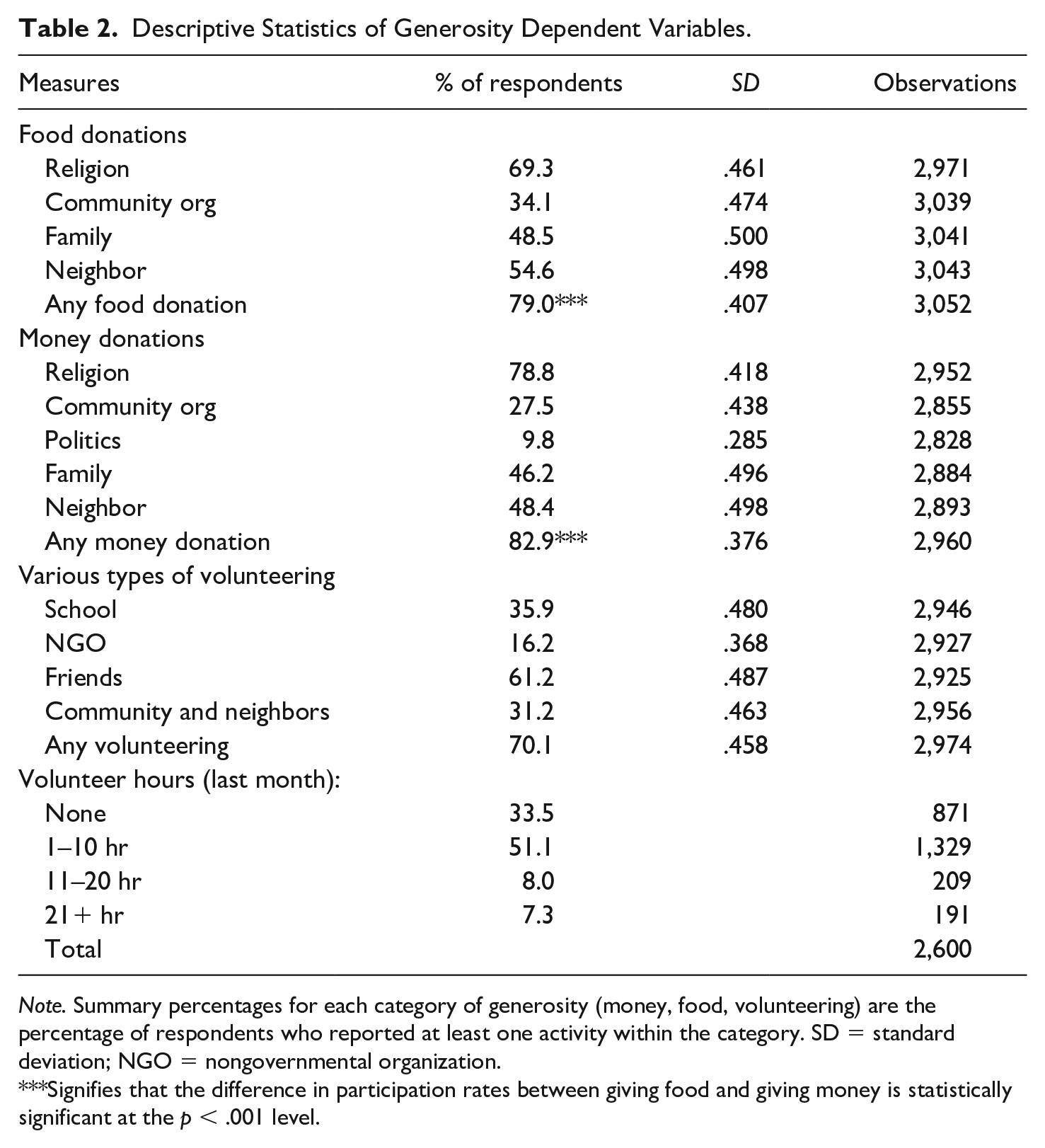
Note. Summary percentages for each category of generosity (money, food, volunteering) are the percentage of respondents who reported at least one activity within the category. SD = standard deviation; NGO = nongovernmental organization.
Signifies that the difference in participation rates between giving food and giving money is statistically significant at the p < .001 level.
Independent variables
We also collected measures on several independent variables related to prosocial behavior. For socioeconomic variables, we measured eight forms of income (including wages, business earnings, pensions, and remittances), and we used the sum of all forms of income; owning a house and owning a car were yes/no questions; education was measured with six levels from illiterate to postgraduate degree; English proficiency was self-reported with four levels from “not known” to “fluent”; and digital access is a sum score of nine dichotomous items about various forms of digital technology (including home electricity, cell phone, reliable internet, and a computer). Religion was measured in five categories: Hindu, Buddhist, Muslim, Christian, and Other. Only 79 respondents (2.5% of the sample) did not answer the question on religion, and only 5 respondents reported as “Other,” so the category was dropped from the analyses. Social group was also self-reported and had four categories: SC, ST, OBC, and Other.
Analyses
To answer questions about the extent of prosocial behaviors, we first provided descriptive statistics for each form of giving (Table 2). We then calculated the percentage of respondent participation in each category: giving money, giving food, and volunteering. To determine whether rural Indians participate more in giving money or giving food, we used a paired t-test for differences in means between two variables within the same sample (Table 2). For our second question, we treated each of the 14 measures of giving and volunteering as a unique dependent variable. We then ran probit regressions for each measure of giving and volunteering with all of our explanatory variables for our four hypotheses entered simultaneously (see Tables 3–5). For volunteer time, we used an ordered logistic regression. We used dummy variables for religious groups, with Hindus as the reference category, and for social groups with “Other” as the reference category. To check for multicollinearity of our independent factors, we calculated variance inflation factors (VIF), none of which indicated significant multicollinearity (highest VIF score was for education, 1.46).
Probit Regressions of Giving Money.
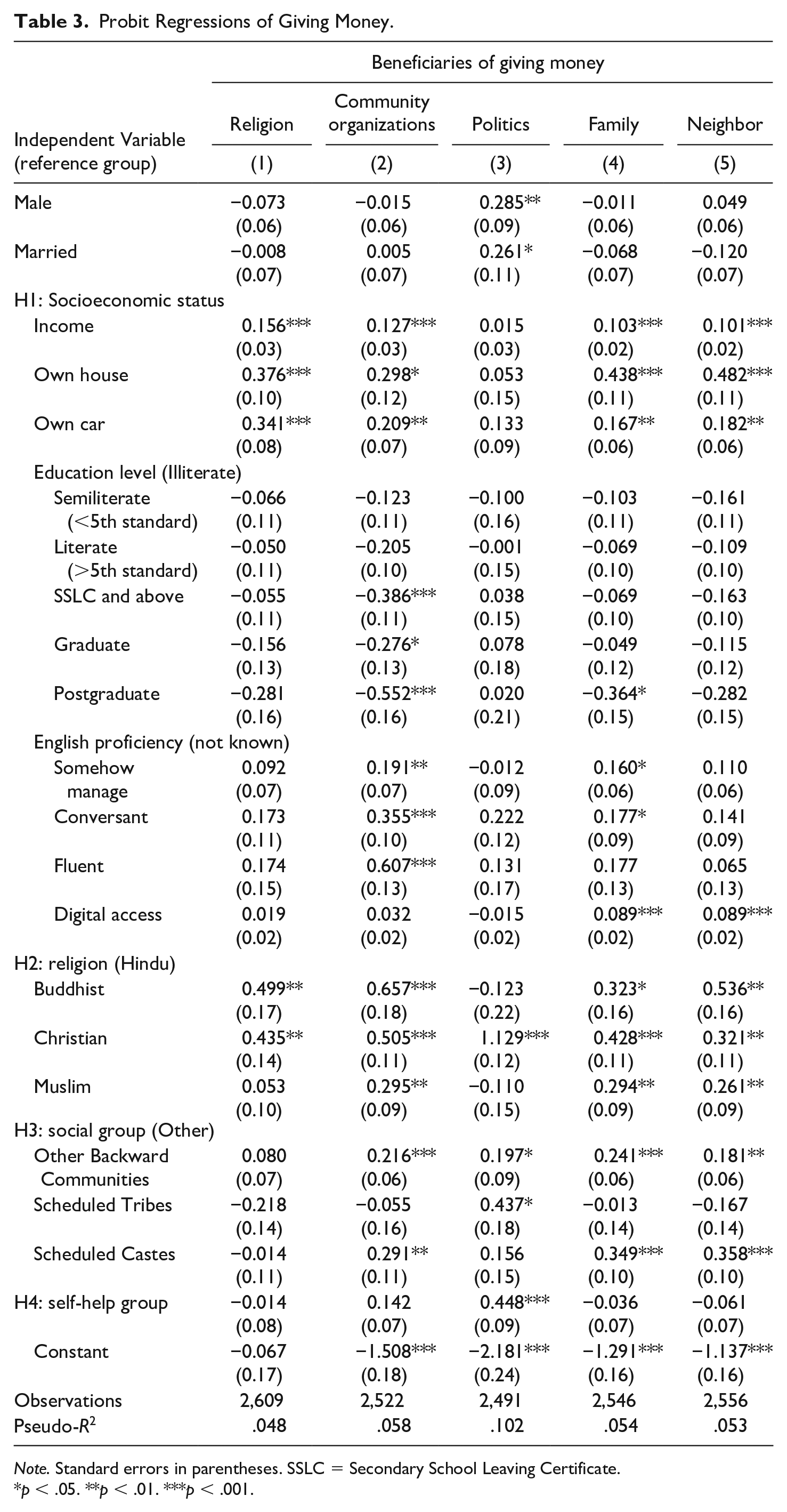
Note. Standard errors in parentheses. SSLC = Secondary School Leaving Certificate.
p < .05. **p < .01. ***p < .001.
Probit Regressions of Giving Food.

Note. Standard errors in parentheses. SSLC = Secondary School Leaving Certificate.
p < .05. **p < .01. ***p < .001.
Probit and Ordered Logistic Regressions of Volunteering.

Note. Standard errors in parentheses. NGO = nongovernmental organization; SSLC = Secondary School Leaving Certificate.
An ordered logistic regression was used for Volunteer Hours.
p < .05. **p < .01. ***p < .001.
Findings and Discussion
Our first research question concerned the extent to which rural Indians participated in various forms of giving. As seen in Table 2, poor rural villagers in India are generous with food (79%), money (83%), and/or volunteered (70%) in some way within the last year. However, it is important to understand variation across the forms of giving, which may help explain inconsistencies in other studies on Indian philanthropy.
Giving to a religious organization, either food (69.3%) or money (77.4%) was more prevalent than supporting other beneficiaries. Contrast these participation rates with donating food (34.1%) or money (27.5%) to community organizations. The variation in these participation rates is strikingly similar to inconsistencies between other research surveys. The WGI (Charities Aid Foundation, 2021) and Sheth et al. (2015) surveys reported giving levels around 25–36%, which are very similar to our results on giving to “community organizations,” but they did not specifically include giving to religious organizations. By contrast, the Sen et al. (2020) survey conceived a broader scope of giving behavior, which may have captured giving to religious organizations and neighbors. Their results reflect higher giving levels of around 76%, which align more closely with our total giving participation rates.
In fact, our study reflects even higher participation rates than Sen et al. (2020) for all forms of giving (79% for food and 82.9% for money). The reason for these higher rates is likely due to the various forms of giving we measured. For example, donating food (54.6%) and money (48.4%) to neighbors was reported by approximately half the sample, and similar but slightly lower percentages of the sample reported giving food (48.5%) and money (46.2%) to family members not living with them. Less than one in 10 households (8.9%) reported political cause/party donations.
Regarding volunteering, almost two thirds of the sample (64.9%) reported providing informal support to friends or helping neighbors or community events. Helping at a school (35.9%) was more commonly reported than helping a nongovernmental organization (NGO) (16.2%). Approximately half of respondents (51.1%) spent 1–10 hr in the past month volunteering. Less than 10% of participants (7.3%) reported doing so for more than 20 hr in the past month. Overall, the rural villagers were highly active in multiple forms of prosocial behaviors.
The second research question seeks to understand the social variables associated with different forms of giving. After regressing independent variables on the 14 separate dependent variables measuring different forms of giving, results generally supported our hypotheses but also indicated nuances in relationships between social variables and forms of prosocial behavior. Regression models are presented in three tables categorized by different types of prosocial activity: giving money (Table 3), giving food (Table 4), and volunteering (Table 5). To consider results for each hypothesis tested, we refer to all three regression tables.
Considering socioeconomic variables, income was predominant in explaining prosocial behavior. Income had significant and positive associations for all giving measures, except political giving. Owning a house and car had similar positive relationships with giving money and food, and like income, they did not predict political giving. Owning a house was associated with volunteering to help neighbors and community events, while owning a car was associated with volunteering at schools, helping friends, and increased volunteering.
Education yielded unexpected results. Some with higher education levels were less likely to give food and money to some causes, such as giving money to community organizations or family members, and giving food to community organizations, family, or neighbors. Interestingly, education was not significantly associated with religious giving. It did, however, positively predict volunteering at schools, whereas English proficiency, which is moderately correlated with education (Pearson correlation coefficient r = .46), positively predicted almost all forms of giving, except giving money and food to religion, and giving money to politics. We tested the possibility of collinearity among our independent variables using a variance inflation factor postestimation in Stata; however, none of the scores warranted further investigation.
Digital access positively explained prosocial behaviors toward family, friends, and neighbors as well as volunteering for schools, indicating social connectedness through digital means facilitates giving in rural India. On the whole, most measures of SES, with the exception of education, positively related to several measures of giving—except political donations. These findings provide substantial support for H1 that among poor rural Indians, relatively higher SES predicts higher levels of prosocial behaviors.
Regarding the minority religions compared with Hindus (H2), villagers in our study who identified as Buddhists reported higher levels of most forms of giving, compared with the reference group—those who identified as Hindus. Buddhist respondents were more likely than Hindu respondents to have given money and food to religion, community organizations and neighbors, as well as food to family members. They were significantly more likely than Hindus to have volunteered in all forms measured and to have spent more time volunteering. Villagers who identified as Christians were more likely than Hindu respondents to give money to the various types of recipients, including political donations, and were more likely than Hindus to give food to nonreligious beneficiaries. People in the study who were Christian also reported higher levels of volunteering at schools, NGOs, and community activities, but not necessarily more time overall. Respondents who identified as Muslims were more likely than those who were Hindu to report giving money to community organizations, family, and friends, and to give food to family members outside their household. They were also more likely than members of the reference group to volunteer in community activities but were less likely to help friends and reported lower instances of volunteering. Overall, the results support H2, that adherents to minority religions in our study reported higher levels of prosocial behaviors after controlling for social group, socioeconomic factors, and demographics than respondents belonging to the Hindu majority.
Social groups represent a complex social variable associated with giving, and our findings provide some initial insights into understanding their relationships. We hypothesized that higher social groups would exhibit higher levels of giving generally (H3a), but that lower social groups would be more likely to give money to politics to protect their beneficial status with government programs (H3b). Contrary to H3a, we found that some of the lower social groups were more likely than the Others to engage in several forms of giving. Villagers in the OBC and SC groups were more likely than Others to give money to community organizations and family members, and more likely to give both money and food to neighbors. People in the OBC group also gave more money to family than those who identify as Other. When it came to volunteering, OBC respondents were more likely than Others to volunteer in all forms, but not necessarily spend more time volunteering. Respondents in all three lesser groups (OBC, ST, and SC) were more likely than their upper-class counterparts to help friends informally. As a whole, we found some evidence that people in lower social groups in India demonstrated higher levels of prosocial behavior. In regards to political donations, we found evidence supporting H3b: Members of the OBC and ST were more likely than Others to give money to politics, but SC were not. This indicates more middle-class engagement with politics, even within poor rural villages.
Finally, we hypothesized that members of SHGs were more likely to exhibit various forms of giving (H4). The results indicate that being an SHG member significantly predicted higher likelihood of giving money to politics, giving food to community organizations, and volunteering for community events. These types of gifts are more communally oriented. SHGs are known to help members assume local political perspective and allow them to collectively influence local affairs. This is reflected in our finding that they are donating and volunteering for community organizations and events. For example, SHGs may help prepare a local festival by recruiting members to volunteer and/or support financially.
Although the findings do support the H4, the results are more subtle than results from other subsets of variables with giving. Being a member of an SHG was the independent variable (along with being a member of ST) with the fewest statistically significant regression coefficients. Because the primary purpose of SHGs is to help people generate income, it may be that controlling for income effects reduced the direct effects of SHG membership.
Limitations
As with all large-scale surveys, this study has limitations. By sampling seven different states in various regions of India, we attempted to get a representative sample of rural villagers. However, social, political, cultural, and economic conditions vary widely between states in India. Moreover, we only sampled two villages in each state which were relatively close in geographic proximity; the same concerns about not capturing variation across states also applies to rural villages within states. Therefore, our sample may lack representation from some segments of India’s vast rural population. Similarly, languages vary greatly between states and even villages. In each state, we used local experts to translate and transliterate our survey into local languages. Interviews were conducted by local university student research assistants in various languages, and it is possible that some level of nuance was lost in the process—especially regarding concepts such as “community organizations” and “NGOs.” For the sake of linguistic simplicity, we asked primarily yes/no questions, which loses variation in responses. We did not ask respondents to try to recall amounts of giving for concerns around the accuracy of responses and challenges of gauging nonmonetary donations. Therefore, our data lack variation in regard to giving amounts of money and food. In addition, there is the possibility of social desirability. Respondents may have wished to seem more generous when interviewed, and so our survey results may present higher levels of prosocial activity than actual behavior. Note, however, that this type of bias exists in many forms of survey research. Future studies may wish to apply laboratory experiments with rural southern populations and assess the possibility of social desirability.
Conclusion
We documented how poor and socially marginalized populations are underrepresented in the literature on philanthropy. We conducted a large-scale survey of rural villagers in India and found relatively high rates of giving and volunteering. The extant research on Indian giving behavior reports disparate participation rates. This study covers a wide range of giving behaviors and provides much needed nuance to understanding inconsistencies between other studies. Specifically, we found that including religious giving greatly increased participation rates over giving to community organizations alone. In studies of Western cultures, giving to religious organizations is considered a type of formal philanthropy. This kind of giving may not be reflected in the WGI (Charities Aid Foundation, 2021) surveys or other studies, and so their results may underestimate rates of giving in India. Further research and giving surveys in India should be careful to distinguish religious and other informal types of giving to more accurately measure actual philanthropic behavior.
Compared with declining rates of volunteering in the United States, where Grimm and Dietz (2018) reported that volunteering for formal organizations among rural populations reached an all-time low of 25.2% in 2015, more than one third (35.9%) of our sample reported volunteering for a school within the last year, and 16.2% volunteered for an NGO. Jones (2020) reported a Gallup survey that found Americans reported an all-time low of 73% donating to a religious or other type of charity within the past year. Among our sample of rural Indians, 78.8% donated to religion alone, and 27.5% donated to other community organizations. These findings highlight that the rural poor of India give and volunteer on par with their global counterparts.
The assumption that philanthropy is the purview of the affluent was not completely refuted by our findings. We still found strong income effects on most measures of giving and other measures of SES. Education, however, was inversely related to giving behaviors. Following Deshpande and Spears’ (2016) findings on in-group biases, our study suggests that more educated Indians may not identify as strongly with the needy, and that more education mostly led only to more volunteering in schools. Even among a mostly impoverished sample, owning a car and having access to digital technologies were proxies for economic privilege and were significant, positive predictors of prosocial behaviors. In addition, as Piatak et al. (2019) found, our findings also suggest that digital access enhances social connectivity, which leads to more giving and volunteering opportunities.
Our observations while conducting the surveys brought about yet another insight into our findings. Rural villages in India are still built on what Tönnies (1887/1957) referred to as gemeinschaft. In a gemeinschaft, people have many face-to-face interactions and their roles, value systems, and behaviors are based on these interactions. This is the notion of the idealized community where people know and are committed to the wellbeing of others. Opposite gemeinschaft is gesellschaft, where relationships are legalized, anonymous, uniform, and impersonal. One use of how gemeinschaft may explain some of our findings is especially relevant in the areas of religion and social groups. The different levels of prosocial behavior between members of different religions may be more of an effect of community interaction and sense of in-group solidarity than sectarian or religious explanations. Minority religions are known to form tight-knit communities that protect their members especially when ethnic/religious tensions are on the rise. A sense of vulnerability may facilitate increased intra-group prosocial behaviors. A similar explanation may be used to explain why, contrary to our hypotheses, lower social groups reported higher levels of prosocial behaviors. Further research is needed to determine how minority status, in both religious and social groups, affects the relationship between an individual’s community environment and prosocial behavior.
Finally, we conclude that evidence from this research reaffirms the ubiquitous predisposition of human beings to engage in prosocial behavior. The fact that humans living in rural Indian villages, on the edge of modern civilization, engage in similar behaviors observed among people living in the urban ghettos of London or shanty towns in South Africa evidences a shared human talent for giving. We do not always recognize or associate these similarities, however, because of a narrow and biased conception of philanthropy. Observing and recording how humans act generously toward one another, especially among less-affluent, non-Western cultures and civilizations not only broadens our comprehension of philanthropy but also builds the evidence necessary for more universal theories of philanthropy.
Footnotes
Acknowledgements
We would like to thank the many panchayats (local governments) who allowed us to field this survey in their villages. We acknowledge the talented, multilingual students who carried out the surveys. Mostly, we would like to thank the people of rural India who willingly opened their homes to us and answered our survey questions.
Declaration of Conflicting Interests
The author(s) declared no potential conflicts of interest with respect to the research, authorship, and/or publication of this article.
Funding
The author(s) disclosed receipt of the following financial support for the research, authorship, and/or publication of this article: We would like to acknowledge the Penn India Research and Engagement Fund at the University of Pennsylvania for their generous support of this research.
