






Abstract
This article takes a fresh look at nonprofit/government relations in the context of both the partnership literature on collaboration and the closing space literature on repression. Following the Weberian ideal-type approach, we develop a heuristic tool for nuanced analyses of relations between the sectors in comparative research that is applicable in diverse political regime settings. We integrate foundational conceptions of Salamon, Young, and Najam to develop our framework, which we then illustrate with the cases of Russia and China. While repression is not necessarily the predominant characteristic of nonprofit–government relations in authoritarian regime settings, the reduction of intersectoral relations to collaboration strategies common in Western contexts also falls short of capturing the full complexity of the relationship. Rather than trying to establish national patterns, researchers need to remain sensitive to the coexistence of multiple government/nonprofit relationship types, affecting various parts of the nonprofit sector differently.
Introduction
The worldwide growth of the nonprofit sector in the latter part of the 20th century ushered in an era of government–nonprofit relations marked by a partnership paradigm. Following the “third wave of democratization” (Huntington, 1993) and adapting the emerging new governance concept focusing on horizontal and participatory approaches lieu of the traditional and hierarchical modes of governing (Rhodes, 1997), governments in the West and much of the Global South increasingly sought to enlist nonprofits and nongovernmental organizations (NGOs) in the delivery of public services. The assumption of cooperative relations and intersectoral partnerships has since become a guiding principle of nonprofit research and continues to fuel interest in collaboration research seeking to understand the dynamics of public–nonprofit interactions (Gazley & Guo, 2020; Suárez & Hwang, 2020).
However, nonprofits cannot be reduced to their service-providing function alone, as they also constitute the organizational infrastructure of civil society. A different, neo-Tocquevillian literature (Foley & Edwards, 1996; Putnam, 1993) focused on the growth of the sector as an indication of civil society’s role in advancing democracy. NGOs as conduits for democratization efforts gained currency in transformation research investigating regime change toward democracy (Linz & Stepan, 1996). In this field, civil society and NGOs came to be seen as a crucial driving force (Havel & Keane, 1985) for breaking down authoritarian regimes and consolidating democracy in its dual function as a regime type that is based on competitive elections and as a participatory mode of governance that enables citizens to participate in public affairs through membership and involvement in nonprofit organizations.
Nonprofits were thus cast as essential actors in both the democratic transformation and the partnership paradigms. In the former, NGOs challenge governments toward more democracy; in the latter, they support governments in public service delivery. Although both literatures never fully converged, an implicit correlation linked democratization to the evolution of government/nonprofit partnerships through Putnam’s (1993) suggestion of the role of nonprofits in making government better and Weisbrod’s (1975) tying the existence of nonprofits to majoritarian democratic structures. Expanding democracy could thus be expected to create more space for civil society and further growth of nonprofits.
This optimistic tenor of the 1990s, however, has been facing a reversal over the past two decades, amid a “democratic rollback” (Diamond, 2008) and a “third wave of autocratization” (Lührmann & Lindberg, 2019), and growing doubts about the ability of nonprofits and civil society to contribute to democratic consolidation. The recently intensified discourse about closing spaces for civil society (Anheier et al., 2019; Dupuy & Prakash, 2020) signals that the global context for civil society and nonprofits has undergone a significant transformation from the 1990s, which raises questions about the future of the partnership paradigm under these new conditions.
While the partnership paradigm fit the good governance agenda of the 1990s (Bano, 2019; Brinkerhoff & Brinkerhoff, 2002), a thorough adaptation to the newly emerging global realities of nonprofits working in very different political contexts is still outstanding. Conceptually grounded in the experience of Western liberal democracies during the heyday of the third wave of democratization, the partnership paradigm’s principal premise is the assumption that governments create space for collaboration rather than close space for civic activity.
Against this background, we attempt to bridge the narrow foci of the partnership literature on collaboration and the closing space literature on restriction and repression. We argue that collaboration and repression are not necessarily mutually exclusive relationship pattern but part of the multiple realities of government/nonprofit interactions. Following Max Weber’s (1978) ideal-type approach, our goal is to develop a heuristic tool for nuanced analyses of relations between the sectors that is applicable across different political regime settings. Toward this end, we review and integrate the foundational conceptions of sector relations by Salamon (1987), Young (2000), and Najam (2000). All of them are grounded in the experience of the late 20th century and merit a reappraisal in view of the changed 21st-century context.
In this, we join other recent efforts (Grønbjerg & Smith, 2021; Marwell & Brown, 2020) in taking a fresh look at nonprofit–government relations. Marwell and Brown (2020) make the perhaps most sweeping argument that a sectoral perspective has largely become irrelevant and should be replaced with a renewed empirical focus on governance processes marked by institutional conditions that enable or constrain government and nonprofit actors in service provision and the policy process; individual motivations, or the representation and expression of community interests and values; and interorganizational relationships that determine the outcomes of specific, street-level collaborations. Marwell and Brown’s (2020) governance focus draws attention to the use of different tools that allow government actors to steer the relationship (Salamon, 2002). As even funding tools, such as contracts, serve to regulate nonprofit behavior, the focus on institutional conditions strongly suggests that the “government’s ability to modify regulatory environments in ways that may significantly affect nonprofit behavior” (Marwell & Brown, 2020, p. 240) cannot be neglected in exploring interorganizational relationships. In fact, as noted, the network/collaborative governance literature (e.g., Emerson & Nabatchi, 2015) that analyzes the specific conditions and success factors of intersectoral organizational collaborations is the managerial-level embodiment of the complementary relationship type and the partnership paradigm at large.
Grønbjerg and Smith (2021) offer a government–nonprofit relations framework that locates the relationship within the institutional contexts of specific policy fields, such as health or human services, which highlights differences in rules, norms, isomorphic pressures, power relations, and prevailing networks among fields that influence the contours of the relationships between nonprofits and government and other sectors. The framework specifies six dimensions that draw out both differences among fields and among government–nonprofit relations within them. These include economic field size, which determines policy salience and public investment; the relative position and market shares of all three sectors within a field; field variations in the distribution of core functions and differences in public funding, government regulation, and the ability of nonprofits to affect policy change. Their framework also explores the influence of the market and informal sectors as subsidiary influences on government relations with nonprofits.
Both approaches aim broadly at larger points, and while also outlining key variables of the government/nonprofit relationship, they refrain from specifying specific constellations of these variables that can be used to characterize the nature of the relationship. Grønbjerg and Smith contextualize sector relations within the economics and politics of fields and in relation to other sectors. Specifying how government and nonprofits interact is not the focus of their argument. Marwell and Brown (2020) deemphasize the sector concept in favor of a governance approach at the organizational level in which “public and nonprofit organizations are deeply engaged with one another, dynamically creating organizational forms and mechanisms to address public issues” (p. 233).
The purpose of this article, however, is somewhat more limited. It presents an expanded typology of government–nonprofit relations that emphasizes the different forms the relationship can take and that is capable of factoring in non-Western and nonliberal democratic contexts. We ground our argument in the earlier efforts at typifying relations, using many of the key variables the newer frameworks also suggest and conceptualizing them in form of different ideal types that allow measuring different realities to determine actual variations. The typology complements Grønbjerg and Smith’s framework by suggesting grounds for differences within policy fields but could also be reformulated in terms of Marwell and Brown’s governance processes at the micro-level to explore variations within the institutional conditions of different contexts. To demonstrate the utility for nondemocratic regimes, we outline its applicability to the cases of Russia and China as a proof of concept. Both countries are generally seen as prime examples of the “shrinking space” phenomenon, although both have seen the development of notable nonprofit sectors over recent decades. As such, they provide an authoritarian counterexample to the Western liberal–democratic settings that have shaped prior conceptualizations of intersectoral relations. What is more, the closing space debate has portrayed the nature of government–NGO relations as uniformly negative, presenting what Marwell and Brown (2020) might refer to as “an oversimplified sectoral image of a coercive, overbearing state” (p. 246). In Russia, for example, this has led to imbalanced analyses that masked “dual realities” evident on the ground (Salamon et al., 2015). Greater analytic sensitivity to the presence of different types of government relations is therefore needed to explore the full complexities of the relationship across diverse national and political settings or policy field contexts. To develop a useful tool for comparative nonprofit research or country case studies, our framework considers a range of roles that both state and nonprofit actors engage in and associates key constellations of these roles with strategies that both sets of actors deploy to define the relationship.
The Partnership Paradigm and Prevailing Typologies of Government–Nonprofit Relations
One of the more consequential efforts to model the relationship is Lester Salamon’s (1987) voluntary failure and third-party government theory. Salamon’s key contribution was to dismantle monolithic state thinking by insisting that the financing and the provision of public services be treated as analytically distinct to understand the full complexity of modern public service delivery. Making this distinction then allowed Salamon to argue for a natural division of labor between sectors in a mutually beneficial, collaborative relationship. As “partners in public service,” both sectors have comparative advantages that neutralize the shortcomings of the other. The nonprofit sector’s principal shortcomings are the four voluntary failures—philanthropic insufficiency, paternalism, particularism and amateurism—that the government is uniquely set to remedy through its power of taxation, democratic decision-making, and so on. At the same time, nonprofits offer better knowledge of local needs, greater flexibility, and lower cost than comparable state agencies. For both sectors, Salamon’s partnership paradigm offers compelling reasons for cooperation. The “collaborative model”—reflecting Salamon’s core argument that government as key funder of public services works synergistically with nonprofits to ensure their delivery—emerges as the gold standard for evaluating government/nonprofit relations.
Following Salamon, Dennis Young (2000) proposed three government–nonprofit relationship types: complementary, supplementary, and adversarial (Table 1). The complementary one corresponds to the collaborative standard case and the supplementary one to its principal alternative of sectoral independence, where both sectors provide and finance services in parallel. The adversarial model focuses on advocacy—an aspect less prevalent in the service provision-focused partnership paradigm. In the adversarial relationship, nonprofits advocate for social change agendas; the government in return uses regulation to contain nonprofit claims-making to preserve a focus on majority preferences. Nonprofits and government are principally in conflict with each other. Young’s addition of the adversarial aspect is important, particularly in the closing civic space context. As Young derives the three lenses from an examination of the basic economic rationales for the existence of nonprofits, he demonstrates why different relationships exist and provides a general characterization of them without, however, systematically exploring differences in key variables, such as service provision, funding, or regulation across the three types. While this allows for conceptual richness in analyzing country studies, it is less than ideal for systematic comparative research purposes, because significant cross-country differences or variations within relationship types are not easily identified.
Young’s Framework.
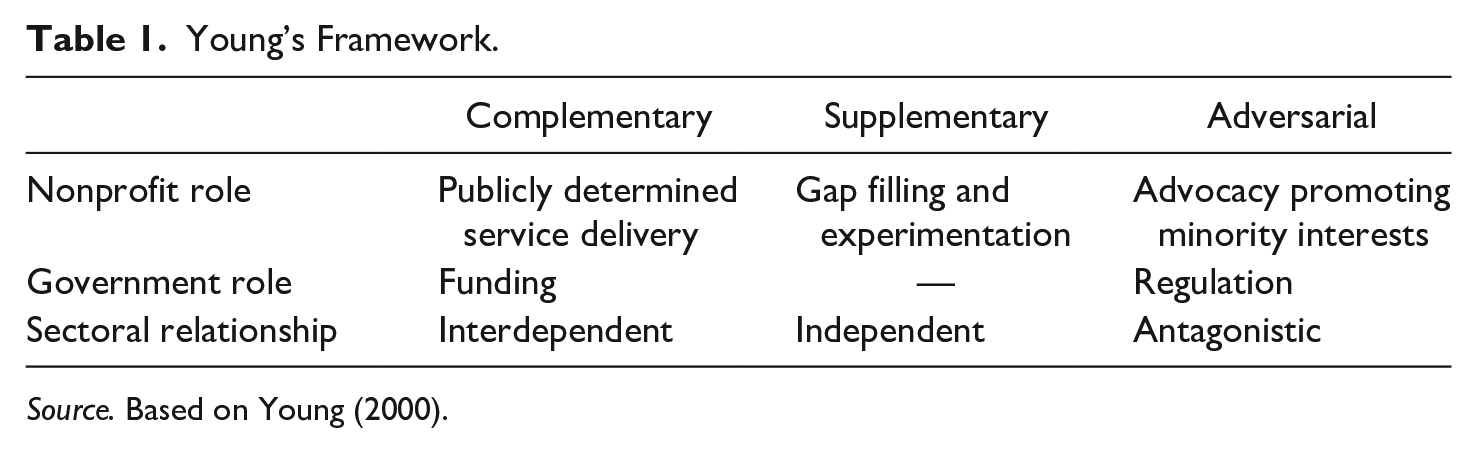
Source. Based on Young (2000).
A third quite different approach to capture sector relations was Adil Najam’s (2000) “4C” framework, which discussed four different government stances based on a somewhat formulaic consideration of congruence or dissimilarity of policy ends and means pursued by the sectors. Najam offers cooperation, complementarity, confrontation, and cooptation as key descriptors to help further unpack the “poorly understood and often simplified” (p. 375) complexities of intersectoral relations. While there is some overlap with both Salamon’s and Young’s arguments, his framework can be understood as a set of strategies the sectors employ to engage with each other within any given type of relationship (Ramanath & Ebrahim, 2010). As such, Najam adds a different dimension by allowing the consideration of concepts, such as cooptation, that are frequently referred to in the literature but not as a discreet relationship type.
Toward a Broadened Typology of Sector Relations
These early conceptualizations each provide valuable building blocks toward a broader typology of government–nonprofit relations that more fully captures the emerging realities of evolving sector relationships, including the growing willingness to repress civil society, but also contrary developments that see improvements for nonprofits in authoritarian contexts. As the latter arguably seeks to emulate the Western partnership paradigm (Salamon & Toepler, 2015) with authoritarian characteristics, the “collaborative model” is still applicable, but not nearly as predominant a guidepost anymore as it was in the initial exploration of sector relations across Western democracies three decades ago.
Young’s (2000) framework principally captures the growing complexity well but requires further specification in the variety of roles that both sectors play across all three relationship types. In this respect, the authoritarian experience foregrounds issues that are rarely emphasized in Western contexts. The use of legal regulation to favor certain parts of the nonprofit sector, while other parts are restricted, for example, has not received sufficient attention in government/nonprofit relationship analyses of the past. Likewise, governments seek nonprofit expertise by involving them in commissions, working groups, or other fora in ways that are often not integrated into discourses around advocacy. This in turn draws attention to questions of strategic intent. Are such efforts attempts at cooptation or, more innocuously, at collaboration? Najam’s 4C framework provides an opening to integrate strategic intent into the relationship typologies, but recent experiences in the authoritarian regime context suggest the existence of additional strategies beyond the initial four.
On a definitional note, we use the term regime to denote the political regimes (i.e., democratic, authoritarian) in which government/nonprofit relations play out. Given the nonmonolithic nature of government, which suggests that different levels of government and various public actors may adopt relationship postures that differ from each other, we hold that different relations frequently co-exist within a given political regime. Therefore, we do not consider the relationship as a regime by itself with set patterns of interaction between government and nonprofits. Rather, government actors make choices about which funding or regulatory tools to use (Salamon, 2002), and nonprofits determine their own actions accordingly, that is, whether or not to accept certain forms of government support or how to engage with government to represent their interests. In this way, our view is more in line with Marwell and Brown’s (2020) focus on governance procedures, as they play out at the micro “street level.” Regulatory governance takes place at the meso-level of the sector but has clear implications for the micro-level, that is, the organizations that experience the effects of the regulation (Toepler & Anheier, 2021; see also Z. Zhang & Guo, 2021). This applies equally to the type(s) of government relations that nonprofits are confronted with. Our argument is primarily focused on the meso-level of analysis, but we acknowledge that the implications for the micro-level bear further specification.
In the following, we explore roles systematically across relationship types and specify variations that can be associated with them. Some of these roles are latent within Young’s argument; others are not. In addition, we utilize the Najam concept to discuss strategies that both sectors can pursue in a given type of relationship. Taken together, this provides a checklist for comparative researchers to identify relationship patterns and variations among them. While, for example, authoritarian regimes show certain similarities in their treatment of NGOs (Toepler, Zimmer, et al., 2020) just as Western countries have long adhered to the partnership paradigm, the extended typology proposed here is intended to pinpoint where significant differences underlie the surface similarities.
Roles
Salamon’s notion of a division of labor (government funding and nonprofit service provision) points to the importance of various roles that both sectors play in their relationship. Ralph Kramer (1981) specified four distinctive roles or functions of nonprofits: service provision complementing the government; social innovation to improve services; advocacy and social change; and value guardianship. Two of these roles are service-focused (provision and innovation) while the other two have more of an expressive character (advocacy and value guardianship). Although most nonprofits are multifunctional, pursuing different combinations of these roles simultaneously (Zimmer, 2010), it is useful for heuristic purposes to differentiate between two basic types—service providers and advocacy organizations—to illustrate how different role performance affects the sector’s relationships with government (Figure 1).
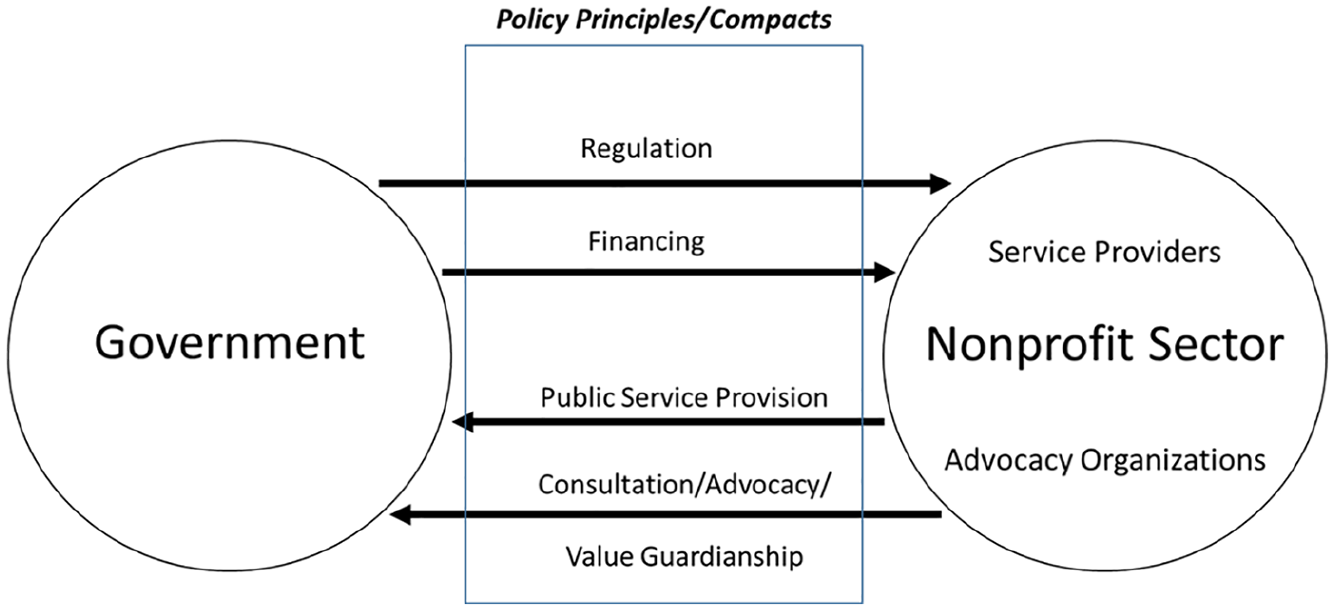
Sectoral relationship roles.
Advocacy for changes in policies and programs on behalf of nonprofits’ clients, communities, and values is an important aspect of the expressive dimension (Salamon et al., 2017). Where governments actively seek input on policy, nonprofits may participate in consultations. These may be done through formal bodies that guarantee nonprofits a voice in policymaking, such as the mandated NGO participation in development planning in South Africa (Nwauche & Flanigan, 2022). Formal consultation opportunities are a form of direct, insider advocacy as opposed to indirect advocacy through public campaigns (Mosley et al., 2020). Within this role, nonprofits also promote values in their interactions with government beyond the context of particular policies, which, where aligned with government-held values, can be a source of legitimization for the state (Toepler, Zimmer, et al., 2020).
On the other side of the equation, core government roles are to secure financing for, and regulate, the activities of nonprofits (Figure 1). Government provides a measure of financial stability and sustainability, allows the sector to scale up its operations, and can increase nonprofits’ legitimacy. However, government support raises concerns for nonprofits about mission drift, conflicting accountabilities, and financial dependency; increased bureaucratization and professionalism; and decreased advocacy, among others (Suárez, 2011; Toepler, 2018). The choice of funding mechanism matters, as some tools have less impact on operations than others: The contracting tool generally provides the government with the highest levels of control.
Legal regulation is another crucial role that needs to be incorporated more fully into relationship typologies. Different aspects of the legal frameworks under which nonprofits operate can be enabling or constraining, and through combinations of those factors, governments frame and regulate the range of options and actions available to nonprofits as a form of regulatory governance (Toepler & Anheier, 2021). Past discussions of sectoral relations primarily focused on the financial aspects and only few efforts linked regulatory regimes explicitly to government relations frameworks. In general though, regulatory regimes occur on a spectrum from hostile to wary to workable (Breen et al., 2019; also DeMattee, 2018). Adding the regulation function to the relationship typologies reflects current realities in which governments increasingly weaponize laws and regulation against NGOs (Rutzen, 2015).
The particular specification and relative scope as well as the interplay of the four roles will generally differ by level of government and policy field involved. In some cases, this will follow traditional policy principles or doctrines, such as pillarization in the Netherlands (Burger et al., 1999) or subsidiarity in Germany (Anheier & Seibel, 2001), or it may be negotiated between government and the sector and laid down in the form of compacts (Smith, 2012).
Strategies
As noted above, Najam’s (2000) “4C” framework suggests strategies that both sectors deploy to negotiate the relationship within the parameters set by the interplay of the four relationship roles. This allows a broader consideration of approaches to managing relations that both sectors employ. Acknowledging that nonprofits may deploy these strategies independent of the overall type of relationship they have with the government (Ramanath & Ebrahim, 2010) and vice versa, the principal strategies for nonprofits are to seek collaboration, conflict, or being complicit. The government in turn may seek to control nonprofits, coopt them, simply condone their activities, or seek collaboration and conflict as well.
Collaboration
Most nonprofits do not have explicit political change among their mission objectives but pursue charitable and other goals by providing services or advocating on behalf of their community or client groups. These largely apolitical nonprofits seek to cooperate with government to finance service delivery. Government provides support for services determined through the political process.
Conflict
Pursuing more political goals, advocacy nonprofits and other groups promoting various, at times conflicting values engage in public efforts to change government policies and programs, or otherwise go against politically held value propositions. Governments can counter these efforts with increasing restrictions up to outright suppression. In response, NGOs are forced to seek various coping strategies to ensure survival, which range from forgoing certain funding opportunities and re-characterizing activities in a way that appears less threatening to government to moving activities abroad or online and registering as businesses to escape measures targeted at NGOs (Toepler et al., 2020).
Complicity
Nonprofits can also be actively supportive of the state and are not necessarily a panacea for democratization. This may include Quasi-NGOs (Quangos) or GONGOs (government-organized NGOs) that are run on behalf of, and inspired by, the government, as well as private nonprofits controlled by elites or other social factions that have something to gain from the system.
Control
Although Salamon argued interdependence between the sectors (with government potentially having as much to lose from a withdrawal than nonprofits), the power within the relationship rests mostly with the government partner controlling key resources, including the regulatory framework. Even in collaborative, nonconflictuous relationships, governments exert some degree of control, whether through legal regulations or through the structure of funding tools.
Condoning
Nonprofit activity outside the core areas of government interest or that does not challenge the state’s primacy in a given field may be tolerated, or condoned, by the government provided it does not stray beyond government control. This corresponds to administrative legitimacy understood as “the implicit permission of individual government leaders, which can usually be interpreted as unspoken support from the government” (Z. Zhang & Guo, 2021, p. 83).
Cooptation
In Selznick’s (1949) original discussion of cooptation, it is a governance strategy to neutralize resistance by absorbing opposition into public procedures through limited power sharing. As such, cooptation is better understood as an alternative or supplementary strategy to repression in situations where state and nonprofits are in conflict. While the power sharing aspect is frequently neglected, public funding is often considered prima facie evidence of cooptation. However, cooptative intent requires resistance against government action, which is not generally the case with service providing nonprofits seeking cooperation and perceiving themselves as in alignment with government objectives.
An Extended Typology of Government–Nonprofit Relationships
Based on this expanded consideration of relationship roles and strategies available to both sectors, we can now propose an extended typology on the basis of Young’s complementary, supplementary, and adversarial relations framework. In doing so, we describe Weberian ideal types—heuristic devices that focus attention on key features and characteristics of social phenomena without necessarily capturing full details of discrete cases. By accentuating core elements of a social construct, ideal types provide analytic guideposts for evaluating and analyzing specific case studies comparatively (Swedberg, 2018). Understood this way, the typology allows identification of prevailing funding patterns of nonprofits, distinguishing explicitly between service providers and nonprofits pursuing advocacy and value expression, and predicting the nature of regulatory frameworks. The prevailing characteristics of the three ideal types are summarized in Table 2.
Expanded Government–Nonprofit Relationship Types.
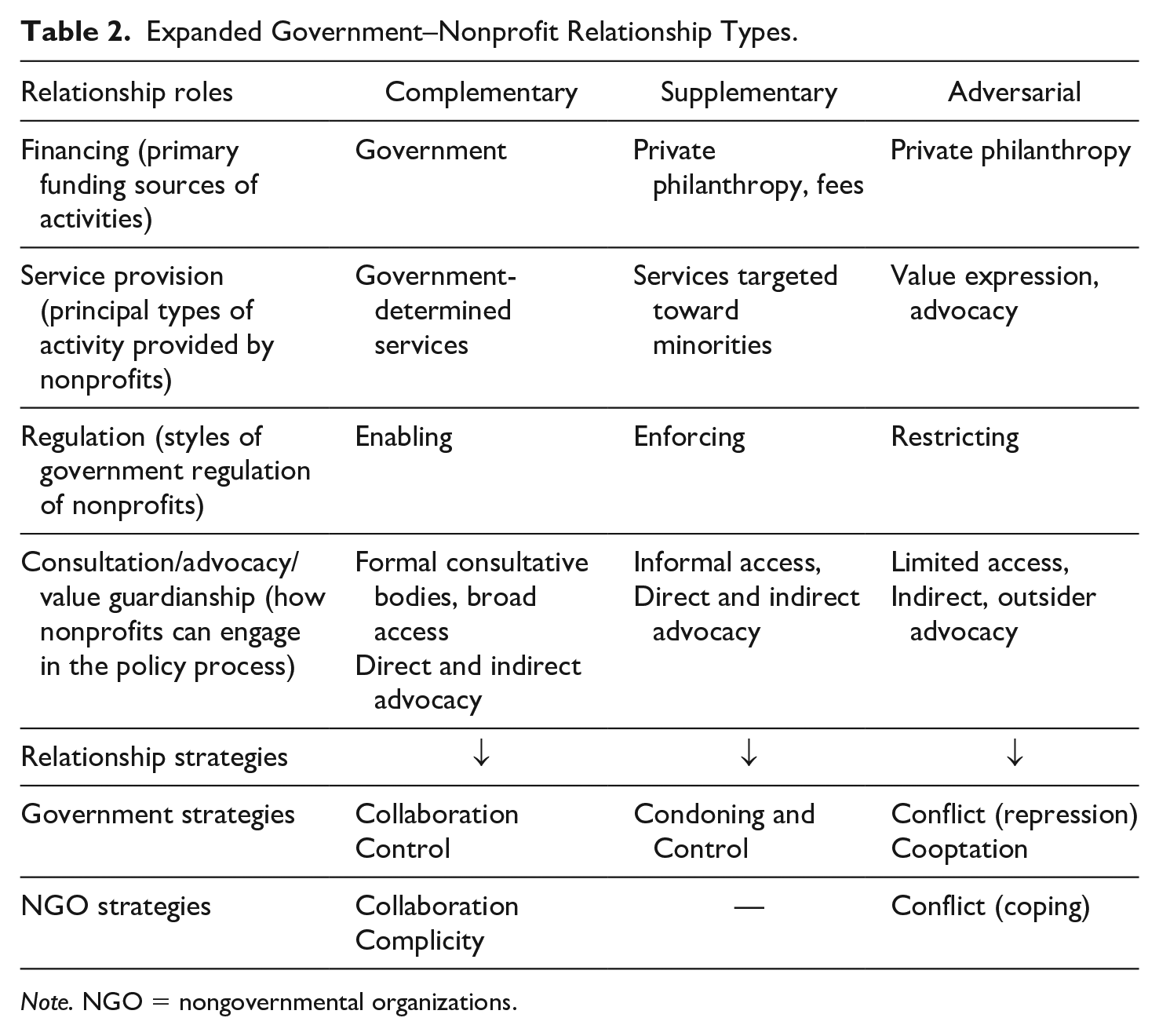
Note. NGO = nongovernmental organizations.
Complementary Relationships
This relationship type primarily involves nonprofits catering toward majority interests and focused on providing services on behalf of, and determined by, the government (Young, 2000). These nonprofits may be accorded special privileges, such as the deductibility of donations for 501(c)(3) public charities in the United States or eligibility to participate in certain public funding programs. As the focus is on services that the government finds desirable, public funding dominates nonprofit revenues, and with government actively stimulating nonprofit service provision, the regulatory framework is generally enabling. Nonprofits are considered partners and may be invited to participate in policy development through formal consultative bodies or arrangements. Involving nonprofits in advisory groups or task forces is an increasingly common feature of collaborative governance (Ansell & Gash, 2008; Mosley, 2020). Open access points in the policymaking process provide opportunities for lobbying and other direct advocacy tactics allowing nonprofits to work within the policy system. The complementary type calls for a collaborative relationship, but one in which the government still exerts some degree of control, through the use of certain funding tools, for example. To the extent that government uses funding and other policy tools to steer service delivery into government-preferred directions, nonprofits become complicit in implementing the state’s agenda. This complicity is frequently seen as cooptation in the literature, although it lacks the underlying conflicts that are the prime motivator for efforts to coopt (Toepler, Zimmer, et al., 2020).
Supplementary Relationships
Nonprofit services are geared toward minority preferences (Weisbrod, 1975), which makes governments less inclined to provide financing. Private philanthropy and earned income are accordingly the prevailing funding sources. Regulation has more of an enforcement character: The government provides oversight to ensure that nonprofits play by the rules and are not misused for profiteering or politics. Nonprofits do not carry enough weight to get formally involved in consultations but generally have access, particularly at the lower levels of government, to engage in the full range of advocacy tactics. In the United States, most noncharitable nonprofits, for example, might fall into this type of relationship. Governments exert control through the general legal framework, but mostly condone, or tolerate, activities allowing nonprofits to pursue their work within the legal guardrails but are not actively supportive. Without active efforts to improve frameworks, operating conditions for nonprofits can deteriorate over time (Anheier & Toepler, 2019).
Adversarial Relationships
This type of relationship with the government will be more common among expressive nonprofits where advocacy and value promotion foreground service provision (Dupuy et al., 2021; Toepler et al., 2020), although the latter may still be undertaken. Funding comes mostly from philanthropic sources, as advocacy activities are rarely supported by government grants and do not lend themselves to fee-charging beyond membership dues. The political nature of nonprofits comes with fewer benefits (e.g., U.S. social welfare 501[c](4) organizations can engage politically but not accept tax deductible donations). Repressive and restrictive laws and regulations are generally most prevalent where sector relations have an adversarial character. Likewise, nonprofits will have fewer access points and be forced to rely more on indirect advocacy by attempting to influence public opinion or being more disruptive and confrontational. Accordingly, being forced to take on the government from the outside, the primary NGO strategy is conflict. Sometimes, governments in an adversarial relationship may also use consultative bodies and fora for cooptation by involving critical NGOs in discussion without granting access to the true decision-making process and thus neutralize resistance, before having to resort to repression. But legal restrictions on core aspects of NGO operations are the hallmark of the government strategy in this pattern. This in turn forces NGOs to adopt coping strategies to adapt their work and ensure survival.
Discussion: Applying the Typology to the Cases of Russia and China
In the following, we apply this framework and heuristic tool to Russia and China “to confront the ideal type[s] with reality” (Swedberg, 2018, p. 188). Ideal types reflect “constructed meaning of hypothetical actors” (Swedberg, 2018, p. 186) based on assumptions that the actor acts rationally with full information and situational awareness and without making mistakes. Ideal-typical perspectives or patterns facilitate deeper analysis of the complexity of government–nonprofit relations, particularly in a comparative context where existing models are still wanting (Anheier et al., 2020). It gives the approach its heuristic quality, as deviations from the ideal type may reveal relaxed assumptions. For empirical analysis, comparing the ideal type to reality allows analysts to focus on the specifics and individuality of discrete empirical phenomena (Swedberg, 2018). Or, in other words, they are a comparative “analytical construct that serves the investigator as a measuring rod to ascertain similarities as well as deviations in concrete cases” (Coser, 1977, p. 223). The purpose of our cases is to show that the relationship principles embodied in our framework are rooted in empirical reality. Accordingly, the following discussion does not attempt a comprehensive examination of government/nonprofit relations in either country but focuses on the specific aspects of the three relationship types that our framework suggests.
Russia
After the collapse of the Soviet Union in 1991, Russian civil society emerged supported with considerable assistance from the West, while the “dominant attitude of the Russian government in the 1990s was one of well-wishing noninterference” (Salamon & Benevolenski, 2020, p. 216). The post-1991 relationship between the sectors was supplementary in nature. The Yeltzin government tolerated civil society “with relatively low barriers to establishing NGOs, but [did not provide] much direct support either” (Benevolenski & Toepler, 2017, p. 65). The noninterference however also extended to the enforcement of regulation, allowing a rampant misuse of NGOs even for criminal purposes. As such this deviation from the supplementary ideal type was not benign but a form of detrimental policy neglect (Anheier & Toepler, 2019) that is consistent with the type.
Beginning with Vladimir Putin’s first term as president in 2000, the state’s regulatory and interventionist eye soon turned toward civic activity and organization (Ljubownikow et al., 2013). The state’s approach toward NGOs since then has been simultaneously supportive and restrictive. While this “dual reality” (Salamon et al., 2015) of the sector suggests the coexistence of different government–nonprofit relationship types, past literature often focused particularly on advocacy, rights-protecting, and democratization NGOs (Daucé, 2014; Flikke, 2018; Sundstrom, 2011). Government policies, however, also established forms of complementary and supplementary relations that have been less visible but nonetheless impactful. In general, the state approaches NGOs as gosudarstvenniki, “supporters of the state,” (Oversloot, 2007, p. 43) and those that adhere to that label see their legitimacy unchallenged. To further that goal, the state has taken various measures to capture social elites and influence the public sphere to shape a “civil society po-russki” (Ljubownikow et al., 2013).
Adversarial relations
National policy initiatives directed against Western-funded NGOs in the Putin era were quite devastating for the targeted advocacy-focused NGOs, beginning with the 2006 “NGO Law” and its crackdown on external funding. This led to an overall decline of foreign support for Russian NGOs and a curtailing of democratization efforts (Crotty et al., 2014). NGOs working on human rights and democratization usually do not have access to government funding and must secure their operations through donations, crowd-funding, and volunteer labor. The state’s adversarial approach toward advocacy NGOs is not only founded on their contestation of the political status quo but also on their proclamation and circulation of liberal values that oppose the state’s own conservative value approach toward Russian society (Fröhlich & Skokova, 2020).
Restrictions on foreign organizations and Russian NGOs that receive foreign funding and engage in “political activity” were tightened with the Foreign Agents Act of 2012. The definition of political activity is quite broad and formulated ambiguously to allow much discretion in its application to unwanted NGOs. Although only a few organizations are listed as Foreign Agents, the law has a signaling function cautioning all NGOs contemplating activities that could be construed as political. Either as a result of pressure to register as a foreign agent or to avoid that accusation, Western-supported advocacy NGOs tend to refrain from official registration or voluntarily forgo foreign money. The former closes the possibility to participate in public funding competitions and makes them fully dependent on private donations and voluntary work.
Repressive policies have been implemented differently on the regional level leaving more or less leeway to NGOs (Salamon et al., 2020). Moreover, the Russian government is turning to the expertise of certain advocacy NGOs to develop policy or address urgent but neglected issues. Thus, restrictive policies are flanked by consultative relations in areas, such as police and prison reform, migration, or human rights (Daucé, 2014). Similarly, federal and regional public chambers involve NGOs, including human rights groups, into a more confined and controllable management of state–society relations (Richter, 2009). As a cooptation effort, it comes with considerable opportunities to access both resources and the policy-making process (Richter, 2009). NGOs also adapt to the state’s repression through various coping strategies (Moser & Skripchenko, 2018; Tysiachniouk et al., 2018), including abandoning foreign funding sources; rebranding or recreating the organization; closing the organization down formally to continue work informally or virtually from abroad; or switching the work to another organization, including for-profit legal forms that are not subject to NGO restrictions; and reverting to more covert and indirect tactics of advocacy, such as public education and individual empowerment. In sum, the Russian government brings repression and some cooptation strategies to bear on advocacy organizations through highly restrictive regulation and the suppression of foreign support, which NGOs attempt to counteract with different coping strategies.
Complementary relations
A second stream of policy measures is more consistent with the complementary perspective. While the repressive measures are fairly narrowly targeted at advocacy NGOs with foreign funding and representing Western values, more supportive policies focus on a broader range of Russian nonprofits. A new socially oriented nonprofit organization, or SONPO, status was created in 2010 (Benevolenski & Toepler, 2017), to ease access to public support, in-kind services by governments at all levels and certain tax benefits. For these nonprofits, new public support programs were created in 2011 to support capacity-building and stimulate regional government engagement with nonprofits (Salamon et al., 2020; Toepler, Pape, & Benevolenski, 2020). Another program was created in 2012 to stimulate greater nonprofit involvement in social service provision to increase the quality and availability of services. A new public procurement law in 2013 and social assistance law in 2015 further institutionalized SONPOs as providers of government-funded social welfare services. A third and currently major form of direct financial support is presidential grants for the implementation of socially important projects (Fröhlich & Skokova, 2020). For these, indications are that state funding is preferring NGOs that carry Soviet cultural legacies (Spencer, 2010) and develop operational objectives that positively relate to regime-legitimizing discourses (Fröhlich & Skokova, 2020). Moreover, some nonprofits are often intertwined with state structures and complicit with the authorities, including all-Russian organizations for support of particular social groups, such as war veterans or people with disabilities (e.g., Fröhlich, 2012), and nonprofits focusing on promoting the state’s policy agenda, such as patriotic education. Among the SONPO are also “outsourced” social service institutions that subsequently serve as “marionettes” for regional governments or public institutions to absorb resources (Cook & Vinogradova, 2006).
Taken together, these measures match the logic of the complementary type and suggest that Russia is attempting to emulate Western patterns of government/nonprofit collaboration with the majority of nonprofit service providers that have seen more enabling regulatory environments and greater government involvement in financing nonprofit service provision. In competing for state support and adopting conservative value narratives (Fröhlich & Skokova, 2020), NGOs are complicit in strengthening regime legitimacy. In addition, social service providers typically participate in consultative bodies on social policy issues at the federal and regional level, such as public chambers and parliamentary working groups (Fröhlich, 2012). Furthermore, service-providing NGOs have developed a broad range of informal and formal advocacy activities to represent their clientele without questioning the dominance of the state (Ljubownikow & Crotty, 2015; Toepler & Fröhlich, 2020), and with a preference for collaborative, insider advocacy (Pape & Skokova, 2022).
Supplementary relations
Certain societal problems or needs of particular groups that have been neglected or outright repressed by state policy are addressed by informal citizen groups or formalized NGOs providing emergency relief, social or medical support, but also legal consultation and advocacy for prison inmates, the homeless, victims of domestic violence (Davidenko, 2020), human trafficking victims (Buckley, 2018), sexual minorities, people with HIV/Aids (Pape, 2018), and drug addicts. Those groups work in parallel to state structures in a supplementary mode and are largely condoned by state authorities but still have to contend with general regulations applied in oppressive and invasive manners. Such organizations have usually no access to state funding and fund their operations through donations and voluntary work. However, because they take on societal problems the state is incapable of addressing, or unwilling to care for officially, informal consultative and advisory ties to the relevant authorities exist in most cases, such as with regard to refugees and prison inmates.
China
In China’s well-researched third sector (e.g., Levy & Pissler, 2020; Z. Zhang & Guo, 2021), social organizations act within a generally restraining political–legal framework and under state control that is particularly restrictive of private political action (Levy & Pissler, 2020). Economic reforms and neoliberal economic policies led to a retreat of the state from its social responsibilities and opened windows of opportunity for social organizations (Lei & Walker, 2013). This caused a continuous growth of the nonprofit sector, which has moderated only since 2012. Legal restrictions increased but did not impede the growth of the sector entirely. After the suppression of the democracy movement in 1989, the much debated “dual management system” (shuangchong guanli tizhi) was introduced and remains in use. It stipulates that each NPO needs to work closely with two different government agencies, one that functions as its professional supervision unit (yewu guanzhu danwei, PSU) and the other as its registration authority. Recent Communist Party documents demand that nonprofits set up primary-level party organizations if they employ three or more Party members. Against this background, the basic contours of the three relationship patterns are traceable.
Adversarial relations
No specific types of organizations are singled out for special restrictions in China. Advocacy in general, however, is largely suppressed with the exceptions noted below. Pure advocacy organizations are very rare (Yuen, 2018) and tend to be grassroots organizations (GROs) lacking formal legal status. For these organizations, the Charity Law of 2016 (see below) can also be considered restrictive or at least precautionary, because it opens up funding opportunities only for formally registered organizations. Among the most prominent areas of nonprofit activity that are notably not included in Charity Law’s list of direct beneficiaries are advocacy of any sort, legal advice, labor rights, human rights, and religious groups (Spires, 2020). Advocacy is rarely voiced in formal organizations anymore but rather informally (Fu, 2018) and/or online (Göbel, 2021).
The Law of the People’s Republic of China on the Administration of Activities of Overseas Non-Governmental Organizations within the Territory of China (Foreign NGO/FNGO Law) regulates the registration and management of foreign NGOs while effectively impeding their operations and prohibiting support of the political activity. Before the FNGO Law came into effect at the beginning of 2017, it was already difficult for FNGOs to establish and work in China. The most promising ways to engage were either to establish a Chinese foundation or register a foreign foundation’s representative. Many FNGOs found alternative ways, such as registering as a general representative office with the State Administration of Industry and Commerce or not registering at all, which was illegal. Although the authorities tolerated this practice to a certain extent, daily operations under these circumstances were difficult (Hippel & Pissler, 2010).
With the FNGO Law, FNGOs can either register as a representative office and then operate within the permissible fields of activity in which case they need a PSU; or they can register temporary activities with a legally registered Chinese partner organization. These regulations have mainly been interpreted as restricting foreign NGO activities. Of an estimated 7,000 FNGOs active in China by 2016, only 563 organizations have registered or re-registered since January 2017 according to the Ministry of Public Security, many of which are professional or trade associations and chambers of commerce. The most difficult aspect for foreign organizations is the requirement to register with the Public Security Ministry and its subordinate police offices on the different administrative levels to set up their representative office or prepare a project. This puts them automatically into the adversary category of state–nonprofit relations. Relatedly, FNGOs are expressly prohibited from engaging in, or funding others to engage in, political or religious activities.
This is a mark of the conflict strategy of the state, as funding restrictions in addition to the prohibition of establishment reflect the strictest form of the “system of graduated controls” over politically antagonistic organizations (Kang & Han, 2008), leading ultimately to suppression (Fu, 2018; Ong, 2018). However, in what has been termed “embedded activism” (Ho, 2007), the Chinese government allowed and channeled environmental activism through restrictive spaces to force local government action, in a form of cooptation. NGO coping strategies include exploiting divisions between local and the central governments, that is, O’Brien and Li’s (2006) rightful resistance; mobilizing and broadening constituencies for public protests and preempting government action (Steinhardt & Wu, 2016); empowering individual clients (Fu, 2018); or switching to business firms or social enterprise to escape the NGO regulation (Spires, 2011).
Complementary relations
The establishment, registration, and management of Chinese NPOs (including the dual management system) are governed by administrative regulations which provide for three different officially permissible legal forms: membership-based associations (shehui tuanti or “associations”), social service organizations (shehui fuwu jigou, SSOs), and foundations (jijinhui). These types of organizations and especially SSOs form the backbone of official collaborative relationships. Until 2016, funding was predominantly provided by the government and to some extent government-sponsored public fundraising foundations (gongmu jijinhui), which in addition to a few large semi-governmental organizations, such as the China Red Cross Society, were the only ones allowed to raise funds publicly before. In addition, a growing number of mostly privately established nonpublic fundraising foundations offered some private funding but mainly conducted their own projects.
The Charity Law of 2016 extends the privilege of publicly raising funds from a small group of privileged foundations to all legally registered nonprofits that first apply for charity status and then for public fundraising status. The conditions that these organizations need to fulfill include having a 2-year track record working as a charity, a sound internal governance structure, and standardized operational procedures. Gaining that status enables charities to work more independently than before, as they are not limited to raising funds from a “defined group of potential donors” (dingxiang muji) anymore, but it also poses significant administrative burdens, particularly in view of extensive transparency requirements. The law is generally formulated in enabling language; although it does contain restricting regulations and enumerates illegal forms of activities.
China has recently also sought to bolster the involvement of nonprofits in social service contracting (Dong & Lu, 2021) and Chinese nonprofits generally see the prospective “funding influx with enthusiasm” (Zhao et al., 2016, p. 51). This is particularly the case in areas that the government and Communist Party consider essential, that is, trade and commerce, science and technology, public welfare and charity, and urban and rural community services (Levy & Pissler, 2020). Social contracting arrangements were tested first in select pilot areas, including Shanghai and Shenzhen, and this experimentation at the provincial level chartered a course for growing official government support for nonprofits and some level of deregulation (Hu & Guo, 2016) and paved the way for the central government to ease policy nationwide (Y. Zhang, 2015). The Ministries of Finance and of Civil Affairs issued new directives allowing nonprofits to compete for the purchase of service contracts in 2016 (W. Wang & Snape, 2018).
Consulting roles of legally registered nonprofits are largely accepted and government consultations regularly include them. Government funding has been found to have a profound and differentiated impact on different kinds of advocacy, for example, it is found to enhance “administrative” (direct or insider) advocacy but discourage “media” (indirect) advocacy (Yu et al., 2021). The Charity Law itself is an example for such a consultation mechanism as nonprofits were involved in its legislative process (Zhong & Yang, 2015).
The easing of public fundraising permissions and growing access to social service contracting reflect the collaboration strategy of the government for legally established NGOs that are still subject to the dual management requirement on the more permissive side of the system of graduated controls (Kang & Han, 2008). The party-state nevertheless seeks to increase control by integrating NGOs into longer-range planning efforts (Q. Wang, 2022). The willingness of NGOs to engage with the government-provided funding streams, in turn, reflect their complicity in supporting the state’s output legitimacy.
Supplemental relations
Grassroots organizations and some foundations are active in areas that have been neglected by the government such as services for persons living with HIV/AIDS or LGBTQ groups. The dual management system, particularly the PSU requirement, has generally been the biggest impediment to nonprofit development (Ma, 2006, p. 64) and is the reason for the existence of gray-area GROs. Despite their lack of legal status, local governments have long pursued an unofficial policy of “no recognition, no banning, and no interference” as a way to receive social services and technical expertise from unregistered GROs and to claim credit for it vis-à-vis higher levels of government (Deng, 2010; Spires, 2011). These informal grassroots groups remain in legal limbo and subsist largely on voluntary support through private fundraising and some philanthropic sources. Consultation within supplementary forms of collaboration between local governments and nonprofits (Teets, 2014) does generally occur and has at times even involved cooperation of nonprofits with media and the central government, despite diverging views and goals with the local government. The latter was particularly evident in the environmental area in the early 2000s, where the central government was collaborating with NGOs to control the local governments’ toleration of local environmental pollution (Ho, 2007; Dai and Spires, 2018). Public interest litigation in accordance with China’s Environmental Protection Law evolved as a channel in which NGOs inform policy and lawmaking. Recently, however, many administrative hurdles impede Chinese nonprofit’s public interest litigation in practice (Gao & Whittaker, 2019). Moreover, since 2012/2013 under Xi Jinping, the environment for GROs has become harsher and it has become more difficult for them to work without official registration, as the central government tightens control and organizations refrain from fueling grievances against the state (Spires, 2011). Nevertheless, during the Covid-19 pandemic, private, informal initiatives addressed neglected issues such as pet care during lockdown or provision of hygiene products to female medical frontline staff. This was organized through social media networks and facilitated by volunteers (Hu & Sidel, 2020; Sidel & Hu, 2021; Yang, 2022).
Similarities and Deviations
As a comparative tool, ideal types serve to identify both similarities and deviations in comparing different realities. A key similarity is that all three relationship types are firmly in evidence in both countries. While the supplementary relationship is often neglected between the predominant collaboration and conflict narratives, government/nonprofit relations even in authoritarian contexts are marked not by dual but by triple realities. Among numerous similarities, however, there are also significant differences.
Funding: both regimes use various forms of government support to steer NGO activities into certain fields and activities, and contracting for services has become a tool of choice. Russia appears more centralized with its grant funding schemes, whereas local governments play more of a role as supporters of NGOs in China. This sets off starkly divergent government postures at local and central levels that are not as evident in Russia.
Providers: Russia is less limiting in terms of NGO eligibility for SONPO status, whereas China precludes NGOs that can or will not satisfy the dual management requirements. Supplementary GROs and political advocacy organizations therefore remain in legal limbo outside the legal system.
Regulation: Legal limbo in Russia is mainly created through the Foreign Agents Act, which appears to be more far-reaching and repressive than China’s Foreign NGO Law, although both accomplish the desired task of suppressing foreign support for politically difficult organizations. While SONPO status is roughly comparable to the American charity status (Benevolenski & Toepler, 2017), eligibility for Charity Law privileges is more tightly controlled in China.
Consultation: Consultation is sought by the government in both cases. Advocacy is generally possible as long as it does not challenge state supremacy. Russia has the consultation role more formally institutionalized with its public chambers.
Strategies: Both countries actively seek and encourage collaboration with some types of NGOs but also seek to maintain control. In Russia, this takes place more indirectly through favoring NGOs willing to support preferred value narratives. China establishes control more directly through the dual management system with its professional supervisory units, and the requirement to create party cells. With foreign support cut off and private philanthropic sources still underdeveloped, NGOs seek government funding opportunities and thus risk becoming complicit in furthering the state’s output legitimacy (Scharpf, 1999). In terms of conflict, both countries are repressive of political advocacy. In Russia, political advocacy organizations are principally permissible but heavily restricted and practically defunded. In China, there are not legally permitted, but the central government has “co-opted” environmental NGOs to pressure local governments into compliance with environmental goals. While consistent with the ideal type, it is nevertheless an exception from the overall nature of the adversarial relationship.
In China, the willingness of local governments to cooperate with the gray-area grassroots organizations (Spires, 2011) represents a deviation from the ideal type and posed a significant puzzle for efforts to interpret the nature of government relations. The lack of legal and funding privileges for these organizations did not suggest a fit with the complementary relationship type; the reliance of local governments on their service provision seemed to preclude adversarial relations too. The precarious status of the organizations resulted from a relationship mismatch between local and central governments, whereas the former accepted GROs as collaborators but the latter kept treating them as tolerated supplements. GROs thus fall between the complementary and the supplementary types. The growing difficulties for GROs to operate without legal status in the Xi Jinping era may well indicate that the central government has become more aware of the mismatch and intends to move them from the supplemental to a complementary pattern with more official cooperation and also greater control.
Another important observation is that in both countries the funding, regulation, and consultative role configurations of each type apply to different parts of the nonprofit sector, which suggests several potential conclusions: First, national “nonprofit regimes” (Salamon et al., 2017) may well exist and explain the evolution of the nonprofit sector along its country-specific institutional pathways but do not provide a sufficient approximation of the types of government/nonprofit relations that are likely to exist. Researchers need to explore the full range of relationship types to gain a more comprehensive understanding of the dynamics in any given country context and should not presume that prevailing welfare regimes or the sector’s social origins predict any particular type of relationship. This is consistent with Z. Zhang and Guo’s (2021) suggestion, based on a review of the Chinese literature, to move away from “grand theories” at the macro-level.
Furthermore, the suggestion that different parts of the sector may be subject to different relationship types may support the notion to de-emphasize sectoral in favor of governance perspectives (Marwell & Brown, 2020, p. 244), or to focus on the institutional dynamics inherent in policy fields instead. Policy fields differ in available public funding arrangements and field-specific regulations or governance processes that suggest different relationship configurations (Grønbjerg & Smith, 2021). Concerns about cooperation with the government, for example, are common in fields where government prefers the contracting tool (Toepler, 2018). How well our ideal types hold up within and across various policy fields remains to be seen. Nevertheless, our case discussions underline the utility of an expanded typology as a heuristic tool for comparative research that covers the complexity of nonprofit–government relations across different regime types.
Conclusion
The shrinking or closing space perspective focused primarily on efforts by authoritarian regimes to cut off foreign funding to advocacy NGOs promoting democracy and Western values that are perceived as politically threatening. At the same time, many authoritarian countries introduced public management instruments, including intensified involvement of nonprofits in service provision through competitive tendering (Zimmer & Smith, 2021). This suggests the emergence of divergent government postures vis-à-vis different parts of civil society in many countries beyond the adversarial lens that has been the primary analytical focus of the closing space literature. As a result, the phenomenon is neither unidirectional nor one-dimensional: While some spaces are closing or shrinking, others are expanding (Anheier et al., 2019; Toepler, Zimmer, et al., 2020).
To capture this new complexity of intersectoral relations, we adapted classic conceptualizations of nonprofit–government relationships into an expanded typology that introduces various roles and strategies under three core relationship types and focused on authoritarian cases. Government relations, however, are also in flux elsewhere, including the Western democracies, where post–World War II partnership patterns have been weakened by neoliberal market orientation. Accordingly, a renewed interest in conceptualizing the relationship is emerging as exemplified by Marwell and Brown’s (2020) and Grønbjerg and Smith’s (2021) recent frameworks.
Both of these frameworks are considerably broader in scope but nevertheless compatible with ours, as all approaches agree on core variables that define the relationship (funding, regulation, advocacy). The key difference is that our focus is on sorting out the different dynamics of the common functional core by suggesting specific combinations of these factors that generate different relationships and strategies that both sectors adopt, while the other frameworks aim at shifting the overall discussion toward governance theory and policy field analyses. Yet, we believe that all these frameworks are fundamentally complementary. Our extended specification of Young’s relationship types slots easily into Grønbjerg and Smith’s (2021) field analyses. Likewise, as core variables also do not disagree with the governance take, the typology can also, at least in part, aid the future research that Marwell and Brown (2020, p. 235) call for to explore “a potentially significant divide between democratic and authoritarian regimes.”
In applying the framework to comparative research in particular, there are some limitations that should be noted. We have kept our brief analysis largely to the central/national government level, although the Chinese case hints at differences in the relations with nonprofits between various levels of government. Likewise, significant regional differences have also been noted in the Russian case, suggesting that greater attention on the subnational level is needed even in centrally controlled authoritarian contexts (Salamon et al., 2020; Toepler, Pape, & Benevolenski, 2020). This takes on heightened importance across the global South, where foreign and supra-national government interventions potentially add different relationship patterns to those of domestic governments, and indigenous NGOs have to balance multiple, at times competing patterns in their interactions with different government entities. As Bano (2019) shows, the West’s good governance agenda has led international donors to force NGO partnerships on governments in the Global South that are not always welcome and frequently resented by the government employees involved.
Conversely, most nonprofits are multifunctional entities that perform multiple roles and functions simultaneously (Zimmer, 2010), and few are the pure service providers or advocacy organizations as which they are cast in the ideal types. In reality, the functions build on and reinforce each other, and in pursuing them, individual organizations may experience conflicting patterns at the same time. An example is the Moscow Helsinki Committee, a prominent Russian human rights organization, which chose to voluntary forgo international funding for its advocacy activities to avoid falling under the Foreign Agents Act. As a consequence, most staff had to be dismissed. The remaining employees worked on “service-related” projects, such as combating police corruption, funded by Presidential Administration grants (Benevolenski & Toepler, 2017).
This raises additional questions for future research to explore how well our ideal-typical typology holds up when applied to policy fields, as noted before. Are adversarial relations restricted to fields that are purely or largely advocacy-focused, like human rights or the environment; and collaborative relations to social welfare fields? In either case, the government/nonprofit relationship typology as a heuristic device allows analysts to sort through these various levels and draw closer attention to the broader complexities of sector relations across different political regimes in cross-national, comparative research.
Footnotes
Acknowledgements
We gratefully acknowledge the feedback received from the editors and the participants of the 50th Anniversary Special Issue authors’ workshop, and of a government relations session at the 2021 ARNOVA Conference, in particular, Lehn Benjamin, Mary Kay Gugerty, Alnoor Ebrahim, Melissa M. Stone, and Dennis Young. And of course, the three anonymous reviewers, who pushed for significant improvements of our arguments. Responsibility for any shortcomings remains firmly with us alone. An early version of the argument in this paper was presented at the Theories, Issues, Boundaries Section Colloquy during the ARNOVA’s 2019 Conference.
Declaration of Conflicting Interests
The author(s) declared no potential conflicts of interest with respect to the research, authorship, and/or publication of this article.
Funding
The author(s) received no financial support for the research, authorship, and/or publication of this article.
