






Abstract
Whether by embezzlement, theft, or other illegal actions, not-for-profit organizations (NFPs) must report significant asset diversions (i.e., fraud) on IRS Form 990. Given the inherent delay in providing annual tax filings, NFPs may choose to voluntarily alert donors to occurrences of fraud in a timelier manner. Prior research has not yet examined the effects of the source or context of such disclosures. In this study, we examine how the source of an NFP’s voluntary fraud disclosure affects donors’ subsequent giving decisions. We find that differently-sourced voluntary fraud disclosures lead to divergent levels of donor backlash depending on a donor’s prior involvement with the organization. Specifically, involved donors respond more favorably to a fraud disclosure made by the board of directors versus one made by management. Our findings have implications for how NFPs can communicate with donors about fraud and potentially minimize post-fraud organizational damage.
Introduction
In this study, we examine how voluntary fraud disclosures made by not-for-profit organizations (NFPs) affect donor backlash (i.e., donors’ negative perceptions and subsequent giving decisions). Fraud threatens an NFP’s accountability as well as the resources available to effectively carry out its mission in the future (Bryce, 2007; Burks, 2018; Harris et al., 2024). NFPs that experience a fraud tend to exhibit subsequent declines in contributions, and over 25% of NFPs do not survive beyond three years following a fraud (Archambeault & Webber, 2018).
Asset diversions are believed to be the most common type of fraud in NFPs (Association of Certified Fraud Examiners [ACFE], 2016; Greenlee et al., 2007). When “significant” resources (i.e., more than $250,000, or 5% of total assets or gross receipts) have been diverted away from their intended and authorized purpose, whether by embezzlement, theft, or other illegal actions, an NFP must report this asset diversion in Section IV of IRS Form 990 and discuss the relevant facts on the related Schedule O (Internal Revenue Service [IRS], 2023).
However, NFP fraud of any amount can signal a severe violation of trust for both NFP stakeholders and the general public (Chapman et al., 2022; Kummer et al., 2015; Ohalehi, 2019). In 2023, the majority of NFP fraud cases involved amounts below the IRS reporting threshold, with a median loss of $76,000 (ACFE, 2024). Given the inherent delay in the availability of annual tax filings, as well as the fact that most NFP frauds fall below the Form 990 reporting threshold, donors may learn about NFP fraud from outlets other than Form 990, such as the media or voluntary organizational disclosures (Grimmelikhuijsen et al., 2018). Media coverage of NFP fraud, which usually occurs before Form 990 is filed, increases the decline in donations that tends to follow a fraud (Harris et al., 2024). Accordingly, many NFPs choose to voluntarily disclose fraud in a timelier manner (relative to the 990 disclosure) in the interest of transparency and to “get in front of the story,” which can blunt potential criticisms of obscuring relevant facts (Ortega-Rodríguez et al., 2020; Willems & Faulk, 2019). Voluntary disclosures may occur via direct donor contact, press releases, and/or communiqués to charitable ratings agencies, and they can be from an NFP’s management, its board of directors, or an unattributed organizational source.
While prior research has explored donor responses to third-party vs. organizational fraud disclosures (Harris et al., 2024; Willems & Faulk, 2019), to our knowledge, no prior studies examine differences in the specific source of organizational disclosures—be it management or the board of directors—or taken into consideration a donor’s prior involvement with an NFP when analyzing how they respond to such disclosures. Professional standards state that management, who is hired by and has a duty to report to the board of directors, should emphasize fraud prevention and deterrence (American Institute of Certified Public Accountants [AICPA], 2011; Jegers, 2019). However, the board of directors is the ultimate governance body in an NFP and is more commonly associated with accountability and transparency (Brown & Pritchard, 2006; Green & Griesinger, 1996). Given this tension, it is yet unclear whether donors view fraud as a dereliction of duty by management or a lack of good governance from the board (Feng & Greenlee, 2024; Harris et al., 2024).
Using the framework of Expectancy Violations Theory (EVT), which contextualizes individual responses to sudden changes in information environments, we use an experimental setting 1 to analyze donor responses to a voluntary fraud disclosure varied by source (the board of directors, management, or “the organization”; Burgoon, 1993). As fraudulent financial activity is an unanticipated betrayal of the trust and cooperation between NFPs and their donors, we propose that EVT assists in categorizing and formalizing these “surprises” in the relationship. We also test whether prior donor involvement with an organization mitigates negative reactions to fraud disclosures through the lens of Affective Self-Affinity Theory, a framework of individual, relationship, and identity-based congruence to organizations (Aspara et al., 2008).
We find that differently-sourced voluntary fraud disclosures lead to divergent levels of donor backlash depending on the donor’s prior involvement with the organization. Specifically, donors with high levels of involvement with an NFP organization respond more favorably to a fraud disclosure made by the board of directors than one made by management, and when management discloses a fraud, there is no measurable difference in donation amounts between those with or without prior involvement.
We contribute to the emerging literature on how donors respond to NFP fraud disclosures. While researchers have studied the magnitude of fraud (Willems & Faulk, 2019), the effects of information asymmetry (Ling et al., 2020), and the presence of third-party disclosure (Harris et al., 2024), we are the first to examine the sources of voluntary fraud disclosures and how such disclosures interact with a donor’s prior involvement with an NFP. Although prior literature has established that on average, donor reactions to fraud are overwhelmingly negative (Archambeault & Webber, 2018; Harris et al., 2024), we find that a fraud disclosure made by the board of directors can potentially mitigate donor backlash from highly involved donors. Our results offer practical insights for NFPs’ communication strategies related to relaying negative information. We also provide evidence that our theoretical frameworks generalize into NFP-sector financial decisions, and we suggest areas for future research on these topics.
Literature Review and Hypothesis Development
Background
NFPs have a responsibility to provide assurance to donors and other interested parties that their resources are being stewarded in a manner that aligns with the organization’s mission and the donors’ intent (Harris et al., 2022). Largely precipitated by the Sarbanes-Oxley Act of 2002 (Benzing et al., 2010), changes made to IRS Form 990 in 2008 provide donors and other NFP stakeholders with enhanced information regarding asset diversions. However, Form 990’s mandatory disclosures are limited to frauds above a threshold of $250,000 (or 5% of total assets or gross receipts) and provide limited details at the discretion of the issuer (IRS, 2023).
Using data from these tax fillings, Harris et al. (2017) find that NFPs with good governance are less likely to experience an asset diversion, and both Burks (2018) and Harris et al. (2024) find that donations tend to decline following the disclosure of accounting-related problems (e.g., internal control deficiencies, asset diversions). However, the depth of these findings is limited due to the relative simplicity of the available Form 990 fraud information compared with other disclosures. Good governance is thought to be an important factor for NFPs that survive a fraud (Archambeault & Webber, 2018), but it is not known if this is due to reasons such as the board’s guidance of management, the adoption of specific policies and procedures, and/or the employment of proactive communication strategies in the wake of such an event.
Skinner (1994) finds that for-profit organizations which voluntarily disclose negative news in a timely manner may mitigate the litigation risk and reputational harm associated with disclosing undesirable information. While the literature has not yet examined the effect of such disclosures in a not-for-profit setting, it is known that NFP fraud results in a severe violation of donors’ trust (Harris et al., 2024; Ohalehi, 2019), and both researchers and practitioners have an interest in understanding this violation and examining ways in which trust might be repaired and/or restored (Chapman et al., 2022; Harris et al., 2024; Willems & Faulk, 2019).
Harris et al. (2024) find that “transparency” on Schedule O helps mitigate the losses stemming from an asset diversion. In their analysis, they group any NFP that leaves Schedule O blank as “not transparent” while all others are coded as “transparent” regardless of the quantity or detail of the content provided. They compare donations following an asset diversion between various permutations of organizational and/or media disclosure and find that media coverage of a fraud further depresses contributions compared with Form 990 disclosure alone, but transparency on Schedule O helps mitigate donors’ negative reactions. The authors notably recognize that the quality of information contained in Schedule O varies greatly (Harris et al., 2024). While their study provides valuable insight into donors’ responses to fraud disclosure, the methodology utilized precludes a causal relationship. To our knowledge, no research to date has causally examined the donative reactions to fraud disclosure sources, voluntary or otherwise.
While the requirement to report asset diversions on Form 990 remains, NFPs can also alert donors to occurrences of fraud through methods such as direct donor contact, press releases to the media, and/or communiqués to charitable ratings agencies (Dethier et al., 2023). Given the inherent delay of disclosing the required information on Form 990, NFPs may initially choose to voluntarily disclose information about a fraud through more timely means than a once-per-year tax filing. 2 One impactful experimental study that explores this practice is Willems and Faulk (2019). Through a series of three trials, the authors compare donor reactions between various scenarios of organizational fraud. This includes “low crisis” versus “high crisis” and voluntary versus third-party disclosure. Contrary to the transparency results of Harris et al. (2024), the Willems and Faulk (2019) study suggests that voluntary disclosure does not mitigate donors’ negative reactions to fraud. They impose a prior, uniform donative relationship on participants and their theory is primarily oriented around the trust between donors and the organizations. Notably, their study does not vary or even identify the source of the disclosure from within the organization.
Another related study examines information search among donors in varied, 990-based fraud disclosure environments. Ling et al. (2020) utilize the construct of donor Value Congruence to explore how the alignment of a firm’s values with a donor’s own values moderates information search decisions. The authors conduct three experiments and find that, for smaller NFP organizations with limited public disclosure, donors with higher value congruence seek out more information in the event of a potential fraud than do low value congruence donors. However, where there is scant information to be found, those high congruence donors are more likely to reallocate contributions to another organization within the same cause/sector. While their study is concerned with donor information search costs and information asymmetry between organizations and donors, it is similar to our study in that we both ask donors to identify a cause and base a manipulation on their response (Ling et al., 2020).
Grimmelikhuijsen et al. (2018) examine the effects on perceived trustworthiness of fraud disclosures made via an NFP’s press release compared with an article in a newspaper and find that individuals tend to respond less favorably to the newspaper article. Specifically, readers of the news article had less trust in the competence of the NFP compared with those who read the press release. However, the wording was not held constant between the two disclosures, so it is not possible to conclude whether participants were responding to the source of the information or the content and tone of the messaging contained within the disclosures. In addition, the study did not measure participants’ prior involvement with the NFP where the fraud occurred, so it is unclear if pre-existing relationships affected responses to the disclosures.
Donors’ Expectations
When faced with multiple options for when and how to report organizational financial information, decision makers must assess “likely actions by the users of accounting information under each method and economic outcomes from such actions” (Ijiri, 1975, pp. 30–31). For this assessment to be well-rounded when a fraud disclosure is under consideration, NFPs should evaluate the impact of both the source of the information as well as a user’s relationship with the organization. Donors will likely use the information to make predictions about the future and to serve as an indicator of how the organization is stewarding its resources (Schipper, 2007), so when a fraud disclosure is made, it is important for it to align with donors’ expectations.
To contextualize the reaction of donors to reports of fraud, we use expectancy violations theory (EVT) to form our predictions regarding the source of a fraud disclosure. EVT defines “expectancies” as primary interaction schemata of an enduring pattern of anticipated behavior(s) that one attributes to a group of people or an individual person (Burgoon, 1993). Expectancies derive from three factors: communicator, relationship, and context. Prior research demonstrates that expectations are closely held even in the face of contradictory behavior, and negative reactions often follow violations of these expectancies, regardless of whether the violation is favorable or unfavorable (Burgoon, 1993). For the purposes of our study, we focus on communicator and relationship expectancies while holding context constant.
Communicator
There are two primary sources from which donors are likely to receive NFP organizational communications: management and the board of directors (Jegers, 2019). Agency theory suggests that there is an inherent tension between these groups due to their differing roles in the organization (Jensen & Meckling, 1976). Managers are responsible for the day-to-day stewarding of an NFP’s resources in efforts to achieve its missional objectives, which often results in a short-term focus, while the board is responsible for effectively guiding the organization in the direction of its overarching missional goals, a role which includes oversight of management and necessarily requires a long-term focus (Fama & Jensen, 1983; Jegers, 2024). Auditing standards hold that while proper oversight by the board of directors is key to deterring fraudulent behavior, direct responsibility for the prevention and detection of fraud is held by an organization’s management (AICPA, 2011). However, it is not clear from prior research if donors associate greater fraud responsibility to management or the board of directors.
A key underpinning of our conceptual framework is the inherent tension between an NFP’s board of directors and its management. While ostensibly unified in their convergent organizational interests, prior research demonstrates that the underlying economic preferences of either party may give rise to conflicting positions. NFP boards, via their oversight mandate, are tasked with holding management accountable for the maximized use of organizational resources. Thus, boards have been categorized as “service maximizers” who strive for full dispensation of revenues toward mission fulfillment and support (e.g., fundraising) efforts, thus aiming for zero profits (Hofmann & McSwain, 2013; Steinberg, 1986). However, absent a specific compensation or incentive/control package to the contrary, NFP management is incentivized toward the accumulation of resources at the expense of support efforts and even mission fulfillment, which leads to them being viewed as “budget maximizers” (Lu et al., 2024; Steinberg, 1986).
This frame presents a persistent dialectic between the two parties. The “service maximizing” board must oversee management and its efficient resource utilization as a natural outgrowth of the board’s economic preferences. Conversely, the “budget maximizing” management’s primary objective is the accumulation of resources, whether for purposes of self-preservation, self-dealing, or prestige (Jegers, 2019). Based on these positions, we posit that fraud disclosure by a board of directors is likely to be viewed as being in alignment with its mandate of providing oversight and accountability, while the same disclosure made by management is likely to be perceived as an indicator of poor stewardship due to management’s focus on the accumulation of resources.
Upon disclosure of fraud, prior research demonstrates that the average donor is likely to have a negative reaction (Burks, 2018; Harris et al., 2024). However, it is tenable that a disclosure made by the board of directors would dampen the negative shock when compared with the same disclosure made by management. A fraud disclosure made by the board represents an affirmation and instantiation of the board’s effective monitoring of management, thus meeting donors’ expectations for the governance role served by the board. Because management is tasked with day-to-day operations and the use of organizational resources, we expect that donors will perceive a greater violation of expectations when management discloses a fraud. In line with EVT, the close conformance of board oversight and monitoring to donor expectations should mitigate the violation of a revealed fraud, thereby resulting in diminished donor backlash when compared with a fraud disclosure made by management. Formally stated, we hypothesize:
Relationship
Donor inclinations are a complex model that may blend ordinarily rational economic decisions into other-regarding economic preferences (De Cooman et al., 2011; Parsons, 2007). We expect that a donor’s prior relationship, or involvement, with an NFP organization will affect their reaction to a fraud disclosure made by that organization. We define prior involvement as a donor’s frequency of contribution to an organization (regardless of magnitude), and this frequency could be categorized as no involvement, one-time involvement (omitted from our study 3 ), or multi-period involvement. These categories capture the archetype new donor, the casually-involved donor, and the highly involved donor, respectively.
From the marketing literature, we find affective self-affinity theory (ASA) to be an apt descriptor of how prior donor involvement is likely to moderate the relationship between fraud disclosure source and donor backlash. ASA is defined as an investor’s (i.e., donor’s) perceived congruence between an organization and their own identity (Aspara et al., 2008). Prior work in the behavioral economics literature demonstrates that ASA manifests from three methods of antecedent identification: group-related, company-people related, and idea/ideal-related. An increased incidence of ASA leads to increased levels of affect-driven investment (contribution; Aspara et al., 2008). Other work demonstrates that ASA toward a firm increases investment over and above the expectations based on financial indicators alone (Aspara & Tikkanen, 2011).
As it applies to our context, ASA addresses the supra-economic decisions made by donors and the “investments” or contributions they make to NFPs aligned with their values, perspectives, and/or preferences. Based on this theory, one can expect that as a donor becomes more involved with an organization, contributions become more of an expression of affect rather than a purely economic, or even impure-altruism, decision (Ling et al., 2020). We therefore propose that as the level of donor involvement increases, the severity of an expectancy violation will be lessened due to the donor’s affective relationship with the NFP, as predicted by ASA. This will in turn lead to lesser backlash compared with those with lower involvement. Formally stated, we hypothesize:
Method
To test our hypotheses, we utilize an online, experimental setting and randomly assign participants to various conditions. This allows us to manipulate the source of a fraud disclosure (board of directors vs. management) and vary prompts for participants’ involvement with charitable causes (never vs. frequent donors). After viewing background information about a fictional NFP organization and a related fraud disclosure, we ask participants to allocate a hypothetical endowment to the organization. In a baseline condition, we omit the fraud disclosure, and in follow-up experiments we examine disclosure conditions either by the news media or by an ambiguous source.
Participants
We recruited participants using the Prolific platform and administered our instrument using Qualtrics. Inclusion criteria for participants were chosen to mirror the study’s population of interest, namely U.S.-based persons with English fluency at or above the age of 18. We excluded participants who had completed any prior Prolific study administered by either author. Of the participants with prior work experience, 94 reported prior experience in the financial services sector, and 94 reported (mostly overlapping) prior experience in the NFP sector. Participants took an average of 5.7 minutes to complete the experiment, with an average payout of $0.90, for an average hourly rate of $9.47. Payments were finalized within 24 hours of each session. Permission to conduct these trials was granted by all relevant Institutional Review Boards.
Design and Procedures
A script of all experimental materials is available in the Online Appendix. We utilized a double-blind, 2x2 (main manipulations) + 2 (control conditions) between-subjects design to test our hypotheses. After reviewing the consent form and affirming their informed participation, participants were asked to select a charity sector from a diverse list of categories (along with a write-in option). Similar to Ling et al. (2020), we elected to use broad categories of charitable sectors rather than specific charitable organizations to control for other-regarding factors in the experiment. Such a comparison would have also (unfeasibly) required holding various performance metrics constant across the organizational options (e.g., financial ratios, reputation). The instrument randomly assigned participants to (otherwise identical) prompts that varied in asking for a charity to which the participant had either never donated OR frequently donated. This reflects the independent variable of prior donor involvement. We asked participants to select or provide a charity sector themselves to control for variation of cause affinity in the target population. That sector choice was automatically incorporated into all subsequent experiment screens. 4 Participants were then asked to assume the role of someone who had just received an unexpected inheritance of $1,000 from a relative’s will. They were provided with a brief history of a fictionalized NFP named “United Public Charities,” which was described as a fairly standard charity in whatever sector they chose.
After reviewing the background information, the participants read a disclosure of a $120,000 5 fraud sourced from either the Board of Directors or the organization’s executive director. This manipulated variable reflects the different sources of fraud disclosure from an NFP organization. The fraud disclosure did not make explicit reference to the mandatory versus voluntary nature of the disclosure to prevent participant bias/demand effects. A generic, unsigned condition was included during pilot testing but did not produce useful data because of mixed attribution of various sources across participants. Out of 129 responses, 14 participants assumed the document’s author was the Board of Directors, 25 participants assumed the Executive Director, 35 selected a generic “Organization” option, and the remaining 55 were “Unsure.” This condition was an attempt to gauge to whom donors automatically attribute unnamed/unspecified organizational disclosures. A similar unattributed organizational fraud disclosure was used in certain experimental conditions in Willems and Faulk (2019), and it is possible that their results were partially driven by this lack of source specificity. Another condition using an external, popular-press disclosure was also included, but observed (and non-significant) differences were vulnerable to the confound/compound manipulation of divergent textual content.
After reading the NFP’s fraud disclosure, participants were asked two attention check questions and informed that each correct answer would add $0.10 to their fixed payout of $0.70: one question asked the purpose of the disclosure and the other asked its source. The disclosure page featured a hidden “forward” button until twenty seconds had elapsed to encourage participants to slow down and carefully review the material. Participants were then asked how much of the hypothetical $1,000 inheritance they might contribute to the charity and were asked to provide a brief written explanation of their decision. We included the written component to ensure participants were not arbitrarily assigning a value to the question and to provide additional data for potential future review. The study concluded with standard post-experimental questions (PEQs), including demographics, prior work experience, and future plans to donate to the sector. In a baseline condition, participants completed the exact same protocols but without any references to fraud or fraud disclosure. This was done to establish ordinary donor behavior as a reference point for both levels of donor involvement.
Independent Variables
The first independent variable of Disclosure Source is operationalized by changing the signer of the fraud disclosure document in the protocol. The text of the disclosure is held constant in each condition and only the last line of the stylized letter varies between “The Board of Directors” and “Executive Director.” For the baseline condition, this fraud disclosure document was omitted entirely. 6
The second independent variable of Prior Donor Involvement was manipulated by a simple wording change in the instrument. On the page where participants selected a charity sector, the question prompted participants to choose a charity sector to which they either “NEVER” [low-involvement condition] or “FREQUENTLY” [high-involvement condition] donate. To ensure the instrument is as flexible as possible to various participant interests, a range of potential sectors and an “Other” option, to be filled in by the participant, were available.
Dependent Variables
Our main dependent variable of interest is the amount, from $0 to $1,000, that the participant donated to the organization from the fictional inheritance (endowment). We also utilized demographic and professional experience responses obtained via the PEQs for data robustness tests, but those were not dependent variables of interest. Further information regarding statistical transformations of the dependent variable can be found in the results section.
Results
Sample and Exclusions
We began with 513 complete participant responses after excluding those with unusable/incomplete data or total response times at the far upper and lower bounds of the average time to complete. Data associated with 156 participants who failed to correctly answer both attention check questions about the source and purpose of the disclosure were further excluded. Finally, written comments were reviewed for any blatant signs that the participant did not understand or follow the instructions. That resulted in the exclusion of 5 participants’ data, yielding a final sample size of 352 (228 main conditions, 124 control conditions). As a result of exclusions (and their stochastic incidence without regard to condition), the balance of participant responses across cells was relatively uneven. We attempted to control for the usual ANOVA anomalies with imbalanced cell sizes by collecting a larger than usual sample.
Analysis of Dependent Variable Responses
A two-way, full factorial ANOVA was run on the main dependent variable “Donation” from the post-exclusion dataset. Due to the anticipated and observed skewness of the dependent variable data toward the $0 and $1,000 endpoints, the data were not compliant with the ANOVA assumption of statistical normality (Kolmogorov–Smirnov D352 = 0.249, p < .001). Using the unadjusted values in an untabulated ANOVA on raw donation amount by disclosure source vs. prior involvement, no statistically significant results were observed in the dataset. The skewness (1.989, std. error = 0.130) can be observed in the histogram of the unadjusted data in Figure 1.

Histogram of (Unadjusted) Donation Data.
Despite this distribution, the ANOVA equality of error variances assumption was not violated (Levene’s Test Statistic W5, 319.163 = 1.192, p = .313 [based on median and with adjusted df]). However, the homoskedasticity assumption was violated as observed using a Breusch-Pagan test (χ2 = 6.3, p = .012). To monotonically attempt correction for the normality and homoskedasticity assumption violations, the data were rank adjusted and re-analyzed using the same parameters. While the rank-adjustment resolved the homoskedasticity violation (adjusted data Breusch-Pagan test χ2 = 2.579, p = .108), the data still displayed violations of the normality assumption (adjusted data (Kolmogorov–Smirnov D350 = 0.117, p < .001). The equality of error variances assumption was maintained after the rank adjustment (Levene’s Test W5,339.499 = 1.858, p = .101 [based on median and with adjusted df]). The resultant values were moderately relieved of the aforementioned skewness (0.016, std. error = 0.130), and the post-adjustment histogram shown in Figure 2 better (but not entirely) reflects a normal distribution. For robustness, this normalization was also performed with a natural log transformation of the raw data and the same overall results (assumption tests, patterns of means, and statistical significance of findings) were observed as compared with the rank adjustment.

Histogram of Rank-Adjusted Data.
Using this rank-adjusted data for all analyses, Table 1 provides basic descriptives for the means, [standard deviations], and cell size for each condition and total:
Descriptive Statistics.
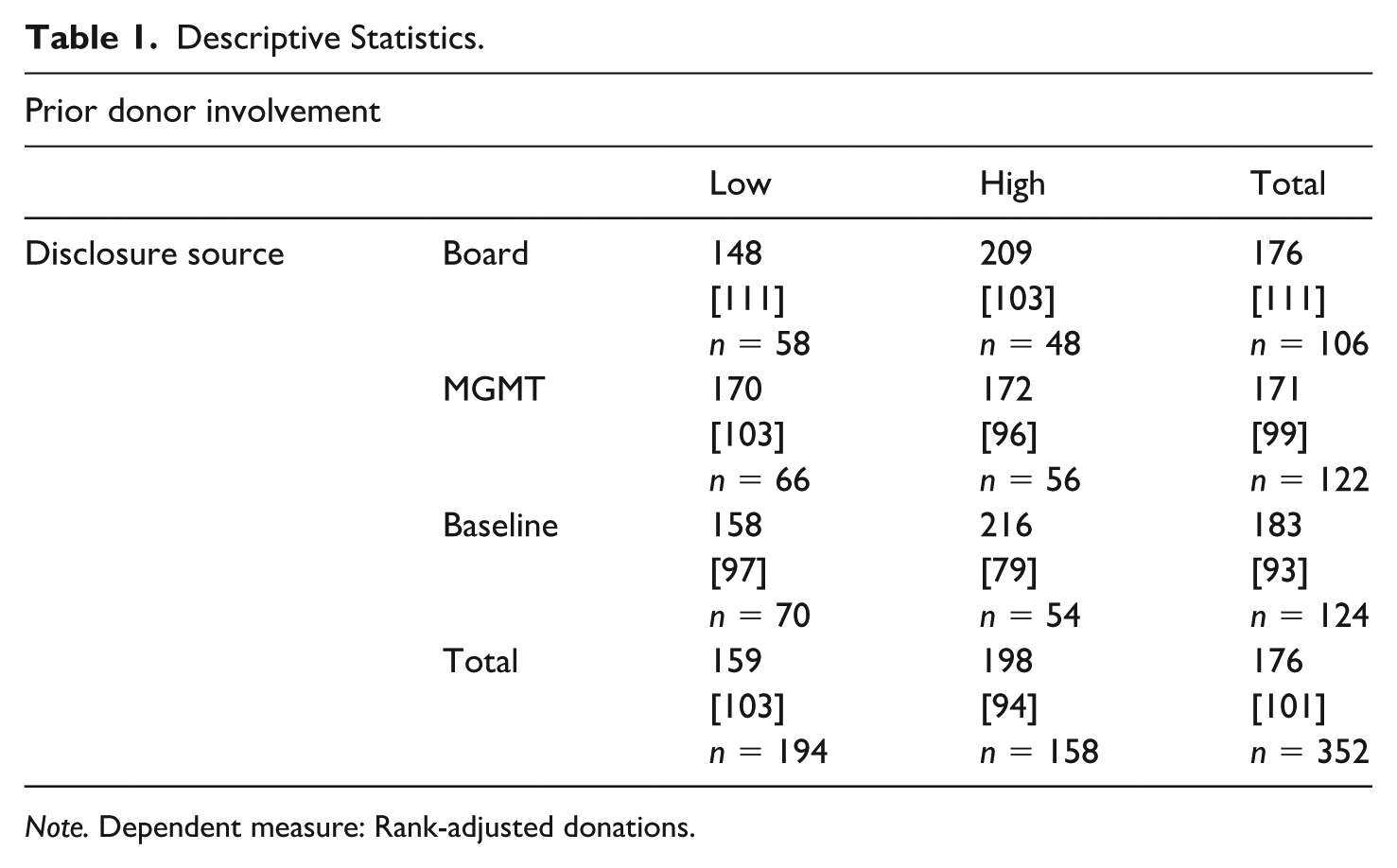
Note. Dependent measure: Rank-adjusted donations.
Discussion of Results
H1 Results: Board vs. MGMT Disclosure
Contrary to our predictions, we do not observe statistically significant support for H1. There is no perceived difference in donations across any source (F = 0.816, p = .443), and the row totals of 176 (Board), 171 (MGMT) and 183 (Baseline) are all non-statistically significantly distinct from each other. This demonstrates that the reactions anticipated under Expectancy Violations Theory are not observed merely when comparing a fraud disclosure between the two sources of management versus board of directors.
H2 Results: Interaction of Prior Donor Involvement and Disclosure Source
We find support for H2 that donor backlash following voluntary disclosure of NFP fraud varied as a function of prior donor involvement AND disclosure source. Namely that compared with management-sourced, a fraud disclosure made by the board of directors led to diminished highly involved donor backlash relative to lesser-involved donors. Table 2 provides ANOVA results on the rank-adjusted data, which yielded two statistically significant results: an unpredicted main effect of prior involvement (F1,351 = 14.424, p < .001) and a disordinal interaction of disclosure source and prior involvement in line with predictions (F2,351 = 3.329, p = .037). The disordinal interaction demonstrates that where management discloses fraud, there is no measurable difference in donation amounts between those with high (172) or low prior involvement (170) (SME F1,346 = 0.013, p = .910). However, when compared with donations from either group under a management-sourced disclosure, a fraud disclosure made by the Board of Directors results in substantially higher contributions by donors with high prior involvement (209) and lower contributions by donors with low prior involvement (148) (SME F1,346 = 10.059, p = .002). Taken together, these observations support our H2 predictions: the expectancy violation of a fraud disclosure is mitigated by the Board’s disclosure to a donor of high-involvement, and although marginal, the uninvolved donor responds in a similar manner to a management-sourced disclosure.
ANOVA Results for Donation Based on Disclosure Source and Donors’ Prior Involvement.
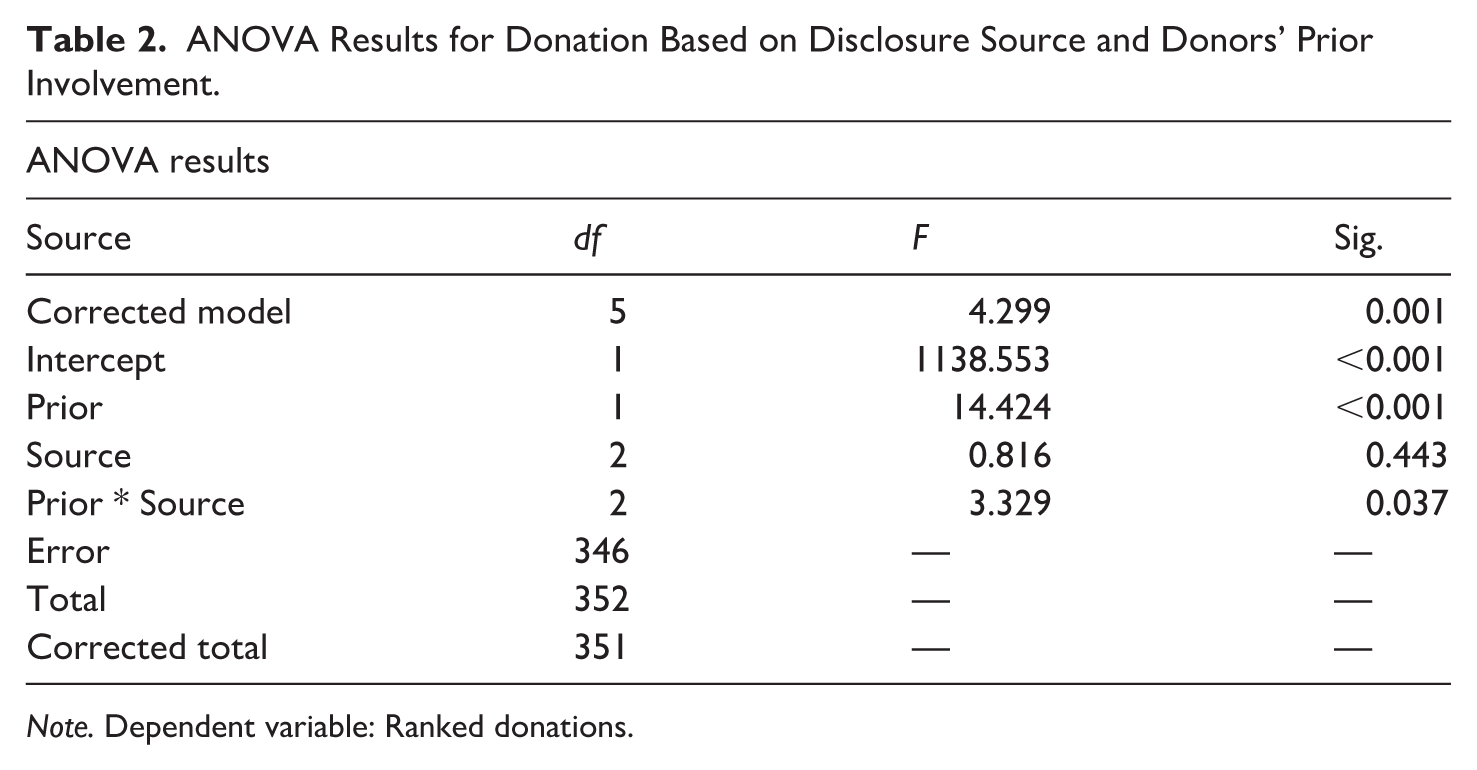
Note. Dependent variable: Ranked donations.
Beyond the relationships between specific cells, the graph in Figure 3 demonstrates broader observations re: fraud versus baseline conditions. Using the baseline conditions as a comparison to fraud environments, we observe that donation levels accompanied by a Board-sourced fraud disclosure are not statistically different from those when there is no fraud disclosure. We also observe that fraud disclosure by management induces the lowest level of involved donor contributions relative to other conditions. As shown in Figure 3, compared with the 209 average contribution of involved donors under Board-sourced fraud disclosure, the baseline condition average is 216. For uninvolved donors, those values are 148 and 158, respectively. Seemingly, reactions to the Board’s involvement with disclosing fraud is entirely reflective of ordinary donative behavior (albeit with a slight variation in overall contributions) for either type of donor. Taken together, these results support our predictions that differently-sourced organizational fraud disclosures lead to divergent levels of donor backlash.

Average (Ranked) Donations by Disclosure Source & Donor’s Prior Involvement.
In an untabulated ANCOVA, the above analysis was re-run with covariates of gender, race, age, and professional experience. No change in any reported results was observed. In addition, we used PEQ responses to questions: “How strongly do you identify with the mission of the {participant selected charity} sector?” and “ For your next REAL LIFE charitable donation, how likely are you to contribute to the {participant selected charity} sector?” to ensure the participants understood the initial manipulation of “never donated or frequently donated” and to gauge any potential demand effects of being asked to consider a charitable donation. Both questions were found to be statistically significant, with F1,349 = 109.78, p < .001 for the “identify” question and F1,349 = 175.49, p < .001 for the “donate again” question. 7 On a 7-point Likert-type scale, mean responses to these questions were nearly two full points lower for the “rarely” donate group compared with the “frequently” donate group. There were no observed differences between the various source conditions of baseline versus BOD versus MGMT.
General Discussion
Fraud threatens the accountability and trustworthiness of NFP organizations, as well as the resources available for those organizations to effectively carry out their missions in the future (Archambeault & Webber, 2018; Burks, 2018; Chapman et al., 2022; Harris et al., 2024). Information about frauds that do not meet the minimum threshold for mandatory reporting on Form 990 may still need to be communicated to relevant stakeholders, whether for sheer transparency’s sake or to “get in front” of a story that is likely to be portrayed negatively if reported by a news or media outlet (Ortega-Rodríguez et al., 2020; Willems & Faulk, 2019).
Until now, the nonprofit literature has not addressed the effects of information source for NFP fraud disclosures or how reactions to those sources differ between donors with different levels of prior involvement with an organization. Although the technical distinctions between a board of directors and top management of an organization may be subtle to the average donor, our study proposes and finds that donors do indeed perceive such a difference. We find that donors who have previously been involved with (i.e., given to) an NFP respond more favorably to a fraud disclosure made by the organization’s board of directors than by its executive director, as evidenced by higher donation amounts. However, donors with no prior involvement with the NFP respond somewhat less favorably to a disclosure made by the board than to one made by management of the organization. We also find that when management of an NFP discloses fraud, there is not a significant difference in donation amounts between those with and without prior involvement with the organization.
Together, NFP management and boards of directors who must guide an organization through and past an occurrence of fraud must decide how to balance the tension between providing transparency to stakeholders and protecting the integrity—and revenues—of their organization. While management is expected to uphold their duty to emphasize fraud prevention and deterrence (AICPA, 2011; Jegers, 2019), the board of directors is often viewed as bearing the ultimate burden of responsibility in a nonprofit organization and is therefore more commonly associated with accountability and transparency (Brown & Pritchard, 2006; Green & Griesinger, 1996). As a result, the expectations of involved donors seem to be realized when a board of directors takes command in the aftermath of a fraud and communicates about the situation with interested stakeholders.
Limitations
To maintain a clear connection between our predictions, theory, and the manipulations/measurements in our experiment, we intentionally created a simplified, hypothetical, and abstract setting. We also chose to incorporate broad, participant-selected causes rather than specific organizations in our experiment to prevent biasing effects and to hold organizational-level parameters constant. While this enhances the internal validity of our study, we recognize the standard limitations of such endeavors when attempting to generalize to more specific settings. Typically, donors have far more detail on the fraud in question and more time to think through their donative decisions. In addition, this study does not account for the personal/organizational relationships developed by involved donors and how those relationships may alter post-fraud disclosure donations in reality. Finally, while we are confident that the participant pool readily proxies for the typical donor in the general populace, we cannot speak to the behavior of sophisticated donors who donate large sums and how their enhanced knowledge of NFP matters may cause different behavior patterns than observed in this study.
Future Research
There is ample opportunity for future research to examine the contexts in which voluntary NFP fraud disclosures are (and perhaps, should be) more likely to come from management, the board of directors, or some other source, as well as the contexts in which donors tend to respond more or less favorably to those disclosures. The process underlying how donors distinguish between information sourced by the board of directors versus management, and perhaps other sources such as the media, can be further explored to help researchers understand why involved donors respond more favorably to disclosures from the board. Such process studies may want to examine the timing of fraud disclosures from various sources, as it is possible that donors will respond differently to messaging that relates to a recent fraud compared with one that was discovered substantially prior (e.g., last quarter, last year). Moreover, assessments made by donors who have been given a fraud disclosure can be studied to provide insight as to whether donors’ ability to make predictions about the future is hindered or enhanced by the source of such a disclosure.
In addition, researchers can test various ways to mitigate donor backlash following the disclosure of fraud, including whether such mitigation techniques have different levels of effectiveness based on the original source of the disclosure (e.g., the organization itself vs. the media, management vs. the board). While the results of this study indicate that an involved donor’s backlash to a fraud at an NFP may be mitigated by the board’s disclosure of the fraud, and an uninvolved donor’s backlash to the same information may be best mitigated with a similar disclosure made by management, it is yet unknown if there are more effective ways to temper the negative reactions donors tend to have when confronted with the fact of an NFP fraud. Similarly, it is not yet known if the effects of such mitigation techniques are short-term or if they might enhance donor involvement over time.
Finally, researchers may want to explore whether donors respond to the disclosure of other types of negative information in similar ways. Although this study focused on voluntary fraud disclosure, it is unclear if our findings will generalize to communications about other difficult circumstances such as budget shortfalls, moral failings of organizational leadership, changes in strategy due to external factors like tariffs or safety concerns, or the unexpected departure of the CEO or a key board member.
Conclusion
Although “significant” NFP frauds (i.e., greater than $250,000 or 5% of total assets or gross receipts) are required to be disclosed on IRS Form 990, information related to a fraud may also be disclosed through other methods, such as media coverage or voluntary organizational communications. Using the theoretical frameworks of expectancy violations theory and affective self-affinity theory, we examine how different types of donors respond to different sources of a voluntary fraud disclosure. We find that donors with prior involvement (i.e., giving) with an NFP organization respond more favorably to a fraud disclosure made by the board of directors than one made by management, and when management discloses a fraud, there is no measurable difference in donation amounts between those with or without prior involvement.
Being mindful of donors’ (and potential donors’) expectations is important when determining the ideal ways to communicate negative information to stakeholders. This study, as well as further research in this area, may aid NFP organizations in their attempts to mitigate donor backlash to fraud and other potentially negative events. The manner in which a not-for-profit organization chooses to disclose such events may provide donors with assurance that proper monitoring mechanisms are in place and that trust in the organization can be maintained.
Supplemental Material
sj-pdf-1-nvs-10.1177_08997640251410568 – Supplemental material for Call Me Maybe?An Experimental Analysis of Donor Backlash to Voluntary Nonprofit Fraud Disclosure
Supplemental material, sj-pdf-1-nvs-10.1177_08997640251410568 for Call Me Maybe?An Experimental Analysis of Donor Backlash to Voluntary Nonprofit Fraud Disclosure by Jonathan Kugel and Julie M. Mercado in Nonprofit and Voluntary Sector Quarterly
Footnotes
Acknowledgements
We gratefully acknowledge the helpful comments and suggestions provided by the editors and reviewers, as well as conference participants at the 2019 Graduate Research Accounting Conference at Emory, the 2020 AAA Government and Nonprofit Section Midyear Meeting, the 2021 ARNOVA Conference, and the 2023 AAA Annual Meeting.
Authors’ Note
This study received approval of exempt status from the Institutional Review Boards at Georgia Institute of Technology (H20167), Christopher Newport University (1804875-1), and Boise State University (076-SB21-161).

Funding
The authors disclosed receipt of the following financial support for the research, authorship, and/or publication of this article: The authors acknowledge and thank the Georgia Institute of Technology, Christopher Newport University, and Boise State University for the funding that enabled this research.
Declaration of Conflicting Interests
The authors declared no potential conflicts of interest with respect to the research, authorship, and/or publication of this article.
Data Availability Statement
The dataset generated during and/or analyzed during the current study is available in the Figshare repository, 10.6084/m9.figshare.30238804.
Supplemental Material
Supplemental material for this article is available online.