






Abstract
This article contributes to the theory of volunteering by examining dropouts. It uses its own data material (59 narrative interviews, 10 group discussions) from charities, sports clubs, church communities, and environmental initiatives in Germany. By comparing narrative styles, it shows at least two specific ways of presenting volunteering practice. First, the (former) volunteers produce different narratives depending on their area of action. In doing so, they position themselves in specific fields of tension. Second, they report on their experiences in collective work processes: cooperation, the avoidance of alienation, and the justification of working time structure the narratives and in turn refer to tense contexts as well. Accordingly, the article theorizes volunteering as a multidimensional endeavor. It distinguishes an area-specific dimension from a work-specific dimension. Both dimensions of the experience are relevant for the dynamics of volunteering. The article recommends paying more attention to this complex, multidimensional practice in particular.
Introduction
Recently, record-breaking international footballer Lothar Matthäus appeared several times in a row in German quality media outlets such as the Süddeutsche Zeitung and ZEIT outside of the sports sections (Heidenreich, 2024; Lohr, 2024; Willeke, 2024). He was a volunteer coach of his son’s youth soccer team but resigned from this role. In other words, Lothar Matthäus dropped out of voluntary work—as he said, it was because he lost his motivation due to constant complaints from critical parents.
This article argues as follows: One can gain a deeper understanding of volunteering in general via an understanding of dropouts. The case of Matthäus does not stand pars pro toto for volunteering in general. It is assumed that motivation is a strong driving force behind volunteer work (Clary et al., 1998; Omoto & Snyder, 1995). But as I will show below, (the lack of) motivation does not explain volunteer work. Rather, by comparing the stories of former volunteers in other fields of activity, it is first shown that dropping out represents a way of dealing with very specific tensions in each area of volunteering. In this way, experiences that arise from a specific social order and dropping out can be linked. At the same time—and the example of Matthäus can also be used here as well—volunteering often means the conduction of work processes. These processes are also fraught with tension and must be considered to understand dropouts. The article contributes to a better understanding of volunteering through an understanding of dropping out, insofar as it spells out the implicit knowledge of (former) volunteers and the multidimensionality of volunteering. This insight comes from two empirical research projects that investigated the questions of how the end of a commitment is reported and whether differences in the presentation of the facts can be reconstructed.
The article makes use of several concepts: Dropouts are defined as committed individuals who terminate their volunteer work earlier than planned. (Implicit) knowledge refers to all knowledge that is acquired in the course of volunteering to find one’s way in a specific practice: In addition to concrete manual skills, this also means points of view, evaluation schemes or personal inclinations. The concept of multidimensional experience refers to the fact that the experience of volunteering cannot be understood in just one dimension—such as voluntary engagement in a specific area or concrete work experience—but that a theoretical model is needed to connect these different dimensions of experience. This is also where the practical suggestions in the article lie: if we understand volunteer work as a practice in which various relationships occur simultaneously—namely, both with a substantial object and with one’s own work process—we can better understand retention and dropout.
The following article begins with a literature review. This review cites various substantial empirical findings on dropping out from volunteering and reflects on dropping out from a social theory perspective. This reflection provides inspiration for the analysis of empirical material. After a brief explanation of the data collection and evaluation process, the main section elaborates on how dropping out from volunteering can be understood as both a voluntary engagement in a specific area and with the practices of the work performed. The discussion of the results accordingly emphasizes that future research should take this multidimensionality of volunteering experience into account.
Literature Review
Volunteering Research on Dropouts
The international literature on volunteering distinguishes between the antecedents, experience, and consequences phases (Hyde et al., 2016, p. 46; Snyder & Omoto, 2008). A key finding from research overviews is that the experience phase, the phase in which volunteers conduct their work, receives comparatively little attention (Wilson, 2012). It is therefore perfectly legitimate to speak of the “black box” of volunteering (Hustinx & Denk, 2009). At the same time, low case numbers and difficult field access make it difficult to gain systematic insights into dropouts (Hustinx, 2010, p. 251; Nesbit et al., 2016).
Nevertheless, there are four distinct theoretical approaches to the topic of dropout in the literature: First, resource perspectives, which emphasize the lack of time in particular. Second, socio-psychological approaches focus on low or declining motivation. This also includes—as the twin of dropout research, so to speak—research on staying involved. Third, perspectives on organizational socialization and HR practices and related to this, fourth, studies that discuss dropouts primarily as the result of specific (negative) experiences, such as problematic further training, a feeling of insufficient support and recognition, a lack of opportunity to object or even burnout.
The first mentioned part of the literature often highlights lack of time as a reason for dropping out, pointing to the resources required for volunteering. The German Survey on Volunteering, for example, collects a comparatively universal set of reasons for dropping out, including professional reasons, a lack of time, and family commitments (Arriagada & Karnick, 2022; Müller & Tesch-Römer, 2017). A British survey reports similar reasons for dropping out (McGarvey et al., 2019, p. 68). Time constraints, especially due to family and changing living conditions, seem to be a major reason to leave volunteering roles (Lancee & Radl, 2014; Wallrodt & Thieme, 2023). Nevertheless, time is not necessarily objectively available or not: time-sensitive research shows that instead of discontinuing volunteer work, volunteers shorten the time they spent in volunteering (Kelle et al., 2024). It is therefore not a matter of a “yes or no” question of whether volunteers chose to give their time or not, but rather a question of how they justify it. Instead of objective time budgets, research on dropping out should investigate the sense making of a particular volunteering role.
From a psychological perspective, volunteers intend to satisfy certain needs and motives (Clary et al., 1998; Stukas et al., 2015). Research showed that it is precisely those who are particularly strongly motivated who remain involved for longer and only broke off their commitment later (Hyde et al., 2016; Omoto & Snyder, 1995; for a critical account (Willems et al., 2012; Yanay & Yanay, 2008). From this perspective, dropping out of volunteering roles is an expression of (dwindling) motivation. In addition, if the reaction of the committed person’s environment to the commitment is negative, committed people end their commitment earlier (e.g., Snyder & Omoto, 2008, p. 15).
The third mentioned part of the literature with its focus on organization is twofold: First, it focuses on organizational socialization, highlighting the difference between ejected newcomers and retiring seniors (Haski-Leventhal & Bargal, 2008). Second, it is concerned with an (inadequate) fit between the volunteer and the organization requesting the work due to poor volunteer management: whether it is because committed individuals were unable to build relationships with the organizations or beneficiaries or identify with them (Alfes et al., 2015; Traeger et al., 2023), or because socialization processes in organizations fail (Traeger et al., 2022), or because a lack of training, a lack of recognition of volunteers, and a lack of say in job design tend to lead to higher dropout rates (Walk et al., 2019; Walk & Peterson, 2023). The results are also confirmed outside of management research, insofar as it can be shown that the emotional exhaustion of volunteers can be reduced where there is good cooperation between volunteers and full-time staff (Ripamonti et al., 2017).
In contrast, some social scientists argue that the decision to start and to quit volunteering are “subject to different underlying processes” (Niebuur et al., 2022, p. 1253) and that the experience of volunteering itself must be considered to fully understand dropouts. In most cases, an individual’s original motives for volunteering would change, and their specific experiences with the organization, those it seeks to benefit, or the scope of tasks involved would influence the decision to drop out (Dury, 2018; Forner et al., 2024; Willems et al., 2012). These experiences leave such an impression on individuals that they not only change the motives themselves, but also the ability of those involved to engage. Examples cited include burnout or alienation from the respective organizations (Allen & Mueller, 2013; Milbourn et al., 2019).
Social Orders of Volunteering
What is striking about the theories and findings is the lack of sociological information about the different contexts of volunteer work. Research on social inequality in volunteering shows that it can indeed make a difference in which area someone gets involved. The question therefore arises as to whether there are structural conditions for such negative experiences, such as working conditions and organizational methods of volunteering. As one can easily imagine, there is a difference between volunteering in a large organization with numerous full-time employees and volunteering in small volunteer initiatives.
It is also worth taking note of the different social science terms used in research to describe the formation of order within the nonprofit sector and its consequences for volunteering: While the German Survey on Volunteering, for example, speaks of social “areas” (Hameister et al., 2023, p. 298) of volunteering without further implications, the National Council for Voluntary Organisations’ survey from the United Kingdom speaks of areas or causes (McGarvey et al., 2019, p. 30). Other authors use basic concepts that suggest a differentiation of volunteering into different social fields (Eimhjellen, 2023; Meyer & Rameder, 2022; Schubert et al., 2023). But there is still no scientific debate as to whether this is merely a statistical phenomenon or whether there are socially influential entities at a social science meso level. Therefore, research on dropouts needs to take into account the possibility that different reasons may arise in different areas of work.
Social Theory on Exiting
If we want to approach the questions at hand from the social theory literature, dropout and abandonment are only marginal topics. However, Hirschman’s work is relevant and theoretically stimulating. With the combination of exit, voice, and loyalty, he contrasts the termination of a relationship (where exit, in Hirschman’s case, is conceived of as migration or also as turning away from a product or service) with a contradiction within the relationship (voice) (Hirschman, 1970). In the latter case, loyalty keeps people in a social relationship despite dissatisfaction. With reference to this text, however, volunteering research focuses less on exit and more on the voice of volunteers (e.g., Garner & Garner, 2011).
Hirschman’s second relevant study, Shifting Involvements (Hirschman, 2002), hardly plays a role in current volunteering research that is concerned with life course events (e.g., Lancee & Radl, 2014; Niebuur et al., 2022; Rotolo, 2000). According to Hirschman, there is a “private-public cycle” (Hirschman, 2002, p. 8) and thus phases in which it is perfectly okay not to appear in public. Committed people can therefore end a political commitment if they feel over (or under) challenged. Both lead to disappointment and to people becoming receptive to the appeal of privacy again. Because of the assumed inevitability of a “change from one [life-]style to another” (Hirschman, 2002, p. 131), Hirschman’s model only provides a limited analytical understanding of the specifics of concrete experiences of volunteering (who or what is over or underchallenged?). Its applicability in areas of society other than politics also appears limited. Nevertheless, it shows what a social science analysis can look like that understands dropouts as a social phenomenon independent of individual cases and furthermore that it makes sense to approach the dropout phenomenon using more abstract social theory concepts.
Ebaugh makes a further contribution to dropout research. She examines dropping out of social roles with an empirical focus on nuns and transsexuals (Ebaugh, 1988). According to her study, those who leave a role go through four phases: a phase of doubt, a phase of searching for alternatives, a phase in which a concrete change (at a so-called turning point) causes a feeling of emptiness and, fourth, a phase after leaving the role, during which the new role is established as an “ex.”
Wacquant’s critical review of Ebaugh’s study provides productive suggestions for research on the act of dropping out, which at the same time represents a rejection of functionalist explanations (Wacquant, 1990). According to Wacquant, it is necessary not to understand certain roles as unquestionably given, but to assume their arbitrariness. This also means taking seriously the “dialectic between social properties objectified in the form of more or less institutionalized ‘roles’ and social properties embodied in the form of cognitive and corporeal schemata of perception, appreciation and action that agents engage in their practice” (Wacquant, 1990, p. 401). Applied to the empirical object discussed here, this means that the termination of a board office in an association, for example, is more than the abandonment of a role (legally) defined in an organizational chart—it is also the termination of a task that was meaningful to a volunteer.
According to Wacquant, this dialectical understanding of terminations dynamizes the object under investigation and gives those involved the agency not only to fill a role or task, but also to make it meaningful in the first place. Wacquant also argues for the analysis of the variety and quality of the relationships ended by termination. He believes that it is of relevance whether it is a job, a friendship, a gender role, or something else that is terminated. Based on agency and an understanding of different relationship qualities, it is then also possible to understand why some, but never all, people fail in a role or choose to end it. With this theoretical insight in mind, requirements can be placed on empirical research processes on dropouts: These should be sensitive to the quality of an experience as well as the ability of actors to act, but also to quite contradictory standardizations of action in different social fields. The latter places particular demands on a high-contrast sample.
Method
Sampling and Data Collection
Qualitative surveys are suitable for shedding light on experiences and relationships in volunteering and for exploring differences in various fields of activity (Hustinx, 2010; Wilson, 2012). This study is based on two externally funded projects that aim to explore specific areas of tension in volunteering. A quantitative survey on dropouts, as a kind of further-reaching statistical validation of the theorization, was not originally planned due to concerns about practical feasibility.
The projects on which this study is based used narrative-based interviews to give former volunteers the opportunity to name their own experiences and to outline engagement trajectories (Nohl, 2010; Philipps & Mrowczynski, 2021). 1 The research group also conducted group discussions (Flick, 2023, pp. 238–244) with individuals still active in the same areas. The research project assumed that a group discussion with former volunteers in a field is more difficult to organize than with currently active people. Nevertheless, by including those who are still actively involved, the research project tries to prevent the possibility that only frustrated former volunteers are included in our sampling. Because tensions are documented in a comparable way in the surveys with both groups—active and former volunteers—the distinction between former and active volunteers is primarily relevant for the sampling, less so for the analysis.
The researchers gained access to the respondents through the organizations themselves as well as through spontaneous (personal) contacts in the context of research and teaching, through mailings, direct contact, and by means of snowball sampling (Flick, 2022, pp. 109–110). From August 2014 to May 2022, 65 interviews and 10 group discussions were conducted. 2 For temporal and financial reasons, the complete data material was not transcribed, but only those interviews that were linguistically and technically flawless and had concrete narratives (59 interviews) as well as those parts of a group discussion with a high interactive density. The interviews were initially conducted in person and, during the coronavirus pandemic, online. The group discussions were conducted in person. Interviews lasted between 30 min and 3 hr, and group discussions between 40 and 80 min.
The research project collected material from (former) volunteers from charities (21 interviews, five group discussions), sports clubs (12 interviews, one discussion), church communities (17 interviews, three discussions), and environmental initiatives (nine interviews, one discussion). The selection criterion for these four fields was a reciprocal contrast in terms of engagement object (active, political-social engagement in charities and environmental initiatives as well as community-oriented engagement in parishes and sports clubs), organizational structure of the field (a lot of contact with full-time staff in charities and parishes; comparatively less in environmental initiatives and sports clubs) and a typology of volunteers according to Dolnicar and Randle (2007) who distinguish altruists, leisure volunteers, political volunteers, and church volunteers.
With regard to the personal backgrounds of the interviewees, the sample offers additional variance: the data material includes committed and non-committed people, men and women, people with and without a history of migration, people at different stages of employment, people with different educational backgrounds, as well as people from urban and rural social areas. The subsample on church communities includes Protestants and Catholics.
Data Analysis
We collected and analyzed the material iteratively (Flick, 2023, pp. 110–115). Interpretation was a collective endeavor by the whole research group consisting of management, research assistants, and student assistants. We recorded the evaluation sessions, which enabled additional reflection on the research process. During the evaluation, the research project followed the steps of the documentary method (Bohnsack, 2010, 2014; Nohl, 2010) and applied a praxeological-sociological understanding of the social (Bourdieu & Wacquant, 1992; Kettler et al., 1980). The documentary method assumes that a specific knowledge of action is formed in practice. It is later on documented in verbal data (interviews, group discussions), for example. As such, the specific knowledge of action is—like a habitus—still available when volunteers talk about their volunteering.
The following questions guide the reconstruction of the data material from interviews and group discussions: How are narratives about volunteering structured? Which implicit knowledge of action orientates the narratives? What are its tacit assumptions? Building on this, the study poses the question of the genesis of this implicit knowledge: What experiences give rise to this narrative?
The reconstruction of the material from interviews and group discussions is thus concerned with how the experiences are told: the framing and orientation of the narratives, that is, the implicitly true/false holding of action premises (of others), the implicit contextualization of the narrated actions, or the use of positive or negative counter-horizons. This reveals two ways of representation, so called orientation frameworks: On one hand, narratives of the areas were reconstructed: The interviewees implicitly answered as if there was a question of what their commitment was actually about. On the other hand, narratives of the work were reconstructed, which implicitly referred to the fact that volunteering is about work processes. However, I do not wish to imply that what the interviewees’ report is an accurate reproduction of the factual situation they experienced.
What I will present below are the reconstructed orientation frameworks that can be assumed to have already guided the volunteers in their work. They therefore represent the implicit knowledge of the (former) volunteers. In this way, the interpretation brought to light the (dialectical) orders of knowledge of the organizations and those involved from the experience of involvement from the qualitative surveys. Evaluation started with an individual survey and developed the types in a process of constant case comparison. Ideally, interpretation names a collective social context that is generative for the corresponding knowledge—in methodological terms, an experiential space (Bohnsack, 2014, p. 229) that is relevant across different cases. In this way, this research links concrete experiences of volunteering with their respective structural conditions.
Results
A constant comparison of cases shows that interviewees structure their narratives about dropping out quite differently depending on the area in which the narrated volunteering takes place. Nevertheless, there are common orientation frameworks across the areas which are based on the experience of collective work processes. Because of the empirical material, I differentiate between area-typical orientation frameworks and work-typical orientation frameworks. I will discuss both orientation frameworks in the following two sections and differentiate them further.
The Area Dimension of the Volunteering Experience
Although the sample implies their relevance for the volunteering experience by comparing areas, the interview prompt asked for the history of the personal commitment. Furthermore, the respective interpretations asked open-endedly whether and how the different areas structure the material in specific ways. It is therefore surprising that the narratives are structured so differently between the work areas, though the structures in the same area are similar. As a result, I argue that there is a meaningful connection between the respective area of volunteering and the experience. Ontologically speaking, areas of volunteering represent social fields because tensions prevail in them.
Involvement in Charitable Organizations as a Question of Partiality
Volunteers in charitable organizations usually take on social aid tasks for an independent organization. We interviewed people from visiting services in elderly care facilities, people who support refugees and people who are active in neighborhood assistance. These activities are often organized and supervised by paid staff, which is why the volunteer interviewees tended to refer to the paid staff rather than other volunteers when talking about their work.
Within the interviews and group discussions, we found a field of tension: on one hand, there are positive stories about the emotional ties to volunteering and, on the other hand, there are negative stories about aversive experiences often related to the organized contexts. For example, a volunteer in elderly care describes how he enjoyed spending time with elderly people in an institution (I 1-W, line 169). 3 At the same time, he observed that the organization of this facility is efficiency-driven, with volunteers and part-time employees filling gaps that arise due to a lack of skilled workers. Other volunteers also described this contrast: they had enjoyed walking in the facility’s garden (I 2-W, line 408), singing Islamic chants with the elderly (I 6-W, line 1176), allotting a “blessed apple from Thanksgiving” (G 1-W, line 216), and giving their time to simply chat and “address the personal level” (I 18-W, line 292). Committed people thus express a certain partiality for the recipients of the commitment: While the institutions in which they worked do not themselves take sides with individual clients and must take into account the mandate of an organization, volunteers are allowed to be clearly partisan and show solidarity with certain individuals.
The contrast described is also evident in the context of other assistance-based volunteer roles in the social sector: one woman involved in helping victims of violence described her friendship with a former recipient, but in the same interview (I 4-W, line 401) criticizes the association’s sluggishness when it comes to financial and membership acquisition and public relations work. Another woman—anonymized as Wiebke—wanted to initiate a “mother-child group” for refugee mothers to offer them a space for low-threshold exchange (I 19-W, line 51). However, her supervising welfare association tried to persuade her to offer childcare as part of a parallel language course for refugee women. Wiebke criticizes this influence of the association on her commitment, saying that it wanted to offer language courses for refugees in the sense of allocating public funds and had functionalized her voluntary commitment for this purpose.
The field of tension between binding personal and aversive organizational experiences is related to the welfare sector in that a special closeness between those involved and those in need of help is constitutive for the commitment: those involved talk about themselves as people who are committed to beneficiaries. They perceive that commitment deepens their solidarity. Welfare organizations, on the other hand, appear as actors who are defensive or detrimental to this search for contact and response relationships with the beneficiaries. The volunteers make them responsible for a problematic everyday life, whether in a retirement home or in refugee aid. At the same time, the volunteers criticize the routines or even the professional understanding of the welfare associations as not being supportive enough (I 2-W, line 340; I 63-W, lines 335, 708; G 2-W, line 794) and as not being sufficiently attentive and appreciative of the volunteers (I 12-W, line 152; I 19-W, line 424; I 23-W line 413). 4 Furthermore, critical narrative passages emphasize that the local staff in their welfare association have little power to act (I 2-W, line 460). Interviewees in this area do rarely mention co-volunteers in their stories.
Volunteering in Church Communities as a Way of Dealing With Conflicting Logics of Action
In church congregations, we interviewed people involved in youth work, preaching, and working in church services, as well as those working on church committees. Their stories frame their work analogues to a specific social order that is typical of a parish. According to the German theologist Pohl-Patalong, these social orders are community, movement, and organization (Hauschildt & Pohl-Patalong, 2013, pp. 138–215; Pohl-Patalong, 2021, pp. 51–58). Tension arises because these social orders mutually emerge as negative counter-horizons in the interviews and discussions: While some wanted to do something for a positive sense of community in the congregation, others merely had a cool eye on finances; some wanted to stand up for a church that was on the side of the poor and weak, whereas others were less ambitious in this regard.
Repeatedly, terms or topics symbolized one of the aforementioned logics of action by church communities. For example, in the interviews and discussions on church involvement, food is mentioned most frequently in the case comparison: Sometimes it is the glass of “sparkling wine” over which people commune (G 10-K, line 247), sometimes it is the “fresh bread” served at the reception following the church service (I 51-K, line 143), and sometimes the sermon is referred to as the “brown bread” for the coming week (I 52-K, line 203). This observation also applies in a broader sense: references to the annual parish festival (G 6-K) with bratwurst (I 60-K, line 104) or to the pastor’s shared pizza meal (I 45-K, line 303) with committed members point to a way of living together that cannot be limited to theology, moral issues and faith practices. They also express a certain conviviality associated with the faith community.
In other interviews, interviewees apply a different logic understanding church more like a movement. Instead of food and community volunteers talk about what they want to achieve. One interviewee speaks about a parish which is open to migrants and appreciates women’s work, but in her story, other volunteers who cling to old community structures undermine this image (I 38-K). In this way, the orientation framework of a new, better church is always in tension with a church that does not face up to these questions. Symbolic markers of a church on the move are therefore issues of social inequality (“Who do we want to reach?” [G 8-K, line 773]), but also issues of church modernization.
In contrast to this are those committed individuals who view the church as an organization with a balanced budget (I 54-K, line 151), its own real estate (I 30-K, line 295; I 43-K, line 71; I 47-K, line 536), and its own employee body (I 54-K, line 665). Certain building specifications, personnel matters, and laws (“occupational health and safety” I 42-K, line 740; “temporary employment” I 42-K, line 584) become focal points of conflict in the interviews, which the (former) volunteers use to make it clear that the church community is also a formal construct that has a budget and is subject to laws. The narrators take up frontal positions, for example, against pastors who carry out their ministry negligently (I 43-K, line 116) and are seen as “self-promoters” (I 54-K, line 250), or against fellow Christians who, in some cases, for sentimental reasons, do not want to accept the constraints of the church community (I 30-K, line 347). The church as an organization is thus also partly a negative counter-horizon of the narrative, for example, when—as in the case of Claire—the church community as the provider of a daycare center causes difficulties for families and thus does not live up to its own claims of promoting charity, reconciliation, and peace (I 48-K, line 826).
The stories told by former volunteers do not differ from those recalled in the group discussions. In the latter, there were also sometimes people sitting together who argued for different logics of action within a parish. In this respect, church volunteers do not appear to end their involvement just because there are others who see things differently in the parish. At the same time, a comparison of the different areas of volunteering shows that these different and sometimes contradictory logics of the same organization do not characterize the other areas. To think of a church as a hybrid structure (Hauschildt & Pohl-Patalong, 2013, pp. 216–219) helps to understand why churches produce volunteers that follow divergent logics.
Involvement in Sports Clubs as Suffering for Structural Preservation
In sports clubs, sport itself is the binding element of the narratives in the interviews and group discussions. In fact, all but one of the people we interviewed practiced sport themselves. The people we interviewed are involved as trainers and coaches as well as members of club and association boards. Not all of them are still active in their sport, but they are all passionate about their respective sport.
Sport creates pleasure and enthusiasm not only through physical exertion and the subsequent feeling of positive exhaustion, but also through the community that forms on the pitch (I 24-S, line 64) and in the hall (“Bombshell feeling,” I 21-S, line 87; I 47-S, line 549; G 9, line 790), the fun in competition (I 63-S, lines 52, 92), and at the atmosphere at sporting venues (I 56-S, line 35). Schimank sums this up by saying that sport provides “in-process benefits” (Schimank, 2006, p. 93) that fulfill no purpose outside of themselves. Sport participants also tell us that they have “learned to fall” through sport (I 21-S, line 389) or that sport has given children a certain autonomy and security (I 58-S, line 77). Overall, the interviewees portray sports involvement as something that gives them and their observers a positive experience.
The surveys show that tension in sport arises from the fact that it has to be structured as a collective undertaking. To this end, there are standards and rules which are introduced by advanced training courses that are increasingly mandatory in sports associations (I 21-S, lines 150, 210, 1031; I 24-S, lines 73, 82, 93; I 59-S, line 90, I 65-S, line 532). But there are also clubs and associations in which someone must take responsibility. The diverse tasks required to maintain the sport subsystem do not offer in-process benefits. Rather, those involved told us how much time is lost due to (bureaucratic) demands from outside (I 63-S, line 300; G 9, lines 596, 604) and how conflictual the relationship is within the clubs or associations, such as between board members and the grassroots movements of the members (I 25-S, line 222; I 47-S, line 410). 5 In this respect, those hoping for in-process benefits put pressure on other volunteers as well.
Most volunteers in Germany participate in sport and it is the sector where most German civil society organizations have their main purpose of action (Schubert et al., 2023, pp. 16–21). The enormous number of volunteers are responsible for maintaining this area. In this respect, the tension between “flow experience” (Schimank, 2006, p. 93) and structural stress, which structures the experiences of those involved in sport, is hardly surprising.
Involvement in Environmental Initiatives as the Creation of Countervailing Power
We conducted research in environmental initiatives that focus on nature conservation and energy and mobility policies. The respondents’ positive point of reference here is their respective everyday experience in environmentally conscious behavior, for example, in their preference for energy generation (I 28-U, line 33; I 49-U, line 33; I 50-U, line 497; I 61-U, line 61), in their reported consumption (I 49-U, line 69; I 50-U, line 483; G 7-U, line 415), and in their mobility (I 27-U, line 19; I 28-U, line 334; I 35-U, line 38; I 41-U, line 28). Their participation in associations and initiatives of the environmental movement appears to be a consistent continuation of this personal practice. It is therefore not per se a matter of implementing the same, shared value of “environmental protection,” but a matter of ensuring that these practices are personally meaningful and significant in each case (Bargheer, 2018). The spectrum of voluntary activities here ranges from organizing demonstrations and signature campaigns to conducting public relations work, discussing scientific and practical findings, to developing an ideological foundation for environmental protests and practical structural work for the respective organization.
In tension with the attractiveness of this movement’s commitment, however, is an aversive experience: the organization of counter-power against powerful companies, administrations, or social conventions seems to generate a latent excessive demand (Hirschman, 2002). One interviewee states that, regarding the legal regulation of a political issue, he did not have to become the “supreme expert” within his organization and vis-à-vis the local administration (I 26-U, line 281) and therefore dropped out. Here the necessarily required expertise in the movement is the negative counter-horizon in the narrative. Activists in environmental initiatives describe their involvement as a job 6 and they say they want to implement an increasingly professional manner to keep pace with political opponents, or to avoid domestication by administrations (Visser et al., 2023). This work is symbolized in the material by stories about expert opinions (I 28-U line 142), funding applications and bureaucracy (G 7-U, line 37), document filing systems in their own organization (I 50-U, line 327), up-to-date graphic design for their own public relations work (I 27-U, line 242; I 49-U, line 589), or the writing of a “concept” (I 35-U, line 702).
Dropping Out Because of Area-Specific Experiences
The comparison of the stories so far shows that the interviews and group discussions are structured similarly for those interviewees who are or were engaged in the same field. At the same time, the narratives are always torn between an attractive and an aversive pole. This polarization stems—analogously to Wacquant’s perspective—on the one hand, from the positioning of those involved in formal contexts who take on tasks in publicly described aid systems, in the hybrid structure of a parish, in the social subsystem of sport, and in the political battlefield of the environmental movement. On the other hand, it arises from the agency of committed individuals with their respective solidarity and partisanship, their understanding of the church, their desire for sport, and their respective environmentally conscious everyday practice. In this respect, the dropout narratives not only document personal preferences and individual experiences but also reveal a typical dialectic within each specific area of volunteering.
The Work Dimension of Volunteering Experiences
The literature review on dropouts at the beginning of the article was organized along strong concepts that are used to understand the phenomenon: (lack of) resources, (lack of) motivation, (lack of) management, (negative) experiences. As will be shown below, a key finding of this research project is that (former) volunteers have had particular experience with work processes.
As already mentioned, some of the former volunteers talk about their work when they talk about their volunteering. Therefore, the interpretation asked open-endedly whether and how working relationships structure the material in different ways. In other words, no workplace theories were tested. Nevertheless, the interviewees addressed topics and reproduced views that are not alien to more general work science. When analyzing the data, it is noticeable that, beyond the communicated meaning level, aspects of work are repeatedly addressed, such as styles of cooperation, the alienation from one’s own activity, or the justification of working hours. This work dimension is at odds with the area dimension in that, for example, descriptions of cooperation are part of stories from sports clubs as well as church congregations.
Cooperation Styles
According to common understandings in scientific literature, volunteering is a collective endeavor (Lichterman & Eliasoph, 2014; Putnam, 2000). This means that it pursues common goals, for example, those defined in association statutes. While conventional work research is more interested in how organizations can promote cooperation between employees—for example, through long-term collaboration (King et al., 2009) or team composition with differently experienced team members (Barmby et al., 2016; Mas & Moretti, 2009). The following results tend to show that cooperation can fail even with the best intentions of the people involved. Those involved repeatedly talk about failing and disappointing cooperation, even though they see themselves and others as trying to achieve their goals. However, a closer analysis of the orientation frameworks reveals two different understandings of cooperation in the way they are related.
For example, some committed individuals say that they and others seek to achieve a goal as equals. Here, “swarm intelligence” (I 50-U, line 355) seems to be at work: No one has the right to a hasty narrowing of discourse or solutions; instead, everyone contributes their skills on an equal footing so that the result is convincing. Claire, the aforementioned church volunteer, describes this mode with the metaphor of a puzzle; she herself is just a “piece of the puzzle” (I 48-K, line 55) that, together with others, creates an ideal offering in the church community.
In contrast, others say that they themselves bring very special skills to the collaboration and to the benefit of the organization: professional experience, (I 42-K, line 163) background knowledge (I 59-S, line 284; I 25-S, line 633) or simply a certain emotional impartiality (I 30-K, line 310; I 36-S, line 505) in decisions are their unique selling points. This style of cooperation is more reminiscent of strategically placed pieces on a game board in which players are allowed to beat other players.
Empirically, both styles structure the narratives of the (former) volunteers, sometimes even within the same interview. Some even talk about themselves first as puzzle pieces and later as game pieces (e.g., I 38-K). Furthermore, none of the styles of cooperation is more functional than the other or ends in fewer dropouts. Rather, it is true that representations of cooperation are an essential part of volunteering narratives, whereby narrators with different understandings of cooperation repeatedly criticize each other, even if these criticisms often remain implicit.
Alienation From One’s own Activity
Some of the narratives reveal an almost romantic understanding of work: Volunteers describe that they have created something in their volunteering that not only gives them pleasure but is also of benefit to others. Specific examples from the material include a demonstration (I 26-U, line 123; I 27-U 158), a religious education offering (“Children’s Bible Weeks,” I 45-K, line 70; “Family Masses” I 46-K, line 91), a handicraft lesson (“Felting,” I 2-W, line 199; “Wood workshop,” G 1-W, line 527), and the organization of an association as a functioning framework for further activities (G 7-U line 32; “sustainable association,” I 47-S, line 184).
However, these results of their own work are also told as something fragile, insofar as the meaning of this activity depends on the affirmation of others. If others criticize the organization of the demonstration (I 27-U, line 325), dismiss the religious education offered as a typical women’s task (namely, education), and otherwise want to keep women in the church away from the altar (I 46-K, line 153), if the creative handicraft hour is undermined by medical-pharmaceutical treatment of the senior citizens (I 2-W, line 472) or solutions found for the challenges of the association are called into question (I 25-S, line 277, I 47-S, line 211), then the meaning of the commitment erodes. These narratives are reminiscent of an originally Marxist concept: alienated labor (Jaeggi, 2014, pp. 11–16). Volunteers talk about losing the feeling that volunteering is still worthwhile, meaningful, or fulfilling. Psychological accounts define alienation as a state of psychological separation from work insofar as work is perceived to lack the potential for satisfying one’s salient needs and expectations. Work alienation reflects targets’ view of the connection between work and themselves and can produce a sense of incomprehensibility about their job and its importance. (Xia et al., 2022, p. 03)
Former volunteers in our study often say exactly that at some point they lost the feeling for or the relationship to their work.
Justification of Working Time
The working time spent on volunteering does not appear to be unquestionable, as numerous empirical studies point to time pressure as a reason for dropping out (Arriagada & Karnick, 2022; Müller & Tesch-Römer, 2017; Wallrodt & Thieme, 2023). In the interviews and group discussions, however, time was not discussed as an objectively available resource, but as a justified or no longer justifiable expense. 7 The narratives thus draw attention to the fact that unpaid time in volunteering—in contrast to time in gainful employment—requires special justification.
I distinguish two patterns in the material. On one hand, volunteers frame their time expenditure in terms of synchronous time balancing: they narrate their experience as if they could combine many of the tasks relevant to volunteering with their parental role or paid work in such a way that they match, becoming congruent. For example, volunteer Wiebke explains how she, as a young mother, wanted to show her daughter through her role in the family café for refugees that migration is part of everyday life and that it is perfectly possible to make a meaningful contribution alongside parenthood (I 19-W, line 19). Other parents also see their involvement in the church community or sports training as an extended element of their parenthood (G 8-K, line 621; I 65-S, line 45). Similarly, the administrative activities in association and community boards often appear in the stories as congruent with the current professional activity (“You’re a manager, you’re used to managing,” I 59-S, line 105).
On the other hand, volunteers in the interviews and group discussions justify their involvement by referring to the past, that is, they adopt a diachronic perspective. It is precisely because they have always shown solidarity (I 1-W, line 28; I 26-U, line 16) that this is also the case today in their involvement. Because they have already completed training in the relevant area (“Because I’m a registered nurse,” I 6-W, line 116), it makes sense to be involved in this area today. Because the interviewees postulate implicitly a connection between successive parts, the second pattern of justification is that of coherence.
In workplace studies, justifying the time spent working is linked to Graeber’s theory of bullshit jobs (Graeber, 2018; Soffia et al., 2022). According to Graeber, these jobs have no social benefit which is why the time spent on them cannot be justified. The orientation framework outlined here differs from this in that former employees acknowledge the social benefit of their work. Nevertheless, they cannot justify its benefit and therefore the time used in the context of their biography and role requirements.
Dropping Out Because of Work-Specific Experiences
Cooperation, alienation, and the justification of working hours indicate an additional frame of reference in the data material. Volunteers do narrate not only a substantial contribution—in the sense of being involved in a parish or a sports club—but also experiences of work relations: First, the work is cooperative, but volunteers do not know about the cooperation style of their co-volunteers in advance. This is where the volunteers enter into tense relationships with each other. Second, the work appears valuable to those involved, but this meaningful connection is precarious. A lack of opportunities to have a say or injuries can lead to a loss of meaning in a task and therefore to alienation. The relationship between the volunteers and their task is correspondingly tense. Third, volunteer work is time-consuming, but time is not always available, and volunteers need to justify the effort involved in relation to other obligations. In this case, tensions most likely exist between the volunteers and their other social environment.
Taken together, cooperation, alienation, and the justification of time point to the strong structuring of volunteering through work relationships. For this reason, the work-typical orientation frameworks are not mutually exclusive, unlike the area-typical orientation frameworks—in some interviews, for example, cooperation and alienation both structure the material at the same time.
Discussion
Previous volunteering research has attempted to understand the initiation, execution, and termination of volunteering primarily based on the dispositions and resources for volunteering, that is, on the basis of status, available resources, suitable motivations, or supportive organizations. In contrast, the results presented here show how much knowledge is formed during volunteering, that this volunteering knowledge is formed in the context of the main work and that this knowledge is highly relevant for the decision to remain or end volunteering. It is stated that this knowledge arises in the course of action as practical knowledge, as knowledge about what is required of one, what one can or is already able to do, but also what one cannot imagine. Such knowledge is not acquired uniformly, but also not solely according to the respective context of action such as in the different areas of volunteering or the different relationships to tasks, beneficiaries, co-volunteers, or full-time organizational staff.
I have sought to typify these relationships. There are typical relationship patterns within the different areas, most of which create tension, but there are also typical relationship patterns beyond the areas. Getting involved is therefore a balanced act in several respects. First, volunteers balance area-specific tensions with their own dialectic between objective and organizational demands and positioning, on one hand, and the subjective experiences and intentions of the volunteers on the other. Second, committed individuals—and here the argumentation goes beyond Wacquant’s sketch of termination processes as described above—not only conduct an area-specific commitment, but also collective work processes. And these also produce contradictions, challenges, and distortions that are part of an everyday volunteering practice.
The tensions typical of volunteering show that there is an internal differentiation. Area-specific tensions in volunteering lead to different experiences. Sometimes the reported tensions and dissatisfaction in volunteering arise from dealing with the recipients of work, sometimes from the understanding of church community work, sometimes from the organization of sports activities, and sometimes from the overwhelming demands of political work. Finally, however, this article shows that, despite all the distinct fields surveyed, working relationships constitute an additional dimension of experience. These therefore mitigate the differences in engagement experiences described above and are analogous to different social fields.
With recourse to Mannheim’s theoretical language (Mannheim, 1980), but also in relation to recent theoretical reflections (Hustinx & Denk, 2009), it is therefore necessary to speak of volunteering as a multidimensional experiential space. This experiential space is a methodological concept (Bohnsack, 2014). The knowledge recorded in interviews and group discussions is a document of this space because people acquire their knowledge practically so as to be capable of acting in this space. However, the experiential space can also become a useful heuristic for civil society research: As a generic term for multidimensional experience, it links specific tense experiences of the area with those of working processes. The data collected documents a multidimensional experience (Hustinx et al., 2010, p. 412): to understand it, we need to take both contexts into account. Through the heuristic of volunteering as a multidimensional experiential space, the article also contributes to a better understanding of volunteering as a collective practice.
To what extent do these empirical insights enlighten our understanding of dropping out from volunteering? Considering the contradictions and dialectics that are evident in the empirical material, dropping out appears to be a reduction in tension. However, the documented tensions do not only affect those who have ended a commitment but are also evident in the group discussions. Consequently, volunteering per se is characterized by tensions and contradictions (Eliasoph, 2016), such as those related to area-specific content or working relationships with others. Against this backdrop, the termination of volunteering, by which volunteers completely withdraw from these tensions, is only one way of dealing with these contradictions.
Tension reduction in volunteering therefore affects at least two dimensions of experience. This can be illustrated by the cases mentioned by name in this article. In the case of Lothar Matthäus, for example, the area-typical dimension of his involvement is the organization of a training and match operation in a sport he once practiced and probably also loved; the relevance of the work processes is shown by the alienation from his own activity due to the interventions of the parents in the sports club. In Wiebke’s case, the different framing of her offer as either a mother–child course with refugee families, or as mere childcare that enables the welfare association to run its language courses, reflects the area dimension. The work dimension, on the other hand, structures her narrative through the justification of (synchronously spent) time with her kid and the refugees. In Claire’s case, on one hand, the different logics of action of a commitment within a parish become clear—she positions herself affirmatively to the logic of church as a community, aversively to the organizational logic. On the other hand, her interview reveals diverging understandings of cooperation—Claire sees herself as a piece of the puzzle, whereas others see themselves as actors who prefer to powerfully enforce their objectives. Similarly, both dimensions also structure the stories of the other interviewees and group discussions repeatedly. They can, however, be regarded as independent of each other, as illustrated in Figure 1.
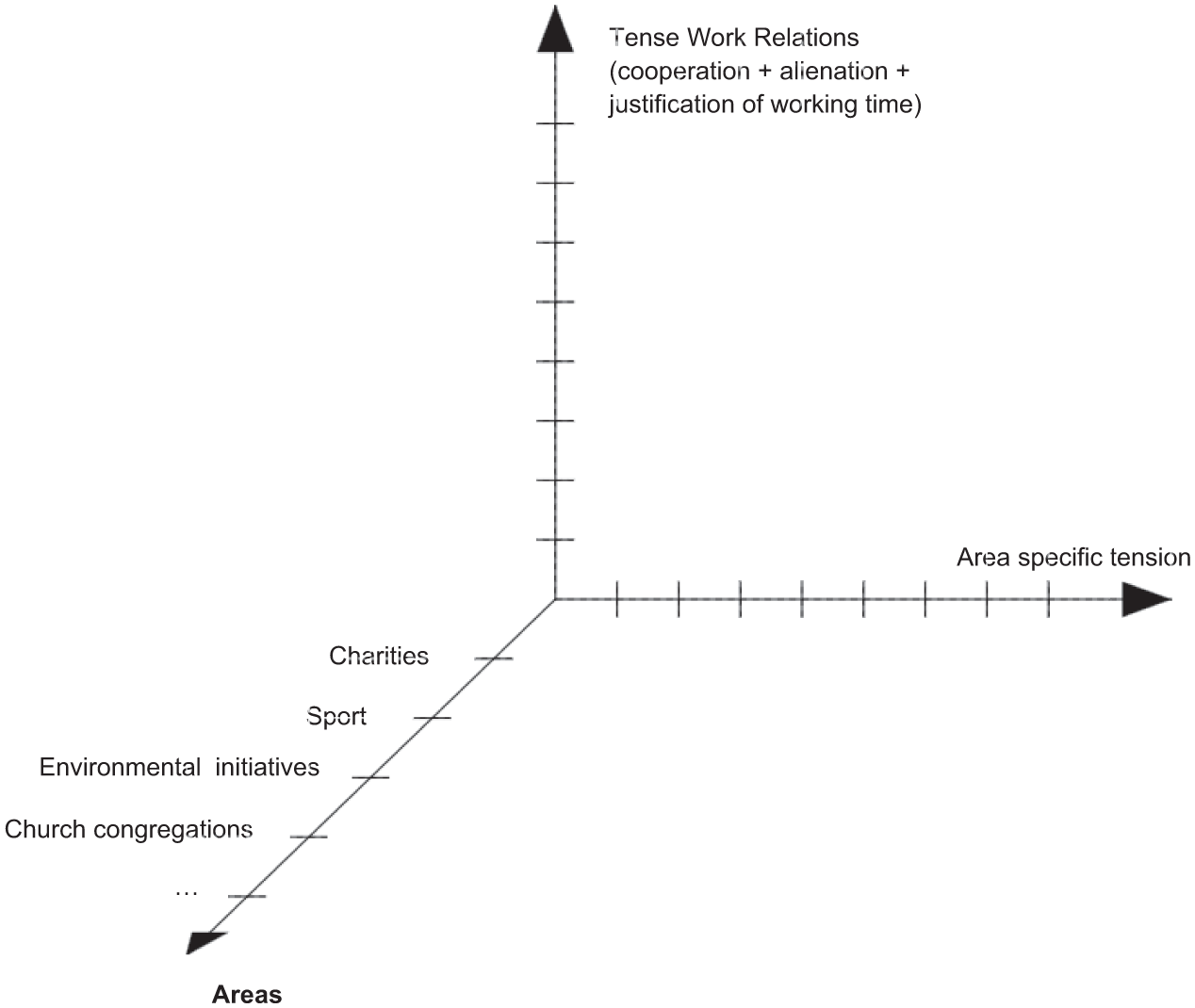
Multidimensional Experiential Space.
These results correspond with the current state of research but systematize the results of dropout research to an even greater extent: If we take, for example, studies on volunteer turnover in helping relationships (Dury, 2018; Milbourn et al., 2019; Ripamonti et al., 2017; Yanay & Yanay, 2008), they address experiences of exhaustion, alienation and lack of involvement, including burnout. In each case, tense experiences of work processes are highlighted. It may be that the working conditions in the welfare sector are particularly conducive to such experiences. Nevertheless, comparable stories were also found in this research project in sports (G 9-S, I 25-S) or in churches (I 45-K, I 55-K). Looking at multidimensional spaces of experience allows us to understand both the area experience and the work experience equally as a consequence of the volunteering experience.
Volunteer management must be sensitive to area-specific fields of tension and at the same time support the coordination of work processes. The difficulty of cooperation, the prevention of feelings of powerlessness, or lack of self-efficacy (cf. alienation), but also the justification of time spent working seem to me to be areas of responsibility that go beyond the previous perspectives of volunteer management (such as employability, recruitability, job crafting) and further specify its tasks.
The limitations of the present analysis result from the scope of the sample and its comparability. It is therefore not yet possible to deduce from the small sample which social group reacts more quickly to the tensions by dropping out, or whether there could be positive factors that help to cope with tensions (such as social contacts). There is also a lack of reconstructions of tensions in areas other than those mentioned, such as cultural, educational, or emergency service commitments.
Further limitations of the present analysis are related to the research approach itself: Because the underlying research project pursues a culturally sensitive approach, there is less focus on the resources of those involved. Due to the survey of volunteers, the perspective of organizations, such as full-time employees, is also missing. Subsequent research could accordingly investigate the extent to which individual resources for action or organizational cultures represent additional dimensions of the engagement experience and need to be integrated into this model accordingly.
Subsequent research could also ask whether and how former volunteers continue to be active in civil society: How do they deal with the end of their involvement? Is it an episode without consequences, a clarification process that causes no damage to the involved self, or even a failure? What consequences do such experiences have for future work in nonprofit organizations? Are they forever lost to volunteering or not (as research assumes in view of the increasing project nature of volunteering)? Considering these questions, dropout research also offers potential for qualitative panel research.
Conclusion
The study contributes to the volunteering literature in general and especially the dropout literature by highlighting some flaws and arguing for alternatives. First, it argues against the background of its findings as it has become apparent that volunteering is often discussed one-dimensionally (Hustinx & Denk, 2009, p. 216). For example, dropout research often formulates the question in a manner which contrasts whether volunteers end their involvement either because they lack resources or because they disagree with a management practice. This perspective either reduces the volunteering experience to the work dimension (whereby research too often ignores the significance of other employees, McAllum, 2018, p. 954) or focuses exclusively on the area dimension. Instead, I argue that it should not be an either-or perspective, but an as well as.
Second, it makes a qualitative difference in the experience of volunteers where they conduct their work. This is not only the case because, objectively speaking, they might deal with issues in different areas differently, but also for more implicit reasons. For example, those involved in the different areas can sometimes act more and sometimes less as co-creators of services. Restrictions, laws, and norms affect volunteering in different areas in separate ways.
Third, future research would do well to investigate volunteering more as work than is already the case (Overgaard, 2019). Volunteers bring in their specialist knowledge and skills, cooperative ventures bring about spontaneous hierarchies, paid staff and co-volunteers devalue work performed.
Footnotes
Author’s Note
This article is based on two research projects on the termination of volunteering in charitable organizations (a) and church communities, sports clubs, and environmental initiatives (b) at the University of Siegen (Germany) under the direction of Chantal Munsch. I would like to thank Chantal Munsch and Moritz Müller for their joint work. Since this publication is a further theorization of the results, the sole author authors the article. I would also like to thank the reviewers and editors for their constructive feedback.

Funding
The authors disclosed receipt of the following financial support for the research, authorship, and/or publication of this article: This research was funded by the Deutsche Forschungsgemeinschaft (DFG, German Research Foundation) - 419367942 and 236860160.
Declaration of Conflicting Interests
The authors declared no potential conflicts of interest with respect to the research, authorship, and/or publication of this article.