






Abstract
This study examines how leadership diversity and representation within nonprofit organizations influence community support. Drawing on a national survey of 1,036 nonprofits in the United States, we tested a structural equation modeling linking board racial diversity, CEO racial and gender representation, staff racial diversity, and private donations. We found that nonprofits with more racially diverse boards were more likely to have racially and gender-representative CEOs, who in turn were linked to greater workforce diversity. However, board diversity did not consistently translate into increased donations, suggesting that diverse governance alone may not enhance community support. Notably, CEO gender representation was positively associated with community support, but no significant mediating effects were found in the relationship between board diversity and community support through CEO representation. These findings highlight the complex dynamics between internal representation and stakeholder support. Nonprofit organizations should strategically align diversity initiatives with mission-driven engagement to realize their full value amid intensifying debates over diversity, equity, and inclusion.
Introduction
Scholars have extensively discussed representation and diversity in nonprofit governance, highlighting their importance as core social values and sources of legitimacy (Kim & Mason, 2018; Rolf et al., 2023). Others have examined the outcomes of such practices, finding that board members or CEOs who reflect the characteristics of their clients and stakeholders can enhance shared values and trust through social identification (e.g., LeRoux & Medina, 2023). However, less attention has been given to whether and to what extent leadership representation and diversity lead to concrete organizational outcomes (Buse et al., 2016), particularly regarding financial resources. This gap is significant in the current U.S. context, where some diversity initiatives have increasingly become politically framed, shaping how nonprofit stakeholders may perceive leadership or workforce diversity. Political Polarization Theory (Iyengar et al., 2019) suggests that when diversity efforts are viewed through a partisan lens, organizations risk alienating certain donors, volunteers, or community members, even when the initiatives themselves are not inherently political.
Building on representation theory and related perspectives, this study develops a conceptual integrative structural model to test whether and how diversity in governance and leadership contributes to external stakeholder support. Specifically, we examine the pathways by which board diversity may influence CEO representation, how leadership diversity may shape workforce composition, and ultimately, how these dynamics affect community support. Accordingly, we ask: Is the proposed path model—linking board diversity, CEO representation, staff diversity, and community support—empirically valid?
Theoretical Background of Diversity and Representation
Over the past decade, scholars have examined nonprofit diversity and its implications for organizational performance through multiple theoretical lenses. Representation theory provides the primary foundation for this study, emphasizing that diverse leadership structures can move beyond descriptive variety to substantive advocacy for community interests (Guo & Musso, 2007). Within this framework, principal–agent theory highlights how diverse boards can enhance accountability and legitimacy by more authentically reflecting the interests of principals such as donors, clients, and policymakers (Gazley et al., 2010; Miller, 2002). Resource dependence theory complements this view by suggesting that diverse boards and leadership expand organizational networks and expertise, thereby facilitating access to critical resources such as funding, client referrals, and specialized knowledge (Siciliano, 1996; Van der Walt & Ingley, 2003). In addition, a social constructionist perspective underscores how community stakeholders perceive organizations with diverse leadership as more responsive, egalitarian, and innovative (Balser & McClusky, 2005; Brown, 2002; Light, 2004; Miller, 1999). These perceptions, in turn, generate symbolic legitimacy and strengthen stakeholder identification, which representation theory suggests can translate into tangible outcomes such as increased donations or volunteer support.
Yet, empirical findings reveal inconsistent outcomes. Diversity has a dual nature: while varied perspectives may enhance innovation and decision quality, they can also reduce efficiency by creating conflict or challenging group cohesion (Jehn & Bezrukova, 2004). Such outcomes depend heavily on how diversity aligns with organizational contexts and performance measures (Mor Barak, 2015; Watson et al., 1993). Moreover, diversity initiatives may still be shaped by broader social and political dynamics, though these dynamics are likely to vary across organizational types. Political Polarization Theory suggests that when efforts around diversity are framed or perceived through a partisan lens, organizations risk alienating certain segments of their donor base, volunteer network, or broader community (Iyengar et al., 2019; Mason, 2018). While this effect may be more pronounced for advocacy organizations that take explicit public positions, even service-oriented nonprofits can face scrutiny depending on how stakeholders interpret their governance and leadership practices. At the same time, research shows that many nonprofits have sought to pre-empt these risks by framing diversity in mission-aligned rather than ideological terms, positioning inclusion as consistent with core organizational values (Eikenberry & Kluver, 2004; Mor Barak, 2022). Building on these insights, we conceptualize diversity governance as a protective factor; it not only represents and safeguards the interests of diverse stakeholders but also strengthens legitimacy and trust, enabling nonprofits to sustain community support.
In nonprofit scholarship, the terms “diversity” and “representation” have often been used interchangeably (Kim & Mason, 2018) but have distinct meaning. Diversity refers to demographic heterogeneity within an organization (e.g., race, gender, or ethnicity), while representation suggests a correspondence between the organization and the communities served (Guo & Musso, 2007). While diversity may refer more broadly to demographic variety without necessarily ensuring alignment with or advocacy for the specific community, the concept of representation emphasizes whether an organization genuinely reflects and advocates for the voices of its clients.
Guo and Musso (2007) provides a comprehensive framework for understanding the importance of representation in nonprofit organizations, identifying five distinct dimensions: formal, descriptive, participatory, symbolic, and substantive representation. Formal representation refers to institutional mechanisms that allow constituents to have a structural voice in governance, such as designated board seats for community members, voting rights, or other rules that ensure constituents can participate in decision-making processes. Building on this foundation, descriptive representation is the extent to which the demographic characteristics of an organization’s leadership and staff mirror those of the served community. This dimension strengthens organizational legitimacy and fosters trust when community members see themselves reflected in various organizational roles.
The framework then shifts focus to active engagement through participatory representation, where constituents become involved in shaping the organization beyond formal structures. This includes volunteer participation, advisory group membership, and other forms of direct involvement that help define organizational priorities. Symbolic representation addresses the perceptual dimension—whether the community views the organization as an authentic and legitimate representative of their interests and values. Substantive representation is the extent to which an organization actively advances the interests of its constituents through policy advocacy, service provision, or other concrete actions.
Social identity theory further illuminates this dynamic by explaining how individuals define themselves through group affiliation and are motivated to support organizations that reinforce their identity (Mael & Ashforth, 1992; Tajfel & Turner, 1986). When a nonprofit visibly represents the values of its clients, community members who share those values are more likely to identify with the organization and provide tangible support (Drezner, 2019). Research shows that when people strongly identify with an organization, they are more willing to contribute time and money because individuals who identify closely with an organization experience their successes and failures as personal outcomes, creating a powerful motivation for sustained support (Ashforth et al., 2008).
These externally oriented dimensions, particularly symbolic and substantive representation, along with social identity theory, inform this study’s focus on nonprofit leadership representation. Distinct from board diversity, the study examines how nonprofit stakeholders perceive leadership representation and how these perceptions influence their support for the organization.
The Influence of Diversity and Representation on Community Support
While some studies suggest that board diversity may increase conflict and reduce efficiency (e.g., Brown, 2004), the majority have found positive relationships between gender and/or racial diversity in leadership and organizational outcomes. These positive associations appear across multiple dimensions: organizational performance (Choi & Ko, 2025; Evans et al., 2025), programmatic outcomes (Harris, 2014), board performance (Bernstein et al., 2019; Buse et al., 2016), advocacy activities (Kim & Mason, 2018), and stakeholder engagement (Gazley et al., 2010; Lee, 2021).
According to representation theory, board composition diversity plays a critical role in enabling both passive and active representation. The theory suggests that descriptive representation at the board level (i.e., the presence of members who share the gender or racial identity of the target community) can enhance symbolic legitimacy and promote substantive outcomes (Guo & Musso, 2007; Leardini et al., 2017). Symbolic legitimacy arises when stakeholders perceive the organization as aligned with their values and experiences, while substantive outcomes emerge when this legitimacy translates into tangible support. Enhanced legitimacy is often manifested in strengthened relationships with nonprofit stakeholders, such as donors, volunteers, and community partners, which in turn facilitate greater resource acquisition. Following this reasoning, we propose that nonprofits with greater demographic (gender or race) diversity on their boards will experience higher levels of resource acquisition, reflecting enhanced legitimacy in the eyes of key stakeholders (H1).
Scholars argue that shared lived experiences can motivate individuals from marginalized groups to advocate for others with similar identities (Lee, 2019). For example, board members of color or women may draw on experiences with discrimination or gendered power dynamics to support more inclusive leadership (Buse et al., 2016; Lee, 2024). Lee (2023) provides empirical evidence that racially representative nonprofit boards are significantly more likely to appoint CEOs who share demographic characteristics with the populations served. This alignment is not coincidental but reflects a commitment to representation as a pathway to support. Accordingly, we hypothesize that higher levels of board diversity are positively associated with the likelihood of appointing a CEO who shares the demographic characteristics of the target client population (H2).
Board diversity often serves as a gatekeeper, shaping executive leadership in nonprofits where hiring decisions often reflect governance values and priorities (Fredette & Bernstein, 2017; Ostrower, 2002). CEO representation, in turn, shapes workforce diversity through both formal hiring decisions and symbolic signaling. Leaders from underrepresented communities are more likely to champion inclusive hiring practices and foster organizational cultures that value diversity (De Vita et al., 2009; Manzi & Heilman, 2021). Moreover, nonprofit job seekers, especially from marginalized backgrounds, are more attracted to organizations with diverse leadership (Li & Kim, 2024). Diverse leadership also enhances perceptions of procedural fairness and legitimacy among staff, potentially improving retention and employee morale (Choi & Ko, 2025). Thus, we propose that nonprofit organizations with greater diversity and representation in leadership will demonstrate increased staff demographic diversity (H3 and H4).
While board composition can be viewed as how the governing entity reflects diverse characteristics of the constituents, executive leadership may more directly serve as the public face of their organizations, shaping external perceptions and legitimacy. Representative bureaucracy theory explains why nonprofit leadership should reflect its constituents (Lee, 2023). Leaders who share the racial or gender identity of their clients can better understand and advocate for their needs, improving program delivery and community trust (Li & Kim, 2024). Research also shows that nonprofits led by women or racial minorities are more likely to engage in equity-focused initiatives (LeRoux & Medina, 2023). According to social identity theory, donors often feel a stronger psychological connection to nonprofit leaders who reflect their own demographic identity or the communities served. This alignment can enhance a sense of shared values and trust, much like the “social identification” process seen in other domains. Nonprofit leaders (i.e., CEO or ED) from underrepresented groups can also attract support by resonating with community members. Donors, especially those from within historically underserved populations, may feel a stronger connection when they see their identities reflected in organizational leadership.
However, representation does not guarantee equal support. For instance, Brown and Harris (2023) found that nonprofits with female CEOs tend to receive fewer donations than male-led counterparts, even after controlling for other organizational characteristics. They attribute this to potential donor biases and to differences in leadership and communication styles. Similarly, Heckler (2019) critiques how dominant norms of whiteness and masculinity continue to define legitimacy in nonprofit leadership, creating structural challenges for leaders of color and women.
Nevertheless, when representation is matched with structural power and public visibility, its effects can be amplified. Bernstein and Fredette (2024) found that while board diversity improved internal governance outcomes, the demographic characteristics of CEOs—particularly race and gender—had stronger effects on external outcomes like fundraising. Leaders from underrepresented backgrounds often bring distinct networks and cultural capital, helping nonprofits broaden their donor base and enhance outreach (Lee, 2023). Thus, we hypothesize that nonprofit organizations with greater demographic (gender and race) representation in leadership (i.e., CEO or ED) will demonstrate increased community support (H5).
While attention is often given to board diversity and executive representation, a growing body of evidence suggests that the composition of frontline staff and program personnel could also significantly influence various organizational outcomes (Elloukmani et al., 2024). Workforce diversity in nonprofit organizations, particularly those providing human services, could play an essential role in shaping public perceptions, trust, and donor engagement. Drawing from representative bureaucracy theory, Ding et al. (2021) demonstrate that racial congruence between public service providers and clients increases trust and service utilization, especially in human-facing sectors. These findings are readily applicable to nonprofits, where frontline staff are key touchpoints for community engagement. When service recipients observe staff who reflect their cultural and racial identities, they are more likely to view the organization as legitimate and responsive, thereby fostering goodwill and financial support.
This dynamic extends beyond service delivery. Research suggests that diverse workforces enhance organizational reputation and external trust. For example, Pitts (2005) found that perceived diversity among public school teachers improves citizen satisfaction and trust. In the nonprofit sector, organizations perceived as inclusive are more likely to receive positive public evaluations and financial support, particularly among donors from underrepresented communities who seek alignment with their values (Gazley et al., 2010). Following this logic, we propose that nonprofit organizations with greater demographic (gender and race) diversity in their workforce will demonstrate enhanced trust in the eyes of key stakeholders, leading to increased community support (H6).
As shown in Figure 1, we propose a conceptual model illustrating how nonprofit representation and diversity may influence community support. Our primary research question is: Is the proposed path model, outlining the relationship among board diversity, CEO representation, staff diversity, and community support, empirically valid?
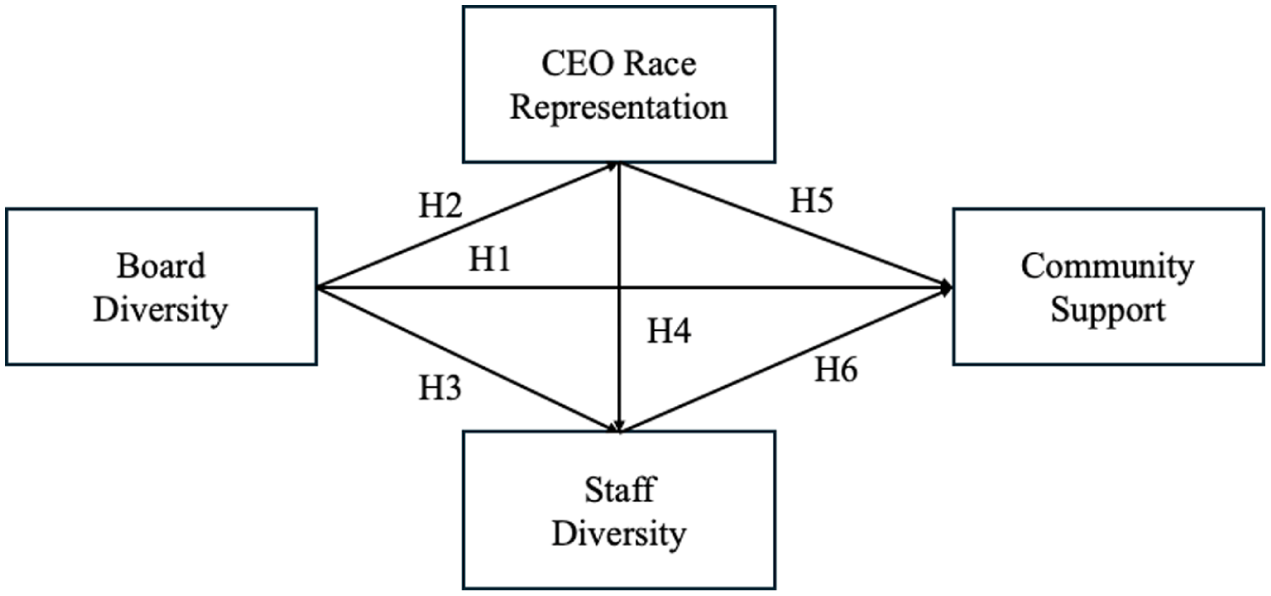
Conceptual Model.
Method
Sample
This study utilized the Urban Institute’s 2021 National Survey of Nonprofit Trends and Impacts. The dataset comprised 2,306 of 501(c)(3) nonprofits engaged in activities ranging from direct service provision to community building and advocacy across the United States. The final sample was 1,036 nonprofits that answered the dependent variable.
Measurement
Based on existing literature (An et al., 2025; Fuller et al., 2024; Goza, 2015), the dependent variable, community support, was defined as the willingness to contribute to an organization, measured by the amount of individual donations an organization receives. Given the skewed distribution of the variable, the amount of donation was log-transformed to normalize its distribution and improve model estimation.
The three independent variables are related to representation and diversity. To assess representation, we used a question identifying the specific groups the organizations served and classifying each as either a primary population (the main service target) or a secondary population (additional group served). CEO racial representation and CEO gender representation were measured as binary variables, coded 1 if the CEO’s race/ethnicity or gender matched the identified population(s) and 0 otherwise. Board diversity and staff diversity were measured based on racial diversity, using the proportion of people of color. Each range was assigned a value from 1 (0%) to 12 (100%).
To account for potential confounding, we include organizational capacity, conceptualized as a latent construct capturing factors such as staff size, budget, and number of clients served, as a control variable, given its plausible influence on both leadership diversity and performance (Kim & Peng, 2018; Nordin et al., 2024; Prentice & Clerkin, 2023). They were measured by total annual revenue, number of paid staff, and number of people an organization served in 2020. Given the highly skewed distributions of staff size and number of people served, these variables were log-transformed prior to analysis.
Data Analysis
We tested our hypothesized mediation model using structural equation modeling (SEM) with full information maximum likelihood (FIML) to handle missing data. Direct paths were specified from board diversity to CEO racial and gender representation and staff diversity. CEO racial and gender representation were tested as potential mediators of the relationship between board diversity and community donations. Descriptive analyses were conducted to examine sample characteristics. Model fit was evaluated using chi-square, RMSEA, CFI, and TLI indices. All analyses were conducted using Stata SE version 19.5.
Results
Sample Characteristics
Table 1 presents descriptive statistics for the key variables in the study. Slightly less than 9% of CEOs matched the race/ethnicity of their target clients, and approximately one-third matched their clients’ gender. Specifically, 4.54% of CEOs were African Americans and shared the same racial/ethnic background as their clients, followed by 2.90% identifying as Hispanic/Latinx, 0.97% as Asian or Pacific Islander, and 0.39% as Native American. In terms of gender representation, 31.66% of CEOs were female, aligning with the populations they serve, followed by 15.05% male and 0.68% identifying as LGBTQ+. The average board racial diversity score was 3.28 (SD = 2.66), and the average staff racial diversity score was 3.91 (SD = 3.40).
Sample Characteristics (N = 1,036).
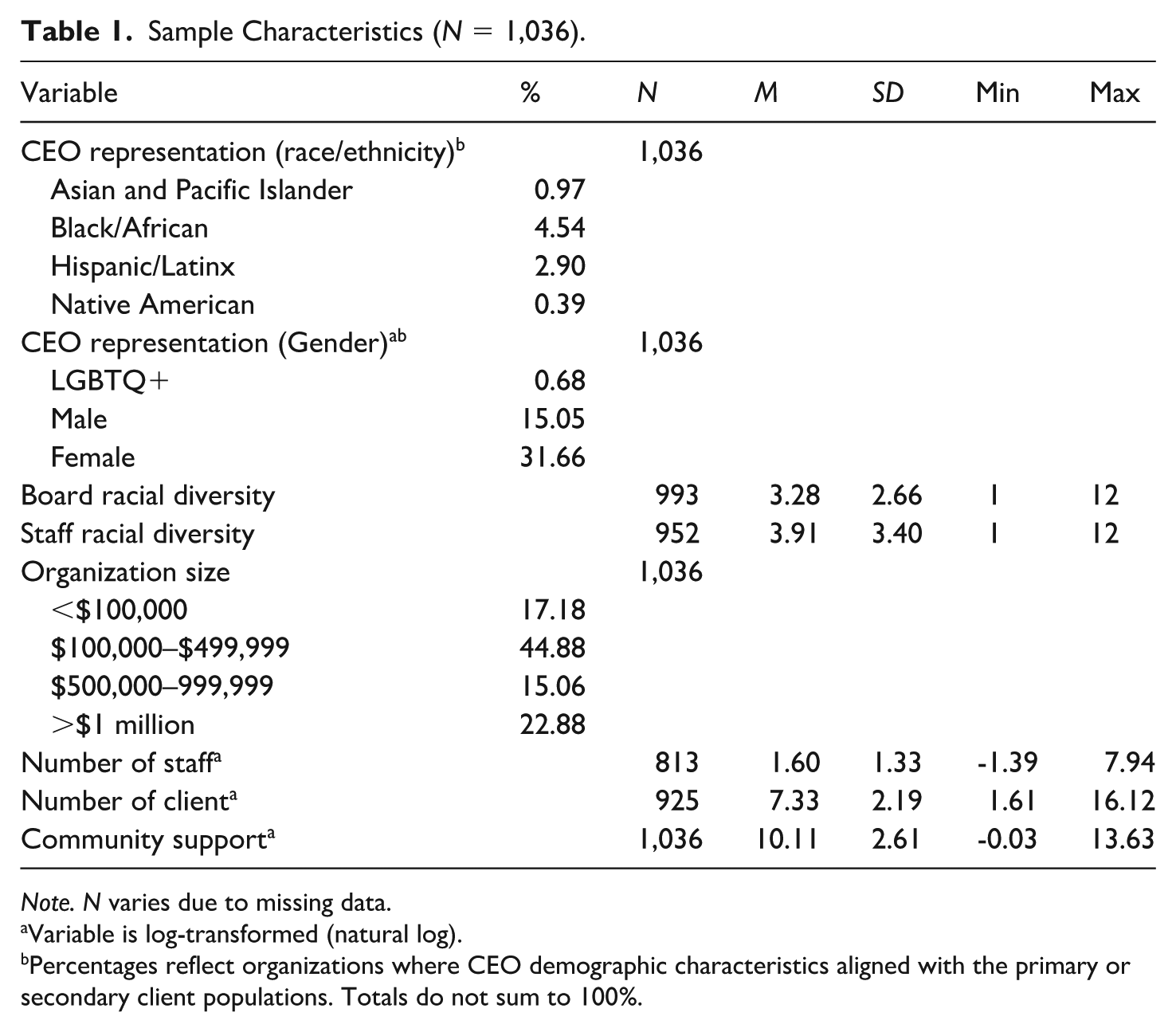
Note. N varies due to missing data.
Variable is log-transformed (natural log).
Percentages reflect organizations where CEO demographic characteristics aligned with the primary or secondary client populations. Totals do not sum to 100%.
Structural Equation Modeling
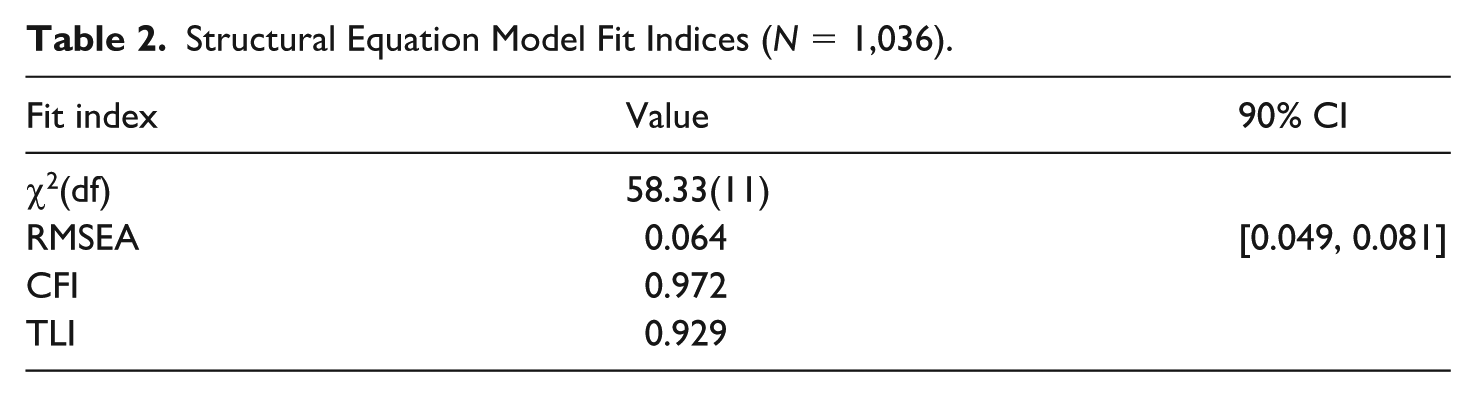
Table 2 presents the results of the structural equation model. Model fit was acceptable, χ2(11) = 58.33, p < .001, RMSEA = 0.064, CFI = 0.972, TLI = 0.929. Results indicated that board racial diversity was significantly and positively associated with both CEO racial representation (B = 0.057, p < .001) and CEO gender representation (B = 0.022, p < .001). This finding is consistent with previous studies that found a positive relationship between board diversity and executive leadership diversity in gender and ethnicity (e.g., Buse et al., 2016; Lee, 2019, 2024). In turn, CEO racial representation was significantly associated with staff racial diversity (B = 2.661, p < .001), as was CEO gender representation (B = 0.355, p < .05). Board racial diversity was also directly related to staff diversity (B = 0.633, p < .001).
Structural Equation Model Fit Indices (N = 1,036).
As shown in Table 3 and Figure 2, CEO gender representation was significantly and positively associated with community support (B = 0.420, p = .010), while board racial diversity was marginally negatively associated with community support (B = −0.076, p = .067). In contrast, CEO racial representation and workforce diversity did not show a significant association with community support. Organizational capacity was significantly associated with higher donations (B = 0.813, p < .001).
Total, Direct, and Indirect Effects.
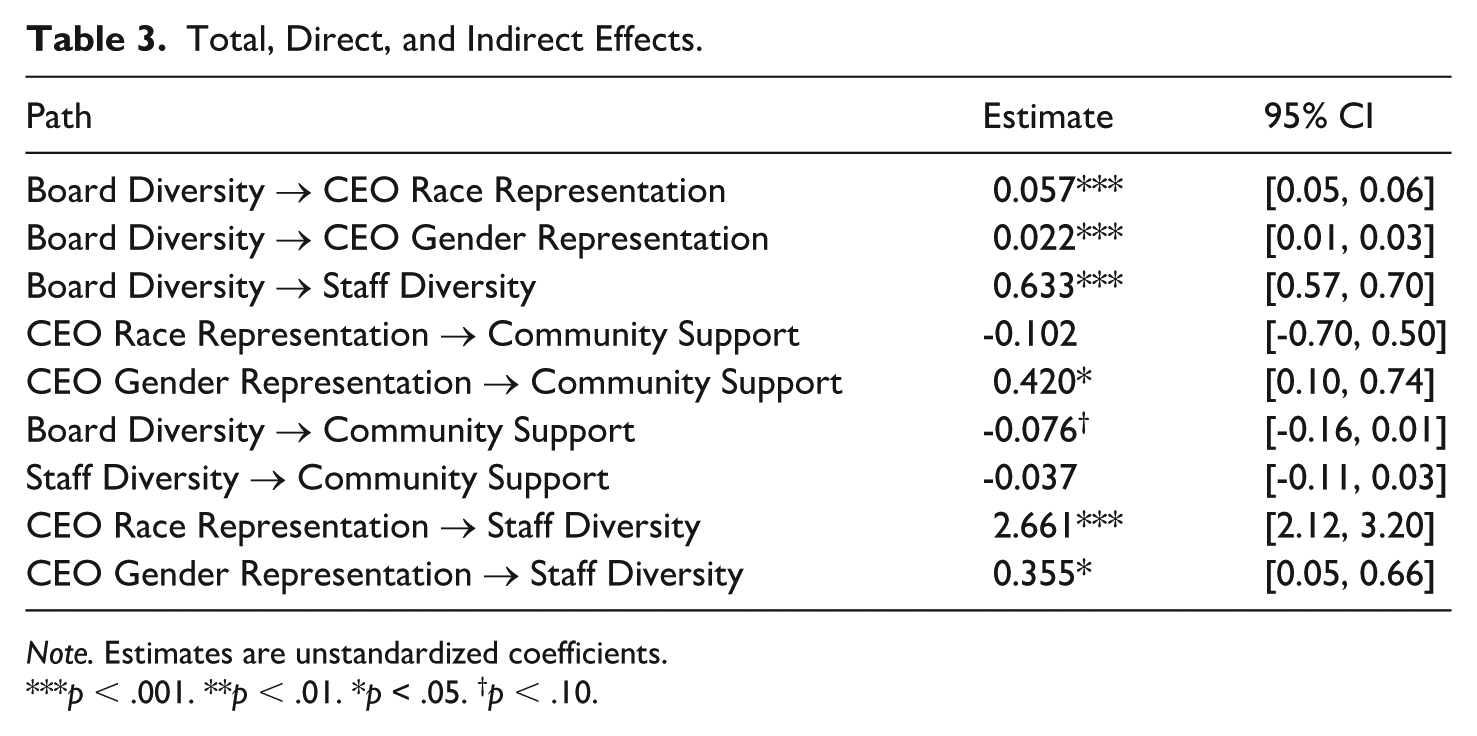
Note. Estimates are unstandardized coefficients.
p < .001. **p < .01. *p < .05. †p < .10.
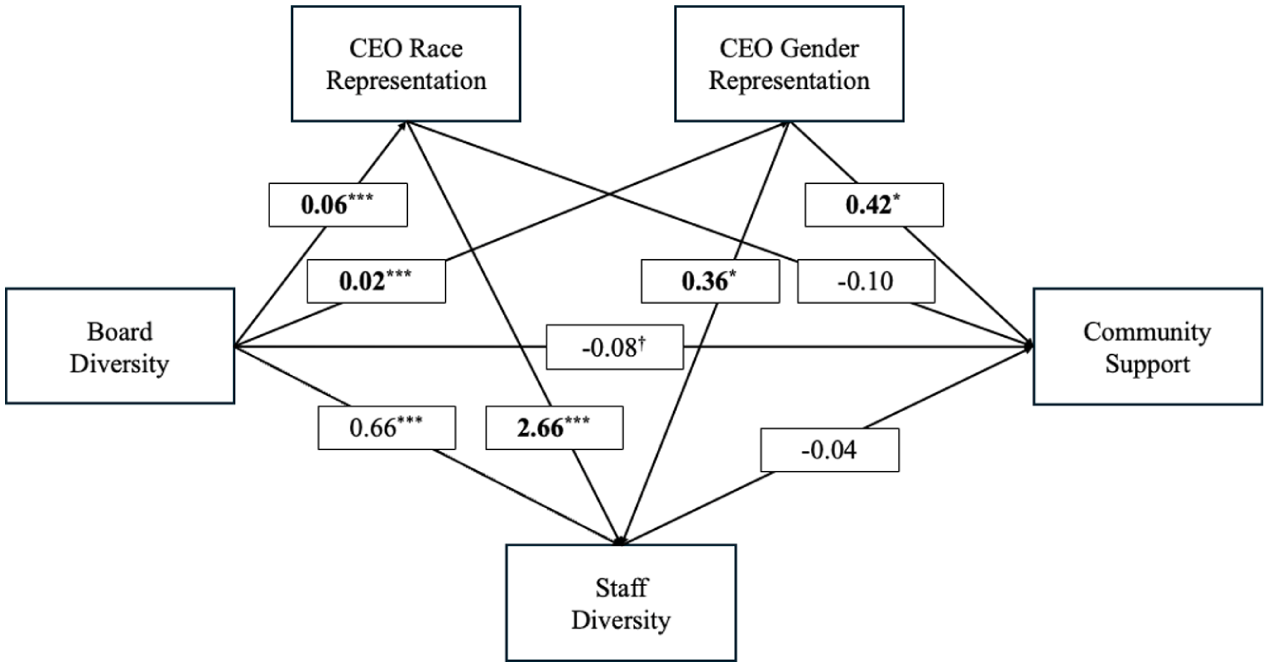
SEM Path Model.
Indirect effects were examined to test the hypothesized mediating roles of CEO racial and gender representation in the relationship between board racial diversity and community support. Bootstrapped standard errors were computed using 5,000 replications. No significant indirect effects were observed through either CEO racial or gender representation.
Discussion
This study examined how organizational representation and diversity, specifically board diversity, CEO representation, and staff diversity, influence community support in U.S. nonprofits. Our findings underscore that descriptive representation alone is unlikely to produce external returns to translate into tangible organizational benefits. As Buse et al. (2016) points out, the pathway from “who is at the table” to “what the organization does differently” likely runs through concrete organizational mechanisms rather than symbolic representation in nonprofit leadership.
Contrary to H1, board racial diversity showed a marginally negative association with community support. This suggests that expanding diversity at the governance level does not automatically enhance community support. One plausible mechanism is capacity mismatch: increases in descriptive diversity without parallel investments in board development (e.g., organizational responsiveness and stakeholder engagement) may dampen fundraising effectiveness (Betzler, 2015). Moreover, scholars have cautioned that prioritizing fundraising as a primary board function risks misaligning board composition with organizational mission and strategic direction (Maurer, 2014). Research further shows that a critical mass of ethno-racial diversity is key to improving fiduciary performance, stakeholder engagement, and organizational responsiveness, because diversity’s effects on governance are uneven and nonlinear (Fredette & Bernstein, 2017). Taken together, these findings suggest that diversity should be understood as part of broader organizational goals, not simply as a strategy to increase funding.
At the same time, our model indicates that more racially diverse boards are more likely to hire representative CEOs (race and gender) (H2), and these CEOs are associated with more diverse workforces (H4): evidence of a pipeline from governance to leadership to staff composition. This pattern suggests that diverse leadership may focus more on internal inclusivity, delivering long-term benefits like improved morale and service quality, even if immediate financial returns are limited (Elloukmani et al., 2025; Findler et al., 2007).
Notably, only CEO gender representation exhibited a positive association with donations, whereas CEO racial representation and workforce diversity did not. One interpretation, consistent with Buse et al.’s (2016) emphasis on policy-and-practice channels, is that certain forms of representation (here, gender at the CEO level) may be more readily recognized by external stakeholders and more effectively translated into donor-facing practices (e.g., inclusive messaging, relationship-oriented engagement) that influence giving.
Overall, our findings suggest that nonprofit organizations should not assume that internal diversity alone will generate external support. Community evaluations of legitimacy are likely influenced by broader governance dynamics rather than individual leadership characteristics alone. While diverse boards may influence inclusive leadership, this leadership does not necessarily result in greater community financial support—and may even reduce it. This counterintuitive finding could reflect public skepticism, donor bias, or ineffective communication of diversity-related impacts. It highlights the importance of coupling representational diversity with strategic storytelling and stakeholder engagement to fully realize its potential benefits.
Limitations
Several limitations inform directions for future research. First, our reliance on the cross-sectional secondary data from 2019 to 2020 constrains the generalizability of our findings. Because we did not have control over how key variables were defined or collected, we were limited in how precisely we could operationalize central constructs. For example, board and staff diversity were measured using a single survey item that asked about the proportion of “people of color,” without disaggregation by specific racial or ethnic groups.
Furthermore, the cross-sectional design prevents us from examining the potential time delays in the effects of leadership diversity. It is possible that shifts in public perception or internal organizational outcomes (e.g., staff composition) occur gradually, or there are bidirectional relationships between diverse leadership and other organizational dynamics. Future research should explore how government policies and broader political climates shape the dynamics between organizational representation/diversity and community support, using longitudinal data.
Second, our measurement of community support is limited to financial donations and does not account for other valuable forms of support, such as volunteer engagement, in-kind contributions, or perceived organizational trust. While higher donation levels may reflect community trust and legitimacy, they are also influenced by various factors, including marketing strategies, fundraising efforts, and donor-specific interests.
Moreover, the use of individual donation amounts serves only as a proxy for external financial support, and the geographic origin of these donations is unknown and may include non-local donors. This limits our ability to assess whether the support received truly reflects local community engagement. In addition, our study lacks community-level data on the areas where nonprofits are located, such as racial, ethnic, or socioeconomic composition that shape community support for nonprofit leadership. Future research should adopt broader measures of community support and incorporate community-level data, potentially through stakeholder surveys, interviews, or available census data.
Finally, although our sample includes diverse nonprofits, diversity initiatives may differ across subsectors. For example, nonprofits in health, poverty alleviation, or homelessness services may elicit distinct responses from donors based on how diversity is perceived in those contexts. In particular, the symbolic or representational significance of leadership diversity may vary depending on whether gender is salient to the organization’s mission. Future work should examine whether and how the relationship between diversity initiatives and stakeholder responses varies by organizational mission and service area.
Conclusion
This study provides empirical evidence on how leadership diversity shapes community support within U.S. nonprofit organizations. Our findings suggest that nonprofit organizations should not assume that internal diversity alone will generate external support. Representation must be actively linked to mission-aligned strategies and communicated in ways that resonate with diverse donor bases. As debates over DEI policies continue to intensify, nonprofits must navigate these tensions by grounding diversity efforts in organizational effectiveness, community responsiveness, and inclusive governance.
Footnotes

Funding
The authors received no financial support for the research, authorship, and/or publication of this article.
Declaration of Conflicting Interests
The authors declared no potential conflicts of interest with respect to the research, authorship, and/or publication of this article.