






Abstract
Despite the importance of diversity, equity, and inclusion (DEI) practices and policies, some public service organizations do not have them. Discourse surrounding DEI has pressured many organizations to remove DEI policies given their resource dependence and stakeholder expectations. During 2024, we used Qualtrics to survey nonprofit organizations in North Carolina with budgets over $1 million (n = 111) to examine their DEI policies and consider how stakeholder pressures influence commitment to DEI. Findings reveal that pressure from staff and state government significantly influences organizational commitment to DEI. We also find that perceived amount of negative controversy surrounding DEI within organizations, communities, and the state positively affects commitment to DEI. These findings show that North Carolina’s nonprofits are doubling down on DEI, likely due to belief in their mission, alignment with marginalized communities, and commitment to long-term, systemic change, allowing them to remain steadfast in their DEI efforts despite shifting cultural and political winds.
Introduction
Diversity, equity, and inclusion (DEI) policies help organizations cement their support of DEI in the workplace. They exist to improve workplace conditions and structures and empower employees to question and change organizational norms (Sessler Bernstein & Bilimoria, 2013; Hanappi-Egger, 2012). Modern DEI policies are evolutions of Affirmative Action policies and go beyond hiring quotas of minority groups to include policies that are proactive, dynamic, and comprehensive by addressing organizational culture, empowerment, and accountability. Also called diversity management programs, DEI policies have evolved from addressing discrimination, diverse hiring, and fairness to access, legitimacy, and equity (Hamidullah et al., 2024; Hoang et al., 2022) to focus on making members of underrepresented groups feel appreciated, understood, and given equal and equitable opportunities for success. As such, a general search for “DEI policies” will result in policies being named DEIJ (diversity, equity, inclusion, and justice), IDEA (inclusion, diversity, equity, and access), diversity management policies or programs, and any other various combinations of these words and concepts.
DEI policies are important for both public and nonprofit organizations that hold values in promoting social justice, fostering inclusiveness, and strengthening stakeholder relationships and accountability (McCandless et al., 2022; Riccucci, 2021), and can improve organizational performance (Hamidullah et al., 2024; Lee, 2019; Moon & Christensen, 2020; Park & Liang, 2020). There has been industry influence on nonprofit adoption of DEI policies, as many nonprofit trade journals and consulting firms that produce reports, papers, or publications discuss DEI policies and provide advice on how to develop, implement, and maintain these policies 1 . In addition, there are best practices offered from accrediting bodies and rating systems in different subsectors (such as the Council of Foundations, Council on Accreditation, Charity Navigator, The American Alliance of Museums, The Joint Commission) which highlight the importance of DEI initiatives, practices, and policies for nonprofit organizations. While the importance of DEI is clear for both public and nonprofit organizations, its implementation and public perception are evolving in response to shifts in the current legislative and political landscape.
When DEI programs and policies are implemented properly, they create a level playing field where talented individuals can succeed based on merit and ability to perform the job, regardless of their background, race, gender, ability, or other demographic. Given the importance of this idea for creating a fair and just society, this article explores DEI policies within nonprofit organizations and considers factors that may influence the adoption or existence of such policies. To this end, our research questions include: Are nonprofits adopting, altering, or removing their DEI policies in the current social and political environment? Does diverse executive leadership influence the presence of organizational policies on DEI? How are internal and external pressures affecting nonprofit organizations to create, change, or remove DEI policies and affecting their commitment to DEI? Before examining these questions, we review the literature on DEI for nonprofit organizations and consider resource dependency, representative bureaucracy, and institutional theories that inform our hypotheses. We then discuss our methodology and examine the general types of influences (both internal and external) that affect nonprofit policies and actions.
Literature Review
DEI in Nonprofit Organizations
There are three antidiscrimination laws in the United States that fall under the DEI umbrella and are relevant to public and nonprofit agencies (Title VII of the Civil Rights Act of 1964, Americans with Disabilities Act of 1990, and Age Discrimination in Employment Act of 1967), and the implementation of these protections can advance workplace diversity (Hamidullah et al., 2024). Nonprofits do not face all of the same legal requirements and expectations as public agencies, however. Public organizations are often bound by legal mandates, such as federal or state regulations, which require them to implement and enforce certain initiatives. These laws affect a variety of organizational operations, such as public procurement, hiring, budgeting, and health and safety. Public agencies are required to allow public access to government records under the Freedom of Information Act (FOIA) and nonprofits do not have this transparency requirement. Some nonprofits do have more requirements than others, however. For instance, nonprofits that receive federal grants must meet operational requirements set by the U.S. government and compete for funding, and some private foundations require DEI policies as a grant condition (LeRoux, 2020). These practices are scrutinized by the government and watchdogs like Charity Navigator, GuideStar, ProPublica, and others (Zietlow et al., 2018). While nonprofits do not face all of the same legal pressure or risk of litigation, DEI is still important for them. In fact, many nonprofits align themselves with DEI principles because they reflect the core values of equity, justice, and service to diverse communities—values that are foundational to their mission.
While the importance of diversity has received more attention in scholarship and practice for its benefit to public and nonprofit administration, the focus on equity and inclusion in the nonprofit sector is still emerging. Social equity is one of the pillars of public administration and emphasizes fair and just distribution of services and the inclusion of all communities in decision-making (Blessett et al., 2019; Frederickson, 1990; Gooden, 2015; Svara & Brunet, 2005). Social equity refers to the commitment to ensure all individuals—especially those from underserved communities—have fair access to resources, opportunities, and decision-making power (Blessett et al., 2019; Svara & Brunet, 2005). For nonprofits—which often serve as partners, intermediaries, or substitutes for government in delivering public goods—embracing social equity is essential to fulfilling mission work that addresses systemic disparities and advocates for underrepresented groups. Gooden (2015) argues that addressing racial inequality requires more than just race-neutral policies but intentional approaches that rectify systemic disparities. For nonprofits, this broadens the scope of social equity beyond service delivery to include operations, governance, and even advocacy. The emphasis Gooden places on confronting institutional discomfort and resistance to conversations on race mirrors many challenges like pressures that nonprofits face in embedding equity into organization missions, practices, and policies.
The last 10 years have seen a significant rise in social equity work in the nonprofit space. Generally, the literature suggests that social equity in nonprofit management means not only acknowledging and addressing power dynamics, biases, and structural inequalities that affect both communities served and internal operations, but also involves inclusive policies, diversifying leadership, and authentic engagement with stakeholders to achieve social change (Azevedo & Bell, 2025; Azevedo & Shi, 2024; Gooden, 2015; Nickels & Leach, 2021). Recent work has called for nonprofit literature to move beyond traditional frameworks and consider unique experiences of underrepresented groups (such as LGBTQ+ communities) to advance social equity within the sector (Meyer et al., 2021). Nonprofits can enhance their legitimacy and affect and contribute to democratic governance and social justice by adhering to principles of social equity and inclusion.
The importance of DEI policies within nonprofit spaces is paramount, as it has been shown to enhance impact and align nonprofits with their goals and values, increase trust and credibility, retain more diverse talent, improve decision-making, and increase community engagement (Azevedo et al., 2021; Buse et al., 2014; Lee, 2023; McClelland, 2021; Mumford, 2022; Willis et al., 2024). Furthermore, board diversity policies and inclusion behaviors have been found to affect governance effectiveness (Buse et al., 2014; Fredette & Sessler Bernstein, 2019). Nonprofit literature also highlights the effectiveness of DEI policies, showing a positive correlation between stakeholder diversity and the number of an organization’s accomplishments (Brown, 2002), and a positive influence on minority leadership employees’ self-perception, ambition, and willingness to seek leadership positions (Gündemir et al., 2017).
Despite the importance of DEI and DEI policies, nonprofit organizations, who play a critical role in public service delivery, may lack commitment and adherence to DEI. Nonprofit HR (2022) found that only 40% of nonprofit respondents have a formal DEIJ statement, and these findings are echoed among other work showing a persistent gap in terms of DEI in nonprofit leadership (Fredette & Sessler Bernstein, 2019; Lee, 2023). In addition, nonprofits do not have the same laws or mandates available in government that can increase diversity and inclusiveness (Azevedo et al., 2021). There is little to no research demonstrating how many nonprofit organizations have such policies, and what influences them to create and implement such a policy (Mason, 2020).
Pressures and Influences on DEI
Diversity programs have been found to be overwhelmingly implemented in response to some type of pressure and are not created proactively in local governments (Harris, 2012). For instance, Harris (2012) found that most interviewed local government officials reported that diversity programs were established in a top-down manner. Pitts, et al. similarly found that diversity management programs in Texas public school systems were developed in public school systems as a response to system pressure (2010). Therefore, pressures may also affect the formulation of DEI policies in nonprofit organizations.
Internally, employees and internal controversies may be sources of internal pressures affecting DEI policies. As individuals who serve to perpetuate the function of the nonprofit organization, employees are capable of exerting pressure on the organization to implement, revise, or eliminate any number of policies, procedures, or programs. Indeed, employee complaints act as an internal pressure on local government agencies to implement DEI policies to address issues raised by underrepresented groups in the workforce (Harris, 2012). The culture of an organization can also create an environment in which either controversy is the norm or the culture is more agreeable. Such environments could encourage or discourage DEI activities. For instance, public school districts in Texas were more likely to adopt diversity management programs when the culture was harmonious (Pitts et al., 2010), suggesting internal structure and culture can influence the adoption of DEI policies or programs.
Organizational leadership can also exert internal pressure on a nonprofit organization, impacting the adoption of DEI policies. Nonprofit board members are responsible for the financial management and performance of the organization, and their diversity can positively affect organizational accomplishments (Brown, 2002). Board diversity also influences board diversity policies and practices, in addition to inclusive behavior (Buse et al., 2014). BoardSource, a nonprofit organization providing tools, resources, and research for nonprofit board members to strengthen both the board and the organization they serve, has biennially surveyed nonprofit boards and their CEOs since 1994 regarding their leadership and diversity, finding that as DEI-related board activities increase, so does organizational effectiveness, suggesting a positive relationship between the two (BoardSource, 2021). While it did not specifically measure the existence of organizational DEI policies, we consider that if the diversity of boards and their DEI activities can lead to positive organizational accomplishments, board members may also be concerned with organizational diversity and diversity activities or policies, and may apply pressure to the organization to address both.
Nonprofits may also be susceptible to pressures external to the organization. Stakeholders of nonprofit organizations have vested interest in the activities, achievements, and outcomes of the organization. External stakeholders may include donors, community members, and collaborating partners or organizational networks. As an external stakeholder, donors can apply unique pressure to make change within an organization through their financial resources. While we are unaware of surveys in the academic literature that tie donor influence to nonprofit organization’s DEI policies, there is evidence in industry publications that organizations consider how donors feel about DEI initiatives and change behavior as a result. NonProfit Pro, a trade association providing advice on industry best practices, recommends organizations lead their marketing efforts by highlighting DEI, because donors find it very important (Chronister, 2022). Similarly, “Study Shows Donors Care” (2022) suggests a donor’s charitable giving is influenced by DEI activities of the organization. A case study of Kalamazoo Foundation’s own DEI policy journey showed they initially implemented consequences for the DEI practices of their funding recipients, which were later revised after receiving input from those recipients (Pickett-Erway et al., 2014). This demonstrates the Foundation’s role as a donor and its potential influence on the DEI activities of those who receive their funding. Therefore, nonprofit organizations may feel pressure from donors to formalize their DEI policies. Similarly, community members who interact with a nonprofit organization may have a keen interest in organizational DEI efforts. Complaints from community groups, including coalitions, minority groups, or other organizations, have led local governments in the northwestern United States to change their DEI policies (Harris, 2012).
Nonprofit organizations often participate in collaborative networks for educational purposes related to best practices. These networks or associations are able to exert pressure externally on nonprofit organizations with respect to their DEI policies. Some professional organizations, like Blue Avocado (n.d.), provide DEI policy templates on their website (www.blueavocado.org). Others, like Charity Navigator, score nonprofit organizations on their DEI practices, and state they hope this will spur nonprofits to focus on DEI (“Nonprofits Receive Charity Navigator Scores for DEI Strategies and Impact,” 2022). The Association of Fundraising Professionals President says IDEA policies are needed, and recommends well-defined policies (Clolery, 2021). Since networks and partners are fostering a norm of creating or tending to a DEI policy, this can lead organizations to participate to fit in with their peers. Public school districts in Texas were found to implement diversity management to mimic other districts, essentially accepting peer pressure to conform to network norms (Pitts et al., 2010). Therefore, nonprofits may feel a level of pressure from collaborating partners or organizations in their network to create and adhere to such DEI policies.
Social movements like Black Lives Matter and political contexts (like a contentious presidential election) may also have an impact on how nonprofit organizations act on their DEI policies. In a 2022 survey of nonprofit organizations across 40 U.S. states and Canada, Nonprofit HR found that as a result of “ongoing racial justice and equality challenges,” 54% prioritized or reprioritized DEIJ objectives, programs, or initiatives, 34% increased or will increase their DEIJ budget, 23% did not adjust their approach, 9% said recent race events had no impact on their DEIJ approach, 1% deprioritized their DEIJ initiatives, and 1% reduced or will reduce their DEIJ budget (Nonprofit HR, 2022). Given the more current political tensions that are creating other external influences on nonprofits to revisit their DEI policies, organizations like the Council on Foundations, Independent Sector, National Council on Nonprofits, and United Philanthropy Forum are sending their members and groups resources and trainings (i.e., webinars and workshops) that are responding to federal pressure (from the Trump administration, through executive order) to remove DEI. Many organizations, including educational institutions, are left uncertain after the terminology of “termination of all discriminatory programs” was used (Exec. Order No. 14,151, 2025). Institutions like Arizona State University informed their researchers to stop any work on DEI projects immediately (The Wall Street Journal, 2025). These external pressures have left uncertainty among nonprofits on their current policies as well as programs. The Council on Foundations, Independent Sector, National Council on Nonprofits, and United Philanthropy Forum are specifically responding to this uncertainty by encouraging nonprofits to stay true to their organizational values and missions while also eliminating unnecessary risk by clearly communicating organizational practices on DEI that show the law is understood and that organizations are complying with the law (E. Cuneo DeSmedt, personal communication, January 31, 2025). Thus, it is worth further examining the relationship between current external environmental pressures and DEI policies.
Theoretical Underpinnings
Resource Dependency Theory (RDT) suggests that organizations are dependent on external resources—such as funding, support, and legitimacy for survival (Pfeffer & Salancik, 2015, 1978); Studies on RDT are heavily linked to strategic management (Ozturk, 2021) and have been widely applied in nonprofit organizations (Berrett & Holliday, 2018; Guo & Acar, 2005; Malatesta & Smith, 2014; Raffo et al., 2016). For nonprofits, dependency can shape their decisions on organizational practices and policies, including their stance on DEI. Nonprofits often rely on funding from government agencies, foundations, or private donors, each of which may have specific expectations or requirements regarding organizational practices. For example, government grants may increasingly come with stipulations that encourage or mandate DEI initiatives as part of the funding criteria. Similarly, private foundations or corporations that fund nonprofits may have their own DEI standards, which can influence whether an organization adopts such policies.
As a result, nonprofits may be more likely to embrace DEI statements or policies if they align with the preferences of their major funders but may hesitate or delay implementation if those funders do not prioritize these issues, reflecting a strategic alignment with resource providers to secure necessary financial support. This is seen in practice as ample educational institutions have called for stopping any and all federally funded programs related to DEI projects and to avoid using any unspent funds, including educational institutions in the state of North Carolina (NC State University, n.d.). Additional implications could also be made for nonprofits that rely on government funding. Bloodgood and Tremblay-Boire (2017) find that external influences, including stakeholder perceptions and government financial assistance to nonprofits, influence nonprofit political activity and their willingness to be seen as too radical or political. We therefore make our first hypothesis.
The theory of representative bureaucracy emphasizes the importance of a workforce that reflects its service population (Kingsley, 2016), suggesting that when there is alignment between social, cultural, and demographic characteristics of the workforce with the service community, more equitable and effective policy outcomes will happen (Bishu & Kennedy, 2020; Bradbury & Kellough, 2011; Ding & Riccucci, 2023; Sabharwal et al., 2018). Representative bureaucracy can improve legitimacy, trust, accountability, and outcomes through promoting diversity (Riccucci & Van Ryzin, 2017). Nonprofit organizations that have a representative bureaucracy are more inclined to offer services that coincide with their interests (Azevedo & Bell, 2025; Azevedo & Shi, 2024; Sowa & Selden, 2003).
Organizations led by individuals from underrepresented groups may be more likely to implement DEI policies due to the distinct lived experiences and critical perspectives these leaders bring to organizational leadership. Heckler (2019, 2023) and Nickels and Leach (2021) emphasize how whiteness often operates invisibly in nonprofit spaces, shaping norms, decision-making, and workplace culture in ways that marginalize non-white perspectives. White leaders and “others,” meaning those whose identity is in contrast to spoken norms and act as external to the mainstream, unless actively engaged in critical self-work, may unintentionally uphold these dominant norms (Heckler, 2019). In contrast, leaders from underrepresented backgrounds often have experience with systemic barriers and cultural exclusions (Heckler, 2023) which DEI policies aim to dismantle. This experiential knowledge allows them to identify gaps in equity, challenge implicit biases in institutional practices, and design policies that reflect a broader, more inclusive understanding of justice (Nickels and Leach, 2021). Heckler’s (2023) critique of whiteness as a normative standard underscores the idea that without leadership capable of seeing and challenging these norms, DEI work risks becoming superficial or performative. Therefore, organizations with leaders from historically underrepresented groups are more likely to embed DEI not just as a set of statements, but as a structural and cultural commitment—because for them, the stakes are not abstract but personal and immediate.
Thus, our second hypothesis is below.
Institutional theory suggests that nonprofits may be influenced by the broader environment in which they operate, meaning they are shaped by social norms, values, and expectations that will influence their own behavior, structures, and practices (DiMaggio & Powell, 1983). Thus, nonprofits may adopt certain social equity or DEI policies if they face stakeholder pressure, if organizations in their network have them, or if other professional norms and standards have similar policies or recommendations for DEI in place. Furthermore, they may be shaped by their political environment and social values of the times. All these ideals are based on types of isomorphism, meaning how the organization may become more like others over time to be seen as legitimate and remain sustainable (DiMaggio & Powell, 1983).
Therefore, our third set of hypotheses is based on the foundation that internal and external environments shape the norms, structures, and policies surrounding DEI in nonprofit organizations:
Context of the Study
DEI began increasing attention in the last several years due to changing demographics, stakeholder demands, and various social justice and racial equality movements like Black Lives Matter and murder of George Floyd, Asian American and Pacific Islander Advocacy, LGBTQ+ Rights, Environmental Justice, Police Reform, and many others (Bell et al., 2021; Harris, 2012; Kao, 2021). The impacts of the COVID-19 pandemic also created more urgency and widespread calls for public serving organizations to act on DEI, given the pandemic’s disproportionate impact on communities of color and other underrepresented groups, bringing systemic inequities to the forefront for community-based organizations (Gaynor & Wilson, 2020; Khazanchi et al., 2020; Medina & Azevedo, 2021). Calls for social justice practices that improve governance have further created urgency to improve diversity management and create strategies that produce actionable initiatives in both public and nonprofit agencies (McCandless et al., 2022; Sweeting, 2022). Although DEI practices and policies do not guarantee a commitment to social justice, DEI initiatives, not having them could suggest public and nonprofit organizations do not value them symbolically or practically (McCandless et al., 2022; Sweeting, 2022). Promoting DEI and understanding its use in organizations is difficult, but often still undertaken because organizations worry about what happens without them: oppressive processes and systems with no procedures or practices set to address them (McCandless et al., 2022).
If DEI were to follow a political pendulum, then it would have swung left in the second half of 2020 and stayed there as President Joseph R. Biden took office in January 2021. Biden’s administration placed heavy emphasis on advancing DEI initiatives within the federal government, issuing 11 DEI-related instructive Executive Orders in his first year in office. The DEI pendulum began its swing to the right in the summer of 2024 when companies like John Deere and Harley Davidson announced they were discontinuing their DEI programs (Murray, 2025) and continued as President Donald J. Trump took office in January 2025 for the second time. Trump’s administration also placed a heavy emphasis on DEI initiatives, but with the goal of dismantling them. Three Executive Orders issued on his first day rescinded all but one of the aforementioned Biden DEI-related Executive Orders and banned any mention of, funding for, or support of DEI practices within the federal government, or any organization that receives federal funding.
Supporters of DEI call attention to the importance of DEI for addressing systemic inequities and promoting diversity. In addition, supporters advancing DEI policies have concern over harms of reducing DEI efforts within organizations, including intersectional protections, such as harm to disabled people by removing accessibility and inclusion, harm to people of color by rolling back efforts to address racial inequalities and promote inclusion, and harm to LGBTQ+ people by targeting programs that foster inclusion and address discrimination. Furthermore, restricting DEI policies can stifle innovation, exacerbate inequities, and lower organizational effectiveness (Dobbin & Kalev, 2016). Supporters of removing DEI efforts, who generally fall on the political right, argue that DEI policies can promote division and discrimination and prioritize demographic factors over merit. Nonprofit organizations across the country reported self-censoring how they position programs and laying off staff due to the funding cuts enacted by these Executive Orders (Barber, 2025; Girardin, 2025).
Given the executive actions by presidential administrations and social movements that we have discussed, the political context in which this survey took place over June and July 2024 cannot be ignored. During this time, the Supreme Court decision against Affirmative Action in higher education was released. University of North Carolina at Chapel Hill, a defendant in the case, began to dismantle its DEI policies, programs, and positions. A directive shortly followed to all state universities to do the same. Likewise, nonprofit organizations operating in the state’s education space may also look around and notice that nine states have banned DEI statements in the past two years at the time of this writing (Zahneis, 2024) and decide to avoid any further controversy that may come to North Carolina by amending their DEI policy.
North Carolina’s uniqueness made it a location of interest to researchers due to the broader political DEI pendulum and its own internal political DEI pendulum. The state’s political and social environment surrounding DEI pressures across the state have made national headlines even outside of the Supreme Court’s Affirmative Action decision. For example, HB2, also known as “the bathroom bill,” of 2016 required individuals to use the bathroom in public buildings that corresponded with their gender assigned at birth, among other anti-LGBTQ components (North Carolina Office of the Governor, n.d.). HB2 also prohibited cities and counties in the state from passing their own anti-discrimination laws. In 2017, the “bathroom” part of the bill was revoked in 2017, but the ban on local anti-discrimination laws stayed in place until HB2 expired in 2020 (Levin, 2019). This may provide important context to our findings surrounding DEI controversy within the state, the community, and within the nonprofit organization itself. It may be that nonprofit organizations in North Carolina respond supportively to the needs of their employees and immediate community, even when it is in opposition to state direction. This also suggests that the political and social environment and government pressure may face institutional pressures from other actors (government agencies) to conform to certain policy expectations, making North Carolina a particularly interesting focus.
Method
Online Qualtrics surveys were sent via email invitation in summer 2024 with a survey link to leaders of nonprofit organizations located in North Carolina. The survey instrument was piloted with 10 scholars familiar with survey design and public administration, policy, or nonprofit research. During pilot testing, questions were edited for clarity. Final survey questions utilized in this study can be found in Supplemental Appendix A. To build the sample, we identified 3,326 organizations on Guidestar as currently registered 501(c)(3) in North Carolina and having budgets of at least $1 million. Of those, 1,205 had completed contact information, to create the final sample. Two rounds of survey invitations were sent, and the survey was opened and started by 138 participants for a response rate of 11.5%. We cleaned the data and ran summary statistics in Excel. First, we omitted any observations that opened the survey but did not advance beyond the first question. We then omitted any observations that completed fewer than 50% of the 60 survey questions, leaving 111 observations. With only six missing item-responses across five surveys, for a total of 0.09% missing data, we used mode score substitution for each question, with the exception of CEO characteristics, respondent characteristics, and organization characteristics. Table 1 (CEO characteristics) includes a “Did not respond” column to note item nonresponses for these three characteristic types. Organization characteristics are detailed in Supplemental Appendix B.
CEO Demographics.

Note. n = 111.
Study Variables
Given the findings from Harris (2012) and Pitts et al. (2010) on how DEI and diversity programs were implemented, we consider pressures to nonprofit organizations as the impetus to create their DEI policies. Pressures can be positive, meaning they increase commitment to DEI, or negative, meaning they decrease commitment to DEI. Stakeholder pressure is critical to examine because it can serve as a catalyst for DEI initiatives, shapes implementation, reflects trends in current social and political contexts, and enhances DEI outcomes, which aligns with social equity scholarship that emphasizes fairness, justice, and the role of external accountability in driving organizational change (Bell & Berry, 2007; Blessett et al., 2019; Frederickson, 1990; McCandless et al., 2022). We examine pressures in the context of who is applying the pressure and from which direction (see Figure 1). As such, our focus of independent variables is internal stakeholder pressure, external stakeholder pressure, and government pressure (see Table 2 for complete list of variables and their corresponding pressure type and Supplemental Appendix A for the codebook and conceptualization with survey questions). To understand internal organizational pressure on DEI, we ask the following question in our survey: “Do you feel your organization faces any sort of pressure from the following actors in expanding or restricting the organization’s DEI efforts?” We also consider the degree of controversy in an organization to measure its relationship with having a DEI policy or not. Stakeholder pressure can come from Board members, donors, community members, and collaborating partners or organizational networks. We asked participants to what extent they felt pressure from board members, staff, donors, community members, collaborating partners/organizations in their networks, and local, state, and federal government.
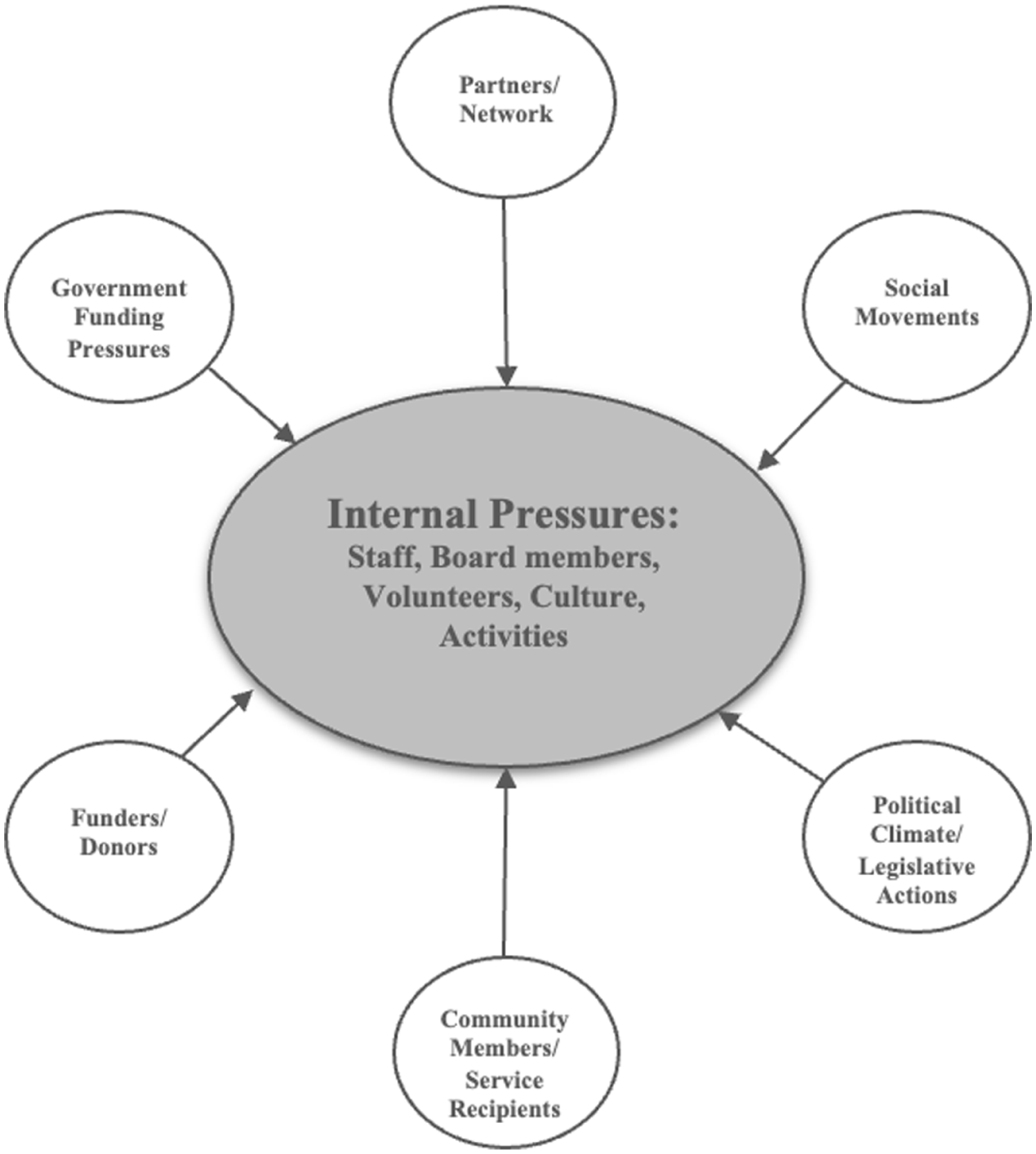
Internal and External Pressures of the Nonprofit Organization.
Summary Statistics for All Variables.

Our dependent variable for Hypotheses 1 and 2 is whether the nonprofit has a DEI policy or statement. It is measured as a binary variable, where 1 = yes, and 0 = no, and operationalized by the question: “Does your organization currently have a written DEI statement or policy?” (see Supplemental Appendix A). Our dependent variable for Hypothesis 3 is commitment to DEI, a latent variable measured by 5 indicators (see Table 2 for factored descriptives). We used the maximum likelihood estimation approach for our factor analysis to identify the underlying structure of the variable and reduce dimensionality of the data and ensured factor loadings were above 0.7, indicating that factors captured the variance of commitment to DEI (Cronbach’s alpha = .784). The organizational commitment to DEI variable was created based on the following five dimensions: (a) if the organization has a DEI statement, (b) has taken action on DEI, (c) made a public statement on DEI, (d) communicated on DEI, and (e) the extent to which the organization has made responses to internal and external controversies (ended DEI, decreased DEI efforts, made no change, taken a targeted approach, or promoted DEI as much as possible). The factor analysis of this variable shows no issues with correlation. The KMO value is .852, indicating a good fit for commitment to DEI (p < .01).
Control Variables
We also consider several control variables because they may have an effect on our dependent variable and respond to the developed theoretical framework to understand different impacts on our independent variable. Table 2 shows the descriptive statistics of our control variables, and includes their pressure type. These include government funding (local, state, and federal), location (organizations serving primarily rural, urban, or an equal mix of rural and urban areas), staff size, budget, organization type (health care, performing arts, etc. and if they are an operating nonprofit organization or a grantmaking organization), if they are part of a collaborative network, and if they participate in advocacy or lobbying. In addition, we asked participants to identify demographic characteristics of their executive director by asking the respondent to “Please think about the demographic characteristics of your
Analysis
For Hypotheses 1 and 2, we conducted a binary logistic regression with the dependent variable being the presence of a DEI statement (yes/no). Control variables included the organization type (Buse et al., 2014; Nonprofit HR, 2022), staff size (Nonprofit HR, 2022), budget or asset size (Buse et al., 2014; Nonprofit HR, 2022; Mason, 2020). Yang and Hyland (2012) calls for consideration of competitors to see mimetic pressure, and due to this we include a model with whether the organization is part of a network. All regression tables for H1 and H2 can be found in Supplemental Appendix C, along with the correlation matrix. For Hypothesis 3, we used a multiple linear regression model to measure pressure relationships with the latent dependent variable commitment to DEI. Independent variables measured include internal pressures such as controversy surrounding DEI within the organization, the frequency with which the organization advocates or lobbies about DEI, and pressure from board or staff members about DEI. External pressures included as independent variables include controversy surrounding DEI in the organization’s community or state, pressure surrounding DEI coming from donors, community members, or network partners, and pressure surrounding DEI coming from local, state, or federal governments. Control variables included whether the CEO is diverse, whether the organization receives government funding, organization type and asset size, as well as respondent demographics such as gender, race, whether they are Hispanic or Latino, and age.
Findings
In our sample (n = 111), an overwhelming majority of organizations had diverse CEOs, with most (74%) being female, and 16% being a person of color. Table 1 shows the breakdown of CEO demographics. Respondent demographics are detailed in Supplemental Appendix D. The largest sector of organizations that responded to the survey are human services at 47%, followed by environmental at 18%, and health at 12%; 71% (n=79) of responding organizations had a DEI policy. These organizations were mostly in human services (43.04%), education (16.46%), or health (11.39%) categories. Of those 79 organizations with a DEI policy, 53 (67%) reported having implemented or revisiting that policy in the wake of recent social movements. Other organizational characteristic information is in Supplemental Appendix B, sorted by the presence of the DEI statement.
In investigating Hypothesis 1: Nonprofits that rely on government funding are more likely to have a DEI policy or statement in place, and 2: Nonprofits that are led by an executive leader from an underrepresented group are more likely to have a DEI policy or statement, we found no supporting evidence. Run as a multiple logistic regression we found no significant relationship between any level of government funding, or CEO demographics, and the organization having a DEI policy. Due to some collinearity, some observations were dropped from the model, and the number observations reduced to 93 (see Supplemental Appendix D for the H1 and H2 regression table).
To examine the third set of hypotheses, we ran a multiple linear regression with independent variables and controls and our latent dependent variable of organizational commitment to DEI and found that the overall model is a good fit of the data F(21) = 11.987, p < .001 (see Table 3). The R2 value of .739 suggests that 73.9% of the variation in commitment to DEI was explained by the independent variables. The adjusted R2 was .677 which accounts for the number of predictors in the model and shows a more accurate measure of model fit. Although there is some concern over an inflated R2 value due to the higher number of variables used in the model, we ensured there were no issues with multicollinearity and that the data for the dependent variable was suitable for the factor analysis using the Kaiser–Meyer–Olkin (KMO) measure.
Regression Model Output for Dependent Variable: DEI Commitment.

Statistically significant findings at the .05 level.
For Hypothesis 3a: Nonprofit organizations receiving positive external pressure on DEI have a greater commitment to DEI, we find that as DEI controversy in the nonprofit’s community goes up, so does the nonprofit’s commitment to DEI (se = 0.075, p <.05). We also find that as DEI controversy within the state increases, the nonprofit’s commitment to DEI decreases (se = .070, p < .05). We find support for Hypothesis 3b: Nonprofit organizations receiving positive internal pressure on DEI have a greater commitment to DEI. Specifically, we see that as controversy within the nonprofit goes up, so does the organization’s commitment to DEI (se = .073, p < .001). And, as the nonprofit’s staff exert increasing pressure on the organization, the organization’s commitment to DEI increases (se = .099, p < .001). Hypothesis 3c states that nonprofit organizations receiving positive government pressure on DEI have a greater commitment to DEI. Indeed, we see that as the state government pressure increases, so does the organization’s commitment to DEI (se = .105, p < .05).
Other findings that were not part of our hypotheses but appeared in our model is the relationship between advocacy and commitment to DEI as well as organizations having a DEI statement and the respondent identification of being Hispanic or Latino. Organizations that engaged in DEI-related advocacy more frequently were found to have a higher commitment to DEI (se = .062, p < .05). Hispanic and Latino respondents were also more likely to be part of an organization that has a stronger commitment to DEI (se = .194, p < .05).
Discussion
Overall, approximately 71% of nonprofit organizations in our sample reported having a DEI policy. Of those, approximately 67% reported implementing or changing a DEI policy in response to social movements. This makes sense because nonprofits are inherently mission-driven organizations. Each one has a unique purpose, usually to serve an underserved population, to step in where the government and the private sector have left a void. Given the legislative changes surrounding DEI in the past two years, as well as the purpose that nonprofits are existing for within their communities, we did not find it surprising that there was no support for Hypothesis 1 regarding government funding and DEI policies. Nonprofits often have mission statements that explicitly include values of DEI in their work, particularly because they are serving marginalized communities or advocating for social justice. This confirms our finding that organizations more active in advocacy surrounding DEI have a greater commitment to DEI. In addition, it appears that reliance on government funding does not affect organizational commitment to DEI. Taking into account the survey collection period in summer of 2024, prior to the Trump administration taking office, we feel that there may be future changes in terms of a relationship between removing DEI policies within nonprofits who are relying on federal funding which would require future studies. We do not anticipate that such legislative changes would affect the actual work of the nonprofit or culture surrounding support for DEI programs, though this is an area also requiring more attention as the political DEI pendulum continues to swing back and forth.
We find that there are internal and external reasons that nonprofits may continue to commit to these policies, despite the swing of the political pendulum. Most importantly, these factors seem to be internal to the organization. The idea that organizations will respond to employee complaints or desire for a culture change is in line with the public administration literature (Harris, 2012). Perhaps nonprofit organizations use DEI policies to internally promote organizational commitment and retention among its employees, or staff are drawn to nonprofits who place a greater emphasis on principles and values of DEI. If DEI policies keep employees happy, then it could also be considered a successful HR tool, drawing potential workers into organizations with policies that align with personal values, goals, or motivations.
We did not find a relationship between receiving government funding and having a DEI policy, which defies the logic of DEI policies as descendants of government-imposed affirmative action policies that beget funding (Harris, 2012; Pitts, et al., 2010). Perhaps this is because nonprofit organizations are not subject to the same legal requirements and expectations that public agencies are, so they don’t feel the need to create DEI policies due to receiving government funding. Thus, it is worth considering whether resource dependency may still operate through community foundations or collaborative networks, given that community pressure was significantly associated with DEI.
We could not confirm Hypothesis 2 because we did not find a relationship between having a DEI policy and the diversity of the executive director. While this could be due to a limitation in diversity indicators that were collected, we believe that it hinges on the power of the executive director to influence policy and limitations of representative bureaucracy in nonprofit organizations as well as other organizational factors that may be at play. Not only do executive directors typically not have final political say in their organizations (which often falls to the board), having a representative bureaucracy does not mean that diverse organizational representatives feel included in organizational processes, receive access to information, or have a say in decision-making (Ding & Riccucci, 2023; Medina & Azevedo, 2021; Sabharwal, 2014). Representative bureaucracy suggests that more diverse representation will lead to policies and actions that benefit those groups (Pfeffer & Salancik, 2015, 1978); however, it may not fully account for instances where diverse CEOs do not prioritize DEI policies for several reasons. For one, the theory can overemphasize passive representation and symbolic change rather than active representation and substantive change. We did not capture how the CEO takes actions to advocate for certain groups or to further DEI values. In addition, even diverse CEOs have to operate in organizational systems that are entrenched in cultures resistant to change. Finally, representative bureaucracy theory has been critiqued for its limited consideration of intersectionality (Bishu & Kennedy, 2020; Meier, 2019; Strader et al., 2023), so we may have overlooked how overlapping identities and other systemic factors could influence a leader’s ability to champion DEI values and policies.
Organization inclusion behavior, an important component of DEI that moves beyond representativeness, is required for people to feel included in the culture and decision-making of the organization (Ding & Riccucci, 2023). Furthermore, organizational factors such as mission, stakeholder interest, employee advocacy, and others could have a greater influence here beyond what we captured in our study. Additional research that examines nonprofit executive director diversity, which we know lacks Black and Latino representativeness in moderate and larger organizations (LeRoux & Medina, 2023), should be examined as it relates to political decision-making and influence on organizational culture. Other organizational factors that could play a factor are also worthy of examination.
Most surprisingly, nonprofit organizations increased their commitment to DEI even as DEI became more divisive in the state. At the same time, the more supported DEI is in their community, and within the organization itself, the more North Carolina nonprofit organizations increase their commitment to DEI. In other words, North Carolina nonprofits are responsive to their immediate community and their internal culture, regardless of what is happening at the state level. This is interesting for two reasons. First, it suggests that mission-driven organizations are just that: focused on their mission and not easily swayed by those that they do not immediately serve or interact with. Second, considering this in the context of our finding that government funding did not influence DEI commitment, this further suggests that mission-driven organizations may not chase money to provide their services, but rather they will chase the right money. Meaning, if proposed funding is counter to the mission, they will not accept it. This finding is counter to the theories of resource dependency and institutional theory, but it is in line with fundraising best practices.
The insights we have gleaned here align with and build onto very recent work on anti-DEI backlash, which highlights the complex dynamics organizations face in navigating DEI efforts amid political and social challenges (Conyers & Wright Fields, 2025; Ng et al., 2025). The increasing divisiveness of DEI within states has led to heightened scrutiny and opposition, as evidenced by actions such as the Trump administration’s investigation into different higher education institutions (for instance, George Mason University’s DEI practices). This political environment can create tension between organizational goals and external pressures, influencing DEI strategies. Our work can be contextualized in very recent frameworks that show how organizations may avoid or retreat from DEI efforts, creating institutional paralysis. For instance, Conyers and Wright Fields (2025) highlight the Institutional Racial Paralysis (IRP) framework, which shows how political opposition can cause organizations to retreat from DEI efforts. Our findings suggest that when community support is strong, local legitimacy and social backing may counteract these effects. Furthermore, staff advocacy can act as an internal counterweight to external political pressures, allowing nonprofits to pursue DEI even in hostile or divisive contexts, which reiterates the importance of internal actors in shaping organizational commitment to diversity and inclusion (Krause & Park, 2024). Thus, nonprofits’ DEI outcomes are not determined solely by state-level anti-DEI pressures
But does it matter if nonprofit organizations have a DEI policy or not? It seems to matter internally, both for employees and for the organization to make an internal statement that DEI is in line with the values of the organization. But do such policies change anything? We have evidence that they increase board diversity and performance for nonprofits and that they increase profits in the corporate sector. But do they make nonprofit organizations more equitable? Are their organizational behaviors actually more inclusive? Or are these more of a signal to their external community to invite support of some kind? We call for research that seeks to explore the importance of these policies for nonprofits. More work is needed to examine how DEI frameworks are integrated into nonprofit operations and their role in promoting equitable access to resources, opportunities, and decision-making.
Limitations
As with any survey, there is a potential for respondent bias. In addition, we were working with a small sample size that could present issues with variables, in particular the respondent demographic variables and diversity of CEO. Furthermore, omitted variable bias in our models could mean that we have overestimated or underestimated relationships, especially during model fitting during testing for Hypothesis 3. We worked to limit the introduction of bias into the model and findings by grounding variables and approach in theory. Another limitation of this study is the use of multiple linear regression despite the latent nature of the dependent variable, which could open the door to measurement errors but was used due to the small sample size that precluded the use of more complex modeling techniques. In addition, the way that gender and person of color are used in the survey could open the door to misunderstanding and identity misappropriation (Starr & Freeland, 2024). Future studies could address this limitation by incorporating a more nuanced set of racial and ethnic identity categories, allowing respondents to self-identify with multiple labels, and providing clear definitions or examples alongside each category to reflect the diverse ways people understand and experience racial identity, which has been shown to be important in capturing intersectional invisibility (Purdie-Vaughns & Eibach, 2008; Smith et al., 2023).
In addition, organizations with budgets over $1 million were selected in our study because they were more likely to have developed administrative structures, HR practices, and formalized written policies, and generally are more likely to file detailed IRS forms and publish annual reports. We recognize that nonprofits with budgets over this threshold may be more likely to have policies like DEI because they face additional pressure from the public, funders, and other compliance expectations. External validity is also limited in this study, as these findings may not generalize to another state, or another time, or smaller organizations. Future research on this topic should include surveying nonprofit organizations in states with differing political and social climates, and with larger numbers of nonprofit organizations to obtain larger sample sizes with more variability in the data and repeating the study in North Carolina during the next political cycle to see if the average nonprofit organization has changed their approach to DEI. In addition, exploring how nonprofits change their approach to DEI both internally and externally due to the pressures identified should be more closely examined.
Conclusion
This study examined different internal and external factors that influence nonprofit organizations’ commitment to DEI. We find that the more divisive DEI is within the state, and the more supported DEI is within the community, the more nonprofits show commitment to DEI. We also find significance in internal pressure, suggesting the importance of staff in DEI policymaking. The political tension surrounding DEI is slowly impacting and reshaping the nonprofit sector and their community work in many ways. While some nonprofit organizations, like the Public Broadcasting System (PBS), are scaling back DEI efforts to avoid controversy and meet funding expectations (Murray & Bohanan, 2025), we find that others, like Tupelo Press, a nonprofit literary publisher, are doubling down on their commitment to DEI despite the current legislative environment (Girardin, 2025).
The current legislative environment that targets reducing and defunding DEI initiatives leaves us thinking about the future of nonprofits and what that could look like without set DEI policies. Given the uniqueness of the nonprofit sector from their public and private sector counterparts, in that their work is mission-centered and their funding sources vary (donations, grants, fundraising, and earned income), we feel there is a strong argument to be made regarding sector values that align with principles of DEI. Nonprofits exist to serve specific causes related to social, environmental, and community issues and create an impact on areas like health, education, and social justice. Generally, their missions are congruent with the values of DEI, as they often seek to serve areas of communities that are on the fringes, most affected by poverty and social injustices. Regardless of the current politics and DEI pendulum, nonprofits may be the champions of the culture war because of their missions and deep concern for their communities, serving people on the margin through all aspects of their organizational procedures and behaviors. Even without DEI policies, they will likely continue to build a positive climate and culture around DEI that centers on their mission and community work. Hopefully, the values of DEI will persist within nonprofit organizations, regardless of an instructional policy.
Supplemental Material
sj-docx-1-nvs-10.1177_08997640261424430 – Supplemental material for Nonprofit Policies in an Anti-DEI Legislative Environment
Supplemental material, sj-docx-1-nvs-10.1177_08997640261424430 for Nonprofit Policies in an Anti-DEI Legislative Environment by Lauren Azevedo and Jennifer Beightley in Nonprofit and Voluntary Sector Quarterly
Supplemental Material
sj-docx-2-nvs-10.1177_08997640261424430 – Supplemental material for Nonprofit Policies in an Anti-DEI Legislative Environment
Supplemental material, sj-docx-2-nvs-10.1177_08997640261424430 for Nonprofit Policies in an Anti-DEI Legislative Environment by Lauren Azevedo and Jennifer Beightley in Nonprofit and Voluntary Sector Quarterly
Supplemental Material
sj-docx-3-nvs-10.1177_08997640261424430 – Supplemental material for Nonprofit Policies in an Anti-DEI Legislative Environment
Supplemental material, sj-docx-3-nvs-10.1177_08997640261424430 for Nonprofit Policies in an Anti-DEI Legislative Environment by Lauren Azevedo and Jennifer Beightley in Nonprofit and Voluntary Sector Quarterly
Supplemental Material
sj-docx-4-nvs-10.1177_08997640261424430 – Supplemental material for Nonprofit Policies in an Anti-DEI Legislative Environment
Supplemental material, sj-docx-4-nvs-10.1177_08997640261424430 for Nonprofit Policies in an Anti-DEI Legislative Environment by Lauren Azevedo and Jennifer Beightley in Nonprofit and Voluntary Sector Quarterly
Footnotes

Funding
The authors received no financial support for the research, authorship, and/or publication of this article.
Declaration of Conflicting Interests
The authors declared no potential conflicts of interest with respect to the research, authorship, and/or publication of this article.
Supplemental Material
Supplemental material for this article is available online.