






Abstract
This study examined how the satisfaction and frustration of autonomy, competence, relatedness, and beneficence (the sense of prosocial impact) relate to volunteer well-being (meaningfulness of volunteer work, volunteer satisfaction, and general well-being) and ill-being (burnout and intent to leave). By investigating beneficence alongside the three basic psychological needs in Self-Determination Theory, we aimed to contribute to debates on its potential inclusion as a fourth basic need. Data from 650 Hungarian volunteers were analyzed using variable- and person-oriented approaches. Results indicated that the satisfaction of the established needs predicted well-being indicators (with outcome-specific patterns), and beneficence satisfaction emerged as a unique predictor beyond them. Ill-being was primarily associated with the frustration of autonomy and relatedness, whereas beneficence frustration showed no independent association with negative outcomes. Cluster analysis identified four distinct need profiles differing in well-being and ill-being. Findings highlight the central role of psychological needs in volunteer functioning.
Keywords
Introduction
Volunteering constitutes a vital pillar of social and economic life worldwide: about 6.5% of adults engage in formal volunteering through structured roles in nonprofit organizations, while 14% participate informally by helping others outside such settings. Together, these efforts amount to roughly 61 million full-time workers globally each month (United Nations Volunteers, 2021). Having established the global scale of volunteering, scholars have increasingly turned to the quality of volunteers’ experiences—what makes volunteering personally fulfilling and sustainable over time. Within this perspective, the concept of volunteer engageability has emerged, emphasizing how organizations can effectively support, motivate, and retain volunteers (Arnon et al., 2022). This focus is crucial, as volunteering, though generally rewarding and associated with greater well-being (Nichol et al., 2023), can also involve emotionally demanding experiences that lead to burnout (Chirico et al., 2021; Coleman & Walshe, 2021; Essex et al., 2008; Pidbutska et al., 2023; Willems et al., 2020). At the same time, nonprofits continue to face challenges with retention amid globally declining volunteering rates (Damian, 2018; Forner et al., 2024; Grimm & Dietz, 2018; Innes et al., 2024). Understanding why some volunteers thrive while others struggle requires examining the psychological processes that underlie these experiences. Drawing on Self-Determination Theory (Ryan & Deci, 2017), which posits that well-being and ill-being depend on the satisfaction or frustration of basic psychological needs, the present study examines how autonomy, competence, relatedness, and the proposed need for beneficence relate to volunteers’ well-being (i.e., meaningfulness of volunteer work, volunteer satisfaction, and general well-being) and ill-being (i.e., burnout and intent to leave).
Literature Review
Psychological research increasingly recognizes that well-being and ill-being are related but distinct dimensions of mental functioning rather than opposite ends of a single continuum (Iasiello et al., 2020). This distinction can also be applied in volunteer research, where both well-being and ill-being can be captured through various indicators. Volunteer satisfaction, for instance, captures how positively individuals evaluate their experiences within the organization and is a multidimensional construct encompassing various aspects of the volunteer role and organizational environment (Galindo-Kuhn & Guzley, 2001). Closely related is the perceived meaningfulness of volunteer work, a concept adapted from the literature on meaningful paid work, which refers to viewing one’s efforts as valuable and significant (Martela & Pessi, 2018). Volunteers’ general well-being, in turn, reflects overall emotional, psychological, and social functioning (Keyes, 2014), rather than experiences tied specifically to volunteering. On the other hand, ill-being among volunteers can manifest as burnout, defined generally as emotional exhaustion and disengagement from one’s work (Demerouti & Bakker, 2008), and as intent to leave the organization, reflecting thoughts or plans to discontinue volunteering.
Several factors may shape these volunteer outcomes, including demographic, organizational, and psychological influences. Most of what is currently known about these factors, however, comes from WEIRD (Western, educated, industrialized, rich, and democratic) contexts (Henrich et al., 2010) and predominantly female, middle-aged, and middle-class samples, leaving the generalizability of these findings to other cultural settings uncertain. Still, within this literature, older volunteers tend to report higher satisfaction and lower burnout (Gaber et al., 2022; Kulik, 2007; Ling et al., 2023; Morse et al., 2022), though some studies suggest a U-shaped age pattern (Nagel et al., 2020). Gender differences appear minimal (Nagel et al., 2020; Scherer et al., 2016), but findings remain limited and likely context-dependent. Beyond age and gender, little high-quality or comparative research has examined how other demographic factors (such as socioeconomic status, race or ethnicity, marital status, or parental status) relate to volunteer well-being and ill-being, although these factors may create specific barriers to volunteering (Southby et al., 2019). From a motivational perspective, volunteers driven by prosocial motives typically report higher satisfaction, well-being, and commitment (Stukas et al., 2016; Zhou & Kodama Muscente, 2023). At the organizational level, effective management practices—such as clear role design, communication, supervision, recognition, peer and organizational support, and supportive leadership—have been linked to higher satisfaction and reduced turnover among volunteers (Einolf, 2018; Forner et al., 2024).
While demographic, motivational, and organizational conditions are important, they ultimately influence volunteers’ experiences through underlying psychological processes, underscoring the need to examine these in greater depth. These experiences can be understood through the lens of Basic Psychological Needs Theory, a central component of Self-Determination Theory (Ryan & Deci, 2017), which identifies three innate needs essential for optimal functioning: autonomy (experiencing volition and self-endorsement in one’s actions), competence (feeling effective and capable in meaningful activities), and relatedness (feeling connected and significant within social contexts). Research in occupational settings shows that the satisfaction of these needs is linked to higher well-being, motivation, and performance (Coxen et al., 2021; Van den Broeck et al., 2016), whereas need frustration—reflecting the active obstruction of these needs—is associated with poorer well-being, emotional exhaustion, and burnout (Niemiec et al., 2022; Olafsen et al., 2017, 2025; Shi, 2024).
Compared to the extensive research on paid work, much less is known about how basic psychological needs operate in volunteering. Still, a growing body of studies (despite differences in measurement) underscores their importance for volunteer functioning. Overall, need satisfaction has been linked to sustained volunteering, behavioral intentions toward the organization, autonomous motivation, life and job satisfaction, and work effort, although not all three needs consistently predict these outcomes (De Clerck et al., 2022; Haivas et al., 2012; Huang et al., 2019; Kim et al., 2019; Pólya & Martos, 2012; Zheng et al., 2021). Fewer studies have examined need frustration, but emerging evidence associates it with psychological withdrawal, controlled motivation or amotivation, and turnover intentions, especially in coercive, disorganized, or unsupportive environments (Bashir et al., 2019; De Clerck et al., 2021, 2022, 2024). Consistently, a person-oriented study found that volunteers characterized by high satisfaction and low frustration reported the strongest continuance intentions, the lowest emotional exhaustion, and the most positive perceptions of work climate (Li et al., 2022).
Although autonomy, competence, and relatedness remain the only basic needs formally recognized within Self-Determination Theory, recent work has proposed beneficence (the sense of having a positive, prosocial impact on others) as a potential fourth need (Martela & Ryan, 2016), which may be particularly relevant in altruistically motivated roles such as volunteering. To qualify as a basic psychological need, a construct must, at minimum, demonstrate unique associations with well-being and ill-being—beyond the effects of autonomy, competence, and relatedness—across cultures, age groups, and life domains (Ryan & Deci, 2017). Evidence indicates that beneficence satisfaction uniquely predicts subjective well-being, vitality, and meaning in life even after controlling for the other needs, across trait-level, situational, diary, and longitudinal studies (Martela & Ryan, 2016; Martela et al., 2017, 2024). Similar results have been found in work settings, where beneficence satisfaction predicts work meaningfulness above and beyond autonomy, competence, and relatedness (Martela et al., 2021; Martela & Riekki, 2018). Findings for beneficence frustration (the perception of having a negative or antisocial impact on others) are less consistent: while Martela and Ryan (2020) found associations with negative affect, depression, anxiety, and physical symptoms, these diminished when controlling for other need frustrations. In contrast, Lubics et al. (2026) found that beneficence frustration remained a significant predictor of ill-being even after accounting for the three basic needs; similarly, Titova and Sheldon (2022) showed that restricting opportunities to help others reduced happiness, with both beneficence and basic need satisfaction jointly mediating the effect. Overall, although prior research links beneficence to well-being and ill-being, its status as a basic psychological need remains untested in volunteer contexts—settings where prosocial impact may be especially central.
The Present Study and Hypotheses
In summary, previous studies have begun to demonstrate the importance of autonomy, competence, and relatedness for volunteer well-being and ill-being, yet this area remains underexplored. Few investigations have simultaneously examined both need satisfaction in relation to well-being and need frustration in relation to ill-being, and the potential role of beneficence has not yet been tested in the volunteering context. Moreover, person-oriented approaches remain rare alongside traditional variable-oriented analyses. To address these research gaps, we formulated and tested the following hypotheses based on the theoretical criteria regarding the functioning of basic psychological needs within Self-Determination Theory (Ryan & Deci, 2017):
Testing these hypotheses extends beyond the theoretical development of Self-Determination Theory and holds direct practical relevance for volunteer management. Specifically, our findings aim to inform organizational strategies regarding several critical applied considerations: the relative influence of demographics (age and gender) versus psychological needs on volunteer functioning; the role of providing explicit feedback on prosocial impact in fostering volunteer well-being; the identification of specific psychological factors to prioritize in preventing burnout and intent to leave; and the “optimal balance” between need satisfaction and frustration required to foster sustainable engagement.
Method
Participants and Procedure
This study formed part of a broader research project on the psychological experiences of volunteers and was approved by the institutional ethics committee of the authors’ university. Data were collected in Hungary via an anonymous, self-administered online questionnaire. The sample comprised formal volunteers who engaged in regular volunteering (at least every few months) within a nonprofit organization. To recruit them, 160 nonprofits demonstrably engaging volunteers were identified through systematic searches on social media and Google using keywords such as “volunteer opportunities” and “become our volunteer,” and were contacted to distribute the survey. Organizations were included if they showed recent activity (e.g., posts or events within the previous year) and/or explicitly referred to volunteer recruitment, ongoing projects, or volunteer participation, whereas organizations affiliated with political parties were excluded. This approach was chosen because official Hungarian registries include many small foundations that primarily exist to receive the personal income tax 1% donations citizens can allocate to a chosen nonprofit (Bullain, 2006). Consequently, nearly every public institution (e.g., schools, libraries, hospitals) maintains a foundation with little or no volunteer involvement. To encourage participation, organizations were offered a mutually beneficial collaboration: after distributing the survey, they received individualized feedback reports summarizing their volunteers’ responses, after which organization names were deleted from the dataset.
Thirty-three organizations confirmed participation and reported sharing the survey. Their activities covered five main areas: social and health services (n = 18), animal and environmental protection (n = 9), education, culture, and inclusion (n = 3), community and housing development (n = 2), and advocacy and equality (n = 1). Based on public information, most were small, volunteer-run nonprofits with at most one or two paid leaders; a few medium-sized organizations involved larger volunteer bases and typically no more than 10 to 15 paid employees.
In total, 721 individuals completed the questionnaire. Of these, 70 were excluded for failing at least one of three attention-check items, and one case was removed due to excessive missing data, resulting in a final sample of 650 participants. Descriptive statistics for the sample’s demographic characteristics are presented in Table 1.
Demographic Characteristics of the Sample (N = 650).
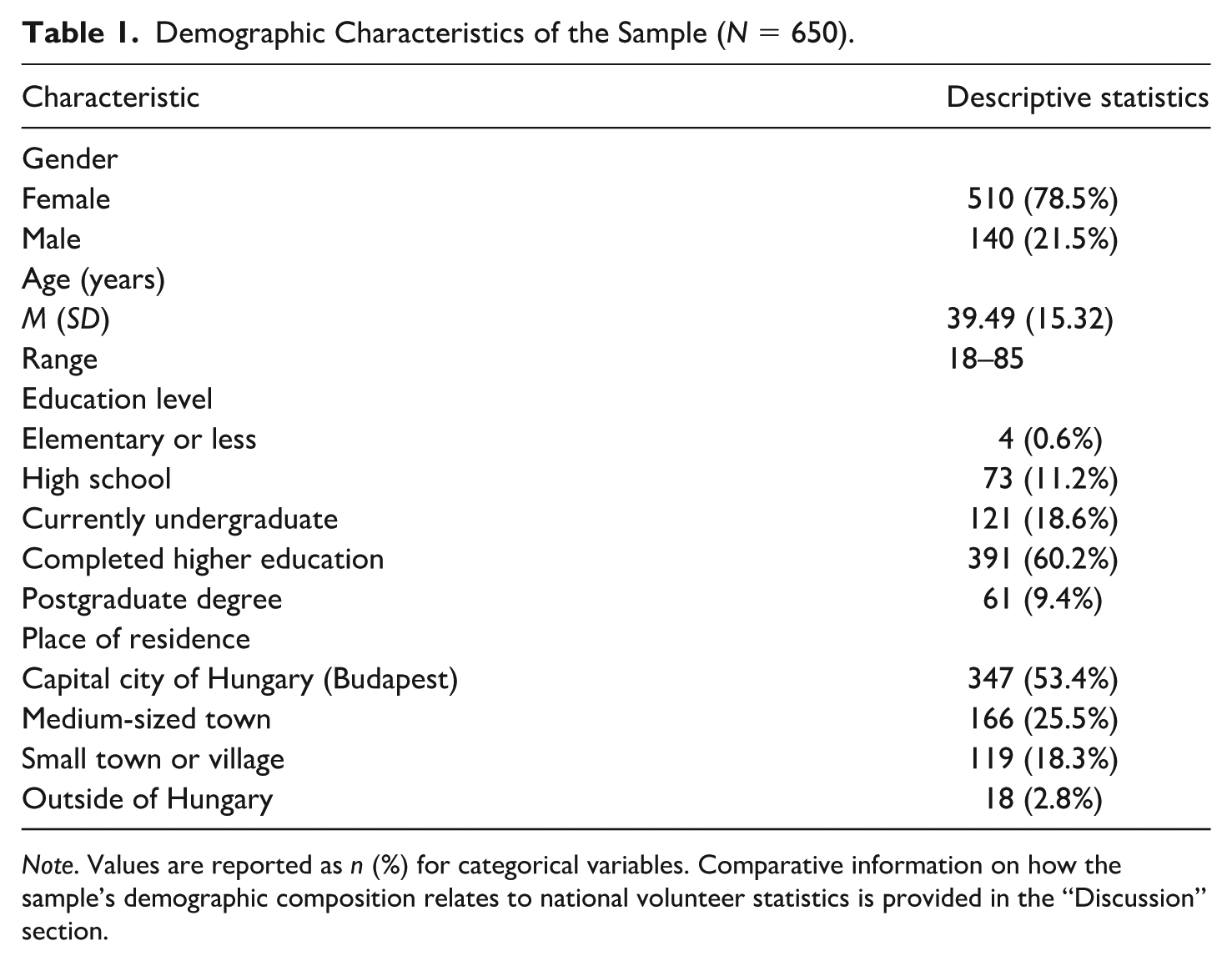
Note. Values are reported as n (%) for categorical variables. Comparative information on how the sample’s demographic composition relates to national volunteer statistics is provided in the “Discussion” section.
Measures
The survey began with demographic questions, followed by a series of standardized self-report scales. All instruments were administered in Hungarian; however, for clarity, example items are presented in English throughout this section. The full wording of scale instructions and items is available in the Open Science Framework (OSF) codebook in both the original Hungarian and English translations (see Data Availability Statement). Internal consistencies (McDonald’s ω) for all subscales were satisfactory overall; detailed coefficients are provided in Table 2.
Descriptive Statistics, Internal Consistencies, and Intercorrelations Among Study Variables.
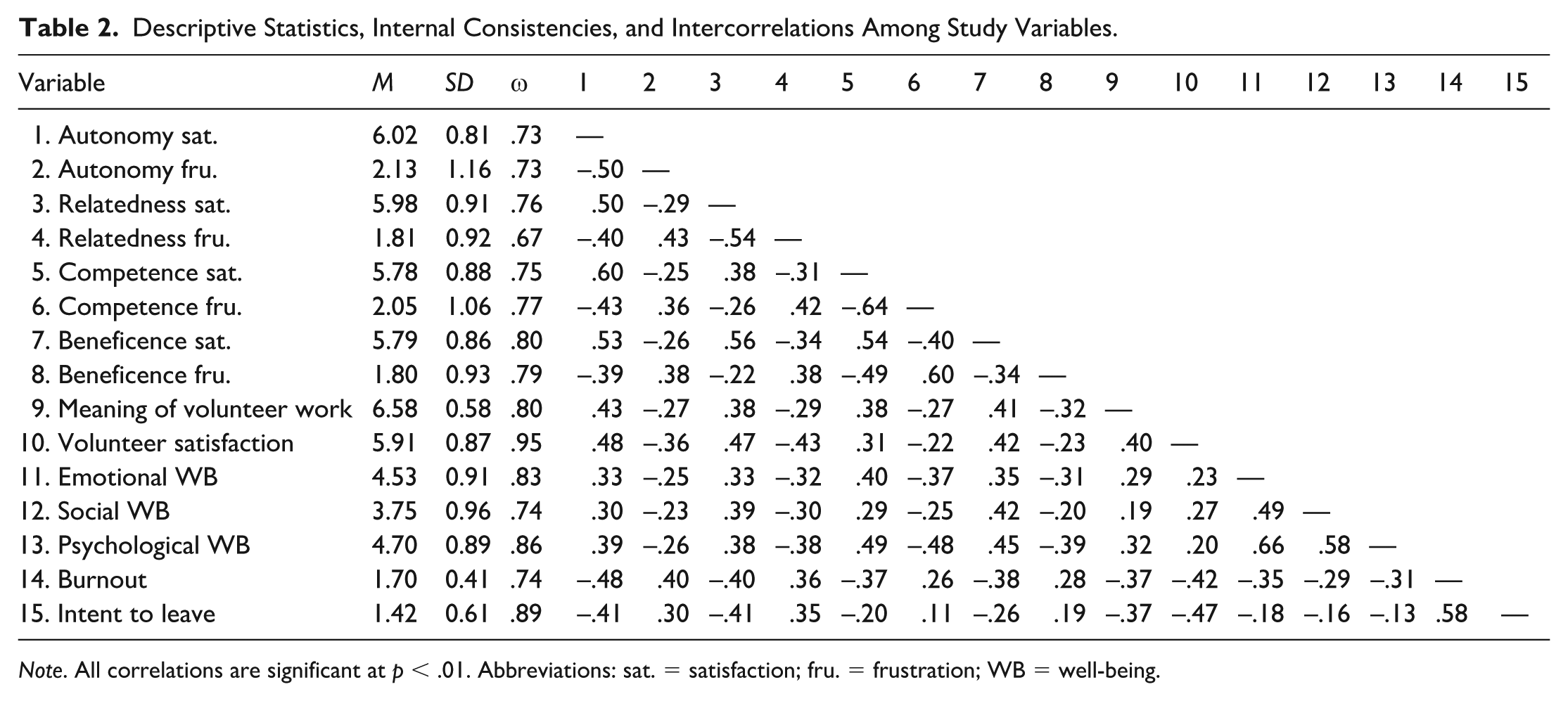
Note. All correlations are significant at p < .01. Abbreviations: sat. = satisfaction; fru. = frustration; WB = well-being.
Basic Psychological Needs Satisfactions and Frustrations
The satisfaction and frustration of autonomy, competence, relatedness, and beneficence in the context of volunteer work were assessed using an adapted version of the Basic Psychological Need Satisfaction and Frustration Scale (BPNSFS; Chen et al., 2015; Hungarian version: Tóth-Király et al., 2022). Participants were instructed to reflect specifically on their experiences related to their current volunteer work. The original six BPNSFS subscales (autonomy, competence, and relatedness satisfaction and frustration; four items each) were supplemented with eight items from the Beneficence Satisfaction and Frustration Scales (Martela & Ryan, 2016, 2020; Hungarian adaptation: Lubics et al., 2026), comprising four items each for beneficence satisfaction and frustration. The added items followed the same format and subscale structure, resulting in eight subscales. Responses were given on a 7-point Likert-type scale (1 = completely untrue, 7 = completely true), with higher scores indicating greater satisfaction or frustration within each domain. One autonomy frustration item (“Most of the things I do feel like I have to”) was excluded due to poor psychometric properties. Including it reduced internal consistency (ω = .60), which improved to .73 after removal. A one-factor confirmatory factor analysis (CFA) on the four autonomy frustration items provided further support for this exclusion, as the item showed a very low loading (λ = .19, h2 = .036), while the remaining items loaded above .60 (h2 > .40). In the Hungarian language and volunteer context, the item may have been interpreted as a morally motivated sense of obligation (e.g., “I felt I had to act because it was the right thing to do”) rather than as autonomy frustration. Consequently, autonomy frustration was assessed using the remaining three items.
To evaluate whether the extended scale accurately differentiates eight unique dimensions within the volunteer context (representing the satisfaction and frustration of autonomy, competence, relatedness, and beneficence), we examined its internal structure using CFA. The eight-factor model showed good fit (χ2(406) = 664.13, p < .001; χ2/df = 1.64; root mean square error of approximation [RMSEA] = .032, 90% confidence interval [CI] = [.027, .036]; comparative fit index [CFI] = .919; Tucker–Lewis index [TLI] = .907; standardized root mean square residual [SRMR] = .049). All items loaded significantly onto their respective factors, supporting the factorial validity of the eight-factor structure. The significant chi-square value is typical in large samples and does not indicate a poor fit.
Well-Being Indicators
We measured the perceived meaningfulness of volunteer work using the Presence of Meaning subscale from the Meaning in Life Questionnaire (MLQ; Steger et al., 2006; Hungarian: Csuka & Konkolÿ Thege, 2022), with the five items adapted to refer specifically to participants’ current volunteer experiences. For instance, the item “I have a good sense of what makes my life meaningful” was modified to “I have a good sense of what makes my volunteer work meaningful.” Responses were given on a 7-point Likert-type scale (1 = absolutely untrue, 7 = absolutely true), with higher scores indicating greater perceived meaning in one’s volunteer role. One item was reverse-scored.
Volunteer satisfaction was assessed with the Volunteer Satisfaction Index (VSI; Galindo-Kuhn & Guzley, 2001). The scale comprises 26 items rated on a 7-point Likert-type scale (1 = very dissatisfied, 7 = very satisfied), with higher scores indicating greater satisfaction with one’s volunteer experience. The VSI was translated into Hungarian using a forward- and back-translation procedure involving independent translators. Since the VSI lacks a standardized factor structure and robust cross-cultural validation, only the total score was used in the present analyses to represent overall volunteer satisfaction.
General well-being was assessed using the 14-item Mental Health Continuum – Short Form (MHC-SF; Keyes et al., 2008; Hungarian: Reinhardt et al., 2020), which captures emotional, social, and psychological aspects of mental health. Participants indicated how often they had experienced various feelings and states over the past month on a 6-point scale (1 = never, 6 = every day). The measure includes three components: emotional well-being (three items), social well-being (five items), and psychological well-being (six items). Higher scores reflect greater overall well-being across these domains.
Ill-Being Indicators
Burnout was assessed using the Mini Oldenburg Burnout Inventory (MOLBI), a brief 10-item instrument adapted from the original Oldenburg Burnout Inventory (Demerouti & Bakker, 2008; Hungarian: Mészáros & Ádám, 2022; Mészáros et al., 2020). The scale includes items reflecting exhaustion (physical and emotional fatigue) and disengagement (reduced psychological involvement in work tasks). Item wording was adapted to refer specifically to experiences related to volunteer work. Responses were given on a 4-point Likert-type scale (1 = strongly agree, 4 = strongly disagree), and relevant items were reverse-coded so that higher scores indicate greater overall burnout. Only the total burnout score was used, as the internal consistency of the exhaustion and disengagement subscales was below conventional thresholds, while the overall scale demonstrated adequate reliability (see Table 2).
Intent to leave was assessed using the Turnover Intentions Questionnaire (Olusegun, 2013; Hungarian: Restás, 2020), with minor wording adjustments to tailor the items to the context of nonprofit volunteer work. Items were rated on a 5-point Likert-type scale (1 = strongly disagree, 5 = strongly agree). Following reverse-coding of the appropriate items, higher total scores reflected a stronger inclination to leave one’s current volunteer organization.
Data Analysis
We began the data analysis by computing mean scores, intercorrelations, and internal consistency estimates (McDonald’s ω) for each construct. Normality was assessed visually (histograms) and numerically (skewness and kurtosis), and although several variables deviated from normality, none exceeded the recommended thresholds (|skewness| > 2, |kurtosis| > 7; H.-Y. Kim, 2013), which are generally acceptable for parametric analyses in large samples (Ghasemi & Zahediasl, 2012).
To test H1 and H2 regarding the unique predictive contributions of the three basic psychological needs and the candidate need of beneficence to well-being and ill-being, we conducted a series of hierarchical multiple linear regression analyses following Martela and Ryan (2020). In each model, one well-being or ill-being indicator (e.g., volunteer satisfaction, burnout) served as the dependent variable. Predictors were entered in three steps: (1) demographic variables (age and gender) as controls; (2) the satisfactions or frustrations of autonomy, competence, and relatedness, depending on whether the outcome reflected well-being or ill-being; and (3) beneficence satisfaction or frustration to assess its unique contribution. Accordingly, models predicting well-being outcomes included satisfaction variables, whereas those predicting ill-being outcomes included frustration variables. Variance inflation factor and Tolerance diagnostics indicated no problematic multicollinearity.
To complement the variable-centered analyses, a person-oriented approach was used to identify volunteer profiles based on overall psychological need experiences and to compare these groups on volunteer outcomes (H3). Because the four need satisfactions and the four need frustrations were substantially correlated and cluster analysis is more stable with fewer input variables, two composite indicators were created by averaging across the four satisfactions (autonomy, competence, relatedness, beneficence) and the four frustrations. The input variables were not standardized, as the scales shared the same 1–7 range; however, standardized cluster means were later used for interpretation, based on the grand mean of the variables and the pooled standard deviation (square root of the average variance). An agglomerative hierarchical cluster analysis (AHCA) using squared Euclidean distance and Ward’s method was first performed to explore potential cluster solutions. Cluster quality was evaluated using the explained error sum of squares percentage (EESS%, acceptable > 65%), the modified Xie–Beni index (XBmod, acceptable > 0.40), and standardized homogeneity coefficients. For individual clusters, HCstan values (adjusted for total-sample variance; lower values = greater homogeneity) were computed, and overall structure quality was indexed by HCmeanS (average HCstan; < 0.80 = good fit). The goal was to identify the smallest number of interpretable clusters meeting these thresholds. Based on this evaluation, the optimal number of clusters was selected, and a k-means cluster analysis (Hartigan–Wong algorithm) was applied to refine the solution and maximize EESS%. Finally, one-way ANOVAs were used to compare the resulting clusters on the volunteer well-being and ill-being indicators. Analyses were performed using JASP (JASP Team, 2024), ROPstat (Vargha et al., 2015), and ROP-R (Vargha & Bánsági, 2022).
Results
Descriptive Statistics and Correlations
Table 2 presents the means, standard deviations, internal consistency coefficients (McDonald’s ω), and intercorrelations for all study variables. Participants reported relatively high levels of need satisfaction, volunteer satisfaction, meaningfulness, and well-being, and low levels of need frustration, burnout, and intent to leave, relative to the scales’ theoretical ranges. Most subscales demonstrated acceptable to good internal consistency (ω > .70); although internal consistency for relatedness frustration was somewhat lower (ω = .67), it was considered adequate for research purposes. As expected, satisfaction and frustration subscales correlated negatively both within and across need domains, with need satisfaction linked to higher well-being and lower ill-being, and need frustration showing the reverse pattern.
Predicting Volunteer Well-Being and Ill-Being From Beneficence and Basic Psychological Needs
Table 3 presents the results of the hierarchical regression analyses conducted to test H1 and H2, predicting volunteer well-being and ill-being outcomes from demographics (age and gender) and the satisfactions or frustrations of the three basic psychological needs and beneficence.
Hierarchical Regression Analyses Predicting Volunteer Outcomes From Beneficence and Basic Psychological Needs.
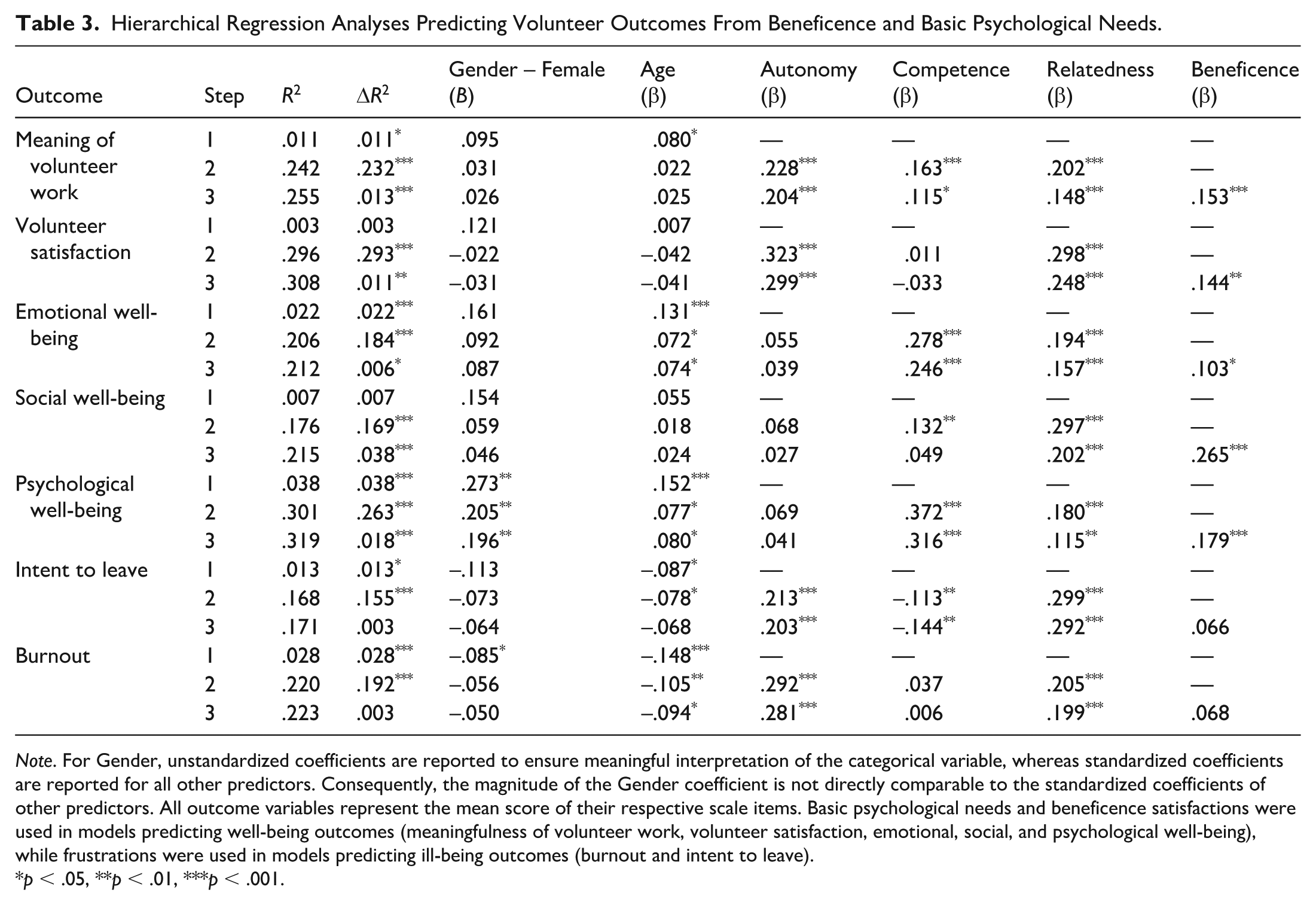
Note. For Gender, unstandardized coefficients are reported to ensure meaningful interpretation of the categorical variable, whereas standardized coefficients are reported for all other predictors. Consequently, the magnitude of the Gender coefficient is not directly comparable to the standardized coefficients of other predictors. All outcome variables represent the mean score of their respective scale items. Basic psychological needs and beneficence satisfactions were used in models predicting well-being outcomes (meaningfulness of volunteer work, volunteer satisfaction, emotional, social, and psychological well-being), while frustrations were used in models predicting ill-being outcomes (burnout and intent to leave).
p < .05, **p < .01, ***p < .001.
Step 1, including age and gender, accounted for a small portion of the variance across well-being and ill-being outcomes. Age positively predicted meaningfulness of volunteer work, emotional and psychological well-being, and negatively predicted intent to leave and burnout. Gender was nonsignificant in most models, except for psychological well-being (which was higher among women) and burnout (which was lower among women).
In Step 2, adding autonomy, competence, and relatedness satisfactions or frustrations substantially increased the explained variance across all models. For well-being, relatedness satisfaction significantly predicted all outcomes; autonomy satisfaction predicted meaningfulness and volunteer satisfaction; and competence satisfaction predicted emotional, social, and psychological well-being, as well as meaningfulness. For ill-being, autonomy and relatedness frustration were significant positive predictors of both burnout and intent to leave. Interestingly, competence frustration was unrelated to burnout and showed a negative association with intent to leave. With these new predictors included, the previously significant effects of age on meaningfulness and gender on burnout became nonsignificant.
In Step 3, beneficence satisfaction further increased the explained variance for all well-being outcomes, though the magnitude of change was relatively small. Controlling for age, gender, and the satisfactions of autonomy, competence, and relatedness, beneficence satisfaction remained a significant positive predictor of all well-being indicators, with standardized coefficients comparable in size to those of the three established needs. In contrast, adding beneficence frustration did not improve model fit for ill-being outcomes; after controlling for demographics and the frustrations of autonomy, competence, and relatedness, it was not a significant predictor of either burnout or intent to leave. With the inclusion of beneficence, the previously significant effects of competence satisfaction on social well-being and age on intent to leave became nonsignificant. Overall, H1 and H2 were partially supported; while the sets of psychological needs accounted for significant variance in all models, not every individual need emerged as a unique predictor for every well-being and ill-being indicator.
Volunteer Profiles Based on Need Satisfaction and Frustration
To test H3 and determine the optimal number of clusters, we examined quality coefficients from the AHCA across 2 to 10 cluster solutions. The proportion of variance explained by the solution declined as cluster number decreased: the four-cluster solution maintained adequate explanatory power (EESS% = 71.41), whereas EESS% fell below the 65% threshold at three clusters (63.79%) and dropped further at two clusters (48.96%). As expected, HCmeanS values (where lower scores indicate greater within-cluster homogeneity) increased with fewer clusters; solutions with three or more clusters stayed below the recommended 0.80 cutoff, whereas the two-cluster solution exceeded it (HCmeanS = 1.023). The XBmod index, reflecting between-cluster separation, showed mixed support: it exceeded the cutoff at 10 clusters (0.514), dropped below it at 9 to 7 clusters (range: 0.241–0.385), and rose again above the threshold from six clusters onward (range: 0.545–0.746). Together, these indices indicated that the four-cluster solution provided the best balance of parsimony, explanatory power, homogeneity, and separation, and it was therefore selected for further analysis. After applying k-means relocation using the Hartigan–Wong algorithm to refine the four-cluster solution, all quality coefficients further improved (HCmeanS = 0.513; EESS% = 74.50; XBmod = 0.642).
The four identified clusters reflected distinct patterns of need satisfaction and frustration. Cluster 1 (n = 146, HCstan = 0.42), labeled the Balanced cluster, was characterized by approximately average standardized satisfaction (–0.50) and frustration (–0.35), yet still reflected a favorable profile in absolute terms (satisfaction = 5.54; frustration = 1.68). Cluster 2 (n = 81, HCstan = 1.39), labeled the At-risk cluster, was the most heterogeneous and vulnerable group, with the lowest satisfaction (–1.65; raw = 4.74) and highest frustration (1.84; raw = 3.37). Although satisfaction still exceeded frustration, the gap between them was the smallest among all clusters. Cluster 3 (n = 132, HCstan = 0.47), labeled the Slightly strained cluster, showed near-average satisfaction (–0.16; raw = 5.78) and moderately elevated frustration (0.74; raw = 2.52). Cluster 4 (n = 281, HCstan = 0.33), labeled the Thriving cluster, reflected the most adaptive profile, with the highest satisfaction (0.81; raw = 6.45) and lowest frustration (–0.70; raw = 1.41) across all clusters.
To test differences between clusters, one-way ANOVAs were used to compare key outcomes. Levene’s test indicated unequal variances for all variables except social well-being; thus, Welch’s ANOVA with Games–Howell post hoc tests was applied in those cases, and standard ANOVA with Tukey HSD for social well-being. All F- and W-tests were significant, showing meaningful differences across clusters. In support of H3, the Thriving group reported significantly higher volunteer-related well-being and lower ill-being than all others, whereas the At-risk group showed the opposite pattern. The Balanced and Slightly strained clusters scored in between, differing from both the Thriving and At-risk groups but not from each other. Detailed results are presented in Table 4.
ANOVA Results for Outcome Variables Across Volunteer Clusters.
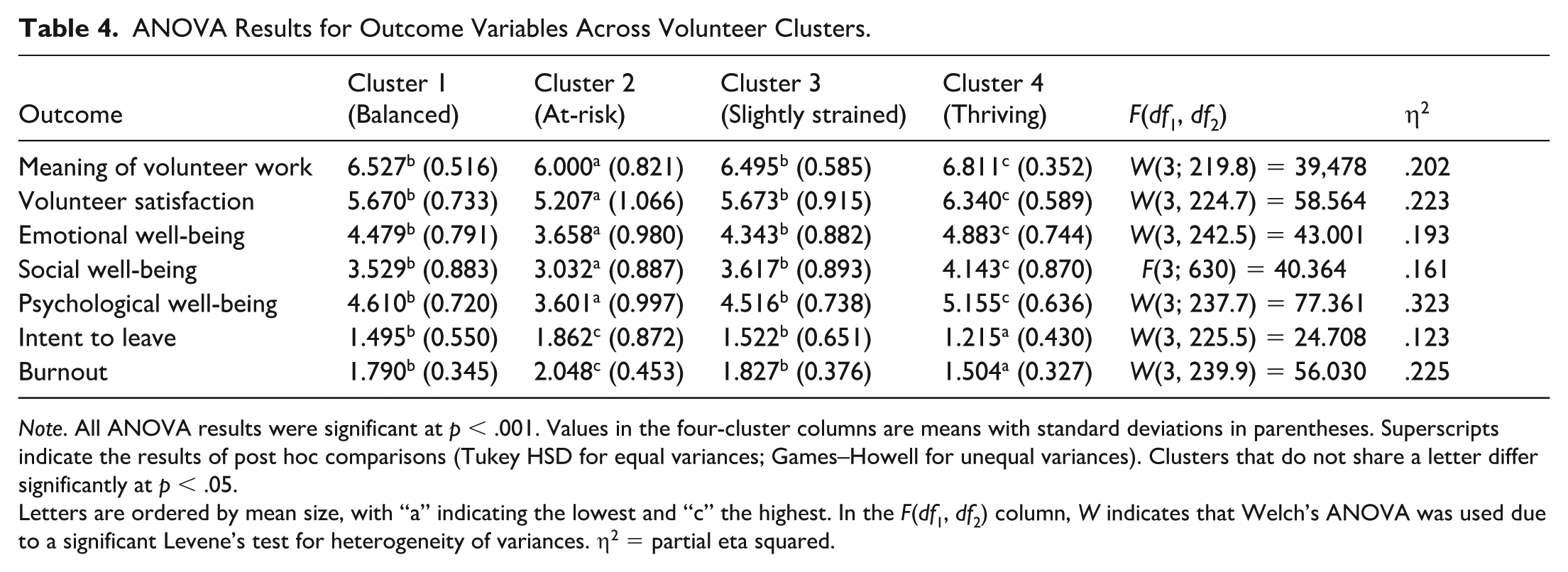
Note. All ANOVA results were significant at p < .001. Values in the four-cluster columns are means with standard deviations in parentheses. Superscripts indicate the results of post hoc comparisons (Tukey HSD for equal variances; Games–Howell for unequal variances). Clusters that do not share a letter differ significantly at p < .05.
Letters are ordered by mean size, with “a” indicating the lowest and “c” the highest. In the F(df1, df2) column, W indicates that Welch’s ANOVA was used due to a significant Levene’s test for heterogeneity of variances. η2 = partial eta squared.
Discussion
The present study examined how the satisfaction and frustration of autonomy, competence, relatedness, and the proposed need for beneficence relate to volunteers’ well-being (encompassing volunteer satisfaction, meaningfulness, and emotional, social, and psychological well-being) and ill-being (reflected in burnout and intent to leave). By including beneficence alongside the three established needs of Self-Determination Theory, the research also aimed to provide new evidence on its potential role as a fourth basic psychological need within the volunteering context. To examine these relationships comprehensively, we employed both variable-centered and person-oriented analyses.
How Do the Basic Psychological Needs and Beneficence Contribute to Volunteer Well-Being and Ill-Being?
A CFA supported a unified eight-factor model distinguishing the satisfactions and frustrations of autonomy, competence, relatedness, and beneficence as separate constructs, consistent with Martela and Ryan (2016, 2020) in a volunteer context. Hierarchical regression analyses were then conducted to examine how the three basic psychological needs and beneficence predicted volunteer well-being and ill-being indicators while controlling for age and gender. Overall, these analyses provided partial support for both H1 and H2; while the sets of psychological needs accounted for meaningful variance in all outcomes, the unique predictive utility of individual needs varied across the different indicators.
In the final models, which controlled for all need satisfactions or frustrations simultaneously, the demographic variables played a limited role. Age retained small but significant positive associations with emotional and psychological well-being, while negatively predicting burnout. These findings align with evidence of higher satisfaction, greater health benefits, and lower burnout and dropout among older volunteers (Gaber et al., 2022; Kulik, 2007; Ling et al., 2023; Morse et al., 2022; Nichol et al., 2023). A likely motivational explanation is that older volunteers are more often driven by altruistic values, whereas younger ones may place greater emphasis on self-development or career goals (Dávila & Díaz-Morales, 2009); altruistic motivation, in turn, is more strongly linked to satisfaction, commitment, and continued volunteering (Zhou & Kodama Muscente, 2023). Except for slightly higher psychological well-being among women, gender was unrelated to the outcomes, a finding consistent with prior research indicating that it does not reliably predict volunteer burnout or satisfaction (Kulik, 2006; Nagel et al., 2020), nor does it moderate health benefits (Nichol et al., 2023). However, these findings should be interpreted with caution, given the overrepresentation of women in the sample, which limits generalizability. In sum, the limited predictive power of age and gender mirrors large-scale Hungarian data on general well-being, which indicates that demographic factors, even when statistically significant, yield only small effects (Vargha & Oláh, 2025). Practically speaking, while there may be differences in motivational factors across demographic groups (particularly regarding age) that are relevant for volunteer management, our results indicate that neither age nor gender constitutes the decisive determinant of volunteer well-being or ill-being. Consequently, no demographic group should be neglected when designing interventions to enhance well-being or reduce ill-being. Instead of relying on demographic targeting, the focus must shift to more psychologically meaningful predictors—namely, the satisfaction and frustration of basic psychological needs.
Regarding the well-being outcomes (H1), among the established needs, relatedness satisfaction was the most consistent predictor, associated with all indicators. Autonomy satisfaction predicted meaningfulness and volunteer satisfaction, whereas competence satisfaction predicted meaningfulness and emotional and psychological well-being. Regarding ill-being, and providing partial support for H2, autonomy and relatedness frustrations predicted both burnout and intent to leave. Competence frustration, however, was unrelated to burnout and showed an unexpected negative relationship with intent to leave despite a positive zero-order correlation; this likely reflects a suppression effect warranting cautious interpretation. While these findings confirm only partial support for the uniform impact of all needs, they align with the empirical reality of the field, where the relative weight of autonomy, competence, and relatedness varies by context and measurement. While relatedness is often a robust predictor of favorable volunteer outcomes such as behavioral intentions (Huang et al., 2019), reduced burnout (Harmon-Darrow & Xu, 2018), and prosocial behavior (Pavey et al., 2011), other studies emphasize competence and relatedness (Kackar-Cam & Schmidt, 2014; Zheng et al., 2021), autonomy and relatedness (Boezeman & Ellemers, 2009), or autonomy and competence (Alamer & Al Sultan, 2022; Haivas et al., 2012, 2013). Evidence on need frustration remains even more limited, as studies typically rely on composite scores rather than examining specific frustrations (e.g., De Clerck et al., 2021, 2024). Future research should prioritize this distinction, as the present findings confirm that separate need satisfactions and frustrations meaningfully drive volunteer well-being and ill-being, even if the precise mechanisms require further clarification.
Regarding the candidate need of beneficence, its satisfaction remained a significant positive predictor of all well-being indicators after controlling for demographics and the satisfactions of autonomy, competence, and relatedness. This result provides strong support for the beneficence-specific component of H1; its standardized effects were comparable to those of the established needs, underscoring its relevance for volunteer well-being. This aligns with evidence that beneficence uniquely supports meaningful work (Martela et al., 2021; Martela & Riekki, 2018) and broader well-being dimensions (Martela & Ryan, 2016; Martela et al., 2017, 2024), confirming that perceiving one’s actions as prosocially impactful is a distinct source of volunteer well-being, rather than merely a means to enhance autonomy, competence, and relatedness. In contrast, the beneficence-related component of H2 was not supported, as beneficence frustration did not predict either ill-being outcome when demographics and the frustrations of the other needs were accounted for. This may indicate that beneficence functions more as a basic wellness enhancer than as a fundamental need, such that its satisfaction promotes well-being while its frustration is not uniquely associated with ill-being (Martela & Ryan, 2020). Alternatively, experiences of beneficence frustration may simply be rare in formal volunteering, as volunteers are unlikely to perceive themselves as having an antisocial impact. Indeed, beneficence frustration showed the lowest mean among all frustration variables (with relatedness frustration only slightly higher). Future research would therefore benefit from distinguishing between beneficence frustration as active harm and thwarted beneficence: situations in which individuals wish to help but feel unable to do so. Such experiences may be more prevalent and psychologically salient in volunteer contexts. Supporting this, Titova and Sheldon (2022) found that depriving individuals of opportunities to help others reduced happiness, with both beneficence and basic need satisfaction emerging as significant mediators.
These findings offer several practical implications for organizations and volunteer coordinators. Since autonomy, competence, and relatedness each emerged as unique predictors of specific well-being outcomes, organizations must adopt a holistic approach that supports all three needs simultaneously: neglecting one could diminish specific aspects of volunteer functioning. Furthermore, the strong independent role of beneficence satisfaction (even after controlling for the established needs) highlights a critical strategy: the necessity of making the volunteer’s prosocial impact visible. These insights point toward specific actionable strategies that could also serve as interventions in future experimental research; a direction of particular importance given that a recent systematic review found the intervention literature to be “still in its infancy” even in paid work contexts (Slemp et al., 2021). Such interventions could focus on promoting beneficence satisfaction (e.g., providing regular feedback that highlights the positive impact of volunteers’ work), autonomy satisfaction (e.g., offering choice in scheduling and tasks), competence satisfaction (e.g., ensuring clear expectations and opportunities for skill development), and relatedness satisfaction (e.g., building team cohesion and a sense of belonging).
Simultaneously, preventing ill-being requires a distinct focus on minimizing need frustration. Management practices should aim to reduce autonomy frustration (e.g., eliminating pressure to perform unwanted tasks), relatedness frustration (e.g., addressing feelings of exclusion or rejection by the group), competence frustration (e.g., mitigating feelings of inadequacy or doubts about capabilities), and beneficence frustration (e.g., ensuring volunteers do not perceive their actions as harmful). Regarding prioritization, our results generally suggest that resources should be directed primarily toward mitigating autonomy and relatedness frustrations, as these were the key drivers of burnout and turnover intentions in the general sample. However, our sample was heterogeneous, encompassing volunteers engaged in a wide range of activities from low-risk tasks (e.g., dog walking, tree planting) to high-stakes roles (e.g., crisis intervention on mental health hotlines). While the universal importance of autonomy and relatedness in such a broad aggregate likely overshadowed the specific vulnerabilities associated with emotionally demanding roles, we hypothesize that competence and beneficence frustration would nevertheless emerge as critical in high-stakes contexts. To illustrate this dynamic with a specific example: in crisis intervention roles, volunteers may experience competence frustration when facing cases beyond their lay training (e.g., supporting a caller who requires professional psychotherapy) and beneficence frustration if they perceive their intervention as detrimental (e.g., a caller’s condition deteriorating by the end of the call). Therefore, future research should specifically target volunteers in these contexts to investigate whether competence and beneficence frustration emerge as significant predictors of ill-being.
These practical implications are further validated by volunteers’ own perspectives, as highlighted in a large-scale qualitative study by Prince and Piatak (2023), which explored the factors making volunteering experiences positive or negative. Although the authors did not explicitly frame their findings within Self-Determination Theory, their results can be interpreted within this framework as reflecting factors consistent with the fulfillment of basic psychological needs. Satisfied volunteers emphasized flexibility and freedom from micromanagement (autonomy), high-quality training (competence), mentoring and teamwork (relatedness), and opportunities to make a visible difference (beneficence). In contrast, dissatisfied volunteers often described conditions that parallel need frustration, including disorganization, ineffective leadership, limited feedback, and feelings of disconnection or underutilization.
What Need-Based Profiles Can Be Identified Among Volunteers, and How Do They Relate to Well-Being and Ill-Being?
Consistent with H3, the person-oriented analyses identified four distinct volunteer profiles based on overall psychological need satisfaction and frustration, each showing meaningful differences in well-being and ill-being outcomes. The Thriving cluster, characterized by the highest satisfaction and lowest frustration, consistently reported the most favorable outcomes across all indicators, whereas the At-risk cluster, marked by the lowest satisfaction and highest frustration, exhibited the poorest outcomes, underscoring the detrimental impact of unmet or frustrated psychological needs. The Balanced and Slightly strained clusters occupied intermediate positions, differing from both the Thriving and At-risk groups but not significantly from each other. These findings parallel the limited person-oriented research on volunteer need profiles: Li et al. (2022) identified “High Satisfaction, Low Frustration” and “Low Satisfaction, High Frustration” profiles associated with favorable and poor outcomes, respectively, patterns resembling our Thriving and At-risk clusters. Similarly, Zheng et al. (2021) found that volunteers with high need satisfaction profiles demonstrated greater sustained volunteering.
Taken together, these findings suggest that the configuration of psychological needs meaningfully shapes volunteer functioning. We believe the specific internal structure of the “At-risk” profile might be of particular interest to practitioners and researchers because, despite being associated with the poorest outcomes, need satisfaction within this cluster still remained higher than frustration. First, this suggests that extreme need frustration is either rare in volunteering or leads to such rapid dropout that these individuals are absent from cross-sectional samples. Second, this phenomenon serves as a vital warning for volunteer management: coordinators should not be misled by survey results simply showing that satisfaction scores are higher than frustration scores. Evidently, the threshold for optimal volunteer functioning is high: merely having “more good than bad” is insufficient to prevent burnout and turnover. This is underscored by the stark contrast in satisfaction-to-frustration ratios: while satisfaction was approximately 4.6 times higher than frustration in the Thriving profile, this ratio dropped to just 1.4 in the At-risk profile.
More broadly, the overall pattern of these profiles demonstrates that need satisfaction and frustration are not mutually exclusive opposites; an organizational climate can simultaneously contain elements that satisfy needs (e.g., a meaningful mission) and frustrate them (e.g., disorganized leadership). Therefore, effective management requires a dual focus: actively bolstering need satisfaction while concurrently diagnosing and eliminating the specific structural factors that cause frustration. Ultimately, shifting volunteers toward the “Thriving” profile is a strategic imperative for organizational sustainability, as the “At-Risk” status represents a direct precursor to costly turnover and reduced service quality.
Cultural Context, Limitations, and Directions for Future Research
It is important to interpret the present findings within the Hungarian context in which the study was conducted. The country’s volunteer sector expanded rapidly after the democratic transition of 1989, following decades of state-controlled “voluntary” work under the communist regime that restricted genuine autonomy and civic engagement (Kuti & Sebestény, 2004; Silló, 2016)—a legacy that may still influence societal attitudes toward volunteering. Culturally, Hungary is often described as lying between collectivism and individualism (Sokolova, 2015), which may influence how social environments support or constrain the satisfaction of basic psychological needs. Nevertheless, Self-Determination Theory proposes that these needs operate universally across cultures (Ryan & Deci, 2017). Thus, while cultural and institutional factors may affect the extent to which the needs are supported, their fundamental role in well-being should remain consistent across societies. Replication in diverse cultural contexts will therefore be essential to test the generalizability of the present findings.
Several limitations of the present study should also be acknowledged. First, its cross-sectional design precludes causal inferences; longitudinal research is needed to clarify how changes in psychological need experiences influence volunteer outcomes over time. Second, the exclusive reliance on self-report data introduces the possibility of response bias, as self-reported intent to leave, for example, may not always correspond to actual volunteer turnover behavior. Sampling bias may likewise have influenced the findings: although a broad range of nonprofit organizations were contacted, those with fewer resources or weaker volunteer management capacity may have lacked the means to respond, leading to their underrepresentation. Within participating organizations, disengaged or dissatisfied volunteers may also have been less likely to participate. Regarding demographics, our sample included a higher proportion of women, university-educated participants, and residents of the capital city compared with national data on Hungarian formal volunteers (Gyorgyovich, 2021; Hungarian Central Statistical Office, 2025), limiting the generalizability of the findings. However, even these two representative national sources differ somewhat in their demographic profiles, indicating that volunteer samples may vary depending on measurement and data-collection methods. In addition, the study did not control for socioeconomic status, race, or ethnicity, or for contextual factors of volunteer work (e.g., activity type, frequency or duration of service, distance from home), all of which may influence volunteers’ opportunities and well-being. Future research should address these limitations through longitudinal and multi-method designs, incorporate behavioral indicators, and test the generalizability of the present findings across cultures and diverse volunteer settings.
Conclusion
Based on data from 650 Hungarian volunteers, this study indicates that volunteer well-being is fundamentally shaped by the satisfaction and frustration of four distinct psychological needs: the established Self-Determination Theory needs for autonomy, competence, and relatedness, as well as the candidate need for beneficence, defined as the sense of prosocial impact. Our analyses revealed that demographic factors played a negligible role compared to psychological need satisfaction in predicting volunteer well-being; notably, beneficence satisfaction emerged as a unique predictor over and above the established needs, while the contributions of the other needs varied across specific indicators. In contrast, volunteer ill-being (burnout and turnover intentions) was primarily associated with the frustration of autonomy and relatedness, whereas beneficence frustration showed no independent association with these negative outcomes. Furthermore, person-oriented analyses identified four distinct volunteer profiles based on need satisfaction and frustration levels, which exhibited significant differences in these psychological outcomes.
These findings carry significant theoretical implications by validating the centrality of basic psychological needs within the under-researched volunteer population and contributing to the ongoing scholarly debate regarding the classification of beneficence as a candidate basic need. From a practical perspective, the results urge a dual-focus management approach: organizations must actively enhance need satisfaction to promote well-being while simultaneously eliminating the need frustrations that drive ill-being. Ultimately, creating such a supportive environment is essential for fostering a resilient and sustainably engaged volunteer workforce.
Footnotes

Ethical Considerations
This study followed ethical standards, with approval from the Research Ethics Committee of ELTE Eötvös Loránd University, Faculty of Education and Psychology (approval number 2024/398).
Consent to Participate
All participants provided informed consent for their participation in this study and for the use of their data.
Author Contributions
Olivér Lubics conceptualized and designed the study, led the data collection, performed statistical analyses, and drafted the manuscript. Tímea Magyaródi and Henriett Nagy supervised the research, supported its initial planning, and provided critical feedback throughout the project. All authors read and approved the final version of the manuscript.
Funding
The authors disclosed receipt of the following financial support for the research, authorship, and/or publication of this article: Olivér Lubics was supported by the EKÖP-24 University Excellence Scholarship Program of the Ministry for Culture and Innovation, Hungary, funded by the National Research, Development and Innovation Fund.
Declaration of Conflicting Interests
The authors declared no potential conflicts of interest with respect to the research, authorship, and/or publication of this article.
Data Availability Statement
The dataset and accompanying codebook, which include the full wording of all scale instructions and items in the original Hungarian (used in the study) and their English translations, are openly available at the Open Science Framework (OSF) at osf.io/3wp5y.
Use of AI Assistance
As the authors are non-native English speakers, ChatGPT (OpenAI) and Gemini (Google) were employed to enhance the language, clarity, and readability of the manuscript. The authors retained full responsibility for all intellectual content, data interpretation, and final revisions.