






Abstract
Arts organizations face intense competition for private support, making effective donor segmentation essential. While attendance frequency is a well-known correlate of giving, little research has quantified the role of event variety—the breadth of engagement across program genres—in shaping donor behavior. Using a 26-year longitudinal dataset from a major multi-genre European arts festival, this study examines whether event variety is a stronger predictor of donor value than attendance frequency and identifies the variety level associated with stronger donor progression. To this end, we extend a latent-class Markov mixture model by incorporating lifetime event variety as a behavioral covariate. Our results show that attending four or more event genres is associated with a higher probability of transitioning into high-value donor states. These findings highlight event variety as a practical metric for donor segmentation and development in arts fundraising.
Introduction
Arts and cultural nonprofits pursue philanthropy in a crowded, resource-constrained environment (Lee et al., 2017), where production costs consistently outpace ticket revenue (Ostrower & Calabrese, 2021). While U.S. charitable giving reached $592.5 billion in 2024, the arts captured only 4% of total contributions, and donor retention remains stagnant near 40%, underscoring fundraising volatility (Fundraising Effectiveness Project [FEP], 2024; Giving USA, 2025). Evidence shows that a relatively small group of highly committed patrons accounts for a disproportionate share of income across museums and performing-arts institutions, intensifying the race to identify and retain high-value prospects (TRG Arts, 2017).
In response, donor segmentation research has shifted from static demographic profiling toward behavioral, motivational, and longitudinal approaches. Building on Social Identity Theory (Tajfel, 1981), early studies in arts membership link organizational identification to visiting frequency, highlighting engagement as a key fundraising lever (Bhattacharya et al., 1995). Later work identifies value congruence and psychological traits—such as empathy and social responsibility—as key drivers of giving (Bennett, 2003), while more recent research shifts attention to repeat donations, showing that providing donors with concrete impact feedback strengthens continued giving (Levontin et al., 2025). Methodological advances mirror this evolution: sequence-based models reveal heterogeneity in donor trajectories that aggregate measures such as RFM (Recency, Frequency, Monetary) often obscure, improving targeting and ask calibration (E. J. Durango-Cohen, Torres, & Durango-Cohen, 2013).
Within this evolution, event attendance has been linked to higher donation likelihood and value (P. L. Durango-Cohen, Durango-Cohen, & Torres, 2013), yet most empirical work emphasizes frequency (how often someone attends) rather than variety (how many distinct event genres they sample). This suggests a potential gap. In customer relationship management, relationship breadth—often operationalized as cross-buying—has been positively linked to lifetime value (Kumar et al., 2008; Reinartz & Kumar, 2003), while research in the sociology of culture shows that cultural “omnivores” typically possess the higher-income profiles associated with increased giving (Peterson & Kern, 1996; Petrovski, 2017). In parallel, sector analyses suggest that broadly engaged patrons—those attending across multiple organizations and genres—generate a disproportionate share of revenue (Greater Philadelphia Cultural Alliance, 2015), implying that breadth may matter more than frequency in identifying donor potential. Taken together, these perspectives position attendance variety as a theoretically grounded but underexplored behavioral dimension in arts fundraising, offering a more precise way to identify donors likely to transition into sustained, higher-value giving. Accordingly, our central research question is: How is event variety, relative to attendance frequency, associated with donor progression in a multi-genre arts festival—specifically, are patrons who attend across multiple genres more likely to transition into higher-value donor states over time?
Multi-genre arts festivals differ from year-round institutions (e.g., museums, theaters) in their time-bounded structure and cross-disciplinary programming (Jones, 2021; National Endowment for the Arts [NEA], 2011). They attract audiences who often prioritize social connection and collective participation over formal cultural consumption (Fabiani, 2011). Moreover, festivals must cultivate support within compressed cycles (Kerr & May, 2011). While findings from such settings may not fully generalize to single-genre organizations, festivals’ participatory, community-centered approaches offer insights into engagement variety increasingly relevant to permanent institutions adopting “festivalization” strategies (Jordan, 2016).
Building on this foundation, we analyze a 26-year longitudinal dataset from a major European arts festival and introduce event variety as a behavioral covariate within a donation-segmentation framework. We combine Gaussian mixture modeling, Dirichlet regression, and sequence-analytic segmentation using latent-class Markov mixtures (MM) (E. J. Durango-Cohen, Torres, & Durango-Cohen, 2013). Gaussian mixtures first define discrete donation states, followed by a baseline MM that captures transitions among these states and identifies latent donor segments. Dirichlet regression then links segment membership to event frequency and variety, testing whether variety better predicts high-value segment affiliation. Finally, a variety-augmented MM uses engagement breadth to condition transition probabilities across donation states. Together, these methods assess whether cross-genre attendance accelerates donor progression and identify the threshold at which an attendee becomes a strong cultivation prospect.
The remainder of this paper is structured as follows. The next section reviews the literature on donor segmentation and modeling to develop the study’s hypotheses, followed by a description of the data and methodological framework. We then present the empirical findings and discuss their implications for theory and practice, including limitations and directions for future research. The paper concludes with a summary of key contributions.
Literature Review
Traditional Approaches to Donor Segmentation
As public funding declines and competition for private support intensifies (Lee et al., 2017), donor segmentation enables arts and festival organizations to move from generic appeals to targeted stewardship aimed at maximizing retention, upgrades, and reactivation (Boenigk & Scherhag, 2014; Sinha et al., 2025). Early research (e.g., Schlegelmilch, 1988) showed that demographic, lifestyle, and psychographic variables could distinguish donors from non-donors or identify heavy givers. Subsequent work, however, questioned their usefulness for segmenting donors by motivation or preferred cause (Schlegelmilch & Tynan, 1989). Relying on observable donor characteristics can obscure the deeper motivational and behavioral diversity shaping donor decisions (Kolhede & Gomez-Arias, 2022), prompting calls for frameworks that capture the complexity and dynamism of donor behavior (E. J. Durango-Cohen, Torres, & Durango-Cohen, 2013).
Despite these limitations, demographic segmentation persists partly because arts participation itself is highest among affluent and well-educated individuals (DiMaggio & Ostrower, 1990; DiMaggio & Useem, 1978). Accordingly, demographic factors—such as age, gender, income, and education—alongside basic behavioral measures (recency, frequency, and monetary value), have long anchored donor segmentation in research and practice (Hsu et al., 2021; Kolhede & Gomez-Arias, 2022; Lindahl & Winship, 1992).
However, traditional approaches face mounting criticism. Demographics alone offer limited explanatory power, and empirical findings are often contradictory (Kolhede & Gomez-Arias, 2022). Variables such as gender and income can exert opposing effects on the initiation and intensity of giving: women are often more likely to initiate giving, whereas men tend to donate larger amounts, while income predicts donation size more reliably than the likelihood of giving itself (de Wit & Bekkers, 2016; Petrovski, 2017). Segmenting by age also risks self-fulfilling bias, overlooking the long-term potential of younger donors (Hoskins & Hoskins, 2024).
Behavioral heuristics such as recency–frequency–monetary (RFM) models have long dominated segmentation practice but are often unavailable for prospective donors (Srnka et al., 2003). Moreover, clustering based on RFM summaries can introduce aggregation bias, obscuring donor dynamics and masking actionable heterogeneity (E. J. Durango-Cohen, Torres, & Durango-Cohen, 2013). Early and repeated gifts, for example, may be stronger indicators of loyalty and lifetime value than initial donation size alone (Shen, 2016). Segmenting donors by their giving trajectories can therefore yield richer insights and support more personalized stewardship (P. L.Durango-Cohen, Durango-Cohen, & Torres, 2013), enabling differentiated strategies for donors with variable versus stable giving patterns.
Still, even trajectory-based models mainly describe how donors give rather than why. Bridging this gap requires greater attention to the sociological and psychological mechanisms that shape giving behavior.
Sociological and Psychological Frameworks of Giving
Recognizing the limits of traditional segmentation, newer approaches increasingly emphasize the behavioral and psychological drivers of charitable giving (Bao et al., 2022). Drawing on Bourdieu’s (1984) concept of cultural capital, arts participation can be understood as a social practice through which individuals signal status and reinforce class distinctions (Ostrower, 1996). Institutional backing from governments and educational systems has long positioned the arts among the most legitimized and prestigious cultural forms (DiMaggio, 1982; DiMaggio & Mukhtar, 2012). Extending this to philanthropy, Ostrower (1998) shows that elite engagement with arts organizations—through boards, benefits, and patronage—functions as a mechanism of class cohesion. Together, these perspectives frame arts giving as both cultural expression and social capital exchange, linking aesthetic participation to status maintenance.
While cultural capital theory captures structural dimensions of participation, Social Identity Theory (Tajfel, 1981) offers a complementary psychological lens: identification with an organization through shared values or cultural interests fosters charitable engagement (Chapman et al., 2024; Kolhede & Gomez-Arias, 2022). More generally, donor behavior is shaped by psychological and relational factors—such as involvement in the act of giving (Bennett, 2007) and social recognition (Andreoni & Petrie, 2004)—as well as by trust in an organization and its effectiveness (Bekkers, 2003). Donors are also more likely to support organizations with which they have prior experience or affiliation (Monks, 2003) and may be motivated by expectations of relational or symbolic returns (Sargeant, 1999, 2001), highlighting the role of perceived personal relevance (Srnka et al., 2003). Practical incentives, including tax benefits or networking opportunities, can encourage participation, though typically alongside stronger intrinsic and relational drivers (Bekkers & Wiepking, 2011; Chapman & Thai, 2026).
In the arts, motivations for giving often blend altruism with consumption-oriented motives. Emotional engagement, aesthetic appreciation, and a sense of belonging shape donation decisions (Bakhshi & Throsby, 2010; Guest, 2002). At the same time, donations may involve “selective incentives,” as contributors gain access to exclusive benefits such as special events or VIP experiences (Cornelli & Buraschi, 2002), making arts philanthropy resemble premium consumption.
From Engagement Frequency to Engagement Variety
Incorporating engagement metrics has advanced donor segmentation, with event participation strongly associated with donation behavior. For example, alumni who attend class reunions are more likely to fall into higher-value giving segments (E. J. Durango-Cohen & Balasubramanian, 2015). This relationship between engagement and donor value can be partly explained by psychological mechanisms: lower frugality reduces the “pain of giving,” increasing willingness to donate (Ho et al., 2025), while event-based benefits enhance donor satisfaction and loyalty (Boenigk & Scherhag, 2014). Such experiences may also reinforce retention by increasing exposure to tangible evidence of impact, which strengthens continued giving (Levontin et al., 2025). Participation further operates within a social context, with spousal involvement influencing both the likelihood and size of donations (Einolf et al., 2018; Mesch et al., 2022).
In arts organizations, participation, purchasing, and giving are closely linked: engaged audiences and frequent attendees are more likely to donate, with philanthropy often cultivated from the core audience base (The Audience Agency, 2015; Shaomian & Heere, 2015). Frequent visits are associated with stronger organizational identification, which in turn is linked to giving behavior (Bhattacharya et al., 1995). This progression from first-time buyer to subscriber to donor remains central to arts fundraising.
However, the participation–giving relationship is not always linear. High attendance or earned revenue can sometimes signal financial stability and reduce perceived need, dampening donation urgency (Kim & Charles, 2016). Moreover, while the frequency of event attendance may signal donor potential, transactional engagement alone does not reliably translate into philanthropy (Johnson et al., 2014), highlighting the limits of frequency-based segmentation.
A complementary perspective is to consider not only how often donors engage, but how diversely. Mirroring findings from the marketing literature, where cross-buying is linked to customer relationship development (Kumar et al., 2008; Reinartz & Kumar, 2003), supporting an organization through multiple channels—such as donations, volunteering, or events—is associated with longer donor lifetime duration (Bennett, 2006). Moreover, higher-status individuals tend to participate across a broader range of cultural forms (Peterson & Kern, 1996), and such breadth is associated with more diverse experiential and relational connections (Ostrower, 2012). These connections can strengthen identification with organizations, which is linked to a greater likelihood of giving (Chapman et al., 2025).
Consistent with this view, evidence from both the U.K. and U.S. arts sectors indicates that donors are not only more frequent attendees but also more broadly engaged across venues and organizations (The Audience Agency, 2015; Greater Philadelphia Cultural Alliance, 2015). These patterns suggest that breadth of engagement might complement frequency in identifying donor potential and progression.
Hypotheses
In donor segmentation research, behavioral and transactional indicators are commonly used to differentiate donors by value and activity status (P. L.Durango-Cohen, Durango-Cohen, & Torres, 2013; E. J. Durango-Cohen, Torres, & Durango-Cohen, 2013). Against this backdrop, we submit that engagement variety—the diversity of event attendance—captures a dimension of donor behavior distinct from attendance frequency. While frequency reflects the intensity of interaction, prior research shows that breadth of engagement is positively associated with customer relationship development (Kumar et al., 2008), donor lifetime duration (Bennett, 2006), and donor value (The Audience Agency, 2015). From a sociocultural perspective, broader participation may also signal greater familiarity with a range of cultural forms (de Vries & Reeves, 2022), which may in turn reflect deeper engagement with an organization’s cultural offerings. In an arts-festival context, attending across multiple genres may therefore indicate a more embedded relationship with the organization than repeated attendance within a single category—a condition associated with stronger organizational identification, which is linked to a higher likelihood of giving (Chapman et al., 2025). This leads to the expectation that engagement variety will be more strongly associated with active donor status than frequency alone.
Beyond its relative predictive strength, engagement variety may also exhibit nonlinear effects. Consumer research shows that variety-seeking arises as repeated consumption leads to satiation and a desire for novelty (Kahn, 1995), triggering shifts between consistency-seeking and variety-seeking modes (Fishbach et al., 2011). In line with this, engagement breadth often manifests as discrete profiles—for example, “omnivores” versus “paucivores”—rather than a continuum (Chan & Goldthorpe, 2007; Peterson & Kern, 1996). Buyer–seller relationship theory supports this discontinuous view, noting that relationships evolve through distinct phases (exploration, expansion, commitment) with shifts in relational dynamics over time (Dwyer et al., 1987). In Customer Relationship Management (CRM), breadth is associated with customer loyalty and retention (Reinartz et al., 2008), as cross-category participation reflects deeper commitment than isolated interactions. However, returns to this breadth are non-uniform (Shah et al., 2012), implying that the impact of variety is not strictly linear but varies with the donor’s level of engagement. This suggests the possibility of a threshold effect: a critical point at which accumulated variety signals a shift in donor behavior, such that upward transitions become more likely beyond a specific level of cross-genre participation.
By testing H1 and H2, this study contributes to the donor segmentation literature by introducing engagement variety as a behavioral dimension that complements frequency-based measures. It also contributes to the CRM literature by extending the concept of relationship breadth (cross-buying) to a nonprofit context where its role in donor progression remains underexplored, and by demonstrating that its effects may be nonlinear and characterized by threshold dynamics.
Testing these hypotheses poses methodological challenges. Existing studies on engagement variety rely largely on cross-sectional approaches that fail to capture the temporal dynamics of giving. Even when measured cumulatively, linking variety to transitions in donor status over time remains challenging, as traditional methods—such as cross-tabulation, regression, or cluster analysis—struggle to represent temporal processes and transition dynamics (Abbott, 1995), limiting their ability to model donor development over time.
More advanced models partially address these limitations. Buy-Till-You-Die (BTYD) models—such as the Pareto/Negative Binomial Distribution (Pareto/NBD) model and its discrete-time analogs like the Beta-Geometric/Beta-Bernoulli (BG/BB) model—use past transaction histories to estimate future donation incidence and the probability that a donor remains “active” or “alive” (Fader et al., 2010; Johnson et al., 2014). Survival and hazard models similarly focus on predicting time-to-event outcomes, including donor lapse, retention, and reactivation (Feng, 2014; Shen, 2016; Sinha et al., 2025). Although these approaches capture longitudinal patterns and can incorporate covariates, they primarily model donation incidence, latent activity status, or time-to-event outcomes rather than explicitly capturing transitions among multiple latent donor states. Consequently, they are less suited to jointly modeling donor-state dynamics along an upgrading pathway.
Other sequence-based approaches model temporal patterns directly. In the donor context, E. J. Durango-Cohen, Torres, and Durango-Cohen (2013) show that donors with similar average giving can follow distinct contribution trajectories, highlighting the value of longitudinal data over summary statistics. They propose a latent-class Markov mixture framework in which donors are segmented based on contribution sequences, with each segment characterized by distinct transition probabilities. The resulting probabilistic segment memberships can then be linked to observable behaviors, enabling a direct test of H1.
Further refinement comes from integrating behavioral covariates into the segmentation process. P. L.Durango-Cohen, Durango-Cohen, and Torres (2013), for example, employ a Bernoulli–Gaussian mixture model incorporating behavioral predictors such as event participation, showing that involvement in alumni activities is associated with higher donation likelihood and value. Building on this approach, we extend the latent-class Markov mixture model of E. J. Durango-Cohen, Torres, and Durango-Cohen (2013) by incorporating event variety as a behavioral covariate to test H2. This extension enables us to assess how engagement variety relates to donor-state dynamics over time and to identify potential variety thresholds associated with higher conversion potential. In doing so, our study responds to calls for more dynamic, behaviorally rich models of repeated giving (Levontin et al., 2025).
Data and Methods
Festival Dataset
The dataset comes from a major European arts festival offering a multi-week annual program across ten artistic genres—including music, opera, ballet, theater, and family events—and attracting both domestic and international audiences. Here, “genre” refers to broad programming categories rather than subgenres within a discipline (e.g., jazz or classical within music), providing a consistent basis for measuring event variety as the number of distinct genres a patron attends.
As a nonprofit institution, the festival relies heavily on recurring memberships and individual donations, the latter of which account for roughly 80% of contributed revenue. The development team provided two anonymized, customer-level datasets: a 26-year record of donations (1999–2024) and an 11-year record of event bookings (2014–2024).
Overall, 9.4% of festival customers donated at least once during the study period. Table 1 reports summary statistics for donation activity at 5-year intervals (with donor counts and annual values indexed to 2024 = 100). While average donation amounts declined through the 2000s and 2010s, the number of active donors increased steadily. After a pandemic-related decline, both donor counts and average gift sizes rebounded. Because donation activity is highly right-skewed—with a small subset of donors contributing disproportionately—our analysis focuses on the larger base of lower-tier supporters, whose giving is modest and intermittent and whose long-term potential is more difficult to assess.
Overview of Donation Dataset—5-Year Intervals (Values Indexed to 2024 = 100).
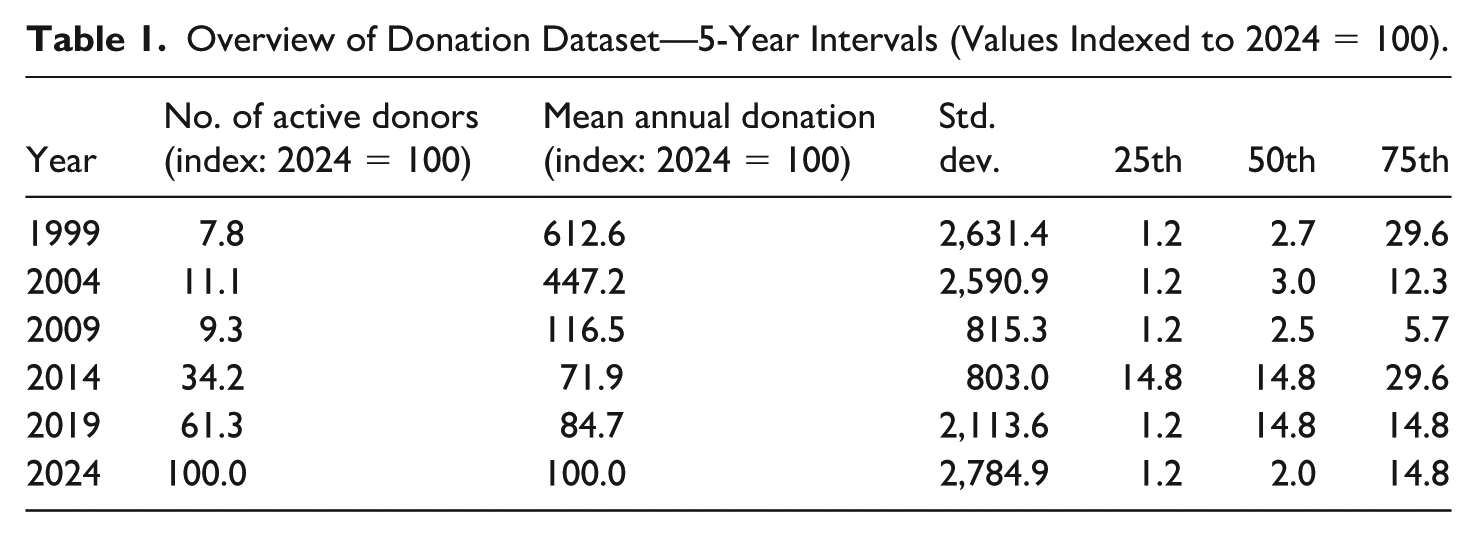
Table 2 summarizes donor retention by reporting the distribution of donors by the number of years they contributed over the 26-year period. Seventy-two percent of donors gave only once, highlighting the challenge of sustaining support beyond the first gift. Only 10.3% donated in a second year and 4.2% in a third, with participation declining thereafter. On average, donors contribute 1.8 times over their lifetime, underscoring limited long-term engagement and reinforcing the need to identify early behavioral signals—such as event attendance variety—that can inform targeted stewardship.
Breakdown of Donors According to Number of Years Donated.

Regarding event variety, Table 3 details donor behavior by the number of distinct genres attended after 2013—including the 23% of donors with no post-2013 bookings, for whom variety cannot be observed. On average, donors attended 13.5 events across 2.2 genres. Attendance frequency and variety are strongly correlated: patrons who remain active longer attend both more events and a wider range of genres and donate more frequently. Donation frequency and amount are also positively related, consistent with evidence linking retention to lifetime value (Sargeant, 2013).
Breakdown of Donors According to Post-2013 Event Attendance and Variety Over Customer Lifetime.
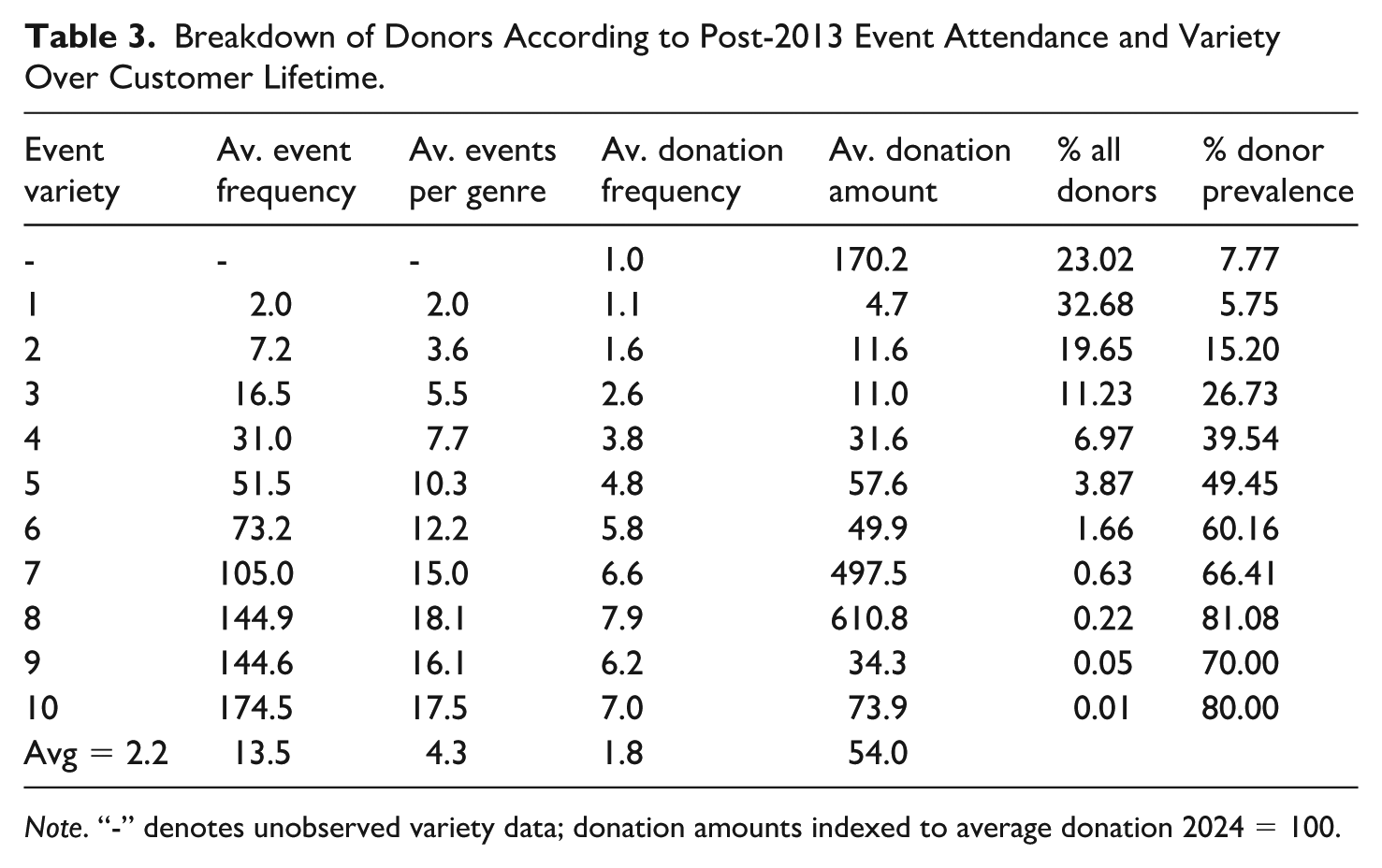
Note. “-” denotes unobserved variety data; donation amounts indexed to average donation 2024 = 100.
Table 3 further reports donor shares by variety level. Average variety among donors (2.2 genres) is substantially higher than among non-donors (1.3 genres), and donor prevalence rises steadily with increasing variety—from 5.8% among single-genre attendees to over 60% among those attending six or more genres. While donor acquisition lies beyond this study’s scope, this gradient suggests a strong association between engagement breadth and conversion to donorship. Donors attending four genres give an average of 3.8 times—more than twice the population average—compared with 1.1 times for those attending a single genre, highlighting event variety as a strong marker of donor value.
Figure 1 visualizes these relationships. Event frequency increases sharply with variety (Pearson correlation = .64), and the average number of events per genre also rises (correlation = .46). Together, these patterns indicate that variety captures both duration and depth of engagement: patrons are not merely sampling broadly but participating intensively across multiple artistic forms. Notably, donor status in our festival confers no booking discounts, suggesting that diverse attendance reflects intrinsic cultural interest rather than financial incentives.
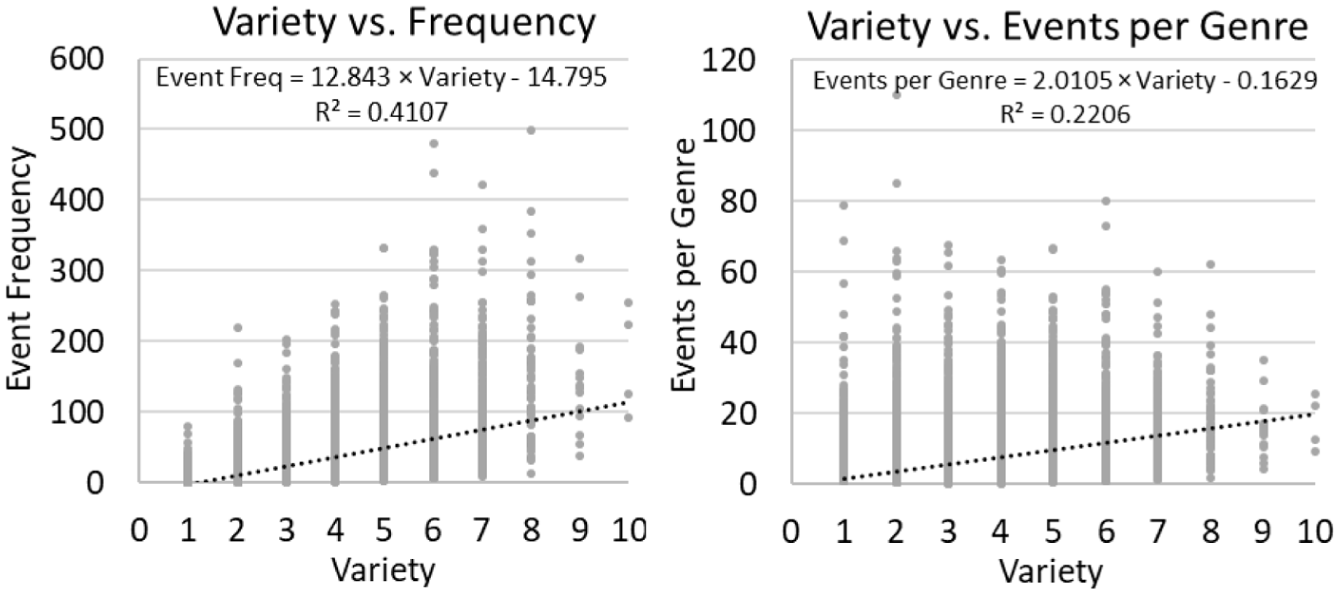
Event variety versus frequency (left); event variety versus events per genre (right).
Because of the overlap between variety and frequency, subsequent analyses explicitly test for multicollinearity to ensure that observed variety effects are not artifacts of attendance intensity.
Baseline Segmentation
Our analysis begins with the full customer-level donation sequences (1999–2024), where each sequence captures annual donation amounts over time. We pool all positive donation amounts observed across donors and years and denote this pooled sample by Y = {y1, y2, . . ., yn}.
We first apply a Gaussian Mixture Model to the distribution of these positive donation amounts to obtain an initial estimate of the number of latent donation-size segments present in the data. This approach assumes that the observed amounts are generated from a mixture of S Gaussian distributions, each with its own mean μs, variance σs², and mixture weight λs (Σsλs=1), such that:

The parameters are estimated using the Expectation-Maximization (EM) algorithm, which iteratively maximizes the likelihood of the observed data under the model. For each number of segments S ∈ {2, 3, 4, 5, 6}, the algorithm computes μs, σs, λs, as well as the average per-datum log-likelihood (LL) to assess model fit. As shown in Table A1, LL improves with additional segments up to five; beyond this point, marginal gains diminish and further segmentation yields very small groups, suggesting over-segmentation rather than substantively meaningful new patterns.
Next, we discretize the continuous range of positive donation amounts into five bins to define donation states, following E. J. Durango-Cohen, Torres, and Durango-Cohen (2013). Boundaries between adjacent bins are determined by solving for the breakpoint b at which the combined cumulative distribution functions (CDFs) of two neighboring Gaussian components, ordered by ascending mean, sum to one:

Here, Φ(b; μ, σ) denotes the normal CDF with mean μ and standard deviation σ, evaluated at point b. The resulting breakpoints define probabilistic tipping points between overlapping components.
Table 4 reports the resulting donation states, with thresholds expressed in normalized donation amounts (2024 average = 100). In addition to a “No” state representing zero donations in a given year, the model distinguishes five positive-giving states—Low, Medium, High, Top, and Elite—corresponding to progressively higher contribution levels. The upper thresholds reflect a small number of very large contributions, primarily from institutional or high-capacity donors. While retained for completeness and transparency, these values represent a negligible share of donors and do not materially affect lower-segment transition dynamics, which are the primary focus of the analysis.
Donation States and Corresponding Normalized Thresholds (2024 Average = 100).

This binning process converts the continuous donation distribution into an ordinal state variable, which serves as the foundation for the subsequent latent-class Markov Model (MM) analysis of donor behavior over time (E. J. Durango-Cohen, Torres, & Durango-Cohen, 2013).
The dataset of donor histories is structured as a matrix:

where M is the number of donors and T = 26 is the number of observed years (1999–2024). Each row corresponds to a donor’s sequence of annual donation states. Thus, the donation state sequence for donor m is:

We estimate a mixture of S Markov models, each representing a latent donor segment. Each segment s ∈ {1, . . ., S} is defined by:
(a) an initial state distribution
(b) a state transition matrix
(c) a prior segment probability λs, such that
Here, L = 6 denotes the number of discrete donation states.
The log-likelihood of donor m’s sequence under segment s is given by:

The marginal log-likelihood for donor m is:

Using the EM algorithm, we estimate the posterior membership probability γms that donor m belongs to segment s via Bayes’ rule:

The EM updates involve re-estimating λs, π₀⁽ˢ⁾, and P⁽ˢ⁾ using weighted counts based on γms. We run this procedure for S = 1, 2, 3, 4, and compute the scaled LL for model comparison.
For interpretability, we compute the long-run (steady-state) distribution π⁽ˢ⁾ ∈ Rᴸ for each segment s as the left eigenvector of P⁽ˢ⁾ corresponding to eigenvalue 1, normalized to sum to one. The steady-state distribution characterizes each segment’s long-run propensity to occupy different donation states.
Model fit and segment proportions for MMs with one to four latent segments are reported in Table A2. LL improves with additional segments but levels off beyond four; the four-segment solution therefore offers the best balance between fit and interpretability and is retained as the baseline for subsequent analyses.
Table 5 summarizes donor-state transition dynamics and long-run (steady-state) distributions for the four baseline segments. Rows report the probability of transitioning from each donation state to another in the subsequent period, with the final column indicating the long-run distribution implied by these dynamics.
Transition and Long-Run Probabilities for Four-Segment Model.
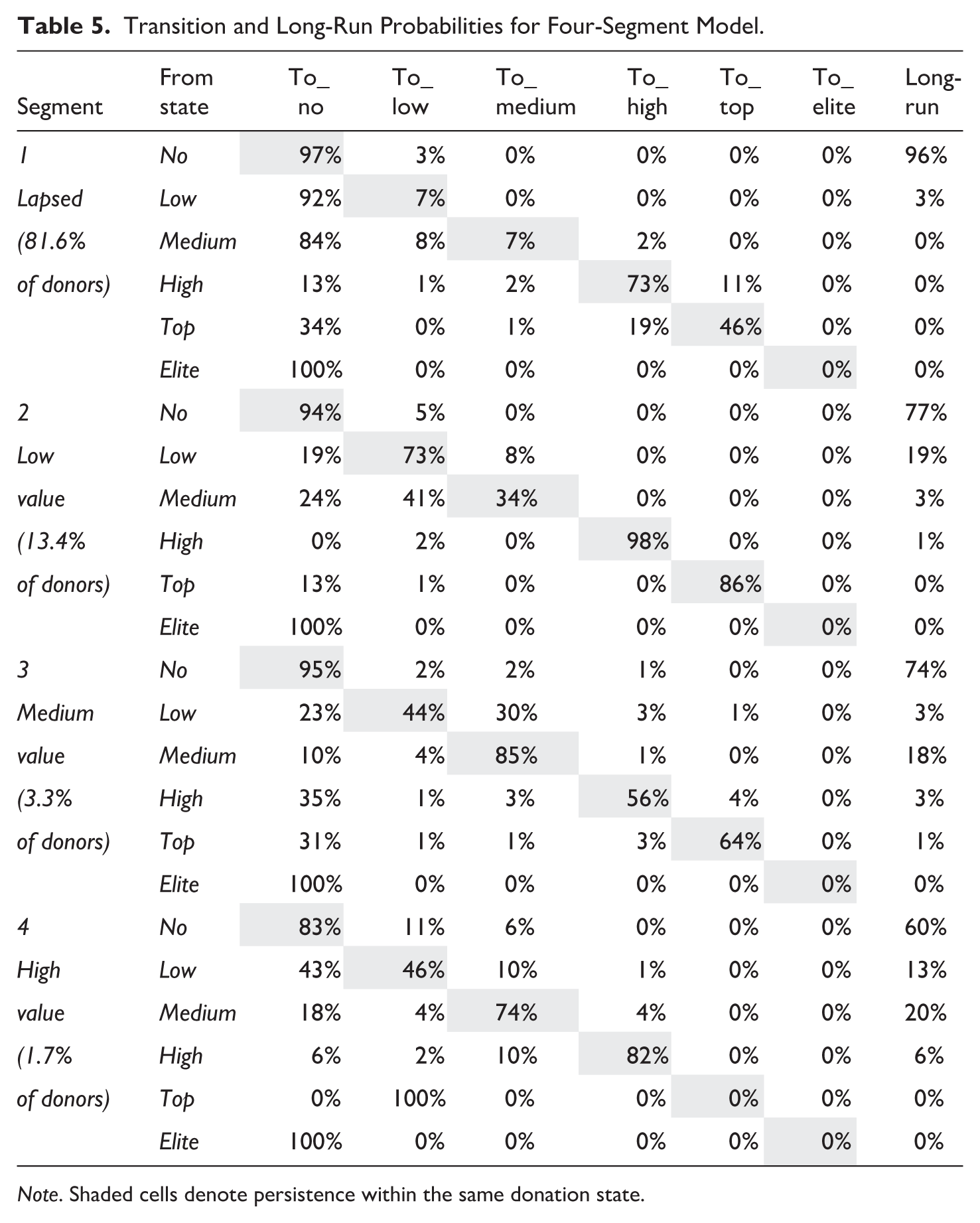
Note. Shaded cells denote persistence within the same donation state.
Segment 1 (81.6% of donors) is best characterized as Lapsed, with donors overwhelmingly remaining in the “No donation” state (96% in the long run) and showing little reactivation. Segment 2 (Low Value, 13.4%) exhibits modest engagement, with most donors persisting in low-giving states and limited upward movement. Segment 3 (Medium Value, 3.3%) displays greater persistence in the “Medium” and “High” states and more frequent transitions, indicating moderate fundraising potential. Segment 4 (High Value, 1.7%) shows the strongest dynamics, with donors frequently remaining in or moving between the “Medium” and “High” states, reflecting sustained engagement and retention.
Figure 2 visualizes donor-state transitions across five consecutive periods using Sankey diagrams. Each panel represents one of the four donor segments (Lapsed, Low Value, Medium Value, and High Value), with the width of each flow indicating the share of donors moving between giving states over time. The diagrams show that while most flows move toward the ‘No donation’ state, higher-engagement segments—especially the Medium and High Value groups—display more balanced, upward flows, reflecting greater stability and sustained giving momentum.

Transition flows by segment—baseline MM.
Dirichlet Regression
To examine how event attendance—both frequency and variety—relates to latent segment membership, we estimate a Dirichlet regression on the posterior membership probabilities (γms) obtained from the MM. The analysis is restricted to donors who began giving after 2013, ensuring that event frequency and variety are fully observed and temporally consistent with the donation data.
Let γm = (γm₁,γm₂,γm₃,γm₄) be the outcome vector for donor m, where ∑sγms = 1 and γms ∈ (0,1). We model γm using a Dirichlet regression framework, with concentration parameters αm = (αm1,αm2,αm3,αm4) defined as:

where zm is a vector of covariates for donor m, including event frequency and variety (number of unique genres attended). To assess whether the effect of variety depends on attendance intensity, we include a frequency × variety interaction. In an alternative specification, frequency is replaced by events per genre (total events divided by genres attended). Because frequency and variety are moderately correlated, multicollinearity is assessed using Variance Inflation Factors (VIFs).
To partially account for potential endogeneity—where unobserved donor traits may influence both event participation and giving—we include three controls: (1) number of registered addresses (proxying wealth), (2) number of relationships with other donors in the Customer Relationship Management (CRM) dataset (capturing social embeddedness), and (3) fundraising email consent (indicating engagement with fundraising communications). Interaction terms between event variety and each control are also included to test whether the predictive strength of variety differs across donor types.
Each segment
This framework allows comparison of the relative effects of event variety and frequency—both overall and conditional on donor characteristics—on segment membership. We test H1 by evaluating whether the marginal effect of variety is stronger than that of frequency after controlling for wealth, social ties, and communication engagement. A stronger, more robust effect of variety supports its interpretation as an independent behavioral correlate of donor progression rather than a byproduct of pre-existing donor characteristics.
Variety-Driven MM
We further assess how event variety shapes donor trajectories by extending the latent-class MM to incorporate variety as a cumulative, donor-level covariate influencing donation-state transitions. This extension allows us to test whether donors who attend a broader range of event genres are more likely to transition toward higher-value giving states over time.
All donors observed between 1999 and 2024 contribute to the estimation of baseline donation-state sequences and transition dynamics. Event variety enters only through covariate-adjusted transitions estimated for post-2013 donors with observed variety data, reducing the risk that estimated effects are driven by missing-data artifacts.
Donors are assigned to a discrete variety category based on the number of distinct event genres attended after 2013. Conditional on latent segment s ∈ {1, . . ., S} and origin state i ∈ {1, . . ., L}, transition probabilities depend on the donor’s variety category. Transitions are modeled as:

where
Variety-adjusted transition matrices are obtained by applying group-specific log-odds adjustments—estimated from post-2013 donors—to the segment-specific baseline transition dynamics estimated using all donors, yielding normalized, variety-conditioned transition probabilities.
To test H2, we identify whether a threshold level of engagement variety is associated with net upward donor progression. This is done by aggregating the top variety bins in decreasing order—first combining groups where variety ≥ 9 genres, then variety ≥ 8, and so forth—and re-estimating the corresponding transition matrices. This right-truncated procedure evaluates whether a variety threshold exists beyond which upward transitions (from “No,” “Low,” and “Medium” states) exceed downward movements, suggesting the level of cross-genre participation at which donors are more likely to upgrade than regress.
Findings
Variety Versus Frequency (H1)
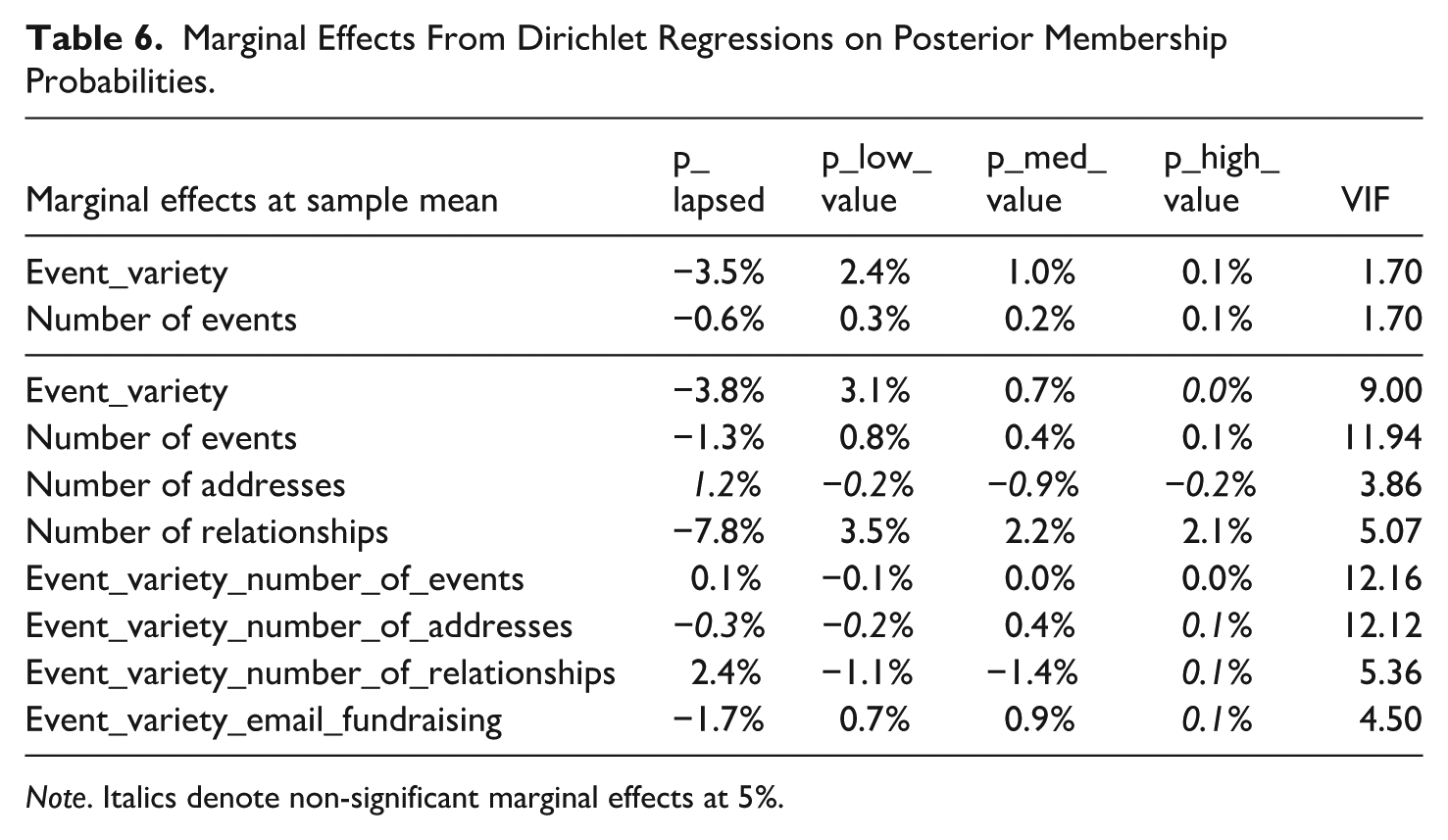
Table 6 reports the marginal effects from the Dirichlet regression models, showing how changes in event variety, attendance frequency, and their interactions relate to posterior probabilities of donor segment membership. Coefficients represent percentage-point changes in segment membership probability associated with a one-unit increase in each variable, evaluated at the sample mean.
Marginal Effects From Dirichlet Regressions on Posterior Membership Probabilities.
Note. Italics denote non-significant marginal effects at 5%.
Results show that event variety is more strongly associated with donor segmentation than attendance frequency. In the full specification, a one-unit increase in variety is linked to a 3.8-percentage-point decrease in the probability of belonging to the Lapsed segment, alongside increases of +3.1 points for the Low-value segment and +0.7 points for the Medium-value segment. These magnitudes indicate that donors engaging across more genres are less likely to lapse and more likely to progress toward sustained giving, particularly at lower donor value levels.
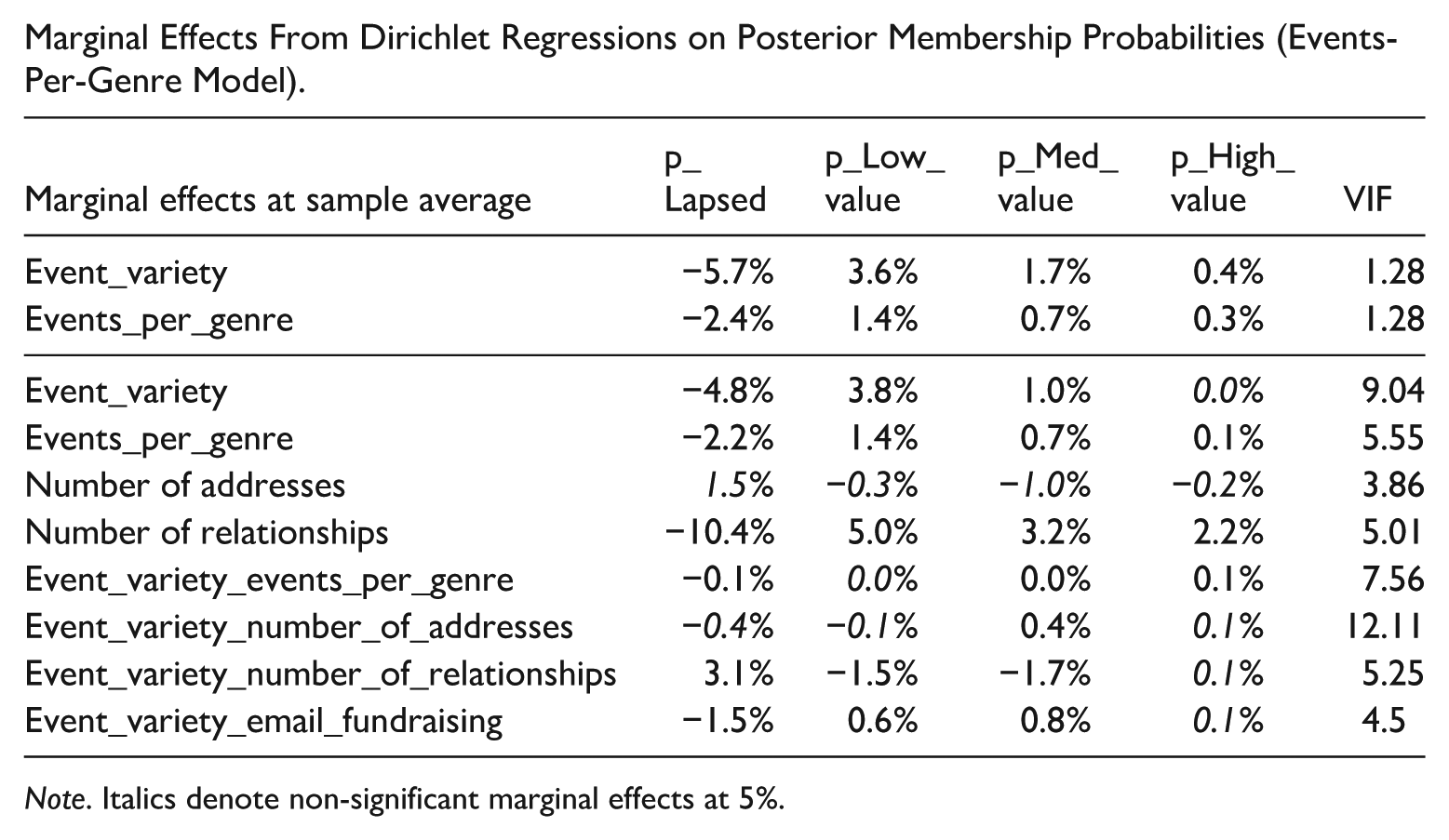
By contrast, the marginal effects of attendance frequency are smaller: each additional event attended raises the probability of belonging to higher-value segments by less than one percentage point (e.g., +0.8 points for Low Value and +0.4 points for Medium Value). This suggests that repetition within a single genre contributes less to donor advancement than broader cross-genre engagement. Using events per genre instead of raw event counts yields the same pattern, confirming the stronger association of variety (Appendix B).
Including the “event variety × number of events” interaction reveals a significant but negative effect for the Low-value segment (–0.1 percentage point), indicating diminishing returns to variety among very frequent attendees. Thus, while variety remains linked to donor progression, its marginal benefit is greatest for moderately engaged donors who diversify rather than repeatedly attend one genre.
To address potential endogeneity, the model includes controls for wealth (registered addresses), cultural capital (donor relationships), and commitment (fundraising email consent), along with interactions with event variety. The number of relationships has the strongest effect: each additional relationship reduces the probability of being Lapsed by 7.8 points and increases probabilities for Low (+3.5), Medium (+2.2), and High (+2.1) segments, suggesting that socially embedded patrons tend to be more stable and generous donors. Positive interactions between variety and email consent (+0.7 points for Low Value; +0.9 for Medium Value) indicate that variety’s association with donor progression is stronger among donors open to engagement. In contrast, negative interactions with relationships (–1.1 for Low Value; –1.4 for Medium Value) suggest diminishing incremental value of variety for already well-connected patrons. Interactions with addresses are small and insignificant, implying limited dependence on wealth.
Crucially, the main effect of event variety remains positive and significant across all specifications. In practical terms, attending one additional genre corresponds to a 3–4 percentage-point higher probability of belonging to an active donor segment, even after controlling for attendance frequency and donor attributes.
Variance Inflation Factors (VIFs) reported in Table 6 indicate acceptable multicollinearity across specifications. Although some interaction terms slightly exceed 10, robustness checks show stable coefficient signs and magnitudes.
Overall, these results support Hypothesis 1: cross-genre engagement is more strongly associated with long-term donor value than attendance frequency.
Variety Threshold (H2)
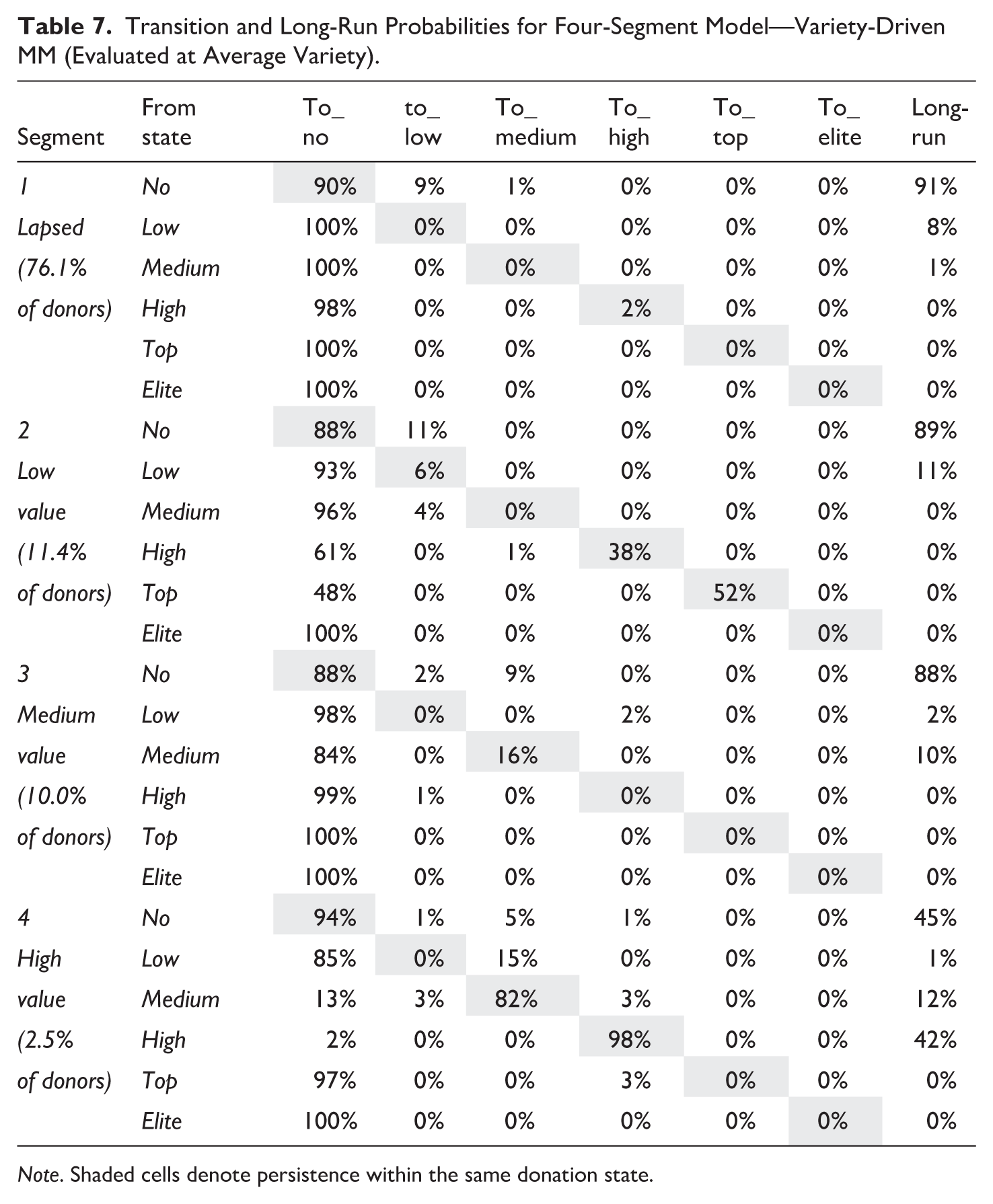
Our search for the minimum level of event variety associated with net upward donor transitions begins with the segment proportions and log-likelihoods from the variety-driven MMs (Table A3). Relative to the baseline model, the share of donors classified as lapsed declines from 81% to 76% in the four-segment solution, indicating that incorporating event variety captures additional engagement heterogeneity and helps identify promising supporters who might otherwise appear inactive.
Table 7 reports transition and long-run (steady-state) probabilities for the four-segment variety-driven MM evaluated at the sample-average level of event variety. Compared with the baseline model (Table 5), high-value donors are more concentrated in the high-value segment, with a 42% long-run probability of remaining in the “High” state, consistent with a stable core of highly engaged supporters. Nevertheless, upward mobility remains limited: donors in the “Low” and “Medium” states show modest progression, while many in the “Low” state lapse into inactivity. These patterns suggest that sustained high-value giving is associated with higher-than-average event variety.
Transition and Long-Run Probabilities for Four-Segment Model—Variety-Driven MM (Evaluated at Average Variety).
Note. Shaded cells denote persistence within the same donation state.
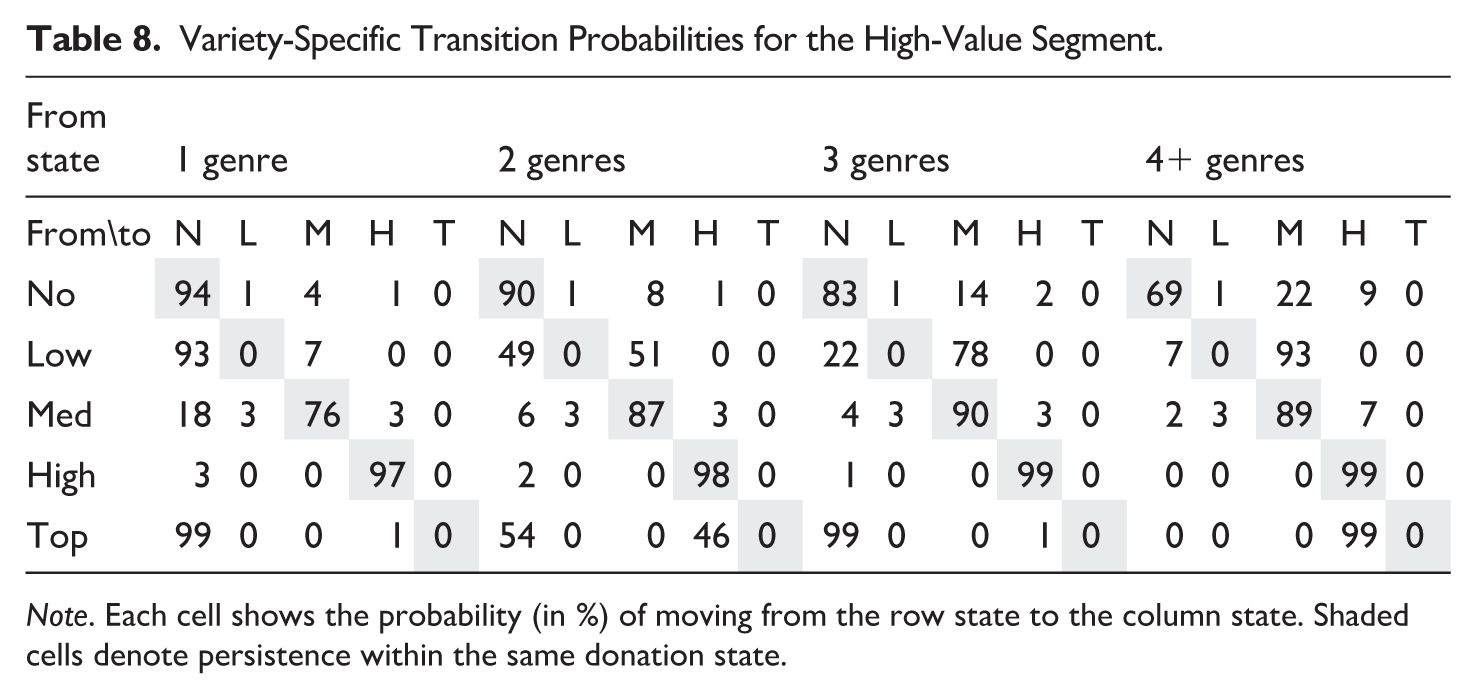
To identify the minimum level of variety linked to net upward transitions, we estimated variety-specific transition matrices for successive top-end aggregations of event variety (variety ≥ 9, variety ≥ 8, etc.). This right-truncated approach evaluates whether a threshold exists at which the combined probability of upward transitions from the “No,” “Low,” and “Medium” states exceeds that of downward movements (H2).
The results, summarized in Table 8, suggest a threshold within the high-value segment: once donors engage with four or more genres, upward transitions begin to dominate downward movements. At this level, the “Medium to High” transition probability increases to 7%, marking a behavioral inflection point where donors become more likely to progress than lapse.
Variety-Specific Transition Probabilities for the High-Value Segment.
Note. Each cell shows the probability (in %) of moving from the row state to the column state. Shaded cells denote persistence within the same donation state.
Figure 3 visualizes these dynamics across five years of transitions within the high-value segment. As event variety increases, regressive flows weaken and progressive flows strengthen. In the 4+ genres panel, upward movements from the “No,” “Low,” and “Medium” states outweigh downward flows, visually supporting the threshold identified in Table 8 and supporting H2.

Transition flows within the high-value segment by variety level (1–4+ genres).
Discussion
We confirm that cross-genre engagement is a stronger predictor of long-term donor value than attendance frequency. Event variety appears to capture both engagement depth and duration, making it a more reliable behavioral signal for segmentation. This aligns with social identity theory, which treats identification—a key driver of giving—as varying in strength rather than as a simple in/out distinction (Chapman et al., 2025). Broader genre engagement may therefore reflect stronger organizational attachment and serve as a practical metric for targeted cultivation.
These results extend donor segmentation research and clarify insights from CRM on relationship breadth (Kumar et al., 2008; Reinartz & Kumar, 2003), highlighting breadth as a distinct indicator of donor progression. They also build on prior work linking cultural engagement and organizational identification to donor behavior (Bhattacharya et al., 1995; Shaomian & Heere, 2015), showing that breadth of engagement—not merely repetition—relates more strongly to donor advancement. In doing so, they contribute to research on cultural participation and omnivorousness (The Audience Agency, 2015; Chan & Goldthorpe, 2007; de Vries & Reeves, 2022; Peterson & Kern, 1996) by indicating that breadth reflects a distinct and consequential mode of engagement rather than higher participation levels alone.
Although many festivals reward repeat attendance, few explicitly incentivize exploration across genres. Dynamic pricing, loyalty perks, or curated “discovery pathways” could encourage such behavior. Bundled discounts for attending multiple events—already used at major festivals (Melbourne Fringe, 2021)—could be adapted to explicitly incentivize diverse cultural participation.
Our second key finding identifies a threshold of four genres beyond which donor progression outweighs regression. This extends CRM research on relationship breadth to a nonprofit context, resolving mixed evidence on its returns (Reinartz et al., 2008; Shah et al., 2012) by showing that breadth functions as a nonlinear signal of donor progression, becoming most informative beyond a critical threshold.
This threshold can be used in conjunction with standard recency–frequency–monetary (RFM) segmentation. Among high-RFM donors in our data, progression potential is not uniform: many remain in lower-value states, whereas those who have attended four or more genres—the level linked to stronger progression—are more likely to advance into higher-value, sustained giving. Adding a variety layer to RFM thus sharpens targeting: high-RFM donors who explore multiple genres are most likely to become higher-value, multi-year supporters. Development teams can focus cultivation on these “multi-genre explorers” while encouraging low-variety donors to broaden their engagement through bundled offers or curated recommendations.
A key implication is that diverse programming can strengthen donor pipelines: offering multiple artistic entry points fosters emotional connection (Brown & Ratzkin, 2011), which is central to donor retention and sustained giving (Sargeant, 2013). This echoes DiMaggio and Stenberg’s (1985) argument that access to culturally engaged patrons supports artistic innovation, suggesting a reinforcing cycle where diverse programming stimulates both creative risk-taking and philanthropy.
Still, progression to high-gift states remains uneven. Many donors remain in the “Low” and “Medium” tiers, which function as retention gateways. Moreover, not all attendees are motivated by variety; many participate within a single genre (Yolal et al., 2012). To address this, personalized outreach that encourages trying “new things” (White & Tong, 2019) can be especially effective, underscoring the value of granular segmentation. Models such as the variety-driven MM can flag declining engagement breadth, enabling proactive re-engagement strategies.
Implementing these approaches requires robust data infrastructure. Consistent genre tagging and longitudinal tracking within CRM systems are essential. Inconsistent taxonomies across seasons can obscure insight, highlighting the need for unified metadata and regular data audits. Stronger infrastructure enhances the precision of variety metrics and supports segmentation, journey mapping, and performance evaluation.
Several limitations of this study should be noted. Our variety metric is time-invariant, capturing cumulative rather than evolving engagement; future models could incorporate time-varying covariates to capture changing audience interests. The observational design also entails potential endogeneity: patrons who attend more genres may possess unobserved traits that independently influence giving. Although controls mitigate this in the Dirichlet model, causal inference cannot be established. Reverse causality is another concern: committed donors may expand their attendance because of prior giving rather than variety itself shaping progression. Longitudinal designs modeling giving and variety over time would help disentangle these relationships. Finally, our findings draw on a festival context and may not generalize to single-genre or year-round organizations. Comparing variety effects across institutional types or incorporating digital or volunteer engagement would extend this work. By refining how donor behavior is measured and interpreted, arts organizations can more effectively cultivate sustainable, data-informed philanthropic support.
Conclusion
This study examined how event variety shapes donor progression in multi-genre arts festivals. Using transactional data from a major European festival, we applied a latent-class Markov Model with genre variety as a behavioral covariate, complemented by a Dirichlet regression comparing the effects of variety and attendance frequency on donor segmentation.
The findings show that genre variety is a stronger behavioral correlate of high-value donor membership than attendance frequency: each additional genre attended increases the probability of belonging to an active donor segment by approximately 3–4 percentage points. Donors attending four or more genres display a markedly higher probability of progressing from Medium to High giving states, suggesting this level of variety as a practical threshold for cultivation. These results underscore the strategic value of encouraging cross-genre participation, allowing organizations to refine recency–frequency–monetary (RFM)-based segmentation and target “multi-genre explorers” as high-potential supporters. At the same time, the stability of high-value states and the churn along the pathways toward them highlight the need for retention strategies aligned with evolving engagement patterns.
Footnotes
Appendix A
Appendix B
Marginal Effects From Dirichlet Regressions on Posterior Membership Probabilities (Events-Per-Genre Model).
| Marginal effects at sample average | p_Lapsed | p_Low_value | p_Med_value | p_High_value | VIF |
|---|---|---|---|---|---|
| Event_variety | −5.7% | 3.6% | 1.7% | 0.4% | 1.28 |
| Events_per_genre | −2.4% | 1.4% | 0.7% | 0.3% | 1.28 |
| Event_variety | −4.8% | 3.8% | 1.0% | 0.0% | 9.04 |
| Events_per_genre | −2.2% | 1.4% | 0.7% | 0.1% | 5.55 |
| Number of addresses | 1.5% | −0.3% | −1.0% | −0.2% | 3.86 |
| Number of relationships | −10.4% | 5.0% | 3.2% | 2.2% | 5.01 |
| Event_variety_events_per_genre | −0.1% | 0.0% | 0.0% | 0.1% | 7.56 |
| Event_variety_number_of_addresses | −0.4% | −0.1% | 0.4% | 0.1% | 12.11 |
| Event_variety_number_of_relationships | 3.1% | −1.5% | −1.7% | 0.1% | 5.25 |
| Event_variety_email_fundraising | −1.5% | 0.6% | 0.8% | 0.1% | 4.5 |
Note. Italics denote non-significant marginal effects at 5%.
Acknowledgements
The author gratefully acknowledges the support of the Edinburgh Futures Institute and the festival’s marketing team. Data visualizations were generated using Python code developed with assistance from ChatGPT. All outputs were reviewed and validated by the author.

Funding
The author received no financial support for the research, authorship, and/or publication of this article.
Declaration of Conflicting Interests
The author declared no potential conflicts of interest with respect to the research, authorship, and/or publication of this article.
Data Availability Statement
The data used in this study is confidential.