






Abstract
Building on the rich scholarly lineage of the “moral economy” concept, this theoretical essay re-interprets the contemporary third sector—non-profit, voluntary and philanthropic organizations, and social enterprises—as a moral economy in its own right. After reconstructing the term’s historical and conceptual trajectories, the article maps six emblematic value dimensions that orient third-sector practice: charity, philanthropy, solidarity, humanitarianism, community and volunteerism, and civicness. The typology supplies an analytical framework that complements market- or state-centric explanations of nonprofits, sheds light on cross-field and cross-country differences, and foregrounds the intrinsic motivations that lie beyond instrumental rationality. By repositioning debates about the third sector’s economic functions within its ethical foundations, the essay offers a generative vocabulary for studying how organizations mobilize moral commitments to meet social needs and nurture civic engagement, urging scholars to put values at the center of analyses of nonprofit behavior, governance, and impact.
Introduction
The concept of moral economy has gained increasing prominence as an analytical framework for understanding how economic practices are shaped by moral values and social norms. Initially applied to historical instances of collective resistance such as 18th-century bread riots, the notion has since been extended across a broad range of economic and social phenomena (Daston, 1995; Fassin, 2009; Scott, 1976; Thompson, 1971). This paper extends it to the third sector—an organizational sphere distinct from both market-driven enterprises and government institutions—whose value-driven missions, voluntary participation, and reinvestment of surplus into community-oriented purposes set it apart from other sectors (Corry, 2010).
This essay advances the agenda in three principal ways. First, it aligns the classical notion of moral economy with third‑sector scholarship, contending that non‑profit, voluntary and philanthropic entities are best understood as embedded within historically sedimented “moral economies.” These economies shape how needs are defined, resources mobilized, and legitimacy claimed. Second, drawing on this genealogy, the paper introduces a six‑dimensional framework of third‑sector moral economies—charity, philanthropy, solidarity, humanitarianism, community and volunteerism, and civicness—that captures the dominant value logics through which actors orient their practices and justify their existence. Third, it translates the framework into an operational analytical grid that can map the moral embeddedness of organizations, fields, and national third‑sector regimes; a brief proof‑of‑concept application illustrates its potential. Taken together, these contributions offer a theoretically grounded yet empirically usable approach for analyzing how moral underpinnings shape the diversity, hybridity, and development of the third sector across time and space.
The remainder of the article proceeds as follows. The next section reconstructs the conceptual trajectory of the moral economy concept, from Thompson and Scott to its contemporary reformulations. The third section traces the historical lineages from which the third sector’s moral foundations have crystallized. The fourth section develops the six-dimensional typology of moral logics that constitute the third-sector moral economy, while the fifth section translates the typology into an operational analytical grid and applies it to three stylized organizational archetypes. The sixth section discusses the framework’s principal implications for the comparative and theoretical study of the third sector. A concluding section addresses limitations and outlines avenues for further empirical research.
The Concept of Moral Economy
The notion of a moral economy has become increasingly salient for explaining how economic activities are molded by socially embedded concepts of justice, duty, and legitimate conduct. Rather than viewing markets, redistribution, or reciprocity as normatively neutral mechanisms, the moral‑economy framework highlights that actors assess prices, needs, and entitlements against shared expectations of fairness and proper behavior; these assessments in turn shape both compliance and contestation (Daston, 1995; Fassin, 2009; Scott, 1976; Thompson, 1971).
Edward P. Thompson (1971) coined the phrase in his seminal work on 18th‑century English food riots, contending that crowd mobilizations were not mere irrational outbursts but “legitimist” protests safeguarding customary norms about fair prices and authorities’ duties toward the poor. James C. Scott (1976) later broadened this framework to peasant societies, interpreting subsistence uprisings as reactions to breaches of a moral economy that upheld minimum livelihood guarantees and reciprocal obligations among peasants, landlords, and the state. In each instance, the term moral economy refers to a historically contingent constellation of expectations regarding the mutual responsibilities of rulers, merchants, and community members.
Subsequent scholarship has expanded the notion beyond its original focus on subsistence conflicts. Lorraine Daston (1995), for instance, applied it to what she calls the “moral economy of science,” describing the values and affective dispositions—honesty, disinterestedness, restraint—that ground scientific practice and professional conduct. Building on this, Didier Fassin (2009) offered an even broader formulation: moral economies are configurations of values, affects, and norms that infuse institutions and policies with particular conceptions of worth, suffering, and responsibility. This shift puts the emphasis on the fact that contemporary welfare, policing, and humanitarian regimes are organized around specific moral grammars rather than purely technical or economic rationalities.
For this article, moral economy denotes the historically sedimented constellation of values, norms, affective orientations, and justificatory principles that shape how resources are mobilized, distributed, and accounted for within the third sector. Scholarship on the third sector has long underscored that non‑profit and voluntary organizations distinguish themselves by their commitment to collective benefit and the public good, as well as by reinvesting surplus into community‑oriented purposes (Anheier, 2005; Corry, 2010; Defourny & Develterre, 1999). Viewed through a moral‑economy perspective, these characteristics are not merely legal or organizational traits but represent underlying moral logics that delineate who bears responsibility for whom, under what conditions, and with which forms of reciprocity, gratitude, or entitlement. The next section sketches how these logics have emerged historically and crystallized across different strands of third‑sector practice.
The Moral Roots of the Third Sector: A Brief History
The moral foundations of the third sector can be traced back to a constellation of partly overlapping historical traditions that continue to shape contemporary organizations and practices. In Europe, early forms of organized assistance were deeply intertwined with religious charity, parish relief, and guild‑based mutual aid, blending obligations of almsgiving with concepts of civic virtue and local responsibility for the poor (Archambault, 1996; Defourny & Develterre, 1999; Harris et al., 2016; Hilton & McKay, 2011; Kendall & Knapp, 1996; Thane, 2017). These practices forged enduring expectations that communities and religious bodies should attend to vulnerable members—an ethos that persisted even after the emergence of modern welfare states.
In the United States, a dense voluntary civil society emerged early, rooted in congregations, civic associations, and reform societies that fused religious fervor with republican ideals (Hall, 2006; Tocqueville, 1838). By the late 19th century, this gave rise to organized philanthropy on a large scale, with general-purpose foundations framing their missions in expansive terms—“the advancement of civilization,” “the development of mankind”—and a recognizable “nonprofit sector” increasingly tasked with delivering social services alongside public authorities (Burlingame, 2004; Hall, 2006; Salamon, 1994).
A second major lineage is rooted in mutualism, cooperatives, and the social economy. Workers’ mutual‑aid societies, friendly societies, cooperative enterprises, and later social enterprises embodied solidarity, shared risk, and democratic control over economic activity (Defourny & Develterre, 1999; Robertson, 2010; Thompson, 1994). Christian social movements—often termed “social Christianity”—sought to apply Christian ethics to labor, poverty, and social reform, birthing organizations that fused religious motivation with cooperative and associational forms (Defourny & Pestoff, 2008; Gueslin, 1998). Utopian socialist and early socialist thought likewise imagined collective ownership and participatory governance as alternatives to market competition and state bureaucracy, thereby shaping the cooperative and mutualist movements that remain core components of today’s third sector (Defourny & Develterre, 1999; Hilton et al., 2012).
A third strand is the rise of modern humanitarianism and international relief. From the late 19th century onward, transnational organizations emerged to render emergency assistance in wars, famines, epidemics and displacements—often against a backdrop of imperial expansion and global conflict (Cabanes, 2014; Götz et al., 2020; Jones, 2009). These actors articulated a moral language of universal humanity and impartial concern for suffering, thereby forging a distinct humanitarian moral economy focused on urgency, witnessing and protection. This moral economy partially overlaps with, yet diverges from, both charitable benevolence and solidarity‑based struggle.
Taken together, these lineages—religious charity and civic virtue, associationism and philanthropic reform, mutualism and the social economy, and humanitarian relief—constitute the principal moral foundations of today’s third sector (Defourny & Develterre, 1999; Götz et al., 2020; Hall, 2006; Harris et al., 2016; Salamon, 1994). They have crystallized across diverse organizational fields and national contexts, yet they also intersect and hybridize. In the forthcoming sections, these historical strands are synthesized into six ideal‑typical moral logics—charity, philanthropy, solidarity, humanitarianism, community and volunteerism, and civicness—that shape how third‑sector organizations define needs, justify their activities, and claim legitimacy.
The Third-Sector Moral Economy
In what follows, I propose that the moral economy of the third sector in Western societies is built upon six value dimensions: charity, philanthropy, solidarity, humanitarianism, community and voluntarism, and civicness. These values manifest to varying extents across specific national settings and sub‑fields within the third sector. This typology of value dimensions that constitute the third‑sector moral economy is designed to furnish an analytical framework capable of supporting cross‑field and cross‑national comparisons. It also seeks to illuminate the diverse motivations and orientations that shape both third‑sector organizations and the individuals—members, volunteers, donors—who engage with them.
These six value dimensions—charity, philanthropy, solidarity, humanitarianism, community and volunteerism, and civicness—are not intended to enumerate every moral notion linked to the third sector. Instead, they synthesize the core field‑structuring moral logics that recur throughout the sector’s historical evolution and across various strands of nonprofit and social‑economy scholarship. Their construction draws on three principal sources: (a) debates in classical and contemporary moral economics; (b) genealogical studies of religious charity, mutualism, associational life, and humanitarianism; and (c) comparative research on nonprofits, philanthropy, and the broader social economy.
From the moral‑economy perspective, Thompson’s framing of bread riots as “legitimist” protests, Scott’s exploration of subsistence ethics and peasant resistance, and Fassin’s reconceptualization of moral economy as a web of norms, affects, and obligations all underscore that economic practices are deeply rooted in historically specific moral orders. These debates intersect with—yet do not reduce to—nonprofit theory.
On the nonprofit side, scholarship on charitable giving and altruism, philanthropic foundations, mutual‑aid networks, cooperative traditions, voluntary associations, and civil society has consistently emphasized distinct normative orientations: compassion for the needy; stewardship of private wealth for public ends; reciprocity and mutual support; emergency relief and witnessing; local belonging and participation; and public‑spirited engagement with collective challenges (Anheier, 2005; Defourny & Develterre, 1999; Edwards, 2011; Frumkin, 2006; Götz et al., 2020; Payton & Moody, 2008).
The six dimensions identified here were chosen because they distill recurrent normative orientations into analytically distinct moral logics that shape how third‑sector actors articulate needs, mobilize resources, and claim legitimacy. Each dimension aligns with recognizable institutional constellations—charitable service organizations, philanthropic foundations, mutuals and cooperatives, humanitarian NGOs, community‑based associations, and advocacy or civic groups—yet it does not confine itself to a single organizational form. For example, charity and philanthropy both rest on asymmetrical giving but diverge in their temporal horizons and the rationales they employ for aid. Solidarity and humanitarianism both express moral concern for others, yet they rest on structurally different relationships: solidarity is relational and symmetric, binding together members of a shared community—whether defined by class, occupation, or collective struggle—who recognize one another as co-participants in a common project; humanitarianism, by contrast, is categorical and asymmetric, activating a duty of the capable witness toward distant strangers in acute crisis, irrespective of any prior bond or shared identity. A practical marker separates the two in organizational terms: solidarity organizations typically vest governance authority in the very constituency they serve—workers govern the cooperative, and members govern the mutual—whereas humanitarian organizations operate through professional staff delivering aid to beneficiaries who bear no membership relation to the organization. This structural difference means that, while both dimensions may co-occur in a given organization, they remain analytically distinct and, as the illustrative application below demonstrates, tend to load on different organizational profiles. Meanwhile, community and civicness underscore local embeddedness and public‑oriented participation.
At the same time, several moral qualities—reciprocity, compassion, trust, and social capital—that are frequently invoked in the literature are treated here as cross‑cutting currencies rather than discrete dimensions. They constitute most third‑sector practices, yet on their own, they do not define field‑level moral logics in the way that solidarity or philanthropy do. For instance, reciprocity lies at the heart of mutual aid and cooperative traditions while also permeating community organizations and volunteering; trust and social capital have been examined as emergent properties of associational life and civic engagement across a wide range of organizational types (Musick & Wilson, 2008; Putnam, 2000). By concentrating on six historically recurrent, field‑structuring logics, the framework remains parsimonious while still doing justice to the moral diversity and hybridity that characterize the third sector. Ostrom’s (1990) institutional analysis of the commons offers a complementary structural register: whereas her design principles specify the governance conditions under which collective action is sustained—monitored reciprocity, graduated sanctions, community self-governance—the six moral dimensions identified here capture the normative orientations that motivate actors to enter and remain committed to such collective endeavors in the first place. The moral-economy framework and Ostrom’s institutionalism thus operate at different analytical levels, the one normative and motivational, the other structural and rule-based, and together they provide a more complete account of how third-sector organizations both hold together and hold their members accountable.
Charity
One of the oldest and most recognizable values animating third-sector activity, charity has deep roots in religious and civic traditions across civilizations—from almsgiving in ancient Mesopotamia and early Christian caritas to the institutionalized philanthropy of the medieval church. Although it has sometimes been critiqued as paternalistic, it remains a powerful moral logic for many organizations dedicated to direct relief and support.
Historically rooted in religious traditions of caritas and almsgiving, charitable action within the contemporary third sector has crystallized into institutions that supply food, shelter, care, and other basic assistance to disadvantaged populations. Research on nonprofit giving reveals how this logic intertwines affective impulses—pity, empathy, compassion—with moral narratives of duty and stewardship (Payton & Moody, 2008; Wuthnow, 1991). Charitable organizations tend to legitimize their work by appealing to immediate human need rather than systemic injustice, and their practices frequently assume asymmetric relations between donors and beneficiaries. In this regard, the moral economy of the third sector is organized around notions of deservingness, gratitude, and the proper conduct of giving, including an expectation that resources be employed faithfully and visibly to relieve suffering (Andreoni, 1990; Breeze & Mohan, 2016).
Philanthropy
Closely aligned with charity, philanthropy involves the organized mobilization of private resources—often financial—to support public goods (Lechterman et al., 2024). Unlike simple acts of monetary donation, philanthropic efforts frequently center on systematic, strategic initiatives to address social problems. While charity generally involves direct acts of giving to relieve immediate needs (through donations of money, goods, or services to support individuals or communities in crisis) and often addresses short-term problems (such as hunger, homelessness, or emergency relief), philanthropy is usually understood as a broader, strategic approach to improving society. It involves the use of resources—often in the form of substantial financial gifts, but also time and expertise—to address the underlying causes of social issues. Philanthropy tends to focus on systemic change, supporting long-term projects like education reform, healthcare improvement, or environmental protection.
In a moral‑economy framework, philanthropy operates as a conduit for ethically grounded investment choices that pursue collective well‑being or societal transformation rather than pure financial gain. It embodies a moral logic of strategically deploying substantial private resources toward public ends. Although it shares charity’s generosity, philanthropy is marked by intentional, long‑term interventions—often channeled through endowed foundations, grant-making bodies, and high‑net‑worth donors (Anheier & Daly, 2007; Frumkin, 2006). Scholarly work on the third sector underscores how this logic mixes moral commitments to the common good with managerial rationality, portfolio thinking, and impact measurement (Reich, 2018). The philanthropic moral economy, therefore, centers on questions of responsibility and legitimacy in exercising private influence over public agendas: who may set social priorities, under what conditions, and with which accountability mechanisms. In contrast to charity’s focus on immediate relief, philanthropy frames social problems as demanding planned intervention, experimentation, and institutional reform—linking moral aspiration to organizational capacity and long‑term management of resources.
Solidarity
Solidarity has ancient roots: the Roman legal concept of obligations in solidum—a debt held in common—captured its core logic of mutual obligation, and the idea came into its own during the 19th century as a response to the challenge of theorizing the social bond among free and equal individuals (Blais, 2007; Hunt-Hendrix & Taylor, 2024).
From utopian socialists such as Owen and Fourier to Catholic social teaching and labor movements, solidarity crystallized as a field-structuring logic of the third sector, emphasizing shared identities, mutual responsibilities, and cooperative effort (Sangiovanni & Viehoff, 2023).
Within the moral economy of the third sector, solidarity determines how resources, information, and labor are pooled to aid vulnerable populations or drive systemic change. This moral logic rests on mutual support, shared interests, and collective struggle. Historically linked to labor movements, mutual‑aid societies, friendly societies, and the cooperative tradition, it has been pivotal in shaping the social economy (Defourny & Develterre, 1999). In contemporary third‑sector scholarship, solidarity is invoked to denote horizontal relations among members, democratic governance, and a commitment to social justice rather than mere charitable benevolence (Evers & Laville, 2004; Hulgård, 2010). The moral economy of solidarity emphasizes reciprocity, co‑responsibility, and the joint pursuit of better living and working conditions—whether for workers, tenants, patients, or other constituencies. Organizations structured around this logic, such as mutuals and cooperatives, derive legitimacy by embodying principles of shared risk, member control, and redistribution within a bounded community of equals, thereby counterbalancing the asymmetry typical of donor–recipient relations.
Humanitarianism
The concept of humanitarianism has evolved considerably throughout history, transforming from localized acts of charity to a complex global system of beliefs, practices, and institutions aimed at alleviating human suffering. The modern concept of humanitarianism, understood as "the impartial, independent, and neutral provision of relief to those in immediate danger of harm," began to crystallize in the 19th century (Rysaback-Smith, 2015, p. 5). Most scholars identify the creation of the International Red Cross in 1863 as a crucial turning point in the formalization of humanitarian principles and practice (Davey et al., 2013).
Contemporary humanitarianism has expanded far beyond emergency relief to encompass diplomacy, education, legal advocacy, and governance in conflict and post-conflict settings (De Lauri, 2021). Humanitarian principles—impartiality, neutrality, and humanity—have become institutionalized across international NGOs, relief agencies, and transnational advocacy networks (Barnett, 2011; Barnett & Weiss, 2011).
While resembling charity, humanitarianism is typically more global and neutral in its reach. It merges the immediate relief characteristic of charity with advocacy and structured programs designed to diminish human suffering on a broad scale. Humanitarian efforts, therefore, span both rapid emergency response and long‑term strategies for rebuilding and recovery after crises. In this way, they embody a moral economy, wherein compassion—not profit or even local reciprocity—guides the allocation of resources and support. Humanitarianism is rooted in a moral logic aimed at alleviating suffering in situations deemed urgent, exceptional, and often geographically or socially remote. It crystallizes around the principles of impartiality, neutrality, and humanity, and has become institutionalized within international NGOs, relief agencies, and transnational advocacy networks (Barnett, 2011; Barnett & Weiss, 2011).
From a moral‑economy perspective, humanitarian organizations operate within a distinct moral regime that privileges both victim and witness, framing interventions as emergency aid and protection rather than long‑term redistribution or structural change (Fassin, 2012). Nonprofit scholarship has mapped how these actors negotiate the tensions between neutrality and advocacy, proximity and distance, compassion and managerialism (Redfield, 2013). Within this context, the third sector’s moral economy centers on the right to act for those in distress, the ethics of representation, and the translation of global moral concern into concrete relief and protection practices.
Community and Volunteerism
Many third-sector organizations are formed around communities of interest or identity, sustained by volunteer participation and resource sharing. These communities can be built around common identities (e.g., ethnic or faith-based groups), shared interests (e.g., cultural associations), or collective stakes (e.g., environmental initiatives, common-pool resources). In the scholarly literature, identity-based communities have been conceptualized as “community of action”, referring to collective social and political activities undertaken by individuals on behalf of their communities, whether geographically defined or conceptual, such as the LGBTQ+ or racial communities (Bole, 2007).
From a moral‑economy standpoint, community and volunteerism harness individuals’ ethical commitments to contribute time and expertise not for monetary reward but out of duty, reciprocity, or the desire to serve their community—whether that community is defined by shared identity or common interests. Most voluntary associations arise from this moral economy of community, which privileges voluntarism, reciprocal exchange, and collective responsibility. Here, community and volunteerism embody a moral logic rooted in local belonging, informal care, and the selfless dedication of time and effort. This dimension is steeped in long‑standing traditions such as neighborhood associations, self‑help groups, cultural and sports clubs, and other local service organizations.
These initiatives generate social capital, foster interpersonal trust, and create spaces for identity formation and mutual support (Handy et al., 2000; Musick & Wilson, 2008; Putnam, 2000). Organizations organized around this moral logic typically depend on unpaid labor, dense networks of interpersonal ties, and flexible, low‑threshold engagement. A note on the bundling of community and volunteerism as a single dimension is warranted. Conceptually, the two terms are distinguishable: community refers to the relational and identity structure within which action is embedded, while volunteerism denotes the mode of participation—the gift of unpaid time and effort. Yet in the third sector, they are institutionally co-constitutive. Volunteer participation is the primary mechanism through which communities of interest or identity are built and sustained; conversely, voluntary participation is motivationally thin outside a community of belonging that supplies purpose and recognition. Empirical studies consistently find that the two cluster together (Musick & Wilson, 2008; Putnam, 2000): the organizations that depend most on volunteer labor are those most deeply embedded in local or identity-based communities. The framework, therefore, treats them as a single field-structuring moral logic—that of belonging, mutual care, and the self-directed gift of effort—while acknowledging that future empirical work could test whether, in specific organizational fields, the two dimensions are better treated as separate factors.
Civicness and Civic Engagement
Civicness—the cultivation of democratic values and participatory governance—has roots in the classical notion of the active citizen: the vita activa, civic duty, and collective self-rule that structured political life in ancient Greece and Rome (Arendt, 1958; Brélaz & Rose, 2021). Kaldor and Radice (2022, p. 125) identify three contemporary meanings: civicness as a logic of public authority (rights-based, inclusive political orders), as a form of behavior (acting ‘as if’ such a logic existed), and as a political position against uncivic politics.
Civicness embodies a moral logic that frames public‑spirited engagement with collective problems as a means to protect and expand civic and political rights. It is the strand of third‑sector activity anchored in advocacy organizations, public‑interest groups, social‑movement entities, and watchdog NGOs. Scholars of civil society have long highlighted how these actors reinforce democratic governance by articulating interests and values, holding power accountable, and fostering public deliberation (Anheier, 2004; Cohen & Arato, 1992; Skocpol, 1999; Warren, 2001). The moral economy of civicness centers on equal citizenship, voice, accountability, and the rule of law. Legitimacy here derives not from compassion or reciprocity but from claims to represent constituencies, defend rights, or advance public goods. While organizations embodying civicness may empirically overlap with other moral logics—such as advocacy combined with humanitarian relief or community organizing—they are united by a normative orientation toward the public sphere and the quality of democratic life.
Cross-Cutting Currencies
A final clarification concerns moral qualities such as reciprocity, compassion, trust, and social capital. In this framework, they are not treated as separate dimensions of the moral economy; rather, they function as cross‑cutting currencies that circulate throughout all six logics. Reciprocity, for instance, is foundational to solidarity‑based mutuals and cooperatives, yet it also underpins community volunteering and certain forms of philanthropy. Trust, in a similar vein, emerges both as a prerequisite for and a by‑product of associational life—from charitable service organizations to advocacy groups (Musick & Wilson, 2008; Putnam, 2000). Social‑capital research demonstrates that dense networks, norms of reciprocity, and generalized trust can arise within diverse organizational forms and value orientations, thereby stabilizing moral commitments over time (Coleman, 1990; Putnam, 2000). Rather than increasing the number of dimensions, the framework therefore conceptualizes these values as relational resources that mediate and enable the six moral-economy logics of charity, philanthropy, solidarity, humanitarianism, community and volunteerism, and civicness.
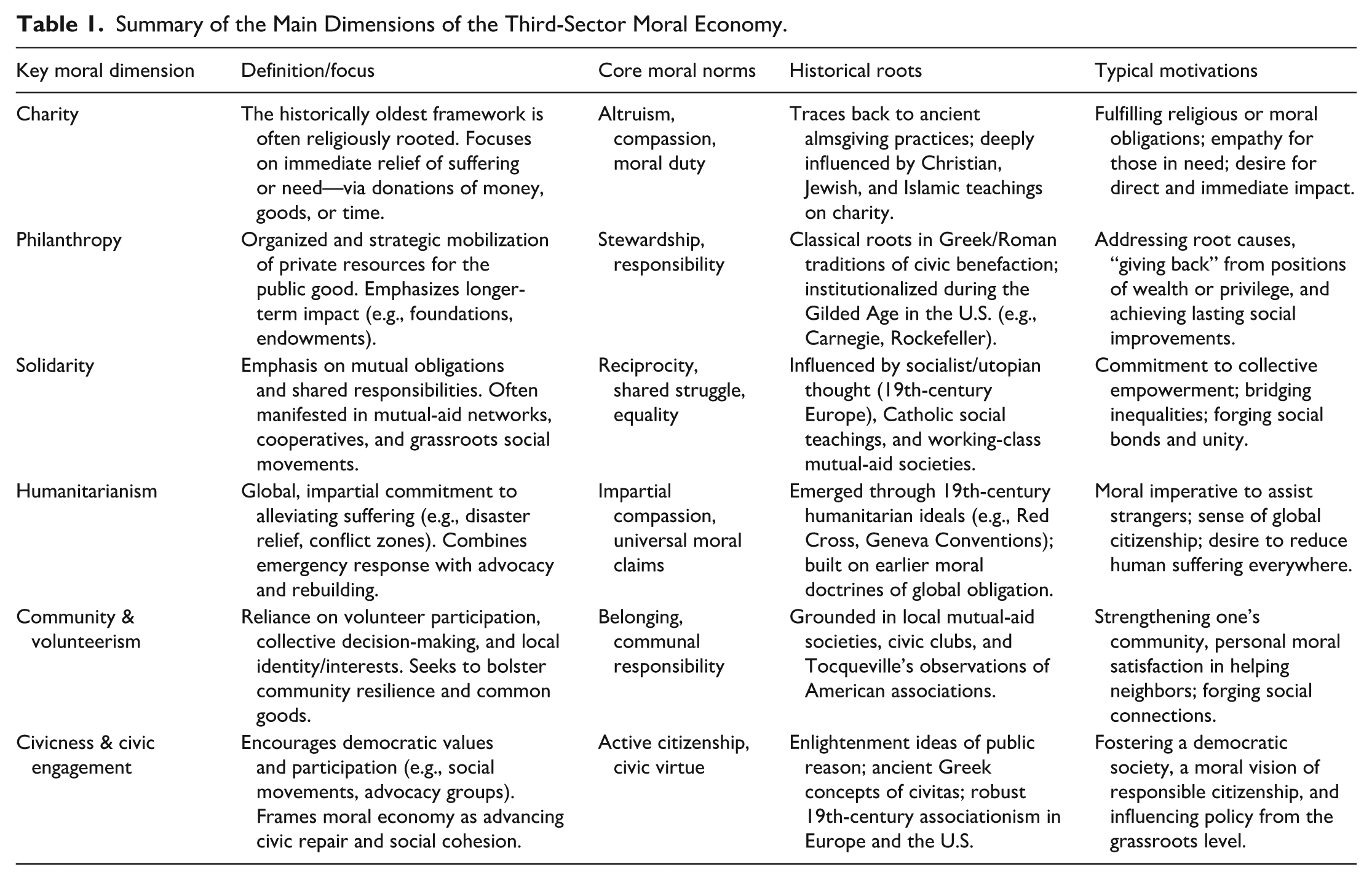
To sum up the argument developed so far, Table 1 presents an overview of the different moral frameworks that shape the third sector’s value orientations.
Summary of the Main Dimensions of the Third-Sector Moral Economy.
Empirical Operationalization of the Typology
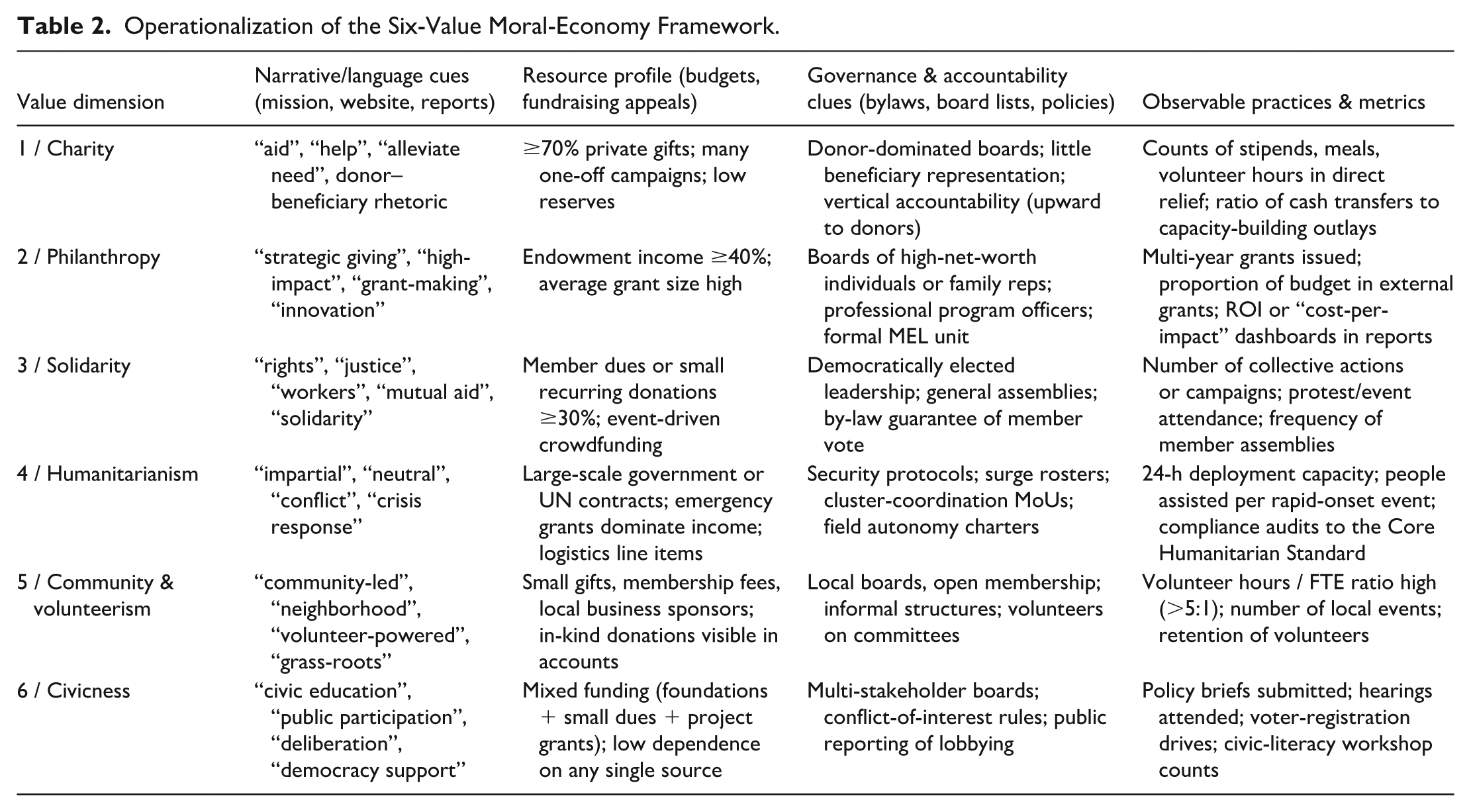
The theoretical framework developed in the previous section may be harnessed empirically to conduct analyses of organizations, policy fields, and cross-country comparisons, using various indicators that make values empirically tractable. Table 2 translates the six moral-economy dimensions from abstract value claims into concrete, researchable indicators. Organized row-wise by dimension and column-wise by four typical data windows—organizational narratives, resource mix, governance architecture, and observable practices—the checklist is designed to help code various data (e.g., annual reports, bylaws, activity logs, or field observations) with minimal ambiguity. Rather than prescribing a single metric, each cell lists multiple cues so that the grid can be adapted to different data environments (e.g., archival documents, survey items, or machine-read text). Each indicator is an observable signal that an organization is orienting primarily around the corresponding value dimension. None is decisive on its own; the idea is to look for clusters. In empirical applications, one would typically (a) score the presence or salience of each indicator, (b) aggregate scores within a row to gauge an organization’s dominant value orientation, and (c) examine hybrids or shifts over time. Researchers may assign each indicator a binary or scaled score and then aggregate them (e.g., simple additive index or latent-class analysis) to classify organizations—or to map hybrid value profiles where multiple dimensions co-exist.
Operationalization of the Six-Value Moral-Economy Framework.
Illustrative Application of the Framework
The framework serves as an analytical instrument for mapping the moral embeddedness of organizations, sectors, and national third‑sector arrangements. This section illustrates its application. The purpose is not a comprehensive empirical test; rather, it is to demonstrate how the six value dimensions and the operational grid (Table 2) can be employed to depict specific organizational configurations and to reveal moral hybridity.
Approach and Coding Strategy
For illustration, I select three prototypical third‑sector organizations drawn from well‑known sectors: (a) a faith‑based local charity that supplies food and emergency aid; (b) a member‑owned cooperative operating within the social economy; and (c) a national advocacy NGO focused on civil and political rights. Although these could be replaced by actual entities in empirical work, they function here as stylized archetypes. Each example is examined through the six value dimensions outlined earlier, with the indicators from Table 2 guiding an assessment of their relative prominence. The primary moral logic is central to the organization’s identity, mission and legitimacy. The secondary moral logic is clearly present and institutionalized yet subordinate to a primary logic. The latent moral logic is weakly articulated or episodic, yet available to the organization as a moral resource on which it can draw under specific circumstances. The absent moral logic, by contrast, plays no perceptible role in the organization’s identity, mission, or practice and forms no part of its moral repertoire. In operationalizing this scheme, each classification maps onto an ordinal score—primary = 3, secondary = 2, latent = 1, absent = 0—yielding a six-element moral profile vector for each organization. Researchers may then aggregate these scores into a composite index, or submit them to latent-class analysis to identify recurring configurations across larger samples. The illustrative profiles below demonstrate that the three archetypes produce meaningfully distinct vectors, offering initial evidence that the dimensions can be empirically differentiated. The data sources consulted to make such judgments in empirical work would typically include primary organizational documents—mission statements, founding charters or statutes, “about us” web pages, and annual reports—supplemented by governance documents such as bylaws and board composition lists, fundraising appeals, and, for cross-national or field-level analysis, sector surveys or administrative registers. A brief illustration of how a coding decision is reached in practice: a mission statement reading “we stand with workers in their struggle for fair pay and safe conditions, governed by our members, for our members” signals solidarity as primary (language of rights and shared struggle; member governance; horizontal reciprocity), yielding a score of 2 on that dimension, with community and volunteerism as secondary (member-based local ties) at 1, and charity and humanitarianism absent or latent at 0. The same logic, applied via the indicators in Table 2, underlies the three profiles that follow.
Faith-Based Local Charity
The first example is a congregation‑based organization that operates a food bank, provides emergency financial assistance, and occasionally hosts social activities in a low‑income neighborhood. Its mission statement emphasizes compassion, care for “the least fortunate,” and a religiously grounded duty of unneighborly love. Within this framework, charity serves as the prevailing moral logic. The organization frames needs in individualized terms—hunger, inability to pay bills—and mobilizes resources through donations and volunteer labor. It justifies its work as alleviating immediate suffering. Asymmetric relations between donors and beneficiaries shape key practices, from eligibility assessments to the moral language of gratitude and deservingness.
At the same time, community and volunteerism emerge as secondary logics. The organization is embedded into local networks, many beneficiaries also serve as volunteers, and activities such as communal meals or informal counseling cultivate a sense of belonging that transcends the narrow donor–recipient dyad. Philanthropic elements may surface only in the background—for instance, when the organization participates in foundation‑funded projects or adopts more formal planning and reporting practices.
Coding this entity within the grid would thus produce a profile where charity is primary, community/volunteerism is secondary, and traces of philanthropy—and perhaps civicness, whenever the organization sporadically advocates for poverty alleviation—remain latent. This profile illustrates how the moral economy of charity is frequently intertwined with local embeddedness without erasing the distinction between the two dimensions.
Social Economy Cooperative
The second example concerns a worker or multi‑stakeholder cooperative that delivers social services—such as home care or child care—under contract with local authorities. Its statutes foreground democratic governance, shared responsibility, and the balance between economic viability and social objectives.
Solidarity is the cooperative’s guiding moral principle. The organization frames its work in terms of mutual support, shared risk, and collective self‑help, whether among workers, users, or both. Decision‑making follows member‑participation rules—“one person, one vote”—and any surplus is either reinvested or distributed according to jointly agreed criteria. Thus, the moral economy is built on reciprocity and co‑responsibility rather than unilateral benevolence.
Community and volunteerism tend to act as secondary logic when the cooperative forges robust local ties, recruits volunteers, or participates in neighborhood initiatives. In some sectors, civic engagement may be secondary or remain latent: cooperatives occasionally lobby for regulatory reforms, champion recognition of social enterprises, or join broader social movements. Philanthropy and humanitarianism are generally absent or modest in this case, although episodic philanthropic funding or emergency responses can surface. This profile demonstrates how the solidarity dimension sets social‑economy organizations apart from purely charitable providers and conventional commercial entities, while still allowing overlap with community engagement and civic advocacy.
National Advocacy NGO
The third example is a national NGO working on civil and political rights, engaging in strategic litigation, policy advocacy and public campaigns. Its mission statement invokes constitutional principles, international human rights norms, and the protection of vulnerable groups against abuses of power.
Civic engagement constitutes the organization’s primary moral logic. Its legitimacy derives from a pledge to represent affected constituencies, voice public‑interest concerns, and safeguard equal citizenship alongside the rule of law. The group’s core activities—monitoring, reporting, lobbying, and litigation—are explicitly aimed at shaping policy decisions and steering public discourse.
A humanitarian thread may surface as secondary logic when the NGO delivers emergency legal or practical aid to individuals confronting immediate peril. Charitable impulses may be latent, for example, when fundraising campaigns appeal to donors’ empathy for victims. Solidarity elements may also emerge, especially when the organization collaborates with social movements or membership‑based groups, framing its work as part of a broader collective struggle.
Thus, in coding this case, one would prioritize civic engagement, relegating humanitarian, charitable, and solidarity dimensions to secondary or latent positions. This approach underscores that advocacy organizations can be embedded in multiple moral economies while a single dominant logic dominates their public identity.
From Organizational Profiles to Regimes of Moral Embeddedness
These stylized examples demonstrate how the framework can be expanded. At the organizational level, the grid lets scholars map value profiles and degrees of hybridity among various third‑sector actors. When aggregated at the field level, these mappings reveal whether domains such as eldercare, international development, or cultural policy are chiefly shaped by charitable, philanthropic, solidarity‑based, or civic logics.
At the regime level, comparative studies across countries could examine how welfare‑state traditions, legal frameworks, and political cleavages influence the relative weight and combinations of the six dimensions that constitute national third‑sector configurations.
Although this exercise is illustrative, it shows that viewing the third sector as a moral economy is more than an abstract idea. The six value dimensions, together with the operational grid, furnish a concrete heuristic for describing and comparing the moral embeddedness of organizations, fields, and regimes, while also enabling researchers to formulate empirical questions about when particular moral logics rise, fall, or co-exist. Table 3 summarizes the moral profile vectors for the three archetypes discussed above, converting the primary/secondary/latent/absent classifications into ordinal scores (3/2/1/0). The profiles are clearly differentiated: no two archetypes share a primary dimension, and the off-diagonal scores reflect the specific secondary and latent logics that characterize each organizational type. The advocacy NGO and the cooperative share civicness as a secondary element, yet differ sharply on solidarity (primary for the cooperative, latent for the NGO) and charity (absent for the cooperative, latent for the NGO). This degree of empirical discriminability is what one would expect from analytically distinct dimensions—and it directly addresses the concern that solidarity and humanitarianism, or community and civicness, might collapse into one another in practice.
Moral Profile Vectors for Three Third-Sector Archetypes.
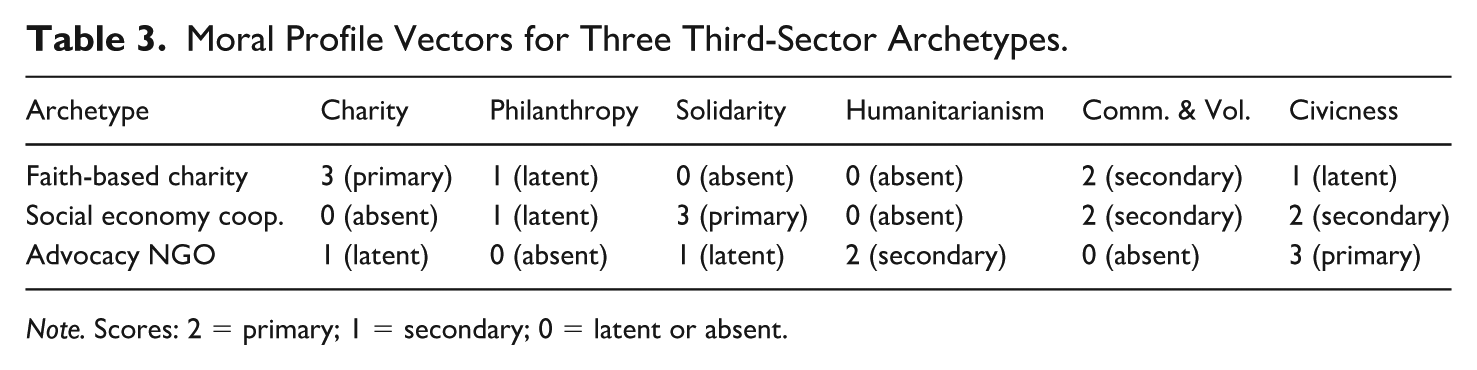
Note. Scores: 2 = primary; 1 = secondary; 0 = latent or absent.
Implications
The moral-economy framework has five principal implications. It provides (a) a tool for investigating varieties of third-sector configurations across policy fields; (b) a comparative lens for cross-national analysis; (c) a complement to existing functional and institutional frameworks; (d) a richer account of organizational behavior by centering values alongside interests; and (e) a platform for empirical research harnessing computational text analysis.
Field-Specific Moral Configurations
The moral economy of the third sector is far from monolithic. Instead, it displays a plurality of embedded values whose expressions shift with policy domain, organizational form, and value dimension. The variation in moral embeddedness reflects both the actors involved in each policy field as well as the historical moral impulses that have shaped these policy fields (Grønbjerg & Smith, 2021). Field‑specific variations occur because third‑sector organizations occupy distinct economic and functional roles across different domains. Moreover, the nature of government–nonprofit relationships varies across policy fields as public policies create the regulatory framework that shapes how these organizations operate (Grønbjerg & Smith, 2021). Thus, when analyzing the moral economy of the third sector, it is essential not only to evaluate the various forms of moral embeddedness exhibited by different types of third-sector actors within particular fields but also to examine how those embeddedness patterns interact with each field’s structural characteristics, regulatory environment, and inter‑sectoral relationships.
Cross-National Regimes of Moral Embeddedness
In comparative studies, the moral-economy framework enriches existing approaches by foregrounding the values that shape nonprofit activity across borders. Drawing on Estelle James (1989) entrepreneurship theory, it posits that nonprofits are founded by actors driven not by profit but by non‑monetary rewards such as social impact and mission fulfillment.
These entrepreneurs—often activists with political, religious, cultural, or humanitarian orientations—are propelled by deeply held values such as worldviews, moral convictions and opinions. They employ the nonprofit organizational form to bundle and co‑produce services—teaching, caring, healing—within a value‑based context, hoping that these values will galvanize support and advance their organization’s ultimate objectives.
In line with Anheier et al. (2020), who observe that recent comparative theory has emphasized the nonprofit sector’s institutional embeddedness in social, religious, economic, and political structures—an embedding that crystallizes into distinct civil‑society models or regimes—the moral‑economy perspective offers a useful framework for mapping these varied regimes across countries and regions.
Indeed, surveying the genealogy of the third sector’s moral foundations has revealed distinct patterns across regions: in the United States, the sector is largely anchored in philanthropic and community‑voluntarism value systems, whereas in Europe it tends to be rooted in charity and solidarity economies—except for the Nordic states, where civic engagement and community voluntarism dominate.
As with cross‑field comparisons, regimes of embeddedness interact with variations in welfare policy, class stratification, and historical power dynamics, giving rise to distinct third‑sector models. The interaction of these elements—conceptualized through frameworks such as the social origins theory of civil society (Salamon & Anheier, 1998) and cleavage‑structure theory (Lipset & Rokkan, 1967)—underscores how social hierarchies, power relations, and critical junctures (e.g., the post‑war welfare state’s emergence or the rise of global digital technologies) continually reshape the third sector. From such a viewpoint, insights from the moral‑economy framework combined with the cleavage‑structure perspective may contribute to enriching and further developing the social origins theory. The comparative potential of the approach also speaks directly to long-standing concerns in NVSQ about why the sector takes such different forms across countries and policy fields (Anheier & Kendall, 2002; Salamon, 2016): the moral-economy lens offers a values-centered complement to the structural and legal explanations that have dominated that literature.
Complementing Functional and Institutional Frameworks
Whereas earlier functional and institutional models have focused on functions and strategies (Vakil, 1997) or traced macro‑institutional patterns that shape state–market–third‑sector relations (Salamon & Anheier, 1998), the six‑value moral‑economy typology puts the emphasis on the core values that animate organizational purpose and legitimize resource mobilization.
While (Vakil, 1997) welfare–development–advocacy scheme categorizes what nonprofits do—their dominant problem‑solving strategies—and Salamon and Anheier (1998) social‑origins theory explains where these organizations come from, namely the macro‑institutional bargains that shape each nation’s third sector, a different framework is required to interrogate motivation. The six‑value moral‑economy framework asks why nonprofits act: which moral imperatives they mobilize to legitimize resource flows, governance decisions, and public claims.
Because it is suited to normative purpose rather than to function or historical regime, the typology operates at a finer, meso‑level grain. A single organization may be “development‑oriented” in functional terms while simultaneously oscillating between solidarity and humanitarian value logics as contexts shift—or even co-exist—within the same liberal regime that hosts peer organizations driven by charity or civicness. Conversely, the framework travels across scales: aggregating organizational profiles within a country exposes the moral composition of each social‑origins regime, whereas mapping values across a nonprofit’s program portfolio reveals functional diversity under one ethical roof. In short, the six‑value typology enriches existing schemes by emphasizing the motivational substrate that cuts through both functional roles and institutional environments, thereby supplying a missing layer for explaining nonprofit behavior, hybridity, and change. The concept of organizational hybridity has itself become a central concern in the nonprofit literature (Battilana & Lee, 2014; Skelcher & Smith, 2015), and the moral-economy framework offers a theoretically grounded vocabulary for analyzing why hybrid organizations combine the specific value logics they do, rather than treating hybridity as a purely structural or resource-driven phenomenon.
Organizational Behavior—Intrinsic Motivations and Axiological Rationality
Intrinsic motivations form a foundational pillar of the third sector’s moral economy. Altruism, civic commitment, and a sense of community drive volunteers, donors, and activists alike to engage in third‑sector activities. These ethical imperatives shift economic action away from pure self‑interest, weaving it instead into broader ideals of collective well‑being and social justice.
The moral‑economy perspective offers a richer framework for interpreting organizational and individual behaviors within the third sector by considering both instrumental and axiological rationality. Conventional institutional‑choice models—grounded in economic rationality—cast nonprofits as remedies for market or governmental failures, premised on actors’ self‑interests. Yet this narrow view neglects the moral and social drivers that propel many third‑sector initiatives. Axiological rationality, articulated by Weber (1978) and later expanded by Sen (1977) and Boudon (1999), foregrounds values, social norms, and ethical commitments as central to human action, moving beyond mere calculations of expected gains.
This distinction is essential for interpreting why volunteers, donors, and third‑sector organizations often pursue social and moral objectives rather than pure economic gain. Weber’s differentiation between “economic action” (centered on production and consumption) and “economically oriented action” (where economic activity serves non‑economic ends) captures the essence of third‑sector work (Weber, 1978). Many nonprofit endeavors—ranging from education and health to social services, arts, and philanthropy—are economically oriented yet driven by moral values instead of profit maximization. A moral‑economy perspective, therefore, offers a richer understanding of the third sector, highlighting how self‑interest and ethical commitments jointly shape nonprofit and voluntary behaviors.
Future Research Directions Through Computational Methods
A natural next step is to operationalize the framework at scale using computational text analysis. Mission statements, “about us” descriptions and similar organizational self-presentations provide compact, relatively standardized articulations of how third-sector organizations define their purpose, beneficiaries and modes of action.
On the approach proposed here, these texts can be read as condensed traces of the underlying moral economies in which organizations are embedded. Building on the analytical grid in Table 2, researchers could construct a theory-driven coding scheme in which the six value dimensions—charity, philanthropy, solidarity, humanitarianism, community and volunteerism, and civicness—serve as labels in a multi-dimensional classification task. A stratified sample of organizations would first be hand-coded for the presence and salience of each moral logic (for instance, as primary, secondary or latent), and these annotations could then be used to train supervised NLP models to classify larger corpora of mission statements. Such an approach would allow the moral-economy framework to be tested, refined and extended in several ways.
First, large-N text classification would make it possible to map the distribution and co-occurrence of the six moral logics across organizational fields, welfare regimes and countries, thereby moving beyond illustrative cases to systematic comparisons.
Second, it would provide empirical leverage on questions raised in this article and by the reviewers, such as the distinctiveness of solidarity versus charity, or the extent to which civicness and humanitarianism combine in particular domains.
Third, building on the proof-of-concept application presented here, large-N classification would allow researchers to assess the discriminant validity of the dimensions more systematically—testing whether the six logics remain separable across diverse organizational fields and national contexts, identifying boundary cases, and pinpointing any additional or context-specific logics where the framework systematically misclassifies organizations.
In this way, NLP-based classification is not an alternative to the conceptual work developed here, but a means of translating it into a cumulative research program on regimes of moral embeddedness in the third sector.
Discussion and Limitations
The geographic scope of the analysis is a first limitation. The framework has been developed primarily from European and North American third-sector traditions and does not account for alternative moral economies found elsewhere: Buddhist economic thought, which foregrounds mindfulness and sufficiency (Armstrong, 2020; Ngamchitcharoen, 2017); Islamic moral economy, anchored in Qur’anic principles of justice and institutions such as waqf (Asutay, 2025); or the Hindu and Jain concepts of dharma and dāna that have long underpinned South Asian philanthropic traditions (Eck, 2013; Swenson, 2020). Extending the framework to these traditions would considerably broaden its comparative reach.
A second limitation is the absence of class and power analysis. The original moral-economy concept, as developed by Thompson and Scott, was fundamentally concerned with class struggle and economic justice. This essay conceptualizes the third sector primarily through values—charity, solidarity, civic engagement—without examining who controls resources, whose interests are prioritized, or how power dynamics shape third-sector activity. Many elite-driven philanthropic initiatives operate within existing hierarchies, potentially reinforcing rather than challenging social inequalities. Further developments of the approach would need to integrate these questions, asking who benefits and who decides, and how moral claims intersect with economic and political struggles within the sector. A productive avenue would combine the moral-economy perspective with Lipset and Rokkan’s (1967) framework of cleavage structures to trace how, over time, class and value struggles shape third-sector configurations.
A third limitation concerns the exclusive focus on civil values. Drawing on Wendy Brown’s insight that every democracy is constituted through an “outside” it deems incompatible with its own ideals (Brown, 2015), future work should ask how third-sector activity can equally be animated by resentment, nativism, or other exclusionary moral economies—values that are integral to some organizations’ identities and funding streams, and that complicate the benign portrait sketched here.
Beyond these limitations, four research directions stand out: extending the framework to non-Western moral economies; integrating class and power analysis, asking who benefits and who decides; examining how digital and algorithmic technologies reshape third-sector ethics; and assessing how public policy affects the sector’s capacity to sustain social inclusion and democratic values.
Conclusion
This essay has made three interlocking contributions to the study of the third sector. It has aligned the classical concept of moral economy with third-sector scholarship, arguing that non-profit, voluntary and philanthropic organizations are best understood as embedded within historically sedimented moral economies that shape how needs are defined, resources mobilized, and legitimacy claimed. Drawing on that genealogy, it has introduced a six-dimensional framework—charity, philanthropy, solidarity, humanitarianism, community and volunteerism, and civicness—that captures the dominant value logics through which actors orient their practices and justify their existence. And it has translated that framework into an operational analytical grid, illustrated through three stylized organizational archetypes, that can map the moral embeddedness of organizations, fields, and national third-sector regimes in ways amenable to both qualitative and computational empirical work.
The broader ambition is to put values at the center of analyses of nonprofit behavior, governance, and impact. Functional and institutional theories have told us what nonprofits do and where they come from; the moral-economy framework asks why they act as they do—which ethical commitments they mobilize to legitimize resource flows, governance choices, and public claims. That motivational layer, largely absent from existing frameworks, is what this essay has sought to make analytically tractable. The hope is that it will spur both theoretical refinement and a new wave of empirical research into the moral underpinnings of the third sector.
Footnotes

Funding
The author received no financial support for the research, authorship, and/or publication of this article.
Declaration of Conflicting Interests
The author declared no potential conflicts of interest with respect to the research, authorship, and/or publication of this article.
Data Availability Statement
This is a theoretical essay; no data are used.