







Abstract
The article draws on ethnographic material from an ongoing study which explores 10- to 12-year-old Greek Cypriot children’s experiences of crossing to the north, the occupied part of Cyprus. By focusing on the act of crossing and the actual physical experience of visiting the occupied territories, the study seeks to highlight the mechanisms implicated in the construction of ethnic difference as children move through spaces and places and encounter ‘others’. The article argues that to understand how children navigate ethnic divisions in the context of these visits, we need to attend to the role of place-making in the construction of identity.
Introduction
[I feel] as if I am crossing to get into a water park, let’s say, that you go through and you show your ticket, but as soon as I enter, I feel anger, I feel a lot of anger when I know that that part would have been ours but because the Turks were jealous of it they came and took it from us. . . . When I saw there [at the checkpoint] the other flags, instead of those of Cyprus and Greece, I felt disappointment . . . (Eleonora)
Eleonora is one of thousands of Greek Cypriot children who have accompanied their parents on their trip to visit the northern, occupied part of Cyprus. In this excerpt, she is describing the moment of going through the Green Line checkpoint (the dividing line between north and south) and entering the part of the island that has been under Turkish military control since 1974. The remarkable range of feelings expressed by an 11-year-old – novelty, anger, disappointment – describing the procedure of crossing over to the ‘other’ side illustrates not only the complexity of children’s emotional worlds but also the process of place-making, especially in a context where borders, territory and sovereignty have been highly contested.
In this article, we present and analyse Greek Cypriot children’s experiences in encountering ‘ethnic others’ and constructing a sense of place when crossing over to the part of the island that has been largely inaccessible to Greek Cypriots until a partial lifting of movement restrictions in April 2003. During these highly emotional visits, the parents and grandparents of children who come from refugee families usually go back to the family home and community that they were forced to abandon in 1974. Children become witnesses in this memory journey and encounter, usually for the first time, the ‘enemy’ that they have been hearing about at school or at home. Our goal in this article is twofold: first, to unravel the ways in which children’s narratives reveal the mechanisms through which ethnic difference is constructed, from bureaucratic processes – ID controls at the checkpoint – and stereotypes about Turks and Turkish Cypriots to the embodied experience of seeing and feeling that children have during these visits. Second, we attempt to connect key issues in childhood and ethnicity through the concept of space as a central question in the material and symbolic construction of difference. To this end, the article features ethnographic approaches enriched by innovative visual methodologies (drawings and mapping exercises) that add different layers of information and show how children are able to actively construct a sense of place in the process of crossing a disputed ‘border’. 1 As we argue in our discussion of children’s drawings and maps, to understand how children navigate ethnic divisions in the context of these visits we need to attend to the role of place-making in the construction of identity.
The article draws on a larger ongoing study of 10- to 12-year-old Greek Cypriot and Turkish Cypriot children’s views and experiences of crossing the Green Line. Here, we focus on a subset from this group (17 children) with refugee backgrounds who mostly come from working- and middle-class families. Though we used a number of ethnographic methods and creative visual methodologies to explore the cultural meanings of these visits for children, in this article we draw primarily on data from interviews with children, children’s productions of maps (e.g. where children trace their remembered trips to the north or colour blank maps of Cyprus) and drawings (e.g. where children draw scenes from crossing the checkpoints). All data were collected in children’s homes from May to July 2010. Given the politicized context of Cyprus, the data from Turkish Cypriot children were collected by a Turkish Cypriot researcher.
Children’s ethnic worlds
While the concepts of childhood and ethnicity have long been separated by disciplinary gulfs that considered issues of children’s development and welfare as detached from questions of ethnic identity and political discourse, the recent interdisciplinary surge in childhood studies has highlighted a flow of research that fills this gap exactly. In the first special issue of the journal Childhood (1997, Vol. 4, No. 1) to examine this intersection, Gullestad (1997: 20) pointed out the three ways in which these connections can be explored: analysis of how images of children and youth are employed in nationalist symbols; analysis of national themes in schools and other institutions; and, finally, children’s experiences and perceptions of the nation.
Indeed, images of children as young citizens are fundamental aspects of the national imagery and the expression of ethnic identity (Gullestad, 1997; Koester, 1997; Stephens, 1997). In addition, as more work recognizes the centrality of everyday life in the construction of national identity (Billig, 1995; Fox and Miller-Idriss, 2008; Thompson, 2001), research on how children define ethnic identity (Carrington and Short, 1995; Howard and Gill, 2001; Waldron and Pike, 2006), understand the dynamics of ethnicity and exclusion (Devine and Kelly, 2006; Dulin-Keita et al., 2011) or even imagine how children in other countries live their everyday lives (Holloway and Valentine, 2000a) has thrown the intersections of childhood and ethnicity into sharp relief. And whereas the proliferation of ethnic stereotypes may create the impression that children simply parrot adults’ prejudices, it is also evident that they are able to challenge and decentre nationalist ideologies (Spyrou, 2000). For example, Waldron and Pike (2006) showed that Irish children used a mixture of cultural clichés to describe Irish people but, when given the right educational opportunities, they revealed a more nuanced and critical understanding of their identity. Similarly, in the case study presented here, some children, on some occasions, are able to challenge nationalist understandings of otherness by drawing on humanistic discourses of similarity and equality which become meaningful as a result of their encounters with Turks and Turkish Cypriots.
The turn towards ethnographic approaches in the study of childhood which has come about in the last 20 years has also underlined the everyday realities of children’s lives, the need to attend to their voices, their gendered understandings and the ordinariness of ‘alternative ways’ of growing up (Brooker, 2006; Morrow, 2006; Morrow and Connolly, 2006; Okely, 1997). Though ethnographic approaches have also given rise to critiques of the quest for authenticity (James, 2007; Komulainen, 2007) and of the preoccupation with children’s voices which are often used uncritically by researchers (Spyrou, 2011a), the complexity and diversity of childhoods documented through research has helped address aspects of children’s lives that have been previously ignored. Thus, for example, the increased awareness of the diversity of childhood which exists around the globe has directed researchers’ attention to cases where children do not grow up in so-called ‘stable’ societies but face anything from low level conflict to war and genocide (Connolly and Healy, 2004; Devine et al., 2008; Grétry, 2011; Healy, 2006; Leonard and McKnight, 2011; Pells, 2011; Povrzanović, 1997; Spyrou, 2011b; Van Ommering, 2011). As Leonard et al. (2011) noted in a recent editorial, research on children living in ethnically and politically divided societies is lacking even though this is the reality for the majority of children around the world.
Children and ethnic borders
Understanding Eleonora’s words at the beginning of this article requires not only the recognition that she has been growing up in a divided society but also the acknowledgement that this division involves a material reality of barbed wire and soldiers. It is interesting to note how she likens the procedure of crossing the checkpoint to the moment of entering a water park: you earnestly show your ‘ticket’ at the entrance and then you are allowed to enter a whole different world. While she obviously tries to process an unusual situation, her words also draw attention to the place-making practices that establish this novel experience.
Our theoretical concern in this article is with space, as it is embodied through social experience and as it is formed in the process of children’s ethnic encounters at and beyond the Green Line checkpoint. Casey’s (1996) work is directly relevant here as he argues that place is not a thing but an event which is constantly changing and reconstituted through people’s practices and material relations. Taking this a step further, Ingold (2008) suggests that place is produced through movement. In other words, place does not exist but occurs as a result of human movement and activity (Ingold, 2008; Pink, 2009: 32). Similarly, in his work with Palestinian children living in a refugee camp in Jordan, Jason Hart (2002: 36, 46) reminds us of the significance that physical space has in children’s engagement with nationalist projects: children’s sense of national belonging is not an abstract relation with discourses of identity but is embedded in ‘the localized constructions of community’ that children engage in at particular historical moments. Recent work on children and childhood, while not necessarily in a conflict context, has drawn attention to the temporal and spatial aspects of children’s lives (Hammad, 2011; Hart, 2002; Holloway and Valentine, 2000a, 2000b, 2000c; Moss, 2010). Jukarainen (2003), for example, showed how young people living close to the Finnish border with Sweden and Russia revitalize the concept of the nation through their spatial identity frameworks while continuing to be active agents in the construction of national identity. In a similar fashion, our study illustrates the role children play in reproducing the idea of the nation and the homeland as they come to embody nationalist discourses of fear, mistrust and prejudice towards the ‘other’ while occasionally also adopting alternative, more empathetic, understandings of this same ‘other’ which are rooted in their experiences of inter-ethnic encounters during their visits in the north.
The presence of ethnic and national borders has gained considerable attention in anthropological literature, where borders are understood as markers of identity: they separate ‘us’ from ‘them’ (Donnan and Wilson, 2001: 5; see also Donnan, 2010; Wilson and Donnan, 1998). Though studies which focus on children and borders are few and scattered (e.g. Ericsson and Simonsen, 2008; Helleiner, 2007; Hipfl et al., 2003; Lask, 1994), we hope to contribute to this limited but emerging literature with a case study that squarely addresses the role of ‘borders’ in children’s understandings of ‘self’ and ‘other’. In short, we seek to explore children’s constructions of ‘self’, ‘other’ and ‘place’ as they cross from one to the other side of the island and encounter the occupied areas that they have been hearing about in school or at home but never visited before. The encounter of the children with the Green Line and the occupied north creates intense but simultaneously ambiguous senses of belonging (Billig et al., 1988). The Green Line is not a recognized border yet one needs to present official documents in order to cross. Children consider the northern part of the island to be the other half of their homeland, yet it is a place that they can only experience temporarily as visitors. We argue that to explore the complexity of the experience, we need to understand how children navigate ethnic divisions in the context of these visits; to do so, we must engage the theoretical and practical reality of bodies moving through areas, locations and obstacles (see Morley, 2001).
The ‘border’ in political and historical context
Greek Cypriot children do not escape the complexity of this situation. They learn early on in school a basic, if not simplistic, plot of the island’s history: that this is an island that faced many conquerors and occupiers throughout its history. In 1960 it became an independent state, at which point, the story goes, Greek Cypriots and Turkish Cypriots were living together in peace. Turkey, however, invaded in 1974 and the two ethnic groups were divided and isolated in the southern and northern parts of the island without much opportunity for contact. Ever since, the education of Greek Cypriots centered on the ‘I don’t forget’ 2 slogan, which infuses all aspects of their school activities and in many ways serves to maintain stark distinctions between ‘us’ and ‘others’ (Christou, 2006, 2007; Philippou, 2005; Spyrou, 2000, 2002; Zembylas, 2010; Zembylas and Bekerman, 2008).
This version, however, was challenged when in 2003 the Turkish Cypriot leadership decided to lift the ban on movement across the Green Line. This meant that, for the first time in 29 years, Greek Cypriots and Turkish Cypriots would be able to visit the areas that were largely inaccessible to them. Since then, many Greek Cypriots crossed the checkpoints to visit the north, a significant number of these being refugees from 1974 when 187,000 Greek Cypriots where forcefully displaced to the south.
The act of crossing the Green Line became the most contested political issue among Greek Cypriots: many simply refused to display their passports and be reduced to ‘tourists’ in their own country (Dikomitis, 2005). A small number crossed and continue to regularly visit the northern part in search of cheaper goods and services while a much larger number of Greek Cypriot refugees crossed the buffer zone in an act of pilgrimage (Dikomitis, 2004, 2005). Their visits to the occupied areas became rituals of visiting homes, churches and cemeteries. They collected soil from the graves and anointed themselves with the water from springs in the centre of villages. 3 Parents came with children and grandchildren who had never seen their ancestral lands but heard so much about them.
The analysis below follows this unfolding of the journey by situating the experience within both the larger discursive fields which surround and inform it as well as the specific and the particular which is reflected in the children’s and their families’ circumstances and of the visit itself.
Preparing to cross
The encounter with history, with the political conflict and division of Cyprus, and with the ethnic ‘others’ who are a constitutive element that gives meaning to such visits starts, we argue, before the actual journey begins – with the preparations which take place – and implicates primarily the realm of the imagination. What children know and feel about the political situation in Cyprus readily becomes apparent when the family decides to cross over. The practical manifestation of this often translates to a concern with issues of risk, safety and trust. Needless to say, parents often play their own part in this by reactivating stereotypes and social fears about ‘the Turk’ who is the enemy and therefore not to be trusted under any circumstances (Spyrou, 2002). Theodora, for instance, recalled a clear injunction from her parents before their first visit to the north to ‘stay close to them and to avoid being close to the Turks who might offer us something . . . not to take it because of all the wars . . . because they took half of our Cyprus’. Others recalled how their families often took food and water with them because they felt that the Turks are not clean and sanitary when preparing food or because they simply could not trust them: ‘we don’t trust them [the Turks] in the occupied territories; they might put other kinds of stuff in [the food]’, Petros explained.
So, to a greater or lesser extent, the children who cross over carry with them particular understandings about those who reside on the other side. They have heard from TV or the radio countless references to Turks and Turkish Cypriots, their teachers at school have talked to them about the Turkish invasion and occupation of Cyprus in 1974, and more than likely their parents and grandparents (especially those from refugee families) have told them stories about their occupied village or town and about life there before being forced to leave as refugees (see Routometof and Christou, 2011).
However, since the controlled opening of checkpoints in 2003, Greek Cypriot children often physically encounter Turkish Cypriots in the south. They see them in shopping malls and stores, in restaurants and in the streets and have ways to recognize them: from hearing them talk in Turkish, 4 from their supposedly darker skin, from seeing some of the women wearing a headscarf, or from the car registration plate which ‘has fewer letters than Greek Cypriot ones’ and is encased in a red border. For many children, also, Turkish Cypriots are people who come to buy goods from the south that they can’t find in the north or people who cross to find employment because there are more jobs in the south or people who are simply poorer than Greek Cypriots. At the same time, the porosity of the ‘border’ has added a new layer to pre-existing stereotypes about the ‘other’ as the news often reports on those who cross illegally to the south to allegedly sell drugs, to steal or commit all kinds of crimes.
While for most children, those who live in the north are simply a different kind of people (‘they have a different mentality, a different logic’, as Maria explained), for some the ‘other’ is not homogeneous. Thus, children may make an evaluative distinction between ‘good’ and ‘bad’ ones (‘they are not my friends but I do not hate them either because it is not their fault, it is their ancestors who did these things’, as Melina explained). Children may also distinguish between Turkish Cypriots and Turks, with the former seen in a more positive light than the latter: ‘The Turkish Cypriots do not scare us, while the Turks do’, explained Antonia. This is part of a more general public discourse which distinguishes between Turkish Cypriots and Turks who came from mainland Turkey after 1974 and settled in the occupied territories. This distinction is also reinforced by family stories about experiences of living together with Turkish Cypriots before 1974 or relationships which are still maintained between Greek and Turkish Cypriots. Similar to other children who grow up in ethnically divided societies (Devine et al., 2008; Healy, 2006; Povrzanović, 1997), Greek Cypriot children develop elaborate understandings of who the ‘other’ is and try to make sense of complex and often conflicting messages.
At the checkpoint
To cross to the north, children have to go through one of the controlled checkpoints that have gradually opened since the first opening of the Ledra Palace checkpoint in Nicosia in April of 2003. Crossing the checkpoint is itself a direct and symbolically powerful encounter with alterity.
Eleonora’s quote at the beginning of the article may seem like a paradoxical parallelism between the experience of checkpoint crossing and the experience of entering a water park. However, as she explains, the only similarity between the two experiences may be the gatekeeping practices at the checkpoint, which are not unlike what one experiences when waiting to buy tickets to enter an amusement park. As soon as Eleonora crosses, her emotions change from anticipation to anger. The presence of the ‘other’s’ flags and of other politically charged symbols, the police which guard the checkpoint and the entire procedure of filling in forms and showing of passports and IDs mark the experience of a visit with the semiology of occupation, division and otherness.
Many children explained that they were particularly sad and upset that they had to show their passports and undergo checks in order to be able to cross to the other half of their country. As Lakis emphatically put it: ‘this country is ours. I do not like being checked.’ Even children who entertained alternative, more positive, understandings of ‘self’ and ‘other’, reported a strange feeling while at the checkpoint. Lana, for example, admitted that she feels ‘a bit weird’ when she goes through the checkpoint: ‘especially in school they taught us that Turkish Cypriots, Turks are bad and enemies . . . and you feel that . . . when you see the police being next to you when you are trying to cross . . . you feel that they might do something to you, they look at you a bit strangely . . . but ok, slowly-slowly as I grow up I feel that they are our brothers too . . . they are not something different from what we are.’
This ‘weird feeling’ may become on some occasions a more distinct sense of anger and injustice. The symbolism which adorns the checkpoint – the flags or the very presence of the uniformed police – and the entire procedure that one needs to undergo in order to cross over arouse negative feelings in many children: ‘I felt some injustice that we have to be checked [at the checkpoint] and [that we] have to pay to go to the other side of our country’, 5 Antonis explained.
Feeling the north: The embodied experience of the visit
Crossing to visit the other side is for most children and their families (especially for refugee families) an emotionally intense experience. It is first and foremost, an encounter with the reality of prolonged division and occupation. The extensive presence of military in the north reminds children that the land is carefully guarded and that it is under the close control of the Turkish military forces which, as they have learned from their parents and teachers, have killed and displaced thousands of Greek Cypriots and took their homes by force in 1974. The constant and extensive presence of symbols reminds some of the children about the occupation and the loss of ‘our land’ and brings about feelings of sadness: ‘it is not their village. Why should they put their Turkish flags [in the village] and borders with barbed wire around it and not let anyone to go in?’ For others, simply being on the other side among people who speak a different language triggers a sense of discomfort: ‘because Turks and Turkish Cypriots live there I do not feel very comfortable not being with Cypriots or Greek Cypriots. [I feel] as if I am among another race, let’s say, who speak a different language’ (Maria).
Moreover, a general sense of distrust about the way things are and the way things are handled in the occupied territories (often encapsulated under the term ‘pseudostate’ in reference to the unilaterally declared illegal state of the so-called ‘Turkish Republic of Northern Cyprus’) characterizes the way many children feel about the uncertainty of being a visitor in the occupied north. As Maria explained (reflecting similar arguments often brought up by adults), if something happens while being in the occupied territories (e.g. a traffic accident), the police may act in a partial manner, that is, by favouring Turkish Cypriots or Turks. This feeling of ‘things not being like they are on our side’ gives rise to a constant feeling of discomfort and uncertainty while one is there.
But for many children, the visit to the north also produces a sense of anxiety and fear. In fact, many children talked about the fear they felt, especially on their initial visits, because of the presence of Turks. Children mentioned being careful during their visits to avoid contact with strangers who might harm, kidnap or rob them. Maria, for instance, was particularly concerned with the issue of safety during her visits to the north: ‘I am always careful not to walk away from my mother and my father. The Turks scare me a lot . . . the way they speak, the way they look at other people . . . so I do not like them very much and they scare me a lot because let’s say we are not that good friends with them as we are with other people.’ In a similar vein, Petros exclaimed that he feels a bit scared when he visits the occupied territories ‘because only God knows what the Turks have in mind!’ A number of the children did point out that their parents constantly held them by the hand during their visits. To fully realize the meanings attached to the feelings of fear, discomfort and lack of safety that children talk about one can simply contrast them with the feelings of relief and safety that children recount following their return to the south.
Seeing the other side, especially during initial visits, encouraged children to make comparisons by resorting to their knowledge and understanding of the past and with the help of older family members who were in a better position to make such comparisons: ‘We saw the mosques, the churches, the restaurants – how they have become!’; ‘we went to see my grandfather’s home . . . which was demolished and turned into [a stable] where horses live in’. Similarly, some children talked about their anger at how the authorities there do not take care of monuments like churches or Greek Cypriot homes.
Each child who came from a refugee family had a story to tell especially about their first visit to the north. Antonia visited her father’s village only to find out that his family’s house had been demolished and was no longer there. Antonia’s visit reified in a powerful way much of what she learned earlier on in her life about the Turks as occupiers and destroyers, but the fact that it is her own family’s house that has been destroyed makes this realization much more emotionally convincing and powerful.
But even when children do find the family home, the experience is rarely a pleasant one. When Maria visited her grandmother’s village for the first time she vividly remembers ‘two Turkish women’ sitting outside the house. The women initially refused to let them go into the house to see it only to change their minds a little later on allowing them in, ‘but just for a little bit’. What Maria saw and realized, aided by her grandmother’s explanations – the demolished walls of the house and the orange grove in the backyard which was no longer how it was when her family moved out in 1974 – left her with a deep sense of sadness and disappointment.
Children’s lack of direct memories from the pre-1974 period is not only compensated by what they learn from school but more importantly by what they learn from their families. The cultural trauma caused by the sudden and indefinite uprooting of the refugees is part of the younger generation’s narrative about the occupied areas (Roudometof and Christou, 2011). Antonis, for instance, recounts how his father was deeply saddened when they visited the occupied village in the north for the first time, while Maria tells of how her grandmother never wanted to go back to her village again after that first time they all went together because ‘she wanted to keep the [old] memories in her mind . . . she did not like seeing other people who would not let her go in her own house’. When, later on in her interview, Maria reflected more on what such visits do to a refugee she did not hesitate to also let us know that she fully understands what her grandmother feels: ‘if I was in my grandmother’s position, I would not want to go [to the north again]. Why, let’s say? To see those women living in my home and not letting me go in?’ In short, these pilgrimages (Dikomitis, 2004, 2005) back to family homes are emotional events even for the children who have never lived there.
Alternatively, for a handful of children, these encounters were not entirely negative but included moments of understanding and empathy expressed through the current residents’ friendliness and hospitality towards them: welcoming them in, offering treats and water or even showing them their family albums they had kept safe for all these years. For some children, relationships with Turkish Cypriots were positive and gave rise to more complex and ambiguous understandings of inter-ethnic relations in Cyprus. Take, for instance, Lakis’s experiences of crossing. His father has a Turkish Cypriot friend and business associate. Therefore, Lakis’s understanding of Turkish Cypriots primarily reflects this positive relationship which is enacted when the family visits the north to meet Turkish Cypriot friends. Yet, despite this family context, he still expresses some ambivalence about his father’s friend. As he explained to the researcher, ‘deep down I hate him, let’s say, but on the other hand I also like him’. His negative comment about his father’s Turkish Cypriot friend stems from his own understanding of how this person acted during the 1974 Turkish invasion. For Lakis, he should have abandoned his community and joined forces with Greek Cypriots but instead he opted to stay. He attributes personal responsibility to him for what he chose to do in a time of crisis. Yet, he likes this person and has a good relationship with him and his children as a result of getting to know them. Lakis’s ambivalence about the ‘other’ is suggestive of the contradictions that come about as a result of real-life experiences which do not fall in line with official discourses about the ‘other’ (Spyrou, 2001).
Occasionally, children are able to transcend the legacy of the division and the ‘us’ versus ‘them’ frame of reference and offer understandings which suggest the possibility of mutual understanding and a sense of common humanity. Lana offered such a reflective understanding though she was admittedly an exception to the rule: ‘they are also like us . . . but . . . so much has happened and some people feel that the bad ones live on the other side and we are the good ones, but they [i.e. those living on the other side] might feel the opposite, that we are the bad ones and they are the good ones. But I believe that the Turkish Cypriots and the Greek Cypriots are the same thing, they are Cypriots . . . we are the same thing and if something happens, if a just solution [to the Cyprus Problem] is found, we will be able to live united together . . . but ok, there are some people who live with the understanding that this cannot happen, but I believe that it can happen and if we get used to it [i.e. the idea] it can happen.’
Senses of home, place and history
If place is constituted through human activity and movement (Casey, 1996; Ingold, 2008) then Greek Cypriot children’s visits to the occupied areas involve a paradox: the areas are known to them from landmarks presented in history books or from parents’ and grandparents’ stories about their abandoned homes but they are completely uncharted territories for them. In an effort to understand children’s place-making practices we asked them to draw a map that traced their trip to the occupied areas, a typical example of which is Antonis’s drawing (see Figure 1).
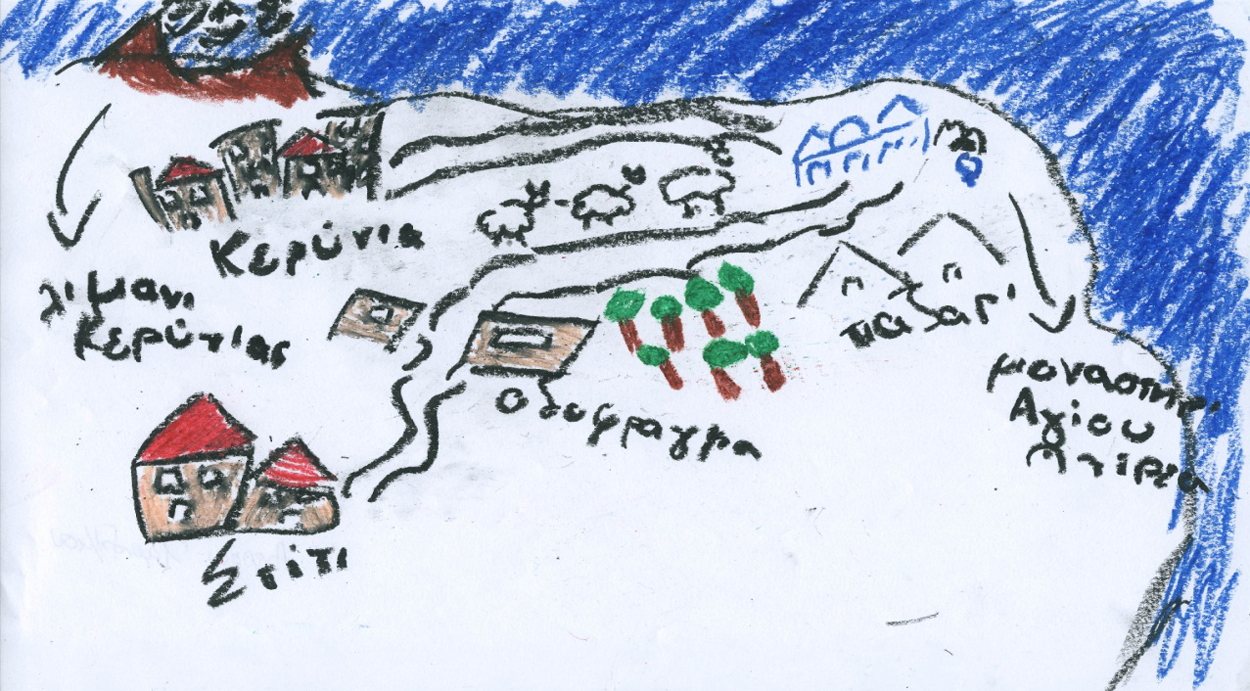
Antonis’s map of his trip to the occupied territories.
Antonis drew his home (lower part of the image) and a road that passes through the checkpoint. Following this road takes us to the Apostolos Andreas monastery and then to Kyrenia (a town and its small port). These are the landmarks that are pictured in his history books and these are the places he visited with his family. The drawing, however, is also peppered with bucolic details: the trees, the sheep and the bazaar they visited. He talked about the monastery’s history and noted how impressed he was by the woods and the sheep he saw on the side of the road. Like other children, Antonis charted his movement in space through a combination of memorialized landscapes and personal experience. These formalized architectural landscapes are similar to what Nora (1989) called ‘lieux de mémoire’ (places/sites of memory) that were almost arbitrarily chosen after 1974 to represent ‘The Occupied Areas’ (Ta Katechomena). The actual trip, however, presented for Antonis information that was not typically present in schoolbooks. By adding his personal experiences to the historical landmarks he helped create a sense of place.
In analysing the drawings, we also noticed that when children were asked to colour a map of Cyprus (the island’s outline) they tended to include formal symbols of the ‘other’s’ presence: flags, a prominent ‘border’ and different colours for the occupied areas. When asked to map their trip to the north, however, children outlined their experience in space and focused either on rural details that impressed them or the landmarks they visited, without much reference to Turks or Turkish Cypriots. The way that children mapped the occupied areas and what they chose to remember may indicate that their physical experience of the space was a discovery of places not of people, regardless of the fact that they did have to encounter the ‘other’.
Discussion and conclusions
In her book Schooling Passions, Benei (2008) uses the term ‘sensorium’ to refer to the ‘entire sensory apparatus’ which is socially and culturally produced. She argues that this ‘sensorium’ is responsible for our passion and our sense of belonging to a nation through the incorporation and embodiment of emotional, sensory and cognitive resources (Benei, 2008: 26). In this article, we have tried to analyse how Greek Cypriot children’s visits to the occupied areas reinscribe in their consciousness a sense of place that was previously only in the realm of the imagination. The occupied territories are not unfamiliar, neutral spaces: they have been rendered socially and culturally meaningful much earlier on as parents, grandparents, teachers and society at large instilled in children’s minds particular senses of belonging (Benei, 2008) and predisposed them to relate to these spaces-places in particular, ideologically informed ways.
Crossing the ‘border’ to visit the occupied north transforms children’s sensorial experience: their sense of space, place and identity acquires new meanings as they come to experience first-hand the occupied lands of their homeland and the ‘others’ who currently reside there. The new knowledge they acquire from this direct, emplaced experience together with their reported feelings of anxiety, fear and sadness make the act of place-making a cognitively and affectively powerful experience that highlights both the strength and persistence of collective imagination but also the personal and experiential dimension of identity as a way of being in the world.
Children’s agency takes form and shape within these powerful ideological constraints which leave limited room for rediscovering identity while at the same time they are called upon to make sense of the new, and to some extent contingent information that they encounter. The places they visit on the other side – whether these are their parents’ villages, important religious shrines or just the beach – are ethnicized and emotionalized (see Donnan, 2010: 262) as children find themselves in a place where the ‘other’ lives and where the whole history of the conflict which resulted in Cyprus’s separation is emplaced.
The very act of crossing a checkpoint to visit the other side constitutes for many of the children we talked to a transformative event. It does so by engaging the children-visitors experientially with the semiotics of space, place and identity, and in a manner which reanimates collective memories of the past and helps forge visions of the future. The act of being physically there provides children with an experiential, embodied sense of identity (see Benei, 2008) which takes form and shape as the journey unfolds, often reaffirming assumptions and stereotypes about ‘others’ but occasionally also reworking and even challenging received meanings about ‘us’ and ‘them’. When children are asked to trace their visits to the north on paper, they selectively represent an idealized version of the territory, devoid of the other. This might signify at some level children’s attempt to forge a vision of the future where the now occupied territories become, once again, ‘ours’.
Footnotes
Acknowledgements
We would like to thank the two anonymous reviewers who provided us with critical feedback. We also would like to thank the following researchers who worked on this project: Sevinc Insay, Louiza Mallouri, Nicolina Karaolia, Athina Tembriou and Maria Kalli.
Funding
This research received no specific grant from any funding agency in the public, commercial, or not-for-profit sectors.