







Abstract
Previous research indicates that adults who live on cul-de-sac streets are more likely to have positive experiences with neighbors than residents of other street types (Brown and Werner, 1985; Hochschild Jr, 2011; Mayo Jr, 1979; Willmott, 1963). The present research ascertains whether street design has an impact on children’s neighborhood experiences. The author interviewed 73 adults who live on cul-de-sacs and 37 adults who live on through-streets (N = 110) to determine adults’ understandings of children’s neighborhood experiences. The data reveal three primary benefits for children raised on cul-de-sacs. First, because cul-de-sacs tend to be territorial streets, parents are more likely to let their children play outside unattended under the watchful eyes of neighbors. These neighbors provide a social safety net for cul-de-sac children and their friends. Second, because they are aware that they are likely being watched, cul-de-sac children are less likely to partake in deviant activities while on their street. The author refers to this internalized form of self-discipline as street panopticism. Third, the low traffic levels on cul-de-sacs create greater opportunity for uninterrupted play, thus drawing cul-de-sac kids outside for individual and group recreation. The author argues that cul-de-sacs, as well as other low-traffic streets, can enhance children’s neighborhood experiences and create more vibrant neighborhoods.
Keywords
Introduction
The neighborhood street has long served as a place of play for children around the world (Lynch, 1977; Moore, 1986). In urban, suburban, and rural contexts, children venture outside their homes for various forms of individual and group recreation. According to Harden (2000), children often seek out these types of familiar public spaces in order to reduce the experience of risk. For many children, the street outside their home represents what she calls a ‘local sphere’ that lies somewhere between the acute safety of the ‘private sphere’ (such as one’s home), and the inexorable contingencies of the ‘public sphere’ (such as an unfamiliar urban context). For many children, their street is a pleasurable refuge where psychological, social, and physical development occurs (Huttenmoser, 2003; Moore, 1986).
Despite the numerous benefits associated with outdoor play, children are increasingly preoccupied inside the home with computers, gaming systems, television, Mp3 players, cell phones, and text-messaging (Bovill and Livingstone, 2001; Conley, 2009). While some research suggests that children can benefit from certain forms of social media (see Livingstone, 2009), many are concerned about the deleterious health effects resulting from spending far too much time indoors (Ferreira et al., 2006; Sallis et al., 2000). For example, a recent report by the Program for the Study of Media and Health found that the amount of time US children spend watching television, playing video games, or surfing the Internet is 7.5 hours per day (Rideout et al., 2010). British youth consume almost 5.5 hours of media per day (Bates, 2008), while Australian children consume 4.5 hours (Australian Communications and Media Authority, 2010). For many children, vibrant neighborhood life and meaningful face-to-face relationships have been replaced with time staring at electronic screens, and social relationships mediated through electronic filters such as text-messaging, email, MySpace, and Facebook.
While electronic technologies have taken the brunt of the blame for children’s lack of outdoor play and reduced face-to-face peer interaction (Bovill and Livingstone, 2001; Conley, 2009), scholars have not given as much attention to the impact of neighborhood design on children’s outdoor play. Neighborhood design is an important determinant of children’s outdoor play because it dictates where play may take place, the kinds of play that may occur, and the possibility of getting in trouble for inappropriate play. The present research examines whether street design affects children’s play. Specifically, I am interested in the different consequences for children raised on ‘bulb’ cul-de-sacs, ‘dead-end’ cul-de-sacs, and through-streets.
Methods
I conducted semi-structured interviews with 73 cul-de-sac residents and 37 through street residents (N = 110) in the state of Connecticut to assess the relationship between street design and parents’ perceptions of children’s neighborhood experiences. While interviews with children would shed direct light on their experiences, I am primarily interested in how street design affects (1) adults’ ability to watch over neighborhood children, and (2) parents’ tendency to let children play in the street.
I selected three distinct street types for this study: the ‘bulb’ cul-de-sac, the ‘dead-end’ cul-de-sac, and the through street. As I discuss later, the distinction between ‘bulb’ and ‘dead-end’ cul-de-sacs is an important one because bulbs provide considerably more play space for children than dead-ends. As seen in Figure 1, bulb cul-de-sacs have the large circular turnaround at the end, while dead-end cul-de-sacs have no turnaround. Through-streets are those that have more than one way in and out. Because cul-de-sacs vary in terms of residential propinquity, mutual visibility, shared public space, household location, and number of houses, I standardized the physical layout of the streets and houses to closely correspond with Figure 1. This methodological approach allowed me to assess whether small changes in the physical designs of these streets account for differences in the neighborhood experiences of children.
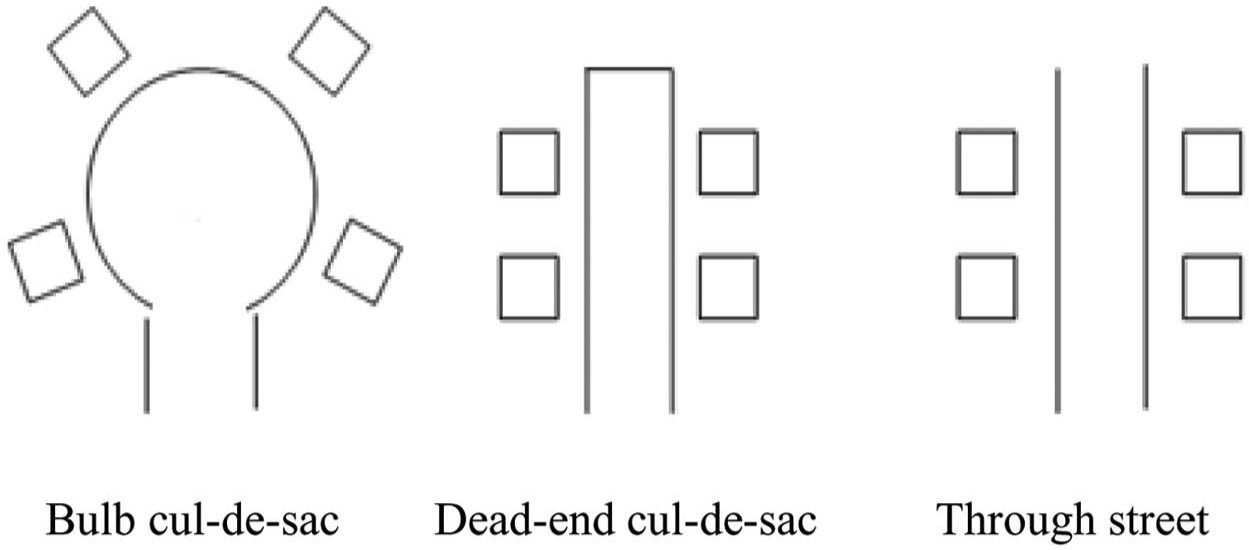
Street design and residential arrangement
I used Google.earth to locate streets that met my sample criteria. This software allowed me to scan the entire state of Connecticut until I accumulated sampling frame subsets of 12 bulb cul-de-sacs, 12 dead-end cul-de-sacs, and 12 through-streets. All 36 streets were quiet and friendly, with low traffic levels. With 4 households on each of the 36 streets, the total number of respondents in my sampling frame was 144. After collecting the addresses of the 144 houses through a drive-by inspection, I sent invitation letters explaining the reason for the study and the kinds of questions I would ask.
In order to control for extraneous factors that might obfuscate the research findings, I ensured that all of the households were in a relatively homogeneous area of Connecticut. While factors such as social class and race are likely to affect children’s neighborhood experiences, one of my goals with this research was to establish a baseline from which other research could proceed. Therefore, I selected households for my sampling frame from 6 predominantly white, upper middle-class towns in Connecticut.
I successfully interviewed respondents in 110 of the 144 (76.4%) households in the sampling frame (35 bulb households, 38 dead-end households, and 37 through street households). Altogether, 93% of the respondents were non-Hispanic whites, the mean income was $106,484, 53% of the respondents were men, 1 77% of the respondents were married, the mean age of the respondents was 53.15, the average number of children (under 18) in the home was 0.72, and the mean age of the children was 10.46.
I asked 23 pre-designated interview questions to all respondents (see Appendix 1). These questions pertained to number of children in the household, number of children on the street, children’s activities on the street, guardianship of children, neighborhood familiarity, neighborhood life, and neighborhood celebrations. These interviews took an average of 45 minutes to complete, although some took up to 2 hours.
In addition to interview methodologies, there was also an ethnographic component to this study. I spent over 150 hours on these streets knocking on doors, taking field notes in my automobile, and interviewing residents. Because respondents and I often sat outside to complete the interviews, I became familiar with the character and rhythm of these streets. I observed children playing, neighbors interacting, recreation occurring, and outdoor chores being done. On some occasions, neighbors would interrupt an interview and chat with me as if I were an old friend. This ethnographic data allowed me to observe neighborly guardianship of children, as well as children’s play, first hand.
Results
My data suggest that there are three primary benefits for children raised on cul-de-sacs. First, the high levels of territoriality on these streets facilitate neighborly guardianship of local children. Cul-de-sac adults are more attuned to unfamiliar traffic on their street than are through street residents. Consequently, cul-de-sac parents on these streets are more likely to let their children play outside unattended. Second, cul-de-sac adults are more likely to detect and report children’s deviant behaviors on their street. As a result, cul-de-sac kids are less likely to partake in deviant behaviors while on their street. Third, the low traffic levels on cul-de-sacs create greater opportunity for uninterrupted play, thus drawing children outside for individual and group recreation. I now provide an in-depth analysis of each of these factors, and then discuss policy considerations in light of social science research findings regarding street design.
Neighborly guardianship
Regardless of what type of street they live on, most residents are concerned about the well-being of children who play outside their front doors. These inhabitants want their street to be a safe one where children can play without fear of hazardous traffic, bullies, or child predators. However, neighborhood design makes it easier for residents of some streets to monitor children better than residents of other streets. Streets with high levels of unfamiliar traffic and lots of noise make it difficult to visually and audibly monitor children. Conversely, streets with low levels of unfamiliar traffic and low noise levels make it easier to discern if a child is hurt or in danger. Because of their enclosed design, cul-de-sacs limit the amount of unfamiliar traffic and noise in this way. A recurring statement from cul-de-sac respondents in this study was that they know ‘who belongs’ and ‘who doesn’t belong’ on their street. One respondent stated that ‘bells go off’ any time an unfamiliar person enters his cul-de-sac. Another stated that her ‘ears perk up’ when she hears an unfamiliar vehicle passing by. In this way, cul-de-sacs have their own built-in security system that helps ensure the well-being of children.
Because of the limited traffic on their streets, cul-de-sac parents were more comfortable letting their children play outside than through street parents. In addition to citing low traffic levels, cul-de-sac respondents discussed how neighbors ‘keep an eye out’ for local children. In The Death and Life of Great American Cities, Jane Jacobs (1961: 35) discussed the importance of ‘eyes on the street’ so that residents can help each other in this way. On cul-de-sacs, the eyes on the street help ensure that children do not wander to far from where they are supposed to be, and that outsiders who might do harm are scrutinized.
Few through street parents expressed the same feelings of security about letting their children play in the street unattended. Despite the low traffic levels on their streets, parents were still concerned about the occasional automobile passing by, or the increased traffic at the end of the workday. Some parents simply refused to let their children play in the street at all, and instituted rules against wandering outside the yard. Others had strict stipulations about what times of the day children could play in the street and which adults had to watch over them.
Because of the high levels of familiarity on cul-de-sacs, these residents are better able to detect and monitor ‘outsiders.’ During the first weeks of data collection, for example, I was the recipient of numerous scrutinizing stares on the cul-de-sacs. One resident gave me an especially unwelcoming glare when I pulled into her cul-de-sac. I gave her a friendly wave to quell any suspicions that I intended to do harm, but she did not return my affable gesture and continued staring at me for two straight minutes. These stares were common whether I was acquiring addresses, getting my paperwork together, taking field notes, or waiting for appointments. One cul-de-sac resident even called the police on me during my first week of data collection. Despite the fact that I was wearing a university polo shirt, dress slacks, dress shoes, and was carrying a clipboard with paperwork, my ‘outsider’ status aroused concern for the well-being of neighbors on this particular cul-de-sac. Only when word spread regarding who I was and what I was doing did these inhospitable reactions subside. On through-streets, by contrast, I rarely garnered a second look when I drove up and parked my vehicle. Through street residents are more accustomed to vehicles driving and parking on their street.
Maria, a dead-end resident with a 9-year-old daughter, described an incident indicative of the high levels of surveillance on many cul-de-sacs: My brother used to drive a taxi cab for a living. I guess he had just dropped a passenger off in the area so he decided to stop by. When Hannah, my daughter, went outside to say ‘Hi,’ and he picked her up and pretended like he was abducting her – he always does things like that. Hannah just started screaming and playing along. Well, my neighbor, Janet, saw what was going on through her window and thought it was a real abduction. She came barreling over here like a football linebacker (laughs). My brother had a baseball cap and sunglasses on, so she didn’t recognize him. When she got closer, she realized who he was, but I think she was ready to tackle him. Even though it wasn’t a serious incident, it’s nice to know people are keeping an eye on my kids.
Like Maria, many cul-de-sac parents expressed appreciation for their watchful neighbors. This collective form of guardianship creates strong neighborly bonds on cul-de-sacs and other low-traffic streets.
It is important to emphasize that the high levels of territoriality and surveillance on cul-de-sacs are not the consequence of the cul-de-sac, per se, but rather the fact that cul-de-sacs reduce the number of strangers on the street. Indeed, respondents of one through street expressed a similar type of territoriality due to low traffic levels. This particular street horseshoed onto a primary road, and no street branching off it. Stan, one of these residents, stated, ‘People driving on this road either live here, are visiting, or are lost. When people come down the street, we know.’ Similar to cul-de-sacs, through-streets with little traffic are easier to monitor than streets with high traffic levels.
When asked who was responsible for the children when they played outdoors, a bulb resident explained, ‘It’s kind of implied that if the children are in your yard, it’s your responsibility to watch them. If they are in the street, everyone watches them.’ On streets where there is a sense of territoriality, parents can let their children swarm from house to house assured that there is a network of adults looking after them. Indeed, cul-de-sac residents were more likely to pool personal resources to watch neighborhood children. Glen, a dead-end street resident, stated: What’s nice is that there are several [private] swing sets and pools on this street, so kids on the street don’t go to a local pool or park – they just use each other’s. This way, it’s easier for everyone to watch over the kids. Come to think of it, I don’t even know where the city pool is, or if we even have one (with confused facial expression).
This implicit agreement that neighbors will watch each other’s children fortifies the social structure of the street.
As they explore their neighborhoods and play their games, children are susceptible to a wide variety of physical injuries. Because parents cannot watch their children every moment of the day, neighbors often fulfill the important function of monitoring for children’s medical attention. Many cul-de-sac respondents recounted stories of running outside to provide aid to a child who had scraped a knee, jammed a finger, twisted an ankle, or been hit with a ball. The network of potential medical assistance on cul-de-sacs quells parents’ concerns as their children play outside.
Another form of neighborly guardianship that was more prevalent on cul-de-sacs was planned babysitting of one another’s children. Altogether, 27 of 73 cul-de-sac respondents (38.4%) stated that they had made arrangements to babysit neighborhood children at some point during their residency. In contrast, only 8 of 37 through street respondents (21.6%) stated that they made such an arrangement. Parents of one cul-de-sac even referred to themselves as the ‘BSBC,’ or the ‘Bolton Street Babysitting Club,’ because in addition to watching each other’s children, they also watched neighborhood children who were dropped off to play with friends.
Because of the high levels of neighborly guardianship on cul-de-sacs, many of these residents thought of one another as family. Cul-de-sac kids commonly referred to their adult neighbors as ‘aunt’ or ‘uncle.’ Adult respondents referred to their neighbors as ‘family.’ Bonnie, a bulb resident, stated the following: All of the kids on this street call me Aunt Bonnie and my husband Uncle Phil – even the ones who are grown now. All the kids call the adults [on this street] ‘Aunt so-and-so’ or ‘Uncle so-and-so.’ Even now that the kids are grown and off to college, they still call me Aunt Bonnie, but they always have so it’s no big deal.
When parents instruct their children to use these honorifics, the recipients are symbolically incorporated into the family.
Just as many cul-de-sac children referred to their neighbors as ‘aunt’ or ‘uncle,’ many of these neighbors also talked about neighborhood children as if they were their own. For example, Ann Marie discussed how she treated local children like family: ‘It takes a village to raise a child’ is a perfect phrase for this street. My husband and I never had kids, but we felt like we did since there were kids over our house all the time. I love to bake, and the kids in the neighborhood would come over every time I made a batch of cookies. They actually called me the ‘cookie lady’ (laughs).
Because cul-de-sacs are conducive to strong neighborhood ties (Brown and Werner, 1985; Hochschild Jr, 2011), children reap many benefits from living on these streets.
Cul-de-sac respondents were more likely than through street respondents to discuss giving gifts to neighborhood children and adults. Christmas, birthday, and graduation presents were often exchanged among neighbors. One dead-end respondent stated, ‘We always make a big deal over everyone’s birthday – the kids love it. Even if we only have cake and ice cream, we all gather over the house of whoever’s birthday it is.’ Most respondents stated that when children on their street had grown and moved away, it became more common to acknowledge holidays with cards or phone calls.
When children befriend one another while playing outside, their families’ lives often become intertwined. A cross-pollination of information typically occurs as children transmit things they have seen and heard to their families and neighbors. The ‘small grapevine’ on these streets ensures that word spreads when a child earns good grades, has been delinquent, scores a goal, is ill, gets a driver’s license, or has gone on their first date. This information is the ‘news’ of the street, and becomes part of the shared knowledge of local residents. Long-term residents may witness a neighbor child’s complete development from birth to adulthood. As a consequence, adults on cul-de-sacs often come to know and care for neighborhood children as if they were their own.
Street panopticism
In addition to enhancing the safety of children through neighborly guardianship, many respondents reported that cul-de-sacs reduce children’s deviant behaviors while they are on these streets. On busy through-streets, the high levels of noise and movement make it more difficult to detect anything out of the ordinary. Children are less likely to be detected fighting, destroying property, stealing, using inappropriate language, or discussing deviant activities in which they have participated elsewhere. On quiet cul-de-sacs, attentive eyes and ears are more likely to perceive children’s misbehaviors. Children who grow up on these streets learn that there is a strong likelihood of getting caught for misdeeds, and alter their behavior accordingly. While some cul-de-sac children may resent being the object of scrutiny on their street, parents appreciate the fact that their neighbors are on the lookout for misbehavior.
I put forth the concept of ‘street panopticism’ to shed light on the process whereby surveillance networks on streets operate to prevent deviance through internalized self-discipline. 2 This concept derives from Michel Foucault’s (1975) classic analysis of how the panopticon prison design gives guards, who are concealed in a central tower, the ability to observe prisoners without being viewed themselves. Because the prisoners are never sure if they are being watched at any given moment, they internalize self-discipline for fear of being punished for violating prison rules. Although Foucault utilized his theory to discuss increasingly pervasive forms of surveillance in modernity, his analysis lends itself effectively to street forms of surveillance.
Because cul-de-sacs have only one access point, children must walk past the same row of neighbors every time they enter or leave the street. Each house consists of potential informants who may observe and report deviant behavior. As one cul-de-sac resident put it, ‘There are eyes everywhere on this street.’ From their windows, yards, garages, and automobiles, cul-de-sac neighbors create a surveillance web that children must pass through in order to get to and from home. In contrast, through street children may have many possible routes to get home. A through-street child who gets in trouble on one part of her street may simply alter her behavior in the future. When a cul-de-sac child is spotted misbehaving by a neighbor, phone calls or visits are often made to the child’s parents. Sharon, a dead-end street resident and mother of two stated, ‘If my kids are causing trouble on their way back from the [school] bus stop, I usually know about it before they get home.’ Similarly, Carol, a bulb resident with a 12-year-old son, recounted: All it took was one time when Frank [neighbor] spotted my son and his friends throwing rocks over an empty house that was for sale. He gave me a call about it later that evening. When I asked Bobby [son] about it, he turned pale white. I took his Xbox away for a month, and he hasn’t done anything like that since.
While children may not know who reported the behavior, they know that someone always seems to be watching. Although a few through street respondents reported similar scenarios, these types of surveillance stories were commonplace for cul-de-sac parents.
In addition to telling parents about their child’s misconduct, neighbors often inform one another so that they may be on alert for this type of behavior in the future. The child is ‘red-flagged’ until enough time has passed that the incident is no longer salient in residents’ minds. Until that time, neighbors serve as informal social control agents by scrutinizing and questioning the child. Mike was one of two cul-de-sac respondents who lived his entire life on the same street. When Mike’s parents passed away, they bequeathed their home to him. At 48 years old, he recalled the high levels of informal social control he experienced as a child: ‘I felt like I had a dozen parents on this street because if I got in trouble, I had to hear about it a dozen times.’ This type of social control causes children to internalize the negative consequences of delinquent behavior. By acting as a web of surveillance informants, neighbors play an important role in the socialization of children.
Antonio, a 27-year-old who also grew up on his cul-de-sac, discussed how the high levels of street surveillance translated into feelings of safety:
Did the adults on this street used to keep an eye on you when you were outside?
Yah. You couldn’t get away with much on this street.
Did you get in trouble a lot?
Not really. Just for minor things like being too loud or fighting with friends.
Did it bother you that you were always being watched?
It wasn’t a big deal. I wasn’t much of a troublemaker, anyway. You just kind [of] knew that you were always being watched. It actually made me feel kind of safe.
How so?
Well, if you’re playing at a playground with no adults around and something [bad] happens, there’s nothing you can do.
Like getting hurt or being kidnapped?
Yah. I was never worried about something like that on this street. We would play until way past dark, but we were never worried about something happening to us.
For Antonio, the communal gaze on his street translated into a personal sense of well-being. Although more research is required before generalizations can be made about the effects of street panopticism on children’s experiences, this study provides preliminary evidence that watchful neighbors provide children with a sense of well-being.
The ‘instant playground’
While the primary concern of most parents is the safety of their offspring, play is the utmost concern of most children. The physical design of neighborhoods affects children’s play because it dictates where play may take place, the kinds of play that may occur, and the possibility of getting in trouble for inappropriate play. On through-streets, children often have to halt their activities each time oncoming traffic is spotted. ‘Football fields’, ‘roller-skating rinks’, ‘basketball courts’, and ‘colored chalk canvases’ must be transformed back into throughways each time an automobile passes. 3 As a consequence of having play continually interrupted, many through street parents stated that their children preferred the uninterrupted diversion of computers, televisions, and electronic gaming systems inside their homes. This finding is consistent with previous research which indicates that higher traffic levels are associated with less street play (Hillman and Adams, 1992; Huttenmoser, 2003).
In contrast to busy through-streets, cul-de-sacs allow children to play with little interruption. For these children, the empty street becomes extra yard space to extend their games. Indeed, cul-de-sacs allow children to play games that might not otherwise be possible within the geographical confines of their own yards. The fact that cul-de-sacs provide extra play space caused one bulb respondent to say, ‘My kids love living on a cul-de-sac – they walk out their front door and they have an instant playground.’ These instant playgrounds lure children outside for activities such as bike-riding, baseball, skateboarding, football, hopscotch, basketball, hockey, jump-roping, soccer, rollerblading, chalk-drawing, tag and snow fort making.
Although both types of cul-de-sacs are ideal for children because of low traffic, bulbs are especially advantageous because the large circular open space gives children more room to play. Furthermore, unlike dead-ends and through-streets, the circular formation of the bulb reduces the number of overhanging tree branches and telephone wires that often interfere with children’s games. As a courtesy, most cul-de-sac respondents stated that they parked their automobiles in the driveway so as not to interfere with children’s games – although a few admitted being worried about errant baseballs hitting their vehicles.
One of the most common points of discussion for cul-de-sac respondents was how children played in their street for hours on end. Cul-de-sac parents described how their children ran into the house after school, dropped off their school supplies, changed clothes, and immediately returned outside to play with friends. After eating dinner a while later, these children sprang outside again so as not to miss any more of the fun. Sherri, a bulb resident whose daughter and son were now in college, recounted a common form of play for children on her street: The one thing I remember most is the baseball games – the kids would always play baseball for hours on the circle. The mailboxes were first, second, and third base. My husband would get so angry when the kids would shake our mailbox loose by leaning on it too hard, but I didn’t care – I just enjoyed watching everybody.
Many cul-de-sac respondents discussed how they enjoyed watching these sorts of children’s activities from their porches on warm evenings.
Although children typically dictate their own games and activities on cul-de-sacs, parents occasionally appropriate the street for organized children’s activities. For example, one bulb served as an annual site for a three-on-three street hockey tournament. Parents from around the neighborhood organized the event, and used a large cardboard scoring bracket to determine which teams would play each other. One of the parents served as the annual referee, donning a referee’s shirt and whistle. Residents of this bulb closed off the street to through traffic for up to 5 hours using street barricades they purchased specifically for this event.
Relatedly, cul-de-sac parents were more likely to actively promote children’s street play by providing portable basketball hoops and hockey nets. Altogether, 8 out of 12 bulbs (66.7%), and 7 out of 12 dead-ends (58.3%) had at least one portable basketball hoop or hockey net in the street. Most of these cul-de-sacs had multiple basketball hoops. Residents of these streets overlooked the large protrusions in their roads so that neighborhood children could enjoy outdoor recreation. In contrast, I observed basketball hoops on only 4 through-streets (33.3%).
While sports provide a structured way for children to play on cul-de-sacs, these streets also allow children to use their imaginations to create a wide variety of games and activities. Many cul-de-sacs in this study were decorated with children’s colored chalk markings. Some of these markings were for common games such as hopscotch and tic-tac-toe, while others were creative sketches of flowers, animals, automobiles, airplanes, and people. A few drawings were abstract creations with unusual shapes and wavy lines. While such artistic expressions are typically frowned upon and labeled ‘graffiti’ in urban contexts, these markings were appreciated by suburban respondents in this study. For many residents, children’s suburban graffiti transforms drab roads and sidewalks into colorful promenades.
The following instance demonstrates how the large open space of bulb cul-de-sacs facilitate creative play for children. As I drove onto a bulb on one occasion, there were four children playing a game I did not recognize. All of the children stood on the sewer cap directly in the center of the circle. A girl who was holding a ball bounced it off the cap as high as she could. As soon as she did, the other children sprang from the cap to the outer curb of the circle. Once the girl caught the ball, she threw it at one of her sprinting friends, hitting him on the leg before he reached the curb. Her excitement, as well as his disappointment, indicated that she had won the game. Unlike many recreational spaces that have pre-determined ways in which they are to be used, the bulb provides and empty canvas for children to use their imaginations to create their own pastimes.
Children also benefit from community activities that adults organize on cul-de-sacs, such as street parties and tag sales.
4
The end of cul-de-sacs are great locations for street parties because the empty street can be used as extra space for chairs, tables, games, and dancing. Additionally, because there are fewer neighbors at the end of cul-de-sacs, there is less chance of someone complaining about loud noise, clustered parking, or bonfires. Residents of 9 bulbs (75%) and 6 dead-ends (50%) stated that their street was the site of a street party at some point during their residency. In contrast, none of the through street niches had ever hosted such a party (0%). Because of the high traffic on through-streets, these residents would invariably have to procure a permit to close the street for such an event. Phil, a bulb resident with a 32-year-old daughter, recalled the street parties that he and his neighbors hosted years ago: We used to have a street party every year when the kids were young. Some of them lasted for days! The women would always organize it. There were usually twelve grills around the circle and a keg of beer at every house! We even had little games and prizes set up at each house for the kids.
Karen, a bulb resident with a 22-year-old son and 17-year-old daughter, stated that street parties on her street were a long-standing tradition: Every year, the ladies on this street get together and organize a street party. We get the men to put picnic tables in the middle of the road. We always have barbecue chicken, ribs, hamburgers, and hot dogs. After we’re done eating, we move the picnic tables away and play kickball or volleyball. We’ve been doing it for almost twenty years now – wow, I can’t believe it’s been that long. Even though there aren’t as many young kids on this street anymore, what’s nice is that children who are away at college are back for the summer.
While children enjoy the excitement of these events, the neighborly bonds that develop are instrumental for children’s social development.
Similar types of cul-de-sac celebrations occur for birthday parties, Easter egg hunts, graduations, and back-to-school bonfires. Gina, a mother of a 9-year-old daughter and a 5-year-old son, discussed the annual Eastern egg hunt on her dead-end:
What types of activities do your children participate in on this street?
For one thing, every year we have an Easter egg hunt with the neighbors. We hide Easter eggs all over the street and the kids go crazy trying to find them all.
How long have you been doing that?
About five years, now. We’ve got about eight little ones on the street, so it works out well. As long as there are little ones, we’ll keep doing it.
Do you block off the street when you do this?
No. We don’t really need to since cars don’t come up this way much. The kids usually get all the eggs within a half hour anyway.
Carl, a father of a 16-year-old son, discussed the back-to-school bonfires on his bulb:
Has this street ever been closed off for a block party while you have lived here?
We close off the street for a ‘back-to-school’ bonfire every year two days before school starts.
Where do you have the fire?
In Tim and Judy’s back yard. They’ve got a nice fire pit that we’ve been using for about ten years.
Do you close off the street?
No. We play baseball in the street in the afternoon. Once it starts getting dark, we light up the bonfire.
Do you barbecue food on the fire?
Yeah, we’ll usually roast hot dogs and grill hamburgers. Mostly, we just sit around and talk. Tim and Judy have satellite radio, so we usually put on some oldies and relax.
How many households participate?
I’d say about ten.
Do all of them have kids in school?
Not all of them. We have a few friends who come by even though their kids graduated already.
As these examples illustrate, holiday celebrations on cul-de-sacs often center on children. However, respondents without children stated that they often participated for the mere enjoyment of interacting with neighbors.
The two men who had lived their entire lives on their cul-de-sacs, Mike and Antonio, touted the benefits of growing up on a cul-de-sac. Mike stated: I couldn’t have asked for a better childhood. There were a lot of kids on this street back then, so there was always something to do. We didn’t have the computers and video games back then, so all of the kids played outside. I don’t think it’s like that anymore – kids have too many distractions nowadays. I was into baseball, so I was always looking to start up baseball games. If my buddy and I couldn’t get other kids to play, we would just practice pitching and hitting over and over. I think what was nice too, was that all the adults were friendly to us and let us pretty much do what we wanted, as long as we weren’t breaking anything.
Antonio expressed a similar sentiment: I didn’t realize it at the time, but I was pretty lucky to grow up on this street. There were so many kids in this neighborhood – most of them would end up over here. The funny thing is I thought that all streets were like this. It wasn’t until I got a little older that I realized that most streets aren’t active like this one. I think because there isn’t much traffic because it’s a dead-end, kids are more likely to play in the street. There are always kids in the street here.
Mike and Antonio expressed what many people who have grown up on cul-de-sacs know: these streets are treasured playgrounds where child development occurs under the watchful eyes of neighbors.
Discussion
Children are the lifeblood of neighborhoods – they make streets vibrant, are topics of conversation, transmit information between families, and create reasons for neighborhood gatherings. When neighborhood design hinders children’s play, it also hinders community interconnectedness. High traffic levels make parents apprehensive about letting children play in the street. Traffic also interrupts children’s outdoor activities, and makes them more likely to partake in uninterrupted electronic diversions alone inside their homes. While certain types of recreational activity in the home can be beneficial for children’s development (see Livingstone, 2009), excessive isolation and lack of physical activity can have a variety of negative physical, psychological, and sociological consequences (Ginsburg et al., 2007). Because of these deleterious consequences, it is imperative that children’s outdoor play become a top priority.
An existing body of work demonstrates the benefits of living on cul-de-sacs and other low-traffic streets for adults. These residents experience higher levels of neighborliness, community involvement, and community satisfaction (Brown and Werner, 1985; Hochschild Jr, 2011; Mayo Jr, 1979; Willmott, 1963). The present study builds on the aforementioned research by demonstrating that cul-de-sacs promote children’s safety, deter children’s deviant behaviors while on these streets, and encourage children’s play. Because of the numerous positive consequences associated with residency on cul-de-sacs and other low-traffic streets, city officials, neighborhood planners, community leaders, and parents should actively endorse construction of these street forms.
Footnotes
Appendix 1
Acknowledgements
I would like to thank Dr Michael Wallace of the University of Connecticut for his support and advice throughout this study.
Funding
This research received no specific grant from any funding agency in the public, commercial or not-for-profit sectors.