







Abstract
Within our research to address sexual violence, we have developed an approach supporting collaboration between young people and academic staff called YRAP (Young Researchers Advisory Panel). YRAP exists to support young people’s influence in research addressing sexual violence – both in our university and beyond. In this article, current and former YRAP members, as well as current and former academic supporting staff, reflect on our experiences and learning. We also highlight the importance of finding new ways to explain the value and contribution of our work through the development of an infographic and model called Participation as Protection.
Introduction
Rationale and approach
This article shares learning from a collaborative research model with young people addressing sexual violence called the Young Researchers’ Advisory Panel (YRAP).
We aim to highlight from our experiences, as current and former YRAP members and staff, what we have learnt since the group formed in 2016, acknowledging the challenges which we have faced and how important it is to work through these. The article will also share a significant output from the YRAP: our participation as protection infographic. This output represents our attempt to better understand and explain the value of young people’s involvement in sexual violence research, and is part of challenging resistance to the role of young people’s participation in this field.
The article was written collaboratively using recorded online conversations that brought together current and former YRAP members and academic staff from the last 7 years. In doing so we engage in what might be termed ‘multi-generational participatory research’ (Fox and Fine, 2015). These conversations were guided by a series of questions such as: • What has the impact of YRAP been on me? • What have been the things that we’ve found hard? • What have been the things that have worked well? • What have we achieved?
In some conversations we spent time writing as well as talking before swapping our reflections to discuss (Atkinson et al., 2022). Quotes throughout the article are taken directly from our recorded conversations or reflective writing, and in a few cases are supplemented by relevant exerts from a related podcast transcript that YRAP members were working on simultaneously. We also worked together to develop a structure for our article – and then volunteered to draft different sections – taking the lead or reviewing. During this process we tried to consider the different skills and perspectives that we brought. For example, it made sense for an academic researcher to collect and share wider literature that put our arguments in context – while existing and former YRAP members led on identifying challenges and achievements. The final draft of our article was edited by academic research staff before whole team review. This article and the dialogue on which it is based was included within a wider ongoing initiative called Learning about the YRAP which was reviewed and approved by University of Bedfordshire’s Institute of Applied Social Research Ethics Panel.
Article overview
The article starts by placing our arguments in context – firstly in relation to wider literature on young people’s participation in relation to sensitive subject matter, and secondly in relation to our own practice. Drawing on the reflections of current and former YRAP team we then present an overview of our working processes and the YRAP’s model - its rationale, history and context. This includes acknowledgement of the flawed and iterative nature of these processes – in keeping with our shared interest in trying to talk about our work more honestly. We use our article to argue the need for longer-term participatory research practices which last beyond project specific boundaries and a need for funding structures which support this. We also highlight the centrality of relationships built on trust, mutual recognition and respect within this work - between academic researchers and young people; and between researchers and their wider institutions and funders.
Finally, we present learning about the need to better articulate the value of young people’s involvement in sexual violence research given long standing barriers and resistance to children and young people’s participation in this field. This highlights how we see the relationship between children’s rights to protection and participation in the field of sexual violence – sharing a collaboratively developed infographic: Participation as protection.
Children and youth participation in context
Young people’s participation in research
Over the last two decades evidence shows increasing use of participatory research approaches globally with children and young people, particularly in the fields of health, humanities, education and social studies (Brady and Graham, 2019; Templeton et al., 2023; Yamaguchi et al., 2023). This change to children’s relationship to research reflects longer term changes to how society recognises children’s rights and agency (Archard, 2004; James and Prout, 1990; UNCRC, 1989). Children and young people’s influence within research is demonstrated through a range of models. These include (but are not limited to) examples where children and young people are described as research consultants or advisors (Wright et al., 2020); peer researchers - researching their own communities or peer groups (Cuevas-Parra, 2018), and activist researchers – implementing research to bring about social change. Young people’s involvement also spans different methodologies and methods including implementation of surveys; interviews; focus groups; arts-based methods; participatory action research and ethnography.
Participatory research with children and young people mirrors (and has learnt from) international development, critical social pedagogies and welfare approaches which seek to increase the influence of individuals with direct experience of relevant issues in practice and policy development (Beresford and Carr, 2012; Chambers, 1994; Freire, 1973). These bodies of work are notable for challenging systemic injustice - recognising participatory approaches as political endeavours that challenge traditional ways in which knowledge is produced and used to uphold structures of power and authority.
Young people’s participation in the field of sexual violence research
Despite the growth of young people’s participation in research broadly this remains limited in research relating to sexual violence globally (Bovarnick et al., 2018; Whittington, 2019). Reticence to engage young people in research addressing sexual violence is associated with paternalism and perceived high levels of risk engaging individuals deemed ‘highly vulnerable’ (Ibid). The nature of this risk is often broadly defined as relating to either re-traumatisation (for those with experience of sexual abuse) and/or vicarious trauma for those exposed to issues for the first time.
Furthermore, the necessarily ‘loose’ nature of participatory research (Chambers, 1994) can sit uncomfortably with research ethics committees who often expect high levels of certainty in the face of particularly ‘sensitive’ subject matter. In this context, certainty is framed as a means to support preparedness and the anticipation and management of risk. Logistical barriers also prevent more widespread involvement of young people in this research field – reflecting high levels of potential support needs for participants which require additional resourcing or different timescales to what is considered ‘normal’ for research.
It is important, however, to acknowledge that notable exceptions do exist. Early efforts from campaigning organisations such as Barnardo’s and ECPAT International in the UK and elsewhere involved young people in consultative work and campaigning research to address child sexual abuse (Taylor Browne, 2002; Barnardo’s SECOS, 2008; Feinstein, and O’Kane, 2008). The last decade has also seen increased commitment to children and young people’s participation in related academic research (Bovarnick and Cody, 2021; Rabe, 2023).
Our work builds on and learns from these examples and recognises ongoing leadership of Non-Governmental Organisation (NGO) based research in this field (Elphick and Notté, 2023). Arguably this also reflects the youth and community work skills base on which so much of this work relies. Supporting Banks et al. (2011)’s argument that participatory research requires strong facilitation skills as well as critical reflection on participant/researcher power relations, rights, and responsibilities – skills which often lie outside those considered foundational for researchers.
The interdependency of protection and participation rights
As noted above, attempts to challenge the absence of children and young people’s influence in efforts to address sexual violence need to engage with questions of both risk and resourcing – both of which remain central to this article. In addition, we posit that children’s rights provide an essential theoretical framework to advocate for children and young people’s role at the centre of addressing sexual violence. Specifically, we highlight the principle of the interdependency of children’s rights, challenging the idea that children’s participation rights can be superseded by their rights to protection (UNCRC, 1989).
Yet despite widespread acknowledgement of this theoretical relationship (Mitchell et al., 2023) there is strong evidence that in practice it remains poorly understood or operationalised (Lefevre et al., 2018). This appears to be particularly true for young people living in contexts of significant risk or considered highly vulnerable, where risk averse research cultures can mean excluding them from participation in the name of protection (Warrington and Larkin, 2019).
Taken together, this is the backdrop against which the YRAP development and work is set. Our work learns from and responds to this context of both the growing movement to engage children and young people in research, and continued barriers to these approaches in relation to sexual violence. In the following sections we outline the work of the YRAP in further detail and the emergence of the Participation as Protection model.
Introducing the Young Researchers Advisory Panel
Background and context to YRAP
The Young Researchers Advisory Panel (YRAP) was established in 2016 within the Safer Young Lives Research Centre (SYLRC) at the University of Bedfordshire. The initiative developed out of an established tradition within the centre of trying to embed participatory research practices with children and young people in our applied research programme addressing sexual violence.
Despite the growth of children’s participation in research and policy development during this period, both SYLRC researchers and young research participants experienced perceptible resistance to young people undertaking participatory roles to address sexual violence – as written about by YRAP members previously (Hamilton et al., 2019). As a team our attempts to engage young people in research addressing sexual violence often met with anxieties from potential NGO service partners and other researchers. This has been a source of frustration for many of us within the YRAP team and a focus for our advocacy efforts. We were very uncomfortable with the way that some professionals were labelling young people with personal experience of sexual violence. And they had this idea and opinion that young people who have lived experience [of the issue] aren't good enough really to contribute and to be involved in participatory work and research.’ (YRAP member)
Meanwhile, project based participatory research practice within the Safer Young Lives Research Centre continued to demonstrate potential to manage this work safely, and benefits that emerged from it. This learning was mirrored in the UK by participatory practice initiatives led by partners such as AYPH (2013), Barnardo’s SECOS (2008) and Abianda (2023).
As this work continued it was increasingly recognised that there would be value in collaboration with young people that went beyond the timeframes and boundaries of specific research projects. Several young people and researchers who collaborated within research projects developed strong and effective working relationships and expressed a desire to sustain these ties. However, without a specific role or project to work on, the nature of these relationships felt poorly defined and hard to support. A desire by research staff to reach out to previous research participants after a project had ended felt ethically problematic, as acknowledged by a former YRAP member: ‘Young people [with prior experience of research involvement] wanted to be acknowledged as more than just people the centre would draw upon.’ (Former YRAP member)
Meanwhile, as our centre was increasingly invited to talk to others about participatory research practice in this field, we became aware of our own shortcomings in embedding participation at the organisational level. Subsequently discussions followed between a group of us, including young people involved in our research and academic researchers. This resulted in piloting a new, professional role where young people were not simply called upon to help with an individual research project but could have a more strategic role and collaborate with our centre and those in the wider sector. At this early juncture, support from our organisational management, including commitment to fund a small amount of YRAP members’ and academic researchers’ time, proved critical – enabling a chance to try out a model and develop further bids.
Defining the YRAP
The YRAP is unsurprisingly a shifting model – necessarily defined and redefined by its evolving membership in response to their priorities and different organisational and funding circumstances which contextualise the work. At the time of writing the group was defined thus:
Young Researchers Advisory Panel
We are a group of young people interested in improving things for young people affected by sexual violence and other forms of abuse. The YRAP support the Safer Young Lives Research Centre by helping to make sure that research about young people is informed by and undertaken with young people, including those with lived experience of the issues being explored.”
Membership of YRAP is a paid and professional role. This aims to reflect the sometimes strategic and advisory nature of the role and the fact that, as YRAP members, at times, we are asked to respond to organisational priorities –alongside engaging in research and influencing priorities of our own.
Membership requires some experience of accessing relevant welfare or justice services and some prior experience of participation activities in relevant research, campaigns or practice. As YRAP members, we self-identify as sharing a passion to influence change and improve experiences for other young people who may have experienced harm. Many of us draw on personal experiences, particularly where we have not been supported in the way we needed. YRAP members are therefore powerful advocates who critically engage with the systems and issues that affect young people, as well as promote and develop more effective ways of doing participatory practice.
One critical enabling factor for all our work has been some flexible core funding. This has enabled a relatively consistent staff team; provided security for YRAP contracts and allowed flexibility to support young people’s contributions in contexts when our needs and capacity ebb and flow. We think that making the funding and resource contexts of participatory work visible is vital to discussing if and how such work is possible. Too often children and young people’s participatory work is built or dependent on invisible (and subsequently unfunded) labour – both from young people and adults: reliant on the passion of key individuals but often unsustainable.
The YRAP work has also been shaped by its national (England-wide) nature, meaning participants are based across the country, informing how the group meet and collaborate.
Since its inception there have been 15 young YRAP members, aged 16 – 25 years, a few of whom have subsequently moved on to wider research or influencing roles. YRAP academic research staff have also included ‘YRAP alumni’ and the role aspires to support young people’s trajectory into further learning or employment. The work of YRAP is both reactive and proactive (though we recognise that it often leans too much towards the former). Reactive work involves advising on research design and research topics for UK and international stakeholders both internal and external to the university (including Department of Health and Social Care; Department for Education; the Independent Inquiry into Sexual Abuse; ECPAT International; SVRI and other universities). More proactive work has involved our own professional development; collaborative writing and reflection; knowledge exchange and influencing activities; development of podcasts; delivering training and a peer research project on young people’s transitions from using services into related advisory or professional roles.
Acknowledging our achievements is important, and we are indeed proud of the breadth and depth of YRAP’s influence. However, the focus of this article is different. Rather than considering ‘what’ we have achieved – it focuses more on the whys and how’s of YRAP work: why it is important to involve young people in participatory ways to address sexual violence (be that through research, practice or policy) and how we have supported one another to do this.
How we ‘do’ YRAP – the good, the bad and the challenges
The conceptual model Participation as protection which forms a focus for this article was both a product of, and reflection on, our shared experiences of ‘doing YRAP’ together. It was developed to explain and advocate for why young people should be involved in research and related efforts to address sexual violence, but it is also an example of how we have managed to work together to exert influence in the sector. For this reason, before we offer more detail about the model, we attempt to better situate how the work emerged and share more about our practices of ‘doing YRAP’ together. In doing so we seek to avoid glossing over some of the contradictions and inconsistencies of our work. ‘being honest about some of those challenges and not painting a rosy picture that it's all wonderful when it's not; finding that balance between the two, about being honest, sharing that learning, I think will give people more confidence’ (Former YRAP academic supporting staff)
The quote above, is taken from an early discussion set up to help us develop this article and highlights that a shared priority among YRAP members and academic supporting staff was not to hide the messy realities of ‘doing YRAP’. This section attempts to highlight some of these ‘messy realities’ and is structured into two sections. The first focuses on what we as a team identify as levers and enablers of our participatory practice. Some of these are cornerstones of YRAP while others are more aspirational – key principles that may at times be hard for us to fully uphold. The second section embraces the challenges that the group face and what we recognise as missteps or shortcomings of our work to encourage reflection.
Levers and enablers of our participatory practice
When developing this article, a key interest among the group – YRAP members and alumni particularly – was a chance to identify factors that had supported us to work together. Many of our reflections will be familiar to others supporting child and youth participation in research and elsewhere. Though not exhaustive we focus on four overlapping principles with particular relevance in the field of sexual violence and abuse. These are: i) the management and holding of risk, ii) a flexible and responsive model; iii) relational processes; and iv) a reflective learning culture.
Management, engagement and holding of risk
As outlined above, we are aware of risks associated with our work, and indeed have experienced these. For example elements of YRAP group discussions can surface difficult memories – sometimes described as being ‘triggered’. At other times, frustrations with confronting shortcomings in practice or policy can leave us heavy with a sense of injustice.
Questions are also often raised about the ‘readiness’ of young people to engage in reflective or collective work to address sexual violence - especially when still receiving individual support (Cody et al., 2022). While few would deny the value of assessment and reflection processes with young people before they engage in new activities, as YRAP members and academic supporting staff we question overly simplistic criteria for assessing young people’s readiness to participate in research: (Banks et al., 2011) ‘=some professionals that I've encountered just seem to think, “…we're not going to involve you because you're … still not healed or recovered from it.” But then that’s some young people's coping mechanisms, to talk about it in such a powerful way … ‘this isn't okay’, ‘I want to change it’, ‘I want to use my experience to make sure that nobody else goes through it again’.’ (YRAP member)
These comments provide a timely reminder that participation rights are immutable and apply equally to all (UNCRC, 1989). YRAP has taught us to be expansive and inclusive in our thinking about participation – involving young people in collaborative safety planning to help them identify if YRAP is the right opportunity for them.
Yet we all agree that an approach that focuses solely on the risks (however seriously we take them) without considering the potential benefits that exist both alongside and perhaps more crucially within these risks, will not be motivated to manage, hold or overcome them. Instead, what we need is to consider is: ‘How [do] you minimise those risks? How do you say okay we know there are barriers, and we know that some things might happen but how do we overcome them and prevent them from happening? … and how do we get young people involved?’ (Former YRAP member).
When asking young people to engage in these processes, it is vital that we work in trauma-informed ways which seek to minimize distress, and respond quickly and sensitively when difficulties arise. Helpful principles include maximizing choice and control, provision of clear information to manage our expectations about the work and what the role entails, and a co-produced ‘group contract’ which informs how we work together. In addition, meetings are designed to include fun and grounding activities. One-to-one catch ups between meetings provide opportunities for debriefs and follow up where difficulties may have arisen in group meetings (sometimes without the knowledge of staff). Facilitation of workshops is also shared; and training opportunities and access to specialist counselling are also provided where required.
Yet the nature of group work and participation means there are limits to what facilitators can control. In choosing to be part of the group we all agree to engage with a level of uncertainty about what will emerge and how this may make us feel. This highlights an ongoing tension between preparedness and the inevitable ‘looseness’ of participatory work.
It is also important to acknowledge that not all risks come from ‘within’ and that our engagement with external partners brings new risks – particularly in relation to respecting young people’s role, their contributions and considering how they are represented and supported to influence change. In past experience, YRAP members have felt their contributions have not been meaningfully used or acknowledged. To mitigate this, we developed a checklist for external partners prompting them to consider their rationale for engaging young people in their research activities, and asking them to think about procedures for meaningful participation, impact, and feedback.
In summary, a crucial part of how we work is about how we ‘put risk in perspective’ (Bovarnick and Cody, 2021). As a YRAP team, we must remind other adults how young people are constantly engaged in reflecting on risks for themselves and others, while also benefiting from support to reflect on these issues and safety plan. One YRAP member notes that ‘participation goes hand in hand with safeguarding’: ‘Young people who have lived experience, working in research can experience reminders of traumas. It is important to safeguard and prioritise young people but I do think it's important to challenge the idea that participation is always risky…I believe we should consider at what point the young person is in their recovery, go over boundaries, consent, making plans to mitigate risks etc.…It may not be constructive for them to participate but from my personal experience it is the opposite. It helped me save myself.’ (YRAP member)
A flexible and responsive model
The YRAP role is necessarily flexible and responsive to individual needs. A commitment to including diverse perspectives and members who are traditionally marginalized from undertaking research means how we work needs to be individually tailored. Enabling YRAP work to be different for different members can and does take time and resources to adapt but ultimately, it aims to make everyone feel included and valued. ‘There was always someone there making sure that my identity, that my journey, my experience, was protected in the way that I felt comfortable with.’ (Former YRAP member) ‘Recognise that every young person is different, experiences things differently. There is not one solution for all. You have to work with the young person and connect with them to be able to help them. Give them time and freedom.’ (Quote from YRAP / Research in Practice podcast, 2023)
A practical example might be mitigating the intensity of travelling or group interaction by offering and developing alternative ways for individuals to feed into a collective task and rejoin group work later. Ensuring that as YRAP members we have choice and control in what we do supports increased and ongoing participation from members. As one YRAP member explains: ‘I know in regard to safeguarding some things must be decided by professionals but it’s the small things, asking the young people where they feel safe to have their meeting, if they want to bring someone etc.’ (YRAP member)
Relational processes
Relationships, unsurprisingly, are a core component that underpins all we do and supports the ongoing work. ‘Ultimately it's all been down to relationships which we know is a key part of the participation as protection model.’ (Former YRAP academic supporting staff)
Before joining YRAP, each new member is engaged one-to-one by a research team member, supporting the development of a strong, trusting relationship and a basis for ongoing one-to-one support and development. One YRAP member explains the importance of this as part of a recent podcast: ‘Personally, having someone come and talk to me, getting to know me, building a connection, is crucial. Feeling safe is important to young people, especially those who have not always experienced safety in their lives. Making sure time and space is held to create these relationships should be a high priority. A key part of ensuring these trusting relationships and a healthy work environment is to prioritise time, rapport-building and relationship-building. And this leads to a level of understanding and trust that helps us to plan and anticipate for risks.’’ (Quote from YRAP / Research in Practice podcast, 2023)
As a YRAP team we recognise a direct link between building relationships and the holding and management of risk. For example, the foundation of trusting relationships facilitates more open dialogue during research project work and supports us to hold space for new ideas and to better manage conflict.
A reflective learning culture
A recurring theme throughout our work was the importance of a reflective learning culture which valued transparency, avoided blame and managed risk. . As both YRAP members and academic supporting staff we acknowledged that YRAP is a space in which it is okay to make mistakes. We have been able to say ‘this is the first time we’re doing this. We’re figuring it out’ and that we commit to learn as we go. For academic supporting staff this is noted to be particularly significant – supporting confidence to hold risk and feel that ambitious aims are manageable: ‘One of the things that really stood out for me when I joined was that it didn't have to be perfect. We learned as we went … [normally] if you make a mistake, it's kind of a failure. But that wasn't the case with this... and I think that's really important to highlight as well, because I think if you know that maybe that reduces the fear’ (Former YRAP academic supporting staff)
Challenges and shortcomings
Despite careful planning and the approaches that have served YRAP well, there are still shortcomings and challenges. Some of these are acknowledged above – such as the potential for distress or conflict. Below we highlight five additional structural challenges: working within an institutional system (the University and beyond); short-term funding; working across differences; issues of representation (or the limits to it); and balancing reactive and proactive work.
These challenges are not unique to our participation work on sexual abuse. By sharing, we hope to encourage cultures and conversations of transparency that don’t render youth participation easy, straightforward or unproblematic. We ourselves have been emboldened by others’ honest accounts of youth participation (Thomas and Larkins, 2019).
Working within a university system and wider institutional context
University institutions are often not designed or suited to collaborative work with communities and knowledge rooted in non-academic expertise. Recent years have seen a growth of co-production within UK universities, but institutional challenges remain (Whittington, 2019). A key example is how to contract and pay collaborators whose profile and contribution does not ‘fit’ the usual employee. YRAP members (aged 16 and above) are on visiting staff contracts – a welcome, if long sought, solution providing pay, paid holiday and pension contributions. However, contracts remain short term, without guaranteed hours, and require complex bureaucratic processes. It’s worth noting too that this would not be possible at all other institutions. Meanwhile wider challenges befall individuals claiming benefits who may lose out on benefit income by taking payment for participation (DWP, 2023). . This disproportionally impacts YRAP members leaving care, on disability benefits, or with caring responsibilities and YRAP members have had to turn down collaboration on this basis.
Short-term funding
Meanwhile, inconsistent and short-term funding streams can create a culture of instability that inhibit longer-term planning or ongoing recruitment for new YRAP members. Given the relatively long-term cycles of engagement – with YRAP recruitment and induction spanning months – the engagement of new members feels feasible only at the outset of funding. Funding cycles also impact staff retention, making the relational working at the core of YRAP challenging. We are working hard, with university support, to embed the work of YRAP as part of our core University research structures, rightfully justified on the basis of enhancing the so-called ‘research environment’, and there are promising commitments of funding from the university. Though slow moving, this feels like part of shifting an institutional research culture to move participation from the margins to the centre.
Group work at distance
YRAP brings together young people and academics across the whole of the UK, with different life experiences. Effective group work, which forms the basis of YRAP’s work, necessitates acknowledging and working with differences to develop trust and working alliances between group members.
This involves facilitating time and space for young people to get to know each other, which can be challenging given the geographic spread of members. Online spaces are useful but have demonstrated limitations to building trust and familiarity – particularly in the early stages of group formation. For example, as YRAP members we’ve found body language and facial expressions harder to ‘read’ online and, as supporting staff, we experienced how managing group dynamics requires different techniques to those we might use in person. The inception of our second intake to YRAP at the onset of COVID demonstrated these challenges.
The ever-present passion which so many of us feel about topics under discussion can also deepen the emotion associated with these differences. ‘There were comments made, and ideas put out and suggestions and some people were just clashing. It wasn’t a great experience, but we did learn quite a lot from that. And it just highlighted that yes, we’re all different, we all have different views, and we all have different opinions but bringing them all together is what makes us unique.’ (YRAP member)
As the comment above highlights, one strategy has been to support us to recognise these differences as a strength of our work. This also means supporting us all to express views respectfully both where they align and diverge. ‘And that is what YRAP has taught me - to communicate in a professional manner and be true to myself and just know that what I’m feeling is fine and it’s ok and if someone else doesn’t feel it or agree with it - it’s completely fine.’ (YRAP member)
Issues of representation and the limits of it
A recurring challenge for YRAP is widening participation to include representation from more diverse life experiences and identities. These shortcomings are hard to address within a small group. Ultimately our group size is determined by a need to ensure we have staff resources to provide supervision for all members. The group’s composition is also determined by engagement routes through which recruitment takes place. Naturally these reflect wider systemic inequalities and the exclusion or under-representation of particular groups of young people in CSA services: disabled young people, young men and those from racially minoritised communities in particular (Warrington et al., 2017).
A related issue is the specialist focus of the group, foregrounding the ‘single issue’ of sexual abuse, despite the fact that all YRAP members have biographies or characteristics that have exposed us to varied forms of injustice. It can mean that in certain research projects there are moments of isolation and ‘being the “only one” in the group with a [certain] marginalised identity [can feel] like a heavy responsibility in terms of representing’ (Former YRAP member). Questions of diversity and representation extend to the staff team, as a former YRAP member notes: ‘During my time working with YRAP, one of the first observations I noticed was that the [academic supporting staff] lacked representation in terms of race, gender, and ethnicity.’ (Former YRAP member)
All academic supporting staff working on YRAP to date identify as white women – reflecting dominant identities in both practice and research in this field. While not quick or easy to address, it is vital we continue to acknowledge and reflect on the implications of our identities when working together.
Balancing proactive and reactive work
Another challenge for us in YRAP has been making decisions about where to focus efforts. Many requests for YRAP involvement stem from external partners keen to meet criteria for inclusion of ‘lived experience’ in their research - and YRAP engagement can seem like an efficient means for doing this. This often results in work for us which is short term and can feel like a means of co-opting young people’s perspectives to serve institutional agendas. Decision-making among the group about what to engage with is complex. We find it echoes reflections from Morrow (2001) that children’s participation opportunities can be participative and tokenistic at the same time; or simultaneously have aspects of young people being co-opted into adult agendas and agenda setting (Kiili and Larkin, 2018). Last-minute requests for YRAP’s involvement can be hard to decline when it’s a chance to influence significant policy – but equally these opportunities have limits. They represent what Cornwall (2004) defines as ‘invited spaces’ – where the agenda and terms of reference for influence are already set. Crucially, we have found that they can also detract from work on our own priorities and agenda. YRAP’s most fulfilling, meaningful (and arguably influential) work has been on projects led by us or which integrates our involvement from the outset.
Participation as protection – reconsidering impact
Having focused at length on how we work we now turn to the question of ‘why’? As noted above, this is slow, relationship-based work involving challenges, emotions and conflict. Work requires sustained and significant resources to support meaningful youth participation addressing sexual abuse within research. This in turn means high levels of commitment are required from all involved, including funders and host organisations.
For this reason - and particularly in contexts of resistance to children and young people’s engagement in sexual violence research and practice - it is essential that we can clearly explain the value of participatory work to build wider engagement with such approaches. We advocate for proper resourcing, and encouraging partners to engage with, rather than avoid risks that are often felt to be significant barriers to youth participation. As one YRAP member succinctly notes: ‘we want people to value this work better’.
These ideas form the basis for our Participation as Protection infographic (see Figure 1). The infographic - developed collectively over several years with the support of artist Zuhura Plummer - provides a ‘conceptual and visual framework’. It explains how young people’s participation in the field of sexual violence supports young people’s safety, individually and collectively. It followed a period of our own research, reflecting and analysing evidence for how participation had benefitted us and others around us. Though space precludes a comprehensive outline of the model, our final section highlights and unpacks some key relationships between participation and protection outlined in the model. Participation as protection infographic (more detailed view available at: https://www.beds.ac.uk/media/jqjk3bvc/participation-as-protective-poster-web-3000-72dpi.jpg).
This model seeks to reframe risk and highlight the risks of omission or exclusion while making visible the manifold and hidden value of participation work in contexts of trauma and oppression. It responds to previous calls to create a ‘more explicit articulation of the indivisibility of children’s rights to participation, protection and provision’ (Warrington and Larkin, 2019: 134). Though these arguments are not new (Hamilton et al., 2019; Mitchell et al., 2023; Lefevre et al., 2018) we think they bear repeating and better interrogating.
Elements of our model highlight different modes of participation – such as the value of peer support and group work. Here, we demonstrate multiple ways in which peers can strengthen safety and protection for one another – supporting access to opportunities and services; countering isolation, stigma or self-blame; and supporting young people to recognise their value and rights. Furthermore it highlights the ability of work with peers to support shifting perspectives from the personal to the political. As one YRAP member explains:
‘A part of the model that stands out to me …reads, ‘Young people start to shift their perspectives from personal to systemic/political’ [see
Figure 2
: Personal to the political]. I actually noticed this change within myself when I joined YRAP in 2019. I did feel really isolated and my opinions were all tailored around my own experiences. Since then, my role within YRAP has not only broadened my perspectives but has also really built on my empathy and ability to imagine myself in other people’s positions in order to speak on issues that we aim to change… It makes us see the bigger picture and be able to change that which needs changing.’ (YRAP Member)
‘Personal to the political’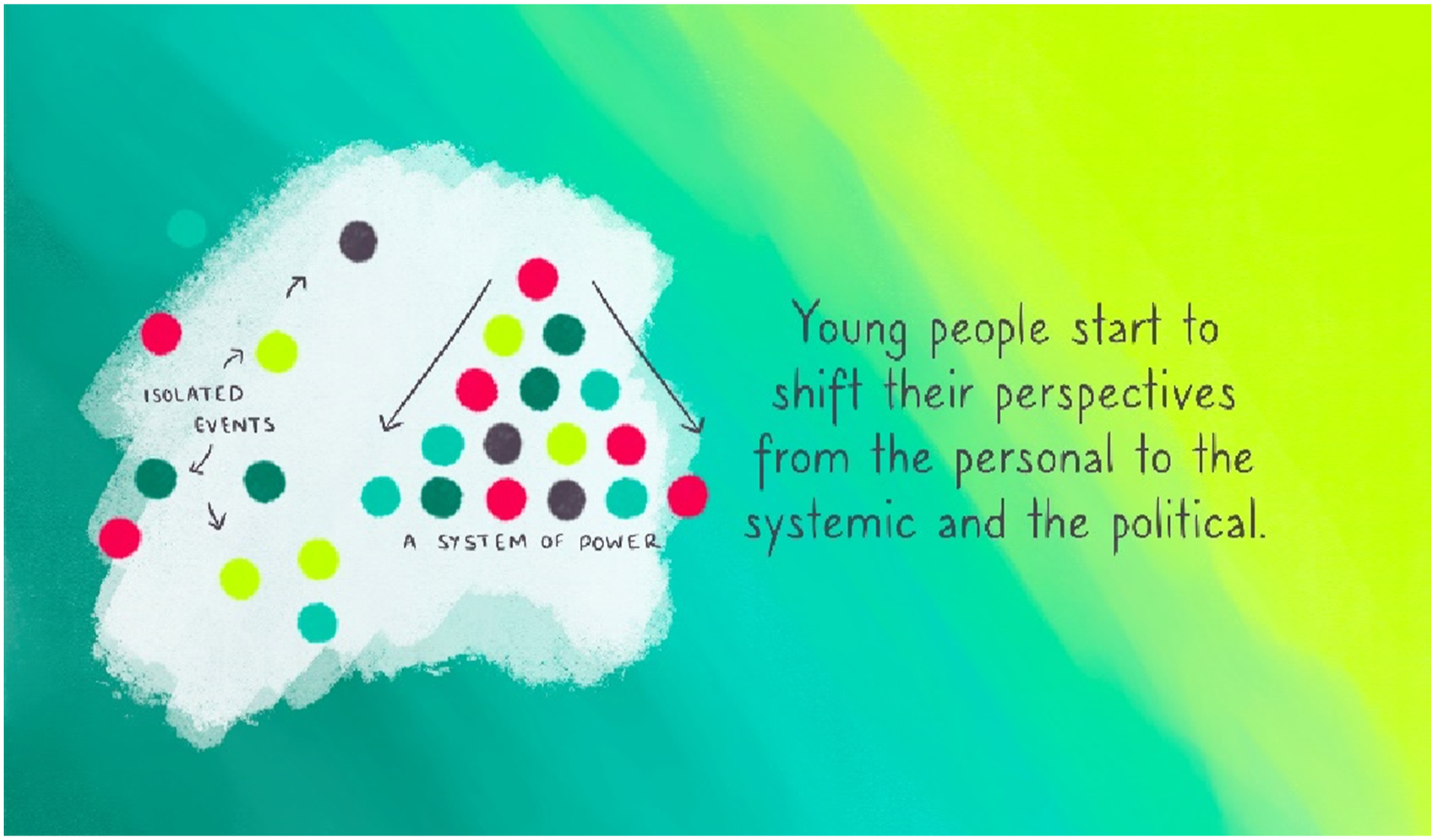
The quote above demonstrates the potential for young people’s involvement in research to help develop critical thinking skills and consciousness (Freire, 1973), which in turn allow them to contribute to changing things to help protect others.
Other YRAP members highlight the significance of the relationship between research and social change, citing tangible examples of how their work in research had influenced policy or practice (see Figure 3: Young people’s influence creates service improvements). As YRAP members we also recognise that seeing our influence builds self-efficacy and confidence to implement wider changes in our own lives and the world around us. ‘Young people’s influence creates service improvements’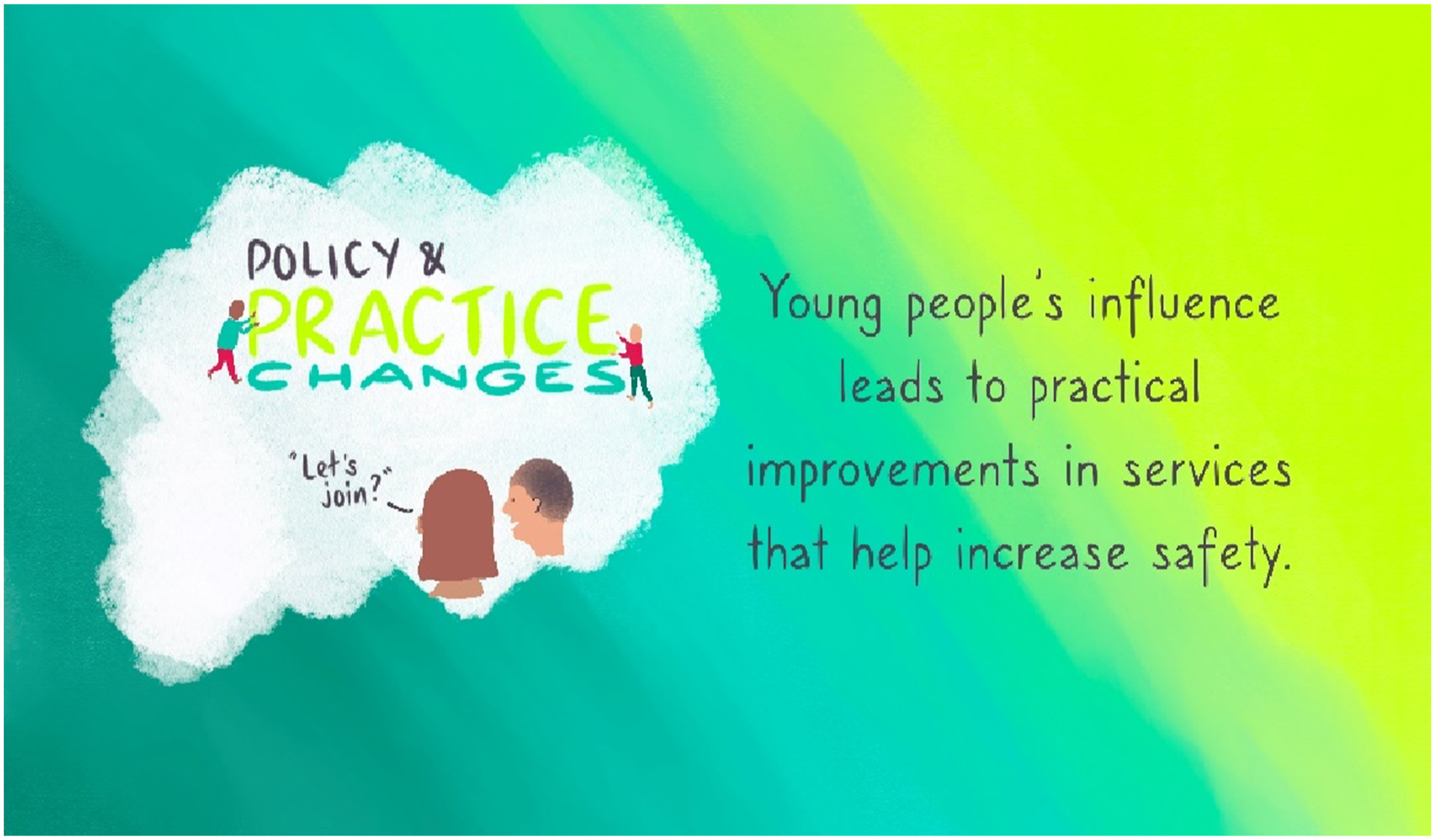
Relatedly YRAP members reflect on how helping to design research had a personal impact on our wellbeing and protection - linked to the importance of enabling young people to assert influence and control in the aftermath of trauma. ‘Participation has been so empowering and healing for me, to feel part of real change. When young people experience this kind of trauma, difficult decisions are made for them, and they feel like they don't really have any sense of control over their life or even their own bodies. Feeling in control and feeling like you can make an impact has been instrumental in my recovery. (YRAP member)
Conclusion
‘YRAP isn't therapy, but it is therapeutic in that it has a much more of a rippled impact on a sense of worth... And although that's not the aim of YRAP, it is a by-product of it. And I think that's really important as well because that also links back to that protectiveness, doesn't it, because it gives you a sense of who you are and the opportunities that [we've] spoken about.’ (Former YRAP academic supporting staff)
Developing this model has created time and space for us to reflect together on YRAP and its role within our research culture and wider practice and policy. It has supported us to further review our practice and develop our ideas more deeply, carefully and collaboratively, so that future cohorts of YRAP members can build on this.
Similarly, the process of writing this article has created a focussed space for us to reflect openly about the challenges as well as achievements of our work with the hope we will spark other people’s conversation and practice. This reminds us of the benefits of processes as well as outputs. Models and conceptual frameworks are helpful communication tools, but also the journey of creating together holds value. The reflective culture we describe as core to YRAP is one we have found can be fostered not just through talking but also writing, visualising and making things together.
Unsurprisingly, in the process of writing this article we also identified gaps and new aspects of our work we want to share with others. For example, our existing Participation as Protection model focuses primarily on benefits to children and young people. Although they are rightly centred, there are also benefits to organisations and adults who work alongside young people that continue to remain obscured. A revelatory moment in our process of developing this article came when we shared reflections about how being part of YRAP had changed us. Several YRAP members expressed shock upon hearing about the impact of the work on academic supporting staff. The idea that the impact of YRAP was bi (or multi)- directional - with young researchers influencing, teaching and changing supporting research staff - came as a surprise. We subsequently realised that the concept of reciprocity within participatory research remains less considered, highlighting how pervasive inequalities endure within our work. Perhaps these are the legacy of a ‘welfare model’ that prioritises individual case work (and ‘rescue’ of individuals) over collective models of care. We believe that further work is needed to explore this and further embed reciprocity and mutuality within our work.
We conclude by noting that as long as resistance to child and youth participation in contexts of trauma continues, we see a clear role for YRAP in advocating for such approaches in research and practice while recognising enduring tensions. For example there remains the challenge that YRAP (and groups like them) are often held up as exceptions. Furthermore we recognise that the presence of YRAP potentially enables some professionals to exclude other young people from research or influencing roles if collaboration with YRAP enables them to avoid developing their own pathways for co-production or participation initiatives. We want others to use YRAP to recognise what is possible – to learn from our mistakes and better understand how young people’s participation in research and elsewhere is an essential aspect of upholding children’s rights and preventing harm to children everywhere.
Footnotes
Declaration of conflicting interests
The author(s) declared no potential conflicts of interest with respect to the research, authorship, and/or publication of this article.
Funding
The author(s) received no financial support for the research, authorship, and/or publication of this article.

