







Abstract
This article applies the techniques of critical discourse analysis (CDA) to an examination of the Chinese government-owned English-language newspaper the China Daily. The aim is to see whether there is evidence that over the last decade the newspaper, which describes itself as the overseas ‘Voice of China’, has attempted to adapt its style of reporting in response to China’s raised international profile, as well as to the increasing diversity and commercialization of its media industry. The study adopts a quantitative and qualitative approach to the analysis of two corpora of texts from the newspaper: one from 1998 and the other from 2010. The focus is on what Labov calls evaluation: an aspect of the narrative structure of a text that has to do with the way the narrator embellishes a narrative to make it more interesting. The results suggest that the China Daily has made its reporting more diverse and interesting, probably in response to the commercialization of China’s media industry and to China’s growing international profile.
On 23 July 2011, two high-speed trains collided near Wenzhou in mainland China. What happened next spoke volumes about the nature of the relationship between the Chinese state and the country’s media. Chinese news outlets quickly reported the news of the collision.
But within hours, reporters received directives from the Central Propaganda Department, the Information Office and other government departments on how and what to report. Many journalists were called back from the crash scene. Newspapers and television stations were instructed to report positive stories, and to avoid questioning the Ministry of Railways and the government more generally.
1
This was not the end of the story, however. Despite the government’s efforts at control, some state media outlets carried strongly worded criticism of the Chinese government. By 29 July, a dramatic shift in mainland news coverage was underway. ‘Media, including the People’s Daily, did widespread reporting and commented strongly on Chinese Premier Wen Jiabao’s visit to Wenzhou. The front pages of many Chinese newspapers conveyed the sadness and rage felt by ordinary Chinese.’ 2
Qian Gang offers three main reasons as to why such a shift was possible: the rapid growth of the Internet, which enabled passengers to blog immediately after the crash; the professionalism of China’s media professionals, who increasingly ‘see themselves as voices of the people, as tools of the public interest’; and the existence of a force for political reform within the Chinese Communist Party (CCP) itself. Thus, while state propaganda officials instructed China’s media to use only information released by the official state news agency Xinhua, Xinhua itself began asking hard questions about the collision. This encouraged other media to push ahead with bolder reports questioning the causes of the accident. A visit to the scene by Premier Wen Jiabao, who has frequently come out in favour of political reforms, ‘instantly cancelled out propaganda directives against coverage’. 3
The tension between an increasingly diverse, commercialized and globally exposed media in China and the attempts by the Chinese state to maintain control over its media while pressing ahead with economic reform and greater global integration have been the focus of increasing academic attention in the last decade or so. Some, such as Stockmann and Gallagher, 4 use content analysis of Chinese newspapers and a TV news programme, supplemented by interviews with Chinese journalists and a survey of news consumers from four Chinese cities, to document how Chinese media coverage of labour disputes ‘hews closely to the Party line, despite the fact that marketization has changed the way the news is delivered’. Others, for example Wang and Chen, 5 use data collected from a survey of Chinese news consumers in Shanghai to examine whether the attitude of Chinese citizens towards state–media relations is shifting.
This article aims to contribute to the growing body of work by using the techniques of critical discourse analysis (CDA) to look at how one Chinese newspaper in particular – the English-language China Daily – has been responding to the changing social, economic and political climate in China over the last decade. There are good reasons for focusing on the China Daily. Not the least of these is the fact that, being written in English, it is conducive to analysis by linguistic tools and methodologies developed for the English language.
There has been a huge amount of academic research aimed at deconstructing the way the English-language media function, which has resulted in a range of sophisticated linguistic tools and approaches being developed for the precise analysis of English-language media texts. Work has been done, for example, on challenging the idea that news coverage is the unbiased reporting of ‘hard facts’; 6 on analysing the social construction of news through choices of what has ‘news value’ and choices about how news is presented; 7 and on the social and economic factors involved in news selection. 8 More recently, the concept of framing has been used for the analysis of media texts. First defined by Goffman, framing refers to the concept of organizing central themes through which issues are viewed 9 or, as Reese puts it, ‘the way events and issues are organized and made sense of, especially by media, media professionals and their audiences’. 10 By studying the way that journalists frame their reports, frame analysts can learn a great deal about how journalists (often unconsciously) present reality, frequently highlighting certain aspects of that reality over others.
Using techniques ranging from critical discourse and genre analysis to frame analysis, researchers have been able to challenge the conviction held by Western journalists that, in terms of news reporting at least, their job is to collect facts, report them objectively, and present them without bias. Reality is understood to be far more complex: the ‘content’ of newspapers is not facts about the world, but a social construction of ideas, beliefs, values, theories and ideology. 11
The research project of which this article is a part falls within the research tradition that has been able to so effectively deconstruct the Western English-language media. However, this article seeks to apply some of the same techniques to the analysis of the Chinese media. Where previous studies have involved content analysis, interviews and surveys; 12 the monitoring of Chinese news outlets that have been closed; 13 or a focus on censorship, 14 this study looks at a particular aspect of the language used in the China Daily. In that respect, at least, it is not dissimilar to frame analysis, since it analyses news texts through a ‘frame’ of certain, specific linguistic features.
The approach used builds on my previous research. Between 2004 and 2008 I published a series of papers that used the techniques of critical discourse analysis in a direct comparison of corpora of texts from the UK Times and the China Daily. The aim was to develop a range of critical linguistic tools that could identify in newspaper texts key linguistic indicators that revealed the social, political, cultural and commercial factors influencing the writing of those texts. I sought to identify a number of such indicators, including what Halliday refers to as verbal processes (verbs of saying used to introduce what someone says in reports of speech, such as ‘said’, ‘claimed’ and ‘declared’); evaluation (an aspect of the narrative structure of a text that indicates the writer/speaker’s emphasis on the importance or interest of what is being narrated – evaluation was identified by William Labov 15 in his 1972 work on oral narratives and will be more fully discussed later); the type of person selected for quoting in newspaper texts; and the use of direct speech quotations. I then analysed two corpora of newspaper texts drawn from newspapers that belong to widely different media traditions (the UK Times from a market-driven, politically independent media tradition; and the China Daily, a state-owned newspaper from a tradition in which state censorship and control are routine) to look for differences in the frequency and use of the various indicators, and attempted to interpret these differences in the light of the cultural, social and political influences operating upon the two newspapers. The methodology adopted was both quantitative (in the use of statistical analysis of large quantities of data from significantly sized corpora of texts) and qualitative (through means of close analysis of individual texts to understand how indicators were used within a text and what they might reveal about the beliefs, values and ideologies they encoded). The analyses 16 identified clear differences between the two newspapers according to a number of these indicators. The results were interpreted as providing linguistic evidence for differences between the newspapers both in terms of their relationship and attitude towards the state (with the China Daily more supportive of and respectful towards government figures, The Times more sceptical and questioning) and in terms of the emphasis they placed upon readability and dramatic richness (with the commercial Times, which operated in a competitive media environment, far more concerned with producing dramatic, readable texts than the state-owned China Daily).
The texts (50 from the UK Times and 50 from the China Daily) analysed in those earlier studies were all selected from newspapers published in 1998, that is, before China joined the World Trade Organization (WTO); before the country’s decade of unprecedented economic growth; and before China staged the Olympics in 2008. Its increasing participation in the global market and the arrival of the Internet have since opened the country to unprecedented levels of international scrutiny.
But how much has the China Daily responded – if at all – to the growing diversity and increased commercialization of the Chinese media industry since 1998? The existence of the original database of China Daily texts from 1998 offers an opportunity to find out.
This study is part of a programme of research that seeks to compare the database of China Daily texts from 1998 with a new corpus of 50 China Daily texts from 2010. The programme aims to employ the same approaches to analysing texts, and the same quantitative/qualitative methodology, used in those earlier papers to contrast the China Daily with The Times. The aim is to look for evidence of change in the language used by the China Daily and to interpret such evidence in the current context of the Chinese media industry and its changing relationship with the state.
While it is possible to examine corpora of China Daily texts from several different time periods, so as to chart the process of change and relate this to the prevailing conditions, for reasons of space and time that has not been done here. Changes in China that have taken place between 1998 and 2010 as already outlined and described in more detail later are sufficiently significant to justify a study that compares corpora of texts from these two time periods.
While this study is about change in the China Daily between 1998 and 2010, reference will also be made to the findings of my original analysis of 1998 texts from the UK Times. Such reference is not the main point of this study and is made purely in order to better understand the changes that have taken place in the China Daily since 1998, and to see whether there are any aspects of its language, style and attitude towards government that have converged towards those of a newspaper (The Times) that belongs to a market-driven, politically independent media tradition.
The article focuses on evaluation as defined by Labov. It is an aspect of the narrative structure of a text that clearly reveals the emphasis a writer places upon readability (and hence, presumably, on the need to attract and retain readers). There is also some consideration given to the range and diversity of points of view expressed. A fuller account of evaluation will be given later. First, I will look in more detail at the literature relating to the development of China’s media over the last decade or so, to provide a context for the analysis that follows.
The media in China
The media and the state
The first decade of the 21st century was a period of extraordinary change and economic growth in China. The country emerged as a truly global power: a process punctuated by its joining the WTO in 2001, the Beijing Olympics in 2008, and China’s overtaking Japan in 2011 to become the world’s second biggest economy. But was this emergence on the world stage accompanied by progress in democratization of the country’s media?
Historically, in the period before Deng Xiaoping launched his ‘second revolution’ in 1978, there were a limited number of media outlets in China: a few central government-published newspapers and journals and a network of central, provincial and municipal ‘people’s radio stations’. These tended to follow the same approved ideological line when reporting on national and international events 17 and were generally ‘restrained by both ideological controls and by the system of the planned economy’. 18
The role of the media in China began to shift after the introduction of the market economy in 1980. 19 The Chinese media were encouraged to play a dual role of serving the Party and the market – even if the Party remained the priority. News outlets were increasingly allowed to become multiple role players, ‘including the provision of information, entertainment and news’. 20
The 1989 student democracy movement posed a challenge to a media whose relationship with the state was already in a state of flux. Conley and Tripoli describe how the China Daily’s coverage of the crisis fluctuated. 21 At the height of the crisis the Propaganda Department officials, who usually met regularly with media leaders to deliver the Party line on how events should be covered, failed to meet with any top Beijing editors. The result was that many news outlets adopted an ultra-cautious line, including the China Daily, whose policy was ‘to do less than other newspapers and to do it later’. 22 Nevertheless, in the absence of a correct Party line to follow, coverage of the events fluctuated. For a brief period the China Daily provided more extensive coverage of the demonstrations, before the declaration of martial law on 20 May led to the re-establishment of a clear Party line. 23
Despite the re-establishment of Party control, the process of change that had been underway in the Chinese media before the student democracy movement continued and even accelerated afterwards. 24 The government began permitting the popular press, such as evening and weekend newspapers, to explore alternative and critical views. Nevertheless, by 1998, while there had been significant changes in the news media in China, in terms of increasing variety and liveliness and a reduced explicitly propagandist content, the CCP still retained ‘overt political control’ – and one of the roles of the media was to serve as a government mouthpiece. 25
In the decade before economic and social change began, the consensus among many was that Chinese journalists still enjoyed significantly less freedom from state interference and control than their Western counterparts. 26 The mainstream government-controlled and government-funded media were largely expected to report positive events and/or put a positive spin on other events that were reported. 27 China, however, had already by this time increasingly begun to participate and compete in the global economy through exports and foreign direct investment. 28 China’s integration with the global economy could not but constitute a powerful surge towards a market economy, and the Chinese government began pushing the nation’s media towards a more market-driven model. 29 The result was an explosion of new media outlets. By 2001, a new class of commercial media outlets had emerged, an example of which is the Beijing Youth News, a newspaper that increased circulation by offering lively reports about crime, sports and economic successes. 30 By 2005 there were nearly 2000 newspapers, 9000 magazines, 300 radio stations and more than 300 TV stations. 31 With the introduction of the Internet, almost all these outlets developed an online presence as well.
The commercialization of the media has necessarily changed their relationship with the state. While the state continues to own most media, it is unable to dictate the style and content as forcefully as it did in the past. Under the dictates of the market, media organizations that no longer relied on state funding stopped acting as dry mouthpieces of the Party: they had to innovate and come up with styles and contents that could help them attract readers and increase circulation. 32
The commercialization of China’s media went hand in hand with another factor: the country’s increased integration into the global economy and hence increased exposure to international scrutiny. Tong Bing argues that China’s entry into the WTO in 2001 led to a relaxation of restrictions on the Chinese media; the media was encouraged to play a greater role in scrutinizing the government, and there was a greater emphasis on freedom of speech and information. 33 While state monitoring and control of media output was less overt, however, this did not mean it had disappeared: it had simply become more subtle. Stockmann and Gallagher argue that while commercial liberalization and diversification of media outlets may have changed the way news content was delivered to readers, media content still stuck close to the Party line by emphasizing the positive. 34
He Qinglian points out a number of misconceptions in the West about increasing media freedom in China, 35 such as the belief that market liberalization promotes media liberalization; that the Internet promotes the free spread of information in China; and that because ordinary Chinese people are now more free to talk about anything they want (including insulting leaders) among friends, they must now enjoy freedom of speech. In fact, it is argued by He that since 2005, the Chinese government has exerted increasingly tighter control of the media. She cites the closure of a string of media outlets since 2005, including Xinjingbao (Beijing news), Bingdian (Freezing point) and Shenzhen fazhibao (Shenzhen legal times).
Bennett lists a range of ways in which the Chinese government continues to use intimidation to control the media and induce journalists to censor themselves rather than risk punishment. 36 These measures include dismissals and demotions, fines, closure of news outlets, imprisonment and self-censorship. Bennett also lists the Chinese government bodies involved in monitoring the flow of information in China, the principal actor being the Communist Party’s Central Propaganda Department (CPD).
Lum and Fischer argue that China’s increasingly commercialized media outlets negotiate a ‘delicate balance between responding to growing public demands for information and remaining within the bounds of what authorities will allow and advertisers will support’. 37 Wang and Chen conclude that state control of the Chinese media has become less intrusive and less direct. In some areas the media are more autonomous than ever; but when it comes to politically sensitive issues, the state still maintains strict control. 38
Why China Daily?
The China Daily is China’s leading mainstream English-language newspaper. According to its website, the newspaper has an average daily circulation of more than 200,000 – one-third of which is abroad. From the point of view of this study, the fact that it is written in English offers a great advantage, since it is amenable to analysis using analytical methodologies developed for English texts. But how representative is it of the Chinese print media more generally?
Given the range and diversity of news outlets that have developed in China over the last decade or so, the China Daily may not be generally representative of the Chinese print media. But it is, at least, perhaps representative of that section of the Chinese media – the large, mainstream, government-controlled news outlets – over which the Chinese state still has most control. China Daily is owned by China’s principal Chinese-language newspaper, the People’s Daily. It is produced in the same building and is effectively an English-language sister paper. 39 By its very nature, the China Daily is written for a foreign language-speaking audience, so it could be said to be the ‘mouthpiece for the Party in its efforts to communicate with the wider world’. 40
The China Daily itself, on its website, describes its mission as being to help the world ‘know more about China and the country’s integration with the international community. China Daily is … an important source of information on Chinese politics, economy, society and culture. It is often called the “Voice of China” or “Window to China”.’ 41 New US and UK editions have recently gone into circulation following a RMB 45 billion investment in overseas media by the CCP 42 – an indication of the newspaper’s importance in the eyes of the Party in terms of the way China is perceived overseas.
The China Daily is still subject to a degree of state control. The China Detail website claims that a high degree of self-censorship is practised by its journalists, with subjects such as Taiwan, Tibet and Falun Gong usually deemed ‘too sensitive’ to cover. Foreign editors of the newspaper have been told that the paper’s editorial policy is to support the policies of the CCP and only to criticize the authorities in the event of deviation from Party policy. 43 The newspaper has, however, been affected by the commercialization of China’s media industry. China Detail reports that, like most other state-owned Chinese industries, the newspaper and the publication group to which it belongs will no longer receive subsidies. The China Daily has thus adopted a more commercial approach, with its editorial content being pitched increasingly towards a wider range of readers so as to earn more advertising revenues. 44
For several reasons the China Daily thus offers a unique window through which to study the changing relationship between the Chinese state and media. It is written and published in English, which makes it conducive to analysis involving methodologies that have been successfully applied to the study of the English-language Western media; it is susceptible to the same market forces that are transforming the rest of the Chinese media; and it is closely associated with the CCP and clearly reflects the way the Party wishes China to be perceived by the outside world.
Evaluation
William Labov developed the concept of evaluation while studying speech patterns in New York. He asked subjects to record oral narratives in which they talked about personal experiences. In the analysis of these narratives, Labov identified six structural elements that make up a narrative:
- the abstract, which sets out what a narrative is about
- the orientation – who, where, when, why, and what
- the complicating action
- the evaluation
- the resolution
- the coda
The evaluative element has to do with the way the speaker embellishes his/her narrative to make it more interesting. Evaluative elements, according to Labov, say to us: ‘This was terrifying, dangerous, weird, wild, crazy; or amusing, hilarious, wonderful; more generally that it was strange, uncommon or unusual – that is, worth reporting’. 45 As will be seen later, texts rich in evaluation tend to be multi-layered and dramatically and emotionally engaging.
The use of evaluation is an important indicator of the nature of the relationship between narrator and audience because it suggests that the need to attract and hold the attention of the audience is important to the narrator. Newspaper texts, in which a journalist (henceforth the term journalist will be used for the author of a newspaper text, although it should be noted that such texts go through a complex process of writing and editing that involves several people) often quotes the words of someone else (the sayer), reveal the relationship between the sayer and his audience; the journalist and his audience; and between journalist and sayer.
Although Labov’s system was developed for the analysis of spoken English, it could also be usefully applied to the analysis of written texts. 46 The study I carried out in 2004 compared 50 texts from the UK Times and 50 from the China Daily – all published in 1998 – in terms of their patterns of use of a particular category of evaluative linguistic device which Labov labelled comparators. 47 These, according to Labov, provide a way of evaluating events by placing them against the background of other events that might have happened, but did not. By doing this, comparators enrich the telling of what did actually happen. Labov identifies several types of comparator evaluation, including the following:
- Negative evaluation, such as has no plans in the sentence ‘The headmaster at William Straw’s school says he has no plans to suspend or discipline the teenager’ drawn from the corpus of Times texts analysed in 2004. Negative evaluation places the events described against a context of other events that might have happened, but did not: William Straw’s headmaster could have suspended the teenager, but has not. Negative evaluation, as will become apparent from examples analysed later, is an effective linguistic device for heightening the drama of a narrative; at times, it even makes it possible to construct a reportable narrative out of very little.
- Future evaluation, such as will make in ‘The mainland will make greater effort towards furthering cross-straits ties’ from the China Daily corpus analysed later in this article. This tends to be used when reporting on future events or developments. Often such reports involve a sayer, such as a politician, talking about plans for a better future.
- Modal evaluation, such as should begin in ‘Taiwanese authorities should begin political discussions’, again from the China Daily corpus. These enable the narrator (or sayer, where the modal evaluation is directly attributed to a particular sayer) to express visions of the world as he/she believes it could or should be.
The results of my 2004 study revealed the different role that The Times and China Daily played in their respective societies in 1998. The Times, a commercially owned newspaper faced competition from rival newspapers, questioned authority and was concerned with producing interesting, dramatically rich reports in order to attract readers and hold their attention, made ample use of evaluation. The China Daily in 1998 was essentially a state-controlled newspaper that acted as a mouthpiece for the Chinese government and, being centrally distributed, did not need to spice up its reports to attract readers; it used comparatively little evaluation. 48
While this article is also concerned with comparators, the original corpus of 50 China Daily texts from 1998 will be compared with a new corpus from 2010. For reasons of space, it deals with only two of the three sub-categories of comparator identified above: negative and future comparators. Modal comparators are dealt with in a separate study. 49
If the nature of the relationship between Chinese journalists and their readership has indeed changed since 1998, we may expect to find linguistic evidence of that in Chinese newspaper reports. An increased use of evaluation might suggest, for example, that since 1998 the China Daily has become more sensitive to the demands and interests of its readership: perhaps as a result of increased competition from rivals, or perhaps because of increased sensitivity to international scrutiny.
Methodology
A total of 100 China Daily texts were analysed: 50 from 1998, 50 from 2010. In order to try as far as possible to compare like with like, a number of criteria for the selection of texts were decided upon. Texts were all between 250 and 700 words long (feature-style content and short ‘briefs’ were excluded), about domestic news, and published online. The first piece of domestic news found for any day that satisfied the criteria was selected; no other texts from that day were chosen.
The approach was both quantitative and qualitative. It was quantitative in the use of statistically significant samples of texts, which were analysed with the aim of identifying significant differences in the patterns of use of evaluation in the China Daily between 1998 and 2010. Instances of negative and future evaluation found were recorded and tabulated. A count was also made of whether evaluation occurred in direct or reported speech (and hence could be attributed to a sayer being quoted) or in the narrative itself (and hence was attributed to the journalist).
But the approach was also qualitative. Individual texts from each corpus that were particularly rich in the use of negative or future evaluation were subjected to a close textual analysis in order to better understand how evaluation was being used in context, and what its use suggested about the newspaper’s relationship with its readership and, to a certain extent, its attitude towards the information it was reporting. Reference was also made to the findings of my original analysis of 1998 texts from the UK Times. This was done in order to comprehend more clearly the changes that have taken place in the China Daily since 1998, and to ascertain whether any aspects of its language, style and attitude towards government have converged towards those of a newspaper (The Times) which belongs to a market-driven, politically independent media tradition.
Findings
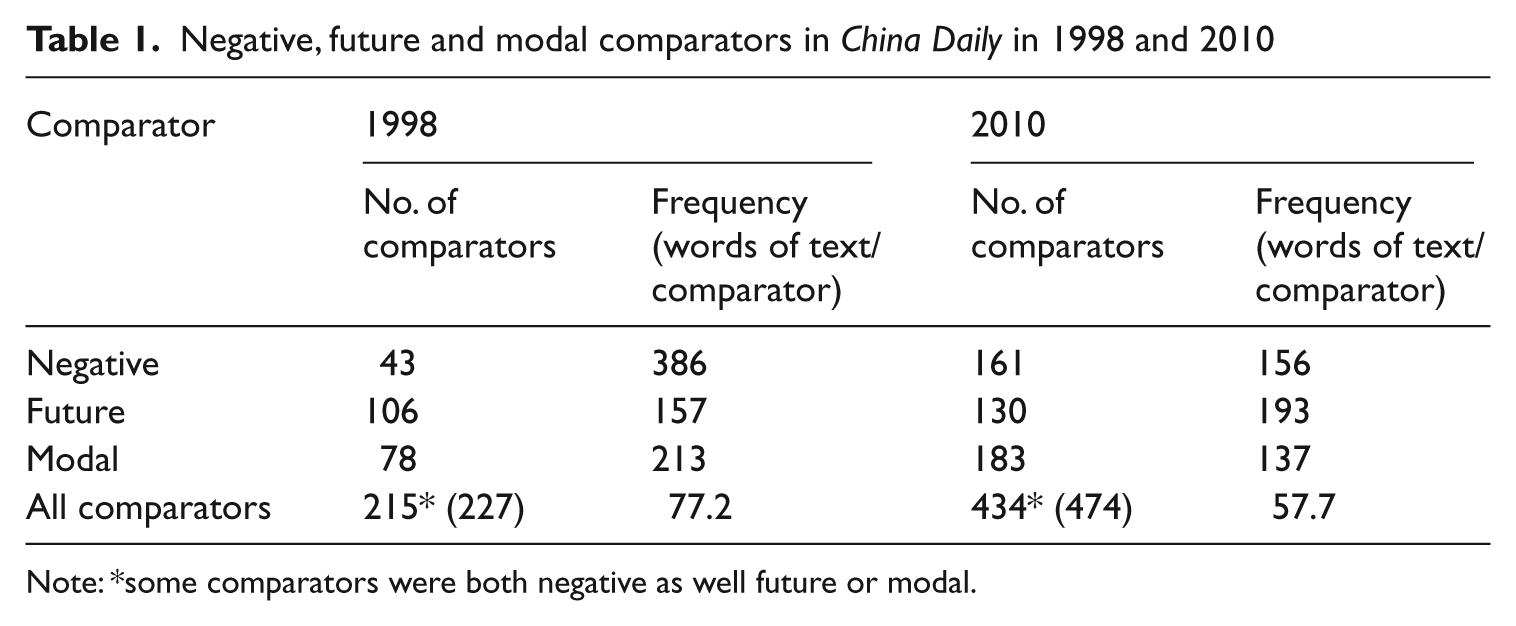
The analysis revealed some striking quantitative differences between the two sets of texts. These are summarized below as well as in Table 1. Significance was calculated using the proportion test, unless otherwise stated:
- Use of comparator evaluation overall (including modal evaluation, which is not examined in detail in this study) more than doubled between 1998 and 2010, from 215 instances in 1998 to 434 in 2010. This finding is very significant (P<0.001, t test).
- Allowing for the greater average length of texts in 2010 (which had a total word count of 25,038 words, compared with 16,598 in 1998), the frequency of comparators had nevertheless increased to one every 57.7 words in 2010, compared with one every 77.2 words in 1998. This increase is significant (P<0.05).
- The frequency of negative evaluation more than doubled, from one every 386 words in 1998, to one every 156 words in 2010. This increase is significant (P<0.01).
- The frequency of future evaluation decreased from once every 155 words in 1998 to once every 193 words. This decrease is not significant.
Negative, future and modal comparators in China Daily in 1998 and 2010
Note: *some comparators were both negative as well future or modal.
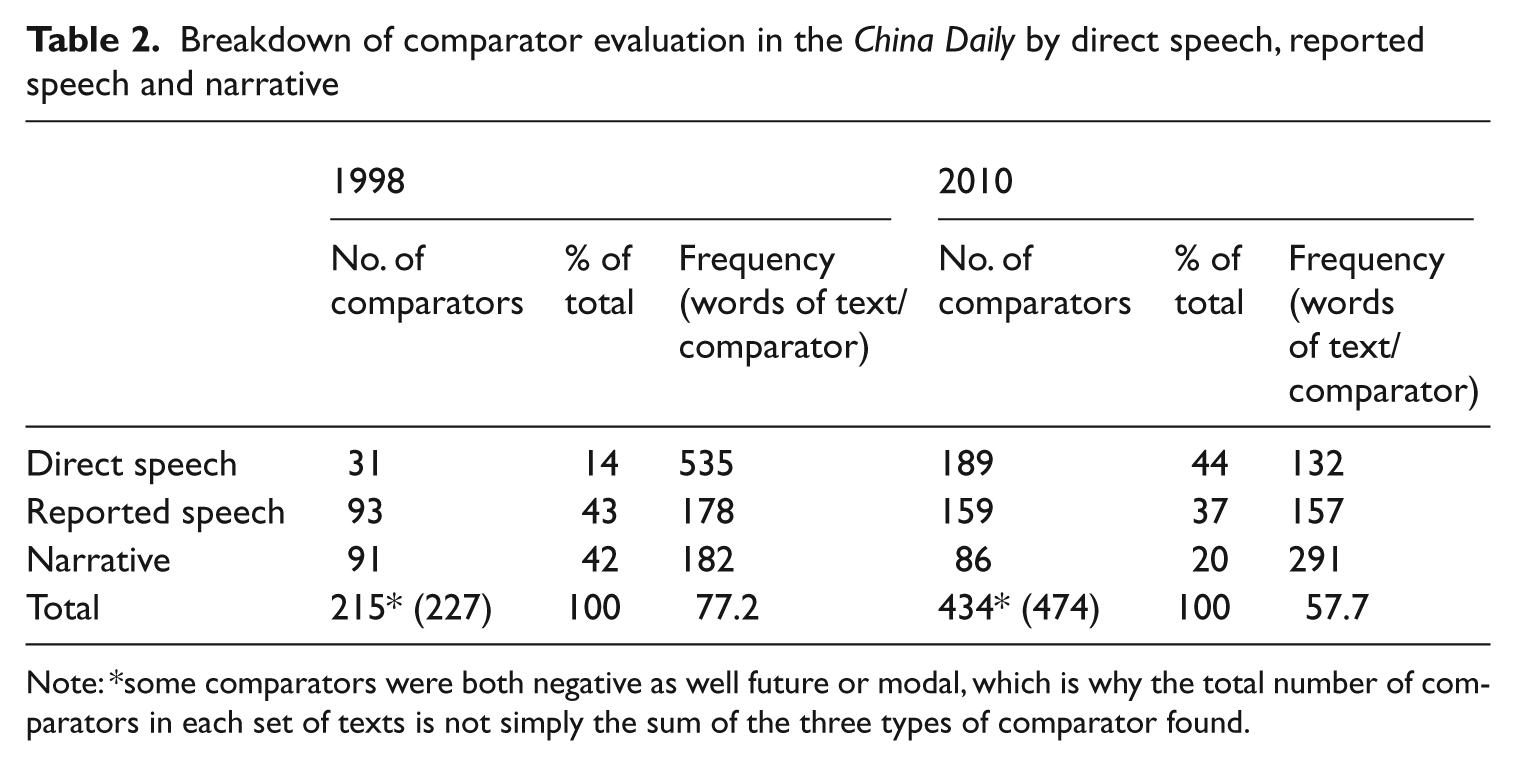
Comparators were further categorized into: those that occurred in direct speech (and hence were purportedly the words of the person being reported on, selected but otherwise uninfluenced by the journalist); those in reported speech (a representation of a speaker’s words, but as summarized by the journalist); and those in the narrative (and hence the journalist’s own words). The results are summarized below and in Table 2:
- The frequency with which comparators occurred in direct speech increased from once every 535 words in 1998 to once every 132 words in 2010. The change is significant.
- The frequency with which comparators occurred in reported speech increased slightly, although the change was not significant.
- The frequency with which comparators occurred in narrative dropped sharply, from once every 182 words in 1998 to once every 291 words in 2010. The change is significant.
Breakdown of comparator evaluation in the China Daily by direct speech, reported speech and narrative
Note: *some comparators were both negative as well future or modal, which is why the total number of comparators in each set of texts is not simply the sum of the three types of comparator found.
The quantitative findings show that there were real changes in the use of comparator evaluation in the China Daily between 1998 and 2010. Overall, use of evaluation increased significantly. My 2004 study, which compared the same set of 50 China Daily texts from 1998 with 50 from the UK Times in the same year, had revealed that comparator evaluation was far more frequent in The Times than in the China Daily. Since the effect of evaluation is to enrich a narrative and to make it more dramatic and interesting, and since the commercial character of The Times meant that it had to compete with its rivals to attract and retain its readership, I suggested that one reason for the greater use of comparator evaluation in the latter newspaper may be that journalists were attempting to brighten up and dramatize their writing to attract more readers. One explanation for the increased use of comparator evaluation by the China Daily in 2010 may therefore be that it has become more concerned about the need to attract readers and maintain its appeal than in 1998.
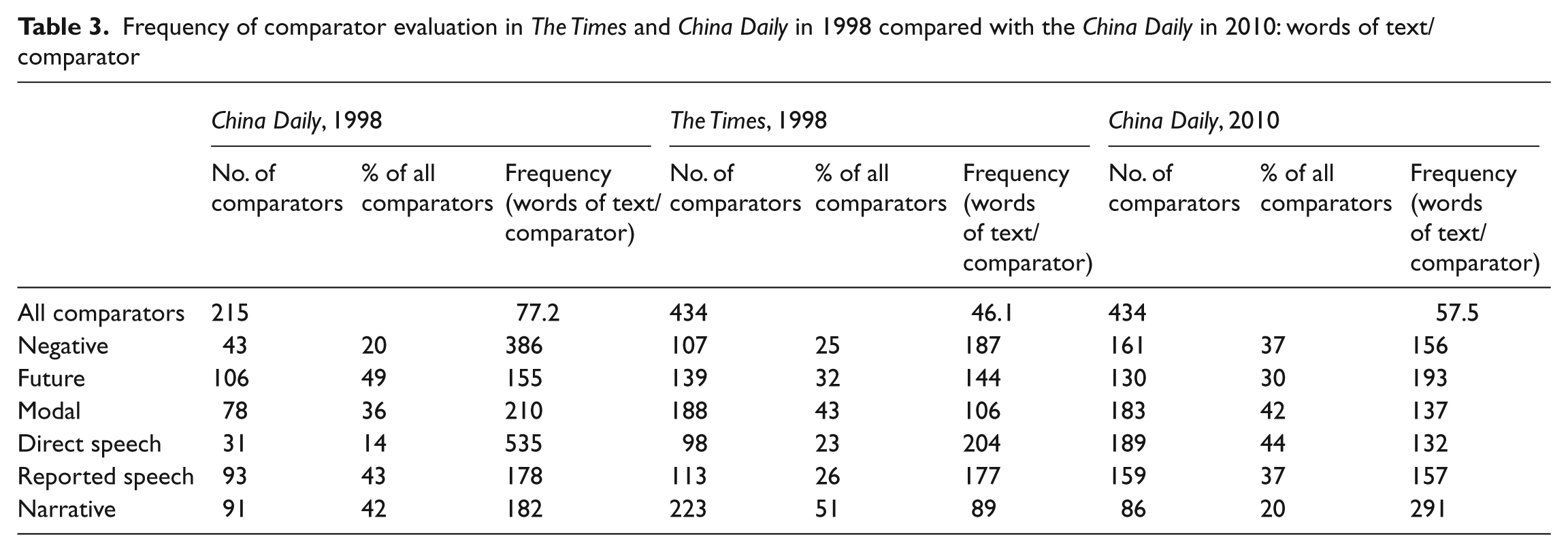
The need to attract a wider readership is illustrated by other similarities exhibited by the use of comparator evaluation in The Times in 1998 and China Daily in 2010 (see Table 3). The former was rich in negative evaluation, like the China Daily in 2010 but not the China Daily in 1998; and both The Times and the China Daily in 2010 used proportionally less future evaluation than the 1998 China Daily. However, the situation is more complex. In one area in particular – comparators that occur in narrative, rather than in direct or reported speech – the use of comparator evaluation in the China Daily in 2010 is very different from The Times. More than half of all comparators in The Times occurred in the narrative. In the China Daily in 2010, however, only 20 per cent of comparators occurred in the narrative – even much less than in the China Daily in 1998.
Frequency of comparator evaluation in The Times and China Daily in 1998 compared with the China Daily in 2010: words of text/comparator
In an attempt to better understand the patterns that the quantitative data reveal, I now look more closely at the texts themselves.
Interpretation
Negative evaluators
Analysis of the two sets of China Daily texts reveals a huge increase in the number and frequency of negative evaluators between 1998 and 2010. Negative evaluation in the China Daily in 2010 is, in fact, even more frequent than it was in The Times in 1998 (see Table 3).
To ascertain the reasons for this change, I first revisit The Times texts analysed in 2004 to illustrate the way in which evaluation is used in a commercial, politically autonomous newspaper. In that earlier analysis, 50 I looked in detail at The Times text containing the highest level of negative evaluation: article 38, an account of an incident at the school attended by the then British Home Secretary Jack Straw’s son William. The headmaster of the school said he would not punish the boy for selling marijuana. Table 4 shows the negative evaluation found.
Negative evaluation found in Times article 38
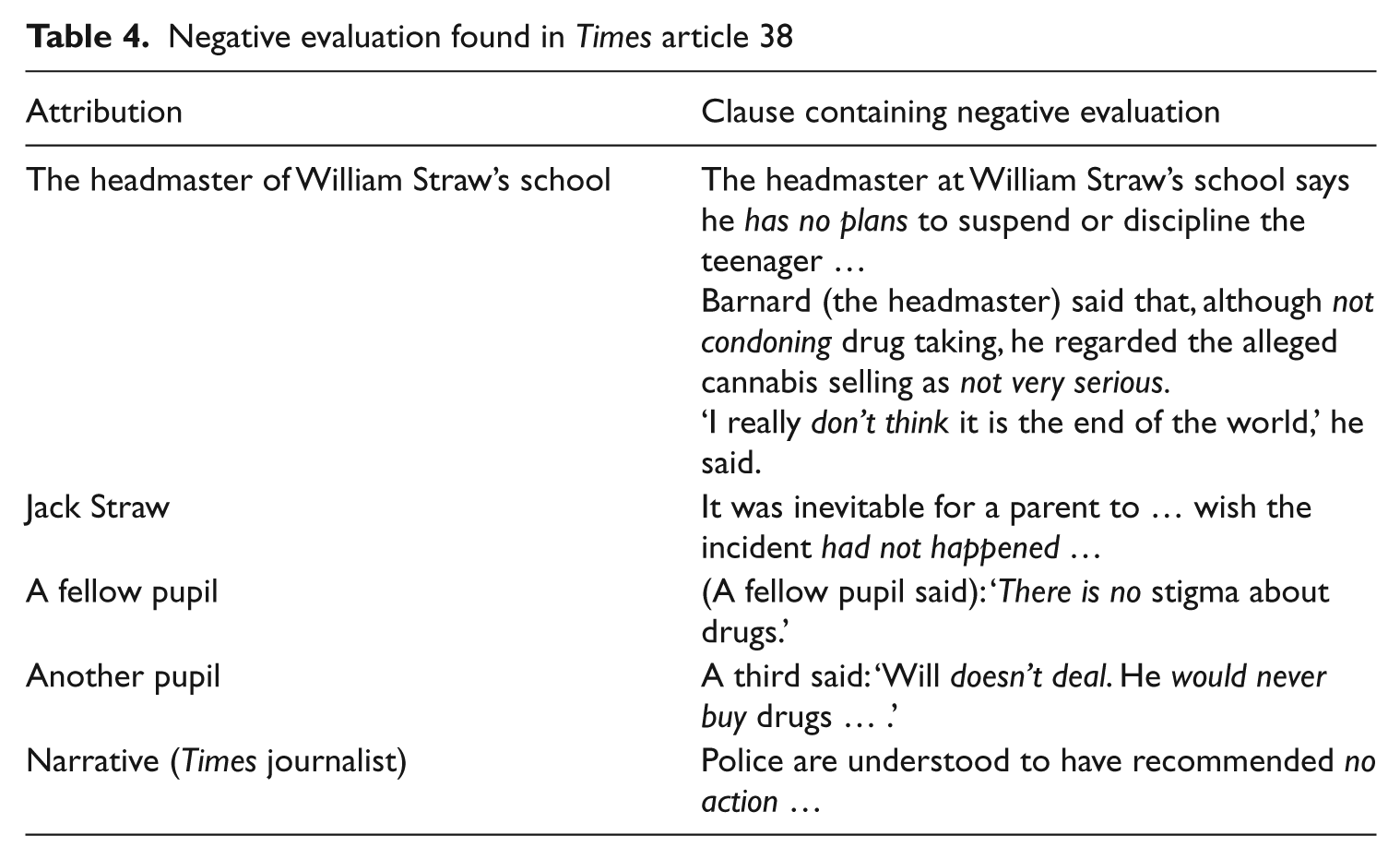
I noticed a number of things. First, the whole narrative was predicated on negatives. The headmaster had no plans to suspend or discipline William Straw; selling marijuana was not serious; the boy did not deal. The entire report was about nothing happening. What gave it news value was the connection to a senior politician. What made it reportable was the denial – the negative evaluation. By beginning the text with the statement that the headmaster had no plans to discipline the teenager, the journalist raised in the reader’s mind the possibility that the headmaster might have done so but decided not to, and that, despite the denials, he may therefore have had reason to do so.
There was something else. Analysis of the 1998 texts revealed that overall, more than half of The Times evaluation was found in the narrative, and hence was the journalist’s own choice of language. This was not the case, however, with negative evaluation. Almost 70 per cent of negative evaluation in The Times occurred in either direct or reported speech, and was associated with an identified sayer. The effect of this is clear from text 38. Eight of the nine instances there occurred in direct or reported speech, in clauses attributed to a named or non-named sayer. I labelled this direct association of evaluation with a sayer personalization. My analysis revealed that it was common in The Times in cases of negative evaluation.
The effect of personalization in text 38 is to heighten the sense of human drama by introducing varied perspectives and intimate human voices; and at the same time to decrease the authoritativeness of the denials at the core of the story. Compare the following two sentences:
- William Straw does not deal drugs
- A fellow pupil said: “Will doesn’t deal”
In the first sentence, the fact that William Straw does not deal drugs is stated as plain, incontrovertible fact. In the second sentence, it is presented as the opinion of a fellow student: and because of that, it carries less weight. By putting the denials (about William Straw using drugs) in the words of quoted sayers, often classmates of William, The Times journalist was effectively distancing himself from those denials: signalling to the reader ‘this is what X says’, while declining to endorse it as fact.
Personalized negative evaluation in The Times is an effective linguistic device for heightening the drama of a narrative – planting ideas in readers’ minds about what might have been the case even though it was denied, constructing a reportable story out of little happening, and distancing the newspaper from claims made by sayers. But what about China Daily in 1998?
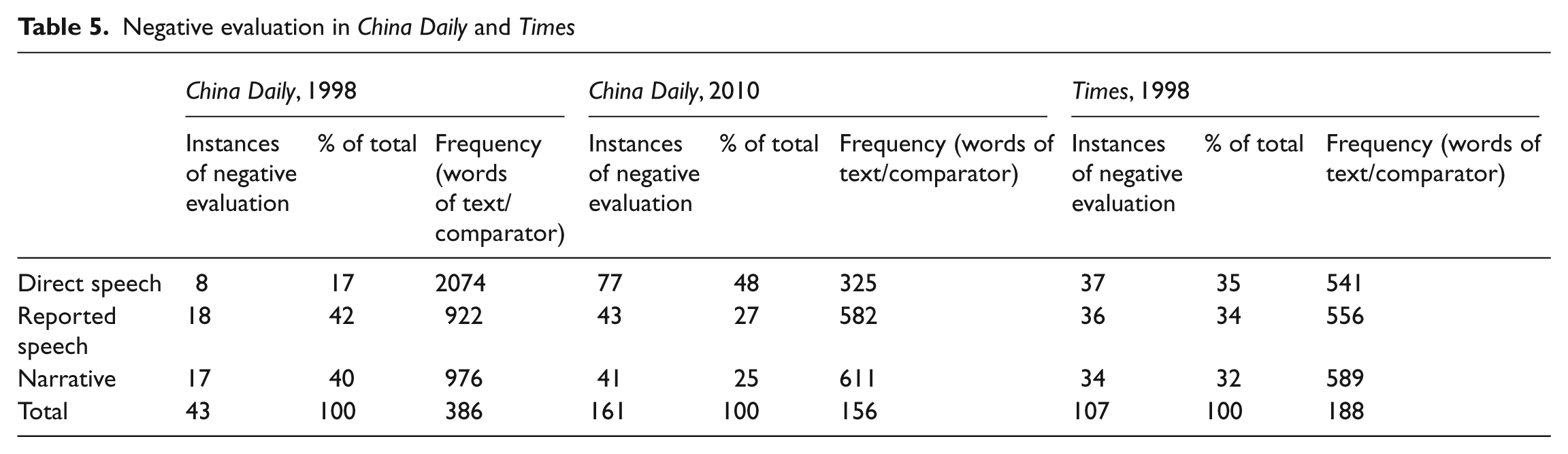
Negative evaluation in the 1998 China Daily was far less frequent than in The Times, occurring once every 386 words as opposed to once every 188 words in the latter. But it was also used differently, as Table 5 reveals. In The Times, the bulk of negative evaluation occurred in direct or reported speech, and was strongly personalized. In the China Daily, just 17 per cent of negative evaluation occurred in direct speech, with correspondingly more in the narrative. The largest percentage, 42 per cent, occurred in reported speech. Often this was the result of the newspaper quoting other government-owned news outlets, and so was not true personalization: it was simply reproducing narrative from another government-controlled news outlet.
Negative evaluation in China Daily and Times
To illustrate this point, I looked in detail at the 1998 China Daily text with the most negative evaluation: text 20, about a crackdown on fireworks in Beijing. This contained eight instances of negative evaluation, as shown in Table 6.
Negative evaluation in 1998 China Daily text 20
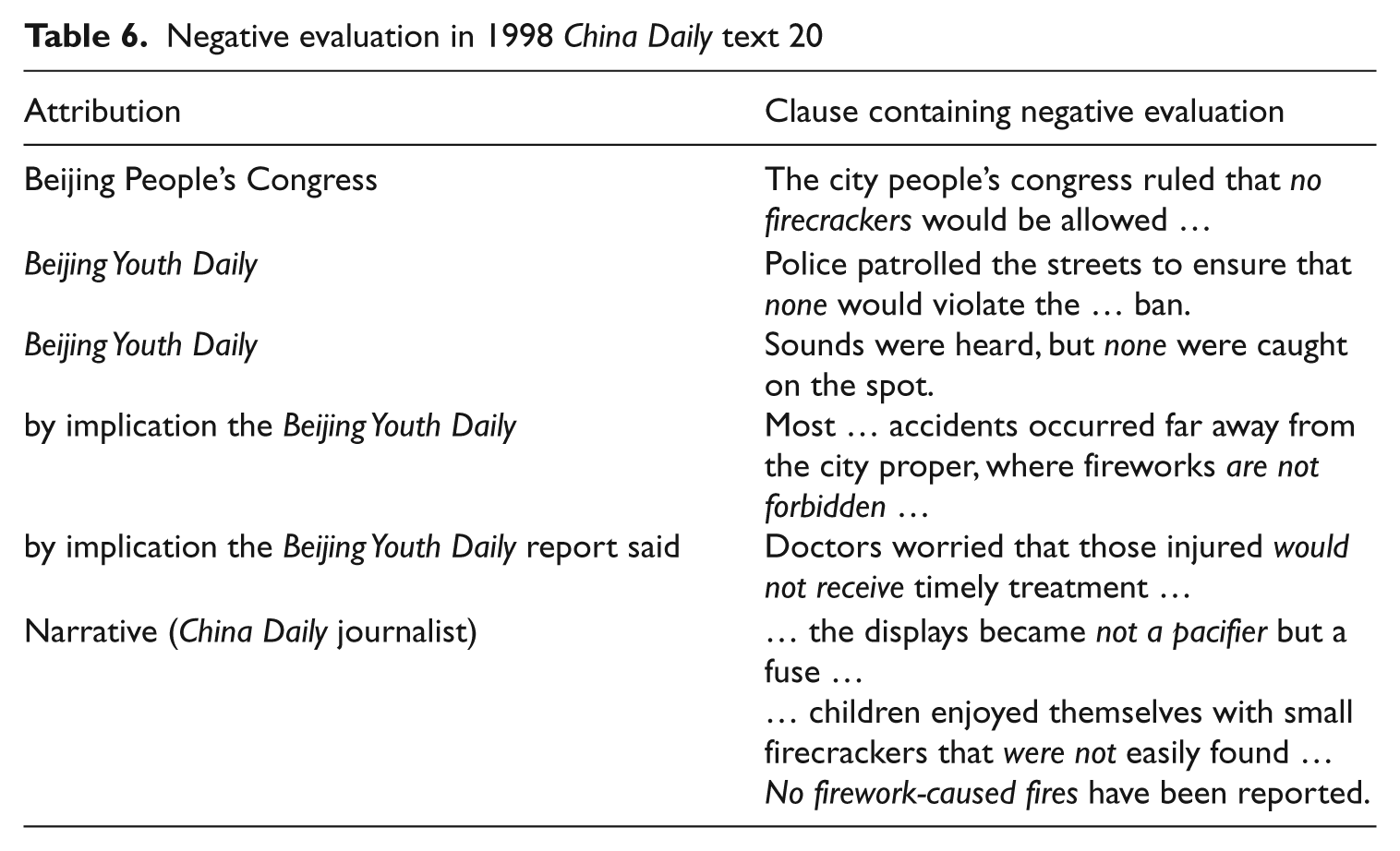
The use of negative evaluation here shows a very different pattern to the one in The Times. Not one of the negatives occurred in direct speech, and while a number occurred in reported speech they were not truly personalized, being mainly attributed to the Beijing Youth Daily. As such they were effectively bald statements of fact, which were simply narrative passages from the Beijing Youth Daily reproduced in the China Daily. There was none of the variety, richness of perspective, or heightened sense of drama displayed by The Times in its use of direct speech evaluation. Instead, the effect was that of a mouthpiece of the government lecturing its readership. With more than half of all negative evaluation in the 1998 China Daily found in the narrative, this was a generally repeated pattern.
So what about China Daily in 2010? Table 5 reveals how dramatically things have changed. The findings suggest three key differences between 1998 and 2010:
- A statistically significant increase in frequency of negative evaluation in 2010.
- A statistically significant increase (P<0.01) in negative evaluation in direct speech, making it the most common form of negative evaluation in 2010 (as opposed to least common in 1998).
- Statistically non-significant increases in negative evaluation in reported speech and narrative.
The pattern of negative evaluation in the China Daily in 2010 is in many ways similar to that found in The Times: high frequency of negative evaluation, with an even higher proportion of instances occurring in direct speech.
The 2010 China Daily texts with the highest frequency of negative evaluation were texts 24, 25 and 36, each containing eight instances. Text 24 is an account of the Chinese Ministry of Commerce’s rejection of international calls to allow the Chinese renminbi to appreciate in value. Table 7 shows the negative evaluation found.
Negative evaluation in 2010 China Daily text 24
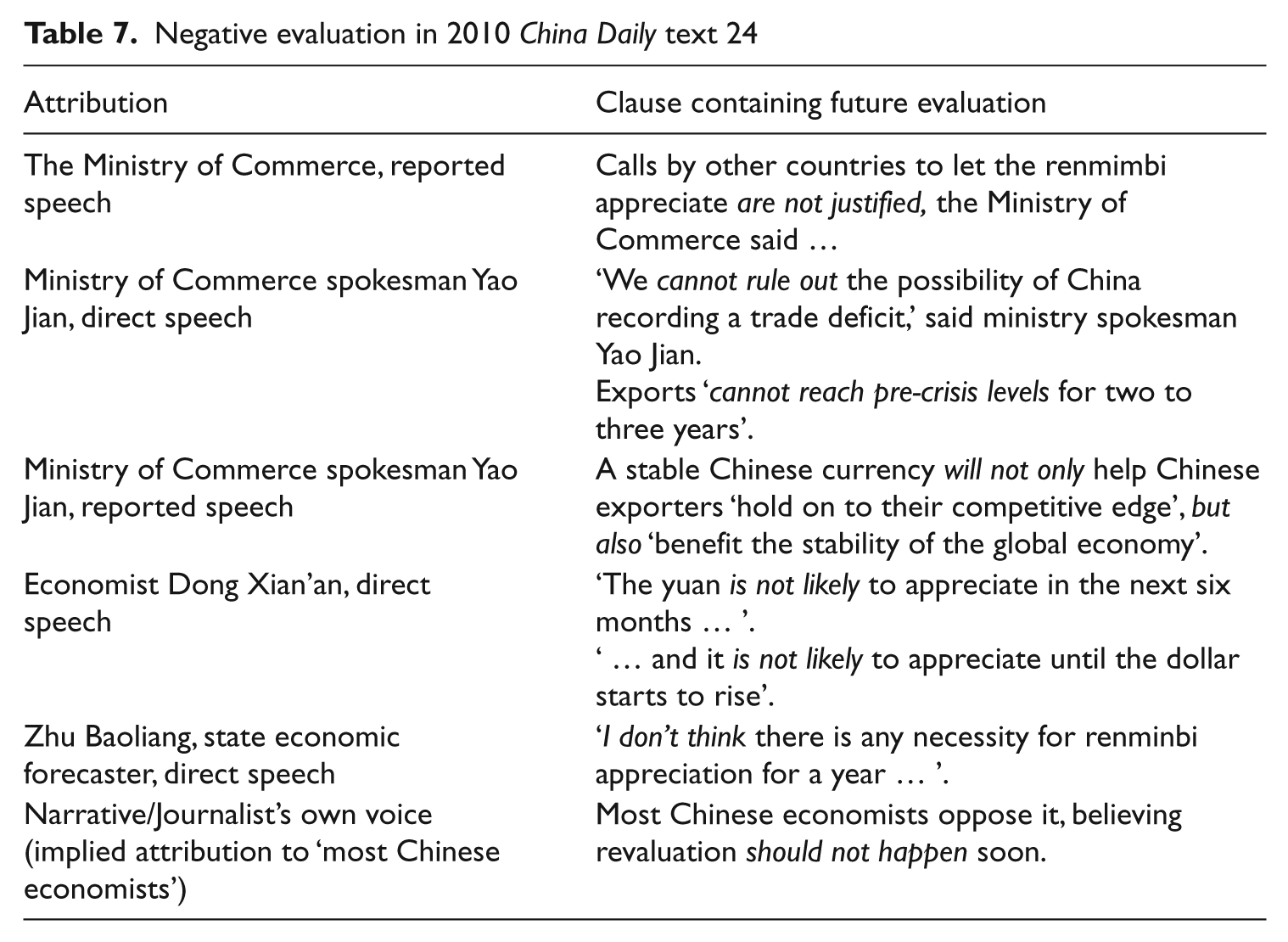
There is a high degree of personalization here. The effect is not dissimilar to that found in text 38 from The Times, about the incident involving William Straw and his school. There, the evaluation functioned to create a reportable narrative out of a denial and to increase the dramatic richness of the text. By putting the denials that William Straw bought or dealt drugs in direct or reported speech, the journalist also distanced himself from them. In text 24 of the 2010 China Daily, the negative evaluation is reinforced by quoting a series of important figures whose statements rebut calls for the appreciation of the Chinese currency. The report was written at a time when China was under pressure to revalue the renminbi, and it afforded top Chinese officials, as well as some of independent financial experts, the opportunity to say why this was not necessary. The fact that the claims were associated with identified individuals and organizations, rather than being baldly stated as fact in the narrative as they so often were in the China Daily in 1998, suggests that by 2010 the newspaper was at least distancing itself somewhat from the claims made – ‘this is what these people say’, rather than ‘this is fact’. To this extent, the use of personalized negative evaluation may be an indicator that the newspaper is trying to appear more objective and independent of the government. Furthermore, by putting the negative evaluation in the mouths of a range of different sayers, the text is much richer in interest and variety, and gives a wider range of perspectives.
Other 2010 China Daily texts rich in negative evaluation demonstrate some of these same traits. The following example is taken from text 25, a report about a rise in infertility rates:
Direct speech:
- ‘However, it (assisted reproduction) is not a cure all,’ she said. (He Fangfang, professor at the Peking Union Medical Hospital)
- ‘Many of these illegal clinics … administer expensive ART [assisted reproductive technology] procedures which are actually not necessary for patients.’ (He Fangfang).
- ‘The success rate at these clinics is also low, with patients facing potentially adverse, if not serious, medical conditions.’ (He Fangfang)
- ‘Despite an average cost of 100,000 yuan for ARTs (assisted reproductive technology procedures), demand still cannot be met,’ he said. (Zhou Canquan, Director of Obstetrics and Gynaecology at Sun Yat-sen University)
Reported speech:
- An increasing number of relatively well-off Chinese who cannot have children are turning to … infertility therapies. (Prof. He Fangfang)
- Poorer people have little access to ART, which is not covered by medical insurance. (Ministry of Health)
Narrative:
- No nationwide epidemiology surveys on infertility have been conducted yet.
- Infertile couples also turn to underground infertility clinics that are not registered.
Here, there is a high level of personalized negative evaluation, attributed to a number of different sayers. The thrust of the information provided is often to undermine the suitability of assisted reproduction clinics as ‘cure-alls’ for increasing infertility. Doubtlessly, the China Daily was presenting the approved government line here. But having named individuals voice these claims rather than simply stating them as fact creates a more dramatically engaging text, and there is a wide range of sayers who present perspectives other than those of government. As with text 24, the fact that scepticism about assisted reproduction conveyed through negative evaluation is associated with identified individuals rather than being baldly presented in a statement also appears to suggest a newspaper that is standing further back from the content it is reporting.
Future evaluators
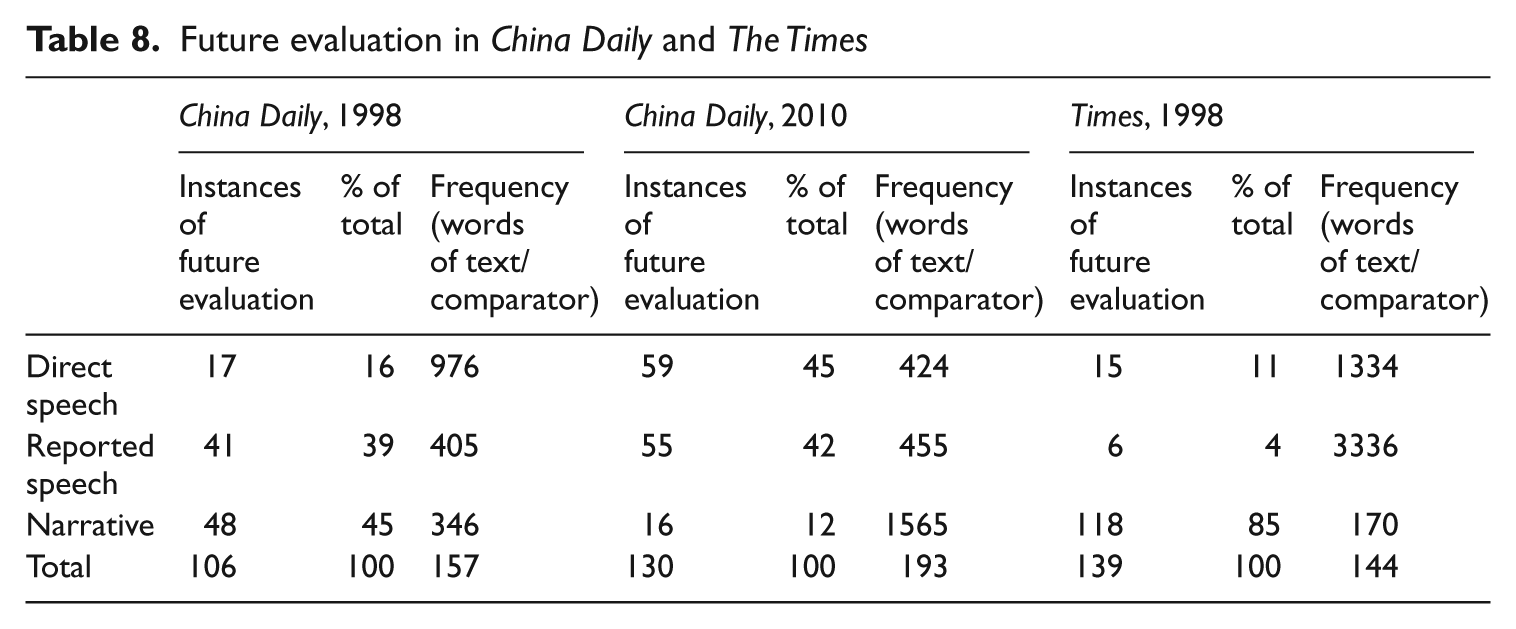
Table 8 reveals that the frequency of use of future evaluation in the China Daily fell between the years 1998 and 2010. There are changes in the pattern of use, too: a statistically significant increase (P<0.05) in the proportion and frequency of future evaluation associated with direct speech, and a statistically significant decrease (P<0.01) in frequency and proportion of future evaluation in the narrative. The pattern of use of future evaluation in the 2010 China Daily is also different from that in The Times, however, where most future evaluation was found in the narrative.
Future evaluation in China Daily and The Times
The most striking aspect about future evaluation in The Times in my 2004 study was that most occurred within the narrative. Times article 22, a preview of the UK Chancellor Gordon Brown’s first budget, was richest in the use of future evaluators, with 24 instances. These are set out in Table 9.
Future evaluation found in The Times article 22
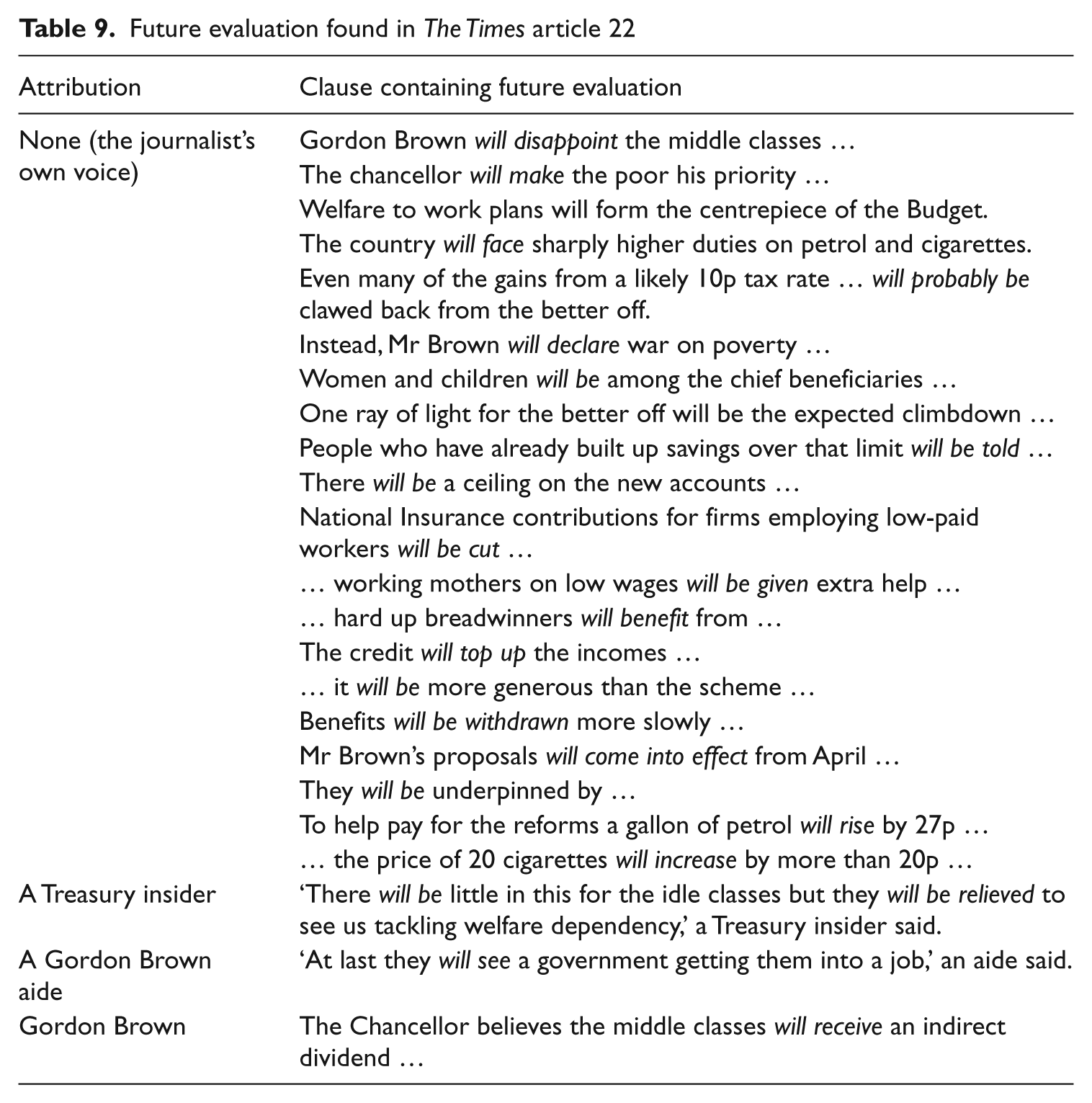
All but four of the future evaluators occurred in the narrative. The repeated use of future evaluation, I suggest, is the result of the journalist predicting/anticipating what the Chancellor would do in his first budget. It was not a negative or hostile piece, but a speculative one – a practice not uncommon in the British press. Presumably the journalist had some grounds for writing the article the way he or she did (possibly based on an off-the-record briefing). But in the text itself, there was almost no attempt to attribute the source of information. It was delivered, as a matter of fact, in the reporter’s own voice. Superficially, the pattern was similar to the use of negative evaluation in the 1998 China Daily. There, the high level of evaluation in the narrative (or in the form of reported speech which was effectively narrative reproduced from another newspaper) gave the text the feeling of a government press release. There was something of the same feel about Times article 22: the price the newspaper paid, perhaps, for reporting a story that had been leaked to it in an off-the-record briefing.
In The Times texts overall, 85 per cent of future evaluation occurred in the narrative: usually in the context of dry, dispassionate pieces such as article 22 making predictions about the future.
Future evaluation use in the 1998 China Daily was quite different. A far higher proportion appeared in either direct or reported speech – 62 per cent, compared with just 15 per cent in The Times – and was attributed to named or unnamed sources.
The 1998 China Daily text with most future evaluation was text 2, on the sensitive political issue of relations between mainland China and Taiwan. The text contained 11 instances, as set out in Table 10.
Future evaluation in 1998 China Daily text 2
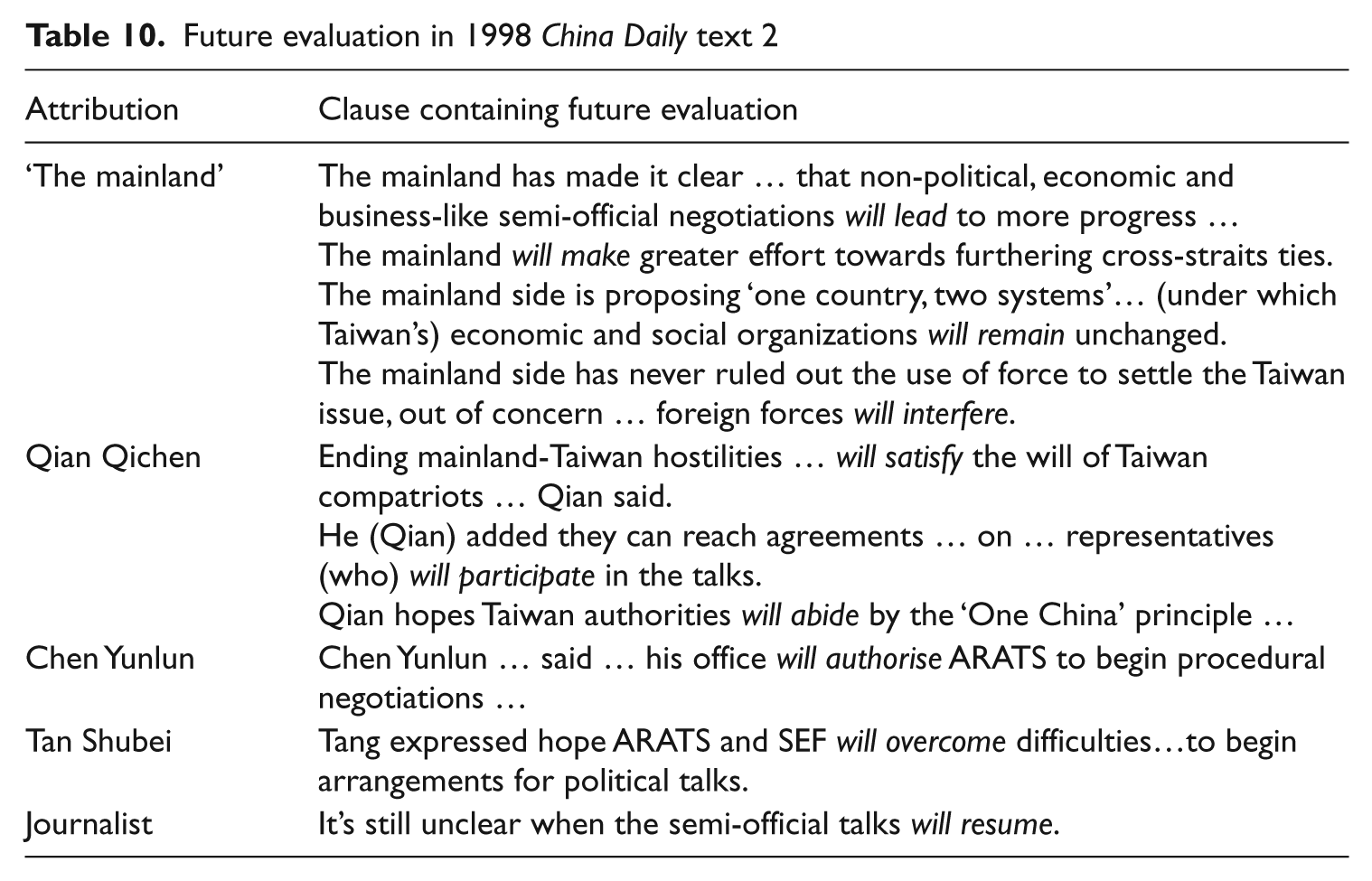
In text 2 of the 1998 China Daily there is only a single case of narrative future evaluation in the journalist’s own voice. The remainder are attributed either to ‘the Mainland’ – a shadowy designation that clearly signifies the government and/or CCP – or named senior Chinese officials.
Future evaluators were used to express plans, intentions and hopes for the future. But more generally, when taken together, they added up to a political vision of the future – a vision held by senior Party officials. Personalization actually strengthened the sense that this was the Party’s plan, since no alternative perspectives were presented. Moreover, even though much of the personalization was associated with the rather nebulous ‘Mainland’, it also served to give the text at least some dramatic emphasis. Personalization gave form to the Party through the leaders quoted, and presented them as trying to stand up for the nation.
Other 1998 China Daily texts rich in future evaluation displayed similar features, and in general future evaluation in the 1998 China Daily broadly reflected the newspaper’s role as a mouthpiece of the CCP. So what about the China Daily in 2010? As Table 8 shows, it has moved much further in the direction of personalization of future evaluation compared with 1998. Only 12 per cent of future evaluation was found in the narrative, compared with 45 per cent in 1998 (and 85 per cent in The Times).
Close examination of the 2010 China Daily texts rich in future evaluation reveals a greater difference from the 1998 China Daily, however. Where in 1998, most sayers associated with future evaluation were government figures, by 2010 a much broader range of voices was being represented.
The 2010 China Daily texts containing most future evaluation were texts 31 and 48, with seven instances each. These are set out in Table 11.
Future evaluation in 2010 China Daily texts 31 and 48
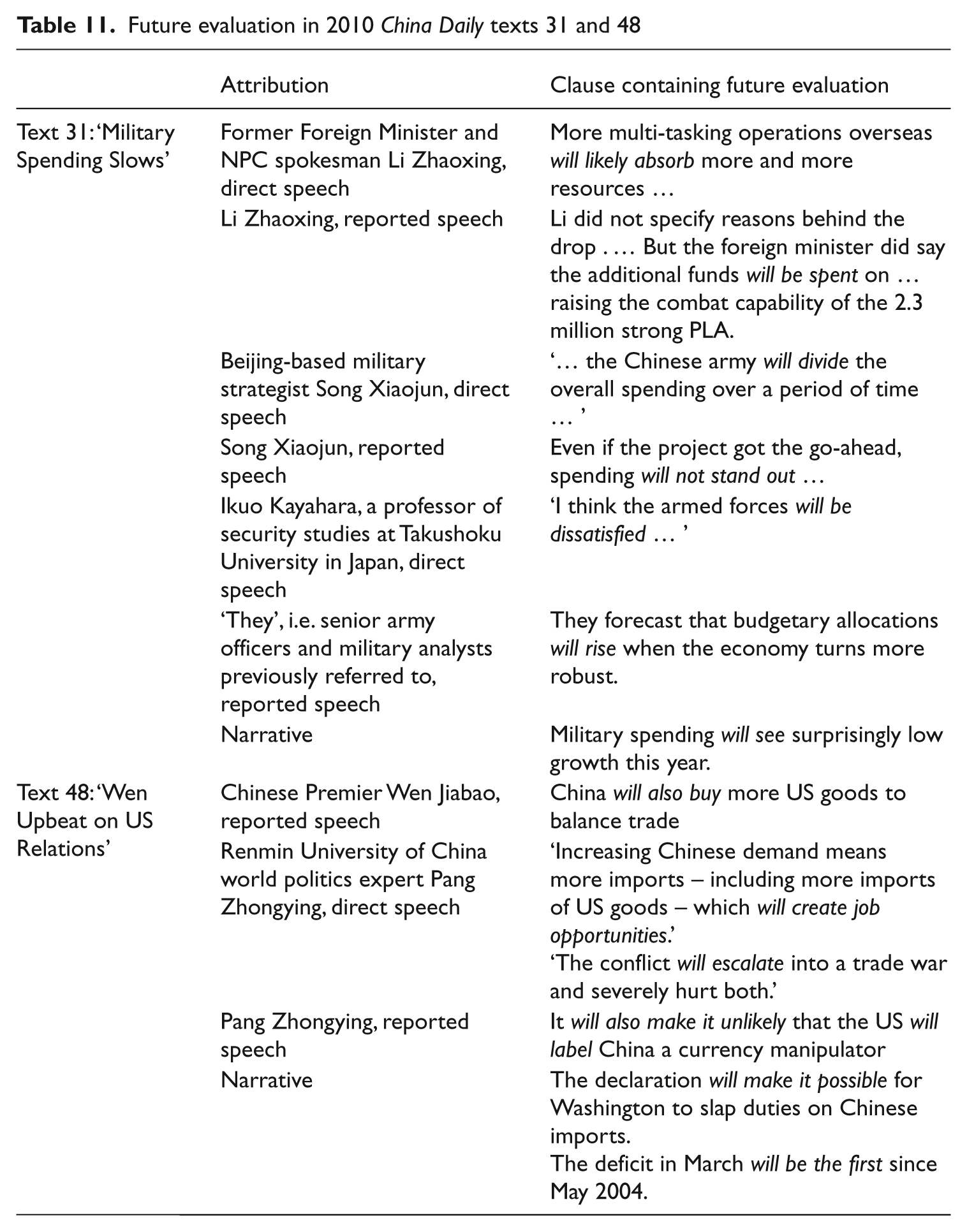
Text 31 is a report about how military spending in China was expected to grow only slowly. A number of identified individuals were called upon to explain this. They included the former Foreign Minister Li Zhaoxing, as well as two – presumably independent – military analysts: Song Xiaojun, and Japanese expert Ikuo Kayahara. The personalized future evaluation in this text increases the human interest of the story, while the presence of different perspectives afforded by the journalist quoting different sayers adds richness. There is even an element of dissent, when Prof. Ikuo Kayahara says, ‘I think the armed forces will be dissatisfied.’
A similar pattern is observed in text 48, a politically sensitive report about why China rejected US complaints that the Chinese currency is deliberately kept undervalued. Chinese Premier Wen Jiabao is quoted (in reported speech), but the person the China Daily interviewed to explain why an undervalued renminbi is good for the United States is (theoretically at least) an independent political theorist – Renmin University of China politics expert Pang Zhongying. The use of direct speech quotes from Pang adds interest and vigour. The future evaluation, as always, makes it possible to consider events that have not yet happened, but could happen. Quoting a non-government sayer on such an important issue gives an appearance, at least, that the newspaper is not simply parroting the government line. And at times the language chosen by Prof. Pang and reported by the China Daily journalist is quite dramatic.
In general, this pattern is repeated throughout the 2010 corpus. China Daily texts in 2010 that are rich in the use of future evaluation are more dramatic and diverse and seek to represent a much wider range of perspectives and points of view than equivalent China Daily texts in 1998.
Conclusion
This study suggests that there have been some changes since 1998 in the China Daily’s use of two key indicators – Labov’s negative and future evaluators – which may reveal how the newspaper is attempting to adapt to a changing social and political environment.
The key quantitative differences can be summarized as follows:
- An overall significantly increased use of comparator evaluation in 2010 compared with 1998.
- A significant increase in the proportion of comparator evaluation that is personalized.
- A marked increase in negative comparator evaluation, and especially in personalized negative comparator evaluation.
- A slight decrease in future comparator evaluation, although again a significant increase in the proportion of future comparator evaluation that is personalized.
The effect of these changes is interpreted as follows. The pattern of personalized negative comparator evaluation in China Daily in 2010 indicates an increase in the dramatic richness and variety of texts compared with those in 1998, especially since such evaluation is associated with a much wider diversity of sayers (many of whom are non-government). This suggests that the newspaper in 2010 may have been more concerned with making its reports interesting and readable than in 1998, possibly as a result of the increased marketization of the Chinese media industry and the need to attract advertising. The greater use of personalized negative evaluation also suggests that the newspaper may have been making some effort to at least appear to distance itself from some government claims, and hence to appear more impartial – an impression reinforced by the quoting of non-government sayers.
The pattern of personalized future evaluation in China Daily in 2010 indicates both increased dramatic richness and again, since it is associated with a broader range of sayers (many of whom are non-government) than in 1998, a richer range of reported perspectives on plans for the future.
The evidence is not in itself sufficient to demonstrate that since 1998 the China Daily has moved away from its earlier role as a government mouthpiece. But it does suggest that by 2010 the newspaper was at least trying to represent a wider range of perspectives. The evidence (notably the increased use of evaluation, and the increased dramatic richness this brings) also suggests that by 2010 the newspaper was more concerned about increasing readership and holding the attention of its readers, and that in the new, market-driven world of the Chinese media, it was not taking its readership for granted in the way which, as a publicly controlled and distributed newspaper, it did in the past.