







Abstract
In this study, I analyse the historical origins of China’s distinctive tiered economy by employing the analytic framework of a complex adaptive system to examine how the process of change involves selection, interaction among elements, and variation in types, which ultimately lead to adaptation. I argue that the rise of China’s tiered economy can be traced back to the Mao era and that it was enhanced throughout Deng’s economic reforms. To elaborate on this argument, I first describe how Mao’s invisible hand planted the seeds of the tiered economy. Selection at the strategy level and the resulting variation are examined as Mao’s adaptive tactics for nurturing the industrial sector. This mechanism of selection was also maintained to partially embrace market forces in Deng’s early era of reform. I then closely examine how Deng’s vision of the socialist market economy provided the party-state with raw materials for adaptation, deepening its tiered economy.
Keywords
The Chinese economy is often viewed as an example of state capitalism or red capitalism, because of the strong influence of the party-state on markets. 1 However, as many scholars of the Chinese political economy have noted, the scope and depth of the party-state’s role in the market vary across sectors (or groups of sectors) due to China’s size, development strategies, and official programmes (such as regional and special programmes). 2 Indeed, the diversity and complexities of China’s economic governance are connected to the tiered structure of its industries. 3 In a study of China’s information technology (IT) industry, Dieter Ernst and Barry Naughton argued that China’s emerging industrial economy consists of a three-tiered structure. 4 At the firm level, the first tier is composed of large, central-state-owned firms that are primarily in natural monopoly sectors, with medium-sized firms operating in competitive markets categorized as second-tier firms. 5 Second-tier firms can arise from the state sector or from foreign investment and are often characterized as hybrid firms, with substantial stakes in both public and private ownership. 6 The third tier consists of the remaining small-scale firms with relatively low-technology and labour-intensive production practices. 7
Margaret Pearson shared Ernst and Naughton’s notion of a three-tiered industrial system in China, but she contended that what divides the tiers is not the size or nature of the involved firms, but the strategic importance of the sectors in the eyes of China’s top leaders. 8 Therefore, the focus should be on what industries represent to the Chinese national economy. At the industry level, the top tier is composed of ‘the most important economic lifeline’ or ‘commanding heights’ industries, which are under the state’s direct control via central state ownership. The middle tier consists of sectors that are strategically important but are subject to less state control, because of enterprise ownership and foreign investment. The bottom tier comprises the bulk of the private and collective firms in China’s industries, those with the least strategic importance. 9
Both Ernst and Naughton’s and Pearson’s analyses offered ways to group sectors into tiers, but overlooked how China’s tiered economic structure took shape historically and how it became entrenched. For Leninist institutions, those subject to state planning, state ownership, and the rule of the Chinese Communist Party (CCP), a unique mechanism must have led to China’s complex and diverse systems of economic governance to allow them to function in a market-oriented economy. In this study, I establish that adaptive governance functioning through selection and variation has been the persistent, underlying force that has generated and maintained China’s unique tiered economy since the time of Mao Zedong.
Adaptability of the Chinese party-state
Earlier studies have examined China’s evolutionary process of institutional change and adaptation throughout the period of reform. For example, Naughton argued that ‘growing out of the plan’ described the distinctiveness of China’s economic reform and highlighted Chinese leaders’ flexible and pragmatic approaches to unexpected consequences and accidental events, which allowed them to adapt to the limitations imposed by political-economic institutions and challenges. 10 In a similar vein, but focusing on property rights, Jean Oi and Andrew Walder held that the Chinese economy evolved from state ownership to hybrid property forms to adapt to differences in resource endowments and opportunities across regions and industries. 11
More recently, adaptive governance has attracted considerable attention as a prominent feature of China’s policymaking process and development models. 12 By paying particular attention to revolutionary experiences, Sebastian Heilmann and Elizabeth Perry searched for the roots of adaptive governance techniques in Mao’s guerrilla-style policymaking, which was marked by ‘a process of ceaseless change, continual experiments, and ad-hoc adjustment’. 13 Others have noted that experimentation and contestation at local levels, although they are signs of adaptability in governance, drive the central party-state in a variety of directions because of uneven policy implementation across agencies and issue areas. 14 Based on research on the private sector, Kellee Tsai explains the adaptability of the Chinese party-state and economic structure as the outcome of the evolution of informal institutions. 15 Yuen Yuen Ang also identifies adaptation and selection as key underlying mechanisms of co-evolution in the development of China’s economic growth despite the lack of good governance as a precondition. 16 In exploring the nature of Sino-capitalism, Christopher McNally points to China’s unique duality that combines top–down, state-led development with bottom–up, entrepreneurial private capital accumulation as the key mechanisms of Chinese adaptation to market forces and global influence. 17 To some extent, as Naughton noted, such flexibility and improvisation in governance have enabled Chinese leaders to respond to new challenges and demands by making their own way without disrupting the country’s core socialist political-economic elements.
Complex adaptive system: Analytic framework
Adaptation is undoubtedly a leading element that distinguishes Chinese practices and achievements from conventional pathways. This study adds to the literature by analysing the historical origins of China’s tiered industrial economy using the analytic framework of a complex adaptive system to examine how the process of change has involved selection (of agents or strategies), interaction among elements, and variation in types. 18 A major advantage of this framework is that it allows the examination of how the current tiered structure of Chinese industries grew out of Chinese leaders’ persistent efforts to adapt dominant models or policies to their own realities and visions. That is, as suggested by the framework of a complex adaptive system, the rise of the existing complex system followed a hidden order, which was accomplished through selection, variations, and adaptations. In this study, I argue that such a hidden order (see Figure 1) can be traced back to the Mao era and that it was maintained throughout Deng Xiaoping’s economic reforms. China’s central leadership consistently selected strategies through experiments and competition; and those selections promoted variation in actors, institutions, and the manner of state control across sectors. Such variation provided China with the raw materials for adaptation, and by learning from success, failure, and general competition from incremental experiments, 19 Chinese leaders have been able to select new strategies to accommodate challenges and changes as they arise.

Hidden order in the development of China’s tiered economy.
To elaborate on this argument, I first review how Mao’s invisible hand planted the seeds of the tiered economy through his early efforts to adapt the Soviet model to Chinese realities and achieve efficiency and productivity in the planned economy. Selection at the level of strategy and the resulting variation are examined as examples of Mao’s adaptive tactics in nurturing industrial sectors under the planned economy. This mechanism of selection was also maintained to partially embrace market forces, as seen in the dual-track and particularistic contracting systems of Deng’s early reform era (1978–92). I closely examine how Deng’s vision of a socialist market economy led him to abandon the primacy of state planning and put the market first. The use of indicative planning as the chosen strategy of selection since 1993 has facilitated variation in the actors, institutions, and property rights in the market, providing the Chinese party-state with the raw materials for adaptation. 20 In this way, the distinctive tiered economy of China has been gradually but persistently shaped since Mao.
Early efforts during the Maoist era
China’s approach to modernizing its economy has not been unilateral across sectors. This section elaborates on the contributions of Mao’s strategy to localize the rigid Soviet model to Chinese realities in the development of the unique Chinese tiered economy. Key incentives in the selection strategies of Chinese leaders were to improve the productivity and efficiency of the command economy, particularly the performance of state-owned enterprises (SOEs), through state planning.
Selection of strategies: Delegating power
Upon the establishment of the People’s Republic of China (PRC), Mao pursued a Soviet-style planned economy characterized by highly centralized administrative coordination and strong emphasis on the development of heavy industries. 21 This period was the most centralized in the history of the PRC. 22 Industrial ministries under the leadership of the planning commission exercised direct control over large industrial enterprises under a strategy of rapid industrialization. The First Five-Year Plan (1953–7) shows how the administrative system for industries, heavily influenced by the Soviet model, was hierarchically structured. 23 For instance, ‘about fifty percent of industrial investment during the first Five-Year Plan was either for equipment imported from the Soviet Union and Eastern Europe or for domestic projects that were directly supported by the Soviet plants’. 24 More importantly, adoption of the prestigious Soviet model for the socialist planned economy enabled Chinese leaders to save time and energy by avoiding political conflicts and policy experimentation. 25 However, even before the Sino-Soviet conflict, Chinese economists and the political elite had begun to question the compatibility and relevance of the Soviet model, which was too repressive and hierarchical to work in China. Economists proposed options for modification, and some of them (e.g. Gu Zhun) even suggested a move toward a more market-oriented system. 26
In fact, unlike early expectations, the defects of a Soviet-style command economy gradually became clear to Mao and other leaders beginning in 1956. 27 In modifying the rigid and hierarchically bureaucratized system, China’s party leaders decided to delegate power to authorities and enterprises at lower levels, attempting to rebalance the industrial structure in agriculture and light and heavy industries. Thus, the strategy of delegating power was selected to adapt the Soviet model to Mao’s China. This initial reform effort was specified in the Provisions on Improving the Planning Administration System (1958), allowing plans to be designed and balanced by local authorities. The Provisions on Transferring the Control of Industrial Enterprises was another early effort to transfer control over state firms to local governments. 28 Such delegation of some industrial, commercial, and financial administrative functions to local authorities aimed to support local governments and enterprises. 29 Indeed, decentralization of economic management enabled local party and government officials to better engage in designing industrialization schemes, creating ample incentives for local officials to mobilize the resources under their control into industry. 30
To some extent, such delegation of decision-making and production to localities contributed to the smooth process of the Great Leap Forward campaign. However, incomplete and poor implementation of decentralization led to chaotic authority relations because of the lack of a clear mandate, 31 which unfortunately caused serious economic deterioration and social disorder. Mao later claimed that the failure to maintain balance was the major shortcoming of the Great Leap Forward, believing that ‘over-delegation of power in administration, financial resources, commerce, and industry should be taken back by central and provincial governments’. 32 Accordingly, in 1962, the Central Committee of the Communist Party of China’s Financial and Economic Leading Group, headed by Chen Yun, undertook several measures to recentralize the administration of government finance, credit, and enterprises and to establish a system even more centralized than that of the 1950s. 33
However, the falling-out with the Soviet Union and the subsequent hostility and tension during the 1960s pushed the Chinese leadership to reformulate an economic strategy independent of the Soviet Union. Despite the painful costs and memories of the Great Leap Forward, a strategy for delegating authority to the local level was once again established. As control over most state enterprises was decentralized, the provinces obtained contractual responsibility for their budgetary revenues and investments. This created additional financial resources for SOEs and local governments and resulted in a regionally based system of material balance. 34 As a result, the early command economy, which had focused on the largest SOEs, was restructured on a regional basis, and the central party-state’s capacity to exact specific control over the economy gradually decreased. 35 The Chinese planned system before 1978 remained chaotic and loosely controlled by the central government, with overlapping authorities. To improve administration rather than reform the economy, rebuilding the planned economy became the most pressing goal.
Adapting the Soviet model to China
In China, it was actually Mao Zedong’s era that initiated the strategy of selection that fostered variation in agencies, property rights, and types of state control across sectors. 36 In early 1949, Mao affirmed that ‘the Communist state would control the economic lifelines of the nation and make the state-owned sector the leading sector of the entire national economy, while allowing the development of private capitalism within the framework of the economic policy and economic planning of the People’s Republic’. 37 This can be seen as the onset of China’s selective approach to industrial development and control, leaving a profound legacy in the generation of different levels of state control across industries. In fact, the strong emphasis on direct intervention and tight control of economic lifeline industries can be traced back to Mao’s and other revolutionary leaders’ bitter experiences of war with Japan during the Republican era. As some analysts have noted, Mao’s emphasis on direct control over economic lifeline industries and the development of heavy industries was affected by both the Soviet model and shared experiences with the nationalist government during the Sino-Japanese War. 38 That is, as early as the 1940s, even before the founding of the PRC, Mao Zedong imagined that the communist party-state would own big banks, big industries, and large commercial establishments, but not control the entire economy as in the Soviet model. 39
Moreover, the selection of a power delegation as a strategy created variety in the administration of Chinese industrial SOEs. By the late 1970s, China’s state-owned industrial enterprises were under three systems of control: central, dual, and local. 40 Large and strategic SOEs were under the control of central authorities, while small and medium-sized state firms with relatively less strategic value were supervised by local authorities. 41 Some SOEs, such as those in the automobile industry, were subject to control by both central and local authorities, although they were considered centrally controlled or locally controlled depending on the predominant ownership. 42 As a result, ‘the predominantly centrally controlled enterprises were confined mainly to the electricity generating industry, whereas the predominantly locally controlled enterprises were mostly in light industry and textiles’. 43
To some extent, this selective categorization shows how China’s emphasis on heavy industries created layers of SOEs across industrial sectors by distinguishing SOEs that were subject to central state ownership. This early selection influenced the SOE reform policy of ‘grasping the large, letting go of the small’ (抓大放小) in the 1990s, as explained in detail later on in this article. This variation in the levels of ownership shows how Chinese leadership during the Mao era attempted to maintain direct central control over strategic sectors and firms amid an overall strategy of decentralization that gave local authorities political and economic incentives to maximize SOE productivity and efficiency in resource distribution. This early selective approach to the level of state control via ownership paved the way for the tiered structure of industries that is in place today.
Intellectual effort and suggestions were made to enhance the productivity of SOEs and the efficiency of the planned economy. For example, after learning from the examples of socialist countries in Eastern Europe, the reform-minded Chinese economist Sun Yefang promoted a model of a socialist economy that separated major and non-major issues according to degree of market forces. According to Sun, the key proposition was to centralize power regarding major issues and decentralize authority over minor issues. 44 Sun’s criterion for distinguishing major from minor was the scale of funding; that is, extended production with new funds was a major issue and should be the government’s responsibility, whereas simple production with existing funds was a minor issue and should be granted more autonomy. 45 Sun’s proposal during Mao’s planned economy is notable as a pioneering effort to selectively exercise state control over industries and economic affairs, and it indicates that the Chinese elite understood that the development of a planned economy did not necessarily mean absolute government control over the entire industrial economy, as in the Soviet model. Instead, non-state actors can operate outside economic lifeline industries. Some have considered Sun’s early reform proposal (to centralize power to manage major issues while delegating power when it comes to minor issues) to be similar to Wlodzimierz Brus’s decentralized model of reform. 46 Sun’s proposal did not gain much attention from Mao, but it was widely shared and implemented through Deng’s reform policies. In short, although ideological obstacles prevented market-oriented reform from being acceptable until the downfall of the Gang of Four in 1976, Chinese selective industrial management during the Maoist era, which served as a mechanism of adaptive governance intended to produce a productive and efficient economy based on SOEs, planted the seeds of the tiered industrial system that gradually emerged.
Deng’s evolving approaches
The major departure from Mao’s era was to embrace market forces in earnest while maintaining the primacy of state planning throughout the reform. During the early reform period, therefore, regulating the scope and depth to which market mechanisms would be allowed into the planned economy was the primary task for Chinese leaders. Indeed, Chinese scholars and officials (e.g. He Jianzhang, Liu Guoguang, and Zhao Renwei) had fierce discussions about how to combine state planning with market mechanisms. 47
Selection of strategies: Partial reform
Both dual-track and particularistic contracting systems demonstrate how China exercised the strategy of partial reform by embracing a market system in some measure while maintaining the primacy of state planning during Deng’s early reform era. As a leading example, the idea of a dual-track system was initiated as a temporary measure to combine planning and market channels in the allocation of a given good. 48 In rural land reform under the dual-track system, peasants signed contracts to turn over a certain amount of grain to the government, 49 and were then free to release the rest of their production to the market. Beginning in 1988, however, mounting economic instability and market failures, including severe inflation and an ensuing shortage of goods and daily necessities, led to the re-establishment of tighter state planning in the distribution of resources. 50 As a result, although the combination of state planning and market mechanisms was largely maintained, mandatory state planning was re-emphasized as the leading tool for distribution of resources. 51
Similarly, based on particularistic contracting that applied only to materials of strategic importance or specialized materials, 52 enterprises signed profit contracts compelling them to turn over a specified amount of annual revenue to the government. Having gained insight from the success of the dual-track system in rural reforms, policymakers expanded the idea of contracts into urban industrial reform, in part to help the central government maintain its control over some crucial parts of the economy, while other parts were left free to transact in the market. As the scope was expanded into the industrial and commercial sectors, decision-making power and resources were transferred to lower governmental units. However, Beijing insisted on its demand that it retain the power of approval in major issues such as pricing, investment, and market entry, which discouraged local actors from acting independently of the governmental centre. In this way, the core interests of central authorities were secured. 53 Furthermore, because decentralization and the dual-track strategy were not applied uniformly throughout the 1980s, Deng’s selection of a partial reform strategy allowing the coexistence of two coordination mechanisms (i.e. plans and market forces) fostered variation in the depth and scope of state intervention across sectors and firms, depending on the process of adaptation to market forces. 54
As in the Maoist era, materials of strategic importance or first-category materials (e.g. steel, petroleum, and coal) were planned and allocated by the central government through agencies such as the State Planning Commission and State Material Bureau. Specialized materials (second-category materials such as copper or textile machinery) were planned and allocated by individual branch ministries. All other materials, known as third-category goods, were either planned by a local government or left to enterprises. 55 As a result, the Central Economic Commission directly administered relatively few large, strategic, industrial enterprises, while most industrial enterprises were under the administration of the Central Economic Commissions at their various localities. 56 Indeed, the state monopoly over state sectors and firms established during the Mao era was not completely transferred to local authorities and firms in the 1980s. Depending on the significance of an industry to the national economy, state control over the sectors was hierarchically structured from the Central Economic Commission to local offices across regions. The Seventh Five-Year Plan (1986–90) distinguished between strategic and non-strategic industries, which were then managed accordingly. 57 For example, the central government designated ‘major pillar industries’ for the first time, and tried to make them more competitive by maintaining economies of scale or assisting enterprises in key sectors.
Embedding state planning into the market
As the selection of the partial reform strategy shows, China neither intended to wholly embrace the market mechanism nor to fully adjust state planning to the market during the early reform. Rather, the state emphasized planning to enhance micro-flexibility while maintaining macro-control. In this process, the rigid mandatory planning of the Mao era was adapted to growing market forces. This resulted in the emergence of the idea of ‘guidance planning’ (指导型计划), which combines such planning with the market. 58 Under guidance planning, targets for micro-units (i.e. state enterprises or agricultural producers) were not binding but were adjustable to conditions and market demand. In this way, the Chinese party-state increased incentives for enterprises or producers of agricultural products while maintaining control over overall production volume and the economy’s macro balance. 59
Likewise, Chinese partial reform facilitated variation in types of state planning from the ‘mandatory planning’ (指令型计划) of the past to a flexible type of guidance that incorporated market adjustments of the future. In this regard, the rise of guidance planning shows how the Chinese party-state attempted to adapt its prior rigid and mandatory planning, which had failed to consider specific changing demands from enterprises and society in general, 60 to adjust to market forces without disrupting state planning. For example, in price setting, mandatory planning did not consider possible changes in supply. Thus, unreasonable pricing often led to a lack of products in the market and missed opportunities for appropriate supply. 61
From the mid-1980s, the scope of guidance planning was extended into other areas. According to the 1984 Interim Provisions on Improving the Planning System by the State Planning Commission, 62 the aim of guidance planning was to reduce the number of items subject to mandatory plans, allowing state firms to make their own decisions about production plans and management based on market conditions and social needs, even though the autonomy of those enterprises remained bound by state-guided planning. 63 To ensure stability and address primary concerns of the central leadership, investments in energy and infrastructure continued to be set by the central government, but market mechanisms were allowed to operate in less strategic sectors. In this regard, early Chinese efforts to embed state planning into the markets promoted variety in the manner of state control across the sectors in the following respects.
First, as the principle of guidance planning highlights, state planning remained primary, 64 even though the benefits and importance of the market system were stressed. 65 In other words, although the scope and share of mandatory planning were decreasing, the production and distribution of key products remained under the direct authority of state planning targets. 66 Thus, the leading role of planning was combined with a supplementary role for the market. 67
Second, as suggested in the 12th Party Congress, efforts were made to advance the operation of state planning. 68 In fact, before economic reforms, the Chinese leadership was well aware of the need to develop diverse ways to facilitate state planning. For example, three types of planning were proposed based on experience gained from China’s First Five-Year Plan and the mandatory and guidance planning and market regulation of the 1960s. 69 The size and significance of enterprises, as well as type of industry, were considered the main criteria by which modes of state planning were allocated. Thus, large state-run enterprises in key industries (i.e. heavy industry) remained in the domain of mandatory state planning, whereas medium and small enterprises in less important sectors became the domain of guidance planning. As residuals, various small products or special agricultural products were permitted to rely on market regulation rather than on state planning. 70 In fact, such variation in the types of state planning was first initiated by veteran planner Chen Yun in 1956. During the First Five-Year Plan, Chen was already sceptical about the Soviet system of rigid economic planning and proposed dividing the Chinese economy into three sectors: ‘A dominant planned sector under state control, a guided market sector under various degrees of plan guidance, and a free market sector for minor local products.’ 71 Likewise, introduction of guidance planning fostered diverse state interventions across sectors, creating a complex system of economic governance in China.
Changing gears
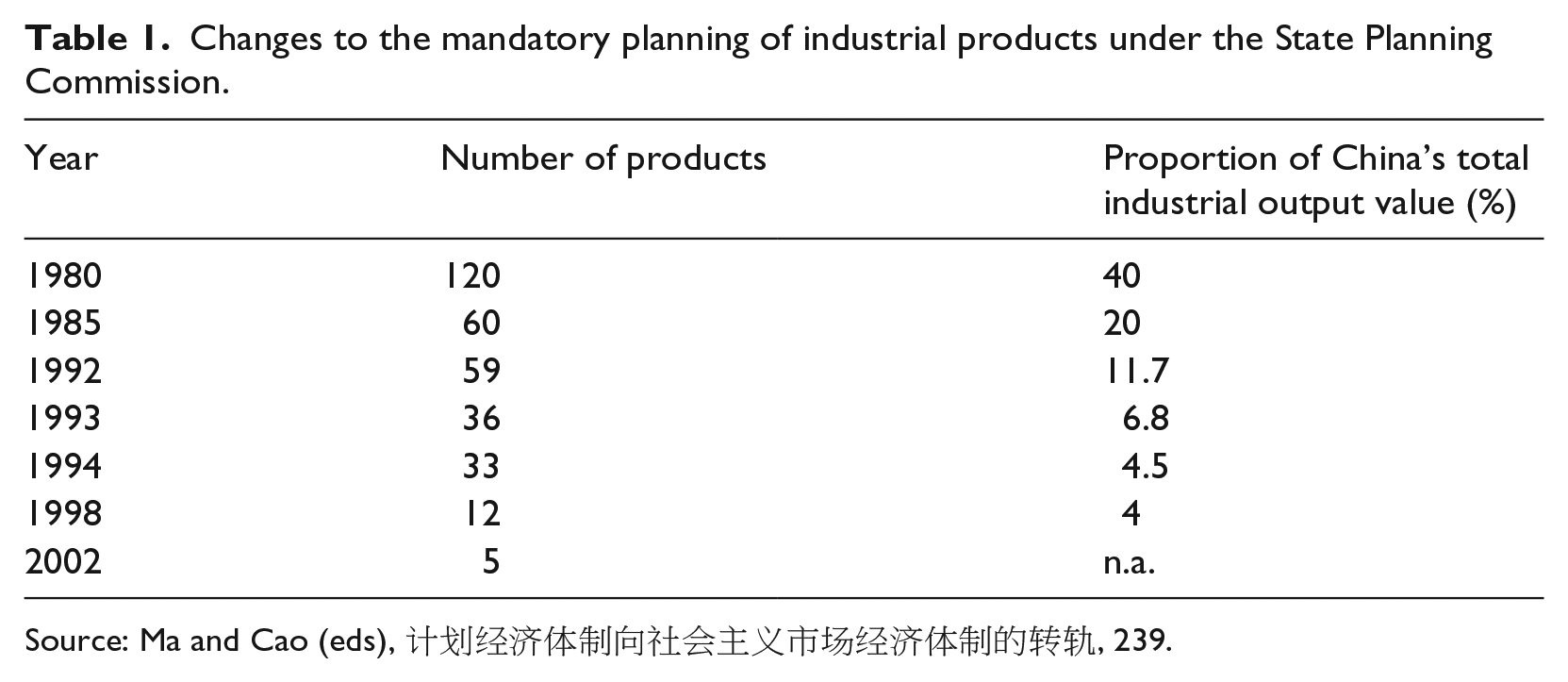
Despite the political and economic turmoil of the late 1980s, Chinese efforts to reform the country’s economy remained strong. In a major departure from the first stage of reform, the underlying norms and institutions shifted toward a more market-oriented economy during this period. China’s declaration of a socialist market economy had a profound effect on other institutional reforms. Major steps included dropping the dual-track strategy and a gradual reduction in the number of mandatory plans run by the State Planning Commission (Table 1). That shift in the direction and depth of reform was first declared in the Third Plenary Session of the 14th Central Committee of the Communist Party of China, as well as in the Decision on Issues Regarding the Establishment of a Socialist Market Economic System in 1993. These confirmed that the ultimate goal of economic reform was to establish a market economy in China with socialist characteristics that would reflect continuity with the past rather than lead to a liberal market economy. 72 Xi Jinping’s recent emphasis on the same plan at the 19th Party Congress in 2017 reaffirmed China’s consistent moves toward a socialist market economy with unique characteristics.
Changes to the mandatory planning of industrial products under the State Planning Commission.
Source: Ma and Cao (eds), 计划经济体制向社会主义市场经济体制的转轨, 239.
Selection of strategy: A socialist market economy
In China, the concept of a socialist market economy implies not only eliminating the past primacy of planning, but also accepting the creation of market-oriented institutions, such as corporatization or legalization, along with state planning, state ownership, and the CCP. The Chinese party-state has thus been willing to adjust guidance planning, by which the market has remained complementary to increasing market forces. Thus, indicative planning, which gives primacy to the market, was adopted as a strategy for building the socialist market economy. Some scholars hold that indicative planning refers to ‘the action of the state in coordinating information from private agents about their intentions, thereby improving forecasts of the future and improving inter-temporal resource allocation’. 73 However, a more inclusive conceptualization defines indicative planning as ‘an attempt to influence outcomes with information, not simply affording information’. 74 Using governmental forecasting (e.g. statements that estimate growth potential in certain industries), signalling (e.g. preferential policies for small and medium-sized enterprises), and indirect incentives (e.g. improved access to bank credit and domestic/overseas markets), indicative planning ultimately aims to stimulate market incentives and resource mobilization in sectors that the government deems to have development and strategic potential. The most important shift has been that the entire procedure now relies more on market mechanisms than on government distribution of resources, unlike in the era of guidance planning.
For example, the Eighth Five-Year Plan (1991–5) elaborated a new concept of plan, addressing for the first time the significance of pillar industries such as the machine-electronic, petroleum-chemical, auto machinery, and construction industries. 75 This reflects an important transformation in state planning. Instead of directly commanding and controlling micro-affairs, the state functions as a vehicle for informing the direction of macro-control and development alongside market-oriented industrial policies. 76 In this paradigm, state planning attempts to alter the economic structure by motivating the actors involved. 77 Accordingly, significant modification of the roles and tools of the State Planning Commission occurred during the Eighth Five-Year Plan. 78 The roles of the Commission were modified from the previous direct micromanagement (计划) over microeconomic affairs to macroeconomic coordination through long- and medium-term macromanagement (规划) or industrial and regional development policies. 79 As such, the Commission took on more responsibility for helping to coordinate macro development by issuing economic information and setting up the indicative annual planning index.
The State Planning Commission has published policy suggestions on some important issues based on such macro-level assessments. 80 For instance, because the Commission was keen to establish and support infrastructure and pillar industries, related policies were promoted. 81 The outline of the national industrial policy for the 1990s, the 1994 auto industrial policy regulations on foreign commercial investment, and the guidance of 1995 for the foreign commercial investment industry are all good examples of how the Chinese party-state adapted the means of control used by the planning agency to the markets, refining the agency into an indicative planner. 82 In this regard, the desire to build a socialist market economy does not reduce the role of the Commission. Instead, its function was simply modified from guidance planning, which uses both micro- and macro-control, to indicative planning, which uses indirect macro-control. 83 Renaming the State Planning Commission the State Development and Planning Commission as part of the 1998 governmental administrative reform also reflects the changing nature of state planning in China. 84
Deepening variation
The pursuit of a socialist market economy has allowed diverse actors, institutions, and property rights to emerge, and ultimately diversity in economic governance has determined the combination of two contradictory components, state planning and market mechanisms. The emphasis on building a socialist market economy indicates that Leninist institutions are to remain central. As China’s pathways show, the proliferation of markets and institutionalization does not necessarily lead to diminished Leninist institutions. Instead, their traditional roles and forms have been constantly adapted to meet new realities and challenges.
The change in state planning from guidance to indicative also involved a policy shift to incentive-based, non-hierarchical planning through open diverse channels that can absorb new trends and demands, making them adaptable to local contexts. 85 In so doing, ‘extensive and sustained decentralized policy experimentation across a large spectrum of sectors’ 86 has been encouraged. Rather than supplementing mandatory planning, as seen in guidance planning, indicative planning abolished administrative resource allocation and partial price liberalization, allowing the market to play a greater role. Long- and medium-term industrial policies were thus used mainly as tools of indicative planning to inform local governments or state enterprises about development directions, strategies, and preferential policies. Compared with the guidance planning of the 1980s, indicative planning represents a far more substantial adaptation on the part of Chinese state planning. The 1998 government restructuring that renamed the State Planning Commission the State Development and Planning Commission aptly reflects those changes. Such levels of flexibility and improvisation account for China’s adaptability in governing its economy without abrupt changes to the essence of its political and economic institutions.
Promoting adaptation
Despite the advocacy of a plan for markets with indicative planning, the extent of market forces has remained limited. That is, the central leadership has continued to maintain tight control over strategically important industries such as infrastructure and finance while allowing more market-based incentives and competition to operate in less strategic sectors. In fact, this selective approach to governing the economy was recommended by leading economists and officials in China between the late 1970s and early 1980s.
87
According to this vision: First, the form of central planning should change from mandatory to indicative planning, so that the state provided guidance and long-term forecasting, but did not intervene directly. Second, state ownership system should be confined to the infrastructure of the economy, such as transportation, harbours, and energy. In principle, government departments should not own and manage industrial enterprise directly. Third, the means of production should be reclassified as ‘commodities’, to be allocated through the market. Finally, the state’s role in the economic sphere should be limited to the use of economic leverage through economic and financial measures (such as the control of credit, revenues and taxation, tariffs, the pricing mechanism, foreign exchange and so on) rather than direct administrative means [emphases added].
88
In modernizing traditional SOEs and introducing corporate governance, 89 Chinese central leadership did not attempt to fundamentally modify the centrality of state ownership in the Chinese economy. The idea is that even though the state has continued to embrace market forces, state ownership remains central in selected strategic sectors, even as other sectors become more or less liberalized. The selective approach was also used for reforming SOEs. China’s remarkable SOE reform in the 1990s offers another example of adaptive governance through a selective approach to different industries. Following a policy of grasping the large, letting go of the small, SOE reform focused on around 1000 large and medium SOEs that were crucial to the national economy, releasing small and medium SOEs in less strategic industries (such as those in the bottom tier) to be invigorated by merging, leasing, contracting, offering themselves for sale, or going bankrupt.
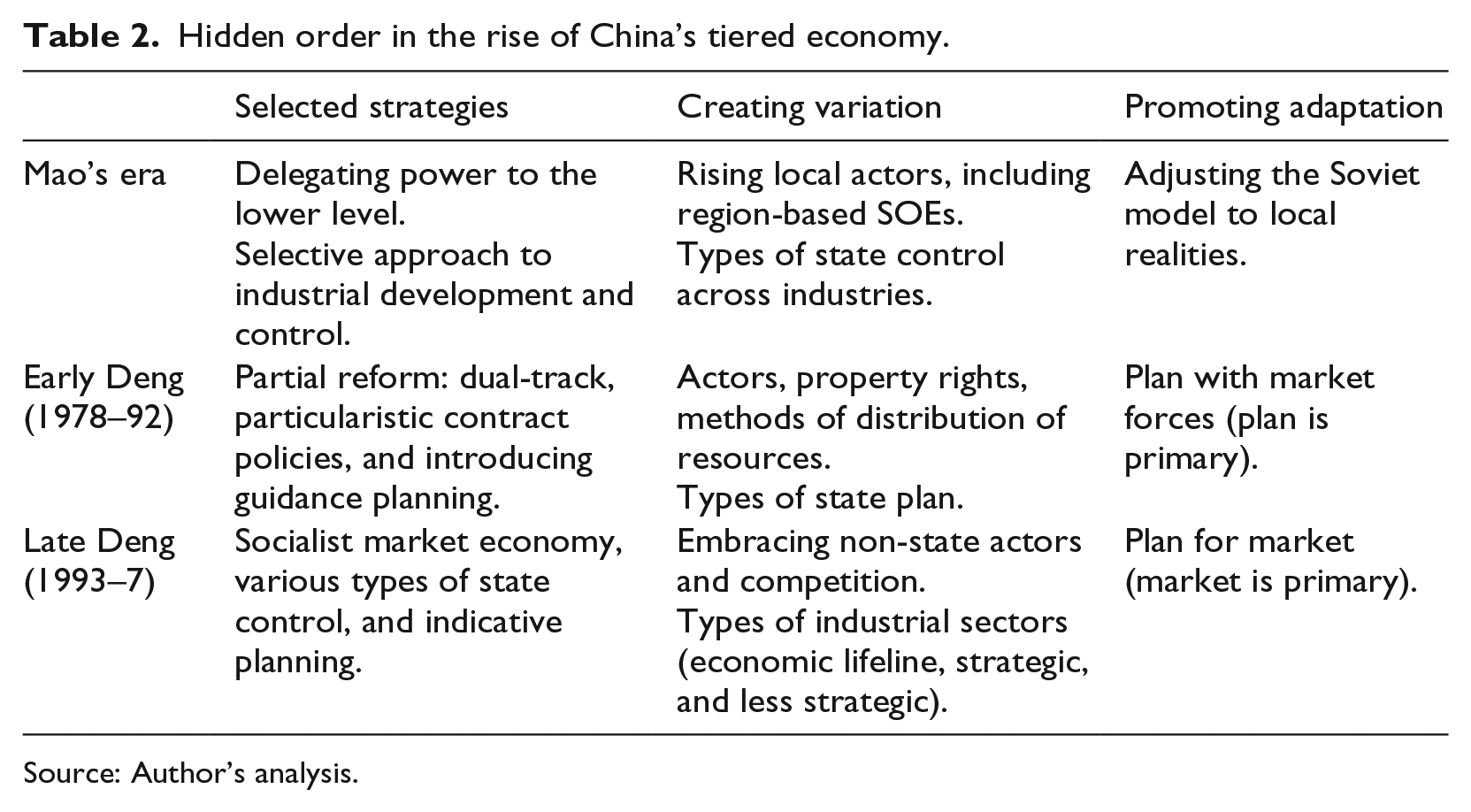
Structurally, the policy of grasping the large, letting go of the small came from the idea of building state enterprises in strategically important industries into national champions by merging existing, less competitive, and inefficiently run state firms or allowing them to be privatized or dissolved. Thus, the big SOEs that were targeted were in industries strategic to the national economy, such as network industries, while mixed ownership has come to emerge in less strategic industries. 90 The Chinese party-state’s continued control over such businesses was once again manifested by the Fourth Plenary Session of the 15th Central Committee of the Communist Party of China in 1999. Four fields were specifically addressed in its decisions: (1) industries related to national security, (2) industries of natural monopolies, (3) industries providing important public goods and services, and (4) key enterprises in backbone and high-tech industries. 91 Likewise, as the policy of grasping the large, letting go of the small shows, China’s selection of an SOE reform strategy reveals how the creation of a socialist market economy has led to variation in both the manner of state control and the depth of embracing the market across industrial sectors and generating hybrid property forms, as noted early (see Table 2).
Hidden order in the rise of China’s tiered economy.
Source: Author’s analysis.
Enduring historical effects
In this article, I have explored the historical origins of China’s tiered economy. As noted by other scholars, ‘identifying the roots of contemporary methods of governance is important for analysing both the genesis and the generalization of the specific array of solutions, institutions, and process at work in China today’. 92 Similarly, with its unique policymaking process involving experimentation, the origins of China’s tiered economy – with its diversity and complexities in governance – were planted in the Maoist era and further enhanced throughout Deng’s economic reforms. Adaptive governance has been persistent, taking a selective approach when Mao localized the Soviet model to Chinese realities and when Deng reformed state planning and embedded it into a market-oriented system.
As the evolutionary dynamics exhibit, variation in the manner of state control across industries accelerated during economic reform, using the dual-track system and particularistic contracting to adapt China’s plan-based socialist economy to a market-based economy. According to these findings, the Chinese leadership has followed consistent rules of selection: first, maintain top leadership control of strategically important industries; and second, combine or coordinate socialist political-economic institutions, such as state ownership, planning agencies, and the CCP, with market forces. Thus, what shapes each tier is not firm size, but the strategic value of the industry to the national economy as perceived by the top leaders (Mao Zedong, Deng Xiaoping, and Xi Jinping). This organization has certainly contributed to shaping the tiered structure of the economy, as reflected by the different depths and scopes of state control.
For example, China’s great emphasis on the IT sector results from that sector’s increasing significance to the national economy and mounting global competition in the new era of the industrial revolution. Some argue that large private IT firms (e.g. Alibaba and Tencent) constitute new commanding heights beyond the first tier of state firms. However, given their strategic value combined with strong private ownership, it seems more reasonable to expect such firms to join the second tier. For example, private auto producers (e.g. Geely and BYD) benefit because the government prioritizes global leadership in the production and sales of electric vehicles. Such a persistent underlying mechanism shows how the Chinese party-state has endeavoured, since Mao, to select the best strategies for local realities and contexts. This practice has fostered variation in actors, institutions, and types of state plans, and eventually led to adaptation of its own economic system to a more market-oriented system than before.
In short, as many pundits argue, China’s core feature of adaptive governance is feasible because economic reform has proceeded with a dialectic combination of the central leadership’s top–down approach and planning with local governments’ experiments and bottom–up initiatives from private business. 93 As noted above, this dialectic dynamic constitutes the nature of Sino-capitalism and empowers China’s ambition to become a tech superpower during the Fourth Industrial Revolution. Recent advances among China’s giant private IT firms and electric vehicles sector offer excellent examples of how top–down, state-led development policies have mobilized resources and incentives from the bottom, a layer that includes private entrepreneurs. In this process, local experimentation and entrepreneurial spirit shape policy change from the bottom, which has created variation in both local compliance and implementation of the national policies. Some say that such ‘newly empowered local actors were key drivers of the reform process’. 94 Likewise, they have been the main sources of China’s remarkable adaptive governance. In this regard, Xi Jinping’s excessive centralization of power and top–down approach to reform agendas, including finance and SOEs, has tended to produce local governments that are ‘less actor and more acted upon’. 95 By placing Liu He, Xi’s top economic advisor, in a leadership position in the newly reorganized Leading Small Group of Science and Technology and State-Owned Enterprise Reform, China has created within ‘the hierarchy a more disciplined and efficient transmitter of top-level commands’. 96 Many private Chinese entrepreneurs are concerned that this excessive top–down approach, which offers less discretion at the bottom, could challenge the trials of policy experimentation and private entrepreneurship, and will eventually impede the operation of China’s adaptive governance.