







Abstract
This essay explores the queer literary modernism of Hong Kong and Singapore since the 1990s to make several interventions. While the two cities have been studied as exemplars of postcolonial state formation in which finance capitalism contributes to the rise of modernity, their queer modernism in the literary and cultural spheres has largely escaped comparative studies. To address this blind spot, I examine two literary texts of gay male urbanism, namely Bryan Yip’s 2003 Hong Kong queer novel, Suddenly Single and Johann S. Lee’s 1992 coming-of-age queer Singaporean novel, Peculiar Chris, as cases of “queer vernacularism.” Specifically, Yip and Lee’s queer vernacular modernism—especially their references to Hong Kong and Singaporean popular culture, urban space, and soundscapes of modernity—altogether exceeds the familiar boundary of queer transnationalism and actualizes other modes of minor transnational desire. This essay concludes with a brief analysis of Yonfan’s 1995 Hong Kong film Bugis Street, which visualizes the bygone past of Singapore’s 1950–1970s sexual utopia and transgender imaginary.
Introduction: Late modernity, coloniality, and queerness in Hong Kong and Singapore
Existing theorization of postcolonialism has largely revolved around countries and regions formally colonized by the French and British empires, with studies on French and British colonialism in Africa, Indo-China, and South Asia figuring more prominently on scholarly agenda. 1 The Southeast Asia region—in which Hong Kong is often included—is indeed so utterly ignored, dismissed in postcolonial theory that Singaporean studies scholar Chua Beng Huat remarks, in an introductory essay to a 2008 issue of Postcolonial Studies (“Southeast Asia’s Absence in Postcolonial Studies”) that, while postcolonial theory has been institutionalized across disciplines in recent years, “this productive academic development has bypassed one of the most colonized regions of the world; Southeast Asia does not figure significantly, if at all, in the expanding archive of what is constituted as the academic field of Postcolonial Studies” (Chua, 2008: 231). In more recent years, the analytical turn to questions of “colonial modernity” in East Asia has initiated the task of recuperating the previously overlooked histories of Japanese imperialism and colonialism all over Asia and in Korea, Taiwan, and Northeast China more specifically (Barlow, 1997; Ching, 2001). With this expanding interest in questions of colonial modernity, discussions around double-consciousness, divided loyalty, and the ironic coexistence of colonialism and “Western” infrastructural modernity are brought to the forefront. Nevertheless, one can still deplore the insufficient critical attention given to Asian colonies and regions that do not fit comfortably along the prefix of the “pre” and the “post” of postcolonialism.
In this essay, I turn to the queer literary modernism of Hong Kong and Singapore since the 1990s to make several interventions. When Hong Kong and Singapore do make their way into discussions of the postcolonial, they are usually framed as “anomalies” of the British empire because former colonies seem, in all regards, to have already surpassed the economic benchmark and standard of living of their former imperial masters. Hong Kong cultural theorist Ackbar Abbas (1997) frames the conundrum in the following term: “This amounts to saying that colonialism will not merely be Hong Kong’s chronic condition; it will be accompanied by displaced chronologies or achronicities” (p. 6). Such perverted logics of economic developmentalism that frame Hong Kong’s economic miracle (and similarly Singapore’s economic success) as an exception to most postcolonial nation-states problematically pay lip service to Weberian modernization theory that posits a certain “ideal type” and path of modernization. The crowning of Hong Kong and Singapore as specific cases of postcolonialism, whereby their economic achievement and status as members of the Asian four tigers have exceeded meaningful categorizations of postcolonial subjecthood, is a provocative move without much theoretical substance. In this broad stroke, postcolonial regionalism is often assumed to symbolize poverty, underdevelopment, and neo-colonial dependency. The conventional approach of economic developmentalism also extends a masculine economic determinism and fetishism, as if these two cities are only worthy of attention in the global stage as long as they keep playing the proper role of finance capitalism in the post-Cold War era of renewed American empire and Asian economic regionalism, namely in their roles in ASEAN and BRICS.
Bypassing the usual economic attention to postcolonial modernity as revolving around the masculine success and failure of economic well-being and standard of living, Hong Kong and Singapore are recast in my work as sites of overlooked queer vernacularism, whose mode of expressive culture are often mediated by the two cities’ popular reception to American music, local disco, and gay clubbing scenes, affective and often dramatic reference to the “gay male” romance genre, and, most of all, overlooked points of convergence in their shared affective investment in queer urbanism.
The vernacular—conventionally understood as local languages and cultural aspects that are not easily homogenized by processes of nation building—has entered into dialogues with modernism through the concept of vernacular modernism. Yet, even vernacular modernism coined by Miriam Hansen (1999, 2000) pivots on the Hollywood model of stardom and cinematic aesthetics as “the first global vernacular,” by relegating 1930s Shanghai cinema as a simply belated formation. In this essay, I propose to treat vernacularism as at once a locally produced, transnationally circulated, yet globally neglected cultural formation, in order to rethink the limits of transnational queer studies, which far too often pivots on queer cinema, literature, and cultural works concerned with the trauma and legacies of American empire, British imperialism, and Eurocentric colonial modernity (Eng, 2001; Gopinath, 2005; Manalansan, 2003). Reading Bryan Yip’s (2003) Hong Kong queer Sinophone novel Suddenly Single (突然獨身) as an unlikely case of adaptation and affinity with Singaporean author Johann S. Lee’s (1992) coming-of-age queer novel Peculiar Chris, I consider and discuss the possibility of queer vernacularism on the margins of the British empire across “Asia.”
Yip and Lee’s queer vernacular modernism—especially their references to Hong Kong and Singaporean popular culture, urban space, and soundscapes of modernity—altogether exceeds the familiar boundary of queer transnationalism and actualizes other modes of minor transnational desire. Their conceptualization of queer vernacularism thus evinces what Francoise Lionnet and Shu-mei Shih (2005) envision as the powerful articulation of minor transnationalism, that is, a “cultural transversalism [that] includes minor cultural articulations in productive relationship with the major (in all its possible shapes, forms, and kinds), as well as minor-to-minor networks that circumvent the major altogether” (p. 8).
My essay first proceeds through close textual analysis of Yip’s queer vernacularism, which playfully maps the drama of gay life through detailed excavation of the local soundscapes of Cantonese pop music and Euro-American popular music. Cantonese pop music, more widely known as Cantopop, itself borrows heavily from the dance rhythms and sound beats of American RnB and Japanese pop music in the 1980s and 1990s (Chu, 2017). In Yip’s novel, heteronormative soundscapes about heartbreak and eroticism between heterosexual lovers are queered into the background and foreground of the stormy relationship between Linus, the young gay narrator, and his cheating boyfriend, Jason.
The following section of this essay examines the contradictory elements of queer excess and sexual norms, Singaporean Sino-racial homonormativity (Phillips, 2012), and non-Chinese racial othering (Heng and Devan, 1992), as well as the similar affective dramatization of queer life in Lee’s novel Peculiar Chris. In particular, I demonstrate how both Yip and Lee narrate the queer drama of gay male urban modernity by normativizing middle-class gay male subjects as desirable and worthy of mutual understanding from the supposedly broader heterosexual world. Yet, the fact that both Yip’s and Lee’s novels about gay male urbanism reproduce the dominant racial queer subject is not surprising (the male protagonists are Cantonese Hong Konger in Yip’s case and Sino-Singaporean in Lee’s case). This racially homonormative tendency can be understood within the broader geopolitics in which liberalism is disavowed in both regions while various illiberal pragmatic accommodations of queer subjects are emerging in recent years. For instance, Chua (2017) claims that, while the first generation of the one-party authoritarian leadership of the People’s Action Party was comprised of “highly privileged individuals who could naturally claim leadership on account of their superior English education,” subsequent generation of leaders to Lee Kuan Yew have emphasized less “national collectivity” and more the pragmatic survival of the nation based on economic calculation and rational policy in governance. A case in point, Singapore has allowed enough cultural liberalization that, as recently as 2007, lawyer Siew Kum Hong introduced a motion to consider repealing Section 377A of the British colonial penal code that criminalizes sodomy among adults regardless of consent. While this law still remains on the book, Prime Minister Lee Hsien Loong made the promise not to criminalize consenting adults by not enforcing the law (Chua, 2017: 158, 165).
Audrey Yue (2012) further developed Chua’s analysis of the contradiction and disavowal of liberalism by theorizing queerness in Singapore as a mode of illiberal pragmatism (and I would add Hong Kong to this model): “Illiberal pragmatism is characterized by the ambivalence between non-liberalism and neoliberalism, rationalism and irrationalism that governs the illegality of homosexuality in Singapore” (p. 2). While Hong Kong decriminalized sodomy in 1991, and allowed transgender people to change their ID cards after sex reassignment surgery, the Hong Kong government remains reluctant to pass anti-discrimination laws related to sexual orientation and gender identity. Yet, Hong Kong is frequently ranked as the “freest economy of the world.” Such socio-historical and material contradictions between capitalist modernity and illiberal governance that are shared by Hong Kong and Singapore invite comparative studies of queer modernity in both regions. In fact, a more ambitious cultural studies approach could further examine how these material conditions of late modernity, lingering colonial legacy, and illiberal pragmatism produce uneven processes and representations of queer urbanism and what I have been calling “queer vernacularism.” In the textual analysis that follows, I show how, despite the overindulgence in gay male-centered queer urbanism, both novels by Yip and Lee also provide glimpses of queer vernacularism at work, namely the possibility of the queer utopian elsewhere (Muñoz, 2009), the wildly erotic gay club scene, and occasional scenes of public sex. Indeed, Yue’s (2012: 3) theorization of illiberal pragmatism also points to the opening up and liberalization of the cultural terrains, especially in the hosting of the first public LGBT Nation Party in 2001, the IndigNation annual pride events, and the emergence of Pink Dot, an annual public rally that began in 2009 for LGBT, queer, and allies to gather at the Speakers’ Corner in Hong Lim Park. Ultimately, my essay concludes with a brief analysis of Yonfan’s 1995 Bugis Street, a Hong Kong film that visualizes the bygone past of Singapore’s 1950–1970s sexual utopia and urbanism made possible by transgender performers and sex workers. In many ways, Yonfan’s Hong Kong queer inflection of a queer Singaporean past critically addresses the interpretative gap and gay male homonormative erasure in Yip’s and Lee’s novels by drawing an alternative transgender imaginary.
Queer vernacularism in Hong Kong: Literary soundscapes of queer urbanism
Yip’s Suddenly Single narrates the affective journey of a young gay man approaching the age of 30 only to come to the realization that his “long-term” partner has been cheating on him for the past 2 years. While illustrative of a certain coming-of-age queer genre that details the growing-up trauma and confusion of a gay male protagonist, the novel can alternatively be read as a literary exemplar of queer vernacularism. The expressive culture of queer vernacularism in Hong Kong first and foremost characterizes a familiarity with both local and global references in print culture, consumptive lifestyle, music, cinema, and even urban cruising scene (Leung, 2009). As a conceptual framework, it is less concerned with the critique of Eurocentrism that has preoccupied postcolonial studies from its founding moment of subaltern studies (Chakrabarty, 2000; Guha and Spivak, 1988). Rather, it implies that the imaginative threshold of modernity can be embodied by non-Western yet obviously global subjects like the queer urban subjects in postcolonial Hong Kong. Taking the queer urban modernity and vernacularism in the “non-West” seriously also implies that the distinction of Hong Kong queer subjects as pre-gay, post-gay, post-Stonewall, or “white-washed” is not that useful because, in many ways, queer modernity in Hong Kong precisely embodies all these disjunctive aspects. A queer vernacular approach can better account for the effect of British colonialism, a highly Western education, the active use of vernacular and everyday Cantonese slangs, and the increasingly entrepreneurial aspects of gay consumerism (Kong, 2010).
The uneven experiences of modernity and queer vernacularism in Hong Kong are best captured by Audrey Yue and Helen Leung’s suggestion that queer Asian cities are precisely sites of disjunctive queer modernity. Yue and Leung (2017) propose that “the concept of disjunctive queer modernity provides a new starting point to account for the emergence of non-Western gay cities that do not follow the linear model of emancipation, rights, assimilation and equality” (p. 761). Specifically, while the late colonial government in Hong Kong decriminalized gay male sodomy in 1991 in order to make Hong Kong laws more compatible with the “international legal standard” in liberalizing private intimacy, the government since Hong Kong’s 1997 return to the People’s Republic of China has been quite reluctant to legalize gay marriage. As of now, Hong Kong has permitted the change of “gender” on the ID card for post-sex reassignment surgery (SRS) individuals since 2013 and granted spousal dependent visa to gay men and lesbians since 2018, but it has yet to begin the process of drafting an anti-discrimination law based on sexual orientation and gender identification. This mixed neoliberal governance of legalizing consensual sexual intimacy and post-surgical transgender marriage while sidestepping efforts of legalizing gay marriage and equal protection also finds response in the increasing visibility of a queer celebrity culture (Li, 2017). Several prominent singers and public figures like Anthony Wong Yiu Ming, Denise Ho, and Gigi Chao have all come out publicly since 2012, with Wong and Ho also participating actively and courageously in the Umbrella Movement, a 2014 collective movement that voiced the genuine effort to democratize universal suffrage in Hong Kong against a rising authoritarian PRC.
While the 2003 publication of Suddenly Single predates recent queer public visibility by a decade or so, it nonetheless displays a playful referentiality and vernacular urban knowledge of the sexual landscape of Hong Kong, particularly through its representation of queer soundscapes and sonic modernity. 2 Of course, I am not the only one interested in this line of inquiry. In their study of Singapore and Hong Kong as queer Asian cities, Yue and Leung (2017) ask: “When and how does a city like Hong Kong sound queer? How do we map these acoustic territories and examine their role in enabling queer urban sociality?” (p. 760). The novel begins with the “meat” of the gay drama, with the opening section of the story titled “Day 1: Suddenly.” In fact, the entire story is formatted like a local gossip magazine’s editorial column, with a suggestion of what song the reader should listen to while reading this particular section. It instructs with a hint of campiness: “Today is not a good day for those with bad drinking habit. Readers who are allergic to dog, man, and gay men should proceed with caution. Suggested song for reading: Karen Mok’s song ‘Suddenly This Moment’” (p. 1). By framing what follows with a melodious song by Mok—a local female singer and actress who was quite popular in the Sinophone world during the millennial age—the novel gives equal weight to both the sonic and the literary. It treats the sonic aspect as an integral part of what it means to feel the queer urban scene of Hong Kong. In this way, Yip’s novel can be understood as continuing the sonic genealogy of Hong Kong literary modernism since the early pioneer of Hong Kong literature, Liu Yichang, who often makes references to both Shanghai and Hong Kong music in his classic story “Intersection.” The lyrics of Mok’s song are also written by the famed queer Chow Yiu Fai, known as one of the three most outstanding lyricists of Hong Kong.
The lyrics of the song read as follows: “Why do I only miss you during my most vulnerable moment? I understand this . . . too hard to let go of your love, too familiar with your care and affection. When we cannot separate yet, is this a comforting truth or despair?” Exerting such queer sonic impression on the written words, Mok’s song trains the reader to not only “listen to” the song but also to “listen in” the storyline and drama of gay romance (Huang, 2013: 188). I borrow the concept of “listening in” from Nicole Huang’s study of late Mao soundscapes in the last years of the Cultural Revolution in China (1970s), where a daily culture of listening involved divergent forms of “listening against” and “listening in” with regard to international film cultures from Russia, North Korea, and occasionally North America. Here, in the postcolonial cosmopolitan landscape of Hong Kong, “listening in” involves a seasoned ear for both local songs, diverse foreign influences (American, Japanese, and increasingly South Korean pop music), and urban gay vernacular lexicons (Chu and Leung, 2013; Jung, 2011).
This sonic epigraph is followed by a brief self-narration by the narrator, Linus:
I am 29 years old, a Gemini. As to my body and look, I think my answer would be: “I have my market” . . . I just experienced a painful breakup. Well, this is not quite right, I actually lived together with my ex-boyfriend for six years already, with serious dating period for one year before that. (p. 3)
Linus then follows up this brief self-description of his age, body type, and handsome look with another description of how his ex—Jason—flirted with him in the corporate office’s bathroom because they used to work together in the same company. This excitement that describes gay cruising and his first kiss with Jason is however followed by the brutal fact of heartbreak. Six months beforehand, on a day when Linus’s yoga teacher had to cancel the class, he returned home early to find Jason lying on the top of a boy so young and fresh that he almost looked under 21 years old. At this crucial moment of betrayal in the story, instead of revealing what he would do next, Linus’s narration turns extra-diegetic and meta-fictional. The narrator asks the reader: “This is a one million dollar question: what should I do next? A. Cover my face and cry unconsolably; B. Kill Jason with a knife; C. Start cooking dinner; D. Join in the fun and play 3 P (a gay sexual lingo of threesome)” (Yip, 2003: 6). While these pause moments in a conventional bildungsroman might have come across as aesthetic imperfection or page-filler, in a novel such as Yip’s, that does not take itself so seriously, it actually maximizes the readerly effect of queer vernacularism. Indeed, to “include” the reader as a participant and familiar reader of queer urban Hong Kong—itself an open text—the narration goes extra-diegetic. In this way, sonic references, urban sexual lingos, and spatial allusions to cruising places such as locally notorious bars (Yin Yang Disco, Disco in the 1980s), saunas, and public bathrooms impress the literary text in the same way that the latter thickens the reader’s awareness of the spatial dynamics of queer Hong Kong.
While enlivening the literary with the sonic, Suddenly Single also situates Hong Kong as a dense site of queer regionalism, where American popular culture is only one among many other sources of modernity. Departing from the linear trajectory that measures queer globalization from a post-Stonewall (i.e. post-1969) timeline ending on a narrative of liberal inclusion or a “McGay” vision of the world (Manalansan, 1995), Yip’s novel instead maps gay male urbanism through a dense relationality of sexual perversity, betrayal, and final self-reliance. After witnessing his boyfriend Jason cheating in their own apartment with a much younger boy, Linus decides to stay with his best friend temporarily. The latter, an older gay man named Daniel, has resorted to a perpetual life of one-night stands in order to avoid any pain from gay romance. Linus then asks Daniel to take him to the gay sauna room in Causeway Bay, a commercial district in Hong Kong that is home to many LGBT leisure activities (Tang, 2011: 41–64). In so doing, the character expresses his desire to indulge in a one-night stand as a means of forgetting the pain he feels from Jason’s betrayal. Yet, at a crucial moment when Linus is about to engage in a deep sexual encounter with a tall, handsome, and muscular stranger called “Mr. Dark Shadow,” he suddenly recalls Jason’s face and quickly rushes back to their old apartment. The once estranged lovers have a heat of the moment. Linus the narrator describes: I start kissing all over his body and give him a deep blowjob. He is laying on his back with hands grabbing my shoulders firmly. I know he is enjoying this moment intensely since we are so used to each other’s sexual habits with years of living together . . . his tongue keeps licking from my back to my butt, and the inside of my ass is now wet. Without a warning, his cock enters deeply inside my body. I scream with pain and struggle on the floor. (Yip, 2003: 51)
The scene ends on a blissful climax on both sides. With that, the couple lives peacefully for a few months.
It is worth noting that Yip’s novel stands out as a complex vernacular literary work. As it cites multiple queer Sinophone textualities, it further exemplifies the multidirectional critique of Sinophone studies (Shih, 2011). To sum up the rest of the story: the crucial point that causes the final breakup of the couple is the lingering sense of distrust which Linus feels toward Jason, precisely because he cannot be sure that the latter’s past sex partners practiced safe sex, while he certainly does not use condoms with Jason. As Linus decides to get an HIV test, and to bring up the issue of HIV testing with Jason, the two characters ultimately realize that they have simply been avoiding the inevitable breakup. After they decide to break up, one night Linus feels strong sexual urges and decides to cruise the gay bar again. There, he encounters “Mr. Dark Shadow” (Patrick, in real life) whom he has previously met at the sauna room. Patrick and Linus have a meaningless one-night stand. After that experience, Linus cries in the park, which leaves him affectively recalling the one time when Jason and he had watched Tsai Ming-liang’s 1994 film Vive L’Amour (愛情萬歲). In Tsai’s film, the independent female real estate agent May Lin (played by Yang Kuei-mei) cries uncontrollably in a public park at the end of the film after having an intense sexual encounter with Ah-jung, a handsome street peddler and regular sex partner of May’s. When Jason (at that time still Linus’s boyfriend) watched the film with him, he remarked on the odd Chinese title of the film, which translates roughly into “All Hail to an Everlasting Love.” Of course, ironically, true love does not need the adjective “everlasting” to qualify it. As he realizes that he has turned into someone who resorts to casual sex and has stopped believing in so-called true love, Linus decides to leave Jason because he considers their love unsalvageable. By the end of this queer urban drama, Linus lives by himself independently in Sheung Wan, occasionally inviting Jason back to his apartment to watch a movie, repair his furniture, or casually talk about his current lover. It seems like their breakup only leads to an “everlasting” relationship (inspired by Tsai’s film) that borders between friendship and romance.
By narrating the urban drama of gay male love and desire through the textured immersion in Tsai Ming-liang’s queer Sinophone cinema and the queer sounds of Hong Kong (which includes references to songs by such luminaries of Cantopop divas as Sally Yip, Sandy Lam, Faye Wong, Karen Mok, and Sammi Cheung), Yip’s Suddenly Single actualizes various expressions of queer vernacularism. In Hong Kong, such expressions are transversal, horizontal, and aesthetically polylocal (Zhang, 2009). They invite minor-to-minor transnational comparison with Sinophone cultural production instead of the predictable reference point of North American queer culture (Chiang and Heinrich, 2013; Lionnet and Shih, 2005). Yip’s queer vernacularism of Hong Kong is thus akin to what Shu-mei Shih terms the “Sinophone redistribution of the audible” (Shih, 2014), making visible a cultural formation that is at once locally situated, globally inflected, and transnationally circulated. In this way, Yip’s novel also actualizes a comparativism of queer urbanism across diverse locales in Asian global cities, including the Singaporean Johann S. Lee’s queer novel, Peculiar Chris.
Peculiar Chris’s queer vernacularism: School boy romance, race, and regionalism
Lee’s novel, similar to Yip’s, is a queer bildungsroman that describes the pleasure, pain, and drama of growing up as a young gay man during the 1990s in Singapore, a country that has yet to decriminalize sodomy. The narrative follows the protagonist Chris’s confusion about his “heterosexual” adolescent romance with Sylvia, the chairperson of the Debating Society at his high school. Then, Chris encounters an exchange student from Indonesia named Ken, who in every way is the perfect gay teen crush for any gay boy. However, as the narration unfolds, Ken is left out of the story since he is obligated to return to Jakarta for an arranged heterosexual marriage set up by his parents, while Chris begins his second romance and true love with Sergeant Samuel Lye. Close to the end of the story, Samuel contracts HIV following a car accident and a blood transfusion error, while Chris stays with him till his death through thick and thin. Chris eventually decides to enroll in law school in London and is on the way to his next destination by the end of the novel.
Previous literary interpretations have either read Lee’s novel as conforming to the Singaporean nationalist vision of “order, meritocracy, elitism, family values, and material comfort” (Yeoh, 2006: 127), or as illustrative of what Yue has termed “pragmatic complicity” (Yue, 2012: 12) in which the gay male protagonist simply adheres to sexual norms and domestic rationality. Building on these concerns, I trace how the novel cultivates the queer normative subject by hinting at yet suppressing the queer vernacular elements of cruising, illicit sexuality, and inter-generational desire. I, thus, contend that queer vernacularism highlights how Lee’s novel both adopts the conventional gay coming out genre while referencing local urban landscapes of queer sexuality.
Peculiar Chris is a self-reflexive novel about how different sociolinguistic and cultural “systems” make up the urban vernacular queerness of Singapore. Rather than conveying a flat version of multiculturalism, the story reckons with the fact that Singapore is a semi-authoritarian state that is bent on strict sexual governance, while it allows multiple ethnicities and languages to flourish. As EK Tan (2016) trenchantly observes,
On the one hand, the celebration of cultural preservation was important to a gradually decolonizing society; on the other, the modern multiracial nation-state had to address the precolonial cultural past of its three main ethnic groups (homogeneously categorized as Chinese, Malays and Indians) and contain the tension among them in order to construct a common culture belonging to the multiracial society as a whole. (p. 528)
More specifically, in his preface to the novel, Johann S. Lee (1992) states that:
In Western societies, writers who choose to write about gays can now develop plots that explore beyond the predictable and restrictive confines of “coming out” blues or the “growing-up-gay” syndrome. But no such liberty exists in our country. For this reason, what you are about to read is in one sense extremely new and yet, in another, very passé. (p. v)
What partly constitutes the conventionality and predictable aspects of the story lies in its ambition to cite and multiply cultural referentialities about race, gender, and sexuality. One useful framework to approach this multiplicity of the novel’s spatial mapping of gender is queer regionalism. In parsing the complex regional configurations of sexuality in the novel, Howard Chiang and Alvin K. Wong argue that “queer regionalism can potentially counter the ‘area unconscious’ of queer studies in order to allow for gender and sexual modernities in ‘other Asias’ to actualize both objects of studies and conceptual paradigms for queer theory” (Chiang and Wong, 2016: 1646). Lee’s novel precisely references such “other Asias” as Singapore through its triangular mapping of erotic confusion and school boy romance across the Chinese-Singaporean protagonist Chris and the minor characters Sylvia and Ken (Spivak, 2008).
Peculiar Chris cultivates a particularly homonormative and rationally thinking queer subject who overcomes various institutional exclusions based on sexual discrimination precisely because Chris chooses an upwardly mobile Sino-Singaporean gay lover rather than a racially “other” Indonesian lover. By referencing homonormativity, I draw on Lisa Duggan’s (2002) definition of the concept which she defines as “a politics that does not contest dominant heteronormative assumptions and institutions but upholds and sustains them while promising the possibility of a demobilized gay constituency and a privatized, depoliticized gay culture anchored in domesticity and consumption” (p. 179). Indeed, the dynamic of queer regionalism and homonormativity at work in the novel is one that both desires the “racial other” while finally disavowing any inter-racial bond. One anthropological study on queer South Asian men—another racial minority in Singapore’s LGBT community—reveals similar mechanism of selective eroticization and exclusion:
For example, a number of Indian-Singaporean interlocutors recounted stories of having satisfying intimate relationships with Chinese-Singaporeans. Yet, these relationships, for the most part, did not extend past the private realm of the bedroom or the semi-private realm of the sauna and into public spaces such as restaurants, pubs, and dance clubs. (Phillips, 2012: 189)
Precisely, this inter-raciality of queerness can be unpacked in the erotic bonds between Chris and Ken. The latter is first introduced to the reader as both foreign and local, exotic and familiar. The text describes him from Chris’ first-person narration:
I was enthralled. His hair was long and slightly wavy, concealing most of his forehead. But the sheer masculinity of his features was undeniable. The bridge of his nose was prominent, his cheeks well-defined and his chin well-formed . . . But what held my attention most was his pair of dark and deep-set eyes. Strangely, these separate features which were in themselves characteristically Caucasian, combined to form an indisputably oriental face. (p. 6)
By racially screening Ken as both Caucasian and “oriental,” the character’s description here maps the queer regionalism of Indonesian-ness as both internal and exterior to Singapore. Given that Singapore used to be part of British Malaya during the height of British colonialism in the 18th to early-20th centuries, and given that a large majority of Indonesians speak some version of Malay, the characterization of Ken as racially mixed can be understood as a genuine effort to “include” the racial other as part of the sociolinguistic fabric of Singapore.
In addition to framing Ken as both racially interior and exterior to Singapore, the novel also associates Ken with the wild sexual knowledge of queer illicit sexuality and the gay clubbing scene, namely by framing Chris as a morally upright and innocent gay boy who is too “normative” to even associate himself with such wild sex scenes. For instance, after Chris is briefly hospitalized due to a minor surgery, Ken decides to take him for a night out to explore the scene and to show him the “real gay world” out there: the club scene, and other cruising areas like Malabar Street, Bugis Street, the Muslim cemetery at Jalan Kubor, and Fort Road Beach (Tan, 2012). Chris describes what he sees when he enters into the club:
The loud, modern interior décor bombarded my vision with a set of bizarre images—shapes and patterns with no flow or continuity, here and there, and sometimes side by side, with total disregard for consistency; a riot of bold primary colours splashed across the walls, the ceiling and even the floor; black and white posters of movie idols and rippling male bodies plastered all over the place. (Lee, 1992: 28)
As the protagonist explores the club scene with Ken, he ultimately realizes one brutal fact: the gay urban scene in a country with sexual regulation and “illiberal pragmatism” (Yue, 2012) induces a meat market mentality divided by generation gap, in which the young and toned male bodies are prized over the emotionless looking older men staring at Chris and Ken from a distance. Following this episode, Ken further surprises Chris by taking him to the seedier side of the town (probably Malabar Street or The Esplanade) to make him come to term with the sad reality that many men in Singapore in the 1990s only seek illicit sex in the park, the gay male world being saturated with the feeling of shame and secrecy of the closet. Chris laments that “the search for carnal gratification swirled and mixed with hope and despair, remorse and recklessness, until one could no longer be detached from the rest” (Lee, 1992: 32).
Previous studies on gay urban scenes in Singapore suggest that the ethnic enclaves of Singapore’s Chinatown give rise to consumptive places for gay men, thus pointing to how queer identities thrive economically despite the existence of legal discrimination (Tan, 2015). Others have argued that the Singapore government keeps the sodomy law on the book as a tactic to deter queer subjects from publicly engaging in sexual behaviors that are deemed disruptive to the “clean” image of the global city (Tan, 2012). Here, what is curious about the relationship between Chris and Ken is that the narrative acknowledges the regionalism of queerness by including Ken in the first place only to disavow him as somebody who is more knowledgeable of illicit gay sex, but who in every other way is in denial of his own gay identity. In fact, Ken is so much in denial that he even calls Chris’s flamboyant best friend Nicholas a “homo” (Lee, 1992: 26). In the end, Ken’s sexual perversity, his acute knowledge of the urban cruising scene, and his queer shame only preclude him from fully becoming Chris’s homonormative and ideal boyfriend, not to mention his racial otherness.
By both acknowledging and disavowing the urban scenes of public sex and racial difference—or, more precisely, by conflating racial otherness with self-internalized guilt of being gay—Lee’s novel symbolically confers a cosmopolitan Sino-Singaporean identity on Chris through a sense of flexible migration and citizenship (Ong, 1999). What makes Peculiar Chris a truly peculiar text of queer vernacularism is thus the way in which the narrative mobilizes the homonormative tendency of the Western gay emergence of the self through disavowing sexual perversity and urban vernacular knowledge of sexual diversity. As Chiang and Wong (2016) suggest,
[With] the subsequent multicultural inclusion of Indians and Malays alongside the Chinese as national subjects, Ken as a queer Indonesian can equally be read as internal to the very transcolonial fabric of Singaporean queerness. In his fluctuating positionality of being an external regional other and an internal national other, Ken’s queer subjecthood marks the very boundary through which a Sinocentric Singaporean queer subject like Chris can emerge. (p. 1648)
I would add that what grants the self-narrative of Chris its transnational currency is precisely its queer vernacularism, namely the familiarity with and convergence of global gay references into the transnationally mobile cultural capital of Chris. For instance, before finding out that his military superior Samuel is romantically interested in him, Chris travels to Australia for a sex vacation and meets Jack. Jack is described in exotic terms that are both similar to and different from the text’s previous description of Ken. Chris indeed narrates,
He was one of those fair-skinned men whose blondness was almost translucent, and there was a fine sprinkling of freckles on his cheeks, shoulders and back. His lack of musculature was compensated by the smoothness and springiness of his flesh, and he was altogether quite an attractive man . . . we probed and fondled each other to another peak of ecstasy. (Lee, 1992: 110)
While, at this point of the narrative, Ken is “textually erased” given his gay shame and “racial nonbelonging” to Singapore, it is rather telling that even at this moment of inter-racial ecstasy between the Sino-Singaporean gay protagonist Chris and his blonde one-night stand Jack, the “musculature” of his first crush Ken has ghostly returned only to be disavowed—the “springiness” of Jack’s blonde flesh will just do the trick. Indeed, the rest of the novel can be read as a queer vernacularism that mobilizes racial and regional difference in order to recapitalize the Sinocentric protagonist Chris as the one who can be truly queer, global, and mobile all at once. After Samuel contracts HIV and is tested positive, Chris stays with him until his death in the end. Yet, after this difficult lesson in love, he decides to fulfill his dream of attending law school in London. Meanwhile, he encounters another possibly gay global Chinese subject on the plane. As he recounts this curious moment, Chris narrates:
The first thing I’ll do in London is—“Excuse me,” someone says. “I believe you dropped this.” The fellow sitting next to me is smiling and holding up my copy of “Maurice.” “My name is Kuang Ming,” he introduces amiably as he extends his hand. “Hi. I am Chris.” (Lee, 1992: 226)
By flexibly including the Indonesian queer other, desiring Australian whiteness, and finally reaffirming Sino-Singaporean and global Chineseness through Chris’s relationship to Samuel (now dead) and the mysterious global traveler, Peculiar Chris performs global queer modernity precisely through a citationality of queer vernacularism. Such a sexual and affective vernacularization of multiple cultural references—that include British queer classic Maurice by E. M. Forster as a form of narrative closure—serves to reaffirm the idea of a Sino-Singaporean queer self. Besides, in performing multiple citationality across race, gender, and regions, Peculiar Chris exemplifies the kind of transnational queer desire that ambivalently acknowledges minor articulation while simultaneously exorcizing it.
Yonfan’s Bugis Street: Hong Kong’s minor transnational visuality of Singapore
While both Bryan Yip’s Suddenly Single and Johann S. Lee’s Peculiar Chris reproduce a certain homonormative gay male desire through the coming-of-age genre, queer vernacularism in Bugis Street expresses an acute awareness of 1950–1960s Singapore as a postcolonial site of sexual modernity. This was a site in which American Rest and Recreation business (R&R), the sounds of Mandarin and Cantonese pop music, and a vibrant transgender community and sex work industry once coexisted. Right at the beginning of the film, we are greeted with images of a pendulum clock on the wall and the radio playing a Mandarin classic ballad called “My Lover’s Tear” (情人的眼淚) sung by the Singaporean singer Pan Xiu Qiong. The sentimental song about “why a woman should shed tear for her lover” is placed alongside a conversation that is taking place between a hotel client and the receptionist. The client (with a gender-neutral and somewhat masculine tone) says, “Give me a room please!” The receptionist with a feminine voice replies, “By the day or by the hour please?” to which the client says, with a sense of pride, “What do you think? I am a fast worker.” In the scene that follows immediately after, hard moaning and gratifying sounds of sexual climax can be heard while the camera pans through the lush landscape and bright blue sky outside the window. As the camera captures these landscapes of sky, forest, and river, we can hear the filmmaker Yonfan narrating in English, with a touch of Cantonese British accent: “When the rain is over, darkness comes. Along the wall of unending desire, the butterflies spread their wings, searching for true love.”
Cinematically and conceptually, this beginning of the film infuses 1950s Singapore with an affective dose of queer vernacularism, where sexual intensity, cruising, transgender voice, and linguistic cacophonies (Cantonese and Mandarin) are brought to the forefront. While previous criticism of Yonfan’s cinematic aesthetics examines his eroticization of male bodies (Chao, 2016) even when telling the story of postcolonial Hong Kong (as in his 1998 film Bishonen) and Martial Law Taiwan (as in his 2009 film Prince of Tears), the role of sentimentalism in Bugis Street is considerably more complex. The multi-layered cinematic narrative privileges both the ups and downs of a group of transwomen and transgender sex workers in Sing Sing Hotel, their male clients (both American and local Singaporean), and the newly hired receptionist Lien, a young girl who just arrived in Singapore from Malacca. Partly a migration narrative, a transgender cinematic testimonial, and an experimental attempt to capture Singapore’s transgender historiography, the cinematic aesthetic of Bugis Street is intrinsically queer and vernacular.
In addition to queer vernacularism at the formal level, Yonfan’s film also details the daily struggle of the transgender sex workers who frequent Bugis Street to work their trade while dealing with dominant and sometimes exploitative American and Caucasian clients. This transgender and erotic inter-racial dynamic is most powerfully articulated in the second sequence that follows the previous scene of lush landscape. The scene is again playful in its sexual vernacular urbanism. First, a song called “An Indescribable Ecstasy” (說不出的快活) is playing in the background; the rendition is sung by the famous Taiwan songstress and actress Grace Chang. The latter—who appeared in numerous Hong Kong films in the 1950–1960s—is most well-known in her role as a mambo dancer in Mambo Girl (1957). Chang’s song further includes English chanting such as “Ja Jumbo!” that propels the listeners and viewers to get on their feet and do line dancing. The scene also features a bunch of rowdy and drunk American sailors who dance on a public stage in Bugis Street while mooning the viewers with their bare butts at the end of their performance. While Bugis Street today is known as the largest street-shopping location in Singapore, its former identity is that of a much more scandalous space for transgender women, American sailors, sexual tourism, prostitution, and cruising spot for gay men. As Koh Buck Song, a journalist for Singapore’s main newspaper Straits Times, described in 1994:
A relatively short lane (about 130 metres long and 8 metres wide), Bugis Street is traversed by the junctions of Malabar and Hylam Streets, and bounded by Victoria Street and North Bridge Road . . . British, Australian and other servicemen began frequenting the area for the cheap hawker fare in the late 40s and early 50s . . . It was around this time that the transvestites came on the scene and made their presence felt. (quoted in Chan, 2015: 11–12)
This bygone era was literally erased when the Singapore government decided to gentrify its urban cityscape, and Bugis Street was bulldozed in 1985. One famous photograph provides a glimpse into this bygone past, showing a transwoman sashaying down the street and enjoying attention from the crowd (see Figure 1).
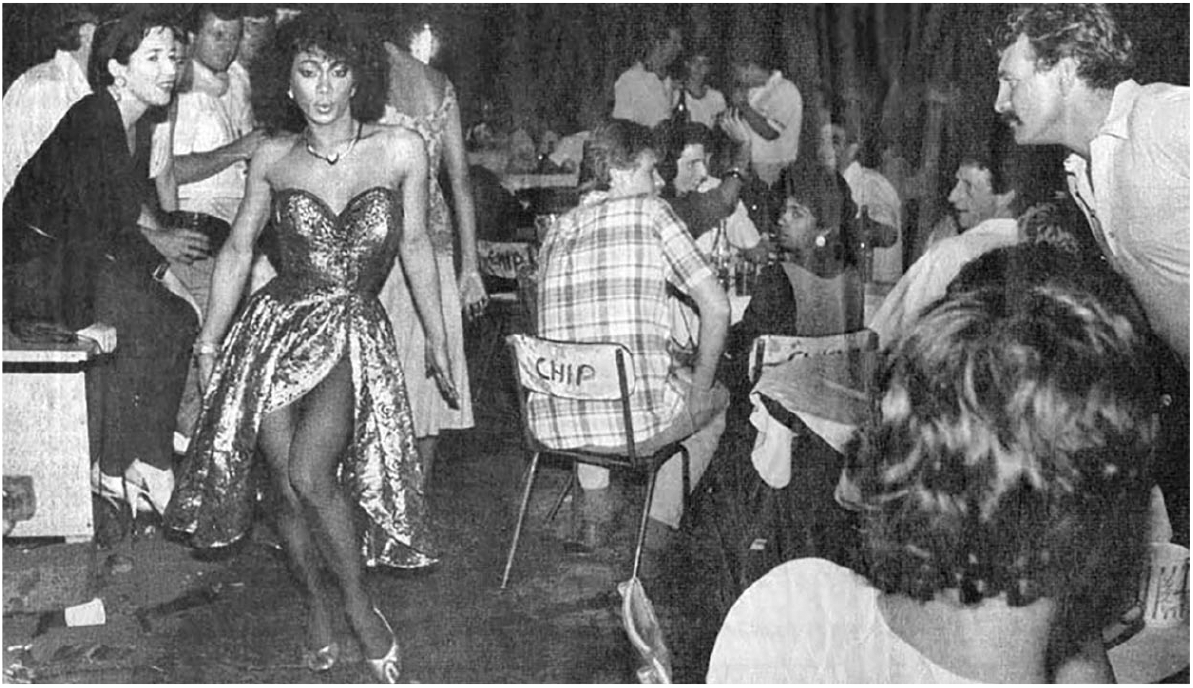
A transwoman sashaying down Bugis Street (Tan, 2012: 118).
Yonfan’s Bugis Street follows the minor-to-minor articulation of queer gender expressions by indeed first setting up Bugis Street as a space of prostitution for horny sailors looking for sexual pleasure among transgender sex workers. Yet, the narrative trajectory of the film soon departs from such a dominant spatial history by cinematically aligning the viewer’s identification with a heterosexual Malaccan girl who, due to her poor social upbringing, decides to come to Singapore and work in the Sing Sing Hotel, a cheap motel occupied by transgender sex workers and their clients. Within this heterotopia of gender variance and heterosexual coming-of-age consciousness, the film recounts the rich queer alternative history of Bugis Street through the coexistence and vitality of diverse tongues, sounds, and bodies, namely queer vernacularism.
Specifically, the movie introduces Lien, the girl from Malacca, West Malaysia, by staging a conflict between Lola and a drunk Caucasian client. Lola is a fierce transgender sex worker who earns money by having sex with white sailors, but in fact she only devotes her true love to an ethnic Cantonese Singaporean man, Meng. The conflict between Lola and the white sailor happens during the night when the American sailors proceed with their butt mooning performance. Shortly after, a heavy rain causes the venue to close down, and a drunk sailor starts making out intensely with Lola. Lola takes him back to Sing Sing Hotel and after a night of passionate wild sex, the sailor wakes up in the morning only to accuse Lola of “misleading him.” He feels disgusted at the fact that he “fucked a fake pussy.” Lola, the ever fierce lady, retorts: “Don’t fuck with me! Hey, my pussy is just as good as any other and you enjoyed it, okay? If you don’t pay up, I will call the police.” She then shouts for help from the balcony as the sailor starts hitting her. At this point, the front desk lady Madam Wee calls up another guy named Ah Bong, saying: “I am sorry, I got some trouble for you to fix.” Shortly after, as the white sailor attempts to leave Sing Sing Hotel without paying, a group of Cantonese speaking Singaporean mafia gangsters show up and force him to pay.
Lien, the new Malaccan girl and soon-to-be receptionist of Sing Sing Hotel, walks in right as this big drama happens. After witnessing the dispute between Lola and the white sailor, Lien is reassured by Madam Wee that “it is not like this every day,” implying that in fact Sing Sing Hotel marks a queer space precisely just like that, one of rendezvous, chance encounters, transgender livelihood, and queer capitalism in the form of sex work. The film eventually ends on a melancholic note, with Lola’s rebellious boy toy Meng leaving her for good while Lien decides to stay in Singapore and explore her life in this wild city. By visualizing the queer transgender history of 1960–1970s Singapore through a Malaysian perspective filled with the sounds and linguistic cacophony of Singaporean Mandarin, Cantonese, Singlish, and Malay English, Bugis Street, like Peculiar Chris, maps a dense queer regionalism of Singapore. Through a queer vernacular lens, Yonfan’s film sheds light on the racialized exoticization of Bugis Street as a space of sexual tourism through a locally inflected narrative of love between racially diverse Singaporean subjects. Where it differs from both Suddenly Single and Peculiar Chris is the nuanced queer minor transnationalism whereby the film whimsically includes sonic impression, cinema history, and languages from the diverse regions of Taiwan, Hong Kong, and of course Singapore itself. It points to Bugis Street as a site of queer vernacularism precisely because of its queer perversity, one that Chris in Lee’s novel deems “non-normative.” Contrasting the urban public perversity with the comparatively more homonormative and privatized space of gay male urbanism in both Yip and Lee’s novels, Yonfan’s film underscores the ethics of reading temporal and spatial presence/absence across the vibrant sites of queer modernity in Hong Kong and Singapore.
Conclusion: Queer vernacularism and the art of minor comparativism
Ultimately, a minor transnational approach to queer sexuality enables rhizomatic, horizontal, and more complex mappings of gender and sexualities than exclusively local, global, or national frameworks. While Hong Kong and Singapore are both highly visible as exemplars of economic miracle in the post-Cold War era and as models for the “success” of global capitalism worldwide, such economic determinism often reduces the “other” aspects of cultural production as insignificant. Of course, both Hong Kong and Singaporean literatures, films, and cultural productions deserve their own specific analytical excavation, and in recent years academic journals such as Interventions and Postcolonial Studies have each devoted special issues on the postcolonial conditions in Hong Kong and Singapore. If both regions are already marginalized on the map of global Anglophone literature, world literature, and postcolonial theory, it makes little sense to simply claim their own “area” specificity for disciplinary inclusion. The more ambitious approach is a minor transnational one (Lionnet and Shih, 2005), wherein the particular circumstances of Hong Kong and Singapore as sharing the similarity of late capitalism, Asian globality, mixed-authoritarian regime, and surprisingly vibrant queer public cultures are put into meaningful comparisons.
Theorizing vernacular cultural forms through queer regionalism enables a way of doing transnational queer studies that attends to local, national, colonial, and global configurations of racial and sexual differences on multiple registers and across “minor-to-minor” articulations. This art of minor comparativism also redirects our attention to the urban sexual scenes, disco culture, cruising sites, and transgender memory where the sounds of American, Japanese, Taiwanese, and Hong Kong music occupy the same temporality as queer bodies and desires. Examining Hong Kong and Singapore through the lens of queer vernacularism challenges us to see beyond the dominant economic model of “inter-city rivalry and comparison” that often characterizes the two cities. Whereas in the economic developmentalist and urban planning lingo “inter-city comparisons reinforce the link between economic speculation and urban aspiration” (Roy and Ong, 2011: 18), queer vernacularism signals alternatively flows of desire, affect, sensation, and literary urbanism that occupy the margins and sideways of the global city imaginary. In recasting dominant urban imaginary, the concept of queer vernacularism suggests that the vernacular is both local and global at once, and its translocal hybridity also enables queer cultural productions in Hong Kong and Singapore to engage with each other anew, without being mediated by the hegemony of Eurocentric queer modernity exclusively (Gopinath, 2018; Martin et al., 2008). Ultimately, queer minor transnationalism across Hong Kong and Singapore provides one useful model for envisioning other queer methods of comparison across wider transpacific sites, temporalities, and scales.
Footnotes
Funding
The author(s) received no financial support for the research, authorship, and/or publication of this article.