







Abstract
This article presents insights into the life story of Johny Baleng, a subchief from the Cameroon Grassfields. I argue that understanding him as a broker in a colonial context helps to identify local agency beyond the paradigm of coloniser-colonised. He needed to prove to his paramount chief that he was able to manage people and facilitate a high agricultural production rate, in order to achieve a more elevated social status in the local context. He travelled extensively and forged alliances with several chiefs of the region. At the same time, he worked with the German and French colonial administrations as a tax collector, worker recruiter and interpreter. These activities secured him an important position in his social environment and in the colonial structures.
Introduction
Johny Baleng (c. 1890–1964) was a member of the royal family of the paramount chiefdom of Bafou in the Cameroon Grassfields (situated in the hinterland of the Bight of Biafra). Despite his royal status, he was initially not destined for the position of a subchief but still managed to become one. To better understand this exceptional development in his career, this article sketches his life story with a focus on his activities as a broker in a colonial context. Those activities encompassed interpreting for the colonial administration, trading in goods and coffee and coordinating a large number of workers. At first sight, his general attitude seems to have been simply pro-colonial. But taking a closer look at his life story shows a much more complex image that this article sets out to analyse.
Ethnographic and archival material about Johny Baleng was collected during 3 years of research (2015–2018) in the Cameroon Grassfields. The diversity of this material (written memories of descendants, interviews with family members and other village inhabitants, and archival records) allows a differentiated account of his life that defies easy categorisation. Johny Baleng can be classified neither with the nowadays out-of-date term of colonial ʻcollaborator ʼ (Robinson, 1972) nor only with the currently used professional designation ʻinterpreter ʼ (Osborn, 2003; Schaper, 2016) for the colonial administration. Instead, the term ʻcolonial broker ʼ describes the complexity of his activities much better. The term is used here to designate an individual that mediates between the seemingly separate spaces of the colonisers and the colonised. By doing so, it becomes clear that the dichotomy ʻcoloniser-colonised ʼ (Memmi, 1957) is no longer tenable, since the colonial situation necessitated subjects of both groups to regularly cross (cultural, linguistic, political) boundaries to translate colonial projects into action. Further characteristics of colonial brokers are presented in detail in the next sections of this article. The concept of the colonial broker here serves as an analytical lens to investigate and interpret the life course and the strategies of people like Johny Baleng. He was not a subchief who acted as broker, but his acts of brokerage rather helped him to become a local subchief. The colonial context in which he grew up produced the obvious manifold ʻgaps ʼ in social structures that he then identified and used to mediate between the local population and representatives of the colonial administration. He acquired several competences ʻon the job ʼ that allowed him to engage in a variety of acts of brokerage.
Colonial brokerage, as performed by him, comprised the mediation of scarce resources such as information, goods and people. Since Johny Baleng recognised the value of mediating these resources, he was remunerated by one or even both of the parties involved. As a colonial broker he crossed borders constantly, which allowed him to acquire more valuable competences. Trade was not necessarily an act of colonial brokerage but a part of it, since it permitted the trader to accumulate the essential economic and social capital to forge new alliances. At the same time, those alliances contributed to an enlargement of his social network. This consisted of colonial employees (Europeans and Africans) and numerous local chiefs. The latter gave him kinswomen as wives who worked on his fields and enabled him to become a powerful coffee producer. This reciprocal effect between Johny Baleng’s different brokerage and non-brokerage activities is essential to understand his work (see the conceptual framework in the introduction to this special issue).
In situations where Johny Baleng did not switch fast enough from one value system to the other, misunderstandings and conflicts were the consequence. For example, he was sentenced to jail at least once and spent some time in prison. Nevertheless, his activities of brokerage and his efforts to foster agricultural production were later recognised and rewarded in retrospect both by his people and by the colonial administration. He was installed as a subchief in the early 1930s by the paramount chief of Bafou. 1 The colonial administration honoured him many years later with different distinctions such as the Mérite Agricole (Regional Archives of West Cameroon in Dschang, further cited as RAWC, 1954) that was introduced in the 1920s to promote Africans in the domain of export crop cultivation (Mbapndah, 1994: 48). These distinctions in the form of medals have been immortalised on his commemorative statue at the entrance to his own subchiefdom (Figure 1) to show his achievements during colonial times.
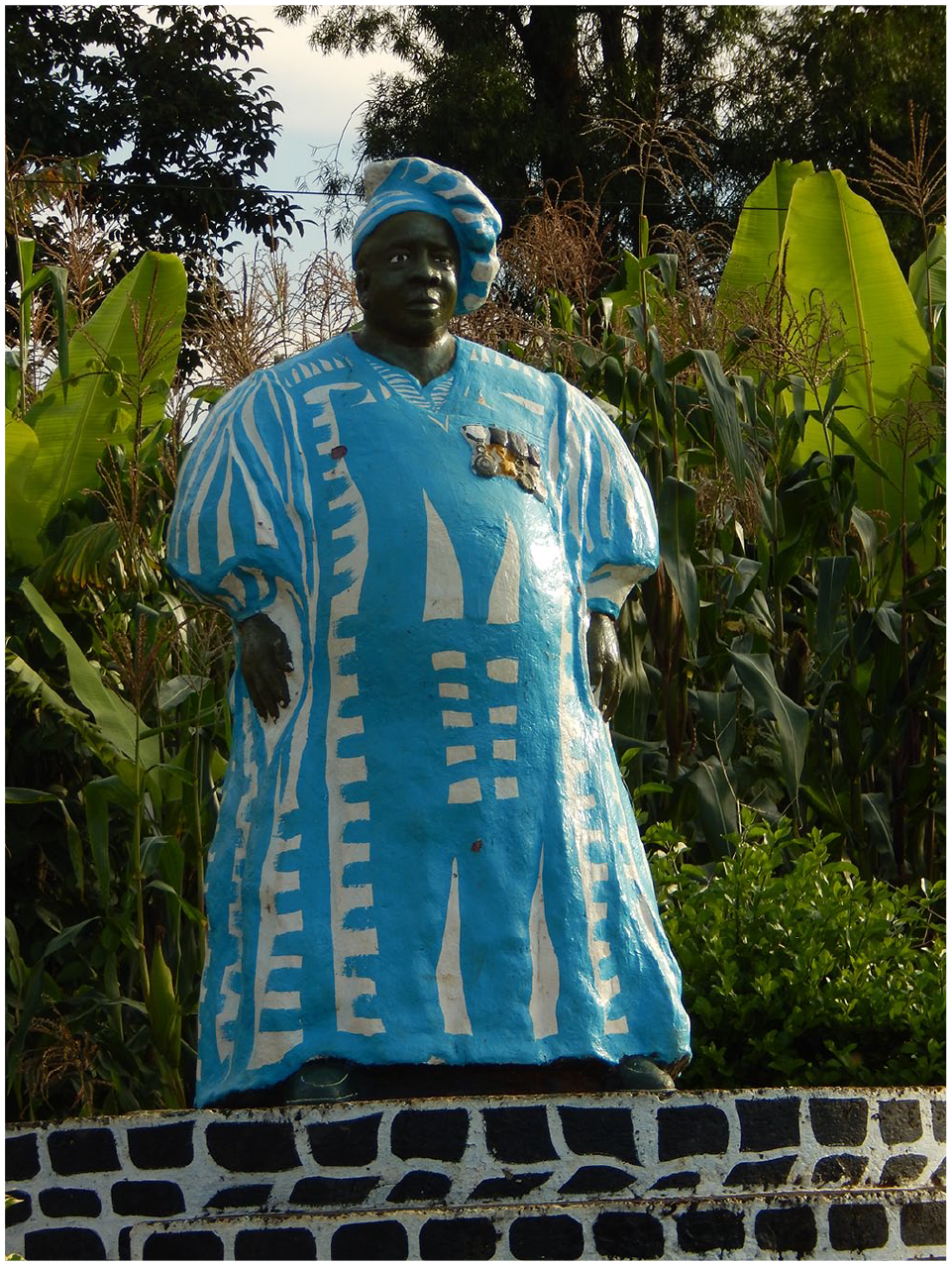
Statue of Johny Baleng on the entrance of the chiefdom, 2016.
This case study aims to contribute to the analysis of African life stories in colonial contexts by advocating the use of the ʻcolonial broker ʼ concept. By discussing ethnographic and archival material together with the theoretical basis of the sociological term ʻbroker ʼ, this study provides an interpretation frame that can be useful for similar cases. The focus hereby lies on the strategies of one individual and not on those of the state. As a result, individual agency takes centre stage instead of colonial policies. As the case of Johny Baleng illustrates, colonial brokerage was not something imposed by the colonial administration on subaltern subjects but rather a way of life chosen by those people themselves. To support and develop these arguments, this article is divided into three main sections. The first section gives a brief overview of previous scholarly approaches and their terminology for the analysis of African chieftaincy and its relationship to the colonial state. That section also provides the theoretical foundations of the term broker, applied to the study of colonialism. The second and main section of this article is dedicated to the life of Johny Baleng as a colonial broker, which serves as new evidence for challenging common assumptions about local agency in a colonial context. The article closes with a discussion of local agency within colonial contexts beyond dichotomising categories.
Local African brokers between personal interests and colonial politics
Social interaction in colonial contexts has been the subject of study for many researchers, primarily anthropologists and historians, since the 1950s (Bührer et al., 2017: 3). This field of research has helped to blur the boundaries of the rigid dichotomous notion of colonisers versus colonised (Memmi, 1957), adding more differentiated categories for the manifold actors of colonial projects such as ʻmiddlemen ʼ (Austen and Derrick, 1999), ʻpatrons ʼ, ʻclients ʼ (Newbury, 2000), ʻcolonial employees ʼ (Osborn, 2003) and ʻinterpreters ʼ (Schaper, 2016). These studies try to illuminate the complexity and variety of social interaction and the agency of local people in colonial contexts.
At the same time, social scientists have engaged with the theorisation of the role and social position of ʻtraditional chiefs ʼ in African societies by analysing their relationship with the colonial state (Barbier, 1987; Van Rouveroy van Nieuwaal, 1987). What these studies have in common is that they analyse the impact of European colonisation on the colonised societies and their traditional power structures. For some regions of Cameroon, the institution of chieftaincy has even been categorised as an ʻinvention ʼ of the German, French and British colonial administrations (Geschiere, 1993 for the Maka and Bakweri people and Quinn, 1980 for the Beti people) or as a ʻpolitical resource ʼ in German colonial times (Schaper 2017 for the Duala people). Few researchers (Fowler, 1993; Warnier, 1993, 2007 for the Cameroon Grassfields) have addressed the issue of chieftaincy from a local perspective as opposed to the colonial state perspective.
The studies cited above usually characterise local rulers as middlemen, intermediaries, tricksters or interpreters in a cumulative and interchangeable way. For example, Austen initially described the Duala people of Cameroon interchangeably as ʻmiddlemen ʼ (Austen, 1983: 1), ʻintermediaries ʼ and even as ʻtricksters ʼ (Austen, 1983: 13, 14) before settling on the term of ʻmiddlemen ʼ in a joint publication (Austen and Derrick, 1999). For Austen and Derrick, ʻmiddlemen ʼ implies the variable role of the Duala towards the Europeans ʻfirst as merchant-brokers of pre-colonial trade; then as a colonial-era elite of educated évolués and planters; and finally, as claimants to anti-colonial political leadership ʼ (Austen and Derrick, 1999: 1).
Another study that aims to characterise a local ruler is the one written by of Schaper (2016) on the life story of the Duala subchief and interpreter David Meetom in German colonial times. First, she defines him as an interpreter and then adds the function of a broker (Schaper, 2016: 760). After analysing his life course, she finally decides to define him as a ʻprototypical broker ʼ (Schaper, 2016: 768), unfortunately without explaining her exact definition of the term. She simply clarifies, that ʻhe not only mediated between different social groups but also gained a genuinely intermediary position for himself ʼ (Schaper, 2016: 768). This in-between status and the crossing of ʻvarious boundaries at work in the colonial context ʼ (Schaper, 2016: 768) are the main factors that Schaper emphasises when contouring the term ʻbroker ʼ. Quinn (1980), starts his study about Charles Atangana from the Beti group of central Cameroon by highlighting that this case is ʻan example of an important African leader whose career defies easy categorisation ʼ (p. 485). The task seems to be so difficult, that Quinn finally foregoes any kind of classification. These are just a few studies of many concerning colonial Cameroon. The following paragraphs provide the theoretical foundations of the term ʻbroker ʼ that will be used to characterise Johny Baleng in the colonial context.
Some foundational reflections about the characteristics of brokers are given in Simmel ʼs (1950) Quantitative Aspects of the Group. Here, Simmel explains the possibilities of social interaction between two parties and introduces the idea of a third one that facilitates communication due to its neutral position. The position of the third party can be, according to Simmel, one of a non-partisan, a mediator or a tertius gaudens (a third who enjoys). It is only through the mediating work of the third party that the other two achieve communication with less ʻsubjective passion ʼ (Simmel, 1950: 147). If the conflict is resolved, the position of the third element becomes redundant because ʻthe group in question changes from a combination of three elements back into that of two ʼ (Simmel, 1950: 160). This is a very simplified presentation of Simmel ʼs ideas that social scientists still find useful and inspiring today. Stovel and Shaw, for example, refer to Simmel when describing the mediation of the third party: this figure profits from the conflict between two parties, mostly because of its control over information that one of the two parties lacks about the other one. In some situations, the third party even produces new conflicts to gain a dominating position (Stovel and Shaw, 2012: 141). According to Lindquist, this process is based on the mediation of valued scarce resources ʻthat he or she does not directly control, which shall be distinguished from a patron who controls valued resources, and a go-between or a messenger, who does not affect the transaction ʼ (Lindquist, 2001: 870). This mediation of valued and limited resources by the broker creates a situation of dependency of the other two parties. They rely on him or her to access resources for which the broker receives a commission (see also introduction to this special issue). The currency used for the payment may differ depending on the context and the resource, for example, cash, reputation or future obligations (Stovel and Shaw, 2012: 144).
Wolf (1956) has described the activities of brokers in colonial contexts as the work of bringing together ʻcommunity-oriented groups ʼ with ʻnation-oriented groups ʼ. In this sense, colonial brokers like Johny Baleng aimed to connect small groups (e.g. villages) with bigger groups (e.g. administrative regions). These brokers were not an optional tool for colonial policies but rather a necessary element to fill the gap between colonial bureaucracies and local populations (Hönke and Müller, 2018: 339; see also introduction to this special issue). The brokers applied both hierarchical (e.g. coercion) and non-hierarchical methods (e.g. negotiation) to achieve their aims (Hönke and Müller, 2018: 338). As the case of Johny Baleng will show, such brokerage is able to ʻperpetuate old inequalities and create new ones ʼ (Faist, 2014: 40), in particular when engaging in cross-border mobility between chiefdoms or even states. In pre-colonial Cameroon, people dealt with numerous borders between the different chiefdoms and were confronted with new forms of mobility control introduced by the colonial administration. These new mobility dynamics created new task fields that were managed by colonial brokers. These brief introductory thoughts concerning the work of colonial brokers will be expanded while presenting the ethnographic and archival material about Johny Baleng.
Johny Baleng as a colonial broker
This section provides insights into various aspects of Johny Baleng ʼs activities of brokerage and non-brokerage. A brief outline of his family background is followed by an account of his mediation of goods and information and his constant task of crossing borders.
Then a subsection is dedicated to Johny Baleng’s mediation of another scarce resource in the Grassfields: manpower. This is followed by an overview of his social and economic forms of capital and lastly, a subsection about his non-brokerage activities closes the section.
Family background
In order to better understand the historical person of Johny Baleng alias Paul Tsobgny, it is helpful to briefly introduce his family background (Figure 2). He was born in the area of the paramount chiefdom of Bafou as a grandson of the ninth paramount chief, Takongmo (reign: 1852–1909). Johny Baleng ʼs father, Fogap, was one of many children of Takongmo and very close to him. Takongmo took the most important decisions in his chiefdom together with three of his sons. One of them was Fogap to whom he assigned command of the army and of diplomatic relations with the neighbouring chiefdoms. Aside from this, Takongmo had the judicial power over his people; he was also in charge of sentencing criminals and the subsequent ʻdeportation ʼ of the convicted (Zébazé, 1979: 13). If the crime of the convicted person was regarded as very bad, his or her whole family was deported in order to eliminate this bad influence from society forever (Zébazé, 1979: 14, 15). Concerning the buyers of the convicts, Siméon Zébazé, one direct son of Johny Baleng, states: ʻThey were bought either to be sold more expensively or to use them as wives or as labourers on the fields. [. . .] After all, a plot of land and a wife were given to a serious, loyal and submissive slave ʼ (Zébazé, 1979: 15; all translations from French are mine). Thus, the sale of condemned people led to a financial profit for the sellers and a gain in labour for the buyers. Fogap ʼs activities included trade with clothes, salt, necklaces, palm oil and slaves. He exchanged these ‘goods’ for ivory, beads, palm oil, bracelets, cowrie shells and cattle. His trading partners were mainly chiefs and notables from the surrounding chiefdoms like Baleveng, Bansoa, Bamendou, Bamenjou, Batcham and Foto (Zébazé, 1979: 14).
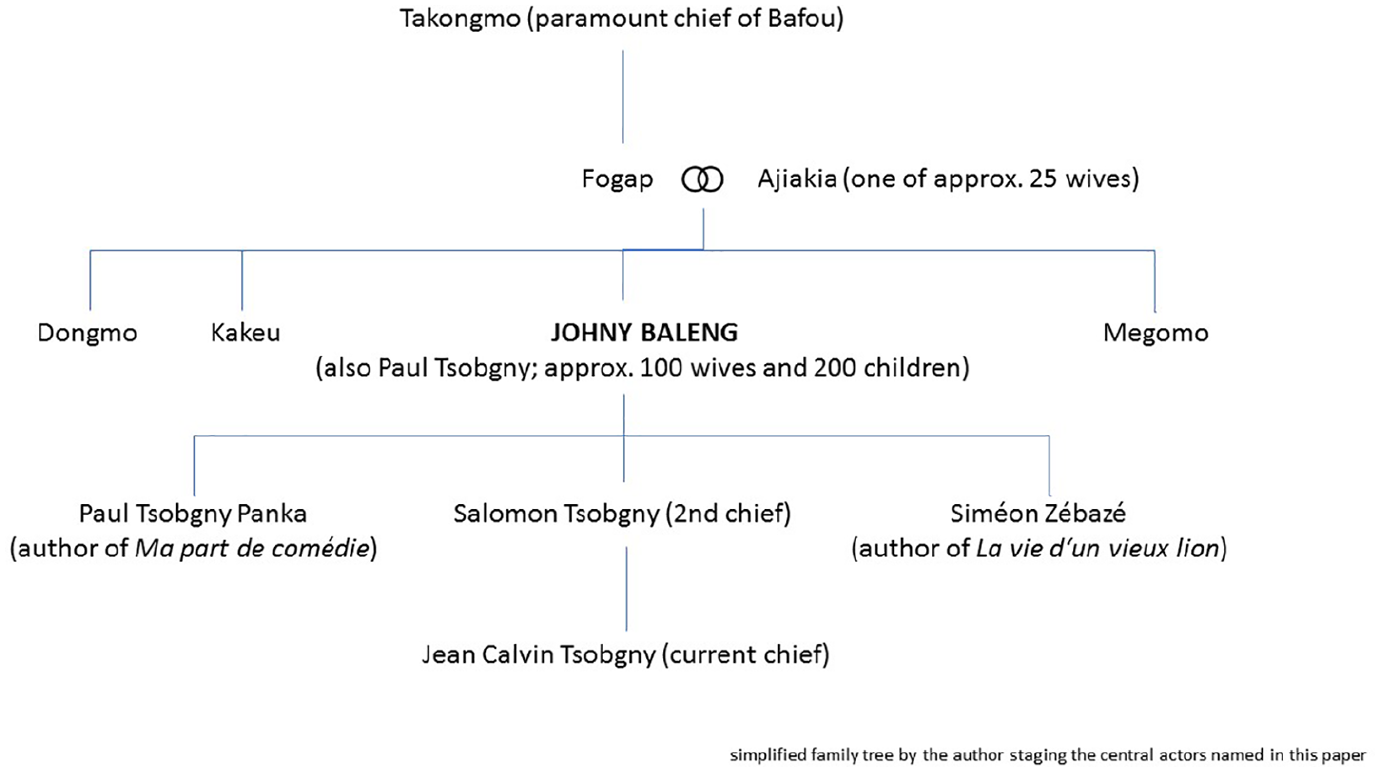
Simplified family tree of Johny Baleng.
The business with ‘slaves’ (Zébazé writes in French and uses the word esclave; this concept hides many different local notions of asymmetrical dependencies between people that go beyond the scope of this study) and their possible integration into society is described as a well-organised practice with fixed role assignments. Regarding female slaves, Zébazé explains that their surveillance was carried out by women, while male slaves were rather monitored by men (Zébazé, 1979: 17). In total, Fogap is said to have had about 25 wives, many of whom originally belonged to the group of slaves to be sold. He selected those he liked best and interrogated them to know how bad the crime was for which they were originally convicted. If the offence was acceptable, he took these women as wives and men as ʻservant boys ʼ (Zébazé, 1979: 18). Out of his approximately 25 wives, at least one is said to have come from Bafou (most likely not acquired as a slave). Her name was Ajiakia and she had four children with Fogap: Dongmo (female), Johny Baleng (male), Kakeu (male) and Megomo (female). Ajiakia, together with her daughters as well as with the female slaves, cultivated the fields of Fogap. If Ajiakia noticed a hardworking woman among the slaves, she tried to also make her one of Fogap ʼs wives (Zébazé, 1979: 21). The former practice of selecting more wives for one ʼs own husband was described to me in several conversations as very common in earlier times.
In Fogap ʼs lifetime, his father and paramount chief (of Bafou) Takongmo pursued an expansionist policy, which was accompanied by a number of war campaigns and subsequent annexation of the respective territories. In the newly won territories, the paramount chief always sent a trusted person as a settler and official representative, who in many cases was made a subchief. Fogap is said to have been sent to settle in an area he had conquered after he had previously fought against the troops of the neighbouring paramount chiefdom of Foto (Cosmas, 1995: 14–17). Thereby, he laid the foundation stone of the later subchiefdom of his son, Johny Baleng.
Mediating goods, information and crossing borders
The oral and written sources consulted also give some clues about the influences that shaped Johny Baleng as a young man in Bafou and later brought him into close contact with the European colonisers of the Grassfields. Already as a child, Johny Baleng developed a good sense for multilingualism because slaves from different origins and language groups were present at his father ʼs compound (Zébazé, 1979: 24). However, he is said to have acquired his language skills not only at home but also as a companion of his father who travelled with his brothers for trade. By doing so, Johny Baleng was very soon involved in the mediation of scarce ressources (in this case of goods), which later became a component of his activities as a colonial broker. But not only goods were mediated by his father and him. Johny Baleng also spoke, or at least understood, Pidgin-English as well as numerous local languages of the Grassfields (Cosmas, 1995: 19). These language skills were the decisive reason why he became an interpreter between the paramount chiefdom of Bafou and the Germans who established their administration centre for the region in the adjacent town of Dschang in the 1900s (Zébazé, 1979: 22).
But the career of Johny Baleng was not as straightforward as World War I brought major changes to the Grassfields and to the whole German colony of ʻKamerun ʼ: new colonial rulers. After the war and under the supervision of the League of Nations, the colony was divided in 1919 into a bigger French part ʻCameroun ʼ and a smaller British part ʻCameroons ʼ. This division also affected the Grassfields and the territory of Bafou fell into the French part, which led to new challenges for its population. For those like Johny Baleng, who until then were close to the German colonial administration, this change meant crossing several borders (cultural, linguistic, social) from one moment to the next. If that change was possible for several colonial brokers, for Johny Baleng it signified in the first instance getting into trouble.
The fact that Johny Baleng was imprisoned after World War I at least once is undisputed in the various sources consulted. The reasons behind his imprisonment remain controversial. We know that the judgement was passed by the French in 1926, whereby he was condemned to 1 year (RAWC, 1926). There are numerous hypotheses about Johny Baleng ʼs activities at that time that led him to be liable for prosecution. One of the best sources on this issue is the already quoted monograph by Siméon Zébazé, who, as the direct son of Johny Baleng, attempts to accurately reconstruct these events. Zébazé claims that during German colonial times in the Grassfields (c. 1900–1915) Johny Baleng was known to the colonisers and worked as an interpreter between them and the paramount chiefdom of Bafou. After the withdrawal of the Germans, the paramount chief of Bafou is said to have sent Johny Baleng again as a messenger and interpreter between his chiefdom and the new French colonial administration, where he was considered a secret agent for the defeated Germans due to his knowledge of Pidgin. The change of colonial administrations with their respective value systems thus caused mistrust. 2 For this reason, Johny Baleng was sent to prison, where he was forced to act as a porter on explorative trips in the region.
In his forced role as a forced porter, Johny Baleng is said to have also acted as an interpreter given his knowledge of numerous local languages. This freed him from his prisoner status and enabled him to work as an official interpreter again. This situation proves how, even when he was an being oppressed prisoner, Johny Baleng was able to perform agency to a certain degree which finally helped him to improve his personal situation. As an interpreter, he moved through the many competing chiefdoms of the Grassfields (up to 100) that reflected a high linguistic diversity (Warnier, 2012). This meant that when travelling, numerous ʻinvisible but important linguistic and cultural borders had to be crossed, for which acts of brokerage were useful and necessary ʼ (Stovel and Shaw, 2012: 152). Johny Baleng ʼs activity as an interpreter for the colonial administration was, therefore, an early training in acts of brokerage, acquiring competences ʻon the job ʼ (Bierschenk et al., 2002: 19) that helped him establish an important network in the region. During his journeys, he made many contacts with rulers of the Grassfields, including, among others, the powerful King Njoya of the Bamum Kingdom (Zébazé, 1979: 23). By doing so, he started accumulating one necessary sort of capital upon which a broker depends: a broad personal network (Boissevain, 1969: 383). That personal network was probably the reason why Johny Baleng engaged in trade, because very soon he recognised the utility of long-distance traders who brought imported manufactured products in great quantities to the local population.
Mediating manpower
The financial wealth of the Grassfields in the first half of the 20th century was principally nurtured by coffee cultivation (for this important topic, although but partially neglected in academia, see: Eckert, 2003; Guetat-Bernard, 2008; Kuété, 2008, 2012; Mbapndah, 1994). At the beginning, in the 1920s and 1930s, this activity was carried out by a large number of people. However, it soon became clear that normal peasants did not have enough time and resources to take ʻproper care ʼ of the new plants and that these were easily affected by various diseases. As a result, the colonial administration decided to regulate cultivation in a strict way. This was done by granting licences only to ʻqualified people ʼ following prescribed criteria. Above all, the chiefs and their notables profited from this because they fulfilled the two most important criteria: they possessed large swathes of land and numerous workers, predominantly consisting of their wives and children (Eckert, 2003: 308; Kuété, 2012: 167). The number of coffee plants that a man could get in the official nursery was determined by the number of wives and children of the male candidate. Therefore, the following explanations will shed light on Johny Baleng ʼs strategies in recruiting people to secure his entry into the very promising coffee economy of that time.
Several sources stress the numerous journeys of Johny Baleng in the Grassfields and even to distant Douala and Yaoundé (Cosmas, 1995: 19; Zébazé, 1979: 9). These are often referred to as business trips, that included visiting acquaintances, establishing new contacts, etc. From these trips he not only returned home with extended linguistic skills but also with people for various purposes. 3 By doing so, he mediated succesfully another ‘scarce ressource’ in the Grassfields: manpower. It is often claimed that Johny Baleng purchased male and female ʻslaves ʼ from his friends for resale. He did this mostly in Bandjoun, Baleng (next to Bafoussam) and Fontem where he had good contacts. Of the group of female ʻslaves ʼ, he kept those he liked best. I was told that a wife who was ʻstubborn ʼ or did not behave according to his ideas, was usually resold. He is also said to have kept male slaves for the performance of agricultural and constructional tasks and at some point, he made some of them his dignitaries. To come into the possession of human beings, Johny Baleng also abused his position as an interpreter by simulating false claims of the colonial administration, like the necessity of workers for public services that at the end only benefited him. It is also often mentioned that his many friends, especially chiefs, sent him their daughters as wives in order to cultivate good relationships with him. He reciprocated this by offering of his own daughters and other female subjects (Cosmas, 1995: 21).
Social and economic capital
When people in Bafou remember Johny Baleng today, there is one common element they associate with him: his almost 100 wives (for the importance of a very large entourage of a chief in the Grassfields see Fowler, 1993: 256). This number of wives (and especially the number of children) is not precise but rather a possible metaphor for the large amount. However, those numbers were not stable and changed constantly due to births, deaths, flight, sale, transfers of daughters to friends, etc. The only written document that provides a snapshot of this is a census register from 1959, updated in 1966 (RAWC, 1959). This register is patrilineal and begins therefore with the male family head, followed by numerous wives and children. In total, 126 individuals are assigned to Johny Baleng in 1959 (5 years before his death). These included his wives, children and grandchildren. Even if such a document only represents one part of social reality at that time, it is useful for estimating not only the social status of Johny Baleng and of his family but also his agency in terms of available manpower and competitiveness towards European coffee producers and traders. Johny Baleng even had a slightly larger family than the paramount chief of Bafou who was assigned 124 individuals. All these individuals were potential workers, which Johny Baleng could dispose of at his discretion. If one considers that this snapshot of 1959 happened at a time when Johny Baleng was already old and, according to his descendants, impoverished, 4 we can assume that the number of subordinates must have been much larger a few decades earlier. It is also necessary to consider the additional workers he employed (whether paid or not) for agricultural production. Thus, it can be assumed that Johny Baleng, at his most productive times, led and coordinated roughly 200 workers. In comparison, some successful European immigrants employed between 200 and 400 workers on their coffee plantations (RAWC, 1946; for the supplying of European coffee planters with Cameroonian workers by the colonial administration see Eckert, 2003: 307).
Johny Baleng ʼs staff was differentiated and included a riding servant, a hunter, a guard for his fields, a cattle herder and a priest for offerings (Cosmas, 1995: 30). According to one of his sons, Johny Baleng’s daily work routine began at 5 am with a patrol on his compound. At 6 am he distributed tasks among his children, wives and other workers. Small teams were formed to carry out tasks together (Zébazé, 1979: 43–45). In general, my interlocutors remember small working groups of five or seven people. The groups were either sent to the fields of coffee and other food plants, or they stayed at home to cook for the members of the compound. Johny Baleng is said to have used a large bell to call his numerous wives and children to work and to eat, and he used his trucks to transport them to his remote fields at Balessing (some kilometres from Bafou). Even though the management of people alone was not an act of brokerage, it was part of Johny Baleng ʼs numerous activities that were mutually interrelated. Sometimes, acts of brokerage such as mediation between local chiefs and the colonial administration led to benefits for Johny Baleng, for example obtaining a new wife. The effective management of his workers, too, permitted Johny Baleng to accumulate capital that brought him to a higher social status and gave him the necessary groundwork for merchant brokerage.
After some years of brokering for the French colonial administration, Johny Baleng gradually gained the means to invest in three sectors that were the cornerstones of prosperity in the Grassfields during the first half of the 20th century: trade, agriculture and transportation (Kuété, 2008: 288). Some scarce but valuable archival material confirms this and provides some details. Johny Baleng is mentioned in an annual report of the Subdivision de Dschang (RAWC, 1945), where he appears as the owner of two trucks: a Dodge from 1938 and a Chevrolet from 1942. The special nature of this entry becomes clear when other entries in this report are also considered. Lists of the possession of trucks, cars, weapons, etc. are presented here and the respective owners are divided into three categories: ʻAdministration ʼ (16 trucks), ʻEuropeans ʼ (19 trucks) and ʻIndigenous ʼ (11 trucks). Johny Baleng belonged to the latter, who competed with the colonial administration and with immigrant Europeans in the field of transportation. Within this imposed category, Johny Baleng is the only owner of two trucks, a clear sign of his high economic power.
Inventory lists and reports from the Second World War mention Johny Baleng repeatedly in his function as a merchant and shop owner. Such inventory lists should possibly lead to a more targeted distribution of products for trade during wartime. He appears along with 10 other shop owners (RAWC, 1940a). At that time, he was mainly in the possession of canned milk, canned meat, rice and salt. This not only exemplifies his financial opportunities but also shows that he and his family belonged to a privileged group of people who had direct access to imported goods and thus probably promoted new hybrid consumption practices. Not the simple fact of owning a shop, but the fact of opening one of the first shops for imported goods in the town of Dschang, is an act of brokerage that Johny Baleng performed at that time. With this, he assisted the colonial administration in establishing infrastructure in accordance with colonial ideals and allowed the (wealthy) people of the region access to imported goods. By doing so, he connected these two groups in an economic way, identifying a new gap in social structure by promoting the flow of goods (Diani, 2013; Stovel and Shaw, 2012: 140, 141). In further wartime listings, he emerges in connection with the agricultural production of food. Along with five other competitors, he is one of the most important producers of peanuts and potatoes (RAWC, 1941). Further archival recordings indicate that he also produced palm kernels and traded motor oil and petrol (RAWC, 1942).
However, the material prosperity of Johny Baleng cannot only be understood by this officially recorded information. The grandson of Johny Baleng and current subchief, Jean Calvin Tsobgny, proudly reports that his grandfather owned not only several trucks but that there are also other material testimonies of his wealth. During a walk through the royal palace of the subchiefdom he showed me various artefacts that belonged to his grandfather, which, in his opinion, are evidence of his progressive spirit. They are kept with the expectation of exhibiting them in a not yet finished museum of the subchiefdom in the future. Among the central objects were refrigerators, weapons (Warnier, 1980 for the history and meaning of guns in the Grassfields), oversized cooking pots (for nearly 140 litres) and machines for processing coffee and corn. All these items are imported goods, which prove Johny Baleng ʼs purchasing power. They are today associated with Johny Baleng ʼs numerous activities and with some of his personal attitudes. The cooking pot, for example, was presented to me as proof of how much had to be cooked for Johny Baleng ʼs large family. The machine for pulping coffee (separating external fruit and coffee beans) is often promoted as being extremely robust and durable. It is seen as one of the few lasting proofs of the high productive commercial coffee cultivation of the 1930s–1950s that declined in the second half of the 20th century. The refrigerator is a common brand of the 1940s/50s and stands in the palace for Johny Baleng ʼs early enthusiasm for imported goods alongside his cars and agricultural machinery.
When remembering Johny Baleng ʼs commercial activities, one of his sons describes him in an enthusiastic way: ʻI ʼm the son of the almighty and rich merchant from the West [Region] Johny Baleng ʼ (Tsobgny Panka, 2009: 23). In addition, Johny Baleng is often designated as one of the largest coffee farmers of his time in the region (Zébazé, 1979: 46). He is also credited with the large-scale cultivation of other agricultural products (cinchona bark, potatoes, maize and peanuts) (Cosmas, 1995: 19) and people in Bafou cite his possession of several trucks for transport and a grocery shop as further key elements of his prosperity (Zébazé, 1979: 34, 35).
Non-brokerage activities
Most of the above described activities of Johny Baleng can be understood as typical for brokers. Mediating scarce resources, crossing borders and acquiring competencies ‘on the job’ are possible, when a common ground for brokers is given: at least two parties that benefit from the mediation of a third one who knows their necessities and preferences, and gets recognition and different kinds of remuneration for it. Hereafter, some activities of Johny Baleng are presented which probably did not directly aim at brokering but ultimately favoured his public image and in that way had a positive effect on his broker activities.
The following statement of Paul Tsobgny Panka about his father, Johny Baleng, is programmatic when analysing Baleng ʼs personal attitudes and preferences: ʻMy father had been influenced by the Europeans, mainly by the Germans. He wanted to apply those new ideas on us, even though things from abroad were normally considered bad. He, on the contrary, preferred things that came from abroad ʼ (Tsobgny Panka, 2009: 152). These ‘things’ from abroad, which Johny Baleng preferred, can be understood through his concrete actions and attitudes.
His early style of dress is today known thanks to a 1931 postcard (Figure 3). It was discovered by a son of Johny Baleng in Douala in the 1970s and then sent to some family members who confirmed its authenticity and recognised Johny Baleng and some of his wives on it. An enlarged version of that image hangs in the reception hall of the royal palace of the subchiefdom of Johny Baleng; it is therefore not a document out of context but rather one of the most central and locally consumed visual representations of Johny Baleng and a part of his family. His descendants describe Johny Baleng ʼs attire in the photograph as particularly ʻadvanced ʼ and ʻelegant ʼ for that time. He wears a vest, which at that time was considered elegant in many Western countries and was worn with shirt and trousers. But Johny Baleng made something of his own out of it and wore it without a shirt but in combination with a valuable blue-white ndop-fabric, a royal cloth from the region, which he wrapped around his hip. This dress style demonstrates Johny Baleng ʼs early ʻhybrid character ʼ which is usually assigned to contemporary chiefs (Geschiere, 1993: 169). In the picture, there are two other extraordinary accessories for that time. The lower edge of the photo shows that Johny Baleng was wearing boots that might have come from the military context. Another element is the watch on his left arm. This representation of Johny Baleng and the recognisable combination of elements from different cultures demonstrates that, through his lifestyle, he was also able to ʻplay the game [of brokerage] according to a variety of rules, which allow[ed] him to profit from the ambiguity around each rule ʼ (Bierschenk et al., 2002: 21).
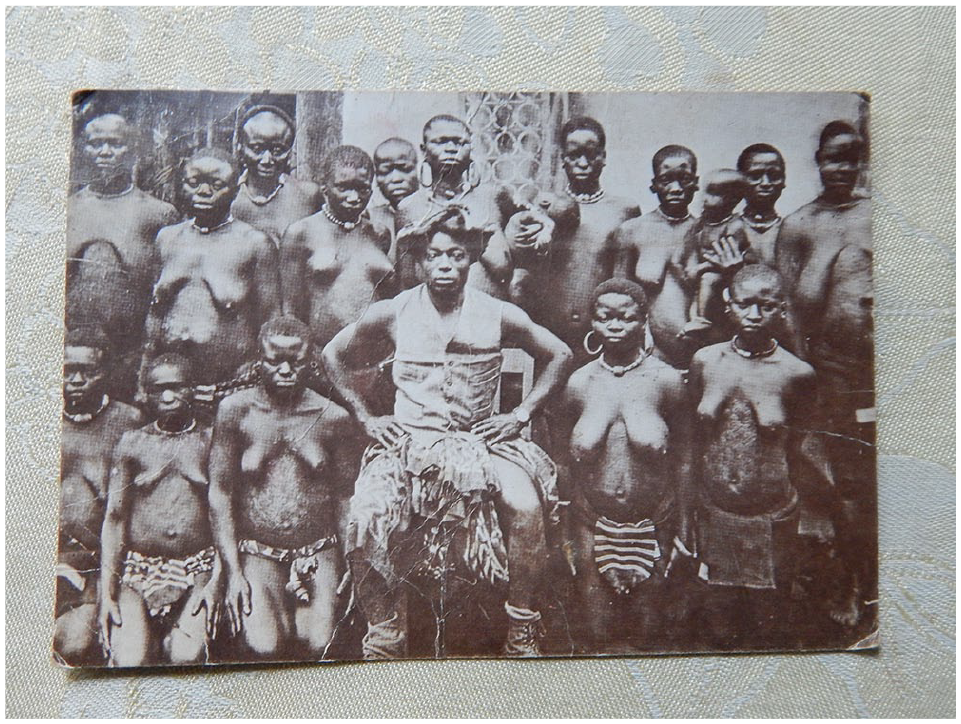
Postcard from 1931 showing Johny Baleng with some of his wives.
But it is not only his personal lifestyle that proves Johny Baleng ʼs open attitude towards European influences. His behaviour towards the colonial administration has been described by an officer of that time as ʻloyal ʼ (quoted in Zébazé, 1979: 50–52). This ‘loyalty’ was confirmed in the context of World War II. At that time, Johny Baleng is said to have made his two trucks and his private car available to the colonial administration for support. This supportive attitude towards France during the war was also recorded in an official protocol. It says: Johny Baleng motivates the people to do everything possible to help France. He explains how bad the situation in the Grassfields was before the arrival of the French. He recommended that the surplus that was collected due to the rise in taxes was given to France to allow them to buy more airplanes and win the war. It was France who brought richness to the Grassfields and now it is time to take some of this richness and donate it to achieve the victory. He asks all the people to donate some money when they get some from the sale of coffee or other agricultural products. The people have to show that they support France and that they cannot be afraid since they are at the side of a good ruler (RAWC, 1940).
This can be interpreted as an authentic willingness to support the French or just as a strategy to inspire trust among the colonial administration and maintain his position as a reliable broker. According to this statement, he regarded the presence of the French as the main reason for prosperity in the Grassfields. He showed a submissive attitude towards the ʻgood ruler ʼ. This exaggerated positive way of speaking about the French shows the need for Johny Baleng to create and maintain a visible loyal attitude towards the colonial administration and his ability to identify opportune situations and act strategically (see the discussion about moral ambiguity and opportunism in the introduction to this special issue). As a broker, this practice formed part of his daily routine, since the constant crossing of social and cultural borders usually made his partners distrustful and obliged him to permanently show loyalty (Lindquist, 2001: 870).
Local agency through brokerage within colonial contexts
Johny Baleng lived at a time when things were changing pretty fast in the Cameroon Grassfields and in many other regions of Africa. He was born in pre-colonial times and witnessed the arrival and departure of different European colonisers. Colonialism was for him not necessarily something disadvantageous but rather a context that created new opportunities for taking action. He recognised very soon the benefits of those opportunities and developed manifold strategies. This encompassed several activities such as the mediation of scarce ressources, the constant necessity of crossing cultural, linguistic and political borders as well as the accumulation of economic and social capital. Besides those brokerage activities, some personal attitudes and non-brokerage acts complemented the general ‘broker-strategy’ of Johny Baleng, for example, his external appearance and his public statements. Through all of these activities, he mediated between the groups of people that are often characterised as ʻcolonisers ʼ and ʻcolonised ʼ and bridged those categories. He switched constantly between those two seemingly disparate spaces and was thus obliged to inspire trust on both sides to keep his activities going. The process of formal decolonisation weakened Johny Baleng since the respective political, economic and social changes made most of his activities superfluous.
The career of Johny Baleng has been presented in detail in this article with regard to his role as a colonial broker. It was argued that the concept of the colonial broker allows us to identify the agency of ‘colonial subjects [who] were not helpless victims of superior forces and institutions, but historical actors who were active agents and who acquired information, tools and resources’ (Bührer et al., 2017: 4). Nevertheless, this undertaking remained a very risky one that led to both social advancement and dangerous situations. The proposed approach of an analysis of life stories with regard to brokerage activities is not the only way of identifiying the important agency of local people within colonial contexts. It is only one of many possible paths to take when trying to deconstruct binary notions of colonialism. Nonetheless, the present approach and the analytical framework of brokerage allow us to identify behaviour patterns applied in colonial contexts and beyond. Many of those strategies used by people such as Johny Baleng in the (colonial) past are still useful in the present, particularly in contexts of strong asymmetrical power structures (see the contributions in this special issue).
In my opinion, it is necessary to combine historical with anthropological methods to be able to achieve the goal of identifying local agency through brokerage within colonial contexts. Archival records are not enough to understand that agency, since those documents were mainly produced from the perspective of the colonial administration. Oral data and written local memoirs are very scarce and difficult to collect but they give a valuable perspective from within the local context and from within brokerage. I am convinced that this might be one of the best paths out of dichotomous notions of colonialism.
Footnotes
Acknowledgements
I am grateful to the editors of this special issue, Ute Röschenthaler, Birgit Bräuchler and Kathrin Knodel, and also to the other participants of the project, Nadeeka Arambewela-Colley and Antje Missbach, for their helpful feedback.
Funding
The author disclosed receipt of the following financial support for the research, authorship, and/or publication of this article: This article is one of the outcomes of a project-related exchange of scholars from Monash University Melbourne, Johannes Gutenberg University Mainz and Goethe University Frankfurt (2019–2021) that is funded by the German Academic Exchange Service (DAAD) and Universities Australia.

Notes
Archival materials
All files are from the Regional Archives of West Cameroon (RAWC) in Dschang.
RAWC (1926) Correspondence from 1926 to 1977.
RAWC (1933) Documents on administration and law from 1931 to 1987.
RAWC (1940a) Correspondence from 1926 to 1977.
RAWC (1940b) Monographs on chiefdoms from 1939 to 1992.
RAWC (1941) Records on administration, staff and finances from 1935 to 1989.
RAWC (1942) Reports from 1935 to 1943.
RAWC (1945) Records and reports from 1934 to 1946.
RAWC (1946) Records and reports from 1934 to 1946.
RAWC (1954) Correspondence from 1926 to 1977.
RAWC (1959) Population census from 1959 to 1966.