We study semi-classical asymptotics for problems with localized right-hand sides by considering a Hamiltonian positively homogeneous of degree on . The energy shell is , and the right-hand side is microlocalized: (1) on the vertical plane ; (2) on the “cylinder” , when . Most precise results are obtained in the isotropic case , with a smooth positive function. In case (2), is the frequency set of Bessel function , and the solution of when , already provides an insight in the structure of “Bessel beams,” which arise in the theory of optical fibers. We present some extensions of our previous works with A. Anikin, S. Dobrokhotov and V. Nazaikinskii. In Section 3, we sketch the semi-classical counterpart of the construction of parametrices for the Cauchy problem with Lagrangian intersections, as is set up by Melrose and Uhlmann. This involves Maslov bi-canonical operator.
Introduction
Let , or possibly a smooth manifold. Write . For , we recall (see e.g., Ivrii, 1998, Chapter 1) the usual class of symbols
with asymptotic expansion . We define analogously . Most of the time, we shall consider symbols compactly supported in . Let be a -PDO whose symbol belongs to , or , which is, for instance, the case when is positively homogeneous of degree with respect to . We will denote by or by a point in . Let be a non-critical energy level for Hamiltonian . Let also be a Lagrangian semi-classical distribution locally of the form
where is a non-degenerate phase function in the sense of Hörmander (or a generating family in the sense of Arnold) defining the Lagrangian manifold (see Section 3), and for some . We assume here to be compactly supported in , excluding, for example, the case , , corresponding to , which is too singular from our point of view. For brevity we will often denote such a (normalized) integral, possibly including Maslov index factor such as , simply by .
We shall assume that Hamiltonian vector field is transverse to , which we call Lagrangian intersection. In the articles Anikin et al. (2017, 2018, 2023), we have considered in the context of Maslov canonical operator the problem of “semi-classical Green functions,” which consists in solving , being the vertical plane , with outgoing at infinity. The distributions and are linearly related by , where is the semi-classical outgoing parametrix, that we shall compute in term of Maslov canonical operators. See also Kucherenko (1970) and Fedoriuk (1999).
Some Examples of “Localized Functions”
Here are some examples of (expressed in a single chart):
, (that we call the “vertical plane”) is the conormal bundle to , so that
We say simply that is a “localized function” at . This is the basic example since can alway be taken microlocally to such a form, and to , where , see Section 3. Note that we can choose the amplitude in equation (1.2) independent of (see Hörmander, 2009, Lemma 18.2.1).
More generally, a conormal distribution , , with respect to , that is, . Again can be expressed with a new amplitude not depending on .
WKB functions in Fourier representation
here .
Semi-classical distributions related with Bessel functions, microlocalized on
which is called the “cylinder”; here is the unit vector parametrized by , see Section 5.
When , this holds in particular for Bessel function of order 0
a radially symmetric solution of Helmholtz equation , and follows from the integral representation:
More generally, this applies to “regular” distributions on of the form
Airy-Bessel beams, which are known also as Berry-Balasz solution, see Berry & Balazs (1979); Dobrokhotov et al. (2014a), of the paraxial approximation of the wave equation in 3-dimensionnal space, with initial manifold
Lagrangian distributions with a complex phase in the sense of Melin-Sjöstrand, see Melin and Sjöstrand (2006) equivalently a complex germ in the sense of Maslov, which are superposition of coherent states , and is a strictly positive Lagrangian manifold.
Examples (1) and (4) will be extensively studied when and is positively homogeneous of degree ( in Example (4)). Since in Example (5) looks like a plane wave in the direction , one could expect that Example (4) could be generalized to this case, once the eikonal coordinate has been found. Examples (6) and (7) require some special treatment and will not be considered either.
Global Parametrices for PDO’s of Principal Type and Their Semi-Classical Counterpart
Thus our main problem is to represent the formal asymptotic solution of
in the most explicit form. Here is the propagator, so we need consider first Cauchy problem
For general , we adapt the constructions of Melrose and Uhlmann (1979) to the semi-classical setting; in the case of homogeneous Hamiltonians of degree , we present formulas more globally. See Bogaevskii and Rouleux (2023a, 2023b) when is given by (1.3), which forces .
Here we review some general concepts for solving the semi-classical PDE’s (1.5) and (1.6) in term of oscillating functions (i.e., semi-classical distributions) modulo terms, as well as their non-semi-classical analogue (for standard pseudo-differential calculus)
starting from Cauchy problem
In the latter case, we look for parametrices, that is, distributions defined modulo smooth functions.
Semi-classical approximation is also called asymptotics with respect to the small parameter . This is the most natural calculus, since it is concerned with functions oscillating rapidly with respect to a given scale , but can nevertheless be smooth in . They are called semi-classical distributions. In the simplest case, these semi-classical distributions are of WKB type.
Global existence of an outgoing solution at infinity provided suitable hypotheses on Hamilton vector flow, such as Lagrangian intersection, the non-trapping and the non-return conditions, is quite involved. The main strategy in case of conormal distributions, has already been set up by Melrose and Uhlmann (1979) in the context of smooth parametrices (asymptotics with respect to smoothness) for a PDE, called sometimes Melrose-Uhlmann calculus.
The non-return condition was first formulated by Guillemin and Melrose (1979, Proposition 2.7), in constructing parametrices for hyperbolic PDE’s with a boundary (billiard problem), extending the case without a boundary (Duistermaat, & Hörmander (1972).
The non-return condition was then formulated in greater generality by Melrose and Uhlmann (1979), equation (6.5), when solving a PDE with a right-hand side. Let be a conic Lagrangian manifold, which we will call the “initial manifold,” and be a PDO of real principal type, with real principal symbol such that the Hamilton vector field is never tangent to , where . Given a Lagrangian distribution microlocally supported on , the problem is to find such that mod . Here plays the role of the “boundary” (generically both are of dimension ). Note that the results of (Duistermaat, & Hörmander 1972) and Melrose and Uhlmann (1979) hold in a general pseudo-convex manifold , and that in (Duistermaat, & Hörmander 1972), the non-return condition is automatically satisfied. We refer to Melrose and Uhlmann (1979) for precise statements, see also Greenleaf and Uhlmann (1990), Joshi (1999), Ford et al. (2018), and Sternin and Shatalov (1983) and references therein.
The natural framework of such PDE’s has its counterpart in the semi-classical case described in equation (1.5). In particular the non-return condition (renamed as the non-refocusing condition) has received a more systematic treatment in relatively recent works (Bony, 2009; Castella, 2005; Klak & Castella, 2014).
Namely, let be the vertical plane, and be a semi-classical Schrödinger operator with a smooth potential with long range interaction and such that . In this case, the non-refocusing condition is characterized by the relation on (the “return set”)
where is the trajectory issued from .
The non-refocusing condition in the restricted sense, means that . But the dimension of can also be taken into account. According to Castella (2005), Bony (2009), and Klak and Castella (2014), it is assumed that is a submanifold of of dimension less than .
The non-trapping condition should also be introduced in the semi-classical setting (see also Melrose & Uhlmann, 1979, equations (6.3) and (6.4)). This is a condition on the set of trapped trajectories at energy :
where and here we can replace the non-trapping condition on the phase variables by a condition on alone, for example, as .
Outgoing solutions , are characterized by Sommerfeld radiation condition of the form
where , , is the unique solution of , and . It relates in a non-trivial way the behavior of at infinity with the value of the potential at . Sommerfeld radiation condition requires careful estimates on , or , along with a discussion according to the relative magnitude of and . The proof consists, roughly speaking, in testing against some fixed , and then show that as . In particular, one needs to know asymptotics of in a -dependent neighborhood of .
In this article instead, given and the initial Lagrangian manifold , we content ourselves to present, in the sense of formal asymptotics, a “closed form” for the solution of (1.5) in term of Maslov canonical operator for bi-Lagrangian distributions. So the non-refocusing and the non-trapping conditions can be largely ignored in case of formal asymptotics. By formal asymptotics (Leray, 1978) we mean that, in principle, our approximate solution is only a quasi-mode, that is, it has no reason to be equal to mod . In practice, however, numerical simulations show that Maslov canonical operator provides an excellent agreement with the “exact solution.”
Actually the main issue we are faced with is about existence and uniqueness of the “asymptotic solution” To fix the ideas, we can already formulate the problem as follows: How can a “formal” WKB solution approximate the solution of (1.6)? A possible answer relies on the construction of a normal form for . Assume, for instance, is self-adjoint and such that its principal symbol is real, vanishes at and (by analogy with the terminology used for smoothing parametrices, we call a -PDO of real principal type near ). Then is microlocally equivalent to , that is, there is a FIO associated with the canonical transformation such that (Darboux theorem), is microlocally unitary, and , where is a local operator norm. This is a version of the semi-classical Egorov theorem (see e.g., Ivrii, 1998, Section 1.2). So solving (1.6) amounts to construct a solution of
where . This PDE with constant coefficients can easily solved in the “same class” as . Taking the image of by gives the suitable WKB solution of (1.6). Of course, this construction can be extended so long as remains of real principal type. This is one of the basic ideas of Melrose and Uhlmann (1979), which has to be extended in the case of a (microlocal) boundary, namely to the solution of (1.5). See also Sternin and Shatalov (1983). Another ingredient for solving (1.5) is to construct an asymptotic solution in the “elliptic zone,” that is, when . There we only need to invert an elliptic -PDO. Gluing together the different branches of solutions follows from the “compatibility condition” (see Melrose & Uhlmann, 1979 and Section 3 below for the semi-classical case), leading here to the notion of Maslov bi-canonical operator.
In the framework of Maslov bi-canonical operator, we can, in principle, make these constructions global provided the non-trapping and the non-refocusing conditions hold.
Note that making use of the non-trapping condition only, we can ensure that our construction of Maslov bi-canonical operator can be extended to large values of , but still microlocally outside the initial manifold (i.e., in the case is the vertical plane , outside ).
Even if we had taken care of the non-trapping and the non-return conditions, we should point out that the solution to (1.5) is not unique in general. Following the principle of limiting absorption, we should introduce the auxiliary equation
and take the limit . In case is the Schrödinger operator, this is related with the fact that the limit of , when satisfies Sommerfeld radiation condition (1.8), but in general taking the limit can be a non-trivial fact. So for simplicity again, we will ignore the limting absorption principles in this work.
To close this general introduction, we should mention again the case of parametrices for hyperbolic PDE’s with a boundary (billiard problem), which was given a new insight by Petkov and Stoyanov (2024), Petkov and Vodev (2017), and Vodev (2015, 2018, 2019, 2021). These works make use of resolvent estimates.
Lagrangian Intersection and Microlocal Green Functions
Recall the canonical 1-form on takes (locally) the form ; on the extended phase-space , (or locally on ) it is given by . We consider several Lagrangian manifolds:
The “initial manifold” which contains . We will be concerned essentially with the “vertical plane” (1.2) or Bessel cylinder (1.3).
The Lagrangian submanifold in extended phase-space (denoted instead by by Anikin et al., 2023)
where is the phase flow of the Hamiltonian vector field generated by
(denoting instead of ). Not to confuse as a variable in (1.9) with the given value of energy in (1.5), we shall change the variable to , so that for . Lagrangian manifold contains , where solves Cauchy problem (1.6).
where is the energy surface . Let be the “boundary” of . We shall always assume Lagrangian intersection, that is, is transverse to .
For Example (4), however, there may be points on , where transverse intersection fails (we call them glancing points) by analogy with the problem of diffraction by obstacles, see Section 5), so we miss some informations on nearby. Note that a glancing point is a critical point of . This is discussed by Bogaevskii and Rouleux (2023a, 2023b).
We shall assume that the amplitude defining is compactly supported in . This hypothesis is discussed in more detail by Anikin et al. (2023), Section 1.6. In particular, if is only rapidly decreasing in , then we must assume some ellipticity of at .
For simplicity, we restrict to the case where is a compact, isotropic submanifold without boundary, which is certainly the case when is elliptic. This restriction, however, is not essential (Melrose & Uhlmann, 1979) and some of our results carry to the case, where is the wave operator.
We also assume that there is no finite motion on , namely
for any trajectory issued from at .
The non-return set in (1.7) is irrelevant if we content ourselves with the asymptotics of microlocally in a compact set outside . For instance, if , we shall compute , locally uniformly in any compact set , as . A first improvement would consist in removing only a -neighborhood of for some , this we have sketched by Anikin et al. (2017), Theorem 2.
Our main goal is to represent formally (1.5) as a superposition
where is Maslov canonical operator associated with , and is an amplitude depending linearly from the amplitude defining .
The relevant contributions to this integral come from , and the critical points .
The contribution of is excluded by (1.11). If we do not have glancing points, then is a smooth Lagrangian submanifold. We need to take into account in formula (1.12). If the initial manifold is the vertical then this contribution is zero outside of . Otherwise (as is the case is Bessel cylinder), the contribution of is not zero but maybe of small order (as ). But if has compact support, then the contribution of is zero outside .
The critical points give of course the main contributions to (1.12), and give in principle all possible types of Lagrangian singularities in , microlocally outside . This will be investigated in detail in Sections 4 and 5 for a particular type of Hamiltonian which allows to construct quite explicit “global” asymptotic solutions.
In case is the vertical plane, (1.11) can be replaced by as , and the measure on factorizes as , where is the measure on , see Anikin et al. (2023, Theorem 2). The accuracy in (1.12) can improve to , see Anikin et al. (2023, Theorem 4), and also Sternin and Shatalov (1983).
One of our claims is to express as some “bi-canonical operator” acting on pairs of symbols depending linearly on , resp. the boundary-part and the wave-part symbol of , which we call a bi-Lagrangian (semi-classical) distribution. This follows from a symbolic semi-classical calculus similar to Melrose and Uhlmann (1979).
In Section 3, we translate the setting of classical pseudo-differential calculus elaborated by Melrose and Uhlmann (1979) to the semi-classical one, and make some statements more precise. By Proposition 3.2 below, near any we are reduced microlocally to the case where , and is the flow out of the “model Hamiltonian” in energy surface . In Proposition 3.5, we show that can be taken microlocally near to its normal form by conjugating with a -FIO. So without loss of generality, we may assume that, after some canonical transformation, . We have the following theorem:
Let (not necessarily homogeneous with respect to p). Assume the vertical plane , and , where is a non-critical energy level, intersect transversally along the compact isotropic manifold . Assume as for all initial conditions . Let also be a semi-classical distribution microlocalized on of the form (1.2), with (to fix the ideas), and where we can assume the symbol is independent of . Then there is such that the equation can be solved in the form (1.12) for , locally uniformly for small enough.
Moreover, there are symbols , such that in local coordinates , verify the compatibility condition
and such that can be represented by Maslov “bi-canonical operator,” see (3.28) as
We have the commutation relation
for , locally uniformly for small enough.
We stress that this representation holds in a punctured neighborhood of , that is, is not uniform in near , since we have neglected the non-return condition.
However, since the Hamiltonian vector field remains transverse to for all , the condition is not really a restriction. Namely, using local charts for Maslov “bi-canonical operator” as in the case of Maslov canonical operator associated with the homogeneous equation (see Section 3.2 below), the asymptotic solution can be made global outside . See also Anikin et al. (2023, Theorem 4).
The remainder term in (1.14) can be improved by considering higher-order transport equations and using the compatibility condition (1.13).
Maslov “bi-canonical operator” is some operator version of the “compatibility condition” by Melrose and Uhlmann (1979), formula (2.10) and Section 4. It encompasses the parametrices both in the elliptic region and in the hyperbolic region (see Theorems 1 and 2 by Anikin et al., 2023).
Hamiltonian is homogeneous of degree with respect to and is the vertical plane.
The previous result is not very useful from the point of view of applications, since it does not provide a “close form” for . Much more information is available when Hamiltonian is homogeneous of degree with respect to , due to the relations and (Huygens principle). We have chosen coordinates on , a “radial coordinate” such that on and coordinates along , we can think of as angles parametrizing the -sphere.
Lagrangian intersection always holds on , for if , Euler identity gives which contradicts . We will, therefore, assume the non-trapping condition (in ) , .
Note that such a symbol is not suitable for pseudo-differential calculus when is not an even integer, because of the singularity at , but this is harmless if .
A particular case of these Hamiltonians is the “conformal metric” given by the following equation:
where be a smooth positive function on , . In case , identifies, through Maupertuis-Jacobi correspondence, with Helmholtz Hamiltonian in a non-homogeneous medium with refraction index such that . We shall pay a great attention to this Hamiltonian, for which computations are most explicit.
Recall that a focal point for a Lagrangian embedding (where is either , , or ) is a point such that has rank . The set of focal points is denoted by . Recall also that there exists a covering of by canonical charts , where for all . These for which are called regular charts, and those for which singular charts.
At least for small enough, that is, small enough, using at most two canonical charts (depending if or not) we can construct solution of Cauchy problem (1.6), and hence by integration with respect to . To this end, we introduce eikonal coordinates (see Section 2), and a generating family for as (see (4.5)):
The “-variables” are thus . This defines the 1-jet along the critical set of the solution of Hamilton-Jacobi equation associated to (1.6). This yields (see equations (3.7) and (4.14)) an (inverse) density on , given by ( being Lebesgue measure on the critical set) and non-vanishing precisely when is a non-degenerate phase function, see Propositions 4.3 and 4.8. This holds at least for small . For larger , the non-vanishing of will only be assumed.
Let , and be positively homogenenous of degree . Let such that
(this holds for small). Then there is such that the equation can be solved in the form of the following equation:
for , locally uniformly for small enough.
Moreover, we can decompose
where is a partition of unity subordinated to a chart , where and a (singular) chart , where , near , and near , both contributions being discussed in Sections 4.4 and 4.5 below.
We do not attempt here to formulate the result in terms of bi-canonical Maslov operator as in Theorem 1.1. Note the loss of accuracy () instead of in Theorem 1.1. In Section 2.3, we discuss (somewhat informally) the case where has several pre-images under .
By constructing (1.5) and (1.6), we mean also determining the Lagrangian singularities of . They are revealed when reducing the number of “-variables” in the oscillating integral . We get virtually any kind of Lagrangian singularity, but because of homogeneity of with respect to , it is convenient to introduce another classification in , which clarifies the construction of .
Let be positively homogeneous of degree with respect to . We call a point such that an ordinary point if , and a special point otherwise. If we call a residual point.
Here are some examples:
For Tricomi Hamiltonian, , the residual points are those for , the special points those for but , and the ordinary points those for . Tricomi operator is used as a model for diffraction. This model extends to the 3D case as .
For Métivier Hamiltonian, , the residual points are given by or , the special points by and , but , and the ordinary points by . Métivier operator provides a counter-example for analytic hypo-ellipticity.
Let be the “conformal metric” given by (1.15). The residual points are the critical points of ; at a special point, , that is, is tangent to the level curves of . This is our main example here.
We denote by the set of special points on . We shall partition points according to the following values: (1) is a focal (or non-focal) point; (2) is a special (or ordinary, or residual) point. Thus each canonical chart splits again into ordinary, special or residual points. Assume for simplicity.
Let , and at . Then
so that we can perform asymptotic stationary phase in to simplify (1.5) at . This holds when is of the form (1.15) and is an ordinary point. Likewise, if several values of parameters contribute, we sum over such ’s. Then reduces to a phase function and we can further reduce the number of variables in a standard way, according to the fact that is a focal point or not. When but , we have
where is constrained to be equal to 1 on the critical set , so that we can perform asymptotic stationary phase with respect to . Then has rank 1 if is a special point or rank 2 otherwise, see Proposition 4.6(ii). Note that never turns vertical, since on .
In this generality, we only succeed (see Proposition 4.6) to describe the contribution to (1.5) (by asymptotic stationary phase) of short times (“near field”), that is, so long as , but this is actually sufficient to compute microlocally near , when .
is the “conformal metric” and is the “vertical plane.”
Using that is parallel to we get more complete results in this case. If is bounded, a sufficient condition for (1.12) is that energy is non-trapping. The following stronger condition excludes natural potentials having a limit as , as shows the example . However it turns out to be convenient from the point of vue of the following:
We say that has the defocusing condition iff
In particular if has a critical point, this is a non-degenerate minimum. Under defocusing condition (1.20), if is a special point along some bicharacteristic issued from , then for all , is an ordinary point. We expect that (1.20) is related to the non-trapping condition (1.12), and provides an information on the “return set” in (1.7), for example, . It also implies that special and residual points are “exceptional” compared to ordinary points, in the same way singular points are “exceptional” with respect to regular points. This allows a natural subdivision of canonical charts into ordinary and special (residual) points, so we can speak of a regular-ordinary chart, or regular-special chart, and so on. The main results are summarized in Proposition 4.11.
In case (1.15) with and (scattering problem), the asymptotic solution of has been constructed by Dobrokhotov et al. (2013, Example 6), in term of Bessel functions.
is “Bessel cylinder” , and .
To the former “-variables” , one has now to add as a parameter. Note that has a Lagrangian singularity at . This is the most technical part of the article, and the results are only partial, because we are ignoring glancing points. It is necessary here to assume . For , Euler identity shows that the 1-form vanishes on . We are led to assume . For simplicity, we shall also assume essentially that is of the form (1.15) with radially symmetric.
Due to possible glancing points, we cannot formulate a global result in term of Maslov canonical operator as in Theorem 1.2. For an Hamiltonian positively homogeneous of degree 1 in the variables, we content ourselves with computing the phase and density on , so our results are most complete in case of the conformal metric. This simplifies further in case of a radially symmetric conformal metric. We refer to Section 5 for detailed statements.
Outline of the Article
In Section 2, we first construct eikonal coordinates on when is positively homogeneous of degree , and is either the vertical plane, or Bessel cylinder. Then we discuss some well-known facts about the extension of the solution of Cauchy problem (1.6) for large . In particular, we examine the case where there are several branches of lying over , that is, , leading to Van-Vleck formula. Following Colin de Verdière (2005), Guillemin and Sternberg (1977), and Guillemin and Sternberg (2013) we then focus to the case when defines a metric, according to (Finsler metric, or Randers symbol), or .
In Section 3, we prove Theorem 1.1. We start to recall some basic facts on Maslov theory. Then we sketch its generalization to bi-Lagrangian distributions, following mainly Melrose and Uhlmann (1979), where is taken microlocally to its normal form on a non-critical energy surface. We make also the results of Melrose and Uhlmann (1979) more precise and adapted to asymptotics with respect to the small parameter . Thus we can construct microlocally outside , and locally uniformly with respect to . We end up by computing explicitely when , and is compactly supported, and verify that can be written as the sum of two terms, microlocally supported on and , respectively.
We start in Section 4 to recall from Dobrokhotov et al. (2014b, 2017), the matrix matrix defined on a local chart of a Lagrangian manifold , whose determinant turns out to be the (inverse) density on . It will be most useful in Section 5. Then we define the phase function from which compute directly the (inverse) density on . Later on we restrict to the 2D case. In Section 4.3, assuming this density is non-zero, or equivalently, that is a non-degenerate phase function in the sense of Hörmander, we investigate some configurations of in (according to or ) and describe more closely the corresponding Lagrangian singularities (focal points) in the chart, where . We relate focal points with ordinary, special or residual points. In Section 4.4, we complete the first-order asymptotics by considering the transport equations, and prove Theorem 1.2. In Section 4.5, we specialize further to the case of the “conformal metric,” using also the defocusing condition (1.20), which allows a more complete description of focal points.
Section 5 is the most technical and sketchy part, since we do not take glancing point into account. In Section 5.1, we give necessary and sufficient for a point of the “cylinder” (1.3) be glancing with respect to . In particular, we show that a glancing point at is also a special point. Then we describe the parametrization of provided this is a closed manifold without boundary. We compute the matrix we introduced already in Section 4, and show that we should take so that its determinant identifies with the density on . All computations should be carried in the extended phase-space .
In the Appendix, we prove the density is non-vanishing near focal points in the case of the “conformal metric.”
Some Open Problems
Semi-classical structure of the Green function outside a -neighborhood of .
Other types of initial Lagrangian manifolds, for example, more general Bessel or Airy-Bessel beams, for which the initial manifold is similar to the Bessel cylinder.
Structure of the Green function near residual points, in particular glancing points, where Lagrangian intersection fails to be transverse, see Bogaevskii and Rouleux (2023b).
Hyperbolic equations ( non-compact).
Case of multiple characteristics, involving Lagrangian manifolds with boundary and corner (Melrose & Uhlmann, 1979).
Complex phases as in Example (7).
Nonlinear PDE’s: Melrose-Uhlmann calculus has been used in the study of propagation of singularities for nonlinear wave equations, see Uhlmann and Zhai (2021), and it would be natural to try the semiclassical analogue in the analysis of oscillatory solutions, as in the work of Joly-Métivier-Rauch (1996, 2021).
Hamiltonians and Phase Functions
In this section, we consider integral manifolds for positively homogeneous Hamiltonians on , which is the first step in constructing semi-classical Green kernels. We discuss first general facts (eikonal coordinates and Hamilton-Jacobi (HJ) equation), but more specific points will be discussed in Sections 4 and 5. Basic references are Arnold (1967, 1976), Hörmander (2009), and Guillemin and Sternberg (1977, 2013).
Eikonal Coordinates
First, we recall some general facts about canonical coordinates on Lagrangian manifolds, see Dobrokhotov et al. (2013, 2017). Let be a smooth embedded Lagrangian manifold. We write , where is a local coordinate on . The 1-form is closed on , so is locally exact, and on any simply connected domain (the so-called canonical chart). Such a is called an eikonal (or action) and is defined up to a constant. If on , can thus be chosen as a coordinate on , that is, a local coordinate on , and completed by coordinates such that
This holds true if is projectable on , that is, of rank , but this condition is not necessary. Namely, consider a local chart of rank , and let , , , so that is defined by , , then
We shall deal with elliptic positively homogeneous Hamiltonians of degree with respect to on the cotangent bundle ( for simplicity), and eventually restrict to “conformal metrics” to get most explicit results. In this section, we write for .
if is a geodesic flow associated with a Riemannian metric . In the Riemannian case, when , geodesics are parametrized by the arc-length.
is of the form (1.15) with . Hamilton equations then read
Our most complete results hold for such Hamiltonians with .
Case of the “vertical plane.” When is positively homogeneous of degree with respect to , and is the vertical plane, is always transverse to when , that is, there are no glancing points.
Let be the flow-out of with initial data on . Thus is the union of maximally extended bicharacteristics starting at , and a Lagrangian immersion.
Let also be smooth coordinates on , which we complete by , the dual coordinate of , so that is given in by , and in by .
In the special case , we have , with ,
The sections are defined as follows: for small , let be the Lagrangian manifold in the energy shell issued from at . We consider the isotropic manifold , viewing as a manifold with boundary. When , we simply write .
For , let , we have the group property for all .
We define in a similar way the family of isotropic manifolds .
We compute the eikonal on by integrating along a piecewise path connecting the base point, say (where ) to , , followed by the integral curve of starting at , where . Because is Lagrangian, does not depend on the choice of the base point. Since on , we get
By Hamilton equations and Euler identity, . Now is the action on , and the eikonal coordinate is just up to a constant , and we may set . Restricting to we get , or
and it follows (Huygens’ principle) that:
We will denote for short or when . This is called the leading front.
Case of “Bessel cylinder.” Even for positively homogeneous of degree with respect to , there may be glancing points, but is still an immersed Lagrangian manifold away from the trajectories starting at the glancing points. In this work, we restrict to local charts where is immersed, glancing intersection being considered by Bogaevskii and Rouleux (2023a, 2023b).
Let , then , which shows that is the eikonal on .
Let be homogeneous of degree with respect to , and be the flow out of by in the extended phase-space. According to Euler identity, along the trajectories, the eikonal on is again , and are eikonal coordinates. This results also from the fact that preserves on (see also (2.15) below).
Let be the flow-out of at energy with initial data on (1.3). Along we have as in (2.5)
As before, , so on
and we may set again . This is the eikonal on . Identifying the differential of we get (omitting again variables)
Consider the case (1.15) with and radially symmetric , with if . Let be such that . Then we have on for small , and parametrize , at least for small . See Example 5.2 below.
In Section 5, we develop a slightly different point of view, extending the phase-space to , which amount to introduce variable as the dual variable of , and change to accordingly. But for simplicity, we restrict to radially symmetric as above. The general case is complicated by the occurence of glancing points, that is, where fails to be transverse to the initial manifold . Nevertheless, (2.8) and (2.9) are sufficiently general to be considered as a “starting point” in order to investigate the case of glancing intersection.
Hamilton–Jacobi (HJ) Equation for Small and Phase Functions
Because of focal (or glancing) points, we cannot in general find a phase-function such that , so we obtain it as a critical value of a phase . To do this, we solve HJ equation in the extended phase space , which is the suitable framework to vary as well ( being set eventually to 0). So we look for a phase function satisfying
with given (to be chosen lateron), and prescribed satifying . By Hamilton equation, is a constant of the motion. It is well-known (HJ theory, see Hörmander, 2009, Theorem 6.4.5) that (2.10) as a unique solution for small . This is the generating function of the Lagrangian manifold the extended phase-space
constructed along the integral curves of starting at from the Lagrangian manifold in given by . Its section at fixed is the Lagrangian manifold
which is simply the flow out of in at time . We choose the initial condition to be the standard pseudo-differential phase function of the form . Here is a parameter, we choose so that , where is a coordinate on , that could be taken of the form , being coordinates on .
Actually, Sections 4.2 or 5.2 will not directly rely on HJ theory, but rather on the construction of a generating family (in the sense of Arnold) or a non-degenerate phase-function (in the sense of Hörmander) for . This is the 1-jet of along . On the other hand, since is smooth in a neighborhood of , it can be differentiated and thus provides the jet of at infinite order along .
The phase has the property (for a general Hamiltonian) that along each of these curves
which is for positively homogeneous of degree , and simplifies to when , see Section 5. This is also the action , where the integral is computed along an integral curve of from to (see e.g., Arnold, 1976, Section 46).
The Phase Functions “in the Large” and the Semi-Classical Cauchy Problem
We discuss the case of the vertical plane , which reduces to standard variational problems in the space variable.
Let parametrize the initial condition in (2.10). The relevant case is , we can take as local coordinates on near . So for the initial surface, is compact and of the form , . We will add to the “”-variables since we require .
We consider the map , or which is the same, .
So far we have described the phase function when “moving along” for small . Thus the critical point of , is such that . A “dual” point of view is to fix and find the set of with . In the Riemannian case (), this is related to the problem of geodesic completeness, which holds locally. Namely, if is small enough, there is a unique such that . This holds globally if the Riemaniann manifold () is geodesically convex. Otherwise, the “inverse map” may be multivalued.
It is well-known (Colin de Verdière, 2005, pdf p. 132) that the global geodesic convexity can be relaxed (locally) to a non-degeneracy condition. Namely, let be associated with a Lagrangian strictly convex with respect to , in particular if is positively homogeneous of degree with respect to .
Let be a compact set, which will be identified with the support of in (1.2) (after eliminating ). For fixed , we make the generic assumption:
Assumption (A.1).For allsuch that, the map, is a local diffeomorphism near : in other terms, andare not conjugated along any trajectory that links them together within time, with initial momentum.
The set of such is an open set , and by Sard theorem, its complement has Lebesgue measure 0.
Fixing , Assumption (A.1) implies by Morse theory that has a discrete set of pre-images .
Fixing , consider now the pre-images of . It can happen that the integral manifold of has several sheets over , so several values of can contribute to the same . However, under the non-trapping condition as , there is again, generically, a finite number of such . Namely, it suffices that Assumption (A.1) holds with a time such that for , will never coincide again with . Moreover, these are non-degenerate critical points of . This holds in particular when and are connected by (possibly several) minimal geodesics for the Riemannian metric associated to , each indexed by some .
At least for small , we seek for a solution of (1.6) of the form
where the phase function as in (2.10) with the initial condition ; the symbol verifies , and solves some transport equations along the integral curves of . One may address the problem of a semi-classical “close form” of (2.13), that is, of performing the integration with respect to , so that the final expression is of the WKB type. Under Assumption (A.1), the answer to this problem is given by Van Vleck formula (Colin de Verdière, 2005, pdf p. 132) which gives as a finite sum
(at leading order in ) indexed by all such that . Here is the principal part of (where we have eliminated the dependence in ), is the Jacobian of at and Morse index of the integral curve , . In other words, under Assumption (A.1), it suffices to use only non-singular charts on over , and the solution is expressed in term of finitely many oscillating functions.
When Assumption (A.1) is not met, that is, is conjugated to , then there is at least one focal point over in . The construction of the canonical operator (see Section 3) necessarily uses a singular chart in a neighborhood of , and the solution in a neighborhood of involves not only simple oscillating functions corresponding to non-singular charts as in (2.14) (if any) but also an integral of an oscillating function over some of the momenta (or “-variables”). The total number of singular and non-singular charts over , however, remains finite, and so (generically) only a finite sum of integrals and simple oscillating functions contribute (one summand per each chart). So Maslov canonical operator encompasses Van Vleck formula. See Section 3 for more details.
Distances and Generating Functions
When is the vertical plane, the phase function is related to the “distance” to for the “metric” implied by , which is of special interest. We make here some general remarks, mainly following Colin de Verdière (2005) and Guillemin and Sternberg (2013).
In Sections 4 and 5, we shall discuss how to parametrize, by a non-degenerate phase function, the flow of out of some Lagrangian plane, when is positively homegeneous of degree . It includes the case which plays an important role because of Finsler metrics. So we begin with a general discussion on corresponding symplectic maps.
Let be a positively homogeneous Hamiltonian of degree with respect to , defined on , and be the graph of (time-1 flow). Recall from Guillemin and Sternberg (2013, Chapter 5, formula (5.6) and Theorem 5.4.1) that
Integrating over a path , we recover the fact that .
So when , not only the 2-form, but also the 1-form are preserved under the flow of . In this case, is actually the lift of a vector field on . We are forced to assume when is Bessel cylinder, see Section 5.
When , formula (2.15) gives a generating function for under the following assumption (which however might never be verified when ):
Assumption (A.2).Letbe the natural projection, and assumeis a diffeomorphism, that is, for all, there is a uniquesuch that.
Then we say that is horizontal. In case of a geodesic flow (), Assumption (A.2) holds true when is geodesically convex. Provided Assumption (A.2), has a generating function , that is, , where is the projection onto the th factor, and is a diffeomorphism . Moreover, we can then represent as follows:
and are related by . In notation , the subscript 1 refers to time-1 flow. In case (flat metric on ), comparing (2.17) with (2.15), that is, , we get , and more generally, if , with , .
Again, is not well defined when . More generally, coincides with above for the geodesic flow.
For HJ equation, we have the following proposition, extending (2.10) for large . Assume is associated with a Lagrangian convex with respect to . Let be non-conjugate points along an extremal curve such that and , and the corresponding points in .
Colin de Verdière (2005, Theorem 14), pdf p. 45. Let be as above. Then for any close to , and close to , there is a unique extremal curve such that and . Let be the action along these curves (minimizing the Lagrangian action). This is a generating function for the Hamiltonian flow near , verifying HJ equation
This is verified in the Riemannian case , where is the exact symplectic twist map considered above, and can be identified with the phase in the heat kernel. We can check (2.18) trivially when , (see Arnold, 1976, p. 255). This holds also under Assumption (A.2). Clearly under Hypothesis (A.1), (2.18) extends (2.10) for large times.
So far we have assumed some convexity of with respect to . The case (Finsler metric and Randers symbols) is investigated by Taylor (2009): it turns out that similar results hold when the square of Finsler metric or Randers symbol enjoys some convexity property, so for a “conformal metric” the case makes no difference. In Section 5, we shall require , but is no longer associated with a distance on .
Maslov Canonical Operators and Bi-Lagrangian Distributions
First, we recall the asymptotic stationary phase formula for a quadratic phase function (Hörmander, 2009, Lemma 7.7.3). Let be a symmetric non-degenerate matrix, then
Since we shall ignore for simplicity Maslov indices, this formula has the advantage of hiding phase factors like , which we could restore by choosing an appropriate branch of the square root in the complex plane. A similar formula (Hörmander, 2009, Theorem 7.7.5) holds for replaced by with a non-degenerate critical point at and Hessian matrix .
Lagrange Immersions and Non-Degenerate Phase Functions
A smooth function , , defined near with is called a non-degenerate phase function in the sense of Hörmander iff the matrix has rank on the critical set
Let also (or simply ) be the natural projection. If , we say that has rank in a neighborhood of , and call a local chart of rank near . If , is called a “regular” chart, and is called “projectable” or “horizontal” on . On the other extreme, if , is called a “maximally singular” chart, and is called “vertical” on .
If at some , is transverse to the vertical plane (i.e., is a regular point) then equation (3.4) shows that is of the maximal rank .
When we start to add some extra variables: namely there exists a partition of variables such that the matrix
is non-degenerate. So the map has a non-degenerate critical point with the critical value . The projection becomes of maximal rank . Hence near is parametrized by .
The above non-degeneracy condition on is equivalent to (non-degeneracy in the sense of Hörmander) , and are linearly independent on the critical set . The property stated above means that, if is non-degenerate in the sense of Hörmander, then it is always possible to find coordinates such that has rank . Actually, there are coordinates such that has a non-degenerate critical point, so that
is non-degenerate and is of the form (see Hörmander, 2009, Proposition 25.1.5). This follows from the fact that while is invariantly defined under diffeomorphisms in , this is not the case for the horizontal projection . For the generating function of constructed in Section 4 below, is actually degenerate in the “natural” coordinates of the problem, while is not, see Remark 4.4.
Let us recall the expression for the (inverse) density on . Let be some local coordinates on and corresponding Lebesgue measure. Then the non-vanishing, real function
is well-defined near as the quotient of two volume forms, see Hörmander (2009), Vol.IV, p.14, Dobrokhotov et al. (2017), (2.8), and Anikin et al. (2023). Restricted to , its absolute value defines the (inverse) density on . Computed on the complexified tangent space to , the variations of the argument of can define also the variations of Maslov index (see Anikin et al., 2023; Dobrokhotov et al., 2017), which we shall ignore in this article. We can also write the absolute value of (3.7) on in the form (see Grigis & Sjöstrand, 1994, Section 11)
It is actually independent of the choice of coordinates on but it does depend on the choice of local coordinates .
Maslov Canonical Operator Acting on Lagrangian Distributions
Let be a semi-classical Lagrangian distribution (or oscillatory integral), that is, locally
where is a non-degenerate phase function in the sense above, and an amplitude. With we associate as in (3.3) the Lagrangian submanifold .
It is proved by Hörmander (2009, Proposition 25.1.5) that, using that (3.6) is non-degenerate, we can choose local coordinates on , take -Fourier transform and expand by the stationary phase. The half-density in the local chart is the given by (denoting for short), and the (oscillating) principal symbol of in by
Here is the “reduced phase function” such that . We emphasize that the factor in (3.9) is due to the fact that the Lagrangian manifold is not necessarily conic in (see e.g., Duistermaat, 1974, p. 222).
Alternatively, when (3.5) is non-degenerate, one can express the (oscillating) principal symbol of taking partial Fourier transform
leading again to an expression of WKB type as in (3.9), and locally
Thus we obtained a reduced phase functions, with least possible number of variables , that is, at most . When , then assumes simply a WKB form in variables.
Conversely, let be a Lagrangian immersion. We know (Hörmander, 2009, Theorem 21.2.16) that there exists a covering of by canonical charts , such that is parametrized in each by a non-degenerate phase function . The Lagrangian immersions and (3.3) have the same image on and is a submanifold of dimension . In particular, is a diffeomorphism onto its image. These phases can be chosen coherently, and define a class of “reduced phase functions” , parametrizing locally. This gives the fiber bundle of phases , including Maslov indices, equipped with transition functions. We are also given local smooth half-densities on , defining the fiber bundle of half-densities , equipped with transition functions. The collection of these objects make a fiber bundle over . A section of will be written as , where is called Maslov canonical operator. At leading order reduces to its oscillating symbol (3.9). The set of such Lagrangian distributions microlocally supported on will be denoted by .
We apply Maslov canonical operator for constructing solutions to homogeneous equation
microlocally supported on in the characteristic foliation of . Here is a -PDO with principal symbol , and we assume for short , so that we denote by . If is a Lagrangian distribution locally of the form (3.8), then the same holds for .
The phase (with time in Hamilton equations as one of the -parameters) is determined by the HJ equation (2.10), with the initial data on , which gives (locally) the Lagrangian embedding (3.3) with image . Alternatively, we can use the 1-jet of along as above. In particular, . We prescribe the amplitude such that . The construction of goes as follows. The amplitude of has leading term
Moreover, if has sub-principal symbol , and on , has principal symbol
where denotes the Lie derivative along acting on half-densities as follows:
in local coordinates. For Schrödinger operator , is “horizontal,” and takes the form , and a similar expression when is “vertical,” (see e.g., Dobrokhotov & Rouleux, 2011, b. 14). Then (3.9) solves mod .
Note that on , . Provided is a non-degenerate phase-function, (3.10) admits a global solution, computed on each canonical chart. For instance, on a regular chart, this is just WKB construction. In a totally singular chart instead, we solve (3.10) in Fourier representation, and more generally in the mixed representation.
The function is smooth in , but of course when expressed in -variable, singularities may occur due to singular Jacobians at focal points.
The fact that solves mod is also expressed by the commutation relation
Bi-Lagrangian Distributions
According to Melrose and Uhlmann (1979), see also Han, our constructions make use of symbolic calculus adapted to Lagrangian intersection. So we need first to translate some notions relative to asymptotics with respect to smoothness (or “standard Pseudo-differential Calculus”), to the framework of asymptotics with respect to small parameter (or “-Pseudo-differential Calculus”), in particular to allow for general phase functions, without homogeneity in the momentum variable. We need also to keep track of the energy parameter.
Let be a smooth embedded Lagrangian manifold, and be a smooth embedded Lagrangian manifold with smooth boundary (isotropic manifold). Following Melrose and Uhlmann (1979), we say that is an intersecting pair of Lagrangian manifolds iff and the intersection is clean, that is,
On the set of intersecting pairs of Lagrangian manifolds we define an equivalence relation by saying that iff near any , , there is a symplectic map such that , and a neighborhood of such that , . We will call the equivalence class a Lagrangian pair.
All intersecting pairs of manifolds in are locally equivalent. This results from Darboux theorem see, for example, Hörmander (2009, Volume 3), or Grigis and Sjöstrand (1994) suitably adapted to a pair of Lagrangian manifolds with non-glancing intersection by Melrose and Uhlmann (1979, Proposition 1.3). The following proposition extends (Melrose & Uhlmann, 1979, Proposition 1.3) in the case of homogeneous Lagrangian manifolds:
Let be an intersecting pair, and . Then there exists a neighborhood of , and a canonical map such that , (vertical fiber at 0), and , as in (1.10) being the flow-out of by the Hamilton vector field of , passing through some , that is,
(superscript 0 is relative to the energy level).
So this pair of Lagrangian manifolds is in the class of intersecting pairs, that is, in some local canonical charts and . In particular, are mapped onto by a canonical transformation sending onto .
As a warm-up, let us construct mod for , and as in (1.2) with compactly supported. By a gauge transformation and a shift of the support of in (1.2), we may assume . So, we just need to compute a primitive of . Hamilton equations give in this case and , so in particular as . Let and vanishing near and for . We consider
Provided (say) integration by parts and a non-stationary phase argument in variables show that
Note that by Hörmander (2009, Lemma 18.2.1) we could already assume . This will be crucial for the compatibility condition (see below).
We need to adapt to the semi-classical case the symbolic calculus considered by Melrose and Uhlmann (1979).
To this end, we need to generalize (3.14), including local semi-classical distributions of the form
where is an amplitude, and a cut-off as in (3.14), which we omit for simplicity, since our analysis is local in .
Let us first compute the semi-classical wave-front set in (3.16). Fix , . It is well-known that is characterized by the following property: iff there exists equal to 1 near , such that
If moreover verifies the transport equation , we get the sharper estimate , , which is the conormal bundle of the manifold with boundary . Here we recall from Proposition 3.2 that is the flow out of by in .
Since we work locally in , we can safely omit the cut-off in (3.16). Let be the phase-function in (3.16).
If , we choose such that , with . It follows that is non-stationary in , so .
Assume and choose such that , with . Let be so small that on and , we split according to and , where .
We have , so that integrating by parts times with respect to we get , where
Now has a non-degenerate critical point at . Assume , that is, we choose such that ; so is not stationary and . Hence for any .
Consider next the contribution of to . The map
has a critical point at . Since when , is non-stationary and . Altogether, so if . In particular, .
Assume next and take as above , with . Then is critical at , and this is a non-degenerate critical point. So when , asymptotic stationary phase (3.1) shows that
In particular, using (i), we see that , which altogether proves (3.17).
For the last statement of Proposition 3.3, apply to and integrate (3.16) by parts once with respect to . We find
so if verifies the transport equation, and since , the last (sharper) estimate on follows from the well-known property .□
Then, we must show that a -FIO “quantizing” the canonical transformation in Proposition 3.2, that is, whose canonical map preserves the Lagrangian intersection, preserves also bi-Lagrangian distributions of the form (3.16). Namely, let be Lagrangian pairs in the sense of Proposition 3.2, , and be of the form (3.16). Proposition 3.2 of Melrose & Uhlmann (1979) readily extends as follows:
Let be Lagrangian pairs in the sense of Proposition 3.2. Let be a -FIO of the form
associated with the canonical transformation , with graph
such that (locally) , and the compositions are transversal Hörmander (2009), Vol. IV, p.19 and 44. Here have denoted as usual . Let be defined near on the Lagrangian pair by (3.16). Then defined near on the Lagrangian pair is again of the form (3.16).
The proof essentially reduces to show that , after a change of variables, can be rewritten as an integral of the form (3.16), that is, with the same phase , and a new amplitude .
So we can define the class of bi-Lagrangian distributions supported on the Lagrangian pair , all of which take locally the form (3.16).
We say that is a bi-Lagrangian (semi-classical) distribution on the intersecting pair .
Consider now the inhomogeneous equation , where
is conormal to .
When , solves whenever solves the transport equation, that is, , so that (3.21) simplifies to mod .
In the general case, we can show that we can take to its normal form by conjugating with a suitable -FIO as in Proposition 3.4. Namely, we have the following proposition.
Let the energy surface be non-critical, and be transverse to at , where is the flow out of from . Then there is a -FIO , as in Proposition 3.4, defined microlocally near , quantizing the canonical transformation of Proposition 3.2 such that .
We could presumably take (microlocally) unitary as in the case without a boundary, but this will not be needed.
Compatibility Condition and Symbolic Calculus. Maslov Canonical Operator for Bi-Lagrangian Disributions
Now we prove Theorem 1.1. By Propositions 3.4 and 3.5, it suffices to consider the Lagrangian pair , with (which we denote again for short). When solves mod we want to define the “boundary-part” and “wave-part” symbols of satisfying the compatibility condition (see also Melrose & Uhlmann, 1979, Section 4) for a more intrinsic discussion on .
Our argument is similar to Melrose and Uhlmann (1979, Propostion 2.3), and relies on the fact that if is a -PDO with , then is a Lagrangian distribution supported on , while if is a -PDO with , then is a Lagrangian distribution supported on .
We proceed in two steps. In Step 1, we construct a family such that pointwise and is supported on . This will give the boundary-part symbol. In Step 2, we construct a family such that pointwise and is supported on . This will give the wave-part symbol. The compatibility condition results in comparing these two symbols.
Step 1: The boundary-part symbol. We check first the compatibility condition for . Consider of the form with on , and pointwise for , as . Let
From part (ii) of the proof of Proposition 3.2 for , taking so that the contribution of to is , we know that
We may assume is such that , hence computing
by asymptotic stationary phase in with (3.1), where , , gives
The oscillating integral solves iff satisfies the transport equation
which makes sense since on . So for we define the boundary symbol of as follows:
Step 2: The wave-part symbol. Consider next of the form with on , and pointwise for , as . As in part (iii) in Proposition 3.2, we perform the integration
by the asymptotic stationary phase (3.1) with respect to . Here the Hessian is , , and the critical value of the phase is . We find
So we define the wave-part symbol of by letting as follows:
From Hörmander (2009), Lemma 18.2.1 and its proof, we know that if , then we also have , with a symbol independent of . Applying this to amplitude , the terms and respectively, in (3.24) and (3.26) disappear, is continuous up to , and we end up with the compatibility condition (1.13) mod between the wave-part and boundary-part symbols on .
It is clear, following again the proof of Proposition 3.2, that (3.22) carries by induction mod , all , when replacing by .
This allow to define coherently the (bi-)symbol computed as above in local coordinates, and thus by analogy with Section 3.2, an “effective” Maslov canonical operator . The commutation formula for bi-Lagrangian distributions takes the form
which gives (1.14) once the transport equation has been solved as in (3.10). This brings the proof of Theorem 1.1 to an end.
The Constant Coefficient Case
In general, it is difficult to obtain a decomposition of adapted to the splitting , where and .
Here, we compute explicitely in the 2D case for Helmholtz operator , but with compact support. Let also be radially symmetric; its Fourier transform is again of the form and extends holomorphically to . For , , we rewrite as follows:
as with
To compute we use contour integrals. When , we shift the contour of integration to the positive imaginary axis and get by the residues formula
while for ,
Summing up (3.29) and (3.30), integrating over and letting , we obtain
Since , the latter integral vanishes, so we end up with
It is readily seen that
Consider now . We let and set . Since , we have , where denotes the Hankel transform of order 0. Let be radially symmetric, and equal to 1 near 0, since , we have
so in the expression for we may replace mod , by a constant times (see Baddour, 2009 for 2D convolution and Fourier transform in polar coordinates). To estimate , we compute again the Fourier transform of , where is a cut-off equal to 1 near 0, and we find it is again if on . This shows that .
Note that this example makes use of Bessel function , we shall return to such “localized functions” in Section 5.
is Supported Microlocally on the “Vertical Plane”
Here we shall construct objects written globally in a suitable coordinate system, using the phase functions in Section 2. This system consists only of coordinates on and of time parameter in Hamilton equations. This section relies in a strong way on Dobrokhotov et al. (2017).
Consider the case where is positively homogeneous of degree with respect to and is microlocally concentrated on the vertical plane , for example, , with (Schwartz space).
Some Non-Degeneracy Condition
Recall first from Dobrokhotov et al. (2017, Lemma 6), the following result. Let be a Lagrangian embedding of dimension , a connected simply connected open set,
local coordinates on . Here the additional assumption of Dobrokhotov et al. (2017, Lemma 6) that is the rank of , is not required. Thus is defined by in the chart . Let be a smooth matrix function defined in such that:
Then there is a neighborhood of such that the system
has a unique smooth solution satisfying the condition , when .
Consider now our special setting where is positively homogeneous of degree , is the vertical plane, and recall from (2.7). Here small enough is taken as a parameter, everything depends smoothly on and . So is a left inverse of : . Furthermore, the map , is clearly an embedding. This fulfills conditions (4.1) above for , with , and , . So the system
has a unique solution satisfying the condition , and this solution is a smooth function. When we omit it from the notations, and write, for instance, for .
has determinant . As we shall see, it turns out that gives the invariant (inverse) density on .
Let us compute at for a geodesic flow , on the energy shell when or . When , up to a change of coordinates such that at , the metric takes the diagonal form (elliptic polarization), and for some . Hence at , and for small we have . For , , for some and in spherical coordinates where , we find for small and away from the poles .
When , recall from (2.4) that at . Since , again we have for small .
Construction of the Phase Function and Half-Density, General Case
We first construct by the HJ theory a generating function of that verifies the initial condition . Our approach consists in looking for a parametric form of the phase, depending on the initial data through the “front variables” only.
The most natural Ansatz (recall ), would be
with initial condition , arbitrary. The “ variables” in Hörmander’s definition are then .
In the simplest example, where , , (there are no variable , and is independent of ). This is actually a parametrization of , , for . But the drawback of is to depend on (that has eventually to bet set to 0) in a complicated way, when taking variations with respect to parameters.
The second one (Dobrokhotov & Nazaikinskii, Private communication) consists in choosing a new “radial” coordinate , , on completing the variables, such that is given by . We could think of as a Lagrange multiplier. We define
where now are evaluated on (and not on ). The “ variables” in Hörmander’s definition are then . In the example above, . The critical value of with respect to , is viewed either as a function on the critical set , with the Lagrangian embedding
In both cases, (2.10) holds precisely on the critical set.
Eikonal equation (2.10) verified at second order on reads
Variables and are diffeomorphically mapped onto each other. In case (1.15) this goes as follows: comparing (4.6) with (4.7) at , we get , so by (2.3)
A similar correspondence holds in Example 4.1.
Let be positively homogeneous of degree with respect to on , and at some point . Then given in (4.5) is a non-degenerate phase function defining near , with initial condition , thus is the 1-jet on of the solution of HJ equation (2.10). The positive invariant (inverse) density on we recall from (3.7) is given by the following equation:
The critical set is then determined by (which can be inverted as ) and . It coincides with the set defined after (4.1).
Recall that in case of Hamiltonian (1.15), the condition holds at , since there, see Example 4.2. Thus is parametrized by for small . Recall is Lebesgue measure on .
so and along when . We are left to show that is the non-degenerate phase function, with as “-parameters.” From (4.5),
Let us add to the “-variables,” and consider the variational system , which determines the critical set . Last two equations give an homogeneous linear system in with determinant .
So for near , the phase is critical with respect to precisely for and , in particular it is critical along when . Recall from (4.2). By the discussion above and Dobrokhotov et al. (2017, Lemma 6), we find that when has a unique solution satisfying the condition: if , then . Moreover, is the critical point of when .
Condition actually ensures that is a non-degenerate phase function, that is, the vectors are linearly independent on the set . Namely, look at the variational system and use (4.11) and (4.12) to compute on the differentials
Introduce the Jacobian (3.7), quotient of two forms.
Here is the volume form. Substituting (4.13) into we get
Writing , we check that the second term vanishes, so we are left with
which gives (4.10). So if , is a non-degenerate phase function, and (4.10) the invariant (inverse) density on .□
New Parametrizations, General Case in 2D
We investigate some configurations of , and describe the corresponding Lagrangian singularities. Consider first the critical points of the phase. Let (see Proposition A.1)
At the critical point
thus .
When is not transverse to the vertical plane , we know from Section 3.2 that we need to express in Fourier representation. This will be needed in Section 4.5 to derive the commutation formula at some .
Assume (which holds near ). Since , the relation implies , so at such a point, we need to change some of the “-variables” . If is such that , is not transverse to the vertical plane: indeed , for and .
We proceed as in Section 3. Consider the embedding as in (4.7). Let be a partition of , we introduce a partial Legendre transformation as in Section 3, implement the latter equations for the critical point by , and compute the Hessian
Similarly, choosing , we get the same expression with replaced by . Now if , then , and since (we assume here , there is a partition of variables such that . Actually, variables are implicit in the expression of , but fixing on the critical set determines the front variables .).
Compute instead at the critical point. We have
and . When , vanishing of the determinant (4.18) reduces to
In the particular case of Hamiltonian (1.15), at , using , we find
which vanishes at a special or residual point. See Remark 3.1.
Consider instead the embedding as in (4.6), and compute the critical points of . We add to the previous equations . and compute the Hessian
at , namely
so that is non-degenerate, but as a function on (extended phase-space) instead of . This is related to the general fact that is always projectable (for small ) on , which is not the case for on .
On the other hand, in order to investigate Lagrangian singularities of , we need to eliminate some of the “-variables.” For short, we will do it only in the case where is tranverse to the vertical fiber of .
So let be such that is transverse to the vertical plane (namely ), or but , see (4.18); we parametrize with , and . When is a focal point, we discuss according to the case is a special point (in the sense of Definition 1.3) or not.
Let for simplicity. Let (possibly on ) and assume is a non-degenerate phase function near (which holds true when except for exceptional points where ). We have:
Let such that . Then near the rank of is 1 when (i.e., ), and 2 when .
Let be a special point for some . Then the rank of is 1 or 2. When the rank is 1, the tangent space of the caustics at takes the form
where .
Let be a residual point for some , that is, . Then the eikonal is at .
On we have , so implicit function theorem shows that (for small ) is equivalent to . Since we have eliminated , the “-parameters” are now , and we set
Differentiating the relation , we get that on and for
and a straightforward computation using (2.6) yields
Applying (3.4) to the non-degenerate phase function with , we find that the rank of is 1 when or 2 when .
We could attempt to solve but already for , the determinant of the Hessian of with respect to vanishes on . We can solve instead (locally) . Namely since , the implicit function theorem gives .
We want to keep . Differentiating along with respect to and we find, using (2.5) and Hamilton equations
Assume at . This implies , that is, . Taking scalar product with we find , and since is a special point, . It follows that which is a contradiction ( is not a residual point).
Now we need ; since , the implicit functions theorem shows that (possibly after renumbering the coordinates) that . By second line (4.21), we have , and .
Assume . Since we have eliminated , the “-parameter” is simply , and we set
By (3.4) with , it follows that if , and if ( being evaluated at . In the latter case, differentiating gives . Since at point , (4.19) easily follows.
Assume . From , we get by implicit function theorem, so we have eliminated all “-variables” and .
We consider a residual point as a limit of special points, for which . Since , we have at , and . Then (4.21) reduces to at , which can be cast in the form .□
For residual points Proposition 4.6 tells nothing, however, about . For instance, if , hence and , we could have , and we have a cusp described by Pearcy functions (see e.g., Dobrokhotov et al., 2013, Appendix 2). Alternatively, we could think of Hamiltonian for which is maximal, or of Hamiltonian for which . It tells nothing either about ordinary points, see, however, Lemma 4.9 below when is of the form (1.15).
Construction of and the Commutation Formula
Here we prove Theorem 1.2. First, we look for a solution to the Cauchy problem (1.6) that can be expressed as an oscillatory integral , see (1.16).
Assume for simplicity has no sub-principal symbol: . Then it is well-known that the principal term of the amplitude restricted to , since is the (inverse) density, is of the form
with independent of . Since are linearly independent, we look for
where we can determine functions from the second derivatives of by taking variations. Set , it is readily seen that
Let solves Cauchy problem (1.6), and (after sticking in a cut-off as in (3.14)). We start with computing and assume the general case of homogeneous of degree in the variables, and . For simplicity, we present the calculations as if were a differential operator, see Duistermaat (1974). We assume also the sub-principal symbol of (as a -PDO) vanishes.
Let first be such that with , so that is transverse to the vertical plane. We use representation (1.16). Applying to (1.16), we get first
By (4.8) we have, integrating by parts
To the second integral we apply asymptotic stationary phase (Hörmander, 2009, Theorem 7.7.5); denote , and by the critical value of with a non-critical degenerate point (see (4.16)) we have
where denotes times the gradient with respect to the three variables (of course we still assume ). We have , but the next term may not vanish because of the partial derivative , as shows (4.16). So
We consider next the first integral in (4.24). Because of (4.22) and (4.23) which implies
we apply asymptotic stationary phase as before and obtain
Since we can choose in (4.22) to be equal to the amplitude defining , the RHS is just mod .
Note the loss of with respect to the remainder term when solving the homogeneous equation , see the discussion after (3.11).
Take next near with , by the discussion after (4.18), up to a permutation of and , we may consider in the mixed representation . We try as new phase function
so that the eikonal equation reads
Transport equations are derived similarly. Using again (1.16) we can present
in the form
which we compute as before by the asymptotic stationary phase. Theorem 1.2 easily follows.
Reduced Parametrizations of in Case of the “Conformal Metric,”
In case of the conformal metric, we can make the results more precise (at least for ), due to fact that is parallel to . First information is related with the density. By Proposition 4.3, is a non-degenerate phase function parametrizing iff , see (4.10). This certainly holds for small . We want to allow for larger values of (the far field). We have no direct proof that (4.10) is valid everywhere on . See, however, Dobrokhotov et al. (2013, Example 6), when , and is radially symmetric. In general, this property is related with parametrization of Lagrangian submanifolds (see Hörmander, 2009, Theorem 21.2.16). In case of the conformal metric, Lemma A.2 readily implies:
Let be as in (1.15), . Then at least near focal points, representation (4.5) defines a non-degenerate phase function parametrizing , and the (inverse) density on is .
This holds also when is the “cylinder,” see Proposition 5.7 below.
Next information is related to eliminating extra “-variables” in the phase function and determining the rank of . For simplicity, we consider only the position representation of , that is, the case . As in Proposition 4.6, we proceed to find the critical value of when is an ordinary point (which is equivalent to in case of Hamiltonian (1.15). In a simple scenario, there would be at most one special or residual point on each bicharacteristic. Definition 1.4 provides such a scenario. Recall . This holds on , that is, for . Taking second derivative at critical point gives
so we have to take into account the set of such that , that is, of the special or residual points. Consider , so that iff is special or residual. Using Hamilton equations, we find
Let be a special (or residual) point for some , then whenever at some (this occurs when the bicharacteristic projects again on ), is no longer special (or residual). This holds under Assumption (1.20), namely , and is strictly decaying on .
Ordinary critical points. They correspond to non-degenerate critical points of .
Assume (1.20), (no condition on is required here). Let (we have already evaluated the phase at ) Then is an interval, and
where is a smooth function. Moreover, at every ordinary critical point has the same rank as the symmetric matrix (4.20), that is, has rank 1 () or 2 ().
Note that when , . So when , 0 is a non-degenerate critical point of , and the implicit function theorem shows that (4.27) holds. Since is increasing, this holds for all in the maximal interval of definition of the integral curve starting at . When instead, (4.27) holds on an interval ending at some such that . Let us compute the rank of at an ordinary point. Let , then the same computation as in Proposition 4.6 shows that is a canonical chart rank 1 or 2, which gives the lemma.□
Special and residual critical points. Near the end point of , we can solve (locally) as in Proposition 4.6, which gives and . Namely, the Hessian of with respect to at has a determinant on . So if is a special point then is a non-degenerate point of . Integrating Hamilton equations also for gives the Lagrangian manifold . So there is no loss of generality in assuming the special point is at . The following lemma strengthens Proposition 4.6 in case .
Assume be a special point (hence ). If , then as in Proposition 4.6 (i). If , then so that . Near , is given by , , and , . The constraint takes the form
Assume be a residual point (i.e., ). If , then and .
As in Proposition 4.6, the relations being given by we use (4.21). Since , and we have .
By the same geometric argument, we have by (2.2), and since , the relation would contradict . So by second line (4.21), , or . Now we need ; since , the implicit functions theorem shows that . Then we have
Let us show that . Otherwise, we would have , and since we know that , this would contradict the fact that is parallel to . Moreover, , , which readily gives (4.28). To compute the rank of at a special point, we are left to compute the second derivative of the critical value, namely , so we conclude as in Proposition 4.6 that is 2.
Thinking of a residual point as the limit of special points, (4.21) shows that , and (4.21) reduces to . Note that on , (4.16) gives if , so by the implicit functions theorem
Let us check again that : Differentiating with respect to gives the triangular system
and in particular . There are no “-parameters” left and so . Then implies .
□
Note that if at a focal point of , then (otherwise this would violate property (3) of Proposition A.1).
From Lemma 4.10, the set of focal points which are also special points is .
Now to find the canonical charts for the phase functions, we use a connectedness argument. Assume (1.20), and let be the supremum of , we have . Since , we have for all , so all points for are ordinary points. So far we proved (except for the case which can be handled similarly by replacing by its Legendre transformation):
Let , . Then there exists globally a smooth (parametric, i.e., defined by a non-degenerate phase function) solution of HJ equation . Let . Then the embedding
such that consists in charts of rank 1 or 2 [the rank is never 0 since in the energy shell ]. Under the defocusing condition (1.20), these charts can intersect the set of special points only along a line.
The canonical charts in where , that is, of the WKB type are of course of maximal rank 2, in particular, there is a WKB solution near a special point such that .
is Supported Microlocally on “Bessel Cylinder”
We recall from (1.3). When this is the wave-front set of Bessel functions . In case of the vertical plane, was parametrized by , parametrizing . This is no longer the case for the Bessel cylinder, since and are not independent variables on the energy surfaces . Because the eikonal on takes the form (see (2.8)) there is indeed a “pairing” between and , we shall call the “twin variables.” The condition shows to be necessary. Moreover, glancing points naturally occur on , and we will essentially restrict to the simplest case where the Hamiltonian is of the form (1.15) with radially symmetric. The set of glancing points then reduces to , and the situation is quite similar to this of the vertical plane.
Non-Degeneracy Conditions
Let us check first the Lagrangian intersection.
The point is called glancing if . We denote by the set of glancing points on .
So is an intersecting pair whenever . Hamiltonian flow preserves the set of glancing points, that is, for all .
Let and be the Bessel cylinder . We set . With the notation above, is a glancing iff
In particular, let be homogeneous of degree with respect to , then is a glancing point at energy iff
and is a special point, in the sense of Definition 1.3.
We complete in into a (direct) orthonormal basis of , and denote by a section of , . The tangent space has the parametric equations
Now, if is positively homogeneous of degree with respect to , using Euler identity, we get , and (5.2) holds iff for when .□
(Helmholtz equation with constant coefficients): When , all points are glancing at energy 1. Start from the Helmholtz equation in . A radially symmetric solution is given by the following equation:
and microlocalized on the Bessel cylinder. In turn, all points of are glancing for at energy 1, and a radially symmetric solution of Helmholtz equation
is given by the semi-classical Lagrangian distribution
(Helmholtz equation with variable coefficients): When , is a glancing point iff
Second condition means that if is a special point. Assuming the defocusing condition (1.20), it follows that if is a glancing point, will be glancing but never special at later .
We say that is a non-degenerate glancing point if has a non-degenerate critical point at . It follows from Proposition 5.2 that the set of corresponding energies is discrete. Such a non-transversality is called a kiss by Eliashberg and Gromov (1998).
Let , , , with . If , we have , . Critical energy is given by , that is, .
Let us first describe in case (1.15). The intersection of with the energy surface , is given by the implicit equation , which usually defines a smooth -dimensional isotropic submanifold.
Assume that (or simply ) can be parametrized by as in Section 4 when is the vertical plane. Recall from Proposition A.1 that . So taking the limit readily implies
on . This shows that is necessarily radial symmetric.
We ignore herafter glancing points. So let not a glancing point. Let us summarize our discussion so far in the following lemma.
Let as in Proposition 5.2, and be one of the coordinates such that . Then is a local submersion, that is, , or , where , possibly renumbering the coordinates. Away from glancing points, either condition is met in some local chart , or .
In the case (1.15) with a radially symmetric conformal metric, this means that is a local diffeomorphism.
Next we discuss the properties of Hamiltonian flow issued from using eikonal coordinates as in Section 4.1. Consider Hamiltonian on and recall from (1.9) the Lagrangian manifold in the extended phase-space, that is,
which is a Lagrangian embedding if we take small enough. Let , and in the extended phase-space. The action on is of the form
Here is still considered as a variable.
Let us carry to the Bessel cylinder the construction of as in Section 4.
With the notations of (4.1) and (4.2), let , , , . We call the twin variables.
Recall from (2.8) where we can set . In the extended phase-space, we set , one has also to differentiate with respect to , so that , or
Since , we have so we get by identification (still with the notation )
which is well defined if , which is granted for . By Dobrokhotov et al. (2017, Lemma 6) (which does not assume to be the rank of ), we know in particular that the equation
has a unique solution , .
Thus according to Dobrokhotov et al. (2017, Lemma 6), we can prove the following result, at least for small . Recall Lemma 5.6. For short, we restrict to the case , the case being similar.
Let us assume . Then:
There is a open set , , such that
is an embedding.
There is a neighborhood of , such that
has a unique solution , satisfying the condition
Consider now as in Section 4.1. According to Dobrokhotov et al. (2017, Lemma 9), is constructed in a canonical chart of rank for the Lagrangian embedding (without boundary) , so that becomes an invertible matrix. Here we consider instead the expression of as an Ansatz, and check that defines the (inverse) density on . With as in (5.9) we have
so that
Note that when (which implies that is homogeneous of degree 1 as an Hamiltonian on ), , where
On the other hand, when , is non-zero for small .
By the discussion above, this holds for Hamiltonian (1.15) when is radially symmetric, so for we recover the same (inverse) density on as in Section 4. Moreover, with the condition of Proposition 4.8 that carries to this case (and in particular for small ).
We shall recover the (inverse) density from the non-degenerate phase function.
Recall from Section 2 that when , is the eikonal action on , which we complete to as eikonal coordinates.
Construction of the Phase Functions in the Extended Phase-Space
We begin to find a parametrization for , then for . Among the -variables, it is convenient to choose the eikonal.
Let be positively homogeneous of degree 1 with respect to . We set Then
is a generating family for at the points satisfying the inequality , which holds at least for small . Moreover verifies the initial condition .
Taking partial derivatives in (5.16) with respect to variables , using with , , we find
The critical point is uniquely determined (for small ): namely the determinant of the system for the first two equations is given by , and this is non-zero at . So when , belongs to the projection of the critical set . Taking differential on gives
Identifying the coefficient of in the linear combination
we find , and as above the condition gives .
At last we check that for
so satisfies the initial condition.□
Next, we determine the (inverse) density on , which results essentially from the same computations. Actually the non-vanishing of the (inverse) density is equivalent to the linear independence of the differentials .
Under hypotheses of Proposition 5.7, let be the coordinates on . Then the (inverse) density on is the absolute value of defined (up to sign) as the quotient of two -forms
Write . It is easy to see that is a sum of terms, each containing twice one of the factors ,, or . Hence . In turn, for the same reason, reduces to
The last two products equal . Simplifying the quotient on the RHS, we readily get (5.18).□
Consider now . Recall HJ equation for the phase function parametrizing as in (2.10) and (2.11), expressed in the variables as follows:
We find as before an integral manifold . As in Section 4, we look instead for a generating family, which is the 1-jet of along .
Let be positively homogeneous of degree 1. Near a non-glancing point , and at the points satisfying the inequality , which holds at least for small , we could try
with as new -parameters. and check this defines a generating family for near . In general, this is a difficult task, so for simplicity, we assume that can be (locally) parametrized by which implies (locally) radially symmetric.
So let us take instead
with as new -variables, and as a parameter. Compared to (5.16) this amounts to permute the “twin variables” , which play a symmetric role in the expression of the eikonal on .
As in Proposition 5.8, taking partial derivatives in (5.21) with respect to variables , we find
This determines again the critical point , when . So everything holds as if there were no parameter.
Concerning the (inverse) density on the same computations as in Proposition 5.9 give:
Let be as (1.15). Assume is (locally) parametrized by which implies that is (locally) radially symmetric. Assume , so that on , and the set of glancing points on projects onto . Let and be local coordinates near on with fixed . Then the (inverse) density on is the absolute value of the quotient of two -forms
The (inverse) density on has the same expression as this on . It may becomes singular for when approaches a critical value of . This reflects the fact that (which is always equal to 1 on ) may vanish rapidly as takes positive values.
In the general case of an Hamiltonian positively homogeneous of degree 1, and away from the glancing points, we conjecture that we need only -parameters to define , one of them being a function of the “twin variables” (possibly in some degenerate cases such as radial symmetric potentials, a function of alone), depending on the chart in where , or , as stated in Proposition 5.7. This chart is in turn prescribed by the point where we are computing the solution, moving back along the trajectories up to .
Reduced Parametrizations of in Case of the “Conformal Metric”
Let us find the critical point of , that is, consider the system . We have
where . Let .
For , we have , so for Hamiltonian (1.15) this is non-vanishing when is an ordinary point (in the sense of Definition 1.3), where , and if is glancing. So when , implicit function theorem shows that is equivalent to .
Take polar coordinates on of the form such that parametrize a point on near . We make the identification .
For simplicity, we restrict to an ordinary point. We show that near an ordinary point , . Namely, we have the following proposition:
As in Lemma 5.6, let us assume . Assume also , that is, is an ordinary point with . Then for sufficiently close to , the system is equivalent to , and when is sufficiently close to . The critical value of takes the form
In particular, .
Since , the implicit function theorem shows that (we omitted ) has a unique solution , that is, Differentiating along with respect to , and we find
Using the relation , the three sub-systems have determinant
So (5.24) has the unique solution with the condition
On the other hand, we know from Proposition 5.7 that on , that is, when , we have and . This gives:
Compute at . Combining Proposition 5.7 and Dobrokhotov et al. (2017, Lemma 7) (which still does not assume to be the rank of ), we get
Since , we get in particular
Thus along and implicit function theorem gives . Sustituting into we get also . Substituting into (5.21) (where we have assumed ) gives the critical value (for ) where all “-variables” have been eliminated
To close this section, we consider as in Remark 3.1, , and
The outgoing solution is given by the oscillating integral
which we compute (formally) by the stationary phase in . The critical point is given by , , and
and the leading term can be simply evaluated by contour integrals. The phase of course is the same as in the Bessel function . In fact, takes the exact value comuted in Example 5.3.
We can also consider more general and stick in an amplitude of the form (see Dobrokhotov et al., 2013)
when is independent of , this can lead to significant simplifications.
Footnotes
Acknowledgments
Special thanks are due to Anatoly Anikin, Serguei Dobrokhotov and Vladimir Nazaikinski for their collaboration at an early stage of this work, especially concerning eikonal coordinates, the construction of the phase functions in Sections 4–5, and the notion of Maslov “bi-canonical” operator. I also thank Ilya Bogaevsky for collaborating in a subsequent work on glancing intersection (Bogaevskii & Rouleux, 2023a, ), which greatly helped in editing Section 5, Vesselin Petkov for his valuable remarks, and a Referee for his useful comments. Last, but no least, cheerful thanks to Johannes Sjöstrand and Michael Hitrik for organizing a Workshop on WKB theory, held on-line during the Covid time. This work was initially supported by the grant PRC No. 1556 CNRS-RFBR 2017-2019.
Funding
The author(s) received no financial support for the research, authorship and/or publication of this article.
Declaration of Conflicting Interests
The author(s) declared no potential conflicts of interest with respect to the research, authorship, and/or publication of this article.
Appendix: Lagrange immersions and global half-densities
Recall first some well-known properties of Lagrangian immersions (see e.g., Dobrokhotov et al., 2017; [DoZh]):
The symmetry of expresses for instance in the situation of Section 4 as the symmetry of Gram matrix
We consider the rank of projections . It is equal to the rank of .
In general, we call focal point a point where is singular, and caustics the projection of the set of focal points onto . Assume , and let be a focal point, so cannot be of rank 2, and by property (1) above either is of rank 2 (and has rank at most 1, since the projection is not a diffeomorphism at ) or both and are of rank 1.
Assume now , . Let be an integral manifold of in the energy shell , and be a canonical chart parametrized by , that is, verifies , such that is an immersion (not necessarily an embedding). Recall , . Actually, may depend on additional parameters, as in Section 5, but here only matter. Consider the quantity .
References
1.
AnikinA.DobrokhotovS.NazaikinskiiV.RouleuxM. (2017). Maslov’s canonical operator on a pair of Lagrangian manifolds and asymptotic solutions of stationary equations with localized right-hand sides. Doklady Akademii Nauk, 76(1), 1–5.
2.
AnikinA.DobrokhotovS.NazaikinskiiV.RouleuxM. (2018). Semi-classical Green functions. Proceedings “Days of Diffraction 2018,” Saint-Petersburg, IEEE.
3.
AnikinA.DobrokhotovS.NazaikinskiiV.RouleuxM. (2023). Lagrangian manifolds and the construction of asymptotics for (pseudo)differential equations with localized right-hand sides. Theoretical and Mathematical Physics, 214(1), 1–23.
4.
ArnoldV. (1967). On a characteristic class entering into conditions of quantization. Functional Analysis and its Applications , 1, 1–13.
5.
ArnoldV. (1976). Méthodes Mathématiques de la Mécanique Classique. Mir, Moscou.
6.
BaddourN. (2009). Operational and convolution properties of two-dimensional Fourier transforms in polar coordinates. Journal of the Optical Society of America. A, Optics and Image Science, 26, 1767–1777.
7.
BatesS.WeinsteinA. (1997). Lectures on the geometry of quantization. Berkeley Math. Lect. Notes 88, American Math. Soc.
8.
BerryM. V.BalazsN. L. (1979). Non spreading wave packets. American Journal of Physics, 47, 264.
9.
BogaevskiiI.RouleuxM. (2023). Typical transitions of phase in semi-classical approximations. Submitted.
10.
BogaevskiiI.RouleuxM. (2023). Lagrangian intersections and glancing points: Typical transitions of phase in semiclassical approximations. Proceedings Intern Conference Days of Diffraction 2023, 12–18. IEEE.
11.
BonyJ.-F. (2009). Mesures limites pour l’équation de Helmholtz dans le cas non captif. Annales de la Faculté des Sciences de Toulouse MathSciNet, 18(3), 459–493.
12.
CastellaF. (2005). The radiation condition at infinity for the high-frequency Helmholtz equation with source term: A wave-packet approach. Journal of Functional Analysis, 223(1), 204–257.
DobrokhotovS.MakrakisG.NazaikinskiiV. (2014a). Maslov’s canonical operator, Hörmander formula, and localization of Berry-Balazs solution in the theory of wave beams. Theoretical and Mathematical Physics, 180(2), 894–916.
15.
DobrokhotovS.MakrakisG.NazaikinskiiV. (2014b). Fourier integrals and a new representation of Maslov canonical operator near caustics. Transactions of the American Mathematical Society, 233, 95–115.
16.
DobrokhotovS.MakrakisG.NazaikinskiiV.TudorovskiiT. (2013). New formulas for Maslov’s canonical operator in a neighborhood of focal points and caustics in 2D semiclassical asymptotics. Theoretical and Mathematical Physics, 177(2), 1679–1605.
17.
DobrokhotovS.MinenkovD.NazaikinskiiV. (2021). Representation of Bessel functions by the Maslov canonical operator. Theoretical and Mathematical Physics, 208(2), 1018–1037.
18.
DobrokhotovS.MinenkovD.RouleuxM. (2015). The Maupertuis-Jacobi principle for Hamiltonians in 2-D stationary semiclassical problems. Mathematical Notes, 97(1), 42–49.
19.
DobrokhotovS.NazaikinskiiV. (2017). Punctured Lagrangian manifolds and asymptotic solutions of the linear water-wave equations with localized initial solutions. Mathematical Notes, 101(6), 130–137.
20.
DobrokhotovS.NazaikinskiiV.ShafarevichA. (2017). New integral representations of Maslov canonical operator in singular charts. Izvestiya: Mathematics, 81(2), 286–328.
21.
DobrokhotovS.NazaikinskiiV.TsvetkovaA. (2023). Asymptotics of the localized Bessel beams and Lagrangian manifolds. Journal of Communications Technology and Electronics, 26(6), 625–638.
22.
DobrokhotovS.NazaikinskiiV.Private communication.
23.
DobrokhotovS.RouleuxM. (2011). The semi-classical Maupertuis-Jacobi correspondence for quasi-periodic Hamiltonian flows with applications to linear water waves theory. Asymptotic Analysis, 74(1-2), 33–73.
24.
DobrokhotovS.RouleuxM. (2012). The semi-classical Maupertuis-Jacobi correspondence: stable and unstable spectra. Proceedings Days of Diffraction2012, 59–64. IEEE 10. arXiv:1206.5409.
25.
DuistermaatJ. J. (1974). Oscillatory integrals, Lagrange immersions and unfolding of singularities. Communications on Pure and Applied Mathematics, 27, 207–281.
26.
DuistermaatJ. J. (2010). Fourier integral operators. Birkhäuser.
27.
DuistermaatJ. J.HörmanderL. (1972). Fourier integral operators II. Acta Mathematica, 128, 183–269.
EsterlisI.HaggardH. M.HedemanA.LittlejohnR. G. (2014). Maslov indices, Poisson brackets, and singular differential forms. arXiv:1402.0786v1.
30.
FedoriukM. V. (Ed.) (1999). Partial differential equations V asymptotic methods for partial differential equations. The encyclopedia of mathematical sciences 34. Springer.
31.
FordG. A.HassellA.HillairetL. (2018). Wave propagation on Euclidean surfaces with conical singularities I: Geometric diffraction. arXiv:1505.01043v1.
32.
GreenleafA.UhlmannG. (1990). Composition of some singular Fourier integral operators and estimates for restricted X-ray transforms. Annales de l’Institut Fourier, 40(2), 443–466.
33.
GrigisA.SjöstrandJ. (1994). Microlocal analysis for differential operators. An introduction. Cambridge University Press.
34.
GuilleminV.MelroseR. (1979). Poisson formula for manifolds with boundary. Advances in Mathematics, 32(3), 204–232.
JoshiM. S. (1999). Geometric proofs of composition theorems for generalized Fourier integral operators. Portugaliae Mathematica, 56(2), 1–26.
43.
KarasevM. VMaslovV. P. (1984). Asymptotic and geometric quantization. Russian Mathematical Surveys, 39, 133–205.
44.
KlakA.CastellaF. (2014). Radiation condition at infinity for the high-frequency Helmholtz equation: Optimality of a non-refocusing criterion. Hokkaido Mathematical Journal, 43(3), 275–325.
45.
KucherenkoV. (1970). Quasi-classical asymptotics of a point source function for the stationary Schrö- dinger equation. Teoreticheskaya i Matematicheskaya Fizika, 1(3), 384–406 Transl. Consultants Bureau.
46.
LerayJ. (1978). Analyse lagrangienne et Mécanique Quantique. Séminaire EDP Collège de France, 1976–77.
47.
MaslovV. P. (1972). Théorie des perturbations et méthodes asymptotiques. Dunod.
48.
MaslovV. P. (1976). Operational methods. Moscow: Mir Publ.
49.
MelinA.SjöstrandJ. (2006). Fourier integral operators with complex valued phase functions, Springer Lect. Notes in Maths, No459, pp.120–223.
50.
MelroseR. B.UhlmannG. A. (1979). Lagrangian intersection and the Cauchy problem. Communications on Pure and Applied Mathematics, 32(4), 483–519.
51.
PetkovV.StoyanovL. (2024). Geometry of Generalized Geodesic Flows and Inverse spectral problems (2nd ed.). Wiley.
52.
PetkovV.VodevG. (2017). Asymptotics of the number of the interior transmision eigenvalues. Journal of Spectral Theory, 7, 1–31.
53.
ReinjdersK.MinenkovD.KatznelsonM.DobrokhotovS. (2018). Electronic optics in graphene in the semiclassical approximation. Annals of Physics, 397, 65–135.
54.
SouriauJ. M. (1976). Construction explicite de l’indice de Maslov. Applications. In Group theoretical methods in Physics, Nijmegen. Lect. Notes in Physics 50, Springer.
55.
SterninB.ShatalovV. (1983). On a method of solving equations with simple characteristics. Sbornik: Mathematics, 44(1), 23–59.
56.
TaylorM. (2009). Finsler structures and wave propagation. In: V. Isakov (Ed.), Sobolev spaces in Mathematics III Int. Math. Series, Springer.
57.
UhlmannG.ZhaiJ. (2021). Inverse problems for nonlinear hyperbolic equations. Discrete and Continuous Dynamical System, 41(1), 455–469.
VodevG. (2018). Parabolic transmission eigenvalue-free regions in the degenerate isotropic case. Asymptotic Analysis, 106(3-4), 147–168.
60.
VodevG. (2019). Improved parametrix in the glancing region for the interior Dirichlet-to-Neumann map. Communications in Partial Differential Equations, 44(5), 367–396.
61.
VodevG. (2021). Semiclassical parametrix for the Maxwell equation and applications to the electromagnetic transmission eigenvalues. Research in the Mathematical Sciences, 8(3), 35.









































































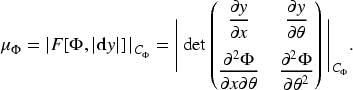


























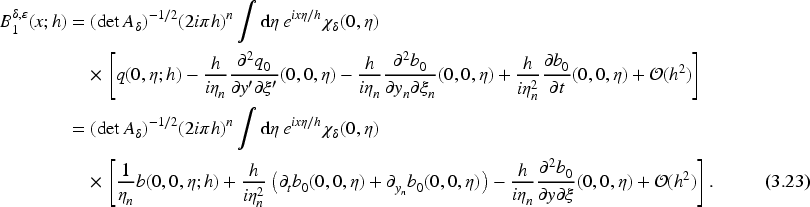








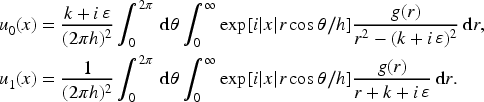




























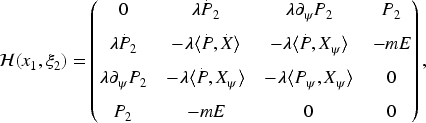

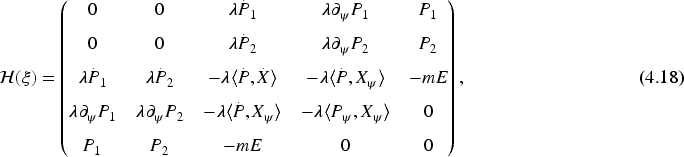



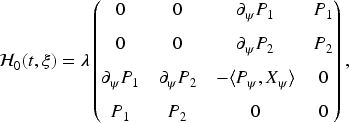

























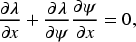


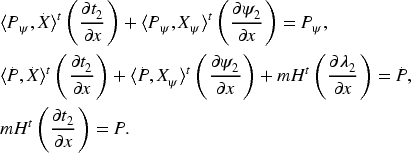











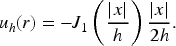






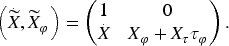











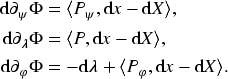








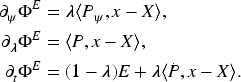



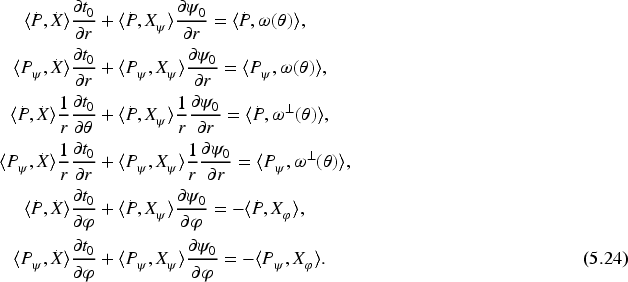














 ), which greatly helped in editing Section 5, Vesselin Petkov for his valuable remarks, and a Referee for his useful comments. Last, but no least, cheerful thanks to Johannes Sjöstrand and Michael Hitrik for organizing a Workshop on WKB theory, held on-line during the Covid time. This work was initially supported by the grant PRC No. 1556 CNRS-RFBR 2017-2019.