This paper is concerned with dynamics for the three-dimensional non-autonomous incompressible Navier–Stokes equations with nonlinear damping in a bounded domain. Based on the norm-to-weak uniform attractor theory constructed by our research, the -regularity of uniform attractor for the considered model has been achieved via the tail estimate technique and localization approach.
The three-dimensional (3D) incompressible Navier–Stokes equations describe the conservation law of momentum and mass of a viscous fluid, which attracts much attention of mathematicians, such as the global well-posedness and long-time dynamic systems for the so-called Leray–Hopf weak solutions, see Chepyzhov and Vishik (2001), Cheskidov and Lu (2014), Hopf (1951), Leray (1934), Robinson (2013), Robinson et al. (2016), Temam (1997), Zelik (2015), and more related literature. However, the regularity and dynamics have not been solved yet, which leads several mathematicians to propose approximated systems instead of Navier–Stokes models for investigation, such as the Ladyzhenskaya models, Navier–Stokes–Voigt model, the Navier–Stokes- equations, and Navier–Stokes fluid flow with nonlinear damping and some others.
This paper is concerned with the -regularity of uniform attractors for 3D incompressible non-autonomous Navier–Stokes equations with nonlinear damping, which describes various physical situations such as porous media flows, drag, or friction effects, as well as some other mechanisms, the damping coming from resistance to the motion of the fluid flow. The model can be written as the following initial value system:
in a bounded domain with smooth boundary for , where the function is the velocity vector field, denotes the pressure, is the kinematic viscosity, the length scale is a characteristic parameter of elasticity for the fluid and is a fixed positive parameter.
The global existence of weak and strong solutions has been achieved in Cai and Jiu (2008). Based on the results of Cai and Jiu (2008), the literature, Song and Hou (2011, 2015), established the existence of global and uniform attractors for autonomous and non-autonomous systems of (1.1), as the Gromov–Hausdorff stability of attractors in Tao et al. (2024), which inspired the research on regularity of uniform attractors in this presented paper. For more results about the asymptotic dynamic systems for (1.1), the literature, Jia et al. (2011) and Li et al. (2018), also presented the existence of attractors by using different topologies. To our best knowledge, the regularity of attractors in Banach space but not Hilbert case has not been investigated yet, which needs some new theory of uniform attractors in this research.
The main results and features can be stated as follows:
The long-time behavior for autonomous dissipative partial differential equations has been investigated, within the theoretical framework of the global attractor, in the 1980s; see, for example, Temam (1997) for more details. The global attractor for the semigroup associated with the problem satisfies, in the case of autonomous systems: (i) it is invariant under the semigroup ; (ii) the compact set attracts all bounded subsets in an appropriate phase space. However, due to the loss of invariance for non-autonomous systems, the theoretical framework of global attractors is invalid. Haraux (1988) used minimality in place of invariance, leading to the uniform global attractor. Considering non-autonomous external forces, such as almost periodic or translation compact, uniform attractors were then proposed, see Chepyzhov and Vishik (2001). One natural question is the sharp condition of the external forces ensuring the existence of uniform attractors. Lu (2006), Lu et al. (2005), and Ma and Zhong (2007) used some new function classes, which are weaker than translation compact external forces and derived the same results. However, the differences between uniform attractors with respect to different non-autonomous external forces are still not clear. Zelik (2015) summarized the above approaches and showed the differences and similarities. This constitutes one inspiration of our paper, that is, we assume that the generic external forces of problem (1.1) have less compactness, the norm-to-weak uniform attractors have been achieved from a theoretical viewpoint, which is the basic theory for our application to system (1.1).
For the increasing of damping in (1.1) for the critical case, using the framework developed in Section 3, we present the norm-to-weak uniform attractor , which is one of the key results in our paper. The bootstrap technique and tail estimates are the essential steps for achieving the uniformly asymptotic compactness for norm-to-weak continuous processes, that is, the -regularity of uniform attractors.
The structure of this presented paper is arranged as follows. Section 2 gives some preparation for our research. Then the norm-to-weak uniform attractors theory is stated in Section 3, which has been applied to (1.1) for achieving -regularity of uniform attractor in Section 4.
Preliminary and Well-Posedness
Let us give some notations and working spaces for preparation. Denoting by () and () the usual Banach spaces, we then introduce the spaces and . Let , be the closure of in the topology; and denote the norm and inner product in , respectively, that is,
Furthermore, is the closure of in the topology, and denoting the norm and inner product in , respectively, that is,
It is easy to check that and are Hilbert spaces and denote . Moreover, , where and are the dual spaces of and , respectively, the injections being dense and continuous. Here, and denote the norm in and the duality product, respectively.
Some Inequalities
Some inequalities in 3D domains that allow to deal with the convective term will be presented as follows, see Robinson et al. (2016), Temam (1997), and related literature.
Ladyzhenskaya’s inequality:
Agmon’s inequality:
For the convective term, we define the bilinear and trilinear operators as
and
respectively. We write in short, where is a bilinear continuous operator from to , and the trilinear operator satisfies the following properties:
The existence of weak and strong solutions can be stated as follows, which is the fundamental preparation for the study of dynamic systems. Cai and Jiu (2008) prove the global well-posedness for problem (1.1) defined on whole space or periodic boundary, which has been extended to non-slip boundary condition in Song and Hou (2011). The strict proof is based on the technique as in Kalantarov and Zelik (2012, 2021), which is omitted here and referred to in another manuscript prepared.
(Existence of global weak solutions)
Suppose that , , and . Then problem (1.1) possesses at least one weak solution for any satisfying , and the weak form in distribution sense as in Cai and Jiu (2008) and Song and Hou (2011, 2015).
We call a pair is a strong solution if it is weak and satisfies
(Existence of global strong solutions (Song & Hou, 2011, 2015)). Suppose that and . Then for , the problem (1.1) has at least one global strong solution . Moreover, if we assume that , then the strong solution of problem (1.1) is unique.
The Theory of Weak and Strong Uniform Attractors for Abstract Dissipative Equations With Less Regular External Forces
Consider the non-autonomous dissipative system
with ( is an enveloping topological space). The global solutions in the phase space generate a family of bi-parameters operators (also called processes) satisfying for .
Since every trajectory changes with the external forces, the invariance is lost, so the theory of global attractors is no longer valid. Using the translation semigroup and translation invariance for external forces to overcome this difficulty, the existence of uniform attractors for (3.1) can be stated as follows.
The Strong Uniform Attractor of (3.1) With Translation Compact External Forces
If the non-autonomous system is explicit as in (3.1) and the external forces satisfy appropriate conditions such as periodic (quasi or almost periodic, interface) functions, then Chepyzhov and Vishik constructed a new framework to construct the strong uniform attractor, see Chepyzhov and Vishik (2001).
Let be a Banach space with spatial variable. The space denotes all functions with spatial values in the Banach space and time variable locally -power integrable in the Bochner sense with norm for any time interval .
The set is defined as the symbol space of the system,
for every fixed .
The space denotes the translation bounded functions satisfying
for .
We say that is translation compact in if is compact in . The corresponding space is denoted as ; is the weak translation compact space which is defied by with weak topology.
Based on the definition of the symbol space, we can define the skew product flow as
which satisfies
and possesses the semigroup property for every , where the family of processes satisfies the translation identity
If is fixed, then for every , we have , where for arbitrary .
For the non-autonomous system (3.1), we suppose that
is the symbol space and is invariant under the continuous translation semigroup defined above;
the family of processes acting on the phase space , which satisfies the translation identity (3.4) is uniformly asymptotically compact and -continuous;
there exists a uniformly bounded absorbing set with respect to every symbol ; and
the skew product flow is defined as in (3.2): and are the projectors from into and , respectively, defined as and .
Then the skew product flow possesses the global attractor , which satisfies
invariance: ,
is the uniform attractor for , ; here is the section at of the kernel for the family of processes with symbol and consists of all bounded complete trajectories for the process.
From the framework by Chepyzhov and Vishik, we see that the external forces in (3.1) need to be translation compact. One natural question is to search for the optimal hypotheses for the existence of uniform attractors.
We call normal if there exists an such that
holds for arbitrary and .
Moreover, if we choose the weak topology here, then we call the space as weak normal, which is equivalent to the translation bounded space.
The Weak Uniform Attractor of (3.1) With Less Compact External Forces
Using weaker conditions on , that is, considering less regular classes such as weak translation bounded or time (space) regular functions, then the existence of the weak uniform attractor for (3.1) can be obtained, see Zelik (2015).
(Weakly continuous process)
We call the bi-parameters operators a family of weakly continuous processes with if
Let be the symbol space in . The set is the weak global attractor of the skew product flow if
is a compact set in endowed with the weak topology by the embedding ;
is invariant under ; and
attracts all bounded sets of in the weak topology of for the space .
Then the projection is the weak uniform attractor, .
(Space regular functions, see Zelik, 2015) A function is space regular if for any , there exists a finite-dimensional subspace , , and a function such that
(Time regular functions, see Zelik, 2015) A function is time regular if for any , there exists a function such that
A function is normal if and only if it is time and space regular. From Theorem 3.8, we can see that the space or time regular functions are weaker than the normal class.
Let the function be translation bounded and assume that there exists such that
Then for any , there exists such that
Assume that is time regular and let be such that in . Then for any , there exists a sequence such that in and
Assume that is space regular, with a bounded domain and let be such that in . Then for any , there exists a sequence for all such that in and
Assume that the family of processes associated with problem (3.1) is uniformly dissipative, uniformly asymptotically compact and weakly continuous and that the symbol space (hull) is weak or strong as in Lemma 3.9. Then the skew product flow possesses the weak global attractor , which can be projected onto the weak uniform attractor .
If the hypotheses of Theorem 3.10 hold and, moreover, the family of processes is uniformly asymptotically compact with respect to the symbol , then the weak uniform attractor in Theorem 3.10 is strong in .
The Norm-to-Weak Uniform Attractor of (3.1) With Less Compact External Forces
Since the continuity of the skew product flow determines the phase space and the strong (weak) cases have been presented above, we will use the norm-to-weak continuity of the skew product flow to achieve our abstract result as follows (see the original work by Zhong et al. (2006)).
(Norm-to-weak continuous process)
Let the operators be a family of processes on with symbol . We say that this family of operators is norm-to-weak continuous on if
;
; and
for given and fixed in , in , there holds .
(Norm-to-weak uniform attractor)
Let be the symbol space in . A set is the norm-to-weak global attractor of the skew product flow if
is a compact set in endowed with the weak topology via the embedding ;
is invariant under the norm-to-weak continuous skew product flow ;
attracts all bounded sets of in the weak topology of .
Then the projection is the norm-to-weak uniform attractor, .
Assume that the family of processes associated with problem (3.1) is uniformly dissipative and norm-to-weak continuous; the symbol space (hull) can be weak or strong as in Lemma 3.9. Then the skew product flow possesses the norm-to-weak global attractor which can be projected onto the norm-to-weak uniform attractor .
Using the framework of Chepyzhov and Vishik (2001), the existence of uniform attractors needs dissipation, continuity, and compactness of the skew product flow . Since is norm-to-weak continuous, we take the initial datum with the strong topology and ( can be weak or strong). Moreover, we consider the uniform dissipation in with the strong norm and the uniformly asymptotic compactness for the skew product flow in with the weak topology. Then by the framework of Zhong et al. (2006), the global attractor for can be constructed, together with the projection onto the first component, yielding the uniform attractor .
Main Result: The -Regularity of Uniform Attractor for (1.1)
The objective here is to construct the norm-to-weak uniform attractor in .
Assume that the family of processes is norm-to-weak and strongly continuous in and , respectively, for , and that has a uniformly bounded absorbing set in . Moreover, assume that the processes satisfy
has a uniformly bounded absorbing set in ;
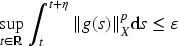
for any and , there exists such that
Then the family of processes possesses the uniform attractor in .
(The norm-to-weak uniform attractor in )
Assume that , and , where is arbitrarily fixed, space regular and satisfies the incompressibility condition. Then since , the norm-to-weak continuous processes generated by the global strong solutions of problem (1.1) possess the norm-to-weak uniform attractor in the topology of .
In view of Lemma 4.1, inspiring from Wang et al. (2007), we divide our proof into the following steps.
Step 1: Dissipativity of the processes in .
Suppose that the hypotheses of Theorem 4.2 hold. Then the norm-to-weak continuous processes generated by the global strong solutions possess a uniformly bounded absorbing set determined by in the space , where
and here is a positive constant.
Let , be an arbitrary constant, denote and , with be such that and , such that and . By the establishment of and , then we have with . Denoting and , considering the regularized equation of (1.1) as
By the Hölder and Young inequalities, using the hypotheses and denoting , we obtain
Define a smooth cut-off function as
Using the properties of the trilinear operator and combining with (2.2), we have
hence
with
and
and
as and , where .
By the boundedness of yields
with
as and , and
Integrating by parts in the second term on the left-hand side of (4.3), we find
By interpolation, it follows that
Combining (4.3)–(4.15), passing to the limit , then we conclude that
where . Then by the uniform Gronwall inequality, from the uniform boundedness of in and neglecting the second term on the left-hand side of (4.16), it is easy to achieve our lemma by choosing an appropriate as in (4.1), which means the existence of a uniformly bounded absorbing set in .
Step 2: Uniformly asymptotic compactness of the processes in with .
By the compact embedding , which is uniform with respect to the symbol, we can obtain the uniformly asymptotic compactness for the family of processes.Step 3: Uniformly asymptotic compactness of the processes in containing the critical case.
Suppose that the processes of problem (1.1) possess a bounded absorbing set in and all hypotheses in Theorem 4.2 hold. Then for any , there exists a positive constant such that we have the tail estimate which implies that the tail estimate holds also for the critical case.
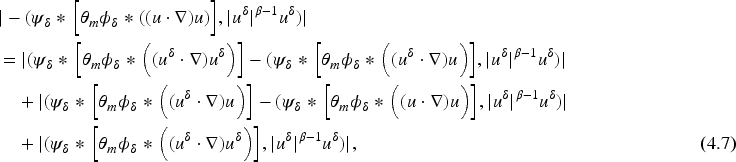
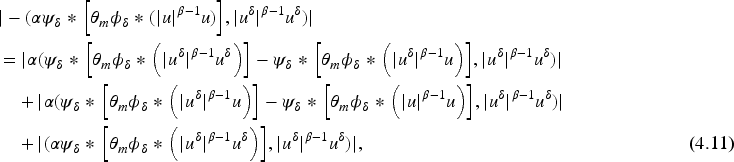
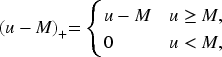
denoting as the regularized function for , which satisfies , noting that
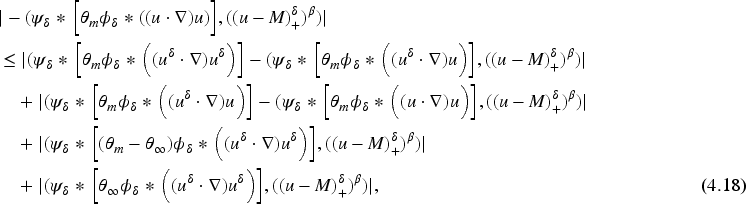
with
as and .
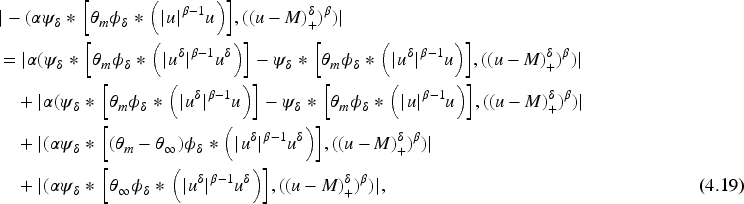
In addition,
with
as and .
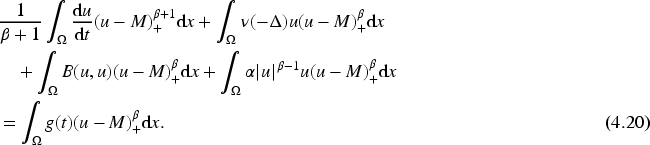
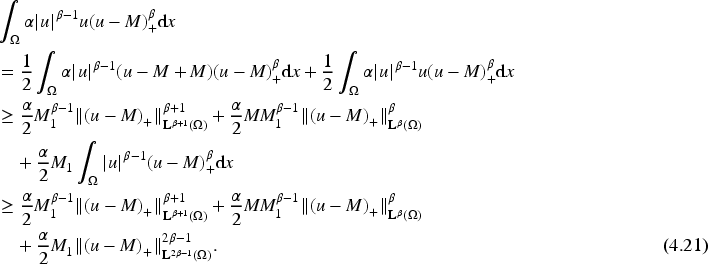
Then using a similar technique and letting and , we conclude that
Noting that and if is large enough, there exists such that , yielding
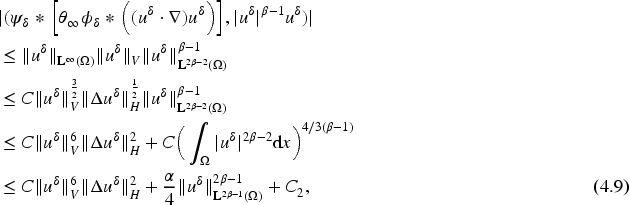
By the Young and Hölder inequalities, using the properties of the trilinear operator and the compact embedding with in the special case since , we have
where and , and are constants which depend on , , , and .
Next, let and be positive constants as above. Using the hypotheses on the external force and employing the Young and Hölder inequalities, we obtain
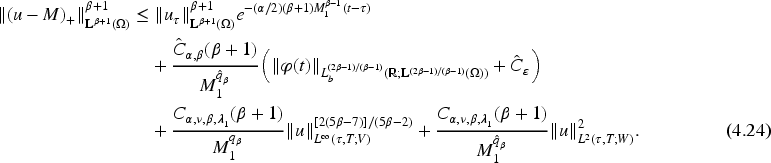
Since the external force is assumed to be space regular, then for any , there exists a sequence such that By the uniform Gronwall inequality, this yields
For arbitrary , choosing a large enough , we can achieve for .
Next, we choose as test function. Using the procedure above again, there exists a constant such that for .
In conclusion, choosing , then we end up with which finishes the proof of Lemma 4.4.
Step 4: End of the proof. By virtue of Lemmas 4.3 and 4.4, based on Step 2, and using Lemma 4.1, since the processes are norm-to-weak continuous, we can finish our proof.
Our results are based on the existence of a global solution, which is studied in Cai and Jiu (2008) and Song and Hou (2011, 2015). However, the proof by Galerkin’s method is not strict and needs more technique to overcome the difficulty of convective term, nonlinear damping, and pressure. The strict proof for a periodic case is proved in Yang et al. (2025).
Footnotes
Funding
The authors disclosed receipt of the following financial support for the research, authorship, and/or publication of this article: This work is supported by Postgraduate Education Reform and Quality Improvement Project of Henan Province (No. YJS2023JC23), the international communication project from the Chinese Educational Ministry (No. HZKY20220270), the international communication project from the Department of Science and Technology in Henan province (No. 242102521039), Workshop of Outstanding Foreign Scientists in Henan Province (No. GZS2024007) and Xingjie Yan was partly supported by the Fundamental Research Funds for the Central Universities (Grant No. 2024KYJD2001).
Declaration of Conflicting Interests
The authors declared no potential conflicts of interest with respect to the research, authorship, and/or publication of this article.
References
1.
CaiX.JiuQ. (2008). Weak and strong solutions for the incompressible Navier–Stokes equations with damping. Journal of Mathematical Analysis and Applications, 343(2), 799–809. https://doi.org/10.1016/j.jmaa.2008.01.041
2.
ChepyzhovV. V.VishikM. I. (2001). Attractors for equations of mathematical physics. American Mathematical Society.
3.
CheskidovA.LuS. (2014). Uniform global attractors for the nonautonomous 3D Navier–Stokes equations. Advances in Mathematics, 267, 277–306. https://doi.org/10.1016/j.aim.2014.09.005
4.
HarauxA. (1988). Attractors of asymptotically compact processes and applications to nonlinear partial differential equations. Communications in Partial Differential Equations, 13(11), 1383–1414. https://doi.org/10.1080/03605308808820580
5.
HopfE. (1951). Üeber die Anfangswertaufgable für die hydrodynamischen Grundgleichungen. Mathematische Nachrichten, 4, 213–231.
6.
JiaY.ZhangX.DongB. (2011). The asymptotic behavior of solutions to three-dimensional Navier–Stokes equations with nonlinear damping. Nonlinear Analysis: Real World Applications, 12, 1736–1747. https://doi.org/10.1016/j.nonrwa.2010.11.006
7.
KalantarovV.ZelikS. (2012). Smooth attractors for the Brinkman–Forchheimer equations with fast growing nonlinearities. Communications on Pure and Applied Analysis, 11(5), 2037–2054. https://doi.org/10.3934/cpaa.2012.11.2037
8.
KalantarovV.ZelikS. (2021). Asymptotic regularity and attractors for slightly compressible Brinkman–Forchheimer equations. Applied Mathematics & Optimization, 84(3), 3137–3171. https://doi.org/10.1007/s00245-020-09742-8
9.
LerayJ. (1934). Essai sur le mouvement d’un liquide visqueux emplissant l’espace. Acta Mathematica, 63, 193–248.
10.
LiF.YouB.XuY. (2018). Dynamics of weak solutions for the three dimensional Navier–Stokes equations with nonlinear damping. Discrete and Continuous Dynamical Systems B, 23(10), 4267–4284. https://doi.org/10.3934/dcdsb.2018137
11.
LuS. (2006). Attractors for non-autonomous 2D Navier–Stokes equations with less regular normal forces. Journal of Differential Equations, 230, 196–212. https://doi.org/10.1016/j.jde.2006.07.009
12.
LuS.WuH.ZhongC. K. (2005). Attractors for non-autonomous 2D Navier–Stokes equations with normal external forces. Discrete and Continuous Dynamical Systems, 13(3), 701–719. https://doi.org/10.3934/dcds.2005.13.701
13.
MaS.ZhongC. K. (2007). The attractors for weakly damped non-autonomous hyperbolic equations with a new class of external force. Discrete and Continuous Dynamical Systems, 18(1), 53–70. https://doi.org/10.3934/dcds.2007.18.53
14.
RobinsonJ. C. (2013). Attractors and finite-dimensional behavior in the 2D Navier–Stokes equations. ISRN Mathematical Analysis, 2013, Article ID 291823, 29. https://doi.org/10.1155/2013/291823
15.
RobinsonJ. C.RodrigoJ. L.SadowskiW. (2016). The three-dimensional Navier–Stokes equations. Cambridge University Press.
16.
SongX.HouY. (2011). Attractors for the three-dimensional incompressible Navier–Stokes equations with damping. Discrete and Continuous Dynamical Systems, 31(1), 239–252. https://doi.org/10.3934/dcds.2011.31.239
17.
SongX.HouY. (2015). Uniform attractors for three-dimensional Navier–Stokes equations with nonlinear damping. Journal of Mathematical Analysis and Applications, 422(1), 337–351. https://doi.org/10.1016/j.jmaa.2014.08.044
18.
TaoZ.YangX.-G.MiranvilleA.LiD. (2024). Gromov–Hausdorff stability of global attractors for the 3D Navier–Stokes equations with damping. Zeitschrift für Angewandte Mathematik und Physik, 75(1), 25. https://doi.org/10.1007/s00033-023-02146-y
19.
TemamR. (1997). Infinite dimensional dynamical systems in mechanics and physics (2nd ed.). Springer.
20.
WangS.XuG.ChenG. (2007). Cauchy problem for the generalized Benney–Luke equation. Journal of Mathematical Physics, 48, 073521, 16. https://doi.org/10.1063/1.2751280
21.
YangX.-G.MiranvilleA.WangS.YanX. (2025). Dynamics and singular limit of the 3D incompressible Navier–Stokes equations with nonlinear damping and oscillating forces, Preprint.
22.
ZelikS. (2015). Strong uniform attractors for non-autonomous dissipative PDEs with non-translation-compact external force. Discrete and Continuous Dynamical Systems B, 20(3), 781–810. https://doi.org/10.3934/dcdsb.2015.20.781
23.
ZhongC. K.YangM.SunC. (2006). The existence of global attractors for the norm-to-weak continuous semigroup and application to the nonlinear reaction–diffusion equations. Journal of Differential Equations, 223(2), 367–399. https://doi.org/10.1016/j.jde.2005.06.008