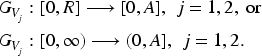
We prove a trace formula for the high energy limit of the scattering phase shifts of Schrödinger operators with short range real valued potentials in hyperbolic space; it relates the scattering shifts and the geodesic -ray transform of the potential. This extends a result of Bulger and Pushnitski for Schrödinger operators in Euclidean space. As an application, we prove that the high energy limit of the phase shifts uniquely determines radial potentials which are monotone and decay super-exponentially. This extends a result of Levinson for potential perturbations of the Euclidean Laplacian to this special class of potentials in hyperbolic space.
The phase shifts are defined to be the logarithm of the eigenvalues of the (relative) scattering matrix, which is a unitary operator. So this is also a spectral problem concerning the distribution of the eigenvalues of a physically meaningful operator which is not self-adjoint. Our main result, Theorem 2.1, establishes a classical-quantum trace formula for Schrödinger operators with short range potentials in hyperbolic space. It relates the high energy distribution of the phase shifts, which are quantum objects, and a measure which is given in terms of the geodesic -ray transform of the potential, which is a classical quantity. The geodesic -ray transform of a function (or a tensor) is the map that takes a geodesic to the integral of the function along it. This extends a result of Bulger and Pushnitski (2012), proved for Schrödinger operators in Euclidean space, to hyperbolic space.
Such trace formulas have been proved for the scattering phase shifts of short range real valued potential perturbations of the Euclidean Laplacian, in different régimes. First, Birman and Yafaev (1980, 1982) and Yafaev (2010) for fixed energies, while Bulger and Pushnitski (2012) treated the high energy limit. The case of magnetic Schrödinger operators was considered in Bulger and Pushnitski (2013) in the high energy limit and by Nakamura (2016) for fixed energies, but for more general manifolds. We will not treat magnetic potentials here.
In the case studied here as well as in Bulger and Pushnitski (2012), the potential is an semiclassical perturbation. In the case where the potential is part of the semiclassical principal symbol of the Hamiltonian, the distribution of scattering phase shifts for the semiclassical Schrödinger operator in Euclidean space was studied by Gell-Redman and Hassell (2012, 2020), Datchev et al. (2014), and by Gell-Redman et al. (2015).
Gell-Redman and Ingremeau (2019) studied the problem for scattering by convex obstacles in Euclidean spaces. Ingremeau (2018) studied compactly supported metric and potential perturbations, and perhaps more importantly, he replaced the assumption of non-trapping with a milder condition on the trapped set. Even in the case of radial potentials, the analysis of the semiclassical problem is very delicate when there is trapping (Berry, 1966). We also mention the work of Christiansen and Uribe (2021) for the semiclassical Schrödinger operator in the case of manifolds with one cylindrical end.
There are several equivalent ways of defining the scattering matrices for the perturbed and unperturbed Laplacians. One can give a dynamical definition in terms of the wave groups and radiation fields as in Lax (2001), Lax and Phillips (1976, 1979, 1980), Nakamura (2016), Sá Barreto (2005), but we will not pursue this here. Instead, we will work in the frequency domain and define the scattering matrix in terms of the asymptotic expansion of generalized eigenfunctions.
It is important to compare the behavior of the eigenvalues of the scattering matrices in the in Euclidean and hyperbolic spaces. In Euclidean space, the unperturbed scattering matrix is the identity, which has only one eigenvalue with infinite multiplicity, independently of the energy. On the other hand, for short range potentials, and for a fixed energy, the scattering matrix of the perturbed Hamiltonian has a countable set of eigenvalues on which possibly accumulate at , see for example Birman and Yafaev (1980, 1982) and Yafaev (2010). The scattering matrix of the Laplacian in hyperbolic space , defined in equations (2.1) and (2.2) below, has special features. If is the metric on then for each defining function of the boundary of , defines a metric on the boundary , which is the sphere at infinity. A different choice of a defining function of , say , induces a different metric . This induces a conformal structure on and the definition of the scattering matrix has to take into account this conformal structure on . For a particular choice of , the scattering matrix is given by equation (2.4) below and it has a lot of eigenvalues. One can see that for a fixed energy the eigenvalues are dense on , and for variable high energies, they actually cover the entire . One defines the relative scattering matrix corresponding to a perturbation to be the product of the scattering matrix corresponding to the perturbation times the inverse of the scattering matrix of the unperturbed Laplacian. It turns out that, in the case we are dealing with, the eigenvalues of the relative scattering matrix do not depend on the choice of a conformal representative of the metric on the sphere at infinity. Moreover, its eigenvalues only possibly accumulate at , which is somewhat the opposite of what happens in the Euclidean case.
The proof of our main result, Theorem 2.1, follows the strategy of Bulger and Pushnitski (2012). The main idea is to use the Born approximation to write the relative scattering matrix in two parts, one of which is a semiclassical pseudodifferential operator whose principal symbol is equal to the geodesic -ray transform of the potential and then use Schatten–von Neumann estimates to show that the contribution of the second term to the trace formula is of lower semiclassical order. In order to do that, we prove Schatten–von Neumann estimates for the Poisson operator in hyperbolic space, which is also known as Helgason Fourier transform (Helgason, 1999; Itoh & Satoh, 2013; Lax, 2001; Zelditch, 1986). These are well known for the Fourier transform in the Euclidean setting and can be found in Chapter 8 of Yafaev (2010) for example, but as far as we can tell, we do not have a reference for them in the case of hyperbolic space.
As an application of the trace formula, we show that the high energy limit of the phase shifts uniquely determines a radial potential which is monotone and super-exponentially decaying with respect to the geodesic distance in . This result also holds for the Euclidean space using the trace formula proved in Bulger and Pushnitski (2012). Levinson (1949) has shown that, in Euclidean space, the phase shifts for all energies determine a radial potential (with additional assumption about its decay), provided its Schrödinger operator has no negative eigenvalues. Bargmann (1949) has given counter-examples showing that the phase shifts do not determine radial potentials which have negative eigenvalues. Our result does allow negative potentials whose Schrödinger operator may have eigenvalues.
The Statement of the Main Results
We define , , to be the Riemannian manifold of dimension which consists of the interior of the ball
As in Fefferman and Graham (1985), Mazzeo and Melrose (1987), Melrose (1995) one thinks of as the interior of a manifold with boundary equipped with a metric which is singular at the boundary and has a specific asymptotic expansion in a tubular neighborhood of . The metric defined in (2.1) is of course singular at and if we use Euclidean polar coordinates , and , it is given by
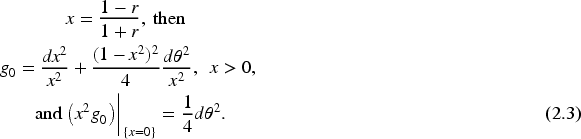
If we set
The function is a defining function of the boundary, in the sense that near and only at and at . But for example , or , , would also be defining functions of . The induced metric on , which is given by depends on the choice of . Vice-versa, as noted in Graham (2000) and Joshi and Sá Barreto (2000), the choice of a conformal representative of determines a unique boundary defining function of such that near .
The generalized eigenfunctions of are solutions of
which are bounded but not in , and have a prescribed asymptotic behavior at infinity, which in this case is the boundary of , given by powers of the boundary defining function , see equation (5.1) below. Here , and so and this choice of spectral parameter is standard in this setting.
This leads to the definition of and , which are the scattering matrices corresponding to and , see (5.3). If we pick as in (2.3), we have
The operators and , which in principle act on , extend to unitary operators acting on with respect to the metric induced by at the boundary, and hence their eigenvalues lie on , but depend on the choice of . To overcome this difficulty, we work with the relative scattering matrix . It turns out that is unitary and its eigenvalues do not depend on the choice of . Moreover, , where is a compact operator. Therefore, its eigenvalues lie on the unit circle and only possibly accumulate at .
Since the eigenvalues of the Euclidean Laplacian on are
the spectrum of given by (2.4) consists of eigenvalues
For fixed, modulo the term involving the gamma function which is independent of , these are points on of the form and it is well known, see Example 2.4 of Kuipers and Niederreiter (1974), that this is a dense subset of , but which is not equidistributed. On the other hand for fixed , Stirling’s formula (Abramowitz & Stegun, 1972) gives that
and therefore as varies, it covers the entire . If one just takes , then according to Example 2.8 of Kuipers and Niederreiter (1974), the sequence
is equidistributed on .
Therefore, while for fixed the eigenvalues of are dense on , the eigenvalues of only possibly accumulate at the point . At the high energy limit, the eigenvalues of cover and our goal is to describe the effect potential perturbations have on these eigenvalues. We denote the eigenvalues of by
The numbers will be called the relative scattering phase shifts. We will show that
see equation (6.15) below. So it follows that for and . In particular, for , , . We set and for , we denote . As in Bulger and Pushnitski (2012), we define the following measure
If one takes , , (as a limit of continuous functions), this is equivalent to the following counting measure:
Our purpose is to study the limit of , as and we prove the following
Let and , . Let be real valued, and let be such that , for some with . Then
If is bounded and compactly supported, we can take and . Equation (2.8) can be rephrased as
where the measure is defined to be
Here “meas” indicates the Lebesgue measure, and is the geodesic -ray transform of the potential along the geodesic defined in (4.2) below.
As already mentioned, in the case of a potential perturbation of in , the analogue of this theorem was proved in Bulger and Pushnitski (2012).
An Inverse Theorem
We apply Theorem 2.1 to prove that the high energy limit of the phase shifts determines a class of radial potentials in . The methods of Levinson (1949) will likely also work in , but we are not aware this has been investigated. However, we are only dealing with the high energy limit of the phase shifts and we only recover the measure , so it is reasonable to expect that we need to restrict the class of potentials.
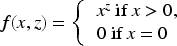
We say that a potential , , is radial if it only depends on the distance from the origin to with respect to the metric . It follows form equation (5.8) below that , where denotes the Euclidean norm of . So . So if is a radial potential if it can be written it as
Moreover, if , then (see the discussion in Section 4 to understand the change of variables), and so it follows from (4.2) that is radial and we define
Let , for all , be real valued radial potentials which are strictly monotone in the sense that if , . Let , be the measure defined in (2.6). If
then for all .
Theorem 2.2 allows negative potentials, and the associated Schrödinger operators may in principle have discrete spectrum, and so it covers cases not included in the (possible generalization of the) results of Levinson (1949). The proof of Theorem 2.2 also applies to the Euclidean case and it follows from the trace formula proved in Bulger and Pushnitski (2012).
It follows from (2.12) that , where is the measure defined by (2.10) corresponding to the potential . Notice that these are invariant under measure preserving diffeomorphisms of which also preserve orthogonality. In the case of radial potentials, these become measures on and the best one can hope to conclude is that . We prove that and have the same range and since they are monotone, it follows that but then it follows that and this implies that
But since and the potentials decay super-exponentially, we can conclude that , because the -ray transform is injective for functions in for all , see Theorem 1.2 and Corollary 1.3 of Chapter 3 of Helgason (1999).
An Outline of the Proof of Theorem 2.1
First of all, one needs to recognize that when , , Theorem 2.1 is a result about the rescaled trace of the operator . Formally speaking, we first notice that
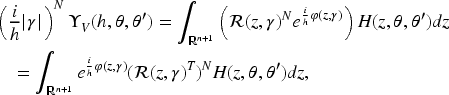
but we use methods of Bulger and Pushnitski (2012) to show that if we replace with in the formula, the difference between the two is a term of order . We also show that the imaginary part of the operator can be replaced by the operator itself, again with an error. So when , the trace formula says that
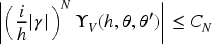
The trace of the operator is equal to the integral of the its Schwartz kernel restricted to the diagonal, and our proof relies on the fact that the Schwartz kernels of the scattering matrices and can be obtained from the kernels of the respective resolvents (Guillopé & Zworski, 1995; Joshi & Sá Barreto, 2000). In this article, as in Bulger and Pushnitski (2012), we use the Born approximation for to show that , and that for bounded compactly supported , is a semiclassical pseudodifferential operator with principal symbol . We do not prove that is a pseudodifferential operator, and instead we use Schatten–von Neumann norm estimates to show that its contribution to the trace is of order , namely:
The Schatten–von Neumann estimates are also needed to extend the result to non-compactly supported short range potentials.
As we will see in Section 5 below, a parametrix for the resolvent gives a parametrix for the scattering matrix, and one should expect to be able to use a more precise parametrix for the semiclassical resolvent such as the ones constructed in Chen and Hassell (2016), Melrose et al. (2014), Sá Barreto and Wang (2016) to directly show that if is compactly supported, is a semiclassical pseudodifferential operator with principal symbol . Then Theorem 2.1 would essentially follow from the calculus of semiclassical pseudodifferential operators. This approach would also possibly work in more general situations, including non-trapping asymptotically hyperbolic manifolds, but it would be much more refined and hopefully will be pursued elsewhere.
The Geodesic -Ray Transform in
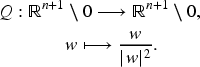
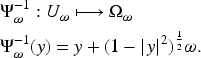
It is well known, see for example Helgason (1999), Lafontaine (2015), that the geodesics of are either circles which intersect the boundary perpendicularly, or straight lines that go to through the origin. Of course there are many different ways of describing such curves, but in this article they will appear naturally in the computation of the principal symbol of the first Born approximation of the semiclassical scattering matrix by using the inversion map with respect to the sphere
One can use this map to parametrize all such circles. Let and , with , and define the curve
obtained by inverting the line with respect to . Notice that
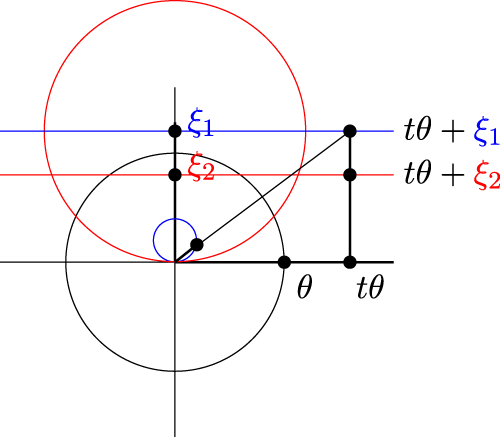
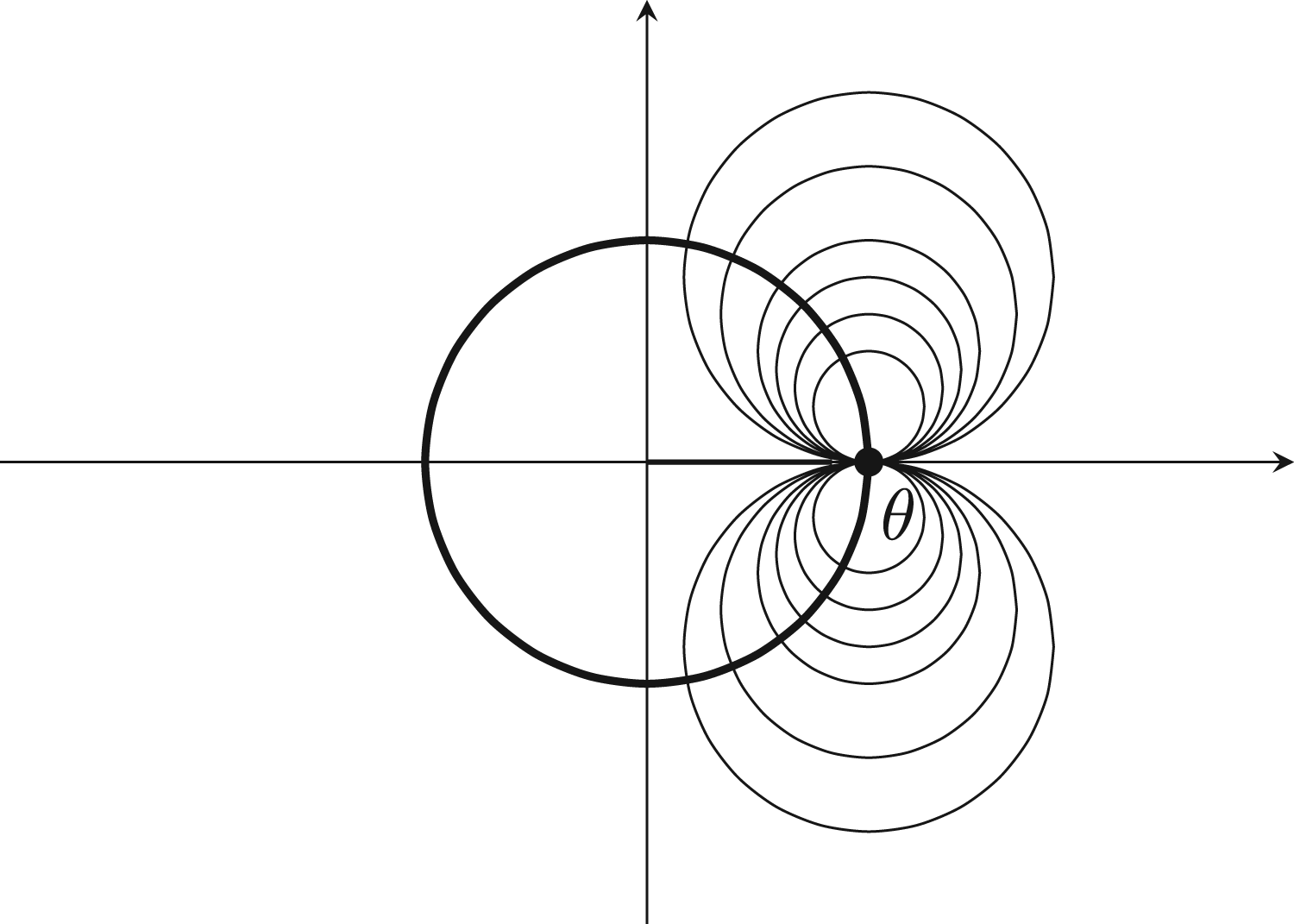
and so if we think of and , this is a parametrization of the circle centered at and radius the case represents a ray in the direction. The closure of these circles go through the origin at the limits and they are tangent to the -axis and intersect the -axis orthogonally. Moreover, since they are contained on the hyperplane defined by passing through the origin, we just need to visualize them in two dimensions, see Figure 1.
Fixed , the Blue (Smaller) and Red (Larger) Circles are the Images of the Lines , , , , Respectively, With Respect to the Map . The Circles are Oriented Clockwise and as the Point Approaches the Origin From the Right and From the Left, Respectively.
Of course, the map
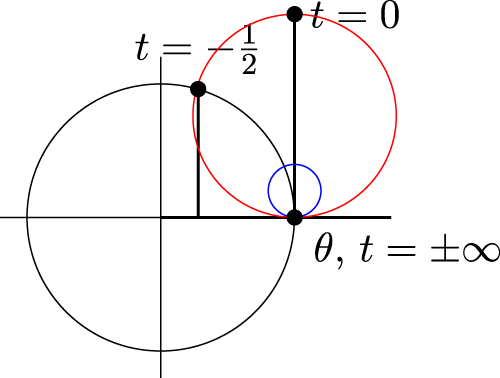
just shifts the circle by and so it is tangent to the axis and centered at . Since , the circle (4.1) intersects orthogonally at , see Figures 2 and 3.
A Family of Circles , for Fixed and for Several Values of , With , as Points Upward or Downward.
Notice that
and so these circles intersect when . Moreover, the tangent vector
satisfies
and so also intersects orthogonally when . Therefore, for , is a geodesic of , and all geodesics on can be parametrized in this way, and we shall denote them by .
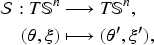
This defines a map of the tangent bundle of to itself
such that and . In other words, one follows the geodesic , which starts at in the direction determined by until one intersects again when , at . The vector is defined to be such the geodesic starting at defined by going backwards intersects at . One can define this map, or perhaps more appropriately, its dual on the cotangent bundle of , as the scattering relation on .
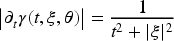
The length of the tangent vector with respect to the Euclidean metric is
and so if , then , and the length of the tangent vector with respect to the metric at the point is given by
Notice that this is positive for , and blows up as , where it intersects the boundary, since the metric also blows up there.
The geodesic -ray transform of a function is defined to be the map which takes a geodesic of into the integral of along , see for example Chapters 1 and 3 of Helgason (1999). We parametrize such geodesics as in (4.1) and so, we define the geodesic -ray transform of along the geodesic to be
Notice that if is compactly supported in , so is . To see that, suppose that if . This implies that if . But this is equivalent to
It follows that if and in particular, if .
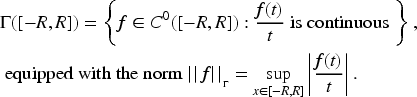
But is also well defined for any which is equal to zero outside the ball and for which the integral converges. For instance, we will work with the class of functions , and we denote
These norms are equivalent for different choices of the boundary defining function and
for obvious reasons, is called the Poisson operator, and the map
is called the Scattering matrix. We shall use and to denote the Poisson operator and the scattering matrix for .
For , , it follows from the definition that
and so if , , extends to a unitary operator on with respect to the metric induced on by the choice of the boundary defining function , as in (2.3).
It was shown in Joshi and Sá Barreto (2000), in greater generality, that for fixed , , and the same choice of , and are pseudodifferential operators of order zero (truly of complex order ), and moreover
This notation means that is a pseudo-differential operator of order on . This shows that and have the same principal part and therefore
Since is a pseudodifferential operator of order , and is compact, then by the Sobolev embedding theorem
is a compact operator and therefore the spectrum of consists of eigenvalues contained in which possibly accumulate at . We shall define to be the relative scattering matrix. This particular relative scattering matrix was also considered by Borthwick and Wang (2024) to study the existence of resonances of .
Notice that, if we choose two different boundary defining functions and such that , then it follows from (5.1) that the corresponding scattering matrices satisfy
Since , it follows that
and so and have the same eigenvalues with the same multiplicity, and we conclude that the eigenvalues of are independent of the choice of .
The Kernels of the Poisson Operator and the Scattering Matrix
It is a standard convention to define the resolvent in hyperbolic space as
where so . When decays fast enough, is a holomorphic family of bounded operators for , or . In fact, if , , continues meromorphically to , see for example Joshi and Sá Barreto (2000) and Mazzeo and Melrose (1987), with poles of finite multiplicity. These poles are called resonances. In the case where , Borthwick (2010) and Borthwick and Crompton (2014), proved upper bounds for the counting function of the resonances. Borthwick and Wang (2024) proved the existence of resonances and obtained lower bounds for their counting function.
The Schwartz kernel of the resolvent , , is a distribution in , which we denote by . We know, see for example Lemma 2.1 of Guillopé and Zworski (1995), that in the case , the Schwartz kernel is given by
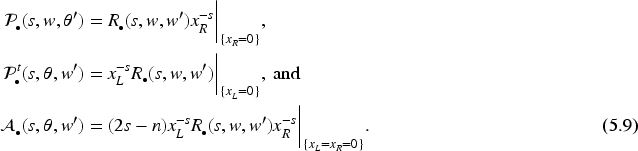
It is proved in Guillopé (1992) and Joshi and Sá Barreto (2000), in much greater generality, that the Schwartz kernels of and , , can be obtained from . We have two copies on the manifold , which we denote by , where and stand for right and left. Let and denote the function defined in (2.3) corresponding to each copy. For fixed, the kernel of is a distribution , and similarly the kernel of the scattering matrix , and it turns out that if , and , then for , the kernels of the Poisson operator , its transpose and the scattering matrix are given by
When , the Schwartz kernel of the Poisson operator and the scattering matrix can be computed directly from (5.7), (5.8) and (5.9). We find that, for defined in (2.3),
Mapping Properties of the Resolvent and the Poisson Operator
In what follows we shall say that
We will need the following estimate on the operator norm of
One can easily check the following two identities,
and combine them to obtain
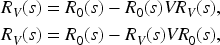
which is called the first order Born approximation for . It follows from (6.3) and (5.9) that
and so, after multiplying on the right by and using (5.4) we obtain
which is the first order Born approximation for . We deduce that
We need to obtain suitable norm estimates for the operators and .
An application of Green’s identity, see for example the proof of Proposition 2.1 of Guillopé (1992), shows that
On the other hand, Stone’s formula implies that the map
induces a surjective isometry
See for example, the proof of Proposition 2.2 of Guillopé (1992). Moreover, it is a spectral representation of , since
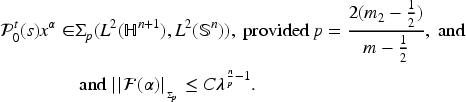
The map is the analogue of the Fourier transform on hyperbolic space, and as already mentioned, it is often called the Helgason Fourier transform. We will follow the strategy of Birman and Yafaev (1980) and Bulger and Pushnitski (2012) and we will need to establish weighted and Schatten–von Neumann estimates for the Poisson operator and its transpose. We are not aware of a reference for these estimates in , and we prove them here. In the Euclidean space the analogue of these estimates can be found in Chapter 8 of Yafaev (2010). We begin with
Let be defined in (2.3) and let be the corresponding Poisson operator defined in (5.2), , and , then the following estimates hold:
For any , there exists independent of such that
and in particular, there exists independent of such that
This proves (6.10) and it implies that and in particular this implies the first estimate in (6.11). The second estimate follows from the first and this proves the first item.
To prove the second statement, pick coordinates , , .
but
and since , , it follows that , provided . Since can be covered by finitely many such charts, (6.12) follows from (6.8), and this proves (6.12).
We have shown that if , . Now notice that for and ,
and so these are continuous functions up to and so if , the function
is holomorphic in (for fixed ) and continuous in (for fixed ), provided .
We consider the family of operators
The family is holomorphic in for . Also notice that it follows from (6.8) that
This implies that the family is holomorphic for and continuous up to . We also know from (6.10), (6.12) and (6.14) that
It follows from Stein’s interpolation theorem (Stein, 1956), that for ,
Since is compact, if , , is fixed and , it follows from (6.13) and Sobolev restriction theorem that
and since , we conclude from the Sobolev embedding theorem that , as an operator acting on , is compact for . To show that the result still holds for , notice that
But we notice that
and one can check that , for and . It follows that, if ,
This means that the sequence of compact operators , , converges strongly to as and so is compact , and this ends the proof of the Proposition.
Next we obtain the following estimates for
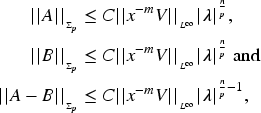
If and is real valued, then there exist and such that
If we deduce from (6.11) that there exists , independent of such that if
Similarly, we combine (6.11) and (6.2) to deduce that there exist and , independent of , such that
Schatten–von Neumann Estimates for
We recall some definitions and results about this topi and we refer the reader to Goh'berg and Krein (1969) and Simon (2005) for more details. If and are Hilbert spaces, and is a linear bounded compact operator, then is a compact self-adjoint nonnegative operator, and one defines . This is also compact, nonnegative and self-adjoint. Let denote the eigenvalues of the operator which are called the singular values of . They are nonnegative and arranged in such a way that , and counted with multiplicity, and converge to zero as goes to infinity.
The Schatten–von Neumann classes , , are defined to be the space of compact operators
This defines a norm, and these spaces are nested
and form ideals in the space of bounded operators,
These spaces also satisfy Hölder’s inequality:
is also called the class of Hilbert–Schmidt operators and if , and is an orthonormal basis for ,
If is defined by
then
If , the class consists of trace class operators, and the trace of the operator is given by
which converges absolutely and is independently of the choice of the basis.
We will need the following Schatten–von Neumann norm estimates for the weighted Poisson operator:
Let be defined in (2.3) and let be defined in (5.2), then the following are true for , provided and
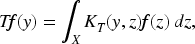
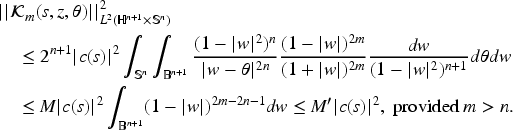
Let denote the Schwartz kernel of the operator . Then, for , there exists a constant independent of such that
and hence and its Hilbert–Schmidt norm satisfies
If , , then and
If , and , then and
If and and , then there exists such that for we have
To prove the second item, we proceed as in as in Yafaev (2010). For fixed , we consider the family
which is holomorphic in . We have shown in Proposition 6.3 and in (6.20) that
and if
and if ,
and so it follows from the three-line theorem for operator valued functions in Schatten classes, see Theorem 2.6 from Chapter 0 of Yafaev (2010) that for all and , and ,
Let and let be real valued. If is as in Proposition 6.6, then for any , such that and and , with and , then
We present the proof for the convenience of the reader, but we just follow the arguments of Bulger and Pushnitski (2012). First we realize that if and then
As a consequence of Propositions 6.8 and 6.7 we obtain
Let and let be real valued. There exists such that if , and , and , and , then
The Structure of the Operator for
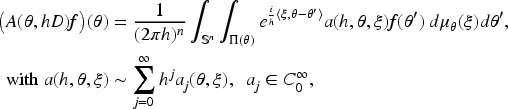
We will show that if , then is in a very special class of semiclassical pseudodifferential operators and in Section 8 we will use the calculus of such operators to prove the trace formulas. We should remark that this result is a particular case of a more general theorem. Notice that the Poisson operator for is given by (5.10) and so
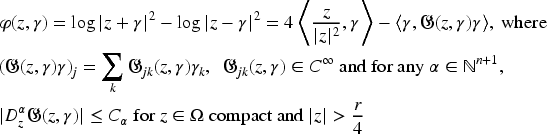
If then for , and the phase is a function and so this is a semiclassical Fourier integral operator, see for example Duistermaat (1974) and Guillemin and Sternberg (2013), associated with the Lagrangian submanifold of defined by
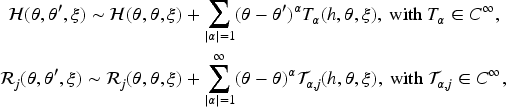
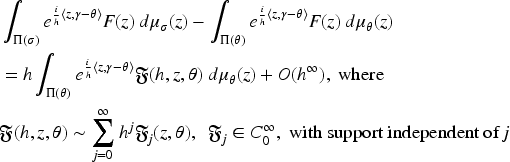
So is the composition of two Fourier integral operators, and the result proved in this section can be thought of as an application of the composition theorem for semiclassical Fourier integral operators, see for example Guillemin and Sternberg (2013), or Hörmander (1994) for regular Fourier integral operators. In this particular case we have an explicit formula and we can prove this result directly using stationary phase methods (which is how the general case is proved), and we start by obtaining an asymptotic expansion in for the Schwartz kernel of .
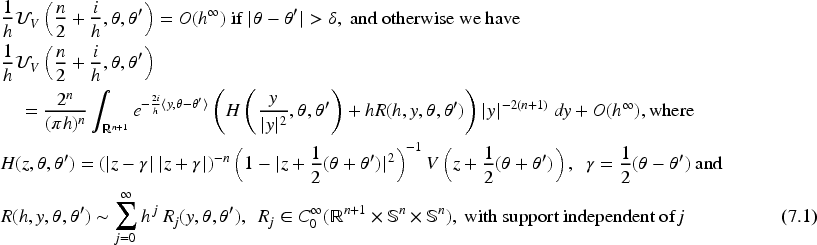
If and , the Schwartz kernel of the operator defined in (6.5) satisfies
Here the notation means that it is an integral of the form
It follows from (5.10) and (6.5) that the kernel of , , satisfies
Since , and , there exists such that , for all , provided . We set and so
As usual we write , and so we have
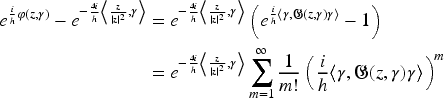
In view of (7.2), and are functions and we can use stationary phase methods to analyze the asymptotic expansion of the integral as . But
We find that
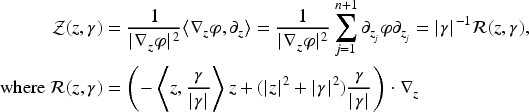
We define the vector field
and of course is a vector field with coefficients in . Then
and so for ,
where is the transpose of . Therefore, if ,
and we conclude that
This means that decays rapidly in is
From now on we assume that , with small enough. This implies that and since for , we deduce that, on the support of ,
Therefore, we write
So we write
So we conclude that
Now recall that on the support of the integrand and so we make a change of variables
As in the proof of Lemma 7.1, we write the Taylor series expansion of and along the diagonal
use that
and that near and integrate by parts in and use that to conclude that
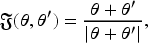
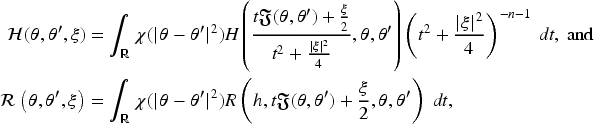
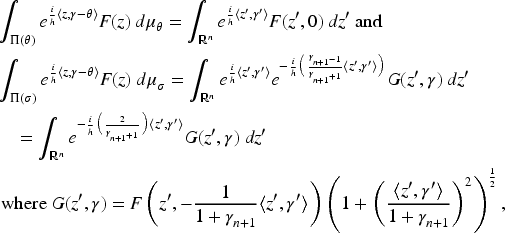
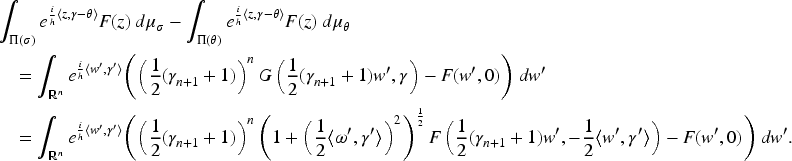
This is not quite the formula we want because the integral is over the hyperplane and we want it over and this is clarified by the following
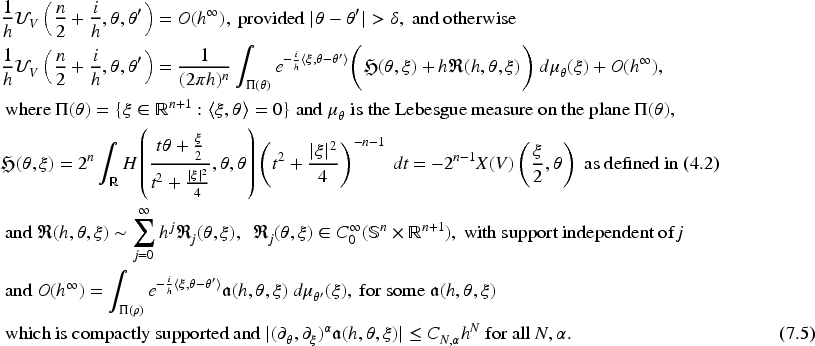
Let be such that is small enough. Let , and be defined as in 7.5, . If , then
If is a linear orthogonal transformation and and , we have
and so we may assume that and , with and , for small enough. If we denote , , and since in this case we have
and so
If we set , then
Now we observe that
and so
We then recognize that
and therefore, after integrating by parts we obtain
and here denotes the transpose of the differential operator. Since , we may write
But
and so
But since , we have
and hence
Finally notice that, since
after integrating by parts, we conclude that
We are left to estimate the difference
which of course can be handled in the same way.
This ends the proof of the Lemma and it also ends the proof of the Proposition.
We define a very special class of semiclassical pseudodifferential operators and refer the reader to Martinez (2002) and Zworski (2012) for much deeper discussions about such operators. We say that
is a semiclassical pseudodifferential operator if
such that
In what follows we will say that
if there exists a semiclassical pseudodifferential operator such that
We use when this is true for every . Using that
one can use and Borel summation formula to show that if is defined as in (7.6), then
We can define semiclassical pseudodifferential operators on a manifold by using local coordinates, see for example Zworski (2012). If is a manifold, , form an open cover of and , are local charts and is a partition of unity subordinated to , then is a semiclassical pseudodifferential operator on if for ,
and this characterization is independent of the atlas , see for example Section 14.2 of Zworski (2012).
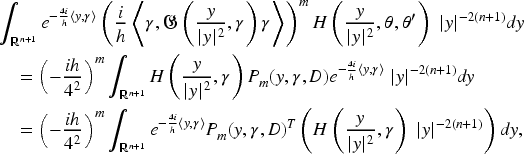
We want to show that fits this definition. A similar discussion for regular pseudodifferential operators is carried out in Section 12 of Chapter 0 of Yafaev (2010). We already know it satisfies the first part of (7.7), and we need to check it satisfies the second part. For fixed , let be the plane orthogonal to passing through the origin:
and let
and let denote the orthogonal projection of onto restricted to . For each fixed its inverse is given by
This collection gives an atlas of . Of course one just needs finitely many to produce form an atlas.
In our case we have an operator of the form
and we want to show that for each fixed , is given by a formula as in (7.7). In fact we just need to verify that this is the case if . Indeed, if is the orthogonal transformation such that , and if we define , one can check that
So we just need to consider the case and verify that is given by a formula as in (7.7). We set (we are just shifting the origin in to instead of ) and and supported near then , and since for
Here we used that If we proceed as above we can see that the integral decays is of order if and so we may expand
and use that and integrate by parts in , we find that
and we are just using and . In our case , defined in (7.5) and (4.2). Notice that any other operator of the same type such that
will satisfy and so we say that is the principal symbol of , and this proves the following
If , the operator defined in (6.5) is a semiclassical pseudodifferential operator on and its principal symbol is equal to .
The Proof of Theorem 2.1 for
We first prove Theorem 2.1 for and for polynomials and then use the Stone–Weiestrass theorem to extend it to compactly supported functions. As already mentioned in Section 3, the idea of using the Stone–Weiestrass theorem in this context is not new. In the next section we extend the result for , .
If , we have shown that is a semiclassical pseudodifferential operator whose principal symbol is . The calculus of semiclassical pseudodifferential operator, see Martinez (2002) and Zworski (2012) and Theorem 7.4 give that for any , satisfies
Since for all , it follows from (6.34) and (8.1) that for ,
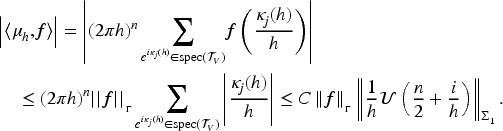
This proves Theorem 2.1 if , , with , . To prove the result for such that , we appeal to the Stone-Weierstrass theorem. Since , for large and so the measure is supported on for some . Similarly, in view of (6.4), , for small, for all . So we may work with supported in . Define the space
Since is compactly supported, we can take in (6.29), and so if is the measure defined in (2.7), then
Since is continuous, for any , there exists a polynomial such that , for all , and so for all t, and we conclude that the space of polynomials such that is dense in . But the argument used above implies that if is a such a polynomial, then
This implies that
If we first take the limit as and then take a sequence of polynomials , which converge to in and the result follows.
The Proof of the General Case of Theorem 2.1
We have proved Theorem 2.1 for and we want to extend it to include the cases where , for some . We know from (6.27) that if and is such that and , is trace class and
We also know from (6.32) and (6.33) that if , and , , that
where is a homogeneous polynomial of degree . Therefore, in view of (4.3) and (4.4), we obtain
Therefore, (9.1) and (9.2) imply that (8.1) also holds for , which is defined to be the closure of with the topology of , provided .
One has that
but in fact one also has
To see that, notice that if and if and if , then
This means that in , if . So, if , pick such that , and so the result holds for . This implies that Theorem 2.1 holds for polynomials of degree . We modify the proof of the case , and we use space , where is continuous, the argument goes through and we prove (2.9) for continuous functions which vanish to order at zero.
Notice that , defined in (2.3), and so if for all , implies that for all , and so is super-exponentially decaying with respect to the distance function to the origin. Therefore
So, if for all , then for all . Also notice that for all if and only if for all and all . But since with , this implies that for all points such that But if as it follows that for So we conclude that if if the same is true for
So we may just assume that nonpositive and increasing and therefore is nonnegative and decreasing. If we have two potentials and for which (2.12) holds, then
In particular, we must have . Otherwise, say for example that , since the functions are decreasing, there would be an interval that would violate (10.2). If , since the functions are decreasing, for all . But in that case the injectivity of the -ray transform for super-exponentially decaying potentials, see Corollary 1.3 of Chapter 3 of Helgason (1999), implies that , which certainly is not the case.
Also, if for all then
Since the same would have to be true for , then and so for all . So we conclude that we either have
In either case the functions are injective and the closure of their ranges are the same. So we may define
and we deduce that, for every , , such that , we have , and this implies that , but since is arbitrary, , but we know that and so .
This implies that , for all . Again, the injectivity of the -ray transform for this class of potentials implies that .
Footnotes
Acknowledgments
The author is very grateful to an anonymous referee for carefully reading the article, making many suggestions on how to improve the exposition and for insisting that more details should be provided.
Funding
The authors disclosed receipt of the following financial support for the research, authorship, and/or publication of this article: The author was funded by the Simons Foundation grant #848410.
Declaration of Conflicting Interests
The author declared no potential conflicts of interest with respect to the research, authorship, and/or publication of this article.
References
1.
AbramowitzM.StegunI. (1972). Handbook of mathematical functions with formulas, graphs, and mathematical tables. Dover.
2.
BargmannV. (1949). On the connection between phase shifts and scattering potential. Reviews of Modern Physics, 21(3), 488–493.
3.
BerryM. V. (1966). Semi-classical scattering phase shifts in the presence of metastable states. Proceedings of the Physical Society of London, 88(2), 285–292.
4.
BirmanM. S.YafaevD. R. (1980). Asymptotics of the spectrum of the s-matrix in potential scattering. Soviet Physics. Doklady, 25, 989–990.
5.
BirmanM. S.YafaevD. R. (1982). Asymptotic behavior of limit phases for scattering by potentials without spherical symmetry. Theoretical and Mathematical Physics, 51, 344–350.
6.
BorthwickD. (2010). Sharp upper bounds on resonances for perturbations of hyperbolic space. Asymptotic Analysis, 69, 45–85.
7.
BorthwickD.CromptonC. (2014). Resonance asymptotics for Schrödinger operators on hyperbolic space. Journal of Spectral Theory, 4(3), 515–567.
8.
BorthwickD.WangY. (2024). Existence of resonances for Schrodinger operators on hyperbolic space. Annals of PDE, 17(6), 2077–2108.
9.
BoucletJ.-M. (2013). Absence of eigenvalue at the bottom of the continuous spectrum on asymptotically hyperbolic manifolds. Annals of Global Analysis and Geometry, 44(2), 115–136.
10.
BulgerD.PushnitskiA. (2012). The spectral density of the scattering matrix for high energies. Communications in Mathematical Physics, 316, 693–704.
11.
BulgerD.PushnitskiA. (2013). The spectral density of the scattering matrix of the magnetic Schrödinger operator for high energies. Journal of Spectral Theory, 3, 517–534.
12.
ChenX.HassellA. (2016). Resolvent and spectral measure on non-trapping asymptotically hyperbolic manifolds I: Resolvent construction at high energy. Communications in Partial Differential Equations, 41(3), 515–578.
13.
ChristiansenT.UribeA. (2021). The semiclassical structure of the scattering matrix for a manifold with infinite cylindrical end. arXiv:2112.12007.
14.
DatchevK.Gell-RedmanJ.HassellA.HumphriesP. (2014). Approximation and equidistribution of phase shifts: Spherical symmetry. Communications in Mathematical Physics, 326, 209–236.
15.
DuistermaatJ. J. (1974). Oscillatory integrals, Lagrange immersions and unfolding of singularities. Communications on Pure and Applied Mathematics, 27, 207–281.
16.
EuB. C. (1968). Method of calculating phase shifts for spherically symmetric potentials. Chemical Physics, 48, 2852. https://doi.org/10.1063/1.1669542
17.
FeffermanC.GrahamR. (1985). Conformal invariants. The mathematical heritage of élie Cartan (Lyon, 1984). Astérisque, 1985, Numero Hors Serie, 95–116.
18.
Gell-RedmanJ.HassellA. (2012). Potential scattering and the continuity of phase shifts. Mathematical Research Letters, 19(03), 719–729.
19.
Gell-RedmanJ.HassellA. (2020). The distribution of phase shifts for semiclassical potentials with polynomial decay. International Mathematics Research Notices, 2020(19), 6294–6346.
20.
Gell-RedmanJ.HassellA.ZelditchS. (2015). Equidistribution of phase shifts in semiclassical potential scattering. Journal of the London Mathematical Society, 91(1), 159–179.
21.
Gell-RedmanJ.IngremeauM. (2019). Equidistribution of phase shifts in obstacle scattering. Communications in Partial Differential Equations, 44(1), 1–19.
22.
Goh'bergI. C.KreinM. G. (1969). Introduction to the theory of linear nonselfadjoint operators. Translations of Mathematical Monographs (Vol. 18.) American Mathematical Society.
23.
GrahamC. R. (2000). Volume and area renormalization for conformally compact Einstein metrics. Rendiconti del Circolo Matematico di Palermo, 1(Suppl. 63), 31–42.
24.
GuillarmouC. (2005). Absence of resonances near the critical line on asymptotically hyperbolic spaces. Asymptotic Analysis, 42(1-2), 105–121.
25.
GuilleminV.SternbergS. (2013). Semi-classical analysis. International Press. xxiv+446 pp. ISBN:978-1-57146-276-3.
26.
GuillopéL. (1992). Fonctions zêta de Selberg et surfaces de géométrie finie. In Zeta functions in geometry (Tokyo, 1990), advanced studies in pure mathematics (Vol. 21, pp. 33–70). Kinokuniya, Tokyo.
27.
GuillopéL.ZworskiM. (1995). Polynomial bounds on the number of resonances for some complete spaces of constant negative curvature near infinity. Asymptotic Analysis, 11, 1–22.
28.
HelgasonS. (1999). The Radon transform(2nd ed.) Progr. Math. 5. Birkhäuser.
29.
HörmanderL. (1994). The analysis of linear partial differential operators (Vol. IV). Springer-Verlag.
30.
IngremeauM. (2018). Equidistribution of phase shifts in trapped scattering. Journal of Spectral Theory, 8(4), 1199–1220.
31.
IsozakiH.KurylevY. (2014). Introduction to Spectral Theory and Inverse Problem on Asymptotically Hyperbolic Manifolds MSJ memoirs, 32. Mathematical Society of Japan.
32.
ItohM.SatohH. (2013). Horospheres and hyperbolic spaces. Kyushu Journal of Mathematics, 67(2), 309–326.
KostasG.AnderssonN. (2001). Scattering of scalar waves by rotating black holes. Classical and Quantum Gravity, 18, 1939–1966.
35.
KuipersL.NiederreiterH. (1974). Uniform distribution of sequences. Wiley Interscience [John Wiley & Sons].
36.
LafontaineJ. (2015). An introduction to differential nanifolds (2nd ed.). Springer. xx+395. https://doi.org/10.1007/978-3-319-20735-3
37.
LandauL. D.LifshitzE. M. (1965). Quantum mechanics: Nonrelativistic theory. Pergamon Press.
38.
LaxP. (2001). The Radon transform and translation representation. Journal of Evolution Equations, 1, 311–323.
39.
LaxP. D.PhillipsR. S. (1976). Scattering theory for automorphic functions. Annals of mathematics studies no. 87. Princeton Univ. Press.
40.
LaxP. D.PhillipsR. S. (1979). Translation representations for the solution of the non-Euclidean wave equation. Communications on Pure and Applied Mathematics, 32, 617–667.
41.
LaxP. D.PhillipsR. S. (1980). Translation representations for the solution of the non-Euclidean wave equation. Communications on Pure and Applied Mathematics, 33, 685.
42.
LevinsonN. (1949). On the uniqueness of the potential in a Schrödinger equation for a given asymptotic phase. Matematisk-fysiske Meddelelser / Det Kongelige Danske Videnskabernes Selskab, 25(9), 29.
43.
MartinezA. (2002). An introduction to semiclassical and microlocal analysis. Universitext Springer-Verlag. viii+190 pp. ISBN: 0-387-95344-2.
44.
MazzeoR. (1991). Unique continuation at infinity and embedded eigenvalues for asymptotically hyperbolic manifolds. American Journal of Mathematics, 113, 25–45.
45.
MazzeoR.MelroseR. (1987). Meromorphic extension of the resolvent on complete spaces with asymptotically constant negative curvature. Journal of Functional Analysis, 75(2), 260–310.
46.
McKeanH. P. (1970). An upper bound to the spectrum of on a manifold of negative curvature. Journal of Differential Geometry, 4(3), 359–366.
47.
MelroseR. (1995). Geometric scattering theory. Cambridge University Press.
48.
MelroseR.Sá BarretoA.VasyA. (2014). Analytic continuation and semiclassical resolvent estimates on asymptotically hyperbolic spaces. Communications in Partial Differential Equations, 39(3), 452–511.
PerryP. (1989). The Laplace operator on a hyperbolic manifold, II. Eisenstein series and the scattering matrix. Journal für Die Reine und Angewandte Mathematik, 398, 67–91.
51.
PielH.ChrysosM. (2020). From Lippmann–Schwinger formulations to a general formula for absolute asymptotic scattering phase functions and shifts: A unified framework for potentials of any range. Molecular Physics, 118(1), e1587024. https://doi.org/10.1080/00268976.2019.1587024
52.
Sá BarretoA. (2005). Radiation fields, scattering and inverse scattering on asymptotically hyperbolic manifolds. Duke Mathematical Journal, 129(3), 407–480.
53.
Sá BarretoA.WangY. (2016). The semiclassical resolvent on conformally compact manifolds with variable curvature at infinity. Communications in Partial Differential Equations, 41(8), 1230–1302.
54.
Sá BarretoA.WangY. (2025). The distribution of negative eigenvalues of Schrödinger operators on asymptotically hyperbolic manifolds. Journal of Spectral Theory, 15(2), 679–727.
55.
SimonB. (2005). Trace ideals and their applications. Mathematical surveys and monographs (Vol. 120). American Mathematical Society.
56.
SteinE. (1956). Interpolation of linear operators. Transactions of the American Mathematical Society, 83, 482–492.
57.
TricomiF. G.ErdélyiA. (1951). The asymptotic expansion of a ratio of gamma functions. Pacific Journal of Mathematics, 1, 133–142.
58.
YafaevD. (2010). Mathematical scattering theory. Analytic Theory. American Mathematical Society.
59.
ZelditchS. (1986). Pseudo-differential analysis on hyperbolic surfaces. Journal of Functional Analysis, 68, 72–105.
60.
ZworskiM. (2012). Semiclassical analysis. Graduate student in mathematics 138. American Mathematical Society. xii+431 pp. ISBN: 978-0-8218-8320-4.