This article investigates the existence and nonexistence of nontrivial solutions for a Schrödinger–Poisson system with doubly critical exponents:
where , , and . Under optimal parameter ranges, we prove both the existence of radial ground state solutions and the nonexistence of nontrivial solutions. This work completely resolves an open problem proposed in [X. Chen, C. Tang, Communications on Pure and Applied Analysis 23 (2024), 1011–1043].
In this article, we study the existence and nonexistence of nontrivial solutions for the following Schrödinger–Poission system with doubly critical exponents:
where , are physical parameters, and . The investigation of (1.1) is motivated by recent studies on the Schrödinger–Poisson system
where and the nonlinearity satisfies appropriate growth and regularity conditions. The values and are referred to as the lower and upper critical exponents, respectively, due to their connection with the Hardy–Littlewood–Sobolev inequality (see Lemma 2.2 below). Over the past decades, system (1.2) has been extensively studied in the case of a subcritical nonlocal term (), while fewer results are available for the critical case (); see, for instance, Li and Zhang (2013) and Li et al. (2014, 2017). These existing results on the existence or nonexistence of nontrivial solutions reveal significant differences between the critical and subcritical nonlocal cases.
Especially, in the case , system (1.2) reduces to the following system
For (1.1), the Schrödinger–Poisson system with critical nonlinearity and critical nonlocal term, Chen and Tang (2024) proved that the system has no nontrivial solutions when and . However, establishing the existence of nontrivial solutions for (1.1) is significantly more challenging. Two major difficulties arise: first, the lack of compactness; second, the competition between the critical nonlocal term and the critical nonlinearity. Motivated by this, Chen and Tang (2024) proposed the following open problem:
(Q) Investigate the existence of nontrivial solutions in the case and .
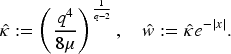
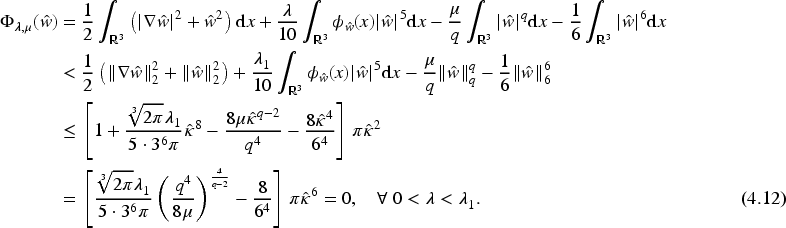
In this article, by employing more refined analytical techniques, we prove that (1.1) admits no nontrivial solutions under weaker assumptions on for all . Moreover, we construct a function with negative energy. Based on this construction, we employ the Ekeland variational principle to obtain a Palais–Smale (PS) sequence in . Inspired by the work of Ruiz (2006), we develop new analytical methods to prove the boundedness and non-vanishing property of such (PS) sequences. Finally, we show that problem (1.1) admits a nontrivial solution. The following theorem presents our main result and gives a positive resolution to the open problem mentioned above.
Let and . If
then (1.1) has a radial solution satisfying , where is the energy functional associated with (1.1) and defined by (2.16). If
then (1.1) does not admit any nontrivial solution.
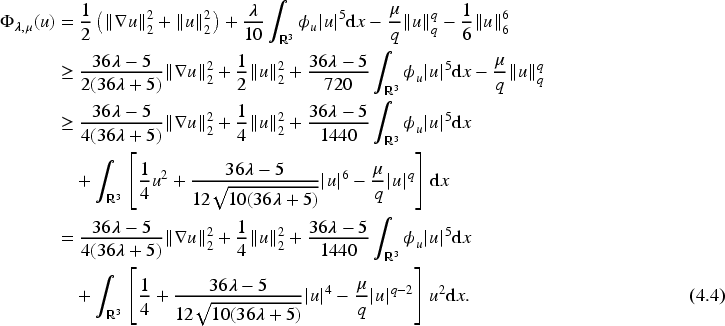
Let and . Assume that (1.4) holds. Then is coercive in .
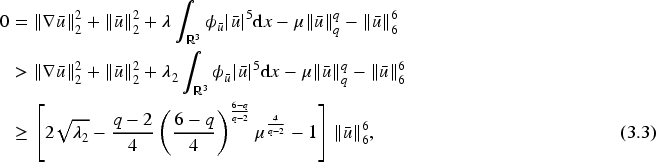
Arguing by contradiction, suppose there exists a sequence such that and for some . Then it follows from (1.4), (2.13) and (2.16) that
Set
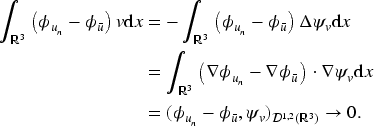
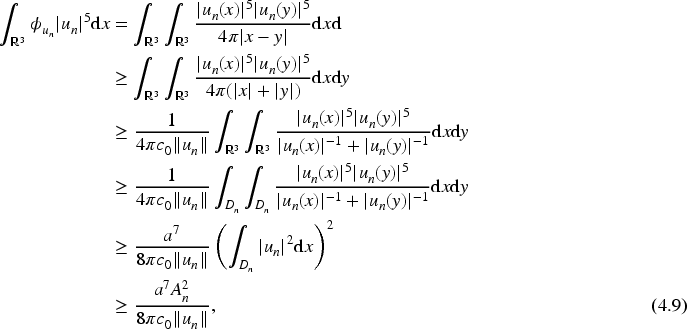
Since and , and as , and then the infimum is attained at some . If , then it follows from (4.4) that is bounded, which is a contradiction. If , then we can obtain that for some . Set
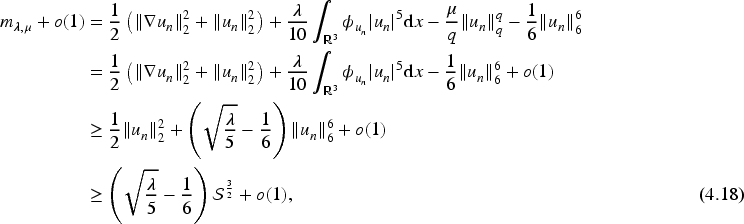
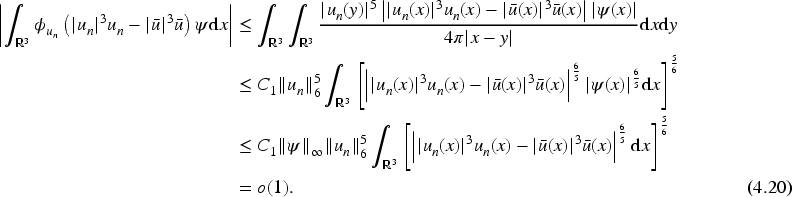
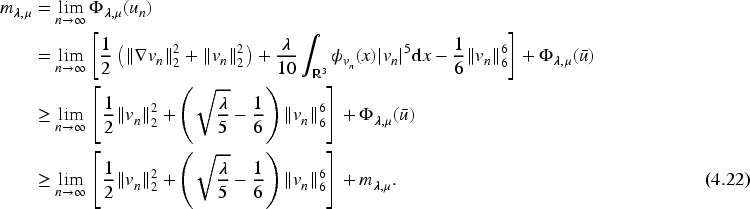
By a standard argument, we can deduce from (2.17), (4.13), (4.14) and (4.21), . Let . Then in and in , and a.e. on . Hence, it follows from (2.11), (2.13), (2.16), (4.11), (4.13), (4.14) and the Brézis–Lieb lemma that
(4.22) show that , and . It follows that and , which implies that is a ground solution of (1.1).
The proof is now complete.
Footnotes
Funding
The authors received no financial support for the research, authorship, and/or publication of this article.
Declaration of Conflicting Interests
The authors declared no potential conflicts of interest with respect to the research, authorship, and/or publication of this article.
References
1.
AguehM. (2006). Sharp Gagliardo–Nirenberg inequalities and mass transport theory. Journal of Dynamic Differential Equations, 18, 1069–1093.
2.
AmbrosettiA.RuizD. (2008). Multiple bound states for the Schrödinger–Poisson problem. Communications in Contemporary Mathematics, 10, 391–404.
3.
AzzolliniA.PomponioA. (2008). Ground state solutions for the nonlinear Schrödinger–Maxwell equations. Journal of Mathematical Analysis and Applications, 345, 90–108.
4.
BenciV.FortunatoD. (1998). An eigenvalue problem for the Schrödinger–Maxwell equations. Topological Methods in Nonlinear Analysis, 11, 283–293.
5.
CeramiG.VairaG. (2010). Positive solutions for some non-autonomous Schrödinger–Poisson systems. Journal of Differential Equations, 248, 521–543.
6.
ChenS. T.TangX. H. (2016). Ground state sign-changing solutions for a class of Schrödinger–Poisson type problems in . Zeitschrift für Angewandte Mathematik und Physik, 67, 1–18.
7.
ChenX. P.TangC. L. (2024). Existence and asymptotic behavior of least energy sign-changing solutions for Schrödinger–Poisson systems with doubly critical exponents. Communications on Pure and Applied Analysis, 23, 1011–1043.
8.
ChenC. Y.WuT. F. (2022). Positive solutions for nonlinear Schrödinger–Poisson systems with general nonlinearity. Nonlinear Differential Equations and Applications, 29, 58.
9.
CocliteG. M. (2003). A multiplicity result for the nonlinear Schrödinger–Maxwell equations. Communications in Applied Analysis, 7, 417–423.
10.
DouX. L.HeX. M.RadulescuV. D. (2024). Multiplicity of positive solutions for the fractional Schrödinger–Poisson system with critical nonlocal term. Bulletin of Mathematical Sciences, 14(2), 2350012.
11.
LiF.LiY.ShiJ. (2014). Existence of positive solutions to Schrödinger–Poisson type systems with critical exponent. Communications in Contemporary Mathematics, 16, 1450036.
12.
LiY.LiF.ShiJ. (2017). Existence and multiplicity of positive solutions to Schrödinger–Poisson type systems with critical nonlocal term. Calculus of Variations and Partial Differential Equations, 56, 134.
13.
LiF.ZhangQ. (2013). Existence of positive solutions to the Schrödinger–Poisson system without compactness conditions. Journal of Mathematical Analysis and Applications, 401, 754–762.
14.
LiebE. H. (1983). Sharp constants in the Hardy–Littlewood–Sobolev inequality and related inequalities. Annals of Mathematics, 118, 349–374.
15.
LiebE. H.LossM. (2001). Analysis. Graduate studies in mathematics(2nd ed., Vol. 14). American Mathematical Society.
16.
RuizD. (2006). The Schrödinger–Poisson equation under the effect of a nonlinear local term. Journal of Functional Analysis, 237, 655–674.
17.
SeokJ. (2013). On nonlinear Schrödinger–Poisson equations with general potentials. Journal of Mathematical Analysis and Applications, 401, 672–681.
18.
ShuM. H.WenL. X.YangH. (2025). Normalized solutions for planar Schrödinger–Poisson equation with mixed nonlinearities. Bulletin of Mathematical Sciences, 15, 2550008.
19.
TangX. H.ChenS. T. (2017). Ground state solutions of Nehari–Pohoz̆aev type for Schrödinger–Poisson problems with general potentials. Discrete and Continuous Dynamical Systems, 37, 4973–5002.
20.
WillemM. (1996). Minimax theorems, progress in nonlinear differential equations and Their applications Vol. 24. Birkhäuser Boston Inc..