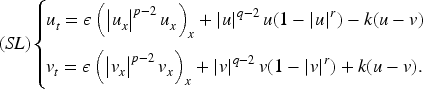
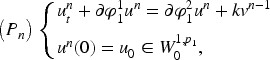
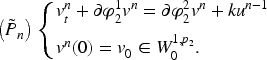
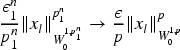
In this article, we study the phenomenon of -synchronization for a quasilinear system governed by -Laplacian, . We obtain this result through the upper semicontinuity of the attractors associated with the systems and the synchronicity property of the limit system.
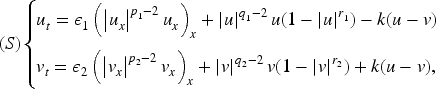
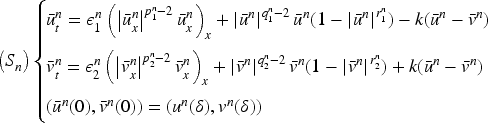
In this article, we investigate a system of coupled reaction-diffusion equations of the form
defined in , where, for and are positive constants, while the exponents satisfy
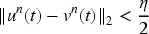
We are concerned with the phenomenon known as -synchronization (Carvalho et al., 1998), that means, we prove that, when , as for , given , there exists such that
Synchronization is a well-known and naturally occurring phenomenon across various scientific disciplines. Since Christian Huygens’ first recorded observation in 1673 in The Horologium Oscillatorium, where he described the synchronization of two pendulum clocks mounted on a common support, similar effects have been identified in biological, electrical, mechanical, and even social systems. A comprehensive discussion of synchronization across multiple contexts is found by Strogatz (2003).
Synchronization is a strong spontaneous phenomenon observable in all areas of the human knowledge. Since the surprising first registered observation made at 1673 by Christian Huygens in The Horologium Oscillatorium on two pendulum clocks suspended on a common support till our days, the same phenomenon has been described in biological, electrical, mechanical systems, and even in social science context. According to Strogatz (2003), there are an extensive list of references confirming its occurrence in a high diversity of contexts. According to Boccaletti et al. (2018) and Ghosh et al. (2024), the analysis of synchronization phenomena in nonlinear dynamic systems began in the 20th century, with the work of Balthasar van der Pol, in electrical circuits.
However, despite -Laplacian problems are one of the most well-known category of nonlinear evolution systems, whose behavior has been systematically analyzed by a great number of authors, -Laplacian synchronization has been not treated up to now and, as far as we know, there is no work in the literature exhibiting the synchronization property for -Laplacian systems.
This work not only provides a further application to the synchronization theory but also it is interesting by itself. This particular system involves equations that, when isolated seen, present a set of equilibrium states that can be qualitatively distinct for different values of , , and , , depending on the position of the diffusion parameter respectfully with bifurcation parameters, and depending if , or . The equilibria bifurcation scheme and stability properties as well for this kind of equation was studied and fully described by Takeuchi and Yamada (2000) and a discussion about the robustness of this problems with respect to and can be found by Bruschi et al. (2010) and Pereira et al. (2015). When allowing initial freedom on these parameters, even if they are arbitrarily close each other, they can give rise to significantly distinct individual asymptotic tendencies which, we prove in this work, converge to a single common behavior under the coupling term.
In this article, we first exhibit a result of existence of global solution for , then we prove that the semigroup associated with is a gradient system and we show the existence of attractors for each value of . We also use an argument, based on an equivalent formulation of Ricceri’s three critical points theorem, (Bonanno, 2002, Theorem 2.3), to assure that problems can have nontrivial attractors.
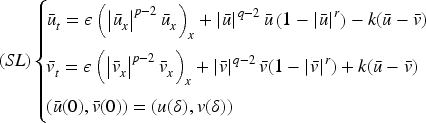
Then we show that those attractors are upper semicontinuous with respect to , and the limit system is given by the following equation:
The -synchronization of is demonstrated using the upper semicontinuity of attractors with respect to and the strong synchronicity property enjoyed by .
This article is divided into seven sections. In Section 2, we prove the existence of solution and exhibit a Lyapunov functional for system . In Section 3, we prove the existence of attractor and in Section 4, we obtain the upper semicontinuity of attractors associated to . In Sections 5 and 7, we analyze the synchronicity of the system limit and prove the -synchronization for . Nontriviality of attractors is carried in Section 6.
Existence and Uniqueness of Global Solutions
In this section, we establish the existence and uniqueness of a global solution in for the coupled system
where and are positive constants, while the exponents satisfy
with initial data .
In what follows we use the notation and to denote the spaces of functions and , respectively, and to denote the domain of the operator , given by the following equation:
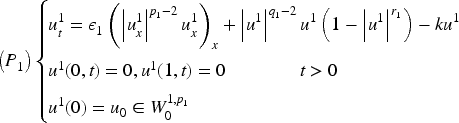
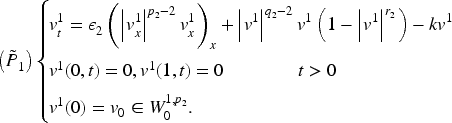
To prove the existence of a solution, we follow the approach by Ouardi and Hachimi (2006). The construction is carried out iteratively by considering, at each step, uncoupled problems that depend on the solutions obtained in the previous step. This process generates a sequence of solutions that converges to an element for each . Finally, we show that satisfies system .
As a first step in this iterative scheme, we analyze the following problems:
and
In order to apply Theorem 5.3 by Ötani (1977), we observe that the previous problems can be rewritten within an abstract framework by defining the functionals
if and if , and
if , and if . It follows from Brézis (1973) that the subdifferentials and of and , respectively, are maximal monotone operators in . Consequently, Problems and can be rewritten in the following form:
Applying Ötani (1977, Theorem 5.3), we conclude the existence of strong solutions and in for and , respectively, for each .
Subsequently, for each , , we consider the following problems:
Applying Ötani (1977, Theorem 5.3), we conclude that these problems also admit strong solutions and in , respectively, for each and .
The next step is to show that the sequence converges to a pair which is a solution of . To achieve this, we will employ a compactness result established by Baras, specifically Vrabie (1995, Theorem 2.5.3).
First, observe that the sets
and
are uniformly integrable in for some that will be determined in what follows. This result follows directly from the lemmas presented below.
Let and solutions of and respectively. There is , such that the sequence is bounded, for all and .
For , multiplying the equations and by and , respectively, and applying Young’s inequality, we obtain
Fix an arbitrary . Integrating from to , with , we have
for all , where depends on , , , ,, and .
For each , multiplying the equations and by and respectively, and using Young’s inequality along with previous estimates, we conclude that for all and
Now, choosing such that , there exists a constant depending on , , , , and , such that for all and
In the next lemma, we establish a similar estimate for and in and , respectively.
If , there exists a constant such that
for all and , as in the previous lemma.
In fact, since and are solutions of and , respectively, we have
By integrating from to , , we obtain
for all and , where depends , , , , , , and .
Denoting by the function , for , it is not difficult to see that
where is independent of . Therefore, we conclude that the families and are uniformly integrable in .
It follows from Vrabie (1995, Theorem 2.5.3) that the sets
are relatively compact in .
Then there is a subsequence still denoted by and an element such that
Since is continuous on , for , and and belong to , it follows from Brézis (1973, Theorem 3.6), that is a strong solution of . To ensure that such solution is indeed a global solution, recall that is independent of the initial data. The uniqueness of solution is easily obtained if we consider .
Therefore, for large values of , the system generates a continuous semigroup in (as stated by Ladyzhenskaya, 1991), given by the following equation:
where
Finally, we observe that the semigroup associated with the system is indeed a gradient system, with Lyapunov functional given by the following equation:
Since the phase space varies with , as , it becomes necessary to adopt a common phase space for all . Given that is compactly embedded in for all , a natural choice for the new phase space is . Before proceeding, we state the following lemmas, which can be proved in the same way as Lemma 3.3 and Theorem 3.4 (Bruschi et al., 2010).
Let be the semigroup generated by , and solution of . Then
as uniformly for , for each . Moreover, if then
as , uniformly for .
The set is relatively compact in .
As previously mentioned, we observe that it is possible to extend the phase space to by showing that, given there exists a weak solution of with initial data .
In fact, consider , and let be a sequence in such that in . For each , there exists a strong solution, , for system , with initial data . By Lemma 3.1, the sequence is bounded in , consequently,
and
belong to . Applying Lemmas 2.3 and 2.4, with appropriate adaptations, we obtain and a subsequence still denoted by , such that
Consequently,
and
in . Therefore, is weak solution of , with initial data (see Brézis, 1973, Definition 3.1).
Existence of Global Attractors
In this section, we establish the existence of a global attractor in for the semigroup associated with . It is well-known that this can be achieved by proving the asymptotic compactness and dissipativity of , see Hale (1988).
The following two lemmas ensure dissipativity, first in and then in , respectively.
If is solution of then there is a constant such that
for all .
In fact, we have
and
Without loss of generality, we assume . Thus, from the Hölder Inequality, if , we have
where depends only on and . Moreover, it follows from Temam (1997, Lemma 5.1) that for all
Let be such that for all
If , we have
and therefore,
for , where depends only on , , , and .
The constant can be chosen uniformly for initial data belonging to subsets of , that are bounded in , provided that and also lie within bounded subsets. Moreover, remains independent of and , for .
If is solution of then there is a positive constant such that for all
Take . If is solution of , we have
Integrating from to , with , we obtain for each
with depending on , , , , and .
Without loss of generality we take , as in the previous lemma. We have
where depends only on , , , and , and is independent of the initial data if . Moreover, as , it follows that
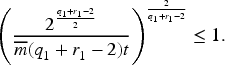
where , , with chosen small enough so that . Note that can be taken uniformly for and in bounded subsets. Thus for all
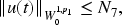
Then from Temam (1997, Lemma 1.1) and from (1), it follows that for any ,
where is taken uniformly for , , , , and in bounded subsets of .
Analogous estimates are obtained for . Therefore, there is , depending on , , , , , , and , such that for all
It is easy to see that for fixed there is a constant, , satisfying
for all and independent of the initial data.
The following result establishes the continuity of the flow in , and will be used to prove the asymptotic compactness for the semigroup.
Let be such that in . Then, for all ,
in , where and .
In fact,
where and , . Integrating from to , we obtain
And the result follows from Gronwall’s inequality.
The next lemma guarantees the asymptotic compactness of the semigroup. The proof follows from the continuity of and the compact embedding of into .
For each , the operator is compact.
Indeed, consider a bounded subset , and a sequence . Let be such that , for all .
So there is a subsequence, still denoted by and such that
and
By Lemma 3.2 and the continuity of (Lemma 3.3), we have
and
It follows from Tartar’s inequality that
with .
Integrating from to and using the dominated convergence theorem, we obtain
as .
Thus there exists a subsequence still denoted by such that
in .
To extend the convergence to all we consider the subset such that
for all . Let be and , for , thus
By choosing sufficiently close to so that , we can conclude that for all , since is uniformly bounded. An analogous result holds for .
Therefore, in , for all .
This completes the proof.
Once established that the semigroup is compact and dissipative, it follows from Ladyzhenskaya (1991, Theorem 2.2), the existence of a global minimal attractor which is compact and invariant in , for the semigroup .
We denote by the attractor of the semigroup associated with the system , with parameters , , , , and , for , whose existence can be obtained in a similar way.
Upper Semicontinuity of the Global Attractors
In this section, we prove that the family of attractors is upper semicontinuous, that is, as
where is the attractor associated with the limit system .
The next theorem ensures the continuity of the flow.
Let and solutions of and , respectively, with initial data . For each , if , then
Take . We know that there is a weak solution of and with initial data for every .
Fix arbitrary, then . Consider the new systems
and
and let and be the strong solutions of and .
From Lemma 2.4, there exists and a subsequence still denoted by such that
We want to prove that is solution of with initial data .
Once is solution of it follows that
for all , and for all . Let us prove that
for , and , and then we conclude from Brézis (1973, Proposition 3.6), that is a weak solution of the equation
Take . Then there is a sequence with in , as . Note that for each , , whatever .
Consider , for every and . We have
for all . Certainly, as ,
uniformly in ,
and
as in .
It remains to prove that , as for every , where .
We start by proving that is weakly convergent . Indeed,
for any , where is a positive constant which depends on . We observe that this is possible because the sequences and are bounded in , and . Therefore, for each , the sequence is bounded in and then we can extract from it a subsequence still denoted by weakly converging to some . Let us prove that .
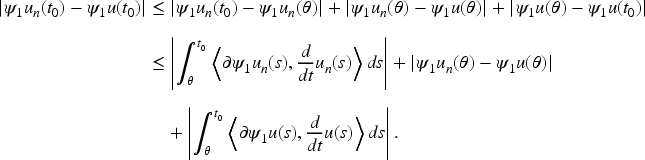
We know that for every , , and therefore for all ,
But once in . And on the other hand, as , it follows that is bounded for all . From dominated convergence theorem, and remembering that and , we have
as . Now we have to consider two cases:
The first is when . In this case, , and certainly
In the second case, , there is a sequence with in . Thus, for every , , for all . In particular , then for all ,
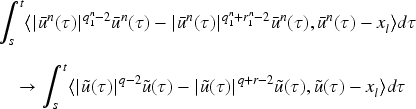
In order to prove (2), we take the limit in (4). Since in , we need only to prove that in , with . Note that
and since is bounded in it follows that is bounded in . Once is reflexive there is a subsequence still denoted by which converges in the weak star topology for any . Then
for all . Now we have to prove that .
We know that for all and for all
Thus making , we have
So . Since was arbitrarily taken in , it is proved that satisfies (2).
By Brézis (1973, Proposition 3.6), is weak solution of the equation
and as is bounded for all , it follows that . Thus by Brézis (1973, Theorem 3.6), is strong solution of (5). Similarly, we prove that is strong solution of the equation
Therefore, is a strong solution of the limit system , with initial data and, by uniqueness, we have .
Suppose, by contradiction, that for some , does not converge to in , where and are solutions of and , respectively, with initial data . Take and fix it. Consider the systems and with initial data and , respectively, and solutions and . We know that
Let be such that . Thus
and this completes the proof.
After proving the continuity of the flow for each , we prove that this continuity is uniform for initial data in compact subsets of . The proof is based on the Cantor’s diagonalization method.
Let be a compact set. Then for each
uniformly in as , where and are solutions of and , respectively, with initial data .
Fix , and define for each , the function given by Note that fixed , it follows from the continuity of the application that if in then
uniformly in as .
Furthermore, we can also define given by Then the family of functions is equicontinuous in .
Let be a compact subset of and an enumerable dense subset of , where . We prove that there exists a subsequence of which converges simply in .
Consider the initial sequence , then is a sequence in , and from Theorem 4.1, it has a subsequence which converges to .
Consider again the sequence of functions , then is a sequence in , and from Theorem 4.1, it has a subsequence , which converges to . Repeat this reasoning for each , with . Note that the subsequence obtained at step is such that to
Therefore, the diagonal sequence is such that for all . It follows that converges uniformly on .
Since is a bounded set in and so relatively compact in , we can take in previous lemma , where the closure is taken in . So, we have the uniform continuity of the flow in .
Now, we proceed to prove that , as , where
is the Hausdorff semi-distance in . This result will help establish the -synchronicity.
The family of attractors is upper semicontinuous.
By Lemma 3.2 there exists and a positive constant such that
for all , and any initial data .
Set . We know that absorbs bounded subsets of under for any in . Since is bounded and invariant it follows that .
But attracts bounded subsets of , in particular attracts . Thus given , exists such that
for all , where is the semigroup associated with the limit system . This implies that
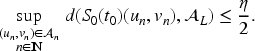
From the uniform continuity of the flow in compacts sets of there is such that for all and
Thus, for each , with
So is upper semicontinuous as .
About the Limit System
We have seen in the previous section that when the system approximates the limit system . To ensure the -synchronicity, we study the attractor of the semigroup associated with the system . We prove that for sufficiently large each element of this attractor is of the form , with .
In fact, when we analyze the system , it is possible to observe that if is solution of with initial data then approximates as , for each sufficiently large and uniformly on the initial data. This property is known as synchronization, see Carvalho et al. (1998).
Let be solution of system . For every sufficiently large, as , we have
In fact, for we have
Multiplying the above inequality by and integrating from to we obtain, for each sufficiently large
If , then .
Indeed, if then for each , with . Thus given , exists such that for all ,
with and . Since for all , it follows that .
Existence of Nontrivial Stationary Solutions
In this section, we show that the attractors are nontrivial at least in the case that , and . For this end, we use an equivalent formulation of Ricceri’s three critical points theorem, enunciated below:
(Bonanno, 2002, Theorem 2.3) Let be a separable and reflexive real Banach space. is a continuously Gateaux differentiable and sequentially weakly lower semicontinuous functional whose Gateaux derivative admits a continuous inverse on ; is a continuously Gateaux differentiable functional whose Gateaux derivative is compact. Assume that
for each ;
there are , and such that ;
.
Then, there exist an open interval and a positive real number such that, for each , the equation has at least three weak solutions whose norms in are less than .
Taking endowed with the norm , we define applications and by
and
respectively. Under the conditions imposed on parameters, the functionals and satisfy the hypotheses of Theorem 6.1. To ensure that all other hypotheses are satisfied we can choose and defined as follows:
And we set
Simple calculations show that , and defined above satisfy hypotheses and of Theorem 6.1 which ensures that at least in the case that for and the family is not given only by trivial attractors and hence -synchronization is not a trivial result.
Synchronization
The following theorem is the main result of this article. We prove in this theorem that the system -synchronizes.
Consider the system
where and for all and , , are positive constants, and and , for and for all . If as then, for sufficiently large the solution of -synchronizes.
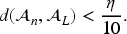
By upper semicontinuity of attractors , given exists such that if
Consider . Since is attractor, for every exists such that
So, for each , there is with
being , and for there is such that
Then if and we have
which ensures -synchronicity.
Footnotes
ORCID iDs
Ana Claudia Pereira
Cláudia Gentile
Marcos Primo
Olimpio Miyagaki
Funding
The authors received the following financial support for the research, authorship, and/or publication of this article: Ana Claudia Pereira was partially supported by the CAPES ‐ Coordenação de Aperfeiçoamento de Pessoal de Nível Superior.
Declaration of Conflicting Interests
The authors declared no potential conflicts of interest with respect to the research, authorship, and/or publication of this article.
References
1.
AfraimovichV. S.RodriguesH. M. (1998). Uniform dissipativeness and synchronization of nonautonomous equations. International Conference on Differential Equations (Lisboa 1995), 3–17.
2.
BoccalettiS.PisarchikA. N.Del GenioC. I.AmannA. (2018). Synchronization: From coupled systems to complex networks. Cambridge University Press.
3.
BonannoG. (2002). A minimax inequality and its applications to ordinary differential equations. Journal of Mathematical Analysis and Applications, 270, 210–229.
4.
BrézisH. (1973). Opérateurs maximaux monotones et semi-groupes de contractions dans les espaces de Hilbert. American Elsevier Publishing.
5.
BruschiS. M.GentileC. B.PrimoM. R. T. (2010). Continuity properties on for -Laplacian parabolic problems. Nonlinear Analysis, 72, 1580–1588.
6.
CaraballoT.KloedenP. E. (2005). The persistence of synchronization under environmental noise. Proceedings of the Royal Society A: Mathematical, Physical and Engineering Sciences, 461(2059), 2257–2267.
7.
CarvalhoA. N.PrimoM. R. T. (2000). Boundary synchronization in parabolic problems with nonlinear boundary conditions. Dynamics of Continuous, Discrete and Impulsive Systems, 7(4), 541–560.
8.
CarvalhoA. N.RodriguesH. M.DlotkoT. (1998). Upper semicontinuity of attractors and synchronization. Journal of Mathematical Analysis and Applications, 220, 13–41.
9.
GameiroM. F.RodriguesH. M. (2001). Applications of robust synchronization to communication systems. Applicable Analysis, 79(1–2), 21–45.
10.
GhoshD.MarwanN.SmallM.ZhouC.HeitzigJ.KoseskaA.JiP.KissI. Z. (2024). Recent achievements in nonlinear dynamics, synchronization, and networks. Chaos (Woodbury, N.Y.), 100401.
11.
HaleJ. K. (1988). Asymptotic Behavior of Dissipative Systems. (Mathematical Surveys and Monographs, Vol. 25). American Mathematical Society.
12.
HaleJ. K. (1997). Diffusive coupling, dissipation, and synchronization. Journal of Dynamics and Differential Equations, 9, 1–52.
13.
KloedenP. E. (2003). Synchronization of nonautonomous dynamical systems. Electronic Journal of Differential Equations, 2003, 1–10.
14.
KloedenP. E.PavaniR. (2009). Dissipative synchronization of nonautonomous and random systems. GAMM-Mitt, 32(1), 80–92.
15.
LadyzhenskayaO. A. (1991). Attractors for semigroups and evolution equations. Cambridge University Press.
16.
ÖtaniM. (1977). On existence of strong solutions for . Journal of the Faculty of Science, University of Tokyo. Section IA, Mathematics, 24, 575–605.
17.
OuardiH. E.HachimiA. E. (2006). Attractors for a class of doubly nonlinear parabolic systems. Electronic Journal of Qualitative Theory of Differential Equations, 2006, 1–15.
18.
PereiraA. C.MoussaC. B. G.MiyagakiO. H. (2015). An example of noncontinuous attractors. Journal of Evolution Equations, 15, 979–1000.
19.
RodriguesH. M. (1996). Abstract methods for synchronization and applications. Applicable Analysis, 62, 263–296.
20.
RodriguesH. M.AlbertoL. F. C.BretasN. G. (2001). Uniform invariance principle and synchronization: Robustness with respect to parameter variation. Journal of Differential Equations, 169(1), 228–254.
21.
StrogatzS. H. (2003). Sync: The emerging science of spontaneous order. Hyperion.
22.
TakeuchiS.YamadaY. (2000). Asymptotic properties of a reaction-diffusion equation with degenerate -Laplacian. Nonlinear Analysis, 42, 41–61.
23.
TemamR. (1997). Infinite-Dimensional Dynamical Systems in Mechanics and Physics (Applied Mathematical Sciences, Vol. 68). Springer-Verlag.
24.
VrabieI. I. (1995). Compactness methods for nonlinear evolutions. John Wiley & Sons.