We consider wave equations with critical shift on the real hyperbolic space () in the framework of weak- spaces. First, we establish dispersive estimates on Lorentz spaces in the context of . Then, employing those estimates, we prove global well-posedness of solutions and an exponential asymptotic stability property. Moreover, we develop a scattering theory and construct wave operators in such singular framework.
In the present article, we are concerned with the wave equation on the real hyperbolic space with critical shift:
where stands for the Laplace-Beltrami operator associated with the hyperbolic metric, the shift , and the nonlinearity satisfies
Equation (1.1) is referred to as the shifted wave equation. In the case , equation (1.1) is called non-shifted wave equation (for more details see Section 2).
The wave and Klein-Gordon equations have been studied by several authors. In the sequel, we review some important results of the literature. Without making a complete list, we begin by recalling briefly results for equations on the Euclidean space . The existence of global solutions was analyzed by Belchev et al. (1999), Georgiev et al. (1997), Ginibre and Velo (1985), Zhou (1995), among others. The nonexistence of global solutions was studied by Sideris (1984). Time decays of solutions for wave equations were proved by Ginibre and Velo (1987a, 1987b), Pecher (1982) and Strauss (1968). In particular, Pecher (1982, 1984) obtained results on time decays and established the nonlinear small data scattering for wave and Klein-Gordon equations in . The scattering theory was also studied by using the time decays in the works (Ginibre & Velo, 1989; Lindblad & Sogge, 1995; Strauss, 1981). After that, Hidano (1998, 2000, 2001) obtained the small data scattering and blow-up theory for nonlinear wave equation on with by using the integral representation formula of solutions. In addition, the scattering for the two-dimensional energy-critical wave equation and Klein-Gordon equation with exponential-type nonlinearity were provided by Ibrahim et al. (2006, 2009). Concerning the nonlinear wave equations, Strichartz estimates were obtained by Georgiev et al. (1997), Ginibre and Velo (1989), and Keel and Tao (1998). Moreover, we quote the results on blow-up (Glassey, 1981) and the life-span of solutions (Li & Yu, 1991; Li & Zhou, 1995).
The well-posedness and scattering theory for wave equations are obtained in Sobolev spaces by first proving dispersive and Strichartz type estimates in suitable norms. By following this general spirit, Metcalfe and Taylor considered wave equations on the three-dimensional hyperbolic space by Metcalfe and Taylor (2011, 2012). They proved dispersive and Strichartz estimates for the associated linear problem and then obtained the global well-posedness of solutions in with smooth compactly supported initial-data . For general dimension , Anker et al. (2012) and Anker and Pierfelice (2014) have succeeded to establish dispersive and Strichartz estimates and obtained the local well-posedness in by Anker et al. (2012) and the global well-posedness in by Anker and Pierfelice (2014). By employing dispersive and Strichartz estimates obtained by Anker et al. and French (2012) studied the scattering for (1.1) with the scattering data space . By the same process, Zhang (2015) established the global well-posedness and scattering theory for wave equations on nontrapping asymptotically conic manifolds. Tataru (2001) improved the dispersive estimates for the wave operator in and used these estimates to obtain the global well-posedness of the wave equation () in with initial data . There are some related works about the Strauss conjecture and blow-up for wave equations on hyperbolic spaces by Sire et al. (2019) and Wang and Zhang (2025) and on asymptotically flat space-times by Lindblad et al. (2014) and Metcalfe and Wang (2017).
On the other hand, the existence and scattering theory for the wave equations on hyperbolic spaces, noncompact manifolds, and asymptotically Euclidean manifolds have been developed by Phillips et al. (1987), Debièvre et al. (1992), and Bony and Häfner (2009), respectively, by means of the translation representation for the unperturbed system and Mourre theory, that is, the spectral method. The scattering data spaces by Debièvre et al. (1992) and Phillips et al. (1987) are Hilbert spaces as the completions of under the energy norms. For the original reference about this method, we refer the readers to the book of Lax and Phillips (1967). In addition, the geometric scattering and inverse scattering for the wave equations on some manifolds such as asymptotically Euclidean and hyperbolic manifolds have been constructed by using the radiation fields (see, for instance, Friedlander, 2001; Sá Barreto, 2005, 2008, and references therein). In related works, the scattering theory for nonlinear conformal wave equations on global hyperbolic space-time was studied by Baez et al. (1990) and results on the hyperbolic spaces have been studied by Antoci (2000) and Banica et al. (2009, 2008) for -forms and Schrödinger equations.
Another approach to scattering theory in hyperbolic spaces was recently developed by Chen and Liu (2026), who constructed a theoretical framework for time-harmonic wave scattering by extending the notions of the Sommerfeld radiation condition and far-field pattern from Euclidean spaces to the hyperbolic setting. In particular, by considering specific time-harmonic waves, one can transform the wave equations (or Schrödinger equations) into the corresponding Helmholtz systems, which can be used to describe the scattering associated with these wave (or Schrödinger) equations. Based on this observation, Chen and Liu (2026) constructed the scattering theory in hyperbolic spaces as follows: first, they provided explicit formulas for the ingoing and outgoing Green functions of the Helmholtz operator in hyperbolic spaces, and proved that they are fundamental solutions of the Helmholtz equation in this setting. Then, they established the asymptotic behaviour of the Green functions and used it to formulate the ingoing and outgoing radiation conditions, which are analogues of the Sommerfeld radiation condition in the Euclidean setting (see, e.g., Li & Liu, 2023). In addition, they proved a Rellich-type theorem in the hyperbolic setting, which guarantees that the scattered field as well as its far-field pattern are uniquely defined. Finally, they obtained the scattering theory for the Helmholtz equation involving a potential.
The purpose of this article is to establish the local and global well-posedness, asymptotic stability and scattering for equation (1.1) in the framework of weak- spaces on . Moreover, we construct wave operators in such singular setting. The idea of studying the well-posedness and scattering in weak- spaces were initially developed by Cazenave et al. (2001) for Schrödinger equations in the Euclidean space by considering mixed space-time weak-, namely with , and employing Strichartz-type estimates. Then, still considering Schrödinger equations in but employing dispersive-type estimates, the global well-posedness and asymptotic behavior of solutions were obtained by Ferreira et al. (2009) in a framework of time polynomial weighted spaces based on the with , extending some results obtained in the -setting by Cazenave and Weissler (1998, 2000). In this direction, we also have well-posedness and scattering results for Boussinesq equations (Ferreira, 2011) and wave equations (de Almeida & Ferreira, 2017; Liu, 2009). In these works, the authors used --dispersive estimates on where , and stands for the so-called Lorentz space. The weak- space corresponds to the case The global well-posedness and scattering in via that approach require the use of suitable Kato-type classes. For example, in the case of the Schrödinger equation in , it is considered the time polynomial weighted space
as well as the initial-data class , where is the Schrödinger operator and the power depends on via a suitable relation. Note that in the hyperbolic space , one can obtain dispersive estimates with decay rates that are faster than those in the Euclidean space . This fact was mentioned in the works by Anker et al. (2012), Anker and Pierfelice (2014), Metcalfe and Taylor (2011, 2012), and Tataru (2001).
In this article, we employ the -dispersive estimates obtained by Tataru (2001) in order to establish --dispersive estimates in the hyperbolic space , where the decays are of exponential type for large and polynomial for small Using these estimates, we obtain a global well-posedness result in the mixed time weighted space , namely the set of all Bochner measurable such that
where are suitable positive parameters (see Section 4 and Theorem 4.1). Note that the exponential weight for large times in the norm (1.3) arises from the asymptotic behavior of the wave group on hyperbolic spaces and constants , and must satisfy certain conditions to ensure the global existence of solutions (see Theorem 4.1 and Remark 4.2 for details). In fact, we do not know whether these conditions are sharp w.r.t. and the time-weights, but they seem difficult to improve in view of their intrinsic relations with the properties and decay rates of the wave group in the hyperbolic space. In view of the exponential weight in (1.3), we show an exponential asymptotic stability result for the global solutions (see Theorem 4.4), as well as an exponential scattering behavior (see Theorem 4.5). Finally, we give the construction of wave operator in Theorem 4.7.
From a structural standpoint, in the hyperbolic geometry there is no scaling map valid in weak- as in the case of . In fact, from the norm expressions (3.1) and (3.3), we can see that the presence of the exponential factor induced by the hyperbolic setting breaks the homogeneity of the norm, generating a further difficulty for the problem. Consequently, any type of scaling argument must be adapted with appropriate care and should be used only as a kind of intuitive guide for the arguments, bearing in mind that there is no full scaling invariance as in the Euclidean setting. On the other hand, regarding the index in the functional space, it arises naturally from the dispersive estimate together with the degree of the power-like nonlinearity , recalling that is the conjugate exponent of . In turn, a scaling-type balance in the norm for small is achieved through the time polynomial weight appearing in the norm itself; namely, the control is provided by a factor of the form .
In comparison with the wave equations in weak- spaces on the Euclidean space (see Liu, 2009), we obtain exponential decay (and hence exponential stability) for the global-in-time solutions on hyperbolic spaces in Theorem 4.1, whereas on the Euclidean setting only polynomial decay is known (see Liu, 2009, Theorem 2.9). Thus, together, the present work and Liu (2009) provide complementary sets of results on well-posedness for wave equations in weak- spaces on Euclidean and curved (hyperbolic) settings, offering a more complete picture across these two geometries.
The article is organized as follows. Section 2 provides the Klein-Gordon equations on and the dispersive estimates in the -setting. Section 3 is devoted to the definition of Lorentz spaces on and the dispersive estimates of the wave operator in . In Section 4, we state and prove the main results.
Wave and Klein-Gordon Equations on Hyperbolic Space
Let stand for a real hyperbolic manifold, where is the dimension, endowed with a Riemannian metric . This space is realized via a hyperboloid in by considering the upper sheet
where the metric is given by
In geodesic polar coordinates, the hyperbolic manifold can be described as follows:
with where is the canonical metric on the sphere . In these coordinates, the Laplace-Beltrami operator on can be expressed as follows:
It is well-known that the spectrum of is the half-line , where .
We consider the shifted wave equation on
where and the nonlinearity satisfies
with . Note that, in the case , then equation (2.1) is called the non-shifted wave equation.
Let , and . Then, there exists a constant (independent of ) such that
for all where .
We notice that Proposition 2.1 is a consequence of Tataru (2001, Theorem 3) by considering . This condition is equivalent to . Notably, inequality (2.6) is precisely the same as (Tataru, 2001, inequality (35)).
Proceeding as in the proof of Theorem 3 by Tataru (2001), we also have the estimate
for all .
Lorentz Spaces and Interpolation Estimates on Hyperbolic Spaces
A measurable function defined on belongs to the Lorentz space if the quantity
is finite, where
and
with denoting the hyperbolic volume measure on . For simplicity, we denote the norm by in the rest of this article. The space with the norm is a Banach space. In particular, and is called weak- space or Marcinkiewicz space.
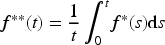
If the function is a positive and radially decreasing function on , then its norm in the Lorentz space is given by the following equivalent expression (see Anker & Pierfelice, 2009, Corollary 3.3):
for , and the one in the weak- space is equivalent to
From (3.3), it is not difficult to see that weak- spaces allow functions exhibiting strong singular behavior and outside the -setting. Moreover, there is no scaling map valid in weak- spaces as in the case of . In fact, from (3.1) and (3.3), we can see that the presence of the exponential factor arising from the hyperbolic geometry breaks the homogeneity of the norm.
For we have the following inclusions:
Let and be such that and . We have the Hölder inequality
where is a constant independent of and . Moreover, for , , and by reiteration theorem (see Bergh & Löfström, 1976, Theorem 3.5.3), we have the interpolation property
Now we extend the dispersive estimates in Proposition 2.1 to the framework of Lorentz spaces.
Let , , and . Then, there exists a constant (independent of ) such that
for all where .
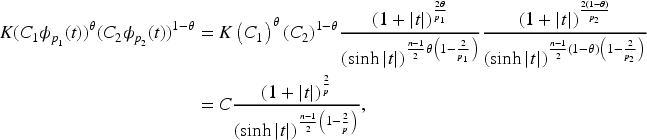
The proof follows by means of an interpolation argument. For that, let and be such that Employing (2.6) and (2.7), and recalling that we have
where is independent of Recalling that the interpolation functor is of exponent and (see Bergh & Löfström, 1976), estimate (3.8) leads us to
where is independent of . Next, taking and using note that
which, together with (3.9), gives the desired estimate.
Well-Posedness, Stability, and Scattering
In order to establish the well-posedness of the integral equation (2.4), we define some suitable functional spaces as follows. Let , , , and denote by the set of all Bochner measurable such that
The pair is a Banach space.
Now, for a fixed (see (4.10)), , , and , consider the space of all Bochner measurable satisfying
The space endowed with is a Banach space. Also, we consider the initial-data space as the set of all pairs such that
In the case we use the notation
Global Well-Posedness
Let . To carry out our analysis, we consider the constants , , and satisfying , where is the conformal exponent and
is the positive root of the equation . Moreover, for , we define the constant
With these definitions in place, we now state the main result of this subsection in the following theorem.
(Global-in-time solution)
(Well-posedness). Let , and set . Consider such that (which is possible since ) and define and . If with for some small enough, then equation (2.4) has a unique global-in-time mild solution such that .
(-regularity). Let and . Suppose further that
Then, there exists such that the previous solution satisfies
provided that .
(Local-in-time solution). With an adaptation on the arguments, we can obtain a local version of the above well-posedness result, regardless of the initial-data size. More precisely, let and . If , then there exists , such that (2.4) has a unique solution with . Moreover, if with , then the solution satisfies
The restrictions imposed on the parameters , , and arise from technical considerations required to ensure the validity of the nonlinear estimates in Lemma 4.3 below which will be used to prove Theorem 4.1. In particular, the limiting values and cannot be used in Theorem 4.1, since at these endpoints certain integrals appearing in the proof of Lemma 4.3 fail to converge, thereby preventing the nonlinear estimates from holding.
Before proving Theorem 4.1, we provide the following lemma with useful nonlinear estimates.
Suppose that the conditions of Theorem 4.1 hold. Set
There exists a positive constant such that the following nonlinear estimate holds:
for all . Moreover, for and , there exists a positive constant such that the following nonlinear estimate holds:
for all .
First we prove the inequality (4.8). Note that we can choose such that the function in (3.7) satisfies
where .
From the conditions on , and , we have the relations
In view of the time symmetry of the wave group (4.7) and estimates (3.7) and (4.10), we can assume without loss of generality. Moreover, we consider three cases for the time variable when estimating the operator .
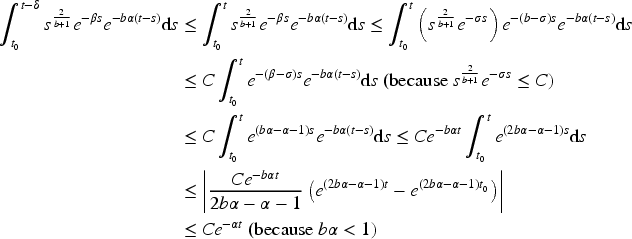
Case 1: For , where . In this case, letting in (4.10), we have , , and Then, it is not difficult to see that
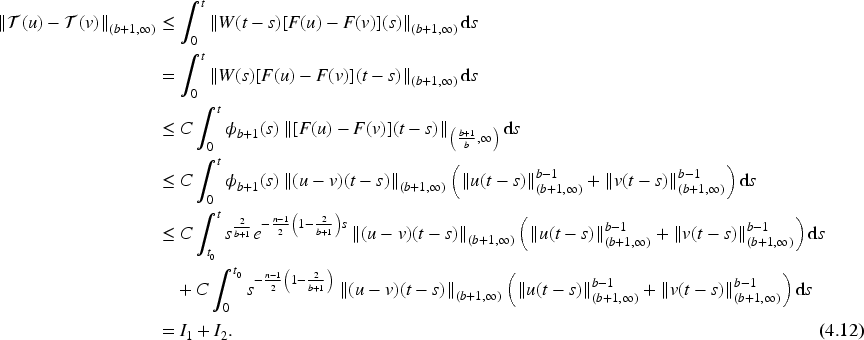
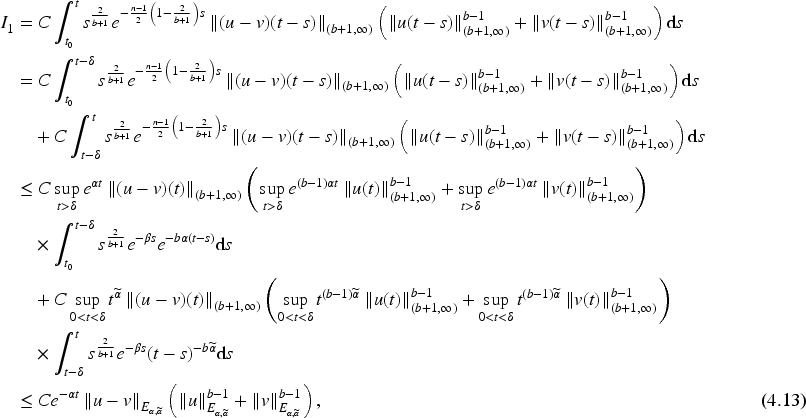
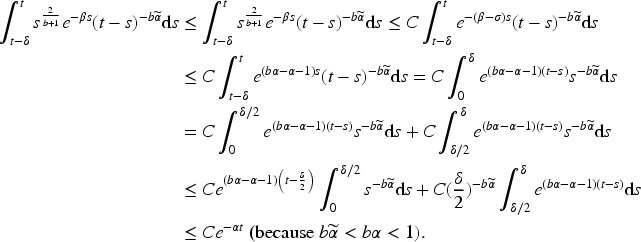
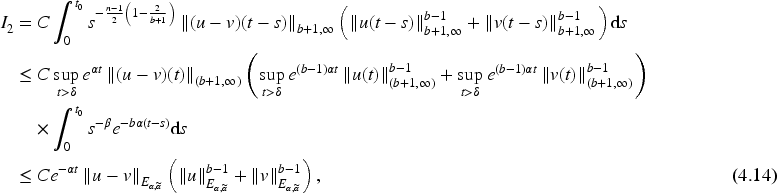
Case 2: For . First note that and Then, using (4.10), Lemma 3.1, Remark 2.2 (ii) and Hölder’s inequality, we can estimate
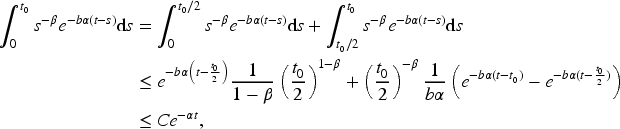
Considering and in (4.10), and taking , we estimate the integral as follows:
because , , and . Combining (4.12), (4.13), and (4.14), we arrive at
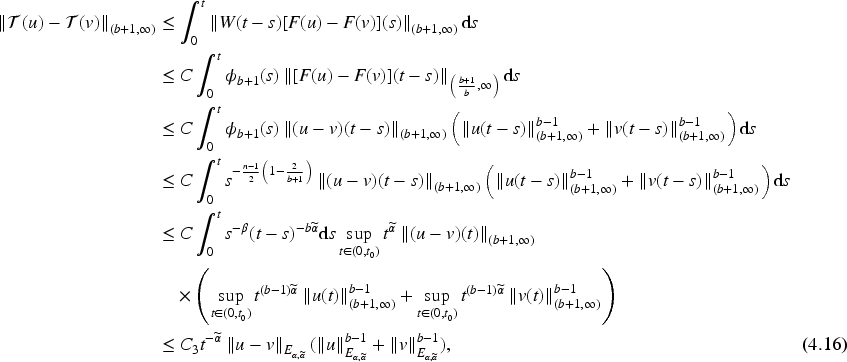
Case 3: For . Employing (4.10), Lemma 3.1, Remark 2.2 (ii), and Hölder’s inequality, we obtain that
where we have used in (4.16) that Therefore, we get
Using (4.11), (4.15), (4.17) and letting we obtain the first nonlinear estimate (4.8).
Now, for , and let be as in (4.10). Proceeding similarly to the proof of the first nonlinear estimate (4.8), we have that: for ,
and for
Therefore, for , we obtain that
Similarly, for , it follows that
Putting together estimates (4.18), (4.19), and (4.20), considering and recalling the space (see (4.1)), we obtain the second nonlinear estimate (4.9).
Proof of Theorem 4.1.
Item (i). For some , we are going to show that the operator is a contraction in the closed ball provided that . For that, set and
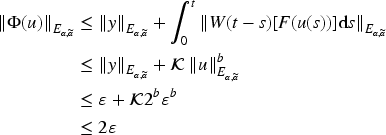
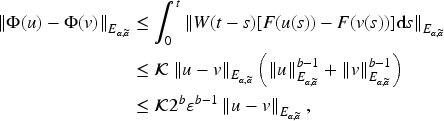
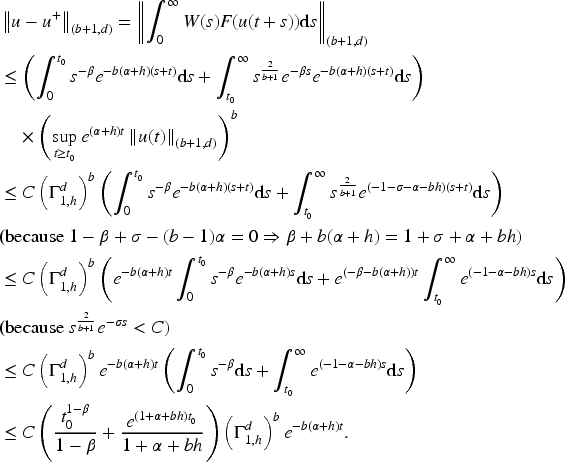
where is given in (4.7). Using the nonlinear estimate (4.8), we have that
and
for all provided that . It follows that is a contraction. Then, in view of the Banach fixed point theorem, we can conclude the existence of a unique solution for (2.4) such that
Item (ii). The solution obtained in item (i) can be approximated by the Picard sequence defined as follows:
where the limit is taken in the norm . Also, by the proof of Item (i), we have that
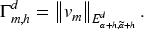
In the sequel, we show that the sequence (4.22) is uniformly bounded in the norm . For that, denote
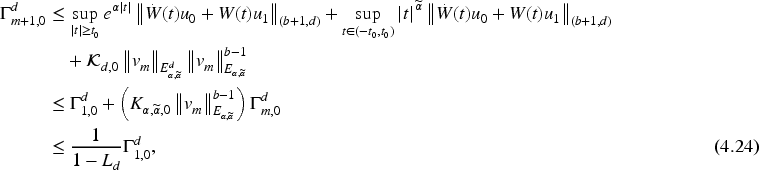
First, for the case , applying nonlinear estimate (4.9) with and yields
provided that satisfies
For the case , applying again nonlinear estimate (4.9), we can estimate
for all . Taking such that and using (4.4), the R.H.S. of (4.26) can be bounded by and then we obtain the desired boundedness. Finally, the uniform boundedness of in and the uniqueness of the limit in the sense of distributions yield the property (4.5).
Exponential Stability
(Exponential stability) Under the same assumptions of Theorem 4.1. Suppose also that and belonging to are solutions of (2.4) obtained in Theorem 4.1 with initial data and , respectively. Then, we have that
if and only if
In particular, condition (4.27) holds provided that and .
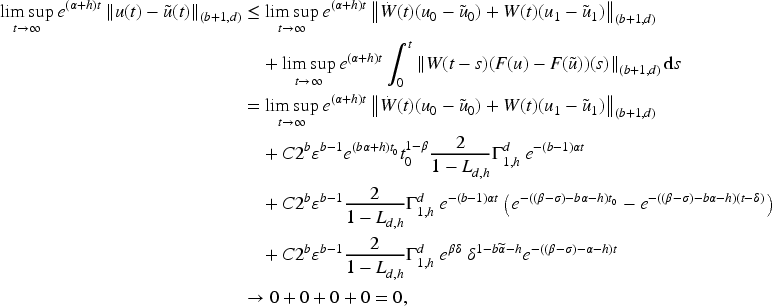
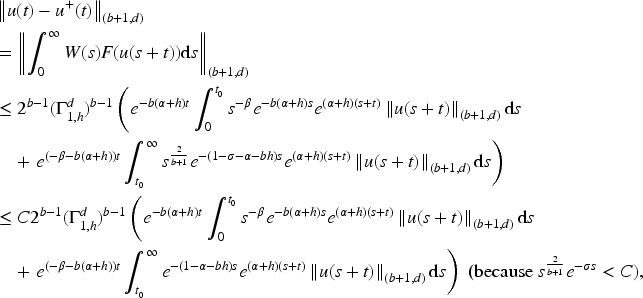
First assuming (4.27), we prove (4.28). Without loss of generality, assume also that . Then, we have that
Take such that , where is given in the proof of Theorem 4.1 (ii) (see (4.26)). Therefore, it follows that
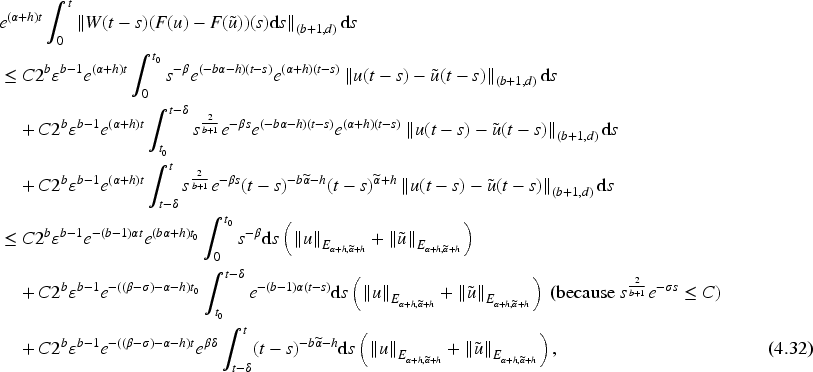
provided that . For , using , we can handle the R.H.S. of (4.29) as follows:
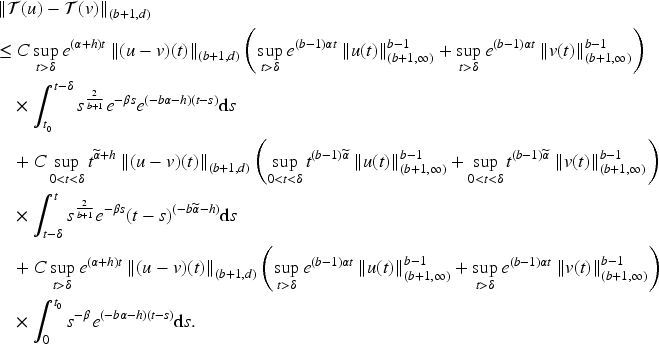
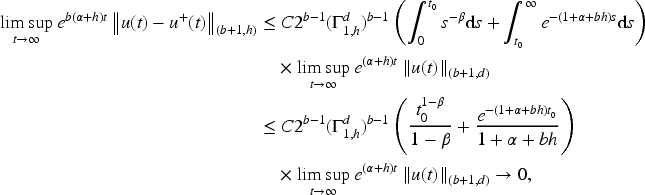
where is as in (4.10), , and . Combining inequalities (4.29), (4.32), and (4.30) and (4.31), and condition (4.27), and using and , we obtain that
which implies (4.28). Next, for the reciprocal assertion, assume (4.28). Then, using the same bounds for
we arrive at
which gives the desired conclusion.
Scattering and Wave Operator
In this part, we analyze the scattering property of the global mild solution obtained in Theorem 4.1.
(Scattering) Suppose the same conditions of Theorem 4.1. Consider also the solution of (2.4) obtained in Theorem 4.1 with initial data . Then, there exist satisfying
where are the unique solutions of the associated linear problem
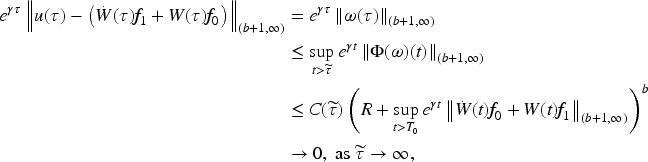
We show only the property (4.33). The proof of (4.34) is left to the reader. We start by defining
Finally, we establish the construction of wave operators for equation (2.3), that is, the construction of solutions with prescribed scattering states. In particular, for a given initial data , we find a global solution which converges as to the solution of the associated linear problem with initial data . In the following theorem, we state and prove the construction of future wave operator, the past wave one is constructed by the same way.
(Future wave operator) Suppose the same conditions of Theorem 4.1 and let . Then, for any such that and
there exist and a solution of the integral equation (2.4) on satisfying
and
If is also a solution of equation (2.4) on satisfying
then there exists such that on .
For , we consider the space of all Bochner measurable satisfying
The space endowed with is a Banach space.
Step 1: Construction of the solution. Let and consider the closed ball
We define the mapping by
Observe that, if is a fixed point of the operator , for some which will be chosen later, then
satisfies and . Using the group properties of , we can show that
where and equation (4.40) holds for a.e. . The function given by (4.40) is a solution of the integral equation (2.4) on .
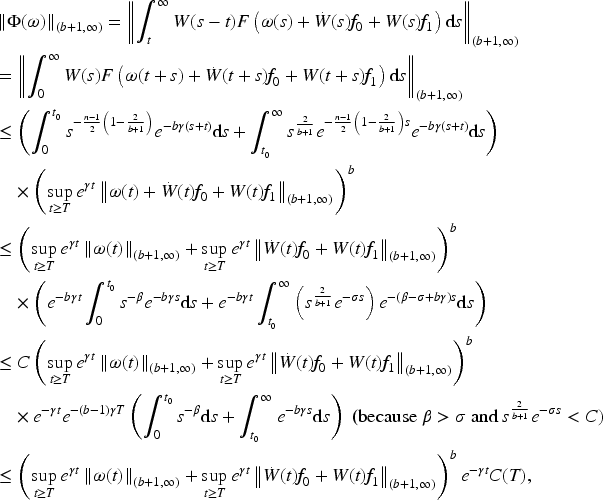
Step 2: The existence of unique fixed point of . We prove this argument by establishing that is a contraction mapping. Indeed, by using (4.10), Lemma 3.1, Remark 2.2 (ii), and Hölder’s inequality, for , we estimate
where
Hence
for . This leads to
for all and . By the same way and using the property (1.2) of function , for every , we can estimate
From inequalities (4.41) and (4.42), we can choose such that is a contraction mapping on , which implies the existence of a unique fixed point of .
Step 3: The convergence and uniqueness. Let be fixed and . Hence, we have . By the same estimates in Step 2, we obtain that
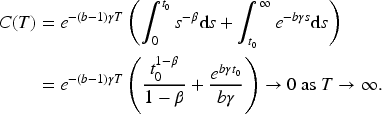
due to as . Finally, the uniqueness assertion follows from standard arguments (see, e.g., Farah & Ferreira, 2012).
In this article, we establish the well-posedness, exponential stability, and scattering theory for the shifted wave equation (2.3) by exploiting the dispersive estimates for the wave group associated with the operator , as obtained by Tataru (2001). For wave equations with (i.e., the Klein-Gordon equations), the above results can also be derived by employing the dispersive estimates for the associated wave groups obtained by Anker and Pierfelice (2014) (see Theorems 4.2 and 4.3 by Anker & Pierfelice, 2014), although this approach yields stability and scattering with at most polynomial decay. The method is similar to our recent work for the dispersive Boussinesq equations (Ferreira & Xuan, 2024).
In the previous works (Anker & Pierfelice, 2009, 2014), the authors employed Strichartz estimates on hyperbolic spaces to obtain the well-posedness and scattering for nonlinear Schrödinger equations and Klein-Gordon equations in - and - spaces. Meanwhile, our method employs dispersive estimates to establish these results for the shifted wave equation (2.3) in the framework of Lorentz spaces, allowing us to extend the class of admissible initial data to include singular data outside the -setting. Consequently, the present work together with (Anker & Pierfelice, 2009, 2014) provide complementary results on the well-posedness and scattering for wave equations, offering a more comprehensive understanding across both regular and singular initial data.
Footnotes
ORCID iD
Lucas C. F. Ferreira
Funding
L.C.F. Ferreira was supported by FAPESP (grant: 2020/05618-6) and CNPq (grant: 308799/2019-4 and 312484/2023-2), Brazil.
Conflicting Interests
The authors declared no potential conflicts of interest with respect to the research, authorship, and/or publication of this article.
References
1.
AnkerJ.-P.PierfeliceV. (2009). Nonlinear Schrödinger equation on real hyperbolic spaces. Annales de l’Institut Henri Poincaré C Analyse Non Linéaire, 26(5), 1853–1869. 10.1016/j.anihpc.2009.01.009
2.
AnkerJ.-P.PierfeliceV. (2014). Wave and Klein-Gordon equations on hyperbolic spaces. Analysis & PDE, 7(4), 953–995. 10.2140/apde.2014.7.953
3.
AnkerJ.-P.PierfeliceV.VallarinoM. (2012). The wave equation on hyperbolic spaces. Journal of Differential Equations, 252, 5613–5661. 10.1016/j.jde.2012.01.031
4.
AntociF. (2000). Scattering theory for -forms on hyperbolic real space. Istituto Lombardo (Rend. Sc.) A, 134, 71–85.
5.
BaezJ. C.SegalI. E.ZhouZ.-F. (1990). The global Goursat problem and scattering for nonlinear wave equations. Journal of Functional Analysis, 93, 239–269. 10.1016/0022-1236(90)90128-8
6.
BanicaV.CarlesR.DuyckaertsT. (2009). On scattering for NLS: From Euclidean to hyperbolic space. Discrete and Continuous Dynamical Systems, 24(4), 1113–1127. 10.3934/dcds.2009.24.1113
7.
BanicaV.CarlesR.StaffilaniG. (2008). Scattering theory for radial nonlinear Schrödinger equations on hyperbolic space. Geometric and Functional Analysis, 18, 367–399. 10.1007/s00039-008-0663-x
8.
BelchevE.KepkaM.ZhouZ. (1999). Global existence of solutions to nonlinear wave equations. Communications in Partial Differential Equations, 24, 2297–2331. 10.1080/03605309908821503
9.
BerghJ.LöfströmJ. (1976). Interpolation spaces: An introduction(Grundlehren der Mathematischen Wissenschaften), Springer.
10.
BonyJ.-F.HäfnerD. (2009). The semilinear wave equation on asymptotically Euclidean manifolds. Communications in Partial Differential Equations, 35(1), 23–67. 10.1080/03605300903396601
11.
CazenaveT.VegaL.VilelaM. C. (2001). A note on the nonlinear Schrödinger equation in weak- space. Communications in Contemporary Mathematics, 3(1), 153–162. 10.1142/S0219199701000317
12.
CazenaveT.WeisslerF. B. (1998). Asymptotically self-similar global solutions of the nonlinear Schrödinger and heat equations. Mathematische Zeitschrift, 228(1), 83–120. 10.1007/PL00004606
13.
CazenaveT.WeisslerF. B. (2000). Scattering theory and self-similar solutions for the nonlinear Schrödinger equation. SIAM Journal on Mathematical Analysis, 31(3), 625–650. 10.1137/S0036141099351309
14.
ChenL.LiuH. (2026). The Sommerfeld-Rellich framework for scattering on hyperbolic space: Far-field patterns and inverse problems [Preprint]. arXiv, https://doi.org/10.48550/arXiv.2310.16416.
15.
de AlmeidaM. F.FerreiraL. C. F. (2017). Time-weighted estimates in Lorentz spaces and self-similarity for wave equations with singular potentials. Analysis & PDE, 10(2), 423–438. 10.2140/apde.2017.10.423
16.
DebièvreS.HislopH. D.SigalI. M. (1992). Scattering theory for the wave equation on non-compact manifolds. Reviews in Mathematical Physics, 4(4), 575–618. 10.1142/S0129055X92000236
17.
FarahL. G.FerreiraL. C. F. (2012). On the wave operator for the generalized Boussinesq equation. Proceedings of the American Mathematical Society, 140(9), 3055–3066. 10.1090/S0002-9939-2011-11131-6
18.
FerreiraL. C. F. (2011). Existence and scattering theory for Boussinesq type equations with singular data. Journal of Differential Equations, 250(5), 2372–2388. 10.1016/j.jde.2010.11.013
19.
FerreiraL. C. F.Vilamizar-RoaE. J.SilvaP. B. E. (2009). On the existence of infinite energy solutions for nonlinear Schrödinger equations. Proceedings of the American Mathematical Society, 137(6), 1977–1987. 10.1090/S0002-9939-09-09773-1
20.
FerreiraL. C. F.XuanP. T. (2024). Dispersive estimates and generalized Boussinesq equation on hyperbolic spaces with rough initial data [Preprint]. arXiv. https://doi.org/10.48550/arXiv.2410.20472.
21.
FrenchA. (2012). Scattering for nonlinear waves on hyperbolic space [PhD’s thesis, University of North Carolina at Chapel Hill]. https://doi.org/10.17615/6fp0-qw21.
22.
FriedlanderF. G. (2001). Notes on the wave equation on asymptotically Euclidean manifolds. Journal of Functional Analysis, 184(1), 1–18. 10.1006/jfan.2000.3546
23.
GeorgievV.LindbladH.SoggeC. D. (1997). Weighted Strichartz estimates and global existence for semilinear wave equations. American Journal of Mathematics, 119, 1291–1319. 10.1353/ajm.1997.0038
24.
GinibreJ.VeloG. (1985). The global Cauchy problem for the nonlinear Klein-Gordon equation. Mathematische Zeitschrift, 189, 487–505. 10.1007/BF01168155
25.
GinibreJ.VeloG. (1987a). Conformal invariance and time decay for nonlinear wave equations I. Annales de l’Institut Henri Poincaré, Physique Théorique, 47, 221–261.
26.
GinibreJ.VeloG. (1987b). Conformal invariance and time decay for nonlinear wave equations II. Annales de l’Institut Henri Poincaré, Physique Théorique, 47, 263–276.
27.
GinibreJ.VeloG. (1989). Scattering theory in the energy space for a class of non-linear wave equations. Communications in Mathematical Physics, 123, 535–573. 10.1007/BF01218585
28.
GlasseyR. T. (1981). Finite-time blow-up for solutions of nonlinear wave equations. Mathematische Zeitschrift, 177, 323–340. 10.1007/BF01162066
29.
HidanoK. (1998). Nonlinear small data scattering for the wave equation in . Journal of the Mathematical Society of Japan, 50, 253–292. 10.2969/jmsj/05020253
30.
HidanoK. (2000). Small data scattering and blow-up for a wave equation with a cubic convolution. Funkcialaj Ekvacioj Serio Internacia, 43, 559–588. https://doi.org/10.24546/0100500048
31.
HidanoK. (2001). Scattering problem for the nonlinear wave equation in the finite energy and conformal charged. Journal of Functional Analysis, 187(2), 274–307. 10.1006/jfan.2001.3801
32.
IbrahimS.MajdoubM.MasmoudiN. (2006). Global solutions for a semilinear, two-dimensional Klein-Gordon equation with exponential-type nonlinearity. Communications on Pure and Applied Mathematics, 59, 1639–1658. 10.1002/cpa.20127
33.
IbrahimS.MajdoubM.MasmoudiN.NakanishiK. (2009). Scattering for the two-dimensional energy-critical wave equation. Duke Mathematical Journal, 150, 287–329. 10.1215/00127094-2009-053
34.
KeelM.TaoT. (1998). Endpoint Strichartz estimates. American Journal of Mathematics, 120, 955–980. 10.1353/ajm.1998.0039
35.
LaxP. D.PhillipsR. S. (1967). Scattering theory (Pure and Applied Mathematics, Vol. 26, pp. xii + 276). Academic Press..
36.
LiJ.LiuH. (2023). Numerical methods for inverse scattering problems. Springer.
37.
LiT. T.YuX. (1991). Life-span of classical solutions to fully nonlinear wave equations. Communications in Partial Differential Equations, 16, 909–940. 10.1080/03605309108820785
38.
LiT. T.ZhouY. (1995). A note on the life-span of classical solutions to nonlinear wave equations in four space dimensions. Indiana University Mathematics Journal, 44, 1207–1248. http://doi.org/10.1512/iumj.1995.44.2026
39.
LindbladH.MetcalfeJ.SoggeC. D.TohaneanuM.WangC. (2014). The Strauss conjecture on Kerr black hole backgrounds. Mathematische Annalen, 359, 637–661. 10.1007/s00208-014-1006-x
40.
LindbladH.SoggeC. D. (1995). On existence and scattering with minimal regularity for semilinear wave equations. Journal of Functional Analysis, 130, 357–426. 10.1006/jfan.1995.1075
41.
LiuS. (2009). Remarks on infinite energy solutions of nonlinear wave equations. Methods & Applications, 71, 4231–4240. 10.1016/j.na.2009.02.112
42.
MetcalfeJ.TaylorM. (2011). Nonlinear waves on 3D hyperbolic space. Transactions of the American Mathematical Society, 363(7), 3489–3529. 10.1090/S0002-9947-2011-05122-6
43.
MetcalfeJ.TaylorM. (2012). Dispersive wave estimates on 3D hyperbolic space. Proceedings of the American Mathematical Society, 140(11), 3861–3866. 10.1090/S0002-9939-2012-11534-5
44.
MetcalfeJ.WangC. (2017). The Strauss conjecture on asymptotically flat space-times. SIAM Journal on Mathematical Analysis, 49(6), 4579–4594. 10.1137/16M1074886
45.
PecherH. (1982). Decay of solutions of nonlinear wave equations in three space dimensions. Journal of Functional Analysis, 46, 221–229. 10.1016/0022-1236(82)90035-0
46.
PecherH. (1984). Nonlinear small data scattering for the wave and Klein-Gordon equation. Mathematische Zeitschrift, 185, 261–270. 10.1007/BF01181697
47.
PhillipsR.WiskottB.WooA. (1987). Scattering theory for the wave equation on a hyperbolic manifold. Journal of Functional Analysis, 74(2), 346–398. 10.1016/0022-1236(87)90030-9
48.
Sá BarretoA. (2005). Radiation fields, scattering and inverse scattering on asymptotically hyperbolic manifolds. Duke Mathematical Journal, 129(3), 407–480. 10.1215/S0012-7094-05-12931-3
49.
Sá BarretoA. (2008). A support theorem for the radiation fields on asymptotically Euclidean manifolds. Mathematical Research Letters, 15(5), 973–991. 10.4310/MRL.2008.v15.n5.a11
50.
SiderisT. C. (1984). Nonexistence of global solutions to semilinear wave equations in high dimensions. Journal of Differential Equations, 52, 378–406. 10.1016/0022-0396(84)90169-4
51.
SireY.SoggeC. D.WangC. (2019). The Strauss conjecture on negatively curved backgrounds. Discrete and Continuous Dynamical Systems, 39(12), 7081–7099. 10.3934/dcds.2019296
52.
StraussW. A. (1968). Decay and asymptotics for . Journal of Functional Analysis, 2, 409–457. 10.1016/0022-1236(68)90004-9
53.
StraussW. A. (1981). Nonlinear scattering theory at low energy. Journal of Functional Analysis, 41, 110–133. 10.1016/0022-1236(81)90063-X
54.
TataruD. (2001). Strichartz estimates in the hyperbolic space and global existence for the semilinear wave equation. Transactions of the American Mathematical Society, 353(2), 795–807. 10.1090/S0002-9947-00-02750-1
55.
WangC.ZhangX. (2025). Wave equations with logarithmic nonlinearity on hyperbolic spaces. Transactions of the American Mathematical Society, 378, 2253–2269. 10.1090/tran/9404
56.
ZhangJ. (2015). Strichartz estimates and nonlinear wave equation on nontrapping asymptotically conic manifolds. Advances in Mathematics, 271, 91–111. 10.1016/j.aim.2014.11.013
57.
ZhouY. (1995). Cauchy problem for semilinear wave equations in four space dimensions with small initial data. Journal of Partial Differential Equations, 8(2), 135–144. 10.4208/jpde.v8.n2.5