







Abstract
The increasing presence of smart mobile devices in sensitive environments raises significant security and privacy concerns, particularly due to the unauthorized usage of built-in sensors such as cameras and microphones. However, space owners currently have limited means to enforce restrictions on mobile devices within their premises. To address this issue, we propose a novel location-based access control system utilizing bluetooth low energy (BLE) beacons to dynamically enforce security policies. The proposed system introduces the jumbo beacon concept, which enables fragmented transmission and reassembly of signed access control policies, overcoming BLE payload limitations. Unlike centralized enforcement models, our approach is fully decentralized, eliminating the need for a trusted central server and providing a flexible, scalable mechanism for enforcing fine-grained access policies. The system is implemented as a native security module within the Android operating system, ensuring tamper-resistant enforcement of policies while preventing unauthorized modifications. A proof-of-concept implementation demonstrates the system’s effectiveness, highlighting its real-time policy enforcement capabilities and resilience against adversarial threats. The results indicate that our approach offers a lightweight, scalable, and secure solution for enforcing location-based access control in dynamic environments.
Keywords
Introduction
The proliferation of smart mobile devices in modern workplaces has brought about significant security and privacy challenges, particularly in highly secure environments such as government facilities and research laboratories. With the widespread use of these devices, unauthorized access to critical device functionalities—such as cameras, microphones, and sensors—poses substantial risks. Mobile device features, including various applications, can inadvertently contribute to data leakage, further exacerbating security concerns. These risks include corporate espionage, 1 unauthorized surveillance, 2 and sensitive data leakage, 3 all of which can have far-reaching consequences for individuals and organizations alike. Traditional security measures, such as network firewalls, device management systems, and physical access restrictions, offer some protection. 4 However, they fall short in dynamically enforcing fine-grained, location-based security policies on mobile devices, where the flexibility and adaptability needed to respond to changing environments are limited. 5
In particular, while many existing access control systems provide some level of enforcement, they often rely on centralized trust models and infrastructure.6–9 This introduces several key concerns, such as scalability issues, reliance on a single trusted authority, and vulnerabilities due to potential single points of failure. Furthermore, many traditional systems are not designed to handle the dynamic and context-sensitive nature of modern, mobile, and highly distributed work environments. 10 This presents a need for a more flexible and efficient solution that can respond to real-time, location-based security requirements in a scalable manner.
To address these challenges, we propose a novel location-aware access control system that utilizes Bluetooth Low Energy (BLE) beacons to dynamically enforce security policies on mobile devices. BLE beacons present an energy-efficient and widely deployable solution for proximity-based enforcement. 11 However, the small payload size of BLE advertisements, typically limited to just 160 bits, makes it difficult to communicate complex access control policies. Additionally, the reliance on centralized models for policy distribution and verification introduces scalability issues and vulnerabilities related to trust, as the system requires a single point of control.
To overcome these issues, we introduce the jumbo beacon mechanism, a novel solution that enables fragmented transmission and reassembly of data across multiple BLE beacons. This mechanism effectively bypasses the 160-bit payload limitation of standard BLE broadcasts, enabling the system to handle large, complex data—such as access control policies—more efficiently. This innovation makes the solution applicable to a wide range of BLE-based use cases, from corporate offices to government facilities, while maintaining a high level of flexibility and efficiency.
Furthermore, our system eliminates the need for a central trusted authority by adopting a fully decentralized, whitelist-based enforcement model. In this model, digitally signed policies are verified locally on the mobile device, improving scalability and security. This approach also ensures that policies are tamper-resistant, preventing unauthorized modifications by malicious actors.
Moreover, the system is intended for enterprise-managed deployments, where devices are provisioned by the space owner and support tamper-resistant OS-level enforcement. To implement this model, we have developed a native security module within the Android operating system that ensures seamless enforcement of access control rules without requiring modifications to existing BLE beacon hardware.
In this paper, we present a proof-of-concept implementation of our approach and conduct a comprehensive performance evaluation. Our results demonstrate that the jumbo beacon mechanism enables efficient policy transmission, ensures low-latency enforcement, and provides robust protection against unauthorized access. Additionally, the decentralized model enhances resilience against attacks, making the system a practical and secure solution for enforcing location-based security policies in real-world environments.
This paper presents the following key contributions: We introduce a novel BLE jumbo beacon mechanism that enables fragmented transmission and reliable reassembly of data, effectively overcoming the payload size limitations of standard BLE advertisements. While designed to support access control policy delivery, this mechanism is broadly applicable to any use case where transmitting larger data over BLE is required. We propose a whitelist-based, fully decentralized policy enforcement model that eliminates the need for a trusted central authority while ensuring policy integrity. We implement a native security module within the Android operating system, preventing unauthorized modifications and ensuring robust policy enforcement.
The remainder of this paper is organized as follows: Section 2 presents a review of related work. Section 3 describes the architecture and design of the proposed system. Section 4 discusses our prototype implementation. Section 5 details the experimental setup, performance benchmarks, security analysis, and overall effectiveness of our approach. Section 6 discusses topics related to system deployment and both strength and limitations of our approach, Finally, Section 7 summarizes our findings and discusses potential future work.
Related work
Chowdary et al. 6 proposed a policy-based framework that enforces application-level restrictions based on user profiles and campus WiFi connectivity. Their model supports different user categories (e.g., students vs. faculty), with policies enforced through middleware-level modifications. However, enforcement relies on infrastructure-controlled networks (e.g., WiFi) and lacks support for continuous or fine-grained access restrictions.
Franziska et al. 7 introduced a world-driven access control framework aimed at preventing untrusted applications from accessing sensitive data, such as video or audio streams, in physical environments (e.g., locker rooms). Their solution requires tagging physical objects (e.g., with QR codes) to associate access policies, which poses scalability and usability challenges in real-world deployments.
Carlos et al. 8 proposed a space-sensitive access control model that considers both user location and policies defined by application developers or space owners. The model requires application-side logic and centralized policy servers, but does not address critical challenges such as revocation, delegation, space ownership verification, or decentralized enforcement.
Other research has explored the use of proximity-based constraints, which consider the spatial relationship between the requester and other entities in the environment.12–14 These models extend the traditional label-based access control (LBAC) framework by incorporating dynamic spatial factors. In parallel, several studies have enhanced role-based access control (RBAC) by embedding location-aware attributes,14–16 enabling roles to be activated or modified based on the user’s geographic context.
Efforts in Hsu and Ray, 17 Zhu et al. 18 explored the use of spatial information in user authentication, while19–21 examined the protection of location privacy within LBAC systems. Other work addressed accuracy limitations in localization and the integrity of reported location data.16,22
Security challenges in LBAC have also been studied. For example, Abdou et al. 23 analyzed the risk of users falsifying their location to gain unauthorized access. Additional contributions include proposals for evaluating LBAC models, 24 identifying key system requirements, 25 and outlining open research directions in the field. 10
Our previous work, ICMS, 9 introduced a space-based access control system that supports hierarchical and fine-grained policy enforcement on mobile devices based on physical space ownership. It enables space owners to define and enforce access restrictions without requiring user interaction and promotes transparency by revealing the identity of the enforcing authority. ICMS also preserves user location privacy by ensuring that location information is never disclosed to third parties. One limitation of ICMS, however, is its reliance on a central server for policy distribution.
Table 1 provides a comparison between our proposed system and existing LBAC systems that similarly empower space owners to enforce access control policies on mobile devices. Notably, our proposal does not require a centralized trust server, unlike some other systems. It also ensures that user location privacy is preserved, a feature not supported by all systems in the comparison. Additionally, our system does not impose any limitations related to physical spaces, providing greater flexibility. In terms of security, while device rooting remains difficult, similar to other systems, our approach ensures robust privacy and security without relying on a centralized infrastructure.
Comparison of our proposal against existing similar label-based access control (LBAC) systems.
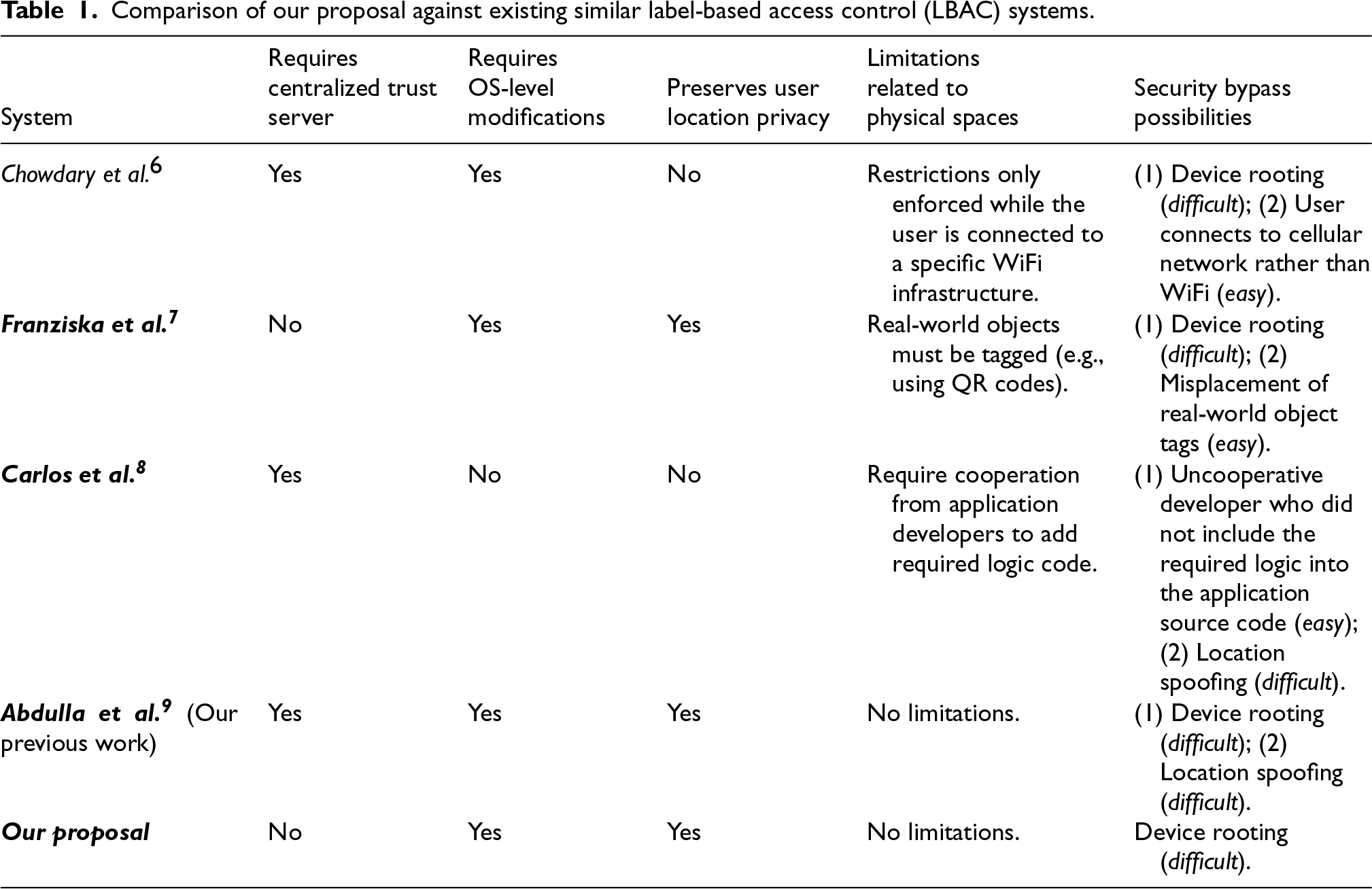
Comparison of our proposal against existing similar label-based access control (LBAC) systems.
This section presents the design of the proposed location-based access control system. It begins by outlining the key design goals, followed by the threat model that identifies potential adversaries. We then describe the overall system architecture and its primary components, as illustrated in Figure 1, which also highlights the associated threats. Subsequently, we introduce the customized BLE beacon structure and the jumbo beacon concept. The section concludes with a detailed explanation of the system’s main operations.
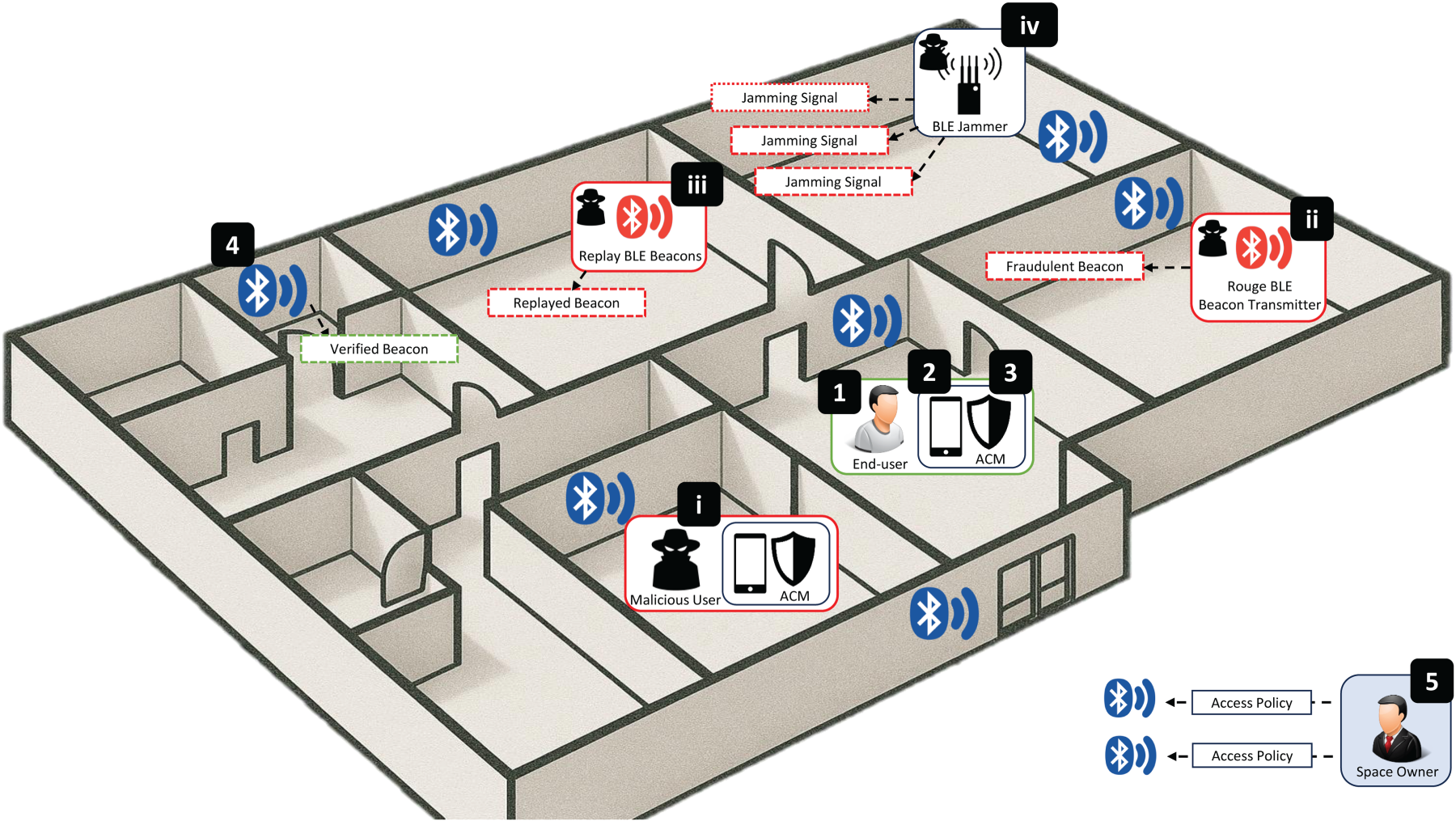
System architecture and threat model overview. Threat actors are labeled (i–iv) as described in Section 3.2, and components are numbered as defined in Section 3.3 (1–5).
The proposed system is designed to achieve the following goals:
Threat model
The threat model identifies potential adversaries and describes possible attacks that could compromise the integrity and effectiveness of the system’s access control policies. Our primary objective is to protect defined access control policies from unauthorized modifications and to ensure their reliable enforcement on end-user mobile devices. We have identified the following threat actors:
The proposed system consists of the following primary components:
The jumbo beacons
Transmitting large amounts of data, such as digitally signed access control policies, directly within a single BLE beacon is challenging due to inherent payload size constraints, typically limited to 160 bits of configurable data (e.g., Major and Minor value fields each with 2 bytes, UUID field with 16 bytes, and other protocol specific fields). 27 To overcome this limitation, we introduce the concept of a jumbo beacon, which logically aggregates multiple fragmented standard BLE beacons to collectively transmit larger policies. In order to achieve that, we customized the BLE beacon structure by repurposing traditional beacon fields into the following specialized fragmentation fields to facilitate accurate data reassembly (this is illustrated in Figure 2):

Customized bluetooth low energy (BLE) beacon structure illustrating how standard beacon fields are repurposed to encode fragmentation parameters, including sequence, offset, and size, to enable accurate jumbo beacon reassembly.
Utilizing these fragmentation parameters, recipient devices can accurately reconstruct the overall data payload by logically combining data payload of beacon fragments (concatenating data fields of our custom beacons in order based on their offest values). This approach effectively overcomes BLE payload size limitations, enabling the reliable transmission of large data payload.
This section describes essential system operations, including configuring and deploying access policies, scanning BLE beacons, reconstructing and verifying beacon fragments, enforcing policies, and revoking them when required. For ease of reference, we summarize all notations used in Table 2.
System design notations.
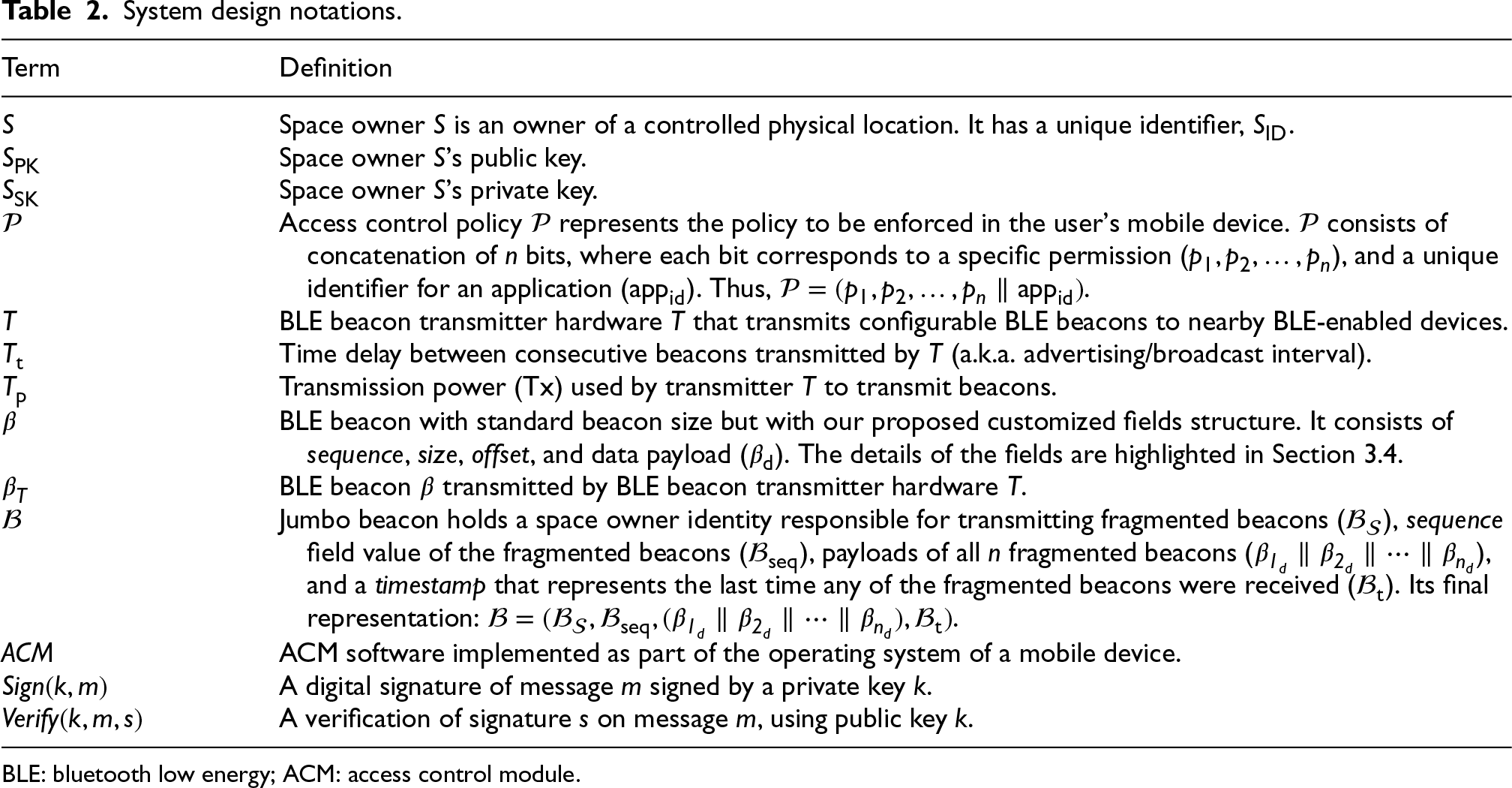
System design notations.
BLE: bluetooth low energy; ACM: access control module.
Furthermore, to improve robustness against rogue beacon attacks and unauthorized certificate injection, our architecture requires users to physically scan a QR code at the entrance of the controlled space. This QR code encodes both the space owner’s unique identifier (
This section details the prototype implementation of our proposed BLE beacon-based access control system, highlighting essential technical components and design considerations.
Implementation overview
We developed a prototype implementation of the proposed location-based access control system on Android, focusing on demonstrating the practicality and effectiveness of our decentralized BLE beacon-based approach. The implementation consists solely of a client-side software module—referred to as the ACM—integrated directly as a native system service within the Android operating system. This integration ensures continuous operation, prevents users from disabling or interrupting the module, and guarantees persistent enforcement of location-specific access control policies.
For beacon transmission, we utilized commercial BLE beacon transmitters from Feasycom. Beacon configuration—such as setting beacon payload content, broadcast interval, and transmission power—was performed using Feasycom’s proprietary mobile application.
Our ACM was implemented in Java, 28 aligning with the standard programing practices for native Android OS system services. We customized several Android system APIs to ensure secure and uninterrupted module operations. Specifically, we modified the Android Bluetooth API to prevent users from disabling Bluetooth, thereby ensuring continuous beacon reception. Additionally, modifications were made to the application launching and feature-enabling mechanisms of Android, enforcing our whitelist-based approach where all applications and device features are disabled by default until explicitly enabled by a verified access policy.
The received BLE beacon fragments are temporarily stored and managed purely in-memory, providing efficient reconstruction and verification of complete access control policies without additional persistent storage overhead.
Operations implementation
As new fragments arrive, the ACM checks for completeness by verifying whether all offsets from 0 to
Evaluation
This section presents a comprehensive evaluation of our proposed system, focusing on key performance dimensions: Policy generation and reconstruction latency, jumbo beacon delivery efficiency, delivery success rate under varying transmission power and distance, and estimated energy consumption of the BLE transmitter. In this evaluation, we used BLE beacon transmitters from Feasycom of model FSC-BP104D. 29 These transmitters support long-range broadcasts, feature an extended battery life of up to 10 years, and comply with IP67 waterproof standards, making them suitable for diverse operational environments. The mobile device used was a Samsung Galaxy J7 model with 2 GB of RAM and 1.6 GHz Octa-core Exynos 7870 processor. We conduct both experimental measurements and theoretical comparisons to assess system responsiveness, delivery reliability, and energy efficiency. The results demonstrate that our system operates within lightweight bounds suitable for real-time deployment, while highlighting important trade-offs between performance and configuration parameters such as broadcast interval and transmission power.
Jumbo beacon generation
We evaluate the performance of generating a jumbo beacon on the space owner’s side. This process includes digitally signing the access control policy
The time required to digitally sign the policy is approximately
After signing, the resulting payload is split into 160-bit fragments, each formatted into a BLE beacon payload. For a typical 7-fragment jumbo beacon, the total time taken to construct and populate all fragments is measured at approximately
In total, the complete jumbo beacon generation process—including signing and fragment formatting—takes about
Jumbo beacon reconstruction
We first evaluate the time required by the ACM to reconstruct a jumbo beacon from the received BLE fragments in order to read the transmitted access policy. This operation is handled in-memory by the ACM. Our measurements show that the time required to process each beacon fragment (i.e., parse and store) averages
Once the complete payload is reconstructed, the ACM proceeds to verify the digital signature to ensure the authenticity and integrity of the policy. The ECDSA signature verification operation takes approximately
Overall, the average latency for reconstructing and verifying a jumbo beacon with 7 fragments is
Theoretical vs. measured delivery time of jumbo beacon
In this experiment, we evaluate the time required to receive complete jumbo beacons under different BLE broadcast intervals. To eliminate the influence of transmission power, we set the transmission power (
We varied the BLE broadcast interval (
The average theoretical delivery time is computed by multiplying the total number of fragments by the advertising interval and then dividing by the total number of jumbo beacons:
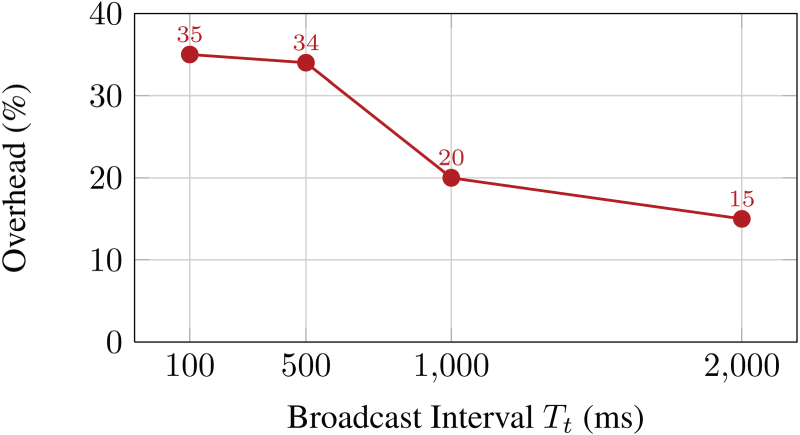
Measured overhead percentage between theoretical and actual delivery time for 100 jumbo beacons (
Avg. theoretical vs. measured delivery time for 100 jumbo beacons (

As shown in the results, the measured delivery time consistently exceeds the theoretical baseline, with overhead ranging from 15% to 35%. The highest overhead is observed at the lowest broadcast interval (
As
In this experiment, we evaluate the impact of transmission power (
The delivery success rate is defined as the percentage of jumbo beacons successfully received by the mobile device within the theoretical delivery time window, computed as
Figure 4 shows the resulting success rates across different distances and transmission power levels. At a short range of
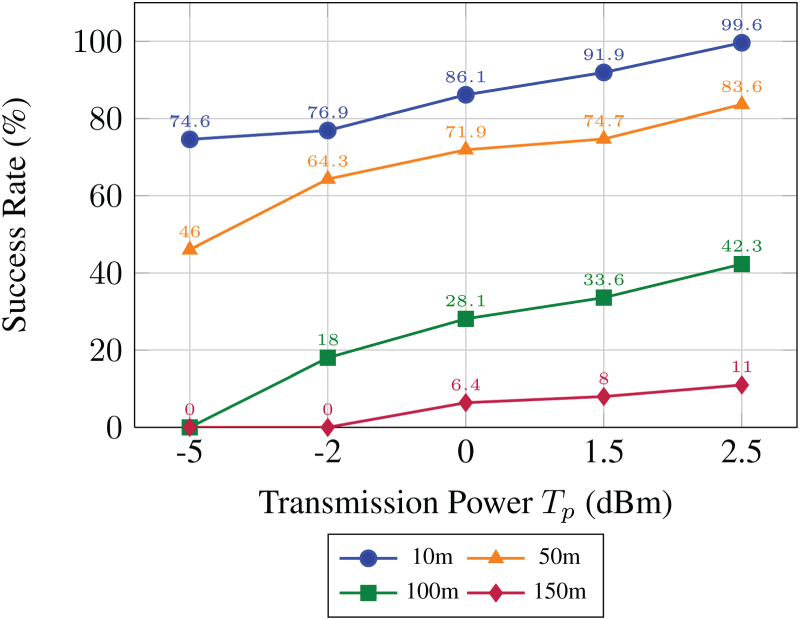
Delivery success rate vs. transmission power (
These results demonstrate that higher transmission power is essential for maintaining reliable jumbo beacon delivery over longer distances. In contrast, at shorter ranges, lower power settings are sufficient for stable performance. This insight is valuable for guiding real-world deployments, enabling developers to adjust
In addition to our outdoor experiments, we conducted preliminary evaluations in indoor environments to observe how physical obstructions affect beacon delivery. We found that BLE beacon performance degrades significantly when the transmitter and the mobile device are not within line of sight. In particular, barriers such as concrete walls, metal partitions, or thick glass noticeably attenuated signal strength and introduced delays or losses in fragment reception.
In several cases, the mobile device failed to receive a complete set of fragments within the expected theoretical time window, even at short distances (e.g., 5–10 m) when obstructed by a wall. These results highlight an important limitation of BLE in non-line-of-sight scenarios, which must be accounted for during system deployment. Optimal placement of transmitters in indoor spaces should therefore prioritize open line-of-sight coverage or consider redundancy to mitigate the effects of physical interference.
Estimated energy consumption of the BLE transmitter
To evaluate the energy consumption of the BLE transmitter, we focused on estimating the average current draw under various broadcast configurations. Our evaluation considers various transmission power levels. Since such measurements are time-consuming, we first performed a direct experiment using the configuration expected to yield the highest power consumption—namely, the maximum supported transmission power (
In this setting, we measured the time taken for the transmitter to consume 1% of its battery capacity. The transmitter is powered by two AAA 1.5 V zinc-carbon batteries in series, providing a total capacity of approximately
This value reflects the current consumption for the configuration of
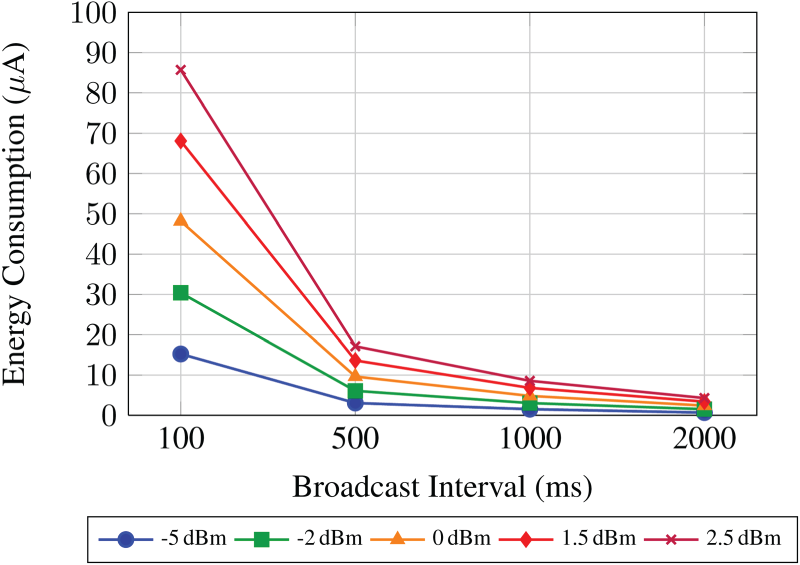
Estimated energy consumption (
This section explores several key design aspects, deployment strategies, and practical considerations of our proposed system. We highlight how the system achieves fine-grained and location-aware policy enforcement, supports flexible and scalable deployment across physical spaces, and enables advanced capabilities such as dwell-time enforcement and path-based access control. Additionally, we discuss system-level design choices—such as Bluetooth availability enforcement and support for variable permission sets—that enhance both the security guarantees and adaptability of our solution. These discussion points collectively demonstrate the practicality, robustness, and extensibility of our system in diverse real-world environments.
Fine-grained access control
Our system enables space owners to define and enforce highly fine-grained access control policies based on both application identity and physical location. Each policy specifies a set of permissions—such as camera, microphone, or location access—and the specific application (via its package name) to which those permissions apply. This allows space owners to precisely control which functionalities are accessible on a per-application basis.
Moreover, the system inherently supports spatial granularity. By deploying BLE beacon transmitters in specific physical areas, space owners can associate different policies with different zones. For example, access to the camera might be permitted in an open office area but disabled in a meeting room or secure zone. This design empowers space owners to tailor access control decisions not only to user context but also to the physical environment in which the device is operating.
The combination of application-level and location-specific control enables practical enforcement of real-world security policies, such as allowing messaging apps only in designated lounge areas or restricting sensor access in confidential meeting rooms. This flexibility makes the system suitable for a wide range of deployment scenarios, including corporate, healthcare, governmental, and industrial environments.
Policy deployment across multiple transmitters
Our system supports the distribution of a single access control policy across multiple BLE beacon transmitters by splitting the associated jumbo beacon fragments among them. As illustrated in Figure 6, each transmitter is configured to broadcast a distinct subset of the total fragments required to reconstruct the complete policy. This design enables parallel transmission of fragments, significantly reducing the time required for a mobile device to receive all necessary fragments for jumbo beacon reconstruction.
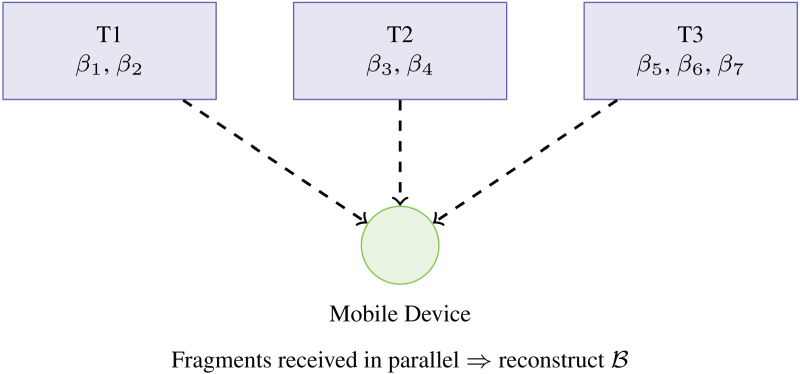
Parallel policy deployment: Fragments of a single policy are broadcast from multiple transmitters and received simultaneously.
In addition to improving policy delivery latency, this approach enhances the overall energy efficiency of the system. By dividing the workload among multiple transmitters, the broadcasting frequency of each individual device can be reduced, thereby extending the battery lifetime of each unit. This makes the system more sustainable and scalable, particularly in large deployments such as enterprise buildings or campus-wide environments, where continuous operation and long-term maintenance efficiency are critical.
Furthermore, different transmitters can be configured to broadcast overlapping fragments, providing redundancy that enhances resilience against localized beacon failures. This is illustrated in Figure 7.
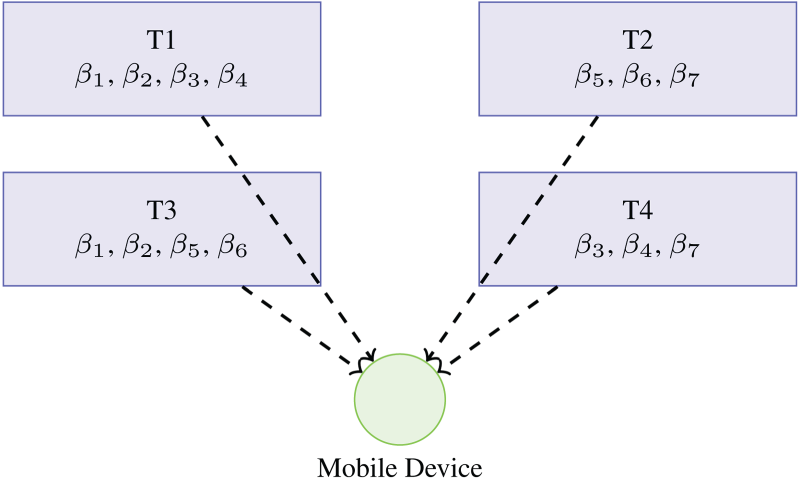
Four transmitters configured with overlapping beacon fragments. The mobile device can reconstruct the complete jumbo beacon even if one transmitter fails.
Our system supports the enforcement of dwell time—i.e., the minimum amount of time a user must remain within a specific physical area—by leveraging the configurable broadcast interval of BLE transmitters. Since each transmitter periodically broadcasts beacon fragments, we can control the rate at which fragments are emitted by adjusting the broadcast interval (
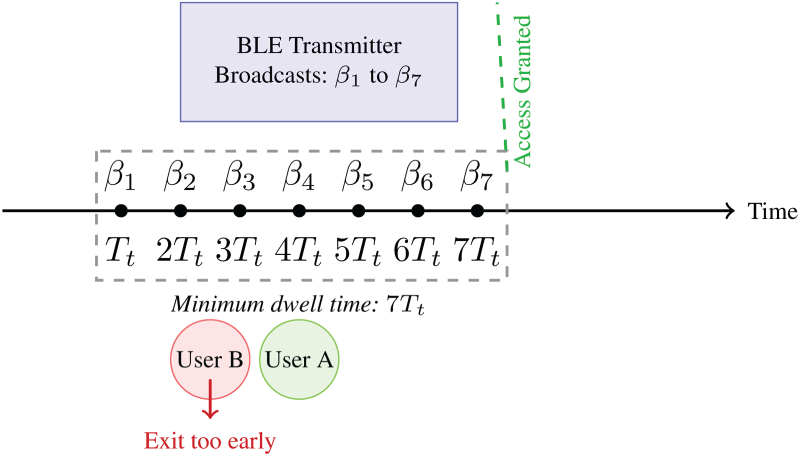
User must remain within the transmitter’s range for
This mechanism allows space owners to intentionally delay policy enforcement until the user has spent a predetermined amount of time in a specific zone. For example, in a secure meeting room, the BLE transmitter could be configured with a longer broadcast interval, requiring the user to remain in the area for several seconds before their mobile device has received all necessary fragments to activate permissions such as screen sharing or document access.
This strategy enhances security in sensitive environments by preventing quick drive-by access and ensuring that users are physically present and stationary long enough to satisfy the intended access control requirements.
Our system enables the enforcement of physical movement patterns by distributing the fragments of a single jumbo beacon across multiple BLE transmitters placed along a predefined path. Each transmitter broadcasts a unique subset of the fragments associated with a given access policy. As illustrated in Figure 9, a mobile device must move through the designated path and sequentially collect all fragments in order to reconstruct the complete jumbo beacon and activate the corresponding policy.
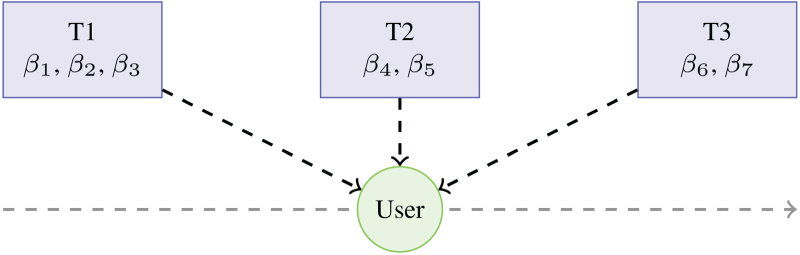
Jumbo beacon fragments
This capability is particularly useful in scenarios where access must be granted only after the user passes through specific locations. For example, in a high-security research facility, access to sensitive data might require the user to physically move through multiple verification checkpoints—such as an identity validation zone, a security scan room, and a decontamination area. Each area is equipped with a BLE transmitter broadcasting different fragments of the same policy. The policy will only be enforced once the mobile device has collected all fragments by passing through all required zones.
This approach strengthens location assurance and ensures that users follow a predefined physical workflow before being granted access, reducing the risk of shortcutting or bypassing essential security steps.
Our system supports not only path-based access policy delivery but also the enforcement of minimum dwell times at each station along the path. This is achieved by strategically distributing jumbo beacon fragments across multiple BLE transmitters placed at different physical locations (stations) and configuring each transmitter with a specific broadcast interval (
This combination enables more than just spatial path enforcement—it also allows for temporal control at each step. Only after collecting all fragments broadcast at a given station, the user can proceed toward gathering fragments at the next station. The complete access control policy (jumbo beacon) is reconstructed only after the user has passed through all required stations and satisfied their respective dwell time conditions.
Figure 10 illustrates this mechanism. A user follows a predefined path consisting of three stations, each broadcasting a subset of the jumbo beacon fragments. Each transmitter is configured with a different broadcast interval, resulting in varying dwell time requirements (e.g.,
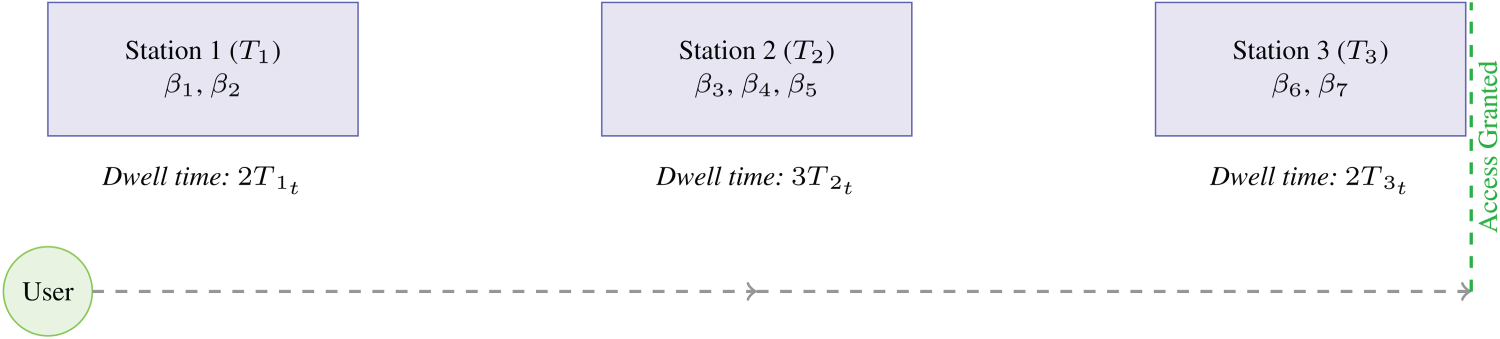
Each transmitter transmits a subset of jumbo beacon fragments at different broadcast intervals. Users must dwell at each station long enough to receive all fragments. Access is granted only after the final station is completed and the full policy is reconstructed.
A real-world example where such a mechanism is particularly suitable is crowd management during large events such as concerts, sports events, or public festivals. Authorities can enforce controlled flow by requiring attendees to move along predefined checkpoints—such as entry gates, health screening stations, and holding areas—where they must remain for a minimum duration. For example, attendees might be required to stay for a few seconds at a temperature screening zone and a few minutes at a crowd dispersal buffer area. Only after visiting all checkpoints and fulfilling the time conditions will their device be granted access to services such as digital tickets, maps, or entry activation.
This capability offers a lightweight, infrastructure-free method for enforcing structured and safe movement through physical spaces while ensuring compliance with operational or safety procedures.
Our system relies on the continuous availability of Bluetooth to receive and enforce location-based access control policies. This requirement is enforced by the ACM, which operates in kernel mode and ensures that Bluetooth remains enabled at all times. Any attempt by the user to disable Bluetooth through the system settings or app-level interfaces is blocked by the ACM at the system level.
While a user may attempt a physical-level attack—such as tampering with or disabling the Bluetooth chip—such attacks are considered beyond the scope of our threat model. However, even in the presence of such hardware tampering, our system maintains a strong security posture. This is achieved through our safe-mode-by-default design, where all permissions and application access are denied unless explicitly granted by a verified access control policy. As a result, in the absence of beacon reception (due to physical tampering or environmental factors), the mobile device remains locked down, preventing any unauthorized functionality.
This mechanism ensures that policy enforcement fails securely, thereby maintaining the integrity of the access control guarantees even under hardware-level denial-of-service attempts.
Support for variable permission sets
One of the key advantages of our system is its flexibility in supporting access control policies with varying numbers of permissions. This is achieved by defining a parameter
By adjusting
This design ensures forward compatibility and scalability. Space owners can define fine-grained policies tailored to specific environments without requiring architectural changes, allowing the system to adapt to evolving security requirements and device capabilities.
Integrity of beacons
To ensure the integrity of access control policies delivered over BLE, each policy is digitally signed, along with the spacer owner identifier, by the space owner’s private key prior to fragmentation. The resulting payload is then split into multiple BLE beacon fragments, each carrying a portion of the data along with essential metadata fields, including sequence, size and offset.
Any tampering with these fragments—whether in their metadata or payload—leads to a failure in policy reconstruction or signature verification. Specifically: If any of the metadata fields (sequence, size, and offset) are altered, the ACM will not be able to reconstruct the complete jumbo beacon correctly. If the data portion of any fragment is tampered with, the reconstructed policy will no longer match the original signed message, and signature verification will also fail.
In all such cases, the policy is discarded. After fragment reassembly, the digital signature of the access policy is verified using the space owner’s public key stored within the ACM, ensuring that even correctly formatted beacon transmissions signed by unauthorized entities (e.g., self-signed or malicious certificates) are detected and rejected. By introducing a PKI-based QR code onboarding process, the proposed approach links cryptographic trust to verified space ownership and physical presence at the secure zone boundary. Consequently, modified or injected beacon fragments and unauthorized policies are rendered ineffective, and even if an attacker deploys a rogue beacon, the device will ignore it unless the corresponding public key has been legitimately provisioned through direct user interaction via the QR code.
Robustness against identified threats
This section discusses how the proposed system addresses the threats identified in Section 3.2. The following design choices and enforcement mechanisms ensure that the system maintains its security guarantees under adversarial conditions:
These combined defenses ensure that the proposed system maintains its integrity and enforcement guarantees, even in the presence of active adversaries or challenging operating conditions.
User location privacy preservation
Our system design supports the preservation of user location privacy. BLE transmitters are utilized to broadcast access policies to nearby devices, ensuring that only the necessary information for enforcing access control is shared. These transmitters are one-way communication devices, meaning they do not collect any data from the mobile devices nor have the ability to track or store personal information. As a result, no location details—such as the user’s exact position or movements—are shared back to the space owner or any other party. The BLE communication is focused solely on transmitting policy updates to authorized devices within a defined area, ensuring that the user’s location remains private and is not tracked or recorded. However, in highly sensitive environments, users should anticipate that their movements may be monitored. Although the system is designed to preserve user location privacy, users should be aware that tracking, through any means, may be implemented in these environments for security enforcement purposes.
Conclusions
In this paper, we proposed a novel location-based access control system utilizing BLE beacon technology to dynamically enforce security policies on mobile devices within sensitive physical environments. Our system introduces the innovative jumbo beacon mechanism, effectively addressing the inherent payload size constraints of BLE beacon transmissions by enabling the fragmented dissemination and subsequent reassembly of digitally signed access control policies. Additionally, our decentralized, whitelist-based enforcement approach eliminates reliance on a centralized trust authority, enhancing scalability, resilience, and security.
We implemented a proof-of-concept prototype as a native security module integrated within the Android operating system, ensuring robust policy enforcement while preventing unauthorized modifications by end-users. Initial performance evaluations demonstrate that the proposed system achieves effective real-time enforcement with minimal overhead, making it highly suitable for deployment in practical, dynamic environments.
Future research directions include evaluating system performance and scalability in large, real-world deployments while exploring ideal transmitter placement and configuration settings. The system may also be extended to support public visitors’ devices (i.e., non–enterprise-managed devices) through a dedicated application that replicates the core functionality of the ACM, subject to a thorough assessment of the associated security guarantees and enforcement limitations. Additional work could explore alternative cryptographic schemes to further optimize both computational efficiency and energy consumption. Moreover, practical exploration of real-world scenarios—such as enforcing dwell time, path-based movement, and path-based movement with station-specific dwell time—can help identify deployment contexts where these mechanisms are most effective, as well as determine optimal parameter configurations for each use case.
Footnotes
Acknowledgements
Not applicable.
Ethical considerations
Not applicable.
Consent to participate
Not applicable.
Consent for publication
Not applicable.
Declaration of conflicting interest
The authors declared no potential conflicts of interest with respect to the research, authorship, and/or publication of this article.
Funding statement
The authors received no financial support for the research, authorship, and/or publication of this article.
Data availability
All data used in this study are available from the corresponding author upon reasonable request.
