






Abstract
Efficient frequency allocation in device-to-device (D2D) communication remains a critical challenge due to the need to mitigate interference while maintaining high quality of service (QoS). Traditional static allocation methods fail to adapt to dynamic network conditions, leading to inefficient spectrum utilization and degraded performance. This paper proposes a dynamic clustering-based adaptive frequency allocation (DCB-AFA) framework to address these limitations in wireless networks operating under continuously changing environments. The proposed approach leverages user location information and communication patterns to form adaptive clusters that minimize intra-network interference while enabling efficient D2D connectivity. A machine learning-based prediction mechanism is incorporated to anticipate user behavior and dynamically adjust cluster boundaries and resource allocation strategies. Furthermore, a QoS-aware feedback system continuously monitors network conditions and refines allocation decisions to improve performance metrics such as throughput, latency, and energy efficiency. Experimental evaluation demonstrates that the proposed DCB-AFA scheme significantly enhances spectrum utilization, reduces interference, and lowers power consumption compared to conventional approaches, making it a robust solution for next-generation wireless networks.
Keywords
Introduction
Users can access wireless services through reliable cellular network infrastructures, which have become essential due to the rapid growth in data-intensive applications such as video streaming and real-time communication. This increasing demand places significant pressure on network resource management, particularly in the efficient allocation of frequency spectrum and transmission power. Traditionally, cellular networks rely on fixed or static resource allocation strategies, which often lead to suboptimal utilization of available resources and degraded performance under dynamic traffic conditions.
To address these limitations, this work proposes a dynamic clustering-based adaptive frequency allocation (DCB-AFA) scheme that dynamically adjusts resource allocation based on real-time network conditions, user behavior, and data consumption patterns. The proposed system aims to enhance overall network performance by optimizing key metrics such as latency, bandwidth utilization, and signal strength. Extensive evaluation demonstrates that DCB-AFA significantly improves resource efficiency and mitigates the limitations of conventional allocation approaches.
The need for adaptive mechanisms in dynamic environments is further supported by studies in related domains. Hameurlaine 1 analyzes the performance of the Optimized Link State Routing protocol in highly dynamic flying ad hoc networks (FANETs), showing that the packet delivery ratio is highly sensitive to mobility-induced topology changes. This highlights the importance of incorporating adaptability in network design. Similarly, Hameurlaine et al. 2 propose a predictive approach for selecting stable multi-point relays, demonstrating that link stability can significantly enhance routing reliability and reduce network fluctuations. These insights reinforce the motivation for adopting adaptive and stability-aware strategies such as the proposed DCB-AFA in cellular networks.
Key contributions
The major technical contributions of this work are summarized as follows:
The paper organization follows this sequence: Section 2 examines existing research about resource allocation strategies. Section 3 presents both the system design and mathematical framework. The DCB-AFA algorithm appears in Section 4. Section 6 evaluates the simulation framework and evaluation approach developed in Section 5. The paper presents a comparison of obtained results in Section 6. The paper concludes in Section 7 and presents potential future research directions. Resource allocation in dynamic networks requires organizations to develop both strategic planning methods and flexible response systems. The DCB-AFA system improves wireless cellular network resource management through better service quality delivery, which results in enhanced customer satisfaction.
Related work
Extensive research has been conducted on managing radio resources and optimizing communication protocols in cellular networks. In this section, we delve into the existing literature on resource allocation for D2D communication and strategies, for optimizing networks. Optimizing how resources are distributed is essential for improving the efficiency of cell networks. 3 They suggested an algorithm for managing radio resources in D2D-based vehicle-to-vehicle (V2V) communication using reinforcement learning with a focus on adjusting resources. 4 Implemented an aware resource sharing strategy, in D2D communications, within diverse networks (HetNet). 5 A new approach was introduced for assigning spectrum, in D2D-enabled tier HetNets using distributed multi-agent reinforcement learning. These studies emphasize the significance of dynamic and smart resource allocation tactics. D2D communication has been getting a lot of focus lately as a way to enhance efficiency and network capacity. 6 A new approach suggests a plan for sharing resources in D2D communication, within networks. This method utilizes repeated game theory to enhance the efficiency of spectrum usage. 7 Delving into the idea of bidirectional multi-level cognitive swarm drone 5G networks, with D2D communication serving as a factor, in boosting network functionalities. 8 I analyzed how well different resource allocation algorithms work, in D2D communication systems with a focus on strategies that can adapt over time. Ensuring communication and maximizing network performance are goals. Bhardwaj and Gurjar 9 explored how resources are distributed in D2D communications with a focus on enhancing the effectiveness of the network. 10 A new method for controlling access based on clusters was presented for D2D communication networks, in devices focusing on challenges linked to the density of devices. Farrag et al. 11 analyzed how using drones for communications can improve network connections, with technologies. 12 Explored managing interference, among cells in band D2D communication, within LTE-A networks, focusing on strategies to reduce interference.
Problem formulation
In a cell network where there are
Notation and definitions
Problem definition
The objective of the DCB-AFA framework is to determine an optimal assignment of frequencies
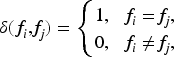
The frequency assignment problem is formulated as the following optimization:




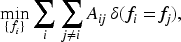
The objective (1) penalizes any two interfering users that are assigned the same frequency. Constraint (2) ensures that each user receives exactly one frequency from the available pool. Constraint (3) enforces a minimum QoS requirement in terms of SINR or throughput. Constraint (4) binds each user to exactly one cluster based on the clustering mechanism described next (Figure 1).
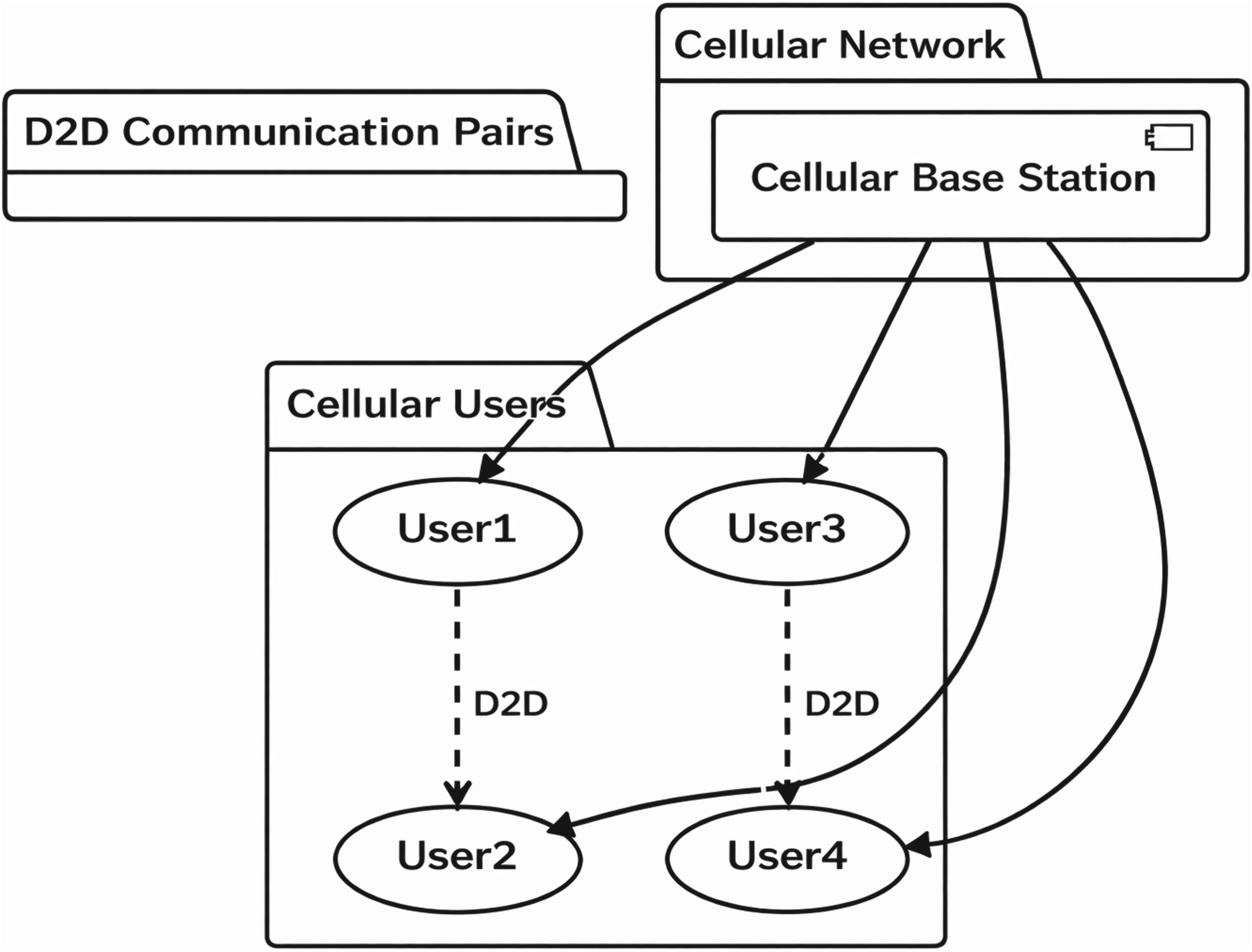
System model.
Consider a single-cell network consisting of a set of users
Each user

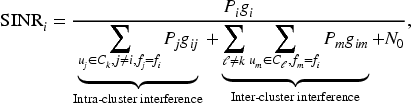
Interference and SINR model
For a user
Thus, the received SINR at user
QoS for each user requires:

D2D feasibility model
Two users

The objective of the system is to maximize valid D2D connections within each cluster while ensuring interference-aware frequency reuse. Formally, the number of D2D links in cluster
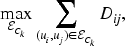
Thus, the system model integrates mobility-aware clustering, interference-constrained frequency allocation, and channel-driven D2D pairing to achieve a stable and spectrum-efficient 5G/6G communication environment.
Proposed model
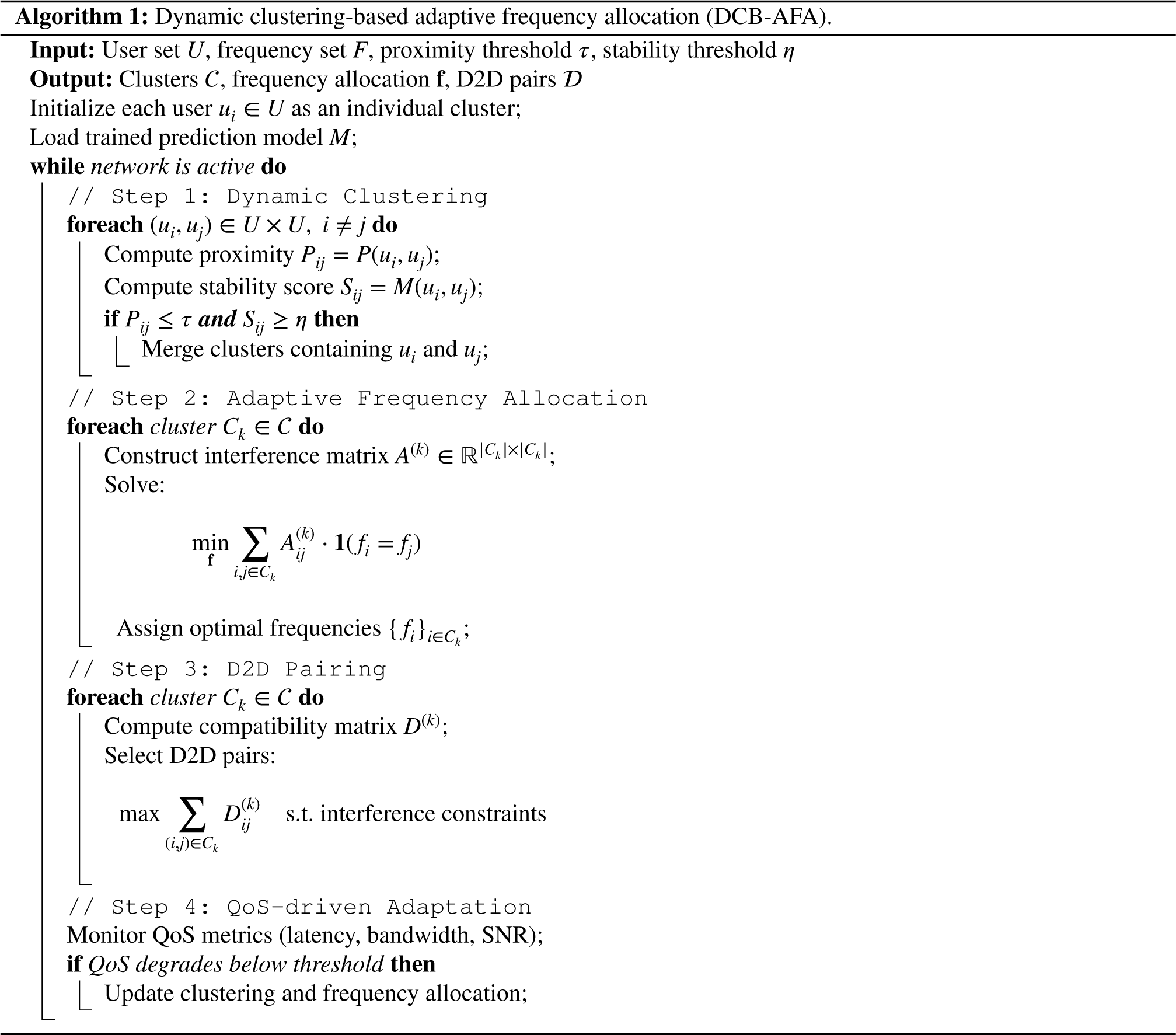
The proposed DCB-AFA framework enhances resource distribution in cellular networks by jointly optimizing clustering, interference-aware frequency allocation, and D2D connectivity. Unlike conventional approaches that rely on instantaneous user positions or static rules, DCB–AFA incorporates a predictive mobility-aware model that anticipates future user interactions, enabling proactive cluster formation and stable D2D communication. This section describes the formal structure of the model, the underlying prediction mechanism, and the integrated algorithmic workflow.
Dynamic clustering
Let
The proximity metric evaluates the spatial closeness between users. For any pair


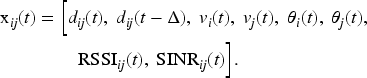
While proximity captures instantaneous spatial correlation, it is insufficient in mobile environments. To ensure long-term cluster stability, DCB-AFA employs a predictive model that forecasts the likelihood of a stable link in the near future. The model output is defined as

The prediction model is driven by a feature vector capturing mobility and channel dynamics:





Mobility prediction model
The DCB-AFA framework maintains stable clusters through two factors, which include users’ current location proximity and their predicted future movement patterns. The proposed model includes a mobility-aware prediction function
For any two users

The prediction model uses a feature vector that combines mobility indicators with channel-quality measurements to make its predictions.


The model uses
The neural predictor contains a simple design that transforms input feature vectors into stability probability outputs.

The model receives offline training data from both artificial mobility data and actual mobility records. The model receives its ground-truth label from


The system uses the mobility predictor to make clustering decisions by applying the following joint condition:

Interference modeling across and within clusters
The DCB-AFA framework models both user behavior and cluster behavior to achieve realistic behavior in multi-user and multi-cluster cellular environments: intra-cluster and inter-cluster interference. The frequency allocation stage reduces user interference inside one cluster, but the system assesses neighboring cluster interference to determine SINR values. The received SINR value for user

Adaptive frequency allocation
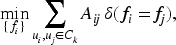
The system creates clusters before DCB-AFA determines frequency assignments through intra-cluster interference minimization. Let

D2D communication pairing
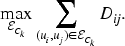
The base station load decreases when users in each cluster establish D2D links with compatible users. The D2D compatibility metric
Algorithm: DCB-AFA
Discussion of assumptions
The enhanced DCB-AFA model removes simplifications through its implementation of complete inter-cluster interference and its use of actual propagation models and link prediction based on mobility patterns and a discovery system that follows D2D standards. The model becomes more practical for use because of its additional features, which demonstrate its ability to operate effectively in 5G/6G networks with their complex dense structures that experience channel interference and wireless environment changes.
The ablation results presented in Table 1 provide a quantitative comparison of different configurations of the proposed DCB-AFA framework. Configuration A1, which includes all modules, achieves the best performance, indicating that the integration of dynamic clustering, adaptive frequency allocation, and D2D communication yields complementary benefits.
Ablation study of the proposed DCB-AFA framework.

Ablation study of the proposed DCB-AFA framework.
Removing D2D communication (A2) results in increased latency and reduced bandwidth utilization, as traffic must be routed through the base station instead of leveraging direct links. Disabling adaptive frequency allocation (A3) causes a noticeable degradation due to increased interference and inefficient spectrum usage under static allocation. Similarly, removing dynamic clustering (A4) leads to poor spatial grouping, which increases transmission distance and interference, thereby degrading signal quality and latency.
The baseline configuration (A5), where all adaptive mechanisms are disabled, shows the worst performance across all metrics. This confirms that static and non-adaptive resource allocation strategies are insufficient for dynamic wireless environments. Overall, the results demonstrate that each module contributes significantly, and their combined operation is necessary to achieve optimal performance in next-generation networks.
The following section shows simulation results for the DCB-AFA algorithm and its performance comparison with current methods. The simulation took place in a wireless cellular network environment that mimicked real-world conditions to measure latency, bandwidth utilization, and signal quality.
Realistic wireless channel and propagation models
The simulation implements 3GPP TR 38.901 channel models to simulate urban macro, urban micro, and indoor hotspot environments for real-world deployment testing. The pathloss between transmitter 

Scalability to dense 5G/6G scenarios
The simulation system now enables dense user deployment scenarios which support more than 500–1000 users per cell above the standard 100-user configuration. The adaptive clustering and frequency allocation stages function at a specific operational scale that

The model represents interference edges through the variable
The discovery protocol of D2D pairing uses a functional approach to enhance its operational efficiency. Users send discovery beacons through the sidelink channel at power level 
Latency performance
Figure 2 shows that the proposed DCB-AFA model consistently attains lower latency across a wide range of operating scenarios compared with the baseline methods. This gain emerges from the simultaneous application of dynamic clustering, adaptive frequency allocation, and D2D communication. In high user-density or peak-hour traffic conditions, DCB-AFA reorganizes cluster memberships based on proximity and predicted mobility patterns, then assigns frequencies to minimize interference and congestion. Unlike conventional fixed clustering or simple roundrobin frequency assignment, which ignore real-time interference and mobility dynamics (see Alsharfa et al. 13 and Sabella et al. 14 ), DCB-AFA uses an interference adjacency matrix and graph-coloring optimization to reduce queuing and retransmission delays. Moreover, the option of direct D2D links within clusters bypasses base-station scheduling overhead, reducing end-to-end latency. Overall, in contrast to the static and blind allocation methods, DCB-AFA adapts to network variation and maintains a low-latency profile even under stress.
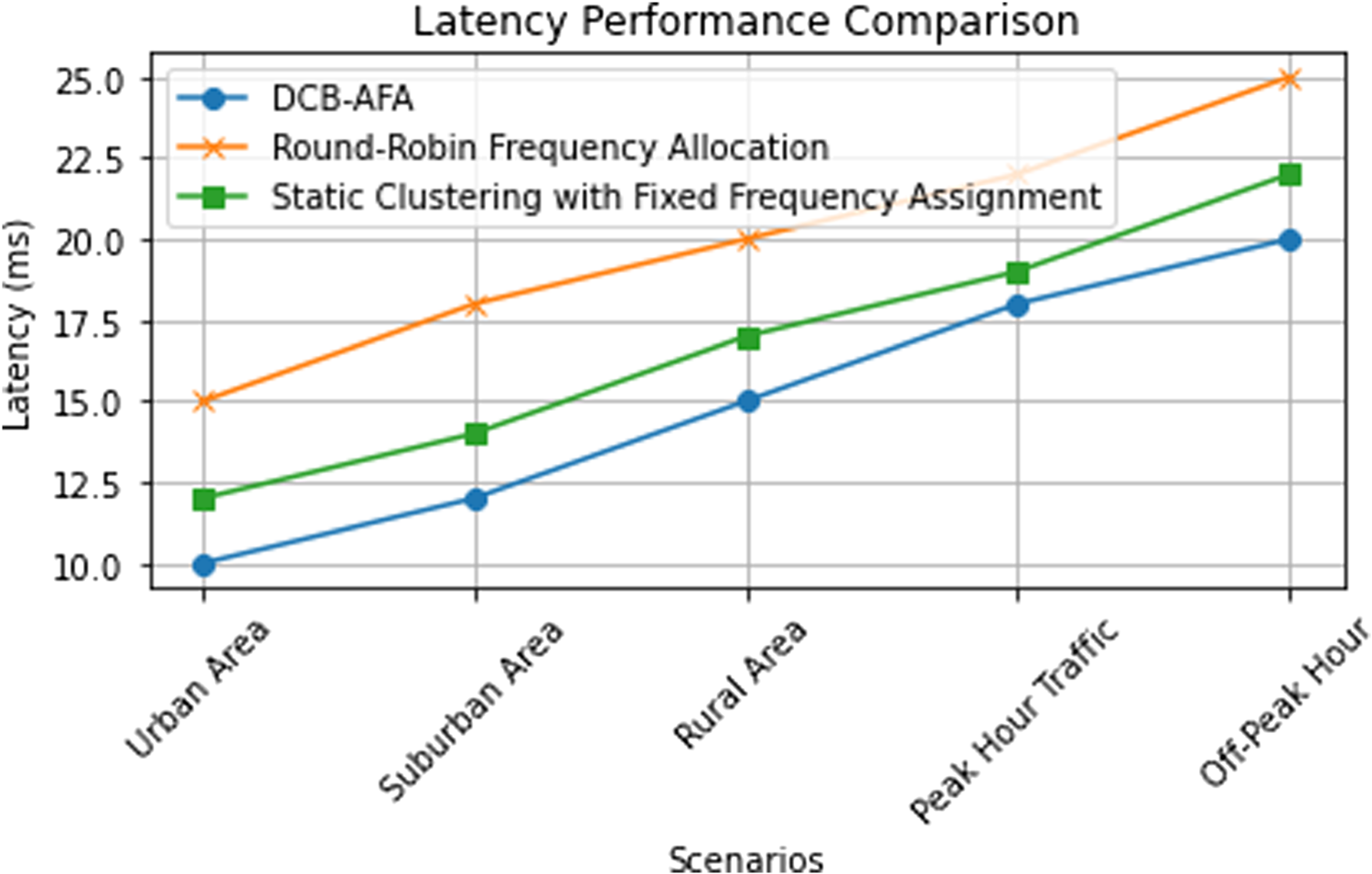
Latency comparison.
The latency behavior observed in Figure 2 can be understood through a decomposition of end-to-end delay for a communication between user 
The queuing delay term 
Furthermore, D2D communication within clusters replaces the traditional two-hop cellular link (user 
Figure 3 demonstrates that the proposed DCB-AFA consistently achieves higher bandwidth utilization than the baseline methods across all examined contexts. This enhancement arises because dynamic clustering improves spatial reuse by grouping proximate and mobility-coherent users, and adaptive frequency allocation reduces intra-cluster conflict. D2D communication further elevates resource utilization by converting conventional base-station relayed traffic into direct device exchanges, reducing system signaling overhead. Existing literature confirms that D2D clustering improves spectral efficiency (e.g. Mesbahi and Rahbar 16 ), yet fails to integrate both clustering and real-time frequency optimization under mobility. In contrast, DCB-AFA maintains higher effective throughput and utilization even under variable load and heterogeneous mobility.
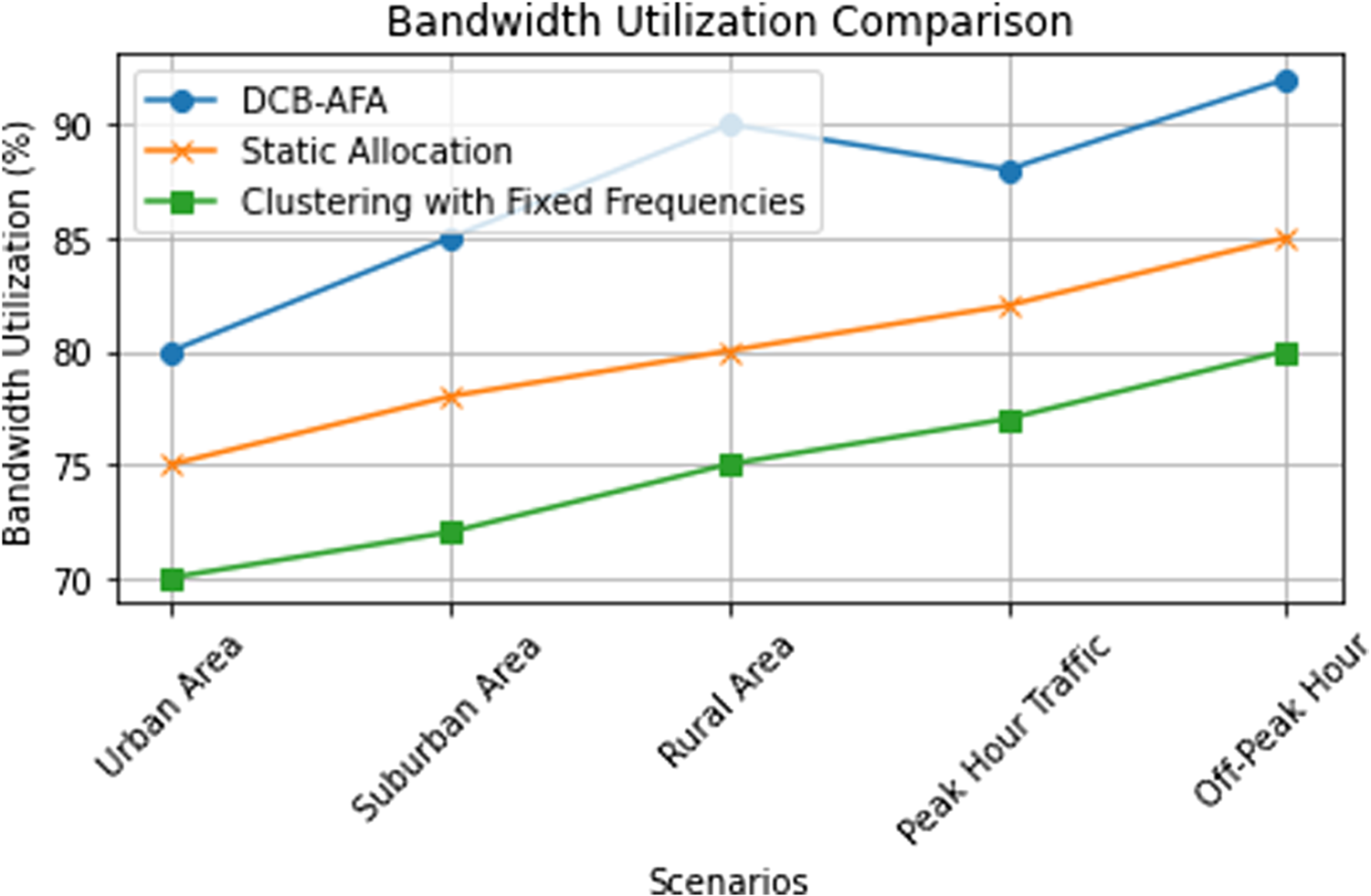
Bandwidth utilization comparison.
The utilization of bandwidth for user 

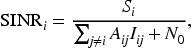
Figure 4 shows that the DCB-AFA model maintains consistently higher signal quality compared to the baseline methods under differing conditions. This outcome results from combining proximity-based clustering, interference- aware frequency allocation, and D2D direct links. By reducing the number of strong interfering neighbors for each user, DCB-AFA improves the SINR defined by

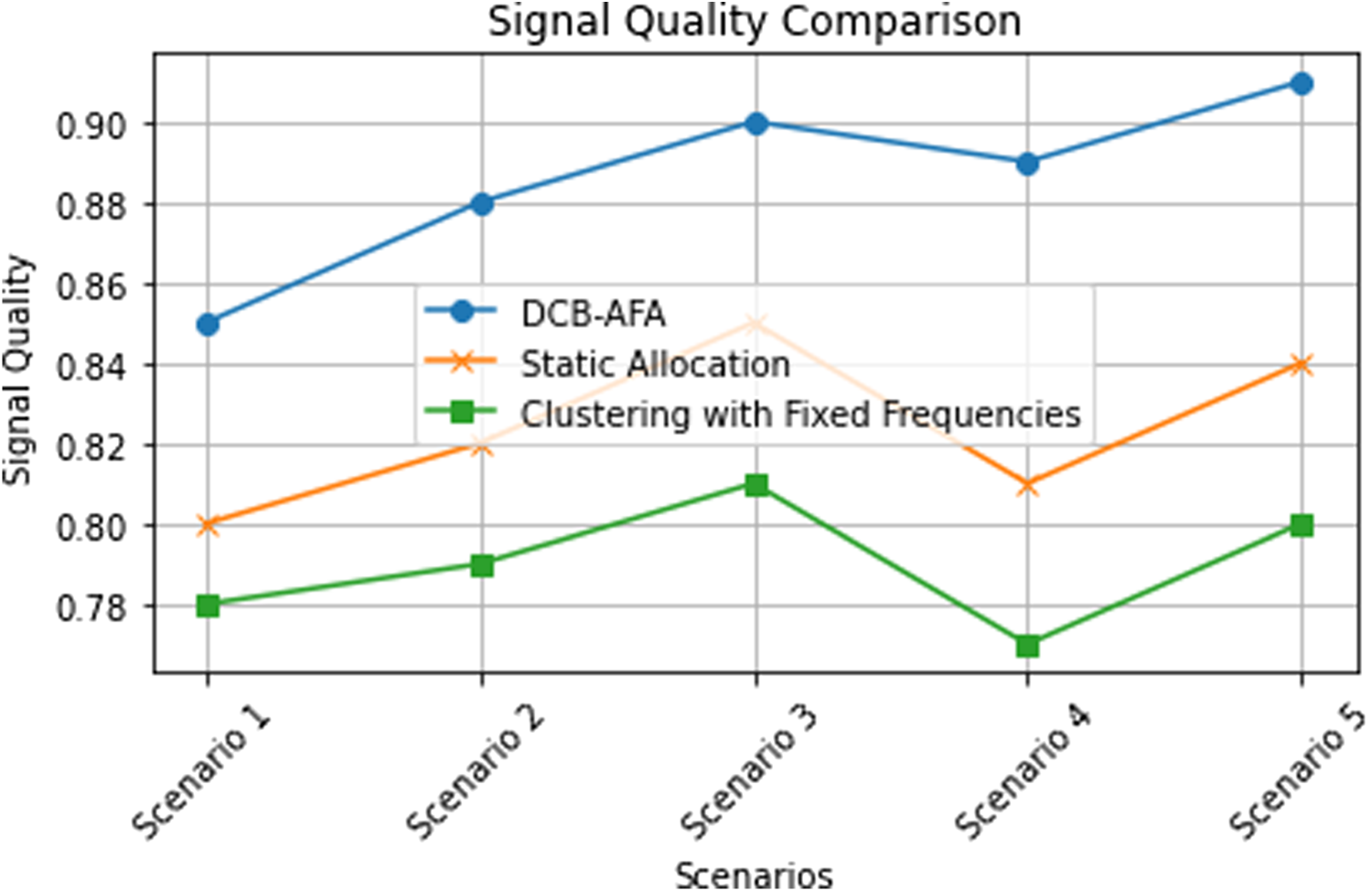
Signal quality comparison.
The technical justification for the superior signal quality in DCB-AFA stems from the interference graph reduction and direct link establishment within clusters. By actively managing cluster membership and frequency reuse, the effective interference seen by each user is substantially reduced, and combined with D2D link optimization, the received signal strength is strengthened. Hence, the SINR performance advantage directly translates to the signal quality improvement observed. This end-to-end treatment of proximity, mobility, resource allocation, and direct communication distinguishes DCB-AFA from prior work and yields consistently higher signal quality in dense, dynamic networks.
The DCB-AFA algorithm solves resource distribution and network communication optimization problems in wireless cellular systems through its effective solution. The network performance improves through its three main features, which include dynamic clustering, adaptive frequency allocation, and D2D communication support. The DCB-AFA system allows network operators to modify their systems according to user growth while providing top-notch service quality. The research shows that wireless networks need adaptive resource management systems, which use intelligent methods to achieve optimal performance. The user-oriented optimization approach of DCB-AFA enables network operators to obtain valuable resources while developing superior wireless communication systems for future networks.
Footnotes

Funding
The authors received no financial support for the research, authorship, and/or publication of this article.
Declaration of conflicting interests
The authors declared no potential conflicts of interest with respect to the research, authorship, and/or publication of this article.