






Abstract
Using quantitative methods, this article examines the effect of foreign accents on job applicants’ employability ratings in the context of a simulated employment interview experiment conducted in the USA. It builds upon the literature on aesthetic labour, which focuses largely on the role of physical appearance in employment relations, by shifting attention to its under-investigated auditory and aural dimensions. The results suggest that the managerial respondents actively discriminate in telephone-based job interviews against applicants speaking Chinese-, Mexican- and Indian-accented English, and all three are rated higher in non-customer-facing jobs than in customer-facing jobs. Job applicants who speak British-accented English, especially men, fare as well as, and at times better than, native candidates who speak American English. The article makes a contribution to the sociological literatures surrounding aesthetic labour and discrimination and prejudice against migrant workers.
Introduction
Concomitant with the rise of interactive services organizations in recent decades has been an effort on the part of sociologists to investigate the ‘embodied’ nature of aesthetic labour (Entwistle and Wissinger, 2006; Nickson et al., 2001; Warhurst and Nickson, 2007; Witz et al., 2003). Aesthetic labourers are often described in relation to the dual foci of ‘looking good and sounding right’ (Karlsson, 2012; Warhurst and Nickson, 2001; Williams and Connell, 2010), but according to Butler (2014), the ‘sounding right’ side of the equation has been marginalized in favour of studies that focus on physical appearance (Gatta, 2011; Pettinger, 2004; Timming, 2015). Through a sociological experiment carried out on participants with management experience in the US labour market, this article shifts the emphasis away from the visual dimensions of employment – the focus of the lion’s share of research on aesthetic labour – and towards its under-investigated auditory and aural dimensions. It argues that aesthetic labour should be defined in terms of a much broader repertoire of human sensory perception beyond just sight (Karlsson, 2012).
The experiment examines variation in recruiters’ hireability ratings in the US labour market across five job applicant accents, divided into both male and female enunciations, in the US labour market: American-, Chinese-, Indian-, Mexican- and British-accented English. The research involves a simulated telephone interview, which removes the possibility that the participants could be influenced by job applicants’ physical features, as would be the case in face-to-face interviews. Thus, one strength of this experimental design is that it allows us to focus exclusively on sound in the absence of visual confounds. Another key strength is that this quantitative approach takes the wider aesthetic labour literature – most of which is either conceptual or qualitative – in a new and exciting statistical direction through the application of behavioural science.
The five accents examined in this experiment (American-, Chinese-, Indian-, Mexican- and British-accented English) are, it could be argued, fluid categories and thus open to interpretation. Complications arise in relation to the fact that, within each of those five countries, there are countless regional dialects and further ambiguities in respect to whether one is a native speaker, a native speaker who is also an immigrant or even a native speaker who is a second or third generational immigrant. While this fluidity might appear as a limitation, it is notably no more of a limitation than any sociological study of race, class or gender. For instance, it has been shown that there are no clearly discrete boundaries across races in light of variations in skin tone (Telles, 2002), that social class is a highly amorphous concept (Savage et al., 2001) and that even gender is at times characterized by ambiguities (Gagné et al., 1997). In order to establish that the five accents employed were real, identifiable and mutually exclusive, a professional phonetician was utilized, as described further below, to validate the audio recordings of the job applicants’ accents as those that were most ‘representative’ of the country in question.
Following the pioneering study of Whyte (1948), the experiment was carried out across two employment contexts in order to capture how these five accents might vary across different types of workplaces. In the first experimental block, the managerial respondents participated in a simulated telephone interview by rating job applicants applying for a front-of-house, customer-facing position. In the second block, they again rated those same accents, but this time they were applying for a ‘behind-the-scenes’ job. This repeated measures design thus throws light on the previously unexplored question of whether proximity to the customer equally impacts on the employability ratings of different migrant groups seeking employment in the US labour market.
The present study is important because of the sheer size of the immigrant labour force, estimated to be a not insignificant 16 per cent of the total US labour market (Costa et al., 2014). Another reason why this topic is important is that many job interviews begin (or end) with a telephone interview, where physical appearance does not play a part other than, perhaps, in the mind of the interviewer.
This study makes an original contribution to at least two sociological literatures. First, it adds to the aesthetic labour literature by conceptualizing aesthetic labour from a much wider point of view than just appearance. The significance of the research is reflected in the small, but growing, number of studies that examine accent and sound in organizations (Butler, 2014; Deprez-Sims and Morris, 2010; Eustace, 2012; Nath, 2011; Shortt, 2013). Second, the study also moves forward the extant literature on workplace diversity and discrimination, especially against migrant labour. Although many researchers have investigated the extent of discrimination against immigrant workers, most of these studies focus on the visual aspects of race and ethnicity (Akrami et al., 2000; Waters and Eschbach, 1995), with a few focusing exclusively on foreign accent (Hosoda and Stone-Romero, 2010), even fewer combining both ethnicity and accent (Singer and Eder, 1989) and fewer still, if indeed any, seeking to discover specifically whether job applicants with foreign accents are more likely to be employed in behind-the-scenes jobs than in customer-facing roles. It is on this unique note that the present study makes its strongest contribution to the literature.
In the next two sections, the literatures on accents and employability, on the one hand, and aesthetic labour, on the other, are reviewed and some hypotheses and research questions are presented. The methods by which the data were collected and analysed and the results are then described and reported, respectively. The article then draws to a close with a discussion of its findings, limitations and directions for future research.
The relationship between accent and employability
There is a huge socio-linguistic literature on accent discrimination generally speaking (Fuertes et al., 2012), but this article focuses exclusively on the effect of foreign-accented voices in the workplace, and especially in recruitment and selection decision-making (Deprez-Sims and Morris, 2013). This research draws from Moss and Tilly (1996) in conceptualizing one’s accent as a ‘soft skill’ (see also Nickson et al., 2012). However, unlike Moss and Tilly (1996), who focus their investigation on the disadvantages that African American men face in the US labour market, the present study examines migrants’ experiences in seeking employment in customer-facing and non-customer-facing jobs.
Already there is a long history of research on the relationship between accent and employability, most of which was conducted in the USA. Much of this research focuses on within-country regional dialects, in contrast with the present study, which examines the effect of foreign accents on perceived hireability in the US labour market. Hopper and Williams (1973) carried out the earliest study in this field. They asked recruiters to evaluate recordings of regional accents and found that ‘standard’ (that is to say, white) American voices were more employable than those with the ‘African American’ dialect. De la Zerda and Hopper (1979) found that native English speakers in the USA were perceived as being most suited for supervisory roles, while applicants with a Mexican accent were preferred for semi-skilled jobs. The earliest UK study on this topic found that job applicants with ‘received pronunciation’ (an English accent prototypical of the upper class; see Roach, 2004) were rated higher on employability than those with regional British accents (Giles et al., 1981). Noteworthy is that many of these studies were carried out in manufacturing firms, while the structure of the US labour market has shifted in recent decades towards a service economy. This shift provides a strong rationale for studies, such as the present one, that are grounded in the interactive services.
More recent research on the relationship between accent and employability has examined the benefits of, and liabilities associated with, having a native and foreign accent, respectively. For example, Hosoda and Stone-Romero (2010) found, in the context of the USA, that French and English accents scored roughly equally on hireability, whereas Japanese accents scored comparatively lower. Cargile (2000), in another study in the USA, found no statistically significant difference between native speakers and Chinese-accented English in relation to employability. Carlson and McHenry (2006) further explored the link between accent and ethnicity in the US job market, concluding that speakers with ‘maximally perceived’, that is to say, strong, accents received lower employability ratings than those with weak or no accents. Segrest Purkiss et al. (2006) examined the interaction between ethnic accents and ethnic names in the US labour market. They found that the presence of an ethnic-sounding name (McGinnity and Lunn, 2011) compounded the respondents’ negative evaluations of the ethnic accent. Nath (2011) pointed to the imperative of accent modification in Indian call centres. She found that employees received accent training in order to ‘neutralize’ their accents. Ashley (2010) examined the relationship between accent and employability from the point of view of social class in the UK. She found that privately educated ethnic minority solicitors faced minimal discrimination in the labour market because they had ‘the right accent’ (p. 722), essentially a substitute for ‘received pronunciation’. Finally, Mai and Hoffmann (2014) examined the implications of accented English in the wider business environment in English-speaking countries. They found that foreign accents reduced ‘comprehensibility’ and hampered ‘message processing’, thus resulting in lower consumer intentions to buy or recommend a product or service.
One important (sociological) caveat pertaining to all of these studies – as well as to the present research – is that the identification of a ‘standard’ accent, as a comparator, is fraught with cultural, political and historical complications. Lippi-Green (2012) thus illustrates the way in which accent in the USA is shaped heavily by social class affiliation, dominant (that is to say, white) culture and unequal power relations. Similarly, Roach (2004) analyses ‘received pronunciation’ in the UK, arguing that it is inextricably linked to the upper and middle classes – the latter of whom often adopt it as an emulative strategy to promote upward mobility in society (Bourdieu, 1991; see also Ashley, 2010). Inasmuch as one’s accent is ultimately socially constructed and shaped by historical class struggle and colonialism (Makoni, 2011), circumscribing a ‘standard’ dialect in any nation is a politically charged process. However, this problem is, conceptually and methodologically speaking, not insurmountable and, as noted above, similar challenges are presented in sociological studies on race (Telles, 2002), class (Savage et al., 2001) and gender (Gagné et al., 1997).
In sum, in spite of the extensive literature on the relationship between accent and employability, unanswered questions remain. For example, we still do not know how the five accents analysed in this study stack up against each other in relation to employability. Using a sociological lens, one might expect accented voices from poorer countries to be rated less favourably on hireability than accented voices from richer countries. Such an expectation is grounded in literature demonstrating that wealth is associated with relationship dominance and prestige (Cheng and Tracy, 2013). Thus, it is hypothesized that the Mexican-, Chinese- and Indian-accented English will be rated lower on employability than the American accent. Moreover, because of the wealth and prestige associated with ‘received pronunciation’ (Bishop et al., 2005), it is also hypothesized that British-accented English will be roughly aligned with the American accent in terms of hireability ratings.
In the light of the lack of literature on the gendered nature of accents in the workplace, we cannot present specific hypotheses on this matter, in spite of the fact that there is a huge literature on the gendering of work. However, because some socio-linguistic research points to the fact that male and female voices are perceived differently at an acoustic level (Clopper et al., 2005; Klatt and Klatt, 1990), we present two exploratory research questions: are male and female accents rated differently on hireability, and do these ratings vary by whether the manager is male or female?
Aesthetic labour: the primacy of the customer
Inasmuch as the literature on aesthetic labour helps to frame this article’s argument, it is worthwhile considering: (i) how the aesthetic labour literature adds value to this research and (ii) how this research in turn contributes to the under-investigated auditory dimensions of aesthetic labour. A comprehensive description of this term can be found in Nickson et al. (2001). In short, aesthetic labour is defined as the ‘supply of embodied capacities and attributes possessed by workers’ (Warhurst et al., 2000). Much of the literature on aesthetic labour investigates empirically how organizations pro-actively recruit and select employees whose appearance and demeanour appeals favourably to customers’ visual and aural senses. Once employed, aesthetic labourers continue to be monitored and trained so that they project the ‘right’ image to customers. Thus, a key distinction that the literature on aesthetic labour brings to the table is the presence (or absence) of customers in employees’ performance of service work. This distinction can be traced back to Whyte (1948), who divided service work into two categories: (i) front-of-house, customer-facing jobs and (ii) back-of-house, non-customer-facing jobs. This dichotomy is further evident in Goffman’s (1959) distinction between ‘front stage’ and ‘backstage’ performances. In short, one might expect employability ratings to differ across front-of-house and back-of-house roles, as described below.
There is evidence that employee selection decisions are driven not so much by hiring managers’ perceptions of the candidate, but rather by how managers think customers will perceive the candidate (Timming, 2015). This idea is grounded in Mai and Hoffmann’s (2014) conclusions that employees with foreign accents reduce the likelihood that a consumer buys or recommends a product or service. In customer-facing jobs, there is already evidence of prejudice and discrimination on the basis of what might be called a lack of ‘physical capital’. Thus, Gruys (2012) points to the ‘fat stigma’ that overweight women face in the labour market, and Madera and Hebl (2012) show how facially stigmatized job applicants are rated lower on hireability than ‘normal’ applicants.
In contrast, the present study shines light on what might be called ‘aural capital’. Giles’ (1970) classic study on ‘accent prestige theory’ provides a useful framework for explaining this concept. The non-native, foreign-accented English spoken by migrants from developing countries can generally be expected to elicit negative reactions on the part of American customers as a result of the lower prestige and social class attributed to such marginal voices, as described in the previous section. Accordingly, there is a sociological rationale underlying the assumption that employee selection decision-making reflects customers’ broadly negative evaluations of the foreign-accented English spoken by most migrant job seekers, with the exception of British English-speaking job applicants.
What happens, however, when customers are removed from the equation, as in the case of back-of-house roles? Even when customers are absent, studies have pointed to continued auditory prejudice (Marchenko, 2014). For example, Butler (2014) illustrates how men who stammer face routine discrimination, even in non-customer-facing roles. Deprez-Sims and Morris (2010) found evidence of bias against French-accented English-speaking candidates applying for a human resource manager position. Thus, in the case of behind-the-scenes jobs, although customer-driven discrimination is irrelevant, there are other sources of prejudice stemming from, for example, co-workers or the personal biases of the hiring manager that can reduce employability. Having said that, one might reasonably expect that the removal of the possibility of customer discrimination will nevertheless increase the hireability ratings of foreign-accented job candidates in back-of-house roles vis-a-vis customer-facing roles. Thus, it is hypothesized that, ceteris paribus, job candidates speaking Mexican-, Chinese- and Indian-accented English will be rated lower on hireability in customer-facing jobs than in non-customer-facing jobs, while there is likely no difference between the two regions of the workplace for British English-speaking applicants.
Research methods
The present study employs methods from experimental psychology in order to simulate a telephone job interview. This approach has two key strengths. It allows the researcher to control and manipulate variables in a way that would be impossible in a naturalistic setting, and it promotes the external validity of the findings in a way that would be impossible using qualitative methods. However, the approach also suffers from disadvantages, chief among them that quantitative research is poor, generally, in probing deeper, contextual questions. Another disadvantage is that questionnaire research is a one-off method of data collection that does not allow for easy follow-up on issues that emerge as salient. In light of these limitations, directions for future qualitative research are presented in the discussion section.
Stimuli
As noted above, five distinct accents were selected for inclusion in this experiment: American-, Chinese-, Indian-, Mexican-accented and British English. For each accent, two male and two female voices were digitally recorded to simulate a telephone job interview. All speakers who lent their voices to the experiment were natives of their respective countries, so the accents are natural, rather than modelled. A composite variable was created by combining, separately, male voices and female voices of the same accent. Two native males and two native females were recorded per accent in order that any vocal idiosyncrasies would be ‘dampened’ through the creation of the composite. Thus, 20 voices were recorded in total. Two male and two female American voices serve as the ‘control’ group. The ‘stimulus’ groups comprise two male and two female voices originating from China, India, Mexico and the UK (specifically, England). The Chinese, Indian and Mexican voices were included in this experiment because they are the three largest immigrant groups entering the USA (Migration Policy Institute, 2015). The English accent was included in order to test the hypothesis that a foreign accent from a similarly wealthy country may rival the American accent.
In light of the myriad of cultural variations of accents within each of the five countries, a formal validation procedure was indicated. In order to promote the validity of the accents, each individual whose voice was recorded for this experiment was instructed to speak naturally in accented English from his or her home country. Foreign nationals who could imitate perfectly, or near perfectly, the American accent were obviously excluded from the experiment. Foreign nationals whose accents were generally unintelligible were also excluded. As a result of the complex variations of accents and dialects, discussed above, a professional phonetician was asked to listen to all 20 recordings prior to running the experiment; she confirmed that each one was nationally ‘representative’ of the accent in question.
To ensure comparability of the accents and to simulate, as best as possible, a telephone job interview, each of the 20 voices was recorded speaking, in the absence of abnormal pitch or intonation: ‘Good morning. Thank you for taking the time to speak with me today. I’m really excited about this job’. Across the 20 recordings, the average length of the clips was seven seconds. This script is short enough so as to avoid significant attrition, but long enough for the respondent to evaluate the accent.
Data collection
The experiment was carried out in the spring of 2015. In total, 108 men and 115 women completed the survey instrument online. In order to simulate a real-world employment interview, only respondents with managerial experience were used for this study. The 223 respondents reported an average of 6.07 years of managerial experience (s.d. = 5.04). Overall, the sample was 51.6 per cent female with an average age of 38.07 years (s.d. = 12.50). In relation to racial distribution, 84.3 per cent of the respondents were white, 8.1 per cent black, 2.2 per cent East Asian, 1.8 per cent South Asian, 0.9 per cent American Indian and 2.7 per cent of mixed race. All respondents were born and at the time resident in the USA.
The respondents completed the survey via a popular online crowdsourcing platform. They were identified as having already registered with the network. Each participant was given a nominal payment of US $0.49 to incentivize timely completion of the questionnaire. All respondents provided informed consent prior to participation in the research. The participants were instructed to assume that they were recruiters seeking to hire for two positions. They were then presented with a succession of audio files and asked to rate how likely they would be to hire each applicant on a scale of 1 to 7, where 1 = extremely unlikely and 7 = extremely likely. All stimulus and control accents were randomly presented to respondents twice in two separate blocks. The first block asked respondents how likely they would be to hire each job applicant for a customer-facing job. The second block asked respondents to rate how likely they would be to hire each job applicant for a behind-the-scenes, non-customer-facing job. A random number table was used to randomize the presentation of audio files in each block to prevent the respondents from identifying a pattern. Inasmuch as there are only two experimental blocks, order effects do not present a problem in this research design (Cozby, 2009).
Strict data screening procedures were put in place in order to ensure that respondents were paying attention to each item and, crucially, listening to all voice recordings. For example, while most of the recordings were of the stimulus or control voices (‘Good morning. Thank you for taking the time to speak with me today. I’m really excited about this job’.), another 10 voice recordings were randomly interspersed throughout the survey instrument with instructions for the participants to select a particular response (e.g., ‘You must click on response number 3 below’.). Participants who provided incorrect responses to two or more of those screening variables were excluded from the study. It should be noted that the final sample of 208 cases (101 men and 107 women) is a reflection of the fact that 15 cases were excluded through this data screening procedure.
Analysis
A mixed design analysis of variance (ANOVA) was used to analyse the data. The main categories of analysis include: employment context (customer-facing vs non-customer-facing), accent (American, Chinese, Indian, Mexican, English), sex of voice (male vs female) and respondent sex (male vs female). Thus, a 2X5X2X2 mixed design analysis was carried out. However, in light of the well-established difficulties of detecting and interpreting interaction effects across so many categories (see McClelland and Judd, 1993), four separate 2X2X2X2 analyses were first carried out, with the American accent being compared, separately, to (1) Chinese, (2) Indian, (3) Mexican and (4) English accents. A Bonferroni correction was applied to each model.
Results
Model 1: 2X2X2X2 (American vs Chinese)
There was a main effect of accent, with the American accent (M=5.43, SD=.06) rated higher than the Chinese accent (M=3.86, SD=.08; F(1,206)=261.92, p<.01, ηp2=.560). There was a main effect of employment context, with customer-facing jobs (M=4.38, SD=.05) rated lower than non-customer-facing jobs (M=4.91, SD=.07; F(1,206)=94.33, p<.01, ηp2=.314). Finally, there was a main effect of sex of voice, with male voices (M=4.44, SD=.06) rated lower than female voices (M=4.85, SD=.05; F(1,206)=85.26, p<.01, ηp2=.293) overall; however, this latter effect was influenced by the extraordinarily high ratings for the female American accents. These main effects are explored in a three-way interaction, reported in Table 1.
Three-way interaction effect between employment context, Chinese vs American accent and sex of voice.

A statistically significant interaction was found between employment context, Chinese vs American accents and sex of voice (F(1,206)=6.09, p=.014, ηp2=.029). In customer-facing roles, it was found that male Chinese (M=3.53, SE=.09) and female Chinese (M=3.27, SE=.09) accents were rated lower on hireability than male American (M=4.69, SE=.09) and female American (M=6.05, SE=.06) accents, but Chinese female voices suffered more than twice as much disadvantage compared to Chinese male voices. In non-customer-facing jobs, it was found that male Chinese (M=4.52, SE=.10) and female Chinese (M=4.13, SE=.10) accents were rated lower on hireability than male American (M=5.04, SE=.11) and female American (M=5.94, SE=.08) accents. In a behind-the-scenes context, the Chinese female voices suffered more than three times as much disadvantage compared to the Chinese male voices. The results suggest that Chinese job applicants are deemed to be more suitable for behind-the-scenes jobs than customer-facing jobs. The four-way interaction including respondent sex was insignificant, suggesting that male and female hiring managers rated the accents roughly equally.
Model 2: 2X2X2X2 (American vs Indian)
There was a main effect of accent, with the American accent (M=5.43, SD=.06) rated higher than the Indian accent (M=4.40, SD=.08; F(1,206)=181.85, p<.01, ηp2=.469). There was a main effect of employment context, with customer-facing jobs (M=4.77, SD=.06) rated lower than non-customer-facing jobs (M=5.05, SD=.07; F(1,206)=23.08, p<.01, ηp2=.104). Finally, there was a main effect of sex of voice, with male voices (M=4.48, SD=.08) rated lower than female voices (M=5.35, SD=.06; F(1,206)=219.34, p<.01, ηp2=.516) overall. However, again, this main effect was influenced by the high ratings of the American female voices. These main effects are explored in a three-way interaction, reported in Table 2.
Three-way interaction effect between employment context, Indian vs American accent and sex of voice.
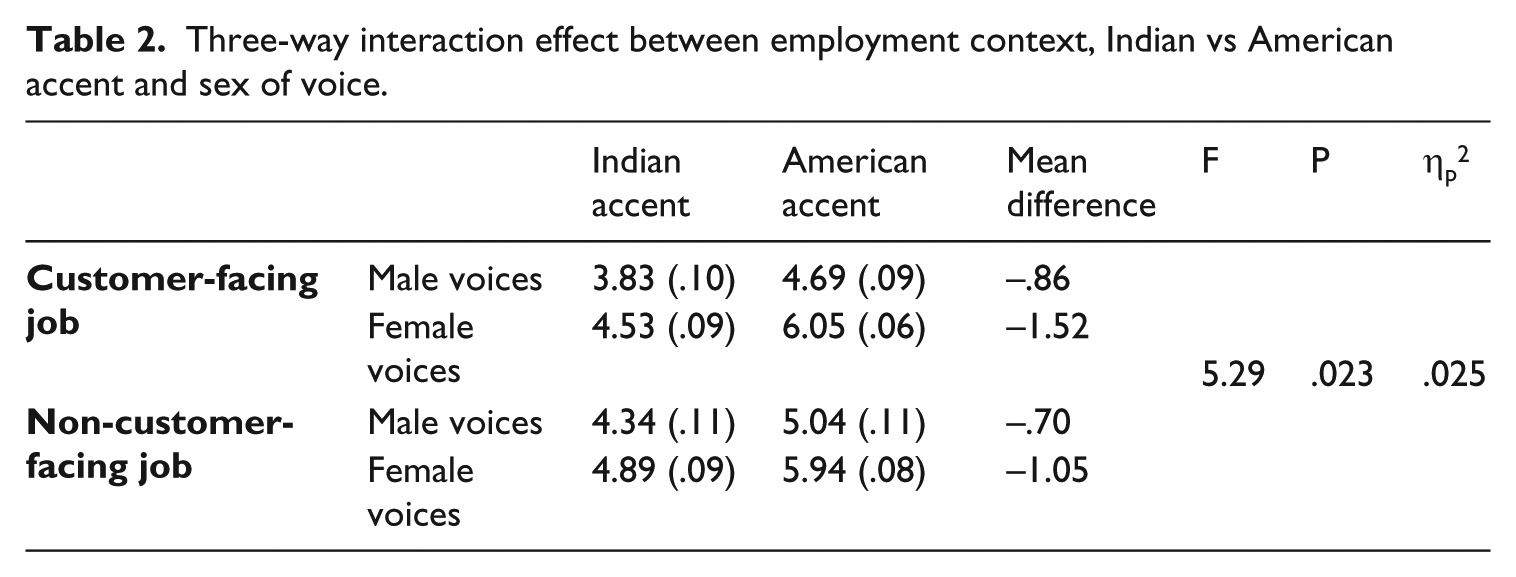
A statistically significant interaction was found between employment context, Indian vs American accents and sex of voice (F(1,206)=5.29, p=.023, ηp2=.025). In customer-facing roles, it was found that male Indian (M=3.83, SE=.10) and female Indian (M=4.53, SE=.09) accents were rated lower on hireability than male American (M=4.69, SE=.09) and female American (M=6.05, SE=.06) accents. Indian female voices suffered nearly twice as much disadvantage compared to Indian male voices. In non-customer-facing jobs, it was found that male Indian (M=4.34, SE=.11) and female Indian (M=4.89, SE=.09) accents were rated lower on hireability than male American (M=5.04, SE=.11) and female American (M=5.94, SE=.08) accents. In a behind-the-scenes context, the Indian female voices suffered only slightly more disadvantage compared to the Indian male voices. The results suggest that Indian job applicants are deemed to be more suitable for behind-the-scenes jobs than customer-facing jobs. The four-way interaction including respondent sex was insignificant once again, suggesting that both male and female hiring managers rated the accents roughly equally.
Model 3: 2X2X2X2 (American vs Mexican)
There was a main effect of accent, with the American accent (M=5.43, SD=.06) rated higher than the Mexican accent (M=3.87, SD=.08; F(1,206)=280.60, p<.01, ηp2=.577). There was a main effect of employment context, with customer-facing jobs (M=4.43, SD=.06) rated lower than non-customer-facing jobs (M=4.87, SD=.07; F(1,206)=61.79, p<.01, ηp2=.231). Finally, there was a main effect of sex of voice, with male voices (M=4.43, SD=.07) rated lower than female voices (M=4.87, SD=.05; F(1,206)=49.96, p<.01, ηp2=.195) overall. Once again, this effect was influenced by the extraordinarily high ratings of the female American voices. These main effects are explored in a three-way interaction, reported in Table 3.
Three-way interaction effect between employment context, Mexican vs American accent and sex of voice.

A statistically significant interaction was found between employment context, Mexican vs American accents and sex of voice (F(1,206)=31.18, p=.000, ηp2=.131). In customer-facing roles, it was found that male Mexican (M=3.67, SE=.08) and female Mexican (M=3.31, SE=.10) accents were rated lower on hireability than male American (M=4.69, SE=.09) and female American (M=6.05, SE=.06) accents. Mexican female voices suffered nearly three times as much disadvantage compared to Mexican male voices. In non-customer-facing jobs, it was found that male Mexican (M=4.32, SE=.11) and female Mexican (M=4.17, SE=.12) accents were rated lower on hireability than male American (M=5.04, SE=.11) and female American (M=5.94, SE=.08) accents. In a behind-the-scenes context, the Mexican female voices suffered just over twice as much disadvantage compared to the Mexican male voices. The results suggest that Mexican job applicants are deemed to be more suitable for behind-the-scenes jobs than for customer-facing jobs. The four-way interaction including respondent sex was again statistically insignificant, suggesting that male and female hiring managers rated the accents roughly equally.
Model 4: 2X2X2X2 (American vs English)
There was a main effect of accent, with the American accent (M=5.43, SD=.06) rated lower than the English accent (M=5.56, SD=.06; F(1,206)=6.73, p=.01, ηp2=.032). There was a main effect of employment context, with customer-facing jobs (M=5.43, SD=.06) rated lower than non-customer-facing jobs (M=5.56, SD=.07; F(1,206)=4.36, p=.04, ηp2=.021). Finally, sex of voice was not statistically significant as a main effect, but it was significant in the three-way interaction explored in Table 4.
Three-way interaction effect between employment context, English vs American accent and sex of voice.

A statistically significant interaction was found between employment context, English vs American accents and sex of voice (F(1,206)=44.71, p=.000, ηp2=.178). In customer-facing roles, it was found that male English accents (M=6.24, SE=.06) scored significantly higher than male American accents (M=4.69, SE=.09), but that female English accents (M=4.74, SE=.08) scored significantly lower than female American accents (M=6.05, SE=.06). In non-customer-facing jobs, again male English accents (M=6.10, SE=.08) were rated significantly higher than male American accents (M=5.04, SE=.11), whereas female English accents (M=5.15, SE=.09) were rated lower than female American accents (M=5.94, SE=.08). In other words, the results suggest that the English accent is an asset for male applicants, but still a liability for female applicants. The four-way interaction including respondent sex was statistically insignificant, suggesting again that both male and female hiring managers rated the accents roughly equally.
Model 5: 2X5X2X2 (All Accents)
Main effects for Model 5 are available upon request. A statistically significant three-way interaction was found between employment context, all five accents and sex of voice (F(1,206)=16.50, p=.000, ηp2=.074) as illustrated in Table 5. In the light of the sheer number of contrasts within this mixed design, instead of onerously reporting individual mean differences in separate repeated measures, three graphical representations are provided in order to summarize the ‘big picture’ results. Figure 1 illustrates the relationship between employment context and foreign accent for all respondents (N=206). It can be seen that the English and American accents are rated highest, the Chinese and Mexican accents lowest and the Indian accent in the middle. In each case, voices are rated higher in non-customer-facing jobs than in customer-facing jobs, but the effect is much more pronounced for the Chinese, Indian and Mexican accents. Figures 2 and 3 illustrate the same relationships, but broken down by male voices (N=107) and female voices (N=101), respectively. Figure 2 shows that male English voices have a decided advantage over male American voices, but that both accents are rated higher than male Chinese, Indian and Mexican accents. Figure 3 demonstrates that American female voices have a distinct advantage over English female voices, which were rated nearly on par with female Indian voices, but much higher than female Chinese and Mexican voices.
Three-way interaction effect between employment context, all accents and sex of voice.

F=16.50, p=.000, ηp2=.074.
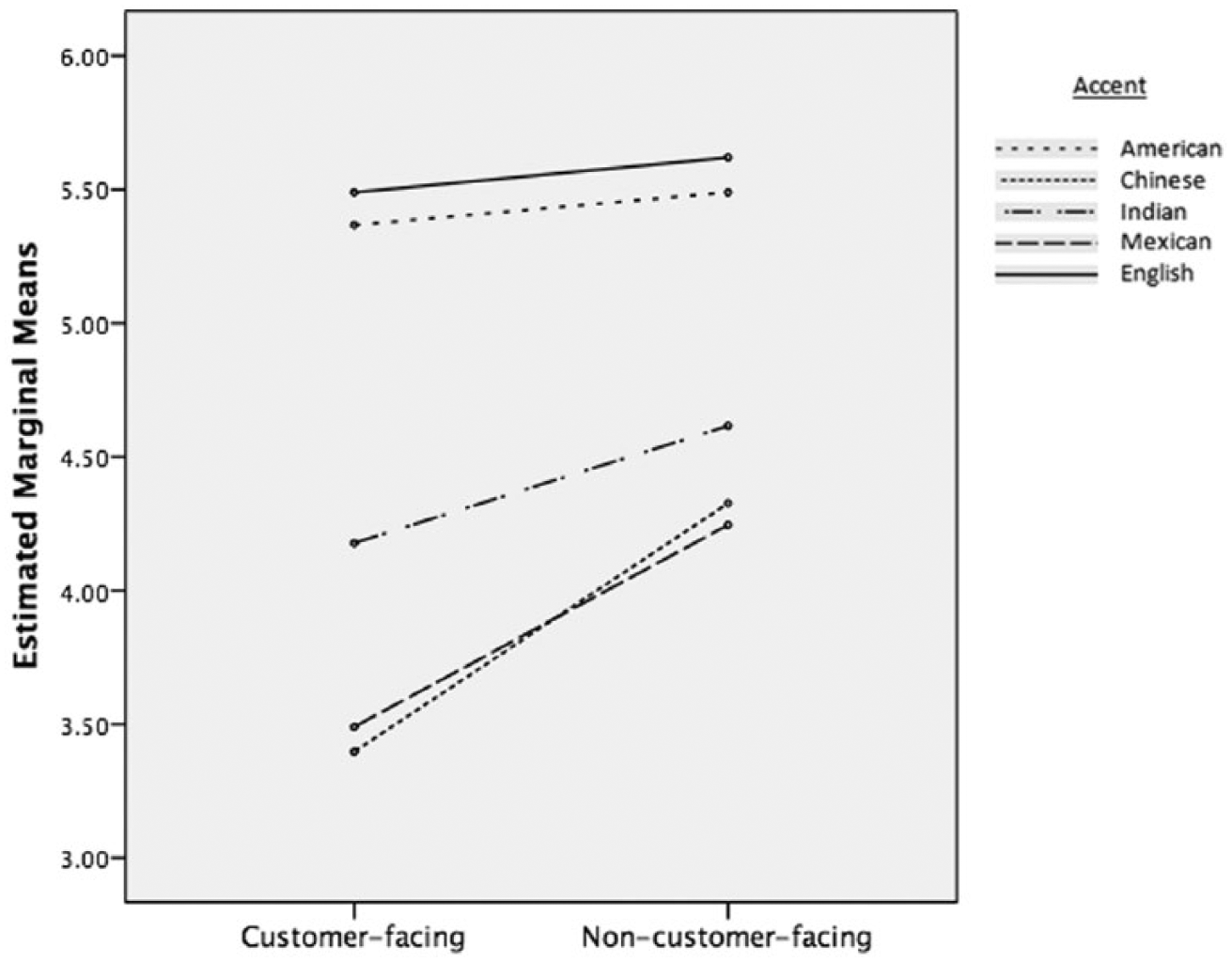
Estimated marginal mean ratings for stimulus and control voices (male and female).

Estimated marginal mean ratings for male stimulus and control voices only.

Estimated marginal mean ratings for female stimulus and control voices only.
It should be noted that the effects sizes, expressed as partial eta squared values, vary from relatively small to stronger associations across the five models. For example, the models comparing American to the Chinese and Indian accents have relatively small effect sizes (ηp2=.029 and ηp2=.025, respectively). The models comparing American to the Mexican and English accents have relatively large effect sizes (ηp2=.131 and ηp2=.178, respectively). The model comparing all five accents simultaneously has a medium effect size (ηp2=.074). These figures suggest that the variables examined in this research explain, as might be expected, only a limited proportion of the overall variation in employability, although it is not clear why some accents appear to explain more variation than others.
Discussion and conclusions
In spite of the already sizeable literature on the effect of accent on employability (Ashley, 2010; Cargile, 2000; Carlson and McHenry, 2006; De la Zerda and Hopper, 1979; Deprez-Sims and Morris, 2013; Giles et al., 1981; Hopper and Williams, 1973; Hosoda and Stone-Romero, 2010; Mai and Hoffmann, 2014; Nath, 2011; Segrest Purkiss et al., 2006), the present study offers several new insights that were previously unknown or unexplored. It should be noted that the results of this research only speak to first generation migrants’ experiences in seeking employment in the US labour market; further research will be needed on second generation migrants. In support of the first hypothesis, it was found that the Chinese, Indian and Mexican accents all scored significantly lower than the American accent, while the English accent was, at least in the main effects, rated higher than the native-speaking control group. Consistent with accent prestige theory (Giles, 1970), a clear hierarchy of accents is evident, with the English and American voices clustered at the top, the Chinese and Mexican voices clustered at the bottom and the Indian voices hovering in the middle (refer to Figure 1).
In corroboration of the second hypothesis, it was found that the Chinese-, Indian- and Mexican-accented voices were rated significantly lower in customer-facing jobs compared to non-customer-facing, behind-the-scenes jobs. In other words, job applicants with these three foreign accents are viewed negatively by hiring managers in the interactive services, but more positively for jobs that involve no engagement with customers. This finding is consistent with research by Timming et al. (2015), who found that job applicants with tattoos and piercings are more suitable for ‘backstage’ work. Indeed, this comparison between accent and body art only works if we use a wider conceptualization of aesthetic labour, as advocated in this article. The results of the present study raise interesting questions about the extent to which employment discrimination against first generation migrants is driven by recruiters’ perceptions of customers’ expectations, rather than, perhaps, by their own personal prejudices. It is worth noting, as well, that there was no major difference for both the American and English accents between customer-facing and non-customer-facing roles.
Finally, this research also provides answers to the exploratory questions posed above concerning the extent to which gender impacts on the relationship between foreign accent and employability. We already know from wider linguistics research that male and female voices are interpreted differently (Clopper et al., 2005; Klatt and Klatt, 1990), but the present study is the first of its kind to show how foreign accent affects male and female migrants disproportionately within the US labour market. In short, with the sole exception of the American women in the study, female job applicants who speak with a foreign accent appear to suffer severe discrimination in employee selection, up to three times more than the men face. Comparatively lower hireability ratings among women were found across all four foreign accents and in both customer-facing and non-customer-facing roles. It would appear that foreign migrant women face a ‘double stigma’ surrounding gender and ethnicity. Such a finding is consistent with previous research on intersectionality in the labour market (McBride et al., 2015). It was also found that the gender of the hiring manager is a non-significant variable in all of the models tested.
This research raises interesting questions about the extent to which recruiters use accent as a proxy for stereotypical judgements about ethnicity, nationality and gender, as was found in McDowell et al.’s (2007) study of migrant labour in a London hotel. The extent to which foreign accents can, in effect, stand in for embodied, racialized discrimination is beyond the scope of the data in this article. We know that there was significant discrimination against some foreign accents, but we do not know whether this discrimination was based on imputed racial and ethnic features, the gender of the job applicant, or, perhaps more innocuously and instrumentally, on a perceived lack of intelligibility. If the latter, there are further questions about the legality of the discrimination illustrated in this article. Race, ethnicity and gender are protected by law (Kumra and Manfredi, 2012), but accent, in and of itself, is not. In fact, the intelligibility of one’s accent, it could be argued, could be legitimately linked to objective assessment of job performance. Clearly, the results have yielded some important questions.
This study makes an original contribution to the extant sociological literature on aesthetic labour. First, building on the work of Nath (2011), Eustace (2012) and Butler (2014), the results of this research project show that sound is an important, if under-investigated, dimension of aesthetic labour (Karlsson, 2012). While there is a sizeable literature on the primacy of ‘looking good’ (Nickson et al., 2001; Warhurst and Nickson, 2007; Witz et al., 2003) in the interactive services, comparatively fewer studies have examined the ‘sounding right’ side of the equation. In the same way that the aesthetic labour literature demonstrates that physically attractive job applicants are more employable (Gatta, 2011), this study has shown that applicants with prestigious accents enjoy significantly improved job chances. Another way in which the present research moves the aesthetic labour literature in a new direction pertains to its methodology. Specifically, while the majority of studies on aesthetic labour are based on qualitative methods, this is among the first studies to use quantitative experimental methods to evaluate managers’ judgements of aesthetic labourers.
The second major contribution of this research is to the extant literature on prejudice and discrimination, especially when levelled against migrant labour. Sociologists of race and ethnicity have thrown an important light on the obstacles that immigrants face within the labour market and wider society (Massey et al., 2005; Portes and Rumbaut, 2014; Rubin, 1994). Yet much of this research, at least in the context of the USA, focuses on the colour of one’s skin, whereas the present study brings the sound of one’s voice into centre stage. Examining perceptions of sound is crucial in order to gain a comprehensive understanding of employment discrimination against first generation migrants, if not only on the basis of the fact that, as was noted above, telephone interviews are often a precursor to face-to-face interviews. In other words, the first line of discrimination often takes place in the absence of any visual evidence of ‘otherness’.
Despite these two contributions to sociology, the article suffers from three important limitations, which, although not devastating to the integrity of the research, deserve mention nonetheless. First, although the study design sought to approximate, as best as possible, ‘real-life’ conditions of a telephone job interview, it needs to be recognized that this is still an experiment, not a field study. While it would have been useful to have access to ‘real-life’ telephone job interviews, data protection makes this impossible. Experiments like this one are useful in that they afford the researcher the necessary control over conditions in order to parcel out and unpack statistical effects accurately. Second, although experimental methods are very good at establishing empirical associations among variables, they are generally poor at explaining why those relationships exist. Experiments are also relatively weak in relation to probing deeper contextual issues. For example, there are unanswered questions surrounding how familiar the managerial respondents are with foreign accents or what types of organizations they have managed. Finally, one might point to the non-random nature of the online sample as a limitation, but research has shown that web-based samples like this one are generally comparable to those drawn by more traditional methods of sampling anyway (Gosling et al., 2004).
In the light of these limitations, it seems sensible to draw this study to a close with some directions for future research. Obviously, it would be useful to follow up this experiment with some complementary qualitative fieldwork. The reflexive nature of qualitative research (Hibbert et al., 2014) would allow for a more comprehensive analysis of not only the extent to which migrant job applicants are discriminated against, but also the important questions of why, and under what circumstances, they face discrimination. For example, future researchers could examine whether a manager’s familiarity with foreign accents impacts on employability ratings. One method of assessing this question might be to interview second-generation immigrants to find out how their perceptions differ from those who have no regular interaction with migrants. Further qualitative research would also allow for an exploration of deeper contextual issues that could not be answered in the present study. For example, it would be interesting to investigate qualitatively the effect of foreign accent on employability in different industrial sectors, including in occupations that are highly gender segregated, such as nursing or care work. Another potentially fruitful direction would be to examine how foreign accents interact with different regional dialects. This research agenda would build into the analysis the heterogeneity of regional accents within countries. Finally, it would be interesting to combine the visual and aural dimensions of aesthetic labour into one research project. To this end, future researchers might ask recruiters to listen to accented voices and perhaps draw representations or images of what they think these job applicants look like in the physical form. This would involve a combination of auditory and visual methods that would lead to a better understanding of how our accents embody race, ethnicity and gender.
Footnotes
Acknowledgements
I want to thank the editor and three anonymous reviewers for very helpful comments. I also want to thank Dr Yuni Kim for her help.
Funding
The author(s) received no financial support for the research, authorship and/or publication of this article.