







Abstract
New models of union organizing have become an important instrument of union growth and renewal. We examine the transfer of US-developed organizing practices to Ireland. We enquire whether the practical experiences of SIPTU can be considered successful. In particular, we focus on the question: in what way is the architecture of union organizing shaped by the material conditions that affect workers’ power? We look at three campaigns across three low-wage sectors (hotels, red meat processing and contract cleaning). The campaigns share a number of common properties, but differ in respect of the power resources available to employees and the shape of their outcomes. Using a most similar systems comparative research design, we identify a variety of causes which help explain the success and shape of the different organizing campaigns. Finally, we make a number of arguments in respect of how our findings link to debates about the future of trade unionism.
Introduction
This article examines the manner in which the architecture of ‘new’ union organizing campaigns is shaped by the material conditions that affect workers’ power. An explicit engagement with the antecedents of union organizing has been absent from a great deal of the existing literature, much of which has been highly descriptive. It looks at campaigns conducted by Ireland’s largest union, the Services Industrial Professional and Technical Union (SIPTU), in the hotel, contract cleaning and red meat processing industries. SIPTU’s approach was informed principally by American unions’ experience of using novel techniques to organize workers occupying low-paid, insecure forms of work.
The case of SIPTU is important. It is a large general union with members across a large variety of sectors wherein workers’ material conditions and power resources vary a great deal. The campaigns share a number of common properties, but differ in respect of the shape of their outcomes and the power resources available to employees. Using a most similar systems (MSS) comparative research design, combined with process tracing, we identify a variety of causes which explain the shape and success of the different organizing campaigns. We argue that an understanding of union organizing strategies requires close scrutiny of the material conditions that structure workers’ power, be they located in the workplace, the marketplace, the geography of production, the institutional system of industrial relations and/or the wider society. The findings reveal that a variety of conditions were associated with successful organizing campaigns, including employees’ skill levels and their potential disruptive position in the supply chain. However, critically more important were union officers’ assessment of the feasibility of worker mobilization. Some material conditions rendered mobilization more likely. They included the posture of employers, which was shaped, in large part, by the structure of market competition. Thereafter, success was determined by the conduct of concurrent aerial and ground campaigns.
The article begins by reviewing how organizing is conceptualized, how it is seen to be animated and how its outcomes might be evaluated. It considers the factors that are commonly claimed to account for its success as a prelude to examining whether these factors, too, might account for outcomes in the campaigns pursued by SIPTU. The article’s focus is on workers who, for the main part, occupy low-paid vulnerable positions. While the task of organizing such precarious workers is increasingly recognized by union leaders as being imperative for ensuring the future viability of trade union organization, the challenge is formidable. This and other broad themes relating to the nature of trade union revitalization are taken up in the article’s conclusion.
Conceiving of and evaluating ‘new’ union organizing campaigns
‘New organizing’ is a union building approach that is concerned with empowering workers to act collectively in their own interests (Heery et al., 2000). Workers’ interests and solidarities are understood not to exist a priori, but are seen rather to be socially constructed and can – with imagination and strategic resourcefulness – be re-fashioned (Ganz, 2009; Kelly, 1998; Simms et al., 2013). Organizing is distinguished from its counterpoint, the ‘servicing model’, in that it endeavours to galvanize and politicize workers in order that they might become the catalyst for the creation of a participatory form of trade unionism, wherein members rely less on the resources and support of full-time union officers (FTOs) and more on their own capacity to organize and represent themselves. It warrants emphasis that the term is often used in two rather different ways. In one, it refers to an already unionized workplace where the move to adopt an organizing model is designed to enhance membership activism. In the other, it refers to campaigns in non-union organizations which are designed to identify and train new activists who in turn are tasked with organizing and mobilizing their work colleagues. It is this latter form that particularly interests us in this article.
In accounting for the shape of organizing campaigns, the issue of workers’ power resources is central. There are two elements. First, there are the structural conditions that influence workers’ power; and second, there is the role of agency. The former include labour and product market forces, technology 1 and institutional infrastructures and regulations (Batstone, 1988). Such influences may create sets of conditions wherein workers are able to mobilize their power resources to organize effectively. However, structural conditions, whatever their configuration, do not determine outcomes for they are shaped by the deliberate choices and actions of management and workers, as well as by inertia and accident (Bélanger and Edwards, 2007). Thus, for example, while the power resources of workers who occupy pivotal locations in the production process may be significant, their activation depends inter alia on workers’ and unions’ ability to mobilize and co-ordinate these resources. Outcomes depend, too, on the responses of other actors, and not only of employers, but of the state and the public. 2
It is important too to recognize that while the issue of workers’ interests and human agency are closely interlinked, they require analytical untangling. Like Edwards (1986), we suggest workers’ interests are in no sense preordained; rather, they are constructed and identified through the process of work and the evolution of the employment relationship. As they are thus constructed in context, it is more appropriate to conceive of them as ‘concerns’ to emphasize that workers’ orientations to their work and their employer are shaped through their agency and actions. As such, concerns cannot be seen to be predetermined (interests), fixed or unitary (Bélanger and Edwards, 2007).
Closely linked to the notion of employees’ concerns and the social processes associated with their animation are two other elements. First, there is the issue of whether workers are conscious that they hold power and whether they possess the motivation to exercise it. Such activation usually pivots on workers’ subjective awareness of their own cohesion in being able to press their case (Kelly, 1998). Second is the role performed by union organizers (UOs) in framing workers’ concerns, promoting group identity and cohesion, urging workers to take collective action and defending that action once counter-mobilizing arguments are mounted to query its legitimacy (Kelly, 1998).
Our knowledge of this ‘micro-mobilization context’ (McAdam, 1988) has been greatly enriched by studies of vulnerable workers (Chun and Agarwala, 2016; Silver, 2003). In seeking to advance their concerns they are compelled to engage in ‘classification struggles’ (Chun, 2009: 18) to press employers to accept their obligations qua employers and that they, qua employees, are entitled to collective representation. They derive power by engaging in alternative cultures of organizing (Chun and Agarwala, 2016), wherein an intersectional approach to class politics is espoused. That is, the roots of economic subordination are identified to be as much about class inequality as they are about social discrimination. Thus, workers’ identities are seen not only to be complex and multiple, but crucially are revealed to intersect as overlapping forms of oppression (Alberti et al., 2013). 3 For example, in campaigns to organize migrant workers, governments (and the public) are enjoined to acknowledge the intersectionalities in structures of race, class and gender-based exploitation.
Such organizing campaigns typically deploy a variety of collective action repertoires in an effort to build associational power of multiple scale. In some cases, the state is pressed to ensure that employers respect minimum standards of employment. In other cases, workers appeal directly to consumer groups in an effort to hold employers to account, or seek the support of human rights groups, churches or journalists in an attempt to appeal to public norms of justice and fairness. In yet other instances, campaigns involve cultivating (compensatory) mutual affinities and alliances with diverse identity-based organizations and issue-based social movements, including women’s organizations and students’ and migrants’ rights groups (Silver, 2003). By so doing, these campaigns, such as those of the Justice for Janitors and Living Wage campaigns, seek to base labour organization in the community, severing its dependence on stable employment in any given firm. A notable feature of many of these community-based campaigns has been the accompanying employment of a lexicon which emphasizes ‘the rights of the citizen’ in place of more traditional rhetorical devices which appeal to ‘workers’ rights’.
We return to the function of agency and, in particular, to the roles performed by professional union officers (FTOs and UOs). This has been a matter of some dispute. Fairbrother (2000) insists organizing campaigns must be membership-led. He argues FTOs cannot be expected to act as honest brokers as they have a stake in preserving existing organizational structures and their attendant power resources. He further reasons workers are best placed to recognize their own concerns. In contrast, Kelly (1998) argues for a direct role for UOs, as it is by such means that workers can be helped to frame their concerns, to be trained in consolidating support and in developing a lexicon within which any proposed collective action might be rendered legitimate. Navigating between these positions is Simms et al. (2013) who make a case for ‘managed activism’. Their position concedes to the vulnerability of workers in mounting campaigns autonomously and of the need for them to be provided with direction and support. Such debates go to the heart of trade unionism and the balance to be established between leadership and democracy. They are closely intertwined, too, with conceptions of the ‘success’ or ‘failure’ of organizing campaigns. Consider Ganz’s (2009) seminal study of the United Farm Workers’ (UFW’s) organization of agricultural workers in California. Ganz argues successful union organizing involves a complex dialectic between leadership and activist autonomy. Its undoing in the UFW’s case arose from the leadership’s efforts to consolidate its political control of the movement. As the space for creative internal debate and challenge was stifled, so the union lost a great deal of its strategic capacity.
Thus, in judging the success of organizing, Ganz and others recommend consideration of criteria that encompass robust definitions of union power and democracy, levels of worker self-organization, the eschewing of sectionalism and the presentation of a shared (social justice) vision of the future (Simms et al., 2013). Others, however, argue for ‘harder’ measures such as whether union recognition is gained or whether there is an increase in union membership, particularly across categories of workers as distinguished by age, gender, race and contractual status so that a union can fairly claim to be representative of the diversity of workers (Holgate, 2005; Waddington and Kerr, 2002).
Fashioning a successful outcome
From our review of the literature, the following preconditions for union organizing to succeed are identified. First, there is the requirement for ‘strategic shift’. This occurs most often in the face of an external shock that removes or significantly degrades existing institutional and/or political supports for union organization and which leads to a fundamental reappraisal as to whether established routines and presuppositions are any longer viable (Gumbrell-McCormick and Hyman, 2013). This requires committed leadership (Martinez Lucio and Stewart, 2009); a significant (re-)assignment of financial and human resources (Heery et al., 2000); the active participation of union officers and members in a dialogue on the identification of new interests combined with agreement on new repertories of contention (Gumbrell-McCormick and Hyman, 2013; Milkman et al., 2010); the establishment of dedicated structures for new groups; an enhancement of unions’ research capacity and organizing expertise; and a long and careful preparation of organizing campaigns.
Second, mobilization is essential. This often pivots on the presence of an opportunity structure such as provided by the existence of a large disaffected group who may be relatively homogeneous in their immigrant status or ethnic composition, or who otherwise share an identity around a particular grievance, and for whom there exists social networks through which mobilization may be initiated (Milkman et al., 2010). It may also hinge on whether workers occupy potentially disruptive positions in the supply chain, whether they possess rare skills, whether their employer is insulated from (international) competition and/or is locked into producing goods/services within a country (Milkman, 2006) and, critically, on employers’ postures toward union organization and on the perceived likelihood of their taking retaliatory or nefarious actions on union activists.
Third, there is the presentation of the workers’ case as being ‘just’. The task is twofold: (1) at workplace level, there is the requirement to voice workers’ concerns, generate social cohesion and union identification among employees, and to convince members of the culpability of their employer; in essence, to create a collective sense of injustice (Badigannavar and Kelly, 2005); and (2) to forge alliances with other civil society groups such that any seemingly particularistic or competitive interests are transformed into encompassing widely accepted policy goals. Thereby, the bases of collective organization are to be found, in part at least, beyond the workplace (Gumbrell-McCormick and Hyman, 2013).
Fourth, there is a requirement for a balance, or at least a tension, between leadership and democracy (Gumbrell-McCormick and Hyman, 2013). This is not simply a question of combining top-down and bottom-up approaches (Milkman, 2006; Simms, 2015; Simms et al., 2013), but of establishing structures that sustain tensions between membership democracy and leadership control. Initiatives which are solely or primarily led from the top with little attention or resources devoted to rank-and-file organization (as in Milkman’s (2006) apparel case company), or driven from the bottom-up with little central oversight or supports (as in her truckers’ case), are likely to flounder. The weighting of balance is likely to be contingent on workers’ agency; that is, their self-belief and self-confidence in confronting their employer; which, in turn, is likely to be shaped by the level of employer hostility to union organization.
The case of Ireland and SIPTU
Ireland provides an interesting context for the examination of union organizing. The circumstances and influence of unions has shifted dramatically over recent decades. Union density declined from a peak of 62 per cent in the early 1980s to 27 per cent following the recent economic crisis. Union leaders now concede that union density in the private sector (16%) resides at a critically low level. Successive governments steadfastly resisted union demands for the enactment of a legal provision for mandatory union recognition. Eventually unions settled for a code of practice, enshrined in the Industrial Relations (Amendment) Acts 2001/2004/2015, which permits employees in non-union enterprises to be represented by a union in matters of dispute heard at the state’s dispute resolution agencies, allowing, in effect, for a form of arm’s-length collective bargaining. However, the legislation has had little – direct or indirect – consequence for union organization and recognition beyond a small number of companies. Ireland thus remains distinguishable from the US and Britain in not possessing statutory recognition legislation or a ‘legal end point’ that might be used by unions in an organizing campaign to compel an employer to cede recognition. Any such concession remains voluntary in Ireland.
Throughout the period of the 1980s to the early 2000s few, if any, unions dedicated significant resources to union organizing. SIPTU’s organizing campaigns are thus a pioneering attempt to address this neglect. SIPTU is Ireland’s most significant union both in its sectoral reach and influence. In breaking new ground, it sought to learn from the experiences of unions in Australia, the UK and America. The methods deployed by the American union, the SEIU, were particularly influential. It seconded staff to support and train SIPTU UOs. In 2003, SIPTU established a dedicated organizing unit.
Early campaigns recorded successes, including those in public services (health and community sectors) and in the private sector (the mushroom industry, Dublin Port Tunnel and Aircoach). Membership increased and recognition was won, but levels of workplace organization and activism varied considerably. Others, at Hertz and Dublin Airport hotels, failed. The lessons learned included the requirement to protect activists from employer victimization; the need to adapt approaches to organizing to the circumstances of particular industries and employer postures; to muster leverage outside the workplace; and to incentivize employers to cede recognition and where possible to press for multi-employer bargaining.
Following a review of the union’s structures and activities (Crosby, 2008), a series of recommendations were implemented that included: a move from a regional to an industrial divisional structure in an attempt to deepen the union’s industrial expertise and to facilitate the organization of campaigns across companies; the establishment of a dedicated grievance-handling unit so that greater priority might be accorded organizing; and that expenditure on organizing would increase to 25 per cent of contribution income. A new head was appointed to the organizing unit together with the recruitment of 30 staff. In these respects, SIPTU’s leadership signalled its ‘strategic shift’ in support of adopting an organizing model.
Method
This study’s research design approximates to a MSS comparative research design (Przeworski and Tuene, 1970). The inferential logic is to identify patterns of covariation and to disregard independent variables that do not covary with the dependent variable (whether workplace organization was pursued and achieved) across the three campaigns. That is, we enquire what was sufficiently different among the various campaigns to produce outcomes that were dissimilar, while controlling for a variety of factors. The three campaigns are deemed comparable as they share a substantial number of common properties. However, they differ both in respect of their outcomes and the power resources available to employees. Mindful, however, of the limits of an MSS design, particularly in respect of it generating spurious inferences, we supplement our analysis with the use of process tracing. This method is particularly useful in examining the effects of actors’ beliefs, preferences and decision-making calculus and in exploring the temporal and conjunction sequence of variables (Mahoney, 2004).
Data collection
Twenty-five interviews were conducted with senior staff, UOs, FTOs, activists and training staff between 2009 and 2015. These ranged in length from 40 minutes to two hours. An aide-memoire was used to guide the interview process. The questions were adapted as appropriate depending on the role of the interviewee. A range of team meetings, training sessions, meetings with workers and union conferences were observed. The meetings with workers were particularly useful in seeing how workers identified and represented their concerns to UOs. A range of documentary sources, including strategic review documents, reports on union organization, presentations, and publicity and training materials were also examined. These were helpful in tracing the development of thinking by UOs on how workers might be best organized and the tactics that might be best deployed. As the fieldwork neared its end, four focus groups with senior and junior UOs were convened. These were comprised of seven UOs from SIPTU and 22 UOs from five other unions at which lessons from our research were discussed. In total, 25 SIPTU representatives participated in the research, with several being interviewed on multiple occasions in both face-to-face interviews and in focus groups. Presentations on the study’s preliminary findings were made to SIPTU’s senior officers and ICTU’s (Irish Congress of Trade Unions’) executive. Feedback in turn enhanced the study’s findings further. Almost all of the interviews were tape-recorded, as were all the focus groups. All interviews were interpreted separately by each researcher before a joint deliberation was conducted.
The case campaigns
The campaigns conducted in the red meat industry, the contract cleaning industry and the hotel sector were the primary focus of SIPTU’s organizing unit in the late 2000s and early 2010s. They shared a number of characteristics. All were exposed to severe cost pressures and wage rates were a key competitive variable. In hotels (in the large urban centres), competition was heightened with the arrival, in increasing number, of international hotel chains, which coincided with the closure of a number of indigenous ‘flagship unionized hotels’ (UO); in cleaning, competition was between a mix of large multi-national companies (MNCs) and small/medium-sized indigenous companies; and, while the meat industry was dominated by a small number of indigenous firms, they competed with international companies to supply large multiples in the UK and on the Continent. The research was conducted during a period of high unemployment (between 9.6% and 14.6%), and all three sectors had a ready supply of labour. Work, for the main part, was routinized and was associated with close management oversight of the labour process. Some had a union presence, albeit weakening and declining. Closed shop agreements (in the meat industry) had been left to wither, the industries’ changing workforce profile led to new challenges such as racism and communication difficulties, and the union, in some cases, had become disconnected from the workforces. All operated adjacent to unionized workplaces: the meat and hotel sectors adjoin the haulage, retail and catering industries in which SIPTU has a presence, and major cleaning firms provide services to the public sector wherein union density and influence are high.
The red meat campaign involved the ‘targeting’ of a large multi-site company. The contract cleaning campaign focused on large employers who had been awarded contracts in state-owned organizations. It is of note that this specific targeting of sub-contract cleaning staff contrasts with cleaning campaigns internationally (in Los Angeles, London and the Netherlands), wherein office cleaners in large business districts were targeted. SIPTU’s approach followed 18 months of research looking at leverage and power resources in the context of the peculiarities of facilities management and building ownership in Ireland. Both campaigns involved significant workplace agitation and organization, and included both UOs and worker activists. The ‘Fair Hotels’ campaign was different. It followed an unsuccessful pilot ground campaign (involving SEIU UOs) to organize workers in hotels in and around Dublin Airport. It encountered ‘vicious anti-union tactics’ (UO). In an effort to insulate workers from any such victimization, the subsequent (‘Fair Hotels’) campaign desisted from organizing workplaces and instead sought to use consumer pressure to press employers to cede recognition. 4
The campaigns involved the mobilization of workers along the lines thought necessary in the literature, including the careful construction of a sense of injustice, the framing of workers’ discontent and the identification of ‘fault’ and a course of action. They were aided by the presence of large disaffected employee groups who were mobilized in alliance with community groups. In all of this, UOs were keenly attuned to the requirement that organizing necessitated balancing membership voice and leadership control:
Now the workers set the agenda, they are centre-stage. It is not about signing up the employers and then signing up the workers. It is about signing up the workers and organizing volunteers and not conscripts … It is about recalibrating who sets the agenda. (Senior organizer, meat campaign, 2012) There is a constant dilemma, and a constant balance to be struck between doing what we need to do to put workers up front and empower them, and not just getting bums on seats but actually developing cohesive organization where they’re more independent. (FTO, contract cleaning, 2011) We have a huge job in trying to work with people in making sure the issues that they generate are centre stage of every campaign, and that they are realizable. (FTO, contract cleaning, 2010)
The campaigns recorded some successful, if uneven, results. After three years, the hotels campaign gained recognition from 70 hotels. This represented a 24 per cent increase in the number of unionized hotels. However, membership levels remained low. The meat and cleaning campaigns resulted in increased density, increased workplace activism, the formation of demographically diverse representative committees, a reduction or elimination of divisions between different groups of workers, and the initiation of worker-fronted communications (to the media). The cleaning campaign was the more successful. It resulted in a collective agreement with one of the major target companies, the MNC ISS, which permitted worker activists access to all of the company’s sites to organize workers and represent their concerns, and time off to undertake union activities during paid time. The wider campaign culminated in the signing in 2012 of a Registered Employment Agreement (REA) for the contract cleaning sector between the union, the Irish Contract Cleaning Association, and Ibec (the peak employers’ association), which was subsequently renegotiated in 2013 and 2015. The agreement approved wage rates for the industry, together with the introduction of a sick pay scheme that provided for 20 per cent of basic pay on top of social welfare for up to six weeks in a year, a death-in-service benefit of €5000 and the deduction of union dues at source. In the case of the targeted red meat company, union density increased significantly across the five targeted workplaces. 5 The employer, however, refused to concede recognition. Yet, the workers were successful in pursuing a variety of collective action items, including an anti-bullying initiative, a reform of a bonus scheme, and a recasting of annual leave arrangements. The senior UO put it thus: ‘The workers are autonomous now; they’re identifying their own issues. They’re now organized.’
Cross-case analysis of necessary and sufficient conditions
We turn now to pursue a schematic analysis of the causal conditions that generated the outcomes identified in the case campaigns. The meat and cleaning campaigns represent ‘positive’ cases of union organization in which the outcomes were sufficiently similar – the objective of organizing the workplaces achieved some considerable success. The hotel case, by contrast, is presented as a ‘negative’ case. A ground organizing campaign was eschewed, but a consumer campaign in the pursuit of union recognition was conducted. However, it is stressed that it was designed as such only after the failure of the pilot ground campaign at Dublin Airport.
The truth table (Ragin and Amososo, 2011) presented in Table 1 identifies a series of causally relevant conditions. These are derived both from the existing literature and our substantive understanding of the cases. They are as follows: (i) structure of product market competition: whether the case industries were insulated from international competition; (ii) whether the case industries’ labour markets were tight; (iii) prior presence of union membership/organization; (iv) whether workers occupied a potentially disruptive position in the supply chain; (v) efforts to present a ‘just’ case to the public; (vi) key actors’ beliefs and perspectives: employers’ postures in regard to union recognition and whether UOs thought it ‘safe’ to involve workers in an organizing campaign; (vii) worker cohesion and presence and nature of a ground campaign: whether UOs thought it possible to build on workers’ sense of collective identity to conduct a ground organizing campaign; and (viii) the conduct of an aerial campaign: whether UOs exploited particular organizational repertoires and associational power resources at multiple points beyond the workplace.
Truth table: identifying case conditions, and necessary and sufficient conditions.
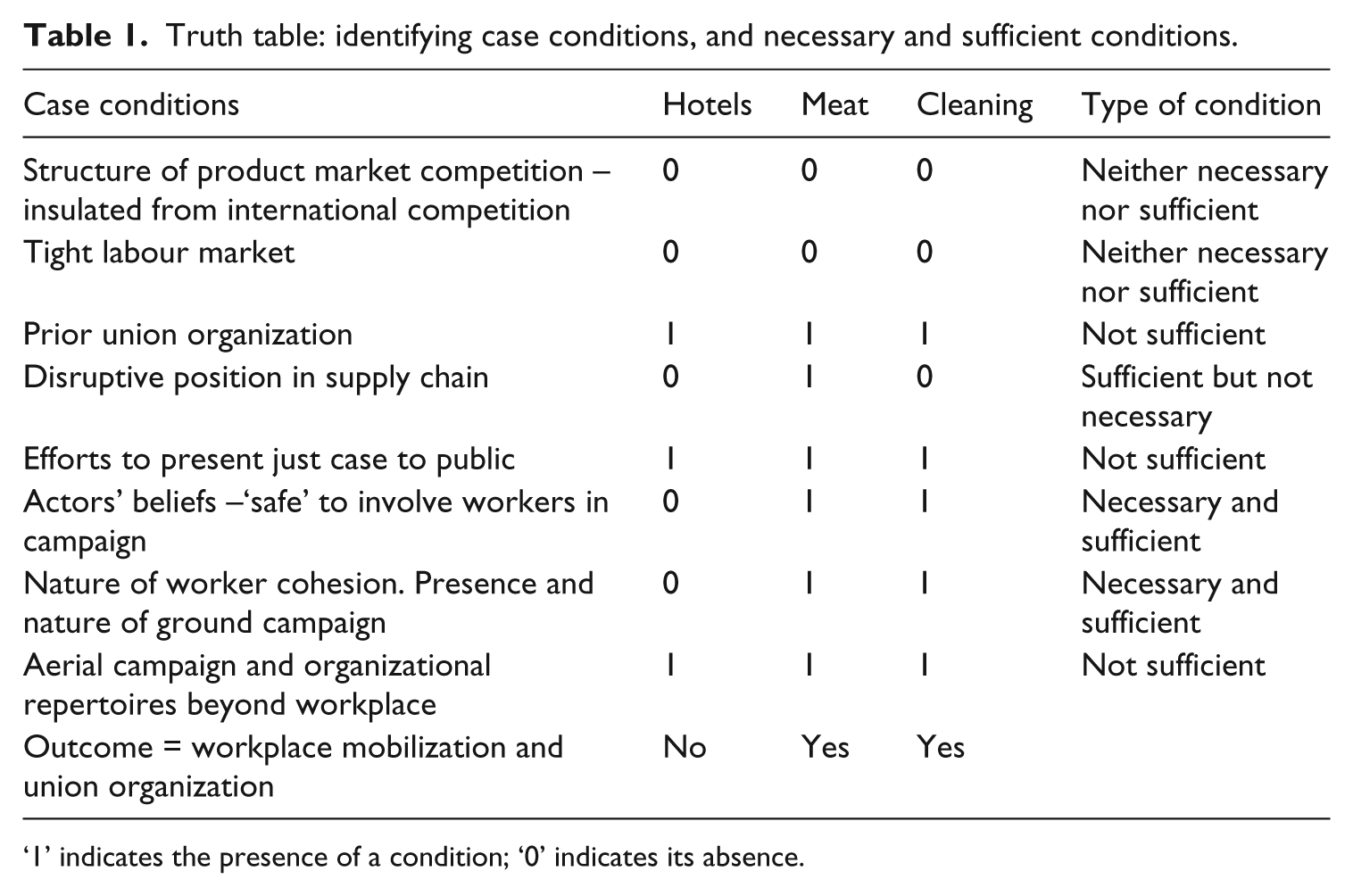
‘1’ indicates the presence of a condition; ‘0’ indicates its absence.
We address each of these factors in turn and in combination in tracing and specifying how different combinations of causes produced different outcomes across the three cases. We distinguish between ‘sufficient’ and ‘necessary’ conditions (Mahoney, 2000). A condition is sufficient for an outcome if the outcome occurs when the condition is present, but it can also result from other conditions. Thus, if an outcome is evident when the condition is present and absent, then the condition is sufficient but not necessary. If the condition is both present and absent when the outcome is manifest, then the condition is not necessary. If the condition is present where the outcome does and does not occur, then the condition is not sufficient. A condition is necessary if it is always present when the outcome occurs; that is, the outcome cannot occur in its absence. Then, if a condition is always present with a given outcome, and if it is not present the outcome will always be absent, then we can claim that the condition is necessary and sufficient; there is, thus, an invariant association between the two. Finally, it should be stressed that, while a condition may be neither a necessary nor a sufficient cause of an outcome, it may be part of a combination of factors that is necessary or sufficient for an outcome.
The first four identified conditions can be considered expeditiously. Given that the outcome is present and absent in circumstances where all three industries are exposed to international competition and where labour markets are not tight, we can state that both factors are neither a necessary nor a sufficient condition. The third condition, whether union organization existed within the three sectors and in adjacent sectors is not sufficient as it is present in all case campaigns. Given that the outcome occurs in the presence and absence of workers with key skills occupying potentially disruptive positions in the supply chain, this would suggest that this element constitutes a sufficient condition only. The last listed condition, whether there was an aerial campaign that included the development of organizational repertoires beyond the workplace, would seem, sensu stricto, not to be sufficient. However, its presence and importance is reassessed below in combination with the remaining two conditions – key actors’ beliefs and perspectives, and the nature of workers’ cohesion and the presence and form of a ground campaign. That the latter two are present where there is a ‘positive’ outcome and absent where there is an ‘unsuccessful’ outcome means they are deemed both necessary and sufficient. This causal configuration suggests that successful union organization is the product of at least these two elements.
We consider this pattern of causation in some more detail. In the red meat campaign, UOs believed that management would engage in reprisals on workplace activists. As a consequence, the campaign was led by them in the initial stages. It went ‘underground’ and was broadened beyond the workplace. Links were developed with local communities, principally through the Catholic Church. Many workers were Brazilian and Polish nationals, and were practising Catholics. Priests who worked with the two communities and who were bilingual came to act as confidants of the workers and performed the role of ‘go-between’ and volunteer translators. Some meetings were attended by Migrant Rights Centre representatives who gave advice to the workers and their partners on a range of issues, including immigration, health provision and schooling:
Meetings were held in homes and communities, which helped engender trust. Father X cleared blockages for us. He gave us credibility and it created trust with the workers. In some cases, he made the first contact with the workers. Without Father X, we would not have had a prayer (i.e. no chance of success). He is important to these workers, so you are grounding the union in their community as opposed to it just being relevant to their work. (Senior UO, 2010) It [organizing] cannot take place in the factories; the message is wrong. Many workers, particularly migrant workers, see this as us colluding with the employer. People are comfortable talking to you in their homes. (UO, 2010)
Thus, pre-existing identity-based structures (ethnicity, language, nationality and religion) provided UOs with a basis upon which to build their organization campaigns.
In the contract cleaning campaign, certain key large employers were amenable to union recognition. They shared the union’s interest in regulating pay levels across the sector. In such circumstances, the union found it reasonably easy to access workers and to encourage them to become activists. However, this employer disposition created tensions for both parties. Employers were ill at ease with union attempts to mobilize and agitate workers when they had already indicated they were favourably disposed to union organization, while UOs remained mindful of the risk of organizing employers, but not workers:
There is an unhealthy tension between doing a deal with an employer in the industry and mobilizing people and bringing them along and empowering them. (Senior UO, 2011)
In the end, the position of the UOs was balanced by a pragmatic estimation of whether it was feasible to organize a transitory workforce. In essence, their organizing campaign was coupled with a partnership and service-based model:
If I am to be honest with you, if you went exclusively with the strategic organizing approach, it would take forever. You are never going to be able to reach the kind of density levels that you need, so, you have to have a mix. It’s not just the case of which, it’s more a case of when. When do we use what approach? (Head of organizing, 2012)
The hotels industry was one of the most difficult sectors in which to organize, given employers’ hostility to union recognition, the level of recorded breaches of employment standards, the high proportion of migrant workers, high labour turnover, low levels of union density (estimated by SIPTU to be 4.2% in 2008), the dwindling presence of collective bargaining and the significant commercial advantage to be gained by undercutting union rates of pay. In this context, allied to the failure of the Dublin Airport hotels campaign, SIPTU shunned pursuing a ground campaign. Instead, a highly visible, entirely top-down consumer campaign was promoted that was endorsed by other unions, political parties (Labour and Sinn Féin), as well as civic and consumer groups (Fairtrade Mark Ireland, the National Women’s Council, the Consumers’ Association of Ireland and the Migrant Rights Centre). Hotels that promoted quality employment and recognized unions for collective bargaining were ‘whitelisted’ in contrast to traditional campaigns where nefarious employers were ‘blacklisted’. The campaign enjoined all ICTU unions to use ‘fair hotels’ for their conferences under a new combined purchasing policy. Hotels that signed recognition agreements permitted SIPTU officials to give employee briefings and to sign up new members in their hotels. This work was done by density-building officials rather than UOs.
Consideration of the other condition – the presence and form of a ground campaign – cannot be adequately treated without consideration of the conduct of an aerial campaign. Both were carefully synchronized in the red meat and contract cleaning campaigns. The latter involved investment in mapping activities (i.e. researching businesses’ sectoral configuration, economic circumstances, procurement links, government policy in respect of their development, sources of third party power, target companies, and the location and number of workers employed). The ground campaigns involved talking to existing members, issue identification (including surveying employees), worker leadership development, workplace-based training, and targeted collective actions. The aerial campaign highlighted a number of leverage points in the meat industry. They included the provision of state subsidies for red meat processing, including employee training in animal slaughter. This was then identified as the point in the production process where the union might best maximize workers’ power resources and where action items might be successfully pursued. Thereupon the aerial and ground campaigns met. Pressure was also placed on the company’s customers, including large retail multiples and hotel chains, by making appeals to ethical trade standards, and logistic companies, many of which were unionized, to support the campaign:
I’ve recently joined the ethical trade initiative, and I’ve gained access to the ethical managers of multiples (in London). I’ve reminded them of the codes of practice their clients have signed up to – ‘this needs to be your problem’. Gone are the days of we standing outside the gate. There might be a role for it, but it is in conjunction with all the other leverage points. (Senior UO, 2011)
In contract cleaning, the aerial campaign involved the formation of alliances with community and interest-based organizations, including the Migrant Rights Centre of Ireland and the National Women’s Council, in an effort to broaden the campaign to protest against low-paid employment among migrant – and largely – female workers. Public sector procurement agencies were also prevailed upon to procure only unionized cleaning companies. The ground campaign involved over 500 one-to-one or small group meetings between UOs and workers across 37 worksites. UOs pursued a blended approach of top-down union building and bottom-up agenda setting and worker participation. The leverage obtained from both the aerial and ground elements of the campaign proved crucial in engaging major employers in talks to agree a sectoral REA.
Another feature of the two ground campaigns was the union’s attempts to deepen worker cohesion. This had two elements. The first involved anti-racism training within workplaces to overcome cleavages between multi-ethnic work-teams combined with efforts to widen membership in representative structures to include hitherto under-represented groups. The second included the establishment of multi-level representative structures within and across workplaces and companies. These structures served three important purposes: first, they provided a forum for the on-going overview of campaigns that helped motivate and empower workplace activists; second, they helped provide strategic guidance to the ground campaigns and to provide a means by which issues identified within workplaces could be addressed at a higher level; and third, they were used to reinforce the union’s message that, unless all worksites were organized (in red meat), management would be in a position to extract advantage by threatening to switch production from one site to another. In the case of cleaning, a national representative forum was used to animate and politicize activists in their campaign to gain political support for protecting industry employment standards by reconstituting the sector’s REA.
Conclusions
This article explores the transfer of US-developed union organizing practices to Ireland and assesses whether and how they are successful. It focuses on organizing campaigns conducted by SIPTU, Ireland’s largest union, in three low-wage industries: contracting cleaning, red meat processing and hotels. SIPTU’s strategy was to organize hitherto poorly represented workers, particularly migrants and female workers, and in a manner that acknowledged their multiple social identities. Although its preferred approach came close to that of ‘managed activism’, the variety of approaches adopted by SIPTU is striking. They included ground campaigns, aerial campaigns and ethical consumer campaigns. SIPTU’s understanding of organizing was derived in significant part from the experience of US unions, but its expertise was further honed through experimentation, internal debate and, critically, came to reflect its assessment of the power resources available to different cohorts of employees.
The case campaigns registered major achievements, including increased membership, enhanced activism, the assembly of demographically diverse representative structures, the establishment of worker-fronted communications, the creation of multi-level representative structures and the gaining of recognition from key employers.
The article’s analytical focus is to assess the influence of particular structural conditions and the role of human agency in shaping outcomes. The case selection approximates to a MSS comparative research design. The MSS design is used to assess the causal effects of particular factors in an effort to distinguish between necessary and sufficient conditions. The meat and cleaning campaigns represent ‘positive’ cases (workplace organization was pursued and achieved) while the hotel case represents a ‘negative’ outcome (an organizing approach was not adopted following an earlier pilot-case failure). We enquire about what was sufficiently different among the various campaigns to produce outcomes that were dissimilar, while controlling for a variety of factors.
Our account of the outcomes pivots not on the net effect of separable conditions, whether they are derived from structural conditions or the role of human agency, but rather on their combined interaction. Causation was thus multiple and conjunctural. Several causes were simultaneously present, and were configured in various combinations (Berg-Schlosser et al., 2009). Further, there was nothing constant or preordained about the effect of similar conditions. In comparing three cases that shared many attributes, we have explained how similar and dissimilar outcomes occurred. In essence, our explanation for the variable architectures of union organizing turns on workers and unions’ interpretation and assessment of how a particular set of structural conditions empowered or imperilled workers in mounting an organizing campaign.
Success in the meat and cleaning cases is attributed to a set of conditions that in combination created more or less favourable circumstances for the identified outcomes to occur. There was nothing inevitable here, however. A condition’s, or set of conditions’ potential for worker mobilization and union organization required interpretation, and assessment by the actors involved. Some material conditions made union organization more likely. They included the posture of employers, which was influenced by the structure of market competition. Consider the case of contract cleaning again: the collaborative stance of employers was linked to the industry’s structure and the nature of (price) competition therein. Ultimately this aided the union’s attempt to develop a ground campaign in that it permitted workers the security to mobilize and front campaigns. By contrast, the fear of employer reprisal in the red meat and hotels campaigns severely circumscribed organizers’ ambition to cast workplace activists as proselytizers for union organization. Still in the former campaign, pre-existing identity-based structures (ethnicity, religion, language and nationality) provided UOs with a basis upon which to build workers’ solidarity and activism. In hotels, by contrast, the context of a transient and insecure workforce whose employers were hostile to union organization rendered it impracticable for workers to prosecute an organizing campaign, or indeed for FTOs to organize large numbers of workers into membership. This culminated in a high-profile top-down consumer campaign that developed links with other community and civic society organizations. Thus, the architecture of union organizing was adapted to match the variable economic and labour market circumstances of an industry, the posture of employers and, critically, the power resources of employees. Thereafter, success was determined by the conduct of concurrent aerial and ground campaigns. Where these elements went hand-in-hand, as in the cleaning and meat campaigns, considerable success was achieved.
Finally, we make the following brief arguments in respect of how our study links to broader questions related to the future of trade unionism. It is plain that unions have struggled to organize workers outside their traditional core constituencies and embrace young, female, precarious and migrant workers (Chun, 2009; Milkman, 2006). To do so will require unions to create the requisite space wherein these workers’ concerns can be articulated from below and not defined from above as a priori interests. This will necessitate new voice mechanisms wherewith a balance will need to be attained between democracy and leadership, and wherein new members are given a central role in formulating policy. This requires the obvious admission – and problem – that there is no homogeneous precariat. Further, their organization will require the mobilization of new power resources and, in particular, the development of associational links across diverse groups of workers within and beyond workplaces, and with other social and community groups. This will inevitably pull unions into a broader discourse of citizen’s rights as against solely workers’ rights. Mistreatment occurs not only within the workplace – although it might be most acutely felt there – and it must be addressed outside the workplace.
Dilemmas and tensions are likely to abound, however. Mobilization and oppositional repertoires will still have to be (re-)aligned with a bargaining function and a co-operative posture where an employer moves to co-operate with the union. The organizing model is thus unlikely to eradicate the contradiction between marshalling workers’ agitation and in containing it; the union leader will remain, as Mills (1948: 8–9) put it, the ‘manager of discontent’. Similarly, a mix of organizing models that include top-down and bottom-up mobilization both within workplaces over time, and across workplaces and sectors, will need to be adopted in the face of varying employer postures and the structural conditions affecting workers’ power.
The challenge of broadening unions’ appeal to include new constituencies without alienating existing members is a considerable one. This will require a new educational endeavour whereby existing members are prevailed upon to understand that it is by giving atypical and precarious workers voice that union decline might ultimately be stemmed and, in so doing, unions can fairly renounce being caricatured as the representative organs of a privileged minority, and instead claim to be defenders of a broader societal interest.
Footnotes
Acknowledgements
The authors thank the journal’s editor, Andy Danford, and the three anonymous reviewers for their helpful comments and advice on a previous draft of this article. We thank the trade union representatives and the many employees in our case sites for the time and help they gave us during the conduct of this research. A previous version of this article was presented at the Irish Academy of Management Conference 2016 and at a research seminar at Durham University Business School. We thank participants for their comments and observations.
Funding
The authors disclosed receipt of the following financial support for the research, authorship and/or publication of this article: financial support provided by the ICTU Newman Fellowship is gratefully acknowledged.