







Abstract
This article investigates the diverse and heterodox array of labour practices and economic activities in artistic work. Existing studies contend that artistic income is highly skewed, with the majority of artists living in poverty, and that artistic work is intermittent, project-by-project based and precarious, with artists juggling multiple jobs. However, these prevalent perspectives typically foreground only formal contractual employment while neglecting the variegated range of informal, alternative and relational economic practices. Building on a mixed method study of Danish visual artists’ livelihoods and drawing on the total social organization of labour perspective, the article maps a diverse spectrum of labour practices ranging from formal paid/unpaid work to informal cash-in-hand work and non-monetized barter exchanges, to wholly non-commodified everyday practices of mutual aid and favour-swapping, as well as ‘consumption work’ such as thrift and self-provisioning. Heterodox economic practices are the primary mode by which artists cope with and manage precarious artistic livelihoods.
Keywords
Introduction
There is a substantial literature in sociology and cultural economics that investigates artistic labour markets (Abbing, 2002; Frenette et al., 2018; Menger, 2006; Throsby and Petetskaya, 2017), work dynamics and work identities in the creative industries and the arts (Bain, 2005; Chafe and Kaida, 2020; Gerber, 2017; Serafini and Banks, 2020; Umney and Kretsos, 2014). Scholars agree almost unanimously that creative labour markets are precarious – deeply unequal, unstable and fiercely competitive (Banks, 2017; Butler and Stoyanova Russell, 2018; McRobbie, 1998). Creative work has been found to be correspondingly permeated by a heightened degree of insecurity, discrimination, overwork and underpayment (Grugulis and Stoyanova, 2012; Siebert and Wilson, 2013). These studies typically find that creative workers manage pervasive precarity by multiple jobholding and developing portfolios of concurrent project-by-project employments (McRobbie, 1998; Throsby and Petetskaya, 2017). Although such approaches depict creative work as consisting of a patchwork of income sources and labour activities, the activities taken into analytical consideration typically encompass only formal paid employment and self-employment involving income from the arts (e.g. registered sales of artworks and related revenue streams such as royalties or exhibition fees), jobs in arts-related fields (e.g. teaching) and non-arts-related fields (e.g. table waiting), and formal unpaid work in the creative industries (e.g. internships).
Studies of creative/artistic work have neglected the variegated range of diverse, relational and alternative labour practices and economic activities – informal, unregistered, and above all deeply interpersonal – that take place in local and situated relational infrastructures such as family, kinship, collegiality and neighbourhood (Gibson-Graham, 2008; Glucksmann, 2005; Williams and Nadin, 2012). By focussing almost exclusively on formalized and institutionalized aspects of work, dominant approaches divest work of the everydayness of artistic lives. In this way the ‘heterodox’ economies of artistic work, i.e. the vast and multifarious array of everyday survival and self-provisioning practices undertaken by artists as elaborate ways, however mundane, of coping with precarity (Alacovska, 2018; White and Williams, 2012), have been left unexamined.
This article challenges entrenched conceptualizations of creative work as a portfolio of formalized contract-based employment/self-employment and a patchwork of registered revenue streams. Drawing on a mixed method study of the economic conditions of Danish visual artists, the article offers a more comprehensive view of artistic work and labour markets. While the quantitative study clearly confirms the basic patterns of ‘formal’ artistic income such as unequal distribution of income and poor pay, with the majority of Danish artists living below the poverty line and juggling multiple formal jobs, the qualitative study reveals more complex dynamics of artistic work, comprising a diverse array of economic practices embedded in everyday relational infrastructures, interpersonal webs of interconnectedness, and a nexus of consumption and production.
To make sense of the diversity of labour practices in artistic work, this article draws on the ‘total social organization of labour’ (TSOL) perspective (Glucksmann, 2005, 2009). Sociologists of work adopting this perspective argue forcefully that market-based formal paid employment is neither a dominant nor a uniform mode of work but that work is a heterogeneous and multi-dimensional category (Taylor, 2004; Williams and Nadin, 2012; Williams and Windebank, 2002). TSOL recognizes as work multifarious forms of economic activities that are neither directly remunerated nor distinguishable from relational work taking place within interpersonal infrastructures of kinship, family and neighbourhood (e.g. gifting, swapping and mutual aid). By recognizing the relational organization of all work, TSOL highlights ‘the interdependencies’ and ‘interconnections’ of work activities (Glucksmann, 2005) as happening across distinct socio-economic spheres, including market/non-market, workplace/home, formal/informal, and paid/unpaid spheres. Employing TSOL as a conceptual lens, this article rearticulates the interdependencies of ‘a diverse spectrum’ of artistic economic practices (Williams, 2011) ranging from formal paid/unpaid work to monetized informal cash-in-hand work and non-monetized labour exchanges (such as in-kind transactions and barter) to fully non-commodified everyday relational practices of mutual aid and self-provisioning (such as sharing and swapping) (see Figure 2).
Drawing further on an ‘extended conceptualization of TSOL’ (Glucksmann, 2005), the article treats alternative forms of consumption such as thrift or house-downsizing as fully-fledged economic activities and micro-financial strategies integral to artistic work. The extended TSOL approach not only recognizes the interdependencies of work undertaken in different socio-economic spheres but also the interconnections of labour across ‘the various stages of instituted economic processes’, encompassing ‘work undertaken across the whole span of a process of production of goods or provision of services, including the work of consumers’ (Wheeler and Glucksmann, 2015: 555; also Glucksmann, 2009: 883). As such, labour can be undertaken at different stages of the economic processes of production/distribution/exchange/consumption, whereby ‘consumption work’, i.e. ‘all work necessary for the purchase, use, re-use and disposal of consumption goods and services’ (Wheeler and Glucksmann, 2015: 553), constitutes ‘an integral component within the division of labour’ (p. 567). Work activities performed by creative workers at the consumption stage are interlocked in an interdependent economy of labour, with economic activities taking place at the artistic production end. This article argues that such interdependent economies of labour enable artists to navigate, cope with and manage precarity while nonetheless actively nurturing and cherishing alternative household livelihoods and cooperative and relational collegial ties.
Formal artistic economies: ‘Superstar’, ‘denied’ and ‘mixed’ economies of creative work
Consistent with theories of ‘superstar’ (Rosen, 1981) and ‘winner-take-all’ economies (Frank and Cook, 1996), scholars typically find that artistic income is highly skewed, with just a few ‘winners-superstars’ earning disproportionally more than the ‘losers’ who comprise the majority and who command very low incomes, teetering on the verge of poverty (Abbing, 2002; Bille, 2020; Menger, 2006). It has become a commonplace in studies of creative/artistic work to argue that artists operate in ‘exceptional’ or ‘peculiar economies’ as scholars grapple with the question of ‘why artists are poor’ (Abbing, 2002) and why they enter the profession in spite of proliferating evidence of poor pay and precarity. Scholars typically resort to Bourdieu’s ‘economic-world-reversed’ theory to show that artists ‘deny the economy’ in the short term by putting up with low pay, dismal working conditions and lack of benefits in exchange for attaining psychological rewards such as self-expression and self-actualization (Alacovska, 2013; Bain, 2005; Simpson and Pullen, 2018; Umney and Kretsos, 2014). Through this lens, artistic economies appear to be ‘denied economies’ in which economic income is ‘paradoxically’ actively eschewed. Accordingly, cultural economists such as Throsby (1994) have developed an influential work-preference model that explains away artists’ willingness to undertake work at lower rates as being a function of ‘an irresistible’ compulsion to create art, whereby the non-pecuniary benefits of work such as autonomy or self-realization become the ultimate payment. Other studies have empirically confirmed the prevalence of significantly higher levels of job satisfaction among artists than workers in other occupations, in spite of high unemployment and low income (Bille et al., 2013, 2017). Such work preferences result in an excess supply of artists (Bille, 2020). In this way, low average income becomes an inherent characteristic of artistic labour markets.
Sociological studies of artistic/creative work typically explain the artists’ acceptance of underpaid or unpaid creative work by defining artistic labour markets as ‘mixed economies’ (McRobbie, 1998). In mixed economies, artists juggle multiple jobs and an assortment of income sources, resorting to a plethora of ‘second’, ‘side’ or ‘day jobs’ to cross-subsidize underpaid and insecure ‘real’ artistic work (Lindström, 2016). A general scholarly consensus holds that artists develop ‘multidisciplinary expertise’ (Frenette et al., 2018), ‘occupational versatility’ (Throsby and Hollister, 2003) and cross-field ‘portable professional identities’ (Lindemann et al., 2017) in order to stay afloat. Scholars have shown how artists generate income from work in art-related fields, such as arts education and arts management, or from work in the broader realm of media industries, enabling them to leverage the occupational skills and knowledge they acquired at arts school (Gerber, 2017; Gerber and Childress, 2017; Throsby and Petetskaya, 2017). Others have shown the importance of jobs in non-art-related industries such as nightlife economies (Mears, 2015), the tech industry (Lindemann et al., 2017), and the social care and healthcare industries (Alacovska, 2020; Lingo and Tepper, 2013). Artistic careers are thus often referred to as ‘portfolio careers’ consisting of self-constructed and continually shifting patchworks of self-employment initiatives, freelance project-per-project jobs, and unpaid formal employments such as internships (Siebert and Wilson, 2013). Beyond formalized mixed economies, studies have demonstrated that art-school graduates from privileged middle-class backgrounds underwrite the costs of protracted periods of low or non-existent pay by informally tapping into formal family economic resources (Friedman et al., 2017).
In contrast to the predominant formal economy view of creative work, emerging sociological scholarship has begun to rethink poverty and precarity beyond the entrenched formal-informal work divide (Alacovska, 2018; Gerber, 2017). For example, Scott (2017: 71) has recently noted that creative work takes place within ‘a variegated economy’ in which more measurable aspects of the economy are intertwined with micro-tactics of sustenance and survival within ‘hidden abodes’ of reciprocity, gift-giving and give-and-take obligations, while Lindemann (2013: 466) has recently called for a study of ‘alternative ways of putting together creative careers’, including informal modes of art work such as mentoring and collegial help.
This article contributes to these nascent sociological efforts to elucidate the heterodox labour practices in artistic work by employing the TSOL approach and the cognate theories of diverse economies (Gibson-Graham, 2008; Holmes, 2018; White and Williams, 2012) by foregrounding the importance of embedding the study of artistic work in everyday life-worlds rather than merely formal labour markets and workplaces. The article substitutes the usual question of ‘why artists are poor’ (Abbing, 2002) with the question of how artists cope with pervasive precarity and poverty on a daily basis, seeking in this way to understand how artists carry on working in the arts in spite of low, unequal and intermittent income.
Heterodox and diverse economies: The plurality of informal, relational, alternative and everyday economic activities
In the wake of the global financial crisis, subsequent neoliberal austerity and formidable political turbulence, an ever-growing body of research on ‘diverse’ and ‘heterodox economies’ as informal, alternative, everyday and non-market responses to global uncertainties and economic hardship has started to emerge and rapidly proliferate (Gibson-Graham, 2008; Holmes, 2018). Sociologists have theorized ‘diverse’ or ‘heterodox economies’ (White and Williams, 2012) as an expansive, rich and proliferative array of economic transactions and practices immersed in alternative and non-market spheres of deep relationality such as mutuality, reciprocity and cooperation.
Some scholars, such as Denning (2010: 80) for example, have argued for the need to ‘decentre’ formal employment and ‘the fetishism of the wage’ in order to understand the rise of ‘wageless life’ and the diversity of ‘post-wage regimes of work’ rooted in sharing, neighbourly help and community self-help (Van Dyk, 2018: 529). Consistent with such wage de-centring projects, empirical sociological studies have demonstrated the contemporary heterogeneity of age-old micro-strategies of survival and getting by, including methods of relational provisioning such as swapping, circulating and gifting, that exist beyond formal waged work (Holmes, 2018; Schor, 1996). Work and employment scholars adopting the TSOL approach (Glucksmann, 2005, 2009; Taylor, 2004) were among the first to demonstrate the economic significance of ‘wageless’ work, including relational and informal labour practices – practices typically and often dismissively associated with the underdeveloped ‘third world’ – in the very heart of developed ‘first world’ capitalist economies, as a means of attaining economic sustainability in the face of financial adversity (White and Williams, 2012; Williams and Nadin, 2012).
TSOL scholars refuse to equate work with formal employment and focus on the interdependencies of labour practices taking place across diverse socio-economic spheres (Glucksmann, 2009; Taylor, 2004). Following TSOL, Williams and Nadin (2012) have argued for a re-conceptualization of work to encompass the ‘spectrum’ of labour practices unfolding across market/non-market, formal/informal and paid/unpaid spheres. Scholars show that even in countries with advanced economies such as the UK, work spans a seamless spectrum from so-called ‘black’ or ‘grey’ informal work, involving monetized work unfolding under the radar of state authorities such as cash-in-hand work or moonlighting, to non-monetized alternative market exchanges such as in-kind transactions and barter, to completely non-monetized work, including favour-swapping, mutual aid and self-provisioning (Williams, 2011; Williams and Windebank, 2002). Similarly, Gibson-Graham (2008: 623) proposes a ‘technique of reading for difference’ of formal economies that brings the inexhaustible plurality of relational and alternative economic exchanges to the forefront of analysis.
Scholars of diverse economies have accordingly begun to redefine informal labour and alternative economic transactions beyond necessity entrepreneurship or emergency provisioning. There has been broad acknowledgement that engagement in diverse economies, besides being a means of coping with precarity and poverty, encompasses complex judgements about what ‘a good life’ comprises (Bolton and Laaser, 2013; Holmes, 2018). Scholars have thus started querying ‘the cycle of work and spend’ (Schor, 1996: 12) by studying ‘downshifters’ or people who resist intensified consumption by decoupling visions of a good life from ever-accelerating material accumulation (Alacovska et al., 2020; Oakley and Ward, 2019). Through this lens, alternative and self-provisioning consumer practices predicated on living a ‘simpler’, ‘flourishing’ and ‘sustainable’ life by reducing consumption avert the need for regular formal paid employment or high income (Gibson-Graham et al., 2013; Oakley and Ward, 2018). By decentring the importance of formal paid work, anti-consumption consumer practices do not only mark trendy sustainable lifestyles but also constitute long-term economic sustainability beyond formal labour markets. The TSOL approach has already recognized the implications of consumption for work.
‘An extended’ TSOL approach (Glucksmann, 2005, 2009) maintains that labour, in addition to being organized in diverse socio-economic spheres, is organized in an overall configuration of ‘economic processes across production/distribution/exchange/consumption’ (2005: 23). According to Glucksmann (2013: 5) ‘consumption work’, i.e. the work entailed in the use, repair, recycling and repurposing of consumer objects, is a distinct form of ‘economic activity’ and an integral component of labour and production. In her study of women assembly-line workers in the UK in the 1950s and 1960s, Glucksmann (1990) demonstrated that interdependencies of different labour practices occur not only between formal paid employment in factories and informal unpaid household labour at home but also between household consumption and factory production, whereby the rise of mass consumption that rendered consumer appliances, ready-made food and clothing widely available and thus freed women from performing labour-intensive household tasks in turn enabled them to take up formal employment in factory production.
Household work activities related to mundane consumer practices such as cooking, repairing and cleaning have long been recognized in sociological studies of informal work as crucial aspects of the (gendered) division of work and as a structural foundation of formal work (Denning, 2010; Warde and Hetherington, 1993). Through this lens, the ‘consumption work’ of thrift, self-provisioning, mending and repurposing undertaken in the domestic sphere becomes an integral component of an individual person’s economic activities (Wheeler and Glucksmann, 2015). Consumption work thus renders underpaid but personally meaningful art-production work sustainable.
Drawing on TSOL, this article proposes a heterodox understanding of Danish visual artists’ economies that captures the multifarious array of relational and informal labour practices and micro-level economic activities that co-exist alongside more formal, official and market forms of employment and income. While emphasizing the salience and vitality of diverse (alternative-to-the-market) economies for artistic work, the article reconnects informal labour practices to distinct forms of everyday household livelihood practices, self-provisioning and adjacent ‘consumption work’ such as thrift, mending, recycling and repurposing (Glucksmann, 2013).
Methodology: A mixed method approach
The research utilizes a mixed method approach involving a qualitative study and a quantitative study. A mixed method enables a comprehensive understanding of complex social phenomena such as artistic economies because it allows for more measurable aspects of the economy, such as income and multiple job-holding, to be combined with subjectively experienced work conditions and labour outcomes (Morse, 2016).
The quantitative data was collected via an extended survey sent out to the total population (n=3028) of visual artists in Denmark in 2017, merged with registry data from Statistics Denmark. The population of artists was defined on the basis of the following criteria: 1) membership in one (or both) of the two main artists’ membership organizations in Denmark; 2) possession of a degree from an arts academy; and 3) receipt of grants from the public arts foundation between 2006 and 2016. The fulfilment of only one of these criteria warranted inclusion in the study. In this way the survey included all visual artists in Denmark whom the researchers were able to localize, and not only a sample selection.
The study collected information about formal artistic economies. Via the artists’ personal identification numbers it was possible to link the survey data with microdata from public registers in Statistics Denmark that provide accurate information about socio-demographic variables for all the artists involved in the study, including total income before taxes, level and type of education, job position, self-employment, gender, age and pensions for the period 2010–2015. The survey was thus used to supplement the data with information not available in the official registers, i.e. the percentage of income that artists derived from a) arts, b) art-related jobs, and c) non-art-related jobs, and the percentage of working time they spend on a), b) and c). In addition, artists were asked whether they depended on other income sources such as their partners’ income or bank loans, including mortgages and consumer loans without collateral.
The response rate to the survey was 35 per cent (n=1000). However, since the survey data was merged with socio-economic information from Statistics Denmark that covers the whole population of artists, including non-respondents, the analysis was able to cover survey non-responses in order to assess the representativity of the sample. No significant differences were found when comparing the total population with the respondents to the survey on a number of important variables (age, gender, total income, geography, educational background, employment and industry). On this basis the sample is deemed representative (Bille et al., 2018).
The qualitative study consists of 21 in-depth interviews conducted with 13 male and 8 female artists between November 2017 and May 2018. The interviews lasted from 1.5 to 2.5 hours. All except four of the interviews were recorded and transcribed verbatim. Comprehensive notes were taken whenever obstacles arose that hindered the recording. The informants were invited to participate in the study via an open call distributed by the biggest arts organization in Denmark, BFK, to its members. After the initial recruitment of participants, snowball sampling was used to ensure gender balance. The majority of informants resided in the greater Copenhagen area. The researchers observed the university’s ethical guidelines to protect informants’ identities, including the use of pseudonyms.
The qualitative study was undertaken after the quantitative study. Many artists who responded to the large-scale survey expressed concerns that their diverse forms of labour were not being systematically captured by the survey. These ‘unanticipated’ concerns indicated the need for ‘a supplementary study component’ in the form of a qualitative study and hence, a mixed method approach (Morse, 2016: 4). The goal of the qualitative study was to investigate the subjective experiences and everyday practices of making a living as a visual artist in Denmark – experiences that had remained hidden in the quantitative analysis. During the interview, the researchers probed how artists cope daily with financial hardship and labour inequalities (as clearly evinced by our survey). The artists were primarily asked to explain the ways in which they personally manage to make ends meet. As thematic patterns started to immediately emerge, accounts of informal and alternative labour practices were solicited explicitly in subsequent interviews.
Almost all interviews took place in the informants’ homes or studios, with only four taking place in public spaces such as cafes or via Skype. Such in situ interviewing secured privileged opportunities for observing people’s ways of life and work, including consumer practices such as cooking, refurbishing and knitting, as these emerged in parallel with the interviewing. Conducting interviews in people’s homes/studios afforded opportunities to enquire directly into mundane economic self-provisioning activities of mending, making, saving, and repurposing as linked to the everyday management of households or studio spaces. For example, some informants showed the researchers objects that had been made, swapped, bartered or received as in-kind payment for artistic work, which fed into and generated further discussion.
The qualitative data was coded thematically. The researchers first prepared an inventory of all the economic practices discussed by the informants, including a range of alternative coping and getting-by strategies, and then coded these practices according to their socio-economic character, such as formal/informal, paid/unpaid, and their relational embeddedness in the workplace/household, in production/consumption, and in the market/non-market.
Formal economies of artistic labour
Confirming a pattern detected in studies from other countries (e.g. Throsby and Zednik, 2011), our study showed that the average income of artists in Denmark was significantly lower than that for other income groups in society, not least among those with the same high levels of education. The average income was £26,600 1 in 2016, and the median income was £22,200. This income measure is total income before tax, including labour market income, public transfers, private pensions, property income and other personal income. For comparison, the average income among all Danes from the age of 25 and above was £38,500 in 2016.
As can clearly be seen from Figure 1, total annual income before tax was extremely low for many artists, with 17 per cent earning a gross income below £11,000, which is below the poverty level in Denmark. In Denmark a single person living alone is defined as poor if they have had an annual average income of less than £12,900 after tax in the three preceding years. Approximately half of the artists in our study had a total income below £22,000 before tax, which is an indicator of widespread precarity and economic hardship. Thirty-four per cent of artists said they were dependent on their partners’ incomes to make ends meet. Consistent with the winner-take-all depiction of artistic labour markets (Menger, 2006; Rosen, 1981), major variations in income became visible, where a very small number of artists earned disproportionally more than the majority.
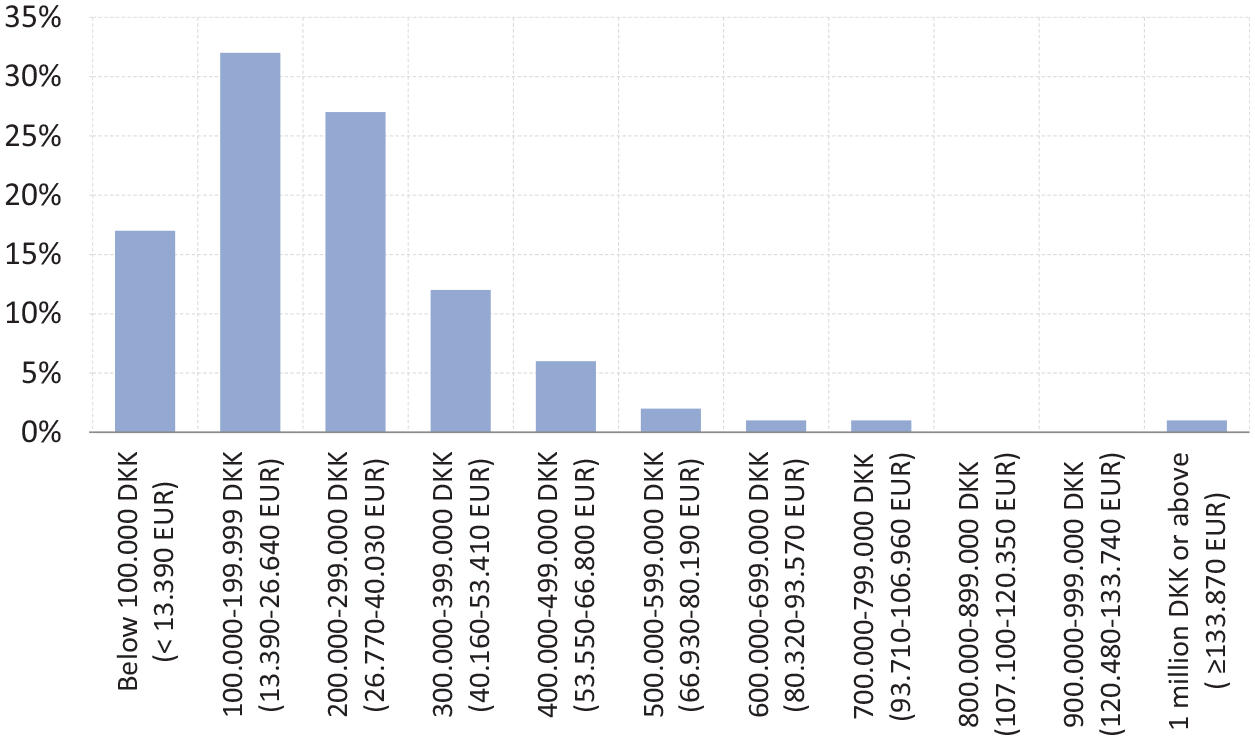
Income distribution among artists, total income before taxes, 2015.
The same pattern could be seen to an even larger extent when the focus was placed on artists’ income from artistic work. On average, Danish visual artists earned £11,100 before taxes from artistic work and related earnings such as exhibitions, fees, grants and earnings from copyright and royalties. The incomes of the few artists who earned the most raised the average income figure significantly, and accordingly median income was exceptionally low, amounting to only £1760 gross per year. The skewed income distribution can also be seen in Figure 2, showing the Lorenz curve. The highest-earning 5 per cent of Danish artists earned the lion’s share (47%) of the total earnings derived directly from artistic work, while the 50 per cent of visual artists who earned the least from artistic work only accounted for 1 per cent of the total earnings. Such skewed distribution of art income confirms that commercial artistic success accrues to a few ‘market winners’ while the majority are unable to garner a living income despite dedicating most of their working time to art and art-related jobs.
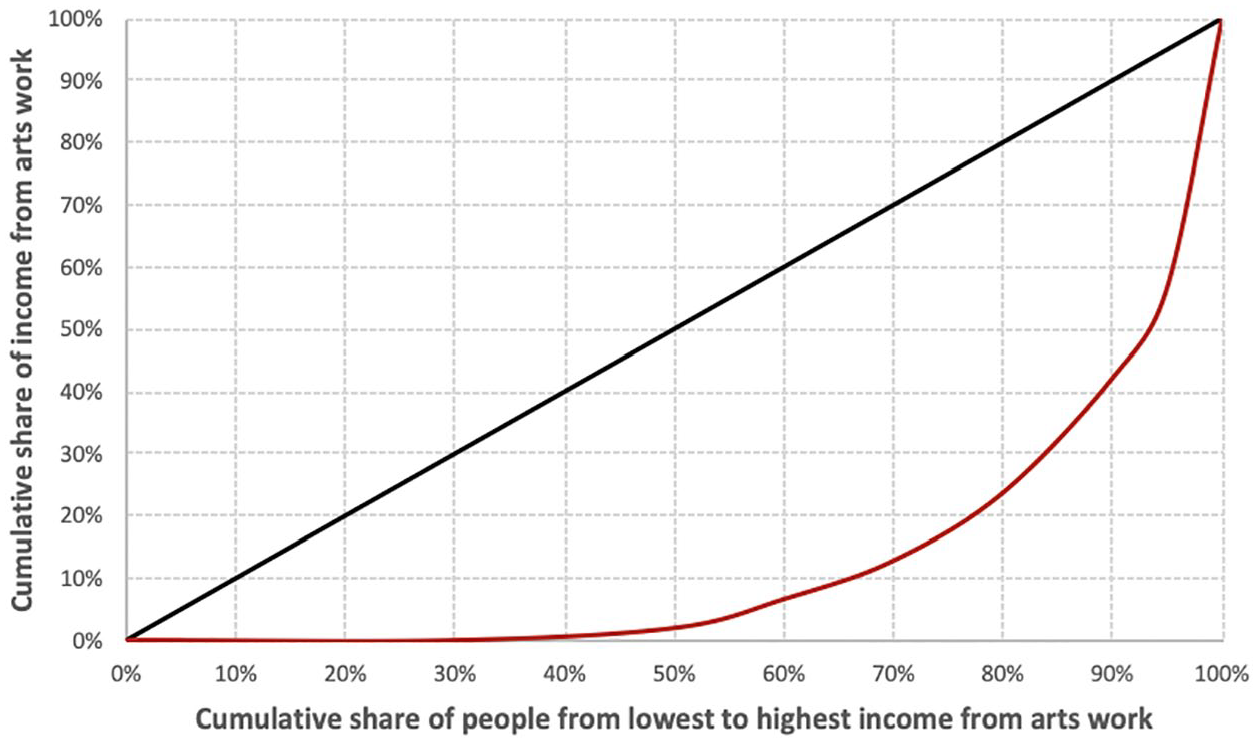
Lorenz curve: Distribution of income from arts work.
In accord with extant views of artistic careers as ‘portfolio careers’, Danish visual artists juggled multiple jobs (Table 1). On average, Danish visual artists spent 63 per cent of their working time as visual artists, while 22 per cent of their time was spent on work in which artistic skills were directly put to use, such as teaching, arts management and public talks. On average, only 15 per cent of an artist’s working time was spent on jobs with no relation to visual art.
The average percentage of working hours and income from artistic, arts-related and non-arts work.
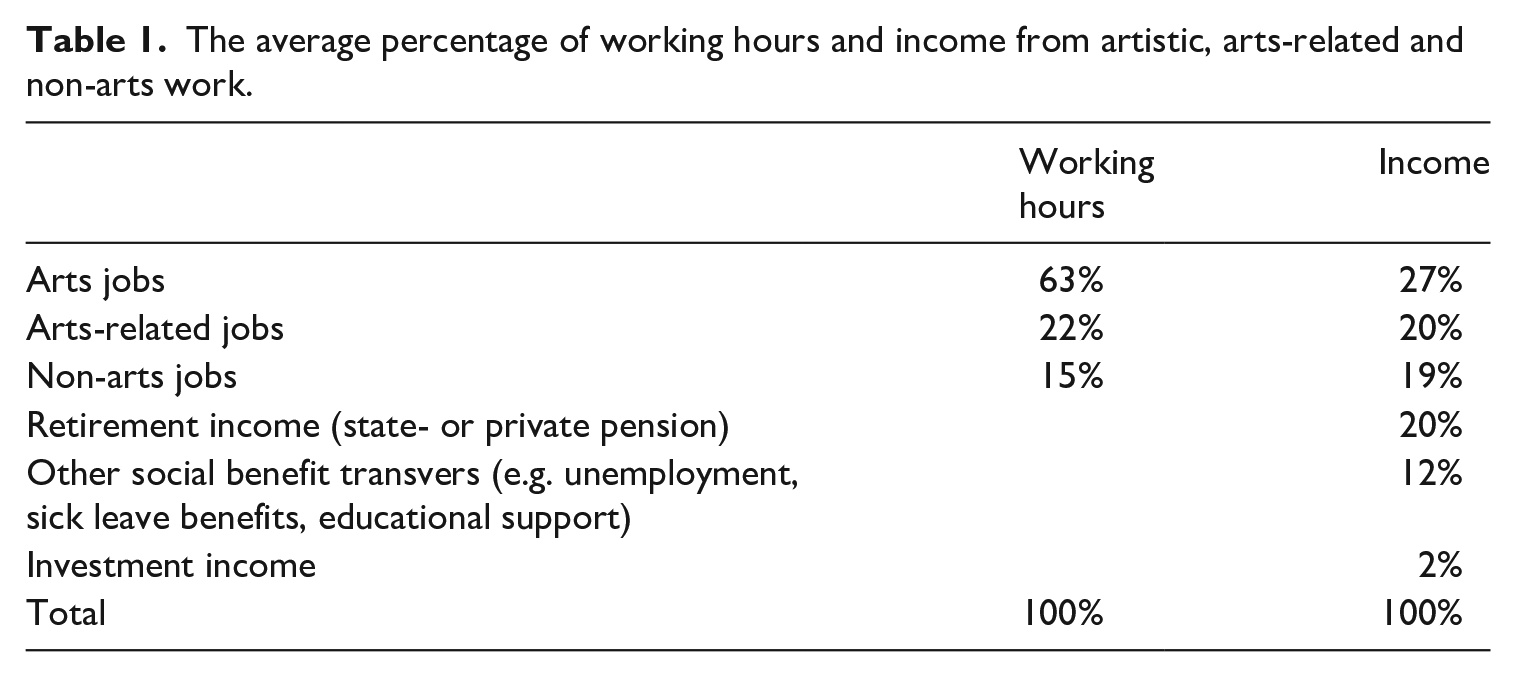
Our survey data also bore evidence of the prevalence of mixed economies in artistic work, consisting of a patchwork of income sources (Table 1). While Danish artists on average had spent 63 per cent of their working time on arts, they only earned 27 pr cent of their income from this work, while 20 per cent of their income on average was generated from arts-related jobs. Artists thus supplemented or cross-subsidized art work with income derived from jobs unrelated to visual art (19%), from retirement incomes (20%) and from welfare benefits such as cash benefits, unemployment benefits and educational support (12%). On average, 2 per cent of artists’ income was capital income (interest, stock dividends, rental income, inheritance). Only 6 per cent of the survey respondents reported having either consumer or mortgage loans, which is highly surprising for a country like Denmark with high household debt-to-income ratios (Nationalbanken, 2017).
Given such poor income conditions for the majority of artists, the question arises as to how Danish visual artists manage financial hardship while still dedicating a large amount of their time to doing art. This question is answered below by reading artistic economies for diversity.
Heterodox re-reading for differences: Diverse artistic economies
Paid and unpaid informal labour practices: The spectrum of diverse economic activities
Most of the interviewed visual artists shared an unwavering determination to continue working as visual artists, dedicating most of their working time to art in spite of often insurmountable obstacles, including intermittent and insecure employment with meagre pay and long periods of no pay at all (see also Serafini and Banks, 2020).
For our informants, their survival as visual artists was generally devoid of exaggerated pecuniary aspirations or grand fantasies about glamorous celebrity. For many, persevering in their profession had involved a thorough reconsideration of the kind of life and work they desired and an active commitment to achieving this aim. From their point of view, the tribulations of financial hardship and economic adversity inherent in artistic livelihoods were assuaged by resorting to a multifarious assortment of economic practices ranging from formal work to everyday, relational and informal spaces of economic exchange. Inspired by TSOL (Williams, 2011; Williams and Nadin, 2012), Figure 3 maps these informal artistic economic practices on a spectrum extending from ‘black’ monetized work unregistered with state authorities (cash-in-hand work; uncontracted work for galleries) and non-monetized market exchanges (in-kind payments and barter) to a set of alternative non-monetized forms of exchange such as mutual aid, favour-swapping and self-provisioning taking place at the non-market relational end of the spectrum and operating on the basis of mutuality, solidarity and reciprocity. These economic practices are neither distinct nor separate but seamlessly overlapping and complementary.
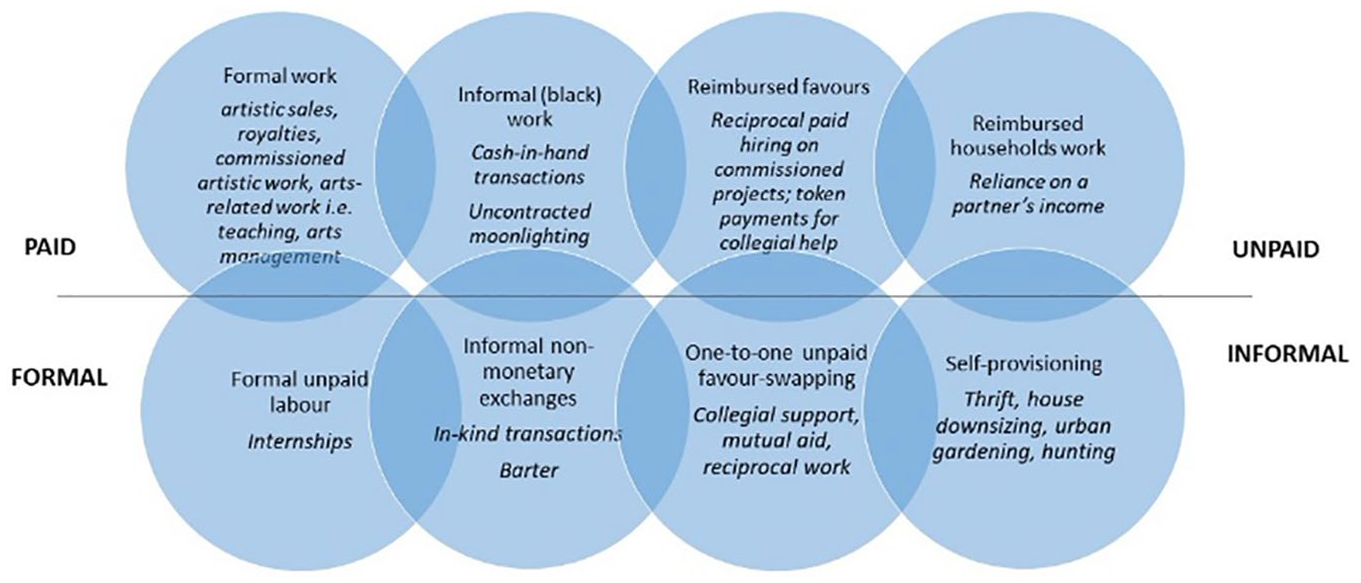
The spectrum of diverse formal/informal labour practices (adapted from Williams, 2011).
Although the informal economic and labour practices practised by our informants were heterogeneous, they were all embedded in everyday ordinary spaces of close intimate and proximate friendship, family, kinship and community ties and interpersonal attachments. Informal and alternative labour practices were thus not only strategic responses to protracted crisis but also enabled the circumvention of personal and household contractual debt, while enhancing deep relationality and a sense of community with the adjacent circuit of mutual obligations and reciprocity.
A prevalent mode of artistic work was informal (black) cash-in-hand work, work unregistered with the official tax and labour authorities, as well as informal unpaid work, work reimbursed with alternative currencies such as in-kind payments, and other forms of barter. Although driven by a clear profit rationale and income-generating logic, these informal paid and unpaid practices were immersed in close-knit local communities and considerations of collegiality. Elaborate relational infrastructures safeguard both the discretion and sustainability of informal (black) paid and unpaid economic exchanges.
Laura, a 29-year-old arts-educated artist, had a strong track-record of sales via a gallery with which she had no formal contract and therefore ‘no pension contributions’ and ‘no legal right to sue in case something goes south’. She got paid in cash when her paintings were sold and paid most of her bills in cash by ‘going to a physical bank counter once a month’. Despite the hassle of dealing with cash and waiving her worker’s rights, Laura still approved of the informal labour arrangement as a means of enhancing both relational, collegial and business ties: I don’t mind really that I have no contract with my gallerist. He’s been my gallerist for the past ten years. It’s all about trust. We’re a very small community here, so if you misbehave you’ll be ostracized, and no one likes that.
Kevin, a 45-year-old artist, was often paid in-kind in ‘all sorts of things’ in exchange for his artistic photography. Recently he was called by a publisher who ‘offered a computer in exchange for using five of his photos in a book documenting human trafficking’. The publisher was a computer producer sponsoring the publication and so ‘computers were the currency of the day’. In accepting a computer in lieu of a fee, Kevin not only felt he was self-centredly ‘filling in a technological lacuna’ in his life, since he ‘really needed a new computer’, but was also convinced that with this gesture he helped ‘an important book to be published that otherwise wouldn’t’.
Another frequent form of market-based non-monetary exchange was barter. Barter is an informal exchange between two parties who agree on a discrete commensuration of the objects or services being exchanged (Williams, 2011). Many informants considered barter to be a crucial practice that enabled them to keep going while capitalizing indirectly on their artistic pursuits and paying tribute to close relational ties within neighbourhoods and local communities.
Sandra, a 38-year-old artist, ‘traded’ her paintings ‘for some really expensive services’ after she had developed long-term relational ties as the basis for the exchange: I have an agreement with a dentist downtown that they don’t charge for my regular check-ups and for my three-times-a-year teeth cleaning. That’s an agreement that my ex-boyfriend arranged about ten years ago and it’s still valid. I show up there, no fee, and then the dentist who owns the practice comes twice a year to my studio and chooses an artwork.
Other informants bartered their artwork in return for second-hand clothing, dental interventions, psychiatric counselling, hairdressing, and even in some cases for their monthly rent. Barter most frequently happened in the guise of gift-exchange, however, as it was common in the Danish art community for artists to exchange artworks. Exchanging artworks as gifts between colleagues was perceived as a sign of friendship and mutual support and as contributing to a sense of community affiliation and appreciation. Although it was considered unacceptable to re-sell such gifts, some informants considered this practice to be an informal retirement saving and asset-hedging strategy, as exemplified by the account given by Jorgen, a 39-year-old artist: [When we exchange artworks] we’re just as appreciative of the art made by our fellow artists. We have to be more appreciative of art than others, so obviously we also like having art in our homes. That’s a good thing, but it’s also kind of a . . . what’s it called? You’re diversifying your assets. So instead of investing in a pension fund I have different artists’ works, and maybe one of them will become really, really famous in the meanwhile and then it will be worth like five million DKK [£550,000].
Besides such marketized and commodified forms of informal exchange, our informants also emphasized the prevalence of economic exchanges either wholly non-monetized or symbolically recompensed with minor fees. Williams (2011: 365) calls such labour practices ‘one-to-one unpaid work’, or reciprocal favour-swapping, that remarkably embody the total relational organization of work (Glucksmann, 2005). To maintain economic viability in the long run and to execute ever-lowly-paid commissioned formal work efficiently in the short run would be practically impossible for the majority of Danish artists if not for their widespread engagement in non-reimbursed relational labour practices like favour-swapping. One-to-one unpaid help was another instance of ‘wageless work’ (Denning, 2010) and ‘post-wage work’ (Van Dyk, 2018) in which mutual aid within the occupational community ensured the conviviality and sustainability of local artistic labour markets.
Specifically, many informants were able to stay afloat and forge a sense of belonging to the artistic community by relying on wageless work (Denning, 2010) entailing reciprocal exchanges of collegial favours. Oliver, a 42-year-old arts-educated visual artist, complained about ‘skimpy budgets’ for commissioned work and then reflected on the indispensability of close-knit collegial communities and reciprocal favour-swapping for carrying out ‘great’ artistic work ‘on the cheap’ (e.g. by borrowing and lending equipment at no cost, by co-sharing production, by regaling expertise, time and skill or offering services at a rate vastly incommensurable with the market value of labour, and by reusing materials from a colleague’s old installation): If I have a technical problem I can either employ a really high-paid technician or I can call one of my friends. I’ll call one of my friends who’s also in the same kind of precarious economic situation and who’ll help me out. If I need a projector I might be able to borrow it but not rent it. If I need a rehearsal space I’ll ask to borrow it, never pay. . . There’s a sharing economy that makes it possible to do projects with very little money. We’re all in it together.
Mutual aid however took place not only within occupational communities but within kinship and family, revealing the importance of middle-class belonging for artistic work (Friedman et al., 2017; Umney and Kretsos, 2014). Many informants reported tapping into relational resources for childcare, household maintenance and daily life management that freed them from incurring additional expenses while maintaining their desired quality of life and upholding all the after-work networking activities requisite for professional advancement.
However, the relational intimacies that made possible the diverse economies of visual artists also inadvertently reproduced and further accentuated the long-standing social inequalities immanent to artistic work. Olivia, a 47-year-old artist, reflected critically upon her self-professed ‘peculiar work’ of producing ephemeral, non-durable digital art that ‘doesn’t sell’: I’m able to work with peculiar art forms because I have a family that can lend me a couple of months’ rent if it goes really wrong. . . I come from a sort of upper-middle class background so I’m in a situation where if the refrigerator breaks down and we don’t have money I can simply borrow 2000 DKK [£220] from my mum.
Most of our informants self-identified as coming from middle or upper-middle class backgrounds, which self-reportedly allowed them to uphold artistic careers through unregistered gifts-of-money and wealth transfers from family members.
Alternative self-provisioning and everyday household activities as micro-financial strategies: Thrift, downshifting and sharing
At the most informalized and deeply relational end of the diverse economy spectrum are ordinary and mundane self-provisioning strategies linked to alternative and sustainable forms of consumption. From the interviews it emerged that such alternative self-provisioning strategies are actually micro-financial strategies motivated not only by fiscal necessity and the need to get by but also by relational considerations that made such alternative economic arrangements possible. A distinct system of shared cultural values and interpersonal connectedness emerged from the interviews.
Regardless of their level of symbolic or economic artistic success, our informants had resorted to alternative modes of consumption predicated avowedly on ‘minimalist lifestyles’. Sebastian, a 42-year-old arts-educated artist, expounded as follows on his strategies for keeping living costs low while increasing his ability to do artistic work: My spouse is an artist as well so we’re very used to living minimalistically. We live as if we were still students basically. It’s cheap rent and very low living expenses. No holiday, no new clothes. [. . .] we also have a garden, and though it doesn’t yield much but we don’t buy apples for example.
Sebastian ‘never buys new’ but ‘shares and recirculates his children clothes’ via neighbourly clothes swaps. He also swaps his ‘extra apples’ for ‘potatoes and tomatoes’ with friends. Such alternative provisioning has as much to do with minimizing costs as it does with strengthening conviviality and enhancing local relationships of good will and kindness.
A range of thrift practices emerged from the interviews. Thrift practices have been defined as ‘micro-financial strategies’ and ‘economising behaviour’ that entail ‘consuming wisely and resourcefully’ (Podkalicka and Potts, 2014: 228), not only as a response to conditions of material scarcity but also as an enjoyable and meaningful practice in itself (Holmes, 2019). Such behaviour is what Oakley and Ward (2018) have recently dubbed ‘sustainable prosperity’, i.e. living the good life by decoupling material consumption from the need to earn higher wages. Second-hand, discount and restricted shopping, reusing, mending and do-it-yourself practices, as well as more politically-engaged types of ‘voluntary simplicity’ and ‘downsizing’ (Schor, 1996), all surfaced in the analysis as fully-fledged labour practices. According to Glucksmann (2013), the (unpaid) work of consumers centred around the reuse, repurposing and recycling of consumer objects within the household represents a significant and growing component of the relational configuration of labour.
We met Nicolas, an arts-academy-educated 39-year-old artist, on a February morning in the spacious kitchen of a refurbished abandoned factory where he co-lived and co-worked with three other artists. When we arrived in time for the interview, we found him immersed in woodstove cooking. Nicolas earned his livelihood exclusively from ‘doing art’: ‘I’m an artist and this means I’m not rich; but you don’t have to be rich to survive well around here. You only have to be careful about how you spend the money.’ Aware that his artistic income would always be limited as long as he was intent on pursuing a full-time artistic career, Nicolas had developed elaborate practices of saving and curbed spending that ‘stretched the money’ and ‘milked maximum mileage out of the same money’. Nicolas has never bought new clothes, for example, but procured what he needed from a local flea market. He has always bought groceries on a discount, always checked the close-to-expiry-date rack in the discount supermarket first, and always bought in bulk because ‘it is cheaper’. Moreover, his thrift extended beyond restrained spending at the point of acquisition and permeated his mundane household activities such as cooking: As you can see, I cook. Mondays are dedicated to cooking. I now make four dishes to last for the week. When it’s ready I’ll put it in jars to store in the fridge. I haven’t eaten out in five years now. It’s cheaper to cook. It’s healthier, and of course nothing goes to waste as I use every single produce I buy. The leftovers are shared with my roomies. Plus cooking is a therapeutic activity for me. It makes me feel good.
For Nicolas, being thrifty was not only a matter of financial necessity but was also motivated by environmental concerns such as reducing waste, as well as ideas about leading a ‘good life’ (e.g. that cooking improves health) (see also Holmes, 2019).
Thrift as a practice of maximizing the value of money while at the same time minimizing environmental impact was evident in the way informants tried to extend the life of the objects they owned via repurposing, reusing and repairing. Caroline, a 43-year-old mother of two, was a full-time artist earning about £14,000 a year after tax. When asked how it was really possible to survive on so little money, she beamed at us and said: ‘By being extremely careful with money and overthinking every single purchase. Once you buy something you make it last.’ She used an ‘old bicycle’, avoided public transport and never owned a car; she refused to buy vegetables in the summer; she did gardening in an allotment and ‘had never thrown things out’. Caroline repaired and reused her stuff. She was forthright about the interlocking and sometimes conflicting values driving these thrift practices: I fix the bicycle myself. . . . See here! [pointing at her shirt] This shirt is made by combining two previously worn-out shirts. I have a sewing machine and do everything myself. [. . .] It takes time to do this but I believe it’s also good for the environment not to overspend on clothes that will eventually all end up in a landfill.
In addition to thrift practices flourishing in ordinary daily life, some thrift practices required a near complete makeover of lifestyles in order to dramatically reduce consumption and so radically minimize the dependence on formal labour markets such as, for example, downsizing the family home. For Kore, a 53-year-old artist, who had relocated to a much smaller abode outside of ‘disturbingly expensive’ Copenhagen, downsizing reduced the constant anxiety of having to work multiple jobs but increased the possibility to work in an environmentally-friendly and community-enhancing manner. Kore, used to sell his paintings ‘pretty well’ but never ceased to feel the pressure of ‘working more’. Ten years ago, ‘when all the stress became unbearable, and the work on art unsustainable’, Kore and his family of three ‘got rid of the big apartment’ in Copenhagen and escaped to a ‘small house’ in the countryside: It’s not about a faster car or a bigger house or a more expensive holiday. We realized that you can have a great life and do fantastic art without living in the city centre in a big house. We’re practically mortgage-free now. We’ve cut our living expenses threefold.
Conclusion
Drawing on a mixed method study, the article charts the diverse and heterodox array of informal, relational and alternative labour practices in which Danish visual artists daily engage in addition to formal paid work. By suggesting that heterodox economic activities constitute a vital component of artistic livelihoods, this article enriches the sociology of creative work with knowledge about how artists manage to persevere in their profession despite typically low and irregular formal income. The article thus contributes to the study of precarity in artistic/creative work by foregrounding the salience of the relational organization of labour and adjacent heterodox, diverse and alternative economies of work.
Creative work has frequently been defined as an archetype of precarity given widely documented high levels of unemployment, low wages and a widespread lack of regular and secure income (Bain, 2005; Butler and Stoyanova Russell, 2018; Standing, 2011; Umney and Kretsos, 2014). However, such definitions usually approach creative work as consisting exclusively of formal, registered and declared income and contractual employment. In contrast, following the TSOL approach (Glucksmann, 2005, 2009); this article has argued for the importance of approaching creative work across the separate socio-economic spheres, market/non-market, formal-informal, workplace/household as well as the integrated economic domains of production and consumption. When approaching work as tightly interwoven with everyday life, the relational organization of work becomes self-evident, with a range of alternative, self-provisioning and informal labour practices – including consumption work such as thrift or downsizing – emerging as central to sustainable artistic livelihoods beyond and above formal paid employment. A range of understudied ‘wageless’ (Denning, 2010) and ‘post-wage regimes’ of work (Van Dyk, 2018) thus appear to be the centrepiece of artistic work and as such necessitate further scholarly attention. This article offered initial empirical evidence that the wageless patterns of work, embedded in relational infrastructures and entangled with ordinary everyday life, are not only means to entrepreneurially combating financial hardship and staying afloat (i.e. by complementing meagre and irregular formal artistic pay), but also modes of embracing the feasibility of, and predilection for, alternative ways of working disjointed from market-based labour and contractual debt and aligned with personal, often anti-consumerist, visions of ‘good life’ and community affiliation. The article thus resonates with recent studies that have emphasized non-instrumental and care reasons for engaging in creative work (Alacovska, 2020; Banks, 2017; McAndrew et al., 2020) and argued that in artistic work meaning and a sense of purpose but also economic sustainability are generated beyond waged income.
Footnotes
Acknowledgements
The authors would like to express their gratitude to the members of Imagine. . .Creative Industries Research Center at CBS for their constructive feedback on earlier drafts of the manuscript. The editor, Alexandra Beauregard, and the three anonymous reviewers provided generous and thoughtful guidance for improvement for which the authors are extremely grateful. The participants at the NCCRP 2019 conference in Iceland kindly offered encouragement and inspiration that we gladly acknowledge. The authors are hugely indebted to the Danish visual artists who took the time to participate in our study.
Funding
The work on this article was supported by Statens Kunstfonds Projektstøtteudvalg for Billedkunst, Bikubenfonden and Ny Carlsbergfondet.