






Abstract
This article explores why some dismissed workers adapt successfully to the changing structure of an economy, while others remain trapped in low-quality jobs and experience deskilling. The associated case study relies on in-depth, semi-structured interviews with 50 former employees of four bankrupt radio-electronics factories in Lithuania. It is found that workers with ‘inherited’ skills that are deep and technical are able to enter high-quality jobs when new firms emerge, recombining the physical, financial and human assets of destitute factories for new productive uses. However, if such economic opportunities are scarce, workers with inherited broad skill sets are relatively more successful in transitioning to services from manufacturing. Further, in line with the literature of the sociology of work, women and older workers are found to face more acute challenges in adapting to the economic shock associated with dismissal.
Introduction
How do workers adapt to shifts in economic structures and why do some experience successful transitions on the basis of their previously acquired skills, while others get trapped in low-quality jobs and experience deskilling? To answer this question, the adaptation trajectories of former employees of the Lithuanian consumer radio-electronics sector are examined. The associated case study considers adaptation strategies under extreme conditions. The disintegration of Lithuania’s consumer radio-electronics sector took place during the country’s transition from a planned to a market economy, which was accompanied by a deep recession and persistently high unemployment. All major factories went bankrupt, making inter-firm movement impossible. At the time, labour market institutions were wholly underfunded and could not accommodate the transition (Cazes and Nešporová, 2003). Only 20–30% of the registered unemployed in Lithuania received unemployment benefits, and active labour market policies during the period from 1991 to 1998 were virtually absent (Gruževskis and Beleckienė, 1999).
The motivation for studying worker adaptation under extreme conditions is twofold. First, in line with the logic of critical case study, the mechanisms that support successful labour market transitions under the most unfavourable conditions should also be at play in less extreme circumstances. In this regard, a critical case study offers high potential to shed light on other cases of economic restructuring. Second, the absence of factors facilitating labour market transitions (such as an active labour market policy) allows us to control for their effects and, thus, to focus on the mechanisms of interest.
Conceptually, the case study aims to contribute to two debates. The first concerns the role of skills specificity in economic transformation. Following human capital theory, the transition economics literature argues that labour reallocation from declining manufacturing in post-socialist countries was hindered by high levels of skills specificity: dismissed workers faced unemployment and inactivity because their ‘inherited’ technical skills were of little use beyond their former jobs (Lamo et al., 2011). However, such a treatment of skills and labour market outcomes is rather mechanical. Therefore, a skill-weights approach (Lazear, 2003) is used as a basis to explore how different combinations of the skill sets developed in the bankrupt factories subsequently evolve as the dismissed workers follow different adaptation trajectories.
The second debate to which the article aims to contribute concerns the sociology of work and the effects of regime change on the career trajectories of different demographic groups (see Gerber and Mayorova, 2006); in particular, to fill the gap identified by Kosyakova et al. (2015: 584) in relation to missing evidence for the long-term consequences of regime-related shifts in life-course inequalities by investigating longer career trajectories in post-socialist countries. The intersectional approach (e.g. Huppatz and Ross-Smith, 2017) is used as a basis and advanced by introducing the skill dimension as well as building upon the work of Bowman et al. (2017), which examines how class, gender and age intersect to structure experiences of marginalization. The interplay between the skill set, age, gender and education of workers is explored, as well as how this affects adaptation to economic change. In particular, this study aims to enrich the literature on the sociology of work by providing evidence pertaining to the rare enquiry (Gerber and Mayorova, 2006; Kosyakova et al., 2015) into the dynamics of worker segregation in terms of gender differences and inequalities.
The case study focuses on the labour market transitions of former employees of the four largest Lithuanian radio-electronics factories that went bankrupt during the economic transition: Banga, Ekranas, Tauras and Vingis. It relies on 50 in-depth interviews.
This article is structured as follows: the next section provides background information on the economic transition in Lithuania, its radio-electronics sector and the four main factories that operated therein. How workers’ labour market adaptation following the economic shock should be conceptualized is discussed. The following section presents data collection and analysis methods. The fourth section reports the results of the case study, while the last one discusses the findings and their implications.
Deindustrialization and worker adaptation trajectories in a post-Soviet regime
Economic change and the Lithuanian electronics industry
Lithuania is a post-communist Central and Eastern European (CEE) country. Prior to transition, its economy was characterized by central planning, an oversized manufacturing sector, large state-owned enterprises and tight integration into the supply chains of the Soviet Union. In the mid-1980s, metalworking and the manufacturing of machinery for metallurgy accounted for a quarter of industrial production. Radio-electronics, a subsector of metalworking, was a cornerstone of high-tech manufacturing in Lithuania. This subsector supplied components for the military industry and produced consumer products. Four large enterprises, constituting the main focus of this article, operated in the four largest Lithuanian cities and formed the backbone of the consumer radio-electronics sector (Table 1).
Key facts for the radio-electronics factories.
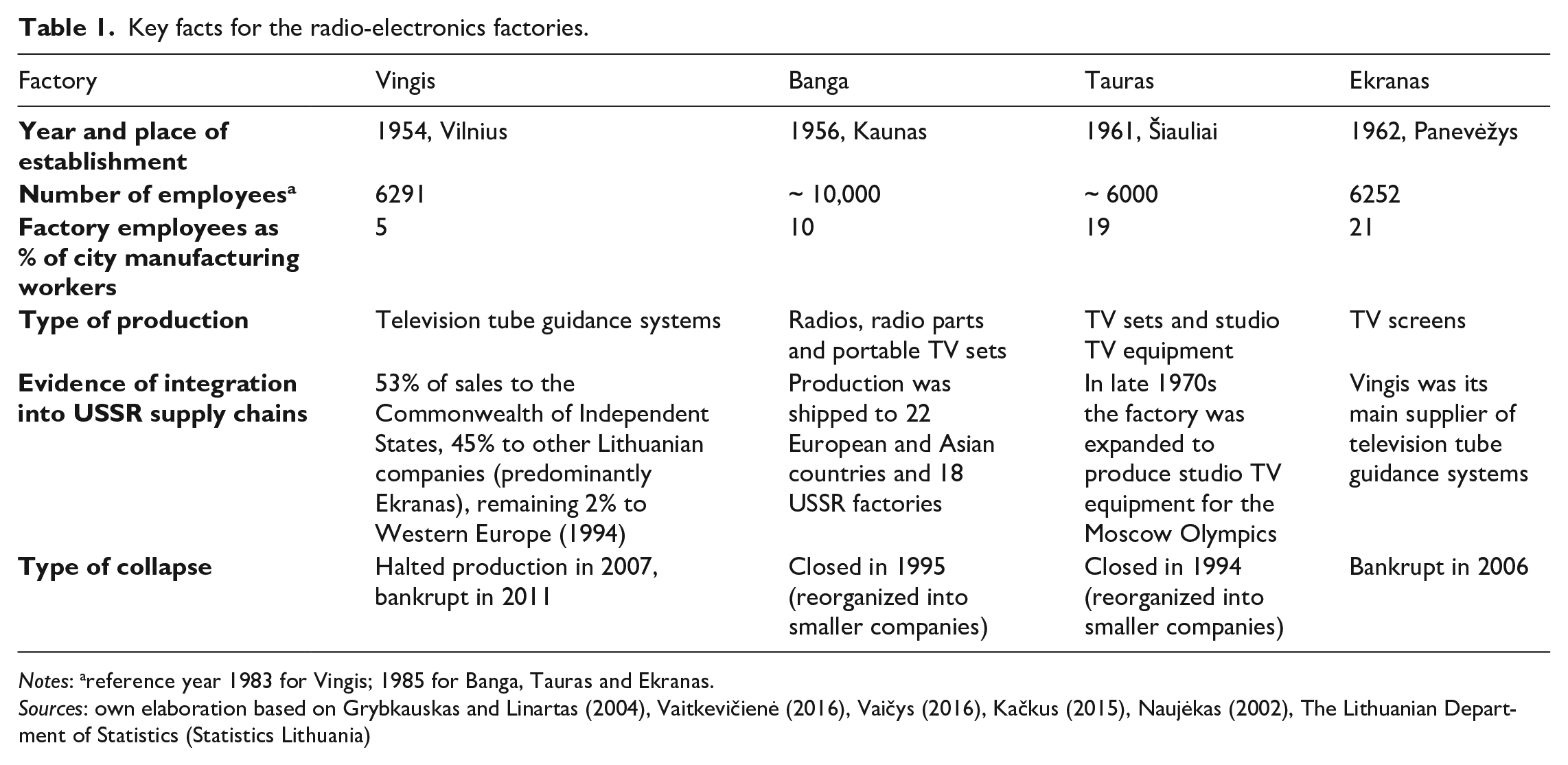
Notes: areference year 1983 for Vingis; 1985 for Banga, Tauras and Ekranas.
Sources: own elaboration based on Grybkauskas and Linartas (2004), Vaitkevičienė (2016), Vaičys (2016), Kačkus (2015), Naujėkas (2002), The Lithuanian Department of Statistics (Statistics Lithuania)
Planned economies ensured full employment: every adult was obliged to work, while factories had incentives to hoard labour. Hence, workers developed deep-rooted expectations of ‘permanent’ employment (Žilinskienė et al., 2016). Planning of human resources meant that vocational education and training (VET), as well as higher education institutions (HEIs), trained the workforce for specific occupations in particular industries (sometimes even in a specific company). For the radio-electronics sector, VET and HEIs provided highly specialized programmes, mainly in radio technology, radio construction, radio-electronic engineering and the production of radio-electronic machinery. These skills were further developed during on-the-job training and long tenures within a company.
In 1990, Lithuania declared independence and started the transition from a planned to a market economy. The early transition literature (e.g. Åslund, 1994) argues that, once unleashed, market forces would smoothly reallocate capital and workers from unproductive state-owned enterprises to new firms. However, Lithuania’s transition involved a sharp and prolonged economic decline, accompanied by deindustrialization. Blanchard and Kremer (1997) explain this as a result of a suboptimal speed of transition. Initially, output dropped, unemployment and inactivity increased due to the large-scale disorganization of supply chains, the pricing system and the collapse of the financial system. The second phase of the transition, which started around 1995, involved stabilization and improvement of macro-economic conditions, as well as the growth of output and employment in the newly emerging private sector. During the first five years of transition, employment in manufacturing in Lithuania halved. While manufacturing growth resumed in 1995, manufacturing employment has never returned to pre-transition levels (Figure 1).

Employment levels, total and manufacturing sector, in Lithuania (1989–2008).
The restructuring efforts of the four largest factories of consumer electronics showcased broader trends of deindustrialization. Initially, Ekranas and Vingis were the success stories of transition. They attracted investment from Western manufacturers (Phillips and Samsung, among others), which facilitated modernization of production lines as well as ensured access to suppliers and markets. However, by underestimating the importance of new technologies (LCD and plasma screens), Ekranas – a producer of traditional TV screens – lost its market share and in 2006 went bankrupt. Because Ekranas was its main customer, Vingis followed suit. Ekranas was liquidated and its assets were sold at auction, while Vingis was able to establish several spin-offs before its liquidation.
The other two factories, Tauras and Banga, were dissolved during the early stages of transition (in 1994 and 1995, respectively). They were forced into bankruptcy because of disruptions in supply chains and difficulties in finding new markets. Banga was split into seven smaller units that were auctioned off as separate companies; these spin-offs reutilized the warehouses and manufacturing infrastructure for new production uses (e.g. manufacturing of wire products, chains and springs, plastic moulding, galvanization of metal, channel selectors). Similarly, Tauras was split into 12 smaller companies that used the ‘inherited’ infrastructure to, for instance, repair radio-electronic equipment and produce water-heating systems (Vaičys, 2016). Most of the spin-offs from Tauras and Banga remain in business, although they are considerably smaller and less knowledge-intensive than their ‘mother’ companies of the 1980s.
The diverse paths of these four enterprises are puzzling from the perspective of transition economics, which emphasizes the importance of foreign direct investment to technological upgrading and access to global value chains. However, in this particular context, the most successful companies are found to be the locally bred spin-offs from Tauras and Banga that managed to enter similar yet distinct markets. This might be explained in terms of the evolutionary economic geography literature, which argues that successful firms have a critical reliance on locally embedded complementary assets (such as networks of specialized suppliers and the skills of the labour force) (Neffke et al., 2018). As a response to external shock, such firms recombine these assets for new productive uses, captured by the concept of ‘related variety’ (Frenken et al., 2007). This change is path-dependent because the recombination of assets already present in declining industries provides a means by which to establish a competitive advantage in new sectors or firms (Neffke et al., 2018). Thus, examples of successful redeployment of assets from declining industries to emerging ones include the diversification of the US radio industry into the production of television receivers (Klepper and Simons, 2000). The relatively successful ‘heirs’ of the Lithuanian consumer electronics industry diversified similarly into other related sectors that relied on local assets (e.g. privatized workshops and local supplier networks). By contrast, Ekranas engaged in technological modernization and successfully entered global supply chains, but remained within the same core subsector (production of traditional TV screens) and eventually faltered as a result of technological shock.
Given this context, the principal question is how and why former workers of the four factories have adapted to such protracted economic change, and the concepts and theories used to address this are discussed in the following section.
Conceptualizing workers’ adaptation trajectories in response to structural change
Transition economics has focused on employment and activity rates to assess worker adaptation to structural change (e.g. Cazes and Nešporová, 2003). However, such static measures cannot adequately convey the dynamic nature of adaptation trajectories. By focusing on the quality of transitions, the theory of transitional labour markets (Schmid, 2017) provides a more fruitful approach and distinguishes between three broad adaptation trajectories (O’Reilly, 2003). First, integrative trajectories are characterized by a sequence of jobs that act as ‘stepping stones’; that is, they result in improved productivity, incomes, status and career prospects by utilizing previously acquired skills and providing new ones (e.g. through on-the-job training). Second, exclusionary trajectories are viewed as ‘traps’, with poor-quality, precarious jobs interrupted by periods of unemployment and inactivity. ‘Traps’ erode human capital as previously acquired skills fall into disuse and lose value over time, which further diminishes career prospects. The third class of adaptation trajectories are characterized as bridging, where a sequence of jobs requires similar levels of skill but of different types; that is, reskilling – the acquisition of new skills as previously acquired but currently unused skills are deprecated.
What would cause dismissed workers to gravitate to one of these three adaptation trajectories? The skill-weights approach, the sociology of work and the transition economics strands of the literature point to the different starting positions in terms of the mix of previously acquired (‘inherited’) skills (e.g. Lazear, 2003) and personal demographic characteristics; in particular, age (Koeber and Wright, 2001), gender (Duncan and Loretto, 2004; Kosyakova et al., 2015) and education (Lehmann et al., 2005).
The skill-weights approach (Lazear, 2003) aims to explain how different skill mixes acquired in previous employments can affect subsequent career moves. It argues that work is composed of multiple tasks and each of these requires skills of different depths. Accordingly, skill sets may be represented in terms of their breadth and depth. Breadth refers to the number of skills an individual possesses and is usually linked with the multiplicity of tasks the individual has to perform; depth refers to the level of mastery, experience or knowledge required to carry out a task. For example, photonics technicians rely on a narrow set of deep skills (e.g. engineering, mathematics and electronics), while canteen cashiers use a larger number of more shallow skills (e.g. basic mathematics, customer service).
The depth and breadth of skills acquired in previous employments are likely to have diverse impacts on workers’ adaptation trajectories according to the mode of economic restructuring. If this involves a radical shift from old to new sectors/firms, broader skill sets are likely to facilitate a more successful adaptation: the larger the number of skills an employee has previously acquired, the higher the likelihood that at least some of them can be put to productive use in the ‘new’ economy. Thus, a canteen cashier is more likely to be able to transfer skills to other occupations or sectors than a photonics technician. However, if restructuring capitalizes on skills-relatedness among industries on the basis of the notion of related variety, complementary deep skill sets are more likely to provide access to high-quality jobs. Because such skills are rare and expensive to acquire, they could constitute an important element of competitive strategies for diversifying firms. Accordingly, the availability of photonics technicians may offer a vital advantage to new firms relying on a similar body of knowledge, with such firms being more likely to provide jobs that act as ‘stepping stones’ to photonics technicians than to canteen cashiers.
The types of ‘inherited’ skills and the opportunities to effectively redeploy them after dismissal should differ significantly by age, gender and education. Older dismissed workers spend considerably longer in unemployment, and their subsequent jobs, if found, tend to be of lower quality and to underutilize previously acquired skills, as documented in studies on both advanced capitalist (Gabriel et al., 2013; Koeber and Wright, 2001) and transition (Turek and Henkens, 2019; Tyrowicz and van der Velde, 2017) economies. This could be attributed to differences between the skill sets of younger and older cohorts of workers. The latter tend to have lower levels of qualifications, their skills are more intricately linked with technologies and work organization practices that were prevalent at the peak of their careers, and they are over-represented in industries facing decline (Lippmann, 2008). However, much of the difference in previously acquired skills between age cohorts may not necessarily be genuine, but embedded in discriminatory attitudes and practices. Nevertheless, Turek and Henkens (2019), among others, show that older dismissed workers find it more difficult to re-enter high-quality jobs as a result of perceptions that their skills are outdated in a fast-changing labour market, and that they are less trainable and more averse to change. Furthermore, older workers are more likely to be traumatized by job loss because they ‘tend to anchor their identities and values on their working lives and career success’ (Gabriel et al., 2013: 58); disillusionment and depression negatively affect a worker’s sense of self-worth and impede their willingness to search for a meaningful new job.
Gender may also explain different adaptation trajectories. In the Soviet education system, men were channelled towards VET and to natural sciences and engineering at higher levels of education, whereas women were concentrated into more academic tracks in general education and into social sciences, humanities and medicine at HEI level (Gerber and Schaefer, 2004). As a result, women were over-represented in services, as well as in blue-collar low-skilled occupations requiring manual dexterity in industry, whereas men tended to take up jobs in manufacturing, particularly in engineering and skilled manual occupations (Gerber and Schaefer, 2004). Thus, vertical segregation also led to horizontal segregation (Kosyakova et al., 2015) because the remuneration and social prestige of skilled jobs in manufacturing were considerably higher than those in services or low-skilled industry occupations in the planned economies. This also suggests that women tended to develop shallower and broader skill sets, whereas men acquired deeper and narrower ones. Accordingly, it is anticipated that women dismissed from manufacturing jobs with broad and shallow skills should be relatively more successful in adopting bridging trajectories and taking up jobs in services, although such trajectories could be derailed by gender-based stereotypes and discrimination and by family care responsibilities, as well as the real or perceived irrelevance of the manufacturing skills of older women in relation to the new service economy. For dismissed men with deep and narrow skills, successful adaptation would depend on the availability of new manufacturing jobs that could make use of their ‘inherited’ skills.
To sum up, an interplay of factors – types of previously acquired skill sets, the structure of economic opportunities, and age, gender and education – are likely to push dismissed workers towards divergent labour market adaptation trajectories. Thus, dismissed workers with deeper ‘inherited’ skills (here, typically male) could adopt integrative trajectories if their deep skills were a source of competitive advantage for the newly emerging firms. Where such opportunities are not available, workers with deep and broad skill sets (also typically male) could be expected to pursue careers in services, while those with deep and narrow skills would likely become trapped in precarious low-quality jobs. Further, dismissed workers with shallow and broad skill sets (here, typically women) may be the most likely to adopt bridging trajectories by seeking employment in services or else to become trapped in poor-quality jobs, particularly if faced with gender discrimination and/or having ‘inherited’ skills that are shallow and narrow. Lastly, it is anticipated that dismissed older workers might be trapped in exclusionary trajectories.
Methods
Data collection and sample
The case study is based on data from 50 semi-structured interviews with former workers of the four largest factories in radio-electronics: Banga, Ekranas, Tauras and Vingis. Stratified purposive sampling was applied to construct the study sample. All 50 interviewees worked at the enterprises prior to the start of transition in 1989 and their employment terminated before or during the bankruptcies of the factories; that is, between 1989 and 2005. Because complete employment records for the factories were not publicly available, the first subset (nine interviewees) was identified from factory publications. The remaining respondents were reached via chain sampling. The diversity of the sample was ensured by looking for study participants that would establish respondent variety in terms of gender, factory, occupational level and the major structural units of a typical radio-electronics factory (Table 2), with most effort needed to find female and worker-level respondents for the study to produce a reasonably diverse final sample.
Stratified purposive sampling criteria used during data collection.
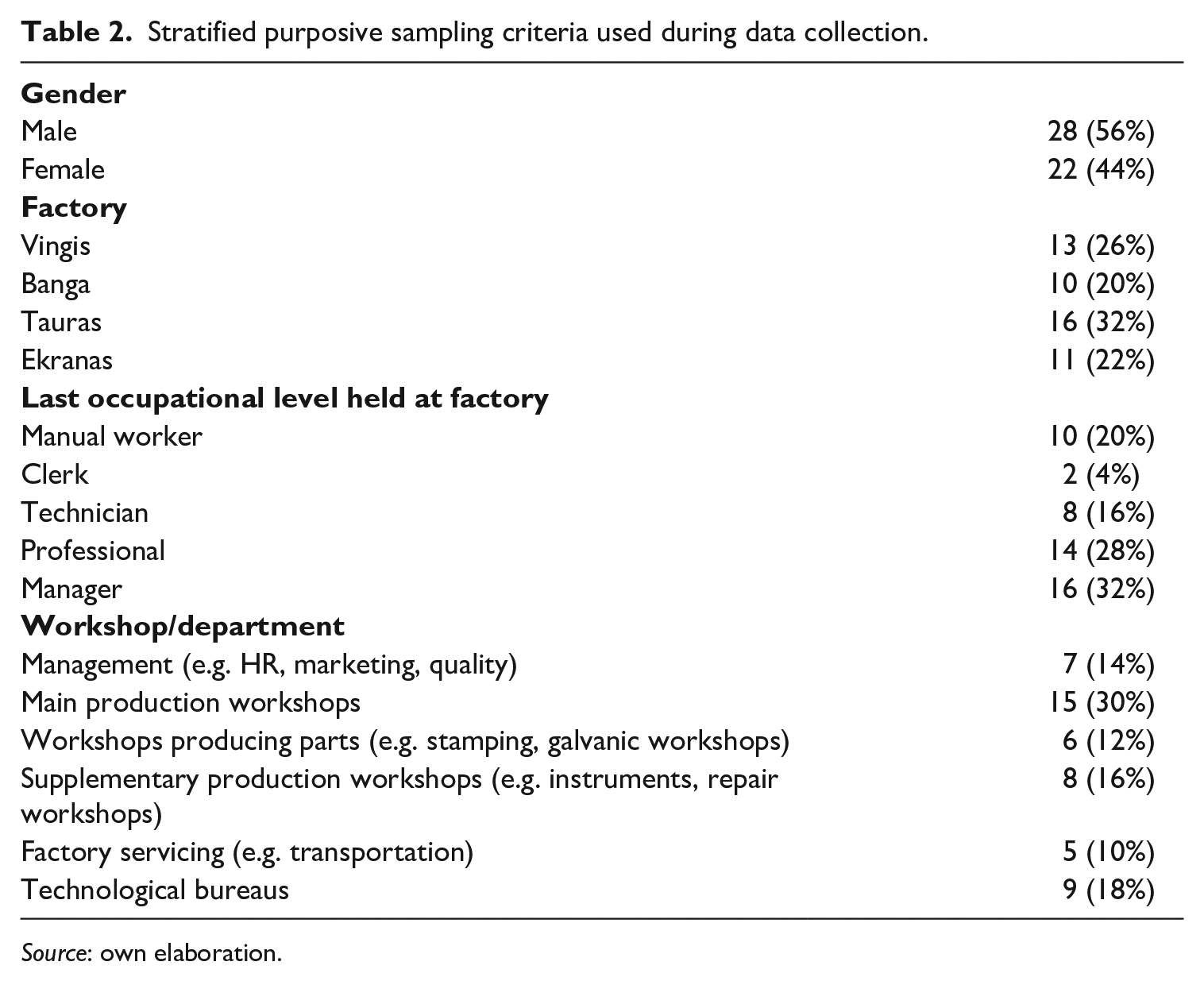
Source: own elaboration.
The interviews were carried out between September 2017 and March 2018 and conducted face-to-face (a majority) or by phone. The 50 in-depth interviews generated over 30 hours of recorded data, with most interviews lasting between 30 and 80 minutes. All respondents gave signed or, in the case of phone interviews, verbal informed consent.
Researchers followed detailed interview protocols that contained an introductory script with details of the research and instructions regarding consent forms and recording. Similarly to Gabriel et al. (2013) and Gardiner et al. (2009), who used individual biographies to explore adaptation to change, the interview questionnaire covered the following topics: educational background, career track before and during employment in one of the four factories (including first occupation, career progression, types of tasks performed and the most important skills used to perform the tasks), and labour market trajectories after dismissal (including experience in finding a new job and/or occupation and career progression, as well as types of tasks performed and skills used in new jobs). All interviews were conducted and transcribed in Lithuanian; quotations were translated into English for the purposes of this article. An overview of the participants is presented in online Appendix 1.
The interviewees primarily represent ‘survivors’ of economic shock. However, they provided anecdotal evidence of former colleagues who migrated, dropped out of the labour market and/or social networks, engaged in anti-social behaviours, or died. This does not, per se, affect the analysis of adaptation trajectories; however, future studies, subject to availability of data, should also explore failures to adapt.
Data analysis
All of the interviews were transcribed, and the data were analysed using a directed content analysis approach. This technique is particularly appropriate when prior research exists about a phenomenon, providing predictions about the variables of interest and relationships between initial coding categories (Hsieh and Shannon, 2005). The analysis was carried out in several steps, as delineated by Neuendorf (2017, 2018). First, the variables to include in the study and their conceptual definitions were identified, derived from theoretical expectations; in particular by juxtaposing the literatures of the sociology of work, transition economics and economic geography, as discussed above. Second, the variables were operationalized to match the theory-led conceptualizations and establish a coding scheme (Hsieh and Shannon, 2005). A codebook was created consisting of variable definitions and keywords by which to measure those variables, whose conceptualizations are described in the following paragraphs. Third, a pilot of inter-coder reliability assessment was performed to cross-check whether the codes assigned by different coders matched (Neuendorf, 2018). The codes assigned to nine out of 10 randomly selected respondents matched perfectly, and for the remaining respondent there was a disagreement on the coding of just one variable, which suggested high reliability. As a last step, the remaining cases were coded; the overview of the codes assigned to each participant is provided in online Appendix 1.
The first set of variables were generated from the literatures on sociology of work and transition economies and included basic socio-economic categories, such as age (date of birth and age at which respondents left the factory), gender and education (in terms of highest educational level attained and field of study). The factory at which respondents worked was also recorded.
To infer the depth and breadth of the ‘inherited’ skills of respondents, the main focus was placed on the tasks they performed prior to dismissal. In line with the skill-weights approach of Lazear (2003) and Christenko et al. (2019), depth of skills is defined as the level of mastery required to perform a task. To assess this, respondents were asked the following questions: Did performance of the task require specialized knowledge beyond that acquired in primary/secondary education? How long does one need to practise in order to perform the task in the correct way? Based on the answers, the ‘inherited’ skills of respondents were coded as either deep or shallow. Overall, prior to dismissal, most interviewees had deep skills regardless of their occupation; that is, deep skills were a common characteristic of both blue- and white-collar workers.
Breadth of skills is understood as the number of different tasks that a respondent’s job encompassed. Assessment relied on the following questions: What were your main responsibilities or tasks in the job? What type of knowledge/skill was necessary for each of these tasks? Respondents’ skills were coded as broad or narrow accordingly. The results suggest that a roughly equal proportion of interviewees had narrow skills as had broad skills. Figure 2 describes the characteristics of ‘typical’ profiles of ‘inherited’ skills of respondents across the matrix for the depth and breadth of skills. The codings for the depth and breadth of skill sets of individual respondents largely corresponded to expectations regarding their distribution by occupation (see Appendix 1 in the online supplementary material); that is, managers having deep and broad skills, technicians and skilled blue-collar workers having deep but narrow skills, and so on. This correspondence provided support for the coherence of the type of data collected and the validity of the results derived through the coding procedures.
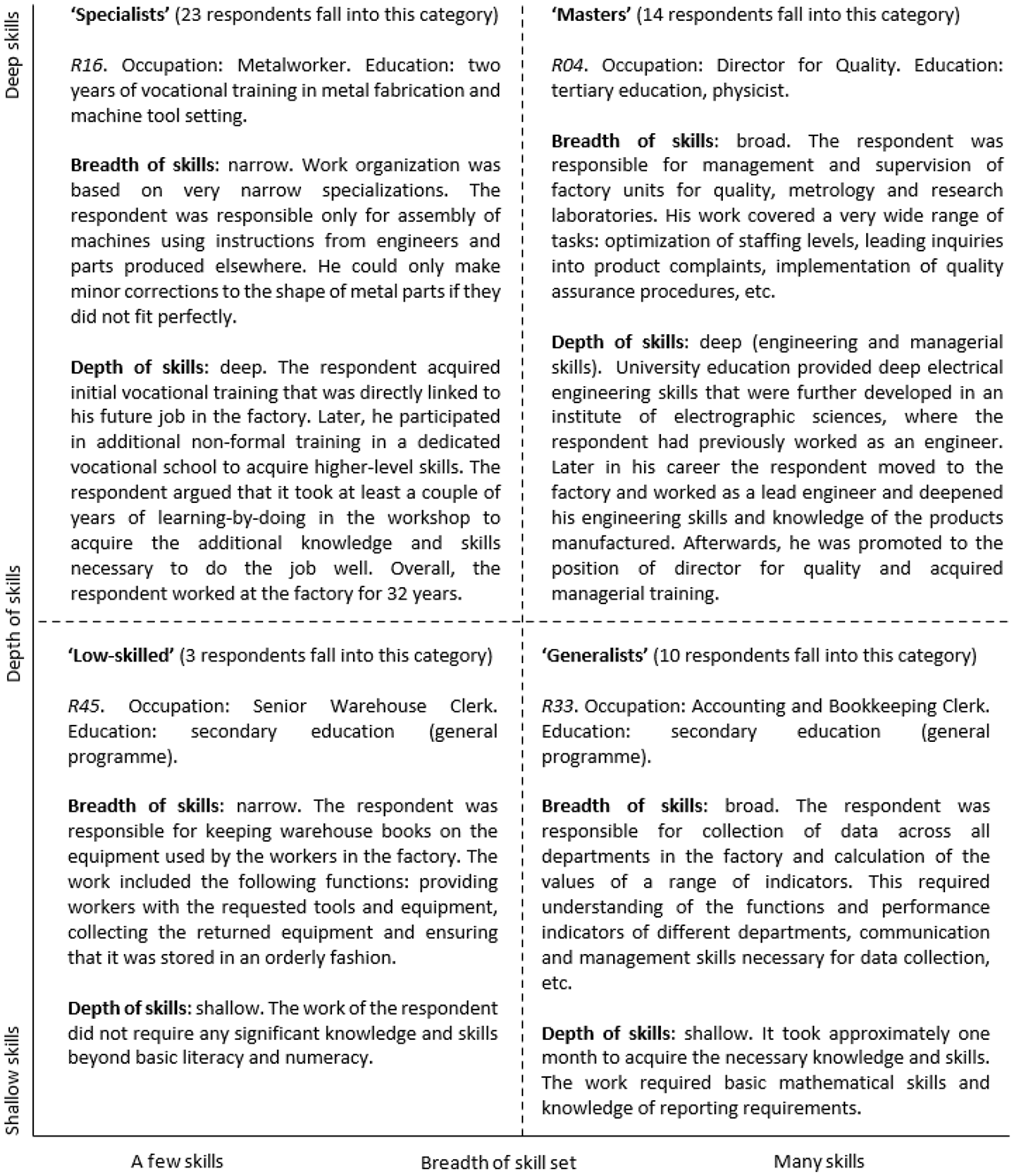
‘Typical’ cases across the skill matrix.
The coding of the emergent adaptation trajectories after dismissal focused on comparing the job titles, economic sectors and tasks carried out by participants in their occupations prior to dismissal with those of their occupations (if any) after leaving the four factories. Because most career moves were non-linear, it was sometimes difficult to ascertain a specific trajectory. Hence, the analysis also focused on adaptation over longer time periods: from leaving the factory in question to the date of interview, or retirement if sooner. On the basis of transitional labour market and economics literature, O’Reilly’s (2003) work was followed, with analysis aimed at assessing the extent to which (multiple) job changes required broader/deeper skills in comparison to previous positions and led to stable, high-quality employment with opportunities for career advancement; such trajectories were categorized as integrative. Job changes that led to poor-quality, irregular employment with low skill requirements were categorized as exclusionary trajectories. Transitions that made use of only a subset of previously acquired skills and largely involved reskilling were coded as bridging trajectories.
Lastly, the links between ‘inherited’ skills and subsequent adaptation trajectories were investigated across different configurations of factors, such as respondents’ demographic characteristics.
Findings: Adaptation trajectories of dismissed workers
The presentation of findings is structured around two questions. First, why have some respondents adapted relatively successfully following the disintegration of their factories; that is, have they gravitated towards integrative and bridging trajectories? The answer to this question depends on analysis of the interplay between types of ‘inherited’ skills and the structure of economic opportunity. Second, why did some workers get trapped in exclusionary trajectories despite having similar skill sets and facing similar economic opportunity structures as their more successful colleagues? The answer to this question involves exploration of the effects of age, gender and education. The two subsections that follow consider these questions in turn.
Integrative and bridging trajectories: The interplay between mode of economic restructuring and types of ‘inherited’ skills
Integrative trajectories
Integrative trajectories were predominantly followed by younger workers, typically male, with deep skills ‘inherited’ from three of the four factories: Banga, Tauras and Vingis. The mode in which the factories disintegrated opened up opportunities for workers with deep skills. Thus, for example, Banga and Tauras disintegrated into multiple spin-offs in the mid-1990s. As these two enterprises were crumbling, some entrepreneurially minded workers – usually workshop managers – saw an opportunity to privatize and restructure their workshops. These new companies had to enter new markets because the old ones had shrunk. Some of these spin-offs entered markets for similar products, such as channel selectors, TV signal receivers and antennas and wiring systems. Others migrated from production to repair and maintenance services. The competitive advantage of these spin-offs relied on relatively scarce technical know-how ‘inherited’ from the destitute factories.
The most radical diversification trajectory was adopted by a former workshop of Tauras. Previously, it had manufactured and installed equipment and production lines for the factory. Its manager privatized the workshop and spotted unmet demand for boilers and other heating systems. The new company largely relied on the same metalworking equipment and skills, but entered completely different markets (Respondent no. 8; hereinafter ‘R8’).
Some workers dismissed from Banga and Tauras moved directly into such spin-offs upon invitation from the workshop managers who became company owners: technical skills and work ethic being among the key selection criteria for such invitations (R41). Their early years were very turbulent, with irregular salaries and unclear prospects. However, the companies offered ample learning-by-doing opportunities as a result of the adoption of new technologies and entry into new markets (R18). Former engineers not only built upon their deep skills but also broadened them as they moved into managerial positions (R19).
Other former Banga and Tauras workers faced a more turbulent adaptation, some eventually entering an integrative trajectory. Initially, upon dismissal, they faced unemployment, inactivity or took up low-skilled jobs, such as taxi driving (R3). This proved a very stressful experience, in some cases leading to alcoholism and depression. Finding other meaningful jobs was difficult because thousands of workers were simultaneously dismissed to a labour market already characterized by high unemployment. Furthermore, unemployment protection was virtually absent and very few respondents registered as unemployed. Instead, they relied on social networks – former colleagues, family and friends – to look for jobs. As the spin-offs from Banga and Tauras expanded in the late 1990s, some of these respondents were rehired because their deep technical skills were in high demand, enabling escape from an exclusionary trajectory into an integrative one, because such jobs typically offered high-quality employment with upskilling pathways.
While only some of the workers dismissed from Banga and Tauras gravitated towards integrative trajectories, most of the former employees of Vingis interviewed did so. Two mechanisms account for this: first, before production was halted at Vingis, its metalworking workshop was sold as a separate company and retained most of its employees. An interviewee recalled this being a smooth process, which hardly felt like a transition: ‘everything stayed the same, only the name changed’ (R16). Second, the dismissed workers of Vingis faced relatively smooth transitions because the company halted production in 2007 – a decade later than Banga and Tauras – during an economic upswing and in a (capital) city that had a high density of similar economic activities. The deep engineering, metalworking and wiring skills, among others, of these workers meant that they were sought out by other companies, which manufactured, for example, medical equipment (R38, R39), packing materials and automation systems (R4). This suggests that a high concentration of similar co-located companies can produce similar opportunities for integrative trajectories to the diversifying spin-offs of Banga and Tauras, in line with the literature of economic geography.
These integrative re-employment paths are dominated by men, who acquired deeper skill sets prior to dismissal than women. Men could also be in this more favourable position as a result of gender-based discrimination, as reported by Pollert (2003) in a study of re-employment pathways in other post-communist countries. Younger workers (in their 30s or early 40s at the time of dismissal) also followed integrative pathways more easily, which may be because younger workers tend to hold lower psychological attachments to lost jobs and are generally more optimistic about new opportunities following dismissal.
Bridging trajectories
Some former workers from all four factories followed bridging trajectories, but this was particularly prevalent among former employees of Ekranas. In fact, virtually none of these latter gravitated towards an integrative trajectory and it appears that a bridging trajectory was the most positive outcome for them. In consequence, these employees are the focus of the discussion that follows.
Once a beacon of successful restructuring and the largest employer in a mid-sized town (approximately 100,000 inhabitants), Ekranas went bankrupt rather unexpectedly in 2006 and did not generate any spin-offs. This occurred during an economic upswing, when there were multiple vacancies available in the labour market and generous unemployment insurance. However, high-quality manufacturing jobs that would utilize previously acquired skills were scarce. Hence, the former employees interviewed described a troubled, non-linear path of adaptation. Those possessing deep skills first attempted to find jobs in manufacturing. Eventually, many of them either became unhappy with their new employment conditions or the companies involved went bankrupt following the global financial crisis of 2008. In these unfavourable circumstances, broad ‘inherited’ skills rather than deep ones proved more of an asset. Five interviewees with deep and broad skills explained that they had to reskill in order to find reasonably good employment in the services or public sectors. To successfully adapt to their changed job profiles, interviewees recalled relying on more general interpersonal, management and critical thinking skills, as well as their ability to learn quickly. In their cases, deep technical knowledge acquired during formal education and on the job was all but destroyed. Although their new jobs were stable and relatively well-paid, the interviewees described them as boring (R1), uninteresting (R28) or ‘dead-end’ (R29).
Some of the workers dismissed from other factories (i.e. besides Ekranas) also followed bridging trajectories. Workers undertaking such paths were, on average, older than those following integrative trajectories and were, primarily, younger women, who capitalized on previously acquired broad skill sets to move from manufacturing to services.
Exclusionary trajectories: The interplay between ‘inherited’ skills and worker demographics
Despite encountering similar structures of economic opportunity, a large proportion of respondents did not gravitate towards either of the adaptation trajectories described above. Instead, upon dismissal they took poor-quality, low-skilled jobs (e.g. in retail, cleaning) interspersed with periods of inactivity and/or unemployment. In addition to shallow and narrow skill sets, most had lower levels of educational attainment, with close correlations to gender and age.
Thus, men and women tended to follow different adaptation trajectories as a result of unequal starting positions in terms of acquired education and career opportunities. Overall, female respondents reported broader skill profiles and lower levels of education. Male respondents tended to possess deeper skills and, in line with previous studies (e.g. Rimashevskaia, 1992), were more successful at climbing the career ladders within their factories. Gender differences permeated educational attainment for at least two reasons: first, prior to transition, tertiary education institutions informally prioritized men over women (Žilinskienė et al., 2016); second, women more frequently felt obliged to drop out or forgo higher education in order to start and/or take care of a family, as one interviewee explicitly stated (R31). This result provides further evidence of a generalized gender inequality common to other post-Soviet economies (e.g. Gerber and Mayorova, 2006; Pollert, 2003).
In addition, many factory occupations were traditionally regarded as either more ‘male’ or more ‘female’. Thus, positions in management and engineering were predominantly occupied by men; a former workshop manager recalled that of approximately 50 managers participating in strategic governance of her factory, only three were women (R24). Similarly, mid-level managers and supervisors were more likely to be female, while engineers tended to be male (R20). Manufacturing supervisors were responsible for organizing the work of a production line during a shift, a job which required broad interpersonal skills because it involved a lot of interaction with workshop workers. As such, the positions were seen as a better fit for women. Conversely, any higher specialist- or management-level position that required deeper technical skills was viewed primarily as a ‘male’ job. Thus, when a female respondent was offered an engineering position at a prototyping bureau, she declined for reasons of social appropriateness, despite having had relevant training: I had not even graduated, the construction bureau already wanted me as an engineer [. . .] I somehow felt uncomfortable. I thought ‘why me, others were as good as I was’ and I declined. (R40)
Upon dismissal, women tended to take up lower-quality jobs in services and, in particular, those requiring lower levels of skills, such as caretakers, salespersons and clothing sorters (R26, R43, R48). By contrast, male respondents tended to search for jobs in manufacturing (particularly in the spin-offs) that would make best use of their ‘inherited’ skills. Those males who willingly transitioned to services entered the sector during the early stages of transition with an entrepreneurial attitude and expectations of lucrative financial returns (R4, R19, R35).
Age also played an important role in adaptation trajectories. Following dismissal, younger respondents reported strong determination to keep searching for high-quality, high-skilled jobs, frequently changing jobs until they found satisfactory positions, and thus avoiding exclusionary trajectories (R30, R34, R39). The trajectories of older respondents depended on their perception of the value of their ‘inherited’ skills and the opportunity of finding a similar high-quality job. For example, one respondent decided to continue working for several years beyond retirement age because he had found it relatively easy to obtain a job that relied on his previously acquired skills: When I was laid off in 1996, I was eligible for a pension. But it was very boring [. . .] So, I found this workshop that continued small-scale production of studio equipment. (R11)
However, others had a dim view of the opportunities to re-employ their previously acquired skills, arguing that they were not young enough to ‘run around changing jobs’ (R48), that ‘no one needs older workers’ (R45) and that reskilling was not attractive because ‘adventures became boring after 20 years’ (R12). Such responses may be the result of older adults feeling that it was too late to learn new skills that might require engagement in work-based training (e.g. Canduela et al., 2012). As a result, the respondents instead took up elementary jobs as janitors, security guards or warehouse workers, typically constituting temporary positions prior to retirement.
Discussion and conclusions
The results of the case study make several contributions to broader academic debates. First, the study contributes additional nuance to the transition economics literature that argues that ‘inherited’ specific (i.e. narrow and deep) skills inhibit successful adaptation by workers (Rashid et al., 2005). In this context, when economic change follows the path of related variety, the study shows that ‘inherited’ deep skills can enable access to integrative adaptation trajectories. In other words, when newly emerging firms aim to recombine the physical, financial and human assets that result from transition for new productive uses, they place critical reliance on the availability of dismissed workers with deep technical know-how. Such recombination contributes to the competitive advantage of these firms as well as providing upskilling opportunities for their workers. Furthermore, in cases of transition where similar jobs are no longer available, relatively successful adaptation trajectories rely on broader interpersonal and cognitive skill sets to facilitate radical career change; that is, movement from manufacturing to services. Nevertheless, respondents at large did not view this as an upward progression but rather as a readjustment to less satisfactory careers. While such trajectories facilitate the acquisition of new skills, they also imply that previously held deep skills are no longer of value. This indicates that radical change in the structure of an economy can have high human costs. The major implication for successful adaptation is that ‘inherited’ skills are sticky. The transitions between very distant (in terms of the skills used) occupations imply that deskilling has significant costs associated with it.
Second, the study contributes to the sociology of work literature, advancing the intersectional approach by providing evidence as to the long-term impact of the interplay between workers’ skill sets, age and gender on their career trajectories, and addressing the research gap identified by Kosyakova et al. (2015). In particular, the study offers a long-term perspective on the differences and inequalities associated with both gender and age in the career trajectories of these demographic groups. Thus, in terms of the participants studied here, women tended to fall into bridging or exclusionary adaptation trajectories and only a few experienced integrative ones. Before economic transition, men dominated the top managerial and engineering positions, and women with tertiary degrees were only offered mid-level management and administrative jobs. Moreover, because of their dual role of ‘mother’ and ‘worker’, women tended to take up lower-level jobs, with glass ceilings inhibiting career advancement. This illustrates how the Soviet system prevented women from fully converting their educational advantage into an occupational one. As a result, women developed broader but shallower skills. Following the collapse of the factories, this inhibited women’s access to higher-quality manufacturing jobs as these re-emerged and, instead, pushed women towards reskilling in services or into exclusionary career trajectories. This finding largely aligns with existing evidence on manufacturing workforce redundancy and re-employment for women in advanced economies (e.g. Blyton and Jenkins, 2012), as well as with findings in post-communist Russia (see Gerber and Schaefer, 2004). The study results also provide evidence of the worsening of vertical gender inequalities during the liberalization reforms, even among higher-educated entrants (Kosyakova et al., 2015).
When it comes to age, older workers are more likely to follow bridging and exclusionary adaptation trajectories. Typically, they do not engage in a proactive search for better jobs when they consider their skills to be outdated and labour market opportunities to be limited. In addition, because of impending retirement, they do not look for learning and upskilling opportunities, instead taking up less creative, low-skilled, low-quality jobs (Ng and Feldman, 2013). Other studies (e.g. Kosyakova et al., 2015) have also found that economic transition leads to a decline in the economic value of previously acquired education and experience because employers favour the new skills and knowledge embodied in younger graduates. These results are consistent with previous research in other socio-economic contexts (e.g. in the US, see Lippmann, 2008) that reports that older workers are less likely to find new high-quality jobs (Koeber and Wright, 2001) or to increase their post-displacement earnings, findings that can also be attributed to age discrimination (Taylor and Walker, 1994; 1998).
This case study has explored how dismissed workers adapt to structural economic change under comparatively extreme conditions. In line with the logic of a critical case study, it can be anticipated that the factors identified as being associated with successful labour market adaptation should also apply in less severe contexts. Hence, these findings may also be relevant for studying transitions in other post-communist countries, as well as in advanced capitalist economies. Policy responses to negative shocks should focus primarily on the diversification of regional economies in line with the logic of related variety, so that the deep inherited skills of dismissed workers can be put to new productive uses. To enhance economic progress and competitiveness, labour market policies should especially tap into the neglected potential of women and older workers, who will otherwise continue to experience lower odds of successful adaptation to structural change.
Supplemental Material
sj-docx-1-wes-10.1177_09500170211041296 – Supplemental material for Adaptation Trajectories of Dismissed Workers: A Critical Case Study of the Lithuanian Radio-Electronics Sector
Supplemental material, sj-docx-1-wes-10.1177_09500170211041296 for Adaptation Trajectories of Dismissed Workers: A Critical Case Study of the Lithuanian Radio-Electronics Sector by Žilvinas Martinaitis, Audronė Sadauskaitė and Mariachiara Barzotto in Work, Employment and Society
Footnotes
Acknowledgements
The authors would like to thank Elžbieta Jašinskaitė, Researcher at Visionary Analytics, and Matas Čiplys, former Research Assistant at Visionary Analytics, for assistance in data collection (conducting some of the interviews and producing their transcripts). Many thanks to the participants at the International Conference of Europeanists, Chicago, Illinois, March 2018, for thought-provoking discussions.
Funding
The authors disclosed receipt of the following financial support for the research, authorship, and/or publication of this article: This work was supported by the Research Council of Lithuania [S-MOD-17-20].
Supplementary material
The supplementary material is available online with the article.
References
Supplementary Material
Please find the following supplemental material available below.
For Open Access articles published under a Creative Commons License, all supplemental material carries the same license as the article it is associated with.
For non-Open Access articles published, all supplemental material carries a non-exclusive license, and permission requests for re-use of supplemental material or any part of supplemental material shall be sent directly to the copyright owner as specified in the copyright notice associated with the article.
