







Abstract
By merging longitudinal register data and a customised survey, this article explores whether sectoral segmentation, migrants’ pre- and post-migration human capital and social structures, shape wages of Polish and Romanian long-term migrants to Denmark. Pronounced wage differences in favour of Polish migrants are evident in the first two years in Denmark, notwithstanding the same regulatory context under the free movement of labour in the EU. Wage differences persist – albeit at a considerably lower level – throughout the eight-year period, mainly because of significant sectoral segmentation. Sectoral segmentation not explained by demographics, pre-migration human capital or crisis effects, might indicate categorical stereotyping by employers. Regarding (co-ethnic) social networks, at least for the early stages of migration, the study does not find significant effects on wages. While the evidence shows a positive return on wages of formal higher education taken post migration, this is not the case for further training and Danish language education.
Keywords
Introduction
Since the EU enlargements of 2004 and 2007, numerous studies have pointed to high employment rates for migrants from Central and Eastern Europe (CEE) across Western European destination countries (Fries-Tersch et al., 2017). Notwithstanding individual differences in pre-migration human capital (such as formal education), CEE migrants seem to mainly find work in low-skilled manual jobs with comparatively poor working conditions and wages (Kaczmarczyk and Tyrowicz, 2015; McCollum and Findlay, 2015). Employment is concentrated in sectors such as agriculture, cleaning, hotels and restaurants where employers have an interest in reducing labour costs by using a flexible work force with perceived high work ethics (e.g. MacKenzie and Forde, 2009; Ruhs and Anderson, 2012). This concentration may reflect limited transferability of human capital across borders (Chiswick and Miller, 2009), use of co-ethnic social networks or private labour market intermediaries as a job-search strategy (Granovetter, 1995[1974]; Waldinger and Lichter, 2003) or categorical stereotyping by employers (Diehl et al., 2016; Favell and Nebe, 2009) − all of which risk locking migrants into ethnic occupational niches (Portes, 1995) − or a combination of these factors. Because most studies either group CEE migrants into one supposedly homogeneous category or use one nationality as representative of CEE migrants, very little is known about differences in labour market outcomes within the CEE group (for notable exceptions with quantitative data, see Felbo-Kolding et al., 2019; Lubbers and Gijsberts, 2016; Snel et al., 2014; and with qualitative data, Samaluk, 2016). Likewise, previous studies provide limited information about whether the sectoral segmentation of CEE migrants persists over time and about how longer-term wage development might be affected by better acquaintanceship with the destination country’s labour market opportunities and regulations and the acquisition of host-country-specific human capital (Becker, 1965). Some qualitative studies do, however, suggest that, even as time passes, CEE migrants still struggle to break out of the sector where they found their first job (e.g. Eade et al., 2007; Parutis, 2011).
To address these shortcomings, this article compares the wages of the two largest CEE migrant groups in Denmark – Poles and Romanians – over an eight-year period. 1 Despite different accession dates to the EU (May 2004 for Poland and January 2007 for Romania), Polish and Romanian workers have faced the same overall regulatory conditions in the Danish labour market since 2007 (the first year of our analysis), including an initial period of light transitional arrangements, 2 which were phased out completely in 2009. From this point onward, Poles and Romanians have thus enjoyed all European Union rights pertaining to free movement of labour. This includes work in Denmark without needing a work permit and equal treatment to nationals regarding access to employment, working conditions and all other social and tax advantages. Moreover, pull factors have been similar for the two groups, given higher (youth) unemployment rates in both Poland and Romania than in Denmark and substantive wage differentials between country of origin and destination country. While the relative difference in wages is and has been somewhat smaller for Polish than for Romanian migrants, 3 the overall gap for both groups is so large that notable disparities in terms of the two groups’ reservation wages with regard to work in Denmark would not be expected.
The following research questions thus stand at the focus of the analysis and are explored in a temporal perspective covering the first eight years of integration: can differences in wages between long-term Romanian and Polish migrants in Denmark be explained by sectoral segmentation, and what might be the role of individual human capital and structural factors such as migrant recruitment channels and categorical stereotyping in this explanation? In particular, what role does pre- and post-migration human capital play in the wage differences of these two groups of EU migrants in the setting of the flexi-secure Danish labour market?
This article draws on two unique data sources linked at an individual level. Data from a customised survey conducted in 2015 of around 1200 long-term CEE migrants from Poland and Romania who migrated to Denmark in the 2007−2010 period are merged with Danish administrative register data covering the migrants’ first and subsequent seven years of work, as well as other activities such as education and further training in Denmark. 4 Separate multivariate linear regressions are performed for each of the eight years using monthly wages as the dependent variable.
The Danish labour market is particularly well suited for such an analysis. First, because education, further training and language courses are financed by the welfare state and the social partners, 5 the Danish framework offers intra-EU migrants unique opportunities to improve their destination-country-specific human capital (Nielsen, 2011). They have access to free general vocational and university education and to non-repayable study allowances, provided they also work in Denmark while studying. Second, the flexi-secure labour market (Bekker and Mailand, 2019), with its lax employment protection legislation and generous social security coupled with active labour market policies and life-long learning, stimulates job turnover and thereby creates continuous opportunities to advance in the labour market. For migrant workers, this means that they can quickly move out of their first job and thereby potentially improve their initial wages and working conditions. Over time, improvements in wages can additionally be facilitated by the presence of trade unions in the workplace and by high coverage with collective agreements. Although CEE migrants in Denmark have low trade union density (Friberg et al., 2014), there are also examples of successful organising of Polish and Romanian workers, with positive implications for buffering precarious employment (Refslund, 2018). Third, on a technical level, the longitudinal register data make it possible to compare longer-term labour market integration across CEE groups and link it to acquisition of post-accession human capital while − thanks to the survey component − also taking into account pre-accession human capital and migrant recruitment channels.
This article thus contributes empirically to the existing literature on CEE migrants’ labour market outcomes by investigating possible CEE inter-group differences in wages between Poles and Romanians over time. It provides a critical analysis of pre- and post-migration human capital by combining it with social structures. Finally, the article investigates these questions quantitatively with reference to a flexi-secure destination-country labour market with a unique combination of labour market flexibility, security and possibilities for education and upskilling. Section 2 lays out the conceptual framework, section 3 presents data and methods, sections 4 and 5 provide the descriptive and multivariate analyses on wage differences between Poles and Romanians and developments over time, and section 6 discusses the results and offers conclusions.
Theories of pre- and post-migration human capital, migrant recruitment channels and categorical stereotyping
The literature on migrants’ labour market outcomes is dominated by the role played by migrants’ individual attributes in the form of human capital (Becker, 1965; Chiswick, 1979; Chiswick and Miller, 2009). This approach has its limitations (see, e.g. Lulle et al., 2021) and needs to be complemented by theories that take into account the complex combination of individual actions and social structures in migration outcomes (Goss and Lindquist, 1995). This includes the use of labour market intermediaries (e.g. Samaluk, 2016) and social networks (Granovetter, 1995[1974]) as migrant recruitment channels (Findlay and McCollum, 2013) that can facilitate categorical stereotyping (Moss and Tilly, 2001; Tilly, 1998) and lead to labour market segmentation, overqualification and low wages (Waldinger and Lichter, 2003).
Within the human-capital literature, individual workers possess different ‘qualifications’ depending on their education, training and work experience, and these explain observed systematic differences in labour market integration (Becker, 1965). Building on the distinction between home- and host-country-specific human capital, Chiswick and Miller (2009) emphasise long-term challenges to transferability of human capital across borders because of lack of information about job opportunities, (lack of) recognition of foreign qualifications and (lack of) language skills. Indeed, several studies show overqualification to be widespread among CEE migrants, implying – among other issues − problems of transferability of human capital between East and West (see, e.g. Clark and Drinkwater, 2008; Johnston et al., 2015). To the authors’ knowledge, however, none of the studies of CEE migrants have compared the transferability of home-country human capital across different CEE groups while also taking account of the acquisition of post-migration human capital.
In their efforts to cut labour costs, employers use a variety of migrant recruitment channels (Findlay and McCollum, 2013), including labour market intermediaries and referral hiring through co-ethnic social networks composed of relatives, friends or acquaintances (Granovetter, 1995[1974]; Waldinger and Lichter, 2003). These migrant recruitment strategies may be one of the explanations for differences in wages between Romanians and Poles. While social networks can improve access to jobs by providing information to workers and employers (Aguilera, 2002), and can supply emotional, instrumental and practical support (Ryan et al., 2008), making use of migrant networks outside the workplace also serves, from an employer’s perspective, as a reliable strategy for recruiting because existing employees can ‘vouch’ for new workers. The availability through the EU-2004 enlargement of a large new pool of legal workers, for example, multiplied the use of migrant networks for the recruitment needs of hospitality employers in the UK (Matthews and Ruhs, 2007). Various studies show that jobs found through social networks risk locking migrants into ethnic occupational niches (Portes, 1995) located in secondary segments of the labour market (Piore, 1979). There are, however, few quantitative studies as yet on the role of social networks on labour market outcomes for the intra-EU free labour mobility context. Leschke and Weiss (2020) show that CEE migrants in Western European countries who found their job through social networks are more often overqualified compared to those who found their job through alternative means. Specialised labour market intermediaries can take over similar functions to the social networks in facilitating access to (specific migrant) employment by substituting or complementing the former (e.g. Ortlieb and Weiss, 2019; Samaluk, 2016). For East-West labour mobility, private labour market intermediaries, such as temporary work agencies, have been shown to lead to segmentation and inferior working conditions, including low wages (Friberg et al., 2014; McCollum and Findlay, 2015). For the post-enlargement context in Denmark, Stuvøy and Andersen (2013) find that temporary work agencies covered by collective agreements find it hard to compete with agencies ‘balancing on the edge of collective agreements’ and with those bypassing collective agreements and advertising that they offer ‘cheap labour’, especially in sectors such as agriculture.
Categorical stereotyping refers to a situation where employers in their hiring decisions subordinate individual attributes and performance to perceptions about the work ethics of groups of migrants vis-a-vis natives or other groups of migrants, which in turn may lead to discrimination (Pager and Shepherd, 2008). Numerous studies of racial inequality in the US and UK show how employers more or less systematically perceive individuals differently depending on their perception of the individual’s race, regardless of personal attributes (Moss and Tilly, 2001; Waldinger and Lichter, 2003). In the context of free labour mobility, CEE migrants are found to be perceived as distinct from EU-West migrants in terms of culture and language (Diehl et al., 2016; Favell, 2008; Favell and Nebe, 2009). This is empirically shown to lead to poorer labour market outcomes for CEE migrants vis-a-vis natives, but also vis-a-vis EU-West migrants in terms of occupational segmentation and wages (Felbo-Kolding et al., 2019; Fox et al., 2015). Employers perceive CEE migrants as possessing strong work ethics (Friberg and Midtbøen, 2018; Stuvøy and Andersen, 2013) and as being very flexible (McCollum and Findlay, 2015), which means that employers prefer them to native workers, especially for low-skill, routine, manual jobs (Dawson et al., 2018; MacKenzie and Forde, 2009). Employers’ general perceptions of CEE migrants as ‘good workers’ (MacKenzie and Forde, 2009) may thus translate into high overall employment levels while at the same time segmenting them into secondary labour market jobs with poor working conditions and wages. Employers’ hiring preferences for specific migrant groups can either be based on direct experience or on perceived stereotypes; the significance of the phenomenon is likely to vary with the job and specific job requirements, as well as over time (Kingston et al., 2015; Matthews and Ruhs, 2007; Ruhs and Anderson, 2012).
Longer-term labour market integration and human-capital investment
Much of the literature on social networks and categorical stereotyping, as well as the more specific literature on CEE migrants’ labour market outcomes, focuses exclusively on labour market entry (e.g. Johnston et al., 2015; Moss and Tilly, 2001). However, once links with the country of origin (including remittances to families left behind) grow weaker, the initially lower reservation wages are likely to lose in importance. Similarly, barriers such as recognition of formal education and insufficient destination-country language skills (Johnston et al., 2015) are likely to decrease in importance over time, particularly with respect to investment in destination-country-specific human capital.
What happens as employers gradually acquire better knowledge of new migrant groups and as migrants become more acquainted with their host country and acquire different forms of destination-country-specific human capital? The relatively few studies on CEE migrants’ longer-term labour market integration suggest that although their absolute wages increase as time passes, they still struggle to break out of the low-skilled sectors in which they enter the destination country’s labour market (Felbo-Kolding, 2018). However, a recent study of young, highly skilled Latvian and Romanian migrants in Sweden (a comparable non-English-speaking country to Denmark) suggests that migrants’ investment in destination-country-specific human capital in the form of formal education (e.g. university) increases the array of possible jobs and the likelihood of finding a match (Emilsson and Mozetič, 2019). Formal education might, however, not be the only means of signalling destination-country-specific human capital to employers and thereby potentially improving labour market integration over time. It will thus be important to also take into account further training and language acquisition, which might be the preferred means of skills upgrading for lower-skilled migrants.
Data and methods
The data for this article are drawn from two unique sources: Danish administrative register information and a customised survey conducted in 2015 of around 1200 long-term CEE migrants from Poland and Romania who migrated to Denmark in the period between 2007 and 2010. Using a unique personal number, the two data sources are linked at the individual level. The data set thus contains both information on what happened before migration as well as detailed and precise information on demographic characteristics, wages and investment in human capital in Denmark. Danish register data cover everyone officially residing in Denmark; consequently, posted, unregistered or undocumented migrants are not included in the data set. Since CEE migrants as EU citizens enjoy the right to freedom of movement within the EU, and their right to social benefits and medical care is contingent on officially residing in the country of destination, it is relatively rare for them to not officially register. In addition, EU migrants are obliged to register if they intend to stay for more than three months. Given that this study is concerned solely with long-term migrants, the possible problem of unregistered migrants is likely to be small.
Because the study is interested in long-term wage developments (the first seven years after initial employment), only post-enlargement migrants who were officially resident in Denmark and had settled at least three years prior to sampling are included. In order to target labour migrants, only migrants of working age defined as 20−60 years who had worked at least 50 hours in the two months immediately prior to the sampling (November and December 2014) are included. Additionally, only migrants who were active on the labour market in the relevant month are included in the yearly regression models. The final sample includes 1201 long-term CEE migrants who settled in Denmark between 2007 and 2010. 6
Dependent variable
The dependent variable is the migrants’ monthly wage in DKK in the first full month of employment 7 and in the subsequent seven years exactly 12 months after the last point of measurement. 8 Monthly wages are chosen over hourly wages because this measure is more directly related to individuals’ consumption possibilities.
For the 2008–2010 arrival cohorts, the monthly wage is measured for the exact month throughout the period. For the 2007 cohort, the monthly wage in the first job (Year 0) is measured as the average monthly wage across 2007 because of data restrictions.
Explanatory and control variables
The study seeks to capture inter-group differences in wages, so the main explanatory variable is country of origin – either Poland or Romania (Model 1 – baseline model). Since the dependent variable, monthly wage, is highly influenced by the number of working hours, all models from Model 2 onwards control for the number of working hours.
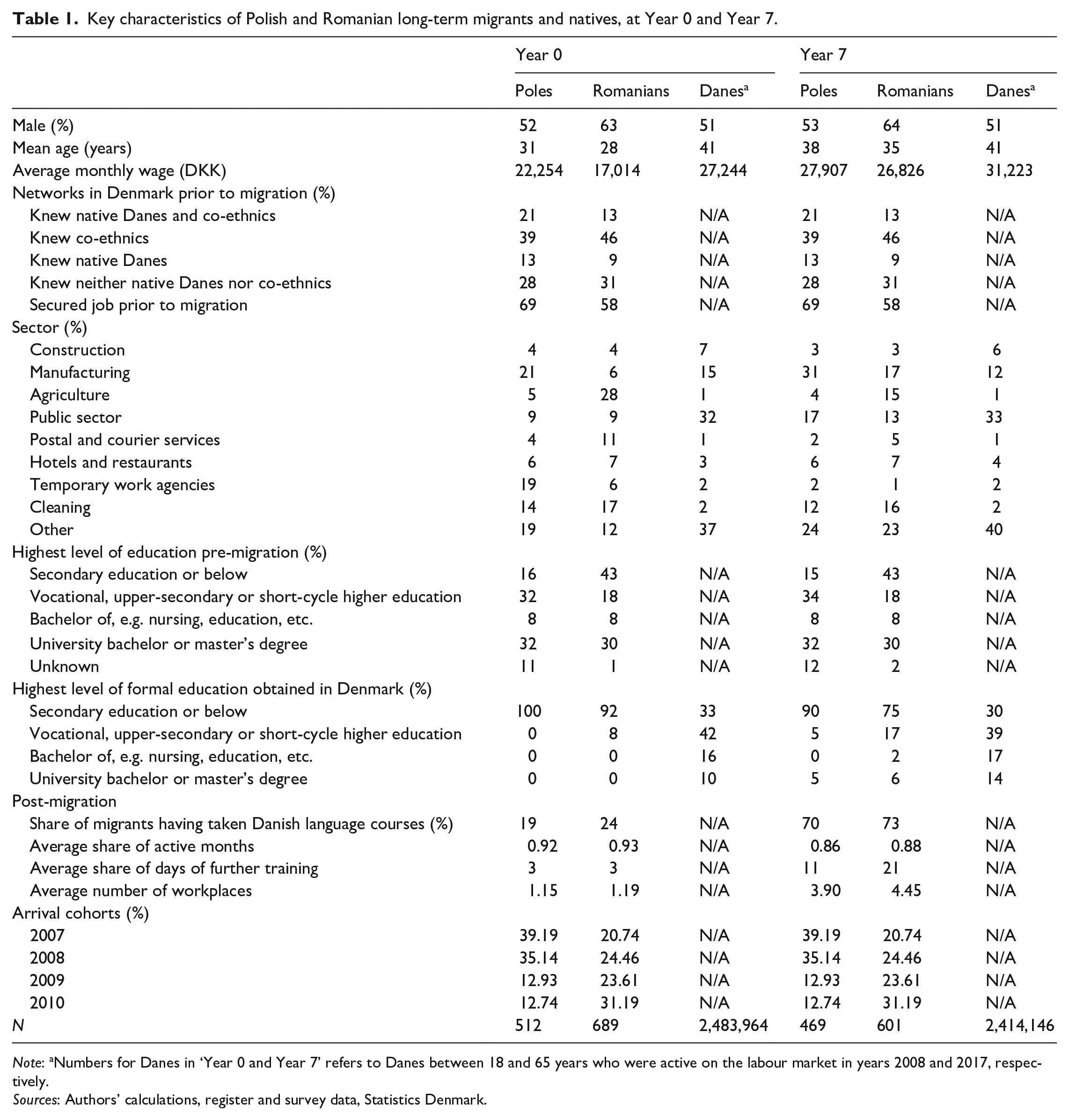
Romanians and Poles in Denmark differ in terms of gender composition, age and highest level of pre-migration education (Table 1). Romanians, for example, are much more likely than Poles to have at most secondary education. In Model 3, demographic characteristics are thus included in order to control for these composition differences: age, age squared, gender, pre-migration education (secondary education or below, vocational, upper-secondary education or short-cycle higher education, non-university bachelor and university bachelor or master’s degree).
Key characteristics of Polish and Romanian long-term migrants and natives, at Year 0 and Year 7.
Note: aNumbers for Danes in ‘Year 0 and Year 7’ refers to Danes between 18 and 65 years who were active on the labour market in years 2008 and 2017, respectively.
Sources: Authors’ calculations, register and survey data, Statistics Denmark.
As discussed in the conceptual framework, varying migrant recruitment channels may be one of the explanations for differences in wages between Romanians and Poles. Therefore, in Model 4, variables measuring whether or not the migrants secured a job prior to migration and the migrants’ social networks in Denmark at the time of their first job are included. The latter is measured in four self-evaluated categories: knew both native Danes and co-ethnics, knew only co-ethnics, knew only native Danes and knew neither Danes nor co-ethnics.
Given that previous studies have found clear patterns of sectoral segmentation when comparing CEE migrants and native workers, in Model 5 the sectoral distribution is included. This is done by combining the three- and four-digit NACE codes to identify the main sectors employing Polish and Romanian migrants, namely construction, agriculture, manufacturing, public sector, postal and courier services, hotels and restaurants, temporary work agencies, cleaning and other sectors.
In order to capture investment in post-migration human capital, the following variables are included in Model 6: highest level of post-migration formal education in Denmark (using the same categories as for pre-migration education), number of Danish language courses and number of days of further training. All of the variables capture the status up until and including the year of measurement (cumulative measure).
In Model 7, to capture the high employment mobility that is characteristic for the Danish flexi-secure labour market, employment ratio (share of months of employment in all months on the Danish labour market) and number of workplaces (cumulative measure) are included. Finally, a control for the year of first job is included because the period of first job (2007–2010) is characterised by substantial differences in the general economic conditions, featuring an economic boom in 2007 and the first half of 2008 and an economic downturn in 2009 and 2010.
Methods
Separate multivariate linear regressions for each of the eight years from the year of the first job (Year 0) until Year 7 are performed. Given that several previous studies have pointed to possible selection bias in studies of migrants’ employment outcomes (e.g. Chiswick and Miller, 2009; Kaczmarczyk and Tyrowicz, 2015), a number of robustness checks are conducted. First, to control for possible selection bias in the specific survey sample of long-term migrants, each of the models is replicated on a balanced panel of the full population of long-term Polish and Romanian migrants who had their first job in the 2007–2010 period and who stayed in Denmark for at least seven years afterwards. Second, to investigate whether the differences between Polish and Romanian migrants found in the study are specific to long-term migrants, the models are replicated on the entire population of Polish and Romanian migrants who had their first job in Denmark between 2007 and 2010, irrespective of their subsequent country of residence. The robustness checks are based exclusively on register data and thus contain a reduced set of control variables; the results are reported below.
Descriptive analysis
Table 1 displays key labour market and demographic characteristics of long-term Polish and Romanian migrants in Denmark in Year 0 and Year 7; where possible, it also includes information on natives.
Although the data focused on long-term CEE migrants in Denmark, the basic demographic characteristics nonetheless mirrored what previous studies have found in other European countries (see, e.g. Clark and Drinkwater, 2008; Friberg et al., 2014). The long-term migrants were, on average, rather young on arrival in Denmark, with Romanians being somewhat younger than Poles. The gender distribution among Poles was comparable to natives, whereas male migrants were significantly over-represented among the Romanian migrants. Despite the compressed wage structure in Denmark, migrants had considerably lower average monthly wages than natives in the first period – as is known from other national settings. After eight years, Poles and Romanians still fared worse than natives, although the gap had narrowed. Importantly, the average wages of Romanians in the first job (Year 0) were around 25% lower than those of Poles, whereas by Year 7 only a small difference remained. Looking at the sectoral distribution (with natives clearly over-represented in the public sector), besides the presence of traditional migrant sectors such as cleaning, hotels and restaurants, a clear pattern of segmentation between Poles and Romanians was evidenced, which likely explains some of the difference in monthly wages. Whereas more than one-fifth of the Polish long-term migrants found their first job in the well-paying manufacturing sector, the same was true for just 6% of the Romanians. Romanians, in turn, were vastly over-represented in agriculture, which is relatively low paid, with 28% of Romanians finding their first jobs in this sector, compared to only 5% of Poles. A closer look at the large group of long-term migrants who had secured a job prior to migration (69% for Poles and 58% for Romanians) revealed that the likelihood of holding a first job in manufacturing and temporary work agencies was higher for Poles who had secured a job prior to settlement than for Poles who found their first job after settlement. For Romanians, this pattern was especially pronounced in agriculture, where 36% of all the Romanians who found jobs prior to settlement had secured a job, compared to 17% of the Romanians who found jobs after settlement. These results suggest the involvement of specialised labour market intermediaries as well as more informal migrant recruitment channels through word of mouth via co-ethic social networks and referral hiring. Over time, both Polish and Romanian migrants left typical entry sectors, such as temporary work agencies and agriculture, while the share in sectors with better paying jobs – such as manufacturing and the public sector – increased. Interestingly, the high share of both groups in cleaning remained relatively stable over time, a result that is likely driven by the comparatively high wage floors in cleaning in Denmark, which are set by collective agreement.
Previous studies have shown that CEE migrants’ educational qualifications are on par with or above the level of native workers. This picture was also present among Denmark’s long-term Polish and Romanian migrants: more than 30% of both groups had at least a university bachelor or master’s degree from their home country – a share that is considerably higher than that for natives. Among the Romanians, however, the largest group came with no qualifications of direct relevance to the Danish labour market (43% had secondary education or below), which coupled with their lower average age might suggest that they chose to migrate before they finished their studies. Among the Poles, almost one-third came with vocational, upper-secondary or short-cycle higher education. Over time, the long-term migrants to a high degree invested in different forms of destination-country-specific human capital. In Year 7, one in four Romanians had completed a formal Danish education, compared with one in ten of the Polish migrants. Long-term migrants had completed 11 (Poles) and 21 (Romanians) days of further training. Finally, a large share of the migrants ‘invested’ in Danish language skills, with 70% of Poles and 73% of Romanians having completed at least one course by Year 7.
Factors explaining differences in wages over time between long-term Romanian and Polish migrants
The following section explores the differences in monthly wages between Polish and Romanian migrants in a multivariate setting. The results of separate yearly linear regression models (Year 0 – Year 7) are presented in the text along with figures outlining the development over time. Tables with the regression results for each of the individual years are available in the online Appendix.
As outlined above, a number of factors have previously been found to affect post-enlargement CEE migrants’ labour market integration in Western Europe. However, little attention has been dedicated to the possible disparities between different CEE nationalities and developments over time. Figure 1 (panels 1–7) shows the differences in monthly wages between Poles and Romanians, with each successive figure adding new controls. 9
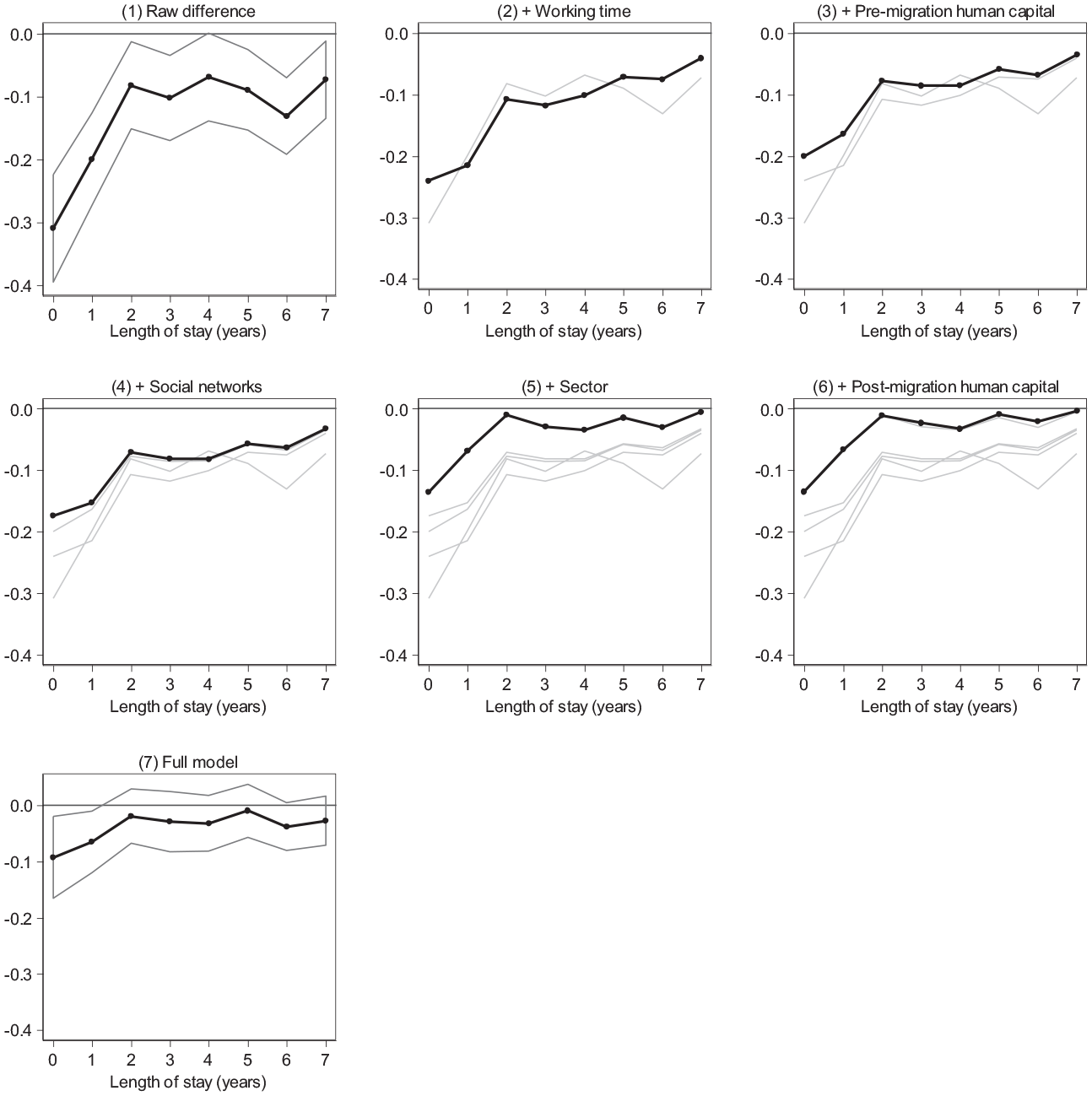
Percentage monthly wage bonus attributed to being Romanian compared to Polish.
Figure 1(1) illustrates how the raw difference between Romanians and Poles developed over the eight-year study period. The raw difference diminished drastically over the first two years – from more than 30% in the first job (Year 0) to less than 10% in Year 2. After Year 2, there were only small fluctuations; however, Romanians consistently trailed their Polish counterparts even as the years passed. As a robustness check, the differences for the entire 2007−2010 cohorts of Polish and Romanian migrants were investigated using the baseline model. This included the shorter-term migrants who left before Year 7 and the entire group of long-term migrants beyond the survey participants who stayed until Year 7 (Figures A1(1)–A1(6) and A2(1)–A2(6), online Appendix). The robustness checks confirmed the overall picture that Romanian migrants trailed their Polish counterparts throughout the entire period and that the differences (although they diminished over time) persisted at around 10% in Year 7.
Figure 1(7) illustrates the difference between Romanians and Poles controlling for all observable characteristics (full model). The figure shows that a significant difference existed only in the first two years, but also that the Romanians trailed their Polish counterparts throughout the observed period. The robustness checks confirmed the pattern, with a relatively small (around 5%) but statistically significant difference persisting also in Years 2 and 3 (Figures A1(1)–A1(6) and A2(1)–A2(6), online Appendix).
Figures 1(2)–1(6) show the overall explanatory effect of the different factors throughout the period. As with the overall difference between Romanians and Poles, the first two years look markedly different to the remaining period. From Year 1, and even more pronouncedly from Year 2 and onwards, the single most important factor in explaining the differences between Romanian and Polish migrants is the different sectoral distribution. Adding sectoral distribution reduced the residual by 5–10 percentage points and rendered the difference between Romanians and Poles insignificant from Year 2 onwards (Figure 1(5)). Again, this picture was confirmed by the robustness checks (Figures A1(1)–A1(6) and A2(1)–A2(6), online Appendix).
Focusing on social networks (Figure 1(4)), whom the migrants knew at the stage of settlement made no difference to their initial monthly wages whereas in later years their seems to be a significant negative but unstable effect. However, migrants who had secured a job prior to migration had significantly higher monthly wages in their first job than migrants who found their first job after arrival. This effect persisted throughout the first five years and seems to be closely related to the sectoral segmentation, as Romanians who had secured a job prior to migration were more likely to start in agriculture and Poles with an arranged job were more likely to start in the better paying manufacturing sector, where wages are higher not least because of much higher collective bargaining coverage (Tables A1–A8, online Appendix).
Although the results regarding the sectoral segmentation of Poles and Romanians dominate the overall picture, over time more individual human-capital attributes affected monthly wages (Tables A1–A8, online Appendix). In the first job, migrants with a vocational, upper-secondary education or short-cycle higher education had significantly higher wages than migrants with secondary education or below (Table A1, online Appendix). Other forms of education (e.g. university degrees) played no significant role on initial migration. However, already from Year 1 onwards, pre-migration university graduates experienced a significant positive return on their education of 10–17% compared to migrants with secondary education or below (Tables A1–A8, online Appendix).
The regression results also show that not all forms of investment in destination-country-specific human capital yielded a significant economic return (Figure 1(6)). While migrants’ investment in formal Danish university education from Year 5 onwards yielded a significant return on wages of 10–20% compared to no formal Danish education, investing in Danish language courses and further training yielded no significant return (Tables A1–A8, online Appendix).
Finally, the results show that there is a significant positive effect of the different arrival years for the first job only, with Polish migrants’ over-representation in the economic boom years (see Table 1) yielding a large positive effect on wages vis-a-vis Romanians (Tables A1–A8, online Appendix)
Discussion and conclusions
The analysis of Romanian and Polish longer-term migrants in Denmark nuances and extends previous findings on CEE migrants’ labour market outcomes (e.g. Friberg et al., 2014; McCollum and Findlay, 2015; Ruhs and Anderson, 2012) by introducing a within-group comparative and over-time perspective. Wage differentials between Poles and Romanians are substantive, particularly during their first two years in Denmark and they persist – albeit at a considerably lower level – throughout the eight-year observation period mainly because of significant sectoral segmentation. This is a novel finding, given that the vast majority of quantitative studies look at CEE migrants as one uniform group (but see Felbo-Kolding et al. (2019), although it is a more aggregate study, or Snel et al. (2014) and Lubbers and Gijsberts (2016), who focus on the impact of differences in transition measures for Romanians/Bulgarians vis-a-vis Poles) and do not use a temporal perspective. It adds to qualitative findings that demonstrate inter-ethnic variation among diverse CEE groups (e.g. Samaluk, 2016) or highlight differences in stereotyping of Polish and Romanian migrants with potential impacts on employers’ hiring preferences and strategies (e.g. Fox et al., 2015).
While pre-migration human capital plays a limited role in the first job, over time both pre-migration human capital and investment in post-migration human capital in the form of formal university-level education positively affect migrants’ individual wages. As in other Western European destination countries (e.g. Turner, 2010, for Ireland), overqualification remains an issue for CEE migrants to Denmark, and also over time, as evidenced, for example, by the sectoral segregation still manifest in Year 7, pointing to the limitations of human-capital approaches in migration research.
The majority of both migrant groups had secured a job before coming to Denmark, with manufacturing dominating for Poles and agriculture for Romanians. The exploratory analysis does not enable uncovering the mechanisms as to how exactly these jobs were secured or identifying the specific role of employers or, in turn, of co-ethnic social networks. Targeting of migrants in the country of origin by specialised labour market intermediaries and, in particular, by temporary work agencies has, however, previously been found to lead to labour market segmentation, including for Denmark (Stuvøy and Andersen, 2013), suggesting a role for more or less conscious categorical stereotyping on their part (for Poland, see Napierała and Fiałkowska, 2013). Beyond direct recruitment, it is likely that migrant contacts pre and post migration with co-ethnic social networks – that are already segmented into specific sectors and occupations – play a role in segmentation and wage outcomes (Portes, 1995; Waldinger and Lichter, 2003). At least for the early stages of migration, this study does not find significant effects of social networks on wages.
The fact that Polish migrants due to their earlier accession to the EU were more likely to have entered the Danish labour market in the economic boom years was shown to have a positive impact on wages for the first job only. We are not able to test potential variation in terms of push factors relating to the country of origin’s labour market situation and wage levels. However, even though Romanian average wages are somewhat lower than Polish ones, the gap for both groups with Danish wages is so large that we do not expect that this would imply a significant difference for the willingness to take up jobs in low-paying sectors in Denmark. Similarly, while inactivity among young persons was somewhat higher in Romania than Poland throughout the period, unemployment among young Romanians (15–39 years) was much lower than among young Poles until 2007 and somewhat lower in the subsequent years. This implies that, if any, Poles were experiencing stronger labour market-induced drivers to emigrate and take up jobs with sub-standard working conditions than Romanians.
The sectoral segmentation between Poles and Romanians, evident in the initial and subsequent periods and not explained by demographics, pre-migration human capital or crisis effects, might indicate categorical stereotyping. This would imply that solely based on their nationality and regardless of their individual attributes, Poles and Romanians are perceived as being more or less suited to specific types of jobs (Dawson et al., 2018; MacKenzie and Forde, 2009; Moss and Tilly, 2001), resulting in wage differentials between the two groups of migrants. While previous studies have indirectly suggested that employers view all CEE migrants as a homogeneous group, this study indicates that employers and labour market intermediaries may have a more nuanced hiring hierarchy, distinguishing between the supposed suitability of different CEE groups for different jobs. Such differential employer perceptions have previously been shown for Swedes versus Poles and Lithuanians (Friberg and Midtbøen, 2018) and for EU15 versus CEE migrants (e.g. Matthews and Ruhs, 2007), but to the authors’ knowledge, systematic studies of difference between different CEE migrant groups have not been carried out.
The wage gap between Romanians and Poles is revealed here to be much larger and only significant during the initial two years of settlement compared to the subsequent years, which are characterised by labour market mobility out of poorly paying sectors such as agriculture, postal services and temporary agency employment into better paying jobs – in particular in manufacturing and the public sector. This finding might reflect an initial adaption period where migrants acquire knowledge of the destination labour market, which is also in line with the positive human-capital effects found for migrants with university degrees only being observed after Poles and Romanians have spent some years on the Danish labour market. The latter result indicates that pre-migration educational qualifications are transferable at least to some degree across the EU, albeit with a time lag, confirming suggestions by Chiswick and Miller (2009).
The temporal analysis in this article, which is rarely applied in studies of CEE migrants’ working conditions (for a qualitative perspective, see, e.g. Ryan, 2018), also makes it possible to take into account specific features of the country of destination and, in particular, the flexi-secure Danish labour market (Bekker and Mailand, 2019). Romanians prove to be much more likely than Poles to pursue and complete a Danish education. This might be due to the fact that a larger share of Romanians has low levels of pre-migration education, but also that their initial and subsequent wages are poorer than those of Poles. The continuously relatively high share of Romanians in agriculture and the unequal occupancy of manufacturing in favour of Poles in Year 7 testifies to this difference. Romanian migrants might therefore invest in formal Danish education as a way to signal individual initiative and ability. This strategy should be seen in the context of the specific institutional configurations of Denmark as a destination country, where formal education and further training are free of charge and even financially supported by a study allowance that may provide an important incentive for skills upgrading by CEE migrants or make it possible in the first place (Emilsson and Mozetič (2019) find similar results for Sweden). While the evidence shows – in line with Nielsen (2011) – a positive return on wages of formal higher education, this is not the case for further training and Danish language education (see also Leschke and Weiss, 2020). Explanations might be found in the low share of migrants who avail of the full Danish language education by Year 7 (the average is three courses only out of a possible six), the common use of English and, among Polish migrants, for example, the use of their language of origin in Danish workplaces (Friberg et al., 2014), as well as evidence that employers might prefer migrants with limited language skills (Simkunas and Lund Thomsen, 2018).
In conclusion, this article contributes to and expands on established research on labour market outcomes, namely wages, of EU migrants in at least three ways. First, few studies have yet quantitatively compared different groups of intra-EU migrants. Where this is done, it is usually carried out at an aggregate level comparing EU-West and CEE migrants (e.g. Johnston et al., 2015; Turner, 2010) and more rarely also distinguishing between migrants from Southern and North-Western Europe and from EU-2004 and EU-2007 accession countries (Felbo-Kolding et al., 2019; Snel et al., 2014). Second, adopting a temporal approach (e.g. Constant and Massey, 2005; and for a qualitative perspective, Parutis, 2014) puts into perspective previous findings on labour market outcomes of migrants, which commonly concern the initial period of migration. The analysis here shows very different results in terms of wage gaps between Poles and Romanians for the first two years as compared to later time points. The over-time perspective also enables scrutiny of the role of the flexi-secure Danish labour market in the development of migrant wages (Nielsen, 2011) and renders it possible to more comprehensively study theoretical mechanisms that are known to change over time, in particular human-capital effects. Third, the matched register and customised survey information not only provides reliable data, particularly on wages, employment histories and participation in education and training, but also enables testing for a range of theoretical explanations of migrants’ labour market integration, such as pre-migration human capital and migrant recruitment channels. In terms of further research, it would be highly relevant to better understand the mechanism of categorical stereotyping and how it interlinks with already established co-ethnic social networks. Referral hiring might be a case in point (Elliott, 2001). Such an endeavour would necessarily have to be based on more qualitative or mixed-methods’ approaches (see, e.g. Matthews and Ruhs, 2007). Also, separate analysis by sector and gender could shed additional light on the mechanisms impacting wage differences among different migrant groups (e.g. Simkunas and Lund Thomsen, 2018). Such an analysis was not possible here given the restricted sample size of the customised survey. While some of the findings – particularly the notion that employers seem to operate with more nuanced perspectives on different CEE groups than generally assumed – are likely generalisable to other European destination-country settings, wage improvements by way of education and upskilling may be more constrained in countries with educational systems based on tuition fees.
Supplemental Material
sj-pdf-1-wes-10.1177_09500170211056203 – Supplemental material for Wage Differences between Polish and Romanian Intra-EU Migrants in a Flexi-Secure Labour Market: An Over-Time Perspective
Supplemental material, sj-pdf-1-wes-10.1177_09500170211056203 for Wage Differences between Polish and Romanian Intra-EU Migrants in a Flexi-Secure Labour Market: An Over-Time Perspective by Jonas Felbo-Kolding and Janine Leschke in Work, Employment and Society
Footnotes
Acknowledgements
We would like to thank Bjarke Refslund and Caroline de la Porte for their detailed and insightful comments on earlier drafts of this article and Simon Halphen Boserup for help with the data analysis.
Funding
The authors received no financial support for the research, authorship, and/or publication of this article.
Supplementary material
The supplementary material is available online with the article.

Notes
References
Supplementary Material
Please find the following supplemental material available below.
For Open Access articles published under a Creative Commons License, all supplemental material carries the same license as the article it is associated with.
For non-Open Access articles published, all supplemental material carries a non-exclusive license, and permission requests for re-use of supplemental material or any part of supplemental material shall be sent directly to the copyright owner as specified in the copyright notice associated with the article.
