






Abstract
This article examines how experience with precarious work influences the notions of control and empowerment among female migrant workers. Instead of focusing on migrant workers as victims of a continuous chain of precarious employment, the article aims to enrich the current knowledge by focusing on the complexity of elements involved in subjective assessments of agency. Based on research of Ukrainian female migrants, we show how precarious jobs can be perceived as enabling, allowing women more control over their lives. To understand these perceptions of agency, we show how important it is to focus on the embeddedness of migrants’ reflective choices in their life trajectories. In the context of migration, this implies a shift in understanding from one in which migrants compare their experience (of labour or gender structures) between country of origin and country of destination towards a more nuanced approach.
Keywords
Introduction
‘We have gained stability at last’, emphasises Anna (35 years), a Ukrainian mother of two with a 15-year history as a labour migrant. She combines full-time and part-time jobs with occasional cleaning to secure the family income, often working 11 or more hours per day. Having little time and energy to attend to her children, precarious low-wage employment affects and shapes all areas of her life. Anna’s employment trajectory of continual precarious employment (Goldring and Landolt, 2011) is typical of Ukrainian female migrants living in Czechia (Czech Republic). Trapped in segments of the labour market characterised by low wages, insecure and temporary contracts and a lack of union representation (Drbohlav and Jaroszewicz, 2016; Leontiyeva, 2016), Anna and other women interviewed in this study claim a strong sense of empowerment while narrating their migration experience.
Ukrainians represent the majority of labour migrants; In 2020 over 165,000 Ukrainian citizens officially lived in Czechia. Ukrainian citizens form the largest group of foreigners in the country (Czech Statistical Office, 2021). The majority hold permanent residency status due to long migration histories (Czech Statistical Office, 2021). This article focuses on female migrants with children because their position at the intersection of mutual axes of oppression (migrant status, gender roles and motherhood) makes them especially vulnerable to the process of precarisation in European labour markets (Castles, 2015; Fuller and Vosko, 2007). According to existing literature, this implies that such women have a limited ability to influence their working and living conditions.
Focusing on the specific perspective of female migrants who have already been living in Czechia long enough to gain permanent residency status (five years of legal stay), the article aims to challenge the dominant understanding of precarious workers’ agency in the context of migration. Instead of focusing on migrant workers as victims of a continuous chain of precarious employment, the article aims to enrich the current knowledge by focusing on the complexity of elements involved in subjective assessments of their overall position, often in comparison with a past situation and with circumstances in the country of origin. In doing this, the article aims to widen the focus to different forms of precarity because these women no longer face a legally precarious status; although legal stability does not necessarily overcome work precarity altogether, it does help these women achieve a degree of stability and possibly a lesser degree of precarious work.
As Tyldum (2015a) and Rydzik and Anitha (2020) already suggest in their research on agency in the working biographies of female migrants, this article argues that experiences of exploitation and empowerment are closely knit fragments of the migration experience that need to be researched together. This text examines the processes of ‘sense-making’ among those moving within the constraints of their structural position. The article does not focus on the capacity to act per se but rather on the actors’ perceptions and reflective beliefs about their abilities and capacities to act. To examine agency as subjectively experienced by migrant female workers, this article employs a temporal perspective on precarious employment as a moment in time, contextualised by life trajectories.
The article emphasises the embeddedness of actors’ reflective choices in individual life trajectories, stressing the ways social actors critically evaluate and reconstruct the conditions of their lives in the context of their life experiences and expectations (Emirbayer et al., 1999; Hitlin and Elder, 2007). Combined with biographic narrative data (which places workers’ self-presentation at the centre), such an approach illustrates the multiplicity of layers of reasoning that can not only make precarious work acceptable but can also provide those working in these positions with a sense of agency and control despite inflexible, restrictive conditions.
Precarious employment trap
Vosko (2010) argues that certain work can be labelled precarious when characterised by a lack of security over employment duration, a lack of regulatory effectiveness and a lack of control over the labour process as well as income inadequacy. Precarious employment can be approached as a continuum rather than a state, ranging from high to low precariousness dependent upon wages and regulatory protection, full-time and part-time employment and permanent and temporary positions (Cranford et al., 2003). As much as precarisation may be observed in all segments of the labour market (Kalleberg and Vallas, 2017), the most vulnerable to the processes of precarisation are migrant workers, minorities, women, the elderly and people with low qualifications. They often employ limited tools to cope with income instability (Pugh, 2015), which contributes to the self-perpetuating character of these types of employment and their impact on increased levels of inequality (Atkinson, 2015).
Women experience a greater degree of precariousness in various types of employment (Fuller and Vosko, 2007). Persistent gender norms contribute to the underprivileged working conditions of women, who are likely to work in lower quality job settings characterised by fewer financial rewards, benefits and union protections as well as part-time or temporary work status (England et al., 2002; Leuze and Strauß, 2016). They also experience effects caused by the devaluation of ‘female-typical’ work tasks, lower social recognition in the public sphere and, consequently, lower pay (Acker, 1998; England, 1992) while they still take on the lion’s share of domestic responsibilities (England, 1992; Morokvasic, 2007). Because unpaid care work remains largely unrecognised and undervalued, female lives are affected by precarity differently than male lives (Young, 2010). In the context of migrant labour, these processes are accentuated by the stratification of the labour market according to citizenship status and existing racial and ethnic hierarchies (Hennebry and Petrozziello, 2019; International Organization for Migration, 2020).
Despite the inherent insecurity, precarious positions can be perceived as acceptable for workers. These processes are enhanced by a highly prevalent discursive framing in which workers tend to present themselves as successful and entrepreneurial (Boltanski and Chiapello, 2005). Precarious forms of employment can be accepted as part of a life transition with a perception of future social ascendance. For migrants, insecure or low-wage employment might be justified as a strategic position in which to improve skills and/or language abilities (Alberti, 2014). A longer tradition in the study of the migrant worker explains a willingness to accept the worst working conditions as an outcome of different frames of reference (country of origin) and the perception of the temporariness of stay (Piore, 1979; Waldinger and Lichter, 2003), which is further amplified by legal status (Anderson, 2010). Hašková and Dudová (2017) suggest that insecure jobs are accepted by women with care responsibilities as a temporary strategy in order to balance work and family needs. However, a number of these authors emphasise the continuity of the precarious position (e.g. Křížková and Formánková, 2012). Despite initial expectations, workers entering precarious positions can be trapped in low-paying and low-skilled employment with few prospects of moving into better-paid work, replicating the processes of labour market segmentation based on gender, race or citizenship (or an intersection of these and other characteristics). In their analysis of migrant worker trajectories, Goldring and Landolt (2011) found evidence of persistent precarity in market conditions for migrants even when they became residents and gained equal access to the labour market.
A temporally precarious situation can thus turn into a permanent trap, a process to which migrants, and particularly female migrants, are more vulnerable than other groups. This has important implications as the experience of work precarity invades all areas of life, contributing to an overall level of insecurity, the result of which is a situation where a ‘person’s economic productivity becomes the overwhelming priority’ (Anderson, 2010: 304). The impacts of precarity and precarious employment include other dimensions of social life, such as domestic and care work, which are especially relevant to female migrant workers. The concept of ‘precarious lives’ implies the inclusion of further life dimensions within the concept of precarity (Clement et al., 2009). Morokvasic (2014) suggests that research on ‘women in migration’ intersects with other dimensions of social relations and sources of inequality and discrimination as female migrant workers represent a group especially exposed to these processes given the multiple axes of oppression forming their lives (gender, race, nationality, migration status, etc.).
As one’s life becomes increasingly subordinated to the needs of economic security, precarious forms of employment limit the ability to act and gain independence of those working in these positions (e.g. Bourdieu, 1998; Hassard and Morris, 2018). Precarious employment leads to a ‘loss of grip over a future that once seemed under control’ (Alberti et al., 2018: 449).
Agency among precarious workers: Constrained ability to shape working conditions?
One of the core issues we address is the impact of precarious work on the agency of female migrant workers. The concept of agency is based on the idea that while individual actors are constrained through their embeddedness in a social structure, they also possess the capacity to act (change, shape and control their lives) within certain alternative frames. Agency reflects social roles, norms and power structures which may be related to gender, class, ethnicity, age or an intersection of these and many other factors that shape social hierarchies. The reproductive or transformative character of agency in relation to social structure may therefore be limited as seemingly free actions can unconsciously reproduce structural milieus (e.g. Hitlin and Elder, 2007). Feminist scholarship conceptualises agency as strongly conditioned by structural forms of oppression towards women: female labour is constrained by the gendered division of labour and gender-based discrimination (Hennebry et al., 2016). A female migrant worker’s choice in employment is often limited to jobs among the bottom ranks, which typically involve oppressive working conditions (Castles, 2015). At the same time, gendered expectations frame female migration as an outcome of sacrifice and economic necessity contrasted with the notion of male migration as opportunity-driven, adventurous and rational (Tyldum, 2015a).
However, in recent years a growing body of literature has attempted to contradict the image of precarious workers as ‘disempowered victims of the vagaries of capital’ (e.g. Alberti et al., 2018: 450). The collective action and forms of political struggle in which precarious workers are engaged are mostly described as constrained, small acts of resistance (Paret and Gleeson, 2016; Standing, 2014). This is particularly pronounced in the case of migrant workers, whose positions are further limited by insecure legal statuses.
Smith (2010) and Alberti (2014) show how migrants use their transnational position and subsequent ability to quit or move (mobility practices) as forms of resistance to the precarious conditions of life and work. Datta et al. (2007) propose using the term ‘coping tactic’ to emphasise the often reactive, fragmented and fragile character of migrant strategies to ensure economic survival. Similarly, when Berntsen (2016) aims to counter the image of precarious workers as disempowered actors who passively accept exploitative employment relations by emphasising incremental, small-scale forms of agency, he acknowledges that these forms of agency may contribute to the continuation of oppressive employment practices. Likewise, despite the emergence of unions in some places (mostly in countries with a long history of organised collective action), authors focusing on migrant women have found that they often exhibit agency through individual resistance (Amrith and Sahraoui, 2018; Anderson, 2010).
In their research of female labour migrants, Rydzik and Anitha (2020) use Katz’s (2004) concept of agency as practices of resilience, reworking and resistance to oppressive contexts and ideologies. Focusing ‘on the microscale politics of work’, the authors focus on the meanings, possibilities and limits of interconnected and sometimes overlapping practices deployed by female migrant workers in response to workplace exploitation in tourism. Rydzik and Anitha (2020) show that with time, the female migrant workers positioned themselves against the initial exploitation and provided increasingly assertive responses to exploitation and discrimination.
All these authors contribute to a better understanding of agency among precarious workers in relation to exploitative working conditions in ways that go beyond a binary construction of victimhood versus agency. In the small acts of resistance, power structures are more often normalised than challenged and recalibrated. Despite limits to social transformation, this reflects the migrant worker’s consciousness of power structures. Experiences of exploitation intersect with those of empowerment, which workers gain when they actively ‘engage in carving out “spaces of control”’ (Rydzik and Anitha, 2020: 895).
Approaching agency as a process of interpreting lived experience
Can the agency—and a particularly subjective perception of an ability to act—of precarious workers be limited in the ability to shape working conditions? In line with existing literature, we propose a wider approach to agency, one which emphasises the individual perception of control and manoeuvrability, as particularly useful when analysing the perception and processes of ‘sense-making’ as regards precariousness.
Our approach is informed by the research of Eeva Jokinen (2016). Her term ‘precarious everyday agency’ describes what it means to maintain a sense of agency in the context of increasingly precarious life conditions. The emphasis is not on the ability to negotiate harsh working conditions. According to her findings, the precarious worker’s sense of being a ‘capable individual’, in control of her life, relates to the capacity to navigate the perpetual ruptures of continuity in experience and knowledge (Jokinen, 2016: 95). The idea of an ability to navigate precarious forms of employment is taken further by Decker (2019), who describes the way in which precarious jobs can provide women with children in the countryside a sense of ability in shaping their lives.
A similar line can be traced in research conducted by Tyldum (2015a, 2015b) on Ukrainian migrant women working in Italy. In her analysis, she discusses the reason why many female migrant workers, that often work in exploitative conditions, still experience ‘the move’ as empowering. Tyldum challenges the notion of female migrants as victims of structural oppression and invites us to look at the subjective notion of agency in the migration narratives. Her findings show the degree to which the perception of agency is shaped by the previous experience of economic collapse in 1990s Ukraine, by the comparative advantages of working in Italy’s care sector (which was less demanding and offered more free time and appreciation compared with housework combined with employment in Ukraine) or by failed marriages. Kindler (2011) similarly explains the impression of higher autonomy and independence felt by Ukrainian women working in precarious jobs in Poland, despite even harsher working conditions. Tyldum emphasises that we tend to overlook these experiences if we are not sensitive to discursive struggle in migration narratives.
Yet, in our research, we would like to highlight another aspect which is present in the abovementioned research: the embeddedness of a perception of precarious work in one’s life trajectory. Morokvasic (2007: 84), in her analysis of the relationship between migration, gender and empowerment, emphasises that the migratory experience is ‘constantly reinterpreted in the light of previous experience, pre-migratory socialisation and values’. We suggest that this approach must not only be applied to the perception agency in the migration process but also to the subjective perception of precarious work / agency among precarious workers. As much as we understand agency as embedded in structural constraints and power hierarchies, its perception is also shaped by individual experience.
In this manner, our analysis aims to examine the actors’ perception of choice and control, the processes of ‘sense-making’ among those who are moving within the constraints of their structural position. We follow Hitlin and Elder’s understanding of agency as the ‘individual capacity for meaningful and sustained action’ (2006: 38), perceiving actors as ‘self-reflective agents making decisions . . . within [an] understanding of their constrained possible life choice’ (2006: 39).
By emphasising self-reflection and sense-making, we approach agency as a process of interpreting one’s lived experience. Agency as fundamentally intertwined with social structures, yet not determined by them, has a strong habitual identity aspect which reflects one’s stance and understanding of his or her socially constructed roles (Emirbayer et al., 1999; Hitlin and Elder, 2007). It also reflects the constraints of current situations and the possibility of creative reaction to them, as well as individually reconstructed ‘life course expectations’ or ‘imagined futures’ (Emirbayer et al., 1999; Hitlin and Kirkpatrick, 2015). All of these are deeply embedded in life experience and individual history.
Understanding the temporal embeddedness of agency through biographic narrative analysis
To understand the perception of agency, we use Wengraf, Bornat and Chamberlayne’s biographic narrative inquiry method. Temporality is an important aspect of the analysis of biographical narrative data as the stages of subjectivity are always captured in the context of individual and societal history (Chamberlayne et al., 2000).
As such, it provides us with the temporal and relational context needed for the analysis of agency as we conceptualised it above. It also allows the narrator to tell a story in his or her own way, to identify and describe critical moments or turning points that are perceived as important and to create space for reflection (Thomson et al., 2002). The method enables us to research individual experience as it focuses on subjectivity (Chamberlayne et al., 2000). It provides access to ‘dated’, ‘situated’, ‘evolving’ and ‘deciding’ subjectivities in the context of an individual biography. Agency is embedded in a narrated life trajectory as the stages of subjectivity are revealed (Wengraf, 2001). Applying the life-story approach to agency permits us to go beyond the limits of dominant discursive regimes on migration and gender. As Erel (2007) suggests, ‘Migrant women’s life stories can produce alternative and resistant stories that challenge the positions ascribed to them structurally and discursively and as such may become transformative and empowering’.
The data set consisted of 13 in-depth narrative interviews conducted with first generation migrant women of Ukrainian origin. Ukrainians represent the most numerous migrant group in Czechia over 165,000 in 2020 (Czech Statistical Office, 2021). Motivated by economic factors, this migration to Czechia began in the 1990s and peaked during the period of economic growth prior to the 2008 economic crisis (Drbohlav and Jaroszewicz, 2016). By mid-2010, Ukrainians constituted about 40% of non-EU migrants in Czechia. Due to this long history, a majority have long-term residency permits and are employees. Women represented nearly half of the incoming migrants arriving from Ukraine, a proportion which increased over time. In 2010 almost half of the Ukrainians with children had to leave their offspring in their home country, but family reunifications have been increasing ever since (Leontiyeva, 2016). Most Ukrainians work in low skilled and semi-skilled positions, mostly in industry and construction; however, the proportion of women working in services has been growing throughout the last decade. All these segments of the labour market are characterised by low wages, high occurrences of insecure contracts and legal transgressions, and low trade union representation (Leontiyeva, 2016).
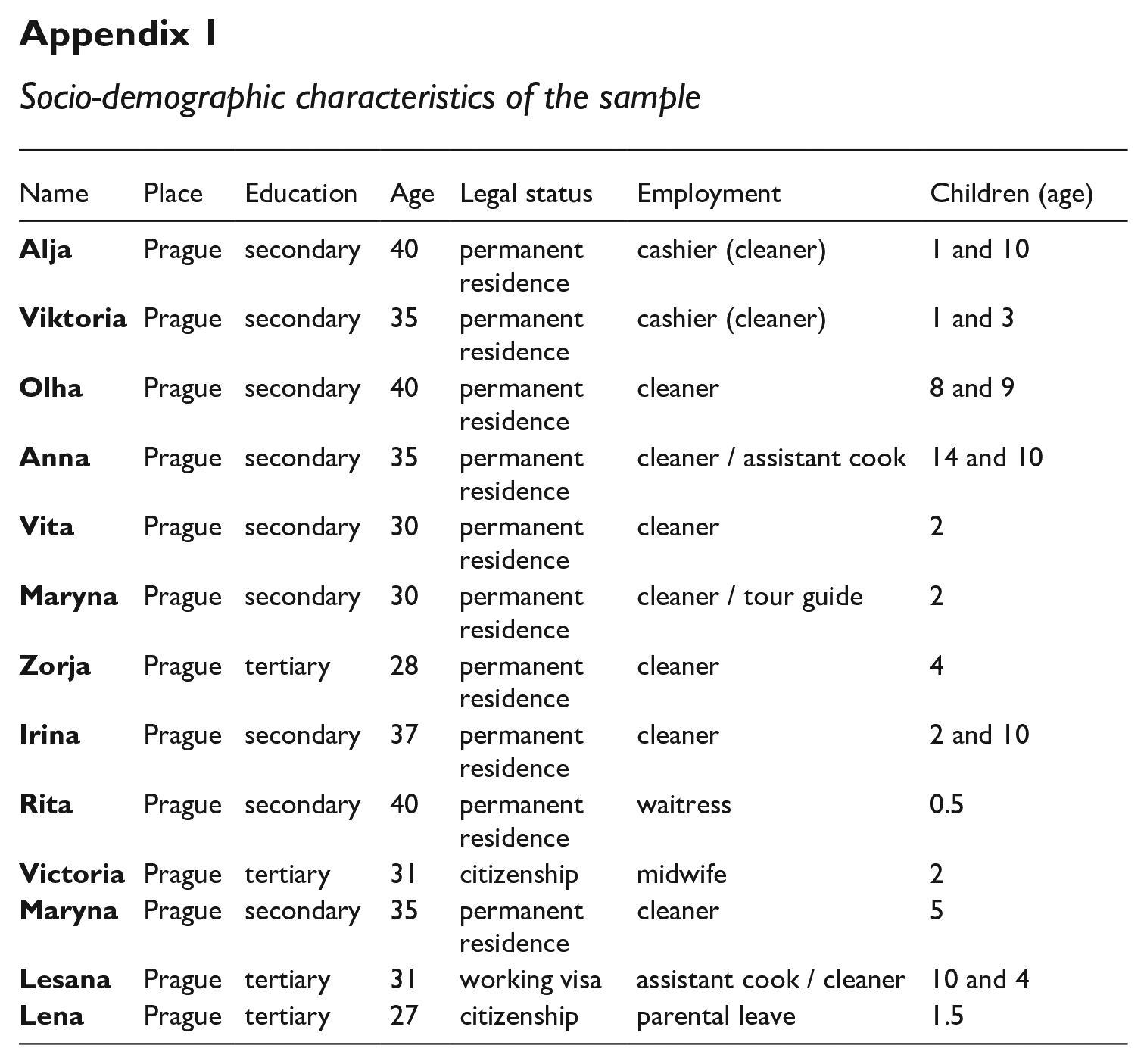
The women we interviewed had moved to Czechia in the last 10–15 years for economic reasons, were aged between 32 and 40 and currently lived in Prague (or a Prague suburb). All had a long-term residence permit, and some were applying for Czech citizenship. They all had children (1–3) living in Czechia. The children’s ages ranged between 5 months and 14 years. Their education levels varied between vocational training and university degrees (See Appendix 1 for socio-demographic characteristics of the sample). These characteristics correspond to the general structure of Ukrainian migrants in Czechia. Face-to-face interviews were conducted by the authors in 2017 and 2018 in Prague using the Czech language. To position ourselves as researchers, we are both childless women, slightly younger or of similar age to the women we interviewed. There were still some power discrepancies, including the fact that we were both born in Czechia, had a higher position in the labour market and, in some cases, a higher level of education. However, all the women were interviewed in a place and at a time in which they felt secure. The participants have been given pseudonyms to ensure their anonymity.
The interviews started with one opening question asking about the interviewees’ life after deciding to come to Czechia for the first time, followed by a ‘free narrative’ section. In the second part of the interview, we reconstructed their life trajectories on a timeline, which allowed us to gain detailed information on different forms of employment as well as the context of their lives in that period.
The subsequent analysis involved the following steps: first, we reconstructed the set of historical events in an individual biography and created a timeline for each informant which captured developments in five different areas of their lives: employment, legal status, place of residence, family situation / parenthood and access to welfare and housing. Each timeline included events that the woman decided to describe, that is, events that she considered important in her life—these might be compared with critical moments as defined by Thomson et al. (2002). For each of these, we created transcriptions of the informant’s reflections on this situation.
This allowed us to place the employment trajectories in relation to other areas of their lives. Consequently, we identified periods in which the informants worked in precarious jobs. We considered a working situation precarious if they fulfilled most of the following characteristics (based on Vosko [2010] and Campbell and Price [2016]):
(low) degree of continuing employment certainty (temporary contract, multiple jobs, work outside an employment relationship);
(low) status and level of protection (lack of access to employment protection as well as social or health insurance, harsh working conditions, long and irregular hours, low status);
inadequate income (low wages, necessity to work overtime to cover life expenditures);
and lack of collective representation or other tools of control over working conditions.
For each of the jobs with precarious traits in the individual biographies, we looked for perceptions of, reflections on and reasoning about that situation. This allowed us to highlight the ways in which the women explained and evaluated their situations, their positions and their roles in the context of a particular section of their narrated stories as well as within the overall narrative of their life experiences, current situations and expectations for the future.
Shaped by the past, oriented towards the future? Worker perceptions of agency
The employment trajectories of the interviewed women show a number of similarities. At the time of our interview, all of them were fluent in the Czech language and had a good understanding of the Czech legal and institutional system. Yet even when all these factors had formally permitted them to have full access to the labour market for many years, they still had precarious jobs with irregular working hours, low wages, no collective representation (none of them understood the Czech word for ‘trade union’) and most did not expect a change in the future. Thus, it might seem that they were trapped in the precarious segment of the labour market (Goldring and Landolt, 2011).
Yet, this position had been preceded by even more precarious situations: after coming to Czechia, all had worked in semi-legal positions, often within a ‘client system’—semi-dependent employment through informal work agencies organised by and directed towards Ukrainian labour migrants (for detailed information, see Čermáková and Nekorjak, 2009; Kindler, 2011 describes a similar system in Poland). In this period, most of the women had some form of legal residence, usually provided by the ‘agency’, and a permit—though usually not a work permit (or it was not valid for the jobs they had). For all of them, the main turning point came when they obtained a long-term residency permit (which can be obtained after five years of legal stay), formally granting them an equal position on the labour market. Its holders do not need a work permit. After receiving long-term residency, most of the women moved from semiformal ‘client’ employment and positions occupied solely by migrants to jobs where most of their co-workers were Czech.
The women we spoke to did not underrate the problematic aspect of their current employment, nor the negative impact this employment has on other areas of their lives. However, the constellation was often perceived as the outcome of an active choice, the best situation possible and, in some cases, even as emancipatory. In the following section, we will focus on these perceptions. We have chosen three women’s stories as examples of how these perceptions are embedded in individual life trajectories and experience.
For Anna and her husband, the possibility to combine multiple low-wage, precarious jobs provided an opportunity to reunite with their children and financially provide for the family, a stabilisation that was not possible in earlier phases of her migration. Her story points to the importance of employment experience upon arrival in Czechia. The evaluation of job quality through the lens of this after-arrival employment experience is a pattern we observed in most of the women’s stories.
For Olha, accepting precarious employment provided a possibility to spend more time with her children. Motherhood plays an important role in many narratives regarding precarious work. Olha’s story is an example of a seemingly traditional interpretation of gender roles that had been, in the context of both her personal experience and the strategies of other migrant women, perceived as a break from the expected pattern.
The third story, Irina’s, was selected as an example (exceptional in our sample) of a situation in which precarious work provided a striking sense of empowerment and financial independence. This story shows how this perception of and the demand for financial independence is deeply embedded in past experience (past relationships).
Anna: Precarious work as stabilising in the context of past employment experience
Anna’s employment trajectory, as described in Figure 1, represented a ‘continuum of precarity’ (Goldring and Landolt, 2011). She shifted to more formal yet still strongly precarious positions with no proclaimed expectation of future change. Anna’s position was characterised by low wages, multiple jobs, insecure contracts or none at all (in some of them), no collective representation and a limited level of social protection (based on the minimum wage income). Anna had worked in this position for six years and did not expect any change in the future.
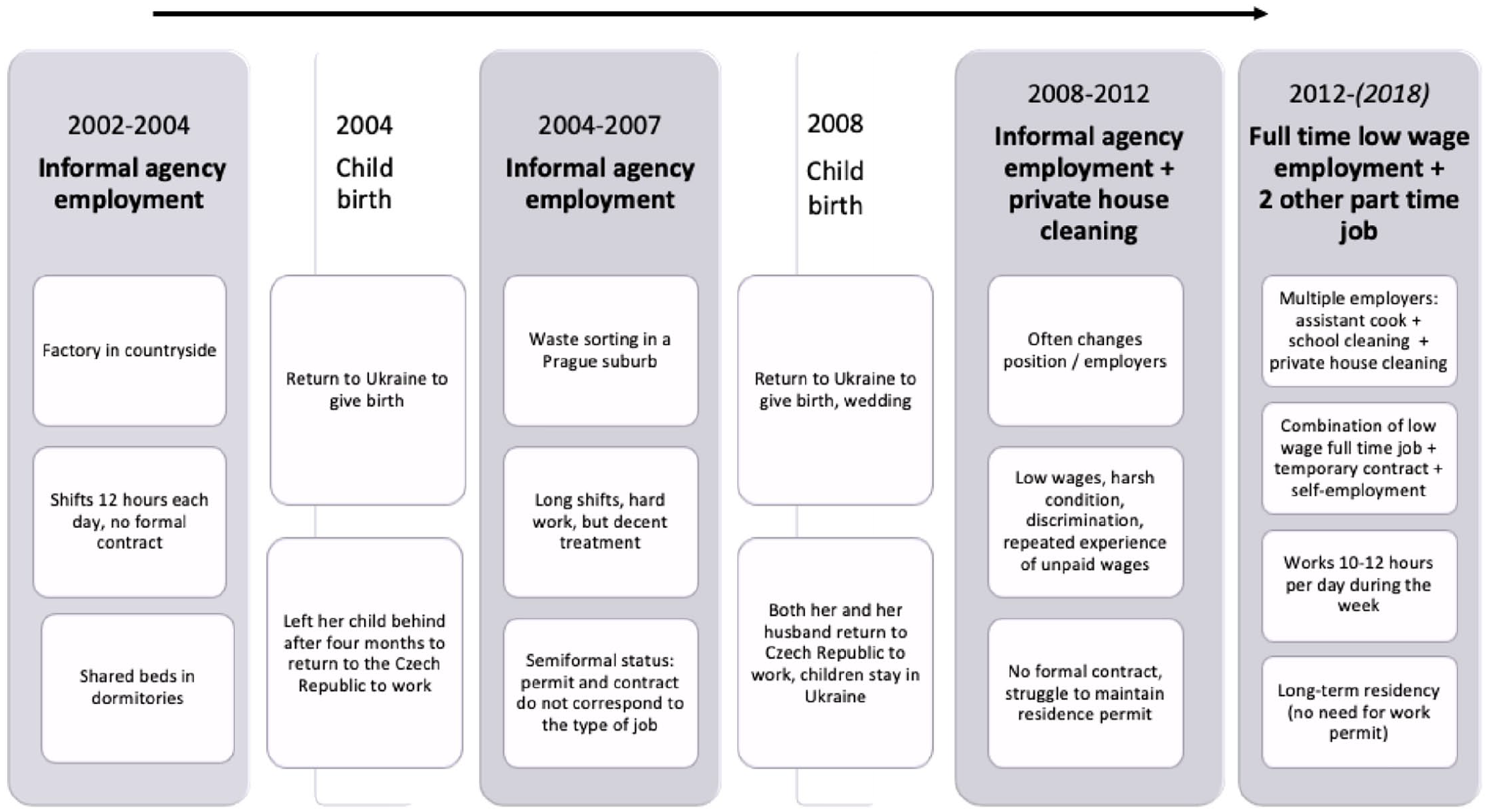
Anna’s employment since her arrival in Czechia (2002–2018).
Anna (35) lived with her second husband, also Ukrainian, and two children, aged 14 and 10 years, who were born in Ukraine and lived there with their grandparents until 2014.
Anna came to Czechia to work in 2002. At the time of the interview, 15 years later, both Anna and her husband had employment at a school, to which they commuted three hours daily; she was an assistant cook and he was a school caretaker. Both received the Czech minimum wage, which is below the poverty threshold and one of the lowest in the European Union (Eurostat, 2020); it does not cover basic household needs. As the wages were not sufficient, Anna and her husband shared a second job from the same employers, cleaning the school via a temporary contract (an additional 2‒3 hours per day for Anna). Furthermore, Anna did private house cleaning in her spare time in the evenings and on the weekends (classified as self-employment). As Anna described it:
I always work. I never see the kids . . . My husband and I often quarrel about not seeing the kids enough. You come home and you are always sleepy and tired.
Anna had characteristics of a precarious worker as defined by Anderson (2010), for whom the character of employment invades all other areas of life. Nevertheless, she repeatedly emphasised how well off they are, alluding to benefits which reflected her previous experience with an extremely insecure legal and financial situation, particularly an inability to reunite with her children:
He [the employer] allowed me to take vacations and gave me my wages on time . . . [then] we got legal papers; nothing was under the table, so we even invited the kids [to come to Czechia] . . . Now we are satisfied, good.
She placed their current situation in sharp contrast to her previous employment experience in the first years after her arrival in Czechia:
I worked for Tesco, in the bakery, night shifts. It was terrible . . . I also cleaned dishes in one canteen; this was a completely illegal job. . . then [I] worked in a retirement house. . . There was a grandma always covered in shit; nobody wanted to clean her, so they told me, ‘You are Ukrainian, you go and do it!’ I was so glad I had a job, so I went and did it. . . . I did not have the papers [a work permit], so all the worst jobs that exist, I did them all.
Anna’s story and the explanations she provided offer instructive insight into the impact of long-term experience with precarity. Despite low wages, long working hours and chronic fatigue, she described her employment status as a significant improvement, a break from the history of exploitation and the experience of separation from her children she had undergone as a migrant worker. In the context of her life story, the transnational forms of mothering, when care was provided for from a distance (Baldassar and Merla, 2014), represents a frame in which the current situation is seen as less precarious and her family situation as an achievement she worked hard to achieve.
Perceptions of work quality among migrants are often linked in the literature to experiences and employment opportunities in their country of origin (Morokvasic, 2007; Tyldum, 2015a; Waldinger and Lichter, 2003). Anna’s story shows that the core factor that shaped her perception of her current working and living situation was her experience after arriving in Czechia—in other words, the structural position from which she entered the labour market and consequent experience of exploitation. This reasoning for being satisfied—comparing the current situation with the period after arrival—was common among the women we interviewed.
Olha: Retreat to precarious work as a work-life balance strategy
Olha’s employment trajectory (Figure 2), assessed via a criterion of labour market precarity, showed traces of deterioration in both employment conditions and labour market security—after a decade in Czechia, she worked with no contract in a low-paid, low-status job. The decision to accept this work might be seen as reproducing and confirming the gender norm of intensive motherhood and as replicating her precarious labour status.
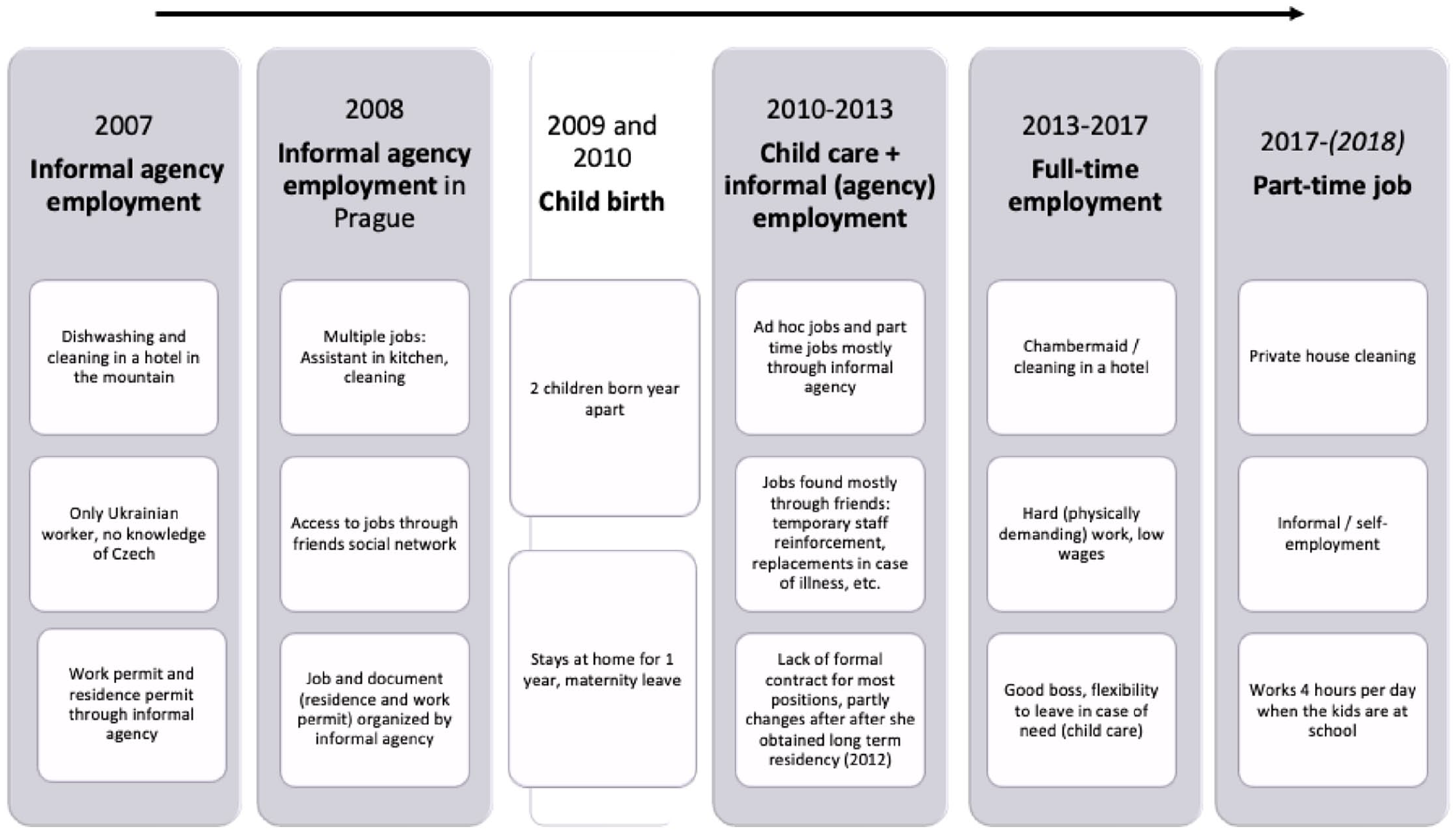
Olha’s employment since her arrival in Czechia (2007–2018).
Olha (40) moved to Czechia in 2007 with her husband; they have two children, age 8 and 9, both born in Czechia. At the time of our interview, 10 years after her arrival, Olha was working as an informal house cleaner in several households, without any contract.
I do house cleaning. My older boy is ashamed that mummy makes money as a home cleaner, that she is cleaning only toilets and toilets. . . . [My husband] works eighteen hours a day . . . he does two shifts in a row to cover all the expenses. . . The children see daddy only on the weekend. Sometimes we argue about that a lot—it is terrible.
In Olha’s case, her employment (and some of her husband’s employment) is precarious for multiple reasons: low wages, the need to combine several jobs, partly informal arrangements, lack of social protection, stigma in Olha’s case and a negative impact on family life.
Yet, she perceives this particular combination as the outcome of her active choice. A few years back, when her children were in kindergarten, she found a full-time job cleaning in a hotel with flexible working hours which allowed her to leave in case she needed to take care of the children. It was a move towards a more stable form of employment compared with previous informal and semi-formal jobs (see Figure 2). However, when both her children started school, she quit her full-time job in order to spend more time with them.
[I needed] to spend more time with them—we need to work on the Czech language, spend more time on reading, writing, repeating everything. I study with them. We learn from each other . . . [The children] need mummy with daddy the most . . . I grew up without mummy.
Olha’s story was in line with literature on the acceptability of precarious work as a temporary strategy for women with care responsibilities, done so as to address the need to combine work with care obligations, reproducing the female caregiver and male breadwinner division. Yet, in the context of migration, these roles are less pronounced. Compared with other migrant women with children, she perceived her choice as exceptional. She felt obliged to explain it, but she perceived it as her own decision (albeit approved and enabled by her husband).
The theme of motherhood was dominant in Olha’s narrative. Yet, she also perceived the time spent with children as an opportunity to reimagine plans for the future, which had seemed inaccessible for a long time.
I wanted to study law. But back at my home, we never had enough money, it was too expensive. So, I had thought that I would try to work, to save some money. But then I met my husband [laughs] . . . I still think about it, maybe when I will learn the language with the children, maybe afterwards.
Olha perceived the retreat from a more stable job as a proactive choice. It enabled her to organise her life and interpret her role as a mother in a way that she perceived as important and independent of predominant choices made by migrant women in her surroundings. Her past experience of growing up without a mother played a central role in her preferences, but the choice also allowed her to imagine a different path for the future. By accepting precarious employment, she was ‘carving a space of control’ (Morokvasic, 2007, 2014; Rydzik and Anitha, 2020), and the importance of this type of control was shaped by her life experience.
Irina: Precarious work as a means to achieve independence from the male breadwinner model
Irina’s situation (Figure 3) serves as an example of how economic independence from a husband can result in increased dependency on exploitative working conditions in the lives of migrant women (Morokvasic, 1984). After more than a decade in Czechia, Irina needs three different jobs to (barely) cover her and her children’s basic needs.
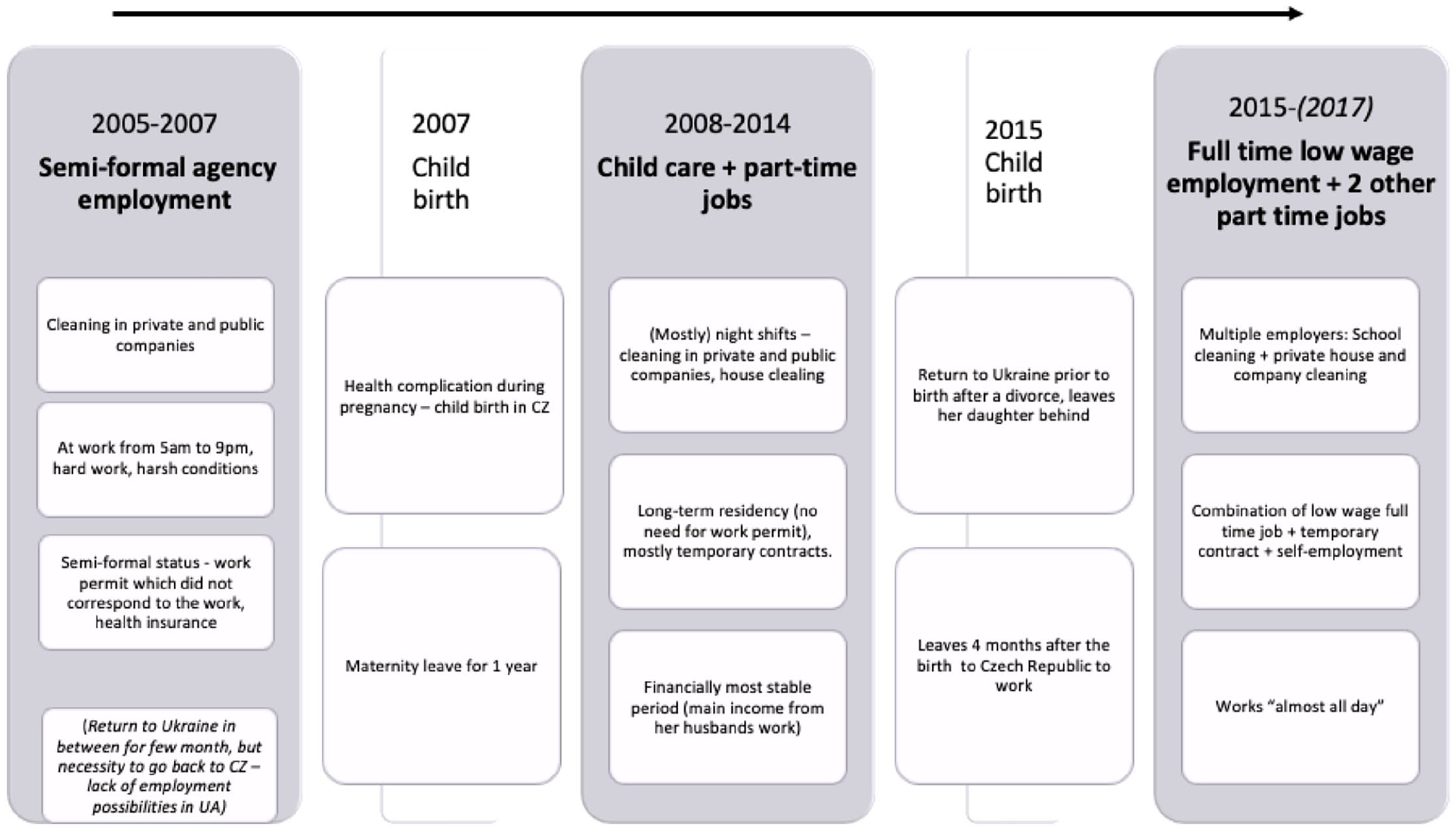
Irina’s employment since her arrival in Czechia (2005–2017).
Irina (37) came to Czechia in 2005. She had two children: one from her first marriage, aged 10, and another from her second marriage, aged 2. Only the younger one lived with her. At the time of the interview, she was separated from both her husbands.
Irina worked on a full-time contract as a cleaner for minimum wage, had another temporary contract with the same employer (an additional 3‒4 hours per day) and semi-formal cleaning jobs on the side (self-employed; 2‒4 hours per day and weekends). This allowed her to have an income slightly below the median wage. However, after covering rent and child costs, there is not much left. Yet when she described her situation, the main emotion was not frustration, but pride.
I simply know who I work for, who I do all this for—for my children. And, for me, it is better than if [my son] were not here and I worked here by myself . . . I will look after my kids, but NOT after a man . . . I tell him, ‘I don’t want your money or for you to pay for something. I can earn it all by myself.’
This perception was strongly shaped by her past experience when her husband had been the main financial provider of the family. She was responsible for their child and so worked part-time jobs, mostly at night, to cover free time and educational activities for children, hoping to obtain a better future for her daughter. Recalling this period, she said that despite some tensions with her husband, she was content. However, when their daughter was seven, she learned her husband was an adulterer. This experience was followed not only by a psychological breakdown, as she had deeply trusted her husband, but she also had to leave the apartment they had bought together. She returned to Ukraine without her daughter, her husband having persuaded her it was better for her daughter’s future to stay; at that point, Irina was not able to provide for her daughter in Czechia.
In Ukraine, she remarried and had a son. Not long after she returned to Czechia to work, first alone and then with her son, who was less than a year old, after obtaining a legal permit for him. Since then, her sister, mother and brother have come in turn to help her with childcare while she covers the rent and most of the living costs at work.
Irina’s narration was about gaining power and independence. Her notion of good motherhood was framed as being able to provide financially for her children and was shaped by her past experience of dependence and betrayal. Irina was challenging the gendered division of labour, often replicated in the process of migration (Morokvasic, 2007), by shifting from being financially dependent on her husband to being the family breadwinner herself. The precarious forms of employment allowed her to gain this independence.
Similar to previous narratives, Irina’s employment trajectory represented a chain of precarious jobs, one might say, reproducing her marginal labour market status. Yet this was also a transformative story of breaking a gender norm. She was proud of her ability to provide financially for her family. To understand how economic and financial independence was empowering for Irina, the context of her past and the way she relates to it provides a crucial source of understanding.
Conclusion
This article aims to challenge the notion of precarious workers as constrained and limited in their ability to act (Paret and Gleeson, 2016; Standing, 2014). It applies the workers’ individual perspective as a major analytical focus for understanding the agency of precarious workers. Migrant women were selected for the study as they represent one of the most vulnerable groups in the labour market context. These women are positioned within numerous axes of structural oppression and processes of precarisation, with limited capital and resources to actively influence and structure their lives (Fuller and Vosko, 2007).
Structural vulnerability is prevalent in the narratives of the Ukrainian migrant women working in Czechia included in the study. Their stories depict the persistence of precarity beyond the precarious legal status often described when discussing the situation of migrant workers. Despite having stayed in the ‘host’ country for more than a decade (allowing for permanent residency and thus equal labour market rights), and having their families with them, as well as leaving the ‘migrant job’ segment of the labour market, they still suffer from structural exploitation. Their employment trajectories are characterised by a high level of precarity; for some, this precarity has even increased over time. The women’s labour market experience is characterised by a continuum of diverse forms of precarious employment and personal life statuses. They seem trapped in a continuum of precarity (Goldring and Landolt, 2011). Yet, as Tyldum (2015a, 2015b) and Rydzik and Anitha (2020) suggest in their research on agency among female migrant workers, exploitation and empowerment are closely knit fragments of experience that need to be researched together.
The narratives of the women in this study contradict the image of female precarious migrant workers as victims or disempowered people. They are aware of the problematic aspect of their current employment and the negative impact it has on other areas of their lives. However, they also perceive the jobs they are working as enabling them to carve out a larger space of control over their lives. For some, this allows them an unprecedented degree of financial stability; for others, it gives them the opportunity to spend more time with their children, potentially enrol in future studies or gain financial independence as family breadwinners. These subjective perceptions are shaped by the women’s perceived ability to react to the contingencies of the current situation, as well as by their past experiences and their imagined scenarios of the future.
There is a consensus that the migratory experience is constantly reinterpreted in light of previous experience, and migrants tend to compare their current situation with the situation in the country of origin. This allows the experience of constrained agency of precarious workers to be bridged with the experienced autonomy of migrant women in the process of migration (Fedyuk and Kindler, 2016; Tyldum, 2015b). Yet, what is observed in the analysed narratives of this article is the centrality of the experience after the women’s arrival in Czechia. This article suggests that to understand these perceptions of agency among precarious migrant workers better, it is necessary to shift attention away from the experience of migration as a dichotomous category in which migrants compare their experience (of labour or gender structures) between the country of origin and country of destination and focus on a more nuanced approach.
Based on this research, this article proposes to approach the perception of agency among workers facing precarious working conditions as a process of interpreting a person’s lived experience. It emphasises the embeddedness of this perception in women’s life trajectories, stressing the ways social actors critically evaluate and reconstruct the conditions of their lives in the context of their life experiences and expectations (Emirbayer et al., 1999; Hitlin and Elder, 2007). Combined with biographical narrative data (which places workers’ self-presentation at the centre), such an approach illustrates the multiplicity of layers of reasoning that can make precarious work not only acceptable but can also provide those working these positions with a sense of agency and control in spite of inflexible and restrictive conditions (Erel, 2007). It sheds more light on the ways in which actors can perceive decisions as transformative despite still seeming to reproduce a precarious status or (gendered) role.
Whereas the temporal dimension prevails in migration research, the temporal context in the perception of precarious jobs is often missing or is focused primarily on the (often constrained) ability to negotiate working conditions. Zooming out from the experience of migration (‘the move’) as a dominant frame, yet maintaining the focus on the embeddedness of perceived agency in life trajectories, a much wider set of possible perceptions and choices can be captured. Moreover, it clarifies why similar choices and situations (work positions and trajectories) may be perceived differently by different actors. Anna perceives her multiple jobs in a school as stabilising, but for a woman with a middle-class background and no migration experience, such a job might be a step back. Such an understanding is important when searching for a language to describe the experience of exploitative working conditions and structural oppression that maintains sensitivity and respect for the workers’ dignity and perceptions. This does not imply that conditions are acceptable or that they do not have a negative effect on both the individual and social levels. However, researchers should avoid the trap of portraying workers in marginalised conditions as disempowered when they do not feel that way. By emphasising the role of past employment, an approach that includes the agency of migrant workers, research can also contribute to understanding the impact of long-term experience with precarity as a normalisation process of substandard employment forms in certain segments of the labour market.
Footnotes
Appendix
Socio-demographic characteristics of the sample
| Name | Place | Education | Age | Legal status | Employment | Children (age) |
|---|---|---|---|---|---|---|
|
|
Prague | secondary | 40 | permanent residence | cashier (cleaner) | 1 and 10 |
|
|
Prague | secondary | 35 | permanent residence | cashier (cleaner) | 1 and 3 |
|
|
Prague | secondary | 40 | permanent residence | cleaner | 8 and 9 |
|
|
Prague | secondary | 35 | permanent residence | cleaner / assistant cook | 14 and 10 |
|
|
Prague | secondary | 30 | permanent residence | cleaner | 2 |
|
|
Prague | secondary | 30 | permanent residence | cleaner / tour guide | 2 |
|
|
Prague | tertiary | 28 | permanent residence | cleaner | 4 |
|
|
Prague | secondary | 37 | permanent residence | cleaner | 2 and 10 |
|
|
Prague | secondary | 40 | permanent residence | waitress | 0.5 |
|
|
Prague | tertiary | 31 | citizenship | midwife | 2 |
|
|
Prague | secondary | 35 | permanent residence | cleaner | 5 |
|
|
Prague | tertiary | 31 | working visa | assistant cook / cleaner | 10 and 4 |
|
|
Prague | tertiary | 27 | citizenship | parental leave | 1.5 |
Acknowledgements
We are very grateful to the anonymous reviewers who provided very valuable feedback on previous versions of the article.
Funding
This article was published with support from a Czech Science Foundation, project no. GA17-21259S.
