







Abstract
In a context of growing dualisation of the workforce that in France takes the form of a ‘contractual dualism’, this article analyses the mechanisms supporting the resort to contract observed in the public teaching sector otherwise modelled on (statutory, long-term) civil service. It departs from analyses mainly focused on the institutional variations of dualism and their outputs, and contributes to the literature on labour market segmentations by adopting an analysis of workers’ experiences and professional trajectories. Findings reveal that contract teachers receive little support from the state to secure their careers and develop professionally, but nonetheless commit to their careers despite the differential in employment and work conditions, which they seemingly consider as acceptable comparatively with their previous work and employment conditions, and given their social origins and aspirations. Analyses thus bring forth new evidence of intersections between institutionalised forms of dualism, social reproduction and the employment trajectories of individuals.
Introduction: The social premises of the access to public employment
In policy systems that had been organised around civil service employment, the issue of the ‘state as employer’ was recently raised with the growing resort to contract in the public sector (Derlien and Peters, 2009; Givan and Bach, 2007; Gottschall et al., 2015). This phenomenon has been analysed as part of public management reforms and transformations of professional dynamics within the state, but also more generally as part of the growth of nonstandard employment relations (NSER) (Kalleberg, 2013), and of the dualisation of employment regimes and labour markets (Emmenegger et al., 2012; Gallie et al., 1998). Formerly subject to strong labour regulation in Europe, welfare professions and the education sector have been prone to many deregulation schemes, such as the rise of subcontracting and flexible employee management (Mossé et al., 2011; Pollock, 2007), or less emphasis on collective bargaining, in favour of employers and employer schools (Mathou et al., 2022).
In France, the implicit figure of the lifelong serving civil servant has been the backbone of most analyses of public service employment, and the diversity of employment statuses in the public sector has only been recently addressed (Bresson, 2016; Peyrin, 2019). This scarcity of studies on short and fixed-term employment contracts in the public sector can be explained by the fact that the legitimacy of state policy action has implicitly relied on the status of civil service. The ‘neutrality of the state’ embodied in the neutrality expected from professionals in their missions of public service, has arguably led to misapprehension of the variety of ways by which individuals enter public service, and how they come to occupy specific positions within it (Laurens and Serre, 2016).
In this perspective, our aim is to understand how dual systems of employment in the public sector rely on and perpetuate existing social inequalities. The article closely looks at how social trajectories of workers are interrelated with the dualism of trajectories of employment in the public sector. It argues that the dualisation of the teaching public sector in France does not only rely on state regulation of the profession, but also on discrepancies in the social and professional trajectories of their employees translated institutionally into separate channels of recruitment in the state sector.
Recent works have contributed to expand the analysis of employment policy regimes along with the study of social inequality in labour markets (Grimshaw et al., 2017; Halleröd et al., 2015; Yates, 2021). They have searched to include an analysis of the role of employers in drafting ‘good’ and ‘bad’ jobs and a multi-dimensional and intersectional approach to employment, to understand how disadvantage on the labour market is socially constructed and reproduced (Grimshaw et al., 2017). Such works have revealed the mismatch between demanding employment standards for entering highly regulated state jobs and the actual chances of candidates trapped in precarious jobs to meet the requirements to obtain such jobs (Samaluk, 2021). They have also revealed how professional difficulties can be experienced individually or be the source of collective strategies (Della Porta et al., 2015). Biographical conditions taken as a whole, as the articulation of different types of resources (economic, cultural, political, etc.) that interplay into life trajectories, are therefore being questioned to grasp how individuals relate to norms of employment, their relative distance and proximity to these norms, and how they navigate between them (Mrozowicki and Trappmann, 2021).
Additionally, the comprehensive and multi-dimensional approach to public employment segmentation that we employ here, builds upon strands of research that have studied the state, social services and education in France along with changes in the social structure. In France, many works have studied socio-professional groups across the social spectrum for their ties to the central state in France, contributing to understanding how specific policy areas may be implemented by different social groups within the state – to cite only a few, postmasters (Join-Lambert, 2001), higher administration officers (Eymeri, 2001) and school principals (Barrère, 2006), but also front office immigration civil servants (Spire, 2007). More largely, the public sector and public sector professionals in France have long been studied in relation to changes in social structure and stratification. Several research (Gollac, 2005; Gollac and Hugrée, 2015) thus showed that with its contraction over the last 30 years, the public sector, historically favourable to women and members of the working-class in upward social mobility, lost its role of social promotion. Other research showed the relative disavowal of public service careers among qualified young generations more attracted to the non-profit sector (Hély, 2009). Studies of the teaching profession have also specifically relied on the broader canvas of changes in social structure to explain transformations of the profession. Although professional and general education teachers’ social profiles and trajectories have converged over the last decades (Jellab, 2005), they still evolve in separated segments of the social space, notably according to the education level of teaching, primary or secondary (Farges, 2017).
Such studies showed social group dynamics, internal social diversity and professional mobilisation in relation to transformations of the state. However, they seldom considered the specificities of civil service labour markets and more precisely the variety of conditions of employment, especially between titular and contract employees. This study thus interrogates on the intersection between labour market dualism in the public sector and social trajectories of employment of individuals by adopting a processual analysis of their experiences and professional trajectories. It addresses this void by asking the following questions: (1) What are the social characteristics and previous employment trajectory of individuals entering the teaching profession as contract teachers (compared with titular teachers)? (2) How do individuals entering the teaching profession as contract teachers navigate between norms of employment of the professional group? In particular, how do they make sense of the differential in the employment status of titular and contract teachers? (3) How does the regulation of the employment trajectories of contract teachers condition their career opportunities and professional integration?
Compared with titular teachers, (1) contract teachers in our corpus tend to have lower social origins and discontinued previous professional trajectories before entering into the teaching profession. Results then show (2) how these characteristics explain how they navigate in the employment norms of the teaching professional group. Further analyses focused on the HRM practices for contract teachers reveal (3) how these reinforce the employment differential and the risk for them to be trapped in precarious employment conditions.
The dualisation of the public teaching sector in France
The issue of the permanence for public service employment has a long history in France. The distributive policy of employment on the national territory contributed to territorial legitimacy of administrative and political power, and strongly relied on the ideology of public agents’ interchangeability (Dreyfus, 2000; Rouban, 2009). The institutionalisation of the public service regime of employment was reinforced after the 1946 statutory law on civil service that introduced principles of derogation of titular civil service employment conditions from the French Labour Code. However, the civil servant status only became the norm of employment in the public sector much later (Loi Le Pors, 1983), when the number of contract agents was paradoxically declining, compared with the 1946–1975 period when high levels of contract agents were observed in most state ministries (Peyrin, 2019). Since the 1980s, the legal protection of civil servants defines any other forms of employment as ‘atypical’ (Peyrin, 2019: 74) and legally assigns them to a marginal place.
The regulation of the teaching profession in France is at the crossroads of dynamics of higher and lower civil service, depending on teaching levels, types of concours and agents’ positions in the social structure. The higher civil service gained legitimacy on diffusing civil service reform ideas in the 1930s, while distinguishing itself from other sections of lower civil service at the same period, and it succeeded in maintaining a variety of modes of recruitment within (nomination, contract and civil service). The professional regulation by concours (organising conditions of entrance) 1 and corps (organising professional mobility and careers) contributed to re-articulate civil service statuses to their related policy domains and Ministry after 1946.
In the closed internal labour market of civil servant teachers, symbolic hierarchies of the state (the prestige of teaching in lycées, in elite classes préparatoires, as opposed to teaching in kindergarten or primary schools) interplay with professional segmentations (professeurs des écoles for children under 12, and enseignants du second degré, afterwards), salaries and differences in social recruitment (85.9% of primary and pre-primary school teachers were women in 2019, while this was the case of 60% of secondary and upper-secondary school teachers). 2 Within secondary and upper-secondary schools, this is reflected in the difference between agrégation and CAPES, 3 the two main secondary school teaching concours that are taken at the same level of qualification with differences regarding their academic difficulty, but leading to differential career developments and opportunities, salaries, 4 advancement, extent of service hours due and prestige.
Symmetrically to the meritocratic neutrality of civil service concours, the national territorial distribution of titular teachers is promoted to treat everyone the same way: this large-scale regulation of titular teachers relies on the allocation system to a position, based on ministerial orientations. Newly appointed teachers and teachers in mobility make preferences of geographical location and positions at the national level, and then are distributed within regions called ‘académies’ (30 in France). This two-step allocation system first relies on national algorithms weighing seniority with family situation, type of corps and echelon for teachers to be distributed in regions. Then teachers make choices for specific positions and schools. Most of the regulatory work is carried out by the regional authorities and the unions, and aims at affirming public sector rules of ‘equality of treatment’ among civil servants.
The rule of geographical mobility on the national territory for young titular teachers entering the profession sometimes generates disillusionment with the profession. The value of a teaching position in a school is internally determined by the demand of this position by titular teachers, according to characteristics pertaining to career (seniority and advancement, concours) and to family and conjugal characteristics (that accelerate stabilisation in a position). The less they are requested by candidates, the more the positions are attributed to newly appointed titular teachers. Entry-level teaching jobs for titular teachers are thus positions in schools less favoured by teachers with more seniority – who in turn have more leeway in their choice of school – and they are concentrated in underprivileged areas (Cour des comptes, 2018). More precisely, they are more often given to young titular teachers who have not planned career strategies before entering the profession or who do not hold the resources (information, proximity to the inspectorate, etc.) to circumvent geographical mobility and be appointed to better posts requiring specific skills (international schools, academic specialties, prep schools).
Contract teachers are hired for two main reasons: as replacement teachers for teachers on leave, or as teachers on posts that have not been attributed to titular teachers. Public reports have also noticed the relative disaffection for the teaching profession, as shown by the diminution of the number of candidates at concours and in consequence the non-attribution of created positions each year in some disciplines. In that context, the lesser-requested teaching jobs are also more and more attributed to contract teachers. In addition, the ratio of contract teachers in schools’ teaching staff depends on the socio-economic characteristics of the schools and their attractiveness to teachers (especially location, public, reputation). Contract teachers are thus not homogeneously distributed on the national territory.
There is a distinct rise of the resort to contract teachers over the last decade. A total of 8.5% of teachers are contract teachers in public schools in 2018, but 25% of newly hired teachers were recruited as contract teachers, mostly in general education (although, historically, vocational schools had hired most contract teachers for their expertise on a given professional domain) (Dumay, under review). Contract teachers cannot legally stay longer than six full years on short-term contracts (but they do when they are attributed intermittent contracts more than 6 months apart). The trajectories in employment of contract teachers show a great variety. Taken nine years after their recruitment (data 2008–2018), 47.3% of contract teachers have left teaching or have not been re-employed, 29.8% have become titular after passing concours, 12.7% obtained a long-term contract through legal dispositions, and 10.2% appear to have taught intermittently during these years and appear to be entangled in unstable teaching employment patterns (Delhomme, 2019). On the contrary, titular teachers very rarely opt out of teaching and resign from civil service (Feuillet and Prouteau, 2020).
Methods
Our analysis is based on a qualitative case study conducted collectively within an ERC-funded project that analyses global transformations of the teaching profession regulations in several EU countries. In this article, we present the case study that we conducted in France in a region characterised by its median attractivity for titular teachers (entering the profession and later on in their career) and by an increased level of contract teaching jobs over recent years. The number of contract teachers has grown in all académies, but with disparities: the académies of Créteil and Versailles near Paris now have a higher share of non-tenured teachers in secondary education – respectively 13.8% and 11.2%. 5 In the region under study in 2017, the share of contract teachers among teachers is close to the national average (9.1%). 6 The region is characterised by a central metropolitan area, very attractive for teachers, and contrasted semi-urbanised areas, comprising de-industrialised regions in demographic decline, and more well-off areas in demographic growth, developing as commuter towns.
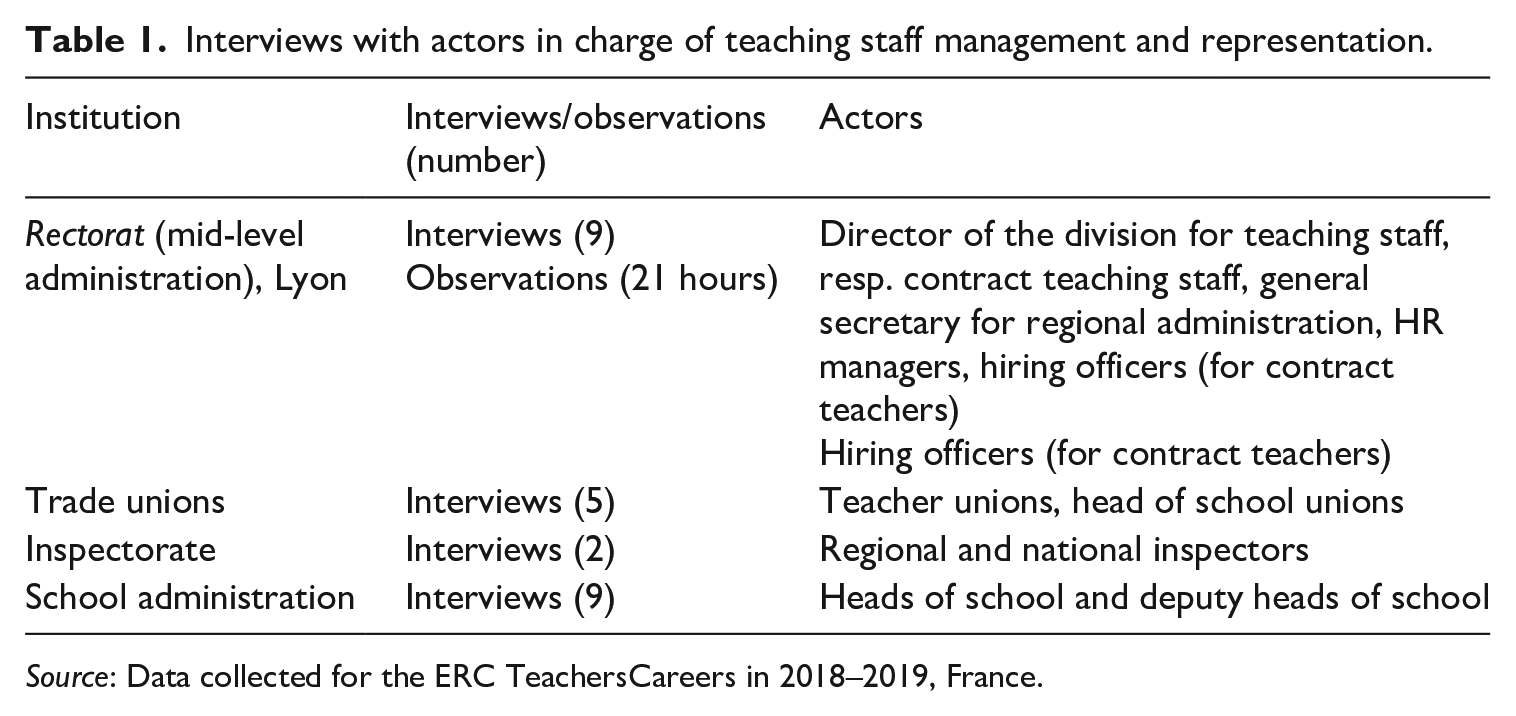
In 2018 and 2019, we conducted 25 interviews with institutional actors and HR in charge of employment relations, teacher recruitment and regulation at the regional level (administrations, unions, school leaders), and through the administrative work regarding contract teacher recruitment and management in the regional offices (rectorats d’académie) of the Ministry of Education (Ministère de l’Education nationale) (Table 1). We also conducted 44 interviews with permanent and contract teachers in seven state and semi-private lycées (upper-secondary schools) in the same region that we selected for their contrasts regarding academic results, educational offer and options, geographical situation (rural/urban) and the public (priority education schools/privileged neighbourhoods) (Table 2). Among the state schools, the urban and privileged Lycée Monet had the highest success rate at students’ final exams (baccalauréat) and the lowest rate of contract teachers (1.2%). In a rural area, Lycée du Beaumont had a lower than national success rate at baccalauréat and the highest rate of contract teachers in our corpus (11.4%).
Interviews with actors in charge of teaching staff management and representation.
Source: Data collected for the ERC TeachersCareers in 2018–2019, France.
Seven upper-secondary lycées and their teaching staff.

Notes: Success rate at baccalauréat: DEPP, MEN, 2017.a These rates are relative to total hours of service. bll lycées have been given a pseudonym.
Source: APAE 2017, state upper-secondary lycées (no data provided for semi-private lycées), direction Prospective et Statistiques, académie de Lyon.
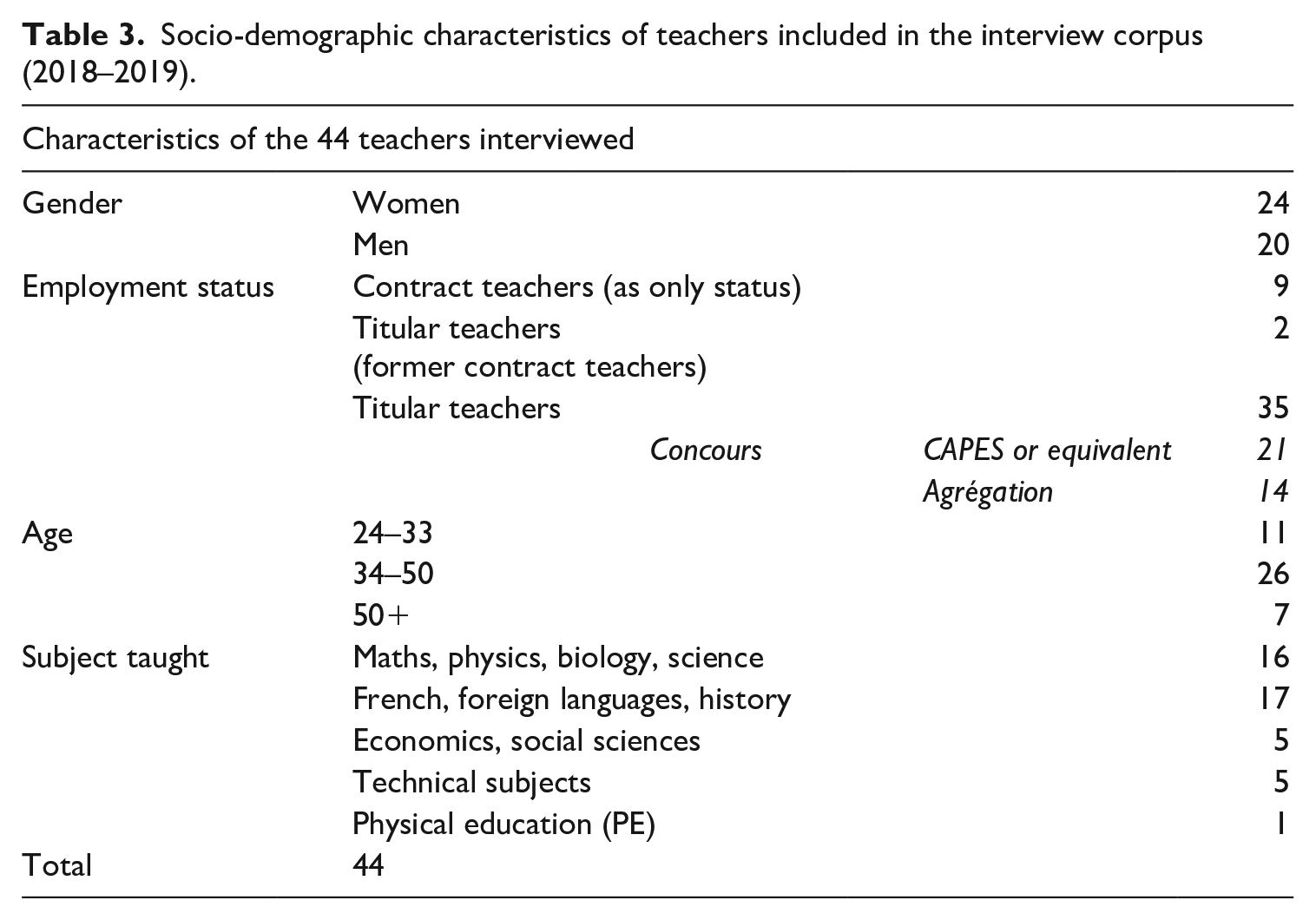
Teachers were selected and contacted through direct discussion with heads of schools in order to contrast teaching careers (reflecting contract/titular positions, first or second career in teaching, the variety of subjects taught and seniority in the school, type of teaching concours passed) and socio-demographic characteristics (gender, age). We later often obtained additional interviews among colleagues of our interviewees, by way of snowballing effect. Among the teachers interviewed, 24 were women and 20 were men. Most interviewees taught general subjects in science or humanities; 33 had only been titular teachers and 11 were contract teachers at the time of the interview or recently passed titular (Table 3).
Socio-demographic characteristics of teachers included in the interview corpus (2018–2019).
The interviews followed a biographical logic in order to sequence different phases of teachers’ biographies, from their early education and social backgrounds to their studies and the transition to the labour market, to later stages of their careers. We collected successive sequences of their professional career as a teacher (and before teaching when relevant) and the articulation with life course events (family events, health conditions, changes of location), resources (cultural, economic, social, political capital) and socio-demographic characteristics (gender, social background, immigration trajectories). Within this biographical grid, the interviews were structured thematically: we interviewed teachers on their work and on their work-related practices (relations to students, pedagogical orientations, integration in teaching teams, practices other than teaching but related to teaching) at different stages in their careers.
As civil servants’ teaching careers are highly regulated (concours, central allocation to a teaching position), institutional arrangements appeared as prevalent and as internalised guidelines in teachers’ understanding of their careers and life courses. Contract teachers’ interviews were less linear in terms of understanding teachers’ relation to their careers, although becoming titular was a goal for all but one of them (and the main goal for most).
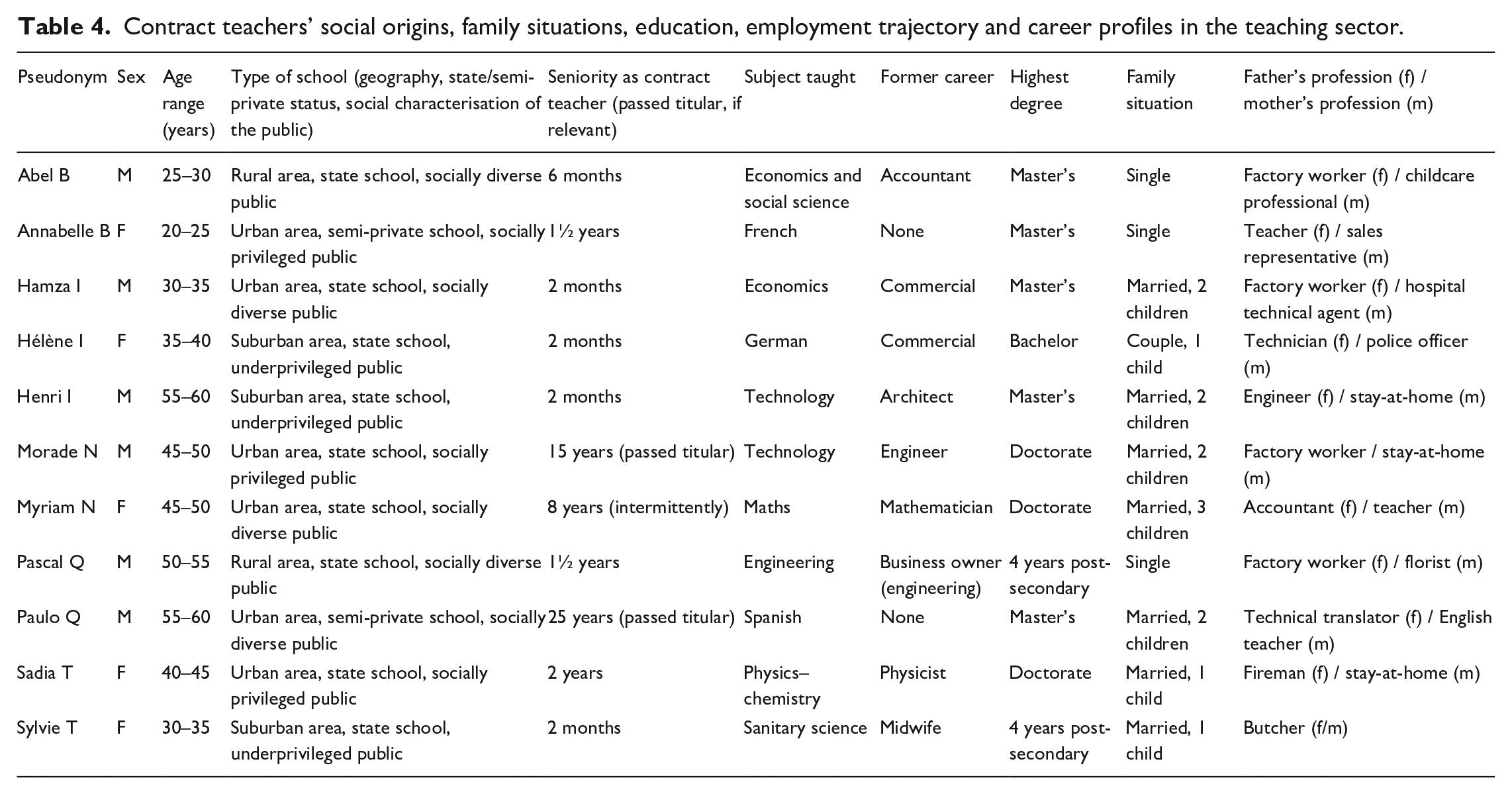
The interviews were analysed using textual analysis (NVivo 12), so as to associate employment conditions, perceptions and experience of the job and of one’s position, integration in teaching teams, with socio-demographic characteristics and trajectories in employment (see Table 4 for detailed information about the 11 contract teachers). We completed this analysis with in-depth biographical portraits of each interviewee. To guarantee anonymity, all names appearing in the article are pseudonyms.
Contract teachers’ social origins, family situations, education, employment trajectory and career profiles in the teaching sector.
Dualisation of teaching employment, social origins and employment trajectories
In order to better situate contract teachers on the social and professional spectrum, we contrast them with the socio-professional situation of titular teachers. Owing to the regulation of entrance into the profession by concours valuing academic knowledge and university training, entrance into the teaching profession as a titular teacher still mostly occurs just after completion of one’s initial training and constitutes teachers’ main experience on the labour market. Most teachers continue to mention ‘vocation’ as prevalent in their choice of career (Périer, 2018). In 2018, individuals having a prior professional experience outside of teaching represented 15% of new teachers. 7 If the average age when entering the profession has risen slightly over the last decade for all categories of teachers as an effect of the increase in qualifications needed to take concours (Master’s degree), teachers on average enter the profession through concours at the age of 29. 8 Contract teachers’ ages when entering the profession seem to be continuously rising (Farges, 2011). Concours is increasingly taken after a first experience as a contract teacher, although this is by far not the most frequent situation. The social origins of teachers as a professional group has also been widely studied, showing that teachers come from more privileged social backgrounds than the general working population and that social reproduction among teachers is high (Farges, 2017). In 2015, one teacher out of five has a parent who is a teacher (Delhomme, 2020).
Titular teachers in our corpus have mostly middle-class and upper-middle-class backgrounds (only five have working-class backgrounds). On the contrary, only one out of 11 contract teachers interviewed have an upper-middle-class background, and most have middle and working-class backgrounds. Among the titular teachers interviewed, several have at least one parent who is/was a teacher (this is the case of only one contract teacher), suggesting that most contract teachers possibly have less knowledge about teaching as a career and less proximity to the profession, which some interviews confirmed. In our corpus, only two contract teachers had no other professional experience before teaching and had not finished their course of studies. The other nine contract teachers had either known employment instability in their previous jobs (short-term jobs, explicit racial discrimination), or were self-employed and had known difficulties in their activity (as a private practice professional or small business owner, for instance). By contrast, 24 out of 33 titular teachers had no other professional experience before becoming a teacher. Titular teachers were more often university graduates of the subject matter they taught than contract teachers, who had less linear educational background and/or direct correlation between their studies and the subject they taught when interviewed. Four titular teachers (out of 33) were PhD graduates and three out of 11 contract teachers were PhD graduates. A bachelor’s degree (licence) is needed to teach as a contract teacher, yet a Master’s degree is required for titular teachers, but most contract teachers held a Master’s degree (and only two contract teachers had a bachelor’s degree).
If contract teachers are far from being a homogeneous group, interviews with contract teachers in our study show differences with titular teachers concordant with available data on teachers’ socio-demographic and professional backgrounds (Farges, 2017). Our interviews with contract teachers also show the attractiveness of the civil servant status, as most of them aspire to secure employment situations and achieve social stability. Therefore, they do not necessarily consider themselves as precarious because short-term contracts in the public sector may appear comparatively more secure than some of the bad jobs they used to occupy, as Hélène, 40, a contract teacher holding a 4-year degree in management, related about her previous career:
I am not obsessed with long-term contracts, I prefer freedom. I am, I am bored very, very quickly unfortunately. I struggle staying a long time in the same company, especially in big companies, where changes are too slow. When you do not have a business school or engineering degree, it is very difficult to evolve – I am not passionate enough to stay and become . . . chief of secretaries, it is not my thing. I prefer a certain freedom.
9
Most of the contract teachers we interviewed experienced multiple difficulties on the job market, showing that the ‘choice’ rhetoric is at variance with financial and organisational difficulties (Bresson, 2016). The example of Hélène shows that disadvantaged groups on the labour market do join the public sector labour market to run away from their previous precarious situation, which explains why they privilege downward comparisons (with their previous precarious conditions) over upward comparisons with tenured civil servant teachers. Among interviewees who used to work in the private sector, teaching under contract appeared to be just a precarious job among others, as they do not immediately see themselves as teachers in the long-term and/or they maintain another professional activity on the side. They had usually come across difficulties such as unemployment periods, illness, motherhood and racial discriminations that engender discontinuities in their careers. In some cases, they cumulated other forms of precarity, notably in social protection and pensions. Pascal, an engineering contract teacher in a school in a semi-rural area, had a highly fragmented career before becoming a contract teacher. He alternated salaried work and independent work. He had been employed then laid-off, and had experienced many interruptions. At the time of the interview, he was teaching in several organisations (university, training programmes and schools) as a way of getting complementary income.
Dualisation in the public sector thus intimately relies on dualisation and rising precarity in the private/independent sector labour markets. For contract teachers, joining the teaching labour market is often linked to getting minimum social protection. Henri, 58, an architect who described his career as an unwillingness to ‘shine shoes’ and be ‘aggressive’ in his search for contracts, and was content in his ‘niche’ of small-building architecture, explained that he turned towards teaching when he discovered he would retire at 67 with a 1100€/month pension. The 2008 economic crisis burst out just after he had started hiring new employees and he faced serious economic difficulties from being left unpaid by some clients. Teaching then ensured salaried employment with a minimum social protection he had not acquired in his previous activity. Similarly, Sylvie, a 32-year-old contract teacher and former midwife, had health problems that prevented her from continuing as a full-time self-employed worker. She concluded in the same way:
[Teaching] is not well paid, that is clear. But it gives me access to social security. That is the thing. It is not so much about job security, but about welfare, with teaching I qualify for unemployment.
10
The employment stability indexed on the social status of the profession thus proves to be a strong social norm (Bouffartigue, 2012), even if, for contract teachers, this norm reflects in a form of security that albeit precarious is seen as better than what they experienced before. In addition, the capacity for contract teachers to achieve tenured status depends on a complex and unlikely articulation of a set of diverse resources such as social and economic background, previous employment conditions and positions, qualifications and, last but not least, on-the-job socialisation. They sometimes do not have qualifications or a favourable environment to prepare demanding teaching concours. Many contract teachers do not come to terms with taking these exams because other resources are necessary to involve in their preparation, such as being free from family caregiving or having a minimum of economic resources to be able to undertake concourspreparation without another job.
In search of stability: The difficult path to constructing a career as a contract teacher
The recruitment of contract teachers responds to job-specific demands: the need for a teacher for a short period in a given subject and a given school. For teachers with tenure it is to the contrary, interchangeability is the rule, and when teaching positions are individualised, as is increasingly the case in upper-secondary schools, they correspond to specific needs in the education system – such as teaching for hearing-impaired students, migrant students learning French as a foreign language, teaching history in English, teaching cinema studies, etc. In most cases, individualisation for tenured teachers corresponds to highly sought-after jobs, whereas for contract teachers, individualisation is tantamount to a compensation for undesirable positions.
Sadia, 35, a PhD graduate in physics turned contract teacher in technology in 2017, was educated in Tunisia and had postdoctoral positions in Hong Kong and England before relocating to France following her husband, also a physicist. She explained having first been recruited to teach technology classes in lycée technical curricula because her degree was misinterpreted. Her application was itself the result of a misunderstanding. When looking for a job in academia, she had misinterpreted the administrative rectorat’s announcements as ‘higher education’, but she maintained her application nonetheless. She ‘just sent her résumé’ and was ‘called from one day to the next’ for a part-time contract in a professional upper-secondary school, realising afterwards that the subject area she was assigned to was in fact not her specialty. At the end of the semester, she received negative reports from the headteacher and the inspectorate on her teaching, which was considered too academic and lacking the input of professional experience, and was not called for another job. Yet, a few months later, she answered a Pôle Emploi 11 local announcement for a position in teaching physics at a general upper-secondary school in the same region, which she obtained, and another contract followed after that.
The allocation to a specific teaching position plays differently according to employment status, with consequences on territorial and educational equity: contract teachers rarely stabilise in the same school, which appears to have a strong influence on career projection. Hélène was recruited as a German teacher because she had experience working in Germany. She started on the spot and recounted feeling overwhelmed by the variety of tasks and responsibilities. Gradually feeling illegitimate and not recognised or supported, she decided to quit after three months only:
I feel ashamed, I realise it, I realise that I cannot tell it to my colleagues, and they cannot hear this. Because I do not have my place. I want to hide. I was very scared last week when I went on sick leave. They told me ‘watch out for depression, it can go very, very fast’. I saw indeed that it goes very, very fast. I was feeling bad, I was scared. I thought, I cannot find myself in a burnout like that.
12
When they occupy year-long contracts, or have the opportunity to come back to the same school for a second contract, teachers seem to receive more institutional support that increases their trust into taking concours. Integration in teaching teams varies most of the time with the duration of their contract. If contract teachers deplore the lack of support from pedagogical inspectors, by whom they feel they are ‘stopgaps’, as one teacher repeated; integration and relative stabilisation in teaching teams helps them to consider their work as equivalent to the work of tenured teachers, and to foster recognition of their professional skills. It also appears that concrete projections into taking concours grew when combined with higher level of qualifications. Morade, 48, holds a PhD in engineering. After trying to find a position as a researcher and periods of unemployment, he applied to be a contract teacher:
Supply teacher [jobs] were . . . It was when there is a gap. They are stopgaps. In spite of that, you do the same mission as any teacher, [. . .] the same things, number of hours face-to-face, practices, preparation, school trips . . . It means the same expectations, you do the same teaching, in the same frame, I mean . . . We are professional. In other words, the requirements are the same . . . So we were not, how would I say, extra-terrestrial (laughs).
13
Morade was aware that he was overqualified for the job, but he also felt on the same ground as permanent teachers. During seven years, he had consecutive teaching contracts, covering many gaps. Aspiring to find a job as an engineer, he first refused to take teaching concours, although he was advised to. Feeling that he was ‘forced into a corridor’ of jobs from which he would not escape, he prepared concours in order to stabilise his position.
Contract teachers cannot have the same leeway as permanent teachers, such as avoiding less attractive schools and regions, or benefiting from an acceleration in career. In return, precarious work affects the conditions, practices and recognition of professional activity (Bouffartigue, 2008). Among the contract teachers interviewed, only one was a member of a trade union while the others considered this ‘not in their priority’. Because of their non-tenured status, they explained not taking part in strikes or mobilisations and even declared unionism was paradoxically for permanent and not for contract teachers.
HR for contract teachers: An allocation model leading to discontinued careers
The differential in employment and work conditions is indeed reinforced by the HR model for contract teachers. The recent rise in demand for contract supply teachers during the school year, and for teachers in the less sought-after teaching jobs, has contributed to ‘industrialise’ the management of contract teachers in the regional administration under study. As in other regions, it recently started to develop recruitment pools, which contributed to institutionalise a secondary labour market of temporary agents inclined to take on a series of short contracts as long as legally permitted.
14
Such recruitment and management practices clearly emerged in 2017, when the regional administration decided to respond to chronic needs in certain subject areas by systematising the recruitment in these specific areas:
Three years ago, or two years ago, we had problems [recruiting] in technology, all year long. But, finally, we managed, and once the pool is here . . . We have no more difficulties. Actually, our problem is how to anticipate the need . . . It is not really finding people so much, because we always manage somehow. But it is doing it in advance enough for them to be ready when we need them.
This regulation is explicitly compared with one of titular teachers, with the constitution of a quasi-internal market and retention mechanisms: regulation by subject area, offering some longer-term employment perspective and, to a certain extent, without an immediate position to purvey. Commitment in June for a contract starting by September allows HR to weaken the ‘risk to have [contract teachers] evaporating during the summer’:
15
The contract teachers are here, we manage them, we manage their careers, we keep them, we try to make their career evolve, to give them perspectives, to make them progress salary-wise. They are practically assimilated to civil servants, in our management concerns at least.
The internalisation of pools of contract agents may take on existing institutional forms of professional segmentation, such as adding scales to upgrade salaries, rather than bonuses, performance-rewards or higher base pay. This reflects the alignment of contract teacher management on the formal rules of civil servant teacher management, and the need for regional authorities to negotiate between those rules newly applied to contract teachers and more informal practices to fill unattractive positions. Administrative officers described themselves as ‘mass managers’ working ‘qualitatively’ when it comes to contract agents.
This tension is exemplified in the following situation of an interview with Frank G, a frontline administrative officer in charge of recruitment of contract teachers in economics, management and technological subjects. He explained that the profiles of these teachers were close to those of managers in SMEs. A former HR manager in a multinational company, Frank G did not hesitate to negotiate salaries and employment conditions and compare private and public sector working conditions in headhunting-like phone calls, all the while recurrently admitting on the side that teacher salaries were too low. These negotiation practices are, however, quite unusual for administrators who had done most of their career in public administration. Administrative officers articulate at least two logics: a ‘public service logic’ inspired by the management of titular teachers, and a territorially based logic of adaptation, which justifies more leeway in order to fill unattractive positions.
In the region under study, as in most regions, the main regulatory issue concerns teacher provision to the less attractive places. A local management framework for contract teachers was recently implemented and designed to ‘direct the flows’ 16 of applicants to the more demanding areas of the region in order to ‘distribute, import and displace’ contract teachers. This local scheme contributed to institutionalising contracting teaching as a way to deal with the problem of the territory allocation of teachers. However, it followed few regulatory measures (e.g. salary or accommodation benefits) which were ambivalently denounced by administrative officers as ‘a little discriminatory’.
On the side of contract teachers, the territorial dimension of recruitment introduced some leeway, but with uncertain effects on job security. Abel, a former accountant aged 28, after taking CAPES concours twice without success, applied for contract teaching in several regions at a time. He had an interview with the principal at Lycée du Massif, 17 a school described by its management team as unattractive because of its geographical location, where a position had been vacant since the beginning of the school year. He was recruited by the inspectorate, and moved in the school boarding team, as other contract teachers in this school. On the contrary, Hamza, a contract teacher aged 32, was first looking for a position at one of the schools in his hometown (20,000 inhabitants) or nearby, in order to stay close to his wife and young children. After many unskilled jobs since he was 20, he resumed his studies and applied to be a teacher because he wanted to gain experience before taking teaching concours. Hamza was recruited full-time for four months, but in a school in the regional capital, two and a half hours’ distance from his home, where he returned every weekend.
While contract teachers are not contractually constrained in terms of mobility, these two cases show that they often accept a job far from their home to show their commitment to a teaching career as they envision taking concours, but this commitment has uncertain effects on their careers and career perspectives. It may have a positive effect on job security, as in the case of Hamza, but in working conditions that are at a distance from the employment and life aspirations of applicants. These cases also show that the management of contract jobs still takes place in the regulatory model of assignment to positions from central management, and the social acceptance of this model by contract teachers is largely dependent on the social characteristics of individuals entering the secondary market of contract teachers.
Discussion and conclusion
The objective of this article was to contribute to the study of dualisation mechanisms in the public sector by adopting a processual analysis of teachers’ careers and work experiences. The thesis of a growing dualisation of employment was revived in the 1990s in response to persistent unemployment rates in several job-creating national contexts (Zajdela, 1990), and has been furthered with the analysis of new labour market inequalities over the past two decades (Verdugo, 2017). In France, the dualisation thesis has the particularity of exposing the extent to which labour market inequalities are linked to the specific terms of employment.
Our results contribute to the scholarship on employment dualism and labour market segmentations in the public sector in three ways. First, they bring forth new evidence of connections between social origins, trajectories of employment (or unemployment) and the employment status of workers in a dualist regime of employment. Results show that compared with titular teachers, contract teachers in secondary-level education not only tend to come from less privileged social backgrounds, but they also have discontinued previous professional trajectories that condition significantly how they enter into the teaching profession. They expand Samaluk’s findings (2021) on education-to-work transitions, by showing how different recruitment channels (for contract and titular teachers) are matched ‘structurally’ with individuals who have differentiated social, education and employment backgrounds. Moreover, they reveal work-to-work transitions are central to understanding why contract teachers accept the differential in employment conditions. These findings point out that the expansion of the secondary labour market in the public sector not only relies on the social premises to access to public employment, but also on the connections between expanding secondary labour markets (in other sectors) through the employment trajectories of individuals intersectionally disadvantaged.
Second, it adds to the literature on labour market segmentations and NSER by looking at the role of employment norm perceptions in the evaluation of job quality and desirability. Results show clearly that the extension and the ‘normalising’ of NSER (Rubery et al., 2018) in the secondary labour market for teachers in France is allowed by comparative and normative psychosocial mechanisms on the side of contract teachers. On the one hand, the social status of most of them and their previous difficult employment experiences and economic insecurity lead contract teachers to privilege downward comparison (with their previous precarious employment conditions in particular) over upward comparison (with civil servant teachers), which may possibly be explained by rising precarity in private/independent labour markets. This confirms the precarity in the closed employment system could not only be channelled to the unskilled but even to qualified labour market outsiders (Blossfeld et al., 2005), particularly in the public sector where institutional filters at the commencement are important. On the other, most of them strongly, but ambivalently, value and aspire to reach civil service status, yet essentially they have limited chance to benefit from it, given the lack of institutional support they receive as professionals.
Third, our results contribute to the analysis of the role of employers (here the state and the regional administrations) as ‘architects of inequalities’ (Grimshaw et al., 2017) in the dynamics of labour market segmentations. Contractualisation, individualisation and territorialisation, elsewhere seen as consequences of workfarist regimes of employment and the institutionalisation of precarity (Samaluk, 2021), explain less how contract teachers enter and occupy secondary segments of teacher employment than the institutional and historical regulation of titular teachers, which is seemingly extended to the HR of contract teachers (Bertron et al., 2021). While the HR for titular teachers at the national level combines models of allocation, career progression and professional development, one of the contract teachers is limited to an allocation model centred on job positions rather than on workers. This has strong consequences for contract teachers left without any substantial support to develop professionally as a teacher, and career progression. Teacher training for contract teachers is indirectly addressed, and left to universities’ Master’s programmes preparing students for concours, leaving aside older professionals who would not meet the academic requirements for concours or who would prefer/need to work full-time rather than preparing for it.
Taken together, these three lines of results bring forth new evidence and interpretations of intersections between institutionalised forms of dualism in the public sector, social reproduction and the employment trajectories of individuals. They also invite future research to further consider trajectory analyses in the study of institutional transformations of employment systems, and the precariousness of work. Not only do they help conceptualise precarisation as a complex and holistic process articulating changing structural and institutional conditions, individual choices and strategies, and social reproduction, but they also enrich the comparison between institutional systems of employment by looking at how patterns of evolution in institutional complementarities (Amable, 2016; Palier and Thelen, 2010) play in situ, at the level of individuals switching from one institutional sphere to another (or from one type of labour market to another) at different periods of life, particularly during transitions (Samaluk, 2021).
Footnotes
Acknowledgements
The authors wish to thank the Work, Employment and Society editors and three anonymous peer reviewers for constructive and nuanced feedback. In addition, we would like to thank the ERC TeachersCareers project team, partners and colleagues for commenting on draft versions and providing important inspiration for the article.
Funding
The authors disclosed receipt of the following financial support for the research, authorship, and/or publication of this article: This article draws on research from the TeachersCareers project ( ), which has received funding from the European Research Council (ERC) under the European Union’s Horizon 2020 research and innovation programme [grant agreement N 714641].