







Abstract
This article explores the formation of migrant agency by scrutinizing the decision-making processes of owner-operator truckers. Drawing on qualitative data collected among male migrants from Turkey in the US, the main finding is that migrant truckers, by making various decisions at the turning points of their career, choose one of three trucking segments and decide the number of trucks that they own. To understand the differentiated ways agency is formed, the article utilizes forms-of-capital analysis, which reveals how truckers mobilize combinations of social, economic and cultural forms of capital. The study conceptually contributes to the scholarship on migrant entrepreneurship by developing the concept of ongoing agency that combines the temporal aspects of migrant agency with the forms-of-capital analysis. This concept is used to understand how migrant truckers reconfigure their agency as they move between segments and ownership statutes over time.
Keywords
Introduction
Early work on minority entrepreneurship scholarship in the US indicates that migrants have a high propensity for self-employment due to structural disadvantages in labour markets (Light and Gold, 2000; Waldinger et al., 1990). Although the mixed embeddedness perspective (Kloosterman, 2010) offers a more nuanced theoretical tool by arguing that migrant resources are embedded in institutions that largely determine the entrepreneurial paths of migrants, this perspective has been subject to many critiques due to its lack of attention to migrants’ agency (Vincent et al., 2014). Recent scholarship stresses that migrant entrepreneurship studies should not prioritize ‘structural imperatives at the expense of the freely chosen strategies of the actors themselves’ (Jones et al., 2014: 501), calling for a new debate on migrant entrepreneurial agency (Ram et al., 2017; Vincent et al., 2014). To respond to this call, a growing number of studies point out various factors that characterize entrepreneurial agency, such as forms of capital (Cederberg and Villares-Varela, 2019), entrepreneurial aspirations (Villares-Varela et al., 2022) and group-specific psycho-social resources (Adhikari et al., 2023). These studies, however, do not pinpoint the temporal aspects of entrepreneurial agency, and the question of how migrants convert themselves into entrepreneurial agents remains unanswered. A temporal understanding of agency, in fact, has potential to elucidate the complexity of agency formation processes (Villares-Varela et al., 2018). This study suggests that Hitlin and Kirkpatrick Johnson’s (2015) concept of ongoing agency provides a more elaborate dynamic conceptualization of agency. By drawing on a reflexive understanding of agency, this concept points out that agents do not only change their purposes over time but also transform their agency. The concept, thus, reveals that migrants do not always follow predetermined paths shaped by structures but actively pursue various goals at different stages of their work life.
This concept, on the other hand, does not provide a framework that explains the variation in agency formation. Regarding the trucking industry, why do some entrepreneurial truckers act in a specific way whereas others do not (Lee and Jones, 2015)? To unpack the patterns of differentiating entrepreneurial positions over time, this study applies the concept of ongoing agency for a forms-of-capital analysis, which has been used only in a few studies without a focus on temporality (Cederberg and Villares-Varela, 2019; Nee and Sanders, 2001; Ram et al., 2008). The forms-of-capital analysis helps uncover how survivalist truckers mobilize the social, economic and cultural forms of capital as well as converting them into each other. To understand the acts of capital mobilization, the empirical investigation focuses on truckers’ turning-point decision-making processes: choosing a sectoral segment and purchasing trucks. By enriching the concept of ongoing agency with the forms-of-capital analysis, the empirical aim is to conduct a temporally sensitive analysis of resource mobilization in trucking.
The empirical material is based on three years of qualitative data collection consisting of 24 in-depth interviews and several hundred hours of participant observations among first-generation male Turkish truckers in New Jersey and Pennsylvania. In the remainder of the article, the theoretical section reviews how the concept of migrant agency has been framed within the literature, developing a new temporal understanding of entrepreneurial acts. After the section on methodology and methods, the findings section explores the ways in which survivalist entrepreneurs activate various forms of capital. The conclusion places the results in the historical context of migrant entrepreneurial agency by comparing the trucking sector with other sectors in which immigrants concentrate.
Theoretical background: Decisions of ongoing agency
First, this section develops the concept of ongoing agency by focusing on the temporal aspect of agency formation. This analysis indicates that while this concept provides a conceptual understanding of the temporal formation of agency, it does not explain the differentiating entrepreneurial acts that lead to ‘agential variations’. For this reason, the second part focuses on migrant entrepreneurship studies that utilize forms-of-capital analysis, which, on the other hand, does not include a temporal analysis of entrepreneurial agency formation. To fill the gaps in two strands of literature, this study suggests combining a temporal conceptualization of agency with the forms-of-capital analysis, which is better equipped to clarify the differentiating patterns of entrepreneurial acts.
The critical theory of agency requires the analysis of practical steps taken by agents against the problems posed by changing historical situations. Emirbayer (1997) considers this aspect by underlining the temporal dimension of decision-making processes. Temporally embedded agents are, in this sense, ‘informed by the past (in its habitual aspect) but also oriented toward the future (as a capacity to imagine alternative possibilities)’ (Emirbayer and Mische, 1998: 963). The temporal understanding of agency also scrutinizes people’s mental ‘evaluation of their own experience and observation of the world’ during these acts (Hvinden and Halvorsen, 2018: 871). Such an analysis of the agential ‘self-appraisal’ requires examination of potential changes of reflexivity modes throughout individual biographies, drawing on a dynamic conceptualization of agency. As Caetano (2015: 69) points out, ‘the way each person reflects upon him/herself in the world can change over the course of life, in line with transformations in circumstances’. This dynamic theoretical standpoint indicates that ongoing agents change their objectives over time by reflecting upon themselves. In some cases, they have very short-term objectives, which may quickly alter as circumstances change. They might not have a definite understanding of what to do with their long-term careers (Zampoukos et al., 2018). In other cases, agents do not limit themselves to action within immediate situations but take action across the life course. They conceive of themselves as more stable agents with long-term projects, and take longer life horizons into account, which gives them ‘a sense of their ability to act successfully across the life course and form measurable intentions for future action’ (Hitlin and Kirkpatrick Johnson, 2015: 1438). Both short-term and long-term individual decision-making processes have significant social consequences. ‘Once on these trajectories, a host of identity processes and accordant reflected appraisals may serve to keep people “committed” to certain trajectories’ (Hitlin and Kirkpatrick Johnson, 2015: 1462), keeping them ‘connected’ or ‘disconnected’ to certain groupings.
The temporal understanding of agency has rarely been used in the migrant labour and entrepreneurship literature. By drawing on such a temporal understanding of agency, Iskander et al. (2013) propose using the concept of temporal strategies to understand occupational advancement in the case of migrant workers in the service industries. Villares-Varela et al. (2018) apply the temporal understanding of agency to migrant entrepreneurs, proposing an examination of not only past (habitual) and evaluative (immediate) but also projective (future orientated) aspects of agency. The simultaneous analysis of past, present and future entrepreneurial orientations, Villares-Varela et al. (2018: 946) underline, reveals ‘how far any given entrepreneur can be said to be reactive to past experience, coping with present exigencies or aspiring to future goals’. Other studies operationalize the various forms of ‘future goals’ by pointing out how migrants make strategic short-term and long-term practical work-related decisions, which activate their entrepreneurial agency (Gomez et al., 2020; Hitlin and Kirkpatrick Johnson, 2015).
Still, the existing temporal analysis of entrepreneurial agency leaves a crucial question unanswered: how do migrants draw on their resources in a differential manner, which results in the variability of survivalist entrepreneurial outcomes? As Archer (2003: 3) asks, how do ‘agents use their own personal powers to act so rather than otherwise’? Several studies answer similar questions by demonstrating the connection between the varieties of available resources and the diversity of agents’ achievements (Adhikari et al., 2023; Bazzani, 2023). They explain how the distinct trajectories of survivalist entrepreneurs in terms of their access to resources are related to the intra-group variations of migrant entrepreneurs, usually along the lines of class, gender, race and nativity (Valdez, 2011; Vallejo and Canizales, 2016; Verdaguer, 2009; Vershinina et al., 2011). Migrants achieve or secure advantages and disadvantages by mobilizing differentiated resources. Villares-Varela et al. (2018: 944) say that ‘the exercise of agency is highly dependent on the social position of migrant entrepreneurs, where a higher access to resources results in a greater exercise of projective agency’. In other words, agential variations are reflections of socio-economic position and depend on the extent to which entrepreneurs have access to different kinds of resources (Cederberg and Villares-Varela, 2019). To understand the ‘stratifying cleavages’ of entrepreneurial paths among immigrant truckers at the empirical level, this study draws on the forms-of-capital approach, which intends to explain how the various labour market trajectories of migrants are influenced by their mobilization of social, economic and human capital (Nee and Sanders, 2001; Ram et al., 2008). According to Bourdieu (1986: 243), capital ‘can present itself in three fundamental guises’: social, cultural and economic.
Social capital is ‘made up of social obligations’ (Bourdieu, 1986: 243), which ‘accrue to an individual or a group by virtue of possessing a durable network of more or less institutionalised relationships of mutual acquaintance and recognition’ (Bourdieu and Wacquant, 1992: 119). Villares-Varela et al. (2022: 1444) define this aspect as the non-pecuniary component of migrant entrepreneurial aspirations, underlining that ‘close attention needs to be paid to social capital, the personal networks of friends and family’. While the importance of networks of friends and family is mentioned in the entrepreneur literature (Ram et al., 2017), this scholarship rarely analyses why the mobilization of social ties depends on the positions of individuals in relation to structures of power (Cederberg and Villares-Varela, 2019). While social capital is essential for many migrants, especially in the early days of immigration, it does not always substitute for opportunities provided by cultural (particularly linguistic and educational) capital. Cultural capital ‘can be deducted from the fact that, in its fundamental state, it is linked to the body and presupposes embodiment’ (Bourdieu, 1986: 244). In people’s everyday life, cultural capital means various capacities of interpreting values, referring to competence in society’s language, which is key for truckers. Educational qualifications are an important representative of cultural capital in its institutionalized state. Like social capital, as Cederberg and Villares-Varela (2019: 119) mention, cultural resources are embedded in a hierarchical (racialized, classed and gendered) social context, meaning that ‘different individuals are able to engage in educational and skill-enhancing measures to different extents’. It arises from the class position and socio-economic conditions in which the ethnic entrepreneur operates (Vershinina et al., 2011). Economic capital includes assets such as cash liquidity and properties, which bring benefits in the market. Villares-Varela et al. (2022: 1444) underline that both ‘financial and human capital (funding and expertise) tend to be decisive, with a primary task of enterprise support being the plugging of shortfalls in these two central keys to entrepreneurial capability’.
A crucial feature of Bourdieu’s usage of capital is that the different forms of capital can be converted into each other, even though this conversion process is usually not easy and does not always happen successfully (Vershinina et al., 2011). For instance, social capital is connected to economic capital, which is ‘immediately and directly convertible into money and may be institutionalised in the forms of property rights’ (Bourdieu, 1986: 243). Those immigrants who have more extensive social capital, but not advanced cultural capital, might find ways of converting their social capital into economic capital. Mobilizing social ties through family networks might be the only option to access business start-up capital (Jones and Ram, 2007). Converting social capital into economic capital is a challenging process if migrants are unable to access mainstream credit markets and have difficulties getting bank loans. Cultural knowledge (language proficiency) can be occasionally converted into economic advantage (Storti, 2014). Migrants who have higher levels of institutionalized cultural capital might take advantage of some economic opportunities as they become more familiar with the characteristics of markets in the new country, gaining knowledge ‘which is convertible, under certain conditions, into economic capital’ (Bourdieu, 1986: 243).
The theoretical inquiry here is established in two steps. First, a temporal understanding of agency through the concept of ongoing agency is suggested to explain how trucker migrants form their agency while changing their sectoral positions. Second, the forms-of-capital analysis is activated to specify the ways in which trucker migrants as ongoing agents mobilize various forms of capital. This conceptual inquiry combines a temporally sensitive agency-centred approach with the forms-of-capital analysis. The concept of ongoing agency is used to understand how trucker migrants convert various forms of capital into other forms of capital at various points of their entrepreneurial life. This analysis reveals the temporal patterns of conversion processes, which lead to diverging paths of agency formation. The next section provides an explanation of how the empirical data were collected.
Methodology, methods and data
This article is based on three years of qualitative data collection that includes 24 in-depth interviews and participant observations among first-generation male migrants from Turkey (Table 1 gives detailed information on these respondents). Methodologically, qualitative inquiry is employed to observe behaviours in everyday situations under a specific context. Grounded theory accepts the importance of material conditions without ignoring how people experience events in ways that are shaped by their own biography, gender and cultural backgrounds, examining respondents’ perspectives without objectifying their lives (Gibson, 2007). This strategy is reflected in the middle-ground conceptualization (Timmermans and Tavory, 2007) and theoretical sampling of this study (Charmaz and Belgrave, 2012).
List of in-depth interviews.
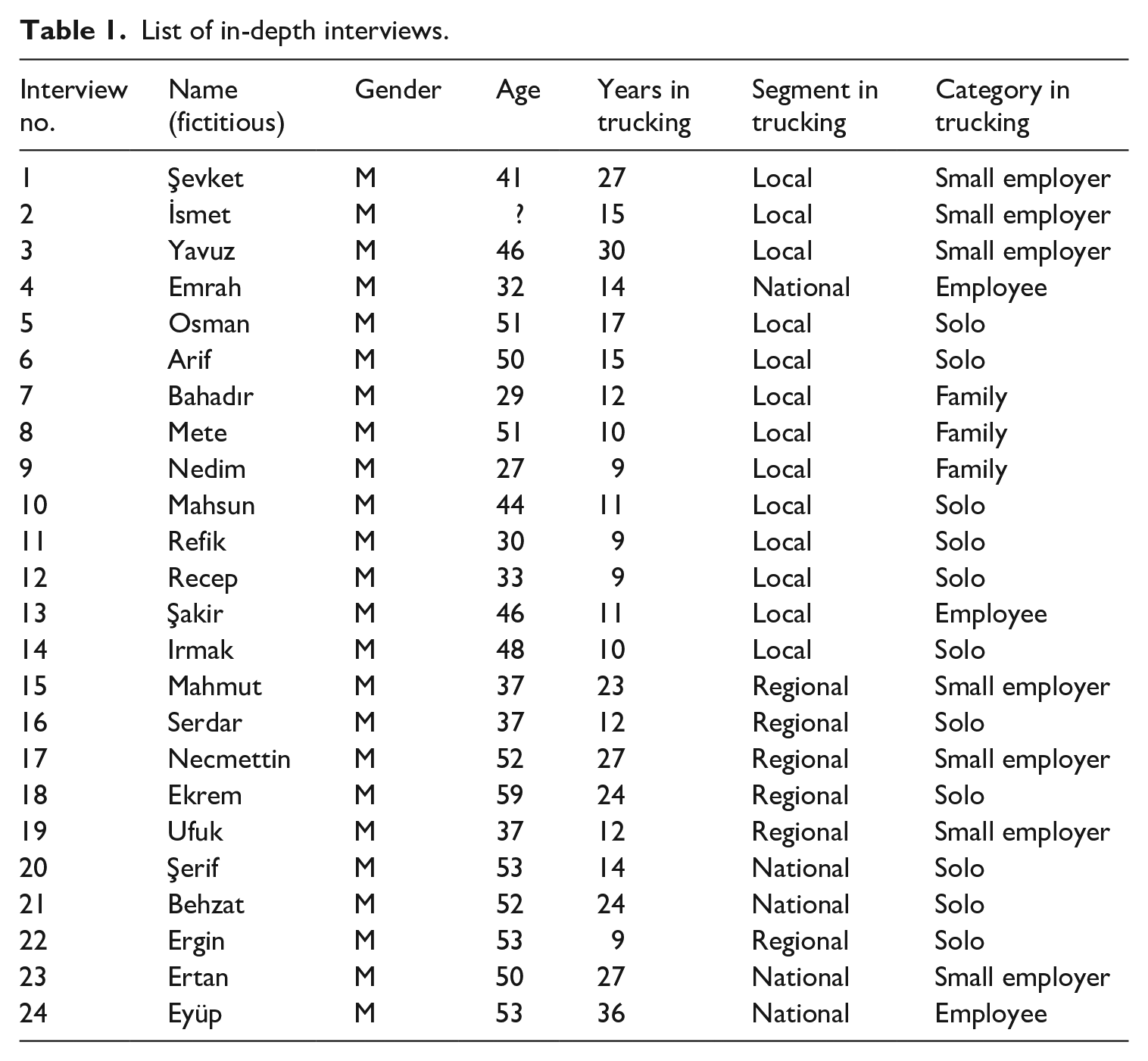
Participant observations and in-depth interviews are the research methods used in this article. I, the author, carried out all the interviews and observations. My role during fieldwork as both participant and observer required ‘the relatively prolonged immersion of the observer in a social setting’ (Bryman, 2012: 273). I started the process of observation by working in a truck repair shop in New Jersey for an average of 50 hours a week from August 2016 to December 2016. The shop was owned by a Turkish trucker who is well known in the trucker community. During this period, I did bookkeeping, replaced truck tyres, cleaned the dusty shop floor, disposed of trash, carried heavy truck parts, listened to the bosses’ directions, welcomed customers and listed the problems with their trucks, used a computer to diagnose problems with the trucks and ordered stock, as well as managing the shop for short periods of time.
Later, I conducted systematic observations throughout the summer of 2017. In total, I conducted 10 four-hour visits from 13 June to 10 August. At the end of each visit, I documented my observations in field notes totalling 104 pages. By drawing on the highlighted points of these notes, I formed an interview guide for interviews. The participant observations were complemented by semi-structured in-depth interviews, which were especially vital in studying socio-economic aspects of this community. I conducted interviews between June 2018 and August 2019. All the interviews were in Turkish and recorded in respondents’ cars and trucks and at local coffee shops. They lasted between 27 minutes and 1.5 hours.
The sampling method was non-representative and purposeful. I did not look for a representative sample of survivalist truckers from Turkey. Instead, I examined processes within the cases to make analytical generalizations (Ram et al., 2008). My purpose was to find truckers who would discuss and help me understand the phenomenon of survivalist migrant entrepreneurs. Respondents who were born in Turkey and migrated as adults were accepted as the population of the study. Respondents were diverse in age, duration of residence, hometown in Turkey and education level. To avoid bias, a snowball technique in which respondents were recruited from different social circles was applied. The purpose of using ‘chain referral sampling’ was to overcome reliance on a narrow range of social networks (Penrod et al., 2003). Pseudonyms were used to protect the identity of the informants. Ethical approval was obtained from the ethics committee of the university.
Drawing upon Charmaz’s (2014) understanding, the data analysis took place in three stages of coding: initial, focused and selective (Creswell and Poth, 2018). After the interviews were transcribed verbatim in Turkish, initial coding was done to develop major categories of information without rearrangement of the data. The major categories were migration stories, intra-migrant group solidarity in the US, early precarious job experiences, work experiences in the trucking industry and thoughts and expectations about trucking. In the second stage of focused coding, the most frequent codes were identified to interconnect the initial categories. The focused codes include the central categories, the causal conditions that influence central categories and the strategies of actors that result from these conditions. The data were manually reorganized and split into four broad themes in relation to different axes, including: migration from Turkey (migration stories, mobilization of ethnic ties); pre-trucking job experiences (precarious jobs, driver experiences in the transportation sector, choosing to be a trucker, getting the Commercial Driver’s Licence [CDL]); labour processes in trucking (choosing the segment, navigating the driver and load markets, truckers’ conception of money and time); and experiences of owner-operators (thoughts on being independent, the process of buying a truck, becoming an employer, ambitions or hesitations with regard to expanding the business).
The early fieldwork observations had already shown that whether truckers should buy just one truck or several trucks was a ‘popular’ question debated during their daily conversations. Truckers were talkative about their experiences of buying trucks and becoming owner-operators. The focused analysis of interviews demonstrated that migrant truckers gave lots of details about their memories and ideas about changing segments of the trucking industry. The decision-making processes over whether to stay in national trucking or, as many do, to choose either regional or dump trucking were the second focus point of the interviews. Choosing the segment and buying the truck became the focus of this article because truckers explained these events as turning points. During the selective coding, the focused categories were connected to form a storyline, which empirically explores why truckers choose their segments in the industry and how they purchase trucks. This storyline led me to construct the theoretical framework of the temporality of migrants’ ongoing agency presented in the previous section.
Immigrants from Turkey meet the deregulated trucking industry
The increasing visibility of immigrants from Turkey in the trucking industry, along with Indian, Mexican and Polish migrants, has been related to the labour shortage since the 1990s. The trucking industry 1 was historically known as a sector largely dominated by White male workers, ‘the knights of the highway’, when truck driving was considered a stable blue-collar job (Agar, 1986; Ouellet, 1994). A series of policy changes that started in 1977 effectively deregulated the industry (Robyn, 1987), transforming it dramatically. Institutional regulation was replaced with market deregulation, which brought harsh competition, a well-known consequence of neoliberalism. Declining wages have been a direct consequence of the deregulation and competition (Belzer, 2000). While the trucker shortage structurally pulled migrants into this sector, how did they respond to this call? In the 2000s, a growing number of migrants saw trucking as a ‘good’ job market destination despite worsening working conditions (Viscelli, 2016). The labour force has become more female, queerer and browner as driving a truck has become less preferable in the eyes of the White working class (Balay, 2018). In California and New Jersey, 46% and 40% of truckers are foreign-born, respectively (Gonzalez, 2016). In Southern California, about 90% of the port truckers are either Central American or Mexican (Bonacich and Wilson, 2008; Monaco and Grobar, 2004). Without immigrants, the trucking industry would be in decline, given an ageing native-born workforce (Khan, 2014). Within this context, a growing number of qualitative studies analyse the changing ethnic and racial composition of transportation workers. While various studies examine the work lives of migrant cab drivers, including their use of social capital (Mitra, 2012), their precarious conditions (Occhiuto, 2017) and their informal struggles (Wells et al., 2020), only one study (Alvarez and Collier, 1994) has focused on migrant truckers, examining Mexican truckers who entered the US temporarily and run ethnic enterprises between Los Angeles and northern Mexico. In excellent fieldwork, three scholars of the trucking industry analyse the impact of precarious employment conditions (Balay, 2018; Viscelli, 2016) and digital surveillance (Levy, 2022) on native-born truckers only.
The incorporation of migrants from Turkey into the labour markets of Western countries began only after the 1960s, as the country became one of the leading labour-exporting countries under the context of uneven capitalist development. In the 1980s, European countries, which had been major destinations for migrants, implemented more restrictive border policies. As a result, the US was a better option for an increasing number of working-class people in Turkey (İçduygu, 2009; Karpat, 2008). The changing US immigration system in the second half of the 20th century prepared the material ground for the migration of workers from Turkey. The important legislative moment was the implementation of the Immigration and Nationality Act of 1965. This act increased opportunities for legal migration and family unification, so that migrants with legal documents could sponsor their immediate relatives (such as spouses and unmarried minor children). By 1995, the diversity immigration visa was another common way of migrating to the US. Despite a long history of immigration, the number of immigrants from Turkey did not increase dramatically, and the community stayed small, with nearly 250,000 immigrants. New York, California, New Jersey and Florida have the largest number of immigrants from Turkey. For immigrants who do not have college degrees, migrating abroad often means a chance for economic upward mobility. In the early years of migration, they usually find low-income service jobs in gas stations, diners and construction firms (Akçapar, 2009).
Findings
The respondents of this study constitute a subgroup of immigrants from Turkey. Almost all of them came to the US as permanent residents. Unlike professional migrants, none of them obtained student or work visas by using educational qualifications. They received their permanent residency (green cards) through either diversity visas or family reunification. The latter group were sponsored by their co-ethnic spouses or fathers who already held US citizenship. Since these migrants’ social networks were concentrated in New Jersey and Pennsylvania, they directly moved to these states and worked in three easy-to-enter but labour-intensive jobs: (1) attendant or car washer at gas stations; (2) dishwasher or cook at restaurants; and (3) painter or gutter installer in construction firms. Since they did not like the harsh work conditions, they quitted these jobs after a short time. Then, they either initiated unsuccessful small businesses or worked in upgraded jobs such as local delivery jobs. In the meantime, they collected information on markets in the prestigious trucking industry, which they call ‘the king of jobs’. Once these migrants transformed themselves into truckers, they started their agential struggle against precarious conditions by mobilizing three forms of capital: social, cultural and economic.
Becoming a trucker through social capital
How do truckers mobilize their social capital? The mobilization of immediate family and friendship networks, which is defined as limited social capital, kept the truckers in low-income jobs in the early years of their migration. After a couple of years, they realized that they needed to expand their social capital beyond immediate circles by meeting up with other migrants from their hometown or other cities of Turkey. Their expanded social capital led them to start their survivalist adventures in the trucking industry, shaping the rest of their work life. One interviewee, Serdar, pointed out the role of expanded social capital, summarizing the concentration of migrants in a series of economic sectors ending with the trucking industry: ‘People came here once upon a time. There were first comers who helped these people. As they started working at diners and restaurants, newcomers came next to the older ones. Then came the dump truck sector.’ In the process of becoming company truckers, migrants receive various types of support from their brothers, fathers, fathers-in-law and close friends, as well as their wives. 2 For instance, they support each other in preparing for the CDL exam. 3 They learn how to drive a truck with the help of friends and family members instead of spending money on driving lessons from private schools. They get help to find their first trucking companies. When their trucks need repairs, they go to mechanic shops run by co-ethnic immigrants. If they need to do paperwork for their businesses, they find a Turkish accountant.
While working as company truckers, they face two dilemmas: choosing a segment and purchasing trucks. As they make these decisions, their agential resources also transform and differentiate. The first major decision is to choose which segment of the sector is appropriate for them. This study defines three segments of the trucking industry that are based on the distance in which the vehicle operates: national trucking, regional trucking and local dump trucking. For novice truckers, national trucking 4 has many benefits and attractions. They see it as financially promising, at least at first sight. Moreover, it is relatively easy to work as a company driver because of the driver shortage of the last 20 years (Costello and Suarez, 2019). After a couple of years, however, migrants tend to leave this ‘tough’ segment because of its long working hours, accidents and potentially low payments, especially when they get married. Eight of 13 truckers who currently work in local dump and regional trucking previously worked in national trucking. Whether they worked in national trucking or not, truckers talked about the disadvantages of this segment, describing it as repetitive, boring and unhealthy.
Many truckers exercise their agency by refusing to work in national trucking for more than a couple of years. They mobilize their expanded social capital to find a better trucking job in regional and local dump trucking. Compared with truckers who have higher cultural capital, migrants of lower education levels, who have lower-level English proficiency, have fewer options. Those who have ties with truckers from Yağlıdere 5 find it easier to find a company to work for because the social networks of this tight-knit community are more likely to concentrate in dump trucking. 6 Osman (a 51-year-old solo dump trucker) mentioned this process: ‘So then, he introduced me to someone, who owned a few trucks at that time. They were looking for a driver because one of their drivers had gone to Turkey. Then I started working there.’ Osman has continued working in dump trucking, unlike some others who prefer regional trucking, which is the topic of the following section.
Upgrading segments through cultural capital
Trucking is not an easy-to-enter job. To be able to drive a truck requires a preparation period, including not only the mobilization of expanded social capital but also limited cultural capital, such as having a CDL. While truckers who have only limited cultural capital choose to work in dump trucking, other truckers who have more expanded cultural capital, such as more advanced proficiency in English, look for chances to work in regional trucking, which has some advantages compared with dump trucking. 7 This section discusses why some truckers choose to move into regional trucking while others remain ‘stuck’ in dump trucking.
How does cultural capital in terms of formal qualifications and informal skills affect the segmental location of truckers? Many truckers in this study do not speak English fluently, having little social contact with non-Turkish people. In fact, speaking fluent English brings two advantages in the trucking industry. First, they can survive without the influence of the tight-knit community. Second, they are more likely to grow their businesses in regional or national trucking by hauling special loads (such as cars or gas). The experiences of the second group of truckers who have more advanced English proficiency clarify the role of language. They have more contact with native-born truckers. In addition, this group of truckers intentionally have limited physical and social contact with the dump trucker community. While contrasting regional trucking with ‘unhealthy’ cross-country and ‘dirty’ dump trucking, they express negative opinions about dump trucking and truckers. Serdar, who received residency by marriage and purchased his first truck with the help of his father-in-law, compares dump trucking with regional trucking: First, dump trucking is a dangerous sector. Second, there is always stress, and you are always on the run. When one is careless just for one second, he can get involved in deadly accidents. They want to make money by being fast. They want to catch up with the schedule, and they calculate every hour and minute. Then they cannot unload their load, or they cannot get their money. It is also reflected on the driver. (A 40-year-old solo regional trucker)
The load markets in the dump trucking sector are quite unstable. In contrast to hyper-competitive dump trucking, regional truckers take advantage of carrying the same kinds of loads for the same company over a long period of time. Nonetheless, the option of working as a company driver in regional trucking is relatively limited. Respondents pointed out the difficulties of entering the regional market as an independent owner-operator.
The findings further demonstrate that the concentration of truckers in the different segments mentioned above is mainly based on hometown background. There are cultural divergences between regional and dump truckers. The division between urban and rural background corresponds to educational dispositions pertaining to the socio-economic background of the immigrants’ parents. Truckers of urban backgrounds, who have higher English proficiency and have no community ties, are more likely to work in regional trucking. They have higher educational qualifications than truckers of rural backgrounds. They use more individual resources than those who are attached to the tight-knit community. These narratives indicate how truckers of urban backgrounds convert their cultural capital to economic capital by forming relatively bigger businesses, escaping dump trucking. However, having more expanded cultural capital is not the only way to accumulate economic capital. As the following section examines, truckers who work in both regional and dump trucking find another way of transforming their ‘solo trucker’ agency by purchasing trucks and starting family businesses or becoming small employers.
Buying trucks through economic capital
The mobilization of limited economic capital is much more vital for the small-scale trucker entrepreneurs as survivalist agents. After choosing the best segment, truckers’ second major decision is about the purchase of trucks. This section outlines the ways in which truckers accumulate economic capital by purchasing trucks, which remarkably transforms the financial conditions in which they are embedded. Three categories are defined based on truck ownership: (1) solo truckers (with one truck); (2) family truckers (with two trucks); and (3) small employer truckers (with three or more trucks).
Truckers have some advantages while developing their economic capital. First, trucking businesses require relatively low start-up costs and have lower barriers to entry in terms of capital outlays. Second, migrant truckers have easier access to financial resources because of the variety of financing opportunities for purchasing a truck. Company drivers are not paid very poorly. By 2019, while a driver in a dump trucking company made US$1200–1400 in a week, a regional trucker was usually paid US$1600 weekly. Many truckers save enough money to purchase their first trucks in a couple of years. During the purchasing process, truckers combine their social or cultural capital and convert it into economic capital.
Staying as a company driver until their retirement is not a popular path in this community. Most of them want to ‘become their own capitalists’ (Marx, [1894]1991: 571) or be their ‘own boss’ (Barratt et al., 2020: 1651) because they do not want to ‘have a boss breathing down their neck’ (Milkman et al., 2021: 362). Specifically in the context of neoliberalism, ‘the worker himself appears as a sort of enterprise for himself’ (Foucault, 2008: 225). Mahsun (a 44-year-old solo dump trucker), who worked as a company driver for a couple of years, underlined this control aspect: ‘Working on my own is better for me. No one intervenes in my life. Even if I make mistakes, or I make correct things, it is my job at the end of the day. I am glad that I work for myself.’ Osman similarly stated that ‘I am free. I work for anyone I want.’ Company truckers want to be independent of their bosses even though being an owner-operator does not increase their salaries remarkably. An owner-operator usually makes US$2000–2500 weekly, only under ‘normal’ conditions, when there are no accidents or repairs needed. Furthermore, being independent comes with new ‘headaches’. First, they continually spend money and time on repairs and replacement parts for their trucks. They must make monthly payments if their trucks are on lease. These giant machines get old very quickly even though they are products of the latest technologies. Second, survivalist truckers always need to be searching for their next job unless they work repeatedly for the same brokers and shippers, which is uncommon.
Despite the challenges of being an owner-operator, some respondents prefer staying in this form of market dependency because owning a truck also has various symbolic meanings for them. First, company drivers are readily judged by the trucking community when they make a mistake while driving. Truck owners, directly or indirectly, pressure company drivers about the issue of truck ownership. Behzat (a 52-year-old solo national trucker) was once asked by his friends: ‘Why do you not buy your own truck? Why do you work for someone else?’ Second, besides the importance of the entrepreneurial culture in the US, the migrants’ ambition to be their own boss is connected to the appreciation of self-employment in Turkey, especially among a segment of the population who cannot join high-paid labour markets as employees because of their lack of higher education. Third, they prove their masculinity and boost their self-esteem by showing off the high effort required in their jobs, such as the ability to drive several hours without complaining (Ouellet, 1994: 220).
Being a survivalist business owner is a baseline in this community, something ‘everyone is expected to do’. If finding a better segment and becoming an owner-operator can be accepted as the first stage of an ongoing agency, the second stage is to buy a second truck, which not every trucker goes through. Buying the second truck is an important threshold that has not been discussed in previous work (Belman and Kossek, 2006). Owing to the high precariousness of owning one truck, some truckers make continuous calculations of whether it is better to expand their business or not. Who are the truckers who own more than two trucks? How are they different from those who embrace the idea of ‘one truck, one driver’ and oppose buying a second truck on account of language limitations or the difficulty of finding reliable drivers for the second truck as well as the lack of high-paid opportunities in the load market? This group has more entrepreneurial ambitions than truckers who have just one truck. Buying a second truck is a crucial point for truckers. For them, being an owner-operator is not the end, but the beginning, of a form of entrepreneurial agency that may protect them better against precarious conditions.
The major difficulty of buying a second truck is not finding enough money but finding a reliable driver. If a driver is not good enough, the second truck will have lots of mechanical problems and may get involved in accidents. Given this difficulty, truckers pursue various strategies to realize the advanced economic capital of having more than two trucks. The common feature among those who have community-based social capital and have more than two trucks is that, in the past, when they had two trucks, they shared their trucks with their brothers. They buy their second truck and ‘hire’ their brothers and fathers, whom they consider more reliable drivers, to overcome the problem of finding ‘a good driver’ who really cares about the truck as if it is the driver’s own. Since sharing with a family member appears to be the key to expanding a trucking business, this group is called ‘family truckers’. Except those who have expanded cultural capital and are outside of this tight-knit community, all the truckers who extended their business hired their fathers and brothers when they bought a second truck. Not everyone is able to hire an immediate family member as a driver, though. Şerif (a 53-year-old solo national trucker), for instance, had to cancel his plan for getting a second truck because his son refused to be a trucker.
Family truckers are less vulnerable than solo truckers to the precarious conditions of the market. When one truck gets broken, they continue to make a decent living temporarily by using their second truck. However, having two trucks does not correspond to a stable position in the market because only having three trucks protects them against harsh market forces. For that reason, family truckers do not keep their two-truck business for a long time. To run more than two trucks in the market, family truckers mobilize advanced social capital, contacting dozens of people in the industry to get detailed information about existing routes, shippers, types of loads, brokers, legal regulation and so on. It is not always easy to differentiate their advanced social capital from advanced cultural capital (such as having advanced knowledge of taxes and an office space).
Besides economic benefits, buying the third truck brings a new status for truckers. Migrant truckers who have three or more trucks are defined as ‘small employer’ truckers. These truckers expand their business practices beyond the scope of family by hiring non-family co-ethnic or non-co-ethnic drivers. Besides using family-based social capital, small employer truckers mobilize either their expanded cultural capital or community-based social capital (such as receiving information and monetary help from the community). While the use of cultural capital is more widespread in regional trucking, the mobilization of social capital is more likely in dump trucking. Thus, the empirical analysis shows that migrants of different socio-economic backgrounds exercise their entrepreneurial agency by mobilizing various forms of capital and transforming them into one another.
Discussion and Conclusion
This section discusses three contributions of this study. First, the study elaborates the debates of agency in migrant entrepreneur scholarship (Adhikari et al., 2023; Cederberg and Villares-Varela, 2019; Villares-Varela et al., 2022) by suggesting the concept of ongoing agency. By combining the temporal conceptualization of agency (Hitlin and Kirkpatrick Johnson, 2015) and the agential perception of migrant entrepreneurs (Villares-Varela et al., 2018), this concept highlights the temporal aspects of agency formation in trucking. Novice company truckers in national trucking exercise both ‘evaluative’ and ‘projective’ agency. While trying to overcome the harsh working conditions and the lack of autonomy, they make projections by saving money and collecting information to become owner-operators. They leave the national segment and buy their own truck in a couple of years. At this stage, the ‘habitual’ aspects of their agency (their existing resources) that affect their segment preference are revealed. Once they settle in either regional or dump trucking, the ‘projective’ agency is not activated for every trucker. Some truckers do not plan to purchase more than one truck due to resource limitations. Only a few truckers make entrepreneurial projections of purchasing trucks either by collaborating with their family members or activating their cultural capital. The latter group, as ‘forward-looking’ agents (Villares-Varela et al., 2018), more likely expand their businesses. Migrant truckers usually do not have a master plan at the beginning of their career. Starting and ending their trucking jobs in the same position is an extraordinary experience. Most of them ‘turn the pages’ of their entrepreneurial journey step by step as they activate different resource components of their agency.
Second, this study unpacks variations in ongoing agency by utilizing forms-of-capital analysis (Cederberg and Villares-Varela, 2019). This analysis specifically reveals the temporal patterns of entrepreneurial differentiation. Entrepreneurial variations start when some migrants 8 in national trucking decide which segment of the trucking industry is more appropriate for them. Migrants of urban backgrounds, who choose regional trucking, do not use community-based social capital often; instead, they remain solo by using individual strategies that reflect their cultural capital. Migrants of rural backgrounds, by contrast, tend to choose dump trucking. Without being able to mobilize cultural capital, this group of truckers initially mobilize only community-based capital. Variations in entrepreneurial agency become more visible after they settle in a specific segment and buy their own trucks. They decide whether they should remain solo truckers or, by purchasing more trucks, become family truckers or small employers. In regional trucking, truckers of urban backgrounds are more likely to rely on their cultural capital and family-based social capital. When they mobilize both resources, they turn into small employers by buying more than two trucks. In dump trucking, truckers of rural backgrounds are dependent on their community-based social capital and remain solo survivalist truckers. Some, by mobilizing family-based social capital, such as by ‘hiring’ their brothers, become family truckers with two trucks. A few truckers turn into small employers, buying more than two trucks, when they mobilize social and economic capital simultaneously. Thus, this study argues that survivalist migrant truckers accumulate their various forms of capital in relatively predictable ways. Depending on the combination of the forms of capital, they convert these forms into each other in a patterned temporal order (Table 2 shows the temporal patterns of the conversion processes). In this sense, this study has different findings from the recent studies that point out the role of chance and coincidental encounters in migrants’ entrepreneurial trajectories that cannot be accurately predicted (Bazzani, 2023; Berntsen et al., 2022).
Forms-of-capital and entrepreneurial differentiation among truckers.
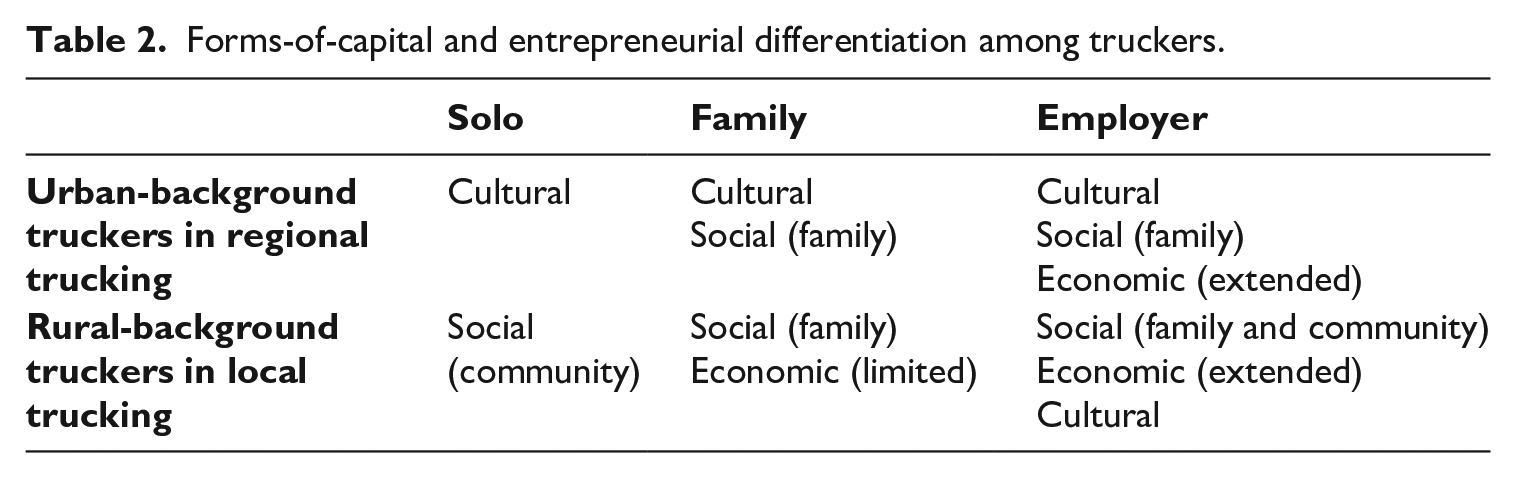
Lastly, the study contributes to the survivalist entrepreneurship scholarship by discussing the cross-sector applicability of the temporal analysis of ongoing agency. The first aspect of this comparison is about the survivalist agency formation patterns in different sectors. Survivalist truckers always confront the pressures of hyper-competitive markets, not unlike entrepreneurs in restaurant and retail sectors (Jones and Ram, 2007; McDowell et al., 2009; Rath and Swagerman, 2016). They are ‘satisfied to survive’ (Barrett and Rainnie, 2002; Edwards et al., 2016), stay in ‘vacancy chain openings’ (Kloosterman, 2010) and do not attempt to ‘break out’ to less labour-intensive sectors (Barratt et al., 2020; Ramirez and Hondagneu-Sotelo, 2009). However, this study argues that sectoral structures in trucking are not only hindrances but also enablers (Hvinden and Halvorsen, 2018) for the agency of survivalist truckers. The deregulated markets of the industry, besides imposing obvious constraints (Belzer, 2000; Viscelli, 2016), provide a unique set of entrepreneurial enablements that can give migrants limited opportunities to construct agency. Truckers are thus not only characterized by the conditions of entrepreneurial insecurity but also by ‘autonomy’ (Valenzuela, 2001) and ‘independence’ (Cohen et al., 2019: 121).
The second aspect is about the temporal patterns of capital formation across sectors. Migrant entrepreneur scholarship finds that survivalists significantly vary in their levels of capital, highlighting the effects of class, gender and legal status (Romero and Valdez, 2016; Valdez, 2011). They underline how family-based resources are vital for businesses in markets characterized by high competition (Ram et al., 2001; Valdez, 2016). Truckers of rural background similarly mobilize family-based capital to become owner-operators. However, this form of capital is not a must for urban-background truckers who have enough cultural capital, which brings more entrepreneurial connections (Cederberg and Villares-Varela, 2019; Vershinina et al., 2011). By skipping the social capital accumulation, truckers of higher cultural capital follow a different entrepreneurial path than survivalists of other sectors. The patterns of economic capital mobilization in trucking also diverge from the experiences of survivalist entrepreneurs in other sectors. Accumulating economic capital has always been a barrier to business start-up for survivalist entrepreneurs (Villares-Varela et al., 2022). However, like suburban gardeners (Ramirez and Hondagneu-Sotelo, 2009), migrant truckers have some advantages compared with entrepreneurs of other sectors. Truckers are less likely to be subject to low hourly income, which is very common in restaurant and retailing sectors (Valdez et al., 2019). Company truckers become solo truckers as well as transforming into family or employer truckers if they merge either cultural or social capital at the right time. The study argues that the temporal patterns of capital conversion processes are related to the unique characteristics of the trucking industry. The temporal patterns of intra-group entrepreneurial cleavage formation correspond to the unique segment and ownership structures of the industry. Further empirical research among other immigrant communities (Mexican, Polish, Russian, Indian, Pakistani) in trucking is required to analyse whether these patterns are ethnicity-specific or not. Trucking is not an easy-to-survive sector under neoliberalism, but it is financially promising for under-resourced truckers who want to reach the basics of the ‘American dream’, such as buying a suburban home and sending their kids to college. More importantly, trucking offers a more independent work life in which they do not feel ‘a boss breathing down their neck’.
Footnotes
Acknowledgements
The author is grateful to the Editor and three anonymous reviewers for their insightful comments and constructive suggestions on the earlier versions of the article.
Declaration of conflicting interests
The author declared no potential conflicts of interest with respect to the research, authorship, and/or publication of this article.
Funding
The author disclosed receipt of the following financial support for the research, authorship, and/or publication of this article: The empirical research of this article was supported by Temple University Department of Sociology Research Grant.
Informed consent
All research participants were given information to give informed consent to be part of this study and they gave their permission to participate.
