







Abstract
While the existing literature on service work allows us to understand how customer sovereignty policies constrain service work by transforming servicescapes, we need a more agential approach to how service workers use space as a resource to deal with the tensions resulting from the promotion of customer sovereignty. This article draws on de Certeau’s thinking to fill this gap by looking at how workers play with space constraints and opportunities and deploy spatial tactics to walk a fine line with their customers. Through an ethnographic study of service work in train stations, this article offers a fine-grained empirical account of the spatial tactics used by workers in their daily work. We show how they use space to cope with the tensions in their daily interactions with customers, and how spatial tactics constitute micro-practices of resistance to customer sovereignty policies.
Introduction
Customer sovereignty – whereby the customer enjoys superior status and plays a leading role in the service encounter (Korczynski and Ott, 2004) – has been highlighted as one of the key aspects of the service economy (Korczynski and Evans, 2013; Korczynski and Ott, 2004). However, the dominant discourse (du Gay and Salaman, 1992; Gabriel et al., 2015) of customer sovereignty is a myth aimed at enchanting customers; in reality, management strives to combine two potentially contradictory logics, thereby creating the conditions for eventual customer disillusionment (Korczynski and Ott, 2004). The customer-orientation logic entails service personalisation, while the service performance logic entails service work rationalisation. On the frontline in particular, this contradiction results in daily tensions for service workers (Bishop and Hoel, 2008; Lopez, 2010). Service workers therefore experience ambiguous relations with customers (Sayers and Fachira, 2015) and often struggle to reconcile moral and market logics (Darr, 2011). To understand service work, it is necessary to discover how service workers actually ‘walk a fine line’ in navigating the contradictions inherent in the implementation of customer sovereignty policies and the resulting tensions in service relationships (Korczynski, 2002). In this article, we explore how service workers walk a fine line when dealing with sovereign customers by looking at how they use space as a resource in their daily work. Drawing on de Certeau’s concept of spatial tactics, we look at how workers play with service space constraints and opportunities.
Indeed, customer sovereignty is not only a discourse but also a spatial matter – the myth can be transmitted through the design of servicescapes (e.g. the lights, music and furniture in a superstore, which support the feeling that the shopper is being given a leading role; see Korczynski and Tyler, 2008: 315) and these places where the customer is deemed sovereign are proliferating (Brown, 2019). To date, service scholarship has concentrated on how these spaces determine workers’ practices in interacting with service recipients (Baldry and Barnes, 2012; Hultin, 2019; Rosenthal and Peccei, 2007) or on how the former try to escape the latter’s control by withdrawing from these spaces and finding refuge in downtime spaces (Korczynski, 2002) or liminal spaces (Shortt, 2015). By contrast, in this article, we favour a more agential view of service workers as being ‘capable of using resources open to them’ (Rosenthal, 2004: 606) and we therefore treat space as a flexible concept that can be shaped by service workers when dealing with the sovereign customer (Chugh and Hancock, 2009; Korczynski and Tyler, 2008; Pettinger, 2006).
To investigate the space-related resources that service workers employ, we draw on de Certeau (1980; English translation, 2011),1 who theorised the experience of everyday life to highlight the micro-practices of resistance (Gálvez et al., 2021). De Certeau theorised the notion of ‘spatial tactics’ as an unplanned appropriation of space that emerges in response to the flow of events. Indeed, de Certeau views situations as opportunities for individual creativity, where actors may divert the use of space from its intended purpose. In this sense, these various ‘ways of doing’ (de Certeau, 1980: XL) can serve as micro-acts of resistance. His thinking offers an original analytical framework for considering space as a modular resource for service workers, one which they can ‘play’ with, in the sense of diverting a strategy from its original intention. Using this approach helps to explain how, through their spatial tactics, service workers concretely deal with the contradictions and tensions that result from customer sovereignty policies (e.g. the strategy deployed by management), particularly while they strive to perform their interactive tasks. Our research question is therefore: What spatial tactics do service workers invent to play with customer sovereignty?
This research is based on two parallel ethnographies of service work in French train stations, a service setting marked by the promotion of the sovereign customer in a transit space which is simultaneously dedicated to private consumption and to public transport. In analysing the micro-interactions of service workers, the study contributes to the sociology of service work by enriching the spatial understanding of service work in the context of customer sovereignty. This study makes three specific contributions. First, using the de Certeau lens to describe space as practised by workers, we shed light on how the latter engage with the contradiction of customer sovereignty by adapting the service space designed by management. Such a perspective offers a more agential understanding of the critical role of service space in enacting customer sovereignty than in existing scholarship (Baldry and Barnes, 2012; Rosenthal and Peccei, 2007). Second, we draw on the concept and the deciphering of service workers’ spatial tactics to show how they cope with sovereign customers spatially, whereas most studies focus on how they cope with them emotionally or interactionally (e.g. Bishop et al., 2009; Good and Cooper, 2016; Korczynski, 2003; Stroebaek and Korczynski, 2018). Finally, we contribute to the literature on resistance in service work by identifying and describing service workers’ micro-practices of resistance through spatial tactics, whereas existing scholarship tends to focus on discursive practices (Gálvez et al., 2021; Mills and Owens, 2023). These spatial micro-practices are done within dominant spaces (Shortt, 2015) where workers are constrained by both managerial power and customer demands (Bélanger and Edwards, 2013).
Theoretical framework
Service space and customer sovereignty
Criticising the overemphasis in the service literature on customer interaction as the key aspect of meaning production, Pettinger (2006) argues for more consideration of the materiality involved in service work, particularly ‘the cultural production of meaning through the creation of selling space’ (Pettinger, 2006: 61). Subsequent scholarship further investigates the spatial dimension of service work, elaborating on aesthetic work by emphasising non-human artefacts such as furniture and lighting (Chugh and Hancock, 2009; Cutcher and Achtel, 2017; Simpson and Pullen, 2018). Although these studies acknowledge the spatial dimension of service work, they do not really address the question of how service workers engage with this dimension in dealing with customer sovereignty.
The few studies that do so focus on describing service space as a determinant that structures service workers’ practices. Hultin (2019) highlights how the new layout of the reception space at the Swedish Migration Board led public service users to behave ‘as if checking into a hotel and expecting to be served as a guest or a customer’ (p. 98). Similarly, studying Jobcentre Plus, Rosenthal and Peccei (2007: 213) state that ‘the physical environment of offices [had] been [carefully] designed to reinforce this sense of the customer as a figure of respect and legitimacy’. Service space arrangements also directly constrain workers’ behaviour. Indeed, Baldry and Barnes (2012) associate the transformation of students into customers with the conversion of professors’ offices from a cellular to an open-plan layout, which undermines their professional identity.
How service workers resist the spatial implications of customer sovereignty policies and use space in a more agential way to manage the ensuing tensions on the frontline is often overlooked. Korczynski (2002) is a rare exception as he stresses the role of downtime spaces in allowing workers to recover following episodes of abusive interactions. In this perspective, these liminal spaces become a resource for service workers to distance themselves from their customers. Shortt (2015) elaborates on this idea by revealing how the employees of a hairdressing salon use liminal spaces as alternative locations for them ‘to resist dominant spaces and seek out liminal sanctuaries and territories, like toilets, away from corporate expectations’ (p. 653). A digital equivalent can be found in Sayers and Fachira’s (2015) study of a hairdressers’ online forum where they can discuss difficult customers.
The notion of liminal spaces generally helps to explain how individuals find spaces in a ‘parallel universe’ (Söderlund and Borg, 2018: 892). For service workers, in particular, it suggests they can leave the ‘stage’ (Shortt, 2015: 644) of the interaction. However, there are situations where it is not possible for workers to escape ‘the gaze of the client’ (Shortt, 2015: 644) and researchers should study how workers deal with the tensions of customer sovereignty in interaction spaces (i.e. dominant spaces).
We now turn to the notion of ‘spatial tactics’ (de Certeau, 1980, 2011), which allows us to better understand how workers employ space (including on stage) as both a constraint and a resource for dealing with consumer sovereignty contradictions.
The spatial tactics of service workers
The term ‘spatial tactics’ is defined in de Certeau’s (1980) seminal work L’invention du quotidien as an emergent and daily practice or set of practices. De Certeau distances himself from the devices that control space, such as Foucault’s (1977) panopticon, more recently criticised by Bain and Taylor (2000). Also taking some distance from Bourdieu (1972), he points instead to the ability of actors to resist and emancipate themselves from social determinism as they play with and within space. His approach relies on a central distinction between tactics and strategies: tactics divert rituals and mechanisms from their original intention (i.e. strategies), far from technological and social determinism. De Certeau uses the term ‘spatial tactics’ to describe ‘actions, practices, discourses or meanings that a subject deploys in a field of play determined by the strategy’, always as ‘a response to an existing strategy’ (Gálvez et al., 2021: 373). It is noteworthy that these responses depend on circumstances as they emerge from and through events ‘to transform them into “opportunities”’ (de Certeau, 1980: 46).
We elaborate on de Certeau’s notion of ‘spatial tactics’ within the context of service work, highlighting invention and play in workers’ practices; that is, diverting a strategy (e.g. customer sovereignty) depending on the circumstances of the customer interaction. De Certeau’s perspective allows us to go further than the determinist or liminal interpretations of service workers’ adaptation to customer sovereignty by precisely capturing their micro-practices of resistance to it, thereby fostering a more creative and political approach to service work embedded in daily practices.
Scholars often construe spatial tactics as practices where service workers play with and divert organisational policies, thus revealing their resistance. Research in the field of management and organisation studies demonstrates de Certeau’s influence, as scholars draw on the notion of spatial tactics to show how workers resist organisational strategies on a daily basis (Courpasson, 2017; Hjorth, 2005; Munro and Jordan, 2013). We find an occasional use of de Certeau in the sociology of work scholarship, such as where Gálvez et al. (2021) show how the tactics of female teleworkers allow them to define a subjectivity in which they attempt to balance the professional and family dimensions of their lives. However, neither de Certeau nor these recent studies elaborate on the specific components of these spatial tactics, which could be helpful for conducting an empirical study. Nor do they engage with a service work setting.
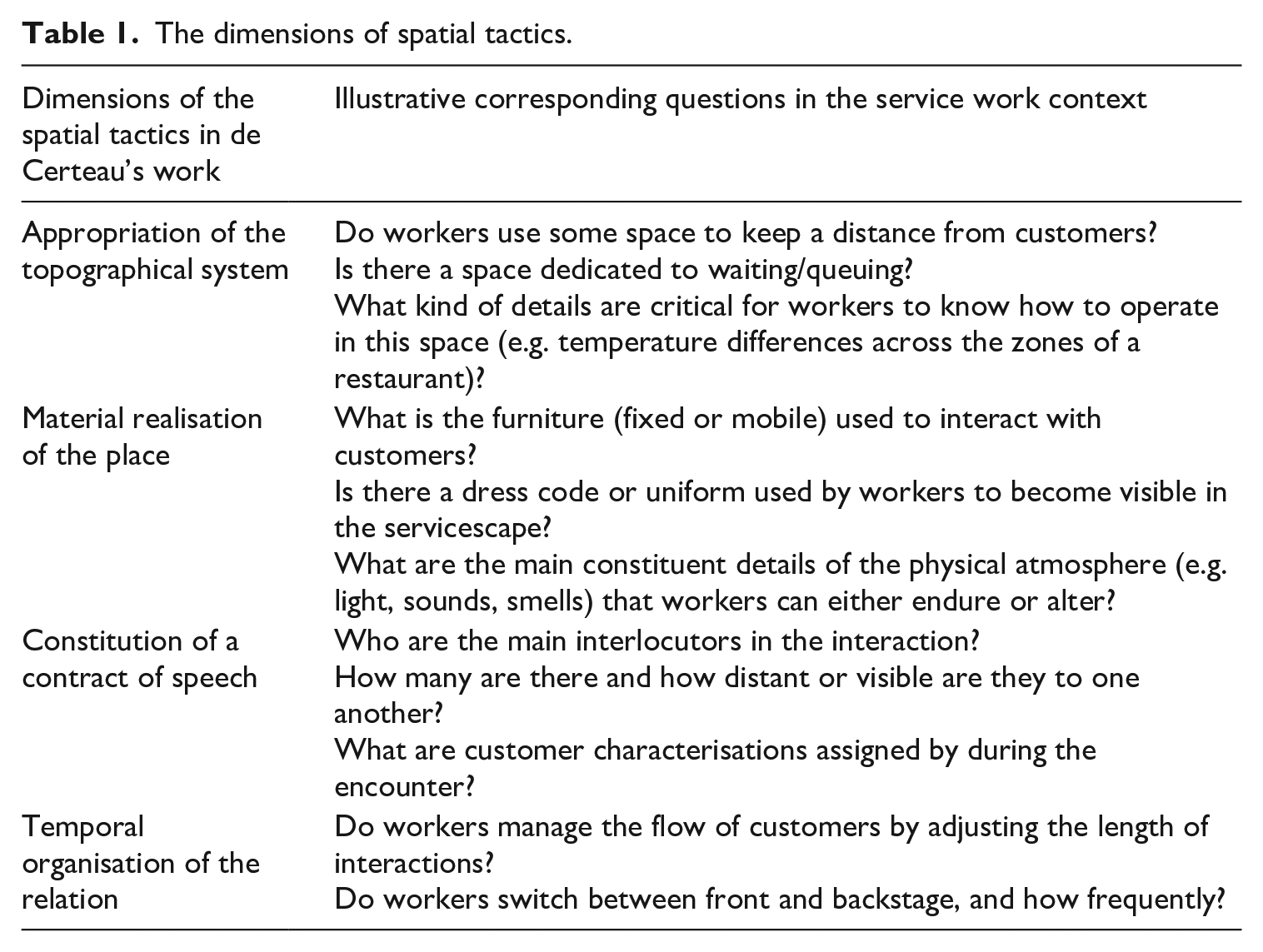
In seeking to derive an analytical framework of spatial tactics from de Certeau’s writings, we observe that in chapter three of L’invention du quotidien he develops a spatial ‘grammar’, developing an analogy of spatial tactics with the act of enunciation which could help to enrich empirical studies. He distinguishes four dimensions of enunciation: (1) the appropriation of the topographical system; (2) the material realisation of the place; (3) the constitution of a contract of speech; and (4) the temporal organisation of the relation. Although de Certeau does not further specify what these dimensions mean, in Table 1 we attempt to offer corresponding questions that illustrate each dimension. By specifying the components of a spatial tactic, we show what these tactics are made of and how they can be used to explore service workers’ practices in the context of service interactions.
The dimensions of spatial tactics.
Methodology
Our study is an ethnographic investigation of service workers of the French national railway company at four major train stations in France (Jordan, 2018; Ybema et al., 2009). It is based on two sets of ethnographic data collected in parallel between 2016 and 2018. Train stations are transit spaces which are being ‘loungified’ (O’Doherty, 2017) and which offer a suitable context for conducting an investigation into the spatial tactics that service workers deploy to deal with customer sovereignty.
The promotion of the sovereign customer in train stations
The service under study is an urban mass transit service delivered in railway stations with particularly heavy traffic (between 100,000 and 350,000 travellers per day). Since the end of the 1990s, the rail company has been committed to a policy of ‘absolute’ customer orientation, in the words of the head of the organisation. This policy revolves around promoting a new way of treating the customer (Arnould and Cayla, 2015) and a redesign of service work and spaces, very similar to the contemporary practices of commodification described by O’Doherty (2017).
The service work was redesigned to prioritise satisfaction of the new figure of the ‘good’ customer. There are different types of good customer. The first is the ‘profitable’ customer, who frequently uses high value-added services (e.g. regular customers of high-speed trains). The second is the ‘vulnerable’ customer who has difficulty using the service (e.g. elderly travellers). At the same time, the service spaces were redesigned to make them more customer friendly by adding commercial spaces (e.g. shopping malls), leisure spaces (e.g. relaxation spaces, play areas or cultural exhibition areas) and workspaces (e.g. lounges for frequent travellers, areas with power outlets, co-working spaces). The spatial transformation of the stations was accompanied by new guidelines on how workers are supposed to behave in the new spaces to produce the intended customer experience, as this excerpt from the new ticket office service protocol illustrates:
Welcoming customers must be proactive and must convey the French national railway company’s values of customer service and kindness towards its customers, following three steps:
Immediate contact, which demonstrates the attentiveness of the company to its customers (‘I am expected’, ‘I am welcome’).
Reassurance as soon as the customer enters the point of sale (‘I’m sure I’m in the right place’).
An orientation that makes it easier for customers to find their way around the ticket office (‘they guide me’).
The promotion of customer sovereignty in the stations gave rise to some contradictions. First, the enormous volume of passengers in the stations called for rationalisation and automation. This means that, apart from these two ideal types of ‘profitable’ and ‘vulnerable’ customers, there are a large number of customers considered to be sufficiently autonomous to use the transport service without the assistance of service workers, as they are able to use automatic terminals, websites and apps designed for the purpose. Second, an economic rationale was prevalent in management actions: managers were tasked with stimulating competition for vacant spaces in the stations to make the square footage profitable for the station owner. As a former station manager explains, customers’ needs do not always come first: ‘Generally speaking, we try to get rid of anything that is not commercial and that does not make money . . .’.
An ethnography of service work in train stations
The first two authors collected data on service workers and frontline service sector managers (Bolton and Houlihan, 2010) in four railway stations. We chose to focus our data collection on the daily tasks of the service workers rather than on exceptional situations by paying particular attention to what seemed both typical (i.e. recurring) and critical (i.e. important) in their service work activity.
Their tasks include providing transport services (sales, information, after-sales service) in a variety of spaces inside the station, under both normal (regular traffic) and dysfunctional (disrupted traffic) conditions. This work is carried out in small groups (two to five members) and under the supervision of a first-line manager. Some teams may have been specially trained for ticket office or train platform work, but versatility is increasingly required by management, ensuring that any worker should be able to perform any task. Service work at the stations can therefore be considered as a whole.
We studied work practices in relation to three of the daily tasks performed by service workers (who often switch from one task to another within the same day): (1) selling tickets; (2) reception and information; and (3) passenger boarding. It is therefore important to consider that these service workers’ interactions with customers take place at different times and locations in the station. This affects the service workers’ constraints and possibilities in managing customer sovereignty (i.e. by strengthening or diverting it).
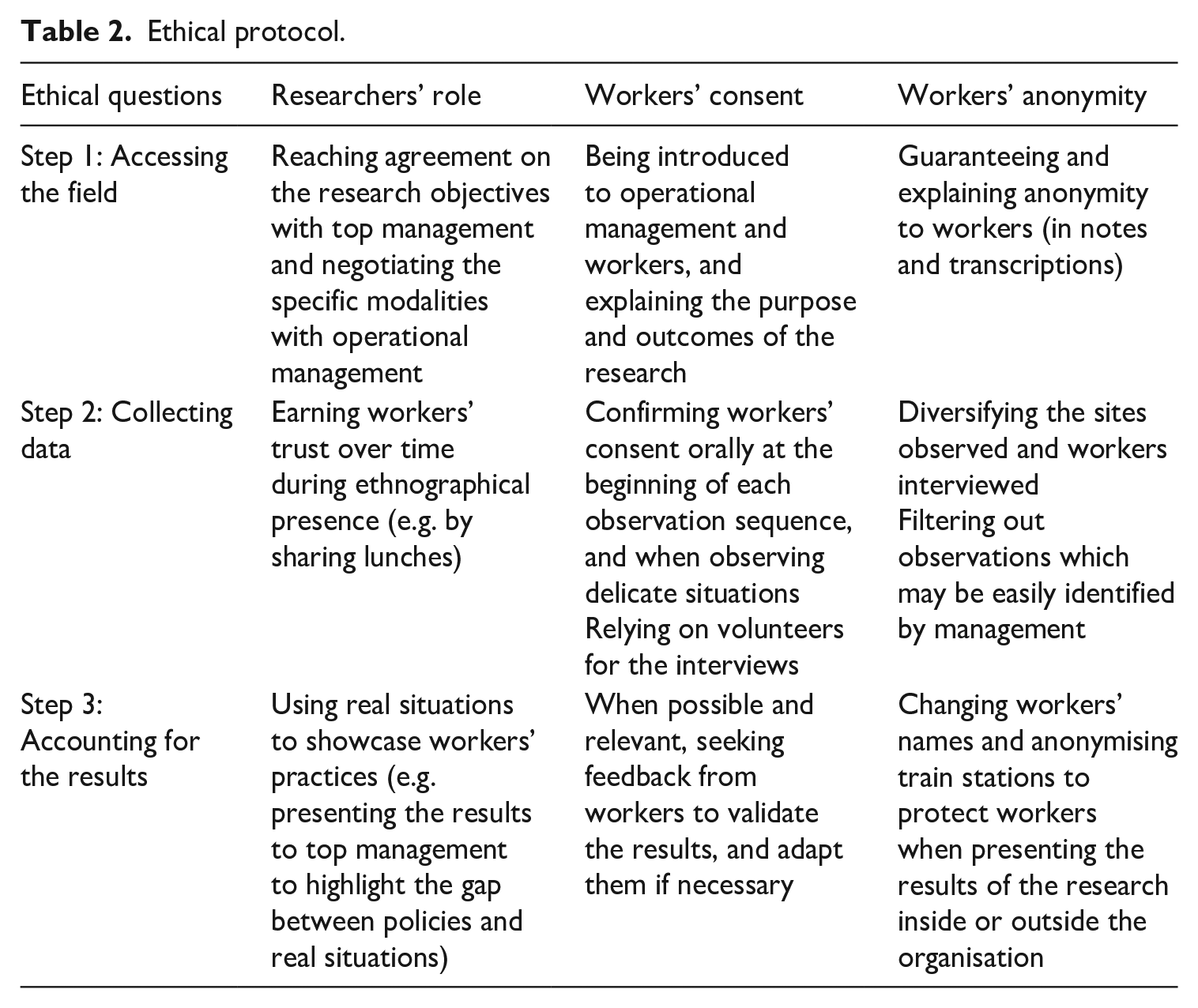
Field observation was conducted separately and autonomously (i.e. each author conducted their own fieldwork and collected their own data), but a similar ethical protocol was followed. Table 2 presents how the authors dealt with ethical questions (researchers’ role, workers’ consent, workers’ anonymisation) at each stage of the research. The resulting dataset comprises observations (91 days of observations recorded in a logbook), interviews conducted with service workers (78 interviews) and a large set of contextual data (32 internal documents and 30 interviews with managers to understand the organisational demands on service workers).
Ethical protocol.
Analysing service workers’ spatial tactics
Data analysis was done in three steps. First, we worked to gather our data. As the first two authors had conducted their ethnographies separately, the two sets of data had to be pooled before it could be processed (Heaton, 2004). Comparing and combining the two datasets created an appealing opportunity, but given the large amount of data collected, the challenge was to sort it for analysis into a single piece of research. The first two authors then shared their respective experiences in the field, to make sure that the ethnographies were sufficiently similar in terms of the spaces studied (i.e. the train stations and the typical service spaces they comprised), the service workers considered, the methodology used (i.e. ethnographic methods) and the types of data collected (mainly observations and interviews).
Once the dataset was unified, all the authors went through the data and discussed the emerging themes. Each primary data collector was paired with an external party so they could compare their views. This facilitated researcher reflexivity and made sure that we remained true to the data. During these discussions we examined the issue of customer sovereignty at an empirical level along with its related contradictions (e.g. providing dedicated services versus customer flow management). More importantly, and unexpectedly, we repeatedly found that service workers used space as a resource to actively cope with the difficult interactions they were involved in. This interesting aspect of the data led us to consider de Certeau’s theoretical perspective (de Certeau, 1980; Gálvez et al., 2021) because of his emphasis on space in everyday practices and tactics, understood as ‘play’.
The final step consisted in analysing workers’ practices as spatial tactics. We used the components of spatial tactics (see Table 1) to characterise the observed practices. For instance, we were attentive to the scope of the space in which the practices happened (see appropriation of the topographic system in Table 1) as, in some cases, workers dealt with travellers in large, external spaces with no borders, whereas in others, they interacted in a specific office. Based on the descriptive coding of workers’ practices, we were able to make a more detailed analysis and to identify the spatial tactics used by service workers when dealing with customer sovereignty. We now present these spatial tactics through illustrations of the daily service work and how they relate to the customer sovereignty policy.
Findings
‘It’s like walking a tightrope. We adapt to each situation.’ As this frontline manager rightly says, dealing with customer sovereignty policy and its intrinsic contradictions is a balancing act. Our results show that this constant search by service workers for equilibrium largely involves adjusting the service space. This adaptation of the service space results from the confrontation between the spatial strategies designed by the organisation to orient service work towards customer expectations and the spatial tactics invented by service workers to modulate the impact of these strategies on service work and interactions. These spatial tactics are threefold: (1) workers modulating their spatial accessibility for customers; (2) placing customers at the right distance; and (3) distributing the customers into dedicated spaces. Each of these tactics can either reinforce or subvert the customer sovereignty policy.
Playing with spatial accessibility to filter customers
One of the key spatial implications of the customer sovereignty policy implemented by the organisation is to make service workers accessible to customers. As Lucie, a service worker, explains: ‘The customer is king; they need everything, right now’ and the service workers ‘have to be there, at their disposal, doing everything for them’. Being ‘at the customer’s disposal’ means that service workers must be accessible to customers, who can call on them without constraint. Service workers are expected to immerse themselves in the customer flow and make themselves visible to customers. As Sebastien, a service worker, explains, they have a ‘visibility goal [which] consists in being present’ at the service frontline. To be easily spotted and identified by customers, they are instructed to position themselves where customers can find them in no more than eight minutes, and in such a way that they are clearly visible, available and accessible. They must be in the right place (i.e. where they are needed), at the right time (i.e. when they are needed) and in the right uniform (i.e. allowing them to be identified). This accessibility requirement is also being evaluated by management to minimise the time it takes a customer to find an available service worker in the station.
This spatial strategy gives rise to a contradiction between the constant accessibility of service workers ‘at the customer’s request’ and the quality of the service. Walking around the station in uniform, they are constantly approached by customers, sometimes with very specific questions. Yet, owing to the constant flow of questions to which they are exposed when in contact with customers, they are unable to gather the information they need to answer them. To deal with this contradiction, service workers modulate their own accessibility depending on the customer flow.
First, service workers sometimes limit their spatial accessibility by hiding from customers. This tactic is very clear in the following situation, observed on the concourse of a train station:
The observed station serves both the richest and the poorest suburbs of the city. Trains connecting the station with the richest suburbs arrive and depart from platforms in the eastern part of the station. Trains connecting the station with the poorest suburbs arrive and depart from platforms in the western part of the station. Paradoxically, when trains arrive from or depart for the richest suburbs, the observed service workers tend to stay on the west side of the station concourse, which serves the poorer suburbs of the city. They avoid as much as possible going to the eastern part of the station concourse, which is a few dozen metres away. According to them, service interactions are clearly not the same in these two areas of the station. They explain that they dread interactions with customers from privileged backgrounds because they feel they are more demanding, more aggressive, more contemptuous of them. So they avoid them, keeping a safe distance from the area they pass through.
This observation shows that service workers perceive some customers to be disrespectful or ungrateful. Accordingly, these customer interactions are not considered very welcome and are sometimes even unpleasant. Going against the policy of customer sovereignty, which encourages service workers to make themselves accessible, the observed service workers flee the time–space where they are expected to be, making themselves inaccessible to the demands of those customers. More broadly, as Karim, a frontline service manager, explains: during rush hour, some service workers ‘run away from the customer’ because ‘they’re afraid of the customer’ and ‘they’re afraid to be on the concourse’. Those service workers find escape spaces to make themselves inaccessible to customers. Keeping themselves busy elsewhere gives them a reason not to go into those energy-intensive time–spaces. In this way, when supervisors seek to implement the customer sovereignty policy by redirecting them to areas where they are more accessible to customers, they have a ‘good excuse’ to avoid it.
Our observations show that when hiding is not possible, workers resort to another tactic to avoid unwanted solicitations from customers. Rather than distancing themselves from all customers, they choose those with whom they will interact. This is precisely what Mélia and Hamza do in the following situation, observed on the station concourse:
It’s rush hour, and Mélia and Hamza have left their counters to wander through the flow of hurried customers who call out to them ‘on the fly’, mainly asking them to direct them to their departure platform, without bothering to consult the notice board just a few metres away. Mélia and Hamza seem to be encircled by an incessant flow of solicitations, which gradually turn them into talking billboards, with no possibility of retreat. Yet they manage to ‘choose’ in the midst of these unwanted solicitations, offering their services to customers who haven’t asked for their help. So, when Mélia sees an elderly woman standing on the cross platform of the train station, she goes to her and offers to find her a seat. The customer accepts but most of the seats are occupied. Mélia asks a seated person if she can give up her seat. She agrees. The elderly woman thanks Mélia, who says ‘it’s okay’. Later, Hamza sees a blind person. He goes to him, introduces himself and offers to accompany him to his train. The blind person accepts, Hamza takes him by the arm and they go to the train.
In this situation, Mélia and Hamza gave help to an elderly person and a blind person who had not requested it. In this way and, as Stéphane (service worker) says, they manage to escape spatially and temporally from those they feel ‘don’t really need them’ (i.e. the customers who ask them to carry out tasks that in their eyes are unrewarding), in order to ‘feel useful’ rather than ‘at people’s disposal’. These chosen ‘needy customers’ are predominantly people with physical or social disabilities. They may have difficulty moving around the station because they are blind, in a wheelchair or elderly, or they may not speak or read the language well, have no digital tools or do not know how to use them. Towards these people who do not ask for his services, Medhi (service worker) explains that he is ‘proactive’ and he ‘approaches them’ to offer his help. This tactic does not go against or subvert customer sovereignty policy, as according to management these ‘needy customers’ should also be taken care of. Rather, by choosing to render a service they have not been asked for, these service workers protect themselves for a moment from requests they deem illegitimate, as they are made by customers who could very well ‘look after themselves’. In this way, they regain control over the prioritisation of service requests. It is no longer the flow of customer requests that sets the pace and dictates their service work, but their sense of priorities. Customer expectations are no longer seen as inherently legitimate, but as more or less important relative to other potential demands in a given situation.
To sum up, service workers adjust their physical accessibility to select the customers for whom they want to provide service. They make themselves more accessible for service interactions that they consider to be useful and rewarding and try to avoid service interactions they consider to be less so. They redefine the scope of the service provided by modulating their spatial accessibility, which allows them to prioritise the figure of the sovereign customer they wish to serve and thus adapt the implementation of customer sovereignty policies through spatial arrangements at their level.
Playing with spatial distance to protect from customers
Another key aspect of how the customer sovereignty policy is implemented spatially in our case consists in bringing service workers closer to their customers. While service interactions have long occurred via a glass partition, which created ‘a kind of physical barrier’ (François, frontline service manager) between workers and customers, physical proximity is now the norm to ensure direct and face-to-face interactions. In these configurations, the service worker and the customer ‘can touch each other’ (François). There are still glass-panelled spaces in the station, where service workers and customers talk via an intercom, when the interaction involves an exchange of money (and thus a risk of aggression or robbery), but they offer a much clearer view and can often be opened as needed.
The physical proximity strategy results in the incursion of the customer ‘into the service worker’s space’. The service worker’s attitude must partly substitute for the lack of physical separation, in order to keep some control over customers’ behaviour. Xavier, a service designer, explains, for instance, that the lack of barriers leads service workers to take control of the space, requiring ‘leadership skills to manage the flows of customers’. For example, the workers ‘position themselves’ in the open service space and develop a kind of spatial ‘authority’ over customers without any material support in doing so. Following on from Xavier’s statement, another question may arise: how can service workers adapt the service space when they are expected to cohabit with the customer and find themselves ‘at each other’s fingertips’?
The question is particularly tricky given that some customers might prove dangerous; there is an intrinsic contradiction in this policy between the expected proximity with customers and the safety of service workers. As Anne (human resources manager, former service worker) explains, this contradiction became apparent as soon as the policy of opening up service areas was implemented in 2001. She relates that when these service desks first opened, service workers were mistreated by customers, not least because the glass barriers made interactions less fluid and limited the building of reciprocal empathy between customers and service workers. It proved necessary to convince workers that opening up the service areas would not put them in more danger but would protect them. Nevertheless, while open spaces make the majority of service interactions smoother and more peaceful, they also expose service workers to a minority of dangerous customers who may become abusive.
Ultimately, workers have no choice but to find a balance between getting closer to customers while remaining at a distance: they modulate the worker–customer proximity strategy by deploying a second spatial tactic aimed at placing the customer at the right distance. Didier came up with the idea of mounting computers on glassless counters to create a protective distance:
A customer hit me with a computer because he was unhappy, he knocked against the screen. More than the act itself, what I always try to keep in mind is why it has come to this and how it can be prevented. And it’s very simple, but following this incident, [the service workers] attached the computer screens to the service counters. (Didier, service worker)
This service space creates a proximal relationship where the only way the service worker can move away from the customer is by stepping behind the desk. Attaching the computer to the desk prevents the customer from suddenly hitting the service worker with an object.
Despite management’s desire to foster proximity with customers, some service areas still have glass barriers due to the presence of cash, limiting proximity to customers and confining workers behind a counter. In these spaces, we observed that service workers may increase their proximity, especially to customers who seem particularly worried, stressed or lost, when the worker feels the spatial distance to be deleterious. These customers need to be reassured, calmed or accompanied. To do this, workers attempt to recreate spatial conditions of mutual trust and empathy by spontaneously coming out from their space. Note that the same tactic can be used to handle customers who take advantage of the distance established by the service space to be aggressive. As Redah explains:
I have a colleague, a Black man who is six feet tall, and once we were in the booth [the glassed-in service area] and he was serving the customers. And then, there is a lady who comes in and starts to insult him. Behind the glass [when he is sitting] you can’t see that he is tall. And then he picks up the microphone, and he stands up like this [Redah makes a show of standing up, revealing an impressive physical stature]. And then the customer’s countenance broke down and I was laughing my head off. He said, ‘Excuse me? Can you repeat that? Do you want me to come out of the booth so we can have a quiet chat?’ [pointing to the door behind him that would allow him to quickly reach the customer face-to-face]. (Redah, service worker)
Physical proximity is both a risk for service workers and a deterrent to customers who may abuse their sovereignty when they consider themselves to be protected by the glass around the worker. It is interesting to observe here how service workers will leave the parallel space in which they are confined for safety reasons in order to reach the customer’s space and confront them directly.
To summarise, placing customers at the right distance is a spatial tactic which consists in increasing either the proximity or the distance between service worker and customer, depending on the nature of the service space and the nature of the customer. This adjustment is made according to the space in which the interaction takes place but also according to the need for proximity or distance that the interaction involves. Service workers use this spatial tactic to rearrange service spaces to better deal with the customers’ expectation of proximity implied by the customer sovereignty policy.
Playing with spatial distribution to sort customers
The last spatial implication of the customer sovereignty policy consists in allocating dedicated spaces to different types of customers. This strategy involves identifying certain types of customers, sorting them, directing them to dedicated spaces and creating different customer journeys within the station. The aim here is to favour access to customers deemed to have priority, either because they are particularly profitable for the organisation (e.g. regular consumers of high value-added services) or because they are deemed to be vulnerable and therefore require special treatment (e.g. pregnant women or the elderly).
As Jonas, a service space designer, explains, ‘the idea is to provide a better service to these [valuable] customers’. The so-called ‘valuable’ customers are invited by the service workers to go to the service areas that are now dedicated to them. Business customers (i.e. frequent travellers), in particular, have a dedicated counter in the service area where service workers ‘offer them a drink and newspapers’ (Jonas). The reception in the sales area is scripted with an entry point and systematic screening by a service worker at the entrance. Once identified as such, valuable customers must be immediately sent to an ‘express’ counter, so that their needs can be met as quickly as possible.
In order to give some customers access to the service area, others are excluded. Therefore, security gates have been installed in the stations to limit access to those with a ticket. Others are considered undesirable users and are no longer welcome in the train station. According to public statements by organisation executives, this security gate should limit fraud and the nuisance of antisocial behaviour by some people towards others, based on the organisational hypothesis that antisocial behaviour is mainly perpetrated by fraudsters.
This spatial strategy gives rise to a contradiction between the inclusiveness and exclusiveness of these service spaces in an open space that service workers liken to ‘a sieve’. In this context, sorting and orienting customers into dedicated spaces is a big challenge. Service workers must both ‘capture everyone and direct the customers correctly’, sometimes favouring the inclusion of certain customers and the exclusion of others. Here again, a spatial tactic allows service workers to deal with this tension.
On the one hand, service workers can reinforce the organisational strategy that gives priority to ‘valuable’ customers by excluding the ‘undesirable’ users of the station, as Quentin, a service worker, explains:
The station is one of the few places that is open until midnight, so there are ‘poor guys’ who arrive at 10:00 pm to ‘take a train’. Curiously, there is no train. Often, they have no money and they are not informed [. . .]. When they are friendly, we can talk [. . .]. But often, they are not nice. So, the objective is to get rid of them in a pragmatic way. (Quentin, service worker)
The service workers involved in this tactic participate in limiting access to the station for undesirable users. Most often, these are homeless people who come to the station to find temporary refuge. At the same time, the workers orient the ‘valuable’ customers towards more privileged spaces with more favourable conditions. These customers are therefore mainly frequent business travellers (categorised as professionals or ‘pros’). For them, ‘waiting is not an option’, and for the service workers it is a matter of identifying them and getting them out of the regular queue quickly to save them from waiting, or worse, missing their train.
On the other hand, service workers may tolerate undesirable users in spaces where they are not allowed. For instance, we observed service workers letting homeless people ride the train to spend the day in the warmth. Their knowledge and tolerance of this use of the train by a priori ‘undesirable’ users is evident in the evening when the trains depart to the depot: then they approach homeless people to warn them to leave the train. At the same time, service workers can exclude some customers from spaces dedicated to them, and accept some undesirable users in spaces where they are not normally accepted. This is the case in the following observation:
Sélya and her colleagues serve customers in closed service areas with a counter. One customer in the queue seems particularly upset. When the customer arrives at Sélya’s counter, she starts to get really upset. She had planned to take a train which was eventually cancelled. Sélya tries to explain to her the causes of this cancellation but realises that the customer had not yet bought a ticket for this train, and that she is becoming more and more aggressive. Sélya sees that the customer is accompanied by a little girl and therefore does not want to call security. She decides to end the interaction. But the customer’s expression seems to change, and she starts to lob racist insults at Sélya:
Sélya → Customer: Look, madam, you’re throwing a fit about a train you don’t even have a ticket for. I can’t help you, sorry. [Sélya walks to her seat]
Customer → Sélya: BAG OF GREASE! DIRTY NIGGER! 2
Tina, Hamza and Leïla leave their counter and position themselves between Sélya and the customer, forcing the customer to leave the closed sales area, and push her towards the exit and thus towards the station concourse:
Tina → Customer: [the service workers present surround the customer closely to prevent her from approaching Sélya] YOU LEAVE NOW!
Customer → Sélya [showing disgust at the proximity of the service workers] GET OFF ME, ALL OF AFRICA THERE, GO HOME!
Hamza → Customer: YOU GET OUT! GET OUT! GET OUT! [Sélya turns around to restrain her colleagues in turn. The customer leaves, screaming]
In this situation, a customer hurls insults at service workers in a closed sales area, disrupting the service. The procedure is for the service worker to call security. As a last resort, workers are advised to leave (i.e. stop the service and move away from the customer). But given the spatial and human conditions of the situation, this is impossible. With the break room located at the other end of the room, Sélya cannot leave the interaction without being confronted by the customers waiting in front of her. In this context, the service workers preferred to remove the customer from the sales area and move her to the station concourse where her behaviour could be more easily avoided.
Finally, distributing customers into the different service areas involves ‘sorting’ and ‘storing’ them, not only in accordance with an organisational and economic hierarchy, but also according to an occupational and moral hierarchy. Based on certain characteristics, service workers favour some customers for economic and moral reasons.
Discussion
Drawing on our reading of de Certeau, we propose an analytical framework of spatial tactics in the empirical context of service work. Our findings show that service workers face significant challenges in dealing with the contradictions of customer sovereignty in their day-to-day service work and spaces and that they find inventive ways to respond to them, which we analyse as spatial tactics. By revealing these spatial tactics at a micro level, our results contribute to the literature on service work and customer sovereignty in three ways. First, we offer a more agential understanding of the critical role of space in enacting customer sovereignty. Second, by shedding light on their spatial tactics, our findings reveal an expanded repertoire of practices that service workers employ to deal with the contradictions of customer sovereignty. Finally, we show how service workers may resist sovereign customer policy through their daily interactions with customers.
Service spaces as practised places
Our study benefits from de Certeau’s conception of space (based on the distinction between strategy and tactics; see Gálvez et al., 2021) to illuminate the role of space in enacting customer sovereignty. We propose a more agential reading of the service space, adding nuance to the more deterministic approaches to the role of space in service work (Baldry and Barnes, 2012; Hultin, 2019; Rosenthal and Peccei, 2007).
According to de Certeau (1980), service spaces do not result only from the strategic construction of a rhetoric around customer sovereignty. Rather, they are ‘practised places’ that workers try and appropriate to make their work bearable. The notion of space as a ‘practised place’ (de Certeau, 1980: 173) is recognised in the literature on organisational space as being inhabited, implying the integration of social actions and power relations within it (Tyler and Cohen, 2010). Our results show that while service space design is a way for management to deploy its customer sovereignty strategy, by practising places, service workers also help to enact and adapt the implementation of the customer sovereignty policy that governs the strategic organisation of space.
Indeed, while the intrinsic, structural contradictions within the myth of customer sovereignty (Korczynski and Ott, 2004) are materialised spatially, it appears that service workers can also play on these contradictions in a spatial way. Our case exemplifies this materialisation through three different space-related contradictions that service workers address in their everyday spatial tactics. The first pits the full accessibility demanded of workers against their conception of service quality; the second contradiction pits the demand of customer proximity against that of service worker safety; and the third contrasts the inclusiveness demanded for all customers and the exclusiveness demanded for certain priority customers of service spaces. Rather than a material translation of the customer sovereignty discourse into a material apparatus (Arnould and Cayla, 2015), as suggested in previous service studies (Korczynski and Tyler, 2008), here we describe a service space that is partially reshaped by workers’ spatial practices. We show that the ability of workers to control and influence contemporary frontline service work (Rosenthal, 2004) also involves reappropriation and rearrangement of the service space by fashioning their material environment (e.g. attaching a screen to a desk) and their interactions with customers (e.g. preventing abuse from angry customers).
The role of spatial tactics in dealing with customer sovereignty
Our second contribution relates to workers’ practices for dealing with sovereign customers as informed by de Certeau’s notion of spatial tactics.
To shed light on the spatial tactics invented by service workers in our study, we developed an analytical framework based on de Certeau’s (1980) insights, which can equip scholars with a ‘spatial grammar’ to craft fine-grained empirical accounts of spatial tactics in their different components, such as those we identified (see Table 1). With this perspective, we highlight and characterise three spatial tactics that service workers use to cope with the tensions resulting from the promotion of customer sovereignty in a train station. Within the sociology of work, de Certeau is mostly used to explore the tactics that workers employ in relation to organisational discourses (e.g. Gálvez et al., 2021). Our study therefore complements past scholarship by emphasising the spatial dimension of these tactics and by offering a spatial grammar that future research can use to describe them.
We contend that using de Certeau this way paves the way for a more spatial understanding of work practices. By highlighting how service workers use their agency in the service space, our work also shows the potential of de Certeau’s theoretical lens to further explore the spatial dimension of service work. Space work is present in some studies as a component of ‘aesthetic labour’ (Chugh and Hancock, 2009; Simpson and Pullen, 2018). Our results suggest that space work is not only an aspect of service labour (e.g. when workers need to manage the flows of travellers in the open environment of the train station), but also, and especially, a tactical way of overcoming the contradictions of service work by using the socio-material resources that the situation offers (such as uniforms, furniture, gates, windows). By shedding light on these, we add to the existing scholarship on how service workers manage to ‘walk a fine line’ (Korczynski, 2002). In particular, our study reveals how workers cope with sovereign customers through their spatial agency, whereas most research focuses on the emotional, interactive component of the practice of coping (e.g. Bishop et al., 2009; Good and Cooper, 2016; Korczynski, 2003; Stroebaek and Korczynski, 2018).
Spatial resistance to customer sovereignty
Finally, following de Certeau’s notion of spatial tactics as micro-acts of resistance, our research highlights how service workers spatially resist customer sovereignty policy. While a Foucauldian analysis of our fieldwork would lead us to see the deployment of managerial constraining power in the design of service spaces, our de Certeau-inspired perspective reveals how service workers resist by playing with discipline. The distinction between strategies and tactics becomes particularly relevant here, with service workers’ spatial tactics playing with managerial rules is understood as an individual ‘reappropriation’of the ‘collective management’ (de Certeau, 1980: 146). In a similar vein to Taylor and Bain’s (2003) classic study of subversive humour in call centres, we focus on daily micro-practices to apprehend resistance, which in our case is found in the workers’ spatial tactics to resist customer sovereignty policies.
Our description of service workers’ spatial tactics contributes to understanding their daily practices of resistance within the ‘triangle of power’ in which they are posited (Lopez, 2010). The sociological literature on service work has established how challenging it is for workers to resist as they experience a double constraint exerted both by management and by customers (Bélanger and Edwards, 2013). We argue that such constraints are even stronger in a context of customer sovereignty policy materialised in dominant spaces where customers are expected to be satisfied. In this context, managerial power is partly delegated to customers. As a result, service workers can no longer resist without risking a deterioration in the quality of the service experience.
Unlike previous studies that highlight the role of liminal spaces in resisting the control of customers (Shortt, 2015), our results shed light on how workers resist within dominant spaces. Indeed, although one of the observed spatial tactics (hiding from customers) does correspond to a tentative escape from the ‘gaze of the customer’ (Shortt, 2015), the others occur on the stage of the interaction, therefore offering an understanding of space as a resource for resistance within the service situation in interaction with the customer.
The spatial tactics identified concur with workers’ preferences about who they think should be served (e.g. as we saw in the example of vulnerable customers), leading them to either endorse or subvert the myth of customer sovereignty (Korczynski and Ott, 2004) by positioning themselves on ethical ground (Darr, 2011). The spatial micro-practices we identified can therefore be deemed to be politically oriented like those that Gálvez et al. (2021) describe. However, they differ from what is found in many studies of service work resistance practices, which focus mainly on discursive strategies (e.g. Mills and Owens, 2023; Valenzuela-Bustos et al., 2022). By contrast, the spatial micro-practices we identified allow service workers to navigate their fundamentally ambiguous relationship with customers (Sayers and Fachira, 2015) while expressing their political views, albeit not discursively.
Conclusion
In this article, we have developed a more agential perspective of how service workers use service space as a resource to deal with the tensions resulting from the promotion of customer sovereignty. We have explored how the spatial tactics they deploy allow them to walk a fine line in their daily interactions by playing with service space constraints and opportunities. Our research offers an understanding of the role of space in service workers coping with and resisting customer sovereignty policies. It thus leads us to consider the service space as a political space. As Gálvez et al. (2021) note, the mobilisation of de Certeau’s theoretical framework supports a view of workers as ‘political subjects’ (p. 382). As such, we believe that this article opens up stimulating avenues for studying service space not just as a space of organisational determination or domination but also as a space of agency and resistance by service workers.
This article has three main limitations that could be addressed in future research. First, our research is limited to the spatial tactics that service workers invent, without taking into account those that may be implemented by customers or frontline managers. More ecosystemic perspectives could better account for the coexistence of these spatial tactics and their interactions (e.g. how do managers react to workers’ tactics? How do customers take advantage of service spaces for themselves?). Second, our material offers a snapshot of the tactical reaction of service workers to the organisation’s spatial strategies without accounting for its evolution over time. Future research could take a more longitudinal perspective to consider the collective construction of these tactics and the co-evolution of both spatial strategies and tactics during the implementation of a customer sovereignty policy. Third, our research relies on rich ethnographic material, but we did not systematically collect visual data, such as pictures and videos, to identify and analyse spatial tactics. Such data would offer a useful avenue for investigating these tactics in more detail.
Footnotes
Acknowledgements
We would like to express our sincere gratitude to all participants who contributed their time and trust to our ethnographic surveys. We extend special thanks to Andrew Beresford for his invaluable assistance in refining our ideas and improving the clarity of our work in the final stages. Finally, we are grateful to the editor and three anonymous reviewers for their support and constructive feedback throughout the review process.
Funding
The authors disclosed receipt of the following financial support for the research, authorship, and/or publication of this article: Two authors received funding from SNCF (French National Railway Company) for their PhD research, on which this article is based.
