







Abstract
While many universities have implemented various initiatives and teaching and learning methods to embed the most in-demand skills into their degree programmes, there is little evidence in the literature of students’ opinions and awareness of these skills. The purpose of this article is to assess, through an empirical study, students’ perceptions of the skills commonly identified in the literature as important for the field of accounting and finance. A total of 462 surveys were collected and analysed using the SAS statistical analysis tool. According to the findings, the most important graduate skills are communication skills, followed by analytical skills and self-management. The findings also reveal that the language of instruction is statistically significant for a few graduate skills, including interpersonal, planning and organization, communication, self-management and analytical skills. Age is statistically significant for critical thinking skills and gender is statistically significant for leadership, technological and communication skills.
Keywords
Education has long been considered the foundation of a sustainable society. Knowledge generated through research and practical experience emanating from industry must be not only exploited but also captured and injected into the curricula in higher education systems so as to nurture and equip future graduates with skills and attributes that are relevant and current. This is particularly important because many organizations are now placing greater emphasis on employable and demonstrable skills that will enable recent graduates to transition seamlessly into the workplace rather than focusing simply on degree classifications, theoretical subjects studied or grades achieved at university. In a competitive global economy, organizations have less time to train new employees, and this, compounded by the saturated graduate employment market, leads them to be more selective in their recruitment.
In a mission critical field such as accounting and finance, candidate choice can make a huge difference to a firm, where both the applied and the interpersonal skills of an accountant and/or finance manager will play an important part in its operational performance and strategic direction (Dale-Jones et al., 2013; Jackling and De Lange, 2009; Stanley and Marsden, 2012). Universities worldwide are now increasingly conscious of these trends and have been responding with appropriate initiatives within the operational framework of degree programmes to develop the necessary and in-demand interpersonal and applied skills that will make their graduates employable in their chosen field of study (Siriwardane et al., 2015; Wilkin, 2014; Yap et al., 2014).
Interestingly, the impact of the skills challenge has a different dimension in different parts of the world (Osmani et al., 2015; Weerakkody et al., 2016). While many Western nations are faced with the challenge of too many graduates and too few jobs, Middle Eastern countries are striving to reduce their reliance on an expatriate workforce by developing nationals in highly skilled jobs in fields such as accounting and finance and information and communication technology (ICT) (Weerakkody et al., 2015, 2016; E&Y, 2012, 2014). Several countries in the Middle East have initiated national programmes focused on the development of human capital and the movement towards a knowledge-based economy (Osmani et al., 2016). In this respect, universities in the region have been placed at the centre of such initiatives. They aspire to set high standards in their learning and teaching strategy by incorporating various skills development tools and techniques into their curricula. Universities in the Middle East are working closely with industry, professional and accreditation bodies to determine industry requirements so that they can introduce and embed innovative teaching methods in their learning curricula (Osmani et al., 2017). Learning and teaching methods practised in the classroom include flipped teaching, case study-based learning, interactive quizzes, team-based problem-solving and project-based learning. Outside the classroom, students are exposed to industry days, internships and competitions that allow potential graduates to experience the world of work in their chosen field of study and to reflect on how theory relates to practice (Osmani et al., 2017). By working with professional bodies such as the American Accounting Association and the Institute of Management Accountants, universities in the Middle East aim to ensure that students are equipped with professionally recognized and accredited skills and knowledge that are critical to the accounting and finance field (Osmani et al., 2017; Siriwardane et al., 2015).
In light of this learning and teaching environment, it is also important to assess how students feel about graduate skills and what they perceive to be the most important skills that will make them desirable to employers (Osmani et al., 2015; Wilkin, 2014; Yap et al., 2014). Ensuring awareness and appreciation of the in-demand graduate skills among the student population is as important as the initiatives and methods that are used by academics to deliver the skills (Weerakkody et al., 2016). The aim of the article is to assess students’ perception of graduate skills in the accounting and finance field in the Middle East. In order to realize this objective, a survey was undertaken among accounting and finance students in a leading business school in a public university in the Middle East. In this context, the findings offer insights to varied stakeholders, including the tertiary academic community, higher education policymakers and professional and accreditation bodies, into current student perceptions of graduate skills. These insights will help stakeholders to plan and develop initiatives and methods focused on bridging gaps that may exist in students’ perception and awareness concerning in-demand graduate skills and attributes in the field of accounting and finance.
The remainder of the article is structured as follows. In the next section, a summary of the normative literature highlights the most cited skills and attributes in the field of accounting and finance. Next, the methodology adopted for the research is outlined followed by a presentation and analysis of the empirical findings. Finally, a discussion and synthesis of the empirical findings against the literature and concluding comments are provided.
Addressing graduate skills in accounting and finance education: The gaps
Several previous studies have investigated the challenges faced by accounting professionals and have highlighted a variety of graduate attributes and skills sought by employers, particularly emphasizing the importance of soft skills (Dale-Jones et al., 2013; Jackling and De Lange, 2009; Siriwardane et al., 2015; Stanley and Marsden, 2012; Wilkin, 2014; Yap et al., 2014). Siriwardane et al. (2015) reported that entry-level accountants lacked appropriate levels of written and oral communication skills and attributes that are critical to communicating effectively in the accounting field. Based on a pilot survey of 59 practitioners of accounting firms and members of the Chartered Institute of Management Accountants, Siriwardane et al. (2015) found that some of the communication skills taught in universities were not sought by the industry – in particular, the ability to create visual aids and give formal presentations. Practitioners perceived written and oral communication tasks such as preparing working papers and engaging in informal discussions as the most important skills desired in entry-level accountants. Siriwardane et al. (2015) argue that it is critically important to identify the required writing, speaking and presentation skills and attributes and to ensure their development in accounting graduates.
Dale-Jones et al. (2013) also studied the use of collaborative peer assessment and self-assessment learning and teaching initiatives to improve accounting students’ communication skills: a significant improvement was identified in the students’ ability to apply assessment standards to the grammatical, structural and presentation components of written communication.
Wilkin (2014) suggests that accounting education should ensure that students acquire core professional skills such as communication, analytical ability and critical thinking skills that are important for career success in the field. Wilkin (2014) further argued that there was a need to shift the emphasis from verifying the importance of achieving these skills to identifying the best ways to teach or learn them. Wilkin provided evidence that incorporating research-led teaching and problem-based learning tasks into the curriculum led to improved communication and reflective appraisal as well as analytical and critical thinking skills in accounting graduates.
Stanley and Marsden (2012) also highlighted the importance of developing and implementing problem-based learning in accountancy programmes, basing their recommendation on quantitative and qualitative data collected from student questionnaires over seven semesters. They found that students perceived problem-based learning to be generally effective, particularly in developing questioning, teamwork and problem-solving skills.
Wells et al. (2009) identified the capabilities that are considered most important for successful practice in accountancy during the first years after graduation and assessed the extent to which they had been developed in university courses in New Zealand. Their results highlight the importance of the personal, intellectual and interpersonal aspects of professional capabilities needed to be successful in the workplace. However, their findings also indicated that the role of university courses in developing professional capabilities in teamwork and providing real-world learning experiences was weak. Wells et al. (2009) suggest that it is important to create a balance between the university and workplace environments in developing professional capabilities.
Jackling and De Lange (2009) investigated the generic skills developed during undergraduate accounting courses from both graduate and employer perspectives. Based on 147 collected surveys from graduate accounting students and 12 interviews with human resource managers in Australia, their findings suggest that the employers required a broad range of generic skills, which graduates indicated were not being adequately taught in their accounting degree programme. The greatest areas of divergence from the employers’ perspective were team skills, leadership potential, verbal communication and interpersonal skills. In another study, Keneley and Jackling (2011) surveyed 437 undergraduate accounting students in Australia to investigate their perception of the acquired generic skills in accounting studies in preparation for graduate employment. In this study, it was noted that while students generally perceived that their accounting course had assisted them to develop generic skills, differences in perceptions were identified between different cultural cohorts. These authors recommend the need to embed generic skills development in the curriculum in a way that maximizes the opportunities for culturally diverse student cohorts to enhance employment outcomes on graduation.
The ability to use common software applications in accounting and finance is an obvious skill that employers look for in graduates. Ragland and Ramachandran (2014) investigated the Excel functions perceived as important for accounting graduates prior to starting a job in public accounting. Their results suggest that accounting students underestimate the importance and usage of some of these Excel functions. Their results also suggest that the perceived knowledge of new recruits on how to use specific functions in their accounting job is statistically different from the perceived knowledge of students on how to use some of these same Excel functions.
At a broader level, Yap et al. (2014) explored the failure of incorporating required graduate attributes into postgraduate accounting programmes and its impact on teaching and learning. Based on 3022 collected student surveys and eight interviews with educators in Australia, they found a contrast between the course outcomes and the development of behavioural attributes such as written communication, oral communication, teamwork and self-management. Yap et al. (2014) also mentioned that desirable graduate attributes, as specified by employers, professional accounting associations and government regulators, were not aligned with programme documentation and graduate perception. They argued that universities needed to align curricula and assessment more closely with the skills required by employers.
Commonly identified graduate skills
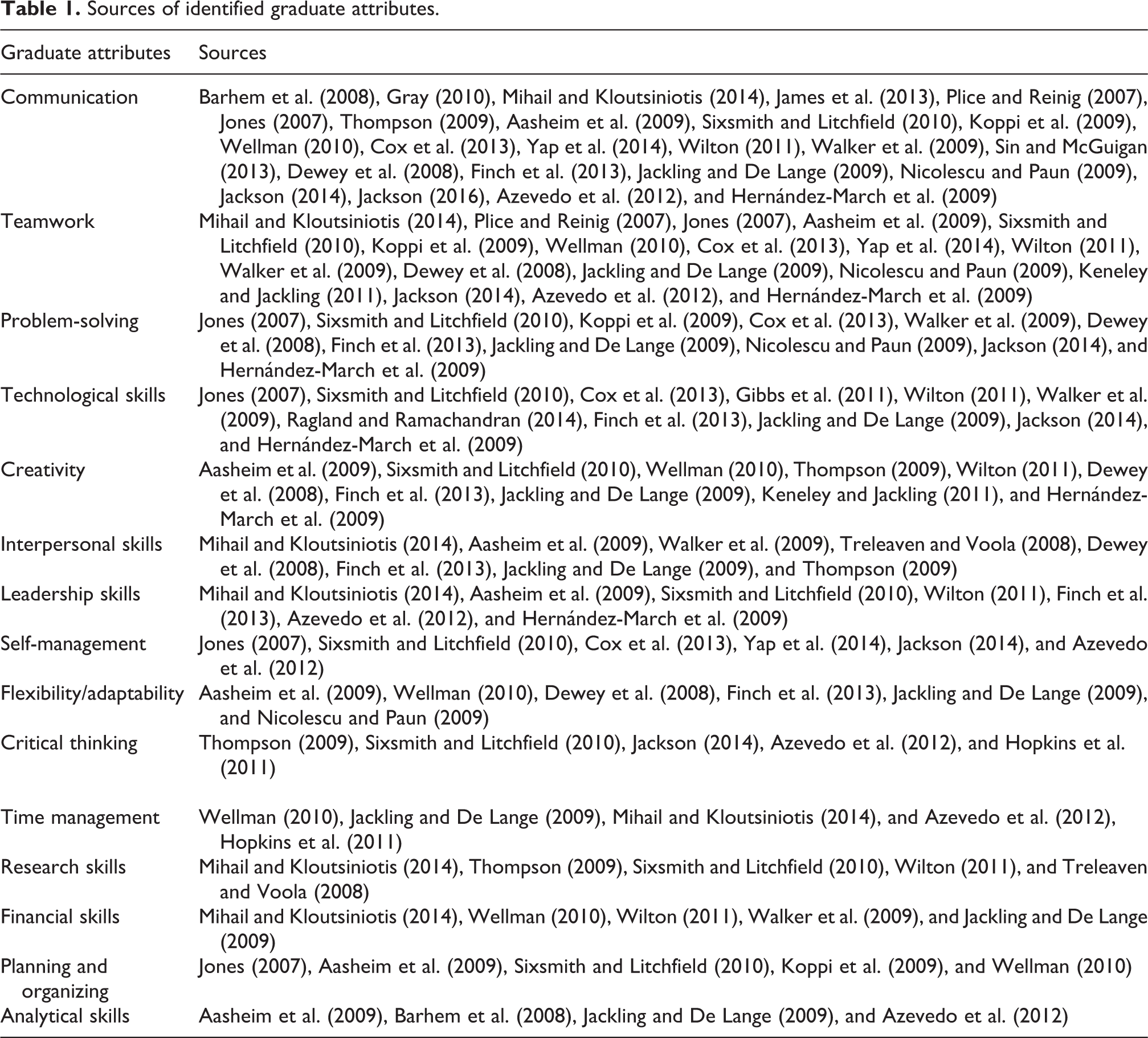
The literature review undertaken in the study identified 15 graduate skills and attributes that are essential for business and management students undertaking an accounting and finance degree in university. The most frequently mentioned of these skills (Table 1) were communication, teamwork, problem-solving, technological skills, creativity, interpersonal skills, leadership, self-management, critical thinking, time management, research skills, financial skills, planning and organizing and analytical skills.
Sources of identified graduate attributes.
Communication skills enable constructive and harmonious interaction, not only between employers and employees, but also between employees and customers, and entail listening, understanding and information sharing (Jones, 2007). Finch et al. (2013) find that graduates with good communication and interpersonal skills are more competitive in the marketplace, while Gray (2010) and Stone et al. (2013) note that oral and listening skills are given particular attention in shortlisting and recruiting graduates for accountancy careers. Daud et al. (2011) argue that these skills need to be reinforced with constructive speaking, the ability to explain issues and problems clearly and language proficiency. Communication also plays a role in teamwork, which facilitates productive outputs and working relationships in organizations (Jones, 2007). Cox et al. (2013) identify important characteristics of teamwork as respect for others, cooperation, negotiation, persuasion, contribution to discussion and an awareness of interdependence. According to Azevedo et al. (2012), team players competent in relationship building are the preferred choices for today’s employers. The literature also suggests that, while good communication skills will allow potential graduates to work effectively in a team, students nevertheless need to be equipped too with problem-solving and creativity skills so that they can contribute to the development of creative, innovative and practical solutions in a team (Cox et al., 2013; Jones, 2007). Finch et al. (2013) define ‘creative thinking’ in terms of the creative processes individuals bring to their work environment and the value their ideas bring to their organization. Individuals who create and contribute innovative ideas will give the organization a competitive advantage. Yet, problem-solving and creativity can be facilitated only through critical thinking skills. Accounting and finance graduates are expected to be able to identify patterns in complex financial documents and to test and forecast potential multiple strategies and solutions (Cox et al., 2013; Jackling and De Lange, 2009; Jackson, 2014). Therefore, potential employers are keen to assess the abilities of graduate candidates to think critically, to apply concepts and to present material professionally (Hopkins et al., 2011). In this context, incorporating real-time cases, whereby students have to analyse real business problems and deal with financial constraints, will help to build their analytical and critical thinking skills (Hopkins et al., 2011).
Finch et al. (2013) define interpersonal skills as an individual’s ability to work and communicate with others while bringing value to the organization. Competencies such as communication, negotiation, conflict, collaboration and cross-cultural understanding are labelled collectively as interpersonal skills (Dewey et al., 2008). Finch et al. (2013) and Lievens and Sackett (2012) have associated interpersonal skills with social sensitivity, relationship building, working with others, listening and communication skills. According to these authors, the ability to use interpersonal skills can be a strong predictor of future success for new graduates, thus influencing employability. Mihail and Kloutsiniotis (2014) suggest that a graduate programme which incorporated interpersonal skills would help graduates to develop their ability to inspire and motivate others.
In the current business environment, ICT skills are given prominence by several authors who identify competency in using various applications and tools as an important strategic differentiator for potential accounting and finance graduate employees. Jackson (2014) defines technological skills as the graduate’s ability to select and use appropriate technology to address diverse tasks and problems in their work environment. According to Finch et al. (2013), the ability to adapt technology would make graduates more competitive in the work environment and would also make them more desirable to employers.
Much of the literature mentions leadership skills as another important area for business and management students, including those studying accounting and finance. Finch et al. (2013) define leadership as the ability to motivate others and guide them to success. According to Azevedo et al. (2012), leadership is the ability to take responsibility for a task, give direction, provide structure and assign responsibility to other employees. At university, leadership competence could be developed through designing and evaluating learning activities that demand increasingly higher levels of proficiency from students. For example, a student might move from performing a small leadership role in group work at the beginning of a study programme to demonstrating high levels of leadership ability towards the end of the programme (Azevedo et al., 2012). Both Finch et al. (2013) and Azevedo et al. (2012) acknowledge that leadership ability is important for employers looking for graduate employees.
Hernández-March et al. (2009) suggest that larger companies in particular are interested in candidates’ ability to manage their time at work and to work under pressure. According to Cox et al. (2013), self-management covers the readiness to accept responsibilities; the readiness to work on one’s performance based on feedback; and reflective learning, time management skills, flexibility, resilience and assertiveness. Self-management is often linked with self-efficacy, which reflects a candidate’s confidence in handling personal and employment-related challenges (Jackson, 2014).
Research design and methodology
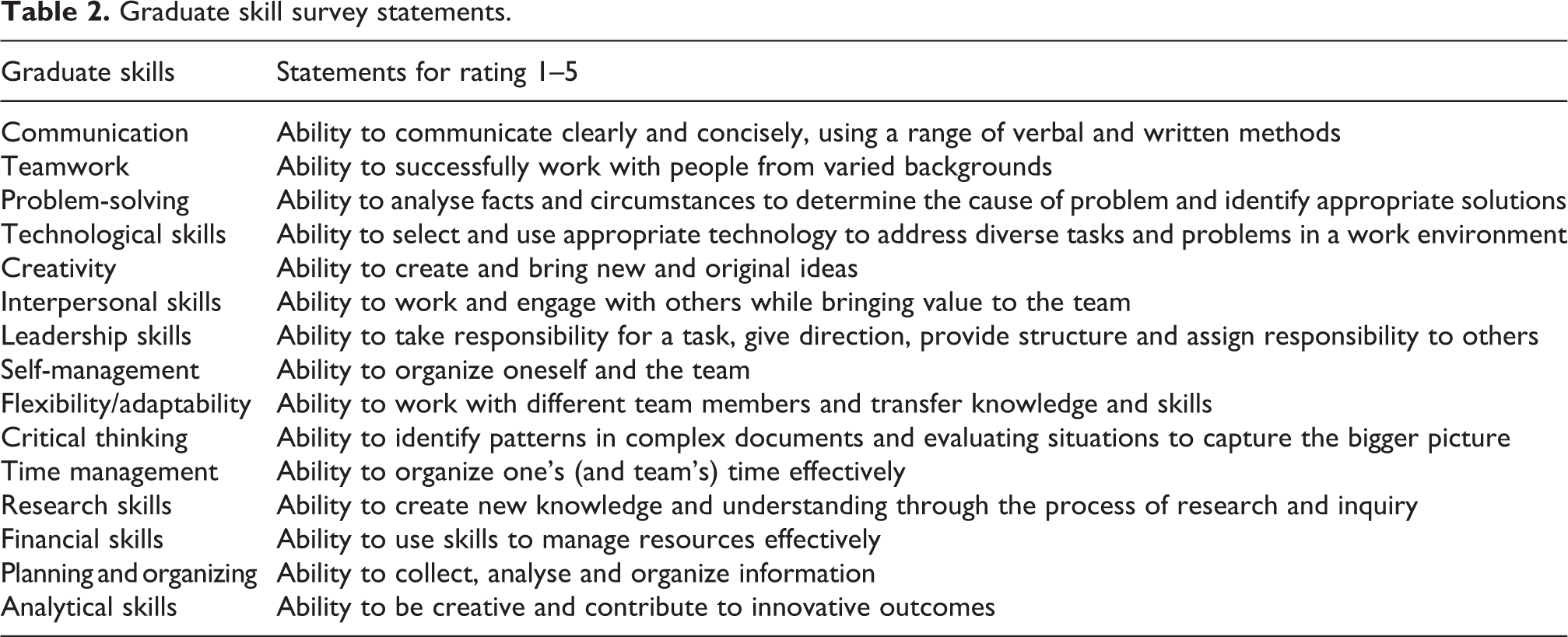
The research design for this study began with a definition of the research problem, based on current practice and secondary information emerging from industry regarding the employability challenges facing new graduates. This was followed by a literature review to ascertain the scope of the problem and research gaps in order to develop the empirical data collection instruments and the analysis method to be used. Based on the nature of the empirical research to be undertaken (i.e. the assessment of students’ perceptions of graduate skills), a quantitative approach was deemed most appropriate with a survey as the data collection instrument (Bryman and Bell, 2015; Saunders et al., 2009). Table 2 presents the survey statements: students were asked how they perceived the importance of the listed skills in the context of their future employability. Respondents were asked to rank each skill from 1 to 5, where 5 represented ‘extremely important’ and 1 ‘not at all important’. With appropriate approval from the University, feedback from several academic staff members was used to further validate how the questions were phrased in the survey instrument. Then, 20 students were invited to complete the survey and to provide feedback on any inconsistencies in questions or a lack of clarity. This exercise identified no need for further changes and confirmed that the questionnaire was ready for distribution. The questionnaire was then distributed through course leaders to accounting and finance students in the undergraduate programme at an AACSB-accredited leading business school in a public university in the Middle East during the period November 2015 to May 2016. The course leaders were briefed on the purpose of the survey and were advised to distribute the questionnaires at the beginning of the lecture. In all, 462 surveys were collected, with students responding to three demographic and 15 skills-related questions, and analysed using the SAS statistical analysis tool: SAS was used as the preferred data analysis method due to the availability of advanced analytics such as text analysis, forecasting, predictive analytics and data mining. Descriptive and χ 2 tests were performed on the data to assess students’ perceptions, and the results are discussed in the following section.
Graduate skill survey statements.
Findings and analysis
This section presents brief exploratory results of the survey questionnaire. The goal of this analysis is to investigate the perceptions of the respondents regarding graduate skills in the field of accounting and finance, taking into consideration variables such as gender and the language of instruction. The chosen business school offers two language options for its accounting and finance undergraduate degree: Arabic or English.
Table 3 presents demographic information about the respondents. It shows that of the 462 respondents, 97 (21%) were male and 365 (79%) were female. The age range was 18–40. Overall, 394 (85%) were in the 18–24 age group. Sixty-six percent studied in Arabic and 34% studied in English.
Survey respondents: demographic details (n = 462).
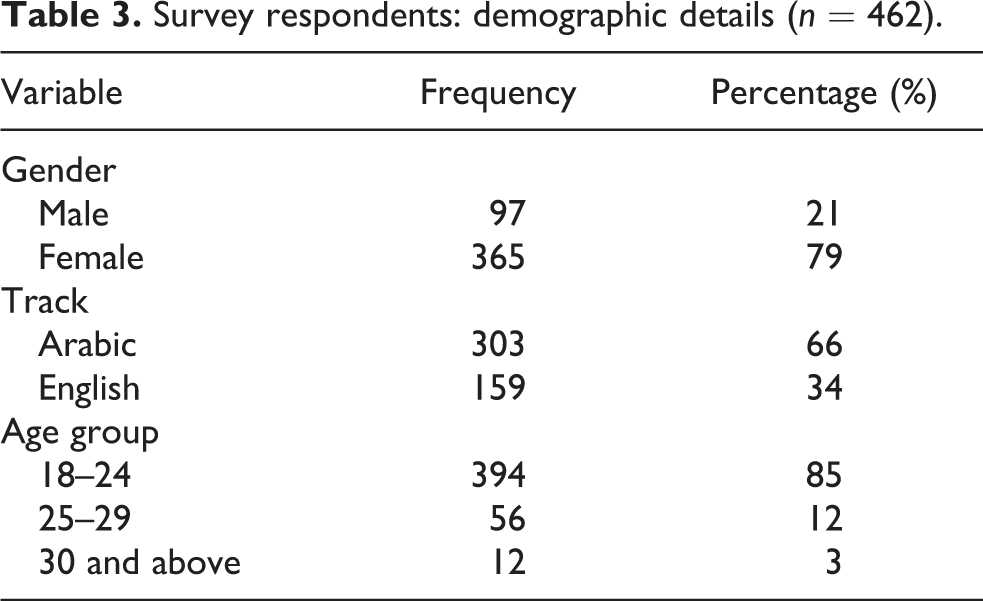
Table 4 shows that all the graduate skills identified in the literature were perceived as important. However, some were considered more important than others. The most important graduate skill was seen as communication, followed by analytical ability and self-management, and then time management and teamwork skills; the graduate skills perceived as least important were critical thinking and research skills. Table 4 also shows the mean scores for each graduate skill. The mean score for the 15 graduate skills assessed in the survey ranged from 4.3 to 3.8.
Perceived importance of graduate skills.
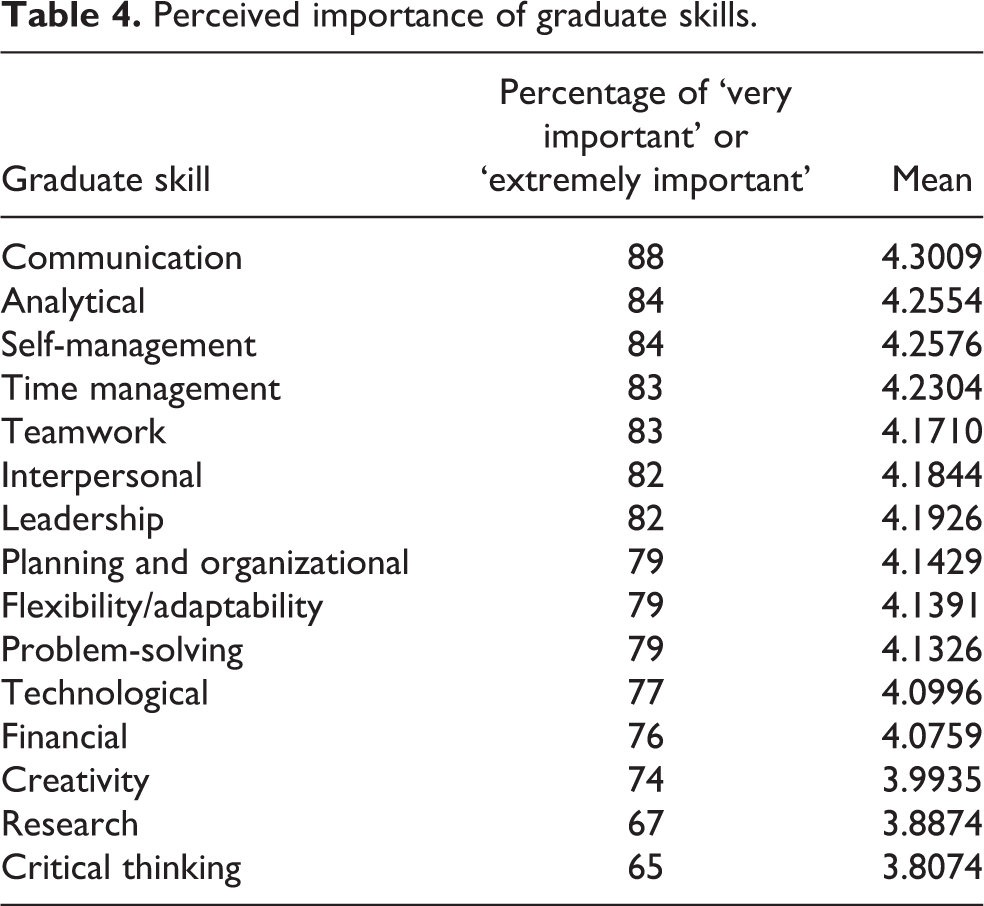
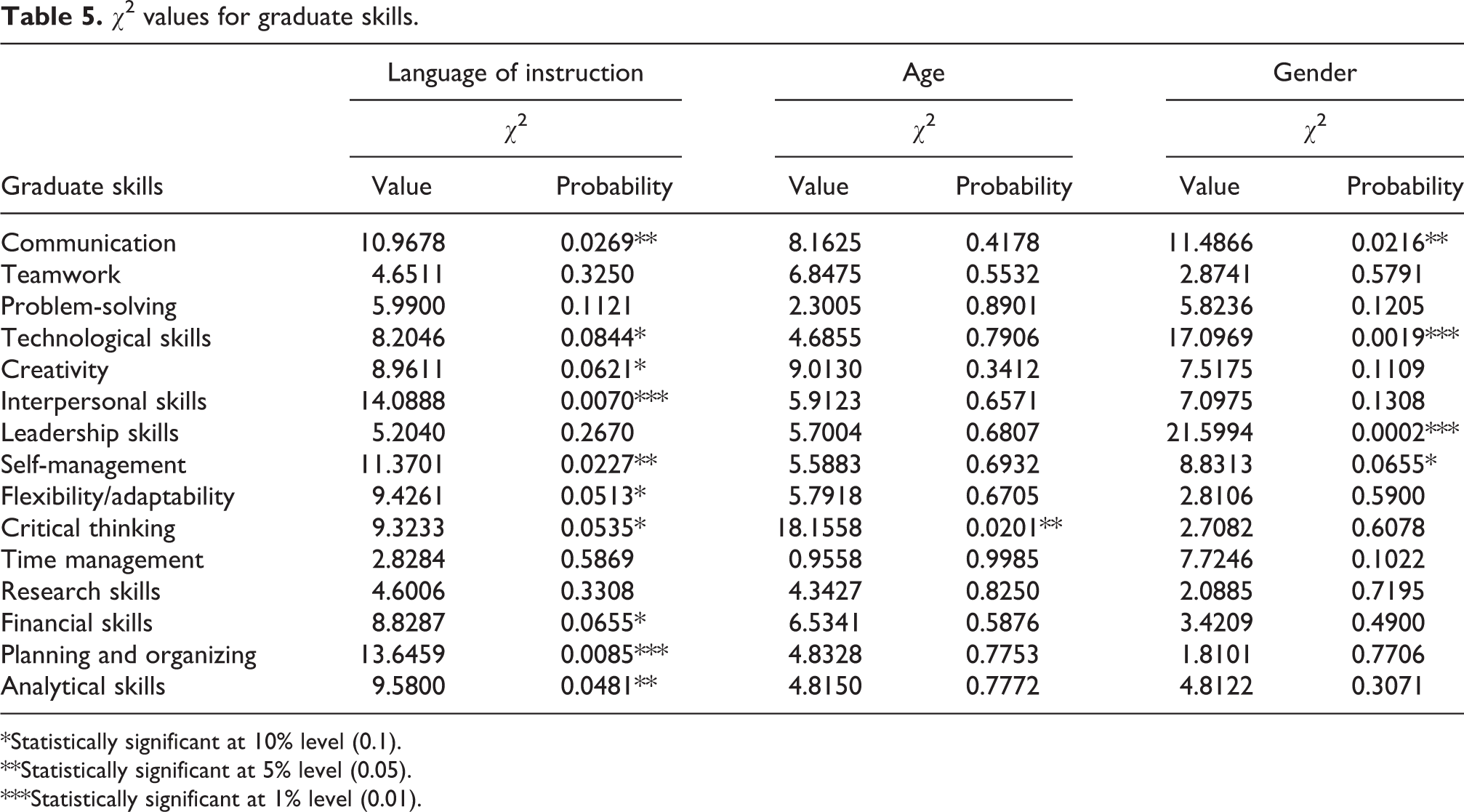
Table 5 reports the calculated χ 2 values for three of the study’s variables: language of instruction, age and gender. The study indicates significant associations between graduate skills and respondents’ variables.
χ 2 values for graduate skills.
*Statistically significant at 10% level (0.1).
**Statistically significant at 5% level (0.05).
***Statistically significant at 1% level (0.01).
The results indicate a statistically significant relationship, at 1%, between the respondents’ language of instruction and the perceived importance of interpersonal and planning and organization skills. In the Arabic programme, 85% of students perceived interpersonal skills to be very important or extremely important, compared to only 78% of students in the English programme. Interestingly, 83% of students in the English track thought that planning and organization were important or very important, compared to 77% of students in the Arabic.
The results also indicate that there is a statistically significant relationship, at 5%, between the respondents’ language of instruction and the perceived importance of communication, self-management and analytical skills. In the Arabic programme, 88% of students perceived communication skills as very important or extremely important, compared to 83% of students in the English programme. Also, 85% of students in the Arabic track perceived self-management skills as important or very important, compared to 80% of students in the English track. Eighty-six percent of the Arabic track students felt that analytical skills were very important or extremely important compared to 80% of students in the English track.
A χ 2 statistic was used to test for independence between the responses and the respondents’ age. The results, reported in Table 5, confirm a significant relationship between age and the perception of the importance of critical thinking skills. While 66% of students between the ages of 18 and 29 felt that critical thinking skills were very or extremely important, only 42% of students between the ages of 30 and 44 took the same view.
A χ 2 statistic was also used to test for independence between the responses and the respondents’ gender. The results reported in Table 5 confirm a significant relationship between gender and the perception of the importance of leadership, technological and communication skills. Among the female students, 83% felt that leadership skills were very or extremely important (46% thought they were extremely important), compared to 79% of the male students perceived such importance (with only 24% rating them as extremely important). Interestingly, 80% of the male students thought that technological skills were important or very important, compared to 76% of the female students. Finally, 90% of females and 83.5% of males perceived communication skills to be very or extremely important.
Discussion and conclusion
This explanatory study examines the perceptions of undergraduate university students of graduate skills in accounting and finance in the context of the Middle East. Following a systematic literature review, a survey was developed and distributed at an AACSB-accredited business school in a Middle Eastern public university. Seventy-nine percent of the survey respondents were females, and 66% were studying in Arabic. According to the results, the most important perceived graduate skill was communication, followed by analytical, self-management, time management and teamwork skills. The least important was critical thinking, followed by research and creativity skills. More male than female students thought that technological skills were very or extremely important; leadership and communication skills were perceived as important by more female than male students. Finally, the language of instruction was statistically significant in the respondents’ perceptions with regard to communication, self-management and analytical skills. Students studying in Arabic perceived these skills as more important than those studying in English. Finally, younger students (aged 18–29) perceived critical thinking as more important than older students (30–44).
Several insights can be drawn from this initial study for both theory and practice. The empirical findings confirm the commonly identified graduate skills outlined in the normative literature for the field of accounting and finance, although students’ perceptions varied as to their level of importance in relation to the literature. As such, our empirical data not only validate previous findings conducted in different geographical contexts but also help to consolidate the general consensus in the literature about graduate skills in the field of accounting and finance. In addition, the insights from the statistical data offer universities a frame of reference for embedding and developing graduate skills into the curriculum and updating their learning and teaching strategies accordingly.
From a theoretical perspective, this study synthesizes the literature on graduate attributes and skills in accounting and finance and classifies these to propose a set of core skills for graduates in the field. The study offers a synopsis of the state-of-the art in graduate skills for accounting and finance and casts light on students’ perceptions of them through empirical analysis. Moreover, the literature review helped to consolidate several empirical studies conducted in universities and industry in different locations and allowed the comparing and contrasting of students’, academics’ and employers’ perceptions of graduate skills and attributes across the existing literature.
The study offers several important lessons for universities, accreditation bodies, policymakers and those responsible for setting quality and standards in higher education, particularly from a Middle Eastern regional perspective and also more generally. First, by identifying and validating core graduate skills and attributes, it offers universities a blueprint from which graduate-level curricula in accounting and finance should evolve to develop employment-ready graduates. Universities, particularly in the Middle East, should take note of the empirical findings and focus on educating students about the importance of attributes such as critical thinking and research and creativity skills, which were perceived as least important by our respondents. Second, accreditation bodies should take note of the skills identified in the study and should aim to align their accreditation criteria to promote these by working closely with directors of studies and course leaders at universities. Professional accreditation bodies also have an important role to play with respect to the working environment: they need to work closely with their member employers and employees to create stronger synergy between theory and practice and to establish priorities in relation to graduate skills. Those responsible for evaluating quality and setting the standards in higher education also have a role to play in this area as they can and should act as the regulating mechanism for ensuring that university education continues to achieve a meaningful balance between helping graduates to understand theoretical principles and acquiring the needed skills to succeed in the world of business. Finally, the role of industry should not be overlooked as it has the important responsibility of identifying and communicating the most in-demand skills in the diverse and dynamic modern business world. This is an area that has been traditionally neglected and proactive steps are needed from both university and industry leaders to strengthen collaborative working. Examples of stronger collaborative working include industry leaders taking an active role on university (and college/departmental) advisory boards, managers giving guest lectures, students engaging in industry visits and short- or long-term internships and study programmes that combine include problem-based learning in industry settings.
There are several limitations that should be acknowledged when interpreting the findings of this study. First, the empirical evidence gathered represents students’ perceptions in a public university in one Middle Eastern country, and generalization of the findings should be made only after collecting more data from other universities in the region. Second, several sociocultural factors inherent to the geography and the country in which the empirical study was conducted may have influenced the perceptions of the students. Therefore, more research is needed to further validate the identified graduate attributes through qualitative or interview-based research.
Footnotes
Authors Note
The findings discussed are solely the responsibility of the authors.
Declaration of conflicting interests
The author(s) declared no potential conflicts of interest with respect to the research, authorship, and/or publication of this article.
Funding
The author(s) disclosed receipt of the following financial support for the research, authorship, and/or publication of this article: This publication was made possible by NPRP under grant 7-1534-5-231 from the Qatar National Research Fund (a member of the Qatar Foundation).