







Abstract
Recent trends have made the transition from business professional to academic increasingly popular as a move to a second career. This article offers a personal perspective on a critical component of a successful transition—the fruitful leveraging of different university communities. The recommendations are in line with studies showing the importance of relationship variables to nontenure track faculty. The article also supports researchers who strive to create a stronger relationship between business and higher education institutions. The roles of departmental faculty mentors, faculty and administration in the larger university community, the student body community, and nonprofit organizations are discussed.
Keywords
Community and the transition to business academia
A second career in academia has become an increasingly popular choice for many business professionals, as evidenced by the growth of full-time nontenure track (NTT) faculty at colleges and universities (Kezar and Maxey, 2013). Both the need and the desire to work beyond the age of 55 and above has fostered this trend (Clark, 2014; Hardy, 2017).
Various business professionals provide excellent articles on the challenges of moving from the business to the academic world (e.g. Showalter, 2018; Wisneski, 2013). The current article expands on previous work by discussing a critical area in the transition: harnessing the power of different communities in the academic environment. This direction is in line with studies in the literature on NTT faculty, which have pointed to variables such as “perceived relatedness” (Seipel and Larson, 2018), collegiality (Haviland et al., 2017) and departmental support (Kezar, 2013) as key factors for well-being. The importance of these factors is explained via the theory of social exchange (Umbach, 2007), which posits that enhanced connection with people promotes higher commitment and performance. This article also supports researchers who seek to develop a stronger relationship between business and higher education institutions (Wohlfart and Hovemann, 2019; Woodside, 2018).
After nearly 35 years of experience in the corporate world in marketing positions at companies such as Hershey and Newell Brands, I was hired as a full-time professor at Seaver College, Pepperdine University, to teach marketing to business undergraduates. Having now completed 3 years of full-time teaching at this university, I believe I am in an excellent position to share insights into how business professionals can leverage communities to optimize their academic experiences. I was fortunate to benefit from a university with a strong sense of community, as the institution’s mission (Pepperdine University, 2019) places a high degree of importance on fellowship: “Pepperdine is a Christian university committed to the highest standards of academic excellence and Christian values, where students are strengthened for lives of purpose, service, and leadership.” However, my experiences can be replicated in a diversity of environments with a proactive attitude by aspiring faculty. In addition, I believe my points are equally applicable to business professionals teaching graduate students, even though my experience has been in the undergraduate arena.
Growing trend toward transition
Individuals are working longer than in the past because they need and/or desire to do so. A US Gallup poll in 2013 indicated that 73% of baby boomers, or individuals born between 1946 and 1964, expected to work beyond the time they received social security, 32% due to need, and 41% by choice (Clark, 2014). According to a 2017 Statistics Canada report, 3.6 million Canadian workers, or 20% of the workforce, are 55 or over—a gain of 1.2 million since 2006 (Hardy, 2017). A strong motivator behind the trend toward working longer is the desire for increased fulfilment, which may be satisfied by a second career. A survey by the American Psychological Association (Pofeldt, 2013) shows that nearly half of US workers do not feel sufficiently valued or compensated in their jobs.
The growth in NTT faculty at major institutions is another indication of individuals pursuing new types of careers. In 1969, 78.3% of faculty positions were tenure track and 21.7% part- or full-time NTT (Schuster and Finkelstein, 2006). By 2009, these figures had almost reversed to 33.5% tenure track and 66.5% part- or full-time NTT (Kezar and Maxey, 2013).
Literature related to transition
Various business professionals have shared their learnings after working as NTT faculty. Wisneski (2013) stresses the need to embrace the autonomy in one’s new role, describing how academicians highly value creating their own knowledge assets. Showalter (2018) discusses a transition from the perspective of the accounting function. He cites the need for professionals to develop public speaking skills while still in their corporate jobs, as well as the opportunity to take advantage of guest speakerships and other short-term teaching opportunities at universities.
Academic researchers have taken a different perspective by studying the experience of NTT faculty. One consistent theme throughout much of this work is the importance of relationship variables to NTT professors. Seipel and Larson (2018) identify departmental and administrative support as key for the well-being of NTT faculty, but mediated by “perceived relatedness,” or mutual caring, concern and connection with others. Other researchers (Haviland et al., 2017; Ott and Cisneros, 2015; Waltman et al., 2012) show how NTT faculty experience lower collegiality, or a feeling of respect and value by other individuals in the institution. The work showing the importance of relationship variables to NTT faculty may be conceptualized within a theory of social exchange (Umbach, 2007). This theory posits that people build connections with individuals who can provide resources and support. Commitment and performance in an organization are greater when individuals feel helped and rewarded.
My own experience as an NTT professor supports the importance to one’s well-being of connections with others. To the extent that I have been able to be successful on the job, I feel it is mainly due to the sense of community I have built with other individuals at the university.
The role of faculty mentors
The most critical community for business professionals transitioning to be academics is that of faculty members in their own department, and the key area in which these faculty play a role is that of teaching. One of the most daunting tasks facing a new professor is to teach a course for the first time. Transitioning professors should thus seek to benefit from faculty who can provide models to structure courses based on their own tested teaching of the classes. In my “Principles of Marketing” class, the model included the group assignment of a new product marketing plan, divided into two parts. This element of the course proved to be very popular with students because it made the task more manageable. In an “International Marketing” class, the model called for a group in-class case assignment. This course feature turned out to be instrumental in keeping sessions engaging, given that the class was taught once a week for 3 h.
Aside from these structural suggestions, faculty colleagues can provide a wealth of riches when it comes to pedagogical advice. My main mentor, whom I sought out, was always there to help me when it came to challenging interpersonal issues with students, such as how to handle side conversations in class or repeated absences. In addition, I distinctly remember specific gems of advice given to me by a host of other faculty mentors in my division. One professor gave me her “who are you” form to get to know students better in the first class of the semester; another taught me always to put an agenda on the board; and one faculty member advised me on the proper timing for posting grades, which turned out to be critical for my sanity (i.e. not too early, so as to avoid undue complaining!). In the more weighty matters, such as when I confronted my first instance of cheating in an exam, I always felt able to turn to the Dean of the division for guidance.
An additional area in which faculty mentoring is helpful concerns one’s evaluations by students. As a professor new to academia, one quickly learns that, contrary to the corporate world, one’s most important evaluations come not from one’s bosses but from one’s “customers,” or students. However, it is not a simple task to digest and understand the formal written evaluations requested of students by the university. Faculty mentors can advise which parts of the evaluations are most important. In addition, professors can provide a comforting perspective on one’s evaluations. When my average was at a relatively low 4.0 out of 5.0 after my first semester, I was told that this score was not uncommon for a beginning professor and that I could improve over time (which turned out to be true, as I increased to a 4.6 after 3 years).
A final area in which faculty mentoring is critical is research. Developing one’s skills as a researcher is important for one’s own feeling of acceptance in the academic community, the university’s reputation and often the accreditation of the department. However, academic research is a whole new world, and faculty mentoring is critical. When I first started, a decision science professor gave me a statistics textbook and taught me the “R Studio” statistical software program. Another individual mentored me on the role of theory and what kinds of data sets were appropriate. A third professor coached me on the proper style to use in communicating with reviewers. Through intensive work with faculty colleagues, one can develop research abilities which are of the type gained by tenure-track professors in doctoral programs.
The role of the broader university community
In addition to relationships with faculty in the department, it is important for one’s well-being to develop connections with faculty and other individuals in the broader university environment. One way of doing this is to attend university events, such as retreats and presentations by outside speakers. Participating in such events is, in any case, a benefit of the university environment, as they embody the liberal arts orientation of many institutions and expand intellectual horizons.
Attending administrative functions, such as faculty meetings and receptions, is also critical to building connection with the wider community. Being visible at these events helps transitioning business professionals to be taken seriously as academic colleagues and to gain an understanding of the language of their new environment. For example, what was “senior management” in the corporate world is “the administration” in the academic world. The new contacts thus made can also increase the chances of winning elections for administrative positions. Due in part to my efforts in the administrative area, I was elected to the committee that evaluates the promotion of visiting faculty.
The role of students
While the main focus with regard to students is on how they can best be taught, they also constitute a community of individuals who deeply affect a professor’s well-being. The most significant way in which one can build a connection and reputation with students is through becoming an outstanding teacher. However, a business professional has a special means of building relationships with them—by helping them with their careers, an area of major importance and concern. In the first session of all my classes, I take students through my background and tell them that I am always available to discuss their careers with them. I suggest that they might send me their resume to review, and/or that I might help them prepare for interviews. Numerous students from each class take up these offers. An additional way to leverage one’s business expertise is to develop a greater sense of community with students by offering assistance with new business ideas. I have worked with students in such areas as e-sports and digital apps, advising them on their new ventures.
It is also advisable to take advantage of opportunities to speak at student-sponsored events. I recently was asked to present at the Alpha Kappa Psi fraternity and gave a presentation about the highlights of my career and the challenges of choosing my profession. This kind of presentation by former business professionals helps them to build a reputation with students and encourages the students to sign up for their courses.
The role of nonprofit organizations
While not necessarily part of the university, nonprofit organizations offer an additional path for building well-being through a sense of community. In my case, these opportunities were even more meaningful due to the strong service orientation in my university’s mission (Pepperdine University, 2019). I was also able to benefit from a “Nonprofit Leadership Collaborative” in the Business Administration Division to learn about the dynamics of nonprofit organizations. This group, led by our nonprofit department, facilitates the preparation of faculty and students for service to nonprofits in the community.
During my first year, I entered into a pro-bono consulting relationship with two nonprofits in Los Angeles: the Westside Food Bank and Our House Grief Support Center. My services were offered gratis with the understanding that I would be allowed to use data from the organizations in research. My involvement with both organizations has been highly gratifying and has heightened the feeling of well-being in my job. One project led to a publication and the other to a conference presentation. I also supplied student interns for each nonprofit at different times, which broadened the relevance of the organizations to my role at the university.
The pursuit of communities
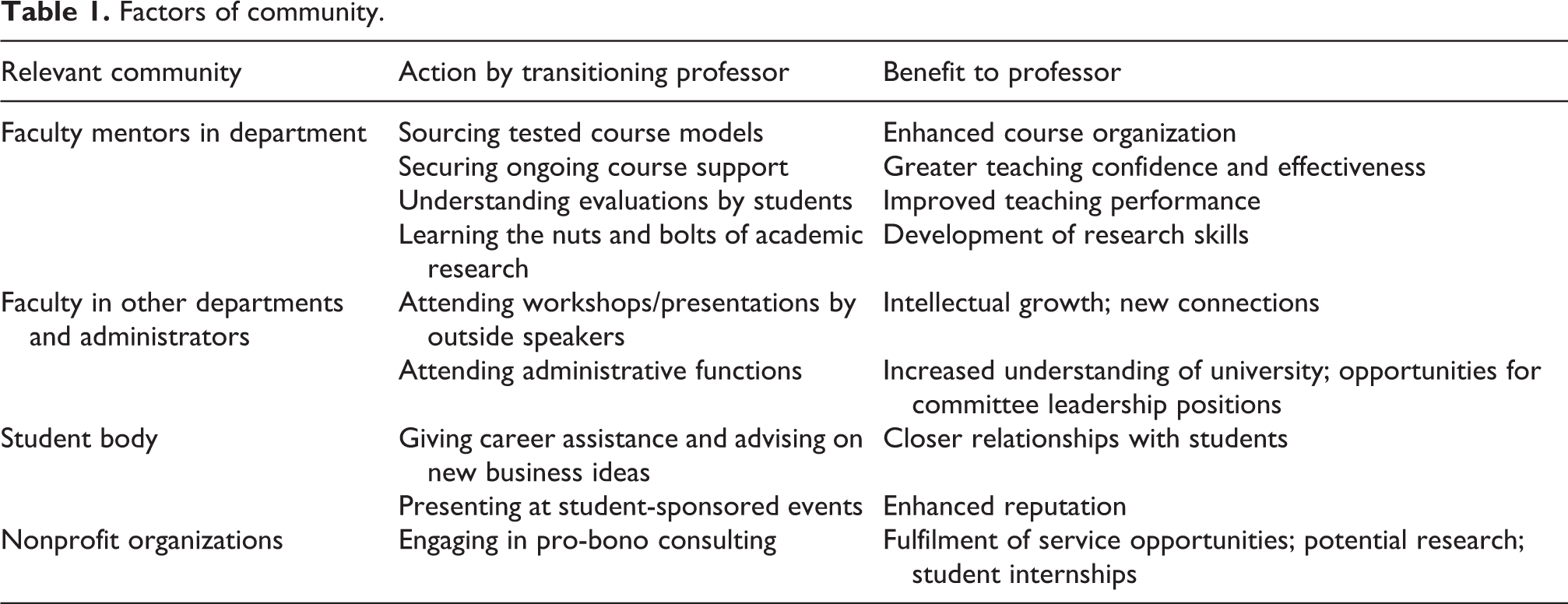
Throughout this article, I have described a number of concrete ways in which business professionals transitioning to professors can cultivate different communities at the university: these are summarized in Table 1. The actions are line with research which has shown the importance of relationship variables to NTT faculty (Haviland et al., 2017; Kesar, 2013; Seipel and Larson, 2018) and a stronger relationship between higher educational institutions (HEI) and business (Wohlfart and Hovemann, 2019; Woodside, 2018). These actions have helped me to achieve a measure of success in the academic environment and are translatable to individuals in other institutions making similar transitions.
Factors of community.
The academic environment is characterized by greater autonomy in one’s role than is the case in the corporate environment (Wisneski, 2013), with supervision generally not as rigorous. Thus there is a particular need in the academic world to be proactive about seeking out mentors to help one learn and progress in one’s career. Business professionals transitioning to academia must have the humility to know that they require help and must be proactive in soliciting it from the wealth of individuals ready to provide support.
To be successful in the academic world, it is also necessary to develop lateral relationships with people throughout the institution. There is a similar dynamic in the professional world. Bonds need to be formed with professors both within the department and in other parts of the university, with key administrators, with the student body, and with nonprofit organizations. Again, a proactive approach is needed by the business professional aspiring to be an academic.
As the recommendations in this article are in the form of testimonials from my own experience, it would be valuable to corroborate them via further research. Since faculty mentorship in the transitioning professor’s own department seems a particularly critical factor, starting with this topic may be the most advantageous. For example, it might be instructive to test the performance of transitioning professors who adopt course structures from experienced professors against the performance of those who do not. Useful research could also be done on subjects such as the benefits of reaching out to the larger university community, developing relationships with students outside class, and working with nonprofits. With more and more individuals pursuing transition from business professional to academic, undertaking such research will become increasingly relevant.
Footnotes
Acknowledgement
The author is deeply grateful to Dean Baim, Dean of the Business Administration Division at Seaver College, Pepperdine University, for suggesting the article idea and for reviewing a draft of the article. In addition, he would like to thank Marc Vinyard, Research and Instruction Librarian at Pepperdine University, for his generous assistance throughout all stages of the research process.
Declaration of conflicting interests
The author(s) declared no potential conflicts of interest with respect to the research, authorship, and/or publication of this article.
Funding
The author(s) received no financial support for the research, authorship, and/or publication of this article.
